Posted on

Alternative Hairstyles for Over 40s: Bold Cuts Without the Rules

Alternative Hairstyles for Over 40s: Bold Cuts Without the Rules

Age doesn’t come with a haircut rulebook. If the styles you’re finding feel too safe, too trend-led or aimed at someone else, alternative hairstyles for over 40s offer another route: cuts with character, shaped around who you are, not the number of candles on your cake.

It’s fair to wonder whether a bold shag, wolfcut or mullet will work with your hair texture and morning routine. The right cut should feel like you, not like a costume you have to maintain. Length, layers and styling all affect the finished shape, so personalising the silhouette matters more than copying a trend exactly.

Here, you’ll find expressive, age-inclusive cut ideas and practical ways to compare texture, upkeep and day-to-day styling. Heavy Metal Hairdresser specialises in shags, wolfcuts, mullets and textured cuts, with each look centred on individuality. Bring your instincts, your hair’s natural behaviour and a few reference images into the conversation. There are no age-based rules to follow, only a cut that feels right for you.

Key Takeaways

  • Explore shags, wolfcuts, modern mullets and textured crops to find a silhouette that matches the kind of edge you want.
  • See how straight, wavy, curly and coily hair can change the shape and styling needs of alternative hairstyles for over 40s.
  • Compare cut length and styling effort to narrow down options that fit your everyday routine.
  • Choose reference images that show the cut’s shape, then note what you want to keep, change or make easier.
  • Specialist alternative cutting can adapt an idea to your hair and personal style.

Alternative hairstyles for over 40s: style has no age limit

Want a change that feels more like you, without a list of age-based rules attached? You’re not alone in wanting hair with personality rather than a prescribed “suitable” look. Alternative hairstyles for over 40s aren’t a special category with their own restrictions. They’re expressive cuts and styling choices, from a subtle shift in shape to a full-on statement, chosen because they speak to the person wearing them.

Hair has long been part of personal grooming, fashion, and cosmetics, as well as a way to express taste and identity. That expression doesn’t expire at a certain age. Your years alone don’t decide whether you can wear a cropped cut, keep your length, add vivid colour or choose something more pared back. Hair texture, its current condition and how you like to style it are more useful starting points than an age bracket.

Why alternative hair is not reserved for one generation

Rules that prescribe short, subdued or conventional hair after a certain age reduce people to a stereotype. Bin them. Some people want a dramatic silhouette; others prefer an offbeat detail that only shows when their hair moves. Both count. Your gender, hair history and style goals are yours to define, so there’s no single look that represents everyone over 40.

Alternative can mean contrast, texture or shape, not just bright colour or a dramatic chop. Layers can add movement without sacrificing length; a sharper outline can make a cut feel more deliberate. The point is choice, not proving you’re bold enough.

What makes a cut feel right for you

Start with the details you’re drawn to. Do you like a cut that falls into place with natural movement, or one you can sculpt into a more defined shape? Do you want to keep length around your face, expose the neckline or bring out your natural texture? These preferences turn a general mood into a shape your stylist can work with.

Then weigh up the upkeep you’ll genuinely enjoy. A cut that relies on daily styling may not suit a wash-and-go routine, while a low-effort shape still needs to work with how your hair falls and grows. Think about the styling time you have, the tools you use and how often you want to refresh the shape. Heavy Metal Hairdresser’s specialist textured cutting adapts the silhouette to your hair’s behaviour rather than forcing it into a generic template.

The takeaway: age doesn’t dictate a cut. Identity, texture and upkeep help shape a look that feels like yours.

Alternative hairstyles for over 40s: four cuts with expressive edge

Think of these cuts as starting points, not prescriptions. The same silhouette can shift with your hair’s texture, length, fringe and layer placement. None belongs to a particular age or face shape. For wider inspiration, explore Alternative Hair Styles: A Professional Guide to UK Trends, then focus on the details that catch your eye.

Shag and wolfcut: movement, layers and lived-in texture

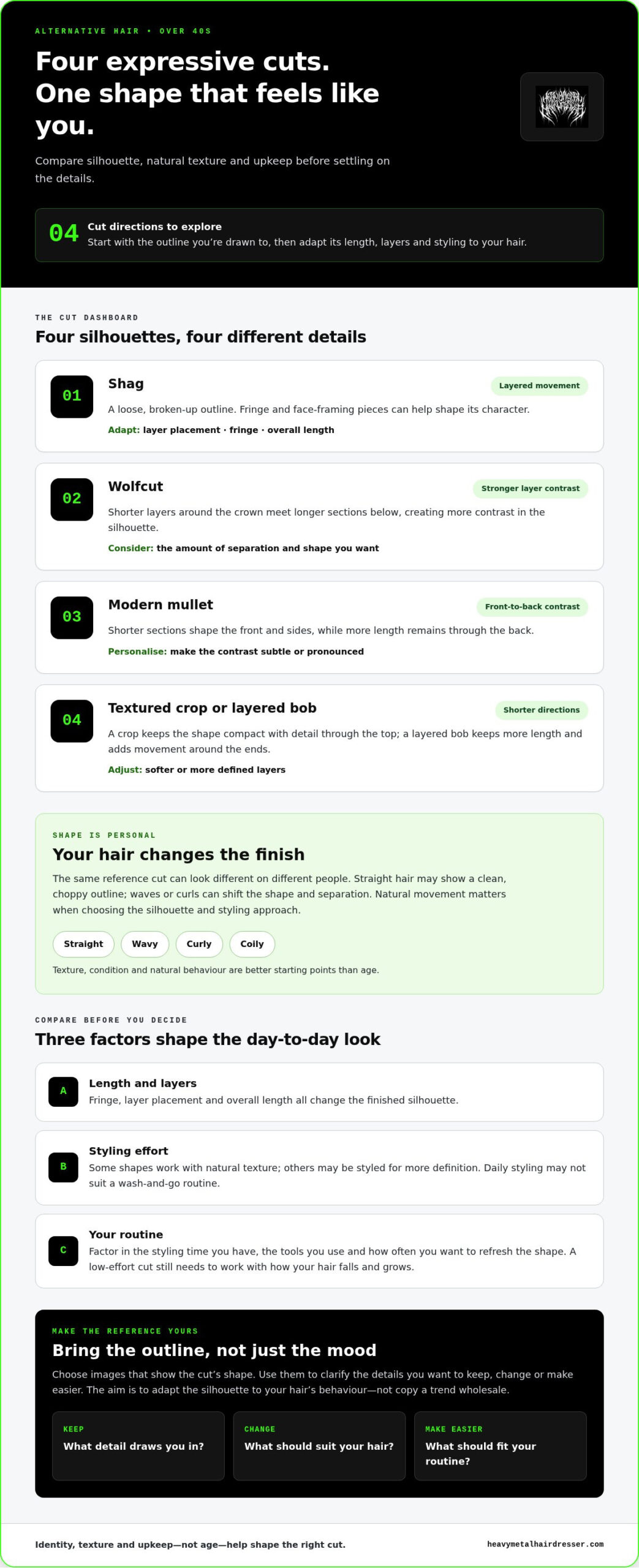
A shag uses layers to build a broken-up, lived-in outline, often with a fringe or face-framing pieces. A wolfcut pushes the contrast further, combining shorter layers around the crown with longer lengths below. Both can create movement, but the result depends on how your hair naturally sits. Fringe shape, layer placement and overall length all change the silhouette, so the cut can be adapted rather than copied wholesale. For a closer look at the shag, see The Shag Haircut Resurrection.

Modern mullet and shorter textured cuts: sharper silhouettes

A modern mullet plays with contrast: shorter sections shape the front and sides, while more length remains through the back. That difference can be subtle or pronounced, depending on how the sections blend. It’s a distinctive outline with plenty of room for personal interpretation.

If you’d rather go shorter, a textured crop gives you a compact shape with detail through the top; a layered bob keeps more length while adding movement around the ends. Either can be tailored with softer or more defined layers. Texture affects the finish: straight hair may show a clean, choppy outline, while waves or curls can shift the shape and separation. For more wolfcut detail, look up The Ultimate Wolf Hair Cut Guide.

  • Shag: layered and loose, with fringe and length shaping its character.
  • Wolfcut: more contrast between shorter crown layers and longer sections.
  • Modern mullet: shorter front and sides balanced by length at the back.
  • Textured crop or layered bob: shorter options, with different lengths and layers to play with.

Save reference images that show the outline you like, not just the colour or overall mood. Heavy Metal Hairdresser specialises in alternative, textured cutting and can translate that inspiration into a shape that works with your hair. Explore Heavy Metal Hairdresser’s alternative hair expertise for ideas grounded in expressive cuts.

How to compare alternative cuts by texture, length and upkeep

A cut can look completely different on two people, even when they bring the same reference image. Compare the shape you want with your hair’s natural movement and the time you’re happy to spend styling it. This gives you a more useful shortlist than choosing by age or face-shape rules. Use the table as a starting point, not a formula.

Cut direction Silhouette Styling effort Possible adaptation
Shag Layered, broken-up movement Can be worn with natural texture or styled for more definition Adjust layer placement, fringe and length
Wolfcut Shorter crown layers with longer sections Depends on how much separation and shape you want to create Adapt the contrast and layering to your hair’s density and movement
Modern mullet Shorter front and sides, with length through the back Can be worn more softly or styled to emphasise the contrast Change the length difference and how the sections blend
Textured crop or layered bob Shorter overall, with detail from texture or layers Varies with the finish you prefer Keep the outline softer or more defined, and tailor the layers

Match the cut to how your hair naturally behaves

Straight, wavy, curly and coily hair each respond differently to layering. Straight hair may show the outline and separation clearly; waves can create their own movement; curls and coils can change how length and layers sit. Density, growth patterns and natural direction matter too. They’re useful design information, not problems to correct. Heavy Metal Hairdresser’s textured cutting shapes layers around those behaviours instead of expecting every head of hair to follow the same template.

Balance the look you want with its upkeep

Be honest about your routine. Do you like shaping your hair each morning, or would you rather let its natural texture do the work? A deliberate, piecey finish may call for more hands-on styling than a softer, less structured shape. Neither is better. Choose the level of effort you’ll enjoy repeating.

Consider three separate upkeep factors: length, which affects how the shape sits as it grows; fringe, which may need attention to keep its intended position; and colour, if you choose to add it. Vivid colour is optional. A strong cut can make its mark through silhouette and texture alone. Your hair and preferences are individual, so discuss how the shape may change over time instead of relying on a universal maintenance schedule.

The best alternative hairstyles for over 40s aren’t dictated by a face-shape chart. Start with the outline you love, then weigh it against your texture and everyday styling habits.
Alternative Hairstyles for Over 40s: Bold Cuts Without the Rules

Plan your alternative hairstyle before changing your look

A clear brief turns “I want something different” into a useful conversation about shape, texture and routine. You don’t need the perfect haircut vocabulary. A few visual references and honest notes about what works for you can help your stylist understand the direction you have in mind.

Build a clear visual brief for your haircut

Collect a handful of images that show a similar length, texture or styling goal to your own. Look beyond colour and overall mood: focus on the cut’s outline, fringe, layers and where the shape sits around the head. Save examples you like, but also note what feels impractical or unlike you. A photo is inspiration, not a demand for an exact copy.

Talk through styling habits and personal boundaries

Your usual routine matters as much as the reference. Explain how you wear your hair on an ordinary day, how much styling you enjoy and what you’d rather avoid. Share how your texture behaves, what you want to keep from your current cut and what you’re ready to change. You can be excited about a new silhouette and still have boundaries around length, fringe or daily effort.

Use this quick prep list before your appointment:

  • Gather references: Choose images that show the shape you’re drawn to, ideally with hair texture or length close to yours.
  • Name your priorities: Pick the details you care about most, such as movement, a fringe, a sharper outline or keeping length.
  • Set your boundaries: Describe what you want to keep, change or avoid in your current cut. Be clear about any big changes you’re unsure about.
  • Talk upkeep: Explain your everyday styling habits and discuss how the proposed shape may behave as it grows.

For alternative hairstyles for over 40s, this preparation keeps the choice personal rather than trend-led. You don’t need to arrive with every detail decided. Give your stylist enough information to shape the idea around your hair and the way you want to wear it.

Ready to explore a cut with more character? Explore alternative cutting work from Heavy Metal Hairdresser, including shags, wolfcuts, mullets and textured styles.

Make the look yours with inclusive alternative hair expertise

A reference photo can spark an idea, but your cut shouldn’t be a carbon copy. A shape that works in a picture also needs to make sense with your hair’s texture, natural movement and the way you like to style it. A skilled alternative haircut takes that conversation into account: keep the parts that feel like you, reshape what doesn’t, and find the details that give the look its edge.

A cut should reflect the person wearing it

Bring images as a visual starting point. One might show the fringe you love; another could capture a layered outline or the balance between shorter and longer sections. Explain what you want from each, as well as what you’d change. Heavy Metal Hairdresser can use those cues to discuss shape, texture and styling effort, then adapt the idea to your hair and personal taste.

There’s no need to treat your age, identity or hair texture as something to work around. They’re part of the full picture, alongside your preferences and routine. Maybe you want a shag that moves without losing length, a wolfcut with a softer contrast, or a mullet shaped to feel distinctly yours. The useful question isn’t whether a style is “right for your age”. It’s whether the cut expresses what you want and feels wearable in your everyday life.

From inspiration to your next cut

Keep the decision simple: choose a direction, think through the upkeep you’re comfortable with, then communicate your priorities clearly. That gives your stylist a strong starting point without locking you into every detail before the conversation begins.

Heavy Metal Hairdresser is an inclusive alternative salon founded by stylist Simon Tuckwell, with specialist work in shags, wolfcuts, mullets and textured styling. The focus is individuality: adapting the chosen silhouette to the person wearing it, rather than forcing hair into an age-based template. This specialist experience helps turn a broad reference or half-formed idea into a more personal cut plan.

Exploring alternative hairstyles for over 40s should feel like opening up possibilities, not narrowing them down. Keep the details you love, be honest about what fits your routine, and let your inspiration lead the conversation.

Explore Heavy Metal Hairdresser’s alternative hair services when you’re ready to take the next step.

Choose a cut that feels like your next chapter

Age doesn’t set the limits. The best alternative hairstyles for over 40s start with what you want to express, then take your natural texture, preferred length and styling routine into account. Shags, wolfcuts, mullets and shorter textured shapes can all be adapted; vivid colour is a choice, not a requirement.

Bring images that show the shape you love, and be clear about what you want to keep, change or avoid. That gives your stylist room to turn inspiration into a cut that feels personal, rather than simply copying a reference.

Heavy Metal Hairdresser, founded by barber and creative stylist Simon Tuckwell, specialises in shags, wolfcuts, mullets and textured styling. Its backstage festival work includes Download and Bloodstock, but the focus stays on the individual in the chair and the look they want to make their own.

Explore alternative cuts and find a look that feels like you. Your next style doesn’t need permission from a rulebook. Make it yours.

Frequently Asked Questions

Can you wear alternative hairstyles over 40?

Yes, you can wear an alternative hairstyle at any age. A shag, wolfcut, mullet or vivid colour isn’t reserved for a particular generation or identity. Choose a shape that suits your personal taste, hair texture and everyday routine, rather than following rules about what you should wear after 40. Heavy Metal Hairdresser can adapt reference ideas around your hair’s natural behaviour and the look you want to express.

What is a low-maintenance alternative hairstyle for over 40s?

A low-maintenance option is one that works with your natural texture and doesn’t demand more daily styling than you enjoy. A softer layered bob or shag may suit someone who prefers a relaxed finish, while a sharply defined crop may need more deliberate shaping. No cut is automatically easy for everyone. Talk through how you usually wear your hair and what effort feels realistic before choosing a shape.

Can a wolfcut work on mature hair?

Yes, a wolfcut can be adapted for different hair textures and life stages. Its shorter layers around the crown and longer sections below can be adjusted to suit your hair’s density, movement and preferred length. The name alone doesn’t determine whether it’ll work for you. Discuss how your hair sits naturally, how much styling you want to do and how pronounced you’d like the layered contrast to look.

Is a modern mullet suitable for over-40s?

A modern mullet can suit anyone drawn to its contrast between shorter front and side sections and more length at the back. That contrast can be subtle or bold, with the shape tailored to your hair and taste. If you’re unsure about a dramatic change, discuss a softer outline or a less pronounced difference in length. Your age doesn’t rule it in or out; your preferences should lead.

How do I choose an alternative haircut for my hair texture?

Start by noticing how your hair behaves without forcing it into a particular shape. Straight, wavy, curly and coily hair can respond differently to the same layers, fringe or length. Consider density, natural movement and growth patterns, then gather reference images that show a similar texture or cut outline. Heavy Metal Hairdresser’s experience with textured alternative cuts helps adapt the shape to your hair and the way you like to style it.

Do alternative hairstyles for over 40s have to be brightly coloured?

No, alternative hairstyles for over 40s don’t have to include vivid colour. A cut can make a statement through its silhouette, layers, fringe or texture alone. Colour is an optional way to shift the overall feel, whether you prefer a subtle change or a brighter expression. If you’re choosing a new cut, decide whether colour is part of the idea or a separate choice; neither is required to make the look personal.

How should I prepare for a bold haircut?

Collect a few images that show the shape you like, not only a colour or general mood. Note details such as length, fringe and layers, plus what feels impractical or unlike you. Before your appointment, think about what you want to keep, change or avoid in your current cut, and how much daily styling you enjoy. Sharing your hair’s natural behaviour and your priorities gives your stylist a clear starting point.
Posted on

How to Ask for a Wolfcut: The Alt-Hair Survival Guide

How to Ask for a Wolfcut: The Alt-Hair Survival Guide

The difference between a high-aggression wolfcut and a generic “mom” haircut is exactly three inches of disconnection and a stylist who isn’t terrified of their scissors. It is incredibly frustrating to walk into a salon craving a raw, rebellious silhouette only to leave with safe layers because you didn’t know how to ask your stylist for a wolfcut using the right technical language. Most stylists are trained to be cautious, which is the quickest way to kill an alternative aesthetic and leave you feeling like a carbon copy of the mainstream.

We agree that your hair should be a weapon of self-expression, not a compromise. This guide promises to arm you with the pro terminology and consultation tactics needed to ensure your stylist delivers pure grit rather than a polished disappointment. We will preview the specific phrases that signal insider knowledge, whilst showing you how to maintain that “just-off-stage” texture at home with products like Death Grip. It is time to stop settling for mediocre results and start commanding the chair with total confidence.

Key Takeaways

  • Master technical terms like “disconnected layers” and “shattered ends” so you know exactly how to ask your stylist for a wolfcut that retains its alternative edge.
  • Understand the essential anatomy of the style, focusing on a top-heavy silhouette and a bottleneck fringe to frame your face whilst maximising volume.
  • Learn how to curate a high-impact mood board that highlights what you want to avoid, ensuring your stylist understands the difference between grit and “safe” styling.
  • Explore variations ranging from the long, textured wolfcut to the more aggressive, short “wolfie” style to find the version that fits your subcultural identity.
  • Discover how to maintain that raw, second-day texture at home using specialised products like Death Grip for maximum grit and movement.

The Wolfcut Identity: Why Terminology Matters for Alternative Styles

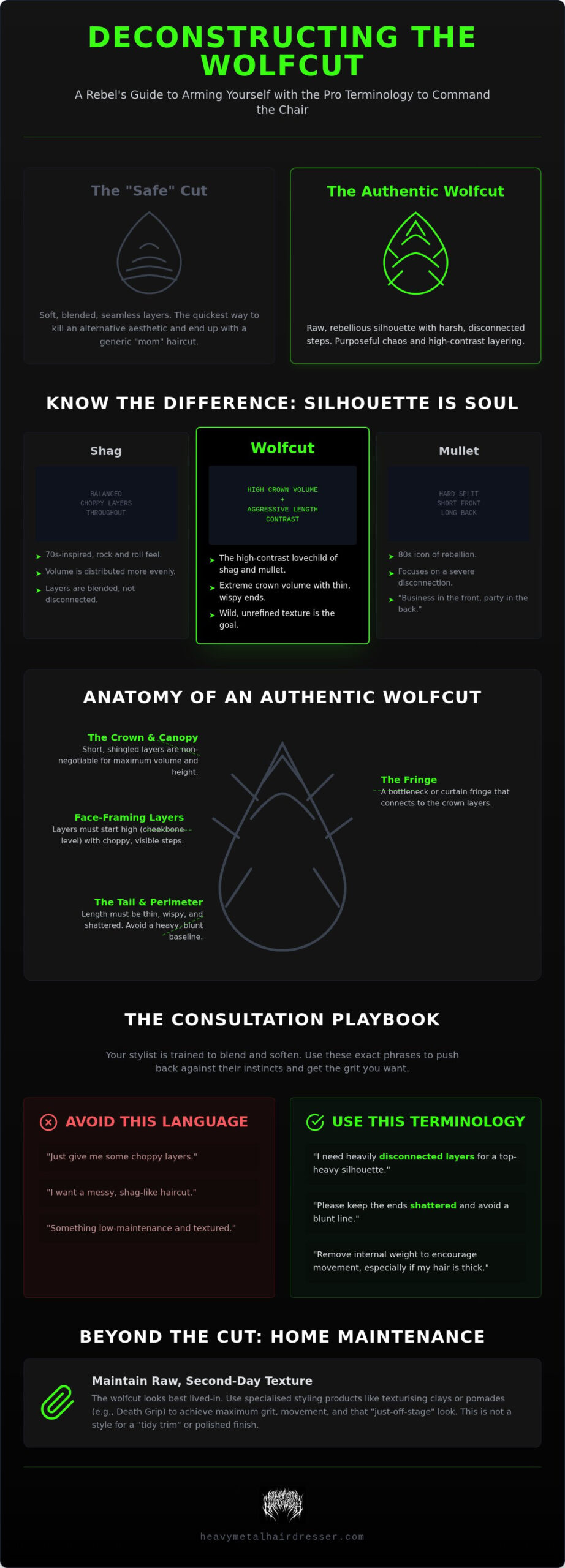
The wolfcut isn’t just a fleeting TikTok obsession. It’s a reclamation of subcultural identity. Think of it as the high-contrast lovechild of a 70s shag and an 80s mullet. It’s aggressive. It’s raw. It prioritises extreme crown volume and wispy, shattered ends that frame the face with intent. Reclaiming your individuality starts with the silhouette you present to the world. It is about reclaiming individuality, not just following a TikTok trend. If you want to avoid a generic look, you must understand the grit behind the terminology. Knowing how to ask your stylist for a wolfcut is the difference between looking like a rebel and looking like you’re heading to a PTA meeting.

Wolfcut vs. Shag vs. Mullet: Knowing the Difference

The silhouette defines the soul of the cut. A traditional shag is about balanced, choppy layers throughout. A mullet is a hard split between the short front and the long back. The wolfcut, often described as a modern variation of the shag, bridges these worlds. It keeps the heavy volume of the shag on top but borrows the aggressive length contrast of the mullet. This makes it a favourite amongst those seeking a non-conformist edge. The “wolf” element is found in the wild, unrefined texture. It’s the ultimate gender-neutral choice for alternative souls because it defies the polished expectations of the mainstream. It doesn’t care about traditional beauty standards. It only cares about movement, grit, and attitude.

The Danger of the “Safe” Haircut

Most stylists are trained to blend. They want everything to look seamless and “pretty”. For alternative styles, seamless is boring. When you’re learning how to ask your stylist for a wolfcut, you have to push back against their instinct to soften the edges. Traditional layering creates a soft gradient; the wolfcut demands harsh, disconnected steps. Without this disconnection, you end up with a “mom” haircut that lacks any bite. The wolfcut is a technical exercise in purposeful chaos and high-contrast layering. Demand that your stylist keeps the crown heavy and the ends shattered. This isn’t about a “tidy trim”. It’s about creating a shape that looks just as good after a night in a mosh pit as it does in the mirror.

The Anatomy of a Wolfcut: Breaking Down the Layers

To get the silhouette right, you need to understand the architecture of the cut. It is all about the top-heavy profile. Think maximum height and volume at the crown. This isn’t a stiff 60s beehive; it’s an organic, moving mass of texture that feels alive. When you are figuring out how to ask your stylist for a wolfcut, explain that the internal weight must be gutted. Thick hair needs this aggressive weight removal to achieve that signature flow. Without it, the style collapses under its own bulk and loses its edge. The “tail” is equally vital. The length should look thin, wispy, and intentional, avoiding any hint of a blunt, heavy baseline that might lean towards a standard long-layered look.

The fringe acts as the anchor for the entire frame. Whether you opt for a deep curtain bang or a narrower bottleneck fringe, it must connect to the shorter crown layers. This connection creates the “wolf” energy. If the fringe is too isolated, you lose the subcultural grit that makes this style so potent. It should feel like a cohesive, chaotic frame for your face.

The Crown and the Canopy

Short layers at the top are non-negotiable for that signature volume. Traditional layering often fails here because it is too uniform and blended. Instead, ask for “shingling”. This technique creates overlapping, shorter pieces that support each other, building height from the inside out. It is the secret to hair that stands up to a day of movement without looking flat or lifeless. For a deeper dive into these technical nuances, check out The Ultimate Wolf Hair Cut Guide for more on aggressive texture.

Face-Framing and Perimeter Grit

The layers must start high. We are talking cheekbones or even the eye line. This creates the heavy face-framing that defines the alternative aesthetic. Ensure the bottom length maintains a “mullet-lite” feel by keeping it significantly thinner than the top section. The transition between the fringe and the side layers should be choppy, not blended. You want visible steps. If you are ready to reclaim your look, consider booking one of our bespoke wolfcuts to get the technical precision your hair deserves. This perimeter grit ensures the style looks lived-in and raw from the moment you leave the chair. Keeping the ends shattered whilst maintaining crown density is the ultimate goal. It is about finding balance through purposeful imbalance.

How to Ask for a Wolfcut: The Alt-Hair Survival Guide

Choosing Your Weapon: Wolfcut Variations for Every Vibe

The wolfcut isn’t a one-size-fits-all trend. It is a versatile weapon that adapts to your specific hair behaviour whilst maintaining its subcultural grit. Choosing the right variation depends on how much length you want to keep and how much aggression you want to project. The Long Wolfcut is the ideal choice for those who want to maintain their length but crave a silhouette that feels dangerous. It’s about shredding the mid-lengths to create movement that traditional layers simply cannot achieve. On the other hand, the Short Wolfcut pushes the boundaries closer to a modern mullet. It is high-aggression, high-impact, and perfect for anyone looking to make a bold, non-conformist statement.

Adapting the cut for your natural texture is where many stylists get it wrong. Straight hair requires deep, manual texturising to prevent it from looking flat. Curly hair needs a completely different approach to manage the way the weight sits. Understanding these nuances is a core part of how to ask your stylist for a wolfcut that actually works with your lifestyle rather than against it. You want a style that looks lived-in and raw, not something that requires hours of heat styling to look “right”.

The Wolfcut on Fine Hair

Don’t let thin strands trick you into thinking you can’t pull this off. Injecting chaos into thin hair is actually the best way to create an illusion of density. The secret lies in keeping the perimeter ends blunt whilst shattering the internal layers. This contrast provides a solid base that makes the hair look thicker, whilst the “shattered” layers at the crown add the necessary height. Executing a wolfcut on fine hair requires a specialised touch to ensure the hair doesn’t end up looking stringy. It’s about purposeful texture that builds volume where it usually falls flat.

Curly and Textured Wolfcuts

Curly hair was practically made for the wolfcut silhouette, but it requires a technical strategy to avoid the dreaded “shelf” effect. This happens when layers are cut too horizontally, creating blocks of hair rather than a fluid shape. Your stylist should use a “C-shape” cutting technique to follow the natural curve of your curls. Managing shrinkage is the biggest hurdle here. Demand that your stylist cuts the hair whilst it is dry. This is the only way to see exactly where the curls will sit once the weight is removed. When you are learning how to ask your stylist for a wolfcut, insist on a dry cut to ensure the final shape frames your face perfectly without any surprises once you leave the chair. It ensures the grit remains intact without sacrificing the health of your curls.

The Consultation Playbook: How to Speak Their Language

Walking into a salon and simply saying “give me a wolfcut” is a high-stakes gamble. Most stylists are conditioned to avoid extreme shapes because they are trained to prioritise “pretty” over “powerful”. To get the grit you crave, you must master the consultation. This is how to ask your stylist for a wolfcut without ending up with a generic, blended shag. Start by curating a visual mood board. Crucially, include photos of what you do NOT want. Showing examples of a safe, suburban layer cut helps your stylist understand the aggressive boundaries of your aesthetic.

Next, use the “D-Word”. Ask for “disconnected” layers. This tells the stylist you want visible, purposeful steps between the crown and the length. Demand “shattered” ends. This ensures they use a razor or deep point-cutting to remove any hint of a blunt baseline. Define your fringe limits early. Decide if the shortest layer should sit at your cheekbones or your eye line to frame your face with intent. Discuss the “tail” density too. If they leave too much hair at the bottom, the top-heavy silhouette will vanish. Finally, be honest about your maintenance. If you won’t touch a hairdryer, tell them. A true wolfcut should thrive on a bit of neglect and the right product.

Specific Phrases to Use (and Avoid)

Precision is your best defence against a boring cut. Instead of saying “just give me some layers”, try “I want aggressive internal texture”. This signals that you want the weight gutted from the inside out to create movement. Avoid the vague phrase “thin it out”, which often leads to over-processed, stringy ends. Instead, ask them to “remove weight from the mid-lengths”. If you want maximum shattered grit, ask for a razor cut. The razor creates a raw, uneven finish that traditional scissors simply cannot replicate. It’s about creating purposeful chaos in the silhouette.

The Reference Image Strategy

For those looking to enhance their new silhouette with expert colour work, consulting a blonde specialist Cincinnati can help ensure your highlights perfectly accentuate every disconnected layer.

Photos are a safety net, but only if they are realistic. Show images of people with your actual hair texture. If you have fine hair, showing a thick-haired influencer will only lead to a consultation meltdown. Point out specific elements you like: “I love the fringe here, but the length there”. This level of detail prevents technical misunderstandings. For those craving even more extreme shapes, explore our guide on the modern mullet haircut. Ready to stop compromising on your identity? Book your session with our alternative experts and get the high-aggression wolfcut you actually asked for.

Beyond the Cut: Styling and Maintenance with Heavy Metal Grit

Forget the polished blow-dry. A wolfcut shouldn’t look like you’ve spent three hours with a round brush. It should look like you’ve just walked off a stage or out of a basement show. The “Air-Dry” Manifesto is your new religion. Heat damage kills the raw movement you fought for during the consultation. Instead, let your hair air-dry whilst scrunching in texture to encourage that natural, chaotic wave. This is where you see the true value of knowing how to ask your stylist for a wolfcut with disconnected layers. If the structure is sound, the hair will fall into a gritty silhouette on its own.

Second-day hair is often where this style hits its peak. The natural oils provide a built-in grit that fresh washes often lack. It passes the “Mosh Pit” test with ease. If your hair can survive a night of movement and still look intentional, the cut is a success. If it falls flat, you likely didn’t demand enough internal weight removal. Home maintenance is about preserving that “just-off-stage” energy without over-complicating the process. When you were learning how to ask your stylist for a wolfcut, you fought for disconnection. Don’t ruin it by styling it flat.

Essential Alternative Styling Tools

You need the right gear to keep the vision alive. Use Death Grip to define those shattered ends. It creates a piecey, aggressive texture that prevents the style from looking like a soft shag. For the crown, Hair To the Throne is your ultimate weapon. It provides the height and support needed to keep the top-heavy silhouette from collapsing. To find the best kit for your routine, check out our guide on alternative hair merch UK. Having the right tools ensures you maintain the same level of rebellion at home as you do in the salon chair.

Maintaining Your Wolfcut Between Salon Visits

The fringe is the first thing to lose its shape. Book a “Fringe-Only” appointment every few weeks to keep your vision clear and your frame sharp. You’ll know your layers have grown out too much when the “flow” turns into a “flop” and the crown loses its volume. A wolfcut is a living style that evolves as it grows, provided the initial “aggressive” structure is sound. Keep an eye on the transition between the side layers and the length. When the disconnection starts to blend back into a generic shape, it’s time to return for a refresh. Remind your stylist to gut the weight again to restore that high-contrast grit during your maintenance sessions.

Reclaim Your Identity with Purposeful Chaos

You now have the technical arsenal to ensure your next salon visit results in a weapon of self-expression rather than a suburban compromise. By mastering how to ask your stylist for a wolfcut using terms like “disconnected layering” and “shattered ends”, you’ve removed the risk of a safe, blended look. Remember that the core of this style lies in the top-heavy silhouette and the aggressive face-framing that prioritises grit over polish. Your hair is an extension of your subcultural identity; it deserves the precision of an expert who understands the music and the movement behind the aesthetic.

At Heavy Metal Hairdresser, we provide a gender-inclusive safe space where individuality is the only standard. Our expertise in aggressive textured layering has been seen on stages at Download and Bloodstock, proving that we know how to handle hair that needs to survive a mosh pit. Stop settling for stylists who are afraid of their scissors. Book your wolfcut transformation with the alternative masters today and step into a look that finally matches your energy. It’s time to embrace the chaos and wear your identity with pride.

Frequently Asked Questions

How do I explain a wolfcut to my stylist if they haven’t heard of it?

Explain the cut as a high-contrast hybrid of a 70s shag and an 80s mullet. Emphasise that you want disconnected layering rather than seamless blending. Use technical phrases like “shattered ends” and “aggressive crown volume” to bridge the gap. Knowing how to ask your stylist for a wolfcut means speaking their language. If they seem hesitant, insist on a top-heavy silhouette that focuses on movement rather than a traditional, polished finish.

Is a wolfcut high maintenance for everyday wear?

It is surprisingly low maintenance if the initial structure is sound. The style thrives on natural texture and a lived-in feel. You won’t need a round brush or a blow-dryer every morning. In fact, second-day hair often looks better because the natural oils add grit. Just a quick refresh with Death Grip on the ends is usually enough to maintain the aggressive silhouette. It is built for those who prefer an air-dry routine.

Can I get a wolfcut if I have very thin or fine hair?

Absolutely. Fine hair benefits from the chaos of this cut because it creates the illusion of density. Your stylist should keep the baseline perimeter blunt to provide a solid foundation. They then use shattered layers at the crown to build height where fine hair usually falls flat. This contrast between the heavy base and the airy top creates a much fuller look than traditional long layers ever could whilst maintaining an alternative edge.

What is the best fringe type for a wolfcut?

Bottleneck or deep curtain bangs are the gold standard for this silhouette. The fringe must connect to the shorter layers at the crown to avoid looking like an isolated block of hair. This framing is essential for the wolf energy. Ensure the shortest part of the fringe sits near the bridge of the nose, whilst the outer edges sweep down to meet the cheekbones for maximum impact and a gritty, face-framing finish.

How often should I get my wolfcut trimmed to keep it sharp?

Aim for a full trim every six to eight weeks to keep the layers from losing their flow. However, the fringe usually needs attention every three to four weeks to keep your vision clear. If you wait too long, the crown volume will drop and the disconnection will start to look like a generic, overgrown mess. Regular maintenance ensures the aggressive structure of the cut remains sharp, intentional, and subcultural.

Will a wolfcut work with my natural curls?

Curls and the wolfcut are a perfect match. The key is finding a stylist who performs a dry cut to account for natural shrinkage and bounce. This prevents the dreaded “shelf” effect where layers look too horizontal. Using a “C-shape” cutting technique allows the curls to stack vertically, building volume at the crown whilst keeping the ends wispy and light. It is a game-changer for maintaining texture without the bulk.

What is the difference between a wolfcut and a butterfly cut?

The difference lies in the finish and the grit. A butterfly cut is a polished, highly blended style designed for a “blowout” look with soft, sweeping layers. A wolfcut is its rebellious sibling. It prioritises disconnected steps, shattered ends, and a raw, unrefined texture. Whilst both use layering to create volume, the wolfcut is a technical exercise in purposeful chaos, whereas the butterfly cut seeks a seamless, traditional beauty standard.

Can a wolfcut be styled to look professional for work?

You can easily tone down the aggression for a professional environment. Tucking the side layers behind your ears or pulling the length into a low, textured ponytail softens the silhouette. You can also use a light cream to smooth the shattered ends for a more “controlled” texture. Knowing how to ask your stylist for a wolfcut that remains versatile is key. It is a shape-shifting style that adapts to the office without losing its soul.

Posted on

Transitioning from a Bob to a Wolfcut: The 2026 Alternative Style Guide

Transitioning from a Bob to a Wolfcut: The 2026 Alternative Style Guide

Your precision-cut bob isn’t a style statement; it’s a cage that’s suffocating your alternative edge. We know the frustration of looking too “neat” or “mainstream” while you’re desperate for something with more bite. You want the volume and aggression of a shag, but you’re terrified of that awkward, mullet-like in-between stage. Transitioning from a bob to a wolfcut doesn’t mean you have to wait a year for your hair to grow out before it looks intentional.

We agree that the blunt, structured lines of your current cut feel restrictive when your soul craves chaos. This guide promises to show you how to dismantle that structure and embrace the fierce, textured layers of a short wolfcut right now. We’ll provide a clear roadmap for the transition, proving that short wolfcuts are just as aggressive as longer versions. You’ll also discover how to use products like Death Grip to hide the growth process and maintain your subcultural identity whilst your layers evolve. It’s time to stop the wait and start the deconstruction.

Key Takeaways

  • Stop viewing your blunt cut as a limitation. A structured bob provides the ideal perimeter for a fierce, jaw-length wolfcut that prioritises volume at the crown.
  • Discover why transitioning from a bob to a wolfcut is an act of structural deconstruction. Focus on internal weight removal to achieve that signature, aggressive “kick out” texture.
  • Map out a three-appointment evolution plan with your stylist. This ensures your hair looks intentional and rebellious throughout the growth process instead of accidental or messy.
  • Learn the exact rockstar terminology to use during your consultation. Requesting “disconnection” and “aggressive layers” ensures you avoid a mainstream result and keep your alternative edge.
  • Master the “wash and wreck” styling method. Utilise dry waxes and texture pastes to keep your new layers looking sharp and chaotic with minimal daily effort.

Dismantling the Blunt Line: Why Your Bob is the Perfect Wolfcut Canvas

The structured bob is often sold as a “timeless” classic, but for those outside the mainstream, it can feel like a cage. It’s too polished, too neat, and lacks the raw energy of an alternative aesthetic. Transitioning from a bob to a wolfcut is the immediate solution for anyone looking to trade that “safe” silhouette for something with more bite. You don’t need to wait months for your hair to grow before you can start this process. In fact, the solid baseline of your bob provides the ideal foundation for a shorter, more aggressive iteration of the style.

A wolfcut is the rebellious hybrid of a 70s shag and a modern mullet. It’s defined by heavy crown volume and thin, wispy ends that demand attention. Whilst a bob is all about the perimeter and maintaining a solid shape, the wolfcut is a modern variation of the shag that prioritises movement and internal texture. Your bob’s current length acts as the scaffolding. We aren’t waiting for length; we are deconstructing the weight. This shift from clean lines to intentional chaos is what gives the wolfcut its fierce, underground edge.

The “Wolf-Bob” Hybrid: A 2026 Trend

The “Wolf-Bob” is the high-impact answer for those who want a shorter silhouette. It sits proudly above the shoulders, offering a punchy alternative to the long, flowing versions seen on social media. This is the ultimate first step when transitioning from a bob to a wolfcut. It keeps the compact feel you might be used to but replaces the blunt edges with aggressive, choppy layers. This style creates a high-impact silhouette that works perfectly for those moving away from a blunt cut without sacrificing their alternative identity.

Deconstructing the Perimeter

The biggest hurdle in this transition is the “bottom-heavy” feel of a traditional blunt cut. To fix this, we focus on perimeter deconstruction. This technique involves breaking up the solid baseline through intense point-cutting and razor work. We shred the ends to remove the “helmet” effect that plagues many growing-out bobs. By thinning out the bottom and stacking weight at the top, the hair begins to kick out in that iconic wolfcut fashion. Perimeter deconstruction is the key to avoiding the “helmet” look and transforming a static cut into a living, breathing style.

The Structural Shift: From Clean Lines to Aggressive Layers

Sculpting your new identity requires a complete departure from traditional layering techniques. Transitioning from a bob to a wolfcut is more than just adding a few steps; it’s a structural overhaul of how hair weight is distributed. Standard layers found in high-street salons aim for a smooth, blended finish. Aggressive textured layers do the opposite. They create intentional shelves and jagged edges that demand attention. This disruption is what separates a “nice haircut” from a subcultural statement.

Internal weight removal is the secret weapon for this transition. Whilst a bob keeps weight at the ends to maintain a solid line, a wolfcut requires the mid-lengths to be hollowed out. This allows the hair to kick out and move with a raw, unrefined energy. Without this internal sculpting, your hair will simply look like a messy bob. Avoid the temptation of the DIY “ponytail method” seen on social media. When you are starting with the limited length of a bob, one wrong snip with a hair tie can turn your alternative vision into an accidental bowl cut. Precision is everything when you are working with shorter starting points.

The Crown and the Shag: Creating Vertical Volume

Bobs are essentially horizontal styles. They pull the eye across the jawline. The wolfcut is unapologetically vertical. By cutting shorter, choppy layers into the crown, we shift the focus upwards to create that iconic rockstar volume. This creates a high-impact silhouette that feels tall and aggressive. If you are used to a side-parted bob, this shift involves moving hair towards a centre-weighted or forward-swept position. It’s about building height where there was once only flatness, giving the “wolf” its bite.

Face-Framing Disruption: Disconnecting the Fringe

The fringe is the soul of this style. To successfully move away from a bob, you must disconnect the front sections from the rest of the hair. This usually involves heavy curtain bangs or a “bottleneck” fringe that sits shorter in the middle and longer at the temples. We blend these into new face-framing layers that “shred” the face, creating a frame that looks lived-in and gritty. For a deeper dive into achieving that raw look, check out our Ultimate Wolf Hair Cut Guide to understand how to master subcultural grit. If you’re ready to ditch the boredom, booking a professional wolfcut ensures your transition is handled with expert hands rather than luck.

“My hair isn’t long enough yet” is the most common excuse for staying stuck in a boring blunt cut. It’s also a lie. Mainstream beauty magazines often claim you need collarbone length or six inches of growth before you can even consider this style. They’re wrong. Transitioning from a bob to a wolfcut is about shape evolution, not just length accumulation. We treat this as a strategic roadmap over two or three appointments. By focusing on the silhouette rather than the tape measure, we ensure your hair looks aggressive and intentional from day one.

The first appointment focuses on deconstructing that heavy bob perimeter. By the second visit, we deepen the disconnection between the crown and the nape. The “awkward phase” only happens when layers are left to grow out without a plan. If the weight is correctly distributed, that extra length at the back becomes a deliberate design choice rather than a sign you’ve missed a trim. We lean into the “mullet-esque” growth at the neck. In our world, a mullet isn’t a mistake; it’s a foundation. We keep the sides tight and the crown high to ensure the shape remains fierce whilst the back catches up.

Texture Matching: Fine vs. Thick Hair Transitions

Fine hair needs strategic scaffolding. We use shorter crown layers to create the illusion of a thicker, more chaotic mane. This prevents the hair from looking flat or “stringy” as it grows. Thick hair has the opposite problem: the “triangle bob” effect. This is where the ends flare out and look like a tent. We fix this by cutting internal channels. These “hidden” layers remove bulk and encourage the hair to collapse in the middle whilst kicking out at the ends. It turns a heavy, static block of hair into a moving, breathing wolfcut.

The Role of Vivid Colour in the Transition

Strategic pigment is your best friend during this shift. Using vivid hair colour can distract the eye from uneven growth or “in-between” lengths. Peek-a-boo panels or bold “money pieces” highlight your new, choppy layers, making them the focal point of the style. We also recommend darker, “lived-in” roots. This adds immediate visual depth to the crown, making those shorter layers look even more explosive and voluminous. Colour isn’t just an accessory here; it’s a tool to refine your new silhouette whilst transitioning from a bob to a wolfcut.

The Salon Consultation: How to Request a Wolfcut Without Losing Your Soul

Walking into a standard high-street salon with a bob and asking for a wolfcut is often a gamble. Most traditional hairdressers are trained to value symmetry, “healthy” ends, and polished finishes. They might try to talk you out of the chop. They’ll warn you about “losing your length” or suggest a “soft, blended layer” to keep things tidy. You must be firm. You aren’t there for a sensible trim; you’re there for a structural overhaul. Tell them you want a raw finish that looks intentional, not a “neat” style that blends into the crowd.

When transitioning from a bob to a wolfcut, your reference photos are your strongest weapon. Avoid high-fashion magazines that sanitise the look for a mainstream audience. Instead, search for “stage hair” or “rockstar mullets”. Look for images where the hair looks like it’s survived a three-day festival in a muddy field. You need to show your stylist the “shredded” look you’re after. If the photo looks too curated or brushed, you’ll likely end up with a result that lacks the necessary bite.

Speaking the Language of Grit

You need to use specific terminology to ensure the result matches your vision. Ask for “disconnection” between the crown and the perimeter. Tell your stylist you want “internal weight removal” to create that hollowed-out middle section that allows the hair to move. Request “shattered ends” rather than blunt ones. If your hair type can handle it, ask for a razor cut. Razors create a jagged, lived-in texture that standard scissors simply cannot replicate. For a deeper look at these terms, check out our Modern Mullet Haircut guide to master the language of alternative hair.

Why an Alternative Specialist Matters

An alternative salon is more than just a place for a haircut; it’s a safe space where your subcultural identity is the priority. A specialist in textured layers understands that your hair needs to survive more than just a desk job. We build “mosh-pit survival” into the structure of every cut. We know that a wolfcut should look just as good sweaty and tangled at a gig as it does when you first leave the chair. If you’re ready to stop compromising and finally ditch the bob, book your wolfcut with a team that actually speaks your language.

Styling Your New Chaos: Tools and Techniques for the Wolfcut

Forget the high-maintenance blow-outs and the clinical perfection of your previous blunt cut. Transitioning from a bob to a wolfcut introduces you to the “wash and wreck” philosophy. This is low-effort, high-impact styling designed to look better the more you move. While mainstream tutorials might suggest curling every single layer with a hot iron, we know that true alternative grit comes from working with your hair’s natural rebellion. You want a finish that looks lived-in and raw, not something that belongs in a bridal magazine.

The secret to this texture lies in your product choice. Ditch the heavy oils and smoothing creams that weighed down your bob. You need salt sprays for grit, texture pastes for definition, and dry waxes for that matte, “unwashed” appearance. To define the iconic “wings” of the cut, we recommend using a product like Death Grip. It provides the necessary hold to keep those layers flicking outwards without making the hair feel crunchy or static. Scrunch-drying is your primary technique here. Simply apply your product to damp hair and squeeze upwards to encourage volume and chaos without the need for a round brush.

Air-Drying for the Mosh Pit

Air-drying doesn’t have to mean looking flat. Start by applying a salt spray to damp hair, focusing on the roots and mid-lengths. Use small clips to “set” your face-framing layers whilst they are wet. By pinning the hair back at the temples or pushing the fringe into a specific shape, you ensure it dries with an intentional silhouette. This method is perfect for maintaining your edge without the heat damage. For more cross-compatible tips on managing aggressive texture, our guide on how to style a modern mullet covers the essentials of maintaining grit during the growth phase.

The Power of Texture Pastes

Once your hair is dry, use a texture paste to refine the details. Take a small amount and “pinch” the ends of your layers. This creates the sharp, wolf-like finish that defines the style. Traditional hairspray is the enemy here. It creates a “helmet” effect that kills the movement your new layers provide. You want a style that can survive a gig and still look intentional. If you’re looking for the right tools to maintain your look, explore our alternative hair merch UK for the gear you need to keep your subcultural identity sharp. Transitioning from a bob to a wolfcut is your ticket out of the mainstream. Stay messy, stay aggressive, and let the chaos work for you.

Embrace the Chaos: Your Transformation Starts Now

Your bob was a starting point; now it’s time to make it a statement. Transitioning from a bob to a wolfcut is an act of rebellion against the polished and the predictable. You’ve learned that length isn’t the barrier; structure is. By focusing on aggressive internal layers and disconnecting the crown, you can bypass the “awkward phase” and move straight into intentional grit. Remember that your styling routine should be as raw as your aesthetic. Use texture pastes to define those edges and let your hair breathe whilst it evolves.

We don’t do “neat” and we don’t do mainstream. Our salon is a gender-inclusive safe space where your identity is celebrated, not just managed. We’ve spent years crafting stage-ready looks for bands and festival stages, and we’re ready to bring that same energy to your transformation. It’s time to stop waiting for growth and start embracing the deconstruction. Work with specialists who understand alternative, textured styles and won’t try to “fix” your edge.

Book your wolfcut transformation with the Heavy Metal Hairdresser crew. Your new silhouette is waiting. Let’s wreck the rules together.

Frequently Asked Questions

Can I get a wolfcut if I have a very short bob?

Yes, a chin-length bob is the perfect starting point for a shorter, punchier iteration of the style. We focus on crown volume and face-framing disconnection rather than waiting for length at the back. This “Wolf-Bob” hybrid creates a high-impact silhouette that works immediately without requiring months of growth.

How long does it take to transition from a bob to a full wolfcut?

Most clients achieve the full silhouette within two to three salon appointments, typically over six months. Transitioning from a bob to a wolfcut is a process of evolving the shape. Each visit involves removing weight from the mid-lengths and allowing the nape area to grow into those signature wispy ends whilst keeping the top layers short and voluminous.

Is a wolfcut high maintenance compared to a bob?

It’s actually the opposite. A bob requires precision styling and constant heat to maintain its blunt, polished look. A wolfcut thrives on natural movement and intentional messiness. You’ll swap your round brush for texture pastes and spend significantly less time fighting your hair’s natural rebellion every morning.

Will a wolfcut work on curly or wavy hair during the transition?

Natural texture is a massive advantage for this style. The aggressive layers remove the “tent” effect common with curly bobs, allowing your curls to stack vertically. This creates immediate volume at the crown and prevents the hair from flaring out at the chin in a triangular shape that many alternative clients hate.

Do I need to use heat tools every day to style a wolfcut?

No. We advocate for the air-dry method using salt sprays or dry waxes to maintain that raw, underground aesthetic. Heat tools often make the layers look too “finished” or mainstream. Embracing your natural texture keeps the style looking authentic and gritty whilst protecting your hair from unnecessary damage.

What is the difference between a wolfcut and a shag when growing out a bob?

The difference lies in the level of aggression and disconnection. A shag is a soft, blended variation of the 70s classic. A wolfcut is a hybrid that leans heavily into the mullet aesthetic, featuring sharper disconnection and more dramatic weight removal. It’s the more rebellious choice for those ditching a blunt cut.

How often should I get a trim during the transition period?

Aim for a refresh every 8 to 12 weeks. Regular maintenance is essential to keep the layers from becoming a “helmet” as they grow. These appointments ensure the weight remains focused at the top whilst the perimeter continues to deconstruct, allowing the back to grow into a fierce, mullet-like tail.

Can a wolfcut hide the “awkward growth” phase of a bob?

It is the best way to handle the growth process. By shredding the perimeter of your bob, the extra length at the nape looks like a deliberate design choice rather than a missed trim. Transitioning from a bob to a wolfcut transforms the frustration of growing out a blunt cut into an immediate, intentional style statement.

Posted on

How to Know If a Shag Haircut Will Suit Me: The Ultimate Alternative Guide

How to Know If a Shag Haircut Will Suit Me: The Ultimate Alternative Guide

Stop scrolling through Pinterest boards of 70s housewives. You’re likely wondering how to know if a shag haircut will suit me without looking like you’ve joined a vintage tribute act. It’s a valid fear. Most high street salons treat layers like a polite suggestion rather than an aggressive architectural choice. You want the grit and the movement, but you’re worried your fine hair will vanish or your thick hair will turn into a shapeless helmet.

We get it. You need a style that matches your subcultural identity, not a “mumsy” chop that feels safe. This guide is your roadmap to discovering how rebellious layers and aggressive textures can be tailored to your specific face shape and hair type. We’ll break down the maintenance reality and help you find the variation that screams your name rather than a mainstream trend. From understanding hair density to choosing the right fringe, we’re diving into the mechanics of the perfect alternative cut. It’s time to stop guessing and start owning your look.

Key Takeaways

  • Understand why the modern shag is a technical masterpiece of internal layers rather than just a messy, accidental chop.
  • Discover how to know if a shag haircut will suit me by focusing on feature enhancement and aesthetic energy instead of restrictive face shape rules.
  • Identify the specific technical adjustments needed to make aggressive texture work for both fine and thick hair types without losing volume.
  • Learn how to avoid the “mumsy” trap by prioritising sharp, disconnected angles that protect your subcultural edge.
  • Explore the collaborative, gender-inclusive consultation process used to ensure your new layers align perfectly with your alternative identity.

Decoding the Shag: More Than Just a Messy Cut

Forget the idea that a shag is just a lazy day at the barbers. It’s a technical masterpiece of internal layers and face-framing texture. If you’re wondering how to know if a shag haircut will suit me, you have to look past the surface level. This isn’t about looking like you just woke up; it’s about looking like you woke up and chose chaos. It’s a deliberate, architectural rebellion against flat, boring hair.

Traditional beauty magazines often push the “pretty shag.” It’s soft, blended, and safe. We don’t do safe. The subcultural version is aggressive. It’s defined by sharp angles and a specific kind of grit that refuses to conform to mainstream standards. It’s the ultimate low-maintenance cut because it actually looks better when it’s a bit battered. It thrives on being lived-in. The more you mess with it, the better it performs.

The Anatomy of a Shag Haircut

Short crown layers are the engine room of this style. They create that height and volume that defies gravity. Without them, you’re just left with a flat mop. The fringe acts as the anchor for the entire look. Whether you opt for a brutal micro-fringe or heavy curtain bangs, it frames the eyes with intent. Thinning and texturising aren’t just finishing touches here. The ends need to look chewed or raw. We want texture that looks like it’s been through a mosh pit, not a blow-dry bar. It’s about creating space within the hair so the layers can actually move.

Why Subculture Reclaimed the Layers

The shag has always been a middle finger to the status quo. Understanding the history of the shag haircut reveals it was born in the hands of 70s rock and metal icons. It was the uniform of the outsider. Whilst the mainstream tried to sanitise it, subcultures kept the edge sharp.

Don’t confuse this with the 80s “disaster” mullet. The modern shag is smarter. It uses disconnection to create a shape that’s edgy but wearable. It has also evolved into a gender-neutral weapon of self-expression. It doesn’t care about your gender identity; it only cares about your attitude. It’s about reclaiming your image and making it as loud as your favourite record. Whether you’re at a festival or in a dive bar, the shag signals that you aren’t here to blend in.

Face Shapes vs. Aesthetic Energy: Who Does the Shag Really Suit?

Traditional beauty standards are a trap. They tell you that only certain faces can pull off certain cuts. Usually, they claim the “oval” face is the holy grail. We call bullshit. If you are obsessing over how to know if a shag haircut will suit me, stop measuring your jawline with a ruler. The shag isn’t about fitting a clinical mould. It is about manipulating volume to match your energy. This cut is a tool for self-expression, not a mask to hide behind.

Aesthetic energy is the real secret. Confidence outweighs facial symmetry every single time. A shag works because it is customisable. It is a collaborative build between you and your stylist. We don’t look for “perfection.” We look for what makes you feel like the most authentic version of yourself. If you have the grit to own the layers, you have the face for the cut. It is that simple. If you want to see how these textures look on real people in the scene, check out the work at heavymetalhairdresser.com to get inspired.

Framing Your Features: Eyes and Cheekbones

The shag is a technical weapon for feature enhancement. A heavy, purposeful fringe acts like a spotlight for your eyes. It creates a frame that demands attention. If you have a softer jawline, we use “shattered” layers to add artificial structure. These aren’t polite, blended ends. They are sharp, disconnected points that create shadow and depth. The “cheekbone-skimming” layer is a universal flatterer. By placing a shorter layer exactly where your cheekbone peaks, we create an instant lift. It is about highlighting your favourite bits and letting the rest fall into a controlled, beautiful mess.

Adapting the Shag to Your Unique Face Shape

While we ignore the “rules,” we don’t ignore the physics of hair. We adapt the silhouette to balance your proportions without losing the alternative edge.

  • Round faces: We focus on height. By adding aggressive crown layers, we elongate the silhouette. We keep the sides slimmer to avoid adding width where you don’t want it.
  • Long faces: Horizontal volume is your friend. We use wide fringes and layers that kick out at the sides to create a sense of balance. It breaks up the vertical line with textured movement.
  • Square faces: We use wispy, disconnected layers to soften strong angles. The goal isn’t to hide your jaw, but to frame it with texture that moves. It turns a “hard” shape into something with fluid, rebellious energy.

The shag is inclusive by design. It adapts to you. It never asks you to change for it.

How to Know If a Shag Haircut Will Suit Me: The Ultimate Alternative Guide

Texture Talk: Will Your Hair Type Play Ball?

Your hair texture isn’t an obstacle; it’s the raw material. One of the biggest myths in alternative styling is that you need a specific, thick mane to pull off this look. If you’re currently asking how to know if a shag haircut will suit me based on your hair type, the answer lies in the technique. This cut isn’t a one-size-fits-all template. It’s a bespoke construction that changes based on whether your hair is fine, thick, straight, or curly. We don’t fight the hair; we manipulate it.

The “shag for everyone” claim is only true if your stylist understands the physics of weight. Bone-straight hair often needs extra help with texturising products to create the grit required to hold the shape. Without natural movement, the layers can fall flat. We use internal carving to force that movement into the hair. This ensures the style doesn’t just hang there like a wet blanket. It’s about creating a silhouette that survives the mosh pit and the morning after.

Injecting Volume into Fine Hair

Fine hair doesn’t have to look stringy. That trap usually happens when a stylist over-thins the ends or uses a razor too aggressively on the wrong sections. To avoid this, we focus on shorter crown layers. These act as a support system, pushing the rest of the hair up to create maximum height and volume. By incorporating blunt ends within the layers, we maintain a sense of density whilst still achieving that shattered, rebellious look. Another pro tip? Using vivid hair colour adds incredible visual depth. High-contrast pigments create shadows and highlights that trick the eye into seeing more hair than is actually there. It’s a technical illusion that works every time.

Taming the Beast: The Shag for Thick and Curly Hair

Thick hair often suffers from the dreaded triangle shape. This happens when the weight is left at the bottom, making the hair look bottom-heavy and dated. We fix this by removing significant weight from the mid-lengths. This isn’t about thinning for the sake of it; it’s about creating channels for the curls to sit in. The shag actually embraces natural curl patterns, allowing them to bounce and move whilst reducing the bulk that leads to frizz. If you want something even more aggressive, the ultimate wolf hair cut offers a high-texture alternative that leans even harder into that wild, untamed aesthetic. It’s about working with your hair’s natural behaviour rather than fighting it until it gives up.

The Fear of Regret: Avoiding the ‘Mumsy’ or ‘Messy’ Trap

The internet is a graveyard of failed shags. You’ve seen the Reddit threads. People go in asking for Debbie Harry and come out looking like a 70s news anchor. If you’re still wondering how to know if a shag haircut will suit me, the answer often depends on your stylist’s bravery. The “mumsy” trap is real. It happens when a stylist plays it safe by blending every layer until the hair looks like a round, soft helmet. We don’t do soft. We do sharp.

A rockstar shag requires purposeful disconnection. It needs to look a bit battered. It needs grit. The growing out phase is actually one of the best parts of this cut. Because the layers are shattered and uneven by design, they don’t grow into awkward shelves. They just evolve into a longer, lazier version of the original shape. Maintenance is equally straightforward. You can air-dry it for a raw look or use heat to define the texture. Either way, it’s built to last. It’s the ultimate choice for anyone who wants to know how to know if a shag haircut will suit me whilst maintaining a busy, alternative lifestyle.

Avoiding the ‘Dated’ 70s Look

The fringe is the make-or-break element. A rounded, bouncy fringe is a one-way ticket to a vintage costume party. To keep it modern, the fringe must be choppy, heavy, or disconnected. Disconnection is the secret to that aggressive, modern edge. It prevents the hair from looking too “done.” If you want to take this energy to the extreme, the modern mullet haircut is the shag’s bolder cousin. It takes those layers and pushes them into an even more defiant silhouette that refuses to play by the rules.

Styling for Mosh Pit Survival

The alternative aesthetic thrives on texture that stays put. We use products like Death Grip to provide that essential second-day grit. For maximum volume at the crown, Hair To the Throne is your best friend. This combination makes the shag the perfect festival hair choice. It’s designed to survive the mosh pit and still look intentional the next morning. You can easily refresh the layers with a salt spray amongst the daily grind. It’s high-impact style without the high-maintenance headache. If you’re ready to ditch the boring cuts, secure your spot with a stylist who understands the difference between a messy cut and a technical masterpiece.

Claiming Your Layers at Heavy Metal Hairdresser

The final answer to how to know if a shag haircut will suit me isn’t found in a mirror. It is found in the chair of a specialist who understands your culture. Most salons see a shag as a trend to be replicated. We see it as a resurrection of your identity. Heavy Metal Hairdresser operates as a fiercely independent, gender-inclusive sanctuary where your subcultural edge is the priority. We don’t just cut hair; we build silhouettes that withstand the energy of a mosh pit and the scrutiny of the scene.

Clients travel from across the UK to seek out Simon Tuckwell’s expertise. This national reach isn’t just about his international acclaim or his backstage work at festivals like Download and Bloodstock. It is because he and the team speak the same language as you. You don’t have to explain why you want your layers aggressive or why you need that disconnected grit. We already know. When you book with shag hairdressers who live the lifestyle, the anxiety of being misunderstood vanishes.

The Alternative Consultation Process

Our consultation is a collaboration, not a command. Before the scissors even touch your hair, we talk. We discuss your favourite music, your daily lifestyle, and how you want to express your identity. This is a vital step in determining how to know if a shag haircut will suit me because the cut must align with your soul as much as your face. We provide a safe space for queer and neurodivergent clients to express their needs without judgement. Whether you want a subtle nod to the 70s or a brutal, high-contrast chop, we tailor the grit level to your personal comfort zone. It is about making sure you leave the chair feeling more like yourself than when you walked in.

Why We Don’t Do ‘Standard’ Cuts

Standard cuts are designed for a six-week shelf life. Our shags are designed for movement and lived-in texture that lasts for months. We use specialised tools and techniques to carve space into the hair, ensuring it never feels heavy or stagnant. This technical precision allows us to recommend the right textured styling products to keep your layers sharp at home. We don’t rely on traditional beauty industry clichés. Instead, we focus on the raw, authentic vibe that defines our community. The Heavy Metal Hairdresser ethos is a sharp blend of technical precision and rebellious spirit. We don’t follow the mainstream; we create the alternative.

Own Your Alternative Identity

You’ve moved past the generic beauty standards and clinical advice. You now know that a technical shag isn’t about conforming to a face shape; it’s about the deliberate execution of aggressive layers and shattered ends. Whether you’re injecting volume into fine hair or taming thick curls, the secret is collaboration with a specialist who understands the subcultural weight of the look. Stop worrying about how to know if a shag haircut will suit me and start deciding which version of this rebellious silhouette fits your energy.

Simon Tuckwell brings international acclaim to every appointment, specialising in the specific grit and texture that mainstream salons often fear. We’ve built a gender-inclusive safe space where your identity is celebrated, not just tolerated. It’s time to ditch the “mumsy” safety net and embrace a cut that actually says something about who you are. Book your alternative transformation with Simon Tuckwell today. Your hair is the ultimate canvas for self-expression, so don’t be afraid to make it loud.

Frequently Asked Questions

Will a shag haircut make my face look rounder?

A shag won’t make your face look rounder as long as the volume is placed at the crown rather than the sides. We focus on technical height to elongate the silhouette. It is all about vertical movement. If you’re wondering how to know if a shag haircut will suit me without widening your face, the secret is in those shorter crown layers that pull the focus upwards.

Is a shag haircut high maintenance for daily styling?

The shag is actually one of the lowest maintenance cuts for an alternative aesthetic. It thrives on being air-dried and lived-in. You don’t need a blow-dry bar finish or hours with a round brush. A bit of salt spray or a grit product is usually enough to wake the layers up. It is designed to look better the more you mess with it.

Can I get a shag haircut if I have very fine hair?

You can definitely pull off a shag with fine hair. We use shorter internal layers to act as a support system for the rest of the hair. This prevents the “flat” look and creates the illusion of density without needing a naturally thick mane. It’s about using architecture to build volume where nature didn’t provide it.

What is the difference between a shag and a wolfcut?

The main difference is the level of aggression and disconnection. A shag is a technical masterpiece of internal layers distributed throughout the hair. A wolfcut leans harder into mullet territory with more extreme disconnection between the top and the bottom. Both prioritise texture over blending, but the wolfcut is generally more “top-heavy” in its silhouette.

How often do I need to trim a shag haircut to keep the shape?

Most clients only need a trim every three to four months. Because the layers are shattered and raw by design, they don’t grow out into awkward shelves. The shape simply evolves into a longer, lazier version of the original cut. It is a style that respects your schedule whilst maintaining its subcultural edge.

Do I have to have a fringe with a shag haircut?

You don’t strictly need a fringe, but it is often the anchor of the style. Most alternative versions use a heavy curtain or micro-fringe to frame the eyes with intent. If you choose to skip the fringe, we focus more on face-framing “bits” to ensure the layers still have an aggressive point of origin.

Is the shag haircut gender-neutral?

The shag is entirely gender-neutral and inclusive by design. It doesn’t care about traditional beauty binaries. It only cares about your personal grit and the energy you bring to the chair. It is a weapon of self-expression that works for anyone looking to reclaim their identity from the mainstream.

What products should I use to style a shag for an alternative look?

You need products that provide hold and raw texture. Use Death Grip for that essential second-day grit and Hair To the Throne for maximum crown height. These tools help you understand how to know if a shag haircut will suit me by giving you the power to maintain that defiant, textured edge every single day.

Posted on

Curtain Bangs Shag Haircut: Aggressive Face-Framing for Alternative Souls

Curtain Bangs Shag Haircut: Aggressive Face-Framing for Alternative Souls

Why settle for a haircut that looks like a polite apology when you could wear a manifesto? Most mainstream salons are terrified of hair that actually says something. They’ll take a request for a curtain bangs shag haircut and dilute it until you look more like a 1970s housewife than a subcultural icon. You’ve likely felt that sting before. You ask for edge, but you leave with a “soft” finish that lacks any real bite.

We know you’re tired of your fringe falling flat and your fine hair looking lifeless. You want a look that resonates with your musical identity and refuses to be ignored. As the modern shag dominates 2026 trends for its air-dry friendly versatility, it’s the perfect time to claim yours. This guide shows you how to weaponise these layers to create a high-impact, textured silhouette. It’s about aggressive face-framing that defies traditional beauty standards and puts the power back in your hands.

We’ll explore the technical grit behind the modern shag, show you how to master your styling routine, and ensure your layers stay sharp. It’s time to ditch the mainstream fluff and embrace a style that’s as unapologetic as you are.

Key Takeaways

  • Learn how the curtain bangs shag haircut fuses disconnected layers with a sharp fringe to create a silhouette that rejects mainstream norms.
  • Explore five aggressive styles, including the wolf-shag hybrid and razor-cut goth-rock shag, to find a look that matches your subcultural roots.
  • Understand how tailored layers create a gender-neutral, inclusive frame that works for any face shape or identity.
  • Master the “Death Grip” method and embrace second-day hair to maintain extreme texture and hold without over-washing.
  • Discover why choosing a specialist stylist who understands alternative aesthetics is vital for avoiding the dreaded high street soft finish.

What is a Curtain Bangs Shag Haircut?

Forget the “effortless” fluff you see on high street mood boards. A curtain bangs shag haircut is a structural rebellion. It is the tactical collision of heavy, disconnected layers and a wide, cheekbone-skimming fringe that refuses to play nice. While the history of the shag cut dates back to the 1970s, the modern alternative version ditches the “pretty” for something far more percussive. It is a look that prioritises texture over tidiness and grit over grace.

This specific combination serves as the cornerstone of the shag haircut resurrection currently dominating the UK’s alternative spaces. It works because it bridges the gap between retro rebellion and modern identity. You get the raw volume of a classic shag but with a face-frame that can be sharpened into a blade or softened into a haze depending on your aesthetic. It is about weaponising your hair to reflect who you are, rather than what society expects.

The Anatomy of an Alternative Shag

To build this silhouette, we start at the top. Short, choppy layers are carved around the crown to create maximum height and movement. This isn’t about “feathering” or soft blending. We want “shattered” ends that look like they’ve seen a few mosh pits. The curtain bangs then integrate with specific face-framing “bits”, ensuring a seamless flow from the fringe into the rest of the textured mess. It’s a calculated architecture designed to hold its shape even when the wind picks up.

Mainstream vs. Heavy Metal Styles

Most salons are obsessed with the round brush. They want your curtain bangs shag haircut to look polished and “safe”. We find that boring. A Heavy Metal style is aggressive and intentionally disconnected. It is styled for maximum chaos and raw energy. Ironically, achieving this “unpolished” look requires far more technical precision than a standard trim. Your stylist must master weight distribution and internal thinning to ensure the hair moves with purpose. It takes genuine expertise to create a mess that looks this good.

5 Aggressive Shag Styles with Curtain Bangs to Inspire Your Next Cut

Mainstream trends are built for people who want to blend in. We don’t do that here. If you’re looking for a curtain bangs shag haircut, you’re likely searching for a way to express a specific subcultural identity. These five variations take the basic structure of the shag and push it into more aggressive, high-impact territory. They reject the “pretty” and embrace the raw energy of the alternative scene.

The Wolf-Shag: For Maximum Volume

The Wolf-Shag Hybrid is for those who find a standard mullet too restrictive. It merges the long, tapered back of a mullet with the heavy, textured crown of a shag. The curtain fringe is the anchor here. It frames the face whilst the rest of the hair creates a chaotic, high-volume silhouette. This cut focuses on extreme crown height and wispy, tapered ends. It works amongst almost all hair types, particularly those with a bit of natural wave. For those ready to commit, our Wolfcuts offer the perfect starting point for this hybrid look.

The Goth-Rock Shag: Sharp and Saturated

The Goth-Rock Shag is about saturation and sharp lines. We swap the soft blending for razor-cut edges that look lethal. The curtain bangs are cut wider than usual to expose more of the forehead and eyes. This makes it the perfect frame for bold eyeliner, heavy piercings, or alternative jewellery. It’s a style that demands deep pigments. Think jet black, bruised purple, or midnight blue. It’s sharp; it’s saturated; it’s unapologetic. This isn’t just a haircut. It’s a shield.

The Vivid Chaos Shag uses creative colour to highlight the “peek-a-boo” effect of the fringe. Imagine neon green layers hiding under a dark curtain fringe, or blood-red tips that flash as you move. The texture of the shag makes these colours pop in a way that flat, one-length cuts never could. It’s about using every layer to tell a story of controlled chaos.

The Short-Circuit Shag is a cropped version for those who want maximum neck exposure and jawline definition. It’s percussive and fast. It takes the weight off the shoulders whilst keeping the heavy face-framing elements that define the style. It’s the perfect choice for a low-maintenance, high-impact aesthetic that works in any setting.

The Long-Haired Legend allows you to keep your length whilst injecting massive texture into the mid-lengths. It’s for those who want the volume of a shag without sacrificing the hair they’ve spent years growing. The curtain bangs bridge the gap between the long ends and the choppy crown, ensuring the look stays cohesive and intentional.

Curtain Bangs Shag Haircut: Aggressive Face-Framing for Alternative Souls

Anatomy of the Cut: Why This Duo Works for Every Identity

The beauty of a curtain bangs shag haircut lies in its refusal to conform. It isn’t a one-size-fits-all trend delivered by a conveyor-belt salon. It is a modular system of layers and fringe that we tailor to your specific bone structure and identity. By using disconnected layers, we create a silhouette that feels inclusive and non-binary. It’s hair that looks as good in a mosh pit as it does in a creative studio. This cut doesn’t just sit on your head. It works with you.

We focus on the internal architecture of the hair to ensure it suits your lifestyle. For those with high-energy days and late nights, the shag is the ultimate low-maintenance solution. The “disconnected” nature of the cut means that as it grows out, it doesn’t lose its edge. It just evolves. We adjust the weight of the fringe based on your hair density, ensuring that fine hair gains volume whilst thick hair loses the bulk that usually weighs it down with a shag haircut for thick hair.

Gender-Inclusive Framing

Hair has no gender. We use the shag to build shapes that feel authentic to your personal identity, moving far beyond traditional masculine or feminine styling rules. The aggressive crown layers provide a height that can feel either punk-rock or ethereal, depending on how you wear it. Finding a safe-space salon environment is crucial for this process. You need a stylist who understands that your hair is a vital part of your self-expression and respects the nuances of alternative subcultures. It’s about creating a look that makes you feel seen, not just styled.

The “Cheekbone Trigger”: Tailoring the Fringe

The placement of your fringe is a tactical decision. We call it the “Cheekbone Trigger”. Where the curtain bangs hit determines the entire energy of the silhouette. When they skim the cheekbones, they create a sharp, architectural frame that highlights your features without looking “done”. This integrates perfectly into modern 70s shag layers, giving you that retro grit with a contemporary, razor-cut finish.

We also focus on the “flick” effect. This ensures your curtain bangs shag haircut doesn’t just hang flat against your face like a wet blanket. By carving out weight from the ends, we encourage the hair to kick out and move. It creates a percussive, textured look that responds to your movement. Whether you’re headbanging or just walking down the street, your hair should have a life of its own. It should be a statement of intent, not just a trim.

Styling for Chaos: How to Maintain Your Texture and Fringe

Mainstream beauty standards want you to wash your hair every single morning. We don’t. If your hair is too clean, your curtain bangs shag haircut will likely fall flat and lose its soul. The secret to that gritty, lived-in aesthetic is “second-day hair”. Natural oils provide the friction needed to keep those disconnected layers from looking like a polite bob. If you’ve got fine hair, you’ll need to fake that grit with the right arsenal. For most alt souls, the less you do, the better it looks.

Styling your curtain bangs is the most tactical part of the routine. Use a round brush too aggressively and you’ll end up looking like a 1970s newsreader. Instead, use your fingers. Direct the hair away from your face whilst it’s damp and let it settle naturally. You want a “flick”, not a “roll”. Sharpness requires strategy. Whilst the shag grows out beautifully, your fringe will eventually blind you. Pop in for a “fringe-only” trim every three to four weeks to keep the frame precise whilst the rest of the cut continues its chaotic journey. For a deeper dive into keeping those layers sharp and gritty between appointments, our guide on how to maintain a shag haircut between gigs covers every tactical step you need.

The Texture Toolkit

Volume that defies gravity doesn’t happen by accident. We use Hair To the Throne to build a foundation of height at the crown. It provides that percussive lift without the sticky residue of traditional mousses. Follow up with sea salt sprays to get that “just off the stage” grit. For those who need extreme separation and hold that won’t budge during a set, the Death Grip approach is essential. It’s about keeping your layers separated and gritty, not glued together. Ready to lock in your look? Grab our Death Grip for hold that actually survives the night.

The “No-Heat” Styling Hack

You don’t need a curling iron to get movement. Use hair clips to “set” your curtain bangs in a soft “C” shape whilst they air dry. Simply pin them back at the temple for ten minutes after washing. You can also twist individual layers whilst damp to encourage natural waves. This allows you to organise your morning routine so you spend less time in front of the mirror and more time doing what matters. It’s styling for people with better things to do than fight a blow-dryer. Let the air do the work and embrace the natural chaos of your hair’s unique behaviour.

Beyond the Mainstream: Getting Your Custom Shag

Walking into a standard high street salon with a request for a curtain bangs shag haircut often leads to a specific kind of heartbreak. Most mainstream stylists are trained to prioritise symmetry, “softness”, and commercial appeal. They see curtain bangs and think of a polished 90s rom-com. They see a shag and think of a sensible, layered bob. They often lack the subcultural vocabulary to understand that “aggressive” is a compliment. To get a cut that actually resonates with your identity, you need a specialist who understands the history and the grit of alternative aesthetics.

A true alternative shag isn’t just about following a diagram. It is about a stylist who understands how hair moves in a mosh pit and how it settles after a night of no sleep. We don’t aim for “pretty” because we know you’re looking for something far more interesting. We focus on the technical precision of the disconnect, ensuring your layers have the raw energy required to stand out. It takes a rebellious expert to break the traditional rules of hairdressing whilst maintaining the structural integrity of the cut.

The Consultation: Speaking the Same Language

Preparing for your appointment is about more than just finding a photo. We prefer “vibe” references over generic Pinterest boards filled with the same three influencers. Bring us photos of your favourite bassists, specific album art, or even a still from a vintage horror film. We want to know the music you listen to and how you actually wear your hair on a Tuesday morning. This dialogue allows us to tailor the curtain bangs shag haircut to your specific lifestyle. We ensure the weight distribution and fringe length align with your daily reality, making sure your cut is as unique as your record collection.

Join the Community

We celebrate individuality within a fiercely independent, gender-neutral safe space. Our roots are firmly planted in the UK metal and punk scenes. We’ve traded the clinical, over-polished feel of traditional salons for a raw, authentic environment where being different is the standard. We aren’t here to fix you; we’re here to help you express who you already are. Every cut is an identity-affirming process designed to empower you. Ready to pull the trigger? Book your transformation with Heavy Metal Hairdresser and claim a style that refuses to be quiet.

Claim Your Silhouette

Your hair is the loudest thing about you. It shouldn’t just sit there; it should scream. By now, you know that a curtain bangs shag haircut is more than just a trend. It’s a tactical choice for those who demand texture and refuse to blend into the background. We’ve covered how disconnected layers provide volume that survives the pit and why the right fringe placement can redefine your entire identity. This isn’t about looking “pretty” for the mainstream. It’s about looking like yourself.

Don’t leave your look in the hands of someone who doesn’t get the culture. As official stylists for Download and Bloodstock festivals, we live and breathe alternative texture. We specialise in wolfcuts and gritty shags within a gender-neutral safe space where your identity is the priority. Whether you want a sharp goth-rock finish or a chaotic wolf-shag hybrid, we have the technical grit to make it happen. Ready to ditch the soft high street finish? Book your aggressive shag transformation at Heavy Metal Hairdresser. Step out of the salon with a look that finally matches your record collection.

Frequently Asked Questions

Do curtain bangs look good with a shag haircut?

Curtain bangs are the perfect companion for a shag because they provide a structural frame that balances the chaotic, disconnected layers. While a blunt fringe can feel too heavy, the curtain element allows for a sharper transition into the face-framing bits. It is the ultimate tactical duo for anyone wanting a high-impact silhouette that rejects the standard high street trim.

How do you style curtain bangs on a shaggy cut?

Styling a curtain bangs shag haircut is about embracing natural movement. Avoid the round brush if you want to stay away from the newsreader look. Use your fingers to direct damp hair away from the eyes and pin it into a “C” shape whilst it air-dries. This creates a sharp flick that integrates seamlessly into your crown layers without looking over-processed.

Are curtain bangs high maintenance for alternative styles?

They are surprisingly low maintenance compared to blunt fringes. Because the edges are shattered and integrated into the shag’s layers, they don’t show growth as quickly. You won’t deal with a harsh line as they get longer. They simply transition into face-framing layers. You only need a quick tidy-up when they start to interfere with your vision.

Can I get a curtain bangs shag if I have fine hair?

Fine hair actually thrives with this combination. The short, choppy crown layers of a shag create the illusion of density and height that one-length cuts lack. By adding curtain bangs, you create a focal point at the front that looks thick and intentional. Use a volumising product at the roots to maintain that percussive lift throughout the day.

What products are best for a gritty, textured shag?

Gritty texture requires products that provide hold without the grease. We recommend “Hair To the Throne” for root volume and “Death Grip” for separating those razor-cut ends. Sea salt sprays are also vital for that “just off the stage” finish. These products help maintain the disconnected look of your curtain bangs shag haircut, ensuring your layers stay sharp.

How often should I trim my curtain bangs?

Aim for a fringe-only trim every three to four weeks. While the rest of the shag can grow out for months and still look intentional, the curtain element needs to hit the right spot on your cheekbones to maintain the frame. A quick tidy-up keeps the silhouette sharp whilst the back and mid-lengths continue to evolve into a lived-in look.

Is the shag haircut gender-neutral?

The shag is a fiercely gender-neutral style. It prioritises personal identity and subcultural roots over traditional masculine or feminine beauty standards. The disconnected layers and aggressive crown height work for anyone looking to express a non-binary or alternative aesthetic. It is about the energy you project, not the gender box you are expected to fit into.

Will a shag with curtain bangs work for curly hair?

Curly hair is a natural fit for a textured shag. The layers help manage bulk and prevent the “triangle” shape that often plagues curly cuts. Curtain bangs work by removing weight from the front, allowing your curls to spring up and frame the face. It creates a silhouette that is both wild and controlled, perfect for showcasing your natural behaviour.