Posted on

Wolfcuts and Altcuts: Your Guide to Edgy British Styles

Wolfcuts and Altcuts: Your Guide to Edgy British Styles

A cut that gets softened until its sharp edges disappear isn’t the cut you asked for. Wolfcuts & altcuts are about individuality, not making every silhouette behave. If you’ve left a mainstream salon with layers that feel too polite, or wondered how a wolfcut differs from a shag, mullet or another altcut, you’re in the right place.

You don’t have to choose between a bold look and hair that works for you. The right shape should suit your texture, length and identity while keeping the attitude that drew you to it. Heavy layers can also be easier to style at home once you know which tools and techniques bring them to life.

This guide compares wolfcuts and other altcut silhouettes, helps you think through what might work for your hair, and shares practical styling advice for a lived-in, textured finish. You’ll also learn what to look for in a stylist who understands alternative hair and respects your vision. Heavy Metal Hairdresser is a gender-inclusive space, with experience styling bands and artists and working backstage at Download and Bloodstock. No sanding off the edges.

Key Takeaways

  • Wolfcuts & altcuts cover a range of shapes, from shag-inspired layers to disconnected mullets. Learn what distinguishes each silhouette.
  • Compare the textured movement of a modern shag with the more pronounced contrast of a mullet.
  • Fine hair isn’t automatically off-limits for bold layers. A considered shape can add movement while retaining fullness through the ends.
  • Build a practical styling routine with damp-hair prep and rough-drying or diffusing.
  • Look for an alt-hair stylist who understands the look you want and creates a gender-inclusive space where your vision is respected.

What are Wolfcuts & Altcuts? Defining the New Alternative Standard

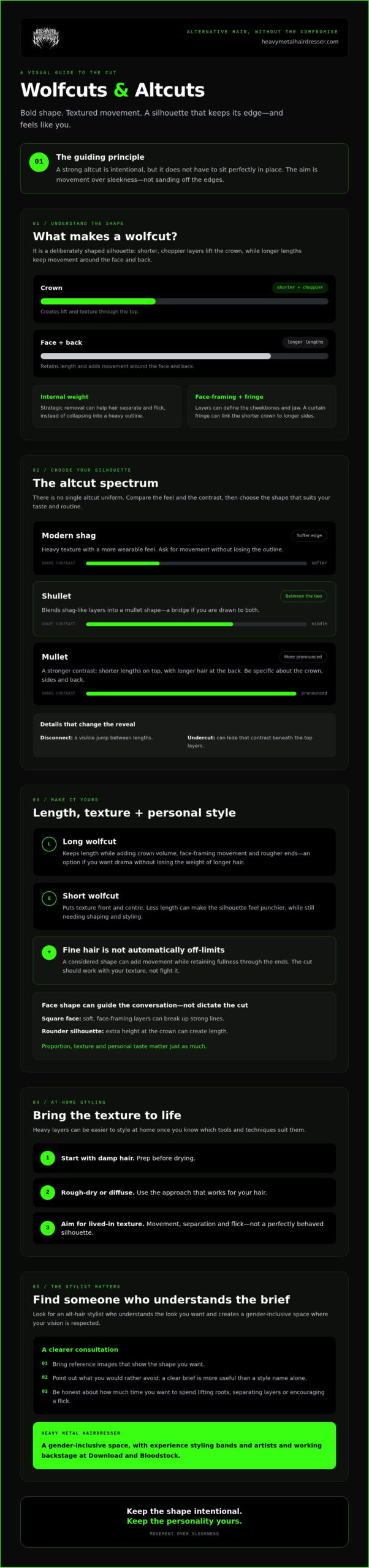
A wolfcut isn’t simply a shag with a mullet bolted on. It’s a deliberately shaped silhouette, with shorter, choppier layers creating lift through the crown and longer lengths retaining movement around the face and back. The result has contrast and direction rather than a uniform cascade of layers. Wikipedia describes a variation of the shag called a wolf cut, placing it within the shag’s wider haircut history.

Altcuts is the bigger picture. The term can include shullets, jellyfish cuts and disconnected mullets, each playing with shape, separation and proportion in a different way. The shared principle is movement over sleekness. Think controlled chaos: the cut should have intention, but it doesn’t need to sit perfectly in place to look finished.

Wolfcuts & altcuts bring music, identity and personal style into the shape of a cut. They aren’t one fixed trend, but a way to create personality through proportion and texture.

The Anatomy of a Professional Wolfcut

The shape depends on more than piling layers on top. A stylist can remove internal weight strategically to help the hair separate and flick instead of collapsing into a heavy outline. Face-framing layers can sharpen the silhouette around the cheekbones and jaw. A curtain fringe can anchor the look, linking the shorter crown to the longer sides. Its length and density matter: it should feel like part of the cut, not an afterthought.

The Subcultural Roots: From Punk to the Mosh Pit

The wolfcut’s shag-and-mullet DNA echoes the long relationship between alternative hair and rock, from the free-moving shapes associated with 1970s rock to the louder styles seen around modern festival culture. The point isn’t to copy a specific era, but to carry its defiant spirit forward.

For heavy metal and underground communities, hair can be part of the signal: a visible refusal to blend in. The shift is from perfection to personality. Texture, unevenness and an unapologetic outline aren’t flaws to correct; they’re part of the design. Heavy Metal Hairdresser brings that subcultural context into its work, with experience styling prominent bands and artists and working backstage at Download and Bloodstock. A strong altcut should look intentional, but it should still feel like you.

The Altcut Spectrum: Choosing Your Silhouette

There’s no single altcut uniform. A modern shag brings heavy texture with a softer, more wearable edge, while an aggressive mullet makes the contrast more pronounced, with shorter lengths on top and longer hair at the back. A shullet sits between the two, blending shag-like layers into a mullet shape. The Guardian captured that easy-going appeal in its piece on the easy, breezy shullet.

Want a sharper reveal? Disconnects create a visible jump between lengths, while an undercut can hide that contrast beneath the top layers. These details let you dial up the edge without changing the whole outline. Bring reference images that show the shape you want, and point out what you’d rather avoid. That gives your stylist a clearer brief than a style name alone.

Long Wolfcut vs Short Wolfcut: Choose Your Weapon

A long wolfcut keeps the length while adding crown volume, face-framing movement and rougher ends. It can suit anyone who wants drama without losing the weight of longer hair. A short wolfcut puts texture front and centre; less length can make the silhouette feel punchier, though it still needs shaping and styling. Think about your daily routine: how much time do you want to spend lifting the roots, separating layers or encouraging a flick? Be honest about that before choosing.

Altcuts for Different Face Shapes

Face shape can guide the conversation, but it shouldn’t dictate the cut. Soft, face-framing layers can break up strong lines around a square face; extra height at the crown can lengthen a rounder silhouette. Proportion, texture and personal taste matter just as much. Wolfcuts & altcuts are about making the shape yours, not following a chart. If you want to explore how a specialist approaches individual silhouettes, see Heavy Metal Hairdresser’s alternative hair work.

For a wearable shag, ask for texture that moves without losing the outline. For a full-throttle mullet, be specific about the contrast between the crown, sides and back. If you’re drawn to both, a shullet can bridge the gap. There’s no face-shape rule that outranks your own taste.

Injecting Chaos into Thin Strands: The Wolfcut on Fine Hair

Fine hair can wear a wolfcut. The idea that it must stay blunt and untouched confuses fine strands with low density and assumes layers always reduce impact. A considered cut can use texture to build lift and movement. The key is control: remove weight where it helps the shape, but keep enough fullness through the ends to avoid a wispy outline.

Ask whether a dry-cutting approach would suit your hair. Seeing the strands in their natural fall can help a stylist judge where the layers sit and how much weight to remove. Shattered ends add separation and a broken-up edge, creating the impression of movement without cutting broad, thin sections. Explore the technique in this guide to the wolfcut on fine hair.

Technical Secrets for Fine Hair Volume

For lift, a stylist may shorten selected crown layers so they don’t lie flat against the head. The back needs a considered shape too: remove too much from the bottom and the mullet outline can turn see-through. Keeping a stronger perimeter, then adding texture selectively above it, can help preserve the look of fullness while creating a more jagged finish. Strand thickness, density and natural movement all affect how a wolfcut or altcut should be shaped.

At home, start with a light touch. A small amount of salt spray or texturiser can encourage separation and grip, but too much product may weigh fine strands down or make them feel stiff. Work it through sparingly, then add more only where the shape needs definition.

Styling for Maximum Oomph

Use a diffuser to encourage natural bends and lift without blasting the layers into a flat sheet. Cup sections gently and move the diffuser around your head; avoid scrubbing the hair, which can disturb the shape. If your hair responds better to your hands, try scrunch-drying: press the ends upwards towards the roots as you rough-dry, then let the layers settle before adding more product.

Keep the finish lived-in, not shellacked. Heavy creams and waxes can collapse fine hair, especially near the roots. Start with clean, damp hair and a light texturising product, then dry until it’s almost set before deciding whether you need extra grit. A little separation often gives a wolfcut more bite than coating every strand.
Wolfcuts and Altcuts: Your Guide to Edgy British Styles

How to Style a Wolfcut: Mastering Aggressive Texture

A wolfcut comes alive through separation, lift and a bit of deliberate disorder. You don’t need a polished blow-out. Build the shape, then let the layers do their thing. Adjust the amount of product and heat to your hair’s texture and the finish you want.

  • Prep: Work a texturising primer through damp hair, concentrating on the lengths rather than saturating the roots with product.
  • Build the shape: Rough-dry for a relaxed finish, or use a diffuser to encourage natural bends and lift. Direct air towards the roots for volume, then dry the fringe and face-framing pieces into place.
  • Define: Warm a small amount of matte clay or texture paste between your hands. Pinch it into selected layers and ends for separation instead of coating every strand.
  • Disorganise: Use your fingers or a wide-tooth comb to break up neat sections and shift the layers into a less uniform shape.
  • Set: If you need extra staying power, mist with a high-hold hairspray from a distance. Use a light veil, then scrunch or lift the hair rather than pressing it flat.

Essential Tools for the Alt-Hair Kit

A diffuser is useful for building texture without flattening natural movement, particularly if your hair waves or curls. It isn’t the only option: rough-drying can work well when you want a looser, less defined finish. Matte clays and texture pastes tend to create a drier, more separated look than shine-heavy pomades, which can make layers appear smoother and more grouped. Use a flat iron to make soft S-waves by gently bending the hair in alternating directions rather than winding it into uniform curls. Keep the iron moving and follow its safety instructions.

Maintaining the Grit Between Salon Visits

On second-day hair, dry shampoo can do more than refresh the roots. Used sparingly, it can add grip and help revive flattened layers. For a tired fringe, dampen just the fringe, reshape it with your fingers or a brush, then dry it into place. No full wash needed. For more on how to style a wolfcut between washes, use the guide as a starting point and adapt the method to your own texture.

Wolfcuts & altcuts look strongest when the finish still moves. Start with less product than you think you need, then build definition only where the layers lose their shape. For a cut shaped around texture and attitude, explore alternative haircuts at Heavy Metal Hairdresser.

Finding Your Style Master: The Alt-Hair Specialist

A dramatic cut needs more than someone who can use scissors. The right stylist should understand the references, attitude and shape you’re asking for, then adapt the cut to your hair and everyday routine. When searching for a wolfcut hairdresser, look for someone who respects the subculture behind the silhouette rather than automatically softening it into a more conventional shape.

That respect matters in the chair too. For non-binary and gender-diverse people, a gender-inclusive safe space means being able to talk about the look you want without fitting it into a gendered haircut category. Describe the length, shape and feeling you’re after. You can also share any language or boundaries that will help you feel comfortable.

Make your vision easy to read. Bring a mood board with different angles, point out the details you love, and name what you don’t want copied. Music references can help too: describe the energy, whether it’s raw and jagged or more flowing and dramatic. Wolfcuts & altcuts are personal; a clear brief helps your stylist shape the idea around you.

The Heavy Metal Hairdresser Philosophy

Heavy Metal Hairdresser was founded by Simon Tuckwell, a barber and creative stylist. Its work includes styling for prominent bands and artists, plus backstage festival work at Download and Bloodstock. That experience brings a connection to the scene, but your cut shouldn’t be a copy of someone else’s look. It should reflect your identity, texture and appetite for change.

Creative colour can push an altcut into a different register, highlighting its layers or making its shape more graphic. If vivid shades are part of your vision, explore this guide to vivid hair colour as a way to think through how colour and silhouette might work together.

Booking Your Transformation

Before committing to a new shape, discuss your reference images, current hair, styling routine and the amount of change you’re ready for. Ask how the proposed layers will sit, what upkeep they’ll need and how the cut could grow out. You don’t need specialist vocabulary; clear examples and honest answers are enough. Heavy Metal Hairdresser offers Wolfcuts for people seeking an alternative silhouette. Explore Wolfcuts at Heavy Metal Hairdresser and take your next step towards a cut that feels like yours.

Make Your Next Cut Unmistakably Yours

The right alternative cut is more than a silhouette. It’s a shape built around your texture, your identity and the level of edge you want to wear. Wolfcuts & altcuts can bring lift and movement to fine hair, retain their grit with a considered styling routine, and range from shag-inspired layers to full-throttle mullet contrast.

Your stylist should understand the vision, not dilute it. Heavy Metal Hairdresser offers alternative haircuts, vivid colour and a gender-inclusive space where you can talk through the look you want on your own terms. Its work celebrates individuality rather than copying a trend.

Ready to turn your references into a cut with real attitude? Explore Wolfcuts at Heavy Metal Hairdresser. Bring your ideas, own your edges and make the next look yours.

Frequently Asked Questions

Is a wolfcut high maintenance for daily styling?

A wolfcut can be low-fuss day to day if its layers work with your natural texture. Some mornings, a quick rough-dry or a little texturiser may be enough; other hair types need more shaping to bring out the flick and volume. Tell your stylist how much time you actually want to spend styling it. The cut should fit your routine, not turn every morning into a full production.

Can I get a wolfcut if I have curly hair?

Yes, curly hair can work with a wolfcut, provided the shape is designed around your curl pattern and how much your hair shrinks as it dries. Ask the stylist to consider where curls will sit when dry, especially around the fringe and crown. Bring photos of your hair on an ordinary day, not only freshly styled. That helps set expectations for the outline and finished length.

What is the difference between a wolfcut and a shag?

A wolfcut generally combines shag-like layers with a stronger mullet influence, often creating more contrast between the crown and the longer back. A shag can have heavy texture too, but its outline may feel more evenly layered and less pronounced at the back. The names aren’t rigid rules, though. Show your stylist the exact shape you mean, since one person’s idea of a wolfcut may differ from another’s.

How often should I trim my altcut to keep the shape?

There isn’t one trimming schedule for every altcut. A sharp fringe, close undercut or very defined disconnect may need attention sooner than a longer, more blended shag. Watch how the shape changes as it grows and book a trim when the outline stops sitting as you like. At your appointment, ask your stylist what to monitor and how your specific cut is likely to grow out.

Will a wolfcut work with a very short fringe?

Yes, a very short fringe can pair with a wolfcut for a stark, graphic contrast. Decide how it connects to the crown and face-framing layers, or whether you want it to stand apart. Consider how your fringe behaves as it grows and whether you’re comfortable styling it. Bring reference photos showing the fringe from the front and side, then discuss how your hair’s texture may affect its shape.

How do I stop my wolfcut layers from looking flat?

Start by lifting the roots as you dry your hair, using your fingers to direct the airflow beneath the layers. A diffuser can encourage natural movement, while a light texturiser can add separation where the hair needs it. Use small amounts and build gradually, especially if your strands are fine. Heavy product or applying too much near the roots can weigh the shape down instead of giving it more life.

Are wolfcuts gender-neutral?

Yes. A wolfcut is a shape, not a gender category. Its length, fringe, layering and level of contrast can be adapted to suit the person wearing it. Explain what you want the cut to express, and use reference images if words don’t quite capture it. A gender-inclusive stylist should listen without forcing your ideas into a gendered menu. Wolfcuts & altcuts are for anyone who connects with their attitude and shape.

Can I transition from a bob to a wolfcut easily?

Often, yes, but the result depends on your bob’s length, layers and current outline. A stylist may be able to reshape the top and sides straight away while keeping enough length at the back for the silhouette you want. If your bob is very short or blunt, you may need a gradual transition rather than one dramatic change. Bring photos and ask which parts are achievable now and which may need time to grow.
Posted on

Vivid Hair Colour Specialist Nottingham: The Alt-Hair Destination Guide

Vivid Hair Colour Specialist Nottingham: The Alt-Hair Destination Guide

Your hair isn’t a temporary fashion experiment; it’s a subcultural manifesto that traditional, clinical salons simply aren’t equipped to handle. Most stylists treat neon pigments as a novelty, leaving you with fading shades and a cut that misses the mark on your aesthetic. You’ve likely felt the sting of paying for a transformation only to see your identity wash down the drain within a week. It is time to stop settling for stylists who don’t understand the difference between a standard trim and a precision wolfcut.

Finding a vivid hair colour specialist who actually respects your alternative roots shouldn’t be an impossible task. You deserve a space where your style is celebrated and your colour stays saturated for more than two washes. This guide will show you how to achieve high-impact results that last. We will cover the essential chemistry of alternative pigments, the importance of technical texture, and how to maintain your look long after you leave the chair. Discover how to protect your hair investment and find a community that truly gets your vibe.

Key Takeaways

  • Learn why high-impact pigment requires technical mastery of chemistry rather than a basic high-street foil service.
  • Discover how a vivid hair colour specialist Nottingham uses low and slow bleaching to keep hair healthy for maximum saturation.
  • Identify the dangers of DIY kits and why professional expertise is vital to avoid chemical damage or patchy results.
  • Master the cold water rule and maintenance secrets to keep your alternative aesthetic fresh through every gig.
  • Find out why a gender-inclusive and music-influenced salon is the key to having your subcultural identity truly respected.

Defining the Vivid Hair Colour Specialist in Nottingham and Beyond

Vivid hair colour isn’t just about picking a bright shade from a swatch book. It is a technical discipline that requires a deep understanding of both chemical mastery and subcultural identity. While a traditional high-street salon might excel at standard “foil and tint” services, they often lack the grit and specialist knowledge required for high-impact neon or deep jewel tones. A true vivid hair colour specialist Nottingham understands that these pigments don’t behave like standard browns or blondes. They require a stylist who merges technical expertise with an appreciation for the “alt” aesthetic.

This isn’t a service you find on every street corner. It is a destination. People travel from across the UK to find a stylist who speaks their language and respects their vision. They want someone who knows that a shock of electric blue is a manifesto of who they are, not just a seasonal trend. We treat every appointment as a collaboration, ensuring your hair reflects your internal world without compromise.

The Chemistry of Creative Pigment

Vivid dyes work differently than the oxidative colours used in mainstream salons. Standard dyes use a chemical reaction to penetrate the hair shaft, but creative pigments require a more nuanced approach. Vivid hair colour is a non-oxidative pigment process. These pigments act more like a stain, sitting on the outer layers of the hair. This makes the “canvas” preparation absolutely crucial for the final result.

Achieving that perfect neon green or soft pastel lilac depends entirely on the pre-lightening stage. You cannot just slap dye over dark hair and expect it to pop. A vivid hair colour specialist Nottingham manages the bleaching process with extreme care. We ensure the hair is light enough to show the pigment whilst protecting its structural integrity. It is a precise balancing act of chemistry and patience.

Why “Specialist” Matters for Alternative Styles

Integrity is everything. Pushing the boundaries of saturation shouldn’t mean sacrificing the health of your hair. Beyond the technical, the consultation is a safe space where your identity is celebrated. We don’t judge the “weird” or the “unconventional.” This is a space where being different is the standard, and your stylist acts as a knowledgeable guide through your transformation.

Saturating Your Identity: The Technical Mastery of Creative Colour

High-impact colour isn’t an accident. It’s the result of a calculated, technical process that begins long before the pigment touches your hair. To get those neon yellows and deep magentas to actually stay, you need more than just a bottle of dye. You need a vivid hair colour specialist Nottingham who understands the intricate relationship between hair porosity and pigment suspension. This is where the science of subculture meets the art of the alternative.

The foundation of every great vivid service is the pre-lightening stage. We advocate for a “low and slow” bleaching method. Blasting your hair with high-volume peroxide might get you to a pale blonde quickly, but it leaves the cuticle shredded. When the cuticle is blown wide open, your expensive vivid colour will simply wash out in two days. By lifting the hair gently, we maintain the hair’s “grip,” allowing the direct dyes to anchor themselves properly. Unlike permanent oxidative dyes, vivids are non-damaging pigments that live or die by the quality of the canvas beneath them.

Achieving Maximum Saturation

Saturation is about more than just slapping on a lot of product. It requires strategic sectioning, especially when working with heavily textured styles like Shag Haircuts or Wolfcuts. We use specific techniques to ensure even distribution across every layer. If you’re looking for multi-tonal effects like colour melting, prism hair, or split dyes, precision is everything. We prevent “muddying” by understanding how different shades interact on the colour wheel. You don’t want your electric blue bleeding into your sunset orange and creating a murky grey. If you’re looking to level up your own skills, our Hair Courses dive deep into these advanced application methods.

Maintaining Hair Integrity Amongst the Chaos

Pushing your hair to a level 10 blonde for a pastel transformation is a risk. We mitigate that risk with advanced bond-building treatments that work at a molecular level. These treatments repair the disulphide bonds broken during the lightening process, ensuring your hair feels like hair, not straw. A specialist always prioritises the long-term health of your mane. During your consultation, we’ll be honest about what’s possible. If your hair has years of black box dye, we won’t promise a neon mint green in one session. We’ll build a roadmap that gets you to your goal without your hair ending up on the floor. It’s about expressive colour without the compromise of chemical burns or breakage.

Vivid Hair Colour Specialist Nottingham: The Alt-Hair Destination Guide

Professional Vivids vs DIY Disasters: Why Expertise Matters

The temptation of a ten pound box of bleach and a tub of chemist-bought dye is real. We get it. But there is a massive gap between a bathroom floor DIY job and the precision work of a vivid hair colour specialist Nottingham. High-street bleach kits are usually “one size fits all” chemicals with aggressive volumes of peroxide. They don’t account for your hair’s history, previous dye layers, or current structural integrity. This lack of control leads to uneven lifting, patchy “leopard” spots, and in the worst cases, chemical burns that can permanently damage your scalp and follicles.

Professionals use high-grade pigments with superior suspension technology. These outlast high-street alternatives because they are designed for maximum saturation without the cheap fillers found in budget brands. When we handle “bleach over bleach” scenarios, we use protective barriers and low-strength developers to lift the hair without snapping the protein bonds. It’s a precise operation that requires a steady hand and a deep understanding of hair structure. We aren’t just applying colour; we are managing a chemical process to keep your hair on your head.

The Risk of Home Bleaching

One of the most common DIY fails is the “hot roots” phenomenon. The heat from your scalp causes the bleach to process significantly faster at the base, leaving you with glowing yellow roots and muddy, dark ends. Achieving complex placements like split dyes or prism effects is nearly impossible when you can’t see the back of your own head. You end up with a blurred mess instead of the sharp, intentional lines of an alt-aesthetic. Professional vivids are an investment in hair longevity.

Corrective Colour: When DIY Goes Wrong

If the damage is already done, we step in with corrective expertise. Removing stubborn home dyes like box-black or “staining” pigments like forest green requires a surgical approach. We use specialised removers that target synthetic pigment without destroying the natural hair fibre. Neutralising a botched blue or green requires a master’s knowledge of the colour wheel to avoid a murky, grey result. At Heavy Metal Hairdresser, we don’t judge the DIY attempt; we just focus on the recovery. We use advanced bond-builders to stabilise the hair whilst we work to get your subcultural identity back on track with the saturation you originally wanted.

Preparing for Your Transformation: Maintenance and Mosh Pits

Walking into the salon is only half the battle. To ensure your pigment stays as aggressive as your playlist, you need a solid game plan. Arrive at your session with hair that’s clean but not freshly washed that morning. Avoid heavy waxes or styling goop. We need to see your natural texture and base colour without the interference of product buildup. As a vivid hair colour specialist Nottingham, we’ve seen how poor prep can slow down the lightening process. Bring your reference photos, but be prepared for an honest conversation about what’s achievable in one sitting.

Once you leave the chair, the cold water rule becomes your new religion. Heat is the primary enemy of creative pigment. Hot water swells the hair cuticle, allowing those expensive direct dyes to simply rinse away. It’s painful, but washing with cold water is the only way to keep your neon shades from turning into muddy pastels. Use sulfate-free cleansers. Sulfates are harsh detergents that strip colour faster than a mosh pit strips your dignity. If you’re heading to a festival like Download or Bloodstock, pack a hat. UV rays act like a low-level bleach, fading your saturation before the headliner even takes the stage. Rinse out sweat and grime immediately after a set to stop salt from dehydrating your strands.

The Survival Guide for Saturated Strands

Preservation is about washing frequency. Aim for once or twice a week at most. Dry shampoo is your best friend here. It absorbs the grit and oil without disturbing the pigment. When you do wash, use a pigment-depositing conditioner to top up the vibrancy. This is especially vital for high-maintenance shades like silver or peach. If you’ve paired your colour with a bold shape, check out our guide on how to maintain a shag haircut to keep the layers looking sharp between appointments.

Styling for Maximum Impact

Vivid colour thrives on texture. Flat, sleek hair often hides the depth of a multi-tonal melt. Use sea salt sprays or matte clays to break up the surface and let the light hit different pigments. Be careful with heat tools. Straighteners and curlers can literally cook the colour out of your hair if the temperature is too high. Always use a professional heat protector and keep the settings low. You can find our recommended textured styling products in our gear guide to ensure your finish has that essential subcultural edge.

Your hair is a statement. Treat it like one. If you’re ready to ditch the boring browns and embrace the noise, secure your spot with a vivid hair colour specialist Nottingham today.

Heavy Metal Hairdresser: Expressive Colour Without Compromise

Heavy Metal Hairdresser isn’t just a salon; it’s a sanctuary for the unconventional. Simon Tuckwell founded this space to bridge the gap between high-end technical mastery and raw, subcultural grit. We’ve built a national destination for those who refuse to settle for the clinical, judgmental atmosphere of traditional high-street shops. Here, your aesthetic is understood without you having to explain it. If you’ve been searching for a vivid hair colour specialist Nottingham that actually understands the weight of a heavy metal influence, you’ve found your tribe. We don’t just follow trends. We define them for the outcasts and the innovators who live outside the mainstream.

Our connection to the music scene runs deep. Our stylists are regularly found backstage at festivals like Download and Bloodstock, working with the bands and crews who keep the alternative scene alive. This insider knowledge allows us to merge high-impact pigments with precision Wolfcuts and textured Shag Haircuts. We create cohesive, aggressive looks that stand out in any crowd. It’s about more than just dye; it’s about a technical subcultural statement that merges grit with chemistry. We encourage our clients to travel for this expertise because your identity deserves a specialist who truly “gets” it.

More Than Just a Haircut

We operate as a gender-inclusive safe space where every identity is celebrated rather than merely tolerated. Traditional beauty industry jargon and gendered price lists have no place here. Our services are inclusive and gender-neutral as a standard. We believe your hair should reflect your internal world, not a corporate box. Being amongst like-minded alternative souls creates a community atmosphere that you won’t find in a standard salon. We provide a space where being different is the norm, and our technical proficiency ensures your hair stays healthy whilst pushing the boundaries of saturation.

For those looking to document their alternative identity during a wedding, finding a creative who understands your vibe is essential. Twig & Vine Photography specialises in capturing these moments with a unique edge; learn more about their hybrid approach to photography and film.

Booking Your Vivid Revolution

Starting your transformation requires a collaborative, methodical approach. We prioritise your safety and hair health above all else, which is why a patch test is a non-negotiable part of our process. We want to see your vision, so bring your mood boards of alternative inspiration. Whether it’s digital art, subcultural icons, or music video aesthetics, we’ll translate that energy into a technical reality. This is an investment in your self-expression. Don’t leave your identity in the hands of someone who doesn’t share your passion. It’s time to stop compromising on your aesthetic and start your evolution. Book your vivid hair colour specialist session and secure your spot in the chair.

Ignite Your Subcultural Transformation

Your hair is the loudest part of your identity; don’t let it be silenced by a clinical salon that doesn’t understand your roots. We’ve explored how technical mastery of pre-lightening and the “cold water” rule are the only ways to ensure your pigment survives the pit. Choosing a vivid hair colour specialist Nottingham means choosing a stylist who merges chemical precision with a deep respect for the alternative scene. You aren’t just a client; you are part of a community that values saturated expression above all else.

As official stylists for festivals like Download and Bloodstock, we live and breathe the same music you do. We specialise in the intersection of aggressive wolfcuts and neon pigments, providing a gender-inclusive safe space where your vision is the blueprint. It’s time to stop settling for patchy home jobs and fading high-street tints. Your evolution starts with a specialist who understands the grit behind the glamour. Join the revolution and book your vivid colour session today. Let’s create something unapologetic.

Frequently Asked Questions

How long does vivid hair colour usually last?

Expect your vibrancy to hold for approximately 4 to 8 weeks depending on the specific shade and your aftercare routine. Pastels and silver tones sit on the shorter end of that scale, whilst deep purples and blues have more staying power. Using professional-grade, sulfate-free products is the only way to ensure your pigment doesn’t vanish after a single wash.

Do I need to bleach my hair to get vivid colours?

Yes, achieving high-impact neon or pastel results requires a lightened canvas so the pigment can actually show. Since vivid dyes are non-oxidative, they cannot lift your natural hair colour on their own. We use a methodical, low-and-slow bleaching process to reach the necessary blonde level without compromising the structural integrity of your hair fibres.

Can I get vivid hair colour if I have dark hair?

Absolutely, but it involves a multi-step journey to safely lift your base. A vivid hair colour specialist Nottingham will assess your hair’s history to create a realistic roadmap. We transition dark hair to a pale blonde foundation first, ensuring the hair remains healthy enough to anchor the creative pigment for a saturated, professional finish.

Is vivid hair colour damaging to my hair?

The vivid pigment itself is actually conditioning and non-damaging; the only risk lies in the pre-lightening stage. We mitigate this by using advanced bond-building treatments during the bleaching process to repair disulphide bonds as we work. This approach allows for extreme transformations whilst keeping your hair feeling like hair rather than straw or cotton wool.

How often should I touch up my creative colour?

Most of our alternative community returns every 6 to 10 weeks for root maintenance and a pigment refresh. If you are rocking high-maintenance placements like split dyes or prism hair, you might want to visit sooner. Lived-in vivids or heavier textures like wolfcuts can often stretch a bit longer between professional sessions without losing their edge.

What is the best way to stop vivid hair colour from fading?

Wash your hair with the coldest water you can stand and drastically reduce your washing frequency. Heat is the primary enemy of creative pigment as it forced the hair cuticle open. Use dry shampoo to manage oil between rinses and always apply a professional heat protector before using any styling tools to prevent “cooking” the colour out.

Are your hair services gender-inclusive?

Yes, we are an unapologetically gender-neutral and inclusive safe space for everyone. Our pricing is based entirely on the time required and the technical complexity of the service, never on gender. We believe that self-expression through alternative hair should be accessible and supportive for all members of our subcultural community without exception.

Do I need a patch test before a vivid colour appointment?

Yes, a patch test is a mandatory safety requirement at least 48 hours before your transformation begins. Even as a vivid hair colour specialist Nottingham, we never skip this step. It ensures you don’t have an adverse reaction to the lightening agents or pigments, keeping your experience in the chair as safe as it is creative.