A rainbow badge doesn’t prove a hairdresser will respect you. The real test is what happens in the chair: whether they use your name and pronouns, listen to the look you want and treat your self-expression as normal. If you’re wondering how to find an inclusive hairdresser, look beyond the slogans.
It makes sense to feel cautious. You might worry about being misgendered, judged for your style or talked into a cut that doesn’t feel like you. A good appointment should be about your hair, not defending who you are.
This guide will help you spot practical signs of inclusion before booking, assess a salon’s portfolio and reviews, and feel more prepared for a consultation. You’ll find useful questions to ask and ways to describe the cut or aesthetic you’re after, whether that means a sharp crop, a shag or a full-on wolfcut. No guessing games: just clearer signals, better conversations and more confidence in choosing a hairdresser who welcomes individuality.
Key Takeaways
- Learn how to find an inclusive hairdresser by looking beyond welcoming language to the salon’s work, communication and consultation approach.
- Compare practical signals without treating inclusive wording as a guarantee.
- Bring reference images to show the shape, texture, colour and level of change you have in mind.
- Share your name, pronouns and personal boundaries in whatever way feels comfortable to you.
- See how Heavy Metal Hairdresser’s alternative cuts and creative styling make room for individuality and self-expression.
How to Find an Inclusive Hairdresser: What Inclusion Should Feel Like
Choosing a hairdresser can feel personal, especially if a past appointment left you misgendered, judged or unheard. Hair can be tied to identity, culture and how you want to show up in the world. It’s understandable to want more than a sharp pair of scissors and a vague promise to be welcoming.
An inclusive hairdresser listens without assumptions, respects how you identify and makes room for your comfort, needs and style. Inclusion shows up in everyday behaviour, from the first booking interaction through to the final styling.
What does an inclusive hairdresser actually do?
They use the name and pronouns you ask them to use, and correct a mistake without making you responsible for comforting them. They ask what you want your hair to do and how you want it to look, rather than steering you towards a “men’s” or “women’s” cut based on your appearance.
They also recognise that clients bring different identities, hair textures, aesthetics and comfort levels. You might want a subtle trim, a dramatic wolfcut or something that breaks familiar rules. Respectful care means taking your goals seriously without treating them as a problem.
Why a safe-space claim is only the starting point
A safe-space statement can be a positive signal, but a slogan alone won’t tell you how a salon handles booking, listens during a consultation or responds if something feels uncomfortable. Look for a consistent picture across its public information, examples of its work and the way it communicates.
Hair discrimination remains a concern, including around natural textures and protective hairstyles. Respectful treatment is more than a marketing detail. Still, a badge, label or polished post can’t tell you everything about a salon’s practice, so consider it one signal among several.
In short, inclusion should feel like being recognised, listened to and free to describe the look you want. You shouldn’t have to perform, explain your identity or accept someone else’s idea of what suits you. As you work out how to find an inclusive hairdresser, focus on whether a salon’s actions match its words.
How to Assess an Inclusive Hairdresser Before You Book
Once you know what respectful care should feel like, use a simple three-step check before booking. You’re not trying to predict every detail. You’re looking for practical signs that the hairdresser’s skills, communication and approach line up with what you need.
Read the salon’s language, services and portfolio
1. Scan the wording and service descriptions. Look for language that recognises different identities and personal styles without making assumptions about who should choose which cut. Clear descriptions of techniques and results can help you work out whether a stylist’s work suits what you’re after. For example, a shag or wolfcut presented as a style, rather than sorted into gendered boxes, keeps the focus on the haircut.
2. Study the portfolio for relevant work. Look for a range of cuts, textures and forms of self-expression, then compare the examples with your own hair and the look you’re considering. If you want a heavily textured shape or vivid colour, photos of similar creative work can help you assess the stylist’s range. They’re evidence of skill, not proof of how every client is treated.
This broader expectation of representation also reaches beyond hair. Bentley University discusses why inclusive beauty brands matter, including the value of recognising needs that have often been overlooked.
Use the first interaction as useful evidence
3. Notice how booking communication feels. Is the information clear? Does the reply address your question without making assumptions about your gender, appearance or reasons for wanting a particular style? You can share a preference or concern, such as “I’d like to keep my sides short” or “Please use they/them pronouns”, and notice whether the response is straightforward and respectful.
You’re not obliged to disclose anything personal to earn decent treatment. If an exchange feels dismissive, confusing or uncomfortable, you can pause and trust your judgement. You don’t have to talk yourself into a situation that feels wrong.
These checks make how to find an inclusive hairdresser a practical decision, not a leap of faith. At Heavy Metal Hairdresser, barber and creative stylist Simon Tuckwell brings an individual-focused approach to expressive cuts, textured styling and vivid colour. Explore Heavy Metal Hairdresser’s alternative hair work to see the creative styles in the portfolio.
How to Compare Hairdressers Without Mistaking Marketing for Inclusion
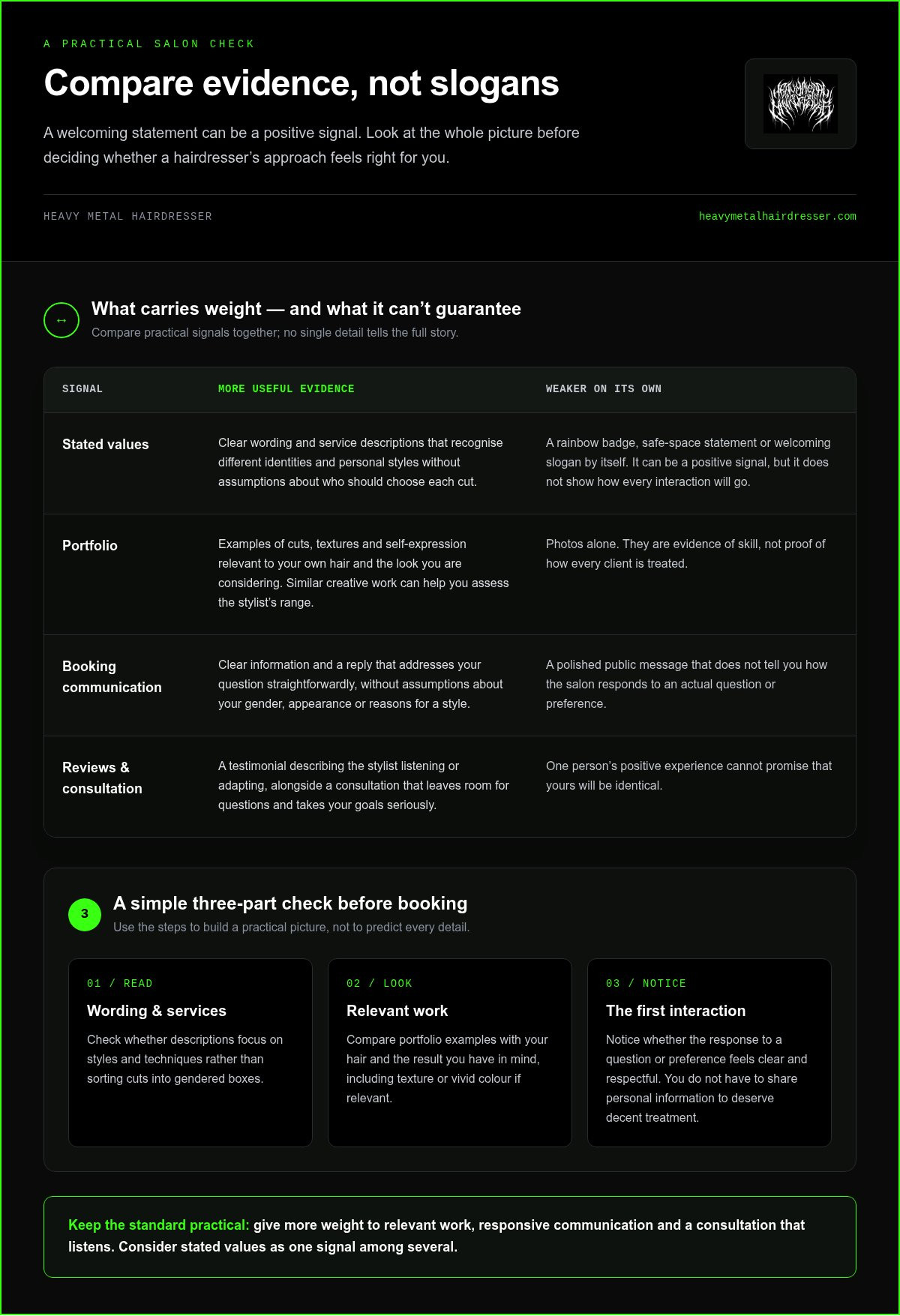
Inclusive wording matters, but it can’t guarantee how every interaction will go. A rainbow symbol or a line about being welcoming is one piece of information, not a full picture. To make a fair comparison, weigh several signals together and focus on what you can observe rather than guessing a salon’s intentions.
Industry guidance on creating safe and inclusive salon environments can help explain what respectful practice may involve. Use that context to consider the evidence in front of you, not to expect a flawless performance from every salon.
Which signals deserve the most weight?
Give more weight to details that connect directly to your appointment: clear service information, examples of work relevant to your desired result, responsive communication and a consultation that leaves room for questions. A testimonial can add useful context, especially if it describes the stylist listening or adapting. But one person’s positive experience can’t promise that yours will be identical.
| Signal | More useful evidence | Weaker evidence on its own |
|---|---|---|
| Stated values | Specific language about respectful communication, names or personal style. | A general “everyone welcome” slogan with no further detail. |
| Relevant work | Portfolio examples showing cuts, textures or creative results similar to what you want. | A single attractive photograph that doesn’t show the range of work. |
| Communication | A clear, considered response to a practical question or preference. | A badge, flag or symbol without any interaction to add context. |
| Consultation | Space to explain your goals, ask questions and discuss options. | Assuming a friendly tone alone means your needs have been understood. |
The point isn’t to score a salon or label it as good or bad. It’s to compare the information available and notice whether different signals support one another. A strong portfolio shows creative ability; respectful communication gives you a better sense of how that skill may translate into a client experience.
What if a salon’s public information is limited?
Limited online detail doesn’t prove inclusion, and it doesn’t prove exclusion. Some salons simply share less publicly. If you’re still interested, use the first booking exchange or consultation to gather more information. Ask a focused question about the cut you want or explain one preference, then notice whether the reply is clear, respectful and relevant.
You get to decide what feels comfortable. If the answer leaves you uneasy, take time before booking and trust your own judgement. That decision is personal, not an accusation. The practical answer to how to find an inclusive hairdresser is to compare observable evidence, then consider whether the overall picture feels right to you.
How to Prepare for an Inclusive Hair Consultation
You don’t need a perfect script or a fully formed plan before you sit down. A few reference images and clear notes about what matters to you can turn “I want something different” into a shared starting point. You’re allowed to be unsure, too. The consultation should leave space to explore options, not pressure you into a decision.
Share the result you want, not just a haircut name
A style name can mean different things to different people. Bring images that show the shape, layers, fringe, colour placement or overall energy you’re drawn to. For a shag or wolfcut, one photo might show the silhouette you like, whilst another captures the texture or fringe you want. Use them as clues, not a demand for an exact copy.
Explain what you want to keep, change or avoid, including how much time you want to spend styling your hair day to day. For example: “I like the layers in this picture, but I want to keep the length,” or “I’m interested in vivid colour, but I’d like to talk through how noticeable the change would be.” You can also mention past experiences that affect what feels comfortable, but you don’t owe anyone a personal history.
Set boundaries and keep the conversation yours
Sharing your name, pronouns or preferred forms of address is your choice. If it feels useful, you could say, “I go by Alex and use they/them pronouns,” or simply offer your name without explaining anything further. You can also set practical boundaries, such as asking before a major change or saying you’d rather not discuss a particular topic.
Before agreeing to a big shift in length, shape or colour, ask what the change involves and what it may mean for your everyday styling. You might say, “Could you talk me through that option first?” or “I’m not ready to decide yet.” A good consultation is a conversation, not a one-way instruction. You can ask for an adjustment, clarify something that doesn’t feel right or pause the discussion.
Consent and comfort aren’t a one-time checkbox. Keep speaking up as the plan takes shape, and expect your preferences to be part of the conversation throughout. If you’re exploring expressive cuts, discover shags and wolfcuts from Heavy Metal Hairdresser, where individuality and alternative styling take centre stage.
An Inclusive Hairdresser Should Make Room for Your Individual Style
Respectful care and creative freedom belong together. A stylist shouldn’t prescribe a look based on your identity or treat an alternative cut or vivid colour as something you need to justify. Their job is to listen to what you want and use their skill to help shape your vision.
That might mean a shag with movement, a mullet with a sharper silhouette, a wolfcut with plenty of texture or colour that turns the volume up. Alternative hair isn’t one fixed look. It’s a way to explore what feels right for you, whether that means a bold transformation or a subtle shift.
Alternative hair is about self-expression, not fitting a mould
Good creative work starts with your goals, not assumptions about who you are or what you “should” wear. You can take inspiration from a trend without having to fit its usual mould. If you’re exploring ideas, the guide Alternative Hair Styles: A Professional Guide to UK Trends can help you discover different directions and find language for the look you want.
For an inclusive stylist, individuality is part of the brief. Your hair can be soft, sharp, colourful, understated or gloriously unconventional. The point is that the result should feel like yours.
Find a stylist whose creative work speaks to you
Heavy Metal Hairdresser is a gender-inclusive alternative salon founded by barber and creative stylist Simon Tuckwell. The salon specialises in expressive cuts including shags, mullets and wolfcuts, as well as vivid colour and textured styling. Tuckwell’s backstage work at Download and Bloodstock, alongside styling for bands and artists, reflects a background in creative hair. That experience informs the salon’s creative approach, while every look starts with the client’s own ideas.
Explore examples of the styles that catch your eye. The Ultimate Wolf Hair Cut Guide can help you think through wolfcut variations, while the Vivid Hair Colour guide offers inspiration if you’re considering a brighter palette. Look for details that match your own vision, then use them to guide a conversation about your style.
If you’re still weighing up how to find an inclusive hairdresser, bring together the signals that matter: respectful communication, relevant creative work and a willingness to listen. Explore Heavy Metal Hairdresser’s alternative styling and consider whether its approach feels right for you. Your next look should start with what you want.
Choose a stylist who makes space for you
Inclusion isn’t a badge or a slogan. It’s the feeling that your hairdresser listens, respects your preferences and takes your ideas seriously. As you decide how to find an inclusive hairdresser, look for consistent signals: clear communication, work that speaks to your goals and a consultation where you can ask questions, share boundaries and shape the plan together.
That freedom should include your personal style, too. Heavy Metal Hairdresser is a gender-inclusive alternative salon founded by barber and creative stylist Simon Tuckwell, with alternative cuts, textured styling and vivid colour at its core. His backstage experience at Download and Bloodstock brings creative expertise, whilst respectful care starts with listening to you.
Ready to explore what your next look could be? Explore Heavy Metal Hairdresser and find your next look. Bring your ideas, trust your instincts and make room for a style that feels like you.
Frequently Asked Questions
What makes a hairdresser inclusive?
An inclusive hairdresser treats clients with respect, listens to what they want and avoids assumptions about identity or style. That can mean using your name and pronouns, explaining options clearly and giving you room to ask questions. Inclusion also means taking different textures, aesthetics and comfort levels seriously. Look for consistent behaviour across booking, consultation and styling, rather than relying on a slogan or symbol alone.
How can I tell if a hairdresser is LGBTQ+ friendly?
Look for more than a label. Check whether the salon uses respectful language, shows work that reflects varied styles and responds thoughtfully to questions about your preferences. Reviews may offer useful context, but one person’s experience can’t guarantee yours. The best clues are practical and consistent: clear information, relevant portfolio examples and communication that treats your identity as ordinary, not something you need to defend.
Should I tell my hairdresser my pronouns before an appointment?
Only if you want to. You can share your pronouns when booking, during the consultation or not at all. A simple “I use they/them pronouns” or “Please call me Alex” is enough; you don’t owe anyone an explanation. You might also choose to share a preferred form of address. A respectful stylist should follow your lead and make the conversation feel straightforward.
What should I ask an inclusive hairdresser before booking?
Ask questions that help you understand the work and the appointment, such as “Do you have examples of this kind of cut?” or “How would you approach this shape with my hair texture?” You could also ask how the consultation works or explain a preference about names, pronouns or boundaries. Notice whether the reply is clear and respectful. You’re gathering useful information, not asking for a perfect guarantee.
What if I feel uncomfortable during a hair appointment?
You can speak up, ask for a pause or stop the conversation. Try direct wording such as “I’m not comfortable with that” or “Could we talk through the next step first?” You don’t have to justify your boundary. If the situation still feels wrong, you can decide not to continue. Your comfort matters, and asking for clarification or an adjustment is a reasonable part of the appointment.
Can an inclusive hairdresser work with alternative styles and vivid colour?
Yes. Inclusion and creative expertise can go hand in hand, though it’s sensible to look for work relevant to the result you want. Heavy Metal Hairdresser is a gender-inclusive alternative salon specialising in shags, mullets, wolfcuts, vivid colour and textured styling. Founder Simon Tuckwell also has backstage festival experience at Download and Bloodstock. Use portfolio examples to discuss your own goals and the style you’re considering.
How do I explain the haircut I want if I do not know the technical terms?
Use reference images and describe what you notice in them. You might point out the overall shape, length, fringe, layers or colour placement, then say what you’d like to keep or avoid. Everyday descriptions work well: “I want more movement around my face” or “I like the texture, but want to keep my length.” You don’t need specialist vocabulary; the consultation is a chance to clarify the idea together.