
Most people treat a haircut like a polite suggestion; we treat it like a structural weapon for self-expression. You aren’t here for a sanitised, salon-standard trim that loses its soul the moment you step out the door. You’re likely worried about your new look feeling like just another fleeting TikTok trend or, worse, watching your fringe go limp before the first band even hits the stage. We get it. If you’re hunting for a wolfcut for thick hair, the goal isn’t just to lose weight; it’s to gain an aggressive, unbothered silhouette that actually stays put.
You deserve a style that feels authentic and survives the chaos of a mosh pit. We’re going to master the art of the wolfcut with fringe, from choosing the specific fringe weapon that suits your vibe to building a maintenance routine that outlasts a festival weekend. We’ll dive into the technical grit of texture and the specific products that ensure your hair never feels flat or mainstream again. This is your guide to a high-impact cut that refuses to play by the rules.
Key Takeaways
- Define the wolfcut as a raw hybrid of the 70s shag and 80s mullet, anchored by a fringe that dictates your entire alternative silhouette.
- Master fringe customisation using brow-mapping to ensure your bangs feel intentional and align perfectly with your specific face shape.
- Learn to engineer a wolfcut for thick hair by removing bulk and creating aggressive movement that maintains its grit without constant styling.
- Adopt a “scrunch and pray” maintenance routine that prioritises the cut’s natural structure over damaging heat tools to survive any festival.
- Understand why an alternative specialist is essential for keeping your texture sharp and avoiding the “softening” typical of high-street salons.
The Wolfcut with Fringe: An Aggressive Evolution of Alternative Hair
The wolfcut isn’t a polite request for attention; it’s a demand. It stands as the aggressive lovechild of the 70s shag and the 80s mullet, born from the sweat of underground music scenes and refined by modern subcultures that refuse to blend in. This isn’t just another fleeting trend you saw on a screen. It is a structural evolution designed for movement, chaos, and raw individual expression. If you are hunting for a wolfcut for thick hair, you aren’t just looking to lose bulk. You’re looking to weaponise your hair’s natural density into an unyielding, mosh-pit-ready silhouette that refuses to play by the rules.
Shag vs. Mullet: The DNA of the Wolfcut
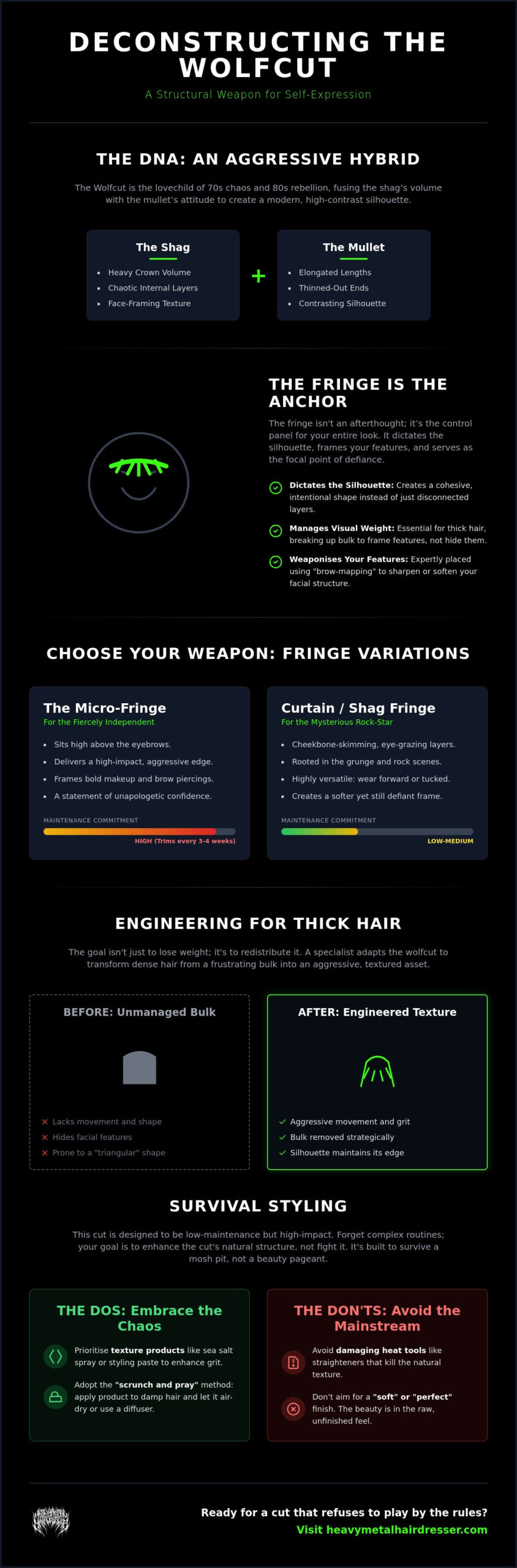
The architectural DNA of this cut is unapologetically retro yet fiercely modern. It inherits the heavy crown volume and chaotic internal layers of the classic shag haircut, which provides that signature “top-heavy” look that defies gravity. This is then fused with the elongated, thinned-out lengths of a modern mullet to create a shape that feels both dangerous and deliberate. In many professional circles, it is recognised as a variation of the shag that pushes contrast to its absolute limit. Ultimately, the wolfcut serves as a high-contrast, multi-layered frame that transforms your face into a focal point of alternative defiance.
Why the Fringe Changes the Game
The fringe is the anchor of the entire look. Without it, the wolfcut is just a collection of disconnected layers; with it, the cut becomes a cohesive statement. A bold fringe allows you to reclaim your aesthetic identity, acting as either a protective shield or a defiant spotlight. It is also inherently gender-inclusive, breaking down traditional beauty binaries by prioritising texture and shape over outdated “pretty” standards. For anyone navigating a wolfcut for thick hair, the fringe is essential for managing visual weight. It breaks up the mass of the hair, ensuring the aggressive texture frames your features rather than hiding them. It’s about balance, grit, and the refusal to look like everyone else on the high street.
Selecting Your Fringe: From Micro-Bangs to Curtain Chaos
Choose your weapon. Your fringe is the most customisable part of the entire haircut. It’s the focal point that decides if your look is a quiet tribute to the past or a loud assault on the present. When you sit in the chair, we start with brow-mapping. Your forehead height and the architecture of your brow bone dictate where that weight should sit. A well-placed fringe can sharpen a jawline or soften a high forehead; it is never about hiding. It is about deciding which features you want to weaponise.
We frequently lean into disconnection. This means your fringe doesn’t always have to flow perfectly into the side layers. In the context of unexpected hair trends, the most striking results come from sharp contrasts. A disconnected fringe creates a visual break that highlights the eyes and adds to that raw, unfinished grit. If you are managing a wolfcut for thick hair, this disconnection is your best friend. It allows us to remove significant bulk from the front without losing the density required for the rest of the silhouette.
The Micro-Fringe: For the Fiercely Independent
If you want high-impact, you go short. The micro-fringe sits well above the eyebrows. It acts as a frame for bold makeup or brow piercings. It is a statement of fierce independence. This isn’t a low-maintenance choice. You’ll need a trim every three to four weeks to keep it looking sharp. If it grows out too far, it loses that aggressive edge and starts to look accidental. It requires commitment, but the payoff is an unmistakable, alternative profile that stands out in any crowd.
Curtain Bangs and Heavy Shag Fringes
For those who prefer a mysterious, rock-star aesthetic, the curtain bangs shag haircut style is the ultimate move. These cheekbone-skimming layers create a heavy, eye-grazing effect. They are deeply rooted in the grunge scene and offer incredible versatility. You can wear them forward for maximum grit or master ‘the tuck’ where you style the longer pieces behind the ears to open up your face. This style is particularly effective for a wolfcut for thick hair because it uses the hair’s natural volume to create a heavy curtain of texture that frames the face perfectly.
If you’re ready to find a shape that actually fits your identity, explore our Wolfcuts and claim your new look.
Texture Engineering: Adapting the Wolfcut for Thick Hair
The wolfcut is not a fragile trend that collapses under the weight of your hair. It is a structural blueprint. When we talk about a wolfcut for thick hair, we are talking about mechanical precision. We don’t just hack away at the lengths; we engineer the density. The cutting angle is the deciding factor. It determines whether we are stacking volume to create a crown or carving out bulk to allow for movement. Internal layering acts as the hidden scaffolding. It supports the shape from the inside out, ensuring the silhouette stays aggressive even after a long night in a sweaty venue.
Professional techniques for adapting the wolfcut for thick hair focus on managing heavier textures to ensure the hair doesn’t become a triangular mess. We look at the hair as a three-dimensional object. By adjusting the tension and the angle of the blade, we strip away the “helmet” effect that thick hair often suffers from. This creates a cut that feels light but looks heavy with attitude. It is about removing the burden of weight whilst keeping the visual impact of the mass.
Taming the Beast: Wolfcuts for Thick, Heavy Hair
Thick hair is both a weapon and a challenge. To keep the silhouette from becoming a solid wall, we use channel cutting. This technique creates literal air pockets between the layers. It allows the hair to move independently rather than moving as one heavy, unyielding mass. This is vital for the fringe. A solid block of hair on the forehead is a disaster for this look. We piece it out and point-cut the edges to ensure it has that raw, feathered grit whilst removing enough weight to prevent it from falling flat. You want texture, not a curtain.
Injecting Chaos into Fine and Thin Strands
The most common objection we hear is that fine hair can’t handle the layers. That is a myth. You just need a different strategy. For fine hair, we keep the ends blunt to maintain the illusion of weight whilst keeping crown layers short for maximum lift. Be wary of stylists who want to use a razor for everything. Over-thinning fine hair with a razor can lead to frizz and limpness. Instead, a wolfcut on fine hair should focus on strategic disconnection to build volume where it matters most. It’s about creating the appearance of chaos without sacrificing the hair’s integrity. You don’t need a massive amount of hair to have a massive amount of presence.
Survival Styling: Maintaining Your Wolfcut in the Real World
Styling shouldn’t be a chore. It should be a reaction. A well-engineered wolfcut for thick hair relies on its structural integrity rather than a 40-minute battle with a hairdryer. We advocate for a wash and go philosophy that respects the natural movement of your strands. If the layers are cut with precision, the hair will fall into an aggressive, intentional shape on its own. You aren’t aiming for salon-perfect smoothness; you’re aiming for a silhouette that looks even better after a few hours of chaos.
For those with natural waves, the “scrunch and pray” method is your primary weapon. Apply your product to damp hair, scrunch the lengths upwards to encourage the internal layers to pop, and let the air do the rest. Your fringe will always be the first part to lose its edge. Instead of washing your whole head, use a spray bottle and a comb to refresh the fringe between washes. This resets the direction and volume in seconds without stripping the grit from the rest of your hair. This is about staying mosh-pit ready, ensuring your look survives the humidity of a basement gig whilst maintaining its subcultural soul.
Grit and Hold: The Alternative Stylist’s Toolkit
To achieve that piecey, aggressive texture that defines the wolfcut, Death Grip is essential. It provides the necessary hold to keep your layers defined and sharp without looking like a plastic helmet. If you struggle with flat roots, Hair To the Throne adds significant volume at the crown without the crunchy residue of traditional high-street mousses. These textured styling products are engineered to maintain your shape amongst the heat and sweat of a live show. You need products that work as hard as you do.
Ready to weaponise your texture? Grab your supply of Death Grip to keep your layers locked and loaded.
The Air-Dry Revolution
Authentic alternative looks are rarely born under a hairdryer. To get the best results, start with damp, towel-dried hair. Apply your styling product from the mid-lengths to the ends, avoiding the roots unless you’re using a dedicated volumiser. Avoiding high heat prevents the “fluffy” finish that ruins the raw grit of a wolfcut. It allows the natural weight of a wolfcut for thick hair to settle into its intended grooves. For that lived-in, backstage vibe, finish with a light mist of salt spray to enhance the separation of your layers. It’s a low-effort, high-impact approach that keeps your identity front and centre.
Beyond the Chair: Why Your Wolfcut Needs an Alternative Specialist
Your hair is a declaration. It is the first thing people see and the last thing they forget. When you’re committing to a wolfcut for thick hair, the last thing you need is a stylist who wants to “tame” your mane. Traditional high-street hairdressers are often trained to prioritise polish and symmetry. They might look at your request and try to soften the edges, blending your layers until the aggressive grit disappears. They’ll turn a subcultural staple into a suburban bob because they don’t understand the rebellion behind the silhouette. You don’t want a “nice” haircut. You want a structural weapon that reflects your identity.
Seeking out an alternative specialist means walking into a safe space where individuality is the standard, not the exception. We live and breathe the same culture you do. We understand that the chaos of the layers is the point. A specialist knows how to handle the weight of a wolfcut for thick hair without stripping away its soul. They understand the subcultural context, from the 80s punk roots to the modern metalcore aesthetic. You aren’t just paying for a service; you’re collaborating with a creative visionary who understands that being different is something to be celebrated, not corrected.
Inclusive Styling and Identity
We’ve binned the outdated rules of the traditional beauty industry. Our environment is built on inclusive consultation processes where your identity is respected from the moment you sit down. This includes gender-neutral pricing because a haircut should be about the technical work and the vision, not your biology. If you want to push your look further, a specialist can help you pair your new shape with vivid hair colour for maximum impact. We see your hair as a tool for self-empowerment. It is the ultimate medium for showing the world exactly who you are without saying a single word.
The Heavy Metal Hairdresser Promise
We aren’t just people with scissors; we’re part of the community. Our team has spent years styling for the mud, sweat, and mayhem of UK festivals like Download and Bloodstock. We know how a wolfcut needs to perform when you’re three days into a festival weekend and haven’t seen a hairdryer. Our promise is simple: we will never “soften” your look to make it more palatable for the mainstream. We want you to walk out feeling like the most authentic, powerful version of yourself. Your hair belongs to you, and we’re just here to help you weaponise it.
Stop settling for “safe” styles that don’t fit your vibe. Book your wolfcut transformation with an alternative specialist and claim the texture you deserve.
Claim Your Identity: Weaponise Your Texture
A wolfcut with a fringe is more than just a trend; it’s a structural evolution of your personal style. By mastering the balance between crown volume and a disconnected fringe, you move beyond the mainstream and into a silhouette that is unapologetically yours. We’ve explored how a wolfcut for thick hair isn’t about fighting your natural density, but engineering it into a shape that survives the chaos of a festival weekend.
Your hair should be a tool for self-empowerment, not a chore to be managed. At our gender-inclusive safe space, we don’t just cut hair; we build identities that belong at the front of the stage. As specialists who have styled for Download and Bloodstock, we live for the grit and raw texture that traditional salons try to hide. It’s time to stop settling for sanitised styles and start wearing a cut that actually reflects your soul.
Book Your Aggressive Wolfcut Transformation and step into a space where being different is the only rule we follow. You’re ready to own your look.
Frequently Asked Questions
How often do I need to trim a wolfcut with a fringe?
You should book a trim every 6 to 8 weeks to keep the layers from losing their aggressive shape. The fringe usually requires a refresh every 3 to 4 weeks if you want to maintain that sharp, intentional line. If you let it go too long, the weight starts to pull the volume out of the crown. Regular maintenance ensures the cut stays structural rather than just messy.
Can I get a wolfcut for thick hair if it is naturally curly?
A wolfcut for thick hair is a game-changer for natural curls and coils. The heavy layering removes the “triangle” shape that often plagues curly hair, allowing your ringlets to bounce and move independently. We use specific channel-cutting techniques to ensure the curls stack perfectly without becoming an unmanageable mass. It is one of the best ways to weaponise natural volume.
What is the difference between a wolfcut and a shag?
The wolfcut is the more aggressive, disconnected evolution of the classic shag. Whilst a shag focuses on blended, soft layers, the wolfcut leans into the high-contrast silhouette of a mullet with a heavy, thinned-out bottom. It is less about “pretty” movement and more about raw, subcultural grit. It demands more attitude and less polish than its 70s predecessor.
Will a wolfcut with fringe make my face look rounder?
A wolfcut with a fringe won’t make your face look rounder if the layers are engineered to sharpen your jawline. We use the fringe to create a focal point and use shorter layers around the cheekbones to add structure. It’s about vertical volume at the crown, which actually elongates the face. We customise the disconnection to suit your specific bone structure.
Is a wolfcut high maintenance for someone who hates styling?
This cut is actually a dream for those who hate styling because it relies on the cut’s internal structure. If the technical work is done correctly, you can simply wash, scrunch, and go. You don’t need a hairdryer to look intentional. The layers do the heavy lifting, providing a built-in shape that looks better the more lived-in it gets over a weekend.
Can I pull off a wolfcut with a fringe if I have a very small forehead?
You can definitely pull off this look with a small forehead by starting the fringe deeper into the crown. This creates the illusion of more height and space. We avoid flat, horizontal lines and instead opt for piecey, textured bangs that don’t swallow your features. It’s all about where the weight is placed during the initial mapping of the wolfcut for thick hair.
What happens if I decide to grow out my wolfcut fringe?
Growing out a wolfcut fringe is relatively painless because the bangs are already part of a heavily layered system. As they grow, they naturally blend into the shorter face-framing layers of the cut. You won’t have that awkward middle stage where the hair has nowhere to go. It just evolves into a longer, shaggier version of itself without losing its alternative edge.
Do I need specific products to keep the wolfcut texture?
Specific products are essential for maintaining that raw, mosh-pit ready texture. You need something like Death Grip to provide a piecey, aggressive hold that defines individual layers. For the crown, Hair To the Throne adds the necessary lift at the root without making your hair feel crunchy or over-processed. Good products turn a flat haircut into a structural statement that lasts.