
More product won’t make your wolf cut look wilder. The wrong formula can flatten its layers, limit movement and leave fine hair coated in residue. If you’re searching for the best products for styling a wolf cut, build a small routine that gives your roots lift while keeping the ends light and textured. Less fuss, better shape.
It’s frustrating when a cut looks full of life in the salon but refuses to behave at home. Your hair texture, the finish you want and the time you have each morning all affect which products may work for you. This UK guide compares product types for volume, definition and separation, with practical pointers for fine, wavy, curly and thicker hair. You’ll learn how to keep the look undone rather than overworked, and when advice from a stylist who knows wolf cuts could help you make more of your layers.
Key Takeaways
- The best products for styling a wolf cut depend on your hair texture, the finish you want and how much time you want to spend styling.
- Compare product types by their role, hold and finish before choosing. One formula won’t suit every cut.
- Limp roots or coated-looking ends can be signs to use less product or rethink where you apply it.
- Keep your routine simple, then adjust how you shape your hair for air-drying or heat styling.
- Check product formats and directions before use. If your layers aren’t behaving as you’d like, consider asking a stylist about the cut.
Best products for styling a wolf cut: what each product type actually does
A styling product system is a small set of products with different jobs. One might add lift, another define texture, and an optional finisher may help hold the shape. You don’t need every category. The wolf cut’s layered lengths and shorter crown sections can need different treatment: the crown may need support, while the longer ends benefit from movement rather than a heavy coating.
The cut sits within the shag family. Wikipedia describes the wolf cut as a popular 2020s variation of the shag, with a deliberately layered shape. Products can help bring out that shape, but they can’t replace a cut suited to your texture or a styling technique that works with how your hair naturally falls.
Which product types create lift, texture and separation?
Choose a product for the effect you want, then start with a small amount. Hair texture and application both affect the result, so use these as starting points rather than guarantees.
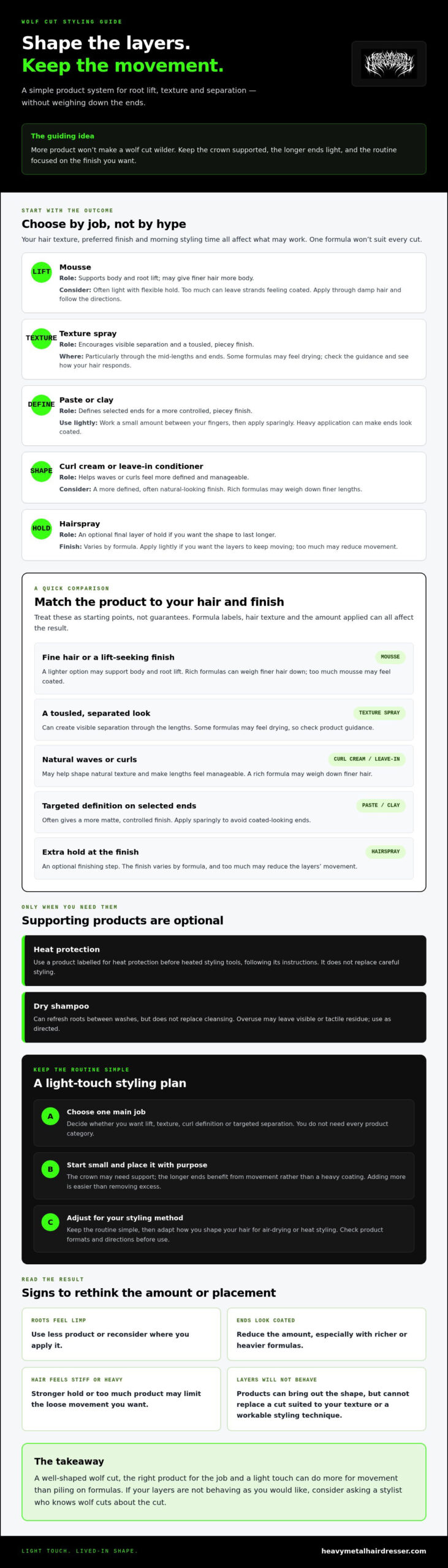
- Mousse: Applied through damp hair, mousse may support root lift and give finer hair some body. Too much can leave hair feeling coated, so follow the directions and use a light hand.
- Texture spray: This can create visible separation and a tousled finish, particularly through the mid-lengths and ends. Some formulas may feel drying, so check the product guidance and see how your hair responds.
- Paste or clay: These can define individual ends or create a more piecey finish. Work a small amount between your fingers first, then apply it sparingly. Adding more is easier than removing excess.
- Cream or leave-in conditioner: These may help wavy or curly lengths feel more defined and manageable. Rich formulas can weigh down finer hair, so consider your texture and the finish you want.
Do you need heat protection, dry shampoo or hairspray?
These are supporting options, not compulsory steps. Choose one for a specific need, and check its directions rather than layering on extras by default.
- Heat protection: Use a product labelled for heat protection before heated styling tools, following its instructions. It’s relevant when you’re blow-drying with heat or using a heated tool, but it doesn’t replace careful styling.
- Dry shampoo: This can refresh the roots between washes. It doesn’t replace cleansing, and overuse may leave visible or tactile residue, so use it as directed.
- Hairspray: This is an optional final step if you want extra hold. Choose a finish that suits your look, and apply lightly if you want the layers to keep moving.
Think of the cut, your hands and your products as a team. A well-shaped wolf cut and a light touch often do more for movement than piling on formulas.
How to compare wolf-cut styling products by hold, finish and hair texture
Choose a product for the job you want it to do, not because it promises to be a universal solution. Light, flexible hold can keep movement loose and touchable. Stronger hold may help a shape stay more defined, but can feel stiff or heavy if you use too much. Finish matters too: a matte product looks less glossy, while a lighter cream may leave hair looking more natural.
Use the table as a starting point. Labels and results vary by formula, and the amount you apply can change the outcome as much as the product category. Davines outlines several hair products for styling a wolf cut.
| Product category | Styling role | Typical finish | May suit | Watch for |
|---|---|---|---|---|
| Mousse | Supports body and root lift | Often light, with flexible hold | Fine hair or anyone seeking lift | Too much can leave strands feeling coated |
| Texture spray | Encourages visible separation | Textured, sometimes matte | People after a piecey, tousled look | Some formulas may feel drying; check the directions |
| Curl cream or leave-in | Helps shape natural waves or curls | More defined, often natural-looking | Naturally textured hair | Rich formulas may weigh down finer lengths |
| Paste or clay | Defines selected ends | Often more matte and controlled | Anyone wanting targeted separation | Heavy application can make ends look coated |
| Hairspray | Adds a final layer of hold | Varies by formula | People wanting their shape to last longer | Too much may reduce movement |
What should fine, thick or naturally textured hair look for?
Fine hair can lose lift under a rich formula, so begin with a lighter option and apply it sparingly. With thicker hair, working in sections can help distribute product through the layers instead of loading the surface. Naturally wavy or curly hair has its own pattern, which affects how the shorter crown and longer lengths sit. Work with that movement rather than expecting the same finish as straight hair.
Matte, natural or defined: choose the finish you actually want
Matte texture tends to look less shiny and more separated. A natural-looking finish keeps the hair closer to its own appearance, with less obvious product definition. These finishes are different from volume: you can lift the roots while keeping the ends soft, or define a few ends without adding height at the crown. Think about your usual styling time and how much separation you want before choosing a formula.
Takeaway: Match product weight and hold to your hair texture and the movement you want. Adjust the amount before switching categories. If you’re weighing up the cut as well as the routine, explore wolf-cut work from a specialist salon.
The biggest wolf-cut product mistake: using too much or chasing one “best” formula
A highly rated product can still be wrong for your hair. Fine strands, dense hair and naturally wavy or curly textures respond differently. The same formula can also behave differently depending on how much you use. The best products for styling a wolf cut aren’t a single universal pick. They’re the products that suit your hair, the cut’s shape and the finish you want.
Look for clues before adding more. Roots that fall flat, ends that look coated or strands that clump together may mean you’ve applied too much, chosen a formula that’s too rich or combined products that don’t work well together. Hair condition and styling technique can affect the result too, so don’t assume every disappointing day means you need a new product.
How can you avoid flat roots and heavy-looking layers?
Keep your test simple. Follow the product directions, apply it where intended and use a little at a time. If a formula is designed for root lift, work near the roots rather than coating the ends. With thicker hair, separate it into small sections to help distribute product more evenly. Avoid trying several new products at once. If the finish changes, you won’t know which product made the difference.
- Try one new product in your usual routine.
- Use less than you think you need, then add a small amount only if the result calls for it.
- Notice what changes at the roots, through the layers and at the ends.
- Adjust one thing at a time, such as the amount or where you apply it.
This gives you a clearer read than changing your products and technique all at once. Follow the label, especially if it says whether the product should be used on damp or dry hair.
When is the product not the problem?
A wolf cut changes as it grows. Layers that once framed the crown and moved freely may sit differently as their lengths shift, so a grown-out cut won’t necessarily style like it did when freshly shaped. Your hair’s texture and length also affect the silhouette. A technique that lifts one head of hair might not create the same shape in another.
If you’ve pared back your routine and tried a consistent technique but the shape still won’t behave as you expect, consider asking a stylist to assess the cut itself. Heavy Metal Hairdresser specialises in wolfcuts and textured alternative styling, so a specialist perspective may help you work out whether the issue is the product, the technique or the layers.
Build a simple wolf-cut styling routine for your texture and daily habits
Your routine doesn’t need a crowded shelf. Start with clean or refreshed hair, choose one main product for the result you want, shape the layers, then pause and assess. You’ll get a clearer idea of what’s working before adding anything else. For more context on how the cut’s layers shape the finish, see the ultimate wolf cut guide.
A low-fuss routine for everyday texture
Work with your texture and schedule. On damp hair, apply your chosen product as directed, then scrunch, tousle or shape a few sections with your hands. The same approach won’t suit every head of hair: curls may respond to scrunching, while straighter hair may need shaping around the crown. If you air-dry, let your hair settle before deciding whether it needs more. If you use heated tools, apply a suitable heat-protection product first and follow its label.
- Prepare: Begin with clean or refreshed hair, then detangle if needed.
- Apply: Use one main styling product, following its directions and starting with a modest amount.
- Shape: Encourage the movement you want by scrunching or working through selected sections.
- Assess: Let your hair dry or finish styling, then check the roots and ends before adding anything.
Product labels matter. Follow the stated directions, and stop using a product if you notice irritation or another unwanted effect.
Adjust the routine when your wolf cut needs more definition
Separate the goal. Root lift is about giving the crown more height; defining the mid-lengths and ends is about bringing out selected layers. Focus your main product where it’s needed rather than coating every section. A finishing product is optional, not a compulsory final step. If you want to explore other product categories, browse this guide to textured styling products, then check each item’s format and directions to see whether it suits your routine.
The best products for styling a wolf cut are the ones you can use consistently without fighting your texture or daily habits. If you’re unsure whether the issue is your routine or the shape itself, explore wolf-cut work from a specialist stylist and consider what cut advice could help.
Choose wolf-cut products with specialist advice and verified product details
There’s no magic formula for every wolf cut. Choose products by your hair texture, the finish and hold you want, and the time you’ll realistically spend styling. A product that supports a quick, loose routine may not suit someone aiming for more defined sections. Keep your goal clear, check the label and try one product at a time.
Heavy Metal Hairdresser offers Death Grip and Hair To the Throne. Before choosing either, check the product information for its format, ingredients, directions and suitability. Don’t assume a product is right for a particular texture or promises a specific hold or finish based on its name alone. Compare its stated details with your styling needs.
What to check before choosing an in-house styling product
Before choosing Death Grip or Hair To the Throne, check what form each product takes, how it’s meant to be used and what the product information says about its intended use. Look for directions, ingredients and any stated suitability guidance. Match the details to your hair, preferred finish and everyday routine, and follow the label.
- Format: Is it a spray, cream, paste or another type of product?
- Directions: Is it intended for damp or dry hair, and where should it be applied?
- Suitability: Does the product information identify hair types or styling goals?
- Finish and hold: Are these described in the product information, rather than assumed?
If you can’t find these details, avoid choosing based on assumptions. The best products for styling a wolf cut are useful only when you know what they’re designed to do and how they fit your routine.
When professional wolf-cut advice can make the difference
Products are only part of the picture. A stylist can consider how your layers sit, your hair’s texture and length, and how you prefer to style it day to day. That can help clarify whether you’re trying to change the finish with product or working with a cut shape that needs a fresh assessment. No one can promise one result for every head of hair.
Heavy Metal Hairdresser specialises in wolfcuts and textured alternative styling. For wider inspiration, explore this wolf-cut and altcut style guide. If you want to learn more about the salon’s work and approach, explore Heavy Metal Hairdresser.
Find your wolf cut’s next styling move
The best products for styling a wolf cut aren’t about piling on more. Choose a formula that suits your texture, the finish you want and the time you have, then use it sparingly. If your layers fall flat or feel coated, reassess the amount and application before writing off the whole routine. The cut’s shape and your styling technique matter just as much as the products on your shelf.
Heavy Metal Hairdresser specialises in wolfcuts and textured styling, with creative stylist Simon Tuckwell leading the salon. The salon has also worked backstage at Download and Bloodstock. For advice grounded in alternative hair and textured cuts, explore Heavy Metal Hairdresser and find your next styling move.
Your wolf cut doesn’t need to look polished or follow anyone else’s rules. Start with one small change, work with your natural texture and make the style your own.
Frequently Asked Questions
What are the best products for styling a wolf cut?
The best products for styling a wolf cut depend on your hair texture, the finish you want and how much time you’ll spend styling. Mousse may help support lift, texture spray can encourage separation, and curl cream may suit someone looking to define natural curls or waves. Paste or clay can add definition to selected ends. Start with one product, follow its directions and judge the result before adding another.
How do I make my wolf cut look more textured?
Use a product designed to create texture or separation, applying it as directed and focusing on the sections you want to define. For example, tousle the mid-lengths or shape a few ends with your fingers rather than coating every strand. Use a small amount first, then check how your layers sit once your hair is dry. Your cut shape and natural texture also influence the final effect.
Can I style a wolf cut without heat?
Yes, you can style a wolf cut without heated tools. Apply a suitable product to clean or refreshed hair according to its label, then scrunch, tousle or shape sections with your hands if that works for your texture. Let your hair air-dry and assess the finish before adding anything else. The result depends on your hair’s natural pattern, the cut and the products you choose.
Is mousse or texture spray better for a wolf cut?
Neither is automatically better. Mousse may be useful if your goal is lift or body, while texture spray may suit a more separated, tousled finish. Formula and application matter, so check the directions and begin with a small amount. If your hair feels coated or loses movement, try less product or reconsider whether that category matches the result you want.
How can I stop styling products weighing down my wolf cut?
Start with one product and use it sparingly. Apply it only where its directions recommend, rather than coating every layer, then let your hair dry or finish styling before deciding whether you need more. Limp roots or coated-looking ends can be signs to reduce the amount or reconsider the formula. If you use several products at once, change one at a time so you can identify what affects the finish.
Do I need a different product for fine hair and thick hair?
Possibly. Fine hair may be easier to weigh down, so a lighter formula and careful application can be a sensible starting point. With thick hair, applying product through smaller sections may help distribute it more evenly. These are starting points, not rules: length, natural texture, cut shape and styling habits all matter. Choose for the result you want, follow the label and adjust based on how your hair responds.