Your wolfcut isn’t a “set it and forget it” hairstyle. It’s a living, breathing shape that thrives on chaotic energy. The moment those aggressive layers start to settle into a polite, blended mess is the moment the subcultural edge dies. You’re likely staring in the mirror wondering exactly how often should a wolfcut be trimmed before the silhouette loses its bite. It’s a common frustration when that hard-earned volume at the crown starts to sink and your fringe begins a hostile takeover of your vision.
We get it. You want to keep that gritty texture without sacrificing the length you’ve spent months growing out. This guide reveals the professional sweet spot for bookings, ensuring your ends stay healthy whilst your layers remain distinct. We’ll explore the specific signs that your cut is losing its definition and how to maintain that sharp, alternative aesthetic between salon visits. From managing split ends to the secret of the six-week refresh, you’ll learn how to preserve the aggressive shape that defines your identity.
Key Takeaways
- Identify the architectural shift from a sharp crown to a bulky mushroom shape as your layers grow out.
- Learn exactly how often should a wolfcut be trimmed to maintain its aggressive silhouette, typically falling between 6 and 10 weeks.
- Master the art of damage control using professional-grade texture tools like Death Grip to keep the vibe alive whilst stretching your booking.
- Discover the difference between a standard salon trim and a specialist maintenance session that preserves your subcultural edge.
The Wolfcut Lifecycle: Why Your Aggressive Layers Lose Their Edge
Stop treating your hair like a fleeting trend. A wolfcut is a deliberate architectural shape, not just a case of “messy bedhead” that happened by accident. It relies on a specific, high-contrast ratio of crown volume to wispy, tapered length. This modern variation of the shag uses disconnected layers to create a silhouette that feels both predatory and effortless. However, hair grows at its own pace, and that precision doesn’t last forever without intervention. The wolfcut lifecycle is the inevitable transition from intentional chaos to unstructured bulk.
The signature look of this cut comes from “shattered ends.” These are sections of hair thinned out with a razor or shears to create a jagged, uneven finish. This isn’t about being tidy. It’s about creating a gritty, alternative texture that moves when you move. When these ends grow out, they lose their sharp point. They become blunt and heavy, causing the entire style to collapse into a shape that looks accidental rather than rebellious. Understanding how often should a wolfcut be trimmed is the only way to stop your hair from looking like a neglected mullet.
The Gravity Problem: Why Crown Volume Disappears
Gravity is the primary enemy of alternative hair. As your top layers grow, they gain weight. This extra mass pulls the hair flat against your scalp, dragging the volume away from your roots and down towards your ears. This is the exact point where the “wolf” starts looking more like a standard shaggy bob. The aggressive lift at the crown is what gives the style its bite. Because these layers are so much shorter than the rest of the cut, even a centimetre of growth can drastically shift the weight distribution. You lose that top-heavy, rebellious energy that makes the cut work in the first place.
Texture vs. Frizz: The Health of Your Ends
There’s a massive difference between “cool” grit and actual hair damage. A fresh cut features separated layers that move independently. As you approach the limit of your maintenance window, those ends begin to fray. Split ends are the death of definition. They cause your hair to clump together, turning your shattered texture into a frizzy, tangled mess.
- Healthy Grit: Defined, jagged layers that respond well to texture products.
- Structural Damage: Tangled mid-lengths that lose their “shattered” effect and look dull.
Knowing how often should a wolfcut be trimmed ensures you are removing that dead weight before it ruins the silhouette. Professional thinning isn’t just about length. It’s about reclaiming the negative space between your layers so the style can breathe again.
The Maintenance Timeline: How Often Should You Trim a Wolfcut?
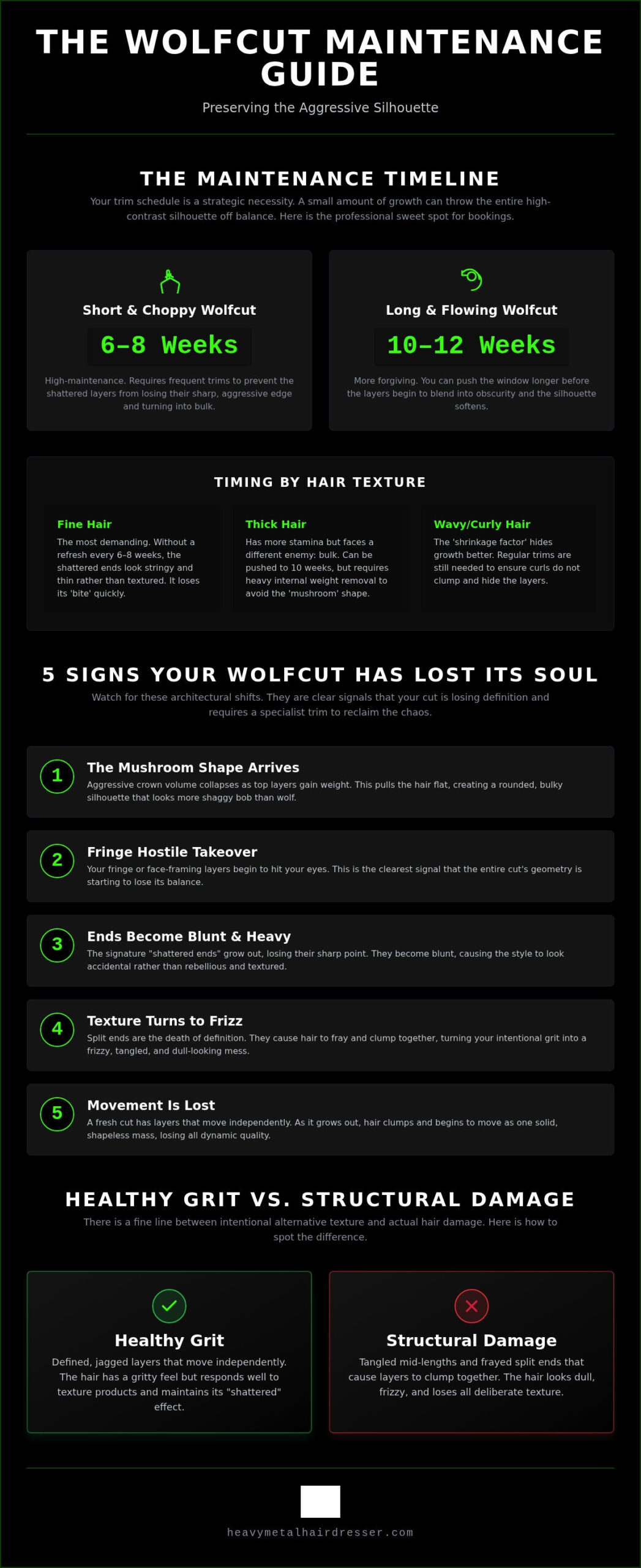
Your trim schedule is a strategic necessity, not a suggestion. Because this style relies on a high-contrast silhouette, even a small amount of growth can throw the entire look off balance. Determining how often should a wolfcut be trimmed involves looking at the specific geometry of your cut. Short, choppy versions are high-maintenance beasts that typically require a routine trim schedule every 6 to 8 weeks. If you’ve opted for a longer, flowing variation, you can often push the window to 10 or 12 weeks before the layers begin to blend into obscurity.
There is a specific phenomenon in the alternative community where a cut actually looks its best at the three-week mark. This is when the initial salon sharpness settles into a more lived-in, authentic grit. However, once you pass the two-month threshold, that “intentional chaos” quickly turns into heavy, shapeless bulk. If you want to keep that aggressive edge, you need to book before the weight of your hair destroys the lift at your crown.
Timing by Hair Texture: Fine vs. Thick Strands
Your hair’s natural DNA dictates the speed of your structural breakdown. Fine hair is arguably the most demanding. Without a refresh every 6 to 8 weeks, the shattered ends start looking stringy and thin rather than textured and sharp. It loses its “bite” quickly. Thick hair has more stamina but faces a different enemy: bulk. Whilst you can push your appointment to 10 weeks, your stylist will need to focus heavily on internal weight removal to stop you from looking like a mushroom. For those with curly or wavy textures, the “shrinkage factor” is your best friend. It hides growth better than straight hair, but you still need regular sessions to ensure your curls don’t clump together and hide the layers.
The Fringe Factor: Managing the Face-Frame
The fringe is the soul of the cut. Whether you’re rocking a micro-fringe or heavy curtain bangs, this section usually requires a refresh twice as often as the rest of your hair. When your fringe starts hitting your eyes, it’s a clear signal that the rest of the silhouette is soon to follow. Maintaining that deadly combination of face-framing layers and aggressive crown volume is a delicate balance. Avoid the temptation of a DIY bathroom trim whilst waiting for your specialist. One wrong snip can ruin the disconnected flow that makes the style work. If your fringe has lost its way, our experts in wolfcuts can sharpen your look without sacrificing your hard-earned length.
5 Signs Your Wolfcut Has Lost Its Soul
A wolfcut isn’t a static style. It’s a volatile shape that eventually surrenders to gravity and growth. If you’re wondering how often should a wolfcut be trimmed, the answer is usually written on your face. When the intentional chaos starts looking like a neglected accident, you’ve hit the limit. Your hair stops being a statement and starts being a chore. Here are the five definitive red flags that your cut has lost its bite.
- The Mushroom Effect: This happens when your mid-lengths become too bulky. The hair around your ears expands whilst the top stays flat, creating a rounded silhouette that lacks the aggressive taper of a fresh cut.
- The Vanishing Crown: You’ve reached the point where no amount of backcombing or product can provide lift. The top layers have grown just long enough to become heavy, dragging all that rebellious volume down with them.
- Invisible Layers: The distinct, shattered steps of your cut begin to blend into a solid wall of hair. Without that separation, you lose the movement and depth that defines the alternative aesthetic.
- The Eye-Poker: Your face-framing layers lose their “flick” and start obstructing your vision. Instead of framing your features, they become a curtain of frustration.
- Split End Sabotage: Your texture looks dull. The ends are frayed. Your hair refuses to hold a shape because the structural integrity of the finish has been compromised by damage.
Diagnostic: Is it a Styling Issue or a Growth Issue?
Before you panic, perform a quick diagnostic. Start by testing your volume. If a professional-grade tool like Hair To the Throne can’t resurrect your crown, you aren’t dealing with bad styling. You’re dealing with excess weight. Try the “Comb Test” for your layers. Run your fingers through the mid-lengths. If they don’t separate naturally into distinct sections, the layers have grown into each other. You have officially reached the “Mullet Point,” where the back length completely overwhelms the front, destroying the balance of the cut.
The Growth-Out Strategy: Trimming for Length
Maintaining a long wolfcut doesn’t mean avoiding the salon for six months. In fact, micro-trims are essential for those aiming for length. By dusting the very ends of your hair, a specialist removes the split ends that cause clumping without sacrificing your overall progress. This keeps the hair growing strong whilst preserving the deliberate architecture of the style. Be clear with your stylist. Tell them you want to reclaim the chaos without losing the inches. Knowing how often should a wolfcut be trimmed for length usually means a quick refresh every 10 to 12 weeks to keep the shape from turning into a shapeless mass.
Stretching the Silence: Maintaining Texture Between Salon Visits
You can’t always hit the salon the second your layers start to lag. Home maintenance is about strategic damage control. It’s the art of buying yourself an extra fortnight of dignity before your silhouette completely collapses. Whilst the structural breakdown is inevitable, you can fake the freshly-cut look with the right arsenal. The goal is to keep the ends shattered and the crown defiant.
Ditch the heavy silicones. Most mainstream conditioners are packed with “smoothing” agents that act like lead weights on alternative hair. They coat the strands. They flatten the volume. Switch to lightweight, professional-grade formulas that prioritise hair health without the grease. Avoid the brush during the drying process. Brushing out a wolfcut is a fast track to a shapeless mop. Scrunch your hair whilst damp. Let it air-dry to preserve that jagged, disconnected finish.
The Texture Toolkit: Products for Subcultural Grit
If your layers have started to blend, you need to manually redefine them. Use a matte clay like Death Grip to pinch and twist individual sections. This recreates the “shattered” effect that growth tries to hide. Salt sprays and volume powders are non-negotiable for injecting chaos back into flat crowns. Apply powder directly to the roots for instant lift that defies gravity. Whilst you’re figuring out how often should a wolfcut be trimmed for your specific hair type, products are your best tool for extending the life of the cut.
Protecting Your Pigment: Maintenance for Vivid Wolfcuts
Aggressive shapes and vivid hair colour go hand-in-hand. However, high-pigment shades require their own set of rules. Wash your hair in cold water to keep the colour from bleeding and losing its punch. This also helps seal the cuticle, keeping your textured layers looking sharp rather than frizzy. If your hair is heavily bleached, try co-washing. It maintains essential moisture in those thirsty, shattered strands without stripping away your identity. If you’re ready to refresh your look, check out our specialist styling services to get your edge back.
Reclaiming the Chaos: Booking Your Specialist Wolfcut Trim
You’ve seen the signs. The crown is flat. The layers have vanished. Now, you need a specialist. Don’t trust a standard high-street salon with an alternative silhouette. They often try to “fix” the disconnect that makes the cut work. They’ll tidy up the edges and blend the layers until you’re left with a generic, polite shag. Reclaiming the chaos requires a stylist who respects the grit. Understanding how often should a wolfcut be trimmed is only half the battle. The other half is knowing who to trust with the blade.
Alternative hair thrives in spaces that understand subcultural identity. We provide a gender-inclusive safe space where your hair journey is respected, not just “serviced.” We don’t do walk-ins or children’s cuts. Our focus is entirely on those who seek to express themselves through unconventional means. When you book with a specialist, you aren’t just getting a haircut. You’re getting a structural restoration of your identity.
Finding Your Style Master in the UK
The Heavy Metal Hairdresser approach prioritises individuality over fleeting trends. We aren’t here to give you a “safe” version of a subcultural staple. We understand the modern mullet and shag lineage that birthed the wolfcut. This expertise allows us to maintain the aggressive texture you crave whilst keeping your hair healthy. When you book, bring inspiration photos of your own hair when it was freshly cut. This helps us see exactly where your specific version of the style lives and how it has evolved as it grew out.
The Consultation: Speaking the Language of Alt-Hair
Forget the word “trim.” It’s too vague for this level of technical work. When you sit in the chair, ask for “re-shattering the layers” and “internal weight removal.” This tells your stylist you want to restore the negative space and movement without necessarily losing overall length. Discuss how your hair has behaved since the last session. Did the fringe get too heavy too fast? Did the crown collapse after four weeks?
Be specific about your desired level of aggression. Some want a soft, wearable wolfcut whilst others want a jagged, predatory silhouette. Setting a long-term plan ensures your aesthetic evolves with you. Prepare for your appointment by arriving with clean, product-free hair so we can see the natural fall. This is how you ensure the professional “sweet spot” for how often should a wolfcut be trimmed remains consistent with your lifestyle and your look.
Keep the Chaos Sharp
Your wolfcut is more than a hairstyle. It’s a statement of identity that demands respect. Letting your layers grow into a shapeless bulk isn’t an option if you want to keep that subcultural edge. You now know the signs of a collapsing silhouette and the technical reality of the 6 to 10 week maintenance window. Determining how often should a wolfcut be trimmed depends on your texture and your commitment to the look, whilst ensuring you don’t let gravity win the battle against your crown volume.
Trust your hair with specialists who actually live the lifestyle. We’ve styled bands at Download and Bloodstock. We understand that your hair is a weapon of self-expression. As a gender-inclusive safe space, we focus on aggressive textures that the mainstream simply doesn’t get. It’s time to stop settling for “polite” hair and reclaim the grit that defines you. Book your specialist wolfcut trim at Heavy Metal Hairdresser today. Let’s get that aggressive shape back where it belongs.
Frequently Asked Questions
Will my wolfcut look like a mullet if I don’t trim it regularly?
Yes, it eventually will. Without regular maintenance, the short layers at the top grow out and lose their lift, whilst the back length continues to drop. This shift in weight distribution turns the balanced silhouette into a heavy, unstructured mullet. To prevent this, you need to know how often should a wolfcut be trimmed to keep the crown volume high and the taper aggressive. Regular sessions ensure the “wolf” stays sharp.
Can I trim my own wolfcut layers at home?
We strongly advise against it. A wolfcut relies on deliberate disconnection and shattered layers that require professional thinning techniques. One wrong snip with kitchen scissors can ruin the architectural flow, leaving you with blunt steps or a patchy fringe. It’s a technical cut that needs a specialist’s eye to maintain its subcultural edge. Save the bathroom experiments for your colour and leave the structural work to our experts.
Does a wolfcut require more maintenance than a standard shag?
It does, primarily because the layers are more aggressive and the contrast is higher. Whilst a standard shag is often softer and more blended, the wolfcut thrives on high-volume crowns and wispy, tapered ends. This specific geometry collapses faster as the hair grows. You’ll find that determining how often should a wolfcut be trimmed is a more frequent task than managing a traditional shag if you want to keep that predatory silhouette.
How much length will I lose during a wolfcut maintenance trim?
You shouldn’t lose significant length during a maintenance session. A specialist trim focuses on “dusting” the ends and internal weight removal rather than taking off inches. The goal is to reclaim the negative space between the layers and restore the lift at the crown. If you communicate clearly that you’re growing your hair out, your stylist will focus on re-shattering the texture whilst preserving every possible centimetre of your overall length.
Is it possible to grow out a wolfcut without it looking awkward?
Absolutely, but you can’t just stop visiting the salon. Growing out this style requires “transitional trims” to manage the bulk as the short crown layers catch up with the length. Without these sessions, the hair becomes mushroom-shaped and heavy around the ears. By booking regular micro-trims, your stylist can slowly blend the disconnected sections, allowing you to transition into a longer shag or mullet without the dreaded awkward phase.
What happens if I wait 6 months between wolfcut trims?
After six months, the architectural soul of the cut will be gone. The short layers that provided the signature crown volume will have grown long enough to pull flat against your scalp. The shattered ends will likely be frayed and clumping together, destroying the gritty texture. Instead of an intentional alternative statement, your hair will look like an unstructured, grown-out mess that has lost its subcultural edge and aggressive silhouette.
How do I tell my hairdresser I want to keep the “messy” look but remove the bulk?
Speak the language of alternative hair. Ask for “internal weight removal” and “re-shattering the layers.” These technical terms tell your stylist that you want to keep the disconnected, gritty vibe whilst getting rid of the heavy bulk that’s flattening your crown. Avoid using the word “tidy.” Instead, explain that you want to restore the movement and negative space so your texture products can actually do their job again.
Should I get a trim if I am using vivid hair colour in my wolfcut?
Yes, maintenance is even more vital for vivid hair. Bleached and high-pigment strands are prone to split ends, which can make your aggressive layers look dull and frizzy. A quick trim removes the damaged tips that cause colour to look muddy or faded. By keeping your ends sharp and healthy, you ensure your vivid tones pop against the shattered texture of the cut, maintaining the full integrity of your alternative identity.