Posted on

Vivid Hair Colour: Saturating Your Identity in High-Pigment Sensation

Vivid Hair Colour: Saturating Your Identity in High-Pigment Sensation

Your hair isn’t just a fashion choice; it’s a percussive saturation of your soul onto your strands. You are likely done with “safe” palettes and the clinical, overly polished vibe of traditional salons that don’t get the subcultural weight of a neon green or a metallic slate. It is a common frustration to crave high-impact tones but fear the wreckage of bleach or the heartbreak of a rapid fade. We understand the irritation of being misunderstood in a chair that feels too “mainstream” for your aesthetic.

In this guide, you will discover how to achieve deeply saturated, alternative shades that reflect your identity without compromising your hair health. We are talking about the technical mastery required for vivid hair color Nottingham and the clear maintenance protocols you need to stop the fade in its tracks. We will walk through the reality of pre-lightening, the legal necessity of a 48-hour patch test, and how to keep your hair feeling as tough as it looks. From the latest 2026 trends like Digital Copper to the secret of “healthy luxury” sheen, we have the roadmap for your next transformation.

Key Takeaways

  • Reject the “fashion colour” label and discover why high-pigment saturation is the ultimate subcultural statement for your identity.
  • Understand the technical necessity of pre-lightening and cuticle health to ensure your neon or metallic tones actually stick.
  • Master the maintenance protocols for vivid hair color Nottingham; using cold water and sulphate-free products is the only way to stop the fade.
  • Learn how to pair your bold palette with textured, alternative shapes like wolfcuts and shags for a total identity transformation.
  • See how a collaborative, inclusive approach replaces the judgmental atmosphere of traditional salons with expert, alternative grit.

Beyond the Mainstream: Why Vivid Hair Colour is a Subcultural Statement

Vivid hair colour isn’t a trend you pick up from a glossy magazine; it’s a high-pigment saturation of your actual self. While mainstream salons might toss around the term “fashion colour,” that phrase fails the alternative community. Fashion implies something temporary; something that fades out when the next season hits. For those seeking vivid hair color Nottingham, this isn’t a seasonal whim. It is identity saturation. This is about wearing your subcultural soul on your head and rejecting the beige middle ground of the “natural” look.

The history and science of hair coloring has evolved from crushed minerals to the complex chemical bonds we use today, yet the purpose remains the same: communication. Choosing a neon or metallic tone isn’t just an aesthetic choice. It is a psychological power move. It signals your tribe. It says you aren’t interested in being tolerated; you’re here to be celebrated. This level of saturation acts as a visual manifesto for who you are before you even speak.

The Death of the “Pretty” Salon

Traditional salons are often clinical. They are too white, too quiet, and frequently too judgmental. For alternative souls, these environments feel alienating. We don’t want “pretty” by mainstream standards. We want raw. We want authentic. An inclusive, gender-neutral safe space is the only place where true self-expression happens. Rejecting the polished perfection of the high street is the first step toward finding a look that actually fits. We value the grit of the underground over the sterile vibe of the corporate beauty industry.

Vivids as Subcultural Armour

High-impact colour needs a shape that can carry its weight. You can’t put a neon green on a boring, flat cut. It needs the movement of a shag or the aggressive texture of a wolfcut to truly sing. This is hair designed for the mosh pit. It’s hair that looks better when it’s messy. If your favourite records are loud and distorted, your hair should be too. It’s subcultural armour that protects your individuality in a world that tries to make everyone the same. Whether you’re down the front at a gig or just walking through the city centre, your colour should be as loud as your favourite track.

The Physics of Pigment: How to Achieve Maximum Saturation

Achieving a high-impact result isn’t magic; it is chemistry. If you want vivid hair color Nottingham that actually stops people in the street, you have to respect the physics of the hair strand. Most alternative tones are direct dyes, meaning they don’t use developers to force their way into the hair’s core. Instead, they rely on a perfectly prepped canvas. You can’t paint a neon masterpiece on a dark, muddy background. Without pre-lightening, those high-pigment molecules have nowhere to sit. They simply slide off, leaving you with a dull stain instead of the electric saturation you craved.

The hair cuticle plays the role of the gatekeeper. When we lift the hair to a lighter level, we are essentially opening those scales to let the pigment in. However, there is a fine line between opening the door and ripping it off the hinges. Professional alternative brands offer a depth of pigment that box dyes simply cannot match. Retail products are often formulated with aggressive chemicals to work on “anyone,” which frequently ignores hair dye safety regulations regarding concentration and metal salts. These inferior products can “blow out” the cuticle, making it impossible for the hair to hold onto colour in the long term.

Pre-Lightening Without the Destruction

Maintaining the structural integrity of your hair is our obsession. We use bond builders to cross-link the internal fibres of the hair whilst we lift. Rushing the process is the fastest way to hit a dead end. If you try to go from jet black to neon yellow in one sitting without the proper technical care, the hair loses its elasticity. We prioritise hair health over immediate, “fast” results because fried hair cannot hold pigment. Saturated colour requires a healthy, albeit lightened, structure to reflect light correctly.

Pigment Loading and Placement

True saturation is different from mere staining. Staining is what happens when you use a cheap tint that washes out in three days. Pigment loading involves packing the hair with high-quality, professional-grade molecules that anchor themselves firmly. We use creative placement like panels, dips, or colour melting to create movement that matches your cut. Level of lift is the foundation of vivid success. Whether you are aiming for a deep jewel tone or a blinding neon, the underlying canvas dictates the final vibrance. If you are ready to ditch the DIY disasters and get it done right, check out our work at Heavy Metal Hairdresser.

Vivid Hair Colour: Saturating Your Identity in High-Pigment Sensation

Choosing Your Weapon: Alternative Palettes vs Traditional Tones

Forget “natural-looking enhancements” or safe, chocolate-toned highlights. If you are here, you aren’t looking for a subtle change; you are looking for a weapon. When searching for vivid hair color Nottingham, the goal is to find a palette that hits as hard as a kick drum. We don’t deal in the “pretty” pastels of the high street. We deal in the aggressive saturation of neons, the cold edge of metallics, and the depth of jewel tones. Your colour choice should survive the mosh pit and still look intentional when you’re grabbing coffee the next morning.

A scientific review of hair dye ingredients shows that the molecular structure of these high-pigment direct dyes differs significantly from traditional oxidative colours. They don’t just sit there; they vibrate. Choosing your palette requires a “fade-to-cool” strategy. This means picking base tones that don’t just wash out into a muddy mess. A well-executed cobalt blue should fade into a clean mint; a deep blood red should transition into a weathered pink. We match these bold vivids with aggressive, textured layers like the wolfcut to ensure the colour has a shape that matches its energy.

The Neon and Pastel Conflict

There is a massive difference between the longevity of a neon and the fragility of a pastel. Pastels are the high-maintenance divas of the hair world. They require a “Level 10” canvas, meaning your hair must be lifted to the colour of the inside of a banana skin. If you aren’t prepared for the upkeep, pastels will break your heart. Neons and deep primary tones, however, have an aggressive longevity. They are stubborn. They stick. Managing your expectations between a “temporary” vibe and a “stubborn” pigment is the first conversation we have in the chair.

Custom Blends for the Unconventional

We never use colour straight from the bottle. That is for amateurs. To get vivid hair color Nottingham that actually reflects an alternative identity, we create custom blends. We mix “gritty” tones that avoid that synthetic, “Easter Egg” look often found in mainstream salons. Whether your aesthetic is Goth, Punk, or Metal, your palette should feel bespoke. We blend smoky charcoals into violets or add “industrial” undertones to greens. It’s about matching the saturation to your subcultural grit, ensuring your hair looks like it belongs to you and no one else.

Maintenance Protocol: How to Stop the Fade and Keep Your Grit

You have the saturation. Now you have to keep it. Traditional advice says wash less, but we say wash smarter. Vivid pigment is like a high-end vinyl record; it needs specific care to stay crisp. If you want vivid hair color Nottingham that doesn’t look like a washed-out ghost after one week, you need a protocol. This isn’t about being precious. It’s about protecting the investment you’ve made in your identity. Most people fail because they treat alternative tones with mainstream habits.

The Cold Water Rule is non-negotiable. Heat is the enemy of vivid pigment. Hot water opens the hair cuticle and lets those expensive molecules escape into the drain. Wash with cold water. It is brutal, but it’s the only way to lock the colour in. Think of it as a baptism in ice to keep your soul saturated. Pair this with sulphate-free cleansing. Sulphates are aggressive detergents that strip your identity along with the dirt. You need a cleanser that respects the bond we’ve built during the lift and load process.

Environmental stressors are the silent killers of high-impact tones. UV rays act like a slow-motion bleach on neons and metallics. If you are spending time outdoors, use UV protection sprays or wear a hat. Professional-grade pigmented conditioners are your secret weapon. They deposit a fresh layer of pigment every time you condition, keeping the vibrancy at peak levels between salon visits. This keeps the grit in your look without needing a full chemical top-up every fortnight.

The Post-Salon Survival Kit

You need gear that works as hard as you do. Your survival kit should include a microfibre towel to reduce friction and a wide-tooth comb to prevent breakage. We don’t just care about the hair; we care about the culture. Choosing Alternative Hair Merch UK isn’t just for looks, but for the lifestyle that prioritises authentic expression over mainstream trends. Wash your hair in sections if you have multiple colours to avoid bleeding. Keep it clean, but keep it saturated.

Longevity in the Mosh Pit

Gigs and festivals are a gauntlet for your hair. Sweat and friction during a set can dull your shine faster than anything else. If you are heading to a weekend at Download or Bloodstock, dry shampoo is your best friend. It absorbs the oil and sweat without requiring a full, colour-stripping wash. For those who want the full technical breakdown, check out our vivid hair colour maintenance tips for a deep dive into longevity. Don’t let your vivid hair color Nottingham die in the pit. Protect your grit and keep the pigment loud. Secure your next vivid session to keep your saturation at maximum volume.

Saturate Your Soul: The Heavy Metal Hairdresser Approach

Simon Tuckwell built Heavy Metal Hairdresser on a single premise: your hair should be as loud as your lifestyle. It isn’t just about technical mastery; it’s about alternative grit. When you seek out vivid hair color Nottingham, you aren’t just looking for a technician. You’re looking for a guide who understands why a specific shade of toxic green or industrial slate matters to your subcultural identity. We don’t do lectures here. We do collaborations. Your consultation is a dialogue where we map out your vision and ensure it survives the reality of your daily life. This is about taking up space and refusing to be muted by mainstream expectations.

We prioritise the wolf hair cut as the ultimate companion for high-pigment sensation. Aggressive texture provides the movement that vivid tones demand. A flat, one-length cut can make even the brightest neon look stagnant. The layers of a wolfcut or a shag allow light to hit different depths of pigment, creating a visual rhythm that matches your favourite records. We aren’t just changing your look; we are building a movement. This is a community where being different is the standard, and your hair is the flag you fly.

Backstage Expertise Brought to the Chair

Our approach was forged in the fires of the UK festival scene. Styling bands backstage at Download and Bloodstock taught us that hair has to perform under pressure. It has to survive heat, sweat, and the mosh pit whilst looking incredible. We bring that same level of intensity to our everyday vivids. We maintain a “Death Grip” on quality, refusing to settle for anything less than the most premium, high-saturation pigments available. This commitment has made us a sanctuary for the unconventional. We provide a gender-neutral safe space where you can be your raw, authentic self without judgment.

Your Next Level Saturation

Booking your creative colour session is the first step in reclaiming your identity. During your first visit to our inclusive space, you can expect an environment that is high-energy and fiercely independent. We will talk through your hair history and your health goals to ensure your vivid hair color Nottingham remains as healthy as it is bold. No corporate fluff. No clinical vibes. Just expert execution of the most intense shades in the city. Stop settling for “natural” and start living in high-pigment sensation. Saturate your identity at Heavy Metal Hairdresser and join a tribe that celebrates the unconventional.

Saturate Your Reality

Your hair is the most visible part of your subcultural armour. You now have the technical roadmap to move from generic tones to high-impact, deeply saturated pigments. We have covered the necessity of a perfect lift, the custom blending of gritty palettes, and the cold-water discipline required to keep your grit. Don’t let your identity fade into the background of a mainstream salon that doesn’t understand your music or your aesthetic. For those ready to commit to vivid hair color Nottingham, the choice is clear: expertise matters.

We are a gender-neutral, inclusive safe space for the unconventional. As official stylists for bands at Download and Bloodstock, we know how to make hair perform under the most aggressive conditions. Whether you are pairing a metallic violet with a textured wolfcut or a neon green with a classic shag, we deliver the technical mastery your soul demands. It’s time to stop settling for fashion trends and start wearing your truth. Book Your Identity Saturation at Heavy Metal Hairdresser today. Your most authentic self is waiting to be unleashed.

Frequently Asked Questions

How long does vivid hair colour typically last before it needs a refresh?

Vivid colour usually stays vibrant for four to eight weeks depending on the specific pigment and your home care routine. Deep primary tones and neons have more staying power than delicate pastels, which can begin to shift after just two or three washes. Your results depend entirely on how strictly you follow the cold-water rule and the quality of your sulphate-free cleansers. Cooler tones like blues and greens often linger longer than warm reds or pinks.

Do I always have to bleach my hair to achieve a vivid colour result?

You need a pre-lightened base to achieve maximum saturation and true neon or metallic results. Vivid pigments are direct dyes, meaning they lack the chemical power to lift your natural colour on their own. Without bleaching, you might achieve a subtle, dark jewel-toned tint on lighter brown hair, but the electric vibrance seen on stage requires a clean, lightened canvas. We prioritise the health of this canvas to ensure the colour looks electric rather than muddy.

Can I get high-impact vivid colour if I have naturally dark or black hair?

You can absolutely achieve high-impact vivid hair color Nottingham starting from a dark base, but it is a multi-step journey. We have to lift the natural pigment out safely first to create the necessary foundation for the dye. Depending on your hair history and any previous box dyes, this might take more than one session to reach the required level of lift. We never rush this process; your hair’s structural integrity is more important than a fast result.

What is the best way to wash vivid hair to prevent rapid fading?

Wash your hair with ice-cold water and use a professional sulphate-free cleanser to keep the hair cuticle closed. Heat is the primary cause of pigment loss because it physically expands the hair shaft and lets the colour molecules escape. Limit your washing to once or twice a week and rely on dry shampoo to manage oil between sessions. This discipline is the only way to keep your saturation at maximum volume for the long term.

Is vivid hair colour damaging to my hair texture or curl pattern?

The vivid pigment itself is non-damaging and often acts like a conditioning treatment, but the pre-lightening process requires expert handling. We use bond builders to protect your curl pattern and hair texture during the lift. When handled by a specialist who understands alternative textures, you can maintain your natural bounce whilst wearing the most aggressive colours in the palette. It’s about technical mastery, not just slinging bleach.

How often should I book a maintenance appointment for creative colour?

Most of our community members book a refresh every six to ten weeks to manage root regrowth and top up their saturation. If you are wearing a high-maintenance pastel or a complex colour melt, you might need a quick toner refresh at the four-week mark. Consistent maintenance ensures your vivid hair color Nottingham remains a sharp statement of your identity rather than a weathered afterthought. We recommend booking in advance to keep your look consistent.

Posted on

How to Maintain Vivid Colour on a Wolfcut: The Alt-Hair Survival Guide

How to Maintain Vivid Colour on a Wolfcut: The Alt-Hair Survival Guide

Your wolfcut is a structural masterpiece that demands to be seen in high definition, but a faded, muddy dye job is the fastest way to turn that aggressive silhouette into a blurry mess. We know the struggle; you spend hours in the chair and a small fortune on pigment, only for the shower drain to look like a neon crime scene after one heavy night out. It is soul-destroying to watch your sharp, choppy layers lose their definition because your hair has turned into a frizzy, washed-out sponge that hides your identity.

You don’t have to choose between high-octane self-expression and hair that actually feels like hair. This survival guide breaks down how to maintain vivid colour on a wolfcut whilst keeping those intentional, jagged layers looking lethal. We are diving into the essential kit and rebellious rituals needed to lock in your saturation for six weeks or more. You will learn exactly how to protect your pigment and ensure your mane stays healthy enough to survive your next bleaching session without losing its signature bite.

Key Takeaways

  • Understand why high-contrast pigment is the spotlight your wolfcut’s aggressive layers need to stay visible and impactful.
  • Lock your pigment in place with subcultural grit by mastering the cold-water washing ritual to prevent bleeding.
  • Discover how to maintain vivid colour on a wolfcut whilst dodging the pigment-stripping effects of UV rays and flat irons.
  • Top up your saturation at home with colour-depositing conditioners to keep your shade looking fresh between gigs.
  • Protect your hair’s structural integrity with professional refreshes so it stays strong enough for your next bleach session.

The Wolfcut and Vivid Colour Synergy: Why Texture Needs Pigment

The wolfcut is a high-contrast, textured hybrid of the shag and the mullet. It thrives on intentional chaos. Every jagged layer and wispy end is a deliberate choice designed to give your hair a rebellious, aggressive edge. However, this architecture relies heavily on visual depth. Vivid colour acts as a spotlight for your layers; it pulls the eye toward the shortest pieces on top and the disconnected lengths at the perimeter. Without high-octane pigment, you risk the “Fading Silhouette” effect. This is when dull, washed-out tones cause your layers to blend together into a flat, shapeless mass. Your cut’s intentional grit suddenly looks like an accidental mess.

Learning how to maintain vivid colour on a wolfcut starts with respecting the foundation. Almost every high-impact shade requires a pre-lightened base. This bleaching process changes the hair’s structure to allow the pigment to take hold. Understanding the basic chemistry of Hair coloring is vital because the more porous your hair becomes, the harder it is to keep that colour locked inside. You are balancing on a knife-edge between achieving the perfect canvas and maintaining enough structural integrity to hold the dye. If the hair is too compromised, the pigment has nothing to cling to.

High-Contrast Layers and Pigment Placement

The way you place your colour determines how much “bite” your cut has. Shadow roots and face-framing “money pieces” are popular for a reason. They create a three-dimensional effect that makes the layers in a wolf hair cut pop. Darker roots provide a backdrop that pushes the vivid mid-lengths forward. Be warned; the wispy perimeters and fine ends are often the first areas to lose their saturation. These sections are thinner and more exposed to environmental damage, meaning they require extra focus during your maintenance routine to keep the overall silhouette sharp.

Why Damaged Texture Kills Your Colour

Texture and health are inseparable. If your hair is over-processed, the cuticle stays open like a broken door, letting your expensive pigment wash straight out. High porosity is the enemy of longevity. When you push for extreme vivid hair colour, you must ensure the hair isn’t so damaged that the layers look “flat” or frizzy. Healthy cuticles are the gatekeepers of your shade. They smooth down to trap the colour inside and reflect light, which is exactly what gives your wolfcut its lethal, glossy finish.

The Washing Ritual: Cold Water and Subcultural Grit

The first wash after a neon transformation is the ultimate moment of truth. If you want to know how to maintain vivid colour on a wolfcut, you have to start with the water temperature. If you step into a steaming hot shower, you are essentially watching your investment vanish down the plughole. High temperatures are the natural enemy of high-pigment shades. Heat forces the hair cuticle to swell and lift. This creates an exit route for the large colour molecules trapped inside. To survive the fade, you must embrace the cold. Washing your hair amongst the freezing water is a rite of passage for anyone serious about their aesthetic. It keeps the cuticle tightly sealed and the pigment exactly where it belongs.

Frequency is the second pillar of your survival strategy. Aim for once or twice a week at most. Every encounter with water is a risk. Between washes, your best friend is a high-quality dry shampoo. It doesn’t just mask grease; it provides the structural lift that keeps your wolfcut’s top layers from looking limp. This restricted washing schedule is backed by scientific research on hair color fade, which proves that mechanical washing is one of the fastest ways to lose saturation. If you can push your wash day back by just twenty-four hours, you are significantly extending the life of your shade.

Selecting Your Sulphate-Free Arsenal

Mainstream, supermarket-shelf shampoos are designed for “normal” hair. This usually means they are far too aggressive for alternative styles. These products are often packed with harsh sulphates that act like industrial detergents. They strip away the very pigment you have worked so hard to achieve. You need acid-balanced cleansers that mimic the hair’s natural pH. These specialised formulas help to smooth the hair shaft and lock in moisture. If you want to master how to maintain vivid colour on a wolfcut, you must invest in products that respect the chemistry of your dye.

Co-Washing for Textured Hair Types

For those with naturally curly or coarse textures, traditional shampooing might be too much. Co-washing, or conditioner-only washing, is a game-changer. It allows you to refresh your scalp whilst leaving your natural oils and pigments intact. This is particularly beneficial for the choppy ends of a wolfcut, which can easily become dry and brittle. Just ensure you avoid products loaded with heavy silicones. These can create a plastic-like film over your hair, eventually making your vivid shade look muddy and dull. If you are unsure which products suit your specific texture, consulting with a specialist alternative stylist is the best way to build a bespoke kit.

How to Maintain Vivid Colour on a Wolfcut: The Alt-Hair Survival Guide

Protecting the Pack: Heat Styling and Environmental Hazards

UV radiation is the silent predator of alternative hair. Whilst we often focus on the damage done in the shower, the sun is constantly working to break down the chemical bonds of your neon or pastel pigment. This is particularly brutal for high-visibility styles like the wolfcut, where the top layers are heavily exposed to the elements. If you want to know how to maintain vivid colour on a wolfcut, you need to treat UV protection as a non-negotiable part of your routine. Think of it like SPF for your identity. Using a UV-filtering spray or a lightweight hair oil before you head out prevents your vibrant violet or electric lime from turning into a muddy, desaturated ghost of its former self.

Heat styling presents a different kind of threat. We call it the “Heat-Pigment Trade-off”. Every time you clamp a flat iron onto your hair, you are essentially cooking the colour out of the shaft. High temperatures can cause “colour singe”, where the pigment literally evaporates or shifts hue under the stress. To keep your wolfcut looking sharp without sacrificing the shade, embrace air-drying whenever possible. The wolfcut thrives on natural flow and lived-in texture anyway. If you must use heat to define those flicked-out ends, always work with the lowest effective setting and prioritise professional-grade barriers that lock moisture in whilst keeping heat out.

Mosh Pit and Festival Survival

High-energy environments are the ultimate test for your hair. Between the sweat, the humidity, and the mechanical friction of a crowded room, your nape is a prime target for rapid fading. Sweat is slightly acidic and can cause your colour to bleed onto your clothes or skin, especially during a long set. Before heading into the pit, apply a lightweight leave-in conditioner to act as a sacrificial shield. This barrier helps repel moisture and reduces the friction that roughens the hair cuticle. For a deeper look at keeping your mane intact through the summer, check out our festival hair survival guide for expert mid-season care tips.

Heat Protection for Aggressive Layers

When you do reach for the styling tools, precision is everything. Aggressive layers mean you have hair of varying lengths and thicknesses all over your head. You must apply heat protection to damp hair to ensure every single strand is coated before you even think about the hairdryer or iron. Focus on the mid-lengths and ends, but don’t ignore the shorter crown layers that define the wolfcut shape. Keep your tools below 180°C. Anything higher risks melting the synthetic pigments used in vivid dyes. Consistent temperature control is a core part of how to maintain vivid colour on a wolfcut whilst keeping the texture feeling like hair rather than straw.

Home Maintenance: Refreshing Your Shade Between Gigs

Maintaining that “just-stepped-out-of-the-salon” vibrancy requires a proactive approach at home. You can’t simply wait for your next appointment whilst your neon fades into obscurity. Using colour-depositing conditioners is the most effective way to top up your saturation. These products act like a temporary stain; they add a fresh layer of pigment every time you wash. If your shade is still holding strong but looks a bit dull, try the “Clear Gloss” trick. A clear, semi-permanent gloss adds a glass-like shine to your layers without altering the hue. This is a vital part of how to maintain vivid colour on a wolfcut because it keeps the texture looking intentional rather than frizzy.

Whatever you do, stay away from supermarket box dyes. They are often packed with metallic salts and unpredictable chemicals that make future bleaching sessions a total nightmare. If you mess up your base with a box dye, your next professional service will take twice as long and cost significantly more in corrective work. As your layers grow out, you might find yourself transitioning from a fresh wolfcut into a modern mullet haircut. This is a natural evolution. Keeping your colour saturated during this growth phase ensures the silhouette remains sharp even as the proportions shift. To ensure your home routine is actually working, book a professional check-up to keep your hair’s structural integrity in check.

The Safe Way to Manage Your Fringe

Your fringe is the focal point of your identity. It is tempting to take the kitchen scissors to it at 2 AM, but home trims are usually a recipe for disaster. You risk cutting away your best colour placements or hacking into the “connection layers” that should only be touched by a professional. If your roots are starting to show, don’t panic. Use textured styling products like sea salt sprays or gritty pomades to add volume at the root. This masks regrowth by creating shadows and movement that blend your natural shade into your vivid mid-lengths.

Deep Conditioning for High-Pigment Hair

Bleached hair is thirsty hair. A weekly masking ritual is essential to combat the drying effects of chemical processing. Focus your moisture on the choppy ends of your layers. These are the oldest parts of your hair and the most prone to split-end travel. A solid protein-moisture balance is the secret to keeping those layers bouncy and defined. Without it, your wolfcut will lose its aggressive shape and start to look limp. High-quality masks seal the cuticle, which is the ultimate secret of how to maintain vivid colour on a wolfcut for the long haul.

Professional Evolution at Heavy Metal Hairdresser

Our salon isn’t a clinical, white-walled space where you are expected to fit into a box. It is the UK’s destination for those who live outside the mainstream. We understand that your hair is a visual manifestation of your identity. Heavy Metal Hairdresser is built on the intersection of technical precision and subcultural grit. When you visit for a “Vivid Refresh” with Simon Tuckwell, you aren’t just getting a top-up. We evaluate how your pigment has lived through your lifestyle. We look at the fade, the porosity, and how the colour interacts with your specific skin tone. It is about saturating your identity whilst ensuring your hair stays strong enough for the next evolution.

Learning how to maintain vivid colour on a wolfcut involves knowing when to step away from the bathroom mirror and into the salon chair. As your hair grows, the weight distribution of your cut shifts. What was once a sharp, aggressive silhouette can quickly become heavy and lopsided. During your professional appointment, we re-balance that weight. We ensure your layers still have the “flick” and movement that define the wolfcut. We also prepare you for whatever comes next. Whether you are sticking with the wolf or transitioning into a shag or a mullet, we manage the pigment and the shape so the change feels intentional rather than accidental.

The Importance of Professional Reshaping

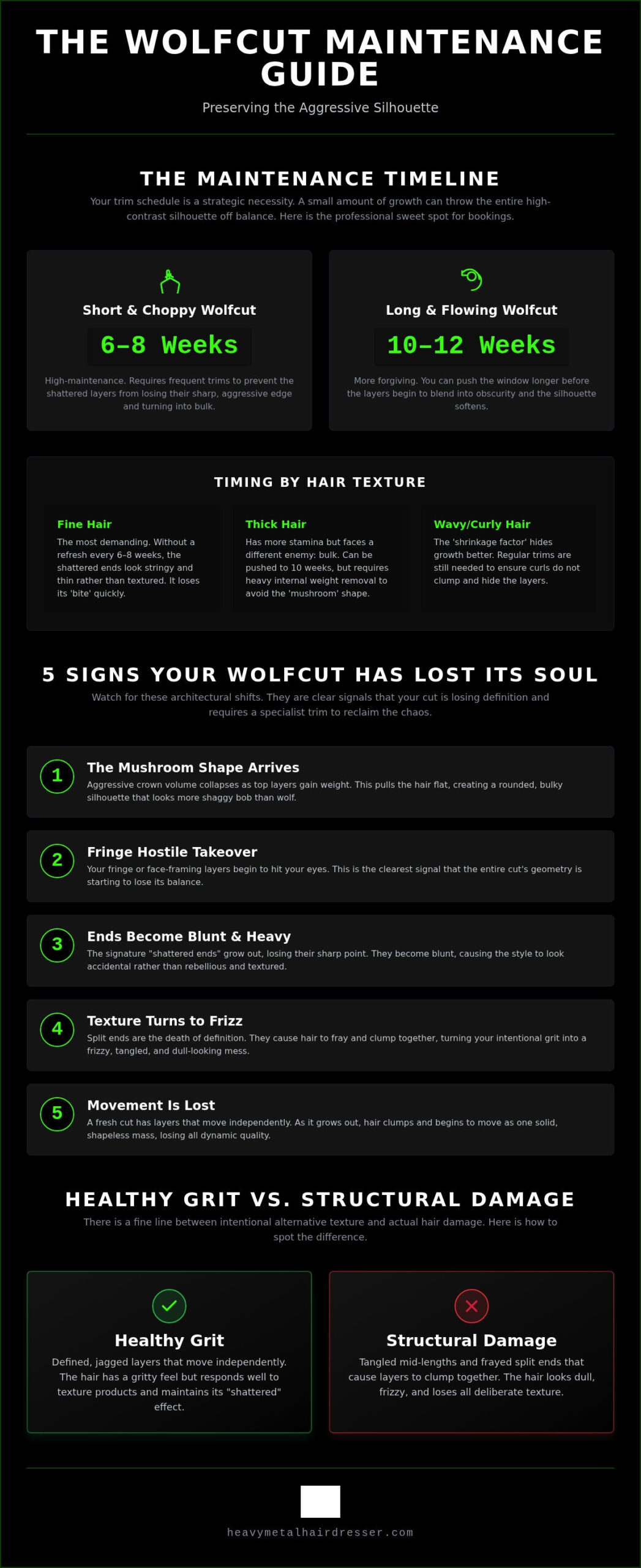
The wolfcut is a high-maintenance beast that requires a structural check-up every 8 to 12 weeks. Without professional intervention, the shorter crown layers lose their lift and the perimeter starts to look scraggly. We use a “dusting” technique to clean up your ends. This removes damaged fibres without sacrificing the length you have worked so hard to grow. It is the best way to re-inject chaos into hair that has grown flat. By keeping the ends fresh, you ensure your vivid pigment looks saturated and deliberate rather than washed out and neglected.

Ready to Saturate Your Identity?

We celebrate individuality amongst the alternative community every single day. We know the balance between the raw energy of a mosh pit and the professional care needed to keep your hair healthy. You deserve a stylist who understands your music, your fashion, and your refusal to conform to traditional beauty standards. If your current shade is looking tired or your layers have lost their bite, it is time for a reset. Book your vivid colour and wolfcut session with Simon Tuckwell and let’s keep your alternative edge sharp.

Own Your Vivid Evolution

Your wolfcut is more than just a haircut; it is a visual statement of intent. Keeping those aggressive layers sharp means you have to respect the chemistry behind the pigment. By embracing the cold water ritual and shielding your mane from the silent killers of UV and heat, you ensure your saturation lasts long enough to see the next gig. Mastering how to maintain vivid colour on a wolfcut is about consistent, rebellious self-care that refuses to let your identity fade into the background.

We aren’t just another salon. Simon Tuckwell is an expert in aggressive textured layering and creative colour; he has styled for bands at Download and Bloodstock festivals. This is a gender-inclusive safe space for the alternative community where your aesthetic is the priority, not an afterthought. Don’t let your sharp silhouette turn into a muddy mess. It is time to give your hair the professional grit it deserves.

Saturate your identity and book your wolfcut at Heavy Metal Hairdresser. Stay loud, stay vibrant, and never settle for a flat finish.

Frequently Asked Questions

How often should I wash my vivid colour wolfcut?

You should wash your hair no more than once or twice a week to “stop the bleed”. Every time water touches your hair, you risk losing pigment through the open cuticle. If you want to know how to maintain vivid colour on a wolfcut, reducing wash frequency is the most effective change you can make. Use a sulphate-free cleanser to ensure you aren’t stripping the dye whilst refreshing your scalp.

Can I use dry shampoo on bright hair colour without it looking dull?

You can absolutely use dry shampoo without losing your signature shine. The key is to choose a professional-grade formula that doesn’t leave a chalky, white residue on your vibrant base. Focus the product on your roots to absorb oil and provide the lift your wolfcut layers need. This keeps your hair looking voluminous and intentional without the need for a full, colour-stripping wash.

Does cold water actually help maintain vivid hair colour?

Cold water is essential for keeping your cuticle closed and your pigment locked inside the hair shaft. Hot water causes the hair to swell, which creates an easy exit route for large vivid colour molecules. It might be uncomfortable, but washing in the coldest water you can tolerate is a non-negotiable rule for anyone committed to high-octane alternative shades and long-lasting saturation.

Will heat styling products make my pink or blue hair fade faster?

Heat styling tools will definitely accelerate fading if you don’t use the right barriers. High temperatures can literally singe the pigment out of your hair, causing immediate desaturation. Always apply a professional heat protectant to damp hair and keep your irons below 180°C. This protection is a vital part of how to maintain vivid colour on a wolfcut while using tools to define your texture.

How do I stop my wolfcut from looking like a flat mullet as the colour fades?

You prevent the “flat mullet” look by booking a professional reshaping every 8 to 12 weeks. As your hair grows, the weight distribution shifts downwards, which kills the volume in your crown and hides your layers. A quick structural check-up re-balances the silhouette. Using a gritty sea salt spray also helps maintain that aggressive, choppy shape even as your colour begins to transition between salon visits.

Should I use a colour-depositing conditioner every time I wash?

You don’t need to use a colour-depositing conditioner every single time you wash your hair. Using it every second or third wash is usually enough to top up the saturation without causing excessive product build-up. If your shade is still looking punchy, stick to a regular moisture-heavy mask instead. Only reach for the extra pigment when you notice the first signs of dullness in your wispy ends.

What is the best way to protect my colour whilst at a music festival?

The best way to protect your hair at a festival is to use a UV-filtering spray and a lightweight leave-in conditioner. These act as a sacrificial barrier against the sun and the acidic sweat of the mosh pit. Braiding the longer sections of your wolfcut can also reduce mechanical friction. This prevents the nape of your neck from becoming a tangled, faded mess before the final headline set.

Can I maintain vivid colour on a wolfcut if I have very fine hair?

You can definitely maintain vivid colour on fine hair, but you must prioritise lightweight products that won’t kill your volume. Fine hair can easily become weighed down by heavy conditioners, making your wolfcut look limp and greasy. Choose high-pigment, liquid-based toners or airy depositing foams. This ensures your colour remains saturated without sacrificing the choppy, textured lift that makes the wolfcut silhouette work.

Posted on

Wolfcut with Vivid Colour Ideas: Saturating Your Alternative Identity

Wolfcut with Vivid Colour Ideas: Saturating Your Alternative Identity

Your hair isn’t just a style choice; it’s a structural rebellion against the beige and the boring. You already know the wolfcut is the ultimate silhouette for anyone living outside the mainstream. It’s raw, it’s messy, and it’s unapologetically loud. However, finding the right wolfcut with vivid colour ideas can feel like a gamble when you’re worried about pigments bleeding or your favourite shades fading into a muddy mess before the month is out. You want the grit without the grime. It’s about ensuring your aesthetic stays as biting as your layers.

We’re here to bridge that gap. You’ll learn how to fuse aggressive, textured layers with high-impact pigments to create a look that screams individuality. We’ll explore expert placement techniques that define your shape and look at 2026 trends like Velvety Cherry Cola and Gemstone Greens. This guide breaks down how to achieve high-contrast results that last. You’ll get the inspiration needed to go beyond basic highlights and the confidence to choose a palette that matches your alternative identity perfectly.

Key Takeaways

  • Discover why the clash of 70s shag layers and 80s mullet grit creates the perfect canvas for high-impact pigments.
  • Master strategic placement for your wolfcut with vivid colour ideas to amplify choppy texture and highlight aggressive face-framing.
  • Choose your aesthetic battle jacket from a range of curated palettes; from deep Gothic Noir to ultraviolet Toxic Neons.
  • Learn the maintenance protocol to stop colour bleeding and keep your saturation biting for longer.
  • Understand why a specialist shag hairdresser is non-negotiable for translating your specific subcultural vibe into a technical reality.

The Wolfcut with Vivid Colour: Why This Duo Rules the Alternative Scene

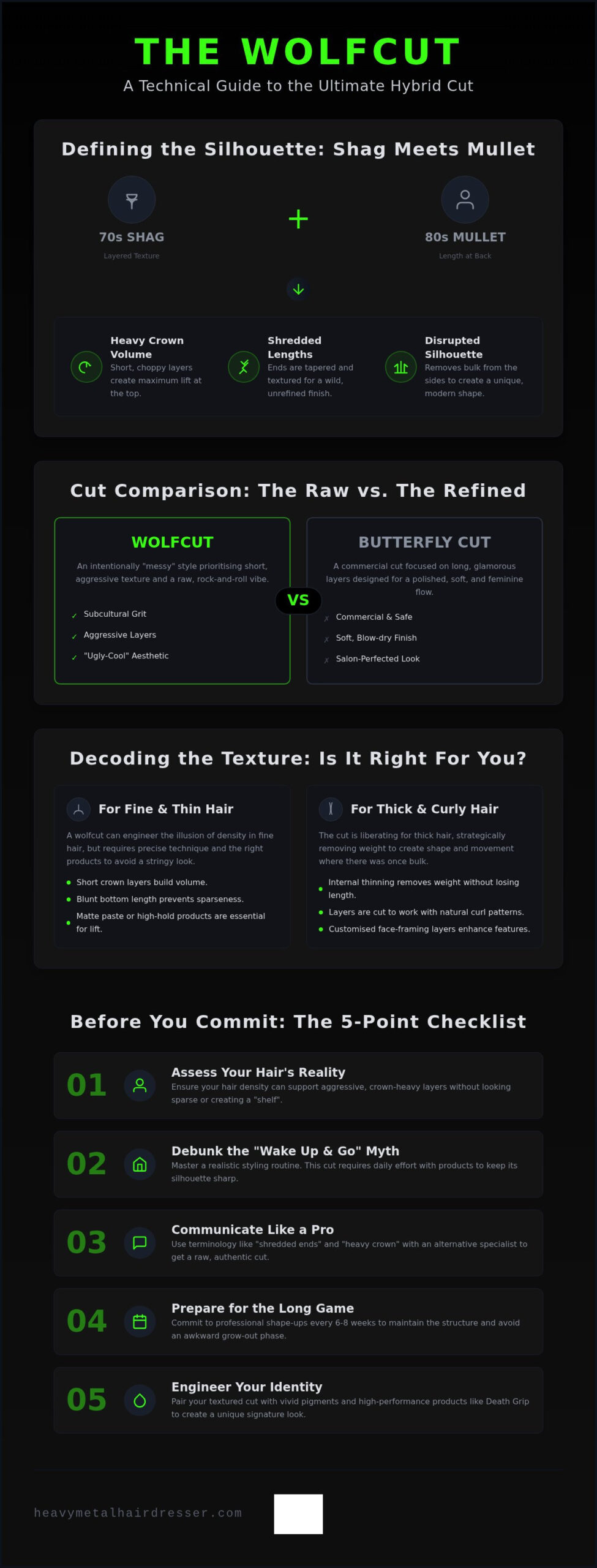
Forget everything you know about “pretty” hair. The wolfcut is a structural riot. It’s a chaotic, aggressive blend of the 70s shag’s volume and the 80s mullet’s tail. This isn’t a style for those who want to blend in at the office. It’s for the outsiders. By combining these two eras, you get a look that is a modern variation of the shag built on raw energy. The wolfcut is a hybrid of subcultural grit and modern technique that refuses to behave.

Vivid colour is the essential upgrade for these choppy layers. Without high-impact pigment, the intricate texture can often get lost in the shadows. Saturating your hair in electric tones or deep, moody hues brings those layers to life. It’s about the psychology of the alternative identity. Your hair is your visual armour. It’s a narrative that you own completely. Whilst mainstream salon standards push for “safe” natural tones that don’t offend, we advocate for unapologetic saturation that challenges. It’s a middle finger to the boring.

The Structural Advantage of the Wolfcut

The beauty of this cut lies in its total disconnection. Those jagged, uneven layers aren’t just for height. They create hidden “pockets” within the hair. This allows for unexpected colour surprises that reveal themselves only when you move. Movement is everything here. Vivids look better on shaggy hair because the light hits the different planes of colour simultaneously. A blunt cut is a flat screen; a wolfcut is a 3D experience. It’s built to be seen from every angle.

Vivid Pigment as a Form of Rebellion

Opting for a wolfcut with vivid colour ideas is a deliberate act of reclamation. You are moving beyond the natural tones that society deems “professional” to reclaim your own visual story. We are seeing a heavy influence from stage aesthetics and the raw energy of festival culture. In 2026, the UK alternative scene is embracing total saturation over subtle blending. It’s about being seen. This combination of aggressive cutting and high-decibel colour breaks every rule in the traditional handbook. It’s messy, it’s loud, and it’s exactly what the scene needs right now.

Strategic Colour Placement Ideas for Maximum Texture Impact

The wolfcut is a masterpiece of disconnection. If you simply douse it in one flat shade, you risk hiding the very texture that makes it iconic. To truly master a wolfcut with vivid colour ideas, you have to think about where the light hits and where the shadows retreat. It is about architectural placement that respects the movement of the hair. You aren’t just dyeing hair; you are highlighting a structural rebellion.

Start with the “Peek-a-Boo” underlayer. This technique involves saturating the bottom layers in a contrasting, dark shade. When you move, the aggressive underside flashes through the top layers, adding immediate structural depth. Then there is the “Radioactive” frame. This focuses high-impact vivids around the face and through those choppy bangs, acting as a neon spotlight for your features. For those who want a total system shock, Split Dye Chaos is the answer. Dividing the cut down the centre for a symmetrical assault creates a high-contrast look that demands attention from every angle. Finally, dip-dyed ends can emphasise the “shredded” texture of your perimeter. By colouring only the last few inches of the longest layers, you make the flicky ends look intentionally sharp and dangerous.

Contouring Your Cut with Colour

Utilising a wolfcut with vivid colour ideas allows you to manipulate how the cut’s volume is perceived. Darker vivids like deep plum or forest green create artificial shadows. Placing these in the mid-layers creates a sense of immense depth. Conversely, hitting the top layers with neon yellows or acid greens draws the eye upward to the crown volume. To keep things clean, always follow safety guidelines for hair dye when mixing pigments. Using the right barrier products prevents different shades from turning into a muddy mess during the rinse process.

The “Internal Glow” Technique

This method involves placing bright tones strictly on the mid-shaft of the hair. It makes the layers look like they are vibrating from within. This works exceptionally well for the wolf hair cut because the shorter crown layers naturally reveal the glowing mid-section underneath. You can choose horizontal sectioning for a more blended “halo” effect or vertical slices for distinct ribbons of light. If you are unsure which placement fits your specific texture, consulting a specialist shag hairdresser is the best way to ensure your vision translates into a technical reality.

Wolfcut with Vivid Colour Ideas: Saturating Your Alternative Identity

Aggressive Palettes: Choosing Your Vivid Battle Jacket

Choosing your palette isn’t just about what looks good. It’s about personal iconography. Think of your hair as a battle jacket; each shade is a patch representing your subcultural allegiance. A wolfcut with vivid colour ideas requires a palette that matches the aggressive nature of the cut. You don’t want a “pretty” pastel if your layers are designed to look like they’ve been shredded by a riot. You want high-decibel distortion that reflects your internal landscape.

The Gothic Noir palette is for the dwellers of the dark. We are talking deep plums, midnight blues, and blood reds that look almost black until the light hits the texture. If you prefer high-visibility rebellion, Toxic Neons are your weapon. Acid green, electric yellow, and UV-reactive pinks create a radioactive glow that is impossible to ignore. For a more metallic, industrial vibe, Oil Slick Realism uses iridescent teals and purples to mimic the greasy shimmer of petrol on rain-soaked tarmac. Finally, the “Nuclear” Sunset blends magentas, oranges, and yellows into a bleeding horizon that flows perfectly through long, shaggy layers.

Matching Colour to Your Aesthetic

Your hair should resonate with your speakers. Metalheads often gravitate towards the Gothic Noir or Oil Slick palettes, whilst Punks might lean into the raw energy of Toxic Neons. Pairing vivid hair colour with heavy texture is what we call the “Deadly Combination.” It’s a sensory overload. If your wardrobe is strictly all-black, a high-contrast pop of colour acts as a visual anchor. It breaks up the silhouette and ensures your identity isn’t swallowed by the shadows. It is about making your presence felt before you even speak.

The Science of Saturation

Achieving these extreme looks isn’t a quick process. To get that “Nuclear” Sunset or a piercing neon, you usually need to start at a level 10 blonde. This provides a clean canvas for the pigment to bond with. Toning the hair before applying the final vivid pigment is vital to ensure the result is pure and not muddied by yellow undertones. It is also important to follow FDA hair dye safety guidelines to protect your scalp during these intensive lightening sessions. Remember that every colour has a life cycle. Some shades, like magentas, look incredible as they fade into soft peaches, whilst others might require more frequent top-ups to maintain their bite.

Maintenance Protocol: Protecting Your Pigment and Shape

You’ve spent hours in the chair and a fair bit of coin on your wolfcut with vivid colour ideas. Don’t let it all wash down the drain in a week. Maintenance for alternative hair isn’t a suggestion; it’s a lifestyle. If you treat your hair like a standard “short back and sides,” you will lose the saturation and the structure that makes this look biting. You need a ritual that respects the grit whilst guarding the pigment.

The first rule is the Cold Water Commandment. Heat is the ultimate enemy of vivid saturation because it forces the hair cuticle open, allowing those expensive pigments to escape. Wash your hair in water as cold as you can stand. It’s a shock to the system, but it keeps your colour locked in. Next, it’s sulphate-free or die. Traditional shampoos use harsh detergents that strip semi-permanent dyes in a single go. Switch to a professional, sulphate-free cleanser that prioritises moisture over foam.

Maintaining the “shred” is equally vital. A wolfcut relies on aggressive, disconnected layers. Without a trim every 6 to 8 weeks, those layers grow out and lose their flicky energy, turning your masterpiece into a shapeless blob. Between salon visits, establish a refreshment cycle. Use a high-quality semi-permanent dye to top up your most visible sections at home. It keeps your palette looking fresh rather than faded. If you want to keep your look sharp between appointments, you can find the right tools and branded merchandise to support your daily ritual.

Combatting the Fade

The sun is a natural bleach. UV rays break down chemical bonds in your hair colour, leading to a dull, dusty finish. Use a UV protectant spray whenever you’re heading out to a gig or festival. You can also integrate pigment-depositing conditioners, but be careful with your placement if you have a split-dye or peek-a-boo layers. Over-washing is the absolute #1 killer of creative colour, so aim for once or twice a week at most.

Styling for Longevity

Heat styling doesn’t just fade colour; it destroys the integrity of bleached strands. Air-drying is your best friend. It preserves moisture and allows the natural texture of the cut to take centre stage. To get that signature messy look, use products like Death Grip or Hair To the Throne. These provide the necessary grit and volume without the heavy weight of traditional waxes. Avoid heavy oils, as they can sometimes act as a solvent and strip certain types of semi-permanent pigments. This keeps your texture looking raw and your colour looking dangerous.

The Heavy Metal Hairdresser Experience: Execution and Grit

Most salons want to tame you. They treat alternative aesthetics like a costume, missing the structural nuance required for a look that actually lasts. We don’t. A specialist shag hairdresser is non-negotiable for this level of technical aggression. It isn’t just about the cut; it’s about the subcultural context. Your hair needs to survive the front row of a gig. It’s hair designed for the mosh pit and the stage.

The consultation is where the technical plan meets your personal energy. We don’t just look at face shapes. We look at your aesthetic, your music, and your lifestyle. Executing a wolfcut with vivid colour ideas requires a safe space where being different is the standard. Inclusivity isn’t a buzzword here; it’s the foundation of everything we do. Every cut and colour is an identity-affirming act.

Beyond the Chair

Joining the HMH community means entering a network of outsiders. We aren’t just stylists; we are advocates for your individuality. For those looking to master these techniques, we offer alternative hair courses UK to train the next generation of rebellious experts. Whether you are chasing a wolfcut with vivid colour ideas or a raw, textured shag, booking your first session is the start of a transformation. Expect high energy and zero judgment.

Your New Weapon of Self-Expression

Stop apologising for being too much or too loud. The world is beige enough. A wolfcut that finally matches the noise in your head is a powerful weapon. It’s about the moment you look in the mirror and finally see yourself. This isn’t just a change of look. It’s a reclamation of your visual narrative. Book your wolfcut and vivid colour session now and finally saturate your identity.

Claim Your Visual Narrative

Your hair is the loudest thing about you. It’s an architectural statement that refuses to be quiet. By now, you know that a wolfcut with vivid colour ideas isn’t just about a trend; it’s about structural depth and high-decibel pigment. You’ve seen how strategic placement like the “Radioactive” frame can highlight your features, whilst a strict maintenance ritual of cold water and sulphate-free care keeps your saturation biting for longer. This is about more than just a haircut. It is a total reclamation of your identity, and for those wanting to document their unique style for a special occasion, Ian Petrie’s Photography provides professional imagery that respects the alternative aesthetic.

We live for the grit. As experts in aggressive texture and creative pigment, we provide a gender-inclusive safe space for the alternative community. Our team has worked as backstage festival stylists at Download and Bloodstock, so we know exactly what it takes to make hair survive the pit. Stop settling for mainstream standards that don’t understand your vibe. It’s time to step out of the shadows and into the neon. Book your wolfcut and vivid colour transformation at Heavy Metal Hairdresser today. Your most authentic self is waiting to be unleashed.

Frequently Asked Questions

How long does a wolfcut with vivid colour typically last?

A wolfcut with vivid colour typically maintains peak saturation for 4 to 8 weeks depending on your maintenance ritual. Cold water washes and professional sulphate-free cleansers are non-negotiable to prevent premature fading. Some pigments like deep purples or magentas may linger longer as a soft stain, whilst neons often require more frequent top-ups to keep their high-decibel energy.

Can I get a wolfcut if I have naturally curly or textured hair?

Absolutely. The wolfcut actually thrives on natural curls and waves because the disconnected layers remove bulk whilst encouraging movement. It creates a wild, organic shape that is much easier to style than traditional blunt cuts. Textured hair provides the perfect gritty canvas for high-impact pigments, making the layers look even more dimensional and aggressive.

Does vivid hair colour damage your hair more than traditional dye?

No, semi-permanent vivid pigments are generally non-oxidative and act more like a deep conditioning treatment than a chemical process. The potential for damage lies in the pre-lightening stage required to reach the pale blonde base necessary for bright tones. Professional application ensures your hair integrity remains intact during the bleaching process so your alternative aesthetic doesn’t come at the cost of shredded strands.

How often should I get my wolfcut layers trimmed to keep the shape?

You should book a trim every 6 to 8 weeks to prevent your aggressive layers from losing their definition. The wolfcut relies on specific weight distribution to maintain its flicky, textured perimeter. If you wait too long, the crown volume collapses and the shape becomes a heavy, uninspired blob. Regular maintenance ensures your silhouette stays sharp and intentional.

What happens if I want to change my vivid colour to something else later?

Changing your palette is entirely possible through professional fading treatments or colour wheel transitions. We often move between adjacent shades, such as shifting from blue to purple, to maintain hair health and avoid over-processing. If you want a total reset, a professional colour removal process is necessary. Never attempt a “DIY” bleach bath at home, as this can lead to uneven results and permanent structural damage.

Is a wolfcut high maintenance for daily styling?

It’s actually one of the lowest-maintenance styles for daily wear because it’s designed to look “undone” and raw. You don’t need a round brush or a flat iron to make it work. A bit of salt spray or a texture-building product is usually enough to wake up the layers. It’s the perfect cut for anyone who wants high-impact style with minimal morning effort.

Can I achieve these vivid colour ideas on dark hair without bleach?

You cannot achieve high-saturation neons or bright gemstone tones on dark hair without a lightening process first. Dark hair acts like a brown piece of paper; if you put purple ink on it, it simply won’t show. To get the most out of your wolfcut with vivid colour ideas, we must lift the hair to a pale yellow base. This provides the clean canvas required for the pigment to truly pop.

What is the best way to stop vivid colours from bleeding into each other?

The most effective way to prevent colour bleeding is washing your hair in ice-cold water to keep the cuticle closed. Cold water traps the pigment inside each strand and prevents it from migrating. You should also rinse different sections separately if you have a high-contrast look like a split-dye. This ensures your neons don’t muddy your deep tones during the cleaning ritual.

Posted on

Growing Out a Wolfcut Gracefully: The Alt-Hair Survival Guide

Growing Out a Wolfcut Gracefully: The Alt-Hair Survival Guide

The “awkward phase” is nothing more than a lack of vision. You didn’t choose a wolfcut because you wanted to look like everyone else, so why should your growth journey feel like a retreat into the mainstream? We know the frustration of watching those back layers outpace the top, leaving you with a mullet that feels more accidental than intentional. It’s a common struggle to feel your volume vanish as the hair gets heavier and the shape starts to sag. Growing out a wolfcut gracefully doesn’t mean you have to endure months of looking unstyled or boring.

This guide is your survival blueprint for transitioning your look without sacrificing a single drop of your alternative edge. We’ll show you how to evolve your silhouette into a killer long shag or a soft mullet that maintains its gritty, rockstar aesthetic. You’ll learn the essential techniques for keeping your texture alive and your volume high while your layers find their new rhythm. It’s time to stop waiting for your hair to grow and start directing its evolution. Let’s make sure your hair stays as bold as your identity throughout the entire process.

Key Takeaways

  • Stop fearing the structural chaos of new growth by understanding how to manage weight and disconnected layers.
  • Master the art of growing out a wolfcut gracefully by pivoting your silhouette into a long mullet or a heavy shag.
  • Learn why the “dusting” technique is the secret to removing split ends whilst protecting every millimetre of your progress.
  • Discover the essential styling tools and salt sprays needed to maintain volume and a gritty texture as your hair gets heavier.
  • Identify the perfect moment for a professional reshape that honours your subcultural identity instead of forcing a mainstream look.

The Wolfcut Growth Timeline: Embracing the Structural Chaos

A wolfcut is a structural masterpiece of chaos. It relies on a heavy fringe, aggressively disconnected layers, and wispy, tapered ends to create that signature silhouette. When you begin growing out a wolfcut gracefully, you aren’t just waiting for length. You’re re-engineering a shape while it’s still in motion. The biggest mistake people make is viewing this transition as a “broken” style. It isn’t. Your hair is simply evolving from one alternative statement to the next. The so-called awkward phase is usually just a failure of weight management. As your top layers gain length, they gain weight. Gravity takes over, the volume collapses, and the shape starts to sag. Understanding this anatomy is the first step to staying sharp whilst the layers find their new rhythm.

Texture plays a massive role in how this timeline unfolds. If you have straight hair, every centimetre of growth is visible. You might notice “staircase” layers where the transitions look blunt rather than blended. For those with curls or waves, the growth is more forgiving but can quickly turn “triangular” as the weight shifts to the bottom. Growth isn’t a passive waiting game. It’s a strategy. You have to decide whether you’re heading toward a seamless blend or keeping the disconnected grit that made you love the wolfcut in the first place.

The First Three Months: Managing the Mullet Effect

In the first ninety days, biological reality hits. The hair at your nape always seems to outpace the crown layers. This creates a bottom-heavy look that can feel accidental if you don’t lean into it. The smartest move is to embrace the modern mullet haircut during this window. By keeping the back long and intentionally textured, you maintain your alternative edge whilst the shorter top sections catch up. You’ll also face the eye-poking “fringe overhang.” Don’t reach for the kitchen scissors to chop it straight across. Keep the texture piecey and swept to the sides to maintain the rockstar aesthetic.

The Six-Month Mark: Transitioning to the Shag

By month six, the disconnected layers finally start to shake hands. The gap between your shortest crown layers and your mid-lengths closes. This is the point where you can officially claim a shag haircut as your new identity. The wolfcut is essentially the rebellious lovechild of the 70s Shag haircut and the 80s mullet, so this transition feels incredibly natural. To keep the look from falling flat, you must redirect volume from the sides back to the crown. Removing internal weight is vital here. It ensures your hair stays light enough to keep that essential height, even as the overall length increases. Growing out a wolfcut gracefully at this stage is all about blending those once-harsh lines into a cascading, textured flow.

Shifting Shapes: Evolving Your Wolfcut into a Shag or Mullet

Most traditional salons will tell you that once those choppy layers start to hit your shoulders, it’s time for a blunt bob. Ignore them. Cutting your hair into a uniform length is a retreat, not a strategy. Growing out a wolfcut gracefully is about leaning into the chaos and steering it toward a new alternative silhouette. You have two primary paths: the aggressive pivot into a long mullet or the soft landing of a heavy shag. Both options allow you to keep your length whilst maintaining that essential subcultural grit. It’s about working with the hair you have, rather than mourning the shape you used to have.

Visual distractions are your best friend during this period. Incorporating vivid hair colour is a pro move to mask uneven growth. High-contrast panels or a bold split-dye can draw the eye toward your colour choice and away from any “staircase” layers that haven’t quite blended yet. Keep your face-framing “bits” short and textured. Even if the rest of your hair is in a transitional state, a sharp, piecey fringe or cheek-skimming layers will keep your look feeling intentional and alt-focused.

The Rockstar Shag Evolution

If you want a more blended look, the shag is your destination. You’ll need to focus on connecting the “steps” of your wolfcut into a seamless, cascading flow. This means letting the crown layers grow whilst keeping the mid-lengths heavily textured. You can maintain that iconic “butterfly” wing effect by styling the layers away from the face, which adds vertical height even as gravity tries to pull it down. To keep the transition smooth, you should learn to Maintain and Style Wolf Cut Hair using techniques that prioritise movement over precision. Extreme texture is the secret here. It hides the gaps between your old layers and your new length.

Aggressive Mullet Maintenance

For those who want to keep things sharp, the long mullet is the ultimate exit strategy. Keep the sides tight and tucked whilst letting the back grow wild. This creates a high-impact contrast that feels deliberate rather than messy. The “party in the back” can quickly become a flat, heavy curtain if you aren’t careful. It needs constant thinning and internal weight removal to stay airy and rebellious. When you’re styling modern mullets in this mid-growth phase, focus on adding grit to the back with salt sprays or clay. If your hair feels like it’s losing its edge, it might be time to book one of our shag haircuts to reset the internal structure without losing your hard-earned length.

Growing Out a Wolfcut Gracefully: The Alt-Hair Survival Guide

The Art of the Maintenance Cut: Why “Dusting” Saves Your Soul

Ignore the generic advice on Quora telling you to chop your hair into a blunt bob and “start over.” That is a failure of imagination. Growing out a wolfcut gracefully does not mean abandoning the salon for six months. It means shifting your strategy from “shaping” to “preserving.” The secret weapon in your arsenal is a technique called dusting. Unlike a traditional trim that removes significant length, dusting is a surgical strike. Your stylist removes only the split ends that occur at the very tips of your layers. You don’t lose a single millimetre of progress, but you stop damage from travelling up the hair shaft and destroying your texture.

As your hair gains length, gravity becomes a relentless enemy. The volume that once defined your style starts to collapse under its own weight. This is where internal weight removal becomes vital. By thinning out the bulk from the inside of the cut, you keep the crown layers light and airy. This maintains the “lift” of your alternative silhouette without altering the external length. Even a quick 10-minute fringe reshape can completely pivot your look. It keeps the front of your hair feeling intentional and sharp whilst the back and sides do the heavy lifting of growing out.

How to Organise Your Salon Visits

Precision is everything when you are in the middle of a transition. To keep your shape from sagging, follow the 8-week rule. This is the sweet spot where your hair has grown enough to require a weight reset but hasn’t yet lost its structural integrity. When you sit in the chair, be specific with your language. Tell your stylist to “blunt the ends for strength, but keep the texture internal.” This ensures your hair looks thick and healthy at the bottom whilst staying piecey and rebellious at the top. If you feel the volume has vanished, it is a clear sign that the weight of your wolf hair cut has shifted too far down.

DIY Dangers: Why the Kitchen Scissors are the Enemy

We’ve all been there at 2 a.m., staring in the mirror and thinking we can “just fix” one heavy section. Put the kitchen scissors down. DIY trims are the fastest way to derail your progress. Professional sectioning is required for disconnected shapes to ensure the layers actually flow into one another. If you over-thin a section at home, you risk creating a “hole” in your silhouette that can only be fixed by cutting the rest of your hair shorter to match. A bad home trim doesn’t just look messy. It can set your growth timeline back by three to four months. Trust the process and keep the technical work to the experts.

Styling the Transition: Tools for Textured Grit

Gravity is a bastard. As your crown layers reach that mid-point growth, they lose the structural integrity that made the original cut pop. Growing out a wolfcut gracefully requires a shift in your styling arsenal. You aren’t just trying to keep it tidy; you’re fighting a daily battle against the “flat” look that threatens to turn your alt-hair into a suburban disaster. Salt sprays are non-negotiable here. They provide that essential beach-grunge grit that mimics the original’s aggressive texture. Dry shampoo is another secret weapon. Don’t just save it for day-three grease. Use it on clean hair at the roots to provide structural lift that gravity can’t easily defeat. It creates a “scaffold” for your hair, keeping the crown airy even as the back grows into a heavier mullet shape.

Death Grip & Hair To the Throne: Your Growth Weapons

Standard mousses and sprays from the supermarket won’t cut it for alternative shapes. They lack the aggressive hold needed for high-texture styles. Use Hair To the Throne specifically at the crown. It provides the massive volume needed when your hair starts feeling heavy and unmanageable. For the ends, apply Death Grip. It maintains that “shredded” look by grouping the tapered ends together without making them look greasy or weighed down. This is how you “fake” a wolfcut shape when the layers have technically grown out too far. By keeping the ends piecey and the top voluminous, you trick the eye into seeing the original silhouette. When you combine these two, you get a mosh-pit-ready finish that stays vertical whilst the rest of your hair is busy gaining length.

Heat Styling for Evolving Layers

Natural texture is your best ally. If you have any wave or curl at all, use a diffuser. It encourages the hair to shrink up and cluster, which hides the uneven gaps between growing layers. This prevents that “staircase” effect that straight-haired folks often struggle with during the transition. To keep those iconic wolfcut wings alive, use a flat iron for quick “flicks” at the mid-lengths. This directs the hair away from the face, maintaining that rebellious energy. Just remember: damaged hair doesn’t grow gracefully. It snaps. If you’re constantly heat styling to maintain your look, you must prioritise health. Always use heat protection to ensure your progress isn’t ruined by fried, brittle ends. Grab our branded merchandise and professional styling tools to keep your texture sharp and your identity intact.

Reclaiming Your Identity: Professional Exit Strategies

Growth is a journey, not a destination. You’ve navigated the structural chaos and mastered the art of growing out a wolfcut gracefully. Now you face the ultimate choice. Do you keep pushing for length, or do you commit to a total reshape? At the Heavy Metal Hairdresser, we don’t care about “standard” beauty rules. We don’t want to turn your alternative edge into something palatable for a corporate office. Our approach prioritises your individuality above all else. We look at your bone structure, your subcultural roots, and your lifestyle to map out a 12-month hair journey that feels like an upgrade, not a compromise. It is about evolving your look whilst keeping your soul intact.

Your vivid colour needs to evolve alongside your silhouette. Longer hair provides a larger canvas for high-pigment sensation. As your layers finally blend, we can transition your colour placement to highlight the new movement. This might mean shifting from a high-contrast split-dye to a deep, dimensional melt that flows with your new length. Booking a consultation is about more than just a trim. It is about vision. We map out where you want to be in a year. We ensure every maintenance session serves that final, aggressive goal. Don’t just let your hair happen to you. Direct it.

Beyond the Wolfcut

The end of the wolfcut is just the beginning of something more intense. You might find yourself gravitating toward a “Mega-Shag” with cascading, face-framing texture that hits your waist. Or perhaps you are ready for the “Floor-Length Mullet,” a silhouette that commands respect in any pit. Keeping your alternative hair merch UK aesthetic consistent is vital. Your hair and your gear should tell the same story of rebellion. For those who want to dive deeper into the mechanics of these shapes, our alternative hair courses UK offer a masterclass in subculture styling. Learn the “why” behind the weight distribution so you can own your look with total confidence.

Your Next Move

Don’t settle for a boring transition. Don’t let a mainstream stylist talk you into a “safe” look that erases your identity. Trust the experts who live and breathe alternative culture. We understand the nuances of the scene because we are the scene. Your hair is your loudest form of self-expression. Keep it loud. Keep it authentic. Growing out a wolfcut gracefully is only possible when you have a stylist who understands that “grace” can still have teeth. Book your maintenance session now. Let’s reclaim your identity together.

Own Your Alternative Evolution

Your hair is a living, evolving statement of your identity. It shouldn’t feel like a mistake just because you’re moving between shapes. We’ve explored how to navigate the structural chaos by pivoting into shags or mullets and why internal weight management is the secret to keeping your volume alive. Growing out a wolfcut gracefully is about taking control of the silhouette instead of letting gravity dictate your look. You’ve worked hard for your length. Don’t let a “messy phase” force you into a boring, mainstream chop.

Ready to map out your next twelve months? We are specialists in aggressive texture and vivid colour, bringing the same expertise we use as backstage festival stylists for Download and Bloodstock. We provide a gender-inclusive safe space where your individuality is the only rule we follow. Book your Wolfcut Evolution session at Heavy Metal Hairdresser today. Let’s make sure your transition is as bold and unapologetic as the subculture you belong to. Stay rebellious.

Frequently Asked Questions

How long does it actually take to grow out a wolfcut?

It typically takes between six and twelve months to transition from a choppy wolfcut to a more cohesive mid-length or long shag. Since hair grows at an average rate of about one centimetre per month, you are looking at a year-long evolution to fully blend the shortest crown layers. The exact timeline depends on your starting length and how aggressively the layers were disconnected. Be patient whilst the top sections catch up to the back.

Can I grow out a wolfcut without cutting it into a bob?

Absolutely, you don’t need to retreat into a blunt bob to fix your shape. By growing out a wolfcut gracefully through a shag or mullet pivot, you keep your alternative edge whilst the layers blend. This strategy focuses on weight management and internal texturing rather than a massive chop. It is about evolving the silhouette rather than starting from scratch with a mainstream style.

How do I stop my grown-out wolfcut from looking like a mullet?

You stop the accidental mullet effect by regularly trimming the length at the nape whilst letting the crown layers grow. If you don’t manage the back, the biological growth rate will naturally outpace the top and sides. Keep the back textured and piecey rather than heavy. This ensures the look remains an intentional alternative choice rather than a neglected or accidental shape.

What is the best product for styling a wolfcut during the awkward phase?

Salt sprays and dry shampoos are your best allies for maintaining grit when the layers feel heavy. Use a product like Hair To the Throne to provide structural lift at the crown when gravity starts to pull your volume down. For the ends, a texturising paste like Death Grip keeps the shape looking shredded and deliberate. These tools prevent your hair from looking flat and mainstream during the transition.

Do I need to trim my hair whilst growing it out?

Yes, regular maintenance cuts are essential to prevent split ends from travelling up the hair shaft and ruining your progress. Focus on “dusting” the very tips every eight weeks to preserve your length whilst removing damage. You also need professional weight removal from the internal layers. Without these small interventions, the hair becomes bottom-heavy and loses the rebellious lift that defines the wolfcut aesthetic.

How do I fix flat hair at the crown as my layers get longer?

You fix crown flatness by removing internal weight and using root-lifting styling techniques. As layers grow, they become heavier and pull the hair flat against the scalp. Ask your stylist for internal texturising to lighten the load without sacrificing the external length. Blow-drying your hair upside down with a diffuser also helps to reset the volume at the roots for more aggressive height.

Is it possible to transition a wolfcut into a shag?

Yes, transitioning into a shag is the most natural path for anyone growing out a wolfcut gracefully. Since both styles rely on heavy layers and a textured fringe, the wolfcut is essentially just a more disconnected version of the shag. By slowly blending the steps between the layers over several months, you create a seamless, cascading 70s-inspired flow that looks completely intentional and sharp.

Should I change my hair colour whilst growing out my layers?

Changing your colour is a brilliant way to distract from uneven lengths whilst reclaiming your identity. Bold, vivid colours or high-contrast panels draw the eye toward the pigment and away from any transitional layers that haven’t quite blended yet. It keeps your look feeling fresh and rebellious even when the shape is in flux. Use colour as a tool to anchor your alternative aesthetic during the growth journey.

Posted on

The Alt-Hair Survival Guide: How to Maintain a Shag Haircut Between Gigs

The Alt-Hair Survival Guide: How to Maintain a Shag Haircut Between Gigs

Your shag haircut is a high-stakes gamble between looking like a legendary frontman or your primary school teacher. You left the chair feeling like a god, but three weeks later, those aggressive layers have lost their kick and you’re wondering how to maintain a shag haircut without it turning into a flat mess. The volume is gone, your fringe is stabbing you in the eyes, and you’re terrified you’re sliding into “mum cut” territory. It’s a common struggle for anyone living outside the mainstream. You want that raw, underground aesthetic to last, but hair has a frustrating habit of growing out of its rebellious phase.

We agree that a shag isn’t a set-and-forget style; it’s a living shape that demands a tactical approach to texture. This guide will show you how to keep your layers sharp, gritty, and intentional until your next appointment. We’re breaking down the art of the DIY fringe refresh, the secret to preserving vivid colours whilst styling, and how to keep that aggressive volume for weeks. You’ll learn to manage your mane like a pro, ensuring your hair health stays intact without sacrificing the grit that makes your style yours. Let’s get into it.

Key Takeaways

  • Identify the six-week shelf life of your cut and learn to spot the “triangle phase” before your silhouette loses its edge.
  • Discover how to maintain a shag haircut by adopting a “less is more” wash routine that protects your vivid colour and preserves natural grit.
  • Master the “scrunch and pray” technique and learn why diffusing is your best weapon for organising face-framing chaos.
  • Follow a monthly checklist to navigate the “fringe crisis” and keep your layers looking sharp whilst your hair grows.
  • Understand the difference between a quick “dusting” and a full resurrection so you know exactly when to book your next professional refresh.

The Anatomy of an Alternative Shag: Why Maintenance is Non-Negotiable

The modern shag is a deliberate collision of aggressive internal layers and face-framing chaos. It’s not the polished, salon-smooth look your local high-street stylist might suggest. This is about grit. Whether you’re rocking a wolfcut or a mullet, the alternative shag thrives on disconnected lengths that refuse to behave. To understand the Shag haircut history is to see a style rooted in rebellion, from 70s rock icons to modern-day punks. But here’s the reality: knowing how to maintain a shag haircut is the difference between a deliberate aesthetic and a flat, shapeless mess.

Mainstream “soft” shags often play it safe with blended layers and subtle movement. Alternative shags don’t play. We use deep point-cutting and razors to create a silhouette that stands out in a crowd. This aggressive approach creates a shape that is both inclusive and identity-affirming, but it comes with a timeline. The first six weeks are your sweet spot. This is when the layers are light enough to defy gravity and the fringe sits exactly where it was intended. After this window, the physics of your hair starts to change. The #1 misconception is that “low maintenance” means “no maintenance.” In reality, it means tactical maintenance.

Messy by Design vs. Messy by Neglect

Gravity is the enemy of the crown. Those short, choppy layers that gave you instant height on day one will eventually succumb to the weight of growth. Usually, the first six weeks are the sweet spot where the cut looks intentional and raw. Beyond that, “lived-in” quickly becomes “grown-out.” The silhouette shifts. The volume drops. What was once a fierce, gender-inclusive shape for alternative identities starts to look like a traditional, unstyled bob. You aren’t aiming for perfection, but you are aiming for impact. Neglect kills the vibe. It turns a statement into an accident.

The Role of Texture in Shag Longevity

The secret to a long-lasting shag lies in internal weight removal. Without it, your hair will inevitably expand at the bottom, creating the dreaded “triangle head” effect. Your specific hair type dictates your maintenance schedule; curly textures might need more hydration, whilst straight hair needs more grit. The shag is a high-texture, low-tension cut designed for movement. Learning how to maintain a shag haircut means understanding that your hair needs to breathe. It needs space between the layers to move, bounce, and look unapologetically messy. If the texture isn’t there, the shag doesn’t exist. You have to keep that internal structure alive to keep the chaos looking cool. If you’re working with a particularly dense mane, understanding the specific techniques behind a shag haircut for thick hair can make all the difference in keeping that internal structure from collapsing under its own weight.

The Wash-Day Ritual: Cleansing Without Killing Your Vibe

Washing your hair shouldn’t feel like a chore, but it shouldn’t be a daily habit either. Squeaky clean hair is the enemy of alternative texture. It’s too slippery. It lacks the lived-in soul that defines a wolfcut or a mullet. When considering how to maintain a shag haircut, the first rule is to embrace the “less is more” philosophy. You want to preserve the natural oils that give your hair its edge whilst keeping your vivid hair colour from drowning in the drain. Sulphates are the enemy here. They’re aggressive detergents that strip high-pigment shades faster than a mosh pit clears out a venue.

Learning how to maintain a shag haircut also involves a specific “Conditioner Map.” Never apply conditioner to your roots. It’s a rookie mistake that weighs down your crown layers, turning your volume into a flat, greasy mess. Apply it only to the mid-lengths and ends. Finish with a cold-water rinse. It’s brutal. It’s a shock to the system. However, it’s non-negotiable for sealing the cuticle and locking in shine. If your layers are starting to look more “lost” than “legendary”, it might be time to book one of the Shag Haircuts we specialise in to restore that internal structure.

Texture-First Cleansing

Whilst some mainstream guides on maintaining your shaggy hairstyle suggest standard volumising products, alternative hair needs a more tactical approach. Sea salt co-washing is a game-changer for naturally wavy alt-styles. It cleanses without stripping the “shag factor” from your strands. Use dry shampoo as a preventative tool on day two, rather than a rescue mission on day four. It builds a foundation of grit that makes styling easier. It keeps your layers standing up instead of falling flat against your scalp.

Managing the “Fringe Grease”

The fringe is always the first part to fail. It sits against your forehead, absorbing oils and losing its shape whilst the rest of your hair still looks killer. Use the “Sink Wash” technique. Pin back your layers and wash only the fringe in the sink. It saves time and preserves the texture of your lengths. Avoid heavy silicones at all costs. They are notorious for flattening modern 70s shag haircuts, turning aggressive layers into limp strands. Stick to lightweight, water-based products to keep that face-framing chaos looking intentional.

The Alt-Hair Survival Guide: How to Maintain a Shag Haircut Between Gigs

The Styling Arsenal: Tools to Organise Your Chaos

Your hands are your most important tools, but they can’t do all the heavy lifting. Mastering how to maintain a shag haircut requires a tactical selection of gear that respects your hair’s natural rebellion. For maximum “shag factor”, you need to choose between air-drying and diffusing. Air-drying is the ultimate low-effort move for a lived-in look, but if you want aggressive volume, the diffuser is your best friend. It mimics the natural movement of the wind whilst lifting those shorter crown layers we discussed earlier. It prevents the hair from hanging flat under its own weight.

If you have wavy hair, embrace the “scrunch and pray” method. Apply your product to damp strands, scrunch upwards with a microfibre towel, and then leave it alone. Touching it whilst it dries is the fastest way to invite frizz. Ditch your standard hairbrush immediately. Brushes are designed to blend; shags are designed to be disconnected. A wide-tooth comb is the only way to keep your layer separation sharp without creating a fuzzy mess. For those who need extreme texture that survives a three-hour set, reaching for a high-performance tool like Death Grip is non-negotiable. It provides the grit needed to keep those aggressive layers from looking too soft.

Whilst some guides on how to style a shag focus on boutique creams, we prioritise products that actually hold up under pressure. You need a kit that matches your specific hair identity. It’s about finding the balance between control and chaos.

Product Pairing for Your Hair Type

  • Fine Hair: You need weightless lift. Use Hair To the Throne at the roots to ensure your crown layers don’t collapse by midday.
  • Thick Hair: Your ends can get bulky. Use heavier pomades or clays to define “shattered” ends, preventing that dreaded triangle shape. For a deeper dive into managing that bulk, our guide to the shag haircut for thick hair covers the essential cutting and styling techniques to transform unmanageable volume into aggressive, weightless texture.
  • Curly Hair: Hydration is key, but don’t overdo it. Use lightweight creams that define your coils without sacrificing the choppy, punk-rock aesthetic.

Heat Styling Without the Polish

Heat styling doesn’t have to mean looking like a pageant queen. Use a flat iron to create “S-waves” by rocking the iron back and forth as you move down the hair shaft. This creates a jagged, uneven wave that fits the alt-aesthetic perfectly. This technique is especially effective for styling curtain bangs on a shag, giving them a flicked-out, 70s rockstar vibe that looks intentional rather than dated. Always use a heat protectant. You want your hair to look dead-cool, not actually dead from heat damage. Keeping your hair healthy ensures your layers remain bouncy and responsive to every move you make. Knowing how to maintain a shag haircut means respecting the hair’s integrity as much as its attitude.

The Shag Maintenance Checklist: Your Monthly Survival Guide

Your hair is a living, growing entity. It doesn’t stay in that perfect post-salon state forever. Mastering how to maintain a shag haircut requires a calendar, not just a mirror. You need to anticipate how your layers will shift as they grow. This isn’t about fighting the growth; it’s about managing the transition so you don’t lose your edge between gigs. A structured timeline prevents you from reaching for the kitchen scissors in a moment of desperation.

The first two weeks are pure euphoria. Your layers are fresh, and the texture is effortless. During this phase, focus on building grit. By weeks three and four, you’ll hit the “Fringe Crisis.” This is when your bangs start to obstruct your vision and lose their “flick.” Weeks five and six are for moisture intervention. All that salt spray and texture paste can leave your ends feeling fried. Use a deep conditioning treatment to repair styling stress whilst keeping your crown layers light. Once you hit week eight, the internal structure of the cut begins to sag. This is the refresh window where professional intervention becomes a necessity to reclaim your silhouette.

The “Between-Trims” Survival Kit

DIY emergencies happen. If your fringe is truly out of control, remember the “point-cutting” rule. Never cut straight across. Hold your scissors vertically and snip into the ends to keep the edge soft and shattered. For flat crown layers, perform 60-second volume CPR. Flip your head upside down, blast the roots with dry shampoo, and massage vigorously. If you’ve just survived a particularly brutal mosh pit, don’t rip through the tangles. Use your wide-tooth comb and work from the bottom up. This preserves your layer structure without causing unnecessary breakage or frizz.

Health vs. Aesthetic

A shag lives and dies by its movement. Split ends are the enemy because they make your hair stiff. They kill the “flick” that makes the layers look aggressive. Regular “dusting” trims are essential. This isn’t a full haircut; it’s just removing the dead millimetres at the tips to keep the shape bouncy. You should also prioritise scalp health to ensure future growth for shag hairdressers to work with. A healthy scalp produces stronger, more resilient hair that can handle the heavy texturising required for alternative styles. When your DIY tactics finally reach their limit, it’s time to book your next appointment to restore the chaos to its former glory.

Professional Refresh: When to Return to the Heavy Metal Crew

You’ve mastered the salt spray. You’ve survived the fringe crisis. But eventually, physics wins. There comes a point where knowing how to maintain a shag haircut at home isn’t enough to fight the weight of natural growth. The most obvious sign is the “Triangle Phase.” This happens when your internal layers grow past your jawline, causing the volume to migrate from your crown to your shoulders. Your hair loses its vertical lift and starts expanding outwards. When you look in the mirror and see a pyramid instead of a rockstar, it’s time to get back in the chair.

Understanding the difference between a “Dusting” and a “Full Resurrection” will save your silhouette. A dusting is a tactical strike. It removes the split ends that kill your movement without sacrificing an inch of length. A full resurrection is a complete re-shaping. This is where we go back in with razors or deep point-cutting to move the weight back up to the crown. Alternative specialists understand the “Wolfcut” and aggressive shags better than high-street salons because we don’t try to “fix” the disconnected layers. We don’t blend the life out of them. We know that the gaps and the chaos are exactly what make the cut work.

When you return for your refresh, communicate your growth goals clearly. If you want to keep the length but restore the grit, tell your stylist you need “internal weight removal.” This keeps the perimeter long whilst giving those shorter layers the freedom to move again. It’s about keeping the soul of the cut alive whilst your hair transitions into its next phase.

Evolving Your Shag

Your hair doesn’t have to stay the same forever. Many clients use the growth phase to transition from a classic shag into a mullet or a more extreme wolfcut. If you have thick hair, we can add “hidden” layers. These are shorter sections tucked underneath the top canopy that provide extra movement without making the hair look thin. You can also use creative colour refreshes to make old layers pop again. A fresh pop of vivid pigment on the face-framing sections can make a two-month-old cut feel brand new.

Mastering the Craft Yourself

For those who want to dive deeper into the world of subculture styling, we offer alternative hair courses UK. These sessions are designed for anyone wanting to master the art of aggressive layering and non-conformist shapes. Whether you’re a fellow pro or a dedicated enthusiast, a professional consultation can provide a personal styling roadmap tailored to your specific hair behaviour. Ready for a refresh? Book your shag resurrection at Heavy Metal Hairdresser and let’s get that volume back where it belongs.

Own Your Chaos: Keep the Shag Alive

Mastering how to maintain a shag haircut is about protecting your identity. You now have the tactical knowledge to defend your grit against over-washing and manage your fringe without disaster. Remember that your hair is a living shape that evolves every week. Stay ahead of the triangle phase by following the monthly checklist we’ve laid out. When the DIY tactics reach their limit, don’t settle for a mainstream compromise.

Our team consists of specialists in aggressive textured layers who have styled for major stages like Download and Bloodstock festivals. We provide a fiercely gender-inclusive safe space where your alternative aesthetic is celebrated. We understand the nuances of the wolfcut and the mullet because we live the subculture ourselves. If your silhouette is starting to sag, it’s time for a professional intervention. Book your shag refresh with the masters of alternative hair. Stay loud, stay messy, and never let your layers go quiet.

Frequently Asked Questions

How often should I trim my shag haircut to keep it looking sharp?

Get a professional trim every six to eight weeks to maintain the internal layers and overall shape. If you’re rocking a shorter shag, you’ll likely need a refresh every four to six weeks to keep the crown from falling flat. Regular maintenance prevents your silhouette from turning into a shapeless triangle as your hair grows.

Can I maintain a shag haircut if I have very fine, flat hair?

You can definitely rock a shag with fine hair because the aggressive layering removes weight that usually drags your style down. The shorter crown layers create the illusion of thickness and height. Use a root-lifting product like Hair To the Throne to provide the structural support fine strands need to stay upright.

What is the best way to style a shag without using heat?

The “scrunch and pray” method is the best heat-free tactic for alternative textures. Apply a sea salt spray or lightweight cream to damp hair and scrunch upwards using a microfibre towel to encourage natural waves. Let it air-dry completely without touching it to ensure your layers stay separated and gritty rather than frizzy.

How do I stop my curtain bangs from splitting in the middle?

Blow-dry your fringe forwards and down immediately after washing to reset the root direction before it air-dries into a split. Use a wide-tooth comb to guide the hair into place whilst it’s still damp. If they separate during the day, a quick blast of dry shampoo at the roots provides the grip needed to hold them together.

Should I use sea salt spray every day on my shag?

Avoid using sea salt spray every single day because the salt content can eventually dehydrate your hair and lead to breakage. It’s better to use it on wash days for initial texture and then revive that grit with dry shampoo on off-days. Balancing salt with hydration is essential for how to maintain a shag haircut without sacrificing hair health.

What happens if I let my shag grow out for too long?

Your hair will eventually lose its vertical lift and the layers will blend into a heavy, flat silhouette. The disconnected edge that makes the cut look alternative will disappear as gravity takes over. You’ll find it nearly impossible to get volume at the crown, and your face-framing layers will start to look like an accidental, unstyled bob.

Is a shag haircut high maintenance for someone with a busy lifestyle?

A shag is actually ideal for a busy lifestyle because the daily styling is incredibly low-effort. It’s designed to look “lived-in” and messy, so you don’t need to aim for a polished finish. The only real commitment is the professional refresh every couple of months to keep the internal structure from sagging and losing its edge.

How can I protect my vivid colour whilst styling my shag?

Always use sulphate-free products and rinse with cold water to keep your cuticle sealed and your pigment locked in. Heat is the enemy of vivid shades, so use a protectant every time you reach for a diffuser or flat iron. This ensures you’re mastering how to maintain a shag haircut whilst keeping your alternative colour identity as punchy as possible.