Posted on

Vivid Hair Colour Correction Specialist UK: Get Back to Bold

Vivid Hair Colour Correction Specialist UK: Get Back to Bold

What if getting back to bold starts with slowing down? Uneven, faded or unexpectedly dark vivid colour can make the next move feel risky, especially if you’re concerned about your hair’s condition. If you’re searching for a vivid hair colour correction specialist UK, you need a clear plan, not pressure to chase a quick fix.

Colour correction is creative work, but it needs a considered approach. The route forward depends on your current colour, its history, your hair’s condition and the look you want. Some changes may take more than one appointment. At Heavy Metal Hairdresser, creative stylist Simon Tuckwell provides vivid colour correction alongside alternative hair services, with an inclusive approach that makes room for individual style and expression.

This guide explains what vivid colour correction can involve, what to share before your appointment and why a gradual approach may make sense. It also covers the practical factors that shape a plan, so you can explore expressive colour with realistic expectations and your hair’s condition in mind.

Key Takeaways

  • Colour correction can address uneven, faded or unexpected vivid results, with the approach tailored to your starting point.
  • Your previous colour and hair history help shape a realistic route towards the look you want.
  • A vivid hair colour correction specialist UK can help you understand whether your colour goal may need a staged approach.
  • Bring your colour history, clear priorities and current photos taken in natural light to show your starting shade.
  • Choose a colour goal that feels like you, and make hair condition part of the conversation from the start.

Vivid Hair Colour Correction: What It Can Fix and When to Seek a Specialist

You had one colour in mind, but the mirror shows something else: patchy sections, a shade that’s gone muddy, or vivid pigment clinging where you didn’t want it. That mismatch can feel frustrating, but adding another colour on top without a plan may not solve the underlying problem.

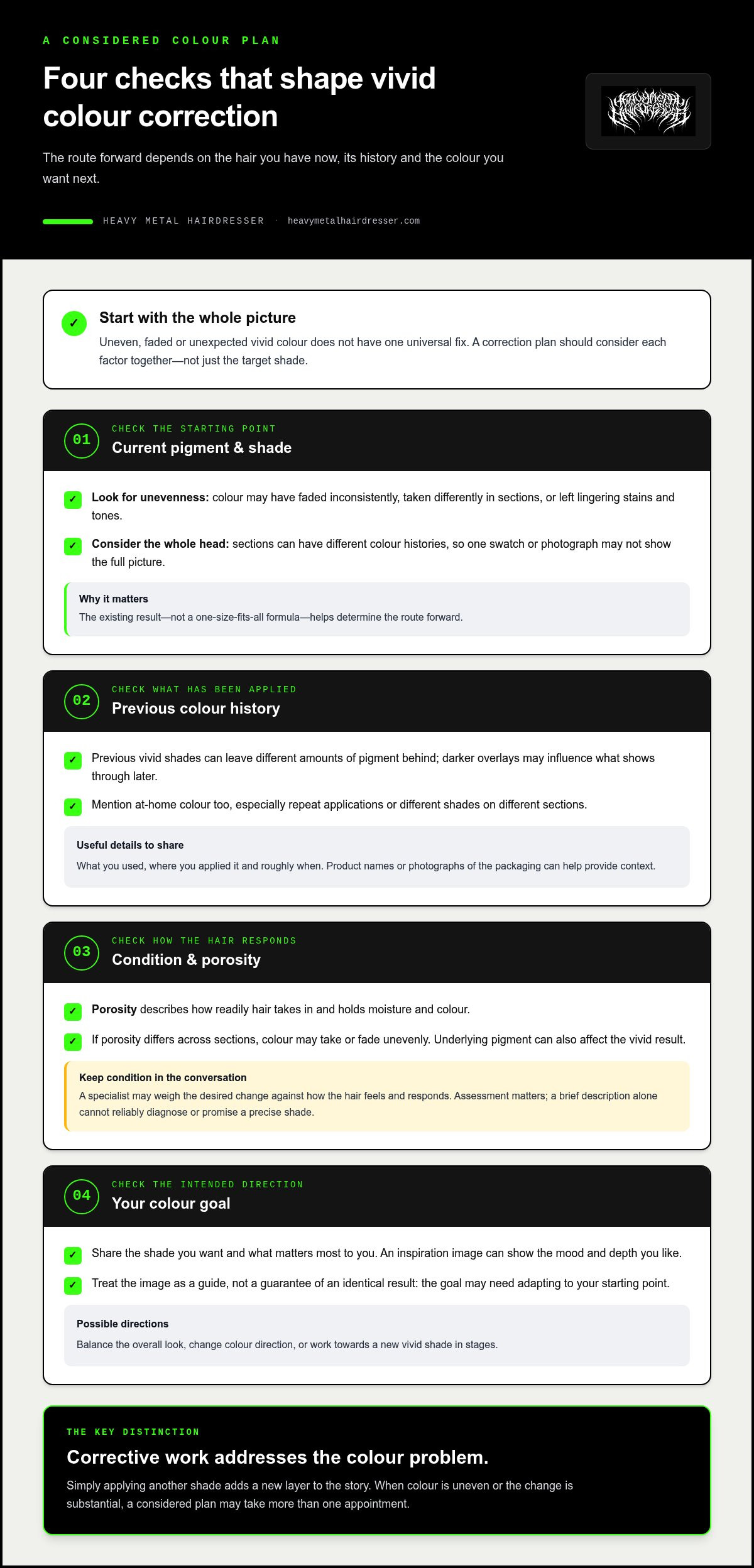
Vivid hair colour correction is a tailored process for addressing unwanted or uneven results and planning a more intentional direction. The approach depends on what’s on your hair now, what’s been applied before, how your hair is responding and the colour you want next. There isn’t one universal fix. Correction might mean balancing the overall look, changing the colour direction or working towards a new shade in stages.

Corrective colour work addresses a colour problem; applying another shade simply adds a new layer to the story. That distinction matters when existing colour is uneven or your goal involves a substantial change. For a useful foundation on how colour methods differ, see this overview of hair-colouring processes and types.

What counts as vivid hair colour correction?

Correction can involve addressing a bright colour that has faded inconsistently, sections that have taken differently, lingering stains or tones that don’t match the intended result. For example, you might want to even out a patchwork effect before choosing a fresh vivid shade. That’s different from starting with an agreed colour goal and simply applying it. The right route depends on the existing result, not a one-size-fits-all formula.

Colour can look different across the head because each section may have a different history. One area might have been coloured repeatedly, while another has less pigment. A useful assessment therefore looks at the overall picture, rather than making a snap judgement from one swatch or photograph.

When does vivid colour need specialist attention?

Persistent unevenness, unexpected tones that remain after washing, or a complicated mix of previous colours are good reasons to seek specialist input. Repeated home applications can make the starting point harder to read: the colour history may vary from section to section, and the visible shade won’t always tell the whole story. Sharing what you’ve used and when gives your stylist more context.

Bring the full story, even if it involves box colour, bold experiments or a shade you’d rather forget. There’s no judgement here. At Heavy Metal Hairdresser, vivid colour correction is part of the salon’s creative colour work, alongside alternative cuts and styling. Creative stylist Simon Tuckwell’s work with bands and artists informs an approach that makes space for individual expression. The plan takes account of both the look you want and the hair you have now.

Why Vivid Colour Correction Depends on Hair History and Starting Shade

A vivid shade doesn’t land on a blank canvas if your hair has been coloured before. Existing pigment, earlier applications and the condition of different sections all affect what can happen next. An inspiration photo is a useful guide, not a guarantee of an identical result. The colour needs to be planned around the hair in front of you.

The main factors shaping a correction plan are your current pigment, previous colour applications, hair condition and the result you’re aiming for. A vivid hair colour correction specialist UK considers those elements together, rather than choosing a formula based on the target shade alone. Even hair that looks like one consistent colour may have different layers of colour history underneath.

How previous colour changes the route forward

Previous vivid shades can leave different amounts of pigment behind, and darker overlays may influence what shows through a later colour. At-home colour matters too, particularly if you’ve applied it more than once or used different shades on different sections. Colour layered over colour can behave differently from hair that hasn’t been coloured, so the same approach won’t necessarily give the same result across the whole head.

Be candid about what you’ve used, where you applied it and roughly when. You don’t need a perfect record. A box colour, a quick experiment or an old shade you’d rather forget is useful information, not a reason for judgement. If you can, bring product names or photographs of the packaging. Leaving out a past application gives an incomplete picture; sharing what you know helps shape a more informed discussion.

Why hair condition and underlying pigment matter

Hair porosity describes how readily the hair takes in and holds moisture and colour. If different areas have different porosity, colour may take or fade unevenly. Underlying pigment matters too: a vivid result is affected by the colour already present beneath or within the hair, so a target shade may need adapting to the starting point. An image can show the mood and depth you like, while a specialist helps translate that inspiration into a plan for your current hair.

Hair condition is part of the planning, not a promise that every correction can happen without affecting it. A specialist may weigh the desired change against how the hair feels and responds, then discuss a more measured route if that better supports its condition. A precise shade can’t be reliably diagnosed or promised from a brief description alone. Assessment matters.

If colour safety is on your mind, the US FDA information on hair dye safety covers possible reactions and precautions. It’s background reading, not a substitute for advice about your individual colour history. Bring your inspiration and an honest account of past colour to give the conversation a stronger starting point. You can also explore Heavy Metal Hairdresser’s vivid colour work for creative inspiration.

Vivid Colour Correction Expectations: Staged Change Versus a Quick Fix

Wanting your chosen shade back now is understandable. But correction doesn’t always mean leaving with the exact target colour after one appointment. The route depends on your starting colour, what’s been done before, the hair’s condition and the change you want. A vivid hair colour correction specialist UK can help set out a direction that balances your goal with what your hair can reasonably manage.

A staged approach isn’t a failed result. It can mean making a useful first change, then reassessing before deciding on the next step. An interim colour might be more even, closer in tone or a better base for moving towards your chosen look. The plan should be tailored to you, rather than forced to match a photograph in one leap.

Staged approach Quick-fix expectation
Works towards the target in considered steps, with the hair’s response informing the next move. Assumes the target shade can be reached immediately, whatever the starting point.
Can treat a realistic interim result as progress towards the bigger goal. May overlook how existing colour or unevenness could affect the outcome.
Leaves room to adjust the direction as the colour and condition are assessed. Focuses on the final shade before the route there is understood.

Can vivid colour correction happen in one appointment?

Some changes may be achievable in one appointment; in other cases, the starting colour, previous processes and desired result call for a more gradual plan. There’s no reliable appointment count to promise from a shade description alone. Shifting a faded vivid tone is a different project from moving away from a deep, layered colour towards a much lighter one. Your stylist can explain the intended direction and what a realistic first result might look like.

Correction versus covering the colour with another shade

Adding a new vivid shade can be a valid creative choice, especially if it suits the colour already there. But simply layering colour over a problem may not resolve patchiness or unwanted tones underneath. Corrective work starts by identifying what needs changing, then shaping a route towards the goal. Covering the colour isn’t always wrong; it may simply answer a different brief.

Bring a clear idea of what matters most to you: a particular tone, more even colour or a gradual move towards a bigger transformation. That gives the plan a useful anchor without locking you into an unrealistic instant result. If you’re still exploring your next bold direction, the vivid hair colour guide can help you find inspiration to discuss.
Vivid Hair Colour Correction Specialist UK: Get Back to Bold

How to Prepare for a Vivid Hair Colour Correction Appointment

A little preparation can make the colour conversation clearer and more useful. You don’t need a perfect timeline or the right technical vocabulary. Bring what you know, show what you’re aiming for and explain what you’d like to change. That gives your stylist a clearer picture of both the starting point and the goal.

What to bring and explain before colour correction

Gather current photos that show your hair in natural light. Take a few angles if you can, and avoid filters or coloured lighting that could shift how the shade appears. Add a small selection of inspiration images that feel achievable, rather than relying on one heavily edited reference. Note previous vivid shades, darker dyes, home applications and recent colour changes. There’s no need to feel embarrassed about experiments; honest details help shape a more informed discussion.

Use this simple sequence to get ready:

  1. Record your colour history. List the shades and applications you remember, including home dyes. If you’re unsure of dates or products, say so rather than guessing.
  2. Take current photos. Photograph your hair in natural light so the existing shade and any differences between sections are easier to discuss.
  3. Choose a few references. Pick images that show the colour, depth or placement you’re drawn to. A reference communicates direction, not a guaranteed copy.
  4. Name your priority. Decide whether you most want to address unwanted tones, make the colour look more even or move towards a different vivid shade.
  5. Share your no-go list. Explain what you want to avoid, such as a particular tone, an all-over application or losing contrast. Your preferences matter.

How to set a clear, flexible colour goal

Describe the feeling and placement you want as well as the shade. For example, you might prefer a saturated look across the whole head or bold colour concentrated in particular sections. If placement is part of your vision, this alternative hair styles guide can help you put that visual direction into words. Keep the goal flexible: the reference is a starting point for a conversation about what suits your current colour.

Preparation is about helping your stylist understand your colour history and priorities, not trying to fix the result at home before the appointment. Ongoing vivid-colour maintenance is a separate topic; for this conversation, focus on what’s on your hair now and what you hope to change. Heavy Metal Hairdresser brings individual goals and colour stories into its vivid colour work without judgement.

Ready to bring your colour history and ideas into the conversation? Explore vivid colour with Heavy Metal Hairdresser.

A Vivid Hair Colour Correction Specialist for Bold, Individual Colour

Colour correction isn’t just about changing what’s on your hair. It’s about finding a way forward that respects your colour history, your hair’s current condition and the look you want to express. At Heavy Metal Hairdresser, vivid colour correction and creative styling are part of an inclusive alternative salon where individuality comes first.

Creative colour work without the judgement

Unconventional shades, past experiments and complicated colour histories are welcome in the conversation. This is a gender-inclusive space where personal style is celebrated, not squeezed into a standard template. You don’t need to arrive with a perfect explanation or apologise for a colour choice that didn’t go to plan. Be honest about what’s happened and clear about what you want next. That gives the colour discussion a useful place to begin.

Founded and operated by barber and creative stylist Simon Tuckwell, Heavy Metal Hairdresser brings an alternative perspective to expressive hair. Simon’s creative work includes backstage styling at Download and Bloodstock, as well as work with bands and artists. That experience sits naturally alongside vivid colour, where individuality and intention matter as much as the shade itself. Every colour goal has its own starting point and route.

Take the next step towards your colour reset

A considered plan starts with the details that make your hair yours: its colour history, its condition now and the direction you want to take. Those factors help shape a realistic path, whether your aim is to rebalance a colour or move towards a different vivid look. A reference image can help communicate the mood you’re after, while an open discussion leaves room to shape the idea around your starting point.

If you’re exploring a new direction as well as a colour reset, Heavy Metal Hairdresser’s professional vivid hair colour offers inspiration for bold, expressive looks. Bring your ideas, your colour story and the result you want to work towards. The conversation can start with what feels like you.

Ready to explore your next colour direction? Take the next step towards your colour reset with Heavy Metal Hairdresser, and make space for colour that reflects your individuality.

Make Your Next Colour Move Your Own

Your next colour doesn’t have to follow anyone else’s rules. Maybe you’re ready to return to a familiar vivid shade, or perhaps this reset is your chance to push into a completely new direction. You don’t need every detail mapped out before you begin. A clear sense of what feels like you is enough to start a useful creative conversation.

Working with a vivid hair colour correction specialist UK can help turn that intention into a considered direction, shaped around your hair and your personal style. Bring your curiosity, your references and the colour you’re excited to explore. There’s room for bold ideas, honest discussion and a look that feels individual rather than copied.

Explore vivid colour work at Heavy Metal Hairdresser and take the next step towards colour that speaks in your own voice. Your next chapter can be every bit as vivid as you are.

Frequently Asked Questions

Is vivid hair colour correction possible after using box dye?

Yes, correction may be possible after box dye, but the dye can affect what options are realistic and how the colour behaves. Tell your specialist the brand or shade if you know it, how often you’ve applied it and roughly when. If you can’t remember every detail, say so. Avoid adding another home colour before your appointment; it changes the canvas and makes your colour history harder to interpret.

Can a hair colour correction specialist fix uneven vivid colour?

A specialist can assess uneven vivid colour and plan an approach for your particular starting point. The result depends on existing pigment, previous applications and hair condition, so there isn’t one treatment that suits every case. A vivid hair colour correction specialist UK can discuss whether the aim is to soften the contrast, balance sections or work towards a new shade. Some patterns may need a gradual approach rather than a single change.

How many appointments can vivid hair colour correction take?

There’s no fixed appointment count for vivid colour correction. The number depends on your starting shade, colour history and target, including how large a change you want. A shift between similar tones may have a different route from moving away from a deep, layered colour. If a staged plan is recommended, ask what each step is intended to achieve. A considered pace is more useful than a promised timeline that ignores your hair.

What happens if vivid hair colour fades unevenly?

Different areas can fade at different rates, especially if they have been coloured or treated differently. Take clear photographs of the current result in daylight, including the sides and back if possible, so the pattern is easier to discuss. Try not to cover the faded areas impulsively with another shade, as this adds more colour history. A specialist can assess the variation and discuss a suitable direction without promising identical colour everywhere.

Can I go from dark hair to vivid colour in one appointment?

It depends on your current shade, the vivid colour you want and whether previous colour is present. A change from a lighter base to a bold tone is a different starting point from moving from dark, previously coloured hair to a bright result. Some transformations may need to happen gradually. An individual plan can set a realistic first step without treating a one-appointment makeover as guaranteed.

Should I remove vivid hair dye at home before seeing a specialist?

It’s generally better to avoid trying colour removal at home before your appointment. A removal product can change the starting point, and the outcome may be harder to assess if more than one process has been used. Make a note of any products or methods you’ve already tried, even if the result was disappointing. Arriving with the colour as it is gives your specialist a clearer picture to discuss.

Can a vivid colour correction specialist work with an unusual colour goal?

Yes, an unusual colour goal can be part of the discussion. Bring a clear reference and explain what draws you to it, such as the tone, placement or overall feel. Also share what you’d rather avoid. Your current colour and hair condition will help shape the route, so an image is inspiration rather than a promise of an exact copy. Bold self-expression belongs in the conversation.
Posted on

Scene Hair: A Professional Guide to the Alternative Look

Scene Hair: A Professional Guide to the Alternative Look

Most people assume scene hair died in 2009 alongside scorched flat irons and snapped fringe ends. They are completely wrong. Modern scene hair is an architectural razor cut, not an exercise in fried, DIY backcombing.

If you have ever spent an hour teasing your crown only to watch it deflate by lunchtime, or walked out of a mainstream salon looking like a suburban mum because the stylist didn’t get alternative geometry, we feel your pain. You shouldn’t have to incinerate your hair with bleach and desperate backcombing just to rock an unapologetic silhouette. You can have severe contrast, sky-high lift, and genuinely healthy hair at the same time.

Discover how to achieve, cut, and style modern scene hair with healthy volume and razor-sharp precision. We will break down the essential razor-cutting mechanics, safe vivid colour maintenance, and the exact styling routine you need for all-day hold.

Key Takeaways

  • Deconstruct the geometry of modern scene hair, moving past nostalgic DIY myths to build radical crown volume paired with a razor-sharp sweeping fringe.
  • Discover why traditional blunt scissor cuts fail alternative silhouettes, and how bespoke razor-carving creates essential shattered separation.
  • Compare aggressive scene disconnections against modern wolf cuts and textured shags to choose the ideal crown height and perimeter density for your hair.
  • Master non-destructive styling and directional blow-drying methods that guarantee structural, all-day hold without shredding bleached strands.
  • Learn clean placement techniques for high-contrast vivid colour panels and iconic horizontal coontail stripes that resist bleeding.

What Is Scene Hair? Deconstructing the Subcultural Silhouette

Mainstream nostalgia often dismisses scene hair as chaotic, scorched teenage rebellion. In reality, it represents one of the most technically demanding architectural shapes in subversive hairdressing. Born out of early 2000s post-hardcore and pop-punk undergrounds, the aesthetic branched away from melancholic emo cuts by amplifying volume, expanding proportions, and embracing vivid neon contrasts. Historically rooted in the wider Scene subculture, this silhouette rejected flat conformism in favour of intentional, dramatic geometry. Today, modern Scenecore bridges that raw mid-2000s angst with refined structural technique, fitting right into the broader pantheon of rebellious Alt hair styles dominating the UK landscape.

The Core Anatomy of the Style

Authentic scene silhouettes rely on radical contrast rather than uniform density. The blueprint demands three distinct elements working simultaneously:

  • The Disconnected Crown: High, blunt-layered internal elevation sitting above the occipital bone to deliver instant shelf-like volume without requiring heavy teasing.
  • Whisper-Thin Perimeters: Razor-carved base extensions or natural lengths that fall dead-straight, accentuating the severe bulk stacked on top.
  • The Heavy Sweeping Fringe: A deep, asymmetric partition originating well behind the hairline, engineered to slice across the brow and deliberately frame one eye.

Extreme separation is the goal. Every layer must possess negative space around it so the silhouette appears sharp, deliberate, and aggressively textured rather than bulky.

The 2026 Scenecore Evolution

The original era relied heavily on chemical violence. People routinely scorched their strands with uncalibrated flat irons and destroyed cuticles using cheap 40-volume bleach. Modern scene hair takes an entirely different philosophical approach: prioritising structural hair health over frantic damage. We now design cuts where the architectural razor work creates automatic lift, drastically reducing the need for aggressive mechanical backcombing.

Contemporary Scenecore is also fiercely gender-inclusive and adaptable. It is no longer restricted to naturally pin-straight strands. By tailoring internal disconnects and fringe weight to individual bone structure, texture, and density, the modern cut delivers sharp attitude without sacrificing hair integrity.

Architectural Cutting: How Professional Stylists Build Scene Texture

Kitchen scissors and bathroom mirror hacks might have been rite-of-passage rituals, but they inevitably end in uneven chunks and frayed split ends. Mainstream stylists often make the opposite mistake: applying blunt scissor lines that leave the haircut heavy, blocky, and completely devoid of movement. Scene hair requires razor-crafted architecture. It demands disciplined sectioning geometry across the parietal ridge to strip away excess density while preserving a structural foundation that supports radical height.

Feather Razors Versus Traditional Shears

Blunt shears cut straight across the hair shaft, creating hard horizontal lines that cause layers to collapse flat against one another. A guarded feather razor slices the hair at an acute diagonal bevel. This tapers the cuticle softly toward the ends, enabling strands to nestle into one another and stack upward effortlessly. Straight and coarse hair benefits from wet razor slicing for fluid glide, while wavy or erratic textures often require dry internal carving to carve negative space precisely where natural density bulks up.

Building the Crown Lift

Lasting crown elevation is an internal engineering trick, not a tease-and-spray miracle. Stylists achieve this silhouette through deliberate mechanics:

  • Internal Scaffolding: Carving hidden, shorter layers beneath the crown to physically prop up the longer exterior canopy sections above.
  • Occipital De-bulking: Channel-cutting weight away right at the occipital bone, which prevents heavy hair from dragging the crown down flat.
  • Perimeter Isolation: Keeping the base tail lengths isolated so they stay wispy and distinct without losing their connection to the dense core.

Crafting the Signature Swoop Fringe

The iconic sweeping fringe relies on strict geometric placement. Stylists map a deep, diagonal parting that begins well past the outer eyebrow arch. The hair is over-directed sharply to the opposite side and sliced down in a continuous, bevelled curve. This technical graduation allows the fringe to glide effortlessly across the brow, veil one eye, and melt seamlessly into razor-tapered side tendrils. Hair is more than aesthetic posturing; academic analysis of the sociology and symbolism of hairstyles shows how precise visual codes signal belonging and individuality.

Executing these razor channels requires specialised subcultural mastery rather than high-street salon caution. If you want a tailored cut that balances severe alternative shapes with weight distribution designed specifically for your hair texture, consider booking with an experienced alternative specialist at Heavy Metal Hairdresser.

Scene Hair vs Wolf Cuts and Shags: Choosing Your Shape

Social media algorithms frequently blur textured alternative cuts together. Shags, wolf cuts, and scene hair get lumped into a single aesthetic bucket, but confusing them leads directly to salon regret. Each cut commands a distinctly different silhouette, weight distribution, and styling commitment. Understanding their internal architecture ensures you leave the salon with the exact balance of rebellion and convenience you want.

Feature Scene Hair Wolf Cut Classic Shag
Crown Height Extreme elevation with harsh disconnect Moderate, rounded crown lift Soft, graduated natural volume
Perimeter Weight Ultra-thin, razor-shredded wisps Medium taper with blended tail Full, fluid, feathered perimeter
Styling Time High: directional heat and texturising Medium: diffuser or quick blast Low: wash-and-wear natural wave

Comparing Disconnect and Layer Aggression

The defining technical separator is layer graduation. A traditional 1970s shag relies on a fluid cascade, celebrating organic movement and seamless blend. A modern wolf hair cut bridges vintage rock grit with modern softness, preserving heavier mid-lengths that cushion the shape. Scene hair strips those transitional mid-lengths out entirely. It builds an intentional cliff edge between a buoyant, short crown and paper-thin perimeters.

Daily Maintenance and Commitment Levels

Your choice comes down to styling stamina and natural growth patterns. If you have stubborn cowlicks, tight curl patterns, or zero patience for heat tools, a softer shag works with your texture rather than against it. Authentic scene silhouettes demand real effort. Keeping that radical contrast alive means booking reshapes every four to six weeks to stop overgrown crown layers from dragging the silhouette flat, alongside a reliable daily routine to coax gravity-defying lift from your roots.

Scene Hair: A Professional Guide to the Alternative Look

Styling and Teasing Without Destruction: The Step-by-Step Blueprint

Scraping a plastic rat-tail comb aggressively against dry, bleached hair is the fastest route to snapped fibres and permanent thinning. Vintage styling tutorials treated backcombing like an act of war, but modern scene hair demands smart mechanical support. You do not need to tear off your hair cuticles to achieve bulletproof crown lift. By combining thermal shielding, directional tension, and frictionless cushion packing, you can construct massive architectural volume that withstands the entire day without shedding hair down the plughole.

Root Preparation and Directional Blow-Drying

Volume begins while hair is still damp. Mist a dedicated thermal shield from mid-lengths to ends, then work a targeted root-lifting tonic into the crown zone. Fit a narrow concentrator nozzle to your hairdryer. Using a medium ceramic round brush, grip sections across the parietal ridge and dry the hair directly against its natural growth direction. Pull upward at a 90-degree angle to freeze root posture before introducing heated styling irons.

The Friction-Free Cushion Backcombing Method

Ditch fine-toothed plastic combs entirely. Instead, use a narrow, natural-bristle brush designed to distribute pressure gently across the shaft:

  • Target the Root Base: Isolate horizontal crown subsections no thicker than half an inch. Leave the top veil layer untouched to conceal the structural work beneath.
  • Single-Stroke Packing: Insert the bristles three inches above the scalp. Glide the brush down to the base in a single, smooth, compacting motion. Never scrub up and down like a saw.
  • Protect the Mid-Lengths: Pack fibres strictly within the first two inches of the root. Leaving mid-lengths and ends completely free stops bird-nest tangles and prevents wash-out breakage.

Locking Shape with Death Grip and Hair To the Throne

Once the root cushion is packed, glide flat irons across your sweeping fringe and wispy perimeter tails, keeping the heat moving briskly down the hair shaft. Architectural hold requires weightless structural integrity rather than sticky helmet hair. Work Hair To the Throne through your crown sections to deliver pliable, gravity-defying body that refuses to wilt under natural humidity.

Lock your shape into place using Death Grip. This formulation acts as an immovable shield, anchoring severe spikes, elevated crowns, and razor-separated textures against sweat, wind, and movement. Finish by misting dry texture spray through the razor-cut tips for ultimate separation.

Equip your styling kit with the exact formulations built for subversive hair shapes by picking up professional hold essentials directly from Heavy Metal Hairdresser.

Vivid Colour Placement and Coontails: Finishing the Alternative Aesthetic

Colour isn’t an afterthought on scene hair; it’s the final structural amplifier. While classic emo styles leaned into monochromatic obsidian or deep mahogany, scene aesthetics demand explosive, high-contrast saturation. Midnight black perimeters paired with electric lime, ultraviolet, or neon magenta bring the haircut’s razor geometry to life. Slapping unmeasured box bleach onto fragile strands creates muddy bands and immediate breakage. Executing technical vivid hair colour requires a clean, even lift so your brights scream with intensity while hair stays healthy.

Precision Coontails and Block Colour Mechanics

Horizontal raccoon stripes, or “coontails”, remain the undisputed visual hallmark of subcultural styling. Amateurs often attempt freehand painting with runny formulas, resulting in blurred, bleeding splotches. Getting crisp graphic lines demands absolute precision:

  • Tension Masking: Isolate a razor-thinned perimeter tail or fringe section. Pin it completely flat against a foil board using low-tack stylist tape to map out sharp horizontal boundaries.
  • Direct Dye Viscosity: Work exclusively with high-viscosity, non-drip direct dyes. Runny pigments bleed straight beneath the tape line, destroying the graphic contrast.
  • Tonal Juxtaposition: Pair cool, level-one jet black against high-voltage warm neons like acid yellow or optic pink. The sharper the contrast, the more dramatic your layers appear.

Safeguarding Bleached Strands in Subcultural Styling

Lifting hair to a clean, pale-yellow canvas before applying vivid direct dyes temporarily compromises internal keratin bonds. If you plan to heat-style and backcomb your crown regularly, bond-building treatments during the lightening process are non-negotiable. These formulations repair fractured disulphide bonds from the inside out, keeping strands flexible under thermal stress.

At-home maintenance requires discipline. Wash your hair strictly with freezing cold water and sulphate-free cleansers. Steaming hot water expands the outer cuticle instantly, bleeding your neon tones directly into your black panels. Mainstream colourists often push clients toward muted, conventional highlights because they don’t understand alternative colour blocking. Trusting an experienced alternative specialist keeps your hair intact, vibrant, and razor-sharp.

Reclaim Your Edge: The New Era of Alternative Structure

Authentic scene hair isn’t a relic of fried DIY nostalgia; it is a masterclass in razor-crafted architecture. When you replace destructive backcombing with intentional internal weight removal, your crown achieves radical, enduring lift without sacrificing hair health. Pair that structural precision with disciplined cushion styling and sharp vivid contrast, and you get an uncompromising silhouette that commands attention.

You don’t have to compromise your identity at salons that fear extreme shapes. Backed by backstage festival styling heritage across major UK alternative events, our team offers a dedicated safe-space environment that celebrates who you are without judgment. Our master cutters specialise in razor-carved texture and vivid transformations designed to honour your individuality. Book your alternative transformation with our specialist stylists and take complete ownership of your look.

Frequently Asked Questions

Can I get scene hair if I have naturally curly or wavy hair?

Yes, you can adapt scene hair to wavy or curly patterns. Modern cuts lean into razor disconnection that embraces natural movement instead of demanding pin-straight compliance. Stylists carve negative space dry to remove bulk without flattening your natural texture. If you want the classic silhouette, smooth your fringe and perimeter with targeted heat while letting the textured crown layers pop with their organic wave.

How is modern 2026 scene hair different from original 2000s styles?

Modern 2026 scene hair prioritises strand integrity and architectural razor technique over fried DIY damage. Vintage versions relied on scorching flat irons, unmeasured bleach, and aggressive teasing. Today’s Scenecore silhouette blends elements of softer wolf cuts and shags. We carve structural lift directly into the internal layers, allowing you to rock vivid colour blocking and extreme height without destroying your hair cuticle.

Will backcombing for scene volume permanently ruin my natural hair?

No, strategic cushion teasing will not ruin your hair if done correctly. Breakage happens when people aggressively saw abrasive plastic combs up and down the hair shaft. If you use a natural bristle brush, target exclusively the root base, and pack the fibres downward in single strokes, your cuticles stay intact. Always shield strands with thermal protectant and gently condition before detangling.

What is the best way to ask a hairdresser for a scene cut?

Bring clear visual references showing both the crown profile and the sweeping fringe. Tell your stylist you want a razor-crafted cut with disconnected internal crown layering and whisper-thin perimeters. Avoid requesting generic long layers, which leave the shape bulky and blended. Ask specifically for weight removal around the occipital bone and an exaggerated, asymmetric swoop fringe mapped across a deep parting. Exploring the portfolios of professional hair design studios like Haomanim can help you source clear reference imagery for precision layering and razor finishes.

How often do I need to get my scene fringe and layers trimmed?

Plan to book a maintenance trim every four to six weeks. Because the signature sweeping fringe sits right against the brow and eye line, even minor growth throws off the geometry. Crown layers also lose their upright tension as they lengthen, which drags down overall height. Regular reshape visits keep the weight distribution sharp and stop the wispy perimeter ends from splitting.

Can I style scene hair without spending hours using straighteners every day?

Yes, directional blow-drying cuts daily styling down to ten minutes. You do not need to flat-iron every strand from root to tip. Focus heated plates only on the fringe and the very tips of your perimeter tails. By rough-drying your crown over-directed against its natural growth pattern, you establish immediate volume. The cut’s internal razor architecture does the heavy lifting for you.

What styling products are essential to keep scene volume from collapsing?

Essential products include a lightweight root-lifting tonic, dry texture spray, and strong-hold styling formulations. Start with a weightless styling prep like Hair To the Throne to build flexible body across damp crown roots before heat styling. Once shaped, anchor the architectural elevation with a firm-hold finisher like Death Grip. This locks out humidity, keeping razor-tapered peaks suspended without leaving flaky residue.

Posted on

Vivid Hair Colour: The Alternative Guide to High-Pigment Identity

Vivid Hair Colour: The Alternative Guide to High-Pigment Identity

Your hair isn’t a canvas for some fleeting high-street trend; it’s a high-decibel broadcast of your identity. If you’ve ever walked out of a traditional salon feeling like a “project” rather than a person, you know the frustration of stylists who don’t understand the soul of a shag or the aggressive edge of a wolfcut. You deserve vivid hair colour that commands attention without fading into a muddy mess after just two washes. We agree that settling for dull pigments or compromised hair health is a sacrifice you shouldn’t have to make to express your subcultural roots.

This guide masters the art of alternative saturation. It shows you how to achieve and own the boldest hues in the UK while keeping your strands resilient. Having styled backstage at festivals like Download and Bloodstock, we understand that your look needs to survive the pit and the after-party alike. We’ll explore the impact of the 2026 cosmetic regulations on pigment safety, the secrets to maintaining punchy tones, and how to find a creative peer who shares your values. It’s time to stop blending in. Start saturating your style with professional expertise that actually respects your aesthetic.

Key Takeaways

  • Master the canvas theory to understand why extreme lifts require professional bond builders to protect your hair’s structural integrity.
  • Ditch high-street fashion tints for the deep subcultural saturation that defines a true alternative identity.
  • Extend the life of your pigments with a maintenance guide that covers everything from the cold-water rule to heat damage.
  • Learn how textured cuts like shags and wolfcuts provide the perfect aggressive foundation for high-impact vivid hair colour.
  • Discover why gender-neutral pricing and safe-space values are vital for an inclusive and identity-affirming salon experience.

What is Vivid Hair Colour? Beyond the Mainstream Trend

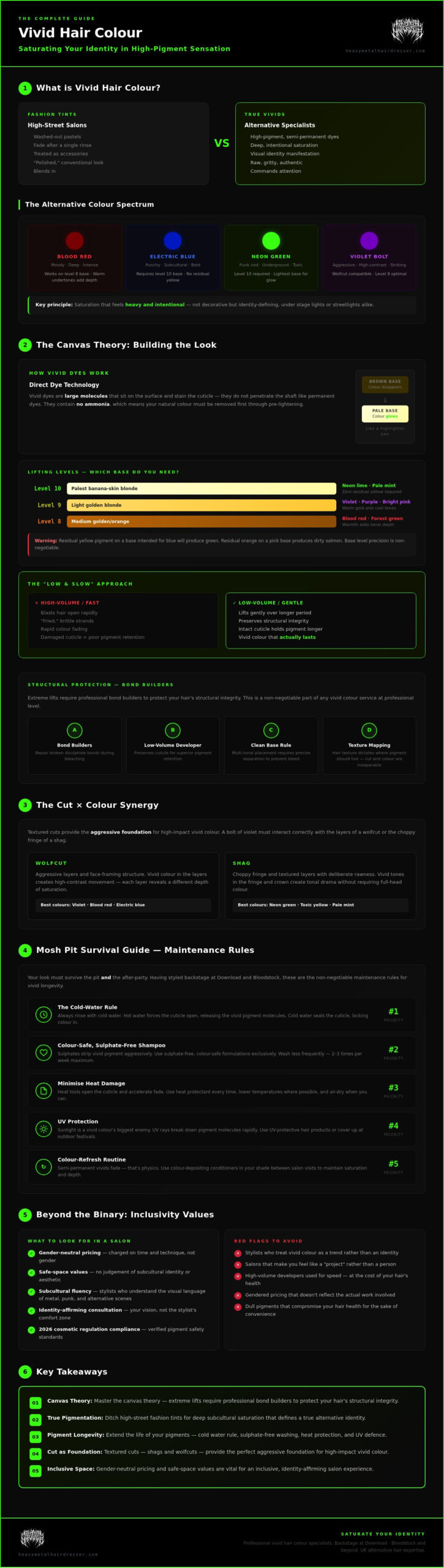
Vivid hair colour isn’t a temporary flirtation with a trend. It’s a permanent commitment to an alternative existence. Unlike the “fashion tints” found in high-street windows, true vivids are high-pigment, semi-permanent dyes that live entirely outside the natural spectrum. We’re talking about saturation that hits as hard as a kick drum. While mainstream salons treat these shades as accessories, we see them as a visual manifestation of your musical and personal soul. It’s about taking up space and refusing to be muted.

The mainstream aesthetic often chases a “polished” look, where every strand is perfectly placed and the colours are designed to blend in. Our approach is the polar opposite. We embrace the raw, the gritty, and the authentic. To understand the foundations of these pigments, looking into The Science of Hair Colour helps explain how semi-permanent molecules sit on the hair shaft, but science only gets you halfway. The rest is about subcultural intuition. It’s knowing that a neon green isn’t just a colour; it’s a nod to a specific era of punk or a particular underground scene.

The Spectrum of Alternative Saturation

Choosing your palette is a high-stakes decision. In the alternative community, primary colours rule the roost. While the mainstream is currently obsessed with washed-out pastels that disappear after a single rinse, we focus on deep blood reds, electric blues, and toxic yellows. These shades offer a tonal depth that pastels simply can’t match. When we apply vivid hair colour, we aren’t just looking for brightness. We’re looking for a saturation that feels heavy and intentional, ensuring your identity remains front and centre whether you’re under stage lights or streetlights.

Why Subcultural Expertise Matters

A standard hairdresser might be a wizard with a blonde balayage, but they’ll often struggle with high-contrast vivid placements. They don’t always “get” how a bolt of violet should interact with the aggressive layers of a wolfcut or the choppy fringe of a shag. Subcultural expertise matters because the cut and the colour are inseparable. We don’t just slap dye on a head; we use the texture of the hair to dictate where the pigment should live. Our consultations aren’t about “looking pretty” in a conventional sense. They’re about finding the intersection between your aesthetic influences and the technical reality of your hair. We speak the same language as you, which means we don’t need a translator to understand your vision for a gritty, non-conformist look.

The Science of Saturated Pigment: How We Build the Look

Building a high-impact alternative look isn’t about luck. It’s about chemistry. To achieve the kind of saturation that stops people in the street, we use the “canvas theory.” Unlike traditional permanent dyes that penetrate the hair shaft and alter your natural pigment, vivid dyes are direct dyes. They’re large molecules that sit on the surface and stain the cuticle. Because they don’t contain ammonia to lift your natural colour, your hair needs to be pre-lightened first. Think of it like painting with a highlighter pen. If you draw on brown paper, the colour disappears. If you draw on white paper, it glows. We create that white or pale yellow “paper” through precise bleaching.

We don’t believe in taking shortcuts with your hair’s health. Many salons use high-volume developers to blast the hair open quickly, but that’s a recipe for “fried” strands and rapid fading. We advocate for a “low and slow” approach. By using lower volume developers over a longer period, we lift the hair gently. This preserves the structural integrity of the hair fibres. When the cuticle remains healthy and intact, it holds onto those vivid pigment molecules much longer. For those seeking vivid hair colour that actually lasts, this technical patience is non-negotiable.

Lifting to the Correct Level

Not every vivid shade requires the same base. If you’re chasing a neon lime or a pale mint, we have to lift your hair to a “level 10” blonde, which looks like the inside of a banana skin. Any remaining yellow pigment will turn your blue into green or your pink into orange. However, if you’re going for a deep blood red or a moody forest green, a “level 8” base with some underlying warmth actually adds tonal depth. We follow the “clean base” rule for multi-tonal applications to ensure colours don’t bleed into a muddy mess. Understanding Hair Dye Safety Regulations and the limits of your hair’s chemistry ensures we never push your strands past their breaking point.

Integrity Over Intensity

We refuse to compromise hair health for a single-session transformation. If your hair is already compromised, we’ll tell you straight. We use professional-grade bond builders like Olaplex during the bleaching process to repair the disulphide bonds that give hair its strength. These treatments aren’t just an optional “add-on”; they’re essential for anyone living an alternative lifestyle where hair is frequently bleached and re-coloured. Structural integrity is the foundation of long-lasting colour. Without it, your pigment has nothing to hold onto, and your vivid dream will wash down the drain in a week. For a look that stays punchy through every mosh pit, you need a stylist who prioritises hair health as much as the aesthetic.

Vivid Hair Colour Maintenance: Mosh Pit Survival Guide

“Vivids fade too fast.” It’s the most common excuse for staying beige. But here’s the reality check: high-pigment saturation is a lifestyle, not a set-it-and-forget-it service. If you’re treating your hair like a standard high-street dye job, you’re going to lose that punchy edge within a fortnight. Maintaining your look requires a tactical approach to home care that respects the chemistry we’ve built. To keep your vivid hair colour Nottingham looking fresh, you have to change how you think about hair health.

The #1 rule is simple: heat is the enemy. Every time you blast your hair with hot water, you’re opening the cuticle and letting those expensive pigment molecules escape. Think of it like a mosh pit for your hair cells; you want to keep things tight and controlled. Cold water is your best friend. It seals the cuticle and locks in the saturation. Beyond temperature, your choice of product is vital. Sulphate-free shampoos are non-negotiable. Sulphates are harsh detergents that strip colour faster than a bad review. For an extra boost, a colour-depositing conditioner can refresh your tones between salon visits.

The Alternative Wash Routine

Step one: stop washing your hair every day. It’s unnecessary and aggressive. When you do wash, focus the shampoo on the roots and let the suds rinse through the ends. This prevents over-cleaning the most porous parts of your hair. Dry shampoo is the unsung hero of the alternative scene. It absorbs oil without disturbing the pigment, allowing you to stretch the time between wet washes whilst keeping your volume high. The “rinse and repeat” cycle is a myth designed to sell more product. For us, less frequent washing means sharper colour and healthier strands.

Festival and Gig Survival

Whether you’re at Download or a basement gig, your wolf hair cut and colour take a beating. Sweat, grit, and beer are part of the experience, but they don’t have to ruin your look. Before heading into the pit, consider a leave-in conditioner with UV protection. Sun exposure is a silent colour killer, especially for neons and electric blues. It bleaches the pigment and leaves your hair feeling parched.

After the weekend, your hair needs a detox. Use a gentle, clarifying treatment to remove product build-up without nuking your base. If your face-framing “money pieces” are looking a bit tired, a quick home refresh with a direct dye can bridge the gap until your next appointment. Owning a bold identity means doing the work to keep it loud. If you’re ready for a refresh, we can always help you organise your next transformation.

Vivid Hair Colour: The Alternative Guide to High-Pigment Identity

Beyond the Binary: Inclusivity in Alternative Styling

Traditional salons often feel like a stage where you’re forced to perform a version of yourself that doesn’t fit. For the queer and alternative communities, a salon shouldn’t just be a place for a trim; it must be a safe space. We’ve built an environment where being different is the baseline, not the exception. This is about more than just aesthetics. It’s about finding a stylist who understands that your vivid hair colour Nottingham search isn’t just about a trend. It’s about visibility and safety in a world that often demands conformity. We foster a community where your subcultural identity is celebrated, providing a psychological sanctuary from the judgmental gaze of the high street.

We’ve ditched the outdated “men’s” and “women’s” menus. Hair has no gender, and neither does our pricing. We charge based on time, technical complexity, and the skill required to execute your vision. Whether you’re getting a short textured crop or a full-head vivid saturation, the price reflects the work, not the binary. This transparency removes the “pink tax” and ensures everyone feels respected from the moment they book. It’s a direct rejection of the clinical, gendered norms that have dominated the beauty industry for far too long.

Identity-Affirming Hair

Vivid colour is a powerful tool for gender expression. It can be a flag, a shield, or a shout. We see the stylist as a collaborative partner in your journey. We don’t dictate what “looks good” based on traditional beauty standards. Instead, we listen to how you want to feel. Our chair is a place where your identity is affirmed through every brushstroke of pigment. Whether you’re using high-saturation tones to align with your gender identity or simply to reclaim your personal power, we’re here to make that vision a reality without judgment.

The Safe Space Consultation

An inclusive consultation goes beyond just looking at reference photos. We talk about pronouns. We discuss neurodivergence and sensory needs. If you need a silent appointment or have specific sensitivities to sound or touch, we accommodate that. Our salon is a high-energy, percussive environment, but it’s also a sanctuary. We’ve created a space where you can be your loudest self or your most quiet, knowing you’re amongst peers who truly get it. We prioritize your comfort as much as the final result, ensuring the process is as identity-affirming as the colour itself.

If you’re ready to express your true self in an environment that respects your boundaries, book your identity-affirming consultation with our expert team today.

The Heavy Metal Hairdresser Way: Saturating the UK Scene

Simon Tuckwell didn’t build this salon to fit in. He built it to provide a sanctuary for those who’ve been told their look is “too much” by traditional high-street stylists. The Heavy Metal Hairdresser Way is about merging technical precision with a gritty, underground soul. We don’t just “do” hair; we engineer it to survive. Whether it’s the aggressive, choppy texture of a “Death Grip” style or the gravity-defying height of “Hair To the Throne” volume, our work is a direct rejection of the mundane. We’ve created a space where your subcultural identity isn’t just tolerated. It’s the entire point of the process.

Our expertise isn’t theoretical. It’s forged in the mud and heat of the UK’s biggest alternative stages. By styling for bands at festivals like Download and Bloodstock, we’ve mastered the art of durability and high-impact visual performance. When you’re searching for vivid hair color Nottingham, you aren’t just looking for a new shade. You’re looking for a result that stays saturated and sharp through a three-day festival set or a heavy night in the pit. We bring that same backstage intensity to every chair in our salon, ensuring your colour hits as hard as a headline set.

From Download to the Salon

We take that backstage intensity and translate it into wearable, aggressive styles for your everyday life. This is where modern mullet haircuts meet high-decibel pigments. We understand that a mullet, a shag, or a wolfcut needs a specific type of saturation to truly pop. A standard flat colour won’t do justice to the layers and movement we create. Our techniques ensure your colour doesn’t just look good in the salon mirror. It looks lethal under the strobe lights of a basement gig and holds its own against the grit of the real world. We use the same road-tested standards for our clients that we use for the artists on stage.

Joining the Community

We aren’t a walk-in factory. We’re a peer-led community of innovators and rebels. Preparing for your first session with us means understanding that we value your hair’s health as much as its hue. Safety is paramount, which is why a patch test is mandatory at least 48 hours before any pigment touches your head. This isn’t just a formality; it’s about protecting your canvas for future transformations. During your consultation, we’ll map out your identity journey and discuss how your chosen palette interacts with your lifestyle. We’re here to be your knowledgeable guides, helping you navigate the world of high-pigment saturation with confidence. If you’re ready to stop blending in and start saturating your identity, book your alternative colour session now and join the movement.

Own Your Alternative Saturation

Your hair is the loudest part of your identity. We’ve explored how to achieve high-decibel saturation through technical precision and how to protect that pigment in the heat of a mosh pit. From the essential “canvas theory” to the cold-water rules of maintenance, mastering your look is about respecting the chemistry as much as the subculture. You no longer have to settle for stylists who don’t understand the grit of a wolfcut or the soul of a shag.

Founded by Simon Tuckwell, our salon is a gender-inclusive safe space built for rebels and innovators. Having worked backstage at Download and Bloodstock, we bring festival-grade durability and expertise to every chair. If you’re tired of being judged in traditional salons and want a vivid hair color Nottingham experience that truly affirms who you are, it’s time to join our community. Stop blending in with the mainstream and start saturating your world with unapologetic pigment. We’re ready to help you manifest your loudest identity.

Secure your spot at Heavy Metal Hairdresser and let’s build your high-pigment identity today.

Frequently Asked Questions

How long does vivid hair colour actually last?

Vivid hair colour usually remains punchy for four to eight weeks before noticeable fading begins. Its longevity depends entirely on your maintenance routine and the initial saturation level. Cold water washes and sulphate-free products are essential for keeping those pigments locked inside the hair shaft. If you’re frequently in the mosh pit or under harsh UV lights at festivals, you’ll need a more rigorous home care plan to prevent premature dullness.

Do I have to bleach my hair to get bright colours?

You almost certainly need to pre-lighten your hair to achieve high-impact vivid results. Think of your hair as a canvas; dark hair acts like a black background that swallows up bright pigments. To make neons or primary colours glow, we have to lift the natural pigment to a pale blonde base. Without this step, the colour will look like a subtle tint rather than the high-decibel saturation our community demands.

Can I get vivid hair colour if I have dark or dyed hair?

Achieving a vivid hair color Nottingham result on dark or previously dyed hair is possible, but it requires a strategic approach. We have to strip away existing artificial pigments or lift through natural dark tones to create a clean base. This process might take multiple sessions if you’ve used box dyes or have very stubborn hair. We prioritise your hair’s structural integrity, ensuring we don’t push the lifting process faster than your strands can handle.

How much does a vivid hair colour session cost in the UK?

Pricing for creative colour in the UK varies significantly based on the complexity of the placement and the time required. Most alternative salons move away from gendered pricing, instead charging for the technical skill and product usage involved in the transformation. You should expect to pay for the pre-lightening stage, the vivid application, and any bond-building treatments used to protect your hair. Always book a consultation to get an accurate estimate based on your specific hair goals.

Is vivid hair colour damaging for my hair?

The vivid dye itself is non-damaging because it doesn’t use developer or ammonia; it’s actually quite conditioning. The potential for damage lies in the pre-lightening process required to create your canvas. We mitigate this risk by using professional bond builders and opting for a low and slow bleaching method. When managed by an expert, your hair stays healthy and resilient whilst maintaining the boldest alternative shades on the scene.

What is the difference between semi-permanent and vivid hair dye?

Vivid hair dyes are essentially high-pigment semi-permanent direct dyes. Traditional semi-permanents often aim for natural tones and offer lower saturation. Vivids are formulated with much larger pigment molecules designed to stain the hair cuticle with intense, non-natural colours. They don’t penetrate the cortex like permanent dye, which is why they eventually wash out. This allows for total creative freedom without the long-term commitment of traditional oxidative hair colouring methods.

How do I stop my vivid hair colour from bleeding onto my clothes?

Bleeding is a common side effect of high-pigment saturation, especially during the first few washes. To minimise this, always rinse your hair with the coldest water you can stand to seal the cuticle shut. Use old or dark-coloured towels and pillowcases to avoid staining your favourite gear. Applying a leave-in sealant or a light hair oil can also help create a barrier that keeps the pigment on your strands rather than your clothes.

Can I go from black to neon in one salon visit?

Going from jet black to a neon shade in a single visit is a massive technical challenge that often compromises hair health. If your hair is naturally dark and healthy, we might achieve it; however, previously dyed black hair usually requires several sessions to lift safely. We refuse to nuking your hair just for a quick fix. A multi-stage journey ensures your vivid hair color Nottingham transformation stays vibrant and your hair remains strong.

Posted on

Wolf Cut with Vivid Colour Ideas: Weaponising Your Layers for 2026

Wolf Cut with Vivid Colour Ideas: Weaponising Your Layers for 2026

Most people treat hair colour like an accessory, but for the subcultural elite, it is a structural weapon. If you are hunting for wolf cut with vivid colour ideas, you already know that a standard, polished salon job simply won’t cut it. You want hair that feels like a riot, not a rehearsal. You have probably felt the sting of vivids that fade before the weekend is over, or watched your expensive layers disappear into a muddy, shapeless mess. It is frustrating when stylists try to “soften” your edge because they don’t understand the grit of the underground scene.

We agree that your hair should be as loud as your favourite record. This guide is your blueprint for combining aggressive texture with high-octane pigment to create a look that is unapologetically yours. We will explore 2026’s most lethal trends, from “Death Grip” texture to strategic split-tones and smoky lilac underlights. You will discover how to place colour so it highlights every jagged layer and grows out with genuine intent. It is time to stop settling for “pretty” and start weaponising your style.

Key Takeaways

  • Learn how the aggressive texture of a wolf cut acts as a structural canvas for high-saturation pigments.
  • Discover high-impact wolf cut with vivid colour ideas that use strategic placement to make every jagged layer pop.
  • Explore subcultural colour palettes, including toxic greens and high-contrast split dyes, that celebrate your alternative identity.
  • Master the maintenance rituals required to stop vivid fade and protect your layers from heat damage.
  • Understand the importance of choosing a specialist who understands aggressive “Death Grip” texture and inclusive safe spaces.

The Wolf Cut with Vivid Colour: Why This Duo Rules the Alternative Scene

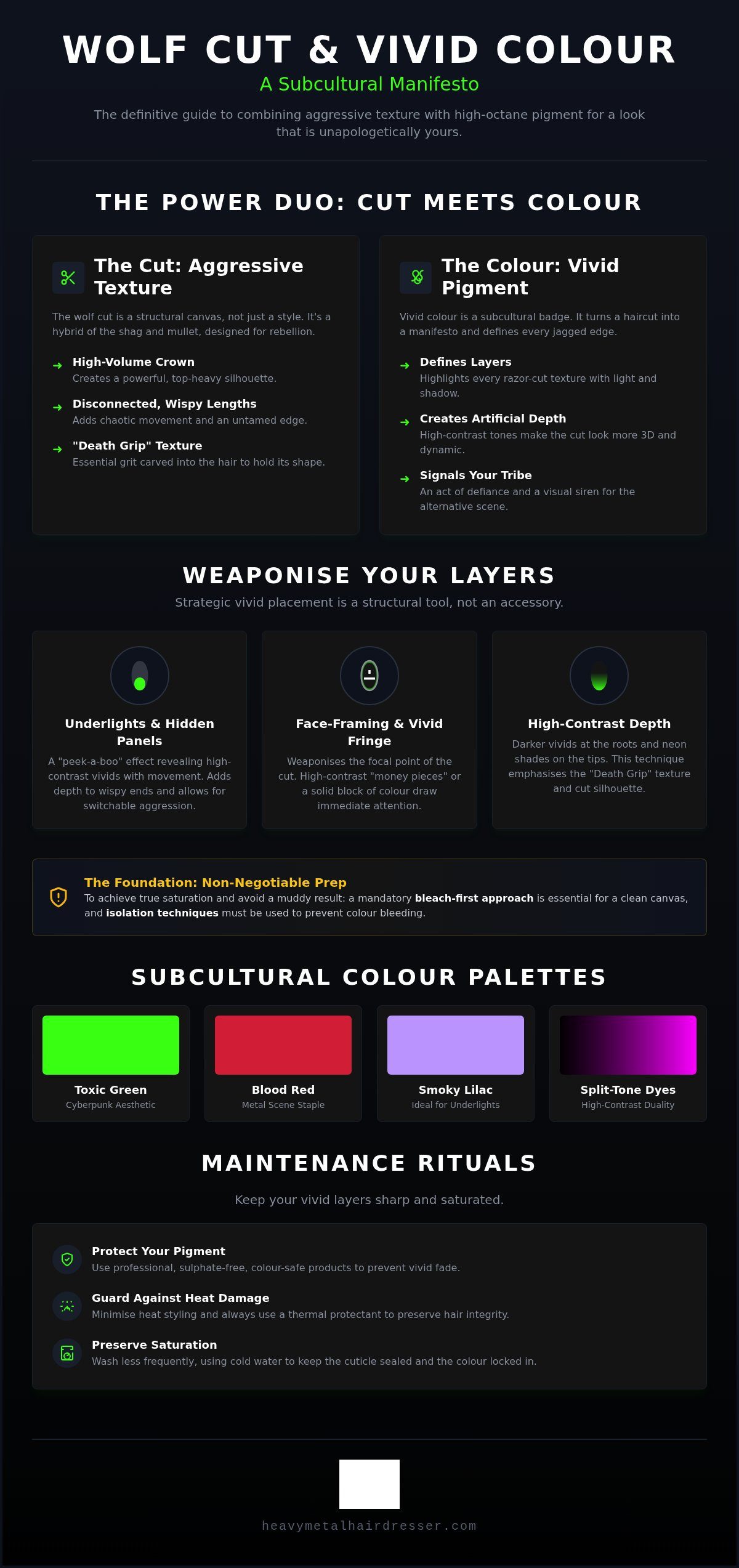
Mainstream salons love to talk about “natural movement” and “subtle blends”. We don’t. In the alternative scene, your hair is a visual siren. The wolf cut is already aggressive by design, but pairing it with high-saturation pigment turns a haircut into a manifesto. It is a synergy that works because the choppy, disconnected layers provide the perfect 3D canvas. Without the right colour, those layers can sometimes look flat or muddy. With vivids, every razor-cut edge is defined by light and shadow.

The Anatomy of an Alternative Wolf Cut

A true alternative wolf cut isn’t just a heavy fringe. It is about the high-volume crown and those signature disconnected, wispy lengths that scream rebellion. Texture is the only word that matters here. We focus on “Death Grip” texture, ensuring the hair has enough grit to hold its shape through a three-day festival set. As a modern take on the shag, the wolf cut is a hybrid of the shag and the mullet for the modern rebel. It demands a stylist who understands how to carve weight out of the hair without losing the structural integrity of the silhouette.

Vivid Colour as a Subcultural Badge

Choosing a bold palette is an act of defiance. It is about moving beyond the binary of traditional styling to express an identity that is uniquely yours. When you are looking for wolf cut with vivid colour ideas, you are looking for a way to signal your tribe. Whether it is the toxic greens of the cyberpunk aesthetic or the deep blood reds of the metal scene, these pigments interact with the gritty texture of the cut to create something visceral.

This transformation requires more than just technical skill; it needs a gender-inclusive safe space where your vision is respected. We celebrate the unconventional. A wolf cut with vivid colour isn’t just a trend for 2026. It is a badge of honour for those who refuse to blend into the background. It is about taking up space and owning your aesthetic with total confidence. Finding the right wolf cut with vivid colour ideas is about more than just picking a shade from a book; it is about weaponising your layers to reflect the music and culture you live for.

Strategic Vivid Placement: Enhancing Your Wolf Cut’s Aggressive Texture

Colour is a structural tool, not just an accessory. It defines the chaos of a wolf cut. When you are exploring wolf cut with vivid colour ideas, you must consider how pigment interacts with the jagged, disconnected layers of the cut. Strategic placement can make short, choppy layers pop with energy or give longer, wispy lengths a sense of fluid movement. It is about using high-contrast tones to create artificial depth. By placing darker vivids at the roots and lighter neon shades on the tips, you emphasise the “Death Grip” texture that makes this style iconic.

Achieving true saturation requires a mandatory bleach-first approach. You cannot get electric blue or toxic green to sing on a dark base. Whilst lightening is essential for that high-octane 2026 look, following professional hair dye safety precautions ensures your hair remains strong enough to hold its textured shape. To avoid a muddy result when mixing multiple shades, we use isolation techniques. This prevents bleeding and keeps your neon yellow from turning into a swampy mess when it hits your jet-black base.

Underlights and Hidden Panels

Hidden panels are the ultimate move for those who want a switchable level of aggression. By placing contrasting vivids in the bottom layers, you create a “peek-a-boo” effect that only reveals itself when the hair moves. This technique adds immense depth to the wispy sections of a long wolf cut, preventing the ends from looking thin or stringy. It is a favourite for the 2026 season, allowing you to hide your subcultural badge during the day and unleash it at the show. If you’re ready to map out your own placement, see how we handle these transformations at Heavy Metal Hairdresser.

Face-Framing Accents and Vivid Fringes

The fringe is the focal point of any wolf cut. Weaponising it with high-contrast “money pieces” or a solid vivid block draws immediate attention to your features. You can create a “halo” effect by applying neon tones specifically to the crown layers, which highlights the volume and height of the cut. This placement ensures that even in low light, the silhouette of your wolf cut with vivid colour ideas remains sharp and recognisable. Whether it’s a razor-sharp platinum blonde or a radioactive green, face-framing accents ensure your alternative identity is the first thing people notice.

Wolf Cut with Vivid Colour Ideas: Weaponising Your Layers for 2026

Colour Palettes for the Unconventional: From Toxic Greens to Blood Reds

Alternative identities aren’t built on “safe” choices. When you are hunting for wolf cut with vivid colour ideas, you are looking for a palette that screams as loud as a distorted guitar. For the metal and rock scenes, colour stories often lean into the dark, the radioactive, and the visceral. We move away from the pastel pinks of the high street. Instead, we embrace deep cherry reds, electric blues, and toxic greens that feel like they belong in a cyberpunk dystopia. These unnatural palettes feel more authentic to subcultural souls because they reject the traditional beauty standard entirely.

Choosing the right palette involves balancing your skin tone whilst maintaining a razor-sharp edge. Cool-toned skin often thrives with smoky lilacs or icy platinums. Warmer skin tones can weaponise neon oranges or blood-soaked reds. The goal isn’t to look “natural”. It is to find a shade that feels like an extension of your creative vision. High-contrast combinations, like neon yellow against jet black, provide the visual impact needed to make those choppy layers stand out in a crowded room.

The High-Contrast Split and Racoon Tails

The “scene” aesthetic is back for 2026, but it is meaner and more refined. Modern racoon tail stripes use aggressive horizontal banding to break up the vertical flow of the layers. This is a technical challenge on heavily layered hair. A perfect split dye requires precision to ensure the line stays sharp across the disconnected lengths of a wolf cut. Whilst many choose vibrant hues, the classic black and white split remains a timeless alternative staple. It provides a stark, graphic look that emphasises the volume and height of the crown.

Gradients and “Melted” Vivids

A colour melt is about creating a seamless flow from deep, shadowy roots to neon-soaked ends. This technique enhances the movement of a textured shag or wolf cut, making the hair look alive. We often recommend palettes that evoke a “radioactive” or “bruised” aesthetic for maximum impact. Consider these combinations for your next session:

  • Radioactive: Deep forest green roots melting into electric lime tips.
  • Bruised: Midnight purple fading into a smoky, ethereal lilac.
  • Volcanic: Jet black crown with fiery orange and blood-red wisps.

These wolf cut with vivid colour ideas work because they use the natural shadows of the cut to their advantage. A well-executed gradient ensures that as your hair moves, the different tones catch the light, revealing the true depth of your “Death Grip” texture. It is high-energy, high-impact, and completely unapologetic.

Maintenance Rituals: Keeping Your Vivid Layers Sharp and Saturated

Achieving the look is only half the battle. You have invested in wolf cut with vivid colour ideas that reflect your identity; now you must defend them. The first 48 hours after your appointment are critical. If you wash your hair too soon, you are literally rinsing your investment down the drain. Let that pigment settle and the cuticle seal. Vivid longevity is about discipline, not luck.

Heat is a double-edged sword. It destroys vivid longevity by blowing open the hair cuticle and wilts the structural integrity of your layers. To keep that “Death Grip” texture looking sharp, you need to step away from the straighteners. Air-drying with the right professional-grade gritty product is the only way to maintain that raw, underground aesthetic without sacrificing your colour saturation. High temperatures will turn your electric blue into a dull grey faster than a bad support act.

The Cold Water Rule and Washing Protocols

Ice-cold water is non-negotiable. It feels like a punishment, but it is the only way to keep those high-octane pigments locked in place. When you do wash, reach for sulphate-free cleansers. Standard high-street shampoos contain harsh detergents that strip your identity along with your natural oils. Wash less, dry shampoo more; this is the fundamental mantra for anyone rocking alternative hair. This approach preserves the natural oils needed to keep your textured ends from becoming brittle.

Protecting Texture in the Mosh Pit

We have spent enough time backstage at Download and Bloodstock to know that a mosh pit is the ultimate stress test for hair. Sweat and friction are the primary enemies of wolf cut with vivid colour ideas. To survive a weekend without looking like a washed-out mess, check out our festival hair survival guide. Using a silk scarf or a loose braid can minimise the friction that leads to colour bleed and tangling during high-energy sets.

Post-festival recovery is about hydration without the damage. Use deep conditioning treatments specifically formulated for alternative hair, avoiding anything with colour-stripping chemicals. This keeps your layers supple and your vivids vibrant until your next session. If your current routine isn’t cutting it, book a maintenance consultation with our specialist team to get your saturation back on track.

Weaponise Your Identity: Booking Your Professional Wolf Cut Transformation

A generalist stylist might give you layers, but they won’t give you a weapon. When you are ready to commit to a wolf cut with vivid colour ideas, you need a specialist who speaks your language. Most traditional salons will try to “soften” your edges or talk you out of high-contrast pigments because they don’t understand the subcultural grit you’re chasing. We don’t do subtle. We specialise in the “Death Grip” texture and aggressive silhouettes that define the alternative scene. Booking with an alt-stylist ensures your vision isn’t diluted by mainstream standards.

Communication is the key to a successful transformation. Reference photos are helpful, but we also want to hear about the subcultural “vibes” you live for. Tell us about your favourite bands or the specific aesthetic you want to project. Do you want “aggressive” layers with sharp, disconnected edges that demand attention? Or are you looking for “soft” layers that offer a more wearable, sophisticated version of the shag? Being clear about the level of chaos you want allows us to carve a silhouette that fits your lifestyle perfectly.

The Consultation: From Concept to Chaos

Our consultation process is a collaboration between your vision and our technical expertise. We translate your aesthetic influences into a concrete hair plan, ensuring the wolf cut with vivid colour ideas we choose will actually work with your hair’s natural behaviour. We honestly discuss the integrity of your hair before any bleach hits the strands. If you want to dive deeper into the mechanics of the cut itself, check out our wolf hair cut guide. We prioritise the health of your hair so your vivids stay saturated and your texture stays gritty.

Joining the Community

Heavy Metal Hairdresser is more than just a place to get a haircut; it is a collective of like-minded individuals who refuse to conform. We take immense pride in being a gender-inclusive, queer-friendly safe space where being different is the only requirement. Our salon is a sanctuary for the outsiders, the metalheads, and the rebels who want their hair to reflect their internal fire. You aren’t just a client; you are part of an independent movement that celebrates individuality above all else. It is time to stop hiding and start owning your space. Book your transformation with Simon Tuckwell and the crew and let’s weaponise your identity for 2026.

Unleash Your Subcultural Edge

Your hair is the loudest thing about you. We have shown how the right wolf cut with vivid colour ideas can transform a standard layered shape into a structural weapon. By using strategic placement like underlights or high-contrast split dyes, you define every razor-cut edge. But the look doesn’t end at the salon door. Success in 2026 relies on your maintenance rituals; cold water and heat protection are your only path to long-term saturation.

Don’t trust your identity to a generalist who wants to play it safe. You deserve a stylist who lives for the mosh pit. As award-winning creative colour specialists with backstage experience at Download and Bloodstock, we know how to make your texture survive the chaos. Our space is a gender-inclusive sanctuary for every rebel, outsider, and alternative soul. It is time to stop settling for a diluted version of yourself. Book your vivid wolf cut transformation at Heavy Metal Hairdresser and own your aesthetic. Your layers are ready for war.

Frequently Asked Questions

How long does vivid colour last on a wolf cut?

Vivid pigments typically last between 4 to 8 weeks depending on your maintenance routine and the specific shade chosen. Cool tones like blue and purple often linger longer than fiery reds or neons. Because wolf cuts feature many exposed, choppy ends, the colour can appear to fade faster on the wispy lengths if you don’t use professional-grade, sulphate-free products to lock in the saturation.

Will bleaching my hair for vivids ruin the wolf cut texture?

Bleaching won’t ruin your texture if it is handled by a specialist who prioritises hair integrity. In fact, the slight opening of the cuticle during the lightening process can actually help you achieve the “Death Grip” texture needed for maximum volume. We use protective treatments to ensure your jagged layers remain resilient and bouncy rather than becoming brittle or losing their structural grit.

Can I get a wolf cut with vivid colour if I have dark hair?

You can definitely achieve a wolf cut with vivid colour ideas starting from a dark base. It simply requires a multi-step lightening process to create a clean canvas for the fantasy pigments to sing. We often suggest strategic placement, such as high-contrast underlights or bold face-framing panels, to give you that subcultural edge whilst protecting the health of your natural dark lengths.

What are the best vivid colour ideas for a short wolf cut?

Short wolf cuts thrive on high-impact crown accents and neon “halo” effects. Because the layers are more compact, electric blues or toxic greens placed at the roots can make the volume look even more aggressive. You might also consider a split-tone fringe or horizontal “racoon tail” banding, which adds a modern, rebellious energy to a shorter, more disconnected silhouette.

How often do I need to visit the salon to maintain the layers and colour?

Most of our community members return every 6 to 8 weeks to keep their silhouette from losing its shape. Whilst the wolf cut is famous for a great grow-out, the aggressive layers need a professional reshape to stay sharp. If you are committed to high-saturation colour, a pigment refresh every 4 weeks will stop the fade from dulling your visual manifesto.

Is a wolf cut with vivid colour suitable for professional environments?

It depends on your workplace, but “peek-a-boo” vivids are the perfect tactical workaround for more conservative settings. We can hide high-octane panels in the bottom layers or under the fringe so they only reveal themselves when you move or style your hair up. This allows you to weaponise your identity on the weekend whilst maintaining a “stealth” look during the working day.

What is the “Death Grip” when it comes to styling a wolf cut?

“Death Grip” is our signature styling philosophy for creating hair that refuses to wilt. It is about using specific gritty products and cutting techniques to ensure your wolf cut with vivid colour ideas holds its aggressive texture through a three-day festival. We move away from polished, “pretty” finishes in favour of a raw, underground feel that stays locked in place no matter the chaos.

How do I stop my vivid colours from bleeding into each other?

Stopping the bleed starts with ice-cold water and minimal friction during your washing ritual. Cold water keeps the hair cuticle clamped shut, preventing the different pigments from migrating into one another. You should also avoid piling your hair on top of your head whilst wet. Use a dedicated colour-safe towel to pat the hair dry rather than rubbing it, which keeps your split-tones crisp.

Posted on

How to Find a Stylist Like Simon Tuckwell: The Alternative Hair Guide

How to Find a Stylist Like Simon Tuckwell: The Alternative Hair Guide

Most mainstream salons are secretly terrified of your hair. You’ve likely spent years sitting in posh, judgemental chairs wondering how to find a stylist like Simon Tuckwell who won’t flinch at the mention of a wolfcut. Instead of the aggressive, jagged shag you asked for, you often leave with “safe” layers that feel completely disconnected from your identity. It’s an exhausting cycle of being misunderstood by stylists who are too scared to take off the weight your texture actually needs.

Finding a professional who respects the link between your fringe and your record collection shouldn’t be a chore. This guide is your blueprint for locating a subcultural architect who treats hair as a raw form of self-expression. You’ll discover the specific portfolio “green flags” that separate the trend-followers from the true experts in aggressive texture and vivid colour technique.

We’ll break down the search techniques you need to find an inclusive, safe space where your subculture is celebrated. Get ready to find a stylist who delivers a cut that looks incredible messy, air-dried, and unapologetically bold.

Key Takeaways

  • Understand the technical difference between standard layers and the aggressive texture required for a genuine wolfcut or shag.
  • Master digital search strategies and TikTok vetting techniques to filter out mainstream salons in favour of subcultural specialists.
  • Use the “Wash and Go” test during your consultation to guarantee a haircut that looks incredible air-dried and messy.
  • Uncover the portfolio “green flags” and specific traits to look for when learning how to find a stylist like simon tuckwell.
  • Identify stylists who prioritise razor cutting and weight removal to ensure your hair has the movement and grit your aesthetic demands.

What Defines a Simon Tuckwell Style Haircut?

A Simon Tuckwell style haircut is a direct rejection of the polished, clinical perfection found in high-street salons. It is built on aggressive texture. When you discover how to find a stylist like simon tuckwell, you realise that a standard stylist might give you soft, blended layers, but a subcultural specialist understands that a true shag needs grit. It requires deep weight removal and disconnected sections that refuse to lie flat. This isn’t about looking “neat”; it’s about looking expressive. It’s about hair that moves with you, reflecting a raw and authentic energy that mainstream beauty standards often ignore.

Traditional layering often fails because it focuses on blending. Alternative styling focuses on separation. Key technical elements include:

  • Deep internal weight removal to create air and movement within thick hair.
  • Disconnected lengths that challenge traditional symmetry and balance.
  • Aggressive razor work to soften ends without losing the “shredded” look.

Understanding how to find a stylist like simon tuckwell means finding someone who respects the silhouette dictated by Heavy Metal Fashion and punk culture. It is about the link between the music you scream and the hair you wear. A wolfcut isn’t just a trend; it’s an evolution of the mullet and the shag. These styles are designed to be thrashed around in a pit and look even better the next morning. It’s a “lived-in” philosophy where the hair is thrashed, not tamed. Your identity comes first; the “rules” of traditional hairdressing come last.

The Anatomy of the Modern Wolfcut and Shag

The architecture starts with short, choppy crowns and sharp, disconnected layers. The fringe is the anchor of the entire look. It shouldn’t be a polite curtain; it should be a jagged frame for your face. To achieve that signature grit, the process involves more than just a pair of scissors. Techniques used in services like Hair To the Throne and the application of Death Grip ensure the hair has a raw, percussive energy. This approach prioritises identity over traditional “pretty” aesthetics, focusing on how the hair behaves when you’re living your life, not just when you’re sitting in the chair.

Vivid Colour with an Alternative Edge

Alternative hair demands high-saturation pigments that refuse to fade into the background. A specialist doesn’t just apply colour; they engineer it. They use creative placement that complements the movement of a textured cut. This ensures the colour pops even when the hair is air-dried and messy. Crucially, they understand the “fade-out” process. Your hair should look intentional as the pigment evolves. A true expert knows that vivid colours are a journey, not a one-time event, maintaining their edge from the first wash to the last. If you are searching for a studio that specialises in these high-impact transformations, you can learn more about Shear Lady Salon and their dedication to precision styling.

Identifying the Skills of a Subcultural Specialist

Spotting a true specialist isn’t about counting the years they’ve spent in a chair. It’s about the tools they reach for and the questions they ask. When you’re learning how to find a stylist like simon tuckwell, you need to look for a specific technical vocabulary. Mainstream stylists often rely on scissor slicing to thin hair, which can leave alternative styles looking flat or “wispy”. A subcultural expert often favours razor cutting. This technique allows them to shred the ends and create the jagged, percussive texture that defines a genuine wolfcut or shag. It’s the difference between a haircut that looks polite and one that looks like it belongs on a stage.

The consultation is where the real vetting happens. A standard stylist asks about your hair type; a specialist asks about your favourite bands. They understand that a silhouette isn’t just about face shape. It’s about how your fringe interacts with your leather jacket or how your layers look when you’re headbanging. Check their portfolio for more than just “edgy” bobs. You want to see a history of mullets, shags, and gender-neutral shapes that prove they aren’t afraid of unconventional silhouettes. Many of the best in the scene have refined these skills through alternative hair courses UK, moving beyond basic training to master the art of the fringe and the shred.

The Technical Markers of an Alternative Stylist

Mastery means working with your natural texture rather than fighting it with a flat iron. Look for a stylist who celebrates “shullets” and hybrid shapes that defy traditional categorisation. They should be comfortable with weight removal that feels radical to a mainstream eye. Aggressive layering is a technical approach that removes significant internal weight to create explosive volume and a jagged, percussive silhouette. While the UK Hair and Beauty Industry Authority (HABIA) sets the baseline for safety and professionalism, subcultural specialists go further by engineering hair that looks better the more it’s thrashed around. If you want to see this level of expertise in action, you can explore the work of a professional alternative stylist who lives the culture they cut.

Why Inclusivity is a Technical Skill

Stop wasting time on generic Facebook groups where the top recommendation is usually a local bridal specialist. Understanding how to find a stylist like simon tuckwell starts with a surgical approach to digital discovery. You need to look beyond the basic #hairdresser tag. Use specific modifiers like #wolfcutspecialist or #alternativehair to filter out the high-street chains and “posh” salons that don’t speak your language. This isn’t just about finding someone who can cut hair; it is about finding a subcultural architect who understands the silhouette you are chasing.

TikTok is your best tool for visual vetting. Watch how the hair behaves in “after” videos. If the stylist has to spend twenty minutes styling it with a round brush to make it look “neat”, they haven’t mastered the architecture of the cut. You want to see hair that looks incredible when the client shakes their head. If it looks stiff or over-polished, keep scrolling. Portfolio red flags are easy to spot once you know what to look for. Avoid salons that lead with “bridal” packages or have portfolios filled with uniform, polished waves. These signals suggest a stylist who might be afraid to take off the weight your texture actually needs.

The Ultimate Alternative Search Terms

Use hyper-specific keywords to skip the mainstream noise. Start with “shag hairdressers” or “modern mullet haircut”, then layer in modifiers. Searching for a “queer friendly hairdresser” often leads you to stylists who already operate outside the mainstream bubble and prioritise inclusive, safe environments. You can also search for salons that mention “textured styling products” in their captions. This shows they value the “lived-in” finish over a clinical, flat look. These terms act as a filter, ensuring you only spend your time on stylists who actually understand the link between music and hair.

Vetting the “Vibe” Before You Book

The salon’s digital presence should feel like a community, not a clinic. Scrutinise their Instagram stories to catch a glimpse of the atmosphere. Is the playlist leaning towards metal and punk, or is it background noise for a traditional salon experience? Look for green flags like backstage work at festivals or collaborations with local bands. If the salon stocks Branded Merchandise or uses terms like “creative colour” rather than just “highlights”, they are signalling that they prioritise expression over convention. A space that feels raw and authentic is more likely to respect your identity and deliver a cut that feels like you.

How to Find a Stylist Like Simon Tuckwell: The Alternative Hair Guide

Vetting Your Stylist: Crucial Questions for the Consultation

Sitting in the chair for a consultation is your final filter. Don’t be polite; be precise. When you are figuring out how to find a stylist like simon tuckwell, you have to ask questions that mainstream hairdressers often find uncomfortable. Start with the “Wash and Go” test. Ask them directly: “How will this cut look if I just air-dry it and head out?” A true subcultural specialist builds the shape into the hair itself through technical weight removal. If they tell you the style needs a professional blow-dry or a round brush to look good, they haven’t mastered the architecture of a genuine shag.

Next, tackle the weight conversation. Most stylists are terrified of taking off too much hair. They worry about making it look “thin” or “sparse”. In alternative styling, aggressive internal weight removal is exactly what creates the movement and volume you want. If your stylist isn’t talking about thinning out the bulk to allow the layers to breathe, your style will end up looking like a heavy, dated helmet. You also need to know their product protocol. Ask what they recommend for maintaining grit at home. You want recommendations for texture-heavy products that enhance the “lived-in” feel rather than silicone-heavy serums that weigh the hair down.

Questions to Ask About Your Specific Cut

You need to ensure they understand the connection between different sections of the hair. Ask: “How do you plan to connect the fringe to the rest of the shaggy layers?” The transition from the fringe to the sides is where most mainstream stylists fail, leaving a disconnected gap that looks accidental rather than intentional. Be specific about your hair type and density. Ask: “Can you execute a wolf hair cut on my specific hair density?” If you are chasing high-impact pigment, ask: “What is your approach to vivid hair colour maintenance?” A pro will give you a realistic timeline for touch-ups and a clear strategy for managing the fade-out.

The Safe Space Vibe Check

Technical skill is only half the battle. You need to feel safe and respected. Ask if they offer gender-neutral pricing; charging based on hair length and time rather than gender is a massive green flag for any modern salon. Confirm the salon is a safe space for alternative subcultures where you won’t be judged for your aesthetic or identity. Offering a “silent appointment” option is a significant green flag for inclusivity because it shows the stylist respects the needs of neurodivergent clients or those who simply want a quiet, focused experience without the pressure of small talk. If you want to skip the guesswork and work with a stylist who already embodies these standards, book in with a professional alternative specialist who lives the culture they cut.

The Heavy Metal Hairdresser Shortcut: Simon Tuckwell and His Legacy

Simon Tuckwell isn’t just a stylist. He is the gold standard for the UK alternative scene, a subcultural architect who treats every head of hair as a raw form of self-expression. If you’ve spent months researching how to find a stylist like simon tuckwell, the most direct path is to look at the man who built the blueprint. He lives the culture. As an ambassador for Metal For Good and a regular backstage stylist at Download and Bloodstock festivals, he understands that your hair needs to survive the pit and still look incredible the next morning. This isn’t about traditional beauty; it’s about identity-first styling that refuses to compromise.

The “Heavy Metal Hairdresser” legacy is built on a Red Dot Design award-winning aesthetic that blends technical mastery with a rebellious edge. Whether he is performing a signature wolfcut or saturating a look in vivid colour, the goal is always to amplify the individual. If you can’t make it to his chair directly, you can often catch him during guest spots across the country, bringing his specialised approach to different communities. He has turned the salon experience into a safe, inclusive space where being different is the only requirement for entry.

Training the Next Generation

Simon’s influence extends far beyond his own chair. Through his professional hair courses, he is populating the UK with a new wave of alternative specialists who aren’t afraid of aggressive texture. When a stylist attends a modern mullet haircut masterclass, they aren’t just learning to use a razor. They’re learning the “Blank Space Creative” philosophy. This approach teaches them to see hair as a canvas for subcultural expression rather than a set of rigid industry rules. This ripple effect means that finding a Simon-trained stylist is becoming the ultimate shortcut for clients who demand grit and movement.

Taking the Aesthetic Home

Maintaining that “just-stepped-off-stage” look requires the right gear. You can’t achieve subcultural grit with supermarket hairspray or silicone-heavy serums that weigh down your layers. Simon’s range of Alternative Hair Merch UK provides the specific tools you need to style like a pro at home. Products like Death Grip are engineered to maintain the jagged, percussive texture of a shag, ensuring your hair stays thrashed and expressive between salon visits. Supporting the scene through alternative hair merch is about more than just the look; it’s about belonging to a community that celebrates the unconventional. If you’re ready to stop settling for “safe” layers and want a transformation that truly reflects your soul, Book your transformation with the Heavy Metal Hairdresser today and finally get the hair your subculture demands.

Reclaim Your Identity Through Subcultural Grit

Finding a stylist who understands the percussive energy of a wolfcut is about more than just a haircut. It’s about finding a specialist who treats your identity as the priority. You’ve learned how to spot technical green flags like aggressive weight removal and how to filter out the judgemental mainstream salons. Mastering how to find a stylist like simon tuckwell means seeking out those who live the culture they cut. It requires a professional who respects the link between your fringe and your favourite records.

Simon has refined this craft as an ambassador for Metal For Good and through years of styling backstage at Download and Bloodstock festivals. Using his signature Death Grip and Hair To the Throne methods, he ensures your texture has the grit it needs to survive the pit. Stop settling for safe layers that don’t represent who you are. Book an appointment with the Heavy Metal Hairdresser today and finally get the hair you deserve. Your subculture is your strength; let your hair prove it.

Frequently Asked Questions

What is the difference between a wolfcut and a standard layered haircut?

A wolfcut relies on aggressive disconnection and internal weight removal, whilst standard layers focus on blending. The wolfcut has a choppy crown and jagged ends designed for a percussive, messy finish. Standard layering is often too polite and flat for alternative aesthetics. It’s the technical shredding of the hair that creates the volume and grit necessary for a subcultural look. This architecture ensures the hair moves authentically.

How do I know if a hairdresser is actually queer-friendly?

Look for gender-neutral pricing on their website as a primary indicator of an inclusive environment. A truly queer-friendly salon will often mention safe space policies or offer quiet appointments for neurodivergent clients. Check their social media for diverse representation and identity-affirming language. If they charge based on time and length rather than gender, it shows they respect the individual over traditional industry binaries and outdated beauty standards.

Can I get a Simon Tuckwell style shag if I have very fine hair?

Yes, you can achieve this look with fine hair by focusing on internal texture rather than just surface layers. Learning how to find a stylist like simon tuckwell involves seeking experts who use specific cutting angles to create the illusion of density. By removing weight in the right places, they allow the hair to pop and hold a messy, air-dried shape without looking thin. It’s about engineering volume through clever disconnection.

What keywords should I use to find alternative stylists on Instagram?

Skip generic tags and use hyper-focused terms like #wolfcutspecialist, #shaghaircutuk, or #alternativehairdresser. You can also search for #modernmullet or #queerfriendlysalon to narrow down your results to stylists who operate outside the mainstream. Following accounts that feature backstage festival work or band collaborations is another effective way to discover professionals who understand the specific link between music subcultures and hair architecture. These tags filter out traditional salons instantly.

Why is a consultation so important for alternative hair styles?

A consultation ensures the stylist understands your identity and how the cut will behave with your natural texture. It is your chance to discuss maintenance reality, vivid colour fade-out, and the “Wash and Go” test. For alternative styles, the architecture of the cut must be engineered to your specific lifestyle. Without this dialogue, you risk leaving with a safe mainstream version of the aggressive look you actually wanted. It builds necessary trust.

How do I maintain the texture of a wolfcut between salon visits?

Use high-grit products like Death Grip to maintain the separation and jagged movement of your layers at home. Avoid silicone-heavy conditioners that weigh down the choppy crown and flatten the volume. Air-drying with a salt spray or texture paste allows the internal weight removal to do the work. Focus on enhancing the lived-in feel rather than trying to make the hair look polished or perfectly smooth. This keeps the shred looking intentional.

What should I bring to my appointment to show the stylist the vibe I want?

Bring images of specific textures and silhouettes rather than just one perfect photo. Show them pictures of your favourite bands or subcultural icons to communicate the energy you are chasing. If you have examples of what you don’t want, such as overly blended layers, bring those too. Providing a visual mood board helps the stylist understand the link between your fashion choices and your desired hair silhouette. It clarifies your personal aesthetic.

Do I need to travel to a big city to find a good alternative stylist?

You don’t necessarily need to travel to a major hub, but you should look for stylists who have taken specialised training. Many professionals across the country have completed alternative hair courses UK to master these specific techniques. Check for guest spots where top-tier stylists visit local salons. A specialist who understands subcultural grit is often worth the train journey if your local high-street options feel too traditional or posh.

Posted on

Alternative Hair Courses UK: Master Subculture Styling in 2026

Alternative Hair Courses UK: Master Subculture Styling in 2026

Most traditional hair NVQs are designed to turn you into a human factory line, churning out “neat” bobs and safe highlights that look exactly like everything else on the high street. It’s clinical, it’s boring, and it’s completely out of touch with the raw energy of the scene. If you’re searching for alternative hair courses UK, it’s because you’re tired of being told to “tidy up” those edges when your soul is screaming for more grit and less polish. You didn’t pick up a pair of shears to play it safe; you did it to create something that actually matters to the people who don’t fit the mainstream mould.

In this guide, we’ll show you how to master aggressive texture, vivid colour, and gender-neutral styling through the UK’s most rebellious professional training. You’ll learn how to dominate the wolfcut and the modern mullet while building a truly inclusive safe space for your niche clientele. We’ll preview the “Death Grip” and “Hair To the Throne” philosophies, giving you the technical precision needed to break the rules with confidence in 2026. It’s time to ditch the corporate fluff and start building a career that celebrates being different.

Key Takeaways

  • Master the percussive cutting techniques required to perfect the “Holy Trinity” of alt-hair: the shag, the mullet, and the wolfcut.
  • Understand why alternative hair courses UK are the future for stylists who value subcultural grit over clinical, “neat” NVQ standards.
  • Learn to implement the “Death Grip” and “Hair To the Throne” philosophies to deliver aggressive movement and gender-neutral results.
  • Discover how to attract your “tribe” and build a fiercely loyal client base by specialising in unconventional, high-pigment styles.
  • Gain insight into Simon Tuckwell’s 2026 training method, blending a raw underground aesthetic with elite technical mastery.

Redefining the Standard: Why Alternative Hair Courses in the UK are Surging

Alternative hair education is the precise intersection where underground subculture meets elite technical mastery. It isn’t just about being “messy” or “edgy” for the sake of it. It’s about understanding the architectural foundation of a cut and then knowing exactly how to break the rules to achieve a specific aesthetic. In 2026, the UK hair scene has shifted. The demand for raw, expressive styles has overtaken the desire for the clinical, “perfect” finishes of the past. Clients are no longer satisfied with a generic look. They want hair that mirrors their identity. This demand for specialist expertise that respects individual traits is seen everywhere, from alternative fashion to high-end pet care providers like H&H Dog, who focus on the specific needs and intelligence of each animal.

Traditional NVQ frameworks often fail the creative, non-conformist stylist. These programmes are built on a “safe” curriculum designed for high-street commerciality. They rarely provide the tools needed to navigate the aggressive texture and high-pigment world of alternative styling. Because of this, alternative hair courses UK have become the essential pathway for those who want to master the craft without losing their soul to corporate standards. Modern stylists need more than just a certificate; they need the ability to provide identity-affirming services that resonate with the pulse of the streets.

The Death of the “One Size Fits All” Salon

Subcultures like metal, punk, and goth are no longer confined to the shadows. They are actively influencing mainstream trends, but the execution remains niche. If you look at the history of punk fashion, you’ll see that hair has always been a primary tool for rebellion and self-identification. Modern clients are seeking specialists who understand this heritage. They aren’t looking for a generalist who might accidentally give them a “mum-shag” when they asked for a gritty, percussive mullet. This shift has fuelled the rise of the independent stylist identity across the UK. Stylists are now building loyal tribes by specialising in specific, identity-affirming looks that traditional salons simply can’t replicate.

Bridging the Gap Between Art and Industry

Alternative courses provide the missing link that traditional hairdressing education ignores. While a standard college course might teach you how to remove weight, it won’t teach you how to use that weight to create a silhouette that fits a specific subcultural vibe. It’s about the “why” behind the cut. You need to understand the person in your chair, their music, and their community. Alternative hair courses are professional training for unconventional aesthetics. By focusing on the intentionality of the style, these courses empower stylists to move beyond the chair and into the world of artistic expression.

Mastering Aggressive Texture: The Core Curriculum of Alt-Styling

To master alternative hair, you have to embrace the chaos of the “Holy Trinity”: the shag, the mullet, and the wolfcut. These aren’t just styles; they’re statements of rebellion. While standard UK hairdressing qualifications focus on the mechanics of a uniform, polished cut, our approach prioritises percussive cutting techniques. This involves a rhythmic, almost aggressive way of removing weight to create movement and grit that feels lived-in from the moment the client leaves the chair. It’s about building a shape that holds its own without needing a salon blow-dry every morning.

Structural integrity is the secret behind the “messy” aesthetic. Without a solid foundation, an alternative cut just looks like a mistake. We teach you how to maintain that balance by using the “Death Grip” texture philosophy. This method ensures that even the most extreme shapes remain functional and wearable. If you want to dive deeper into these techniques, our alternative hair courses UK provide the hands-on experience needed to bridge the gap between theory and the stage. It’s about giving you the confidence to hack into a silhouette while knowing exactly where the weight needs to live.

The Anatomy of the Modern Wolfcut

The wolfcut is a masterclass in internal layering. It’s the perfect solution for creating massive volume in fine hair without sacrificing the length at the back. We focus on adapting this cut for different face shapes, ensuring the edge remains sharp regardless of the canvas. Using a razor provides a soft, shattered finish that screams subculture, whilst scissor-thinning offers a more controlled, chunky texture. Knowing when to switch between these tools is what separates a professional from a hobbyist. You’ll learn to read the hair’s natural behaviour to decide which tool will deliver the most authentic result.

Vivid Colour Mastery: Beyond the Rainbow

Alternative hair isn’t complete without high-pigment, long-lasting colour. We move beyond simple “rainbow” hair to focus on saturation techniques that ensure longevity and depth. Subcultural looks like “peek-a-boo” panels and “split-dye” placements require strategic planning to avoid muddying during the rinse. It’s about pushing the boundaries of chemical lifting whilst fiercely protecting the hair’s health. You’ll learn how to achieve maximum impact with minimal damage—perhaps by utilising professional smoothing systems from Hair Bar NYC Professional—ensuring your clients can keep expressing their identity without compromising their hair’s integrity. Mastery in this area allows you to create bespoke shades that reflect a client’s specific musical or fashion tribe.

Traditional beauty schools often feel like clinical waiting rooms. They’re filled with beige walls and a heavy focus on passing tick-box assessments that prioritise speed over soul. If you’ve ever felt out of place in that environment, it’s because those courses aren’t designed for you. They’re designed for the mainstream. When you choose alternative hair courses UK, you’re stepping into a high-energy theatre of creativity where the playlist is just as vital as the technical theory. We swap the clinical atmosphere for subcultural grit, focusing on the raw energy that defines the underground scene.

The “vibe” isn’t just a buzzword; it’s a technical requirement. You can’t create an authentic subcultural statement if you don’t understand the culture itself. A standard high-street cut follows a rigid template. A subcultural statement, however, is a bespoke architectural build that respects the history of the wearer’s identity. It’s about knowing the difference between a soft, romantic shag and a jagged, aggressive mullet that feels like it belongs on a stage. You’re learning to translate music and attitude into hair. This level of expertise only comes from training that values the person in the chair as much as the technique used to style them.

Learning from the Pit: Backstage Festival Experience

Styling for heavyweights like Download and Bloodstock festivals is a completely different beast compared to a standard Saturday morning in a salon. It’s fast, it’s loud, and the pressure is immense. Hair doesn’t just need to look good for a photo; it needs to survive a mosh pit and three days of camping. We bring this “mosh-pit survival” mentality into our training. You’ll learn how to create durable, high-impact looks that maintain their shape even under the most extreme conditions. This backstage experience is invaluable, teaching you the shortcuts and technical hacks that only the most seasoned alternative stylists know.

The Inclusive Safe Space as a Technical Skill

In 2026, being a great stylist means being an inclusive one. Gender-inclusive styling is the future of the UK hair industry, and it requires a specific technical approach. We don’t just talk about being “welcoming”; we teach the technical execution of gender-neutral consultations. This involves breaking down the traditional binary of “masculine” and “feminine” shapes to focus on what actually suits the client’s features and identity. Learning how to build a gender neutral hair salon environment is a core part of our curriculum. It’s about ensuring every client who walks through your door feels seen, safe, and celebrated for exactly who they are.

Alternative Hair Courses UK: Master Subculture Styling in 2026

Building a Portfolio with Identity: Practical Steps for Aspiring Stylists

Building a professional portfolio in the alternative scene isn’t about showing how well you can follow a manual. It’s about showing how effectively you can break it. Most traditional portfolios look like a sanitised catalogue from a local department store, but your “tribe” doesn’t shop there. To attract the non-conformists, your digital presence needs to bleed the same grit as the subcultures you serve. Authentic social media representation means posting the raw, percussive results of your work, not just the finished, polished product. Show the texture, show the movement, and show the personality of the human in your chair.

Specialising in the “Holy Trinity” of the shag, the mullet, and the wolfcut creates a level of client loyalty that generalist salons can’t touch. Clients seeking these looks are often used to being misunderstood by stylists who try to “tidy up” their edge. When you demonstrate that you understand the architectural weight of these styles, you stop being a service provider and become a trusted collaborator. Organise your professional development around your favourite subcultures. If you live for the energy of the pit, let that influence every cut you make. This focus makes you the go-to expert for a niche community that values authenticity above all else.

Branded merchandise also plays a massive role in building your personal brand. It isn’t just about selling t-shirts; it’s about creating a visual flag that signals your belonging to the community. When a client wears your gear, they’re endorsing your aesthetic and your values. It helps solidify your position as a rebellious expert who understands the nuances of the scene. If you’re ready to master these techniques and build your own brand, our professional hair courses provide the technical foundation you need to stand out.

Choosing the Right Course for Your Career Path

Not all alternative hair courses UK are created equal. You need to evaluate the content with a critical eye. Is the curriculum truly alternative, or is it just a commercial course with a “rock” label slapped on the front? Check the pedigree of the educators. You want to learn from people who actually live the subculture and work backstage at the festivals you attend. Look for training that offers hands-on “aggressive texture” modules. If they aren’t teaching you how to hack into a silhouette with technical precision, they aren’t giving you the tools you need for 2026.

Marketing Yourself to the Alternative Scene

When you describe your work, use the language of the scene. Incorporating the “Death Grip” and “Hair To the Throne” philosophies into your marketing shows that you have a technical system behind the chaos. It builds authority. Your portfolio should be a celebration of non-conformity, featuring diverse models and identity-affirming styles. You can even include shots of your kit and alternative hair merch UK to show your commitment to the aesthetic. This level of detail tells your future clients that you don’t just “do” alternative hair; you understand the soul of it.

The Heavy Metal Hairdresser Method: Professional Training for the Unconventional

Simon Tuckwell didn’t launch this movement to follow the latest high-street trends. He built it to destroy them. The vision for our alternative hair courses UK is rooted in the belief that elite technical precision and subcultural identity belong together. We’ve taken the raw, percussive energy of the festival circuit and distilled it into a professional training method. It’s about mastering the craft at the highest level whilst maintaining a fiercely independent edge. We don’t just teach you how to cut hair; we teach you how to command a silhouette.

Attending a Heavy Metal Hairdresser masterclass feels more like a backstage collaboration than a clinical lecture. You can expect grit, massive volume, and high-impact pigment that pushes the boundaries of traditional colour theory. We’re here to empower stylists to create gender-neutral safe spaces whilst delivering deadly, architectural cuts. This isn’t just about hair; it’s about building a community where being different is the standard. You’ll learn to navigate the nuances of the scene with the confidence of a rebellious expert who knows exactly when to break the rules.

The “Hair To the Throne” Education Philosophy

Our “Hair To the Throne” philosophy focuses on the crown as the structural anchor of every alternative style. We teach you how to manipulate internal weight to create shapes that defy gravity and convention. This hands-on training covers everything from the most aggressive shags to the most intricate, unconventional mullets. You get direct mentorship from stylists who actually work the pits at Bloodstock and Download. We focus on the “why” behind every section, ensuring you leave with the technical mastery to handle any hair type with a “Death Grip” on precision.

Join the Revolution: Booking Your Spot

Making the jump from a standard commercial stylist to an alternative specialist is the most empowering move you can make in 2026. Our upcoming course schedule is packed with intensive sessions designed to overhaul your technical approach and your creative mindset. We cover advanced saturation techniques for vivids and the percussive cutting methods that define the modern wolfcut. These sessions move fast and keep you engaged from the first clip to the final style. Don’t let your talent wither in a beige salon environment. It’s time to Master the art of subculture styling today and start attracting the tribe you were meant to serve.

Own the Future of Subculture Styling

The era of beige, one-size-fits-all hairdressing is dead. In 2026, the most successful stylists are those who refuse to play it safe. You’ve seen how mastering the “Holy Trinity” of the shag, mullet, and wolfcut can transform your career and attract a tribe that truly values your grit. By choosing alternative hair courses UK that prioritise technical precision over corporate fluff, you’re not just learning a skill; you’re joining a revolution.

We bring Red Dot level design to every cut and years of backstage festival expertise to our masterclasses. As gender-inclusive safe space pioneers, we’ll show you how to build a business that celebrates identity without compromise. It’s time to stop following the rules and start writing your own. Your creative edge is your greatest asset. Don’t let it go to waste. We’re ready to help you sharpen your shears and find your voice in the underground scene.

Master the craft of subculture styling with Heavy Metal Hairdresser

Frequently Asked Questions

Are alternative hair courses in the UK accredited for professional insurance?

Accreditation varies, but because the UK industry is currently unregulated, you don’t legally need a specific qualification to practice. Most professional insurers accept certificates of completion from established experts like Simon Tuckwell. Our training focuses on elite technical precision, providing you with the documented proof of competence needed to secure your policy. Always check with your specific provider to ensure your niche styling is fully covered.

Do I need previous hairdressing experience to attend an alternative hair course?

You generally need a solid grasp of the basics to get the most out of our specialist training. While some alternative hair courses UK offer introductory modules, our masterclasses focus on advanced percussive cutting and high-pigment saturation. If you already know how to handle your shears but want to ditch the boring high-street bobs for something grittier, you’re in the right place. We bridge the gap between basic skill and subcultural mastery.

What is the difference between a wolfcut and a modern shag in a professional context?

The difference lies in the architectural weight and the silhouette’s aggression. A modern shag is all about soft, lived-in layers and a balanced fringe that feels effortless. The wolfcut is the shag’s rebellious younger sibling, featuring much shorter, disconnected internal layers and a heavier, more dramatic mullet-style back. We teach you how to read the hair’s natural behaviour to decide which style best suits your client’s face shape and identity.

How long do these specialist hair courses usually last?

Duration depends on the intensity of the curriculum you choose. Short, high-energy masterclasses often last a single day, focusing on one specific technique like the “Death Grip” texture method. More comprehensive programmes can span several days or weeks, allowing for deep dives into vivid colour placement and backstage festival styling. We keep the rhythm fast and the content focused, ensuring you spend less time in a classroom and more time hacking into silhouettes.

Will I learn how to use vivid hair colours on dark hair?

Yes, mastering the chemical lift is a core part of our vivid colour training. You’ll learn how to push the boundaries of lightening whilst fiercely protecting the hair’s integrity. We focus on high-pigment saturation techniques that ensure neon and pastel shades pop against even the darkest natural bases. It’s about understanding the science of the lift to create the perfect canvas for subcultural looks like split-dyes and peek-a-boo panels.

Can I specialise in alternative hair as a mobile stylist in the UK?

Absolutely, specialising in a niche like alternative hair is a brilliant move for mobile stylists. By becoming the go-to expert for wolfcuts and mullets, you’ll build a loyal tribe that will wait for your specific expertise. You don’t need a static chair to deliver elite technical precision. Our alternative hair courses UK give you the confidence to provide identity-affirming services in any setting, from a client’s kitchen to a backstage festival tent.

What tools do I need to bring to an aggressive texture cutting course?

You’ll need your primary arsenal for creating grit and movement. This typically includes:

  • High-quality professional shears
  • A sharp cutting razor for shattered edges
  • Thinning or texturising scissors
  • Sectioning clips and a sturdy cutting comb

We focus on using these tools with percussive techniques to remove weight and build unconventional shapes. We provide the mannequins and the high-energy atmosphere; you just bring the steel and the attitude.

Is there a focus on gender-neutral styling in your training?

Inclusion is at the heart of everything we do. We don’t just mention gender-neutral styling; we treat it as a fundamental technical skill. You’ll learn how to conduct consultations that ignore the traditional binary, focusing instead on features and self-expression. Our “Hair To the Throne” philosophy ensures every cut is bespoke to the individual. We empower you to build a safe space where every client feels seen and celebrated for their unique identity.

Posted on

Vivid Hair Colour Specialist Nottingham: The Alt-Hair Destination Guide

Vivid Hair Colour Specialist Nottingham: The Alt-Hair Destination Guide

Your hair isn’t a temporary fashion experiment; it’s a subcultural manifesto that traditional, clinical salons simply aren’t equipped to handle. Most stylists treat neon pigments as a novelty, leaving you with fading shades and a cut that misses the mark on your aesthetic. You’ve likely felt the sting of paying for a transformation only to see your identity wash down the drain within a week. It is time to stop settling for stylists who don’t understand the difference between a standard trim and a precision wolfcut.

Finding a vivid hair colour specialist who actually respects your alternative roots shouldn’t be an impossible task. You deserve a space where your style is celebrated and your colour stays saturated for more than two washes. This guide will show you how to achieve high-impact results that last. We will cover the essential chemistry of alternative pigments, the importance of technical texture, and how to maintain your look long after you leave the chair. Discover how to protect your hair investment and find a community that truly gets your vibe.

Key Takeaways

  • Learn why high-impact pigment requires technical mastery of chemistry rather than a basic high-street foil service.
  • Discover how a vivid hair colour specialist Nottingham uses low and slow bleaching to keep hair healthy for maximum saturation.
  • Identify the dangers of DIY kits and why professional expertise is vital to avoid chemical damage or patchy results.
  • Master the cold water rule and maintenance secrets to keep your alternative aesthetic fresh through every gig.
  • Find out why a gender-inclusive and music-influenced salon is the key to having your subcultural identity truly respected.

Defining the Vivid Hair Colour Specialist in Nottingham and Beyond

Vivid hair colour isn’t just about picking a bright shade from a swatch book. It is a technical discipline that requires a deep understanding of both chemical mastery and subcultural identity. While a traditional high-street salon might excel at standard “foil and tint” services, they often lack the grit and specialist knowledge required for high-impact neon or deep jewel tones. A true vivid hair colour specialist Nottingham understands that these pigments don’t behave like standard browns or blondes. They require a stylist who merges technical expertise with an appreciation for the “alt” aesthetic.

This isn’t a service you find on every street corner. It is a destination. People travel from across the UK to find a stylist who speaks their language and respects their vision. They want someone who knows that a shock of electric blue is a manifesto of who they are, not just a seasonal trend. We treat every appointment as a collaboration, ensuring your hair reflects your internal world without compromise.

The Chemistry of Creative Pigment

Vivid dyes work differently than the oxidative colours used in mainstream salons. Standard dyes use a chemical reaction to penetrate the hair shaft, but creative pigments require a more nuanced approach. Vivid hair colour is a non-oxidative pigment process. These pigments act more like a stain, sitting on the outer layers of the hair. This makes the “canvas” preparation absolutely crucial for the final result.

Achieving that perfect neon green or soft pastel lilac depends entirely on the pre-lightening stage. You cannot just slap dye over dark hair and expect it to pop. A vivid hair colour specialist Nottingham manages the bleaching process with extreme care. We ensure the hair is light enough to show the pigment whilst protecting its structural integrity. It is a precise balancing act of chemistry and patience.

Why “Specialist” Matters for Alternative Styles

Integrity is everything. Pushing the boundaries of saturation shouldn’t mean sacrificing the health of your hair. Beyond the technical, the consultation is a safe space where your identity is celebrated. We don’t judge the “weird” or the “unconventional.” This is a space where being different is the standard, and your stylist acts as a knowledgeable guide through your transformation.

Saturating Your Identity: The Technical Mastery of Creative Colour

High-impact colour isn’t an accident. It’s the result of a calculated, technical process that begins long before the pigment touches your hair. To get those neon yellows and deep magentas to actually stay, you need more than just a bottle of dye. You need a vivid hair colour specialist Nottingham who understands the intricate relationship between hair porosity and pigment suspension. This is where the science of subculture meets the art of the alternative.

The foundation of every great vivid service is the pre-lightening stage. We advocate for a “low and slow” bleaching method. Blasting your hair with high-volume peroxide might get you to a pale blonde quickly, but it leaves the cuticle shredded. When the cuticle is blown wide open, your expensive vivid colour will simply wash out in two days. By lifting the hair gently, we maintain the hair’s “grip,” allowing the direct dyes to anchor themselves properly. Unlike permanent oxidative dyes, vivids are non-damaging pigments that live or die by the quality of the canvas beneath them.

Achieving Maximum Saturation

Saturation is about more than just slapping on a lot of product. It requires strategic sectioning, especially when working with heavily textured styles like Shag Haircuts or Wolfcuts. We use specific techniques to ensure even distribution across every layer. If you’re looking for multi-tonal effects like colour melting, prism hair, or split dyes, precision is everything. We prevent “muddying” by understanding how different shades interact on the colour wheel. You don’t want your electric blue bleeding into your sunset orange and creating a murky grey. If you’re looking to level up your own skills, our Hair Courses dive deep into these advanced application methods.

Maintaining Hair Integrity Amongst the Chaos

Pushing your hair to a level 10 blonde for a pastel transformation is a risk. We mitigate that risk with advanced bond-building treatments that work at a molecular level. These treatments repair the disulphide bonds broken during the lightening process, ensuring your hair feels like hair, not straw. A specialist always prioritises the long-term health of your mane. During your consultation, we’ll be honest about what’s possible. If your hair has years of black box dye, we won’t promise a neon mint green in one session. We’ll build a roadmap that gets you to your goal without your hair ending up on the floor. It’s about expressive colour without the compromise of chemical burns or breakage.

Vivid Hair Colour Specialist Nottingham: The Alt-Hair Destination Guide

Professional Vivids vs DIY Disasters: Why Expertise Matters

The temptation of a ten pound box of bleach and a tub of chemist-bought dye is real. We get it. But there is a massive gap between a bathroom floor DIY job and the precision work of a vivid hair colour specialist Nottingham. High-street bleach kits are usually “one size fits all” chemicals with aggressive volumes of peroxide. They don’t account for your hair’s history, previous dye layers, or current structural integrity. This lack of control leads to uneven lifting, patchy “leopard” spots, and in the worst cases, chemical burns that can permanently damage your scalp and follicles.

Professionals use high-grade pigments with superior suspension technology. These outlast high-street alternatives because they are designed for maximum saturation without the cheap fillers found in budget brands. When we handle “bleach over bleach” scenarios, we use protective barriers and low-strength developers to lift the hair without snapping the protein bonds. It’s a precise operation that requires a steady hand and a deep understanding of hair structure. We aren’t just applying colour; we are managing a chemical process to keep your hair on your head.

The Risk of Home Bleaching

One of the most common DIY fails is the “hot roots” phenomenon. The heat from your scalp causes the bleach to process significantly faster at the base, leaving you with glowing yellow roots and muddy, dark ends. Achieving complex placements like split dyes or prism effects is nearly impossible when you can’t see the back of your own head. You end up with a blurred mess instead of the sharp, intentional lines of an alt-aesthetic. Professional vivids are an investment in hair longevity.

Corrective Colour: When DIY Goes Wrong

If the damage is already done, we step in with corrective expertise. Removing stubborn home dyes like box-black or “staining” pigments like forest green requires a surgical approach. We use specialised removers that target synthetic pigment without destroying the natural hair fibre. Neutralising a botched blue or green requires a master’s knowledge of the colour wheel to avoid a murky, grey result. At Heavy Metal Hairdresser, we don’t judge the DIY attempt; we just focus on the recovery. We use advanced bond-builders to stabilise the hair whilst we work to get your subcultural identity back on track with the saturation you originally wanted.

Preparing for Your Transformation: Maintenance and Mosh Pits

Walking into the salon is only half the battle. To ensure your pigment stays as aggressive as your playlist, you need a solid game plan. Arrive at your session with hair that’s clean but not freshly washed that morning. Avoid heavy waxes or styling goop. We need to see your natural texture and base colour without the interference of product buildup. As a vivid hair colour specialist Nottingham, we’ve seen how poor prep can slow down the lightening process. Bring your reference photos, but be prepared for an honest conversation about what’s achievable in one sitting.

Once you leave the chair, the cold water rule becomes your new religion. Heat is the primary enemy of creative pigment. Hot water swells the hair cuticle, allowing those expensive direct dyes to simply rinse away. It’s painful, but washing with cold water is the only way to keep your neon shades from turning into muddy pastels. Use sulfate-free cleansers. Sulfates are harsh detergents that strip colour faster than a mosh pit strips your dignity. If you’re heading to a festival like Download or Bloodstock, pack a hat. UV rays act like a low-level bleach, fading your saturation before the headliner even takes the stage. Rinse out sweat and grime immediately after a set to stop salt from dehydrating your strands.

The Survival Guide for Saturated Strands

Preservation is about washing frequency. Aim for once or twice a week at most. Dry shampoo is your best friend here. It absorbs the grit and oil without disturbing the pigment. When you do wash, use a pigment-depositing conditioner to top up the vibrancy. This is especially vital for high-maintenance shades like silver or peach. If you’ve paired your colour with a bold shape, check out our guide on how to maintain a shag haircut to keep the layers looking sharp between appointments.

Styling for Maximum Impact

Vivid colour thrives on texture. Flat, sleek hair often hides the depth of a multi-tonal melt. Use sea salt sprays or matte clays to break up the surface and let the light hit different pigments. Be careful with heat tools. Straighteners and curlers can literally cook the colour out of your hair if the temperature is too high. Always use a professional heat protector and keep the settings low. You can find our recommended textured styling products in our gear guide to ensure your finish has that essential subcultural edge.

Your hair is a statement. Treat it like one. If you’re ready to ditch the boring browns and embrace the noise, secure your spot with a vivid hair colour specialist Nottingham today.

Heavy Metal Hairdresser: Expressive Colour Without Compromise

Heavy Metal Hairdresser isn’t just a salon; it’s a sanctuary for the unconventional. Simon Tuckwell founded this space to bridge the gap between high-end technical mastery and raw, subcultural grit. We’ve built a national destination for those who refuse to settle for the clinical, judgmental atmosphere of traditional high-street shops. Here, your aesthetic is understood without you having to explain it. If you’ve been searching for a vivid hair colour specialist Nottingham that actually understands the weight of a heavy metal influence, you’ve found your tribe. We don’t just follow trends. We define them for the outcasts and the innovators who live outside the mainstream.

Our connection to the music scene runs deep. Our stylists are regularly found backstage at festivals like Download and Bloodstock, working with the bands and crews who keep the alternative scene alive. This insider knowledge allows us to merge high-impact pigments with precision Wolfcuts and textured Shag Haircuts. We create cohesive, aggressive looks that stand out in any crowd. It’s about more than just dye; it’s about a technical subcultural statement that merges grit with chemistry. We encourage our clients to travel for this expertise because your identity deserves a specialist who truly “gets” it.

More Than Just a Haircut

We operate as a gender-inclusive safe space where every identity is celebrated rather than merely tolerated. Traditional beauty industry jargon and gendered price lists have no place here. Our services are inclusive and gender-neutral as a standard. We believe your hair should reflect your internal world, not a corporate box. Being amongst like-minded alternative souls creates a community atmosphere that you won’t find in a standard salon. We provide a space where being different is the norm, and our technical proficiency ensures your hair stays healthy whilst pushing the boundaries of saturation.

For those looking to document their alternative identity during a wedding, finding a creative who understands your vibe is essential. Twig & Vine Photography specialises in capturing these moments with a unique edge; learn more about their hybrid approach to photography and film.

Booking Your Vivid Revolution

Starting your transformation requires a collaborative, methodical approach. We prioritise your safety and hair health above all else, which is why a patch test is a non-negotiable part of our process. We want to see your vision, so bring your mood boards of alternative inspiration. Whether it’s digital art, subcultural icons, or music video aesthetics, we’ll translate that energy into a technical reality. This is an investment in your self-expression. Don’t leave your identity in the hands of someone who doesn’t share your passion. It’s time to stop compromising on your aesthetic and start your evolution. Book your vivid hair colour specialist session and secure your spot in the chair.

Ignite Your Subcultural Transformation

Your hair is the loudest part of your identity; don’t let it be silenced by a clinical salon that doesn’t understand your roots. We’ve explored how technical mastery of pre-lightening and the “cold water” rule are the only ways to ensure your pigment survives the pit. Choosing a vivid hair colour specialist Nottingham means choosing a stylist who merges chemical precision with a deep respect for the alternative scene. You aren’t just a client; you are part of a community that values saturated expression above all else.

As official stylists for festivals like Download and Bloodstock, we live and breathe the same music you do. We specialise in the intersection of aggressive wolfcuts and neon pigments, providing a gender-inclusive safe space where your vision is the blueprint. It’s time to stop settling for patchy home jobs and fading high-street tints. Your evolution starts with a specialist who understands the grit behind the glamour. Join the revolution and book your vivid colour session today. Let’s create something unapologetic.

Frequently Asked Questions

How long does vivid hair colour usually last?

Expect your vibrancy to hold for approximately 4 to 8 weeks depending on the specific shade and your aftercare routine. Pastels and silver tones sit on the shorter end of that scale, whilst deep purples and blues have more staying power. Using professional-grade, sulfate-free products is the only way to ensure your pigment doesn’t vanish after a single wash.

Do I need to bleach my hair to get vivid colours?

Yes, achieving high-impact neon or pastel results requires a lightened canvas so the pigment can actually show. Since vivid dyes are non-oxidative, they cannot lift your natural hair colour on their own. We use a methodical, low-and-slow bleaching process to reach the necessary blonde level without compromising the structural integrity of your hair fibres.

Can I get vivid hair colour if I have dark hair?

Absolutely, but it involves a multi-step journey to safely lift your base. A vivid hair colour specialist Nottingham will assess your hair’s history to create a realistic roadmap. We transition dark hair to a pale blonde foundation first, ensuring the hair remains healthy enough to anchor the creative pigment for a saturated, professional finish.

Is vivid hair colour damaging to my hair?

The vivid pigment itself is actually conditioning and non-damaging; the only risk lies in the pre-lightening stage. We mitigate this by using advanced bond-building treatments during the bleaching process to repair disulphide bonds as we work. This approach allows for extreme transformations whilst keeping your hair feeling like hair rather than straw or cotton wool.

How often should I touch up my creative colour?

Most of our alternative community returns every 6 to 10 weeks for root maintenance and a pigment refresh. If you are rocking high-maintenance placements like split dyes or prism hair, you might want to visit sooner. Lived-in vivids or heavier textures like wolfcuts can often stretch a bit longer between professional sessions without losing their edge.

What is the best way to stop vivid hair colour from fading?

Wash your hair with the coldest water you can stand and drastically reduce your washing frequency. Heat is the primary enemy of creative pigment as it forced the hair cuticle open. Use dry shampoo to manage oil between rinses and always apply a professional heat protector before using any styling tools to prevent “cooking” the colour out.

Are your hair services gender-inclusive?

Yes, we are an unapologetically gender-neutral and inclusive safe space for everyone. Our pricing is based entirely on the time required and the technical complexity of the service, never on gender. We believe that self-expression through alternative hair should be accessible and supportive for all members of our subcultural community without exception.

Do I need a patch test before a vivid colour appointment?

Yes, a patch test is a mandatory safety requirement at least 48 hours before your transformation begins. Even as a vivid hair colour specialist Nottingham, we never skip this step. It ensures you don’t have an adverse reaction to the lightening agents or pigments, keeping your experience in the chair as safe as it is creative.

Posted on

Vivid Color Ideas for Wolf Cuts: Saturate Your Style in 2026

Vivid Color Ideas for Wolf Cuts: Saturate Your Style in 2026

A wolfcut without the right saturation is a wasted opportunity to scream who you are. If you have spent hours perfecting those aggressive, textured layers only to see them disappear into a flat, mousy brown, you aren’t just losing depth; you’re losing your edge. Finding the right vivid color ideas for wolf cuts isn’t about following a trend. It’s about weaponising your aesthetic so your hair reflects your alternative identity before you even speak.

You likely know the frustration of a high-voltage shade turning into a muddy mess after two washes, or feeling like a total outsider in a clinical, white-walled salon. We understand. We’ve built a space where your subcultural roots are the blueprint, not an afterthought. This article explores the most aggressive palettes for 2026, from electric blues to high-saturation cherry reds. You will discover how specific placement techniques like colour melting and high-contrast blocking finally make those layers pop. We’ll also cover the latest 2026 dye regulations and new bond-building tech to ensure your masterpiece lasts through every festival mosh pit.

Key Takeaways

  • Learn how vivid pigments add visual weight to choppy layers, turning a 70s-inspired shag into a modern neon-punk masterpiece.
  • Explore the 2026 palette of vivid colour ideas for wolf cuts, ranging from “Radioactive” yellows to “Deep Abyss” purples.
  • Master strategic placement like split dyes and hidden panels to ensure your colour movement highlights every aggressive, textured layer.
  • Protect your saturation with mosh-pit-proof maintenance tips, including the essential cold-water rule and sulphate-free regimes.
  • Connect with a salon philosophy that views hair as a weapon of self-expression and a safe space for the UK’s unconventional souls.

Beyond the Basics: Why Vivid Color Ideas for Wolf Cuts Rule the Alternative Scene

The wolfcut isn’t a quiet trend. It is a loud, unapologetic fusion of 70s shag grit and modern neon-punk saturation. Whilst some might see it as just another layered style, the alternative community knows it is a declaration of intent. In 2026, we are moving past the ‘safe’ versions of this look. We are seeing a surge in aggressive colour melting that prioritises high contrast over subtle transitions. Choosing specific vivid color ideas for wolf cuts is about more than aesthetics; it is about weaponising your identity. Vivid pigment adds essential visual weight to those choppy, disconnected layers, ensuring the shape doesn’t get lost in the shadows. Without this saturation, the grit of the cut can easily vanish into a mousy, flat blur.

Rejecting mainstream norms requires a signature shade that feels authentic. It is a psychological shield and a badge of honour. In a world that often demands conformity, wearing a high-saturation palette is an act of rebellion. This year is all about the ‘clash’ and the ‘saturation.’ We are seeing people move away from the safety of single-process colours toward multi-tonal masterpieces that look like they were pulled straight from a cyberpunk graphic novel. It is about taking up space and refusing to be ignored.

The Interaction of Texture and Pigment

Texture and pigment are inseparable. A raw wolf hair cut relies on movement and airiness. If the colour is flat, the texture dies. Bleach-induced porosity, which mainstream stylists often fear, is actually a tool here. It allows deep, saturated pigments to anchor themselves into the hair shaft for a more intense, long-lasting finish. We aren’t looking for ‘pretty’ sun-kissed highlights that belong in a bridal magazine. We want aggressive saturation that screams. This means using colour to highlight the ‘bite’ of the scissors. Every disconnected piece should look intentional. High-contrast placement ensures that when you move, the layers reveal different depths of tone, keeping the look dynamic and fierce.

Rejecting the Mainstream Aesthetic

Mainstream beauty standards obsess over ‘natural’ results and ‘lived-in’ balayage. We reject that entirely. In our world, intentional, artificial vibrancy is the goal. It acts as a beacon for the alternative community, a way to find your tribe in a crowd of beige. Understanding what a wolf cut is helps you realise it was never meant to be polite. It is a gender-neutral canvas. Colouring hair this way isn’t about fitting a masculine or feminine box. It is about the soul of the subculture. Whether you are in the front row of a metal show or just walking down the street, your hair should be a high-contrast masterpiece that refuses to blend in. It is about pride, expertise, and a gritty, underground aesthetic that celebrates being different.

The 2026 Vivid Colour Palette: From Neon Toxins to Gothic Depths

Colour is your subcultural uniform. In 2026, we are seeing a massive shift away from generic “fantasy” tones toward palettes that scream specific musical and social identities. If you are leaning into a punk-inspired edge, “Toxic Sludge” greens and “Radioactive” yellows are the primary weapons of choice. These aren’t just bright; they are intentionally jarring. For those who haunt the stages at Bloodstock or Download, “Dried Blood” reds and “Deep Abyss” purples offer a gothic, metal aesthetic that holds its own in the pit. These darker, high-saturation shades provide a heavy, weighted feel to the disconnected layers of a wolfcut, ensuring the shape looks aggressive even under stage lights.

We are also seeing the rise of the “Oil Slick” effect. This involves layering multi-tonal dark vivids like petrol blue, forest green, and deep plum. The result is a shimmer that only reveals its full complexity when you move. It is the perfect choice for someone who wants depth without sacrificing vibrancy. If your style is more industrial or cyber-focused, consider “Industrial Grey” paired with neon “Safety Orange” accents. This high-contrast pairing mimics urban decay and warning signs, creating a look that is both modern and fiercely independent. Choosing a palette is about finding the vivid color ideas for wolf cuts that resonate with your sound and your scene.

High-Saturation Primary Shades

Primary colours like “Cobalt Crush” and “Fire Engine Red” are eternal for a reason. They provide a raw, unfiltered energy that pastel tones simply cannot match. In June 2026, brands like Pulp Riot launched reformulated shades with “Anti-Overworking Technology,” making it easier to achieve these blinding levels of saturation without compromising hair health. We often mix these primaries to create custom, “un-buyable” shades that you won’t find in a standard box. The secret to that neon glow is a perfectly level-ten pre-lightened base. Without that clean canvas, your cobalt will look muddy. When you get it right, the colour looks like it is powered by a battery.

Muted Gritty Tones for the Low-Maintenance Soul

Not everyone wants to be at the salon every three weeks. Muted, gritty tones like smoky teals and dusty mauves are perfect for the “grunge” aesthetic. These shades are designed to look better as they fade, mimicking the worn-in look of a favourite band tee. To keep this looking sharp rather than messy, we utilise “root shadows.” By keeping the roots a darker, more natural or deep vivid tone, the grow-out process looks intentional. It adds a layer of “grit” that complements the choppy nature of the cut. If you want a look that survives the festival season with minimal fuss, our specialists can help you map out a fade-friendly palette that maintains its edge for months.

Vivid Color Ideas for Wolf Cuts: Saturate Your Style in 2026

Strategic Placement: Mapping Your Vivid Colour onto Aggressive Layers

Placement is the difference between a generic dye job and a subcultural masterpiece. When you are looking for vivid color ideas for wolf cuts, you have to think about how the pigment interacts with the movement of the hair. A split dye is the ultimate dual-identity statement. By dividing the cut down the centre, you create a high-impact contrast that highlights the symmetry in your layers. It is bold. It is jarring. It works perfectly with the chaotic energy of the wolf. Choosing vivid color ideas for wolf cuts also means considering how you want to reveal your palette to the world.

If you want something more deceptive, hidden panels are your best friend. We conceal vivid, toxic shades beneath a darker top layer. When you headbang or the wind catches those choppy bits, the colour flashes through. It is a movement-based reveal that keeps people looking. We also love Money Pieces 2.0. This isn’t your standard blonde streak. We use neon face-framing to draw attention to the aggressive fringe. It frames the eyes and adds a sharp, punk-inspired edge to the shortest layers of the cut. Finally, dip-dyed ends can emphasise the “tail” of the wolfcut. Using a contrasting, saturated tip on those longest points makes the silhouette look even more extreme.

Enhancing the Crown and Fringe

The crown needs volume. Placing lighter vivids here creates the illusion of height and lift. It makes the top of the cut look fuller and more textured. When colouring short, choppy bangs, the goal is to avoid overwhelming the face. We use micro-lights or fine slicing to add pigment without losing the shredded look of the fringe. The “Halo” technique is another favourite. We create a ring of colour that separates the crown from the length. This defines the two distinct sections of the wolfcut, making the disconnected layers look intentional and raw.

The ‘Tail’ and Length Strategy

The back of the cut is your largest canvas. It is the perfect spot for a complex colour melt. By applying vivid hair color to the longest points, you maximise the swing and movement of the hair. We often use horizontal blocking here. By applying colour in horizontal bands, we make the layers look even more disconnected. It breaks up the vertical flow and adds to the gritty, unpolished aesthetic. This isn’t about blending perfectly. It is about creating a visual “bite” that shows off the expert craftsmanship of the cut.

Mosh Pit Proof: Maintaining Your Vivid Wolfcut Grit

Preserving your saturation is a battle. When you invest in high-impact vivid color ideas for wolf cuts, you aren’t just buying a look; you’re entering a lifestyle of maintenance. The “Cold Water” rule is your first rite of passage. Hot water opens the hair cuticle, allowing those expensive pigments to literally wash down the drain. Freezing showers are the price of vivid perfection. It sounds brutal, but it’s the only way to keep your “Toxic Sludge” green or “Radioactive” yellow from turning into a dull memory. If you want to keep your edge, you have to embrace the chill.

Your choice of hardware matters too. Sulphate-free and salt-free shampoos are non-negotiable. Traditional shop-bought brands are a chemical onslaught that acts like sandpaper on your saturation. They strip the moisture and the colour in one go. For those living in the pit during festival season, sweat and rain are constant threats. We recommend keeping the hair up in braids or using a dry shampoo to extend the time between wet washes. To keep the texture aggressive without the strip, use specific styling tools like Death Grip. It provides the necessary grit for your wolfcut layers whilst respecting the integrity of the dye.

Home Care Rituals for Alternative Hair

Saturation needs to stay loud. We suggest using colour-depositing conditioners once a week to top up the pigment between salon visits. This is especially vital for high-maintenance shades like cobalt or fire-engine red. Heat styling is the ultimate enemy of longevity. It “cooks” the colour and fries the ends. Instead, air-dry your wolfcut to encourage its natural, raw texture. This preserves the bond-building technology found in 2026’s latest professional formulas. Don’t forget UV protection. The sun eats neon pigment for breakfast. Use a UV-shielding spray if you’re spending the day at a festival to prevent your “Safety Orange” from becoming a muted peach.

Embracing the Fade

Every vivid eventually fades, but there’s a difference between “fading pretty” and just looking tired. A “pretty” fade looks intentional, like a smoky teal turning into a soft seafoam. It still has depth and complements the choppy layers. If the colour looks muddy or patchy, you’ve hit the “tired” stage. Colour bleed is a tactical risk for multi-tonal wolfcuts where pigments migrate across the disconnected layers during washing. When this happens, it’s time to act. You might only need a quick toner refresh to bring the vibrancy back, but if the base has become uneven, a full colour overhaul is the only solution. If you’re unsure if your grit has gone too far, booking a professional refresh is the best way to keep your identity sharp.

Saturate Your Identity at Heavy Metal Hairdresser

Heavy Metal Hairdresser isn’t just a place to get a trim. It’s where your identity gets a voice. We view hair as a weapon of self-expression, a way to signal your subculture before you even step into the pit. Our shag hairdressers don’t just follow a template. They understand the specific, gritty needs of alternative hair. We don’t do “pretty” or “polite.” We do aggressive, textured layers that demand attention. Most importantly, we provide a gender-inclusive safe space where you can be exactly who you are without judgment. This isn’t a clinical salon environment. It’s a community-driven sanctuary for the unconventional souls of the UK metal and festival scene. Traditional salons often feel restrictive or judgmental. We’ve built the opposite: a space where being different is the standard.

Expertise Beyond the Chair

Simon Tuckwell built this vision on the belief that alternative hair deserves expert-level craft. We’ve spent years styling for bands at Download and Bloodstock, learning exactly how hair behaves under stage lights and in mosh pits. This expertise means we prioritise hair health alongside extreme colour saturation. We use the latest 2026 bond-building technologies to ensure your hair stays strong whilst looking radioactive. You aren’t just a client here. You’re part of the movement. We understand the technical nuances of 2026’s new dye regulations, like the limits on resorcinol and Hydroxypropyl-p-phenylenediamine, ensuring your transformation is as safe as it is striking.

The Consultation Process

The journey starts with a conversation. We don’t just pick a colour; we map an aesthetic. When you come in for your consultation, bring your mood boards, your favourite music, and your energy. We tailor vivid color ideas for wolf cuts to your specific skin tone and your subculture. Whether you want a “Toxic Sludge” green for a punk edge or a “Dried Blood” red for a metal look, we ensure the placement weaponises your cut. We’re ready to take your style from “safe” to “extreme.” We’ll look at how the light hits your layers and where the colour will pop most during movement. Ready to bleed neon? Book your spot today.

Weaponise Your Aesthetic in 2026

Your wolfcut is more than a hairstyle; it’s a structural declaration of who you are. We have explored how the right saturation can define aggressive layers and how strategic placement like split dyes or hidden panels keeps your look dynamic. Finding the right vivid color ideas for wolf cuts is about rejecting the polite, beige standards of the mainstream and embracing the grit of the underground. Whether you are leaning into radioactive neons or gothic depths, your hair should be as loud as your favourite track.

Simon Tuckwell is an award-winning creative colourist and a specialist in alternative, gender-neutral hair. As an official stylist for bands at Download and Bloodstock, he understands that your look needs to survive the pit whilst remaining fiercely authentic. We prioritise your hair’s health using the latest 2026 tech so your saturation stays high-voltage for longer. Stop settling for traditional salon environments that don’t get your scene. Secure your vivid transformation at Heavy Metal Hairdresser today. Your identity is waiting to be saturated. Let’s make it happen.

Frequently Asked Questions

Will vivid colour ruin the texture of my wolfcut?

It won’t ruin your texture if you prioritise hair health alongside saturation. We use bond-building technology and 2026-standard formulas to keep those aggressive layers strong and resilient. In fact, a bit of bleach-induced porosity often helps the pigment anchor deeper into the hair shaft. Your wolfcut relies on that raw, gritty texture to look its best, and the right products will keep it that way.

How often do I need to touch up a vivid wolfcut?

Expect to book a refresh every 4 to 6 weeks to keep the saturation loud and proud. Some shades, like “Toxic Sludge” green or cobalt, tend to fade faster than deep purples or “Dried Blood” reds. If you use root shadows, the grow-out looks intentional and sharp rather than messy. This allows you to push your vivid color ideas for wolf cuts a bit longer between full salon sessions.

Can I get vivid colour on a wolfcut without bleaching my hair first?

You can’t get that “neon” glow or high-saturation punch without a pre-lightened base. Darker hair can take deep jewel tones like forest green or deep plum, but the result will be subtle and only visible in direct light. For high-saturation primary shades or neons, you need a level-ten canvas. Without it, the pigment simply won’t show up with the required subcultural intensity.

What are the best vivid colour combinations for a dark wolfcut?

High-contrast pairings or “Oil Slick” palettes work best on dark bases to ensure the cut doesn’t look flat. Think petrol blues, forest greens, and deep plums that shimmer in the mosh pit. Alternatively, neon “Safety Orange” accents against a dark “Industrial Grey” create a jarring, modern look. These vivid color ideas for wolf cuts ensure your disconnected layers don’t get lost in the shadows.

How do I stop my vivid hair colour from bleeding into my clothes?

Cold water washing and 100% drying are your best defences against unwanted transfer. Vivid pigments are large molecules that sit on the hair surface; heat and moisture make them run. Always use a dedicated dark towel and never sleep on white pillowcases whilst your colour is fresh. If you’re heading to a festival, sweat can cause bleeding, so keep your hair tied back during high-energy sets.

Is a wolfcut with vivid colour suitable for a professional work environment?

It depends entirely on your workplace’s definition of professional, but we believe in hair as a weapon of self-expression. If you need to keep it low-key, hidden panels are a tactical solution. You can conceal radioactive shades beneath a darker top layer for a stealthy reveal. When you’re off the clock, the natural movement of the wolfcut lets those hidden vivids scream.

Can I swim in a pool with a freshly dyed vivid wolfcut?

Absolutely not if you want your saturation to survive the week. Chlorine is a chemical bleach that will eat your pigment and turn your masterpiece into a muddy mess. If you must swim, coat your hair in a thick barrier of salt-free conditioner and wear a cap. Even then, you’re taking a massive risk with the longevity of your colour.

What is the best way to style a vivid wolfcut to show off the different colours?

Air-drying with a product like Death Grip is the best way to reveal multi-tonal depth and grit. The raw, disconnected texture of the cut creates natural movement that flashes different shades as you move or headbang. Avoid heavy heat styling or flat-ironing, which can dull the vibrancy. Instead, use your fingers to piece out the layers and let the high-contrast placement do the talking.

Posted on

Alternative Hair Courses UK: Master Subcultural Styling and Textured Grit in 2026

Alternative Hair Courses UK: Master Subcultural Styling and Textured Grit in 2026

Your standard NVQ training wasn’t built for the front row of a metal festival or the gritty streets of Camden. You know the feeling; you’re stuck cutting safe, “polite” bobs whilst your soul is screaming for more texture, more grit, and more rebellion. Traditional education often ignores the aggressive, gender-neutral styles that define modern subcultures, leaving you guessing when a client asks for a jagged wolfcut or a mullet that actually has some bite.

It’s time to stop playing it safe and start mastering the craft. Our alternative hair courses UK are designed to tear up the rulebook, giving you the technical mastery to execute complex layers and vivid colour applications with absolute confidence. We’ll show you how to harness professional techniques like “Death Grip” and “Hair To the Throne” to create the textured grit your clients crave. We are exploring the essential training you need in 2026 to build a portfolio that attracts a loyal, niche clientele and turns your chair into a destination for the underground.

Key Takeaways

  • Understand why traditional NVQ frameworks often fail to meet the demands of modern subcultures and how alternative hair courses UK provide the technical grit required for 2026.
  • Master the technical breakdown of the modern shag and wolfcut to execute aggressive, high-texture layers with absolute precision.
  • Gain the confidence to apply vivid colours using unconventional placement and pigment theory designed for maximum saturation and longevity.
  • Learn how to evaluate an educator’s real-world credentials, ensuring they have the festival and backstage experience required to teach authentic styling.
  • Explore the “Death Grip” and “Hair To the Throne” methodologies to elevate your craft and attract a dedicated, niche clientele.

The Shift in Professional Hair Education: Why Alternative Hair Courses UK Matter

Alternative hair courses are specialised training for subcultural styles like mullets and shags. For too long, the UK hair industry has relied on a rigid framework that prioritises safety over soul. Traditional NVQ training focuses on the “perfect” blend and the “tidy” finish. It’s built for the mainstream high street. But as we move through 2026, the demand for something raw and authentic has exploded. Real technical mastery now requires an understanding of subcultural aesthetics that standard colleges simply don’t touch.

Choosing alternative hair courses UK means learning to break the rules with precision. It isn’t just about “messy” hair; it’s about the deliberate, aggressive layering that defines Punk fashion and its modern descendants. This is the era of the niche specialist. Clients no longer want a stylist who “can do a bit of everything.” They want an expert who understands the weight, the grit, and the lifestyle behind the look. The rise of the niche specialist in the UK hair industry for 2026 isn’t a trend; it’s a shift in power. Stylists are no longer beholden to the “one size fits all” salon model. By focusing on a specific aesthetic, you become a destination.

Moving Beyond the Mainstream Salon Standard

The “safe” approach taught in most academies limits your creative potential. It creates a massive gap between what you’re taught in a classroom and the reality of subcultural styling. Whilst a standard salon might shy away from disconnected sections or extreme texture, these are the hallmarks of a great alternative cut. Beyond the technical, there’s a cultural gap. Traditional training environments can often feel exclusionary or outdated in their approach to gender. Alternative hair education flips this. It prioritises inclusive, gender-neutral training spaces where every identity is celebrated. It’s about the individual, not the box they’re supposed to fit into.

The Economic Value of Specialising in Alt-Hair

Specialising isn’t just a creative choice; it’s a smart business move. People will travel across the country for a stylist who genuinely “gets” their look. This level of dedication is what builds a sustainable, high-income career in an industry that is otherwise becoming increasingly commoditised.

  • Premium Rates: Niche skills are rare. When you master techniques like “Death Grip” or “Hair To the Throne”, you can charge for that unique expertise.
  • Loyal Clientele: Subcultural clients are fiercely loyal. If you’re the only one who can get their mullet right, they won’t go anywhere else.
  • Demographic Target: You’ll attract the festival-goers and music lovers who populate Download and Bloodstock. These are a community that invests heavily in their identity.

In 2026, the most successful stylists are those who have stepped outside the mainstream to own a specific scene with confidence.

Mastering the Holy Trinity: Shags, Mullets, and Wolfcuts

Mainstream hair is obsessed with symmetry. Subcultural hair is obsessed with energy. When you look at professional alternative hair courses UK, the focus is always on the shapes that define the scene. These cuts are the visual language of British subculture; they have evolved from the rebellion of the 70s into the high-octane grit of 2026. Mastering the modern shag, the mullet, and the wolfcut requires more than just a pair of scissors. It requires a complete shift in how you perceive weight distribution.

Traditional education teaches you to remove weight to make hair lie flat and behave. In the alternative world, we redistribute weight to create lift, jagged movement, and “grit.” The modern shag relies on aggressive layering and a heavy, face-framing fringe that refuses to be “polite.” The mullet has undergone a massive evolution, shedding its 80s disaster reputation to become a subcultural staple that plays with extreme length contrasts. Then there is the wolfcut. It blends the best of both worlds, using the shag’s texture and the mullet’s silhouette to achieve maximum volume. For a deep dive into the specific sectioning required for this look, check out The Ultimate Wolf Hair Cut Guide.

The Mechanics of Aggressive Layering

Movement isn’t found in the blend; it’s found in the disconnect. To create authentic grit, you must use unconventional angles that challenge the scalp’s natural flow. It’s about injecting chaos into the silhouette whilst maintaining the underlying structure. This prevents the hair from looking “messy” and instead makes it look intentional and sharp. If you want to push your technical boundaries, exploring our hair courses is the best way to get hands-on with these jagged techniques.

Tools for the Alternative Stylist

Your toolkit needs an upgrade if you’re chasing subcultural perfection. Standard thinning shears are often the enemy here; they can ruin an alternative aesthetic by creating a “fuzzy” finish rather than a defined, chunky texture. Razor cutting is essential for achieving that “lived-in” feel that looks like the client just stepped off a tour bus. We also utilise specialised finishing techniques like “Death Grip” to ensure the texture stays aggressive long after the client leaves the chair. This isn’t about soft finishes. It’s about technical mastery that stands up to the mosh pit.

Alternative Hair Courses UK: Master Subcultural Styling and Textured Grit in 2026

Creative Colour and Texture: Saturating the Identity

Saturation is everything. In the world of subcultural styling, colour isn’t a subtle accent; it’s the core of the identity. Mastering vivid shades requires a deep understanding of pigment theory and how different tones interact with the aggressive layering of a wolfcut or a shag. Our alternative hair courses UK dive straight into the technical side of high-impact colour, moving far beyond the standard foil work taught in traditional academies. It’s about achieving that deep, opaque saturation that stays vibrant even under stage lights. For a complete breakdown of the science behind these high-pigment sensations, explore our Vivid Hair Colour Guide.

Unconventional placement is where the magic happens. We don’t follow the “rules” of placement because alternative cuts don’t follow the “rules” of shape. We place pigment to highlight the jagged edges of a mullet or to add depth to the disconnected sections of a shag. It’s a technical dialogue between the cut and the colour. During consultations, we don’t just ask what colour a client wants. We find their unique pigment identity. This means understanding their lifestyle, their subculture, and how much “fade” they are willing to manage. It’s a bespoke approach for a bespoke clientele.

Vivid Pigment Mastery

You can’t get high-pigment results on compromised hair. We focus on bleaching techniques that push the boundaries whilst maintaining the structural integrity of the hair fibre. Organising your colour palette is just as vital. You need to know which tones will bleed harmoniously and which will turn to mud. We also teach you how to educate your clients on maintenance. “Stop the fade” isn’t just a catchy phrase; it’s a technical requirement for anyone living their life in the mosh pit. High-street products won’t cut it here; we focus on the professional-grade tools that keep the grit alive.

Styling for the Mosh Pit

Alternative hair needs to survive more than just a walk to the office. It needs to withstand festivals, stage performances, and twelve hours in a crowd. We use specialised methodologies like “Hair To the Throne” to build extreme volume that doesn’t collapse. This isn’t about hairspray that makes the hair feel like plastic. It’s about structural hold that maintains movement. For defining those textured layers, we rely on “Death Grip”. This technique ensures every jagged edge is visible and every layer has the grit it needs to stand out. It’s styling for the real world, grounded in our experience at festivals like Download and Bloodstock.

How to Choose the Best Alternative Hair Course in the UK

Most colleges are still teaching the same “safe” bobs they were in 1995. If you’re hunting for alternative hair courses UK, you’ve got to look beyond the local technical college. You need an educator who has actually spent time backstage at a festival, not just in a classroom. In 2026, the gap between entry-level college routes and professional subcultural mastery is wider than ever. Choosing the right course means finding someone who doesn’t just know the theory but lives the lifestyle. You need technical mastery that has been tested in the real world, from the humidity of a festival stage to the high-pressure environment of a band photoshoot.

Authenticity is your best filter. Look for courses that offer hands-on practical workshops rather than just “look and learn” sessions. You can’t feel the tension of a razor or the grip of a textured cut through a screen. It’s also vital to ensure the training environment is inclusive and celebrates subcultural identity. Alternative hair is deeply rooted in self-expression and gender-neutrality. If a course feels too clinical or “corporate,” it’s likely too sanitised for the aggressive, textured grit you’re trying to master. A true alternative course should cover both the technicality of the cut and the creative chaos of the styling.

Credentials That Matter

“Industry standard” is often just another way of saying “boring.” For alternative education, you want to see credentials that include real-world experience at events like Download or Bloodstock. Learning from stylists who live the subculture ensures you aren’t getting a watered-down version of a mullet or a shag. Avoid “sanitised” training that tries to fit alternative aesthetics into a mainstream box. You want the raw, unfiltered techniques that actually resonate with your niche clientele. This is about technical proficiency, not just following a trend.

Practical Logistics for UK Stylists

Time is a commodity. Many stylists prefer one-day intensives that allow them to master a specific technique and get back to the chair. However, multi-session masterclasses offer a deeper dive into pigment theory and complex weight distribution. When you sign up, check the kit requirements. An alternative hair course often requires specific tools like high-quality razors or specialised texturising shears that aren’t found in a standard kit. Beyond the tools, the networking value is massive. Connecting with fellow alternative stylists across the UK builds a community that supports your growth long after the course ends. If you’re ready to escape the mainstream and upskill with the best, check out our upcoming hair courses to find your next masterclass.

Elevate Your Craft with Heavy Metal Hairdresser Education

Simon Tuckwell didn’t build this brand in a corporate boardroom. He built it in the mud, the mosh pits, and the backstage areas of the UK’s biggest festivals. Heavy Metal Hairdresser is the antidote to the clinical, safe education that has been holding you back. When you look for alternative hair courses UK, you’re looking for an ethos that matches your own rebellious spirit. We don’t just teach you how to cut; we teach you how to master the craft of identity. This is about technical proficiency meeting subcultural pride.

Mastering our specific methodologies means adding serious weapons to your technical arsenal. We’ve developed “Hair To the Throne” and “Death Grip” to solve the problems traditional training ignores. “Hair To the Throne” is our blueprint for extreme, structural volume that refuses to collapse. “Death Grip” is the technique that defines textured layers with aggressive grit. These aren’t just names; they’re battle-tested systems used by the crew that styles the pit at Download and Bloodstock. You’re learning from stylists who understand what hair needs to endure when the adrenaline is high and the lights are bright.

Joining us means joining a community of like-minded, rebellious experts. It’s a space where being different is celebrated and where technical skill is used to empower others. We provide a gender-inclusive, safe environment where you can push your creative boundaries without judgment. You’ll leave with more than just a certificate; you’ll leave with a new perspective on what it means to be a specialist in the alternative scene.

From Backstage to the Chair

The beauty of festival-tested techniques is their reliability. If a style can survive a weekend at Bloodstock, it can survive anything your client throws at it. We show you how to apply these high-performance methods to your daily salon work, ensuring your clients leave with a look that lasts. For a deeper look at how we handle extreme conditions, check out our Festival Hair Backstage Case Study. It’s about empowering your clients through bold, expressive identity that stands up to their lifestyle.

Book Your Masterclass

We are currently booking for our 2026 masterclasses. These sessions are designed for stylists who are ready to escape the mainstream and own their niche. Availability is limited to ensure every stylist gets the hands-on technical guidance they need to succeed. To secure your spot in a professional alternative hair course, you need to act quickly as these sessions often fill up months in advance. Don’t let another year go by cutting “safe” styles that don’t inspire you. Master the art of alternative hair—enquire now.

Own the Alternative Revolution in 2026

The mainstream high street is satisfied with “safe.” You aren’t. Mastering subcultural aesthetics means moving beyond basic blends and embracing the technical grit that defines 2026. From the aggressive layering of a wolfcut to the high-pigment saturation of vivid colours, your path to becoming a niche specialist starts with unlearning the rules of the traditional salon. We’ve spent years redefining the UK alternative scene, bringing the same energy to our education that we bring when styling for Download and Bloodstock festivals.

Our alternative hair courses UK provide the exact technical arsenal you need to dominate this scene. By mastering methodologies like “Death Grip” and “Hair To the Throne”, you aren’t just cutting hair; you’re building a brand that attracts the most loyal, expressive clientele in the industry. The underground isn’t waiting for permission. It’s time to elevate your craft and join a community that celebrates identity without compromise.

Join the Revolution: Book Your Alternative Hair Course

Stop playing it safe. Start making your mark on the pit. Your future as a rebellious expert starts now.

Frequently Asked Questions

What exactly is an alternative hair course and who is it for?

Alternative hair education is specialised training focusing on subcultural aesthetics like shags, mullets, and wolfcuts. It is built for stylists who are bored of mainstream “safe” styling and want to master technical grit. If you are a rebellious expert ready to own a niche and attract a dedicated, music-loving clientele, these sessions are designed for you.

Do I need to be a qualified hairdresser to take an alternative hair course in the UK?

Yes, these are advanced upskilling sessions rather than entry-level programmes. Most alternative hair courses UK require a Level 2 or 3 qualification because they build on foundational cutting and colouring skills. we skip the basics and dive straight into the aggressive layering, technical disconnects, and razor work that define the modern alternative scene.

What specific techniques are covered in a wolfcut hair course?

You will master extreme weight redistribution and face-framing fringe work. We cover the technical disconnects between the shag-inspired top and the mullet-style length. You will learn to use razors and texturising shears to create that jagged, “lived-in” silhouette that maintains its volume. We focus on creating shapes that don’t collapse after one wash.

Are these courses accredited or recognised within the UK hair industry?

The UK industry is largely self-regulated, but our training is recognised for its technical excellence and real-world relevance. While not a standard NVQ, which often avoids “risky” subcultural cuts, our courses are led by veterans with experience at Download and Bloodstock. They are designed to build a professional portfolio that attracts high-value, niche clients.

How much do professional alternative hair training courses usually cost?

Investment levels vary across the UK depending on the duration and the educator’s level of expertise. You will find everything from one-day intensives to multi-session masterclasses. We recommend checking specific course pages for current availability and booking details, as rates reflect the specialised nature of the technical skills and subcultural knowledge being taught.

Will I learn how to use vivid hair colours in these courses?

Creative colour is a massive part of the alternative identity. We cover pigment theory, saturation techniques, and unconventional placement that complements textured cuts. You will learn how to achieve high-impact results that survive the mosh pit without compromising the structural integrity of the hair fibre. It is about making the colour and cut speak the same language.

What kit do I need to bring to a textured styling masterclass?

Bring your professional cutting kit, including high-quality razors and texturising shears. Standard thinning shears often aren’t enough for the chunky, aggressive grit we create. We provide the specialised styling products like “Death Grip” and “Hair To the Throne” during the session to help you master the art of extreme volume and structural hold.

Is there a focus on gender-inclusive and safe space styling?

Inclusivity is a non-negotiable part of our ethos. These alternative hair courses UK are designed to be gender-neutral, focusing on the individual’s identity rather than traditional binary styles. We provide a safe, supportive environment where every stylist is encouraged to push their creative boundaries. It is about celebrating difference and empowering your clients through authentic self-expression.

Posted on

Vivid Hair Colour: Saturating Your Identity in High-Pigment Sensation

Vivid Hair Colour: Saturating Your Identity in High-Pigment Sensation

Your hair isn’t just a fashion choice; it’s a percussive saturation of your soul onto your strands. You are likely done with “safe” palettes and the clinical, overly polished vibe of traditional salons that don’t get the subcultural weight of a neon green or a metallic slate. It is a common frustration to crave high-impact tones but fear the wreckage of bleach or the heartbreak of a rapid fade. We understand the irritation of being misunderstood in a chair that feels too “mainstream” for your aesthetic.

In this guide, you will discover how to achieve deeply saturated, alternative shades that reflect your identity without compromising your hair health. We are talking about the technical mastery required for vivid hair color Nottingham and the clear maintenance protocols you need to stop the fade in its tracks. We will walk through the reality of pre-lightening, the legal necessity of a 48-hour patch test, and how to keep your hair feeling as tough as it looks. From the latest 2026 trends like Digital Copper to the secret of “healthy luxury” sheen, we have the roadmap for your next transformation.

Key Takeaways

  • Reject the “fashion colour” label and discover why high-pigment saturation is the ultimate subcultural statement for your identity.
  • Understand the technical necessity of pre-lightening and cuticle health to ensure your neon or metallic tones actually stick.
  • Master the maintenance protocols for vivid hair color Nottingham; using cold water and sulphate-free products is the only way to stop the fade.
  • Learn how to pair your bold palette with textured, alternative shapes like wolfcuts and shags for a total identity transformation.
  • See how a collaborative, inclusive approach replaces the judgmental atmosphere of traditional salons with expert, alternative grit.

Beyond the Mainstream: Why Vivid Hair Colour is a Subcultural Statement

Vivid hair colour isn’t a trend you pick up from a glossy magazine; it’s a high-pigment saturation of your actual self. While mainstream salons might toss around the term “fashion colour,” that phrase fails the alternative community. Fashion implies something temporary; something that fades out when the next season hits. For those seeking vivid hair color Nottingham, this isn’t a seasonal whim. It is identity saturation. This is about wearing your subcultural soul on your head and rejecting the beige middle ground of the “natural” look.

The history and science of hair coloring has evolved from crushed minerals to the complex chemical bonds we use today, yet the purpose remains the same: communication. Choosing a neon or metallic tone isn’t just an aesthetic choice. It is a psychological power move. It signals your tribe. It says you aren’t interested in being tolerated; you’re here to be celebrated. This level of saturation acts as a visual manifesto for who you are before you even speak.

The Death of the “Pretty” Salon

Traditional salons are often clinical. They are too white, too quiet, and frequently too judgmental. For alternative souls, these environments feel alienating. We don’t want “pretty” by mainstream standards. We want raw. We want authentic. An inclusive, gender-neutral safe space is the only place where true self-expression happens. Rejecting the polished perfection of the high street is the first step toward finding a look that actually fits. We value the grit of the underground over the sterile vibe of the corporate beauty industry.

Vivids as Subcultural Armour

High-impact colour needs a shape that can carry its weight. You can’t put a neon green on a boring, flat cut. It needs the movement of a shag or the aggressive texture of a wolfcut to truly sing. This is hair designed for the mosh pit. It’s hair that looks better when it’s messy. If your favourite records are loud and distorted, your hair should be too. It’s subcultural armour that protects your individuality in a world that tries to make everyone the same. Whether you’re down the front at a gig or just walking through the city centre, your colour should be as loud as your favourite track.

The Physics of Pigment: How to Achieve Maximum Saturation

Achieving a high-impact result isn’t magic; it is chemistry. If you want vivid hair color Nottingham that actually stops people in the street, you have to respect the physics of the hair strand. Most alternative tones are direct dyes, meaning they don’t use developers to force their way into the hair’s core. Instead, they rely on a perfectly prepped canvas. You can’t paint a neon masterpiece on a dark, muddy background. Without pre-lightening, those high-pigment molecules have nowhere to sit. They simply slide off, leaving you with a dull stain instead of the electric saturation you craved.

The hair cuticle plays the role of the gatekeeper. When we lift the hair to a lighter level, we are essentially opening those scales to let the pigment in. However, there is a fine line between opening the door and ripping it off the hinges. Professional alternative brands offer a depth of pigment that box dyes simply cannot match. Retail products are often formulated with aggressive chemicals to work on “anyone,” which frequently ignores hair dye safety regulations regarding concentration and metal salts. These inferior products can “blow out” the cuticle, making it impossible for the hair to hold onto colour in the long term.

Pre-Lightening Without the Destruction

Maintaining the structural integrity of your hair is our obsession. We use bond builders to cross-link the internal fibres of the hair whilst we lift. Rushing the process is the fastest way to hit a dead end. If you try to go from jet black to neon yellow in one sitting without the proper technical care, the hair loses its elasticity. We prioritise hair health over immediate, “fast” results because fried hair cannot hold pigment. Saturated colour requires a healthy, albeit lightened, structure to reflect light correctly.

Pigment Loading and Placement

True saturation is different from mere staining. Staining is what happens when you use a cheap tint that washes out in three days. Pigment loading involves packing the hair with high-quality, professional-grade molecules that anchor themselves firmly. We use creative placement like panels, dips, or colour melting to create movement that matches your cut. Level of lift is the foundation of vivid success. Whether you are aiming for a deep jewel tone or a blinding neon, the underlying canvas dictates the final vibrance. If you are ready to ditch the DIY disasters and get it done right, check out our work at Heavy Metal Hairdresser.

Vivid Hair Colour: Saturating Your Identity in High-Pigment Sensation

Choosing Your Weapon: Alternative Palettes vs Traditional Tones

Forget “natural-looking enhancements” or safe, chocolate-toned highlights. If you are here, you aren’t looking for a subtle change; you are looking for a weapon. When searching for vivid hair color Nottingham, the goal is to find a palette that hits as hard as a kick drum. We don’t deal in the “pretty” pastels of the high street. We deal in the aggressive saturation of neons, the cold edge of metallics, and the depth of jewel tones. Your colour choice should survive the mosh pit and still look intentional when you’re grabbing coffee the next morning.

A scientific review of hair dye ingredients shows that the molecular structure of these high-pigment direct dyes differs significantly from traditional oxidative colours. They don’t just sit there; they vibrate. Choosing your palette requires a “fade-to-cool” strategy. This means picking base tones that don’t just wash out into a muddy mess. A well-executed cobalt blue should fade into a clean mint; a deep blood red should transition into a weathered pink. We match these bold vivids with aggressive, textured layers like the wolfcut to ensure the colour has a shape that matches its energy.

The Neon and Pastel Conflict

There is a massive difference between the longevity of a neon and the fragility of a pastel. Pastels are the high-maintenance divas of the hair world. They require a “Level 10” canvas, meaning your hair must be lifted to the colour of the inside of a banana skin. If you aren’t prepared for the upkeep, pastels will break your heart. Neons and deep primary tones, however, have an aggressive longevity. They are stubborn. They stick. Managing your expectations between a “temporary” vibe and a “stubborn” pigment is the first conversation we have in the chair.

Custom Blends for the Unconventional

We never use colour straight from the bottle. That is for amateurs. To get vivid hair color Nottingham that actually reflects an alternative identity, we create custom blends. We mix “gritty” tones that avoid that synthetic, “Easter Egg” look often found in mainstream salons. Whether your aesthetic is Goth, Punk, or Metal, your palette should feel bespoke. We blend smoky charcoals into violets or add “industrial” undertones to greens. It’s about matching the saturation to your subcultural grit, ensuring your hair looks like it belongs to you and no one else.

Maintenance Protocol: How to Stop the Fade and Keep Your Grit

You have the saturation. Now you have to keep it. Traditional advice says wash less, but we say wash smarter. Vivid pigment is like a high-end vinyl record; it needs specific care to stay crisp. If you want vivid hair color Nottingham that doesn’t look like a washed-out ghost after one week, you need a protocol. This isn’t about being precious. It’s about protecting the investment you’ve made in your identity. Most people fail because they treat alternative tones with mainstream habits.

The Cold Water Rule is non-negotiable. Heat is the enemy of vivid pigment. Hot water opens the hair cuticle and lets those expensive molecules escape into the drain. Wash with cold water. It is brutal, but it’s the only way to lock the colour in. Think of it as a baptism in ice to keep your soul saturated. Pair this with sulphate-free cleansing. Sulphates are aggressive detergents that strip your identity along with the dirt. You need a cleanser that respects the bond we’ve built during the lift and load process.

Environmental stressors are the silent killers of high-impact tones. UV rays act like a slow-motion bleach on neons and metallics. If you are spending time outdoors, use UV protection sprays or wear a hat. Professional-grade pigmented conditioners are your secret weapon. They deposit a fresh layer of pigment every time you condition, keeping the vibrancy at peak levels between salon visits. This keeps the grit in your look without needing a full chemical top-up every fortnight.

The Post-Salon Survival Kit

You need gear that works as hard as you do. Your survival kit should include a microfibre towel to reduce friction and a wide-tooth comb to prevent breakage. We don’t just care about the hair; we care about the culture. Choosing Alternative Hair Merch UK isn’t just for looks, but for the lifestyle that prioritises authentic expression over mainstream trends. Wash your hair in sections if you have multiple colours to avoid bleeding. Keep it clean, but keep it saturated.

Longevity in the Mosh Pit

Gigs and festivals are a gauntlet for your hair. Sweat and friction during a set can dull your shine faster than anything else. If you are heading to a weekend at Download or Bloodstock, dry shampoo is your best friend. It absorbs the oil and sweat without requiring a full, colour-stripping wash. For those who want the full technical breakdown, check out our vivid hair colour maintenance tips for a deep dive into longevity. Don’t let your vivid hair color Nottingham die in the pit. Protect your grit and keep the pigment loud. Secure your next vivid session to keep your saturation at maximum volume.

Saturate Your Soul: The Heavy Metal Hairdresser Approach

Simon Tuckwell built Heavy Metal Hairdresser on a single premise: your hair should be as loud as your lifestyle. It isn’t just about technical mastery; it’s about alternative grit. When you seek out vivid hair color Nottingham, you aren’t just looking for a technician. You’re looking for a guide who understands why a specific shade of toxic green or industrial slate matters to your subcultural identity. We don’t do lectures here. We do collaborations. Your consultation is a dialogue where we map out your vision and ensure it survives the reality of your daily life. This is about taking up space and refusing to be muted by mainstream expectations.

We prioritise the wolf hair cut as the ultimate companion for high-pigment sensation. Aggressive texture provides the movement that vivid tones demand. A flat, one-length cut can make even the brightest neon look stagnant. The layers of a wolfcut or a shag allow light to hit different depths of pigment, creating a visual rhythm that matches your favourite records. We aren’t just changing your look; we are building a movement. This is a community where being different is the standard, and your hair is the flag you fly.

Backstage Expertise Brought to the Chair

Our approach was forged in the fires of the UK festival scene. Styling bands backstage at Download and Bloodstock taught us that hair has to perform under pressure. It has to survive heat, sweat, and the mosh pit whilst looking incredible. We bring that same level of intensity to our everyday vivids. We maintain a “Death Grip” on quality, refusing to settle for anything less than the most premium, high-saturation pigments available. This commitment has made us a sanctuary for the unconventional. We provide a gender-neutral safe space where you can be your raw, authentic self without judgment.

Your Next Level Saturation

Booking your creative colour session is the first step in reclaiming your identity. During your first visit to our inclusive space, you can expect an environment that is high-energy and fiercely independent. We will talk through your hair history and your health goals to ensure your vivid hair color Nottingham remains as healthy as it is bold. No corporate fluff. No clinical vibes. Just expert execution of the most intense shades in the city. Stop settling for “natural” and start living in high-pigment sensation. Saturate your identity at Heavy Metal Hairdresser and join a tribe that celebrates the unconventional.

Saturate Your Reality

Your hair is the most visible part of your subcultural armour. You now have the technical roadmap to move from generic tones to high-impact, deeply saturated pigments. We have covered the necessity of a perfect lift, the custom blending of gritty palettes, and the cold-water discipline required to keep your grit. Don’t let your identity fade into the background of a mainstream salon that doesn’t understand your music or your aesthetic. For those ready to commit to vivid hair color Nottingham, the choice is clear: expertise matters.

We are a gender-neutral, inclusive safe space for the unconventional. As official stylists for bands at Download and Bloodstock, we know how to make hair perform under the most aggressive conditions. Whether you are pairing a metallic violet with a textured wolfcut or a neon green with a classic shag, we deliver the technical mastery your soul demands. It’s time to stop settling for fashion trends and start wearing your truth. Book Your Identity Saturation at Heavy Metal Hairdresser today. Your most authentic self is waiting to be unleashed.

Frequently Asked Questions

How long does vivid hair colour typically last before it needs a refresh?

Vivid colour usually stays vibrant for four to eight weeks depending on the specific pigment and your home care routine. Deep primary tones and neons have more staying power than delicate pastels, which can begin to shift after just two or three washes. Your results depend entirely on how strictly you follow the cold-water rule and the quality of your sulphate-free cleansers. Cooler tones like blues and greens often linger longer than warm reds or pinks.

Do I always have to bleach my hair to achieve a vivid colour result?

You need a pre-lightened base to achieve maximum saturation and true neon or metallic results. Vivid pigments are direct dyes, meaning they lack the chemical power to lift your natural colour on their own. Without bleaching, you might achieve a subtle, dark jewel-toned tint on lighter brown hair, but the electric vibrance seen on stage requires a clean, lightened canvas. We prioritise the health of this canvas to ensure the colour looks electric rather than muddy.

Can I get high-impact vivid colour if I have naturally dark or black hair?

You can absolutely achieve high-impact vivid hair color Nottingham starting from a dark base, but it is a multi-step journey. We have to lift the natural pigment out safely first to create the necessary foundation for the dye. Depending on your hair history and any previous box dyes, this might take more than one session to reach the required level of lift. We never rush this process; your hair’s structural integrity is more important than a fast result.

What is the best way to wash vivid hair to prevent rapid fading?

Wash your hair with ice-cold water and use a professional sulphate-free cleanser to keep the hair cuticle closed. Heat is the primary cause of pigment loss because it physically expands the hair shaft and lets the colour molecules escape. Limit your washing to once or twice a week and rely on dry shampoo to manage oil between sessions. This discipline is the only way to keep your saturation at maximum volume for the long term.

Is vivid hair colour damaging to my hair texture or curl pattern?

The vivid pigment itself is non-damaging and often acts like a conditioning treatment, but the pre-lightening process requires expert handling. We use bond builders to protect your curl pattern and hair texture during the lift. When handled by a specialist who understands alternative textures, you can maintain your natural bounce whilst wearing the most aggressive colours in the palette. It’s about technical mastery, not just slinging bleach.

How often should I book a maintenance appointment for creative colour?

Most of our community members book a refresh every six to ten weeks to manage root regrowth and top up their saturation. If you are wearing a high-maintenance pastel or a complex colour melt, you might need a quick toner refresh at the four-week mark. Consistent maintenance ensures your vivid hair color Nottingham remains a sharp statement of your identity rather than a weathered afterthought. We recommend booking in advance to keep your look consistent.