Posted on

Advanced Wolfcut Training UK: Master the Art of Subcultural Grit

Advanced Wolfcut Training UK: Master the Art of Subcultural Grit

Most ‘wolfcuts’ coming out of traditional academies are just glorified shags with the edges rounded off. They lack the grit of the underground. You know that standard, polished training feels far too safe for your clients who demand something raw and authentic. It’s frustrating when ‘creative’ courses still cling to the same old rules of symmetry whilst ignoring the pulse of the subcultures you actually care about. By investing in advanced wolfcut training UK, you’ll finally learn to bridge the gap between technical precision and subcultural rebellion. We’re going to dive deep into the art of aggressive disconnection and gender-neutral aesthetics. You’ll gain the confidence to create hair that doesn’t just look good but feels like a statement of identity. From mastering the technical ‘step’ to finishing with Death Grip for that gritty, lived-in texture, this is your roadmap to becoming a visionary in the alternative scene. Let’s get to work.

Key Takeaways

  • Define the advanced wolfcut as a technical hybrid of the shag and mullet, moving beyond basic layering into aggressive, disconnected tiers.
  • Understand why corporate hair academies often fail to capture subcultural grit and how to preserve intentional texture in your creative work.
  • Level up your skills with advanced wolfcut training UK to master crown volume and face-framing without compromising on alternative identity.
  • Master the art of gender-inclusive consultations to tailor aggressive styles to individual face shapes whilst maintaining a safe space ethos.
  • Elevate your finishes using specialised products like Death Grip and Hair To the Throne to achieve that authentic, festival-ready grit.

Why Traditional UK Hair Training Fails the Modern Wolfcut

Corporate hair academies love a formula. They teach you how to make every head of hair look identical, polished, and ‘safe’. But for anyone operating in the UK’s alternative scene, that approach is a death sentence for creativity. The modern wolfcut is a technical hybrid of the shag and the mullet, demanding a level of intentional grit that standard NVQ paths simply don’t cover. It isn’t just about hacking away at the length; it’s about understanding how to build volume and texture whilst respecting the client’s identity.

UK salon culture is shifting rapidly. We’re seeing a massive move towards expressive, non-binary identities where hair is used as a tool for self-actualisation rather than just a traditional beauty standard. If your training only covers ‘feminine’ layers or ‘masculine’ fades, you’re failing a huge portion of the community. The wolfcut is a balance of aggressive layering and soft internal flow.

The Gap Between Corporate Polishing and Subcultural Grit

Traditional training focuses on perfect symmetry. In the world of metal and punk, symmetry feels clinical and wrong. When you take advanced wolfcut training UK, you learn that the ‘imperfections’ are actually the point. Alternative clients avoid mainstream salons because they’re tired of being told their hair looks ‘messy’ or ‘unfinished’. They want the aggressive, disconnected tiers that define subcultural style. Mastering these techniques requires unlearning the corporate need to smooth everything over. You need to know when to leave a raw edge and how to use products like Death Grip to enhance that gritty finish rather than hiding it under a layer of shine spray.

Moving Beyond the ‘Social Media Trend’ Label

Don’t let the viral videos fool you. This style isn’t just a TikTok fad that will disappear by next season. It is a legitimate modern variation of the shag that has evolved to meet a demand for high-texture, low-maintenance hair. Professional training should focus on the longevity of the cut and the health of the hair, ensuring the style looks as good six weeks later as it did in the chair. By enrolling in independent hair courses, you aren’t just learning a trend; you’re building a sustainable creative business. You’re becoming the expert that subcultures trust because you understand the difference between a costume and an identity. It’s about technical authority, not just chasing likes.

Technical Mastery: The Anatomy of an Advanced Wolfcut

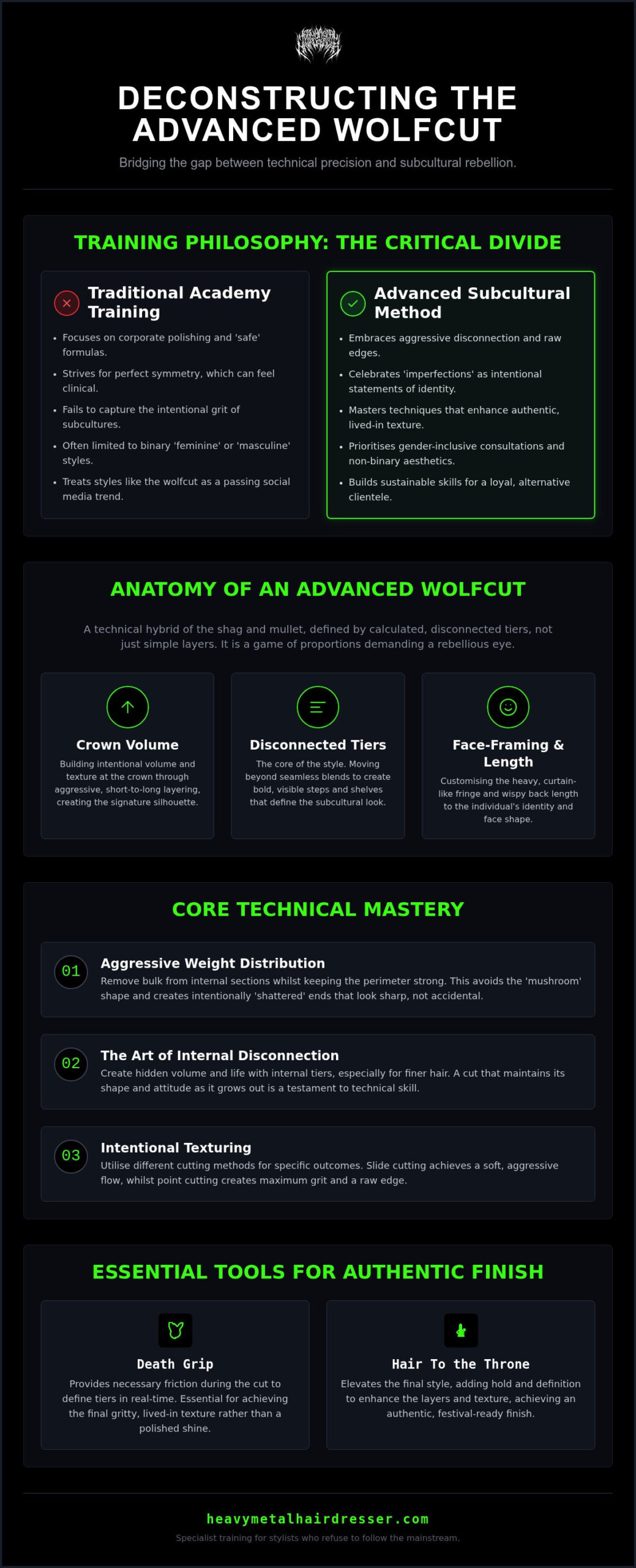
An advanced wolfcut isn’t just a messy shag. It’s a calculated technical feat. To master it, you need to understand the three essential pillars: crown volume, face-framing, and length. Unlike standard layering, which aims for a seamless blend, an advanced wolfcut relies on aggressive, disconnected tiers to create that signature subcultural grit. You can find more foundational context in the ultimate wolf hair cut guide.

Whilst the UK hairdressing and beauty industry continues to expand, many professionals remain stuck in basic NVQ habits. They struggle with the technical difference between a layer and a tier. A layer is a transition; a tier is a statement. When performing advanced wolfcut training UK, we teach you to use Death Grip during the cutting process. It provides the necessary friction to define these tiers before the hair even hits the floor, allowing you to see the texture evolve in real-time.

Aggressive Layering and Weight Distribution

Removing bulk is the biggest hurdle. You want that shaggy silhouette without the hair looking like a mushroom. We focus on removing weight from the internal sections whilst keeping the perimeter strong. This creates ‘shattered’ ends that look intentional and sharp. You have to balance the heavy, curtain-like fringe against the wispy back length. It is a game of proportions that demands a rebellious eye and a steady hand to ensure the weight sits exactly where the subculture demands it.

The Art of Internal Texture and Disconnection

Disconnection is your best friend, especially for clients with fine hair. By creating hidden volume through internal tiers, you give the hair a life of its own. We look at slide cutting for soft, aggressive flow versus point cutting for maximum grit. The goal is a cut that grows out gracefully. It should maintain its shape even as the layers drop over several months. If you want to dive deeper into these technical secrets, exploring our Hair Courses is the next logical step for your creative career.

Customisation: Tailoring the Wolfcut to Individual Identity

Every wolfcut should be as unique as the person wearing it. You aren’t just repeating a pattern; you’re tailoring a silhouette to a specific face shape and hair density. This approach mirrors the subcultural grit of British punk fashion, where individual expression always trumped mass production. Through advanced wolfcut training UK, we help you master the nuances of the consultation. It’s about building a safe space where clients feel seen. Vivid colours can then be applied to emphasise the technical tiers you’ve carved out. A masterfully executed cut prioritises the raw, subcultural truth of the client’s soul over the polished, corporate ego of the traditional salon.

Adapting the Cut for Different Hair Textures

Thick, curly hair can quickly turn into a ‘mushroom’ if you aren’t careful. You need to carve out internal weight without killing the natural bounce. For thin strands, it’s about injecting chaos. Use internal layers to create an illusion of density and movement where there was none before. Knowing how to style a modern mullet or wolfcut with Hair To the Throne is vital for these varied textures. It adds that essential hold whilst keeping the movement aggressive and raw. You want the hair to look like it has lived a life, not like it just stepped out of a box.

Gender-Inclusive Styling: Breaking the Binary with Scissors

The wolfcut is the ultimate gender-neutral weapon. It ignores traditional ‘male’ or ‘female’ boxes entirely. In our courses, we focus on removing gendered language from the entire process. Stop talking about ‘softening’ features or ‘masculinising’ a profile. Instead, talk about shape, weight, and attitude. We create shapes that empower clients to feel confident in their skin. By breaking the binary with your scissors, you aren’t just cutting hair; you’re affirming an identity. This is where subcultural authority meets genuine care. It’s about giving the client the tools to exist loudly in a world that often wants them to be quiet.
Advanced Wolfcut Training UK: Master the Art of Subcultural Grit

Traditional NVQ paths are built for the masses. They provide the basics whilst independent creative styling courses offer the rebellion. When you seek out advanced wolfcut training UK, you aren’t just looking for another certificate to hang on the wall. You’re looking for subcultural authority. You want a mentor who understands that hair isn’t just about aesthetics; it’s about belonging to a community that values grit over polish. Corporate academies often focus on linear learning paths that feel clinical and safe. Independent alternative hair courses UK break that mould by teaching you the technicalities of ‘the break’ and ‘the tier’ in a way that respects the raw energy of the underground.

What to Look for in a Specialist Academy

Does the academy have a real-world connection to the alternative scene? You should look for ‘Wolfcut Hair Course’ specifics rather than generic ‘creative cutting’ modules. A specialised centre should feel like a safe space where inclusive values aren’t just a buzzword but a core ethos. Small group training is essential here. You need eyes-on feedback when mastering complex, textured cuts. If the training environment feels too much like a clinical office, it probably won’t help you find the creative flow needed for aggressive, disconnected styles.

The Importance of Hands-On Subculture Experience

There is a massive difference between ‘studio’ hair and ‘mosh pit’ survival hair. Learning from stylists who spend their summers backstage at festivals like Download or Bloodstock matters. These experts know how hair behaves under pressure, sweat, and movement. They bring those backstage techniques back to the salon, allowing you to give your everyday clients a cut that lasts through a gig and still looks incredible the next morning. It is about technical durability. By choosing a mentor with genuine subcultural authority, you gain the insider knowledge required to create authentic, lived-in textures that corporate training simply cannot replicate. Ready to level up your craft? Explore our specialised Hair Courses and start your journey into advanced creative cutting.

Master the Wolfcut with Heavy Metal Hairdresser Training

Heavy Metal Hairdresser isn’t your average training provider. We’re built on the frontlines of the alternative scene. Our approach is raw, authentic, and backed by years of styling bands at festivals like Download and Bloodstock. When you sign up for advanced wolfcut training UK with us, you’re getting more than just a technique. You’re getting the Red Dot-level creative vision that defines the underground. Our ‘Wolfcut Hair Course’ is designed for stylists who are tired of playing it safe. You’ll walk away with the technical ability to create aggressive, disconnected textures and the confidence to handle any alternative identity that walks through your door. It’s time to stop following the mainstream and start leading the rebellion.

Unconventional Techniques from the Frontline of Alt-Hair

We don’t do ‘pretty’ layers. We do grit. A huge part of our training involves the ‘Death Grip’ method. It’s about using friction and product during the cut to define aggressive tiers. You’ll also explore how the wolfcut relates to the modern mullet, mastering the technical overlap between these two subcultural icons. One of the most practical skills we teach is finishing. A cut needs to look incredible in the chair, but it also needs to survive a three-day festival. We show you how to structure the hair so it looks even better after three days of sweat, music, and chaos. This is battle-tested hair design.

Building Confidence in Creative Styling

Most stylists are terrified of taking off too much weight. They’ve been trained to preserve length at all costs. We help you overcome that fear. Real creative cutting requires you to be bold. It requires you to trust your vision. Through our advanced wolfcut training UK, you’ll develop your own ‘voice’ as a stylist. This isn’t about copying our style; it’s about finding yours. Redefine your professional path and join the rebellion against corporate boredom. We’re currently preparing for our 2026 intake. Space is limited because we keep groups small to ensure you get the attention you deserve. Head over to our Hair Courses page to secure your spot and start your evolution.

Take the Lead in the UK Alternative Scene

The wolfcut isn’t just another service on your menu; it is an entry point into a vibrant, underserved community. You have seen why standard layering fails the raw energy of subculture and how technical disconnection creates the aggressive tiers your clients actually want. Mastering these shapes requires a mentor who lives the lifestyle, bringing backstage festival knowledge from Download and Bloodstock directly into a gender-inclusive safe space. By investing in advanced wolfcut training UK, you are choosing to prioritise identity over industry norms. You’ll gain expertise in creative colour and textured styling that corporate academies simply cannot replicate.

Don’t let your skills stay safe and predictable. It’s time to sharpen your tools and join the rebellion against the polished mainstream. Whether you’re aiming to master internal weight distribution or the ‘Death Grip’ finishing method, our expert-led sessions provide the technical authority you need to thrive. Book your spot on our Advanced Wolfcut Training Course and redefine your creative future. We can’t wait to see the grit you bring to the chair.

Frequently Asked Questions

Is a wolfcut difficult to learn for an intermediate stylist?

Learning a wolfcut is a challenge for intermediate stylists because it demands a departure from the polished rules of traditional training. You must master technical disconnection and aggressive weight distribution whilst maintaining a balance between the crown and length. It isn’t just about layers; it’s about creating a silhouette that feels raw and intentional. Our training helps you bridge this gap by focusing on subcultural grit rather than corporate symmetry.

What tools do I need for an advanced wolfcut hair course?

You’ll need your standard professional cutting kit, including high-quality scissors, sectioning clips, and combs. However, we also focus on the use of specialised products like Death Grip during the cutting process to define tiers and texture. We provide specific tools for texturising during the session, but bringing your favourite shears is recommended. The goal is to learn how to manipulate hair with more than just a blade to achieve that authentic finish.

Is the wolfcut suitable for all hair types and textures?

Absolutely, the wolfcut is highly adaptable across all hair types and textures. For clients with thick, curly hair, the focus is on removing internal bulk to avoid a mushroom effect. For those with fine hair, we use internal tiers to inject volume and chaos. Using products like Hair To the Throne ensures that whether the hair is wavy or pin-straight, the aggressive texture remains defined and stays looking gritty for days.

How does alternative hair training differ from standard NVQ courses?

Standard NVQ courses prioritise clinical precision and mainstream beauty standards that often feel too safe. In contrast, advanced wolfcut training UK focuses on subcultural authority and gender-inclusive styling. We teach you how to break the rules of symmetry and embrace the unfinished look required for metal and punk aesthetics. It is about understanding the identity behind the hair, moving away from corporate formulas to create something truly bespoke and rebellious.

Can I attend a wolfcut course if I don’t work in an alternative salon?

Yes, our courses are open to any stylist who wants to level up their creative game. You don’t need to be based in a dedicated alternative salon to benefit from learning these techniques. Clients everywhere are looking for more expressive, non-binary styles that break away from traditional trends. Bringing these advanced skills back to your own chair allows you to offer something unique and technical that sets you apart from the competition.

What is the best way to maintain a wolfcut between salon visits?

Maintenance is about embracing the lived-in feel rather than fighting it. We recommend air-drying with a bit of Death Grip to enhance the natural movement of the tiers. The wolfcut is designed to look better as it ages, so clients don’t need to worry about a perfect salon blow-dry every morning. It’s about technical durability, ensuring the cut maintains its aggressive shape even after three days of music and movement at a festival.

Are these hair courses accredited for professional development?

Our hair courses are designed for professional development, focusing on high-level creative skills that go beyond basic certification. Whilst they offer a different path to traditional NVQs, they provide the technical authority and subcultural insight needed to thrive in the modern UK hair scene. Stylists gain valuable experience by learning from experts with real-world festival and band styling backgrounds, ensuring they stay relevant in an industry that is rapidly evolving.
Posted on

Alternative Hair Courses UK: Master Subculture Styling in 2026

Alternative Hair Courses UK: Master Subculture Styling in 2026

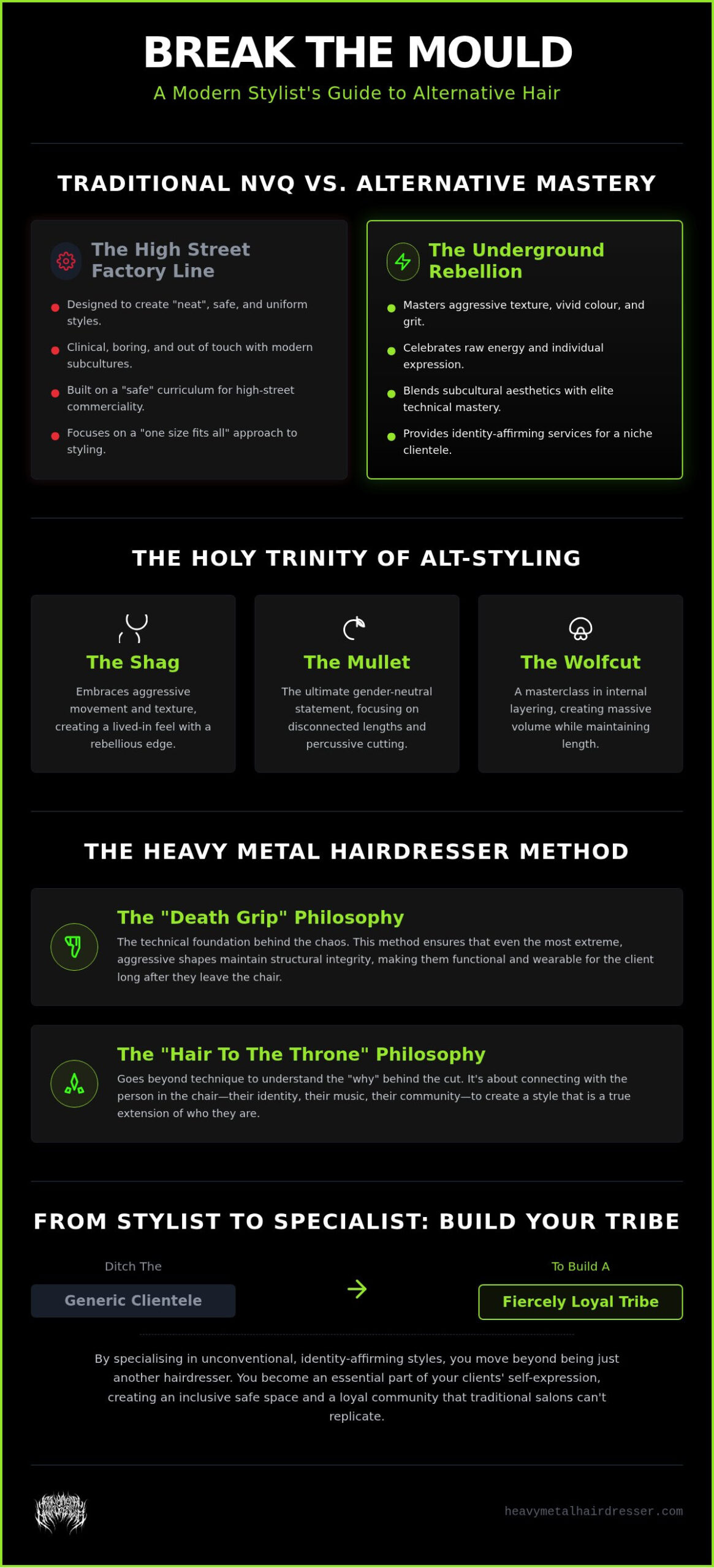
Most traditional hair NVQs are designed to turn you into a human factory line, churning out “neat” bobs and safe highlights that look exactly like everything else on the high street. It’s clinical, it’s boring, and it’s completely out of touch with the raw energy of the scene. If you’re searching for alternative hair courses UK, it’s because you’re tired of being told to “tidy up” those edges when your soul is screaming for more grit and less polish. You didn’t pick up a pair of shears to play it safe; you did it to create something that actually matters to the people who don’t fit the mainstream mould.

In this guide, we’ll show you how to master aggressive texture, vivid colour, and gender-neutral styling through the UK’s most rebellious professional training. You’ll learn how to dominate the wolfcut and the modern mullet while building a truly inclusive safe space for your niche clientele. We’ll preview the “Death Grip” and “Hair To the Throne” philosophies, giving you the technical precision needed to break the rules with confidence in 2026. It’s time to ditch the corporate fluff and start building a career that celebrates being different.

Key Takeaways

  • Master the percussive cutting techniques required to perfect the “Holy Trinity” of alt-hair: the shag, the mullet, and the wolfcut.
  • Understand why alternative hair courses UK are the future for stylists who value subcultural grit over clinical, “neat” NVQ standards.
  • Learn to implement the “Death Grip” and “Hair To the Throne” philosophies to deliver aggressive movement and gender-neutral results.
  • Discover how to attract your “tribe” and build a fiercely loyal client base by specialising in unconventional, high-pigment styles.
  • Gain insight into Simon Tuckwell’s 2026 training method, blending a raw underground aesthetic with elite technical mastery.

Redefining the Standard: Why Alternative Hair Courses in the UK are Surging

Alternative hair education is the precise intersection where underground subculture meets elite technical mastery. It isn’t just about being “messy” or “edgy” for the sake of it. It’s about understanding the architectural foundation of a cut and then knowing exactly how to break the rules to achieve a specific aesthetic. In 2026, the UK hair scene has shifted. The demand for raw, expressive styles has overtaken the desire for the clinical, “perfect” finishes of the past. Clients are no longer satisfied with a generic look. They want hair that mirrors their identity. This demand for specialist expertise that respects individual traits is seen everywhere, from alternative fashion to high-end pet care providers like H&H Dog, who focus on the specific needs and intelligence of each animal.

Traditional NVQ frameworks often fail the creative, non-conformist stylist. These programmes are built on a “safe” curriculum designed for high-street commerciality. They rarely provide the tools needed to navigate the aggressive texture and high-pigment world of alternative styling. Because of this, alternative hair courses UK have become the essential pathway for those who want to master the craft without losing their soul to corporate standards. Modern stylists need more than just a certificate; they need the ability to provide identity-affirming services that resonate with the pulse of the streets.

The Death of the “One Size Fits All” Salon

Subcultures like metal, punk, and goth are no longer confined to the shadows. They are actively influencing mainstream trends, but the execution remains niche. If you look at the history of punk fashion, you’ll see that hair has always been a primary tool for rebellion and self-identification. Modern clients are seeking specialists who understand this heritage. They aren’t looking for a generalist who might accidentally give them a “mum-shag” when they asked for a gritty, percussive mullet. This shift has fuelled the rise of the independent stylist identity across the UK. Stylists are now building loyal tribes by specialising in specific, identity-affirming looks that traditional salons simply can’t replicate.

Bridging the Gap Between Art and Industry

Alternative courses provide the missing link that traditional hairdressing education ignores. While a standard college course might teach you how to remove weight, it won’t teach you how to use that weight to create a silhouette that fits a specific subcultural vibe. It’s about the “why” behind the cut. You need to understand the person in your chair, their music, and their community. Alternative hair courses are professional training for unconventional aesthetics. By focusing on the intentionality of the style, these courses empower stylists to move beyond the chair and into the world of artistic expression.

Mastering Aggressive Texture: The Core Curriculum of Alt-Styling

To master alternative hair, you have to embrace the chaos of the “Holy Trinity”: the shag, the mullet, and the wolfcut. These aren’t just styles; they’re statements of rebellion. While standard UK hairdressing qualifications focus on the mechanics of a uniform, polished cut, our approach prioritises percussive cutting techniques. This involves a rhythmic, almost aggressive way of removing weight to create movement and grit that feels lived-in from the moment the client leaves the chair. It’s about building a shape that holds its own without needing a salon blow-dry every morning.

Structural integrity is the secret behind the “messy” aesthetic. Without a solid foundation, an alternative cut just looks like a mistake. We teach you how to maintain that balance by using the “Death Grip” texture philosophy. This method ensures that even the most extreme shapes remain functional and wearable. If you want to dive deeper into these techniques, our alternative hair courses UK provide the hands-on experience needed to bridge the gap between theory and the stage. It’s about giving you the confidence to hack into a silhouette while knowing exactly where the weight needs to live.

The Anatomy of the Modern Wolfcut

The wolfcut is a masterclass in internal layering. It’s the perfect solution for creating massive volume in fine hair without sacrificing the length at the back. We focus on adapting this cut for different face shapes, ensuring the edge remains sharp regardless of the canvas. Using a razor provides a soft, shattered finish that screams subculture, whilst scissor-thinning offers a more controlled, chunky texture. Knowing when to switch between these tools is what separates a professional from a hobbyist. You’ll learn to read the hair’s natural behaviour to decide which tool will deliver the most authentic result.

Vivid Colour Mastery: Beyond the Rainbow

Alternative hair isn’t complete without high-pigment, long-lasting colour. We move beyond simple “rainbow” hair to focus on saturation techniques that ensure longevity and depth. Subcultural looks like “peek-a-boo” panels and “split-dye” placements require strategic planning to avoid muddying during the rinse. It’s about pushing the boundaries of chemical lifting whilst fiercely protecting the hair’s health. You’ll learn how to achieve maximum impact with minimal damage—perhaps by utilising professional smoothing systems from Hair Bar NYC Professional—ensuring your clients can keep expressing their identity without compromising their hair’s integrity. Mastery in this area allows you to create bespoke shades that reflect a client’s specific musical or fashion tribe.

Traditional beauty schools often feel like clinical waiting rooms. They’re filled with beige walls and a heavy focus on passing tick-box assessments that prioritise speed over soul. If you’ve ever felt out of place in that environment, it’s because those courses aren’t designed for you. They’re designed for the mainstream. When you choose alternative hair courses UK, you’re stepping into a high-energy theatre of creativity where the playlist is just as vital as the technical theory. We swap the clinical atmosphere for subcultural grit, focusing on the raw energy that defines the underground scene.

The “vibe” isn’t just a buzzword; it’s a technical requirement. You can’t create an authentic subcultural statement if you don’t understand the culture itself. A standard high-street cut follows a rigid template. A subcultural statement, however, is a bespoke architectural build that respects the history of the wearer’s identity. It’s about knowing the difference between a soft, romantic shag and a jagged, aggressive mullet that feels like it belongs on a stage. You’re learning to translate music and attitude into hair. This level of expertise only comes from training that values the person in the chair as much as the technique used to style them.

Learning from the Pit: Backstage Festival Experience

Styling for heavyweights like Download and Bloodstock festivals is a completely different beast compared to a standard Saturday morning in a salon. It’s fast, it’s loud, and the pressure is immense. Hair doesn’t just need to look good for a photo; it needs to survive a mosh pit and three days of camping. We bring this “mosh-pit survival” mentality into our training. You’ll learn how to create durable, high-impact looks that maintain their shape even under the most extreme conditions. This backstage experience is invaluable, teaching you the shortcuts and technical hacks that only the most seasoned alternative stylists know.

The Inclusive Safe Space as a Technical Skill

In 2026, being a great stylist means being an inclusive one. Gender-inclusive styling is the future of the UK hair industry, and it requires a specific technical approach. We don’t just talk about being “welcoming”; we teach the technical execution of gender-neutral consultations. This involves breaking down the traditional binary of “masculine” and “feminine” shapes to focus on what actually suits the client’s features and identity. Learning how to build a gender neutral hair salon environment is a core part of our curriculum. It’s about ensuring every client who walks through your door feels seen, safe, and celebrated for exactly who they are.

Alternative Hair Courses UK: Master Subculture Styling in 2026

Building a Portfolio with Identity: Practical Steps for Aspiring Stylists

Building a professional portfolio in the alternative scene isn’t about showing how well you can follow a manual. It’s about showing how effectively you can break it. Most traditional portfolios look like a sanitised catalogue from a local department store, but your “tribe” doesn’t shop there. To attract the non-conformists, your digital presence needs to bleed the same grit as the subcultures you serve. Authentic social media representation means posting the raw, percussive results of your work, not just the finished, polished product. Show the texture, show the movement, and show the personality of the human in your chair.

Specialising in the “Holy Trinity” of the shag, the mullet, and the wolfcut creates a level of client loyalty that generalist salons can’t touch. Clients seeking these looks are often used to being misunderstood by stylists who try to “tidy up” their edge. When you demonstrate that you understand the architectural weight of these styles, you stop being a service provider and become a trusted collaborator. Organise your professional development around your favourite subcultures. If you live for the energy of the pit, let that influence every cut you make. This focus makes you the go-to expert for a niche community that values authenticity above all else.

Branded merchandise also plays a massive role in building your personal brand. It isn’t just about selling t-shirts; it’s about creating a visual flag that signals your belonging to the community. When a client wears your gear, they’re endorsing your aesthetic and your values. It helps solidify your position as a rebellious expert who understands the nuances of the scene. If you’re ready to master these techniques and build your own brand, our professional hair courses provide the technical foundation you need to stand out.

Choosing the Right Course for Your Career Path

Not all alternative hair courses UK are created equal. You need to evaluate the content with a critical eye. Is the curriculum truly alternative, or is it just a commercial course with a “rock” label slapped on the front? Check the pedigree of the educators. You want to learn from people who actually live the subculture and work backstage at the festivals you attend. Look for training that offers hands-on “aggressive texture” modules. If they aren’t teaching you how to hack into a silhouette with technical precision, they aren’t giving you the tools you need for 2026.

Marketing Yourself to the Alternative Scene

When you describe your work, use the language of the scene. Incorporating the “Death Grip” and “Hair To the Throne” philosophies into your marketing shows that you have a technical system behind the chaos. It builds authority. Your portfolio should be a celebration of non-conformity, featuring diverse models and identity-affirming styles. You can even include shots of your kit and alternative hair merch UK to show your commitment to the aesthetic. This level of detail tells your future clients that you don’t just “do” alternative hair; you understand the soul of it.

The Heavy Metal Hairdresser Method: Professional Training for the Unconventional

Simon Tuckwell didn’t launch this movement to follow the latest high-street trends. He built it to destroy them. The vision for our alternative hair courses UK is rooted in the belief that elite technical precision and subcultural identity belong together. We’ve taken the raw, percussive energy of the festival circuit and distilled it into a professional training method. It’s about mastering the craft at the highest level whilst maintaining a fiercely independent edge. We don’t just teach you how to cut hair; we teach you how to command a silhouette.

Attending a Heavy Metal Hairdresser masterclass feels more like a backstage collaboration than a clinical lecture. You can expect grit, massive volume, and high-impact pigment that pushes the boundaries of traditional colour theory. We’re here to empower stylists to create gender-neutral safe spaces whilst delivering deadly, architectural cuts. This isn’t just about hair; it’s about building a community where being different is the standard. You’ll learn to navigate the nuances of the scene with the confidence of a rebellious expert who knows exactly when to break the rules.

The “Hair To the Throne” Education Philosophy

Our “Hair To the Throne” philosophy focuses on the crown as the structural anchor of every alternative style. We teach you how to manipulate internal weight to create shapes that defy gravity and convention. This hands-on training covers everything from the most aggressive shags to the most intricate, unconventional mullets. You get direct mentorship from stylists who actually work the pits at Bloodstock and Download. We focus on the “why” behind every section, ensuring you leave with the technical mastery to handle any hair type with a “Death Grip” on precision.

Join the Revolution: Booking Your Spot

Making the jump from a standard commercial stylist to an alternative specialist is the most empowering move you can make in 2026. Our upcoming course schedule is packed with intensive sessions designed to overhaul your technical approach and your creative mindset. We cover advanced saturation techniques for vivids and the percussive cutting methods that define the modern wolfcut. These sessions move fast and keep you engaged from the first clip to the final style. Don’t let your talent wither in a beige salon environment. It’s time to Master the art of subculture styling today and start attracting the tribe you were meant to serve.

Own the Future of Subculture Styling

The era of beige, one-size-fits-all hairdressing is dead. In 2026, the most successful stylists are those who refuse to play it safe. You’ve seen how mastering the “Holy Trinity” of the shag, mullet, and wolfcut can transform your career and attract a tribe that truly values your grit. By choosing alternative hair courses UK that prioritise technical precision over corporate fluff, you’re not just learning a skill; you’re joining a revolution.

We bring Red Dot level design to every cut and years of backstage festival expertise to our masterclasses. As gender-inclusive safe space pioneers, we’ll show you how to build a business that celebrates identity without compromise. It’s time to stop following the rules and start writing your own. Your creative edge is your greatest asset. Don’t let it go to waste. We’re ready to help you sharpen your shears and find your voice in the underground scene.

Master the craft of subculture styling with Heavy Metal Hairdresser

Frequently Asked Questions

Are alternative hair courses in the UK accredited for professional insurance?

Accreditation varies, but because the UK industry is currently unregulated, you don’t legally need a specific qualification to practice. Most professional insurers accept certificates of completion from established experts like Simon Tuckwell. Our training focuses on elite technical precision, providing you with the documented proof of competence needed to secure your policy. Always check with your specific provider to ensure your niche styling is fully covered.

Do I need previous hairdressing experience to attend an alternative hair course?

You generally need a solid grasp of the basics to get the most out of our specialist training. While some alternative hair courses UK offer introductory modules, our masterclasses focus on advanced percussive cutting and high-pigment saturation. If you already know how to handle your shears but want to ditch the boring high-street bobs for something grittier, you’re in the right place. We bridge the gap between basic skill and subcultural mastery.

What is the difference between a wolfcut and a modern shag in a professional context?

The difference lies in the architectural weight and the silhouette’s aggression. A modern shag is all about soft, lived-in layers and a balanced fringe that feels effortless. The wolfcut is the shag’s rebellious younger sibling, featuring much shorter, disconnected internal layers and a heavier, more dramatic mullet-style back. We teach you how to read the hair’s natural behaviour to decide which style best suits your client’s face shape and identity.

How long do these specialist hair courses usually last?

Duration depends on the intensity of the curriculum you choose. Short, high-energy masterclasses often last a single day, focusing on one specific technique like the “Death Grip” texture method. More comprehensive programmes can span several days or weeks, allowing for deep dives into vivid colour placement and backstage festival styling. We keep the rhythm fast and the content focused, ensuring you spend less time in a classroom and more time hacking into silhouettes.

Will I learn how to use vivid hair colours on dark hair?

Yes, mastering the chemical lift is a core part of our vivid colour training. You’ll learn how to push the boundaries of lightening whilst fiercely protecting the hair’s integrity. We focus on high-pigment saturation techniques that ensure neon and pastel shades pop against even the darkest natural bases. It’s about understanding the science of the lift to create the perfect canvas for subcultural looks like split-dyes and peek-a-boo panels.

Can I specialise in alternative hair as a mobile stylist in the UK?

Absolutely, specialising in a niche like alternative hair is a brilliant move for mobile stylists. By becoming the go-to expert for wolfcuts and mullets, you’ll build a loyal tribe that will wait for your specific expertise. You don’t need a static chair to deliver elite technical precision. Our alternative hair courses UK give you the confidence to provide identity-affirming services in any setting, from a client’s kitchen to a backstage festival tent.

What tools do I need to bring to an aggressive texture cutting course?

You’ll need your primary arsenal for creating grit and movement. This typically includes:

  • High-quality professional shears
  • A sharp cutting razor for shattered edges
  • Thinning or texturising scissors
  • Sectioning clips and a sturdy cutting comb

We focus on using these tools with percussive techniques to remove weight and build unconventional shapes. We provide the mannequins and the high-energy atmosphere; you just bring the steel and the attitude.

Is there a focus on gender-neutral styling in your training?

Inclusion is at the heart of everything we do. We don’t just mention gender-neutral styling; we treat it as a fundamental technical skill. You’ll learn how to conduct consultations that ignore the traditional binary, focusing instead on features and self-expression. Our “Hair To the Throne” philosophy ensures every cut is bespoke to the individual. We empower you to build a safe space where every client feels seen and celebrated for their unique identity.