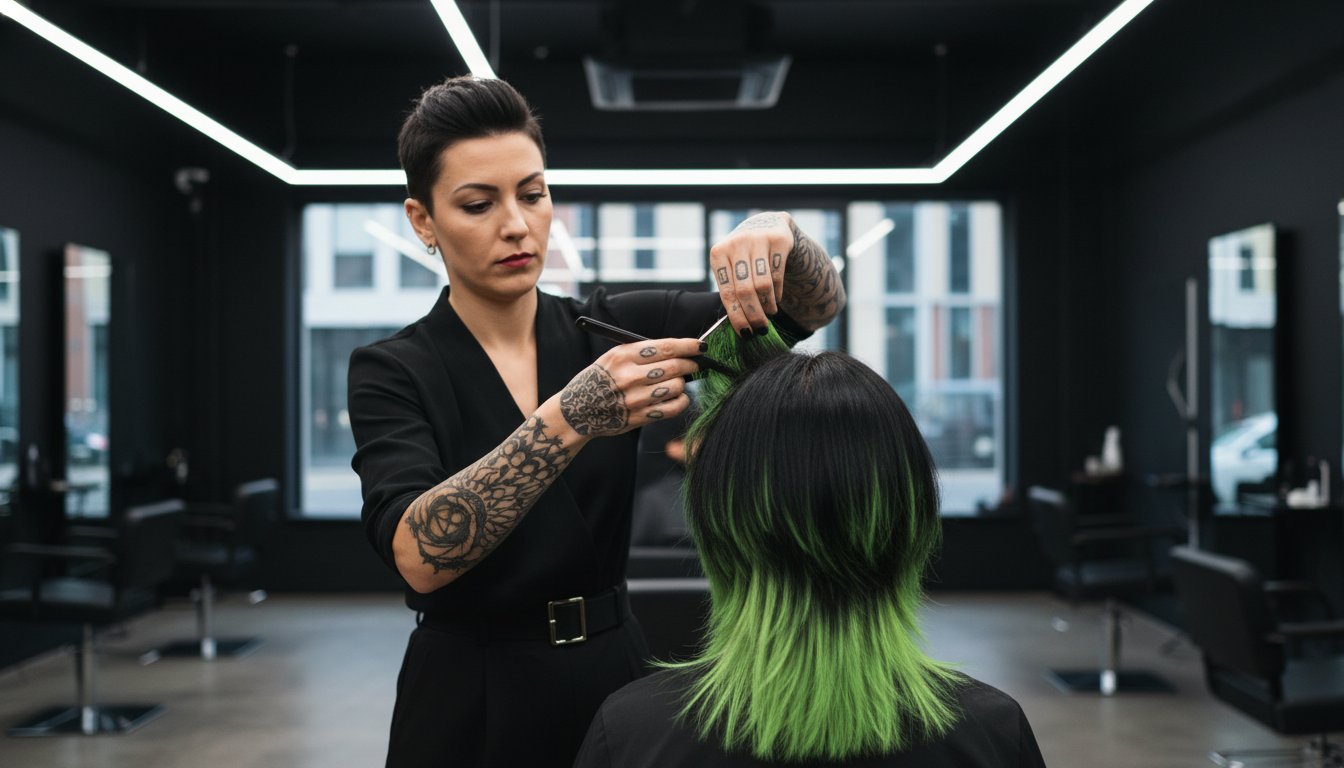
Most traditional hair academies are preparing you for a world that doesn’t exist anymore; or at least, one you don’t want to live in. You’ve sat through the clinical demos and the “safe” bridal styles, but they don’t teach you how to handle a razor with intent or how to make a neon green pop against a jagged fringe. If you’re looking for alternative hair courses UK professionals actually respect, you’ve probably realised that mainstream tutors often miss the mark on subculture aesthetics. They see a mess where you see a masterpiece.
It’s frustrating when your creative energy is stifled by rigid rules and polished finishes. You want to craft identities, not just haircuts. In this guide, you’ll discover how to transcend basic training and master the aggressive textures and inclusive techniques that define the modern UK scene. We’ll explore the essential skills for 2026, from perfecting the wolfcut and shag to building a niche client base that values your raw, authentic expertise. It’s time to stop blending in and start leading the underground.
Key Takeaways
- Learn why mainstream NVQs often leave you unprepared for the aggressive textures and rebellious styles demanded by the UK scene.
- Master the architecture of wolfcuts and shags through specialised alternative hair courses UK that prioritise identity over conformity.
- Gain confidence in advanced vivid colour placement and inclusive techniques that go beyond basic primary mixing.
- Discover how to audit a tutor’s portfolio to ensure they actually live the subculture aesthetic they claim to teach.
- Explore the “Death Grip” and “Hair To the Throne” methodologies designed to help you build a loyal, niche client base.
Why Traditional Hairdressing Training Often Misses the Mark
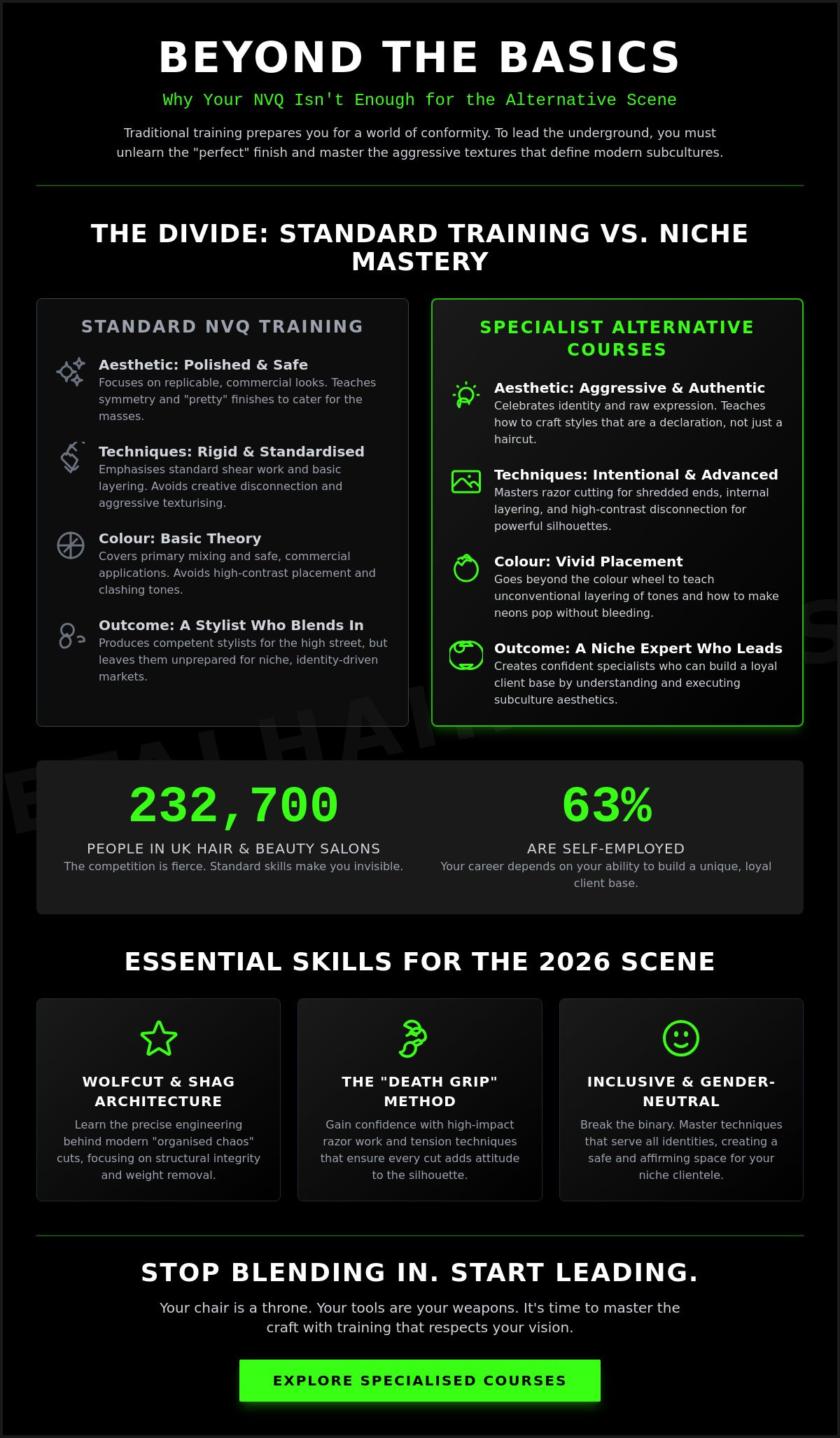
Traditional training is a factory line. It’s designed to produce stylists who can replicate a “safe” commercial aesthetic for the masses. In 2024, there were 232,700 people employed in UK hairdressing and beauty salons. With 63% of those being self-employed, the competition is fierce. If you’re just another stylist doing standard layers, you’re invisible. Mainstream education prioritises these polished looks because they’re easy to grade. They don’t want you taking risks with aggressive textures or vivid, clashing colours. They want symmetry. They want “pretty”.
But alternative hair isn’t about being pretty. It’s about being seen. Standardised modules often ignore the nuances of subculture-specific silhouettes. When you try to apply “one size fits all” layering to shags and mullets, the result is weak. It lacks the weight and the attitude that defines the style. There is a massive disconnect between the clinical etiquette taught in colleges and the gritty, raw reality of alternative spaces. Finding alternative hair courses UK stylists actually trust means looking beyond the high-street curriculum.
The Limitations of the Standard NVQ
An NVQ is a foundation, not a finish line. It teaches you the mechanics of how to cut hair without making a mess, but it stops there. You won’t find aggressive, textured layering or creative disconnection in a standard curriculum. To master the art of the underground, you have to unlearn the “perfect” finish. Raw, lived-in results require a different set of rules. Standard training focuses on the “how” but completely ignores the “why” behind subculture styles. You need to move past the basic short back and sides mentality to truly excel.
Bridging the Gap Between Skill and Subculture
You can’t separate the hair from the culture. Understanding the history of punk fashion, metal, and goth aesthetics is vital for any serious stylist. If you don’t understand the music or the movement, you’re just mimicking a trend without any soul. In the UK alternative scene, the stylist acts as a community gatekeeper. You aren’t just providing a service; you’re affirming an identity. The new SIC codes (9621) for hairdressing and barber activities finally give our industry government recognition, but they don’t teach you how to vibe with a niche crowd. Alternative hair courses UK should bridge this gap by blending technical precision with cultural authenticity.
A haircut becomes a declaration of identity when it’s rooted in the rebellion of the scene it serves.
What to Expect from Specialist Alternative Hair Courses in the UK
Specialist alternative hair courses UK are built for the rebels. They aren’t about learning to blow-dry a bouncy bob for a wedding. They’re about dismantling traditional rules to create something raw. You’ll dive deep into the architecture of the wolfcut and the modern shag. These aren’t just “messy” cuts. They require precise engineering to ensure the hair still has structural integrity even after extreme weight removal. Whilst standard UK hairdressing qualifications get you through the door, they rarely touch on the “organised chaos” required for subculture silhouettes.
You’ll also tackle advanced vivid colour theory. This goes way beyond basic primary mixing. You’ll learn how to layer clashing tones and create transitions that look intentional, not accidental. It’s about understanding how light hits jagged edges and using colour to amplify that texture. Expect to work with high-pigment palettes and unconventional placement techniques that mainstream tutors often find “too risky”. This is where you learn to make neon green pop against a soot-black base without the bleed.
Mastering Aggressive Texture and Layers
The toolkit in an alternative workshop looks different. You’ll swap standard shears for razors and thinning shears to create grit. We focus on the “Death Grip” approach to sectioning and tension. This is about how you hold and manipulate the hair to ensure every snip adds to the overall attitude of the silhouette. It’s a high-impact method that requires confidence. You’ll learn exactly where to take the weight out so the style doesn’t collapse. Working with a textured haircut specialist who understands aggressive alternative layers is the key to engineering maximum volume without the style falling flat. We cover:
- Razor cutting for feathered, “shredded” ends
- Internal layering to create height without bulk
- Disconnection techniques for high-contrast shapes
Breaking the Binary: Gender-Neutral Education
Alternative spaces have always been a sanctuary for those outside the norm. Your training must reflect that. Specialist alternative hair courses UK lead the way in gender-inclusive styling. This starts with the consultation. We teach you to remove gendered language from your vocabulary entirely. You aren’t cutting “men’s” or “women’s” hair; you’re cutting for an individual’s identity. It’s about technical skill meeting radical empathy. You’ll learn to adapt classic subculture shapes to suit any face structure, regardless of assigned gender.
Beyond the chair, these courses prepare you for the reality of the scene. Think music-inspired textures and festival-ready stage hair for musicians that can survive a mosh pit. You’ll get hands-on experience with alternative-specific products that mainstream salons don’t even stock. If you’re ready to stop following the crowd, it’s time to explore specialised hair courses that actually speak your language.
Comparing NVQ Standards with Creative Subculture Workshops
NVQs are the baseline. They provide the fundamental mechanics required to hold a pair of shears without causing a disaster. If you look at the UK’s official hairdressing qualifications, the focus is heavily on safety, hygiene, and standard commercial results. This is essential, but it isn’t enough. While an NVQ gives you the foundation, boutique workshops provide the edge and personality that actually get you booked by the clients you want. There is a massive difference between “Creative” in a mainstream college and “Creative” in an alternative studio.
In a traditional setting, creative hair usually means a slightly more adventurous version of a salon-friendly bob. It’s safe. It’s marketable to the average high-street customer. In the underground scene, alternative hair courses UK professionals lead are far more radical. We’re talking about total identity shifts, not just trims. We prioritise the aggressive, the asymmetrical, and the unapologetic. Accreditation matters for insurance, but authentic experience is what builds a cult following. Clients don’t ask to see your diploma; they look at your portfolio to see if you understand their world.
Accreditation and Career Progression
Choosing private, boutique training doesn’t mean you’re sacrificing professional growth. Many advanced alternative hair courses UK offer CPD (Continuing Professional Development) points that count towards your career milestones. A “name-brand” certificate from a respected alternative specialist carries significant weight in the community. It signals that you’ve moved beyond the basics. This level of specialised training justifies higher service prices in your own space. When you master niche techniques like “Hair To the Throne”, you aren’t just a hairdresser. You’re a specialist in a high-demand, low-supply market.
The Mentorship Factor
Learning from a working “Metal Barber” or a seasoned festival stylist is a total game-changer. These mentors live the lifestyle they teach. They understand the nuances of how hair needs to perform in a mosh pit or under stage lights. This isn’t corporate coaching with a script. Mentorship in the alt-scene is a raw, unfiltered exchange of knowledge between people who value rebellion over conformity. It’s about networking with like-minded rebels who will become your peers, not just your classmates. Corporate coaching focuses on profit margins; alternative mentorship focuses on the power of self-expression and the grit of the craft.
How to Choose the Right Advanced Styling Programme for Your Career
Don’t get blinded by a flashy website or a highly sought-after postcode. Choosing the right alternative hair courses UK stylists can actually bank on requires a deep audit of the person behind the chair. Look at the tutor’s actual portfolio. If their social media is a sea of “safe” honey-blonde balayage, they aren’t the ones to teach you a jagged mullet or a soot-black wolfcut. You need someone who lives the aesthetic they teach. Check for “live” experience. Have they worked backstage at Download Festival? Have they styled prominent artists in the underground scene? This real-world grit is what separates a true mentor from a corporate instructor.
Vivid colour application is another critical factor. Most basic courses teach you how to mix a primary red, but they ignore the science of longevity and clashing. A high-tier programme should cover maintenance as much as application. Inclusivity isn’t just a buzzword in our world; it’s the foundation. Ensure the training environment is a verified safe space where identity-affirming language is the standard, not an afterthought. Post-course support is also vital. You want access to a community of like-minded rebels who can support your growth long after the session ends.
Analysing the Curriculum
A solid curriculum must address the shag haircut resurrection and its many modern variants. It’s the backbone of the current UK alternative scene. Ensure there is a specific focus on the “Wolfcut” and how to adapt it for different hair textures. If you want to go deeper on the mechanics of aggressive disconnection and weight removal that define this style, our dedicated wolfcut hair course covers the full technical workflow from consultation to finish. Demand practical, hands-on time with live models. Mannequins don’t have personalities, cowlicks, or the ability to tell you how they feel. You need to feel the hair move and react to your tools to truly master the craft. Understanding how a textured haircut specialist engineers aggressive alternative layers will transform how you approach every consultation and cut.
Location and Logistics
Travelling for your craft is a rite of passage. If the best alternative hair courses UK has to offer are three train rides away, book the ticket. You should also consider the duration of the training. Some stylists prefer an intensive one-day blast to sharpen a specific skill, whilst others benefit from long-term modular learning. Don’t forget to factor in the cost of professional kits and the specialised alternative products you’ll need to achieve that raw, lived-in finish. Logistics might seem boring, but they’re the bridge between your current skill level and your future career.
Ready to stop following the rules and start making your own? Check out our specialist hair courses and find your edge.
Master the Craft with Heavy Metal Hairdresser’s Specialised Training
Stop settling for mediocre education that tries to sand down your edges. At Heavy Metal Hairdresser, we don’t do “safe”. Our alternative hair courses UK are designed for the rebels who want to dominate the niche market. Simon Tuckwell has spent years perfecting methodologies that mainstream academies simply can’t replicate. With “Hair To the Throne” and “Death Grip”, you aren’t just learning to cut; you’re learning a technical system for high-impact, aggressive silhouettes. These aren’t just buzzwords. They are the tools you need to build a cult following in your own salon.
Our training is built on a foundation of inclusivity and subculture pride. We’ve created a space where being different is the point. You’ll learn the secrets of styling for the people who actually move the needle: bands, festival performers, and high-profile artists. While other tutors are obsessed with red-carpet polish, we teach you how to create stage hair for musicians that survives a mosh pit and still looks iconic under stage lights. Joining the Heavy Metal Hairdresser alumni means stepping into a community of like-minded experts who value raw authenticity over corporate scripts.
The Wolfcut and Shag Masterclass
Our signature textured cutting techniques have gained international acclaim for a reason. They work. In this masterclass, we dive deep into the mechanics of the shag and the wolfcut. You’ll learn how to inject chaos into fine, limp hair to give it life. You’ll also master how to manage the bulk of thick, heavy manes without losing the intended shape. The consultation is where the magic happens. We teach you how to speak the language of alternative clients, ensuring they feel seen and affirmed before you even pick up your shears. It’s about technical precision meeting radical empathy. If you’re ready to go all-in on this signature style, our professional wolfcut hair course gives you the full system for mastering aggressive texture and alternative flow.
Vivid Colour and Beyond
Saturate your identity with our expert vivid colour application training. We go beyond the surface to teach you the actual chemistry of the fade. You’ll learn how to keep your clients’ colours sharp and vibrant between visits, turning them into walking advertisements for your skills. This isn’t just about slapping on some dye. It’s about strategic placement that complements the aggressive textures of an alternative cut. It’s time to stop playing it safe and start making a statement. Level up your skills and book your place on our next course to transform your career and your salon presence.
Own Your Creative Rebellion
You’ve seen how traditional training fails to capture the raw energy of the subculture scene. Mastering the architecture of a wolfcut or the grit of a shag isn’t just about technique; it’s about understanding the identity behind the hair. By choosing specialised alternative hair courses UK, you move beyond “safe” commercial standards and start building a niche career that actually resonates with your values. It’s about technical precision meeting the unfiltered spirit of the underground.
Founder Simon Tuckwell is an internationally acclaimed creative stylist who has brought his expertise to the biggest stages at Download and Bloodstock festivals. Our training is safe-space certified and gender-inclusive, ensuring every stylist feels empowered to express their craft without judgment. This isn’t just a class; it’s an initiation into a community of rebels who refuse to blend in. It’s time to stop mimicking the mainstream and start leading the movement.
Join the revolution and browse our upcoming alternative hair courses
The chair is yours. Make it count.
Frequently Asked Questions
Are alternative hair courses in the UK accredited?
Many specialist alternative hair courses UK offer private certification or CPD (Continuing Professional Development) points rather than traditional NVQ accreditation. While government-regulated diplomas provide a solid baseline, private workshops focus on niche, rebellious techniques that aren’t covered in the standard curriculum. It is always wise to check if the course is recognised by your insurance provider to ensure you are covered for the advanced textures and razor work you’ll be learning.
Do I need a Level 2 NVQ before taking an alternative hair course?
Most advanced workshops require a Level 2 NVQ or equivalent salon experience because they assume you already understand the fundamentals of hair mechanics. However, some entry-level alternative hair courses UK are designed specifically for apprentices or those just starting their journey in the underground scene. If you don’t have a formal qualification, your current skill level or a strong portfolio might still secure you a spot.
What is the difference between a wolfcut and a shag haircut?
A wolfcut is an aggressive, high-contrast hybrid of a shag and a mullet. It features shorter, choppier layers around the crown and face to create maximum volume and a “feral” silhouette. A shag haircut is usually softer and more blended, drawing inspiration from the 70s with feathered layers that frame the face without the extreme disconnection found in a true wolfcut.
Can I learn vivid hair colour techniques online or is face-to-face better?
Face-to-face training is almost always superior for mastering alternative styles. You can’t learn the specific tension of the “Death Grip” or the exact angle of a razor through a screen. Being in the room allows a mentor to correct your hand positioning in real-time, which is vital when you’re working with aggressive layering and complex, multi-tonal vivid colour placements.
Are these courses suitable for barbers as well as hairdressers?
These workshops are perfect for anyone who wants to break away from traditional binary styling. Alternative subcultures don’t care about the label on your shop door. Whether you’re a barber wanting to master longer, textured silhouettes or a hairdresser looking to add more grit to your work, these courses provide the technical skills to serve a diverse, non-conformist clientele.
How much do professional alternative hair courses usually cost in the UK?
Professional training costs vary depending on the depth and duration of the programme. A one-day masterclass often sits between £150 and £350, whilst comprehensive multi-day creative certificates can reach £800 or more. Always check if the fee includes VAT and if you’ll need to provide your own models or if mannequin heads are included in the price.
Will I learn how to style hair for music festivals and bands?
Yes, styling for the scene is a core part of the alternative curriculum. You’ll learn how to create textures that hold up under stage lights and survive the heat of a music festival mosh pit. Mentors with real-world experience at events like Download or Bloodstock will show you how to achieve high-impact looks that are as durable as they are rebellious.
What tools do I need to bring to an alternative hair workshop?
You’ll usually need to bring your own professional kit, including sharp cutting shears, thinning shears, and a high-quality razor. Don’t forget plenty of sectioning clips and a variety of combs. Some workshops might provide specialised styling products or mannequin heads, but it’s always best to check the specific requirements of your chosen course before you arrive.