Posted on

Razor Cutting Course for Stylists in London

Razor Cutting Course for Stylists in London

A razor should change the shape, not just the tool in your hand. A razor cutting course for stylists in the UK can take you beyond watching someone else work and help you understand how the technique shapes a cut.

When choosing training, weigh the practical details alongside the creative promise. Check where the course takes place, what the price includes and how demonstrations lead into hands-on practice. A clear course description should explain the day’s format.

Consider what demonstrations can teach, what you can practise and how to make the most of time with a razor. Whether you’re refining your current approach or exploring a different edge to your work, focus on techniques you can apply in the salon.

Key Takeaways

  • Find out where the London course takes place and what to consider when planning your day.
  • See how to read the course price, including VAT, and what it covers.
  • Learn how live demonstrations connect with hands-on razor-cutting practice.
  • Get a clearer picture of what a one-day 360 razor cutting course is designed to cover.

Course location in London

As stylists travel from across the UK to attend, Heavy Metal Hairdresser hosts this premier razor cutting course for stylists UK at a central venue in London. Plan your journey using the specific venue address found in your booking details. London covers a wide area, and the city name alone will not tell you which station or route is most convenient. Save the full address before choosing your transport or accommodation.

Start with the address, then compare your arrival options. A venue near a Tube station may suit one travel route, while a location closer to a mainline railway station may suit another. Use the nearest named station as your route-planning anchor rather than assuming the course is right in the heart of central London.

For a practical travel plan from anywhere in the UK, work through these steps:

  • Save the venue address: keep it with your booking details so you can enter the exact destination into a map.
  • Choose your arrival station: compare the route from your home station with the route from the London terminal you expect to use.
  • Plan the final leg: check whether walking, a bus or another connection makes sense for that specific address.
  • Allow time to settle in: include room to find the entrance and get your hairdressing tools ready before demonstrations begin.

If you are travelling from outside the capital, plan the journey in two parts: your national rail arrival and the onward trip to the venue. For example, if you arrive at King’s Cross, use the Heavy Metal Hairdresser course address to plan the next leg rather than assuming the venue is nearby. The same careful approach works from all other London terminals.

Keep the address handy on your phone and save it before travelling. If your route changes, the venue postcode gives mapping apps a more precise destination than simply searching for “London”. This small step makes your arrival much calmer, leaving you completely ready to focus on mastering advanced razor cutting techniques and practical salon work.

Course price including VAT

A VAT-inclusive course price is the total with VAT included. It gives you a clearer figure to budget for than a price shown before VAT. For a London training day, compare the full amount payable, not just the headline figure. Check the course information for the fee and what it covers before you commit.

The format can affect the cost. A demonstration-led session and a day with extensive individual practice may involve different teaching and set-up needs. Materials, models and practical arrangements can also shape what a course includes. The final course price depends on the training format, materials and practical arrangements, and is given after a quote request.

Before weighing up the fee, look for these details in the course information:

  • Total with VAT: identify the amount payable, rather than relying on a pre-VAT figure.
  • Training format: note whether the day includes demonstrations, supervised practice or both.
  • Materials and tools: establish what the fee covers and what you’re expected to bring.
  • Practical arrangements: check whether models or other learning resources form part of the session.

When comparing two courses, weigh teaching time and opportunities to practise alongside the total fee. A lower headline figure doesn’t tell you whether hands-on practice is included. Nor does a VAT-inclusive total explain which materials or resources come with the training. These details help you decide whether the format suits your learning priorities.

Set your priorities before comparing options. If you want to improve your control and confidence with a razor, prioritise practical training. If you want to see a technique broken down, consider how demonstrations fit your goals. This helps you assess the price against the experience you want, rather than treating the headline figure as the whole picture.

Live demonstrations and hands-on training

A useful training day connects live demonstration with time to apply the technique. Watch each movement, then practise with a clear shape and learning goal.

Live Razor Cutting Demonstrations

During a live razor demonstration, watch how the educator assesses the shape before cutting. Track the sectioning, hand position, blade angle and direction of each stroke. These details show how the tool creates movement, removes weight or softens an outline.

Compare the result at each stage, not just the finished look. For example, notice how changing the stroke direction can alter a fringe or face-framing layer. Consider which movements create texture and which preserve a cleaner edge.

Make observation active by noting the sequence: preparation, sectioning, cutting and checking the shape. If a stylist demonstrates a layered look, follow how the outline changes as weight is removed. These notes give you specific movements to revisit during practice, rather than just a finished style to imitate.

Hands-on Razor Cutting Practice

Hands-on practice turns observation into controlled movement. Focus on grip, pressure, section size and how the blade travels through the hair. Begin with a clear shape, then build texture gradually, checking the balance between both sides as you work.

Choose one learning target, such as softer ends or less bulk through a heavy section. This gives each movement a purpose and makes it easier to review your result. Compare the section you’ve worked on with the surrounding shape, then adjust your approach if the texture feels uneven.

Connect practice to the demonstration by repeating a movement you’ve just watched. Notice how your hand position affects the result, and keep the cutting direction consistent with your intended shape. A useful review considers the outline, texture and weight together, not just the ends.

  • Watch: follow the sectioning and blade movement.
  • Notice: link each stroke to its effect on shape.
  • Practise: focus on one technique at a time.
  • Review: compare texture, balance and outline.

Razor Cutting Course for Stylists in London

One-day 360 razor cutting course

A one-day format gives the training a focused pace. Consider how the course connects technique, demonstrations and practical work.

Razor and Scissor Cutting Approaches

Scissors and razors create different cutting actions, so your choice affects texture and shape. A razor can help create softer, more broken-up edges, while scissors offer a direct cutting line. The right tool depends on the finish you want and how the hair responds. Compare how each method handles weight, movement and the outline.

During training, focus on the effect of each stroke, not just the tool.

Course Content and Training Format

A professional course can cover sectioning, blade control, cutting direction and shaping. Live demonstrations show technique in action; hands-on work lets you practise movements and assess the result. A 360 approach suggests considering the cut from all angles, including its outline, balance and texture.

Online courses may explain concepts and show demonstrations, but they don’t provide in-person practice with an educator. Choose the format that suits the skill you want to develop.

Course Duration and Entry Requirements

This course is presented as a one-day training session. Other UK courses vary in length according to their format and the amount of practical work. Entry requirements also vary: some training is aimed at working stylists, while other courses may introduce foundational skills.

Accreditation depends on the course and its awarding arrangement. A certificate of attendance or completion isn’t automatically a recognised qualification.

Tools and Equipment for Training

Razor training commonly involves a cutting razor, comb and sectioning clips. A practice head or model may be used to apply techniques. These are examples, not a confirmed kit list for this session, so check the course information for what participants will use.

Safety and hygiene practice can include controlled blade handling, clean tools and careful disposal of used blades. Keep the work area organised, and handle the razor deliberately. Explore razor-cutting training to build your next skills-focused step.

Heavy Metal Hairdresser: Shag Haircuts

Heavy Metal Hairdresser offers shag haircuts for people ready to turn texture and movement into a more individual look. After exploring razor techniques, a shag can be a useful reference for seeing how shape and texture work together in a finished haircut.

Turn to Heavy Metal Hairdresser if you’re considering a shag or want to explore another expressive shape, such as a modern layered finish. The right direction depends on the look you want and how you want your hair to frame your face. Bring those ideas into the conversation to guide your choice.

If a guest spot or creative styling session feels closer to what you’re after, these are also available offerings. For a haircut rather than further training, explore the style that fits your next move. Contact Heavy Metal Hairdresser to discuss a shag haircut.

Put your next creative move into action

A razor cutting course for stylists in the UK can spark new ideas for shape and texture. Decide which techniques you want to explore, then gather references showing the finishes you like. The right razor cutting course for stylists in the UK should support the direction you want to take behind the chair. For creative professionals also looking to develop their own projects and digital presence, IAMFASHION provides guidance on building an independent brand online.

If you’re looking for a cut that puts movement and individuality front and centre, Heavy Metal Hairdresser offers Shag Haircuts and Wolfcuts. Guest Spots also let you explore a distinct creative perspective. Let the style you want guide your next move, whether you’re developing your technique or choosing a fresh look.

Bring your ideas and questions to the conversation. Contact Heavy Metal Hairdresser to talk about the look you have in mind. Your next chapter can have its own edge.

Frequently Asked Questions

What razor cutting courses for hair stylists are available in the UK?

UK stylists can choose focused razor technique training or broader haircutting courses that include razor work. A razor cutting course for stylists in the UK should match the skills you want to develop, so compare its stated content with your goals. Heavy Metal Hairdresser offers Hair Courses, including a Wolfcut course. Distinguish training focused on a specific haircut from tuition centred on razor technique itself.

Which UK cities offer in-person razor cutting training for stylists?

London is the city covered here for in-person razor cutting training. The venue matters as much as the city: consider your route from the nearest mainline station, the final journey to the venue and whether you can travel home after training. If you’re based elsewhere in the UK, weigh travel time against the practical value of attending in person.

How much do razor cutting courses for stylists cost in the UK?

The cost of a razor cutting course for stylists in the UK depends on its format, duration, teaching time and practical arrangements. Compare the total payable amount, including VAT, and assess what the fee covers, such as materials or supervised practice. A demonstration-led session may suit different learning priorities from one with substantial practical work. Budget separately for travel and accommodation when attending in London.

How can a UK stylist choose the right razor cutting course?

Choose a course by starting with the skill you want to use behind the chair. If your aim is softer texture, look for relevant technique coverage; if you want broader shape control, compare the cutting approaches taught. Then assess the balance of demonstration and practice, the course duration and whether its format suits your experience. A clear match between your learning goals and the course content makes comparison more useful.

Posted on

Professional Wolfcut Hair Course: Master Aggressive Texture and Alternative Flow

Professional Wolfcut Hair Course: Master Aggressive Texture and Alternative Flow

A generic salon layer job isn’t a wolfcut; it’s a missed opportunity to capture the soul of a subculture. You’ve likely seen the billion views on TikTok, yet most tutorials still churn out “safe” shapes that lack real bite. If you’ve ever felt a flicker of doubt when a client asks for aggressive disconnection, you’re not alone. Our professional wolfcut hair course is designed to bridge the gap between mainstream basics and the raw, gritty edge your clients actually want.

We know that traditional training rarely covers the aggressive layering and weight removal that defines this alternative flow. You want to deliver more than just a haircut; you want to master a technical exercise in controlled chaos. We’re here to arm you with the technical precision and subcultural grit required to deliver the UK’s most sought-after alternative look. We’ll preview the essential wolfcut workflow, dive into weight removal for alternative shapes, and show you how to increase your revenue by offering these specialist services. It’s time to stop playing it safe and start mastering the disconnection.

Key Takeaways

  • Learn why traditional blending kills the wolfcut’s edge and how to master the “weight-shift” technique for high-contrast volume.
  • Discover why a professional wolfcut hair course beats generic online hacks and “ponytail” shortcuts that compromise technical precision.
  • Master the specific sectioning patterns, including the V-shape crown and horseshoe disconnection, to create an authentic alternative flow.
  • Gain the confidence to identify a client’s “Alternative Identity” and execute the exact level of aggression they desire.
  • Understand the “Backstage” advantage of learning from experts who live and breathe the subcultures they cut for.

Why Standard Layering Fails the Wolfcut (And Why Professionals Need Specialist Training)

Standard salon training teaches you to hide your tracks. You’re taught that a “good” haircut is one where every layer melts into the next with seamless, invisible transitions. That logic is exactly why most stylists fail when a client asks for an authentic wolfcut. This isn’t just another variation of long layers; it’s a high-contrast hybrid that lives in the space between a 1970s Shag (haircut) and a classic mullet. It demands a level of technical aggression that traditional schools simply don’t touch.

Blending is the enemy of the edge. Whilst traditional layering seeks to hide the transition between lengths, the wolfcut celebrates it through deliberate, aggressive disconnection. To master this, you need to unlearn the “safe” habits that have been drilled into you. Investing in a professional wolfcut hair course isn’t just about learning a new trend; it’s about mastering the technical precision required for subcultural shapes. From a commercial perspective, alternative hair courses UK offer the highest ROI for modern stylists. Clients are tired of “safe” cuts; they want specialists who aren’t afraid of the blade.

The Problem with “Safe” Salon Techniques

Over-blending kills the shaggy movement that makes this look work. Many stylists hesitate to take off the necessary weight, fearing they’ll leave a “hole” in the shape. This hesitation results in a cut that feels heavy and dated rather than fresh and rebellious. A wolfcut isn’t just “messy layers” thrown together; it’s a calculated technical workflow. Without a dedicated wolfcut hair course, most stylists end up with a shape that lacks the top-heavy volume and wispy perimeter that defines the look. You have to be brave enough to disconnect the crown from the length to get that authentic, gritty silhouette.

The Subcultural Context: Why Authenticity Matters

Authenticity is the currency of the alternative scene. This style is rooted in punk and rock culture, designed to look as good in a mosh pit as it does on a curated feed. Clients who seek out these looks can spot a “high-street” version from a mile away. They want the wolf hair cut that carries subcultural grit. Mastering this aesthetic means understanding the “pit-ready” vibe, where the hair moves with purpose and attitude. When you provide that level of niche expertise, you stop being just another stylist and start being a trusted guide for their identity.

The Anatomy of the Wolfcut: Master Sectioning, Weight Distribution, and Aggressive Texture

Most tutorials treat the wolfcut as a passing trend, but real mastery requires understanding it as a technical evolution of the shag and mullet. It’s about geometry, not guesswork. To execute this look with precision, you must view the head as three distinct zones: the fringe, the internal layers, and the perimeter. Each zone serves a specific purpose in building that iconic, top-heavy silhouette that defines alternative hair culture.

The “weight-shift” technique is the secret to getting that aggressive volume. Traditional cutting often leaves bulk in the mid-lengths, which causes the shape to collapse. In our wolfcut hair course, we teach you how to move that bulk upwards to create a structural crown that supports itself. The face-frame then acts as the bridge; you can choose to connect it for a softer flow or intentionally disconnect it to ramp up the grit. Your choice of tools determines the final “vibe” of the cut. Razors provide a raw, lived-in edge that screams subculture, while shears offer the structural integrity needed for high-contrast shapes.

Internal Architecture vs External Silhouette

You can’t have a rebellious exterior without a solid foundation. Building a “hidden” support structure involves short-to-long internal layering that prevents the top from falling flat. We use specific over-direction techniques to preserve the length at the back whilst increasing the texture through the crown. The crown is the most critical part of the entire wolfcut hair course; it’s where the attitude of the haircut lives. If you get the crown wrong, the whole silhouette loses its bite.

Adapting for Hair Density and Texture

A one-size-fits-all approach is a recipe for disaster in a professional setting. Fine hair requires strategic support to avoid a straggly, thin finish that looks accidental rather than intentional. Conversely, thick hair needs aggressive thinning that respects the overall shape. This is where the eye of a textured haircut specialist becomes invaluable. You must learn to diagnose hair behaviour before the first snip to ensure the layers fall with purpose rather than clutter. Understanding these nuances ensures your work stands out in a crowded market of “safe” salon styles. If you’re ready to level up your technical game, exploring our specialist hair courses is the next logical step for your career.

Professional Wolfcut Hair Course: Master Aggressive Texture and Alternative Flow

Choosing Your Weapon: Comparing Online Tutorials vs Professional Wolfcut Hair Courses

YouTube is a graveyard of bad hair ideas. The “ponytail method” might get clicks on TikTok, but it’s a technical nightmare in a professional salon environment. These viral hacks ignore head shape, hair density, and the fundamental geometry we discussed in the anatomy section. When you rely on free tutorials, you’re gambling with your client’s identity. A professional wolfcut hair course provides the technical safety net that a 60-second clip can’t offer. You need to understand the “why” behind the disconnection, not just the “how” of a shortcut.

Mainstream education often feels like a factory line. You sit in a room, watch a passive “Look and Learn” session, and leave with a certificate that looks like everyone else’s. Professional alternative training is different. It’s about direct feedback and hands-on workshops where you can actually feel the tension and weight removal. Some competitor bundles offer lifetime access for a flat fee, but they lack the direct connection to a specialist who understands the scene. You need an educator who lives the subculture, not just someone who read about it in a trend report. Real industry credibility comes from those who are active in the community, not just the classroom.

The Pitfalls of DIY Education

Viral methods often result in “holes” in the silhouette that are nearly impossible to blend out without losing too much length. Generic tutorials don’t offer troubleshooting for when the hair doesn’t fall as expected. A specialist course teaches you how to read the hair’s natural behaviour. You’ll learn how to “fix” a wolfcut that a client tried to do at home or at a traditional high-street chain. Turning a disaster into a masterpiece that looks intentional and gritty is the mark of a true expert. It’s about having the confidence to handle the hair when it fights back.

What to Look for in a Specialist Course

Look for educators who have actual “backstage” experience at festivals like Download or Bloodstock. This isn’t just about hair; it’s about the lifestyle and the specific needs of an alternative clientele. Authenticity matters. Your training should also embrace gender-inclusive styling. The wolfcut is inherently non-binary; it defies traditional “feminine” or “masculine” beauty standards. A wolfcut hair course that focuses on identity-affirming language and technical versatility will always provide a higher ROI than a traditional, binary-focused program. You aren’t just cutting hair; you’re facilitating self-expression.

The Professional Wolfcut Workflow: A Technical Template for Stylists

Mastering the wolfcut requires moving away from the “safety” of standard salon guides. You aren’t just cutting hair; you’re building a structural identity. This workflow provides a technical template that ensures every snip serves the final, gritty silhouette. Unlike a viral hack, this process respects the underlying geometry of the head whilst allowing for maximum creative aggression. If you’ve been searching for a wolfcut hair course that treats the craft with this level of detail, you’re in the right place.

  • Step 1: The Consultation. Identify the client’s “Alternative Identity”. Ask how much aggression they want. Do they want a soft, shaggy flow or a high-contrast, pit-ready disconnection?
  • Step 2: Sectioning. Forget the ponytail. Use a “V-shape” crown section to isolate the volume and a “horseshoe” disconnection to separate the internal layers from the perimeter.
  • Step 3: The Perimeter. Establish your base length. Use a shattered edge technique rather than a blunt line to ensure the bottom feels wispy and lived-in.
  • Step 4: The Internal Layers. Carve out the movement. Use texturising shears to remove bulk from the mid-lengths, creating that iconic top-heavy volume.
  • Step 5: The Finish. Texture is everything. Use a heavy-duty product like Death Grip to lock in the grit and define the individual layers.

Step-by-Step Technical Execution

Precision matters when you’re aiming for chaos. Use point cutting at extreme angles to create a “shattered” effect that standard layering can’t replicate. When handling the fringe, decide whether to blend it into the side-burn area for a cohesive look or keep it sharply disconnected for a more punk-inspired vibe. Always include a dry-cutting phase. Refining the texture once the hair is in its natural state allows you to see exactly how the layers behave without the weight of water. This is where the true character of the cut emerges.

The “Alternative” Styling Finish

Ditch the round brush and the polished blow-dry. Authentic wolfcuts thrive on movement, so opt for scrunch-drying to encourage the hair’s natural wave. You can further enhance these layers by incorporating vivid hair colour techniques to add depth and highlight the aggressive texture. Aggressive texture is the intentional removal of weight to create vertical movement. By mastering these finishes, you provide a service that high-street chains simply can’t match. If you’re ready to dominate this niche, check out our specialist hair courses to refine your workflow.

Join the Rebellion: Professional Alternative Hair Courses by Heavy Metal Hairdresser

Traditional academies are clinical, polished, and often completely out of touch with the subcultures they try to emulate. Simon Tuckwell built the Heavy Metal Hairdresser brand on a foundation of “Inclusive Rebellion”. This isn’t just about hair; it’s about a movement that celebrates being different. When you join our wolfcut hair course, you aren’t just getting a technical demo. You’re stepping into an environment where passionate expertise meets a gritty, underground aesthetic. We don’t do “safe” here. We do authentic.

Our training offers a “Backstage” advantage that mainstream educators simply cannot match. Simon isn’t just watching trends from a distance; he’s in the mud at Download and Bloodstock, styling the bands and the community that live this lifestyle every day. This real-world experience informs every part of our curriculum. You’ll learn how hair behaves in the real world, not just under studio lights. This level of authority is what separates a generic stylist from an alternative specialist. We teach you to master the technical precision required for the stage, the pit, and the street.

Inclusivity is at the heart of everything we do. Our courses are fiercely gender-inclusive, focusing on cuts for people rather than outdated binary standards. The wolfcut is the ultimate non-binary shape, and our training reflects that fluidity. Booking a course is simple, but the experience is transformative. You can expect a high-energy, direct dialogue that prioritises your growth as a creative visionary. We’re here to act as your knowledgeable guide, helping you express your identity and the identity of your clients through unconventional means.

Beyond the Cut: Building an Alternative Brand

Mastering the technique is only half the battle. Our courses also teach you how to attract and retain the “alt” clientele in your own area. Understanding the “Safe Space” salon environment is a massive business driver in 2026. Alternative clients seek out spaces where they feel seen and respected. By networking with other alternative stylists across the UK through our community, you’ll gain insights into the specific needs of this niche. We show you how to turn your technical wolfcut hair course skills into a brand that resonates with the rebellion.

Ready to Level Up?

The wolfcut isn’t going anywhere; it’s evolving. Mastering this workflow gives you the technical confidence to handle any alternative request that walks through your door. You’ll increase your revenue, build a loyal niche following, and finally enjoy the creative freedom you’ve been looking for. It’s time to stop playing by the rules of traditional hairdressing and start defining your own. Explore our professional hair courses and join the rebellion today. Don’t just cut hair; create an identity.

Own the Disconnection

Traditional layering is dead; long live the wolfcut. You’ve seen why seamless blending fails the alternative aesthetic and how mastering the “weight-shift” technique creates that iconic, top-heavy volume. Authentic grit isn’t accidental. It’s a technical exercise in controlled chaos that requires unlearning the “safe” habits of the high street. By choosing a specialist wolfcut hair course, you’re investing in technical precision that prioritises identity over industry clichés.

Our training is led by Simon Tuckwell, a backstage stylist for Download and Bloodstock who understands exactly how hair behaves in the pit. We provide gender-inclusive technical training with a specialist alternative aesthetic focus that high-street chains can’t replicate. Don’t let another “safe” layer job leave your chair. It’s time to bridge the gap between mainstream basics and subcultural mastery.

Master the Wolfcut: Enrol in Our Professional Alternative Hair Courses

Step into the rebellion. Your clients aren’t just looking for a haircut; they’re looking for themselves. Give them the edge they deserve.

Frequently Asked Questions

Is a wolfcut hair course suitable for beginners?

Our training is designed for both established stylists and ambitious newcomers who want to bypass traditional blending habits. Whilst a basic understanding of shear handling is helpful; we break down the geometry from the ground up. We focus on unlearning “safe” techniques to master aggressive disconnection immediately. This wolfcut hair course provides the technical safety net you need to start cutting with confidence from day one.

Will I learn how to adapt the wolfcut for curly or textured hair?

Absolutely. Adapting for natural texture is a core component of our training. You’ll learn how to diagnose curl patterns and hair density to ensure the layers fall with purpose rather than clutter. We cover specific tweaks for curly hair to maintain volume without the “triangle” shape. This ensures every cut is bespoke to the client’s natural behaviour and subcultural identity.

Does the course include training on styling products like Death Grip?

Yes; the finish is where the grit truly comes to life. We provide hands-on training with heavy-duty products like Death Grip to lock in that iconic, lived-in texture. You’ll learn how to use these products to define shattered edges and maintain the vertical movement that defines the alternative flow. It is about creating a look that survives the mosh pit.

How long does it take to master the professional wolfcut technique?

Mastery is a journey; but our intensive workshops provide the technical template you need to start executing with confidence immediately. Most stylists find that after completing the wolfcut hair course; they can integrate these aggressive sectioning patterns into their daily workflow. Consistent practice on diverse hair types will refine your “pit-ready” aesthetic and technical precision over time.

Are the courses gender-neutral and inclusive?

Every course we offer is fiercely gender-inclusive and identity-affirming. We believe in cutting hair for people, not for outdated binary beauty standards. Our environment is a safe space where self-expression is celebrated above all else. You’ll learn how to use the wolfcut as a tool for facilitating your client’s unique identity; regardless of where they sit on the spectrum.

Can I use these techniques for shags and mullets as well?

Yes; because the wolfcut is essentially a technical evolution of the shag and mullet. The sectioning patterns and weight-shift techniques you learn are fully transferable to other alternative shapes. Mastering these disconnections allows you to expand your service menu to include a wide range of high-demand subcultural styles. You aren’t just learning one cut; you’re mastering a whole aesthetic.

Posted on

Alternative Hair Courses UK: Master the Art of Subculture Styling in 2026

Alternative Hair Courses UK: Master the Art of Subculture Styling in 2026

Most traditional hair academies are preparing you for a world that doesn’t exist anymore; or at least, one you don’t want to live in. You’ve sat through the clinical demos and the “safe” bridal styles, but they don’t teach you how to handle a razor with intent or how to make a neon green pop against a jagged fringe. If you’re looking for alternative hair courses UK professionals actually respect, you’ve probably realised that mainstream tutors often miss the mark on subculture aesthetics. They see a mess where you see a masterpiece.

It’s frustrating when your creative energy is stifled by rigid rules and polished finishes. You want to craft identities, not just haircuts. In this guide, you’ll discover how to transcend basic training and master the aggressive textures and inclusive techniques that define the modern UK scene. We’ll explore the essential skills for 2026, from perfecting the wolfcut and shag to building a niche client base that values your raw, authentic expertise. It’s time to stop blending in and start leading the underground.

Key Takeaways

  • Learn why mainstream NVQs often leave you unprepared for the aggressive textures and rebellious styles demanded by the UK scene.
  • Master the architecture of wolfcuts and shags through specialised alternative hair courses UK that prioritise identity over conformity.
  • Gain confidence in advanced vivid colour placement and inclusive techniques that go beyond basic primary mixing.
  • Discover how to audit a tutor’s portfolio to ensure they actually live the subculture aesthetic they claim to teach.
  • Explore the “Death Grip” and “Hair To the Throne” methodologies designed to help you build a loyal, niche client base.

Why Traditional Hairdressing Training Often Misses the Mark

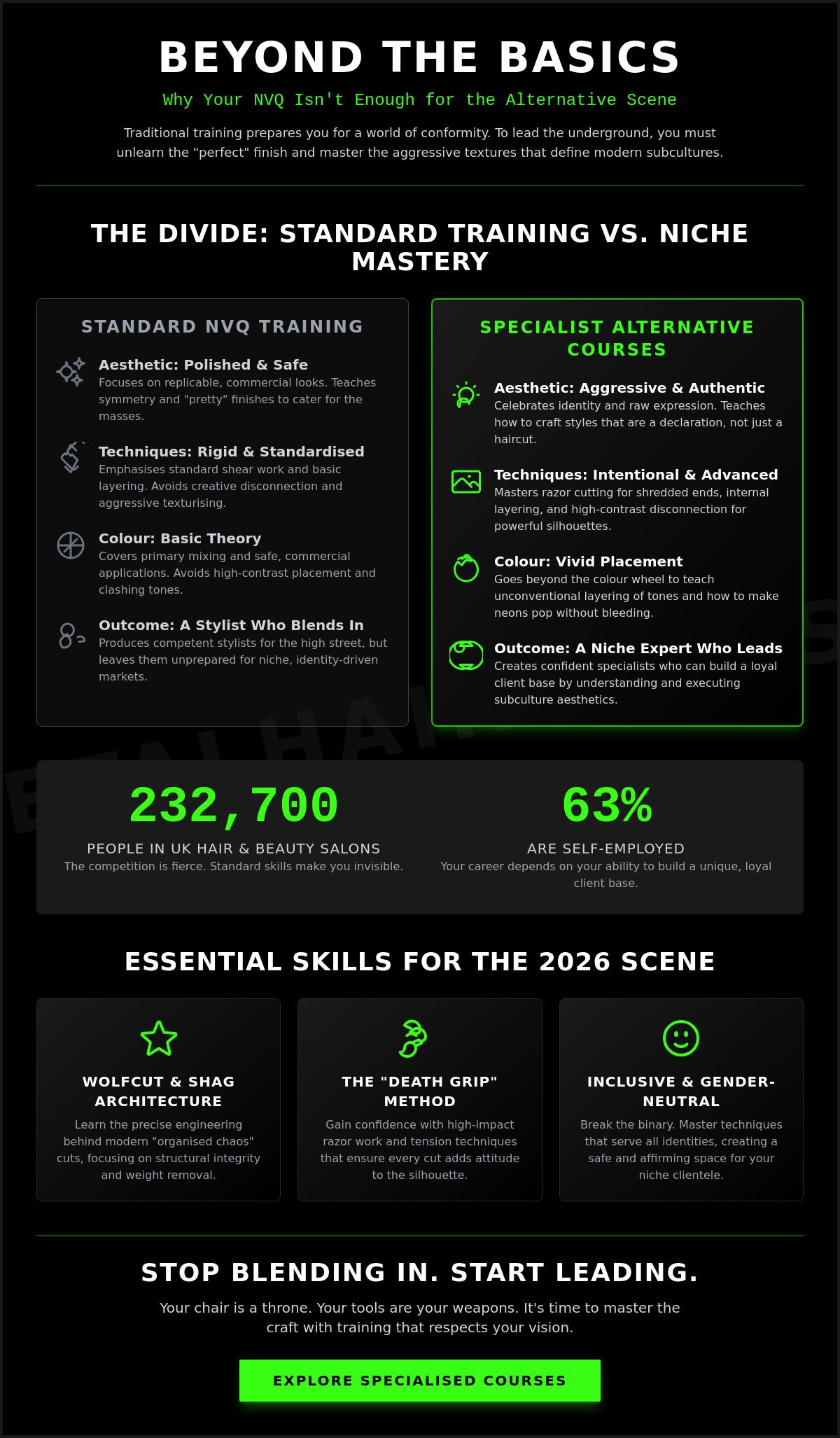
Traditional training is a factory line. It’s designed to produce stylists who can replicate a “safe” commercial aesthetic for the masses. In 2024, there were 232,700 people employed in UK hairdressing and beauty salons. With 63% of those being self-employed, the competition is fierce. If you’re just another stylist doing standard layers, you’re invisible. Mainstream education prioritises these polished looks because they’re easy to grade. They don’t want you taking risks with aggressive textures or vivid, clashing colours. They want symmetry. They want “pretty”.

But alternative hair isn’t about being pretty. It’s about being seen. Standardised modules often ignore the nuances of subculture-specific silhouettes. When you try to apply “one size fits all” layering to shags and mullets, the result is weak. It lacks the weight and the attitude that defines the style. There is a massive disconnect between the clinical etiquette taught in colleges and the gritty, raw reality of alternative spaces. Finding alternative hair courses UK stylists actually trust means looking beyond the high-street curriculum.

The Limitations of the Standard NVQ

An NVQ is a foundation, not a finish line. It teaches you the mechanics of how to cut hair without making a mess, but it stops there. You won’t find aggressive, textured layering or creative disconnection in a standard curriculum. To master the art of the underground, you have to unlearn the “perfect” finish. Raw, lived-in results require a different set of rules. Standard training focuses on the “how” but completely ignores the “why” behind subculture styles. You need to move past the basic short back and sides mentality to truly excel.

Bridging the Gap Between Skill and Subculture

You can’t separate the hair from the culture. Understanding the history of punk fashion, metal, and goth aesthetics is vital for any serious stylist. If you don’t understand the music or the movement, you’re just mimicking a trend without any soul. In the UK alternative scene, the stylist acts as a community gatekeeper. You aren’t just providing a service; you’re affirming an identity. The new SIC codes (9621) for hairdressing and barber activities finally give our industry government recognition, but they don’t teach you how to vibe with a niche crowd. Alternative hair courses UK should bridge this gap by blending technical precision with cultural authenticity.

A haircut becomes a declaration of identity when it’s rooted in the rebellion of the scene it serves.

What to Expect from Specialist Alternative Hair Courses in the UK

Specialist alternative hair courses UK are built for the rebels. They aren’t about learning to blow-dry a bouncy bob for a wedding. They’re about dismantling traditional rules to create something raw. You’ll dive deep into the architecture of the wolfcut and the modern shag. These aren’t just “messy” cuts. They require precise engineering to ensure the hair still has structural integrity even after extreme weight removal. Whilst standard UK hairdressing qualifications get you through the door, they rarely touch on the “organised chaos” required for subculture silhouettes.

You’ll also tackle advanced vivid colour theory. This goes way beyond basic primary mixing. You’ll learn how to layer clashing tones and create transitions that look intentional, not accidental. It’s about understanding how light hits jagged edges and using colour to amplify that texture. Expect to work with high-pigment palettes and unconventional placement techniques that mainstream tutors often find “too risky”. This is where you learn to make neon green pop against a soot-black base without the bleed.

Mastering Aggressive Texture and Layers

The toolkit in an alternative workshop looks different. You’ll swap standard shears for razors and thinning shears to create grit. We focus on the “Death Grip” approach to sectioning and tension. This is about how you hold and manipulate the hair to ensure every snip adds to the overall attitude of the silhouette. It’s a high-impact method that requires confidence. You’ll learn exactly where to take the weight out so the style doesn’t collapse. Working with a textured haircut specialist who understands aggressive alternative layers is the key to engineering maximum volume without the style falling flat. We cover:

  • Razor cutting for feathered, “shredded” ends
  • Internal layering to create height without bulk
  • Disconnection techniques for high-contrast shapes

Breaking the Binary: Gender-Neutral Education

Alternative spaces have always been a sanctuary for those outside the norm. Your training must reflect that. Specialist alternative hair courses UK lead the way in gender-inclusive styling. This starts with the consultation. We teach you to remove gendered language from your vocabulary entirely. You aren’t cutting “men’s” or “women’s” hair; you’re cutting for an individual’s identity. It’s about technical skill meeting radical empathy. You’ll learn to adapt classic subculture shapes to suit any face structure, regardless of assigned gender.

Beyond the chair, these courses prepare you for the reality of the scene. Think music-inspired textures and festival-ready stage hair for musicians that can survive a mosh pit. You’ll get hands-on experience with alternative-specific products that mainstream salons don’t even stock. If you’re ready to stop following the crowd, it’s time to explore specialised hair courses that actually speak your language.

Alternative Hair Courses UK: Master the Art of Subculture Styling in 2026

Comparing NVQ Standards with Creative Subculture Workshops

NVQs are the baseline. They provide the fundamental mechanics required to hold a pair of shears without causing a disaster. If you look at the UK’s official hairdressing qualifications, the focus is heavily on safety, hygiene, and standard commercial results. This is essential, but it isn’t enough. While an NVQ gives you the foundation, boutique workshops provide the edge and personality that actually get you booked by the clients you want. There is a massive difference between “Creative” in a mainstream college and “Creative” in an alternative studio.

In a traditional setting, creative hair usually means a slightly more adventurous version of a salon-friendly bob. It’s safe. It’s marketable to the average high-street customer. In the underground scene, alternative hair courses UK professionals lead are far more radical. We’re talking about total identity shifts, not just trims. We prioritise the aggressive, the asymmetrical, and the unapologetic. Accreditation matters for insurance, but authentic experience is what builds a cult following. Clients don’t ask to see your diploma; they look at your portfolio to see if you understand their world.

Accreditation and Career Progression

Choosing private, boutique training doesn’t mean you’re sacrificing professional growth. Many advanced alternative hair courses UK offer CPD (Continuing Professional Development) points that count towards your career milestones. A “name-brand” certificate from a respected alternative specialist carries significant weight in the community. It signals that you’ve moved beyond the basics. This level of specialised training justifies higher service prices in your own space. When you master niche techniques like “Hair To the Throne”, you aren’t just a hairdresser. You’re a specialist in a high-demand, low-supply market.

The Mentorship Factor

Learning from a working “Metal Barber” or a seasoned festival stylist is a total game-changer. These mentors live the lifestyle they teach. They understand the nuances of how hair needs to perform in a mosh pit or under stage lights. This isn’t corporate coaching with a script. Mentorship in the alt-scene is a raw, unfiltered exchange of knowledge between people who value rebellion over conformity. It’s about networking with like-minded rebels who will become your peers, not just your classmates. Corporate coaching focuses on profit margins; alternative mentorship focuses on the power of self-expression and the grit of the craft.

How to Choose the Right Advanced Styling Programme for Your Career

Don’t get blinded by a flashy website or a highly sought-after postcode. Choosing the right alternative hair courses UK stylists can actually bank on requires a deep audit of the person behind the chair. Look at the tutor’s actual portfolio. If their social media is a sea of “safe” honey-blonde balayage, they aren’t the ones to teach you a jagged mullet or a soot-black wolfcut. You need someone who lives the aesthetic they teach. Check for “live” experience. Have they worked backstage at Download Festival? Have they styled prominent artists in the underground scene? This real-world grit is what separates a true mentor from a corporate instructor.

Vivid colour application is another critical factor. Most basic courses teach you how to mix a primary red, but they ignore the science of longevity and clashing. A high-tier programme should cover maintenance as much as application. Inclusivity isn’t just a buzzword in our world; it’s the foundation. Ensure the training environment is a verified safe space where identity-affirming language is the standard, not an afterthought. Post-course support is also vital. You want access to a community of like-minded rebels who can support your growth long after the session ends.

Analysing the Curriculum

A solid curriculum must address the shag haircut resurrection and its many modern variants. It’s the backbone of the current UK alternative scene. Ensure there is a specific focus on the “Wolfcut” and how to adapt it for different hair textures. If you want to go deeper on the mechanics of aggressive disconnection and weight removal that define this style, our dedicated wolfcut hair course covers the full technical workflow from consultation to finish. Demand practical, hands-on time with live models. Mannequins don’t have personalities, cowlicks, or the ability to tell you how they feel. You need to feel the hair move and react to your tools to truly master the craft. Understanding how a textured haircut specialist engineers aggressive alternative layers will transform how you approach every consultation and cut.

Location and Logistics

Travelling for your craft is a rite of passage. If the best alternative hair courses UK has to offer are three train rides away, book the ticket. You should also consider the duration of the training. Some stylists prefer an intensive one-day blast to sharpen a specific skill, whilst others benefit from long-term modular learning. Don’t forget to factor in the cost of professional kits and the specialised alternative products you’ll need to achieve that raw, lived-in finish. Logistics might seem boring, but they’re the bridge between your current skill level and your future career.

Ready to stop following the rules and start making your own? Check out our specialist hair courses and find your edge.

Master the Craft with Heavy Metal Hairdresser’s Specialised Training

Stop settling for mediocre education that tries to sand down your edges. At Heavy Metal Hairdresser, we don’t do “safe”. Our alternative hair courses UK are designed for the rebels who want to dominate the niche market. Simon Tuckwell has spent years perfecting methodologies that mainstream academies simply can’t replicate. With “Hair To the Throne” and “Death Grip”, you aren’t just learning to cut; you’re learning a technical system for high-impact, aggressive silhouettes. These aren’t just buzzwords. They are the tools you need to build a cult following in your own salon.

Our training is built on a foundation of inclusivity and subculture pride. We’ve created a space where being different is the point. You’ll learn the secrets of styling for the people who actually move the needle: bands, festival performers, and high-profile artists. While other tutors are obsessed with red-carpet polish, we teach you how to create stage hair for musicians that survives a mosh pit and still looks iconic under stage lights. Joining the Heavy Metal Hairdresser alumni means stepping into a community of like-minded experts who value raw authenticity over corporate scripts.

The Wolfcut and Shag Masterclass

Our signature textured cutting techniques have gained international acclaim for a reason. They work. In this masterclass, we dive deep into the mechanics of the shag and the wolfcut. You’ll learn how to inject chaos into fine, limp hair to give it life. You’ll also master how to manage the bulk of thick, heavy manes without losing the intended shape. The consultation is where the magic happens. We teach you how to speak the language of alternative clients, ensuring they feel seen and affirmed before you even pick up your shears. It’s about technical precision meeting radical empathy. If you’re ready to go all-in on this signature style, our professional wolfcut hair course gives you the full system for mastering aggressive texture and alternative flow.

Vivid Colour and Beyond

Saturate your identity with our expert vivid colour application training. We go beyond the surface to teach you the actual chemistry of the fade. You’ll learn how to keep your clients’ colours sharp and vibrant between visits, turning them into walking advertisements for your skills. This isn’t just about slapping on some dye. It’s about strategic placement that complements the aggressive textures of an alternative cut. It’s time to stop playing it safe and start making a statement. Level up your skills and book your place on our next course to transform your career and your salon presence.

Own Your Creative Rebellion

You’ve seen how traditional training fails to capture the raw energy of the subculture scene. Mastering the architecture of a wolfcut or the grit of a shag isn’t just about technique; it’s about understanding the identity behind the hair. By choosing specialised alternative hair courses UK, you move beyond “safe” commercial standards and start building a niche career that actually resonates with your values. It’s about technical precision meeting the unfiltered spirit of the underground.

Founder Simon Tuckwell is an internationally acclaimed creative stylist who has brought his expertise to the biggest stages at Download and Bloodstock festivals. Our training is safe-space certified and gender-inclusive, ensuring every stylist feels empowered to express their craft without judgment. This isn’t just a class; it’s an initiation into a community of rebels who refuse to blend in. It’s time to stop mimicking the mainstream and start leading the movement.

Join the revolution and browse our upcoming alternative hair courses

The chair is yours. Make it count.

Frequently Asked Questions

Are alternative hair courses in the UK accredited?

Many specialist alternative hair courses UK offer private certification or CPD (Continuing Professional Development) points rather than traditional NVQ accreditation. While government-regulated diplomas provide a solid baseline, private workshops focus on niche, rebellious techniques that aren’t covered in the standard curriculum. It is always wise to check if the course is recognised by your insurance provider to ensure you are covered for the advanced textures and razor work you’ll be learning.

Do I need a Level 2 NVQ before taking an alternative hair course?

Most advanced workshops require a Level 2 NVQ or equivalent salon experience because they assume you already understand the fundamentals of hair mechanics. However, some entry-level alternative hair courses UK are designed specifically for apprentices or those just starting their journey in the underground scene. If you don’t have a formal qualification, your current skill level or a strong portfolio might still secure you a spot.

What is the difference between a wolfcut and a shag haircut?

A wolfcut is an aggressive, high-contrast hybrid of a shag and a mullet. It features shorter, choppier layers around the crown and face to create maximum volume and a “feral” silhouette. A shag haircut is usually softer and more blended, drawing inspiration from the 70s with feathered layers that frame the face without the extreme disconnection found in a true wolfcut.

Can I learn vivid hair colour techniques online or is face-to-face better?

Face-to-face training is almost always superior for mastering alternative styles. You can’t learn the specific tension of the “Death Grip” or the exact angle of a razor through a screen. Being in the room allows a mentor to correct your hand positioning in real-time, which is vital when you’re working with aggressive layering and complex, multi-tonal vivid colour placements.

Are these courses suitable for barbers as well as hairdressers?

These workshops are perfect for anyone who wants to break away from traditional binary styling. Alternative subcultures don’t care about the label on your shop door. Whether you’re a barber wanting to master longer, textured silhouettes or a hairdresser looking to add more grit to your work, these courses provide the technical skills to serve a diverse, non-conformist clientele.

How much do professional alternative hair courses usually cost in the UK?

Professional training costs vary depending on the depth and duration of the programme. A one-day masterclass often sits between £150 and £350, whilst comprehensive multi-day creative certificates can reach £800 or more. Always check if the fee includes VAT and if you’ll need to provide your own models or if mannequin heads are included in the price.

Will I learn how to style hair for music festivals and bands?

Yes, styling for the scene is a core part of the alternative curriculum. You’ll learn how to create textures that hold up under stage lights and survive the heat of a music festival mosh pit. Mentors with real-world experience at events like Download or Bloodstock will show you how to achieve high-impact looks that are as durable as they are rebellious.

What tools do I need to bring to an alternative hair workshop?

You’ll usually need to bring your own professional kit, including sharp cutting shears, thinning shears, and a high-quality razor. Don’t forget plenty of sectioning clips and a variety of combs. Some workshops might provide specialised styling products or mannequin heads, but it’s always best to check the specific requirements of your chosen course before you arrive.