Posted on

Alternative Hair Courses UK: Master Subcultural Styling and Textured Grit in 2026

Alternative Hair Courses UK: Master Subcultural Styling and Textured Grit in 2026

Your standard NVQ training wasn’t built for the front row of a metal festival or the gritty streets of Camden. You know the feeling; you’re stuck cutting safe, “polite” bobs whilst your soul is screaming for more texture, more grit, and more rebellion. Traditional education often ignores the aggressive, gender-neutral styles that define modern subcultures, leaving you guessing when a client asks for a jagged wolfcut or a mullet that actually has some bite.

It’s time to stop playing it safe and start mastering the craft. Our alternative hair courses UK are designed to tear up the rulebook, giving you the technical mastery to execute complex layers and vivid colour applications with absolute confidence. We’ll show you how to harness professional techniques like “Death Grip” and “Hair To the Throne” to create the textured grit your clients crave. We are exploring the essential training you need in 2026 to build a portfolio that attracts a loyal, niche clientele and turns your chair into a destination for the underground.

Key Takeaways

  • Understand why traditional NVQ frameworks often fail to meet the demands of modern subcultures and how alternative hair courses UK provide the technical grit required for 2026.
  • Master the technical breakdown of the modern shag and wolfcut to execute aggressive, high-texture layers with absolute precision.
  • Gain the confidence to apply vivid colours using unconventional placement and pigment theory designed for maximum saturation and longevity.
  • Learn how to evaluate an educator’s real-world credentials, ensuring they have the festival and backstage experience required to teach authentic styling.
  • Explore the “Death Grip” and “Hair To the Throne” methodologies to elevate your craft and attract a dedicated, niche clientele.

The Shift in Professional Hair Education: Why Alternative Hair Courses UK Matter

Alternative hair courses are specialised training for subcultural styles like mullets and shags. For too long, the UK hair industry has relied on a rigid framework that prioritises safety over soul. Traditional NVQ training focuses on the “perfect” blend and the “tidy” finish. It’s built for the mainstream high street. But as we move through 2026, the demand for something raw and authentic has exploded. Real technical mastery now requires an understanding of subcultural aesthetics that standard colleges simply don’t touch.

Choosing alternative hair courses UK means learning to break the rules with precision. It isn’t just about “messy” hair; it’s about the deliberate, aggressive layering that defines Punk fashion and its modern descendants. This is the era of the niche specialist. Clients no longer want a stylist who “can do a bit of everything.” They want an expert who understands the weight, the grit, and the lifestyle behind the look. The rise of the niche specialist in the UK hair industry for 2026 isn’t a trend; it’s a shift in power. Stylists are no longer beholden to the “one size fits all” salon model. By focusing on a specific aesthetic, you become a destination.

Moving Beyond the Mainstream Salon Standard

The “safe” approach taught in most academies limits your creative potential. It creates a massive gap between what you’re taught in a classroom and the reality of subcultural styling. Whilst a standard salon might shy away from disconnected sections or extreme texture, these are the hallmarks of a great alternative cut. Beyond the technical, there’s a cultural gap. Traditional training environments can often feel exclusionary or outdated in their approach to gender. Alternative hair education flips this. It prioritises inclusive, gender-neutral training spaces where every identity is celebrated. It’s about the individual, not the box they’re supposed to fit into.

The Economic Value of Specialising in Alt-Hair

Specialising isn’t just a creative choice; it’s a smart business move. People will travel across the country for a stylist who genuinely “gets” their look. This level of dedication is what builds a sustainable, high-income career in an industry that is otherwise becoming increasingly commoditised.

  • Premium Rates: Niche skills are rare. When you master techniques like “Death Grip” or “Hair To the Throne”, you can charge for that unique expertise.
  • Loyal Clientele: Subcultural clients are fiercely loyal. If you’re the only one who can get their mullet right, they won’t go anywhere else.
  • Demographic Target: You’ll attract the festival-goers and music lovers who populate Download and Bloodstock. These are a community that invests heavily in their identity.

In 2026, the most successful stylists are those who have stepped outside the mainstream to own a specific scene with confidence.

Mastering the Holy Trinity: Shags, Mullets, and Wolfcuts

Mainstream hair is obsessed with symmetry. Subcultural hair is obsessed with energy. When you look at professional alternative hair courses UK, the focus is always on the shapes that define the scene. These cuts are the visual language of British subculture; they have evolved from the rebellion of the 70s into the high-octane grit of 2026. Mastering the modern shag, the mullet, and the wolfcut requires more than just a pair of scissors. It requires a complete shift in how you perceive weight distribution.

Traditional education teaches you to remove weight to make hair lie flat and behave. In the alternative world, we redistribute weight to create lift, jagged movement, and “grit.” The modern shag relies on aggressive layering and a heavy, face-framing fringe that refuses to be “polite.” The mullet has undergone a massive evolution, shedding its 80s disaster reputation to become a subcultural staple that plays with extreme length contrasts. Then there is the wolfcut. It blends the best of both worlds, using the shag’s texture and the mullet’s silhouette to achieve maximum volume. For a deep dive into the specific sectioning required for this look, check out The Ultimate Wolf Hair Cut Guide.

The Mechanics of Aggressive Layering

Movement isn’t found in the blend; it’s found in the disconnect. To create authentic grit, you must use unconventional angles that challenge the scalp’s natural flow. It’s about injecting chaos into the silhouette whilst maintaining the underlying structure. This prevents the hair from looking “messy” and instead makes it look intentional and sharp. If you want to push your technical boundaries, exploring our hair courses is the best way to get hands-on with these jagged techniques.

Tools for the Alternative Stylist

Your toolkit needs an upgrade if you’re chasing subcultural perfection. Standard thinning shears are often the enemy here; they can ruin an alternative aesthetic by creating a “fuzzy” finish rather than a defined, chunky texture. Razor cutting is essential for achieving that “lived-in” feel that looks like the client just stepped off a tour bus. We also utilise specialised finishing techniques like “Death Grip” to ensure the texture stays aggressive long after the client leaves the chair. This isn’t about soft finishes. It’s about technical mastery that stands up to the mosh pit.

Alternative Hair Courses UK: Master Subcultural Styling and Textured Grit in 2026

Creative Colour and Texture: Saturating the Identity

Saturation is everything. In the world of subcultural styling, colour isn’t a subtle accent; it’s the core of the identity. Mastering vivid shades requires a deep understanding of pigment theory and how different tones interact with the aggressive layering of a wolfcut or a shag. Our alternative hair courses UK dive straight into the technical side of high-impact colour, moving far beyond the standard foil work taught in traditional academies. It’s about achieving that deep, opaque saturation that stays vibrant even under stage lights. For a complete breakdown of the science behind these high-pigment sensations, explore our Vivid Hair Colour Guide.

Unconventional placement is where the magic happens. We don’t follow the “rules” of placement because alternative cuts don’t follow the “rules” of shape. We place pigment to highlight the jagged edges of a mullet or to add depth to the disconnected sections of a shag. It’s a technical dialogue between the cut and the colour. During consultations, we don’t just ask what colour a client wants. We find their unique pigment identity. This means understanding their lifestyle, their subculture, and how much “fade” they are willing to manage. It’s a bespoke approach for a bespoke clientele.

Vivid Pigment Mastery

You can’t get high-pigment results on compromised hair. We focus on bleaching techniques that push the boundaries whilst maintaining the structural integrity of the hair fibre. Organising your colour palette is just as vital. You need to know which tones will bleed harmoniously and which will turn to mud. We also teach you how to educate your clients on maintenance. “Stop the fade” isn’t just a catchy phrase; it’s a technical requirement for anyone living their life in the mosh pit. High-street products won’t cut it here; we focus on the professional-grade tools that keep the grit alive.

Styling for the Mosh Pit

Alternative hair needs to survive more than just a walk to the office. It needs to withstand festivals, stage performances, and twelve hours in a crowd. We use specialised methodologies like “Hair To the Throne” to build extreme volume that doesn’t collapse. This isn’t about hairspray that makes the hair feel like plastic. It’s about structural hold that maintains movement. For defining those textured layers, we rely on “Death Grip”. This technique ensures every jagged edge is visible and every layer has the grit it needs to stand out. It’s styling for the real world, grounded in our experience at festivals like Download and Bloodstock.

How to Choose the Best Alternative Hair Course in the UK

Most colleges are still teaching the same “safe” bobs they were in 1995. If you’re hunting for alternative hair courses UK, you’ve got to look beyond the local technical college. You need an educator who has actually spent time backstage at a festival, not just in a classroom. In 2026, the gap between entry-level college routes and professional subcultural mastery is wider than ever. Choosing the right course means finding someone who doesn’t just know the theory but lives the lifestyle. You need technical mastery that has been tested in the real world, from the humidity of a festival stage to the high-pressure environment of a band photoshoot.

Authenticity is your best filter. Look for courses that offer hands-on practical workshops rather than just “look and learn” sessions. You can’t feel the tension of a razor or the grip of a textured cut through a screen. It’s also vital to ensure the training environment is inclusive and celebrates subcultural identity. Alternative hair is deeply rooted in self-expression and gender-neutrality. If a course feels too clinical or “corporate,” it’s likely too sanitised for the aggressive, textured grit you’re trying to master. A true alternative course should cover both the technicality of the cut and the creative chaos of the styling.

Credentials That Matter

“Industry standard” is often just another way of saying “boring.” For alternative education, you want to see credentials that include real-world experience at events like Download or Bloodstock. Learning from stylists who live the subculture ensures you aren’t getting a watered-down version of a mullet or a shag. Avoid “sanitised” training that tries to fit alternative aesthetics into a mainstream box. You want the raw, unfiltered techniques that actually resonate with your niche clientele. This is about technical proficiency, not just following a trend.

Practical Logistics for UK Stylists

Time is a commodity. Many stylists prefer one-day intensives that allow them to master a specific technique and get back to the chair. However, multi-session masterclasses offer a deeper dive into pigment theory and complex weight distribution. When you sign up, check the kit requirements. An alternative hair course often requires specific tools like high-quality razors or specialised texturising shears that aren’t found in a standard kit. Beyond the tools, the networking value is massive. Connecting with fellow alternative stylists across the UK builds a community that supports your growth long after the course ends. If you’re ready to escape the mainstream and upskill with the best, check out our upcoming hair courses to find your next masterclass.

Elevate Your Craft with Heavy Metal Hairdresser Education

Simon Tuckwell didn’t build this brand in a corporate boardroom. He built it in the mud, the mosh pits, and the backstage areas of the UK’s biggest festivals. Heavy Metal Hairdresser is the antidote to the clinical, safe education that has been holding you back. When you look for alternative hair courses UK, you’re looking for an ethos that matches your own rebellious spirit. We don’t just teach you how to cut; we teach you how to master the craft of identity. This is about technical proficiency meeting subcultural pride.

Mastering our specific methodologies means adding serious weapons to your technical arsenal. We’ve developed “Hair To the Throne” and “Death Grip” to solve the problems traditional training ignores. “Hair To the Throne” is our blueprint for extreme, structural volume that refuses to collapse. “Death Grip” is the technique that defines textured layers with aggressive grit. These aren’t just names; they’re battle-tested systems used by the crew that styles the pit at Download and Bloodstock. You’re learning from stylists who understand what hair needs to endure when the adrenaline is high and the lights are bright.

Joining us means joining a community of like-minded, rebellious experts. It’s a space where being different is celebrated and where technical skill is used to empower others. We provide a gender-inclusive, safe environment where you can push your creative boundaries without judgment. You’ll leave with more than just a certificate; you’ll leave with a new perspective on what it means to be a specialist in the alternative scene.

From Backstage to the Chair

The beauty of festival-tested techniques is their reliability. If a style can survive a weekend at Bloodstock, it can survive anything your client throws at it. We show you how to apply these high-performance methods to your daily salon work, ensuring your clients leave with a look that lasts. For a deeper look at how we handle extreme conditions, check out our Festival Hair Backstage Case Study. It’s about empowering your clients through bold, expressive identity that stands up to their lifestyle.

Book Your Masterclass

We are currently booking for our 2026 masterclasses. These sessions are designed for stylists who are ready to escape the mainstream and own their niche. Availability is limited to ensure every stylist gets the hands-on technical guidance they need to succeed. To secure your spot in a professional alternative hair course, you need to act quickly as these sessions often fill up months in advance. Don’t let another year go by cutting “safe” styles that don’t inspire you. Master the art of alternative hair—enquire now.

Own the Alternative Revolution in 2026

The mainstream high street is satisfied with “safe.” You aren’t. Mastering subcultural aesthetics means moving beyond basic blends and embracing the technical grit that defines 2026. From the aggressive layering of a wolfcut to the high-pigment saturation of vivid colours, your path to becoming a niche specialist starts with unlearning the rules of the traditional salon. We’ve spent years redefining the UK alternative scene, bringing the same energy to our education that we bring when styling for Download and Bloodstock festivals.

Our alternative hair courses UK provide the exact technical arsenal you need to dominate this scene. By mastering methodologies like “Death Grip” and “Hair To the Throne”, you aren’t just cutting hair; you’re building a brand that attracts the most loyal, expressive clientele in the industry. The underground isn’t waiting for permission. It’s time to elevate your craft and join a community that celebrates identity without compromise.

Join the Revolution: Book Your Alternative Hair Course

Stop playing it safe. Start making your mark on the pit. Your future as a rebellious expert starts now.

Frequently Asked Questions

What exactly is an alternative hair course and who is it for?

Alternative hair education is specialised training focusing on subcultural aesthetics like shags, mullets, and wolfcuts. It is built for stylists who are bored of mainstream “safe” styling and want to master technical grit. If you are a rebellious expert ready to own a niche and attract a dedicated, music-loving clientele, these sessions are designed for you.

Do I need to be a qualified hairdresser to take an alternative hair course in the UK?

Yes, these are advanced upskilling sessions rather than entry-level programmes. Most alternative hair courses UK require a Level 2 or 3 qualification because they build on foundational cutting and colouring skills. we skip the basics and dive straight into the aggressive layering, technical disconnects, and razor work that define the modern alternative scene.

What specific techniques are covered in a wolfcut hair course?

You will master extreme weight redistribution and face-framing fringe work. We cover the technical disconnects between the shag-inspired top and the mullet-style length. You will learn to use razors and texturising shears to create that jagged, “lived-in” silhouette that maintains its volume. We focus on creating shapes that don’t collapse after one wash.

Are these courses accredited or recognised within the UK hair industry?

The UK industry is largely self-regulated, but our training is recognised for its technical excellence and real-world relevance. While not a standard NVQ, which often avoids “risky” subcultural cuts, our courses are led by veterans with experience at Download and Bloodstock. They are designed to build a professional portfolio that attracts high-value, niche clients.

How much do professional alternative hair training courses usually cost?

Investment levels vary across the UK depending on the duration and the educator’s level of expertise. You will find everything from one-day intensives to multi-session masterclasses. We recommend checking specific course pages for current availability and booking details, as rates reflect the specialised nature of the technical skills and subcultural knowledge being taught.

Will I learn how to use vivid hair colours in these courses?

Creative colour is a massive part of the alternative identity. We cover pigment theory, saturation techniques, and unconventional placement that complements textured cuts. You will learn how to achieve high-impact results that survive the mosh pit without compromising the structural integrity of the hair fibre. It is about making the colour and cut speak the same language.

What kit do I need to bring to a textured styling masterclass?

Bring your professional cutting kit, including high-quality razors and texturising shears. Standard thinning shears often aren’t enough for the chunky, aggressive grit we create. We provide the specialised styling products like “Death Grip” and “Hair To the Throne” during the session to help you master the art of extreme volume and structural hold.

Is there a focus on gender-inclusive and safe space styling?

Inclusivity is a non-negotiable part of our ethos. These alternative hair courses UK are designed to be gender-neutral, focusing on the individual’s identity rather than traditional binary styles. We provide a safe, supportive environment where every stylist is encouraged to push their creative boundaries. It is about celebrating difference and empowering your clients through authentic self-expression.
Posted on

Alternative Hair Courses UK: Master the Art of Subculture Styling in 2026

Alternative Hair Courses UK: Master the Art of Subculture Styling in 2026

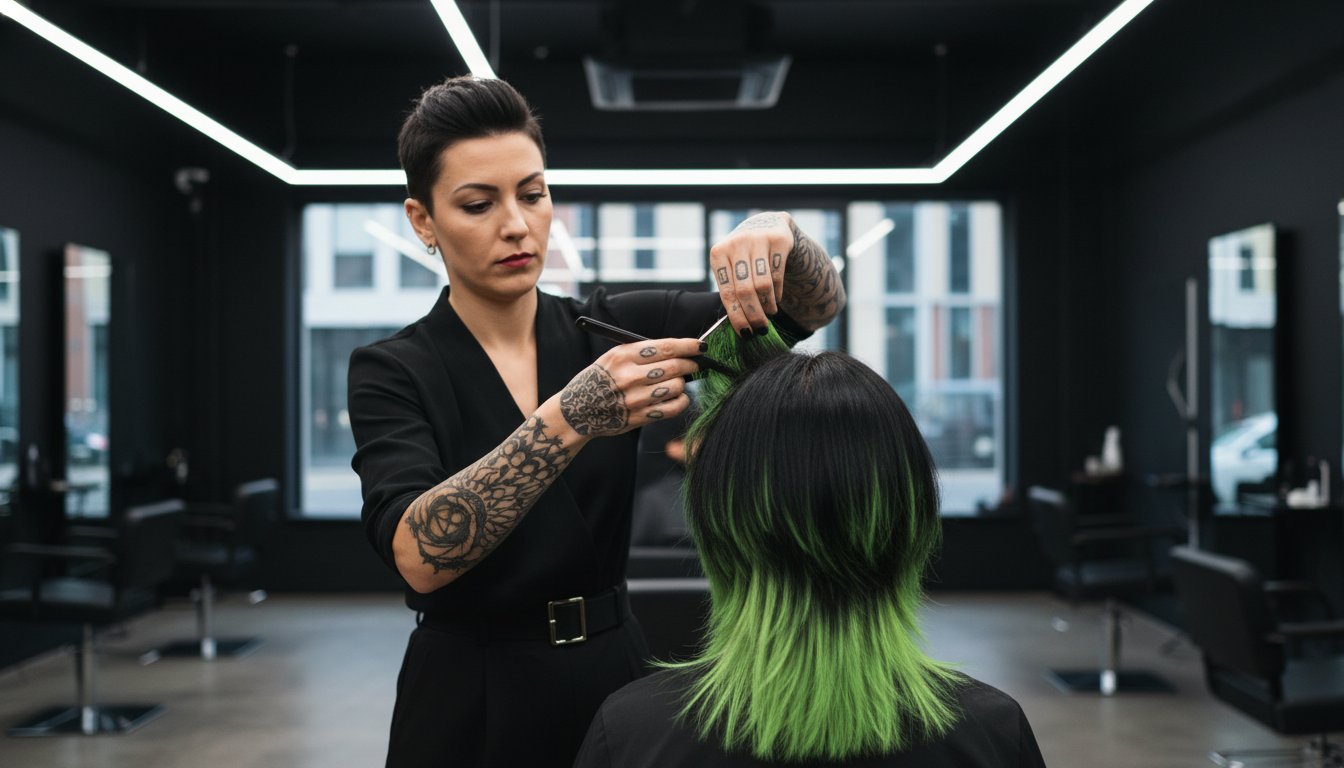
Most traditional hair academies are preparing you for a world that doesn’t exist anymore; or at least, one you don’t want to live in. You’ve sat through the clinical demos and the “safe” bridal styles, but they don’t teach you how to handle a razor with intent or how to make a neon green pop against a jagged fringe. If you’re looking for alternative hair courses UK professionals actually respect, you’ve probably realised that mainstream tutors often miss the mark on subculture aesthetics. They see a mess where you see a masterpiece.

It’s frustrating when your creative energy is stifled by rigid rules and polished finishes. You want to craft identities, not just haircuts. In this guide, you’ll discover how to transcend basic training and master the aggressive textures and inclusive techniques that define the modern UK scene. We’ll explore the essential skills for 2026, from perfecting the wolfcut and shag to building a niche client base that values your raw, authentic expertise. It’s time to stop blending in and start leading the underground.

Key Takeaways

  • Learn why mainstream NVQs often leave you unprepared for the aggressive textures and rebellious styles demanded by the UK scene.
  • Master the architecture of wolfcuts and shags through specialised alternative hair courses UK that prioritise identity over conformity.
  • Gain confidence in advanced vivid colour placement and inclusive techniques that go beyond basic primary mixing.
  • Discover how to audit a tutor’s portfolio to ensure they actually live the subculture aesthetic they claim to teach.
  • Explore the “Death Grip” and “Hair To the Throne” methodologies designed to help you build a loyal, niche client base.

Why Traditional Hairdressing Training Often Misses the Mark

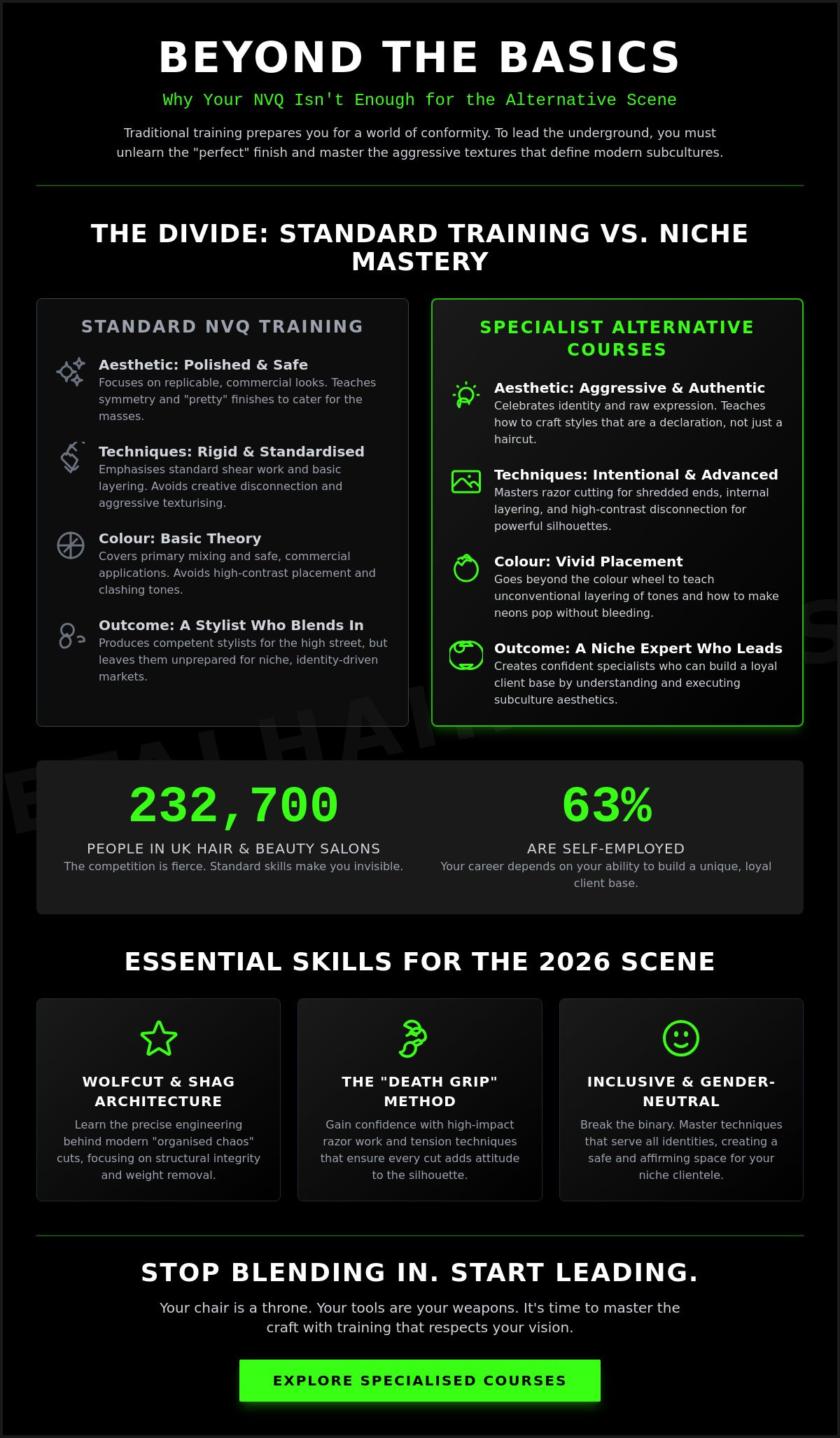
Traditional training is a factory line. It’s designed to produce stylists who can replicate a “safe” commercial aesthetic for the masses. In 2024, there were 232,700 people employed in UK hairdressing and beauty salons. With 63% of those being self-employed, the competition is fierce. If you’re just another stylist doing standard layers, you’re invisible. Mainstream education prioritises these polished looks because they’re easy to grade. They don’t want you taking risks with aggressive textures or vivid, clashing colours. They want symmetry. They want “pretty”.

But alternative hair isn’t about being pretty. It’s about being seen. Standardised modules often ignore the nuances of subculture-specific silhouettes. When you try to apply “one size fits all” layering to shags and mullets, the result is weak. It lacks the weight and the attitude that defines the style. There is a massive disconnect between the clinical etiquette taught in colleges and the gritty, raw reality of alternative spaces. Finding alternative hair courses UK stylists actually trust means looking beyond the high-street curriculum.

The Limitations of the Standard NVQ

An NVQ is a foundation, not a finish line. It teaches you the mechanics of how to cut hair without making a mess, but it stops there. You won’t find aggressive, textured layering or creative disconnection in a standard curriculum. To master the art of the underground, you have to unlearn the “perfect” finish. Raw, lived-in results require a different set of rules. Standard training focuses on the “how” but completely ignores the “why” behind subculture styles. You need to move past the basic short back and sides mentality to truly excel.

Bridging the Gap Between Skill and Subculture

You can’t separate the hair from the culture. Understanding the history of punk fashion, metal, and goth aesthetics is vital for any serious stylist. If you don’t understand the music or the movement, you’re just mimicking a trend without any soul. In the UK alternative scene, the stylist acts as a community gatekeeper. You aren’t just providing a service; you’re affirming an identity. The new SIC codes (9621) for hairdressing and barber activities finally give our industry government recognition, but they don’t teach you how to vibe with a niche crowd. Alternative hair courses UK should bridge this gap by blending technical precision with cultural authenticity.

A haircut becomes a declaration of identity when it’s rooted in the rebellion of the scene it serves.

What to Expect from Specialist Alternative Hair Courses in the UK

Specialist alternative hair courses UK are built for the rebels. They aren’t about learning to blow-dry a bouncy bob for a wedding. They’re about dismantling traditional rules to create something raw. You’ll dive deep into the architecture of the wolfcut and the modern shag. These aren’t just “messy” cuts. They require precise engineering to ensure the hair still has structural integrity even after extreme weight removal. Whilst standard UK hairdressing qualifications get you through the door, they rarely touch on the “organised chaos” required for subculture silhouettes.

You’ll also tackle advanced vivid colour theory. This goes way beyond basic primary mixing. You’ll learn how to layer clashing tones and create transitions that look intentional, not accidental. It’s about understanding how light hits jagged edges and using colour to amplify that texture. Expect to work with high-pigment palettes and unconventional placement techniques that mainstream tutors often find “too risky”. This is where you learn to make neon green pop against a soot-black base without the bleed.

Mastering Aggressive Texture and Layers

The toolkit in an alternative workshop looks different. You’ll swap standard shears for razors and thinning shears to create grit. We focus on the “Death Grip” approach to sectioning and tension. This is about how you hold and manipulate the hair to ensure every snip adds to the overall attitude of the silhouette. It’s a high-impact method that requires confidence. You’ll learn exactly where to take the weight out so the style doesn’t collapse. Working with a textured haircut specialist who understands aggressive alternative layers is the key to engineering maximum volume without the style falling flat. We cover:

  • Razor cutting for feathered, “shredded” ends
  • Internal layering to create height without bulk
  • Disconnection techniques for high-contrast shapes

Breaking the Binary: Gender-Neutral Education

Alternative spaces have always been a sanctuary for those outside the norm. Your training must reflect that. Specialist alternative hair courses UK lead the way in gender-inclusive styling. This starts with the consultation. We teach you to remove gendered language from your vocabulary entirely. You aren’t cutting “men’s” or “women’s” hair; you’re cutting for an individual’s identity. It’s about technical skill meeting radical empathy. You’ll learn to adapt classic subculture shapes to suit any face structure, regardless of assigned gender.

Beyond the chair, these courses prepare you for the reality of the scene. Think music-inspired textures and festival-ready stage hair for musicians that can survive a mosh pit. You’ll get hands-on experience with alternative-specific products that mainstream salons don’t even stock. If you’re ready to stop following the crowd, it’s time to explore specialised hair courses that actually speak your language.

Alternative Hair Courses UK: Master the Art of Subculture Styling in 2026

Comparing NVQ Standards with Creative Subculture Workshops

NVQs are the baseline. They provide the fundamental mechanics required to hold a pair of shears without causing a disaster. If you look at the UK’s official hairdressing qualifications, the focus is heavily on safety, hygiene, and standard commercial results. This is essential, but it isn’t enough. While an NVQ gives you the foundation, boutique workshops provide the edge and personality that actually get you booked by the clients you want. There is a massive difference between “Creative” in a mainstream college and “Creative” in an alternative studio.

In a traditional setting, creative hair usually means a slightly more adventurous version of a salon-friendly bob. It’s safe. It’s marketable to the average high-street customer. In the underground scene, alternative hair courses UK professionals lead are far more radical. We’re talking about total identity shifts, not just trims. We prioritise the aggressive, the asymmetrical, and the unapologetic. Accreditation matters for insurance, but authentic experience is what builds a cult following. Clients don’t ask to see your diploma; they look at your portfolio to see if you understand their world.

Accreditation and Career Progression

Choosing private, boutique training doesn’t mean you’re sacrificing professional growth. Many advanced alternative hair courses UK offer CPD (Continuing Professional Development) points that count towards your career milestones. A “name-brand” certificate from a respected alternative specialist carries significant weight in the community. It signals that you’ve moved beyond the basics. This level of specialised training justifies higher service prices in your own space. When you master niche techniques like “Hair To the Throne”, you aren’t just a hairdresser. You’re a specialist in a high-demand, low-supply market.

The Mentorship Factor

Learning from a working “Metal Barber” or a seasoned festival stylist is a total game-changer. These mentors live the lifestyle they teach. They understand the nuances of how hair needs to perform in a mosh pit or under stage lights. This isn’t corporate coaching with a script. Mentorship in the alt-scene is a raw, unfiltered exchange of knowledge between people who value rebellion over conformity. It’s about networking with like-minded rebels who will become your peers, not just your classmates. Corporate coaching focuses on profit margins; alternative mentorship focuses on the power of self-expression and the grit of the craft.

How to Choose the Right Advanced Styling Programme for Your Career

Don’t get blinded by a flashy website or a highly sought-after postcode. Choosing the right alternative hair courses UK stylists can actually bank on requires a deep audit of the person behind the chair. Look at the tutor’s actual portfolio. If their social media is a sea of “safe” honey-blonde balayage, they aren’t the ones to teach you a jagged mullet or a soot-black wolfcut. You need someone who lives the aesthetic they teach. Check for “live” experience. Have they worked backstage at Download Festival? Have they styled prominent artists in the underground scene? This real-world grit is what separates a true mentor from a corporate instructor.

Vivid colour application is another critical factor. Most basic courses teach you how to mix a primary red, but they ignore the science of longevity and clashing. A high-tier programme should cover maintenance as much as application. Inclusivity isn’t just a buzzword in our world; it’s the foundation. Ensure the training environment is a verified safe space where identity-affirming language is the standard, not an afterthought. Post-course support is also vital. You want access to a community of like-minded rebels who can support your growth long after the session ends.

Analysing the Curriculum

A solid curriculum must address the shag haircut resurrection and its many modern variants. It’s the backbone of the current UK alternative scene. Ensure there is a specific focus on the “Wolfcut” and how to adapt it for different hair textures. If you want to go deeper on the mechanics of aggressive disconnection and weight removal that define this style, our dedicated wolfcut hair course covers the full technical workflow from consultation to finish. Demand practical, hands-on time with live models. Mannequins don’t have personalities, cowlicks, or the ability to tell you how they feel. You need to feel the hair move and react to your tools to truly master the craft. Understanding how a textured haircut specialist engineers aggressive alternative layers will transform how you approach every consultation and cut.

Location and Logistics

Travelling for your craft is a rite of passage. If the best alternative hair courses UK has to offer are three train rides away, book the ticket. You should also consider the duration of the training. Some stylists prefer an intensive one-day blast to sharpen a specific skill, whilst others benefit from long-term modular learning. Don’t forget to factor in the cost of professional kits and the specialised alternative products you’ll need to achieve that raw, lived-in finish. Logistics might seem boring, but they’re the bridge between your current skill level and your future career.

Ready to stop following the rules and start making your own? Check out our specialist hair courses and find your edge.

Master the Craft with Heavy Metal Hairdresser’s Specialised Training

Stop settling for mediocre education that tries to sand down your edges. At Heavy Metal Hairdresser, we don’t do “safe”. Our alternative hair courses UK are designed for the rebels who want to dominate the niche market. Simon Tuckwell has spent years perfecting methodologies that mainstream academies simply can’t replicate. With “Hair To the Throne” and “Death Grip”, you aren’t just learning to cut; you’re learning a technical system for high-impact, aggressive silhouettes. These aren’t just buzzwords. They are the tools you need to build a cult following in your own salon.

Our training is built on a foundation of inclusivity and subculture pride. We’ve created a space where being different is the point. You’ll learn the secrets of styling for the people who actually move the needle: bands, festival performers, and high-profile artists. While other tutors are obsessed with red-carpet polish, we teach you how to create stage hair for musicians that survives a mosh pit and still looks iconic under stage lights. Joining the Heavy Metal Hairdresser alumni means stepping into a community of like-minded experts who value raw authenticity over corporate scripts.

The Wolfcut and Shag Masterclass

Our signature textured cutting techniques have gained international acclaim for a reason. They work. In this masterclass, we dive deep into the mechanics of the shag and the wolfcut. You’ll learn how to inject chaos into fine, limp hair to give it life. You’ll also master how to manage the bulk of thick, heavy manes without losing the intended shape. The consultation is where the magic happens. We teach you how to speak the language of alternative clients, ensuring they feel seen and affirmed before you even pick up your shears. It’s about technical precision meeting radical empathy. If you’re ready to go all-in on this signature style, our professional wolfcut hair course gives you the full system for mastering aggressive texture and alternative flow.

Vivid Colour and Beyond

Saturate your identity with our expert vivid colour application training. We go beyond the surface to teach you the actual chemistry of the fade. You’ll learn how to keep your clients’ colours sharp and vibrant between visits, turning them into walking advertisements for your skills. This isn’t just about slapping on some dye. It’s about strategic placement that complements the aggressive textures of an alternative cut. It’s time to stop playing it safe and start making a statement. Level up your skills and book your place on our next course to transform your career and your salon presence.

Own Your Creative Rebellion

You’ve seen how traditional training fails to capture the raw energy of the subculture scene. Mastering the architecture of a wolfcut or the grit of a shag isn’t just about technique; it’s about understanding the identity behind the hair. By choosing specialised alternative hair courses UK, you move beyond “safe” commercial standards and start building a niche career that actually resonates with your values. It’s about technical precision meeting the unfiltered spirit of the underground.

Founder Simon Tuckwell is an internationally acclaimed creative stylist who has brought his expertise to the biggest stages at Download and Bloodstock festivals. Our training is safe-space certified and gender-inclusive, ensuring every stylist feels empowered to express their craft without judgment. This isn’t just a class; it’s an initiation into a community of rebels who refuse to blend in. It’s time to stop mimicking the mainstream and start leading the movement.

Join the revolution and browse our upcoming alternative hair courses

The chair is yours. Make it count.

Frequently Asked Questions

Are alternative hair courses in the UK accredited?

Many specialist alternative hair courses UK offer private certification or CPD (Continuing Professional Development) points rather than traditional NVQ accreditation. While government-regulated diplomas provide a solid baseline, private workshops focus on niche, rebellious techniques that aren’t covered in the standard curriculum. It is always wise to check if the course is recognised by your insurance provider to ensure you are covered for the advanced textures and razor work you’ll be learning.

Do I need a Level 2 NVQ before taking an alternative hair course?

Most advanced workshops require a Level 2 NVQ or equivalent salon experience because they assume you already understand the fundamentals of hair mechanics. However, some entry-level alternative hair courses UK are designed specifically for apprentices or those just starting their journey in the underground scene. If you don’t have a formal qualification, your current skill level or a strong portfolio might still secure you a spot.

What is the difference between a wolfcut and a shag haircut?

A wolfcut is an aggressive, high-contrast hybrid of a shag and a mullet. It features shorter, choppier layers around the crown and face to create maximum volume and a “feral” silhouette. A shag haircut is usually softer and more blended, drawing inspiration from the 70s with feathered layers that frame the face without the extreme disconnection found in a true wolfcut.

Can I learn vivid hair colour techniques online or is face-to-face better?

Face-to-face training is almost always superior for mastering alternative styles. You can’t learn the specific tension of the “Death Grip” or the exact angle of a razor through a screen. Being in the room allows a mentor to correct your hand positioning in real-time, which is vital when you’re working with aggressive layering and complex, multi-tonal vivid colour placements.

Are these courses suitable for barbers as well as hairdressers?

These workshops are perfect for anyone who wants to break away from traditional binary styling. Alternative subcultures don’t care about the label on your shop door. Whether you’re a barber wanting to master longer, textured silhouettes or a hairdresser looking to add more grit to your work, these courses provide the technical skills to serve a diverse, non-conformist clientele.

How much do professional alternative hair courses usually cost in the UK?

Professional training costs vary depending on the depth and duration of the programme. A one-day masterclass often sits between £150 and £350, whilst comprehensive multi-day creative certificates can reach £800 or more. Always check if the fee includes VAT and if you’ll need to provide your own models or if mannequin heads are included in the price.

Will I learn how to style hair for music festivals and bands?

Yes, styling for the scene is a core part of the alternative curriculum. You’ll learn how to create textures that hold up under stage lights and survive the heat of a music festival mosh pit. Mentors with real-world experience at events like Download or Bloodstock will show you how to achieve high-impact looks that are as durable as they are rebellious.

What tools do I need to bring to an alternative hair workshop?

You’ll usually need to bring your own professional kit, including sharp cutting shears, thinning shears, and a high-quality razor. Don’t forget plenty of sectioning clips and a variety of combs. Some workshops might provide specialised styling products or mannequin heads, but it’s always best to check the specific requirements of your chosen course before you arrive.