Your wolfcut shouldn’t smell like a florist’s bargain bin or collapse the second the bass drops. Most mainstream textured styling products are designed for a quiet Sunday lunch, not the sweaty intensity of a front-row barricade. You’ve likely felt the frustration of heavy layers being weighed down by greasy waxes or watching your carefully crafted shag turn into a flat mess before you’ve even reached the venue. It’s a common struggle when you’re chasing a subcultural edge in a world of polished, clinical beauty standards.
We’re here to help you reclaim that chaos. You’ll learn exactly how to master aggressive grit that stays sharp from the stage to the mosh pit. This guide breaks down the essential tools for alternative hair, focusing on how to build massive, reworkable volume that refuses to quit. We’ll look at how to layer products like Hair To the Throne for foundational height and Death Grip for that final, defiant hold. It’s time to transform your styling routine into a ritual of rebellion that survives every festival and every crowd.
Key Takeaways
- Learn why alternative cuts like shags and wolfcuts require specific grit and separation rather than traditional, stiff hold.
- Discover how to choose the right textured styling products, from salt sprays for foundational volume to heavy-duty clays for aggressive fringe definition.
- Understand why mainstream, silicone-heavy sprays fail to support extreme layers and how to avoid the flat look at festivals.
- Master a step-by-step styling routine that builds volume from the roots up to ensure your look survives the intensity of the mosh pit.
- Explore how to use Death Grip and Hair To the Throne to create a professional, reworkable finish that stays sharp all night.
What Are Textured Styling Products and Why Does Your Alt-Cut Need Them?
Mainstream brands want your hair to look “effortless” and “soft”. That’s fine for a quiet Sunday lunch. It’s useless for a mullet. True textured styling products are about control through friction. They don’t just sit on the hair; they change how it behaves. Traditional products like Hair gel often rely on cationic polymers that create a rigid, glass-like shell. That’s a death sentence for a shag. You need products that allow for movement whilst maintaining an aggressive, piecey separation. For the alternative community, texture is about survival. It’s the difference between a cut that looks professional and one that just looks messy.
The Science of Grit: How Texture Works
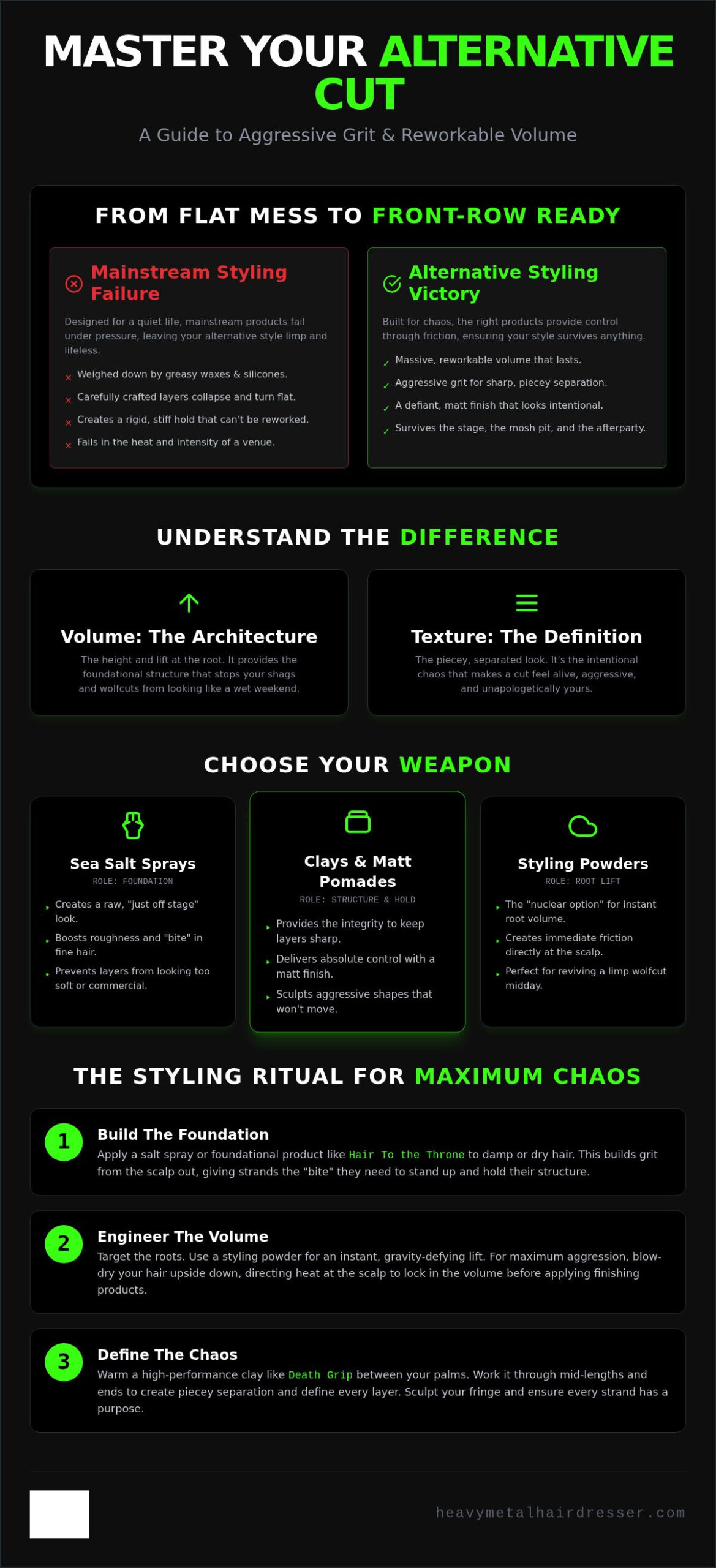
Most people think “dirty” hair styles better. There’s some truth there. Grit is essentially intentional friction. Ingredients like clay, salt, and silica absorb excess oils whilst roughening the hair cuticle. This microscopic “roughness” allows strands to grab onto each other. It’s why a wolfcut looks sharp rather than limp. Using a foundation like Hair To the Throne builds this grit from the scalp out. It provides the “bite” needed for the hair to stand up and stay there. Without this friction, heavy layers simply slide past each other and collapse. Textured styling products ensure your hair has the structural integrity to withstand a night in a basement venue.
Texture vs. Volume: Clearing the Confusion
It’s easy to confuse the two, but they serve different masters. Volume is the architecture. It’s the height and the lift at the root that stops your head looking like a wet weekend. Texture is the definition. It’s the piecey, separated look that makes a wolfcut look intentional. You can have volume without texture, think 80s prom hair, or texture without volume, think greasy grunge. For a proper alternative aesthetic, you need both working in tandem.
Texture is the intentional chaos of the hair. It turns a standard cut into something that feels alive, aggressive, and unapologetically yours. When you apply a high-performance clay like Death Grip, you aren’t just holding hair in place. You’re defining the chaos and ensuring every layer pops. It creates a reworkable finish that lets you fix your fringe after a set without it flaking or snapping. You get the grit of a three-day festival with the control of a professional stylist.
Choosing Your Weapon: Salt Sprays, Clays, and Powders
Building an alternative look requires a specific arsenal. You can’t rely on one bottle to do the heavy lifting for a complex wolfcut. Pro stylists use “cocktailing”. This means layering different textured styling products to achieve specific results. You might want the root lift of a powder combined with the piecey finish of a clay. It’s about building a custom finish that fits your identity. If your hair is currently a blank canvas, start thinking about your toolkit as a set of layers rather than a single fix.
Sea Salt Sprays for Raw Definition
Sea salt spray is the foundation for that “just off the stage” look. It’s perfect for fine hair that needs a boost in roughness. Apply it whilst damp for a natural, gritty dry-down. For maximum aggression, mist it onto dry hair and scrunch it in. A word of caution: salt can be drying. If you’re rocking vivid colours, don’t over-salt your strands. Use it strategically to keep your hair healthy whilst maintaining that underground edge. It provides the “bite” that prevents layers from looking too soft or commercial.
Clays and Pomades for Structural Integrity
Forget high-shine pomades. They look too traditional for an alternative soul. Matt finishes are the gold standard for shags and shorter mullets. Clays provide the structural integrity needed to keep fringe layers from falling flat. Always warm the product between your palms before applying. This ensures even distribution amongst your layers rather than leaving a clump in one spot. These products are superior for gender-neutral, short-to-mid-length cuts where you need absolute control. Using something like Death Grip allows you to sculpt aggressive shapes that won’t move.
Styling powders are the nuclear option for your roots. They provide instant volume that defies gravity. If your wolfcut feels limp by midday, a puff of powder creates immediate friction at the scalp. Mixing these tools is where the magic happens. Start with a volume foundation like Hair To the Throne to prep the hair, then finish with a clay for definition. This layering ensures your style survives the heat of a festival crowd or a long night in the pit. You aren’t just styling; you’re engineering a look that refuses to quit.
The Problem with Mainstream Styling: Why “Soft” Texture Fails
Mainstream brands have a specific goal: they want your hair to look healthy, shiny, and “natural”. For most people, that’s fine. For us, it’s a disaster. Most high-street textured styling products are packed with heavy silicones. These ingredients are designed to smooth the hair cuticle and add shine. Whilst that sounds good in a commercial, it’s the fastest way to kill a wolfcut. Silicones add weight. They make your layers slide together rather than popping apart. When your hair is too smooth, it has no “bite”. You end up with a flat, greasy mess that looks like you’ve skipped a wash for the wrong reasons.
There’s a common fear that adding grit means your hair will feel like straw. This is a misconception born from using cheap, low-grade salts. Professional-grade grit provides surface friction without stripping the internal moisture of the hair. It’s about creating a “reworkable” chaos. You want to be able to run your hands through your hair at a gig and have it bounce back into shape. Mainstream products don’t allow for this; they either offer a stiff, crunchy hold or a soft, limp finish. Neither works when you’re trying to maintain the structural integrity of a professional shag.
Avoiding the “Limp Layer” Syndrome
Heavy conditioners and silicone-laden sprays are the primary culprits behind “limp layer” syndrome. If you’ve invested in a complex, multi-layered cut, the last thing you want is for those layers to stick together. Movement is essential. Lightweight, high-impact formulations are the only way to keep those shorter sections standing up. Professional-grade grit is actually healthier for styled alt-hair because it allows you to use less product over time. You aren’t constantly fighting against the weight of your own styling routine.
Gender-Inclusive Styling: Beyond the Pink and Blue
Traditional hair care is still stuck in the dark ages of gendered marketing. You either get products that smell like a floral shop or ones that smell like a “sport” deodorant. It’s outdated and irrelevant. Performance should be the only metric that matters. Whether you’re using Death Grip or Hair To the Throne, the focus is on identity and expression, not which aisle of the chemist you shop in. textured styling products should empower everyone to express their authentic selves. By stripping away the gendered fluff, we can focus on what actually works for your aesthetic. It’s about providing the tools for individual rebellion, regardless of identity.
How to Style Your Wolfcut or Shag for Maximum Chaos
Styling an alternative cut is a process of controlled destruction. You want it to look like you’ve been on the road for a month, but with the structural integrity of a professional build. It starts with the cut itself. A shag haircut provides the internal architecture. Without those shorter, choppy layers, your textured styling products have nothing to hold onto. You need that foundation before you even reach for a bottle.
Follow this routine for a look that refuses to collapse:
- Prep: Apply a salt spray or volume mist to damp roots. This creates the “anchor” for your volume whilst the hair is still pliable.
- Dry: Power-dry with a diffuser. Avoid brushes. Use your fingers to shake the roots and encourage natural movement.
- Sculpt: Use the “scrunch and grab” technique. Warm a small amount of clay in your palms, then grab chunks of hair from the ends upwards to create separation.
- Finish: Lock it in with a professional texture spray. You want a product that offers hold without the stiff, plastic crunch of traditional sprays.
Mastering the Wolfcut Flow
Styling a wolfcut is all about the “flick”. You want the layers around your face to kick out aggressively rather than curling inwards. Focus your attention on the crown. This is where you need the most height to maintain that defiant silhouette. If you’re learning how to style a modern mullet, the secret is keeping the sides tight whilst letting the top and back go wild. Use your textured styling products to pull the ends into sharp, piecey points. It should look intentional and dangerous, never fluffy.
Festival Survival: Keeping Texture in the Pit
Longevity comes from layering. Don’t just slap on one product and hope for the best. Start with a volume foundation like Hair To the Throne and finish with a high-grip clay like Death Grip. Dry shampoo isn’t just for dirty hair; it’s a preventative tool. Apply it to clean hair to stop oils from flattening your style before they even start. We’ve seen this work first-hand whilst handling stage hair for musicians at major UK festivals. If it can survive a headline set, it can survive your weekend. Ready to upgrade your arsenal? Explore our full range of alternative styling tools to find your perfect match.
The Heavy Metal Arsenal: Death Grip and Hair To the Throne
Mainstream hair care is built for the masses. It’s designed for boardroom meetings and supermarket runs. Your aesthetic demands something more aggressive. Simon Tuckwell created this range because the industry was too soft. These textured styling products weren’t born in a clinical lab; they were forged in the heat of festival backstage areas and underground hair studios. They are the logical conclusion for anyone who takes their subcultural identity seriously. You’ve spent time finding the right cut; now you need the tools that respect that effort.
Choosing the right tools means understanding the specific needs of alternative shapes. You need grit that doesn’t flake. You need volume that doesn’t collapse under the weight of a humid venue. Death Grip and Hair To the Throne aren’t just additions to your shelf. They are the structural foundation of your identity. They represent a shift away from the polished and towards the authentic.
Death Grip: For the Bold and the Brave
This is our high-performance clay. It delivers a percussive, high-impact hold that refuses to back down. The matt finish ensures your style looks raw and gritty, never greasy or over-processed. It’s the ultimate tool for wolf hair cut maintenance, allowing you to define those choppy layers with absolute precision. Best of all, it’s reworkable. You can fix your style after a set or a long night out without needing to wash and start again. It’s built for the pit, not the office.
Hair To the Throne: Commanding Your Style
Every great structure needs a base. Hair To the Throne is the ultimate prep spray for shags and long alternative styles. It adds density and “bite” to the hair without the sticky weight of traditional mousses or gels. This spray creates the friction needed for your other products to work effectively amongst your layers. It’s also specifically formulated to respect your palette. It protects and enhances vivid hair colour, ensuring your pigment stays as loud as your personality whilst you build your style.
Using these tools together creates a synergy that mainstream brands simply can’t replicate. You start with the volume of Hair To the Throne. You finish with the defiant hold of Death Grip. This is how you achieve a professional, stage-ready look at home. It’s about taking control of your image and refusing to settle for the “soft” texture the rest of the world expects. Your hair is your crown; make sure it’s built to last.
Reclaim Your Identity Through Controlled Chaos
Your hair is more than just a style; it’s a declaration of who you are. We’ve explored how the right textured styling products provide the friction and structural integrity needed to keep alternative cuts like shags and wolfcuts alive. You now know that mainstream softness is the enemy of a sharp mullet. By layering foundational volume with high-impact clays, you create a look that survives the most intense festival pits.
Our expertise isn’t just theory. It’s forged backstage whilst styling bands at Download and Bloodstock. We’ve built a gender-inclusive safe space where performance and identity always come first. These tools were developed by alternative hair specialists who understand that “good enough” doesn’t cut it when you’re under the stage lights. It’s time to stop fighting against products that don’t understand your aesthetic.
Grab your gear and master your texture with our pro range. Your hair deserves to be as loud and uncompromising as the music you love. Stay gritty and never settle for flat.
Frequently Asked Questions
What is the best product for a wolfcut?
The best tool for a wolfcut is a combination of Death Grip for definition and Hair To the Throne for volume. You need that foundational lift at the roots to keep the layers from falling flat. Death Grip provides the aggressive hold required to flick the ends out around your face. Using these specific textured styling products together ensures your cut maintains its sharp, subcultural silhouette even after a long night in the pit.
Can I use textured styling products on fine hair?
Yes, fine hair actually benefits most from these tools because it lacks natural grit. Using a salt spray or a volume foundation like Hair To the Throne adds the microscopic friction needed for layers to stand up. It prevents your hair from looking like a flat, silky sheet. Start with a light mist on damp hair to build a structural base that supports the piecey layers of a shag or mullet.
How do I get texture in my hair without it feeling greasy?
You achieve grease-free texture by choosing matt-finish products and avoiding heavy silicones. Mainstream sprays often use oils for shine, which is the enemy of an alternative look. Stick to clays like Death Grip or salt-based sprays that absorb excess scalp oils whilst providing grip. Always apply product to the ends first and work your way up to avoid overloading the roots, which is where greasiness usually shows.
Is sea salt spray bad for your hair?
Sea salt spray isn’t inherently bad, but it is a desiccant that pulls moisture from the hair. If you use low-grade versions daily, your hair might feel dry. High-quality textured styling products balance the salt with nourishing ingredients to protect your cuticle. If you have vivid hair colour, use it strategically. It provides the essential “bite” for a wolfcut, but you should always pair it with a good conditioning routine.
What is the difference between hair wax and texture clay?
Hair wax typically contains oils that produce a high-shine, “clean” finish that looks too polished for alternative styles. Texture clay is formulated with minerals like kaolin or bentonite to provide a completely matt, gritty finish. Clay offers a much stronger, reworkable hold that doesn’t feel heavy or look greasy. It’s the superior choice for anyone maintaining the aggressive separation of a modern mullet or a choppy, multi-layered shag.
How do I keep my shag haircut looking messy all day?
Keeping a shag messy requires a reworkable foundation rather than a stiff hairspray. Layer your products by starting with Hair To the Throne on damp hair, then finishing with a small amount of Death Grip once dry. This creates a “memory” in the hair. If your style starts to drop, you can simply scrunch and shake your hair to reactivate the texture. It stays chaotic and intentional without ever looking like a helmet.
Are these products safe for vivid hair colours?
Our professional range is absolutely safe for vivid hair colours. We know that alternative identities often involve high-pigment shades that need extra care. Unlike some mainstream sprays that contain harsh alcohols which can strip your tone, our products are designed to enhance your look without compromising your colour. They provide the necessary grit and volume whilst ensuring your saturation stays as loud and defiant as the day you dyed it.
How much product should I actually be using?
Start with a pea-sized amount of clay and build up if you need more. Overloading your hair with product is the fastest way to make it look limp and heavy. For sprays, three to four mists is usually enough to provide a solid foundation. You want enough product to create friction, but not so much that you can’t run your fingers through it. It’s always easier to add more than it is to wash it out.