

The richest conditioner on the shelf might be the wrong choice for your coloured hair. The best conditioner for coloured hair is the one that suits your texture, colour process and what your hair needs now, not the one with the loudest label. If you’re worried about fading but don’t want fine hair flattened by heavy moisture, that distinction matters.
Claims about colour protection, repair and shine can make it hard to tell what a product is actually designed to do. With expressive colour, keeping the look vivid is only part of the picture: your hair should still feel like yours. This guide will help you compare useful label details, assess your hair’s condition and choose a conditioner that supports the feel you want without unnecessary weight.
We’ll compare options for fine, thick, curly and dry hair, and explain how your colour process can shape your choice. You’ll also learn the difference between conditioners that deposit colour and those that tone unwanted warmth, plus how to build a realistic routine around your hair’s current condition. No miracle promises, just practical ways to find care that fits.
Key Takeaways
- The best conditioner for coloured hair depends on your texture, colour process and current needs, not a one-size-fits-all claim.
- Match the formula’s feel to your hair: lightweight, richer and curl-focused options can suit different textures and desired finishes.
- Colour-care claims may signal a formula is designed for dyed hair, but they aren’t a promise that colour will never fade.
- Use a simple selection process: assess your hair, decide how you want it to feel, compare labels and follow the product’s directions.
- Creative colour deserves care that supports both the look and feel of your hair without adding weight it doesn’t need.
Best conditioner for coloured hair: what should it actually do?
A suitable conditioner supports how your hair feels and behaves after washing. It can help improve softness, slip and manageability, but a colour-care label isn’t a force field. It doesn’t guarantee that your shade will never fade, and it can’t undo every effect of a chemical process.
That’s why the best conditioner for coloured hair isn’t automatically the richest, the most expensive or the one labelled “colour protection”. Start with your hair’s texture and condition, then decide on the finish you want. Fine hair may feel limp under a heavy formula, whilst dry, coarse or curly hair may feel better with more conditioning. Your colour process matters too, but it’s only one part of the decision.
What does colour-protection conditioner mean?
In plain English, “colour protection” signals that a conditioner is marketed for dyed hair. The formula may be designed to condition coloured hair, but the wording alone doesn’t show how it performs or promise lasting colour. Read the product description for its intended use and follow the directions. Treat dramatic promises with a healthy dose of scepticism.
Keep conditioning separate from cleansing. Shampoo does most of the work of washing away oil, sweat and product build-up; conditioner is primarily used to improve the hair’s feel and manageability. A conditioner can be part of a colour-care routine, but it shouldn’t be credited with every benefit claimed for a shampoo. For a useful overview of the science behind hair conditioners, see how conditioning agents are used to improve texture and make hair easier to handle. Specific ingredient or colour-retention claims still need evidence behind them, so don’t assume a named ingredient guarantees a result.
Why coloured hair can need a different approach
Colouring can change how hair feels. Depending on the process and your hair’s starting condition, it may feel drier, rougher or harder to detangle afterwards. Lightening can be especially demanding, while depositing a darker shade may not leave the same feel. Vivid colour also covers a range of processes, so the shade alone can’t tell you exactly what your hair needs.
If your hair feels fragile or parched, prioritise a formula that leaves it comfortable and easier to manage. If it’s fine and still feels soft, a lighter conditioner may be enough. If it’s curly, consider whether the formula gives your lengths the slip and softness you like without leaving an unwanted coated feel. Your roots and lengths may even have different needs, so pay attention to how each area responds.
For expressive shades, colour is part of the whole look, not a reason to ignore how your hair feels. The vivid hair colour guide explores the impact of high-pigment colour. Pair that colour perspective with a practical assessment of your texture and current condition. There’s no universal winner: the right conditioner is the one that leaves your hair feeling cared for, without weighing it down or promising colour that can’t fade.
How conditioner supports coloured hair: moisture, feel and formula
Conditioner is about how your hair feels after washing. A suitable formula can help lengths feel softer and easier to comb, but “moisture” and “softness” aren’t interchangeable results. Moisture is often used to describe a hydrated-feeling finish; softness describes how hair feels to the touch. Neither word alone tells you whether the formula will suit your hair or preserve a particular shade.
The right conditioner balances your hair’s current condition and texture with the feel you want, not just the colour on the label. That’s the useful filter. Hair that feels rough or tangles easily may benefit from a more conditioning finish. If your hair loses its usual movement, looks flat or feels coated after use, the formula may be too rich for your preference. That doesn’t make it a bad conditioner. It may simply be the wrong match for your hair.
Moisture, softness and lightweight feel
Think about the result you want, rather than chasing or avoiding a single ingredient. A product’s texture and your own hair both affect how it feels in use. Fine hair may prefer a lighter finish, while thicker, curlier or drier lengths may feel better with more conditioning. These are starting points, not rules. Ingredient claims should be checked against reliable evidence, rather than treated as proof that a formula will deliver a specific result for everyone.
Use your own hair as feedback. Does it feel easier to detangle? Does it keep the movement you like? A conditioner that leaves lengths smooth but limp may be richer than you want. One that leaves them difficult to manage may not provide the feel you’re after. Adjust the formula to your preference instead of trying to make your hair fit a marketing promise.
Do colour-safe and sulphate-free claims mean the same thing?
No. “Colour-safe” signals that a product is marketed for colour-treated hair. “Sulphate-free” describes a formula without sulphates. They refer to different things, and neither label alone proves a conditioner is the right match. Sulphates are associated with cleansing formulations, so the claim is more relevant to shampoo’s washing role than to a conditioner’s conditioning purpose.
Don’t treat “sulphate-free” as a shortcut for judging every part of a colour-care routine. A conditioner can still feel too heavy, too light or simply not right for your hair, regardless of that claim. Read the product description and directions, and weigh claims about ingredients or colour retention carefully. Look for clear, specific explanations rather than assuming one label guarantees a result.
Creative colour is personal. If you’re thinking about the colour itself as well as the care routine, explore Heavy Metal Hairdresser’s creative colour work for inspiration. Then choose a conditioner by how your hair behaves and the finish you want, not by the loudest promise on the bottle.
Compare conditioners for coloured hair by texture and colour process
Colour tells you what’s happening visually. Texture and condition tell you more about the kind of finish you may prefer. Fine hair with a vivid shade can need a very different conditioner from thick, curly hair that’s been lightened, even if both colours are equally bold. Use the table as a starting point, then judge the result by how your own hair feels.
| Hair texture | Current condition | Colour process | Category and finish to consider |
|---|---|---|---|
| Fine or easily weighed-down | Feels fairly soft and manageable | Colour deposit or darker shade | Lightweight conditioner for softness while keeping your preferred movement |
| Fine | Dry-feeling or harder to detangle | Lightened hair, with or without vivid colour | A more conditioning formula, used according to its directions; check that the finish doesn’t feel too heavy |
| Thick or curly | Lengths feel rough, dry or prone to tangling | Any colour process, including vivid shades | Richer or curl-focused conditioner for a softer, more manageable feel |
| Thick, curly or coily | Feels healthy, but you want definition and movement | Darker or vivid colour | A curl-focused option that suits your preferred finish, rather than automatically choosing the richest formula |
| Any texture | Roots feel comfortable, but ends feel drier | Previously lightened lengths with colour applied over them | Prioritise the needs of the lengths; a single formula may feel different across your hair |
Which conditioner suits fine, thick, curly or dry hair?
Fine hair doesn’t automatically need the lightest formula, just as thick hair doesn’t always need the richest. Start with the problem you want to solve. If your hair feels healthy but loses its bounce, try a lighter conditioning feel. If thick or curly lengths feel rough and are difficult to manage, a richer or curl-focused category may feel more comfortable. For mixed needs, prioritise the areas that feel most compromised, then consider whether the finish works across the whole head.
Does vivid, bleached or darker coloured hair change the choice?
It can shape your priorities, but it doesn’t dictate one formula. Hair that has been lightened may feel different from hair that’s only had darker colour applied, so consider its history as well as its current condition. Vivid shades can be applied to hair with different textures and lightening histories; the colour itself doesn’t tell you whether you need a lightweight, richer or curl-focused conditioner. No category can promise a shade won’t fade.
For creative colour, make the comparison practical: note whether the hair has been lightened, how the lengths feel, and whether you want softness, easier detangling or more movement. The best conditioner for coloured hair is the one that fits those needs together. If your first choice leaves your hair flat or still hard to manage, use that feedback to reassess the formula, not your colour.
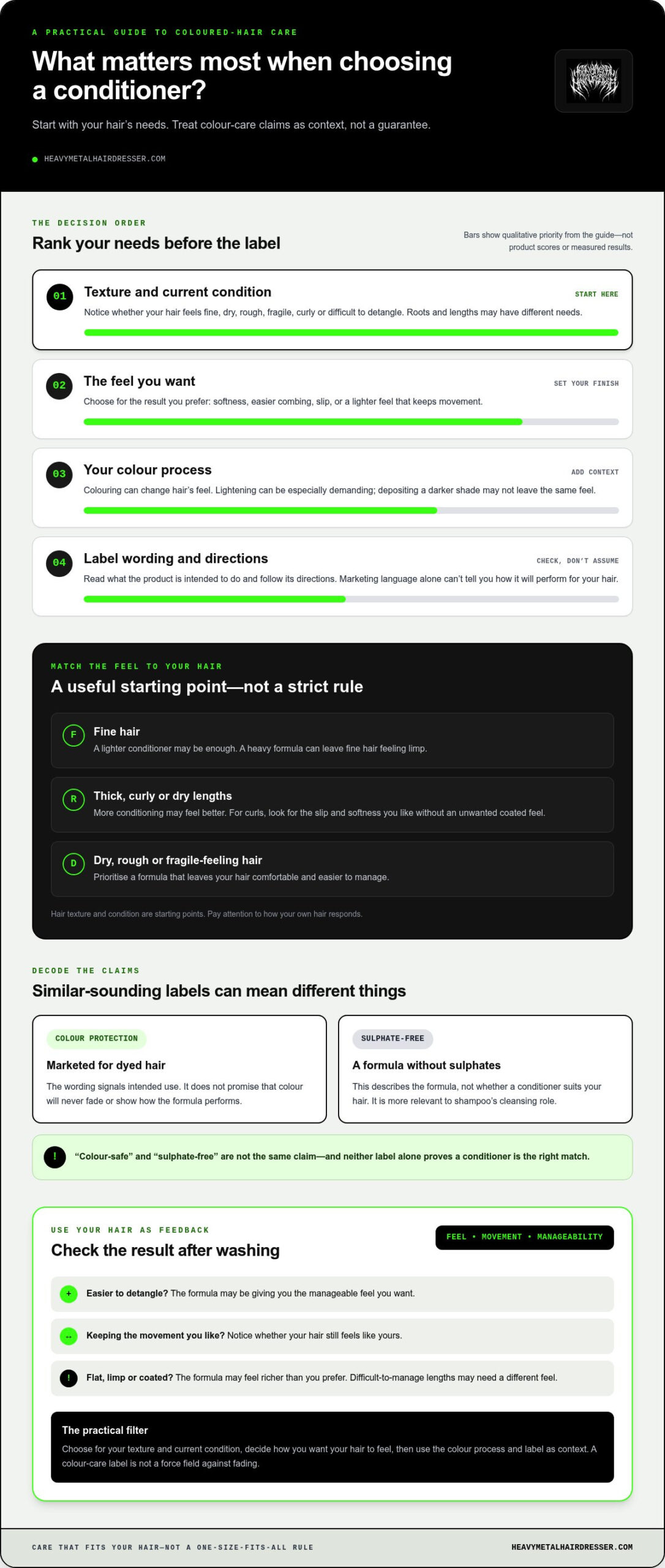
How to choose and use conditioner for coloured hair
Make your choice from your hair’s needs, not the loudest promise on the bottle. A simple process helps cut through the noise and gives you a fair way to judge whether a conditioner suits your coloured hair.
- Identify your texture. Notice whether your hair is fine, thick, curly or somewhere in between. Texture can affect how rich a formula feels and whether it leaves the movement you like.
- Assess its current condition. Is it easy to detangle, or do the lengths feel rough, dry or more fragile than usual? Consider any lightening history as well as the shade you see now.
- Set the finish you want. Decide whether softness, easier combing, curl definition or a lightweight feel matters most. Choose one or two priorities so you can compare products on more than colour-care wording.
- Compare the labels. Look for the hair types or concerns named in the product description, the intended feel and clear directions. The best conditioner for coloured hair is a personal match, not a label that makes the biggest promise.
A quick label-reading checklist
Start with the hair type and condition the product description says it’s designed for. Check whether it describes a lightweight, richer or curl-focused feel, then read the directions before using it. “Colour-safe” may tell you the product is marketed for dyed hair, but it isn’t proof that your shade will never fade. Judge the whole description, not one claim in isolation.
Ingredient lists can offer useful detail, but don’t reject or favour an ingredient just because it sounds unfamiliar. Specific claims about what an ingredient does need reliable evidence. A clear explanation of intended use is more useful than a dramatic promise with no context.
How to assess whether your choice is working
Use the conditioner as directed on its packaging. Don’t add your own timing or assume that leaving it on longer will improve the result. Afterwards, notice how your hair feels once it’s dry: does it feel comfortable, move as you like and feel manageable? Your preferred finish is the benchmark.
If your hair feels coated or loses its movement, reconsider the formula’s richness rather than adding more. If it still feels dry or difficult to manage, the formula may not be conditioning enough for your current needs. Change one thing at a time and pay attention to the difference, instead of making several routine changes at once.
This is a conditioner check, not a complete colour-maintenance plan. For a creative-colour look, explore Heavy Metal Hairdresser’s vivid colour work and use that inspiration to shape a care routine that feels right for your hair.
Choose coloured-hair care that fits your look, not a one-size-fits-all rule
Your conditioner choice should work with the hair you have, the colour process it’s been through and the finish you want. Fine hair with a vivid shade may prefer a lighter feel; curly, lightened lengths may call for more conditioning. Neither colour nor texture tells the whole story on its own. Pay attention to how your hair feels now, then use that as your guide.
Think of colour care as looking after the whole look, not chasing a promise that a product can lock in a shade forever. Your lengths might feel different after lightening, or your hair might remain comfortable after colour. Choose a formula to support its current feel and manageability, and follow the product’s directions. Small, considered choices beat one-size-fits-all rules.
- Match formula richness to your texture and the movement you like.
- Consider your colour process, especially any lightening history, alongside your hair’s current condition.
- Judge the result by how your hair feels and behaves, not by a colour-care claim alone.
When colour care meets self-expression
Vivid and alternative colour can be part of how you show up in the world. It can be loud, subtle, shifting or entirely your own. Thoughtful aftercare helps you care for how your hair feels as you wear that look between colour appointments, without promising to keep a shade unchanged. The aim isn’t to tame your individuality. It’s to find care that fits your hair and lets your style feel like you.
Your next step with Heavy Metal Hairdresser
Heavy Metal Hairdresser’s creative-colour work brings a vivid-colour perspective to this guide: colour is personal, and hair care should make sense for the person wearing it. If you’re exploring expressive styling as well as colour, the alternative hair styles guide can help you consider how a cut and colour might work together. Keep your conditioner choice grounded in your own texture, process, condition and preferred finish.
Considering a creative colour look? Explore Heavy Metal Hairdresser’s creative colour work and find inspiration for your next look.
Site notice: HMH merchandise is no longer sold on this website and is available only at our new merch store. Wolfcut course orders are still accepted here 🤘.
Make your next colour choice feel like you
Your hair care can support more than the shade in the mirror. It can help you feel comfortable wearing a look that’s unmistakably yours. The best conditioner for coloured hair isn’t a badge of perfection; it’s part of a routine that suits your hair and gives you the confidence to keep expressing yourself.
That spirit is at the heart of Heavy Metal Hairdresser’s creative vivid colour work. It’s an inclusive space that celebrates individuality, with backstage festival experience at Download and Bloodstock. Colour can be bold, personal and ever-changing. There’s room for every version of it.
If you’re ready to explore a new expression of colour, take a look at Heavy Metal Hairdresser’s creative colour work. Explore the salon’s vivid colour work and book in to make your next look your own 🤘.
Frequently Asked Questions
What is the best conditioner for coloured hair?
The best conditioner for coloured hair is one that leaves your hair comfortable and manageable without spoiling the finish you prefer. For example, if your lengths feel tangled after washing but your roots go flat easily, focus on a formula described for your hair type and condition, and apply it as directed. There’s no need to choose a product simply because it claims to suit every colour or texture.
Is conditioner labelled colour-safe better for dyed hair?
Not automatically. “Colour-safe” means the conditioner is marketed for colour-treated hair, but it doesn’t tell you whether its feel will suit your texture or whether it will meet your needs. Imagine choosing between two products with the same claim: if one leaves your hair heavy and the other feels comfortable, your own result matters more than the shared label. Read the full description and follow the directions.
Can conditioner stop coloured hair from fading?
No conditioner can guarantee that coloured hair will never fade. A conditioner may help your lengths feel softer or easier to manage, but that’s different from keeping a shade unchanged. If your colour looks less vivid over time, don’t assume a conditioner alone can restore it. A product that deposits pigment is also different from an ordinary conditioner, so check its description and intended use before treating it as routine conditioning care.
Which conditioner is best for fine coloured hair?
For fine coloured hair, look for a conditioner described as lightweight or suitable for fine hair, especially if you want to keep natural movement. A practical test is whether your hair still feels airy and easy to style after use. If it looks limp or feels coated, try a less rich option rather than using more product. Fine hair can still need conditioning, particularly if the lengths feel dry or harder to detangle.
Should bleached hair use a different conditioner?
It may benefit from a different level of conditioning if lightened lengths feel rough, dry or difficult to detangle. But “bleached” doesn’t automatically mean you need the richest formula available. Consider how your hair feels now, and whether it’s fine, thick or curly. For instance, fine, lightened hair may need a comfortable conditioning feel without losing movement, whilst thicker lengths may prefer a richer finish. Follow the product’s directions.
How often should I use conditioner on coloured hair?
Use conditioner according to the directions on its packaging and your usual hair-washing routine. There isn’t one schedule that suits every head of coloured hair. If your lengths feel tangled after washing, conditioning as directed may help make them easier to manage; if your hair feels weighed down, reconsider the formula or how much you’re using. Keep the focus on your hair’s response rather than adding extra applications to chase a particular colour result.
What should I look for on a conditioner label for coloured hair?
Start with the hair type or condition named in the product description, then look for details about the finish, such as lightweight, richer or curl-focused. Check the directions and distinguish claims about conditioning from claims about cleansing, which are more relevant to shampoo. “Colour-safe” may indicate the product is marketed for dyed hair, but it isn’t proof of guaranteed colour retention. Treat specific ingredient promises as claims to assess, not automatic results.