Posted on

Fixing a Shag Haircut That’s Too Short: The Alt-Hair Survival Guide

Fixing a Shag Haircut That's Too Short: The Alt-Hair Survival Guide

That “hedgehog” reflection in the mirror isn’t a hair disaster; it’s the raw foundation for your most aggressive style yet. You went in for a rockstar shag and walked out feeling like a suburban mum with layers that are far too feminine and way too choppy. It’s a total gut punch when your subcultural identity is stripped away by a stylist who didn’t understand the assignment. We know exactly how it feels to lose that edge. Fixing a shag haircut that’s too short is about more than just waiting for it to grow. It’s about taking control of the chaos.

We agree that looking “too suburban” when you wanted to look like a riot grrrl is a nightmare. This survival guide is here to help you resurrect your look and pivot that botched cut into a deadly alternative shape with professional grit. You’ll discover a clear plan to grow out those awkward layers whilst keeping your aesthetic intact. We’ll also cover styling tricks to hide the mistakes and show you how to pivot the mess into a deliberate wolfcut or a sharp mullet. Your style isn’t dead; it’s just in transition.

Key Takeaways

  • Learn how to pivot a botched, disconnected cut into a deliberate wolfcut or modern mullet to reclaim your subcultural edge.
  • Discover the technical secrets to fixing a shag haircut that’s too short by rebalancing internal weight and texture.
  • Master the “scrunch and grit” styling method to hide the “hedgehog effect” and add volume to flat, awkward layers.
  • Understand how to use professional-grade gear like Hair To the Throne to maintain an aggressive silhouette whilst your hair transitions.
  • Find out why specialist alternative salons act as the ultimate recovery centre for reclaiming your identity after a mainstream hair disaster.

The Shag Disaster: Why Your Cut Feels Too Short and How to Stop the Panic

The mirror doesn’t lie, but it can be incredibly cruel after a bad salon visit. You walked in asking for a rockstar silhouette and walked out with a “can I speak to the manager” special. It feels too feminine. It feels too safe. Most importantly, it feels like your subcultural identity has been sanded down by someone who didn’t understand the assignment. It’s a gut punch. But before you spiral, realise that fixing a shag haircut that’s too short is a process of resurrection rather than just a repair job. We aren’t just trying to “fix” a mistake; we’re pivoting the chaos into a new, more aggressive shape.

First, you must respect the 24-hour rule. Freshly cut hair is often in a state of shock. The cuticle is agitated, the weight has shifted, and the layers haven’t had time to live in your natural texture. Give it a full day and a proper sleep before you make any drastic decisions. Hair that looks stiff and “hedgehog-like” immediately after a cut often softens once it’s been lived in for a few hours. Stop the panic. Put down the kitchen scissors. We’re going to find the pivot point that turns this disaster into a statement.

Why Mainstream Stylists Often Botch the Alternative Shag

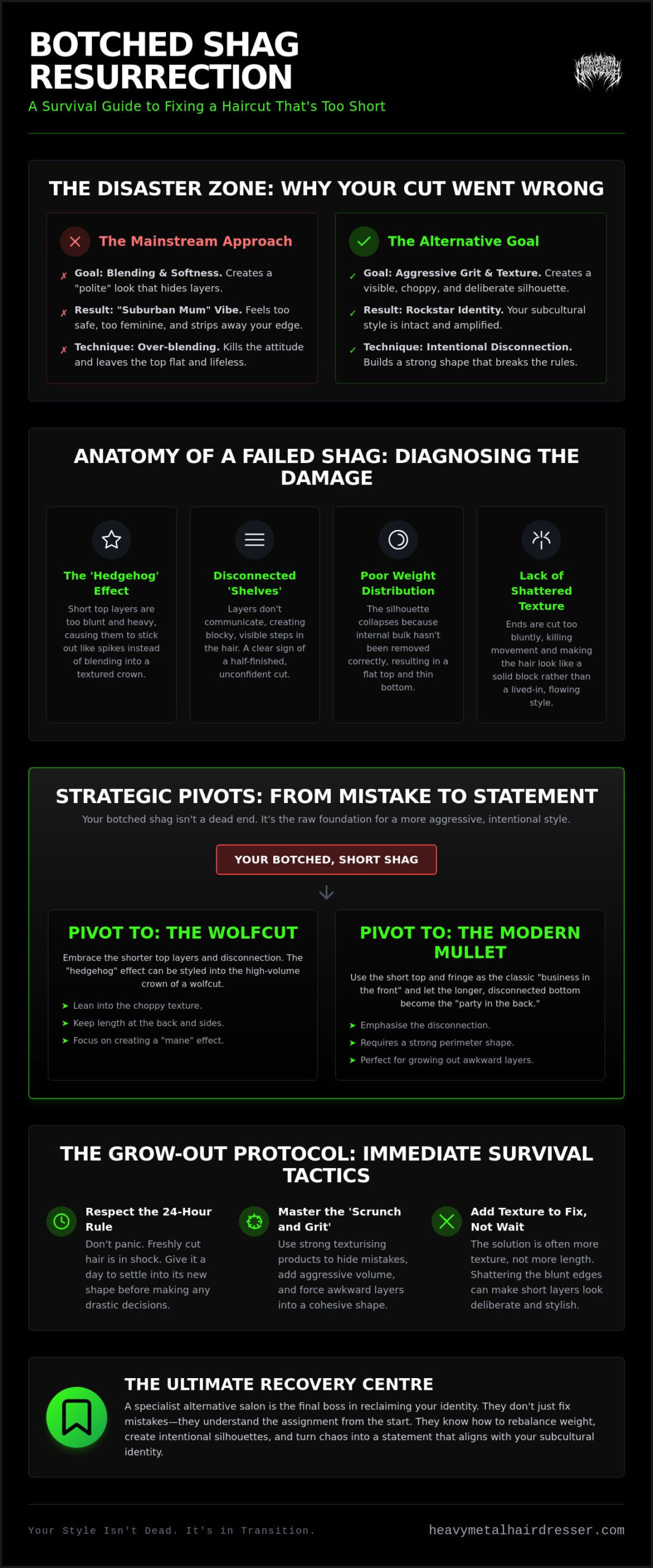
Mainstream hair education prioritises “blending” and “softness” above all else. This is the suburban approach. It’s designed to make hair look polite and inconspicuous. A true shag needs aggressive grit and visible, choppy texture. When a stylist over-blends, they kill the attitude of the cut. They often remove too much weight from the crown in an attempt to make it “wearable,” which leaves the top flat and the bottom looking thin and disconnected. They’re trying to follow a standard template whilst you’re looking for something that breaks the rules.

Assessing the Damage: Is it Too Short or Just Too Blunt?

Look closely at the silhouette to understand the Anatomy of a Failed Shag. Are there “shelves” in your hair? Shelving happens when the layers don’t communicate with each other, creating blocky, disconnected steps. Check the fringe as well. If the stylist has cut the fringe too far back towards your ears, they’ve fundamentally altered your face shape. Identifying these technical errors is the first step in fixing a shag haircut that’s too short. Ultimately, a botched shag is simply a lack of intentional weight distribution.

Anatomy of a Failed Shag: Understanding Layers, Weight, and Length

A successful shag is a delicate balance of internal texture and perimeter length. When this ratio is off, the whole silhouette collapses. Most people think fixing a shag haircut that’s too short requires extensions or months of hiding under a beanie, but the real solution often lies in the weight distribution. A shag that feels “wrong” is usually suffering from a lack of movement. If the ends are too blunt, the hair becomes a solid block of weight. This is especially true for those with high hair density. Amongst alternative styles, thick hair suffers most from half-hearted layering because it ends up looking like a mushroom rather than a rockstar.

Fixing the problem often involves adding more texture rather than waiting for length. By shattering the edges and removing internal bulk, you can make the short layers look like a deliberate choice. It’s about creating a flow where there is currently a blockage. If your hair feels stuck, it’s because the weight hasn’t been properly distributed to allow for that signature lived-in movement.

The ‘Hedgehog’ Effect: When Top Layers Go Rogue

The “hedgehog effect” happens when a stylist applies a traditional bob mindset to an alternative cut. They leave the crown too heavy and the layers too blunt. Instead of a soft, textured halo, you get short spikes that stick out at odd angles. You can identify this by looking for a lack of transition between the crown and the nape. To manage these unruly, short top sections, using a heavy-duty product like Death Grip is essential. It allows you to pin down rogue layers and force them into a more cohesive, aggressive shape whilst you wait for the transition to settle.

Disconnected Layers vs. Blended Chaos

Alternative hair thrives on intentional disconnection. It’s the difference between a “mistake” and a “statement.” If your stylist was scared of the cut, they likely left the layers half-finished. This results in a look that feels more like a primary school bowl cut than a subcultural icon. You need to know how to deal with a bad haircut by identifying if the ends have been properly shattered. If the edges are blunt, the shag will never have the grit it needs. If you’re ready to stop hiding and start reclaiming your look, booking a session for professional Shag Haircuts is the fastest way to regain your confidence.
Fixing a Shag Haircut That's Too Short: The Alt-Hair Survival Guide

Strategic Pivots: Transforming a Short Shag into a Wolfcut or Modern Mullet

Most mainstream advice tells you to hide. They suggest headbands, clips, or growing it out into a boring bob. We disagree. A shag that’s “too short” isn’t a failure; it’s a raw transition into an even bolder shape. Instead of playing defence, go on the attack. Lean into the grit. By embracing aggressive texture, you make the mistake look like a deliberate subcultural choice. Fixing a shag haircut that’s too short is far more effective when you pivot towards styles that actually thrive on choppy, disconnected layers.

Your hair hasn’t lost its soul; it has just lost its direction. When you stop trying to make the layers look “normal” and start making them look dangerous, the panic disappears. The key is intentionality. If the layers look like they were meant to be that short, the “botched” feeling evaporates instantly. You aren’t just hiding a bad cut. You are evolving your aesthetic into something more independent and fierce.

The Wolfcut Pivot: Injecting Chaos into Thin Strands

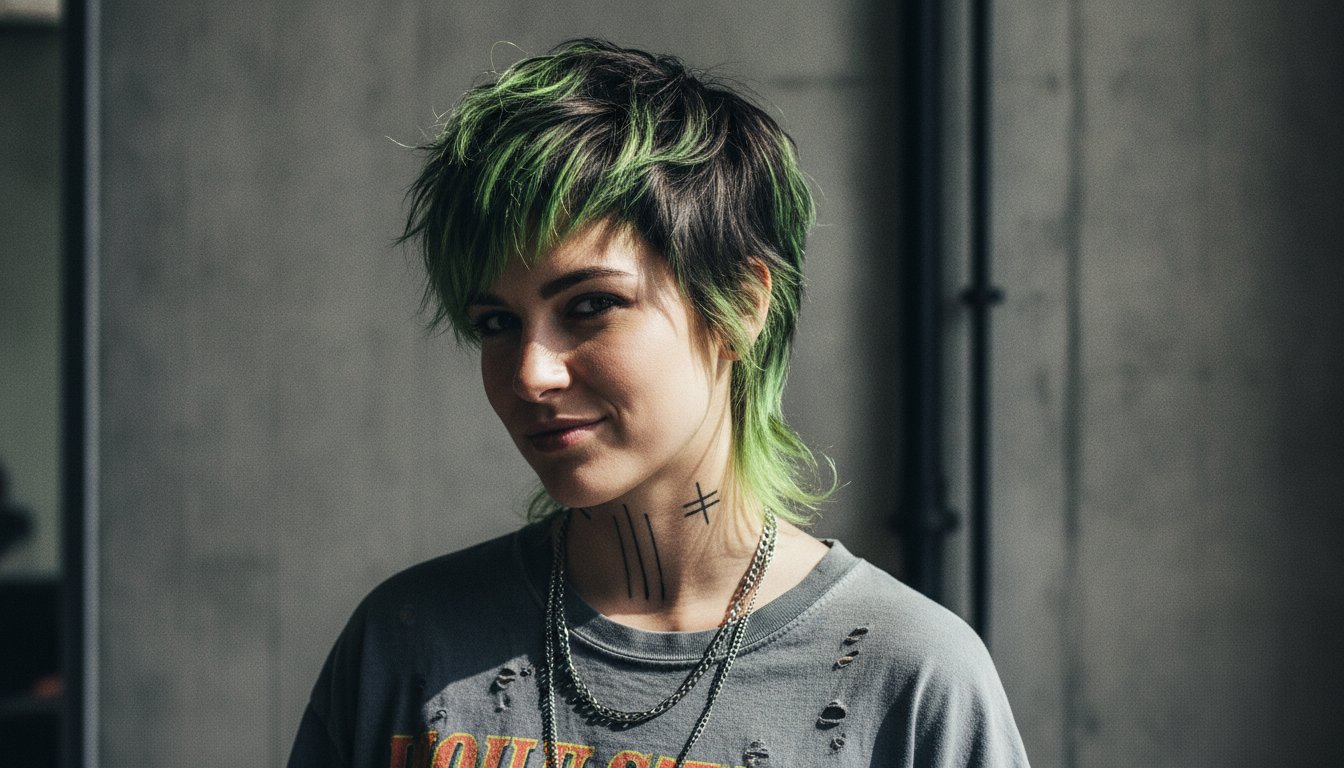
If your crown layers feel like a hedgehog, you’re already halfway to a wolf hair cut. This style uses those shorter top sections to create a wild mane effect. By keeping the sides slightly more textured and maintaining width around the cheekbones, you create a silhouette that feels intentional. This pivot is a lifesaver for people with fine hair. The shorter layers provide the lift and volume that longer, heavier shags often lack. It turns “too short” into “perfectly voluminous.”

The Modern Mullet: Reclaiming Your Soul

A fringe cut too far back or too high is the ultimate panic trigger. The fix? Make the back the star of the show. The modern mullet is the ultimate rebel recovery for a botched shag. It reclaims the “cool” factor by leaning into the contrast between the short front and the longer nape. You can learn how to style a modern mullet using gritty tools that emphasise the disconnect. It’s a high-energy look that tells the world you meant to do this. Fixing a shag haircut that’s too short becomes a statement of independence rather than a desperate repair job.

Style Comparison: Shag vs. Wolfcut vs. Mullet

Choosing your weapon for hair resurrection depends on your hair type and face shape. A wolfcut offers a softer, more face-framing flow that suits heart and oval shapes. The mullet is pure aggression, perfect for square or round faces that need verticality and edge. If you want to keep some femininity, stick to the wolfcut’s blended chaos. If you want to burn the suburban look to the ground, the mullet is your best friend. Whilst the wolfcut prioritises a wild flow, the mullet’s aggression is unmatched for pure subcultural grit.

The Grow-Out Protocol: Professional Styling Techniques for Transitional Hair

Toss your round brush in the bin. It is the enemy of alternative texture. If you are currently fixing a shag haircut that’s too short, your best weapon isn’t a heat tool; it’s the right product. Transitioning out of a botched cut requires a “scrunch and grit” mindset. You want to lean into the messiness rather than trying to smooth it over. Smooth hair reveals every technical flaw. Gritty hair makes those flaws look like intentional design choices. Use Hair To the Throne to inject massive volume into flat, short crown layers. This creates the height needed to balance out the shorter perimeter.

Stop fighting the layers. Start manipulating them. When you embrace the chaos of a transitional cut, you reclaim the power over your image. The goal is to make the hair look lived-in and raw. This isn’t about perfection; it’s about subcultural survival. By focusing on volume and grit, you turn a suburban nightmare into a gritty, independent statement that feels authentic to who you are.

Manipulation with Texture Products

Death Grip is your survival gear. Whilst mainstream guides suggest salt spray, it often lacks the hold required for heavy metal hair. It is too watery. It is too soft. You need a product that allows you to sculpt piecey, aggressive texture that stays put. Create “faux-length” by lightly straightening the very bottom layers whilst using Death Grip to volumise the top. This contrast in texture draws the eye vertically, making the hair appear longer than it actually is. It is a technical illusion that works every time.

The Art of the ‘In-Between’ Fringe

Bangs that are an inch too short can feel like a disaster. Stop trying to blow-dry them flat. Embrace the micro-bang. Use Death Grip to create a “shattered” or spiky fringe look that feels punk rather than accidental. By separating the fringe into distinct, textured pieces, you remove the “bowl cut” weight. Blend these pieces into your side layers to create a seamless, aggressive transition. It turns a mistake into a high-fashion statement that looks entirely on purpose.

Vivid Colour as a Tactical Distraction

Structural mistakes in a cut are often visible because the colour is flat. Introducing vivid hair colour can completely redefine the silhouette. High-pigment tones draw the eye to the saturation rather than the layer length. Use “money pieces” around the face or hidden panels of neon to break up the “hedgehog” effect. A bold colour choice signals that your entire look is a deliberate expression of identity. If you’re tired of the transitional struggle, grab some Branded Merchandise and wear your alt-identity with pride whilst your layers catch up.

Resurrecting Your Style with Heavy Metal Hairdresser Expertise

Mainstream stylists see a mistake; we see a blank canvas for something better. Our shag hairdressers specialise in the resurrection of botched cuts. We don’t do “polite.” We do identity. If you’re currently fixing a shag haircut that’s too short, you’ve found the ultimate recovery centre. This is a gender-inclusive safe space where your subcultural identity is the priority, not a trend. We understand the gut punch of a cut that feels too feminine or too suburban. We’re here to burn that look to the ground.

Simon Tuckwell built this brand on the idea that hair should be aggressive, textured, and entirely personal. With international acclaim and a history of festival styling, Simon understands that “wearable” doesn’t have to mean “boring.” We don’t just trim hair; we sculpt it to fit the person beneath. Stop hiding under that beanie. Your resurrection starts the moment you walk through our doors. We take those disconnected layers and turn them into a statement of independence.

Simon Tuckwell’s Vision for Alternative Hair

We’ve moved far beyond the binary of “men’s” and “women’s” hair. A shag or a mullet is a shape, not a gender. This philosophy extends to our professional gear. Death Grip and Hair To the Throne aren’t just styling products; they are survival tools for alternative life. They provide the grit needed to make short layers stand up and fight. This commitment to subculture has made our salon a national destination for those rejected by mainstream beauty standards. We celebrate the outsiders because we are the outsiders.

Booking Your Recovery Session

When you book a “fix-it” session, don’t just ask for a trim. Tell us your history. Explain where the previous stylist lost their nerve and where the layers became disconnected. Ask for a rebalance of internal weight and shattered ends. Bring reference photos of the most aggressive wolfcuts or mullets you can find. Communicating your alternative goals to a specialist ensures we can pivot the mess into a masterpiece. Fixing a shag haircut that’s too short is about reclaiming your power over your image.

Book your style resurrection at Heavy Metal Hairdresser.

Reclaim Your Edge and Start Your Resurrection

Stop hiding under beanies and waiting for time to heal the damage. You now have the blueprint for turning a “hedgehog” disaster into a deliberate subcultural statement. Whether you pivot into a wild wolfcut or a sharp modern mullet, the key is to embrace aggressive texture and ditch the suburban rules. Fixing a shag haircut that’s too short isn’t about achieving a polished, mainstream perfection. It’s about reclaiming your soul through grit, volume, and intentional disconnection. You are one strategic pivot away from your best look yet.

We specialise in aggressive texture and subcultural grit. Our salon provides a gender-inclusive safe space for all identities who have been rejected by traditional beauty standards. As nationally recognised alternative hair masters, we see every botched cut as an opportunity to create something legendary. You deserve a style that reflects your internal fire, not one that makes you feel invisible. Stop the panic and start the transformation today.

Reclaim your alternative identity at Heavy Metal Hairdresser.

Your hair is a weapon of self-expression. It is time to use it with pride.

Frequently Asked Questions

Can I fix a short shag without losing more length?

Yes, you can absolutely reclaim your style without sacrificing your current perimeter. The secret lies in rebalancing the internal weight and shattering the ends to create movement. By removing bulk from the middle sections, the hair stops looking like a solid block and starts flowing. It is about technical texture rather than cutting the base. This approach makes the existing length look deliberate and aggressive rather than accidental.

How long does it take for a botched shag to grow into a wolfcut?

You can usually expect a transition period of two to four months for the perimeter to drop sufficiently. Hair grows approximately half an inch per month on average. Since a wolfcut relies on a heavier mane at the top and longer length at the bottom, you simply need to let the base grow whilst keeping the top layers textured. It is a fast pivot that rewards patience with a lethal silhouette.

What are the best products for styling short, choppy layers?

Ditch the weak salt sprays and opt for heavy-duty tools like Death Grip and Hair To the Throne. You need a product with enough hold to sculpt aggressive pieces and prevent the “hedgehog” effect. These professional-grade formulas provide the grit required to keep short layers from falling flat. They allow you to manipulate the hair into a raw, lived-in shape that stays put through the chaos of your day.

Is it possible to turn a short shag into a modern mullet?

Absolutely, and it is actually one of the most effective methods for fixing a shag haircut that’s too short. If your fringe or side layers feel too high, lean into the disconnect by shortening the sides even further. This emphasises the length at the back and creates a sharp, rebellious silhouette. It turns a technical error into a high-energy statement of subcultural independence that looks entirely on purpose.

How do I hide a fringe that was cut too short?

Stop trying to hide behind boring clips and embrace the micro-fringe aesthetic. Use a gritty texture paste to shatter the edges and create a piecey, punk look that frames the face with attitude. By separating the fringe into distinct sections, you remove the heavy “bowl cut” weight. It transforms a “too short” mistake into a deliberate, high-fashion choice that signals you are in total control of your image.

Should I go back to the same hairdresser to fix my shag?

If the original stylist didn’t understand your alternative aesthetic, they are unlikely to fix it correctly. Mainstream education prioritises blending and softness, which is the opposite of what a gritty shag needs. They may try to “fix” the cut by softening it further, which only strips away more of your identity. Seek out a specialist recovery centre that understands subcultural grit and aggressive layering instead.

Can vivid colour help hide a bad haircut?

High-pigment colour is the ultimate tactical distraction for a botched cut. It draws the eye to the saturation and tone rather than the structural flaws in the layers. Introducing bold panels or neon money pieces can redefine your entire silhouette. When your colour is this loud, the length of your layers becomes secondary to the overall impact of your look. It confirms that your style is a conscious expression of self.
Posted on

Fixing a Bad Wolfcut Haircut: How to Salvage Your Alternative Aesthetic

Fixing a Bad Wolfcut Haircut: How to Salvage Your Alternative Aesthetic

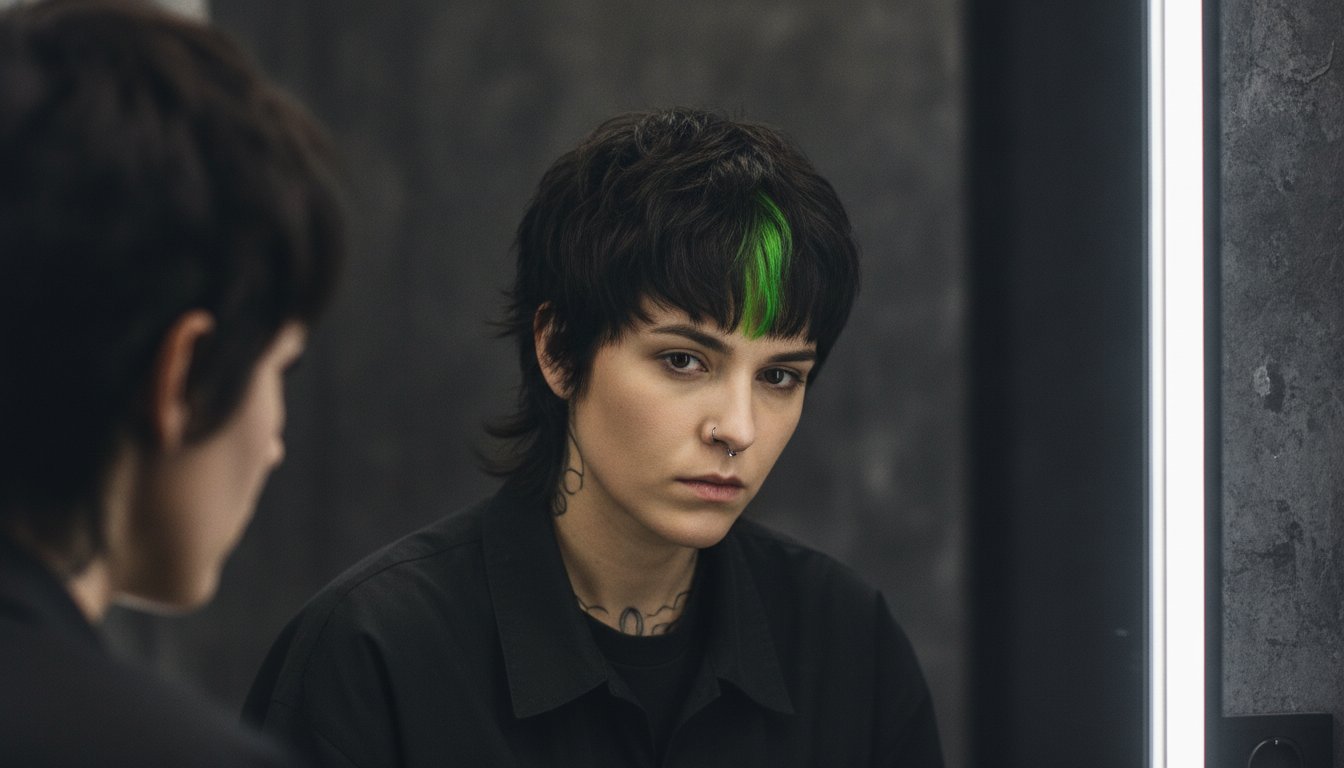
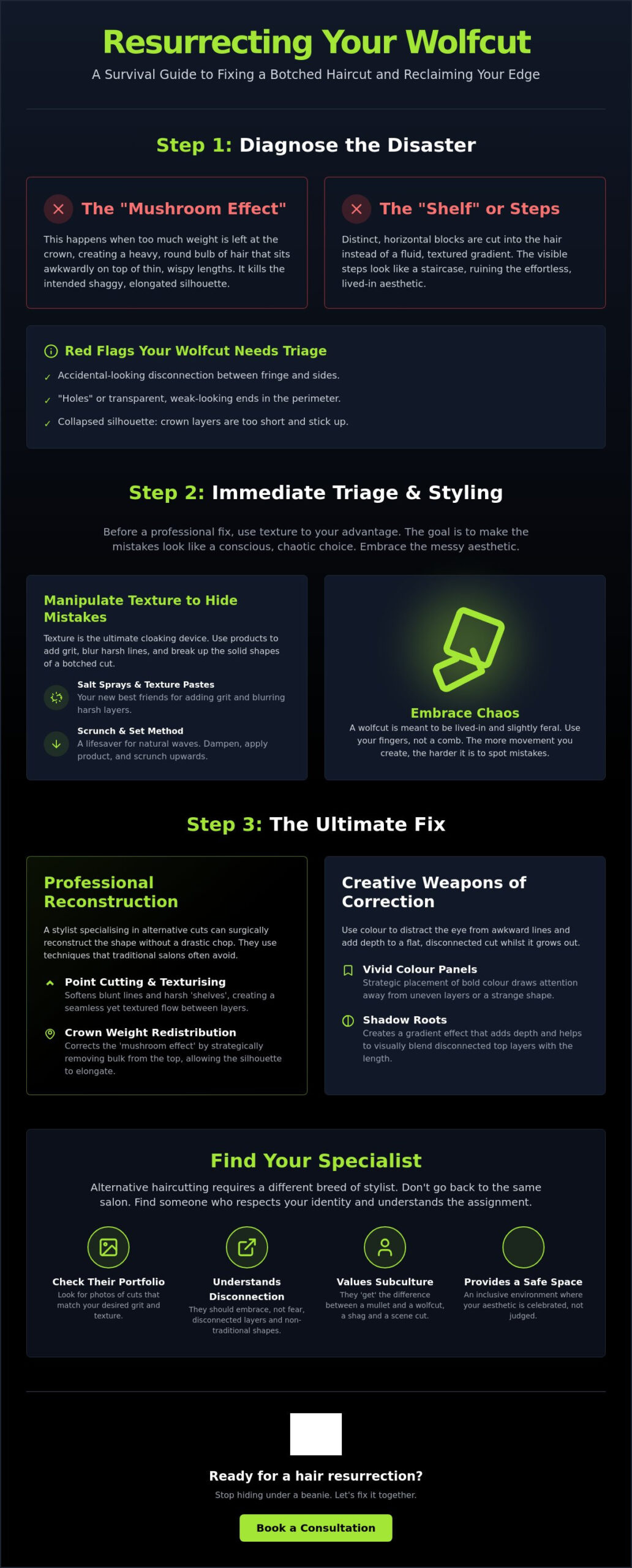
A botched wolfcut isn’t a total disaster; it’s just an unfinished transition that requires a subcultural eye to correct. You probably went in looking for a rebellious, shaggy silhouette but ended up with the dreaded mushroom effect or visible steps that look like a primary school craft project. It’s a common nightmare when a stylist doesn’t understand the nuance of alternative hair. We know the panic of staring at bangs that are too short or layers that don’t blend.

This guide is your roadmap for fixing a bad wolfcut haircut without sacrificing your edge. You don’t have to cut it all off into a boring bob to start over. You’ll discover professional correction techniques, styling triage for the grow-out phase, and advice on finding a stylist who actually respects your identity. We are going to show you how to hide the mistakes whilst restoring an intentional, cool silhouette that feels like you again. It’s time to stop hiding under a beanie and start reclaiming your aesthetic with confidence.

Key Takeaways

  • Identify the “mushroom effect” and harsh layering steps that ruin your alternative silhouette and learn why they happened.
  • Master styling triage for fixing a bad wolfcut haircut by using heavy-duty texture products to blur unintentional asymmetry whilst it grows.
  • Understand how professional techniques like point cutting and crown weight redistribution can reconstruct a botched shape into a balanced gradient.
  • Use creative weapons like vivid colour and shadow roots to distract the eye from harsh lines and add depth to a flat, disconnected cut.
  • Find a specialist who actually understands the grit of alternative hair and provides a safe, inclusive space for your hair resurrection.

The Anatomy of a Failed Wolfcut: Why Your Layers Look More ‘Sheep’ than ‘Wolf’

A botched wolfcut is a special kind of heartbreak. You walked in wanting a rebellious, textured silhouette inspired by subcultural icons; you walked out looking like you’re wearing a mushroom-shaped helmet with straggly bits attached. Understanding the structural failure of your hair is the first step toward fixing a bad wolfcut haircut. Most disasters occur because a stylist tried to apply “safe,” traditional techniques to a shape that thrives on grit and disconnection.

The “Mushroom Effect” is the most common grievance. This happens when too much weight is left at the crown, creating a heavy, round bulb of hair that sits awkwardly on top of thin, wispy lengths. It kills the vibe because a wolfcut should feel shaggy and elongated. Then there is “The Shelf.” This occurs when layers are cut in distinct, horizontal blocks. Instead of a fluid gradient of texture, you get visible steps that look like a staircase. It’s the opposite of the effortless, lived-in aesthetic you were promised.

Don’t confuse a bad wolfcut with an intentional mullet. A mullet has a deliberate, aggressive short-to-long ratio that feels purposeful. A botched wolfcut just looks like a mistake. The wolf cut is fundamentally a modern evolution of the classic shag, relying on internal texture and movement rather than rigid perimeters. If your stylist used traditional blending methods, they likely stripped away the soul of the cut, leaving you with a dated, suburban mess instead of an alternative masterpiece.

The Problem with Traditional Layering

Standard salons often prioritise “seamless blending,” which is the enemy of the wolfcut. Traditional layering techniques use horizontal sections that create weight rather than removing it. In alternative hair design, we embrace disconnection. We want the fringe to feel separate from the side panels. We want the layers to have a jagged, percussive energy. When a stylist tries to make a wolfcut “polite” by blending everything together, you end up with a flat, lifeless shape that lacks any subcultural edge.

Signs Your Wolfcut Needs Professional Triage

If you’re unsure if fixing a bad wolfcut haircut is necessary, check for these red flags. First, look at the fringe. If the bangs are completely disconnected from the side panels in a way that looks accidental rather than edgy, the balance is off. Second, check for “holes” in the perimeter. This happens when a stylist removes too much weight from the bottom layers, leaving the ends looking transparent and weak. Finally, evaluate the crown height. If the top layers are so short they stand up whilst the bottom is still shoulder-length, the silhouette has collapsed. You don’t need a miracle; you need a reconstruction.

Immediate Triage: How to Style Your Way Out of a Hair Disaster

You’ve just looked in the mirror and realised the “vision” was a lie. It’s frustrating. But before you reach for the clippers or hide under a duvet, remember that texture is the ultimate cloaking device. Fixing a bad wolfcut haircut isn’t just about the scissors; it’s about the products in your bathroom cabinet. You can style your way out of a hair disaster by leaning into the very chaos that makes alternative hair so iconic. The goal isn’t perfection; it’s making the mistakes look like a conscious choice.

Embrace the messy aesthetic. A wolfcut is supposed to look lived-in and slightly feral. If your layers are uneven or asymmetrical, lean into it. Use your fingers to break up the hair rather than a comb. The more movement you create, the harder it is for someone to spot a “step” or a “shelf” in your layers. This is about reclaiming your identity and refusing to let a bad salon experience dull your edge.

Manipulating Texture to Hide Mistakes

Salt sprays and texture pastes are your new best friends. They add the necessary grit to “blur” those harsh staircase layers we discussed earlier. By roughening up the hair fibre, you break up the solid lines of a botched cut. If your layers feel too heavy at the crown, applying a product like Death Grip can provide the structural support needed to lift the hair and disguise the “mushroom” effect.

For those with natural waves, the “scrunch and set” method is a lifesaver. Dampen the hair, apply a generous amount of texture product, and scrunch upwards. This encourages the hair to clump in organic, messy patterns rather than hanging in the rigid, uneven sections left by a bad stylist. It’s a vital step in fixing a bad wolfcut haircut whilst you wait for a professional reconstruction.

Heat Styling for Silhouette Correction

Heat tools allow you to physically redirect where the hair sits. If you have short, awkward layers that stick out like a sore thumb, use a small flat iron to “flick” them outwards. This creates a jagged, intentional texture that mimics a successful shag. If the fringe is the problem, don’t leave it hanging flat. Use a round brush or a flat iron to sweep it into the side panels, creating a “curtain” effect that masks any disconnection.

A directional blow-dry can also save your silhouette. If the crown is flat but the bottom is bulky, blow-dry the roots upwards to create height. This balances the weight distribution and prevents the “sheep” look. Whilst these tricks work wonders, they are temporary fixes. If your current look is still causing you grief, consider booking a session for one of our professional Wolfcuts to get the structural correction you actually deserve.

Don’t forget the power of accessories. Bandanas, chunky clips, and beanies aren’t just for bad hair days; they are staples of the alternative aesthetic. Use them to pin back the sections that bother you most. This buys you time and keeps your confidence intact whilst your hair recovers.

Fixing a Bad Wolfcut Haircut: How to Salvage Your Alternative Aesthetic

Professional Reconstruction: Fixing Uneven Layers and Disconnected Shapes

Fixing a bad wolfcut haircut requires more than just a trim; it’s a surgical reconstruction of the silhouette. When your hair has been butchered by traditional techniques, the goal is to restore the balance between the crown and the perimeter. A specialist won’t just chop more hair off. They’ll focus on redistributing weight. If you’re suffering from the mushroom effect, the solution is removing internal bulk from the crown. This creates air and movement, allowing those heavy top layers to sit amongst the rest of the hair rather than on top of it like a lid.

The “Bridge” technique is the secret weapon for hair resurrection. It involves creating new, intermediate layers that link the short, disconnected crown to the longer bottom sections. It’s about building a transition where there was once a void. However, you must know when to stop. Cutting more layers into a shape that’s already too thin at the bottom will only make the problem worse. Sometimes the fix is about refining what’s there and then letting the hair rest. Growth is your ally, but a professional correction gives that growth a sense of purpose.

Blending the “Staircase” Effect

Visible steps in your hair are usually the result of a stylist cutting straight across the hair in horizontal blocks. To fix this, we use deep point cutting and slide cutting. By cutting into the hair at an angle, we shatter those hard lines. The razor is also essential here. It creates the soft, shaggy ends that define a true wolfcut. A specialist understands that the ends should feel lived-in and slightly frayed, not blunt and heavy. We’re aiming for a gradient of texture that feels fluid when you move.

Rescuing the Fringe and Face-Frame

If your fringe was cut too short or feels like a separate entity from the rest of your head, don’t panic. We can soften micro-bangs by point cutting the edges to remove the “blocky” look. Integrating these disconnected face-framing bits into the side panels is about finding the shortest point and creating a diagonal line that flows into the length. To keep everything looking intentional, use Hair To the Throne to maintain volume and grit in the corrected fringe. This ensures the front of your cut has the same rebellious energy as the back.

Vivid Colour and Creative Texturing: The Secret Weapons of Hair Correction

Most guides suggest “growing it out” as the primary fix for a hair disaster. We disagree. Waiting months for hair to grow whilst feeling like a stranger in the mirror is a waste of your aesthetic potential. Fixing a bad wolfcut haircut can be achieved through the art of visual deception. By integrating vivid hair colour, you aren’t just hiding a mistake; you’re evolving your style. Strategically placed pigment can draw the eye toward your best features and away from those awkward “steps” we identified earlier.

Shadow roots add perceived depth to a flat, botched crown. It’s about creating a 3D effect. If your stylist left you with a “mushroom” top, a darker root creates a shadow that makes the hair look more grounded and less puffy. Alternatively, the “Pop of Colour” trick involves highlighting the specific sections that actually work. If your fringe is the only part that survived the butcher’s chair, make it neon. It forces the viewer to focus on the intentionality of the colour rather than the unevenness of the layers. It shifts the narrative from a mistake to a deliberate, high-energy transformation.

Visual Deception with Colour

Darker tones are essential for filling “holes” in your perimeter. If a stylist removed too much weight, a deep charcoal or midnight blue underneath can make the hair appear thicker and more substantial. Neon tips on an uneven hemline turn a mistake into a deliberate “shattered” look. If the whole silhouette feels unsalvageable, a split-dye is the ultimate reset button. It creates a bold, symmetrical divide that distracts from any internal asymmetry. If you’re ready to flip the script on your disaster, check out our Vivid Colour services to start your recovery.

Adding Grit with Creative Texturing

There’s a massive difference between “thinning out” and “creative texturing.” Thinning often leads to the very wispy, weak ends that ruin a wolfcut. Creative texturing is the final boss of fixing a bad wolfcut haircut. It involves “shattering” the ends with a razor or point-cutting to create jagged, aggressive movement. This removes the blocky, heavy look of a bad cut without sacrificing the density you need to survive a night in the mosh pit. It’s about making the hair look intentionally distressed. This grit ensures that even amongst the sweat and chaos of a gig, your hair maintains its rebellious shape rather than falling flat.

Finding Your Specialist: Why Alternative Haircutting Requires a Different Breed of Stylist

Generic salons are often the scene of the crime. They treat alternative shapes like a standard trim, applying rigid, outdated rules to a style that thrives on rebellion. Fixing a bad wolfcut haircut isn’t about finding the nearest salon with a vacancy. It’s about finding a specialist who speaks your subcultural language. Most high-street stylists fear disconnection and aggressive texture. They try to “tame” the hair, which is exactly how you ended up with a mushroom-shaped disaster. You need a stylist who understands that a wolfcut is an attitude, not just a set of layers.

Look for portfolios that feature shag hairdressers and modern mullets. These styles require a specific technical mastery over weight distribution and internal movement. Beyond the technical, prioritize a gender-inclusive safe space. When you’re feeling vulnerable about a botched cut, you deserve an environment that respects your identity and your aesthetic. Heavy Metal Hairdresser specialists focus on individuality over mainstream trends. We don’t want to make you look like everyone else; we want to help you look like the best version of yourself.

Vetting an Alternative Stylist

Social media is your best tool for reconnaissance. When scrolling through a stylist’s Instagram, look past the polished, tonged curls. Does their work show “lived-in” grit? Do they showcase a variety of wolf hair cut designs on different hair types? Check if they use razors and unconventional tools. A razor is often the only way to achieve the shattered, wispy ends that a scissor simply cannot replicate. Finally, see if they’re active amongst alternative subcultures. A stylist who understands the energy of a festival or a mosh pit will understand why your hair needs to move the way it does.

The Consultation: Your Shield Against Another Disaster

The consultation is your opportunity to set boundaries. Don’t just bring “goal” photos; bring “disaster” photos of your current hair. Point out exactly where the previous stylist went wrong. Be specific. Use the terms we’ve discussed. Ask them directly: “How will you blend these steps without losing my length?” If they look confused or suggest a “nice bob” instead, walk out. Fixing a bad wolfcut haircut requires a specialist who isn’t afraid to get aggressive with texture. Ensure they understand your specific subcultural aesthetic, whether that’s Goth, Metal, Emo, or Punk. Your hair is your armour. Don’t let someone who doesn’t understand the battle take the lead.

Reclaim Your Alternative Edge

A botched cut is a temporary setback, not a permanent sentence. You now have the tools to identify the structural failures of a failed shape and the styling tricks to blur those harsh steps whilst you wait for a fix. We’ve shown you how vivid colour and deep point cutting can transform a mushroom disaster back into a sharp, intentional silhouette. Fixing a bad wolfcut haircut is ultimately about trusting the right hands to restore your subcultural grit and reclaim your identity.

It’s time to stop hiding under beanies and start your hair resurrection. Book your wolfcut rescue at Heavy Metal Hairdresser. We provide a gender-inclusive safe space and bring backstage festival styling expertise to every chair. As specialists in aggressive texture and vivid colour, we don’t just fix mistakes; we amplify your individuality. Your hair is your statement. Let’s make it a loud one.

Frequently Asked Questions

Can I fix a bad wolfcut at home with thinning shears?

No, you should put the shears down immediately. Using thinning shears at home is a recipe for a stringy, transparent disaster. Most people end up removing too much bulk from the wrong places, which only makes the “mushroom” effect look more aggressive. Professional correction requires precise point cutting and internal weight redistribution that simply cannot be replicated with a pair of cheap supermarket thinning scissors.

How long does it take for a botched wolfcut to grow out into a shag?

Expect a timeline of three to six months for the layers to blend into a more traditional shag silhouette. Hair typically grows about half an inch per month, so you’ll need that time for the short crown layers to catch up. During this period, booking regular “dusting” trims with a specialist ensures the shape stays intentional whilst you wait for the length to return.

My wolfcut looks like a mushroom; what did my stylist do wrong?

Your stylist likely used traditional horizontal sections and failed to remove enough internal weight from the crown. This creates a heavy “cap” of hair that sits awkwardly on top of thin lengths. In a successful wolfcut, the transition should be a fluid gradient of texture. When a stylist treats the top and bottom as two separate, blunt blocks, the result is that dreaded mushroom shape.

Should I straighten my hair to hide the uneven layers?

Straightening is actually the worst thing you can do for fixing a bad wolfcut haircut. Sleek, flat hair highlights every “step” and “shelf” in a botched cut, making the mistakes impossible to ignore. Instead, you should lean into your natural texture or use heat tools to create messy waves. This visual chaos blurs the harsh lines and makes the unevenness look like a deliberate subcultural choice.

What is the difference between a bad wolfcut and a modern mullet?

The difference lies entirely in intentionality and balance. A modern mullet has a purposeful, aggressive contrast between the short front and the long back. A bad wolfcut just looks like a structural collapse where the layers don’t talk to each other. Whilst a mullet celebrates the divide, a wolfcut is supposed to be a shaggy evolution of the two, requiring a much softer transition.

Can vivid colour really hide a bad haircut?

Vivid colour is a powerful weapon for visual deception. By placing bright neons or deep shadow roots strategically, you can redirect the viewer’s eye away from a botched layer and toward a bold focal point. It shifts the entire narrative of your look from a salon mistake to a high-energy, high-pigment statement. It’s about reclaiming control over your aesthetic when the scissors have failed you.

How much length will I lose if I get my wolfcut professionally corrected?

You shouldn’t lose significant length if you visit a specialist who understands alternative shapes. A pro will focus on “shattering” the harsh lines and redistributing internal weight rather than just chopping the bottom off. In most cases, we only need to trim a tiny amount of the perimeter to clean up the ends whilst we reconstruct the internal layers to restore the balance.

Is a wolfcut suitable for fine or thin hair if it was already ruined once?

Yes, but it requires a very delicate approach to texture. Fixing a bad wolfcut haircut on fine hair involves building internal support at the roots so the hair doesn’t fall flat. We focus on creating the illusion of density whilst removing just enough weight to allow for movement. If your hair was ruined before, it’s likely because the stylist took too much from the perimeter, leaving it looking transparent.