Forget everything the high street told you about “blending” and “tidiness”. If your mullet looks like it belongs in an accountancy firm circa 1985, you haven’t got an alternative style; you’ve got a disaster. True grit comes from embracing aggressive, purposeful disconnection, not trying to make a subcultural icon look “safe” or “presentable”.
We know the frustration of asking for a sharp, rockstar silhouette and walking out with a “helmet” effect on top. It’s a common story: you lose too much length at the back too quickly, or the transition looks like a genuine accident rather than a deliberate stylistic choice. We’re here to help you identify the common mullet cutting mistakes to avoid so you can finally achieve that textured, aggressive finish that grows out with intent. Whether you’re rocking a wolfcut or a heavy shag, balance and weight distribution are everything.
In this guide, we’ll dive into the technical traps that ruin a bold cut. You’ll learn how to maintain that crucial length at the nape and why products like Hair To the Throne are essential for that gritty, lived-in texture. Get ready to turn a mediocre cut into a fierce statement of identity.
Key Takeaways
- Ditch the “helmet” effect by mastering the balance between aggressive layers and intentional disconnection for a sharper silhouette.
- Identify the common mullet cutting mistakes to avoid, such as over-layering the crown or cutting the fringe too narrow, which can kill the flow of your style.
- Discover why thinning shears often sap the soul from an alternative cut and why techniques like point-cutting create more authentic grit.
- Learn the “internal thinning” trick to reduce bulk and restore a failing shape without sacrificing your hard-earned length.
- Understand how to use subcultural identity and musical taste as a technical guide for creating a truly bespoke, rock-inspired look.
Why Most Mullets Fail: Understanding the Alternative Silhouette
A mullet isn’t just a haircut; it’s a subcultural statement. When you get it right, it’s pure rock and roll. When you get it wrong, you’re one step away from a bad fancy dress party. The biggest problem with most modern attempts is a lack of understanding regarding the alternative silhouette. We aren’t aiming for the soft, feathered look of a 1980s pop star. The 2026 aesthetic is about aggressive layers and grit. If your stylist tries to play it safe, they’ll likely fall into the trap of making it look “tidy,” which is the fastest way to kill the vibe.
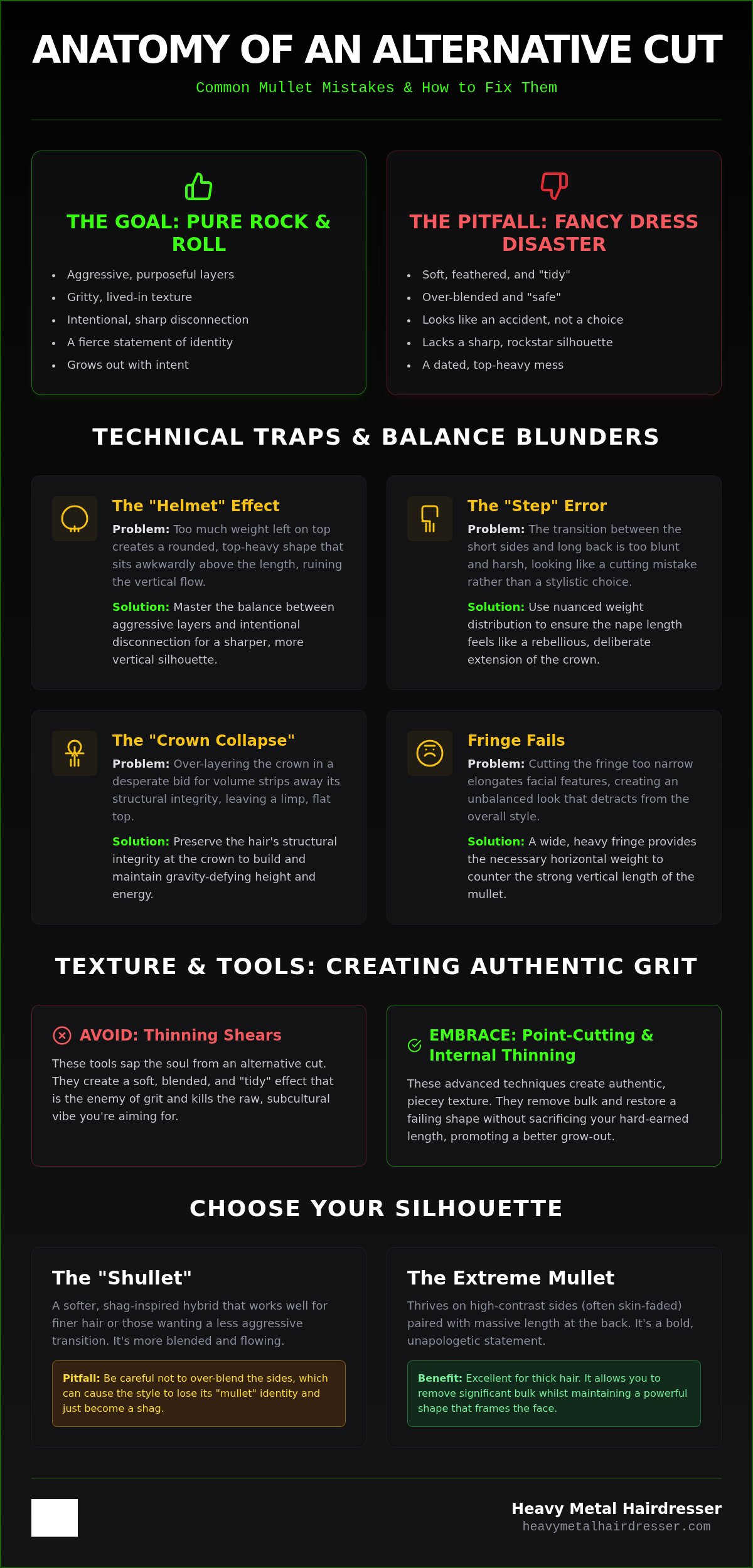
One of the common mullet cutting mistakes to avoid is the “Helmet Mistake.” This happens when too much weight is left on top, creating a rounded shape that sits awkwardly above the length. It ruins the vertical flow. Instead of a tapering silhouette, you get a top-heavy mess that feels dated. Another disaster is the “Step Error.” This occurs when the transition between buzzed sides and the long back is too blunt. It looks like a mistake because it is one. A successful cut requires nuanced weight distribution, ensuring the nape length feels like a rebellious extension of the crown.
Looking back at the history of the mullet, we see it has always been about contrast. However, the modern version demands a specific type of tension between the short and long sections. You want it to look intentional, not accidental.
The Shullet vs. The Extreme Mullet
Choosing your silhouette is the first step. The “shullet” is a softer, shag-inspired hybrid that works for fine hair or anyone wanting a less aggressive transition. Its biggest pitfall is losing the “mullet” identity by over-blending the sides. The extreme mullet thrives on high-contrast sides, often skin-faded, paired with massive length at the back. For thick hair, this allows you to remove bulk whilst maintaining a powerful shape that frames the face without overwhelming it.
The Role of Intentional Disconnection
Blending is often the enemy of alternative hair. Traditional barbering demands seamless transitions; we embrace the gap. Many confuse a “bad cut” with “bold disconnection.” A bad cut looks messy because foundations are weak. Bold disconnection looks sharp because lines are deliberate. It provides that raw aesthetic that sets you apart. Truly, intentional disconnection is the hallmark of the modern mullet haircut. By dodging common mullet cutting mistakes to avoid, you ensure your hair screams attitude, not an accidental error.
Technical Traps: Sectioning and Balance Blunders
Technical mastery isn’t about being neat; it’s about being deliberate. If you don’t understand the architecture of the skull, your alternative cut will fall flat. Literally. One of the primary common mullet cutting mistakes to avoid is the ‘Crown Collapse’. This happens when you over-layer the crown in a desperate bid for volume. Instead of height, you strip away the structural integrity. The hair loses its ability to defy gravity, leaving you with a limp top that doesn’t match the energy of the back.
Failing to plan the ear-clearance is another profile-killer. We call it the ‘Sideburn Struggle’. If you don’t carve out the space around the ear with precision, the hair just clumps together. It loses that sharp, aggressive edge. Similarly, over-direction is a silent killer. Pulling the hair too far forward whilst cutting the sides creates massive ‘holes’ in the length behind the shoulder. It’s a major reason why mullet hairstyles fail during the grow-out phase. You want a solid wall of hair at the back, not a patchy curtain.
Mastering the Radial Section
The radial section is the backbone of your architecture. It is the line that separates the ‘business’ from the ‘party’. Most stylists botch the transition from the top to the nape because they treat them as two separate haircuts. You need to maintain weight behind the ears whilst aggressively removing it from the temples. This creates a forward-pushing energy that looks fierce. If you’re serious about mastering these pivots, our alternative hair courses break down these subcultural silhouettes in detail.
Fringe Fails and Forehead Framing
The fringe defines the face. Go too narrow, and you’ll elongate the features until they look unbalanced. A wide, heavy fringe provides the necessary horizontal weight to counter the vertical length of the mullet. Avoid the ‘bowl cut’ trap by keeping your connection to the sides intentionally jagged. Use a spray of Hair To the Throne during the process. It allows you to see how the fringe behaves with texture, ensuring you don’t accidentally create a flat, lifeless line that kills the rock-inspired aesthetic.
Texture and Tools: Why ‘Tidy’ is the Enemy of Alternative Hair
Clean lines are for office blocks. In the world of alternative hair, “tidy” is just another word for boring. If your mullet looks like it was measured with a spirit level, you’ve missed the point entirely. One of the common mullet cutting mistakes to avoid is treating the texture as an afterthought. You cannot just cut a basic shape and hope for the best. You have to carve the attitude into the hair fibre itself. A mullet that is too polished feels like a costume, not a lifestyle.
The “Over-Thinning” Disaster is a classic trap. Using standard thinning shears often creates a cloud of frizz rather than defined, piecey texture. It strips the hair of its weight and its soul. Similarly, reaching for clippers to “clean up” the edges is a mistake. Clippers create a clinical, manufactured finish that lacks character. If you want a cut that screams subculture, you need the jagged, irregular edges that only a razor or deep point-cutting can provide. You’re aiming for a silhouette that looks like it has already survived a three-day festival. Don’t fight the hair’s natural behaviour, either. Cowlicks in the nape area are gifts. If you try to force a uniform line across a rebellious growth pattern, the hair will kick out awkwardly. Work with the movement and let the hair dictate the grit.
Razor Cutting vs. Point Cutting
Reach for the razor when you want that lived-in, mosh pit ready texture. It provides a feathered, aggressive edge that scissors simply cannot replicate. A common razor mistake is scraping the cuticle; you must slice through the weight with a fresh, sharp blade to keep the hair looking healthy whilst remaining raw. For thicker manes, deep point-cutting is your best friend. It injects chaos into the interior. This removes bulk without making the hair look thin or wispy, maintaining that heavy metal weight we crave.
The Importance of Product Choice
A great cut is only half the battle. If you finish a gritty mullet with a high-shine pomade, you’ve turned a rockstar into a car salesman. A dry, matte finish is essential for modern alternative grit. It highlights the layers and keeps the look authentic. This is where Death Grip comes in. It is designed to create that aggressive, piecey texture that holds its shape through the heaviest sets. Using the wrong product can make a technical masterpiece look like a genuine mistake.
How to Fix a Bad Mullet: Step-by-Step Restoration
Most high-street barbers will tell you that a botched cut requires a buzz cut and a fresh start. They’re wrong. A bad mullet isn’t a death sentence; it’s just a shape that has lost its way. To save the style, you must first assess the damage. Is it a weight issue, a length issue, or a balance issue? Usually, it’s a combination of all three. If you’ve fallen victim to common mullet cutting mistakes to avoid, such as the dreaded “step” or an accidental 80s accountant vibe, there are tactical ways to reclaim your grit without losing your hard-earned length.
The “Internal Thinning” trick is your best friend here. By removing bulk from the inside of the hair rather than the surface, you can collapse a “helmet” shape whilst keeping the exterior silhouette intact. If your layers look too uniform or “neat,” you need to “shag it out.” This involves deep, irregular point-cutting to break up those polite lines and inject some much-needed chaos. If you’ve got genuine “holes” or uneven patches, creative colour can be a lifesaver. Using a darker root or vivid block panels can mask technical errors and make a shaky transition look like a deliberate stylistic choice.
Re-balancing the Profile
Restoring the silhouette requires a methodical approach to weight distribution. Follow these steps to get the shape back on track:
- Step 1: Shorten the top sections. This creates a more vertical, aggressive lift that moves the focus away from the bulk at the sides.
- Step 2: Carve out the sides. Use a razor to tighten the area around the ears, which emphasises the disconnection between the front and the back.
- Step 3: Texturise the perimeter. Soften any “boxy” or square corners at the nape to ensure the length flows naturally rather than hanging like a flat curtain.
When to Call in a Professional
There comes a point where DIY intervention only makes the problem worse. If you’ve hacked into the hairline or lost the structural integrity of the crown, you need a rescue mission. An alternative hair specialist sees the shape through a different lens than a standard barber. We don’t look for symmetry; we look for attitude and subcultural relevance. A professional “re-boot” doesn’t just fix the hair; it restores your confidence to wear a bold style with pride. If your current look feels like a joke, book a restoration session and let us turn that disaster into a masterpiece.
Mastering the Modern Mullet: The Heavy Metal Hairdresser Approach
We don’t believe in factory-line haircuts. At Heavy Metal Hairdresser, our philosophy is rooted in the individual, not the trend. A mullet shouldn’t be a uniform; it should be a bespoke piece of architecture that reflects who you are. Avoiding common mullet cutting mistakes to avoid isn’t just about technical skill; it’s about cultural literacy. We don’t just look at your hair; we look at your life. Our stylists are trained to see the person behind the mane, ensuring every snip serves a purpose.
The consultation is where the magic happens. We often ask, “What music do you listen to?” It sounds like small talk, but it’s a technical guide. A punk-inspired mullet requires a different weight distribution and level of aggression than something leaning towards a 70s glam-rock vibe. By understanding your subcultural roots, we can tailor the texture to match your energy. We focus on creating aggressive texture that doesn’t just look good in the mirror; it lasts between salon visits. It’s about building a shape that evolves whilst maintaining its edge.
Education for the Rebellious Stylist
Mastering these unconventional shapes requires a different kind of training. Our Alternative Hair Courses UK are designed for stylists who want to break the rules with precision. We teach the “backstage” techniques honed at festivals like Download and Bloodstock, where hair has to survive heat, sweat, and movement. Learning to master the wolf hair cut provides the perfect foundation for mullet mastery. It teaches you how to balance extreme layers with wearable grit, ensuring you never fall into the trap of a “safe” mainstream finish.
Final Styling Secrets
Maintenance shouldn’t be a chore. The best alternative cuts thrive on a “scrunch and go” mindset that embraces natural chaos. Apply Hair To the Throne to damp roots and mid-lengths to achieve maximum volume and a gritty, lived-in feel that stays tall. Once dry, use your fingers to break up the sections for that piecey, rock-inspired silhouette. If you want a look that stays sharp without losing its soul, it is time to ditch the high-street approach. Common mullet cutting mistakes to avoid become a thing of the past when you work with experts who live and breathe this scene. Ready for a cut that doesn’t miss? Book your transformation with the Heavy Metal crew.
Claim Your Subcultural Silhouette
Ditching the mainstream doesn’t mean settling for a technical disaster. You now know that a true alternative mullet relies on aggressive texture and intentional disconnection, not the safe, blended lines of the high street. By identifying the common mullet cutting mistakes to avoid, you’ve already taken the first step toward a silhouette that actually speaks your language. Whether you’re fixing a DIY mishap or refining a wolfcut, focus on weight distribution and the raw energy of the razor.
Our crew lives for this grit. As stylists for Download and Bloodstock festivals, we’ve mastered the art of hair that survives the pit whilst looking fierce. We provide a gender-inclusive safe space where vivid colour and aggressive texture are the standard, not the exception. Don’t let a mediocre barber kill your vibe with a “tidy” trim that lacks soul. It’s time to wear your identity with pride and precision.
Join the Revolution: Book Your Alternative Cut at Heavy Metal Hairdresser. Your best look is waiting.
Frequently Asked Questions
How do I stop my mullet from looking like a 1980s haircut?
Focus on aggressive texture and intentional disconnection rather than soft, feathered blending. Modern mullets thrive on sharp contrast and irregular layers that create a gritty silhouette. Avoid the “helmet” effect by keeping the top weight light and the sides tight. Using a razor instead of clippers adds a raw, lived-in edge that feels contemporary. It is about embracing a rock-inspired attitude that rejects the polished finish of decades past.
Can I cut a mullet on curly hair without it looking messy?
Absolutely, curly hair provides natural volume that makes an alternative mullet look incredible. The key is to cut the hair whilst dry to see exactly how each curl sits and bounces. Avoid over-thinning the ends, which leads to frizz. Instead, use deep point-cutting to remove bulk. This ensures your curls frame your face with intent rather than looking like an accidental mop of hair that has lost its shape.
What should I do if I cut the top of my mullet too short?
If the top is too short, you should lean into a “shullet” or wolfcut hybrid to re-balance the shape. Shorten the transition area between the crown and the nape to create a more cohesive vertical line. This is one of the common mullet cutting mistakes to avoid, but it is fixable. Use a matte product like Death Grip to add piecey texture, which helps mask the lack of length whilst it grows back with intent.
How do I explain an alternative mullet to a traditional barber?
Show them clear visual references from subcultural scenes rather than celebrity magazines. Use specific terms like “intentional disconnection” and “jagged texture”. Tell them you want to avoid a “tidy” finish and prefer a razor-cut edge. If they seem hesitant about leaving the back long whilst skin-fading the sides, they might not be the right fit. A traditional barber often prioritises symmetry over the aggressive grit that defines this style.
Is it possible to have a mullet with fine or thin hair?
Yes, fine hair can look surprisingly dense with the right technical approach. You need to focus on internal weight removal to create lift at the root without stripping the perimeter. Avoid using heavy oils or waxes that collapse the shape. Instead, use a volume-boosting spray like Hair To the Throne. This provides the structural support needed to maintain a bold silhouette without the hair appearing sparse or stringy whilst you move.
How often should I trim my mullet to keep the shape sharp?
You should aim for a professional trim every six to eight weeks to maintain the aggressive silhouette. The “party” at the back grows at the same rate as the “business” at the front, which can lead to a loss of balance. Regular maintenance ensures the disconnection remains deliberate. If you wait too long, the layers begin to blend into a generic shag, losing that sharp, alternative edge that sets you apart.
What are the best products for styling a textured mullet?
The best results come from products that provide a dry, matte finish with high hold. We recommend Hair To the Throne for initial volume and grit on damp hair. Once dry, use Death Grip to define individual sections and create a piecey, aggressive look. These tools help you avoid common mullet cutting mistakes to avoid by providing the structural support that a technical cut needs to truly shine in a high-energy environment.
Can a mullet be professional for a workplace environment?
A well-executed mullet is a powerful statement of identity that can absolutely work in professional settings. It comes down to the balance of the cut and how you carry it. A modern mullet with clean, intentional lines looks like a high-fashion choice rather than a lack of grooming. By focusing on a sharp silhouette and healthy hair, you project confidence and creativity, which are valued traits in any modern career path whilst staying authentic.