A mullet doesn’t look good just because it’s bold. It looks good when the proportions feel deliberate on you. If you’re wondering how to make a mullet look good, start with the balance between the fringe and sides, the layers at the crown and the length at the back. Get that relationship right, and the contrast feels like a choice, not a haircut gone rogue.
It’s fair to wonder whether the shape will suit your face, work with your natural texture or demand a complicated routine every morning. There isn’t one template to suit everyone. A mullet can be softened, sharpened, layered or kept subtle to work with your features, hair and personal style. This guide will help you choose proportions, find styling approaches that fit your day-to-day and explain the details you want to your stylist. Think less copy-and-paste trend, more personal shape with just the right amount of attitude.
Key Takeaways
- Learn how to make a mullet look good by balancing the fringe, sides, crown and back to suit the effect you want.
- See how straight, wavy, curly, fine or thick hair can shape the cut’s movement and silhouette.
- Build a simple styling routine that brings out your natural texture without weighing it down.
- Spot common choices that can make a mullet feel unbalanced, including copying a reference without adapting it to your hair.
- Prepare clear references and details about your daily routine so your stylist can shape a mullet around you.
How to Make a Mullet Look Good: Start with Shape, Not Hype
Worried a mullet will look dated or leave you feeling awkward? The cut isn’t locked to one era or one extreme silhouette. Learning how to make a mullet look good starts with treating it as a shape designed to work from every angle, rather than a trend to copy blindly. The contrast between short and long can be soft and blended, sharply defined or somewhere in between. What matters is that the parts feel connected and intentional on you.
There’s no universally flattering version. A bold, high-contrast outline might feel right for one person; another may prefer a quieter shift in length. Neither is more authentic. Your preferred attitude, your hair’s natural movement and the way the cut sits around your head all help determine the proportions.
What makes a mullet look balanced rather than accidental?
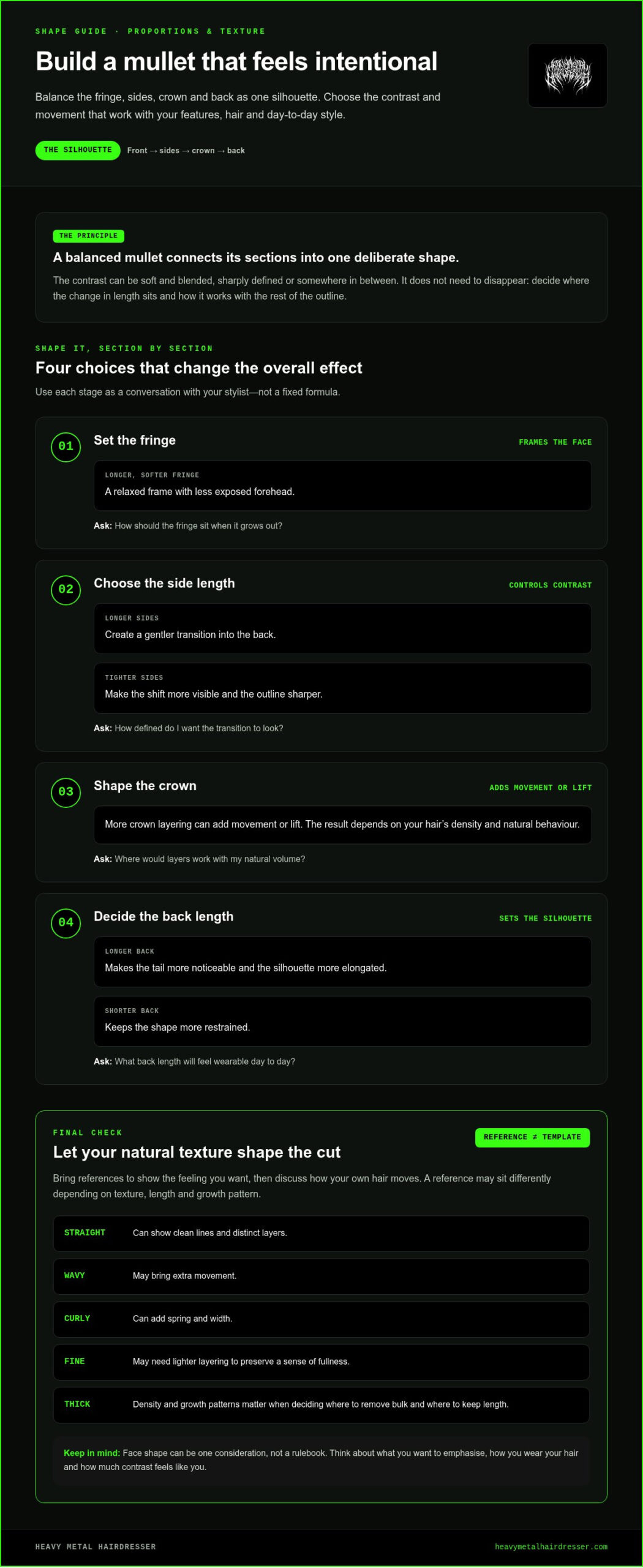
Think of the front, sides, crown and back as one silhouette. The fringe frames your face. Side length controls how much contrast you see, while crown layers connect the shorter sections to the longer back. If those areas fight each other, the shape can feel disconnected. Thoughtful blending or a deliberate, crisp break makes the contrast look like a choice.
A balanced mullet connects the front, sides, crown and back into one intentional shape, whether its contrast is soft or sharp.
That doesn’t mean every section has to blend seamlessly. A visible change in length can be the point. Decide where that change sits and how it works with the rest of the outline.
How do modern mullets differ from the stereotype?
The familiar retro silhouette is part of the cut’s story, not a rulebook. The history of the mullet shows how its look and cultural meaning have shifted over time. Contemporary versions can keep a strong short-front, long-back contrast while personalising the details instead of defaulting to one exaggerated shape.
Fringe, side length, layering and texture each change the attitude. A softer fringe and blended sides can make the outline feel relaxed; shorter sides and stronger separation create a sharper statement. Shaggy layers bring movement, while a cleaner outline can feel more controlled. For a wider look at different cut variations, explore this modern mullet haircut guide.
Use references to show the feeling you’re after, not to demand an exact copy. The same outline can sit very differently depending on hair texture, length and growth pattern. A textured cut can translate those visual cues into a shape that feels like yours, with the contrast dialled up or down to match your preference.
Choose Mullet Proportions That Work with Your Features and Hair
The same mullet can look soft and understated on one person, then sharp and full of attitude on another. The difference often comes down to proportion: fringe shape, side length, crown layers and how far the back falls. Face shape can be one consideration, but it isn’t a rulebook. Think about what you’d like to emphasise, how you wear your hair and how much contrast feels like you.
Which mullet details can change the overall effect?
A longer fringe can bring more focus to the eyes, while a shorter or more open fringe reveals more of the face. Sides left longer create a gentler transition into the back; tighter sides make the shift more visible. Crown layers can add lift and movement, though the result depends on your hair’s density and natural behaviour. More length at the back makes the silhouette more pronounced, while a shorter tail keeps it restrained.
Use the table as a starting point for discussing the feel you want, not as a fixed formula.
| Design choice | Possible visual effect | Discussion prompt |
|---|---|---|
| Longer, softer fringe | A relaxed frame with less exposed forehead | How should the fringe sit when it grows out? |
| Shorter sides | Stronger contrast and a sharper outline | How defined do I want the transition to look? |
| More crown layering | Extra movement or lift, depending on density | Where would layers work with my natural volume? |
| Longer back | A more noticeable tail and elongated silhouette | What back length will feel wearable day to day? |
How should hair texture influence your mullet?
Texture changes how the cut moves, so the finished shape won’t always match a reference exactly. Straight hair can show clean lines and distinct layers; wavy hair may bring extra movement. Curls can add spring and width, while fine hair may need lighter layering to preserve a sense of fullness. Thick hair can carry more weight, so its density and growth patterns matter when deciding where to remove bulk and where to keep length.
Bring references, then talk through what your hair does naturally and how much styling you’re happy to do. A wolf cut shares a layered, textured feel with some mullets, but shifts the overall balance; explore this wolf hair cut guide if you’re weighing up those shapes. For a cut shaped around your texture and preferences, explore Heavy Metal Hairdresser.
Style a Mullet So the Texture Looks Intentional
Styling shouldn’t bury the cut under product or turn your morning into a wrestling match. The goal is to make the shape readable: bring out the layers, give the fringe direction and let the back move naturally. Start with a small amount of suitable styling product to add definition without flattening the hair. You can always add more.
How can you bring out texture without overworking the hair?
Begin with clean, damp hair and work with its natural movement. Your routine will depend on your texture and the finish you want, but this simple sequence gives you room to adjust:
- Remove excess water. Gently towel-dry so your hair is damp, not dripping.
- Apply a small amount of product. Warm it between your hands, then spread it through the areas that need definition. Use less at first, especially if your hair is fine or easily weighed down.
- Shape with your fingers. Separate a few layers, guide the fringe and encourage movement through the crown and back. Avoid combing everything into place if you want a lived-in finish.
- Check the outline. Let the hair settle, then add a little more product only where the texture needs extra control.
Finger styling is one option, not a rule. Wavy or curly hair may need a gentler touch to keep its movement; straighter hair might benefit from more deliberate separation. Follow what your hair does rather than forcing it into a finish it won’t hold comfortably.
What everyday styling choices make the cut feel like yours?
Small changes shift the mood. Try a different parting, sweep the fringe to one side or leave it loose. For a piecey finish, separate a few strands with your fingertips. Tousle the crown for a more relaxed feel, smooth the surface for a cleaner outline, or add definition selectively for a sharper, more controlled shape.
A lived-in finish can still look intentional. Keep the overall silhouette clear, even if individual strands fall freely. If the fringe and crown have movement while the longer back keeps its shape, the cut reads as considered rather than unfinished. That’s a practical way to make a mullet look good without repeating the exact same styling every day.
For a deeper routine and more ways to work with texture, read how to style a modern mullet. To explore personalised alternative cuts and texture, visit Heavy Metal Hairdresser.
Avoid the Mullet Mistakes That Make the Shape Feel Unbalanced
A mullet doesn’t have to be extreme to look deliberate. A softer transition, a shorter back or sides that keep more length can still give the cut its distinct character. The common mistake is assuming bigger contrast automatically means a better mullet. Strong proportions matter more than pushing every feature to its limit.
An intentional mullet makes its contrast feel designed; an unfinished shape looks as if its different lengths weren’t considered together. If yours feels off, notice where the balance breaks down. The fringe may feel too heavy beside close-cut sides, or the back may seem disconnected from the crown. Naming the issue gives you a clearer starting point than deciding the whole cut is wrong.
Why can a mullet look different from the reference photo?
A photograph captures one person’s texture, density, length, growth patterns and styling. Your hair brings a different mix, so even a similar cut can fall another way. Use references to communicate what attracts you, rather than expecting an identical result. Is it the fringe, the length around the sides, the crown layers or the shape at the back? Pointing to those details helps turn inspiration into a cut that works with your hair.
Styling affects the comparison, too. A reference might show carefully defined texture, while your hair is air-dried or brushed smooth. Before changing the cut, try styling it to bring out the intended movement. If the outline still feels wrong, discuss which proportion you’d like adjusted.
Can you make a mullet softer or easier to grow out?
Yes, you can dial back the contrast through proportion and blending. Keeping more length at the sides or choosing a less pronounced back can create a gentler silhouette. If you have future length goals, mention them before settling on the strongest contrast. That gives the shape a direction beyond its first day.
Growing out depends on the starting cut and how your hair grows, so there’s no universal timeline or guaranteed smooth transition. Between cuts, keep the look readable with a styling approach that suits your texture. If the outline starts to lose its shape, a refresh can focus on the areas that feel bulky or disconnected rather than making everything shorter. Let how the cut sits for you, rather than a fixed schedule, guide the timing.
If you want a mullet shaped around your references, texture and plans for growing it out, explore a personalised mullet cut with Heavy Metal Hairdresser.
Get a Mullet Cut That Feels Like You
A reference photo is a starting point, not a blueprint. The best way to explain how to make a mullet look good for you is to show what you’re drawn to, then add the details that make the cut wearable in your everyday life. A stylist can translate those preferences into a shape that works with your hair, rather than reproducing someone else’s silhouette.
What should you tell your stylist before getting a mullet?
Bring a few reference images and point out the exact details you like. Maybe it’s the fringe in one photo, the softer sides in another or the length at the back. Be just as clear about what feels too extreme. Then share your current length, natural texture and usual routine, including how much styling you realistically want to do.
How does a personalised alternative cut come together?
A considered cut brings your preferences, texture and upkeep into the same conversation. Your stylist can use your references to understand the mood you’re after, then adapt the layers and proportions to how your hair naturally sits. That might mean keeping more length in one area, changing the fringe or adjusting the contrast so the shape feels cohesive on you.
At Heavy Metal Hairdresser, alternative haircutting and textured styling centre individuality rather than a one-template result. It’s an inclusive space where self-expression is welcome, but that doesn’t mean every mullet should look the same. The aim is to find a version that feels expressive and comfortable for the person wearing it.
Before you settle on the details, make sure the conversation covers both the look you want and the effort you’re happy to put into it. A cut that suits your texture and routine is easier to make your own.
If you’re ready to explore a mullet shaped around your preferences, take a look at the expressive cuts and textured styling at Heavy Metal Hairdresser.
Make the Mullet Your Own
Knowing how to make a mullet look good comes down to more than chasing dramatic contrast. Choose proportions that work with your features and hair, style to bring out its natural texture, and use references to explain the details you want rather than demand an exact copy. A strong cut should feel like you, not a template.
Heavy Metal Hairdresser was founded by barber and creative stylist Simon Tuckwell, bringing alternative haircutting and textured styling to an inclusive space where individual expression is celebrated. The salon’s backstage festival work includes Download and Bloodstock, but the starting point for your cut is your own style, texture and daily routine.
Ready to explore a mullet shaped around your expression? Explore a mullet cut shaped around you. Bring your references, share what feels right and make the look your own.
Frequently Asked Questions
Can anyone make a mullet look good?
A mullet can be adapted to many hair types and personal styles, but no single version suits everyone. The key is finding proportions that work with your natural texture, preferred level of contrast and everyday routine. Bring reference images and point out what you’d keep or soften, such as the fringe or length at the back. The aim is a shape that feels like you, not a copied template.
How do I make a mullet look less extreme?
Ask for a softer balance between the sides and back, and discuss fringe length, layering and blending before the cut. A mullet can still read clearly without dramatic contrast. Reference images can help show the level of boldness you prefer. Your current length and natural texture also affect how subtle the finished shape can be, so talk through how the cut is likely to sit and move with your hair.
Does a mullet suit fine or thin hair?
A mullet can work with fine or thin hair, but the cut should account for its density, movement and natural volume. Talk through how much layering will create shape without making the ends feel too sparse. Styling can help define texture, but it can’t change your hair’s underlying density. Bring examples you like and explain how much daily styling feels realistic, so the proportions can be tailored accordingly.
How do I style a mullet at home?
Start with clean, damp hair and work with its natural movement. Apply a small amount of suitable styling product, then add more only if needed. Use your fingers to separate layers or guide the fringe, and choose a finish that suits you, from tousled to defined or smooth. Your cut and hair type will affect the routine, so ask your stylist to show you a technique you can manage at home.
Can curly or wavy hair work with a mullet?
Yes, waves and curls can give a mullet natural movement and a distinct silhouette. The cut should account for how your hair sits when dry, along with its density and growth pattern. Think about whether you want to define your texture or keep it softer, and share your usual styling routine. Reference images with a curl or wave pattern similar to yours can help communicate the finish you have in mind.
How often should you get a mullet trimmed?
There’s no single trim schedule that works for every mullet. It depends on how quickly your hair grows, how sharply defined the cut is and how much change you’re comfortable with between appointments. A softer, lived-in shape may feel different from a highly structured one as it grows. Notice which areas lose their outline first, then use that as a guide when deciding when a refresh would help.
Can a mullet be grown out if I change my mind?
Yes, but growing out a mullet takes patience and depends on its starting length, layers and contrast. Mention your future length goals before choosing the cut, so the strongest proportions can take them into account. As it grows, occasional reshaping may help the changing lengths feel more intentional. There’s no single quick trim that makes every section grow evenly, so expect the transition to vary with your hair.