
What if a sharper, more androgynous shape didn’t mean giving up your length? The right layers, fringe and texture can change how long hair sits and moves without taking it all off. Androgynous haircuts for long hair aren’t about following a gendered rulebook. They’re about finding a silhouette that feels like you.
It’s frustrating when an inspiration photo gives you the vibe but not the haircut behind it. A shag, wolfcut or softly layered shape can each create a different outline, and your natural texture and styling habits will affect the result. Instead of asking for something simply “androgynous”, it helps to pin down the details you want to change.
This guide compares long-hair cut ideas by their shape, movement and styling needs, and explains how layers and fringe affect the silhouette. You’ll also find practical ways to describe what you want, from keeping the ends long to adding shorter pieces around your face. Bring references, preferences and boundaries. The goal is a cut that feels authentic, not like a compromise.
Key Takeaways
- Choose the silhouette first: the outline, weight and face-framing can change the feel of long hair without relying on gender labels.
- Use layers and fringe to control movement and shape, and decide whether you prefer a solid edge or a more textured finish.
- Compare different androgynous haircuts for long hair by how much length they keep, the shape they create and the styling effort they need.
- Consider your natural texture and how much daily styling fits your routine before settling on a cut.
- Take clear references to your stylist and explain what you want to keep, change and avoid. Styling can alter the finish, but the cut sets the foundation.
What makes long hair look androgynous? Start with shape, not labels
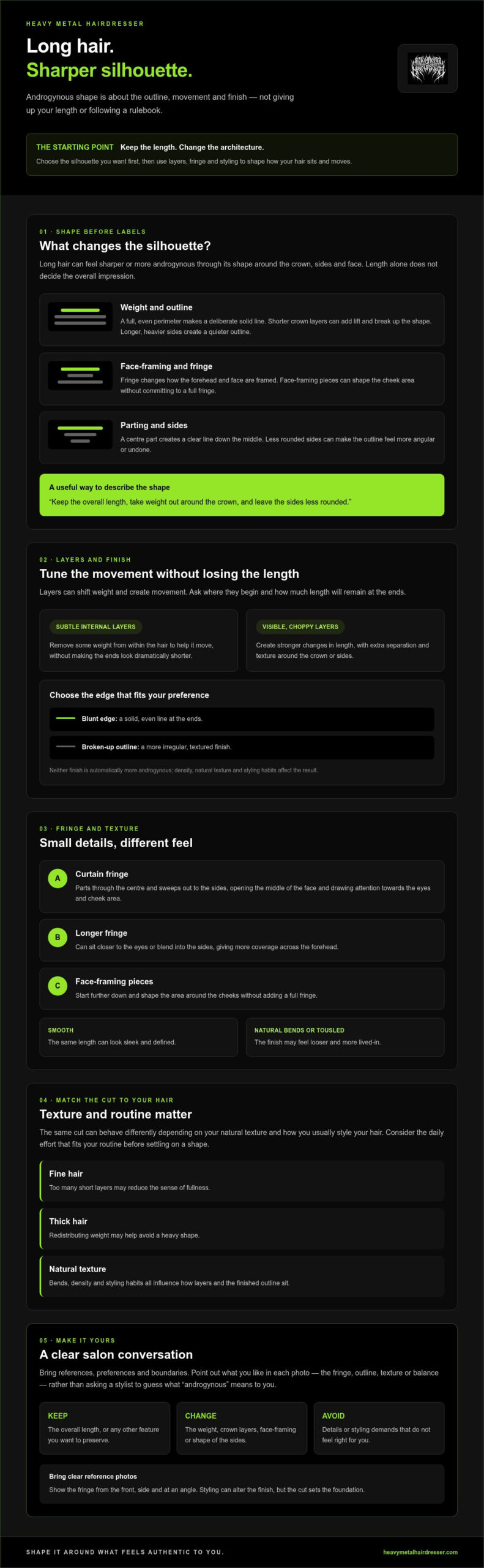
An androgynous haircut is a personal expression created through shape, texture and styling, not a fixed hairstyle or gender rule. The term androgynous can describe different forms of gender expression; in hair, it doesn’t prescribe one approved look. Long hair can feel less traditionally gendered through its outline and movement while staying long. Keep the length, change the architecture.
Start by deciding where you want the hair to carry weight. A full, even outline gives the ends a smooth, deliberate line; shorter crown layers can add lift and break up the shape. Face-framing pieces bring attention to the front, while longer, heavier sides create a quieter silhouette. These details work together, so a cut isn’t defined by one feature alone.
Can long hair still read as androgynous?
Absolutely. Length alone doesn’t decide whether a style feels masculine, feminine or androgynous. Shape around the crown, sides and face can change the overall impression without removing length. For example, a long cut with a flatter crown and less rounded sides may feel sharper than one with soft volume throughout. Start with the feeling you want, not a rule about what long hair “should” look like.
Which details change the silhouette most?
Layers can shift weight and create movement; fringe changes how the forehead and face are framed. A centre part creates a clear line down the middle, while a less rounded outline can make the shape feel more angular or undone. No single detail suits every face, identity or hair type, so treat these as options to discuss rather than instructions.
Texture and finish matter, too. Worn smooth, the same length can look sleek and defined; left with natural bends or a tousled finish, it may feel looser and more lived-in. A shag or wolfcut can build visible movement through the crown and sides while keeping the ends long. The contrast between the shorter layers and the length gives the silhouette its character.
For a salon conversation, describe the shape in plain language: “Keep the overall length, take weight out around the crown, and leave the sides less rounded.” Bring reference photos and point out what you like in each one, such as the fringe, outline, texture or balance. That gives a stylist something specific to interpret, without asking them to guess what androgyny means to you. The best androgynous haircuts for long hair are shaped around your preferences and the way your hair behaves.
How layers, fringe and texture shape androgynous long hair
Once you’ve chosen the broad silhouette, layers and fringe help tune its balance. They can change where the hair sits, how much movement it has and what catches the eye, without dictating a gendered result. The same length can feel soft, graphic, relaxed or deliberately jagged, depending on how it’s cut and worn.
What do layers add to long androgynous hair?
Subtle internal layers remove some weight from within the hair, helping it move without making the ends look dramatically shorter. More visible, choppy layers create stronger changes in length, with extra separation and texture around the crown or sides. Both approaches can retain length at the perimeter, but they create different shapes.
That perimeter matters. A blunt edge gives the ends a solid, even line; a broken-up outline looks more irregular and textured. Neither is automatically more androgynous. Density, natural texture and how you usually style your hair all affect the result. Fine hair may lose a sense of fullness with too many short layers, while thick hair may need weight redistributed to avoid a heavy shape. Ask your stylist where the layers will begin and how much length will remain at the ends.
Should you add a fringe or face-framing layers?
A curtain fringe parts through the centre and sweeps out to the sides, opening the middle of the face and drawing attention towards the eyes and cheek area. A longer fringe can sit closer to the eyes or blend into the sides, giving more coverage across the forehead. Face-framing pieces start further down, shaping the area around the cheeks without committing to a full fringe.
These are visual choices, not gender signals. A fringe can sharpen or soften the outline depending on its length, density and finish. Cultural ideas about long hair and femininity also have a history; BBC Science Focus explores the cultural forces and individual differences behind that association. Your cut doesn’t have to follow those assumptions.
Bring reference images that show the fringe from the front, side and at an angle. Point out what appeals to you, such as the amount of forehead coverage, how the sides connect or how much movement sits around the eyes. A stylist can adapt the idea to your hair rather than copy a picture blindly. The cut builds the shape; styling decides how softly or sharply that shape shows up. For a personalised approach to shags, wolfcuts and textured shapes, explore alternative haircut expertise.
Five androgynous haircut ideas for long hair, compared
Think of these as starting points, not gender categories. Each can be adapted to your texture, preferred outline and how much length you want to keep. The best gender-neutral haircut reference is one that shows details you like, not a rule you have to follow. Heavy Metal Hairdresser works with shags, wolfcuts and mullets, all shapes that can be tailored to personal expression.
- Long shag: Layers build movement through the crown and sides while the ends can stay long. The outline feels textured and relaxed. Styling effort is usually low to moderate, depending on your natural texture and how defined you want the layers to look. See more long shag haircut ideas for inspiration.
- Long wolf cut: Shorter, choppier layers on top contrast with length at the back, creating a bolder, more lifted silhouette than a softer shag. It retains length at the back, though the shorter sections make the shape more noticeable. Styling effort can be moderate if you want to bring out the layers. Explore wolf cut shapes and texture for more detail.
- Elongated mullet: A shorter, shaped front and sides meet a longer back. Keep that contrast subtle for a quieter outline, or make it more pronounced for a sharper, more dramatic shape. Length retention is strongest at the back; styling effort depends on how much definition you want at the top and sides. A modern mullet guide can help you compare variations.
- Blunt-and-textured shape: A solid perimeter keeps the ends looking full, while selective texture breaks up the surface and adds movement. This direction preserves a clear sense of length without heavily layering the whole cut. Styling effort is often low if you prefer the natural finish, or higher if you want a carefully defined contrast.
- Layered fringe: Keep the length through the back and add a fringe that blends into face-framing layers. The result draws attention towards the front without dramatically changing the overall length. Choose a soft, longer fringe for an easier grow-out, or a stronger shape for more impact; styling effort varies with your fringe’s texture and finish.
Which long cut gives you texture without losing length?
A long shag generally spreads movement through the shape, while a wolf cut tends to create stronger contrast between shorter upper layers and longer ends. Both can retain length, but ask your stylist where the layers will start and how much weight they’ll remove. For more inspiration across alternative hairstyles and shapes, compare references that show the outline as well as the texture.
How can a long mullet create a sharper outline?
The shorter front and sides make the longer back stand out. A subtle blend gives a softer shift; a more pronounced difference creates a bolder profile. Bring references that show the front, side and back, then explain how much contrast feels right to you. That makes it easier to personalise the shape rather than copy a cut wholesale.
How to choose a long androgynous haircut for your hair and routine
Use this process to turn saved inspiration into a cut brief your stylist can work with. You don’t need the perfect name for the style. Be clear about the shape you want, what you want to keep and how much effort you’re happy to put in each day.
- Name the shape. Describe the outline or mood you’re after: sharper sides, more movement at the crown, a less rounded shape or a softer frame around your face.
- Assess your texture. Look at how your hair sits naturally, including its density, wave or curl pattern and where it gains volume.
- Choose the details. Decide whether you want a fringe, face-framing layers, a blunt edge or more visible texture. Bring reference images showing the front, sides and back, plus your hair in its usual, unstretched state.
- Talk through upkeep. Be honest about your daily routine. Ask what the cut will look like air-dried or with minimal styling, and what you’d need to do to recreate the reference.
How do hair texture and density affect the result?
Straight hair may show a clean outline and distinct layers; waves and curls can bring extra movement and change how short sections sit. Fine hair can lose some visual fullness if too much weight is removed, while dense hair may need careful shaping to avoid a bulky outline. None of these textures rules out a silhouette. Show your stylist how your hair behaves day to day, not only how it looks after heat styling or stretching it out.
What should you tell your stylist before the cut?
Describe the mood and outline you want instead of relying on a gendered haircut label. Agree your boundaries first: which lengths must stay, and where shorter layers or fringe are welcome. Talk through styling time and upkeep before cutting begins. If you’re unsure about a big change, say so; your stylist can discuss how different amounts of layering might affect the shape before you commit.
Bring a few references, but explain what you like in each one. One may show the fringe you want; another may capture the outline or texture. That gives your stylist room to translate the details into a cut that works with your hair and preferences, rather than copying a look that depends on a different texture or styling routine.
Heavy Metal Hairdresser is an inclusive alternative salon with experience in shags, wolfcuts, mullets and textured styling. To see examples of these approaches, view alternative haircut inspiration.
Make your long androgynous haircut yours with styling and expert guidance
The cut gives your hair its underlying shape. Styling changes how that shape reads from day to day. A centre or side part can shift the balance; a natural finish lets your own texture lead, while more defined texture makes layers stand out. Tucking one or both sides behind your ears can expose the face and create a cleaner outline without changing the cut.
How can styling change the mood of long hair?
Try small switches before making a major change. Move your parting, wear your fringe differently or tuck the sides back, then notice which version feels most like you. A relaxed, natural finish may soften a layered shape; a more defined finish can make the same layers feel sharper and more deliberate. You don’t need an elaborate routine. The right approach is the one you’ll actually use.
Keep expectations grounded: styling can shift the mood, but it can’t replace a cut’s structure. If you want a strong outline or shorter layers at the crown, those details need to be built into the cut. If you’re still deciding, experiment with fringe placement and partings first. They offer a low-commitment way to test how you like the hair to frame your face.
How can you find a stylist who understands your vision?
Look for examples of textured cuts that share the outline you want, rather than searching only by a gendered label. In your conversation, ask how the shape will work with your natural texture and how the agreed length will be protected. Make your boundaries clear before cutting begins, including where you’re comfortable with shorter layers and what you want left untouched.
Use that discussion to confirm practical details, too: how the cut may sit when air-dried, what styling it needs and how often its shape may need attention. An inclusive stylist should make space for your preferences without prescribing what a masculine, feminine or androgynous look must be. Bring references, ask questions and agree on a shape that feels right to you.
Heavy Metal Hairdresser is an alternative, inclusive salon with experience in shags, wolfcuts, mullets and textured styling. Its approach centres individual identity, not a one-size-fits-all idea of androgyny. For examples of how these shapes can be adapted, explore Heavy Metal Hairdresser’s work.
Keep your length. Make the shape your own.
Androgynous haircuts for long hair don’t depend on one approved style. Layers, fringe, texture and outline can change the feel of your hair while keeping the length that matters to you. Start by naming the shape you want, showing what you like in your references and agreeing your boundaries with your stylist before the cut begins.
Then make it yours. A change of parting or finish can bring out a different mood, but the cut provides the structure beneath it. Your hair, your identity, your call.
Heavy Metal Hairdresser is an inclusive alternative salon founded by barber and creative stylist Simon Tuckwell, with expertise in expressive, textured cuts. The salon has also worked backstage at Download and Bloodstock. Explore Heavy Metal Hairdresser’s alternative, inclusive approach and see how a personalised shape can bring your references to life.
Keep the length you love. Choose the edge that feels like you.
Frequently Asked Questions
Can you have an androgynous haircut with long hair?
Yes, long hair can have an androgynous shape without losing its length. The overall impression depends on more than how long it is: layers, weight around the crown and sides, fringe, outline and styling all play a part. Choose the features that feel right for you, whether that means a sharper silhouette, visible texture or a softer, more relaxed finish. There’s no single rule to follow.
What is the best androgynous haircut for long hair?
There isn’t one best cut for everyone. A long shag can add movement through the shape, while a wolf cut often has a stronger contrast between shorter upper layers and longer sections at the back. A blunt outline or layered fringe offers other ways to change the silhouette. For androgynous haircuts for long hair, consider your natural texture, length boundaries and styling routine before choosing a direction.
Will layers make long hair look shorter?
Not necessarily. Layers can remove or redistribute weight while leaving the perimeter, the visible outline at the ends, long. Subtle internal layers may add movement without a dramatic change to the overall length. More visible, shorter layers can make the shape look more textured and create stronger contrast with the ends. Ask your stylist where the layers will begin and agree which length you want to preserve.
Can a wolf cut look androgynous on long hair?
Yes. A long wolf cut can combine shorter, choppier layers around the crown with longer sections at the back, creating a textured silhouette without removing all the length. The result can be adapted: ask for softer transitions if you want less contrast, or more pronounced layers for a bolder shape. Your hair’s density and texture affect how those layers sit, so bring references that show the shape from different angles.
How do I ask a hairdresser for an androgynous haircut?
Describe the shape and feeling you want rather than relying on a label alone. You might ask to keep the ends long, add movement at the crown or create a less rounded outline. Show reference pictures from the front, side and back, and point out which details you like. Agree where shorter layers can go, what length must stay and how much styling you’re willing to do before cutting begins.
Do androgynous long haircuts need a lot of styling?
It depends on the cut, your natural texture and how polished or defined you want the finish. Some layered shapes can be worn with minimal effort; others may need more attention to bring out their separation and movement. Ask how the cut will sit when worn naturally and what it takes to recreate your chosen reference. Be honest about your routine, so the shape works beyond the salon.
Can I make my long hair look more androgynous without cutting it short?
Yes. You can keep your length and experiment with how you wear it. Try changing your parting, shifting your fringe, adding natural-looking texture or tucking the sides behind your ears. A low ponytail or simple bun can also change the overall presentation. These styling choices won’t alter the cut’s underlying shape, but they let you explore different moods before deciding whether you want a more lasting change.