Posted on

Androgynous Haircuts for Long Hair: Shapes, Layers and Ideas

Androgynous Haircuts for Long Hair: Shapes, Layers and Ideas

What if a sharper, more androgynous shape didn’t mean giving up your length? The right layers, fringe and texture can change how long hair sits and moves without taking it all off. Androgynous haircuts for long hair aren’t about following a gendered rulebook. They’re about finding a silhouette that feels like you.

It’s frustrating when an inspiration photo gives you the vibe but not the haircut behind it. A shag, wolfcut or softly layered shape can each create a different outline, and your natural texture and styling habits will affect the result. Instead of asking for something simply “androgynous”, it helps to pin down the details you want to change.

This guide compares long-hair cut ideas by their shape, movement and styling needs, and explains how layers and fringe affect the silhouette. You’ll also find practical ways to describe what you want, from keeping the ends long to adding shorter pieces around your face. Bring references, preferences and boundaries. The goal is a cut that feels authentic, not like a compromise.

Key Takeaways

  • Choose the silhouette first: the outline, weight and face-framing can change the feel of long hair without relying on gender labels.
  • Use layers and fringe to control movement and shape, and decide whether you prefer a solid edge or a more textured finish.
  • Compare different androgynous haircuts for long hair by how much length they keep, the shape they create and the styling effort they need.
  • Consider your natural texture and how much daily styling fits your routine before settling on a cut.
  • Take clear references to your stylist and explain what you want to keep, change and avoid. Styling can alter the finish, but the cut sets the foundation.

What makes long hair look androgynous? Start with shape, not labels

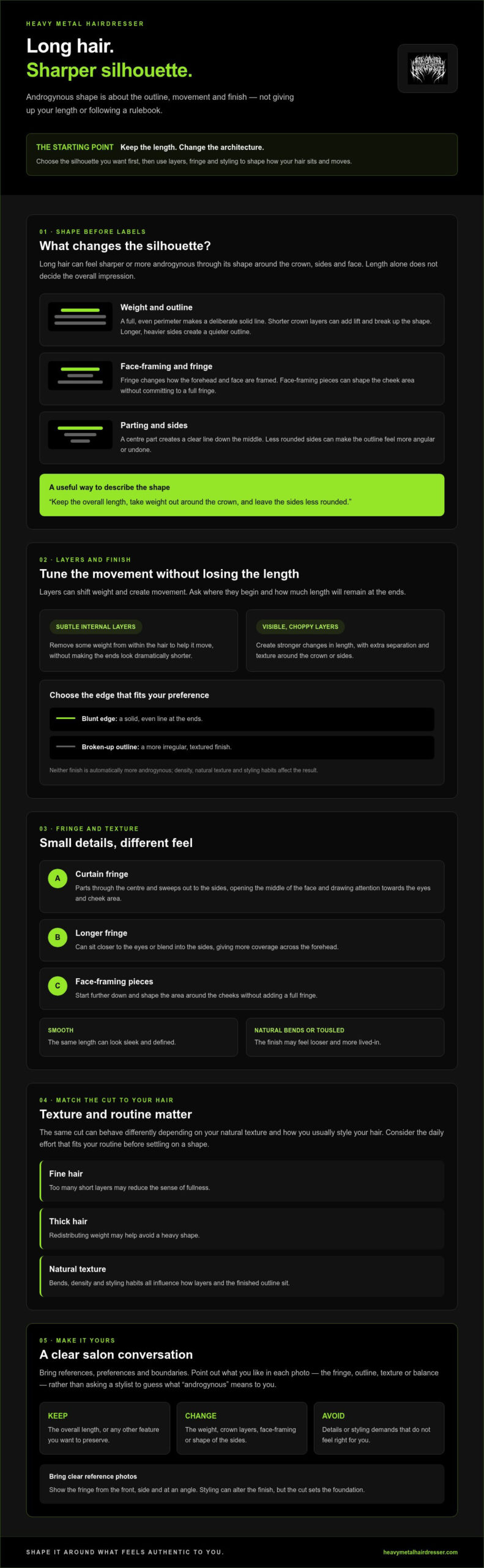
An androgynous haircut is a personal expression created through shape, texture and styling, not a fixed hairstyle or gender rule. The term androgynous can describe different forms of gender expression; in hair, it doesn’t prescribe one approved look. Long hair can feel less traditionally gendered through its outline and movement while staying long. Keep the length, change the architecture.

Start by deciding where you want the hair to carry weight. A full, even outline gives the ends a smooth, deliberate line; shorter crown layers can add lift and break up the shape. Face-framing pieces bring attention to the front, while longer, heavier sides create a quieter silhouette. These details work together, so a cut isn’t defined by one feature alone.

Can long hair still read as androgynous?

Absolutely. Length alone doesn’t decide whether a style feels masculine, feminine or androgynous. Shape around the crown, sides and face can change the overall impression without removing length. For example, a long cut with a flatter crown and less rounded sides may feel sharper than one with soft volume throughout. Start with the feeling you want, not a rule about what long hair “should” look like.

Which details change the silhouette most?

Layers can shift weight and create movement; fringe changes how the forehead and face are framed. A centre part creates a clear line down the middle, while a less rounded outline can make the shape feel more angular or undone. No single detail suits every face, identity or hair type, so treat these as options to discuss rather than instructions.

Texture and finish matter, too. Worn smooth, the same length can look sleek and defined; left with natural bends or a tousled finish, it may feel looser and more lived-in. A shag or wolfcut can build visible movement through the crown and sides while keeping the ends long. The contrast between the shorter layers and the length gives the silhouette its character.

For a salon conversation, describe the shape in plain language: “Keep the overall length, take weight out around the crown, and leave the sides less rounded.” Bring reference photos and point out what you like in each one, such as the fringe, outline, texture or balance. That gives a stylist something specific to interpret, without asking them to guess what androgyny means to you. The best androgynous haircuts for long hair are shaped around your preferences and the way your hair behaves.

How layers, fringe and texture shape androgynous long hair

Once you’ve chosen the broad silhouette, layers and fringe help tune its balance. They can change where the hair sits, how much movement it has and what catches the eye, without dictating a gendered result. The same length can feel soft, graphic, relaxed or deliberately jagged, depending on how it’s cut and worn.

What do layers add to long androgynous hair?

Subtle internal layers remove some weight from within the hair, helping it move without making the ends look dramatically shorter. More visible, choppy layers create stronger changes in length, with extra separation and texture around the crown or sides. Both approaches can retain length at the perimeter, but they create different shapes.

That perimeter matters. A blunt edge gives the ends a solid, even line; a broken-up outline looks more irregular and textured. Neither is automatically more androgynous. Density, natural texture and how you usually style your hair all affect the result. Fine hair may lose a sense of fullness with too many short layers, while thick hair may need weight redistributed to avoid a heavy shape. Ask your stylist where the layers will begin and how much length will remain at the ends.

Should you add a fringe or face-framing layers?

A curtain fringe parts through the centre and sweeps out to the sides, opening the middle of the face and drawing attention towards the eyes and cheek area. A longer fringe can sit closer to the eyes or blend into the sides, giving more coverage across the forehead. Face-framing pieces start further down, shaping the area around the cheeks without committing to a full fringe.

These are visual choices, not gender signals. A fringe can sharpen or soften the outline depending on its length, density and finish. Cultural ideas about long hair and femininity also have a history; BBC Science Focus explores the cultural forces and individual differences behind that association. Your cut doesn’t have to follow those assumptions.

Bring reference images that show the fringe from the front, side and at an angle. Point out what appeals to you, such as the amount of forehead coverage, how the sides connect or how much movement sits around the eyes. A stylist can adapt the idea to your hair rather than copy a picture blindly. The cut builds the shape; styling decides how softly or sharply that shape shows up. For a personalised approach to shags, wolfcuts and textured shapes, explore alternative haircut expertise.

Five androgynous haircut ideas for long hair, compared

Think of these as starting points, not gender categories. Each can be adapted to your texture, preferred outline and how much length you want to keep. The best gender-neutral haircut reference is one that shows details you like, not a rule you have to follow. Heavy Metal Hairdresser works with shags, wolfcuts and mullets, all shapes that can be tailored to personal expression.

  • Long shag: Layers build movement through the crown and sides while the ends can stay long. The outline feels textured and relaxed. Styling effort is usually low to moderate, depending on your natural texture and how defined you want the layers to look. See more long shag haircut ideas for inspiration.
  • Long wolf cut: Shorter, choppier layers on top contrast with length at the back, creating a bolder, more lifted silhouette than a softer shag. It retains length at the back, though the shorter sections make the shape more noticeable. Styling effort can be moderate if you want to bring out the layers. Explore wolf cut shapes and texture for more detail.
  • Elongated mullet: A shorter, shaped front and sides meet a longer back. Keep that contrast subtle for a quieter outline, or make it more pronounced for a sharper, more dramatic shape. Length retention is strongest at the back; styling effort depends on how much definition you want at the top and sides. A modern mullet guide can help you compare variations.
  • Blunt-and-textured shape: A solid perimeter keeps the ends looking full, while selective texture breaks up the surface and adds movement. This direction preserves a clear sense of length without heavily layering the whole cut. Styling effort is often low if you prefer the natural finish, or higher if you want a carefully defined contrast.
  • Layered fringe: Keep the length through the back and add a fringe that blends into face-framing layers. The result draws attention towards the front without dramatically changing the overall length. Choose a soft, longer fringe for an easier grow-out, or a stronger shape for more impact; styling effort varies with your fringe’s texture and finish.

Which long cut gives you texture without losing length?

A long shag generally spreads movement through the shape, while a wolf cut tends to create stronger contrast between shorter upper layers and longer ends. Both can retain length, but ask your stylist where the layers will start and how much weight they’ll remove. For more inspiration across alternative hairstyles and shapes, compare references that show the outline as well as the texture.

How can a long mullet create a sharper outline?

The shorter front and sides make the longer back stand out. A subtle blend gives a softer shift; a more pronounced difference creates a bolder profile. Bring references that show the front, side and back, then explain how much contrast feels right to you. That makes it easier to personalise the shape rather than copy a cut wholesale.
Androgynous Haircuts for Long Hair: Shapes, Layers and Ideas

How to choose a long androgynous haircut for your hair and routine

Use this process to turn saved inspiration into a cut brief your stylist can work with. You don’t need the perfect name for the style. Be clear about the shape you want, what you want to keep and how much effort you’re happy to put in each day.

  1. Name the shape. Describe the outline or mood you’re after: sharper sides, more movement at the crown, a less rounded shape or a softer frame around your face.
  2. Assess your texture. Look at how your hair sits naturally, including its density, wave or curl pattern and where it gains volume.
  3. Choose the details. Decide whether you want a fringe, face-framing layers, a blunt edge or more visible texture. Bring reference images showing the front, sides and back, plus your hair in its usual, unstretched state.
  4. Talk through upkeep. Be honest about your daily routine. Ask what the cut will look like air-dried or with minimal styling, and what you’d need to do to recreate the reference.

How do hair texture and density affect the result?

Straight hair may show a clean outline and distinct layers; waves and curls can bring extra movement and change how short sections sit. Fine hair can lose some visual fullness if too much weight is removed, while dense hair may need careful shaping to avoid a bulky outline. None of these textures rules out a silhouette. Show your stylist how your hair behaves day to day, not only how it looks after heat styling or stretching it out.

What should you tell your stylist before the cut?

Describe the mood and outline you want instead of relying on a gendered haircut label. Agree your boundaries first: which lengths must stay, and where shorter layers or fringe are welcome. Talk through styling time and upkeep before cutting begins. If you’re unsure about a big change, say so; your stylist can discuss how different amounts of layering might affect the shape before you commit.

Bring a few references, but explain what you like in each one. One may show the fringe you want; another may capture the outline or texture. That gives your stylist room to translate the details into a cut that works with your hair and preferences, rather than copying a look that depends on a different texture or styling routine.

Heavy Metal Hairdresser is an inclusive alternative salon with experience in shags, wolfcuts, mullets and textured styling. To see examples of these approaches, view alternative haircut inspiration.

Make your long androgynous haircut yours with styling and expert guidance

The cut gives your hair its underlying shape. Styling changes how that shape reads from day to day. A centre or side part can shift the balance; a natural finish lets your own texture lead, while more defined texture makes layers stand out. Tucking one or both sides behind your ears can expose the face and create a cleaner outline without changing the cut.

How can styling change the mood of long hair?

Try small switches before making a major change. Move your parting, wear your fringe differently or tuck the sides back, then notice which version feels most like you. A relaxed, natural finish may soften a layered shape; a more defined finish can make the same layers feel sharper and more deliberate. You don’t need an elaborate routine. The right approach is the one you’ll actually use.

Keep expectations grounded: styling can shift the mood, but it can’t replace a cut’s structure. If you want a strong outline or shorter layers at the crown, those details need to be built into the cut. If you’re still deciding, experiment with fringe placement and partings first. They offer a low-commitment way to test how you like the hair to frame your face.

How can you find a stylist who understands your vision?

Look for examples of textured cuts that share the outline you want, rather than searching only by a gendered label. In your conversation, ask how the shape will work with your natural texture and how the agreed length will be protected. Make your boundaries clear before cutting begins, including where you’re comfortable with shorter layers and what you want left untouched.

Use that discussion to confirm practical details, too: how the cut may sit when air-dried, what styling it needs and how often its shape may need attention. An inclusive stylist should make space for your preferences without prescribing what a masculine, feminine or androgynous look must be. Bring references, ask questions and agree on a shape that feels right to you.

Heavy Metal Hairdresser is an alternative, inclusive salon with experience in shags, wolfcuts, mullets and textured styling. Its approach centres individual identity, not a one-size-fits-all idea of androgyny. For examples of how these shapes can be adapted, explore Heavy Metal Hairdresser’s work.

Keep your length. Make the shape your own.

Androgynous haircuts for long hair don’t depend on one approved style. Layers, fringe, texture and outline can change the feel of your hair while keeping the length that matters to you. Start by naming the shape you want, showing what you like in your references and agreeing your boundaries with your stylist before the cut begins.

Then make it yours. A change of parting or finish can bring out a different mood, but the cut provides the structure beneath it. Your hair, your identity, your call.

Heavy Metal Hairdresser is an inclusive alternative salon founded by barber and creative stylist Simon Tuckwell, with expertise in expressive, textured cuts. The salon has also worked backstage at Download and Bloodstock. Explore Heavy Metal Hairdresser’s alternative, inclusive approach and see how a personalised shape can bring your references to life.

Keep the length you love. Choose the edge that feels like you.

Frequently Asked Questions

Can you have an androgynous haircut with long hair?

Yes, long hair can have an androgynous shape without losing its length. The overall impression depends on more than how long it is: layers, weight around the crown and sides, fringe, outline and styling all play a part. Choose the features that feel right for you, whether that means a sharper silhouette, visible texture or a softer, more relaxed finish. There’s no single rule to follow.

What is the best androgynous haircut for long hair?

There isn’t one best cut for everyone. A long shag can add movement through the shape, while a wolf cut often has a stronger contrast between shorter upper layers and longer sections at the back. A blunt outline or layered fringe offers other ways to change the silhouette. For androgynous haircuts for long hair, consider your natural texture, length boundaries and styling routine before choosing a direction.

Will layers make long hair look shorter?

Not necessarily. Layers can remove or redistribute weight while leaving the perimeter, the visible outline at the ends, long. Subtle internal layers may add movement without a dramatic change to the overall length. More visible, shorter layers can make the shape look more textured and create stronger contrast with the ends. Ask your stylist where the layers will begin and agree which length you want to preserve.

Can a wolf cut look androgynous on long hair?

Yes. A long wolf cut can combine shorter, choppier layers around the crown with longer sections at the back, creating a textured silhouette without removing all the length. The result can be adapted: ask for softer transitions if you want less contrast, or more pronounced layers for a bolder shape. Your hair’s density and texture affect how those layers sit, so bring references that show the shape from different angles.

How do I ask a hairdresser for an androgynous haircut?

Describe the shape and feeling you want rather than relying on a label alone. You might ask to keep the ends long, add movement at the crown or create a less rounded outline. Show reference pictures from the front, side and back, and point out which details you like. Agree where shorter layers can go, what length must stay and how much styling you’re willing to do before cutting begins.

Do androgynous long haircuts need a lot of styling?

It depends on the cut, your natural texture and how polished or defined you want the finish. Some layered shapes can be worn with minimal effort; others may need more attention to bring out their separation and movement. Ask how the cut will sit when worn naturally and what it takes to recreate your chosen reference. Be honest about your routine, so the shape works beyond the salon.

Can I make my long hair look more androgynous without cutting it short?

Yes. You can keep your length and experiment with how you wear it. Try changing your parting, shifting your fringe, adding natural-looking texture or tucking the sides behind your ears. A low ponytail or simple bun can also change the overall presentation. These styling choices won’t alter the cut’s underlying shape, but they let you explore different moods before deciding whether you want a more lasting change.

Posted on

Short Wolfcut: The Aggressive Guide to Alternative Texture and Grit in 2026

Short Wolfcut: The Aggressive Guide to Alternative Texture and Grit in 2026

Your local high-street salon is likely terrified of your hair. They see the vision of a short wolfcut and immediately try to “soften” the edges until you look like a suburban caricature instead of your favourite subcultural icon. It’s a common trap. You ask for grit and rebellion, but you walk out with a flat, polite “mum bob” that feels more like a safe compromise than a masterpiece.

You deserve a silhouette that actually reflects who you are. We understand the frustration of having your identity diluted by stylists who play it too safe. This guide is here to help you reclaim that aggressive texture and master the short wolfcut with zero apologies. We’re going to show you how to choose aggressive layers that scream rather than whisper.

We’ll explore the best ways to keep your hair from falling flat and which specific products, like Death Grip, will give you that festival-ready finish. From understanding your natural movement to nailing the perfect disconnected fringe, it’s time to embrace the grit.

Key Takeaways

  • Learn how the 2026 short wolfcut evolves the classic shag-mullet hybrid into a high-contrast, face-framing silhouette that prioritises crown volume.
  • Discover the secret of internal crown layers that provide massive lift and aggressive texture without relying on old-school backcombing or heavy styling.
  • Master the “shattered” finish by ditching the round brush and using a diffuser alongside gritty foundations like salt spray or texturising mousse.
  • Understand why the cropped version outshines longer styles for long-term shape retention and immediate subcultural impact at festivals or shows.
  • Explore how to maintain your alternative edge at home using identity-affirming techniques and professional-grade tools like Death Grip.

What is a Short Wolfcut? Redefining the Hybrid Style for 2026

The short wolfcut isn’t just a haircut; it’s a high-contrast collision of eras. Imagine the rebellious spirit of 70s shag texture slammed into the structural aggression of an 80s mullet, then cropped tight for maximum impact. Whilst mainstream salons are busy trying to “perfect” the bob, we’re here to shatter it. This style prioritises massive volume at the crown and aggressive, choppy layers that frame the face with surgical precision. It thrives on raw, textured movement and a tapered nape that refuses to look “done.” The short wolfcut is the definitive 2026 statement for anyone ready to torch the rulebook of polished, binary beauty standards.

The Shag-Mullet DNA in a Cropped Format

Traditional long wolfcuts often rely on length to create flow. The short variant does the opposite. It uses “disconnected” layers to create a silhouette that feels sharp, percussive, and intentional. By stripping away the weight, we reveal the foundational shag and mullet styles that give this look its grit. This isn’t a new concept. It’s the spiritual successor to punk-era evolutions like the “Chelsea” and the “mohawk,” refined for a modern audience that demands both style and subversion. Every snip is designed to create a jagged, shattered edge that moves when you move. It is about creating a shape that holds its own without needing constant adjustments.

Why the Short Variant Rules the Alternative Scene

Practicality meets chaos here. During festival season, you don’t want a style that requires an hour of heat styling or heavy maintenance. The short wolfcut is a low-maintenance weapon. Less weight means more natural lift. It stays aggressive even after three days in a tent at Download or Bloodstock. Beyond the logistics, it serves as a powerful, gender-neutral canvas for self-expression. In the metal and queer communities, hair is identity. This cut offers a way to express that identity amongst peers without conforming to traditional expectations of “pretty” or “handsome.” It’s about being seen on your own terms. For a deeper dive into how this texture functions across different hair types, check out The Ultimate Wolf Hair Cut Guide to master the nuances of subcultural grit.

Anatomy of the Cut: Achieving Aggressive Texture and Volume

The crown is the engine room of any authentic short wolfcut. Forget the dated obsession with backcombing or stiff hairsprays. We achieve massive, percussive lift through short, internal layers that force the hair to stand on its own terms. It’s a technical feat that requires understanding how a client’s specific hair behaviour dictates the final shape. Simon Tuckwell’s approach rejects the cookie-cutter templates found in mainstream salons. Instead, he looks at the natural fall and growth patterns to decide exactly where the grit needs to live to support a rebellious silhouette.

Tool choice is everything. Whilst some stylists reach for thinning shears to remove bulk, we prefer the raw edge of a razor. Razor cutting provides a shattered, lived-in texture that feels immediate and aggressive. It creates the “negative space” necessary for the hair to move and breathe without looking like a static, heavy helmet. When you’re styling the wolf cut in 2026, this built-in texture does half the work for you, ensuring the hair looks just as good at a gig as it does when you first wake up.

The Crown and Choppy Internal Layers

The secret to that voluminous shape in a short wolfcut is the disconnected top section. By separating the crown from the lower lengths, we create a silhouette that screams rather than whispers. This disconnection prevents the hair from looking like a traditional, rounded bob. We focus on shattering the ends to ensure the layers blend through movement rather than through “perfect” graduation. This approach allows the hair to maintain its height throughout the day, even without a heavy arsenal of products. It’s about creating a structure that thrives on chaos.

Face-Framing, Fringes, and Sideburns

The face-frame is where the “wolf-like” stare is born. It’s about creating eyebrow-skimming chaos that draws attention to the eyes and cheekbones. You can choose between a blunt micro-fringe for a sharper, more punk-inspired edge or curtain bangs for a more versatile, shaggy feel. Sideburns are another critical weapon in our arsenal. We use them to accentuate jawlines and add a distinct androgynous or masculine edge to the cut. Customising the “flick” of these layers ensures the style suits your face shape whilst maintaining its alternative soul. If you’re ready to ditch the mainstream and embrace your own identity, consider booking in with the Heavy Metal Hairdresser team to bring this vision to life.

Short Wolfcut: The Aggressive Guide to Alternative Texture and Grit in 2026

Short Wolfcut vs. Long Wolfcut: Which Weapon Suits Your Vibe?

Choosing between lengths is essentially a choice about where you want your volume to live. The short wolfcut delivers an immediate, punchy aesthetic that screams for a spot in the front row at Download. It is a high-impact choice that refuses to blend in. Longer versions certainly offer more “flow” and movement, but they often lose their shape faster. The sheer weight of long hair pulls those aggressive layers down, turning a rebellious silhouette into something far more subdued. If you want a look that stays sharp without constant maintenance throughout the day, going shorter is the smarter play.

The Comparison:

  • Short Wolfcut: Aggressive vibe, high crown volume, 6-week trim cycle.
  • Long Wolfcut: Flowing movement, moderate volume, 10-week trim cycle.

Your daily behaviour should dictate your choice. Short hair requires more frequent trips to the salon to keep the structure intact, but it slashes your morning styling time in half. You don’t have to battle with tangled lengths or heavy sections that refuse to lift. It is about maximum impact with minimal fuss.

Maintenance and Commitment Levels

A short wolfcut needs a sharp eye for detail. To keep that crown from falling flat, you should aim for a professional tidy-up every 6 to 8 weeks. This ensures the internal layers continue to provide the necessary lift. If you decide to let it grow, the transition is remarkably easy. Because of the way we structure the layers, this cut transitions into a modern mullet haircut naturally. It is a versatile way to evolve your style without enduring an awkward “in-between” phase. Whilst you might spend more on salon visits, you’ll find yourself using significantly fewer styling products per wash, which balances the budget over time.

Suitability for Fine vs. Thick Hair

For those with fine hair, this cut is a genuine cheat code for volume. By removing the weight that usually drags fine strands down, we inject life and grit into the hair. It creates the illusion of thickness through shattered, overlapping layers. If your hair is thick, the approach changes. We use aggressive thinning and internal layering to remove bulk whilst maintaining that heavy, alternative aesthetic. Curls and waves also thrive within this choppy framework. The short length prevents curls from becoming a “pyramid” shape, allowing your natural texture to pop whilst keeping the silhouette aggressive and intentional.

Styling Your Short Wolfcut for Maximum Grit and Chaos

Mainstream styling tutorials often ruin a short wolfcut by treating it like a standard salon finish. They reach for round brushes and smoothing serums, effectively killing the very grit that makes the style work. To maintain that aggressive, subcultural edge, you need a process that celebrates chaos rather than trying to tame it. The goal is a shattered, lived-in texture that looks like you’ve just stepped off a tour bus. This isn’t about perfection. It is about identity-affirming movement that holds up under the strobe lights of a basement show.

  • Step 1: Prep the Foundation. Apply a salt spray or a heavy-duty texturising mousse to damp hair. This provides the necessary “tooth” for the layers to grab onto. Don’t be shy with the product; you need a solid base to support the crown volume.
  • Step 2: Kill the Round Brush. Rough-dry your hair using a diffuser or just your hands. Avoid any tools that smooth the hair cuticle. You want the layers to look separated and sharp. Lean forward and dry from the roots up to encourage maximum lift.
  • Step 3: Define the Grit. Work a small amount of Death Grip paste through the mid-lengths and ends. This defines the choppiness and prevents the hair from looking like a soft, undefined cloud. It adds that essential weight to the tips for a “shattered” effect.
  • Step 4: Freeze the Frame. Finish with a blast of cool air from your dryer. This sets the product and locks your chaotic silhouette in place. It ensures the shape stays aggressive until your next wash.

Essential Products for Textured Definition

Achieving that “backstage festival” look requires products that offer hold without the shine. Matt pastes are your primary weapon here. They provide a dry, gritty finish that highlights the aggressive layering of your short wolfcut. For those days when gravity is your enemy, Hair To the Throne is the ultimate tool for maintaining crown volume. It provides the structural support needed to keep your internal layers from falling flat throughout the day. If you’re looking to upgrade your entire kit, our Alternative Hair Merch UK guide covers the pro-level gear you need to maintain subcultural grit at home.

Heat Styling vs. Air-Drying

A well-executed cut should look deadly even when air-dried. This is the “lazy” method, and it works because the internal layers do the heavy lifting. However, if you want to dial up the aggression, a flat iron is a versatile tool. Use it to create shallow “S-waves” through the longer sections. The trick is to keep the ends straight and sharp whilst the roots stay voluminous. This prevents the dreaded “poodle” effect and ensures your texture looks intentional. It’s about contrast. Straight, jagged ends against a chaotic, voluminous crown create the high-impact silhouette that defines the alternative scene. Ready to reclaim your style? Book your transformation with the experts today.

The Heavy Metal Hairdresser Approach: More Than Just a Trim

At Heavy Metal Hairdresser, we don’t do “traditional.” We don’t care about what’s trending on a generic high street. We care about identity-affirming, aggressive style that makes you feel like yourself. When you book a short wolfcut with us, your individuality is the blueprint for every snip. Our salon is a gender-inclusive safe space where being different isn’t just tolerated; it’s the standard. We aren’t just cutting hair. We’re building a silhouette that matches the music you listen to and the community you belong to. Come join a collective that finds beauty in the grit and power in being outside the mainstream.

Gender-Inclusive Styling and Safe Space Culture

We ditched binary “men’s” and “women’s” pricing long ago. It’s an outdated system that doesn’t reflect the technical reality of alternative hair. Instead, our services are based on time and technique. This ensures that our queer, trans, and non-binary clients feel empowered to explore extreme shapes without being boxed in by gendered expectations. During your consultation, we don’t just talk about hair. We talk about your favourite bands and your subcultural influences. We want to know how your short wolfcut needs to function when you’re in a mosh pit or behind a DJ booth. Your voice is the most important tool we use.

Vivid Colour Integration for Wolfcuts

A great cut is the foundation, but vivid hair colour is how you saturate your identity in high-pigment sensation. We use “peek-a-boo” colours hidden within the choppy layers to highlight the aggressive texture of your cut. As you move, flashes of neon or deep jewel tones reveal the complexity of the internal layering we’ve built. We also specialise in the “acid-wash” effect. This involves blending neons with darker, grittier tones for a multi-dimensional finish that looks lived-in and raw. Keeping your creative colour sharp whilst maintaining the integrity of your textured cut is a balancing act we’ve mastered. It’s about ensuring your hair looks just as deadly weeks later as it did on day one.

Reclaim Your Identity with Aggressive Texture

The short wolfcut is more than a trend; it is a declaration of subcultural independence. By mastering the balance between crown volume and shattered, face-framing layers, you move beyond safe compromises and into a silhouette that truly reflects your grit. This cut thrives on raw movement and refuses to be tamed by mainstream standards. It is a low-maintenance weapon designed for those who value authenticity over polish. It provides the perfect canvas for anyone ready to reject the binary and embrace a sharper, more percussive aesthetic.

Don’t let a traditional salon dilute your vision. We bring our expertise from backstage festival work at Download and Bloodstock directly to your chair. As creative specialists in alternative texture, we provide a gender-inclusive safe space where your aesthetic is the only rulebook we follow. We understand the nuances of the scene because we are part of it. Your hair should be a reflection of your soul, not a stylist’s comfort zone.

Book your aggressive short wolfcut at Heavy Metal Hairdresser and step into a style that finally matches your energy. It’s time to wear your rebellion on the outside.

Frequently Asked Questions

Is a short wolfcut high maintenance?

A short wolfcut is low-maintenance for daily styling but requires regular salon visits to maintain its structure. Because the style thrives on imperfection and raw texture, you can often get away with air-drying and minimal product. However, to keep those internal crown layers providing lift, you’ll need a professional tidy-up every 6 to 8 weeks. It is the perfect balance for those who want high-impact style without a long morning routine.

Can I get a wolfcut if I have thin or fine hair?

Absolutely, this style is a genuine cheat code for injecting life into thin or fine hair. By removing the weight that usually drags fine strands down, we create the illusion of thickness through shattered, overlapping layers. The short length allows the hair to stand up more easily, especially when supported by gritty products like salt spray. It transforms flat hair into a voluminous, rebellious statement that holds its own.

What is the difference between a wolfcut and a mullet?

The main difference lies in the blending and the distribution of weight. A traditional mullet has a sharp, often extreme disconnection between a short front and a much longer back. A wolfcut is a hybrid that blends the heavy, face-framing layers of a 70s shag with the tapered nape of an 80s mullet. It results in a more cohesive silhouette that prioritises crown volume over just length at the back.

Do I need to style my wolfcut every day to make it look good?

No, you don’t need to style it every day because this cut is designed to look better as it lives in. A well-executed cut should hold its shape even when air-dried. On days when you want more aggression, a quick blast of cool air and a touch of Death Grip paste will revive the chaos in seconds. It is a style built for festivals and late nights, not for perfection.

Will a short wolfcut suit a round face shape?

Yes, this cut is particularly flattering for round face shapes because the choppy layers add much-needed angles and height. By creating volume at the crown and using face-framing bits to accentuate the cheekbones, we can elongate the face and provide a sharper, more defined look. It breaks up rounded features and replaces them with an edgy, androgynous silhouette that feels both powerful and intentional.

What should I ask my hairdresser for to get a short wolfcut?

Ask for a razor-cut hybrid of a shag and a mullet with significant crown volume and disconnected internal layers. Specify that you want aggressive, shattered ends rather than a soft or “pretty” finish. Bringing photos of alternative icons and mentioning your favourite subcultural aesthetics will help your stylist understand the level of grit you’re after. Emphasise that you want the cut to look lived-in and raw from day one.

How often should I trim my short wolfcut to keep its shape?

To keep your short wolfcut looking sharp and prevent the crown from falling flat, you should book a trim every 6 to 8 weeks. Short styles lose their structural integrity faster than longer ones as they grow out. Regular maintenance ensures the internal layers continue to provide the percussive lift that defines this alternative silhouette. It prevents the style from transitioning into an unintentional bob and keeps the texture feeling aggressive.

Can I have a short wolfcut without a fringe?

You can have this cut without a fringe, though it significantly alters the subcultural vibe. Most people opt for a micro-fringe or curtain bangs to complete the look. If you skip the fringe, focus on heavy face-framing layers that start around the cheekbones to maintain the aggressive framing that gives the style its name. This creates a more open look whilst still retaining the gritty, textured essence of the hybrid cut.