Posted on

Wolf Cut on Straight Hair: The 2026 Guide to Aggressive Texture and Grit

Wolf Cut on Straight Hair: The 2026 Guide to Aggressive Texture and Grit

Straight hair isn’t a limitation; it’s a weapon. Whilst traditional salons might tell you that a wolf cut on straight hair is a recipe for a limp, stringy disaster, they simply don’t understand the architecture of alternative style. Your flat hair is actually the perfect high-contrast canvas for the aggressive, precision layering that defines this look. It provides a level of sharp detail that natural waves often hide.

We know the struggle of the constant battle for volume and the fear of walking out of a shop looking like a wet mop. You deserve a style that feels as rebellious as you are. In this guide, you’ll discover how to transform flat strands into a high-impact silhouette using expert layering secrets. We will walk you through a clear product roadmap, featuring essentials like Death Grip and Hair To the Throne, to ensure your texture stays gritty and your crown stays high. It’s time to stop settling for “neat” and start embracing the grit.

Key Takeaways

  • Learn the technical blueprint of a wolf cut on straight hair, focusing on internal weight removal and aggressive point-cutting to create sharp, intentional texture.
  • Understand the difference between a standard shag and a wolf cut to choose the right level of mullet-adjacent grit for your face shape.
  • Master the “organised chaos” styling technique to transform flat hair into a high-volume silhouette that stays put.
  • Identify the specific professional tools, such as Death Grip and Hair To the Throne, that are non-negotiable for maintaining grit in straight strands.
  • Discover why seeking a specialist alternative stylist is the only way to ensure your layers stay bold and rebellious rather than being “fixed” into something boring.

What is a Wolf Cut on Straight Hair?

The wolf cut isn’t for the faint-hearted or those seeking a “safe” trim. It is a high-contrast hybrid that fuses the raw, effortless soul of the 70s shag with the unapologetic, structured rebellion of the 80s mullet. Whilst many see it as a variation of the shag, the wolf cut is significantly more extreme. On straight hair, the focus shifts from relying on natural bounce to creating intentional, sharp texture through technical skill. The silhouette is defined by heavy face-framing layers and a dramatic, shorter crown volume that creates a predatory, top-heavy shape. Ultimately, a wolf cut on straight hair is an aggressive, identity-affirming choice that turns “flat” hair into a tactical weapon for self-expression.

The Anatomy of the Straight Hair Wolf Cut

The magic of this style lives in the “disconnected” layers. Unlike traditional cuts that aim for a seamless, polished blend, the wolf cut thrives on choppy, irregular edges. If you have pin-straight hair, your stylist must prioritise internal weight removal. This is a non-negotiable step. Without carving out the bulk from within the hair’s structure, the weight will cause the layers to collapse into a dated mushroom shape. By removing that hidden weight, the layers are light enough to “pop” rather than lie flat. The fringe serves as the anchor for the entire aesthetic. Whether it’s a deep curtain bang or a jagged micro-fringe, it dictates the flow and frames your identity with purpose.

Straight vs Wavy: Why Your Hair Type Rules

There is a persistent misconception that straight hair is a disadvantage for alternative styles. That is complete rubbish. Whilst wavy hair often hides the intricacies of a cut amongst its natural folds, straight hair puts the precision of every layer on full display. It allows for a sleeker, sharper alternative finish that feels more “underground” and less “boho.” You get to see the grit in every jagged point and the deliberate nature of the chaos. Straight strands provide a cleaner canvas for architectural volume. When you arm yourself with the right gear, like Death Grip for hold or Hair To the Throne for height, you can achieve a level of aggressive texture that wavy-haired people can only dream of. Your hair type isn’t a hurdle; it is your greatest asset in creating a look that is both raw and refined.

The Technical Blueprint: How We Build Volume in Straight Strands

Building a wolf cut on straight hair isn’t about just hacking at the top. It requires a specific technical blueprint to ensure the hair doesn’t just hang there. As established in the ultimate wolf hair cut guide, the foundation of this style is structural. We focus heavily on internal weight removal. This allows layers to “pop” and move independently instead of lying flat against the scalp. We use point-cutting to create irregular, aggressive edges. This technique involves cutting into the hair at an angle, which gives the cut its signature grit and prevents it from looking too “done.”

To keep your length whilst maximising crown height, we use the “over-direction” technique. By pulling the hair away from its natural falling position during the cut, we create a shorter, voluminous top that flows into a longer, leaner base. This industry-leading haircut trend relies on this specific geometry to work on straight strands. It turns a potentially flat style into a multi-dimensional silhouette that holds its shape through the day. If you are ready for a change, our Wolfcuts are designed to give you exactly that level of precision.

Internal Layering vs. Surface Choppiness

Surface layers alone are a disaster for straight hair. They create a blunt “step” that looks like a mistake rather than a style choice. The secret is invisible layering. We carve out sections from the middle of the hair shaft to create a scaffold that supports the top sections. This prevents the dreaded “stringy” ends often seen on fine, straight hair. You get the volume you crave without losing the density of the overall silhouette. It is about building height from the inside out.

Face-Framing: Sculpting the Jaw and Cheekbones

The “wolf ears” are the side layers that define your face and give the cut its predatory edge. We tailor these to your specific bone structure, ensuring they hit the right points on your cheekbones and jawline. The transition from the fringe to the side-length is the most critical part of the build. It should be a jagged, intentional flow. We create a “curtain” effect that holds its shape naturally. You won’t need to spend hours with a curling wand to make it look decent. It just falls into place with a bit of attitude.

Wolf Cut on Straight Hair: The 2026 Guide to Aggressive Texture and Grit

Straight Hair Wolf Cut vs. Shag: Choosing Your Weapon

Choosing your weapon depends on the level of noise you want to make. Whilst a standard shag focuses on 360-degree volume and a lived-in, rounded feel, the wolf cut is a more aggressive beast altogether. It’s unapologetically mullet-adjacent. If the shag is a soft rock anthem, the wolf cut is a heavy metal breakdown. On straight strands, the wolf cut often performs better because it leans into the high-contrast lengths. You don’t need natural waves to make the “disconnected” layers look intentional. In fact, a wolf cut on straight hair highlights the technical sharpness that a shag might lose in its softness.

Maintenance is the defining factor between these two styles. Shags are often sold as “wash and go” looks, but a wolf cut demands a bit more spirit and effort. It thrives on grit. You’ll need to work with the hair to keep that top-heavy silhouette from falling flat. It’s about choosing between a look that blends in and one that stands its ground. The wolf cut focuses its energy on the top and the face, creating a frame that is both protective and provocative.

When to Go Full Mullet

Sometimes, the wolf cut is just the beginning of the journey. If your personality demands a sharper “business in the front” contrast, you might be ready to cross the line into something more extreme. For those wanting even more subcultural weight, the modern mullet haircut is the natural evolution of this trend. In the UK alternative scene, the mullet-wolf hybrid has become a badge of identity amongst those who frequent festivals like Download or Bloodstock. It’s a way to signal you’re outside the mainstream without saying a word. It’s bold, it’s gritty, and it’s a statement of fierce independence.

The “Soft” Wolf Cut for Beginners

Not everyone is ready to dive headfirst into a jagged micro-fringe on day one. The “soft” wolf cut is your gateway. It uses longer, more blended layers to trial the silhouette before you commit to the full, extreme disconnect. This version is perfect for those finding their feet in alternative aesthetics or those who have spent years fighting with limp hair. You can adjust the fringe length to be more forgiving whilst still enjoying the newfound volume at the crown. It’s a transition piece. Once you see how your straight hair handles the structural change, you’ll likely find yourself craving something even sharper and more aggressive.

Styling for Chaos: Products and Techniques for Straight Hair

Stop trying to make it neat. The biggest mistake you can make with a wolf cut on straight hair is aiming for a polished, salon-fresh finish. This style thrives on organised chaos. It is a look born in the pits of festivals and the back of tour vans, not under a spotlight. To achieve that raw, separated texture, you have to fight the natural tendency of straight hair to lie flat. You need to build a scaffold of product and use techniques that defy gravity.

Your blow-dry technique is the foundation of your volume. Flip your head upside down and focus the heat at the roots of the crown to create immediate lift. When you move to the face-framing sections, dry the hair forward toward your nose. This ensures the layers hug your cheekbones and jawline rather than flicking away. If you use texturising irons to add extra grit, heat protection is non-negotiable. Straight hair shows damage easily, and we want your hair to look aggressive, not fried. Arm yourself with the right toolkit by checking out our guide to Death Grip and Hair To the Throne.

The “No-Heat” Grit Method

You don’t always need a hair dryer to get the look. For a lived-in, backstage aesthetic, use sea salt sprays on damp hair to encourage “fake” movement. Scrunch the hair aggressively with your hands and let it air-dry. This creates a matte, piecey finish that looks effortless. On day two, your layers might start to look heavy. Use a texture powder at the roots to soak up natural oils and revive that crown volume. It provides a dry, gritty feel that keeps the hair from looking stringy or limp whilst you’re on the go.

Essential Gear: Death Grip and Beyond

Put the brush down. It is your enemy. A wide-tooth comb is your only friend when styling a wolf cut on straight hair. Brushes smooth things out; we want to keep things jagged. Use a matte clay or a high-hold paste like Death Grip to create the “clumpy” texture that defines the style. Rub a small amount between your palms and work it into the ends for definition. For the roots, use Hair To the Throne to provide the structural support your crown needs. Applying product strategically ensures your hair has height at the top and sharp, separated edges at the bottom. Ready to upgrade your styling game? Grab the ultimate gear for subcultural grit here.

Why Specialist Alternative Stylists are Non-Negotiable

Traditional salons are built on the foundation of “fixing” things. They see a jagged edge and try to smooth it. They see a disconnected layer and try to blend it. For a wolf cut on straight hair, this approach is fatal. You don’t want a “fixed” version of an alternative style; you want the raw, aggressive reality of it. Specialist alternative stylists understand that the choppiness is the point. It is the texture that gives the look its soul. We don’t fear the “messy” finish because we know it is a deliberate, technical achievement.

Simon Tuckwell’s philosophy is simple: “Identity is not a trend; it is a riot.” This mindset is baked into every cut we perform. We don’t just follow a pattern; we build a silhouette that reflects who you are. This requires a safe space where being different isn’t just tolerated; it is the norm. You shouldn’t have to explain why you want your fringe to look “hacked” or why you need more volume at the crown than a traditional bob allows. Using “alt-hair” vocabulary like “internal weight removal” or “aggressive point-cutting” ensures you and your stylist are on the same frequency from the first snip.

Avoiding the “Karen” Cut

Traditional layering techniques are designed to create soft, round shapes. On straight hair, these methods almost always lead to a dated, “Karen-style” finish that feels far too corporate. The Heavy Metal difference is technical. We cut for the pit, not the office. We look for the tension in the hair and lean into it. To spot a stylist who actually understands subculture, look at their portfolio. Are they styling bands? Are they at festivals? If they only show bridal updos and “natural” balayage, they aren’t the ones to trust with your grit. You need someone who understands the music and the movement behind the aesthetic.

Book Your Resurrection at Heavy Metal Hairdresser

Your hair is the loudest thing about you. It should scream. When you come to see us, bring your favourite band as inspiration. Whether it’s the jagged layers of a 70s punk icon or the top-heavy volume of a modern metalcore lead, we use those references to sculpt your look. We offer a gender-inclusive safe space where the environment is as raw and authentic as the cuts we deliver. Our pricing is gender-neutral because your identity shouldn’t come with a “pink tax” or traditional binary labels. Stop fighting your flat strands and start embracing the chaos. Book your wolf cut session today and let us build the high-impact silhouette you’ve been searching for.

Claim Your Subcultural Edge

Straight hair is never a barrier to high-impact style. It is the ultimate canvas for precision. You now know how technical layering and internal weight removal prevent the dreaded flat finish. By choosing the right gear and mastering the “organised chaos” of the blow-dry, you can maintain a silhouette that stays aggressive from the first track to the final encore. A wolf cut on straight hair isn’t just a trend; it’s a declaration of independence from boring, mainstream aesthetics.

Don’t trust your identity to a salon that wants to “fix” your choppiness. We are the official stylists for Download and Bloodstock, specialising in the aggressive texture that traditional shops fear. Our chair is a gender-inclusive safe space where your vision is the only rule that matters. Whether you want a soft gateway look or a full-throttle mullet hybrid, we have the expertise to make it happen. It’s time to stop fighting your hair and start weaponising it.

Join the Revolution: Book Your Alternative Cut

Your resurrection starts here. We can’t wait to see the chaos you create.

Frequently Asked Questions

Will a wolf cut make my straight hair look thinner?

A wolf cut won’t make your hair look thinner if the technical layering is executed with precision. It actually builds volume by creating a scaffold of internal layers that support the crown. If you have fine hair, we keep the base density higher to avoid stringy ends whilst carving out the top to ensure the style doesn’t fall flat against your scalp.

How often do I need to trim a wolf cut on straight hair?

You should aim for a trim every six to eight weeks to maintain the aggressive silhouette. Because straight hair shows growth more clearly than wavy types, the “wolf ears” and crown layers can lose their sharp edge quickly. Regular maintenance ensures the weight doesn’t shift too low, which would ruin the top-heavy balance of the cut.

Can I get a wolf cut if I have a round face and straight hair?

Absolutely, a wolf cut on straight hair is an excellent tool for sculpting a round face. We tailor the face-framing layers to hit right at the cheekbones or jawline to create artificial angles where there are none. The added height at the crown also elongates the head shape, making it one of the most versatile alternative styles for different bone structures.

What is the best product for a straight hair wolf cut?

The best products for this style are those that provide grit without any greasy residue. We recommend using Death Grip for creating clumpy, separated texture on the ends and Hair To the Throne for building massive lift at the roots. These professional-grade tools are designed specifically to fight the natural slipperiness of straight strands and keep the chaos organised.

Do I have to blow-dry my wolf cut every day?

You don’t have to blow-dry every single day, but it is the fastest way to revive the volume in straight hair. On non-wash days, you can use the “no-heat” grit method by scrunching in a sea salt spray or using a texture powder at the roots. It is about embracing the lived-in, backstage look rather than chasing a polished, salon-fresh finish every morning.

Can a wolf cut be professional for work?

A wolf cut is perfectly professional if your workplace values authenticity and individual identity. For more conservative environments, you can style the layers flatter or tuck the face-framing sections behind your ears to soften the grit. However, we believe identity is a riot; your hair should be a reflection of who you are, regardless of your professional setting.

What is the difference between a wolf cut and a mullet?

The main difference lies in the distribution of the layers and the transition of length. A mullet has a distinct, high-contrast “step” between the short front and the long back. A wolf cut is a hybrid that features heavy, shaggy layering all the way around the head. It is essentially a more blended, 360-degree version of the mullet’s rebellious spirit.

How do I style a wolf cut fringe if it’s pin-straight?

To style a pin-straight fringe, you must dry it forward toward your nose using your fingers to create jagged separation. Avoid using a round brush, as this creates a dated “bubble” shape that ruins the alternative aesthetic. Once dry, apply a tiny amount of texture powder to the roots to keep the fringe piecey and prevent it from looking flat.
Posted on

Wolf Cut on Straight Hair: How to Inject Texture into Flat Strands

Wolf Cut on Straight Hair: How to Inject Texture into Flat Strands

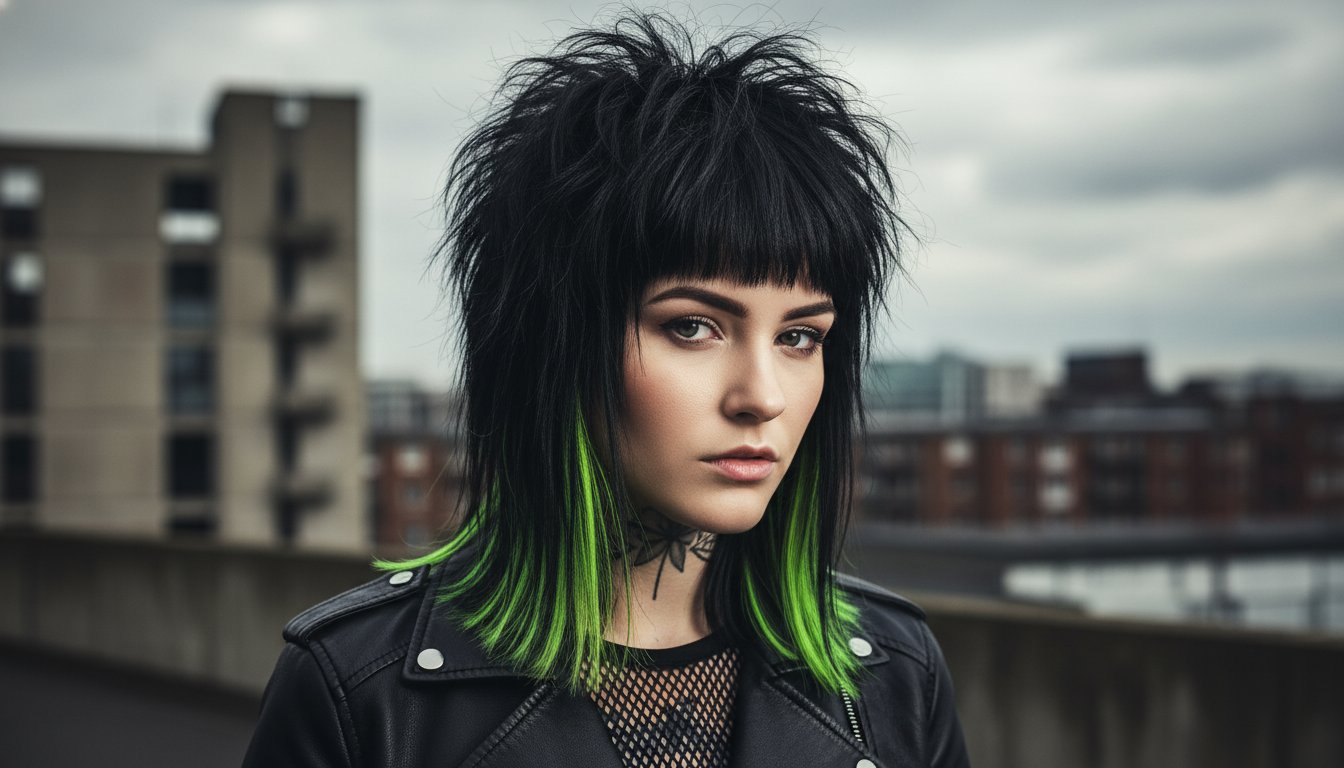
Your straight hair isn’t a curse; it’s the ultimate canvas for the sharpest, most architectural wolf cut on the scene. Most stylists tell you that you need a natural wave to pull off this look, but they’re wrong. A wolf cut on straight hair offers a level of precision and jagged, aggressive detail that curly hair simply can’t match. It’s about time you stopped settling for hair that looks like a limp helmet and started demanding a cut that reflects your alternative identity.

We understand the frustration of strands that refuse to hold volume or look flat by midday. It’s exhausting fighting your natural texture just to feel like yourself. This guide shows you exactly how to transform those flat strands into a masterpiece of sustainable volume and visible, choppy layers. You’ll learn the specific techniques we use to build height at the crown and the styling secrets that keep your look sharp whilst ensuring your hair remains your favourite way to express your identity. From razor-cut ends to the perfect texturising grit, we’re diving into how you can claim this look for your own.

Key Takeaways

  • Reframe straight hair as the perfect canvas for aggressive, high-contrast layers that demand attention and precision.
  • Discover how the disconnected crown technique creates a wolf cut on straight hair that refuses to go flat or look limp.
  • Shift your focus from heavy products to architectural cutting methods like point cutting to build permanent, sustainable texture.
  • Learn the rough-dry and texture powder secrets that keep your layers looking sharp and rebellious every single day.
  • Understand why choosing a stylist who understands subculture shapes is vital for a cut that truly reflects your identity.

Can You Get a Wolf Cut on Straight Hair? (The Short Answer: Yes)

Let’s get one thing straight. You don’t need a natural wave or a permanent curl to look like a wolf. The wolf cut is a high-contrast, heavily layered beast that thrives on attitude. It’s the bastard child of a 70s Shag (haircut) and an 80s mullet. On straight strands, it isn’t just a haircut; it’s a deliberate statement of intent. Whilst most people think straight hair is a limitation, we see it as an opportunity for more precision and sharper lines.

A wolf cut on straight hair exposes the raw architecture of the cut in a way that curly hair simply can’t. It’s honest and unapologetic. We know the fear that keeps you from the chair. You’re worried about the “wet dog” effect or ending up with a limp, helmet-like fringe that just hangs there. That happens when stylists use traditional, “pretty” techniques designed for suburban bobs. We don’t do pretty. We use aggressive texturising to force movement into flat strands where nature didn’t provide any.

The secret to avoiding the flat look is creating “fake” movement. We do this by shattering the ends and carving out internal weight. By removing the bulk that pulls your hair down, we allow the layers to kick out and breathe. This isn’t about gentle thinning; it’s about engineering a shape that holds its own even when you’re in the middle of a mosh pit or running for a train.

Why Straight Hair Offers a Sharper Edge

Straight strands act like a high-definition spotlight for the precision of the cut. You get cleaner, more visible ‘steps’ in the layering process. The contrast between that short, choppy crown and the long, trailing lengths is far more dramatic on straight hair. If you’re chasing an industrial, punk, or cyber-goth aesthetic, your natural texture is your greatest asset. It looks engineered rather than accidental. It provides a level of architectural detail that gets lost in a sea of curls, making the wolf cut on straight hair a superior choice for those who want their identity to be seen from across the room.

Debunking the ‘Perm Required’ Myth

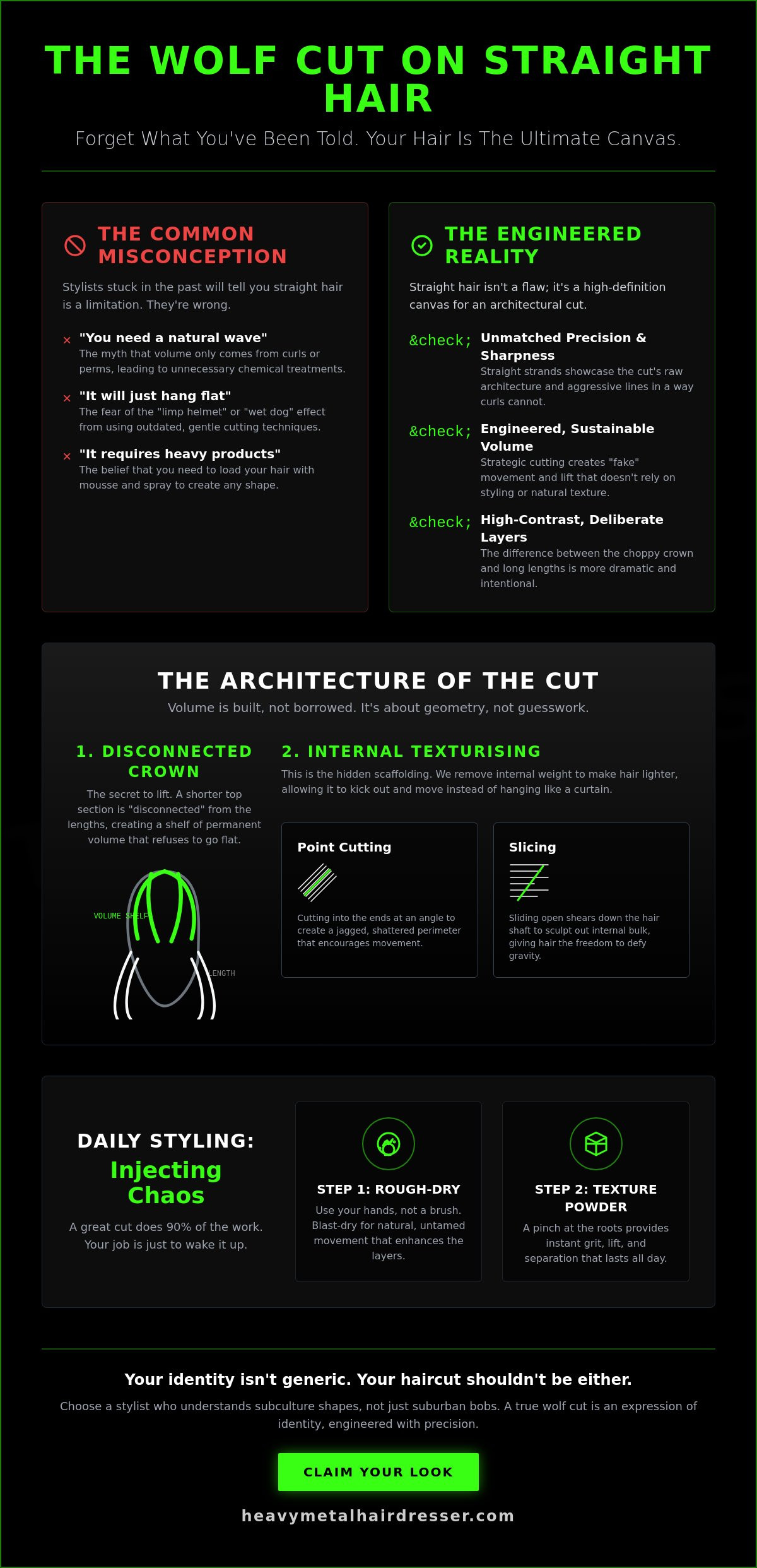
Stop listening to stylists who tell you a chemical perm is the only way to make this work. You don’t need to fry your hair with harsh chemicals to get volume. The real magic lies in the ‘shattered’ ends and strategic internal weight removal. When we remove the hidden bulk from the mid-lengths, we make the hair significantly lighter. Once that weight is gone, your hair is much easier to style ‘up’ and out. Straight hair isn’t naturally flat; it’s just heavy. By removing the anchor, we give your hair the freedom to defy gravity. It’s about the shape of the cut, not just the texture of the strand.

The Architecture: How to Cut Wolf Layers into Straight Hair

The wolf cut isn’t just about hacking away at your ends. It’s a calculated architectural project. When crafting a wolf cut on straight hair, we prioritise the ‘Disconnected Crown’. This is the technical secret to avoiding the limp, lifeless look that plagues most straight-haired attempts. By keeping the top layers significantly shorter and unblended from the lengths below, we create a shelf of volume. As celebrity hairstylist Cheryl Bergamy explains, the wolf cut is defined by its wild and untamed appearance. On straight strands, that ‘wild’ look comes from the contrast between these distinct sections.

We use point cutting and slicing to build this texture. Point cutting involves cutting into the hair at an angle, creating a jagged, uneven perimeter. Slicing is a more aggressive technique where we slide open shears down the hair shaft to remove internal weight. This isn’t just thinning; it’s sculpting. It allows straight hair to kick out and move rather than just hanging like a curtain. It injects a sense of chaos that straight hair naturally lacks.

Length plays a massive role in how much ‘pop’ your cut has. Shorter variations often have more bounce because there’s less gravitational pull on the crown. If you’re chasing that high-energy, subcultural vibe, taking a few inches off the base can make the layers stand up with more attitude. The straightness of your hair actually helps here. It allows the face-framing pieces to act like sharp, architectural lines that highlight your cheekbones and jaw. If you’re ready to commit to this shape, finding a specialist for your Wolfcut is the best way to ensure the geometry works for your face shape.

Internal Texture vs. Surface Layers

Think of internal texture as the hidden scaffolding of your hair. These hidden layers remove the ‘bulk’ that typically drags straight hair down. They create pockets of air that allow the hair to sit higher. Surface layers are the visible, shattered pieces that provide the classic messy vibe. The interaction between these two levels creates the illusion of extreme thickness and movement. It turns a flat head of hair into a multi-dimensional masterpiece that looks thick and rebellious.

The Role of the Fringe and Bangs

The fringe is the soul of the wolf cut on straight hair. Whether you opt for heavy curtain bangs or a blunt ‘micro’ fringe, this section acts as the anchor for the entire look. Straight hair allows for incredible precision in the fringe, which we then blend into the side layers. This seamless transition ensures your hair looks intentional and sharp. It prevents the cut from looking like a DIY disaster and instead gives it a professional, high-fashion edge.

Wolf Cut on Straight Hair: How to Inject Texture into Flat Strands

Defeating the ‘Flat’ Look: Addressing the #1 Objection

“Will I look like a wet dog?” This is the ultimate fear for anyone considering a wolf cut on straight hair. It’s a valid concern. If a stylist applies a cookie-cutter technique designed for wavy hair to your straight strands, you’ll end up with a limp, shapeless mess. But here’s the reality: volume is a product of architecture, not just a can of sea salt spray. You can’t just spray your way out of a bad silhouette. You need a cut that forces the hair to stand up and fight back.

Real volume comes from the internal shape. A standard layered cut is often too cautious. It leaves heavy bulk in the mid-lengths to maintain a “healthy” or “polished” look. On straight hair, that bulk acts like an anchor. It drags everything down until it’s flat against your skull. We don’t do cautious. We create an alternative silhouette that uses the hair’s natural weight against itself. By carving out the underside, we allow the top layers to spring to life.

Sustainable wolf cut on straight hair maintenance doesn’t start in your bathroom; it starts in our chair. If the technical execution is flawed, you’ll spend hours fighting your hair every morning with a round brush and a prayer. When the cut is engineered correctly, the hair naturally wants to sit in that messy, voluminous shape. You aren’t forcing it into a style; you’re just giving it a nudge to do what the cut already dictates.

Why Your Last Layered Cut Failed

Traditional hairdressing is often too obsessed with “blending.” On straight hair, perfectly blended layers often result in a staircase effect. You see every horizontal line where the scissors met the strand. It looks dated, stiff, and unmistakably “suburban.” We solve this by shattering the perimeter. By jaggedly cutting the ends and removing the blunt edges, we encourage the hair to move in different directions. This breaks up the flat surface and creates the illusion of depth and grit that straight hair usually lacks.

The ‘Fine Hair’ Factor amongst Straight Strands

Amongst the straight-haired community, those with fine strands often fear the wolf cut the most. They worry it will leave them with “see-through” ends. Actually, the wolf cut is a saviour for fine hair. When hair is fine and straight, every gram of weight pulls it flat. By strategically removing that weight, we allow the remaining hair to defy gravity. It’s about quality of movement over quantity of hair. If your strands are particularly thin, you might want to look at our specific advice for a wolfcut on fine hair to see how we inject chaos into even the thinnest strands.

Straight Wolf Cut Styling: Injecting Chaos Daily

Straight hair is a liar. It tells you it cannot hold volume. It is lying. Styling a wolf cut on straight hair is about breaking the hair’s natural habit of laying flat. It is a daily act of rebellion against gravity. You don’t need a professional blowout every morning. You need grit. You need the right tools. Most importantly, you need to stop being gentle with your strands. We aren’t aiming for a polished finish; we are aiming for a look that has survived a three-day festival.

We start with the rough dry. This isn’t about smoothness or shine. It’s about finding the volume hidden at your scalp. Blast your roots whilst your head is upside down. This forces the hair to dry in an upward direction. It builds a foundation of chaos before you even touch a styling tool. Once the hair is 80 per cent dry, flip back over. You will already see a massive difference in the height of your crown.

Texture powder is the holy grail for this look. It provides the friction that straight hair naturally lacks. Without it, your layers will slide back into a flat curtain within an hour. A few puffs at the crown create a structure that lasts through a full shift or a long night out. Use your flat iron to create jagged flicks rather than soft curls. Twist the iron away from your face at the ends of your layers. This reinforces the sharp, architectural steps we built into the cut. If you want to maintain this level of aggression, book your next Wolfcut with a specialist who understands subcultural shapes.

Essential Tools for Straight Strands

You need a diffuser. Even on straight hair, a diffuser allows you to “scrunch-dry” texture into the mid-lengths without causing frizz. When it comes to products, texture sprays are for volume, whilst waxes are for definition. Use a wax with a serious Death Grip on the very ends of your layers to create that piecey, shattered look. Avoid heavy oils at all costs. They are the enemy of the wolf cut. They weigh down the crown and kill the lift you worked so hard to create.

The ‘Chaos’ Method: 5-Minute Morning Routine

  • Step 1: Dampen the roots with a water mister and apply a lightweight volume booster.
  • Step 2: Perform an upside-down blow-dry to find that hidden volume at the base of the neck and crown.
  • Step 3: Apply texture powder directly to the roots at the crown for that mosh pit lift.
  • Step 4: Finish with a blast of cool air to set the shape and lock in the rebellion.

Maintenance is the final piece of the puzzle. Your layers will eventually collapse under their own weight as they grow. To keep the silhouette sharp and aggressive, you need a trim every six to eight weeks. This prevents the “wolf” from evolving into a standard, boring layered cut.

Why Heavy Metal Hairdresser is the Ultimate Wolf Cut Destination

Mainstream salons are often terrified of the wolf cut. They try to “soften” the edges. They try to make it look “pretty” or “approachable.” We don’t. At Heavy Metal Hairdresser, we specialise in aggressive, subculture-inspired shapes that demand to be noticed. If you want a wolf cut on straight hair that looks like it belongs on a stage rather than in a supermarket, you’re in the right place. We’ve spent years working with bands and festival-goers. We know hair needs to do more than just look good in a mirror. It needs to survive the pit. It needs to look just as aggressive at 3 AM as it did at soundcheck.

Our space is built on a foundation of fierce independence and radical inclusivity. We are unapologetically gender-neutral and identity-affirming. This is a safe space for every outlier, non-conformist, and alternative soul. Your hair is your most visible form of self-expression. We treat it with the respect it deserves. We also know that a wolf cut on straight hair is the perfect canvas for vivid colour. Whether it’s neon green, deep violet, or industrial grey, our colour work is designed to make those architectural layers pop. Straight hair allows for sharp transitions and contrasts that other textures simply cannot showcase.

Our Signature Aggressive Texturising

We don’t believe in “one size fits all” hair. Every cut we perform is bespoke. We look at your specific hair density and face shape before we ever pick up the shears. Our specialised texturising techniques ensure your straight hair never looks limp or “helmet-like.” We focus on internal weight removal and shattered perimeters to give you height that lasts. We also won’t gatekeep our secrets. We teach you exactly how to maintain that “edge” at home so you don’t lose your attitude between appointments.

Join the Alternative Revolution

We aren’t just a salon. We are a community of people who celebrate being different. If you are looking for more inspiration on how subcultural styles are evolving, check out our deep dive into The Shag Haircut Resurrection. It explains why these high-contrast shapes continue to rule the UK alternative scene. When you’re ready to stop settling for “normal” and start looking like yourself, we are ready for you. Book your transformation with a specialist and claim the look you’ve always wanted.

Claim Your Alternative Identity

Your straight hair is no longer an excuse for a flat, uninspired look. By embracing the sharp geometry of a wolf cut on straight hair, you turn your natural texture into a high-definition statement. We’ve shown you that volume is an architectural choice. It’s built through disconnected crowns and shattered ends rather than just luck. You now have the blueprint for injecting daily chaos into your strands with the right tools and a bit of grit.

Don’t settle for a stylist who wants to play it safe with “pretty” layers. You deserve a look that reflects your true self. Our specialist Wolfcut stylists understand subculture aesthetics and provide award-winning creative direction that mainstream salons can’t touch. We pride ourselves on being a gender-inclusive safe space where your identity is celebrated, not just managed. It’s time to stop fighting your hair and start leading the pack. Book Your Wolf Cut Transformation at Heavy Metal Hairdresser and let us carve out the rebellion you’ve been waiting for. Your new era starts here.

Frequently Asked Questions

Can I get a wolf cut if I have pin-straight hair?

Yes, pin-straight hair is actually an ideal canvas for the sharp, jagged lines of this style. Whilst wavy hair often hides the details, a wolf cut on straight hair showcases the technical precision of every layer. It creates a high-contrast, industrial aesthetic that looks intentional rather than accidental. You just need a stylist who isn’t afraid to use aggressive texturising to force movement into those flat strands.

How do I style a wolf cut on straight hair without it looking flat?

The secret is building a foundation of chaos during the drying process. Always blow-dry your roots whilst your head is upside down to find that hidden volume and prevent the hair from drying flat against the scalp. Once dry, use a high-grit texture powder at the crown to lock in the height. Avoid heavy conditioners or oils that act as anchors and drag your layers down.

Is a wolf cut high maintenance for straight hair?

It depends on your definition of maintenance, but daily styling is actually very fast once you master the rough-dry and powder routine. However, you cannot ignore your trim schedule. Because straight hair shows every line, you need a professional refresh every six to eight weeks. If you let it grow out too long, the weight will eventually cause your layers to collapse and lose their aggressive edge.

What products are best for a straight wolf cut?

You need products that provide friction and hold without adding weight. Texture powder is your absolute holy grail for crown volume. A lightweight sea salt spray can help add grit to the mid-lengths during the drying phase. For the ends, use a wax with a serious Death Grip to define those shattered, piecey layers. Stay away from smoothing serums or anything designed for a polished finish.

Will a wolf cut make my thin, straight hair look thicker?

Yes, removing weight is the best way to make fine hair appear fuller. When straight hair is thin, its own weight pulls it flat and makes it look sparse. By carving out internal layers, we allow the remaining hair to stand up and move freely. This creates the illusion of density and depth. A wolf cut on straight hair turns limp strands into a multi-dimensional shape that looks thick and rebellious.

How often should I trim my wolf cut to keep the shape?

Aim for a trim every six to eight weeks to keep the silhouette sharp. Straight hair grows in a way that can quickly make aggressive layers look like a standard, boring cut. Regular maintenance ensures the technical “steps” in your hair remain visible and the crown stays light enough to hold its volume. If you wait longer, the balance of the cut will shift and the layers will start to look heavy.

Can I have a wolf cut without bangs?

You can, but the fringe is usually what anchors the entire look. If you skip the bangs, you’ll need very heavy face-framing layers to maintain the wolf silhouette. This creates more of a high-fashion shag vibe rather than a traditional wolf cut. It’s a great option if you aren’t ready to commit to a full fringe but still want that jagged, alternative edge around your jawline and cheekbones.

Is a wolf cut the same as a mullet?

Not exactly, though they share the same DNA. The wolf cut is a hybrid of a 70s shag and an 80s mullet. A traditional mullet is very “business in the front, party in the back” with a distinct, often severe disconnection. The wolf cut is more about continuous, heavy layering throughout the entire head. It has more volume on the sides and a more blended, albeit still aggressive, transition between the short crown and the long lengths.