
Posted on

Raccoon Tail Hair: The Ultimate Scene Aesthetic Guide

Raccoon Tail Hair: The Ultimate Scene Aesthetic Guide

The stripes aren’t the hard part. Getting the contrast and placement to feel like you, rather than a costume from someone else’s mood board, is where Raccoon Tail Hair comes alive. Alternating bands across a section bring instant scene-era attitude, but they’re not the same as a single, solid skunk stripe. Whether you’re considering bold black-and-white or a softer colour pairing, plan first, especially if your hair has been coloured before.

This guide explains what defines the look and how you can adapt it, from sharp and high-contrast to subtle, vivid or tucked away. You’ll find practical points to discuss with a stylist, including stripe placement, colour history, hair condition and upkeep. Heavy Metal Hairdresser’s alternative-culture roots and vivid-colour experience offer a relevant starting point, but the pattern isn’t a fixed trend template. It’s yours to make your own.

Key Takeaways

  • Raccoon Tail Hair can look sharp and high-contrast or softer and more understated, depending on your colour choices.
  • Stripe width, spacing and placement all affect the finished look. Decide how bold or subtle you want the pattern to feel.
  • Your colour history and hair condition can affect which options are achievable, so discuss them with a stylist before colouring.
  • Gather reference images and decide where you’d like the stripes to sit before a creative colour consultation.
  • Consider how much maintenance you’re comfortable with, so your colour plan fits your routine.

What Is Raccoon Tail Hair? The Striped Alternative Colour Look Explained

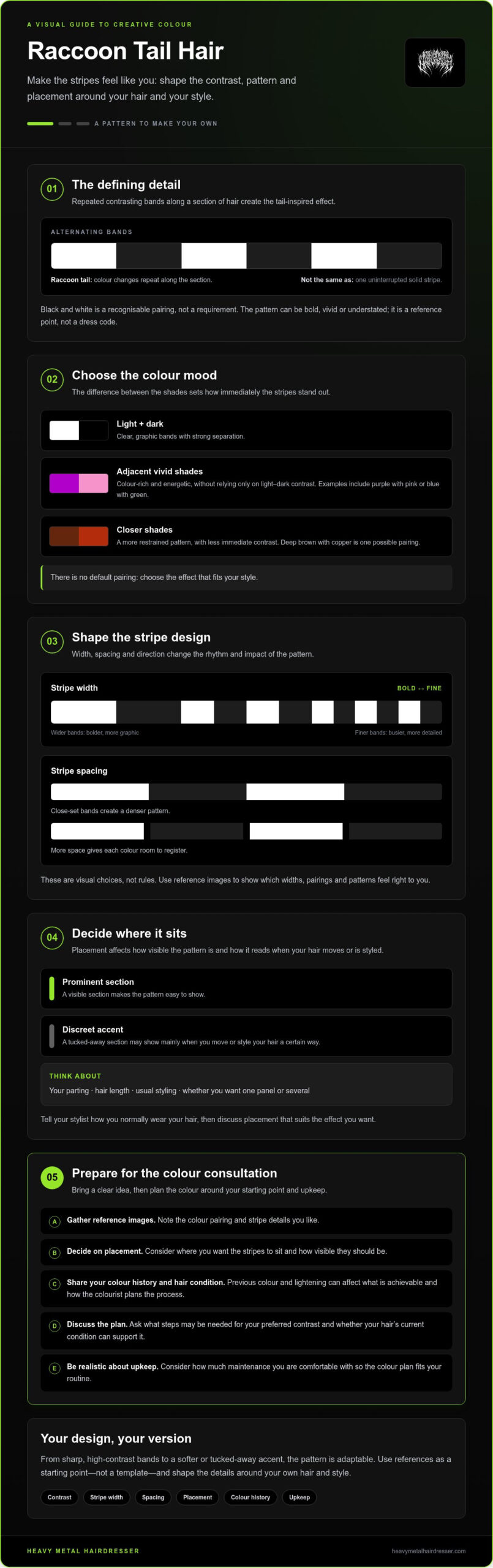
Raccoon Tail Hair is a colour pattern made from contrasting bands across a section of hair, creating a striped, tail-inspired effect.

The pattern relies on repetition: one colour meets another, then the contrast returns along the same section. Black and white is a recognisable pairing, but it’s only one option. Deep brown with copper, or a muted shade against a brighter colour, can create a different mood while keeping the signature rhythm.

There’s no single template. Stripes can be broad or fine, close-set or spaced apart, and placed in one panel or several. Their direction and position can also change how the pattern reads. The idea is recognisable, but the details are yours to shape.

What makes the raccoon tail pattern recognisable?

Look for repeated changes in colour along a section, rather than one uninterrupted block of vivid colour. A single solid panel can create contrast, but it doesn’t have the alternating bands that give this pattern its tail-inspired feel.

Stripe size and spacing matter. Wider bands create a bolder, more graphic effect, while finer, closer stripes can feel busier and more detailed. Colour pairing sets the mood; placement and direction affect how visible the pattern is as your hair moves or is styled.

Is raccoon tail hair only for scene style?

The look is strongly associated with alternative fashion and the scene subculture, particularly its 2000s cultural references. For background on that scene, see this overview of the scene subculture. It’s a reference point, not a dress code or a rule about who can wear the pattern.

Make it loud with sharp, high-contrast stripes, or keep the difference between shades restrained for a subtler effect. The pattern can be adapted to different hair lengths, identities and personal aesthetics. You don’t need a particular cut or a full alternative wardrobe to make it feel like yours. Choose the direction that fits your style, rather than copying someone else’s version of the trend.

How Colour, Contrast and Placement Shape Raccoon Tail Hair

Colour sets the mood; placement decides where the pattern catches the eye and how it looks with your parting, hair length and everyday styling. Consider both before settling on a reference. Striking shades in a discreet section can look very different from the same colours placed prominently around the face.

Which colour contrast should you choose?

High contrast, such as a light stripe beside a dark one, makes each band stand out clearly. Adjacent vivid shades, like purple with pink or blue with green, can still feel punchy but create a different kind of contrast. Pairing shades with less difference in lightness gives the pattern a quieter presence. There’s no default: choose the effect that suits your style.

Your starting colour matters. Existing colour and previous lightening can affect what’s achievable and how a colourist plans the process, so don’t assume a reference will translate exactly onto your hair. Ask what steps might be needed to create your preferred contrast and whether your hair’s current condition can support the plan. The FDA’s guidance on safety precautions for hair dye is a useful general reference. Follow the instructions supplied with any colour product and ask a qualified professional about your individual situation.

Pairing direction Visual effect
Light and dark Clear, graphic bands with strong separation.
Adjacent vivid shades Colour-rich stripes that feel energetic without relying only on light-dark contrast.
Closer shades A more restrained pattern, where the stripes are less immediate.

Stripe design changes the impact too. Wider bands tend to look bolder and more graphic; narrower bands can create a finer, busier rhythm. Close-set bands make a dense pattern, while more space between them gives each colour room to register. These are visual choices, not rules. Bring references showing different widths or pairings, and note which details feel authentic rather than copying a look wholesale.

Where should the stripes sit?

A visible section makes the pattern easy to show, while a discreet accent may appear mainly when you move or style your hair a certain way. Length affects how much of each band is visible; your parting and usual styling can expose or conceal particular sections. Tell your stylist how you normally wear your hair, then discuss placement that suits the effect you want.

For a sense of Heavy Metal Hairdresser’s approach to alternative creative colour, you can explore the salon’s creative colour work. Ask about your hair and desired design rather than assuming every pattern is available.

Raccoon Tail Hair Options: Choose a Version That Fits Your Hair

There’s no single version to copy. Start by deciding how visible you want the stripes to be, then consider your hair’s colour history, condition and the upkeep you’re comfortable with. Bold, vivid bands create a strong statement; closer, more restrained shades give the pattern a quieter feel. Neither is the “right” choice. The aim is a design that suits your hair and feels like you.

Direction Visibility Maintenance to discuss Ask your stylist
Bold, vivid stripes Strong colour separation makes the pattern stand out. How the shades may fade and what care or colour refreshes could involve. What process could achieve this contrast on my current hair?
Restrained contrast A subtler effect, with bands that may blend more into the overall look. How to keep the differences between shades looking intentional over time. Which tones would create a noticeable pattern without a sharp contrast?

Can you get raccoon tail hair on different hair lengths?

Hair length affects the space available for each band. On a shorter section, a stylist may need to adjust stripe width or spacing so the pattern reads clearly; more length allows a different rhythm. No length is a requirement. Discuss how the design could work with your cut and the ways you usually wear it, rather than treating a reference as a fixed template.

How does your existing colour affect the plan?

Bring your full colour history to the conversation. Note previous dye, lightening and at-home colour, including roughly when you last coloured it if you know. This helps a colourist assess your starting point alongside your hair’s condition before recommending a process. Don’t expect a reference image to translate exactly: achievable shades and contrast depend on your hair and a professional assessment.

If you’re exploring brighter shades, the guide to vivid hair colour can help you think about the colour direction you want. Use it as inspiration, then discuss how that idea might work with your hair’s history and condition.

Before settling on a plan, be ready to discuss the effect you want, the upkeep that suits your routine and any concerns about your hair’s condition. A clear conversation helps turn inspiration into a considered option, not a promise of an exact result.
Raccoon Tail Hair: The Ultimate Scene Aesthetic Guide

How to Prepare for Raccoon Tail Hair and Care for the Colour

Good preparation turns a striking idea into a useful conversation. Before discussing Raccoon Tail Hair, get clear on the effect you want, while staying open to adjustments if your hair’s history or condition changes what’s achievable.

  • Collect references: Save examples that show the stripe pattern, colour pairing and placement you like. Include a few alternatives, not just one exact result.
  • Document your colour history: Note previous dye, lightening and at-home colour, including what was used if you know. Be upfront about anything that might affect the plan.
  • Define your contrast: Describe whether you want distinct light-and-dark bands or a more restrained difference between shades. Mention how visible you want the pattern with your usual styling.

A colourist should assess your hair’s condition and discuss realistic options before colouring. If the planned process isn’t suitable, ask what could change: the contrast, colours, placement or overall design. A clear alternative is better than forcing a target that your hair may not safely support.

What should you ask before a colour appointment?

Take your references and colour history into the discussion. Ask how your current colour may affect the pattern, whether the placement suits how you wear your hair, and what upkeep the result could involve. If there are concerns about condition, ask what adjustments the stylist recommends and why. Make sure you understand the options before deciding how to proceed.

How can you help the colour stay looking intentional?

Get aftercare advice tailored to the colour work and follow the instructions for any products recommended or used. Washing habits, heat styling and product choices can affect how vivid colour lasts, but the right routine depends on your hair and the specific process. Ask your colourist what to do, what to avoid and when to check in if the colour changes in a way you didn’t expect.

For dedicated upkeep guidance, read these vivid hair colour maintenance tips. If you’re still shaping your palette, explore expressive hair colour ideas for more inspiration.

Ready to discuss your colour history, references and options? Enquire about creative colour suitability, including whether your preferred direction could work for your hair.

Bring Your Raccoon Tail Hair Idea to a Creative Colour Consultation

You’ve got the reference. Now turn it into a conversation about what you want, what your hair can support and how the result might fit your everyday style. Treat Raccoon Tail Hair as a starting point for personal expression, not a pattern you have to copy stripe for stripe.

What should you bring to a creative colour consultation?

A few well-chosen details can make it easier to explain the look you have in mind. Bring:

  • Reference images: Choose examples that show the stripe pattern and colour contrast you like. If you prefer one image’s placement and another’s colour pairing, point that out.
  • Your colour history: Share relevant previous dye, lightening or at-home colour work. Be as accurate as you can, even if the result wasn’t what you expected.
  • Your placement preference: Describe where you’d like the stripes and how visible you want them with your usual parting and styling.
  • Your upkeep comfort zone: Be honest about the time and effort you’re prepared to put into maintaining the colour.

Bring questions, too. Ask how your starting colour might affect the design and what could change if your preferred contrast isn’t realistic for your hair. Clear expectations help you weigh the options before deciding on a look.

How can a stylist make the idea your own?

A stylist can use your references to discuss how stripe placement and contrast might be adapted to your preferences, colour history and hair condition. That could mean considering a different position, a softer colour pairing or another approach to the effect you want. The aim is a considered conversation, not a promise that every reference can be recreated exactly.

Heavy Metal Hairdresser brings an alternative, inclusive perspective and experience with vivid colour. That background is relevant to a creative colour discussion, but it doesn’t confirm that a specific raccoon-tail pattern is available. Ask about your idea and its suitability before assuming the exact service can be provided.

Your style should feel like yours, whether the finished direction stays close to the original reference or takes a different turn. For more on the salon’s creative colour approach, explore creative colour with Heavy Metal Hairdresser.

Make the Stripes Your Own

Raccoon Tail Hair works best as personal expression, not a pattern you have to reproduce exactly. Contrast and placement shape the visual impact, while your colour history and hair condition help determine which options are realistic. Bring references and be ready to discuss the effect you want and the upkeep that fits your life.

Heavy Metal Hairdresser brings experience with vivid colour and alternative styling, including backstage work at Download and Bloodstock. Its inclusive approach celebrates individuality, but the salon’s experience doesn’t guarantee that this specific pattern is available. Enquire about your idea and its suitability before assuming it can be recreated.

Explore creative colour with Heavy Metal Hairdresser and start a colour conversation around your style. Keep the inspiration, stay open to thoughtful adjustments, and make the final look unmistakably yours.

Frequently Asked Questions

What is raccoon tail hair?

Raccoon tail hair is a striped colour pattern made from alternating bands of contrasting colour on a section of hair. The stripes can be wide or fine, closely spaced or more separated, and placed where you want the pattern to show. Black and white is a familiar pairing, but softer shades and vivid colours work too. It’s distinct from a single solid block of contrasting colour.

How do you get raccoon tail hair?

A stylist sections the hair and applies alternating colours to create defined bands. Bring reference images showing the contrast and placement you like, and share your hair’s colour history before a colourist assesses the plan. The process depends on your starting colour and the effect you’re aiming for, so ask what’s achievable and how the stripes could be adapted to your hair.

Can you do raccoon tail hair at home?

You can experiment at home, but creating neat, evenly spaced stripes with clean colour separation can be tricky, especially if the plan involves lightening. Temporary clip-in striped extensions offer a way to try the look without colouring your own hair. For permanent or vivid colour, read product instructions carefully and consider speaking with a qualified colourist first, particularly if your hair has been coloured before.

Does raccoon tail hair work on short hair?

Yes, the pattern can be adapted for short hair. The available length affects how wide the bands can be and how much space there is between them, so a stylist may adjust the stripe design to suit your cut. There’s no required hair length. Discuss how you part and style your hair, and where you’d like the stripes to be visible.

How long does raccoon tail hair colour last?

There isn’t one set lifespan for raccoon tail hair colour. How long it looks fresh can depend on the colour process, your starting shade, washing habits, heat styling and the products you use. Ask your colourist what to expect for the shades and technique planned, and when you might want a refresh. Follow the aftercare instructions they provide for your colour service.

Can raccoon tail hair be done without bleaching?

Sometimes, but it depends on your starting colour and the contrast you want. A vivid or lighter stripe may require lightening to show clearly against darker hair; a closer, subtler pairing may offer different options. No result should be promised before your hair is assessed. Tell the colourist about previous dye or lightening and ask which colour combinations are realistic for your hair.

How do you maintain raccoon tail hair?

Follow the care instructions your colourist gives you, as the right routine depends on the colours and process used. Washing frequency, heat styling and product choices can affect how vivid colour looks over time. Ask which products are suitable, how to use heat carefully and what signs of fading to expect. If you’re unsure about a care step, check with your colourist rather than guessing.

Posted on

Vivid Hair Colour Maintenance Tips: The Alt-Hair Survival Guide

Vivid Hair Colour Maintenance Tips: The Alt-Hair Survival Guide

Your hair isn’t just a style; it’s a tactical expression of your identity that shouldn’t wash away with the morning tide. You’ve invested serious energy into that electric neon or deep gemstone hue, yet the fear of the fade is constant. It’s soul-destroying to watch your vibrant soul bleed down the drain because of a basic shower routine or a wild night at a festival. We know the struggle of trying to keep that punchy, fresh-from-the-salon saturation when the world seems determined to dull your shine.

We’re here to help you weaponise your hair care routine to stop the fade and keep your creative colour saturated for weeks. This guide delivers the essential vivid hair colour maintenance tips you need to protect your look; whether you’re rocking one of our signature Shag Haircuts or a sharp Wolfcut. We’ll break down the cold-water truths and the product secrets that turn your bathroom into a preservation lab. You’re about to learn how to keep your hair healthy and your aesthetic loud, even after the most brutal mosh pit.

Key Takeaways

  • Master the 72-hour wash lockout and the ice-cold rinse to keep your direct-dye pigments from bleeding out early.
  • Stop paying the “pigment tax” by shielding your hair from thermal tools and UV rays that bleach your aesthetic.
  • Use our vivid hair color maintenance tips to defend your saturation against the sweat and salt of high-intensity gigs.
  • Learn why a professional gloss service is a tactical, cost-effective way to refresh your hue amongst your regular appointments.
  • Invest in the internal structure of your strands with bond builders to ensure your hair stays healthy whilst you push the limits of bleach.

The Brutal Truth About Vivid Hair Colour Longevity

Vivid hair isn’t like your natural brunette or blonde. It doesn’t live inside the hair shaft. It lives on the outside. It’s a direct-dye pigment that sits on the cuticle like a stain. To understand the mechanics, you can look into the science of hair coloring, which explains how different molecules interact with your strands. In the alternative scene, “permanent” is a dirty word because it’s mostly a myth. True vivids are semi-permanent by design. They’re meant to be loud, bright, and temporary. Expecting a neon pink to last as long as a box-dye black is a recipe for sudden heartbreak.

Your hair’s health foundation dictates how much pigment it can actually hold. If your strands are fried from over-processing, there’s no anchor for the colour to cling to. Understanding these chemical boundaries is the first step in mastering vivid hair color maintenance tips for any alternative style. Every hue has its own timeline. Pinks and pastels are the short-lived rockstars of the hair world. They look incredible for a week then start their retreat. Blues and greens are the stubborn tenants. They’ll hang on for months, often fading into a swampy teal that requires a tactical shift in your routine. You need to set realistic expectations before you even pick up the tint brush.

The “Honeymoon Phase” is that glorious first week where your reflection looks like a filtered Instagram post. But reality hits fast. Cool tones like cobalt or forest green have a higher affinity for the hair fibre, whereas warm tones like peach or rose gold are notoriously flighty. If you want a look that survives the month, you have to build a routine that respects these chemical boundaries. Your hair’s structural integrity is the only thing standing between a saturated masterpiece and a washed-out mess. For a deeper understanding of the structural chemistry and professional saturation techniques behind achieving that perfect base, our guide on vivid hair color and high-pigment saturation breaks down exactly what it takes to get the pale blonde foundation right.

Why Vivids Fade Faster Than Natural Tones

Vivid dyes use massive pigment molecules that can’t penetrate deep into the hair’s core. They cling to the surface instead. When you bleach your hair for a neon transformation, you prop the cuticle “door” wide open. This creates an easy exit route for pigment during every wash. Environmental factors like hard water and UV rays act as constant pigment thieves amongst your daily activities, stripping your investment daily.

Porosity: The Secret Key to Colour Retention

Think of damaged hair as a leaky bucket. High porosity hair has a blown-out cuticle that can’t hold onto pigment, leading to rapid fading. Low porosity hair has a tightly shut cuticle that’s harder to dye but locks colour in effectively whilst preventing premature fading. Testing your porosity is vital for effective vivid hair color maintenance tips. Drop a clean strand in water; if it sinks quickly, your “bucket” is leaking.

The Cold Water Commandment: Mastering the Wash Routine

The shower is the primary crime scene for pigment theft. If you want your neon hue to survive, you have to treat every wash like a tactical operation. Waiting 72 hours after your appointment is non-negotiable. It takes that long for the hair cuticle to fully close and lock the direct-dye molecules in place. If you jump under the spray too early, you’re literally rinsing your investment down the drain before it’s even had a chance to settle. Implementing these vivid hair color maintenance tips starts with discipline in the bathroom.

Temperature control is your next line of defence. Hot water is a solvent; it forces the hair cuticle to swell and stand up. When that happens, your expensive dye job escapes instantly. Lukewarm water is still too hot for alternative tones. You need to use water as cold as you can stand. To avoid the misery of an arctic shower, try washing your hair in the sink whilst leaning over. This keeps your body warm whilst your hair gets the cold-water treatment it needs to stay saturated.

Frequency is everything. Your goal is to move to a once-a-week wash schedule. Every time water touches your hair, you lose a percentage of your vibrance. When you do wash, use the “roots-only” technique. Focus your lather strictly on the scalp where the oils live. Don’t scrub your mid-lengths or ends. The suds that run through during the rinse are more than enough to clean the rest of your hair without stripping the pigment from your most visible sections.

Choosing Your Arsenal: Sulphate-Free or Bust

Sulphates are aggressive detergents found in most high-street shampoos. They’re designed to strip everything from the hair, including your favourite creative colours. Whilst hair dye safety regulations ensure the chemicals on your head are safe for use, they don’t protect the vibrancy of the pigment against harsh surfactants. Professional-grade cleansers are formulated with gentler alternatives that preserve the cuticle. Professional shampoo is a financial investment in the structural integrity and longevity of your subcultural identity.

The Dry Shampoo Hack for Alternative Styles

Dry shampoo is the ultimate weapon for extending the life of your shag haircut. It absorbs excess oil without the need for water, allowing you to push your wash day further back. To avoid a chalky build-up on darker vivid tones like deep purple or forest green, apply it before bed. This gives the powder time to absorb and disappear into your strands overnight. Organising your wash days around your social calendar ensures you look fresh for gigs whilst keeping your colour locked in. If your shape is starting to lose its edge between these infrequent washes, a fresh set of layers from one of our signature Wolfcuts can revive your entire aesthetic.

Vivid Hair Colour Maintenance Tips: The Alt-Hair Survival Guide

Combatting the Enemy: Heat, UV, and Environmental Damage

Heat is a silent killer for creative colour. Every pass of a straightener or curling wand is a “pigment tax” you simply can’t afford to pay. High heat literally melts the direct-dye molecules sitting on your cuticle, causing them to evaporate or shift. Understanding how hair dyes work reveals why high temperatures are so destructive; these pigments are held by weak physical bonds that shatter under thermal stress. If you’re serious about your aesthetic, you need to rethink your relationship with your styling tools. Mastering vivid hair color maintenance tips means becoming a fierce guardian of your hair’s environment.

Sunlight is another constant threat. It’s basically a slow-motion bleach treatment for your head. UV radiation breaks down the molecular structure of your dye, leading to that dreaded “ghost” version of your original hue. Using accessories like beanies, bandanas, or wide-brimmed hats isn’t just a subcultural style choice; it’s a tactical “Hat Trick” to shield your saturation whilst you’re outdoors. Don’t let a sunny afternoon at a festival undo weeks of careful preservation.

Then there’s the chemical cocktail of pools and the sea. Chlorine and saltwater are aggressive oxidisers. They don’t just fade your colour; they can fundamentally change the tone. A vibrant sapphire can turn into a muddy swamp green after one dip in a chlorinated pool. These vivid hair color maintenance tips are your primary defence against a dull reflection. You have to be proactive if you want your hair to survive the elements.

Heat Styling Without the Sacrifice

Turn the dial down. You should never exceed 180°C when styling alternative hair. Anything higher is an immediate eviction notice for your pigment. A high-grade thermal barrier spray is a mandatory requirement, not an optional extra. For those rocking heavily textured wolfcuts, air-drying is your best friend. It preserves the tone and lets the natural movement of the cut do the heavy lifting without the heat damage.

Summer Survival for Creative Colour

Summer requires a specific protocol. UV-specific hair veils are essential for protecting your scalp and strands from solar bleaching. Before you enter a pool or the sea, pre-soak your hair in fresh tap water. Your hair is like a sponge; if it’s already full of fresh water, it can’t absorb as much salt or chlorine. Follow this with an immediate rinse-out protocol the second you leave the water to stop chemical reactions in their tracks.

The Mosh Pit Survival Guide: Gigs, Sweat, and Festivals

High-intensity gigs are a war zone for your hair. Sweat is essentially a saline solution that acts as a solvent for your creative hue. It’s especially brutal on your fringe. Because it sits directly against your skin, it soaks up moisture whilst you’re in the pit, leading to rapid pigment loss right where it’s most visible. These vivid hair color maintenance tips are designed to help your look survive the chaos of a weekend-long festival or a single, sweat-drenched set.

Protective styling is your first line of defence. Braids and tight buns aren’t just for aesthetics; they minimise friction and limit how much of your hair comes into contact with sweat and mud. This is crucial for maintaining the sharp layers of your shag or wolfcut. By keeping your ends tucked away, you prevent the pigment from being rubbed out by your clothing or other people in the crowd. Festivals are a marathon, and your colour needs a tactical plan to reach the final encore.

If your fringe has lost its edge after a weekend in the mud, book one of our Wolfcuts to restore the structure and keep your aesthetic sharp. We understand the unique demands of the alternative lifestyle and how to make a look last through the carnage.

Post-Gig Recovery Routine

Don’t reach for the shampoo the second you get home. You can deal with gig sweat without a full wash session. Use a hair dryer on a strictly cool-air setting to dry the moisture out of your roots. This resets your style without opening the cuticle further. For a deeper dive into managing your look during multi-day events, check out our guide on festival hair survival. It’s about working with the grit rather than fighting it.

Colour-Depositing Conditioners: Your Secret Weapon

Think of these as an emergency pigment transfusion. You can mix a custom maintenance mask by adding a small amount of your salon-grade pigment into a high-quality, silicone-free conditioner. For a massive saturation boost, try the “Dry Application” trick. Apply the mixture to completely dry hair and let it sit for twenty minutes before rinsing with cold water. This ensures the hair absorbs the maximum amount of pigment without water molecules getting in the way. These vivid hair color maintenance tips allow you to top up your vibrance at home amongst your professional appointments, keeping your gemstone tones or neons looking fresh for weeks.

Professional Reinforcement: When to Return to the Source

Even the most disciplined at-home routine eventually needs a professional tactical reset. A gloss service is your best friend here. It’s a mid-way refresh that’s faster and more cost-effective than a full re-dye. Instead of starting from scratch, we deposit a fresh layer of pigment over your existing base to restore that “day one” saturation. It’s the ultimate hack for keeping your aesthetic sharp without the time commitment of a full transformation. When you follow our vivid hair color maintenance tips, you extend the time between these sessions, but you should never skip them entirely.

Consulting your specialist about fading paths is another vital part of the process. Creative colour is a journey, not a destination. A well-planned sapphire blue should transition into a beautiful mint whilst a deep violet might fade into a soft lilac. We help you choose shades that age gracefully so you never feel the need to hide your hair under a beanie. Professional guidance ensures your fade looks like an intentional choice rather than a maintenance failure. If you’ve ever struggled to find someone who truly understands alternative aesthetics, our guide to finding a bold hair colour specialist UK will help you identify the technical expertise and subcultural fluency you actually need.

Don’t ignore the “wicking” effect of split ends. When your ends are frayed, they act like a straw, drawing moisture into the hair shaft and allowing pigment to escape even faster. A professional trim isn’t just about maintaining your shape; it’s about sealing the hair’s exit points. Investing in bond builders during your salon visit is equally crucial. These treatments work on the internal structure of your strands, repairing the damage from previous bleaching sessions so your hair can actually hold onto the next round of pigment.

The Heavy Metal Hairdresser Standard

We prioritise hair integrity above everything else. A high-saturation look is worthless if your hair feels like straw. Our approach to creative colour is about building a sustainable identity that lasts through gigs, festivals, and daily life. We don’t do “quick” transformations that compromise your hair’s health. You can book a maintenance session with us to keep your layers sharp and your tone electric, ensuring your look remains as fierce as the day it was cut.

Mastering the Craft Yourself

If you want to go deeper into the world of subculture styling, we offer alternative hair courses that teach you the technical reality of vivids. Whilst these courses empower you with knowledge, professional guidance is always superior to “DIY” kitchen-sink experiments that often end in expensive colour corrections. A specialist salon is your most powerful ally in the relentless fight against the fade and structural damage.

Own Your Aesthetic and Defend Your Hue

Keeping your creative colour saturated is an act of rebellion against the mundane. You’ve mastered the cold-water wash and learned to shield your strands from the pigment-thieving sun. These vivid hair color maintenance tips aren’t just suggestions; they are the protocol for anyone living life in the mosh pit or under festival lights. Your hair is your canvas. It deserves a routine that respects the intensity of your identity whilst keeping your strands healthy.

We aren’t just stylists; we are specialists in aggressive textured cuts and high-voltage vivids. Our team has prepped hair for the carnage of Download and Bloodstock festivals, so we know exactly what it takes to make a look survive the pit. We provide an inclusive safe-space for all alternative identities to express themselves without compromise. Ready to reset your saturation? Book your vivid colour refresh at Heavy Metal Hairdresser and let’s keep your aesthetic loud. Stay bright, stay bold, and never let the world dull your shine.

Frequently Asked Questions

How often should I wash my vivid hair to prevent fading?

You should aim to wash your hair only once a week to maintain maximum saturation. Every time water hits your strands, you lose a percentage of your pigment. Use dry shampoo between washes to manage oils and keep your style fresh. This is one of the most effective vivid hair color maintenance tips for ensuring your creative hue lasts for weeks instead of days.

Does hot water really make hair colour fade faster?

Hot water is a solvent that forces the hair cuticle to swell and stand up, letting the colour escape instantly. Cold water keeps the cuticle flat and the pigment locked inside the hair shaft. If you can’t handle an arctic shower, wash your hair in the sink with cold water whilst keeping your body warm in the shower. It is a small sacrifice for long-lasting vibrance.

Can I use dry shampoo on bright or rainbow-coloured hair?

Dry shampoo is a mandatory tool for extending the life of your creative colour. It absorbs oils without the pigment-stripping effects of water and harsh surfactants. Apply it at night so it absorbs fully and doesn’t leave a chalky residue on your vibrant gemstone tones or deep neons. This allows you to push your wash day back and protect your investment.

What is the best shampoo for maintaining vivid hair colour in 2026?

You must use a sulphate-free, professional-grade shampoo to avoid stripping your direct-dye pigments. High-street brands often contain harsh detergents that act like paint stripper on alternative hues. Look for professional formulas specifically designed for creative colours that prioritise moisture and bond protection. These products ensure your vivid hair color maintenance tips actually work by not undoing your hard work during the wash.

Should I avoid the sun if I have creative hair colour?

UV radiation acts as a natural bleach, so you should protect your hair whenever you’re outdoors for extended periods. Hats, bandanas, and UV-specific hair veils are your best defence against solar fading. Don’t let a sunny day at a festival turn your electric blue into a dull, ghostly teal. Physical barriers are always more effective than products alone when the sun is at its peak.

Is it okay to use a straightener on vivid dyed hair?

You can use a straightener, but you must keep the temperature below 180°C to avoid “melting” the pigment molecules. Every pass of a high-heat tool acts as a pigment tax on your colour. Always apply a professional thermal barrier spray before styling to minimise the damage to your saturation. If you can air-dry your texture instead, your colour will stay vibrant much longer.

How do I stop my hair colour from bleeding onto my pillow?

Never go to sleep with damp hair, as moisture encourages the direct-dye molecules to migrate onto your fabrics. Use a dark-coloured silk or satin pillowcase to hide any inevitable transfer whilst reducing friction on your cuticle. This also helps maintain the aggressive texture of your wolfcut or shag between washes. Ensuring your hair is 100% dry before bed is the best way to keep your bedding clean.

Can I swim in a pool with semi-permanent vivid hair colour?

Swimming is risky because chlorine is an aggressive oxidiser that can turn vivids into muddy, swampy tones. Pre-soak your hair with fresh tap water before entering the pool to limit chemical absorption. Follow up with an immediate rinse to stop any lingering chlorine from reacting with your favourite creative hue. If you’re a regular swimmer, a swimming cap is the only way to truly guarantee your colour’s safety.