Posted on

Emo Haircut Ideas 2026: Fringe, Layers and Colour with Attitude

Emo Haircut Ideas 2026: Fringe, Layers and Colour with Attitude

The heavy side fringe is iconic, but it isn’t the only way to make emo hair hit hard. The best emo haircut ideas 2026 treat the look as a toolkit, not a uniform: choppy layers, a shag-inspired wolfcut, a shorter shape or a flash of vivid colour can all bring attitude without repeating the same template. If your inspiration board shows the vibe but not the cut behind it, start by identifying the details you want to borrow.

Fringe, length and texture change the whole effect, and the right balance depends on your hair and how you want to express yourself. Fine, straight hair, for example, can gain movement from carefully placed layers, while very fine ends may need enough weight to keep their shape. Colour can emphasise the silhouette, but it isn’t essential.

Here, we’ll explore distinct emo directions for 2026, from sweeping fringe and piece-y layers to shorter cuts and bold or dimensional colour. You’ll find ways to compare each shape, adapt it to your hair and explain what you want to your stylist, so the finished look feels unmistakably yours.

Key Takeaways

  • Use emo haircut ideas 2026 as a starting point, then choose the details that feel true to you.
  • Compare five haircut directions by their shape and styling needs, not just by the reference photo.
  • Match length, fringe and layers to your hair texture and the amount of daily styling you’re comfortable with.
  • Make your stylist brief clearer with several references, specific details you like and boundaries you want respected.
  • An inclusive alternative stylist can adapt textured cutting and colour to the shape you choose.

What makes emo haircut ideas recognisable in 2026?

Emo hair uses expressive shape, texture and styling to communicate personal identity. Some visual cues have staying power: a fringe directed across or around the face, visible layers, and contrast between fuller sections and sharper, lighter ends. Colour, length, parting and whether the finish looks polished or undone are all yours to decide.

An emo haircut is a personal, expressive shape built through direction, texture and contrast, not one required fringe or length. That distinction matters when exploring emo haircut ideas 2026. The year offers a lens for fresh interpretations, not proof that one silhouette has taken over. The emo subculture has a rich history, and its familiar visual cues can be adapted rather than copied wholesale.

Which details give an emo haircut its signature shape?

A directional fringe draws the eye. It might skim the forehead, frame one side of the face or blend into shorter front layers. Choppy layers add separation, making sections look deliberately piece-y rather than smoothly blended. Together, these details create contrast through movement around the face, lift at the crown or finer ends beneath a fuller outline.

Length and layer placement change the silhouette. Longer hair can carry sweeping front pieces and tapered ends; a shorter cut can concentrate texture around the crown and fringe. More volume at the top makes the outline bolder, while layers that begin lower down keep more weight through the upper lengths. No single parting, gender expression or hair length defines emo style. Choose a shape that works with your hair and feels like you.

How does 2026 emo hair differ from a throwback recreation?

A scene-era reference might pair long, straight lengths with a dramatic side fringe and strong dark-and-bright contrast. A more individual interpretation could keep the directional fringe but change the length, soften the contrast or add movement through a shag-inspired shape. These are creative options, not a ranking of what’s most popular.

Choose the elements you want to keep and the ones you’d rather leave in the archive. You might borrow a familiar fringe but make the layers more relaxed, or keep a sharply textured outline with a different parting. For another subculture reference, explore our Scene hair guide. Treat all your references as starting points, not rules.

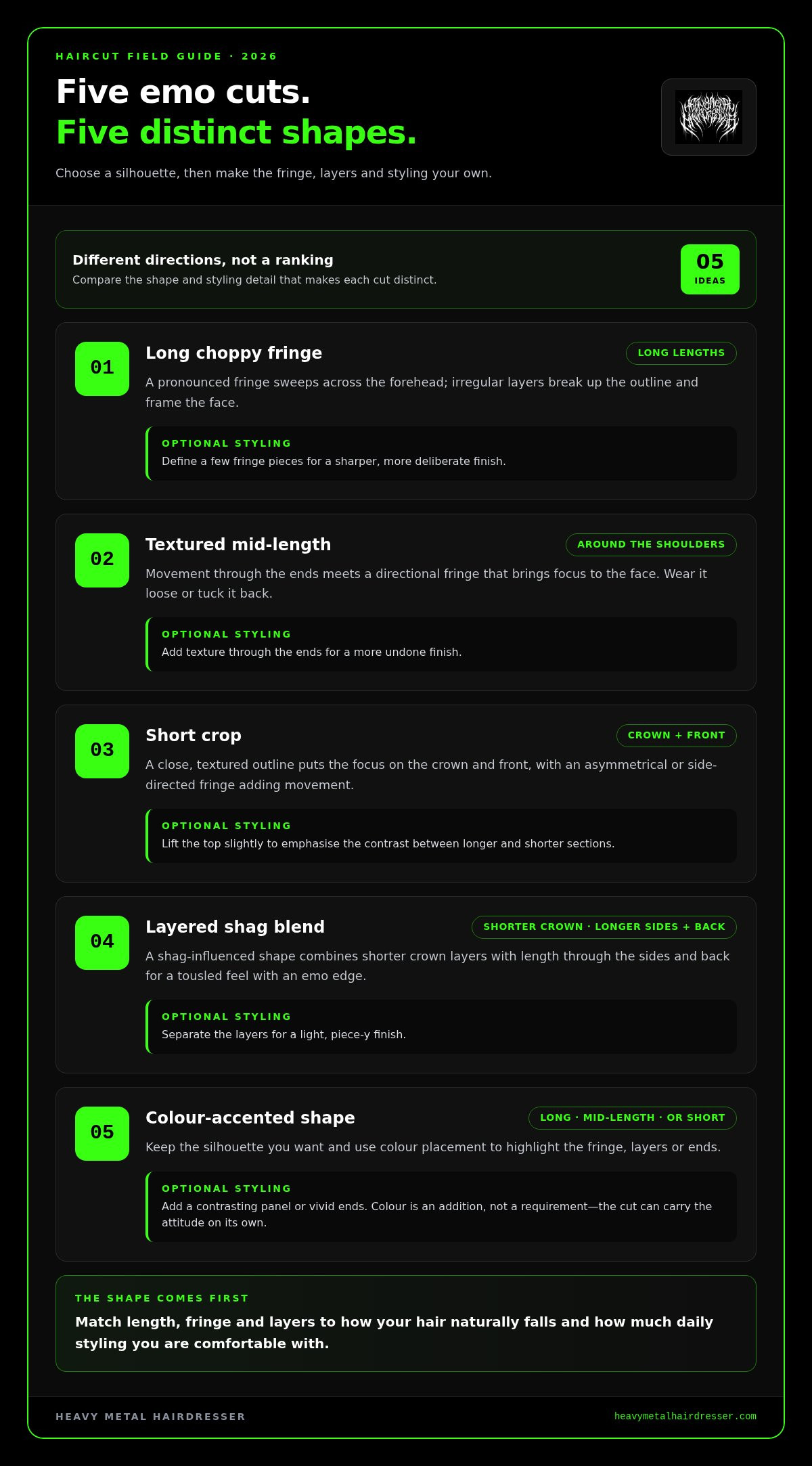
Five emo haircut ideas for 2026, from heavy fringe to textured layers

These are different directions, not a ranking of what’s “in”. The best emo haircut ideas 2026 are the ones you can adapt to your length, texture and styling routine. Hair continually borrows from its past and reshapes it for the present, part of the wider evolution of hairstyling. Start by choosing a silhouette, then decide how much drama you want to add.

  • Long choppy fringe: Long lengths frame the face, while a pronounced fringe sweeps across the forehead and irregular layers break up the outline. Optional styling: Define a few fringe pieces for a sharper, more deliberate finish.
  • Textured mid-length: A cut around the shoulders keeps movement through the ends, while a directional fringe brings focus to the face. Wear it loose or tuck it back. Optional styling: Add texture through the ends for a more undone finish.
  • Short crop: A close, textured outline puts the focus on the crown and front, with an asymmetrical or side-directed fringe adding movement. Short doesn’t have to mean subtle. Optional styling: Lift the top slightly to emphasise the contrast between longer and shorter sections.
  • Layered shag blend: A shag-influenced shape combines shorter layers around the crown with length through the sides and back. The result can feel tousled while keeping its emo edge. Optional styling: Separate the layers for a light, piece-y finish. For more on the cut itself, explore our shag haircut guide.
  • Colour-accented shape: The silhouette can be long, mid-length or short, with colour placed to highlight the fringe, layers or ends. Optional styling: Add a contrasting panel or vivid ends. Colour is an addition, not a requirement; the cut can carry the attitude on its own.

Which long or mid-length emo cut gives layers room to move?

Long face-framing layers keep the overall length while creating movement around the cheeks and jaw. A mid-length cut gives the outline a lighter feel, and its directional fringe can work with the way you part or style your hair. Both shapes can draw on shag cutting, but the amount of layering and where it begins will change the result. If keeping length matters to you, make that clear when discussing how much to remove.

Can short emo hair still feel expressive and unmistakable?

Absolutely. A short crop can use an angled fringe, textured crown or close sides to create contrast without relying on long lengths. Vivid panels or contrasting tones can sharpen the shape, but they’re optional; placement should complement the cut rather than dictate it. Heavy Metal Hairdresser creates textured cuts shaped around individual style. Explore alternative hair styling.

Which emo haircut suits your hair texture, length and styling habits?

There’s no single hair type, length or heavy fringe required for emo hair. The right cut depends on how your hair naturally falls, the shape you want and how much time you’re willing to spend styling it. Use this comparison to prepare for a conversation, not as a set of rules. A reference photo may sit differently on your hair because texture and density affect how layers fall.

Hair and length Texture considerations Fringe preference Daily styling effort
Long, fine or straight Layers can add movement; keeping enough weight may help the ends look fuller. Long, directional fringe or softer face-framing pieces. Low to medium, depending on how defined you want the layers.
Mid-length, thick or straight Discuss where to remove bulk so the shape doesn’t feel too heavy. Pronounced fringe or a less committed side sweep. Medium if you want a distinct, piece-y finish.
Mid-length, wavy Natural movement can make layers sit differently from a straight reference. Flexible fringe that works with your usual parting. Low to medium, depending on whether you define the wave.
Short, fine or thick Density affects crown volume and how sharply the outline reads. Asymmetrical fringe or shorter, textured front pieces. Medium; sharper shapes may need more frequent reshaping.
Any length, curly Talk through curl pattern and shrinkage, as dry length and shape can differ from a stretched reference. Fringe shaped to work with your natural curl and preferred styling. Varies with your routine and the finish you want.

How should hair texture shape an emo haircut choice?

Consider density as well as texture. Thick hair may need carefully placed layers to create movement without losing the silhouette. With fine hair, a more measured approach can help the ends avoid looking overly sparse. Straight hair tends to show the cut’s lines clearly, while waves and curls bring their own movement. Mention your natural wave or curl pattern, any shrinkage and how you usually wear your hair. The cut should make sense without assuming you’ll spend ages styling it every morning.

How much fringe styling and upkeep are you comfortable with?

A pronounced fringe makes a strong statement, but you may need to restyle it to keep it sitting as you like. Softer face-framing pieces offer more flexibility and can be swept aside. Short, sharp outlines can lose their edge as they grow, so consider how often you’re comfortable reshaping the cut. Be honest about your routine: if you want minimal daily effort, say so. These emo haircut ideas 2026 should fit your life as well as your reference board.
Emo Haircut Ideas 2026: Fringe, Layers and Colour with Attitude

How to turn emo haircut inspiration into a clear stylist brief

A reference photo captures a mood, not the whole haircut. Bring several images and explain what you want to borrow from each, along with anything you’d rather avoid. That makes it easier to turn inspiration into a shape that works with your hair and routine.

A strong reference brief names the shape you want and the practical limits it needs to respect. Use this five-step process to make the conversation clearer:

  1. Gather references. Choose a few images that show the overall silhouette, fringe and layers. Include different angles where possible, so the shape isn’t only clear from the front.
  2. Spot the shared details. Is it the long side-swept fringe, choppy ends, crown volume or length you keep saving? Point to the specific feature in each image rather than asking for a copy of one person’s whole look.
  3. Set your boundaries. Explain what you don’t want, too. You might love the layers but want to keep your length, or want an expressive fringe that doesn’t cover your eyes.
  4. Talk through upkeep. Describe how you usually wear your hair, how much styling you’re comfortable with and how often you’re happy to reshape the cut.
  5. Agree the shape. Discuss fringe direction, where the layers begin, the outline and how the cut will sit with your natural texture before settling on a plan.

What should you show and say during an emo haircut consultation?

Be specific about your references. You could say, “I like the fringe in this photo, but I want the length from this one and less bulk through the ends.” Describe your usual styling routine and how much change feels right, whether that’s a subtle shift or a sharper new outline. Your identity and boundaries belong in the conversation. The aim is a cut that feels like you, not someone else’s idea of emo hair.

How can you keep the cut wearable between appointments?

Choose an approach that suits the shape and your routine. You may prefer to let natural movement do the work, or use a small amount of styling product to define the layers. Haircut upkeep and colour upkeep are separate considerations: a vivid panel can complement the shape, but it doesn’t dictate the cut. If colour is part of your plan, our vivid hair colour guide covers colour-specific considerations.

Bring your references and a clear sense of what you want from the cut. Heavy Metal Hairdresser offers alternative hair styling shaped around individual texture and identity.

Make 2026 emo haircut ideas your own with an alternative stylist

A strong reference is a starting point, not a template to copy. The same fringe or layered silhouette can sit differently depending on your hair’s texture, density and natural movement. Keep the part that speaks to you, then shape the rest around your features, styling habits and the way you want to express yourself.

A collaborative approach helps translate an image into practical choices: where the layers begin, how the fringe moves, which sections keep their weight and how the outline works with your hair as it naturally falls. You can keep the attitude of a reference without being locked into somebody else’s exact cut.

What can a specialist bring to an emo-inspired cut?

Textured-cutting experience can turn broad ideas like “choppy” or “piece-y” into a considered shape. Heavy Metal Hairdresser is an inclusive alternative salon founded by barber and creative stylist Simon Tuckwell. The salon specialises in textured cuts, shags, mullets and wolfcuts, bringing a focus on movement and silhouette to alternative hair. The approach is to listen, adapt and create a cut that feels like yours, rather than fitting everyone into one fringe or formula.

Your identity and boundaries are part of the brief. Be clear about what you want to emphasise, what you’d rather avoid and how much change feels right. An inclusive approach makes room for personal expression without assuming that emo hair has one gender, length or look.

Where can your next alternative haircut idea take you?

Before choosing, weigh up four things: the shape you’re drawn to, how your texture behaves, how much daily styling you enjoy and what feels like your own expression. A sharp fringe may be the right statement; softer layers might better suit your routine. Vivid colour can add another layer of personality, but it’s optional. The cut should still feel right without it.

Use emo haircut ideas 2026 to spark possibilities, then bring your preferences into a conversation about a personalised shape. Heavy Metal Hairdresser’s alternative haircuts, textured styling and vivid colour work give you room to explore different directions with individuality at the centre.

Explore Heavy Metal Hairdresser’s alternative hair services and find a direction that feels unmistakably yours.

Make your next emo cut unmistakably yours

The strongest emo haircut ideas 2026 aren’t one-size-fits-all. Start with the silhouette that speaks to you, then consider how your texture, preferred fringe and styling routine will shape the result. Colour can sharpen the look, but it’s never a requirement. A few clear reference photos and honest notes about what you want, and don’t want, can help turn inspiration into a cut that feels personal.

Heavy Metal Hairdresser brings textured cutting and alternative styling together with an inclusive approach to self-expression. Founded by barber and creative stylist Simon Tuckwell, the salon’s experience includes backstage festival work at Download and Bloodstock. Its focus on textured cuts and vivid colour gives you room to explore a shape and finish that fit your identity.

Explore alternative haircuts with Heavy Metal Hairdresser and take the next step towards a look that feels like you. Your hair, your rules.

Frequently Asked Questions

What are the best emo haircut ideas for 2026?

The best emo haircut ideas 2026 are the ones that suit your hair and personal style, rather than a trend ranking. Consider a long choppy fringe, textured mid-length layers, a short crop, a shag-influenced shape or a cut with optional colour accents. Compare the silhouette and upkeep of each direction, then adapt the fringe and layers to your natural texture and the way you like to wear your hair.

Can you get an emo haircut with short hair?

Yes, short hair can carry a strong emo shape. A textured crop can use an asymmetrical fringe, side-directed front pieces or contrast between the crown and sides to create movement and attitude. Length isn’t the defining factor. Before choosing a reference, consider how the shorter outline will sit with your hair’s density and texture, and whether you’re comfortable styling the fringe or maintaining a sharper shape as it grows.

Is emo hair only suitable for straight hair?

No. Emo hair can be adapted for straight, wavy and curly textures. Natural movement affects how layers fall, and curls may appear shorter when dry than they do when stretched. Share your usual styling routine and texture with your stylist, then discuss how the shape will behave without extensive styling. A straight-haired reference can still inspire the fringe or silhouette, but the cut may need adapting to your hair’s natural pattern.

How do I explain an emo haircut to my stylist?

Bring several reference images and point out exactly what you like in each: the fringe direction, layer placement, overall length or outline. Say what you want to avoid, too, such as losing too much length or having a fringe cover your eyes. Explain your natural texture, usual styling routine and how much upkeep feels realistic. Clear details help turn the mood of a reference into a shape tailored to you.

How do you style an emo fringe?

Start with damp hair and direct the fringe the way you want it to sit as you dry it. For a straighter finish, use a heat protectant before applying heat, and work in sections rather than repeatedly passing over the same area. A small amount of texture paste or styling wax can separate the ends. The exact routine depends on your hair’s texture and fringe shape, so choose a finish that feels comfortable and manageable.

Can an emo haircut work without a heavy side fringe?

Absolutely. A heavy side fringe is a recognisable option, not a requirement. You can keep an emo-inspired feel with visible layers, face-framing pieces, crown texture or an asymmetrical outline, while choosing a lighter fringe or no fringe at all. Tell your stylist how much of your face you want the hair to frame and how you normally part it. The aim is a distinctive shape that feels right to you.

What is the difference between emo hair and scene hair?

Emo and scene styles overlap, and people may mix elements from both. Emo hair is often associated with directional fringe, layered lengths and a more restrained or introspective overall look. Scene styling can lean towards a more deliberately exaggerated silhouette, with heightened volume and vivid colour as possible accents. These are broad influences, not strict rules. Your haircut can draw from either, both or neither, depending on the expression you want.
Posted on

Short Mullet Ideas for Women: Aggressive Shapes and Subcultural Grit

Short Mullet Ideas for Women: Aggressive Shapes and Subcultural Grit

The mullet isn’t a costume; it’s a weapon of self-expression designed to survive the front row of a mosh pit. Most people think this cut is just a retro relic, but for those living outside the mainstream, it’s a living symbol of subcultural grit. You’ve likely spent hours looking for short mullet ideas for women, only to find watered-down versions that look more like a “Dad mullet” than a statement of intent. It’s exhausting when you want aggressive texture but keep seeing styles that feel far too safe.

We understand that struggle. You need a look that feels authentic, suits your hair texture, and requires minimal effort to style before a gig. This guide will help you discover the boldest short mullet variations designed to celebrate your individuality and survive the heaviest mosh pits. We’ll explore sharp, aggressive shapes that work for fine hair and show you how to communicate your vision to a stylist who actually understands alternative aesthetics. From jagged crops to your new favourite pixie-hybrid, it’s time to find a cut that matches your energy.

Key Takeaways

  • Learn how to ditch the flat 80s caricature in favour of aggressive, modern shapes that define subcultural rebellion.
  • Discover a range of short mullet ideas for women, including high-impact pixie-mullets and shaggy, radical undercuts.
  • Master the art of tailoring your cut to your chaos, ensuring fine hair gets volume whilst thick hair stays sharp and manageable.
  • Get the lowdown on mosh pit-tested styling techniques, from the raw air-dry finish to using a diffuser for maximum grit.
  • Find out how to spot a stylist who speaks your language and values a gender-inclusive, safe-space environment over traditional salon clichés.

The Anatomy of a Short Mullet: Why It Is the Ultimate Alt-Hair Statement

The short mullet is a middle finger to the status quo. It is the evolution of punk and metal aesthetics, stripped of the hairspray and gloss of previous decades. Whilst the cultural history of the mullet is rooted in ancient warriors and 70s rock gods, the modern iteration is far more aggressive. It’s built for the pit, not the boardroom. Unlike the flat, feathered shapes of the 1980s, today’s short mullet ideas for women rely on raw texture and intentional disconnection. It’s a look that refuses to be ignored.

This style is inherently inclusive. It works across all gender identities because it rejects the binary of “long” or “short” hair. It’s about the silhouette, not the gendered expectations attached to it. To master the look, you need to understand the three pillars of its anatomy:

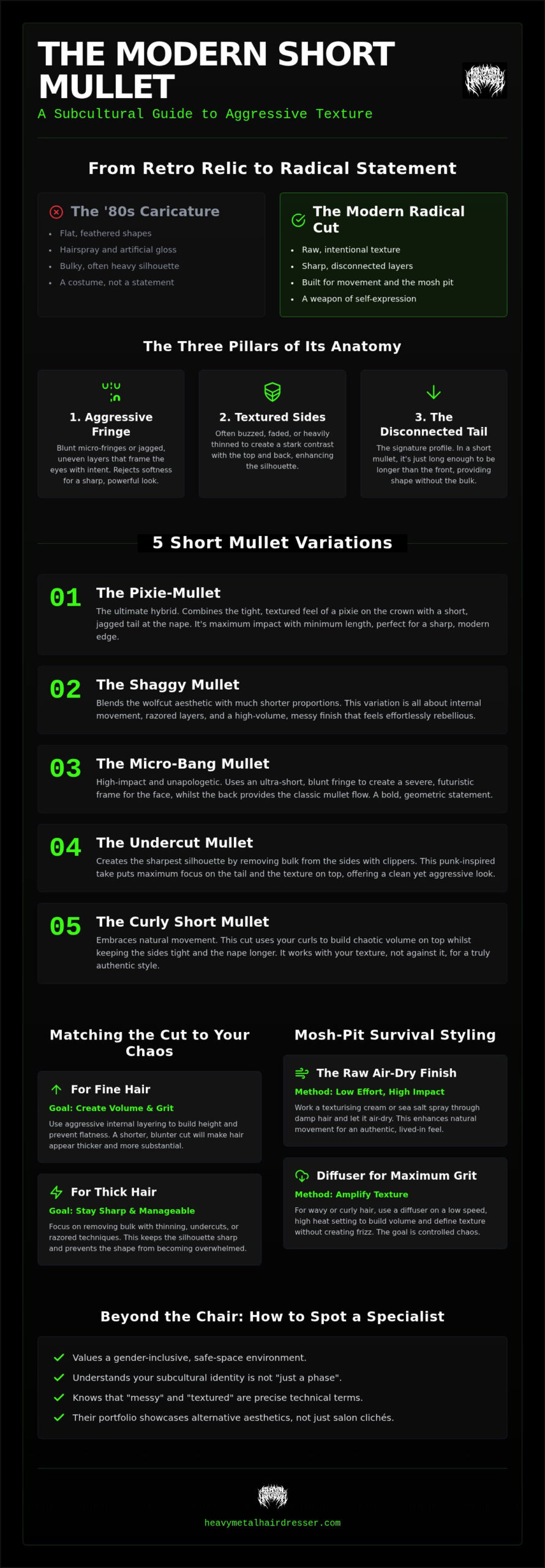
  • Aggressive Fringe: Think blunt micro-fringes or jagged, uneven layers that frame the eyes with intent.
  • Textured Sides: These are often buzzed, faded, or heavily thinned to create a sharp contrast with the top and back.
  • The Tail: In a short mullet, the back doesn’t need to hit your shoulders. It just needs to be longer than the front, providing that signature profile without the bulk.

The Shift from Retro to Radical

The mullet has moved from the stage to the mosh pit. Traditional lengths can feel heavy or dated, but the “short” variation offers a sharper, more percussive edge. It’s about precision. By keeping the proportions tight, the hair gains a sense of urgency. This is why modern mullet haircuts have become a staple in the UK alternative scene. They provide the grit of a shag with the convenience of a crop. It’s a low-maintenance weapon for high-energy lives.

Subculture and Identity

Your hair is a visual badge. It signals your belonging to a community that values authenticity over polish. Choosing one of many short mullet ideas for women is an act of rebellion against traditional beauty standards. It’s an intentional disconnection from being “pretty” in favour of being powerful. Because this look is so specific, finding a safe-space salon is vital. You need a stylist who understands that “messy” is a technical term and that your subcultural identity isn’t just a phase. It’s who you are.

5 Short Mullet Variations: From Pixie-Mullets to Radical Undercuts

Choosing a new look is about matching your hair to your internal chaos. When exploring short mullet ideas for women, you’ll find that the best variations aren’t found in mainstream magazines. They’re found in the pit. These shapes are built on aggressive layering and a refusal to blend in. Each variation offers a different level of subcultural grit, allowing you to customise the intensity based on your hair texture and personal style.

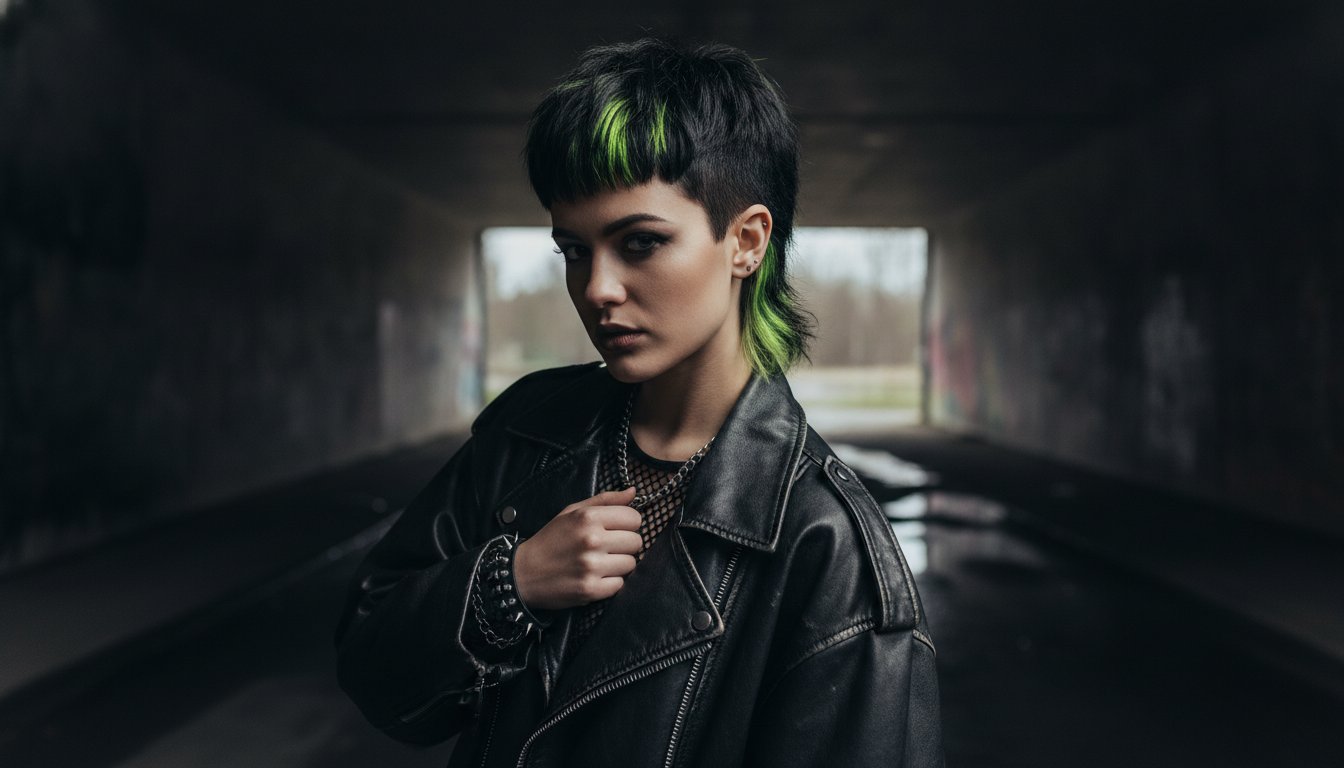
  • The Pixie-Mullet: This is the ultimate hybrid. It offers the tight, textured feel of a pixie on top with a jagged tail at the nape. It’s maximum impact with minimum length.
  • The Shaggy Mullet: This variation blends the wolfcut aesthetic with much shorter proportions. It’s all about internal movement and messy volume.
  • The Micro-Bang Mullet: High-impact and unapologetic. It uses short, blunt fringes to frame the forehead whilst leaving the back to do its own thing.
  • The Undercut Mullet: By removing bulk from the sides with a clipper, you create a sharper, punk-inspired silhouette. It’s the cleanest way to highlight the tail.
  • The Curly Short Mullet: Never fight your natural movement. This cut uses curls to create chaotic volume that stays high and tight where it matters.

Finding the right balance for these aggressive shapes requires a stylist who truly understands alternative hair aesthetics.

The Pixie-Mullet Hybrid

This is the perfect choice for anyone transitioning from a standard pixie who wants more edge. The key is in the internal layers. You want height and grit on the crown to prevent the hair from lying flat. To make the back look intentional, your stylist should use a razor or point-cutting technique. This ensures the tail looks like a deliberate design choice rather than an accidental growth spurt. It’s a sharp, modern way to wear one of the most popular short mullet ideas for women.

Aggressive Fringes and Micro-Bangs

A micro-fringe changes everything. It shifts the energy from retro to radical instantly. You can choose between blunt edges for a graphic look or jagged, feathered edges for a more lived-in feel. The trick is balancing that fringe length with the tail. If the front is super short, the back should have enough texture to provide a sense of symmetry. It’s about creating a percussive rhythm across the scalp that feels authentic to your subcultural identity.

Matching the Cut to Your Chaos: Texture, Face Shape, and Flow

Your hair texture shouldn’t limit your rebellion. It should dictate your strategy. Most short mullet ideas for women fail when they ignore the physics of the hair. A great alternative cut isn’t just about length; it’s about how the layers interact to create movement. The secret lies in disconnection. This is the technical gap between the short top, the thinned sides, and the aggressive tail. It is what separates a subcultural statement from a generic salon trim.

Forget the myth that only certain face shapes can pull off a mullet. It’s all about the framing. A round face benefits from vertical height and a jagged micro-fringe. A square face needs broken, feathered edges to soften the jawline whilst maintaining a sharp profile. We don’t follow traditional beauty rules here. We break them with intent to highlight your best features through intentional disconnection.

Injecting Life into Fine Hair

Fine hair needs a skeleton to keep it from falling flat. We use shorter internal layers, often called “ghost” layers, to provide invisible scaffolding. This technique is heavily inspired by the wolf hair cut approach. By carving out weight from underneath, the top layers gain a natural lift that survives the heat of a gig. Avoid heavy oils or thick waxes. Stick to lightweight salt sprays to keep the texture gritty but airy.

De-bulking for Thick and Coarse Hair

Thick hair is a different beast. Without the right technique, a short mullet can quickly turn into a “mushroom” shape that lacks definition. We manage this through aggressive de-bulking. Using an undercut on the sides is a brilliant way to remove excess volume whilst keeping the silhouette sharp. The goal is to ensure the back flows rather than looking like a solid block of hair. We use point-cutting and channeling to create deep, jagged valleys in the hair. This allows the light to hit the texture and keeps the shape looking dangerous rather than bulky.

  • Internal Layering: Essential for building height without losing length.
  • Undercuts: The best tool for managing side-volume in coarse hair.
  • Disconnection: The key to achieving that authentic, non-conformist aesthetic.

Short Mullet Ideas for Women: Aggressive Shapes and Subcultural Grit

Mosh Pit Survival: How to Style and Maintain Your Texture

A haircut is only as good as its ability to survive a gig. If your style collapses the moment you hit the floor, it isn’t doing its job. The most successful short mullet ideas for women are those that thrive on a bit of chaos. We don’t do “perfect” here. We do grit. Achieving that raw, textured finish is about using the right tools and knowing when to leave the hair alone. The “Air-Dry and Go” method is the gold standard for a reason. It allows your natural movement to take the lead whilst keeping the silhouette sharp and aggressive.

  • Salt Sprays: Essential for that gritty, beach-meets-black-metal texture.
  • Texture Pastes: Use these on dry hair to define individual jagged layers.
  • Diffusers: The secret weapon for injecting chaotic volume without causing frizz.
  • Pomades: Perfect for slicking down the sides or adding weight to the tail.

Styling for Maximum Grit

Forget everything traditional salons told you about blowing your hair smooth. When styling a modern mullet for a high-energy environment, you want the hair to look lived-in. Start with damp hair and apply a generous amount of salt spray. Scrunch the hair with your hands to encourage the layers to separate. If you have fine hair, use a diffuser to blast the roots for extra height. For a finish that refuses to budge, use a product like Death Grip. It provides an untouchable texture that keeps your style locked in place through the heaviest sets. Remember, “perfect” hair is the enemy of the alt-mullet. If a few strands fall out of place, it only adds to the aesthetic.

Between Salon Visits

Maintaining the edge of your cut requires a bit of discipline. Short mullet ideas for women can quickly lose their shape if the “awkward stage” of growth isn’t managed. We recommend organising a trim every six to eight weeks to keep the disconnection looking deliberate. This is especially vital for your fringe. A micro-fringe that gets too long can lose its aggressive energy and start looking like a standard bowl cut. If you are also rocking vivid hair colour, keep it fresh by using cold water and sulphate-free cleansers. This ensures your identity remains saturated in high-pigment sensation whilst your cut stays sharp.

Ready to reclaim your identity with a cut that actually lasts? Grab your slot for a mosh pit-tested transformation here.

Beyond the Chair: Why the Right Specialist Makes the Difference

Your search for short mullet ideas for women shouldn’t end with a screenshot. It should end in the chair of someone who actually gets it. Traditional hairdressing jargon often fails alternative clients because it prioritises “blending” and “softness.” In our world, those are dirty words. You want a silhouette that looks like it was carved with a razor, not polished with a round brush. Bringing a radical vision to a mainstream salon often results in a “safe” version that lacks the subcultural grit you’re after. Traditional stylists are trained to fix “mistakes” like uneven layers or harsh lines. We call those design features.

A specialist alternative salon offers more than just a haircut. It provides a gender-inclusive, safe-space environment where your identity is celebrated, not just tolerated. We don’t do traditional bridal styling or children’s trims for a reason. We focus on the niche. When you choose a stylist with official credentials from festivals like Download or Bloodstock, you’re getting someone who knows how hair behaves under stage lights and in the middle of a crowd. That expertise translates to a cut that holds its shape long after you’ve left the salon. It’s about mosh pit-tested technical proficiency.

The Alternative Specialist Advantage

There is a massive difference between a “fashion mullet” seen on a runway and a “rock mullet” seen in a basement venue. One is a passing trend; the other is a lifestyle. Alternative specialists understand the nuances of aggressive textured layers. They won’t try to talk you out of micro-bangs or suggest “toning down” the disconnection. Instead, they’ll find ways to make those elements work for your specific hair type. Look for a portfolio that shows raw, unedited texture and a variety of identities. If every photo looks like it belongs in a high-street window, keep looking.

Preparing for Your Appointment

Communication is vital. When you arrive for your appointment, bring photos that show the grit, not just the shape. Avoid heavily filtered or over-styled influencer shots. Instead, look for images of musicians or people in your community whose hair has the movement you admire. Be honest about your lifestyle. If you need a cut that survives regular mosh pits but still lets you function in a professional setting, tell us. We can adjust the level of aggression to suit your needs. When discussing short mullet ideas for women, ask for “shattered ends” and “intentional disconnection.” This ensures you walk out with a weapon of self-expression rather than a standard bob.

Own Your Edge in the Front Row

The short mullet is more than a trend. It is a badge of subcultural belonging that survives the heat of the pit and the chaos of everyday life. You’ve seen how aggressive layering and intentional disconnection can transform fine hair or de-bulk thick strands. It is about matching the cut to your energy. When you explore short mullet ideas for women, you aren’t just looking for a haircut; you are looking for a visual identity that refuses to compromise.

Choosing an alternative specialist ensures your vision isn’t watered down by traditional salon jargon. As official stylists for Download and Bloodstock festivals, we specialise in gender-inclusive, mosh pit-tested styling techniques that keep your texture sharp and your spirit independent. Our salon is a safe space where your individuality is the priority. It’s time to stop settling for safe and start looking for radical. Book your aggressive short mullet transformation today and walk out with a shape that actually speaks your language. Your next favourite look is waiting.

Frequently Asked Questions

Is a short mullet high maintenance for daily styling?

A short mullet is actually one of the lowest maintenance styles for alternative hair. It thrives on a raw, lived-in finish rather than a polished look. You don’t need to spend hours with a blow-dryer. Just apply some sea salt spray to damp hair and let it air dry. The aggressive layers do the work for you, creating natural volume that looks better the messier it gets.

Can I pull off a short mullet if I have very fine hair?

Absolutely. Fine hair benefits from the radical layering found in many short mullet ideas for women. By using internal “ghost” layers, we create a skeleton of support that lifts the hair from the root. This prevents the style from looking flat or limp. Avoid heavy conditioners and stick to lightweight texturisers to keep your volume high and your silhouette sharp throughout the day.

How often do I need to get my short mullet trimmed?

We recommend a trim every six to eight weeks to maintain the intentional disconnection of the cut. Because the fringe and the “tail” grow at different rates, leaving it too long can cause the shape to lose its edge. Regular maintenance ensures your micro-bangs stay aggressive and your sides remain tight. This schedule prevents the hair from entering an “awkward stage” that feels accidental rather than designed.

What is the difference between a pixie-mullet and a wolfcut?

The main difference is the proportion and length. A pixie-mullet is much shorter and tighter on the top and sides, often featuring micro-bangs and a jagged nape. A wolfcut is a longer, shaggier evolution that blends the mullet with a traditional shag. Whilst both rely on heavy texture, the pixie-mullet offers a more percussive, punk-inspired energy that is ideal for those wanting a truly short variation.

Will a short mullet work with my natural curls?

Curls and mullets are a perfect match. Natural movement adds chaotic volume that makes the cut look even more dangerous. We use specific carving techniques to ensure your curls sit in a way that highlights the disconnection. Instead of fighting the frizz, we embrace it as part of the grit. Use a diffuser to set the shape and a light cream to define the ends without losing the bounce.

How do I style my mullet so it stays in place at a gig?

Survival in the pit requires serious hold. Start with a gritty base like salt spray, then use a product like Death Grip to lock the texture into place. This keeps your layers separated and aggressive even when things get sweaty. Focus on the fringe and the crown to maintain height. If a few strands fall out of place during the set, don’t worry. It just adds to the subcultural aesthetic.

Should I get an undercut with my short mullet?

An undercut is a brilliant addition if you have thick hair or want a sharper punk silhouette. It removes excess bulk from the sides, making the disconnection between the top and the tail even more dramatic. It also makes daily styling faster because there is less hair to manage. If you want maximum grit, a buzzed undercut provides a clean contrast against the jagged, textured layers of the rest of the cut.

Can I have a short mullet with vivid hair colours?

Short mullet ideas for women look incredible when paired with high-pigment shades. Vivid colours like deep reds, neon greens, or electric blues saturate your identity and highlight the jagged edges of the cut. We specialise in creative colour that complements the aggressive shape of your hair. Just remember to use sulphate-free products to keep your hue fresh and vibrant whilst maintaining the integrity of your mosh pit-tested style.

Posted on

The Ultimate Wolf Cut for Round Face: Aggressive Layers to Sharpen Your Look

The Ultimate Wolf Cut for Round Face: Aggressive Layers to Sharpen Your Look

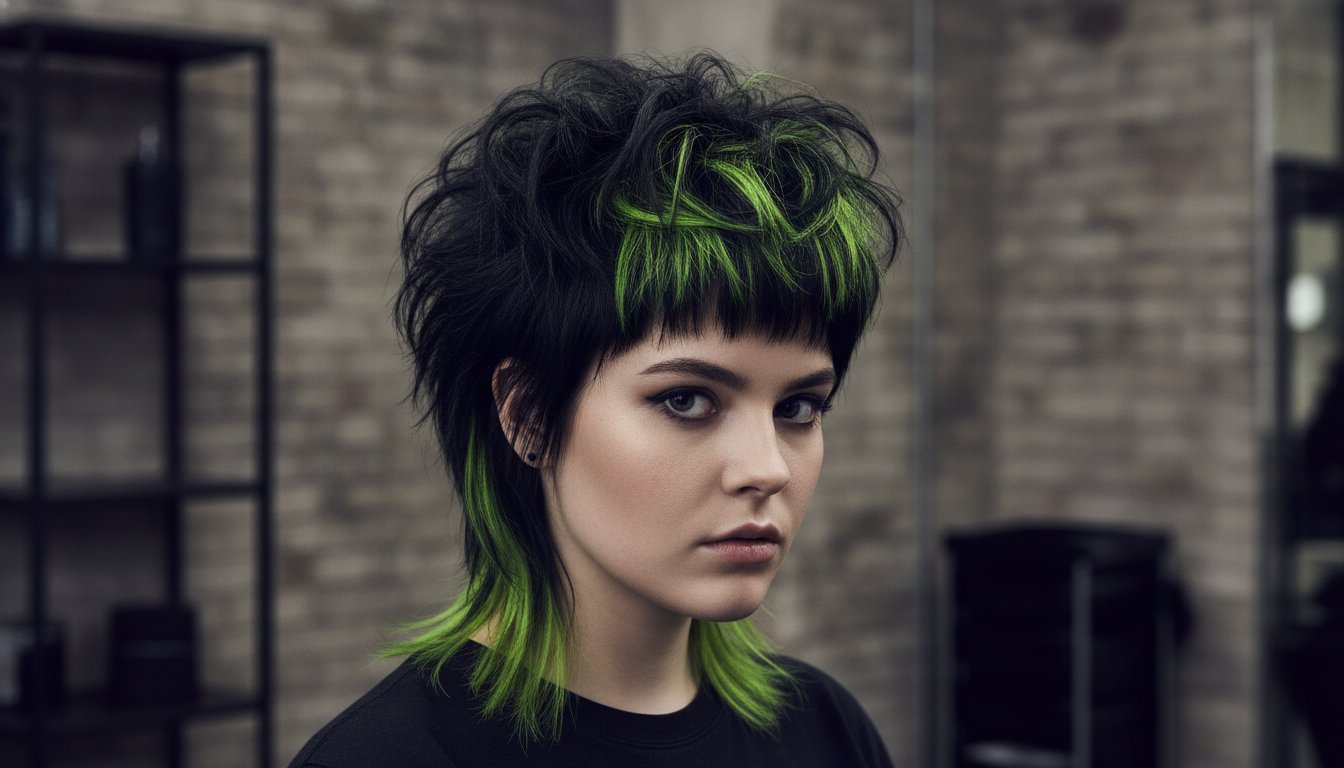
Who told you that a round face needs to be ‘softened’ with a boring, safe haircut? If you’re sick of mainstream stylists trying to make you look ‘cute’ when you actually want an edge, you’re in the right place. Most advice tells you to hide your features. We’re here to sharpen them. Finding the perfect wolf cut for round face isn’t about blending in. It’s about using aggressive texture to build an architectural silhouette that commands attention and defines your jawline.

You’re likely tired of hair that falls flat at the crown or looking too ‘approachable’ for your subcultural identity. You need a look that survives a mosh pit and angles that cut through the noise. We’ll show you how to weaponise the wolf cut to create intense volume and bold, gritty texture that defies traditional beauty standards. We will explore how to specialise your routine with Death Grip and Hair To the Throne to keep your style locked in whilst ensuring your look stays fiercely independent. It’s time to stop hiding and start building a shape that reflects who you really are.

Key Takeaways

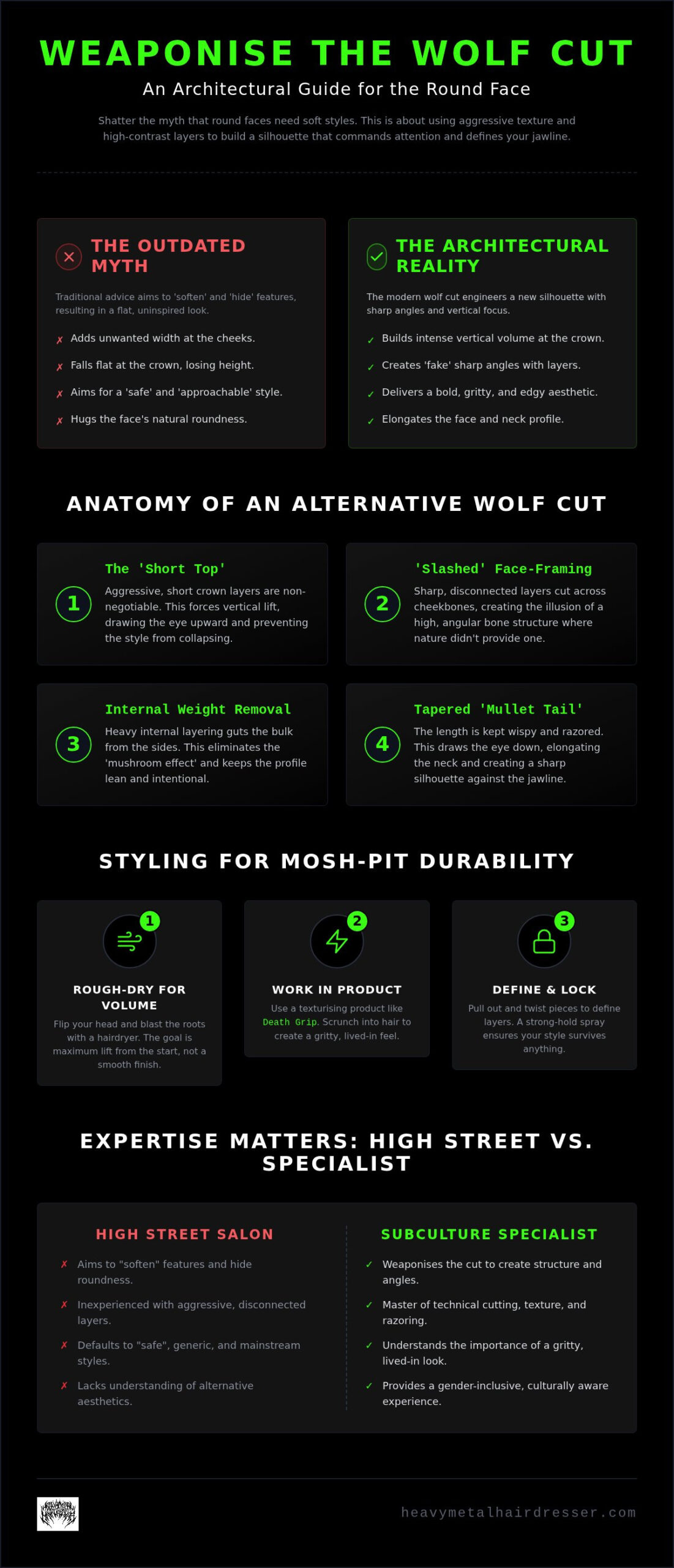
  • Shatter the myth that round faces need soft styles by weaponising high-contrast, aggressive layers to create sharp, architectural angles.
  • Master the ‘Short Top’ technique to build intense crown volume, ensuring your wolf cut for round face provides height rather than unwanted width.
  • Learn how to use ‘slashed’ face-framing layers and micro-fringes to cut across cheekbones, transforming a soft silhouette into a bold statement.
  • Discover the rough-drying secrets and professional products like Hair To the Throne needed to maintain a gritty texture that survives any mosh pit.
  • Understand why skipping the high street for a subculture expert is vital for a gender-inclusive experience that understands your specific alternative aesthetic.

Why the Wolf Cut Rules for Round Faces (and How It Works)

Forget the ‘soft’ look. We aren’t here to blend your jawline into your neck or make you look ‘approachable’. The wolf cut for round face is a high-contrast hybrid of aggressive shaggy layers and mullet-inspired length. It’s the ultimate weapon for anyone sick of being told to play it safe. The wolf cut has solidified itself as a subcultural staple for 2026, offering a middle finger to traditional beauty standards whilst providing a silhouette that actually has some bite.

High-street stylists often claim that round faces can’t handle short layers. That’s outdated bollocks. They’re scared of the texture because they don’t know how to control the weight. If you look at the history of the shag, you’ll see that volume has always been about rebellion and self-expression. We aren’t trying to hide your face shape. We’re trying to give it structure that it doesn’t naturally have. We call this the ‘Architectural Shift’. It’s about using hair to create height and vertical lines that draw the eye up, rather than out.

The Anatomy of an Alternative Wolf Cut

This isn’t your standard salon trim. We use heavy internal layering to gut the weight from the sides of the head. This prevents the hair from poofing out at the cheeks, which is exactly what you don’t want. Instead, we disconnect the length to create a raw, jagged edge that looks lived-in and intentional. In our world, grit is far more important than perfection. We want your hair to look like it has a history, even if you just walked out of the chair. It’s about texture that stays messy and layers that have a life of their own.

Round Face Dynamics: Geometry vs. Softness

Round faces usually find their widest point at the cheeks. Traditional cuts just hug that width and make everything look circular. We do the opposite. By forcing vertical volume at the crown, we offset that horizontal width and create a more elongated look. We create ‘fake’ angles with choppy, pointed layers that slash across the cheekbones. This turns softness into geometry. It’s about building a frame that looks sharp enough to cut. When you focus on height and aggressive texture, the roundness of the face becomes a canvas for the cut, not a problem to be solved.

Engineering the Silhouette: Crown Volume and Face-Framing

The ‘Short Top’ isn’t a suggestion; it’s the foundation. To master a wolf cut for round face, crown layers must be short and aggressive. This creates a vertical focal point that pulls the eye upward. If the top is too long, the hair collapses under its own weight. It adds width where you least want it. We use internal thinning to gut the weight from the sides, especially in the space behind the ears. This prevents the dreaded ‘mushroom effect’ that haunts so many mainstream salon visits. For thick UK hair types, this technical removal of bulk is vital. We create a streamlined profile that stays narrow through the mid-lengths, ensuring the texture looks intentional rather than accidental.

We don’t use soft, wispy bits to ‘frame’ the face in the traditional sense. We use slashed layers. These are sharp, disconnected sections that cut directly across the cheekbones. It creates a synthetic angle where nature didn’t provide one. It mimics the look of high, sharp bone structure. By removing weight from the internal sections, we ensure the hair moves with you. It doesn’t just sit there like a heavy helmet. This is about engineering a silhouette that feels light but looks heavy and textured.

The “Death Grip” on Volume

Flat hair is the absolute enemy of this aesthetic. If your crown falls, your face looks rounder. It’s that simple. We use Death Grip to lock in that raw, percussive texture that defines the subculture. You want to force volume into the roots from the moment you start styling. Use a ‘scrunching’ motion or light back-combing to create a gritty, unpolished feel. It shouldn’t look like you’ve spent hours in front of a mirror. It should look like you’ve been at a show for three hours. If you’re struggling with the technique, our Hair Courses can help you master the art of alternative styling at home.

Jawline Definition through Tapering

The ‘tail’ of the wolf cut is what separates it from a standard shag. For a round face, tapering these ends is crucial for balance. We keep the ends wispy and thin to draw the eye down, effectively elongating the neck. This sharpens the jawline by providing a high-contrast backdrop of negative space. The transition from the shaggy front to the mullet-back must be seamless. We blend these sections using a razor to ensure the silhouette remains architectural rather than bulky. A wolf cut for round face fails if the back is too heavy. It needs to be lean, mean, and perfectly tapered to maintain that aggressive edge.

The Ultimate Wolf Cut for Round Face: Aggressive Layers to Sharpen Your Look

Choosing Your Fringe: Curtain Bangs vs. Micro-Fringe

The fringe is the anchor of your entire look. It’s the piece that dictates how the rest of the layers behave and where the eye settles. When you’re rocking a wolf cut for round face, the fringe isn’t just an accessory; it’s a strategic tool used to disrupt the circularity of your features. You want something that creates tension and interest. Whether you go for a sweeping shield or a sharp, short blade, the goal is to add structure where nature kept things soft. Don’t let anyone tell you that a certain style is off-limits. It’s all about how you angle the cut to suit your vibe.

Asymmetry is your best friend here. A slightly “wonky” or jagged fringe can actually balance a round face better than a perfectly symmetrical one. It breaks the visual expectation of a circle and introduces a sense of movement. We aren’t looking for salon-perfect precision that looks like a wig. We want a fringe that looks like it has lived a little. It should feel raw, intentional, and unapologetically you.

Curtain Bangs: The Versatile Shield

Mainstream stylists love curtain bangs because they’re safe. We love them because they’re a gateway to more aggressive styling. To make them work for a wolf cut for round face, we cut them cheekbone-high. This creates a sharp diagonal line that slashes across the face, effectively ‘cutting’ the width of the cheeks. When you style them with a slight flick at the eye level, you add width at the top of the face rather than the centre. This draws the eye upward and outward, reinforcing that architectural silhouette we’re building. For a deeper dive into the mechanics of these layers, check out The Ultimate Wolf Hair Cut Guide.

Aggressive Micro-Bangs and Blunt Cuts

Breaking the “round face rules” is what we do best. Conventional wisdom says you should avoid straight horizontal lines, but a micro-fringe is the ultimate bold move for sharpening features. By exposing more of the forehead and the brow, you create a stark, cool contrast against the shaggy length of the rest of the cut. It’s punk, it’s high-fashion, and it’s incredibly effective at defining your brow bone. To keep these short bangs from curling or losing their edge, you need to blow-dry them flat immediately after washing. A tiny bit of product is all you need to keep that blunt line looking sharp whilst the rest of your hair stays chaotic and textured.

Styling Your Wolf Cut for Maximum Grit and Durability

A wolf cut for round face isn’t a ‘wash and go’ style. It requires a specific ritual to ensure those layers don’t just hang there like wet laundry. The goal is to build a structure that looks chaotic but stays exactly where you put it. Start by prepping your damp hair with Hair To the Throne. This isn’t just about heat protection; it adds the initial fibre needed to give the hair some backbone. Without a solid base, the aggressive texture we’ve cut into your hair will simply collapse by midday.

Next, flip your head upside down. Rough-dry your hair whilst focusing the heat at the roots. This forces volume into the crown, which is vital for maintaining that elongated silhouette we discussed earlier. Once dry, use a small amount of Death Grip to define the ‘shards’. Work the product through the ends to create jagged, separated layers that slash across your features. Finally, give it the ‘Mosh-Pit Test’. Shake your head. If it moves but falls back into a gritty, textured shape, you’ve nailed it. Avoid heavy hairsprays that turn your hair into a stiff helmet; we want movement, not a plastic shell.

The Alternative Tool Kit

Your tools dictate the final vibe of your wolf cut. If you have natural waves, a diffuser is your best friend. It enhances the natural chaos of the layers without blowing them into a frizzy mess. For those with straighter hair, use a straightener to create ‘kinks’ rather than curls. Twist the iron back and forth as you move down the hair to create a jagged, irregular bend. For more detailed techniques on managing extreme texture, check out our guide on how to style a modern mullet.

Maintenance Between Salon Visits

Lived-in hair always looks better in the alternative scene, but it needs a bit of help to stay fresh. Use dry shampoo to refresh the texture on second-day hair. It absorbs oil whilst adding even more grit to the roots. If you’re rocking one of our signature vivid colours, avoid high heat where possible to prevent fading. Whilst it’s tempting to trim your own ‘bits’ at home, don’t. One wrong snip can ruin the architectural balance of your wolf cut for round face. Keep your style looking sharp and professional by stocking up on our Death Grip and styling essentials.

Booking Your Specialist: Why a Subculture Expert Matters

Walking into a standard high-street salon and asking for a wolf cut for round face is a massive gamble. Most mainstream stylists are trained to ‘soften’ features and ‘blend’ layers until the edge disappears. They see a round face and immediately try to make it look ‘pretty’ or ‘balanced’ according to traditional beauty standards. That’s not what we do. You aren’t here for a trim; you’re here for a transformation that reflects your identity. A subculture expert understands that ‘aggressive’ is a compliment and that ‘messy’ is a technical skill. We don’t hide your face; we use architectural layers to give it a sharper, more defined attitude.

Finding a gender-inclusive safe space is just as important as the cut itself. Your hair is an extension of your identity, and you shouldn’t have to explain your aesthetic to someone who doesn’t get the scene. When you book with a specialist, you’re entering an environment where being different is the baseline. We speak the same language. Whether you’re preparing for a festival or just want to feel like yourself in the mirror, the right stylist makes all the difference. It’s about feeling seen, not just styled.

Consultation Red Flags to Watch Out For

During your consultation, pay close attention to the language the stylist uses. If they suggest ‘thinning it out’ to make it ‘more manageable’ or ‘softer’, they probably don’t understand the wolf cut for round face. You want to hear terms like ‘gutting the weight’, ‘disconnecting the edges’, or ‘slashing the frame’. If they seem afraid of using a razor or thinning shears to create raw texture, they aren’t the one for you. Always bring photos of musicians or people from the scene rather than over-polished influencers. Real hair that has survived a show is the best reference for what you actually want.

The Heavy Metal Experience

Heavy Metal Hairdresser was built on the front lines of alternative culture. Founder Simon Tuckwell has spent years as a creative stylist for festivals like Download and Bloodstock, meaning we know exactly how to create hair that looks incredible on stage and in the pit. We specialise in the aggressive texture and vivid colour that mainstream salons fear. Our approach is built on inclusive, gender-neutral bookings because your identity shouldn’t dictate your price. For more on why these styles are taking over the UK, check out The Shag Haircut Resurrection. It’s time to stop settling for ‘safe’ and start booking with experts who understand the grit.

Sharpen Your Silhouette and Claim Your Look

You don’t have to settle for the ‘safe’ options mainstream salons push on you. A wolf cut for round face is your chance to break the rules and build a shape that actually reflects your identity. By focusing on aggressive crown volume and slashed face-framing layers, you transform softness into a sharp, architectural statement. It’s about grit, movement, and hair that survives the pit whilst looking effortlessly cool. We’ve spent years styling for the biggest stages at Download and Bloodstock; we specialise in the alternative texture that other stylists fear.

Whether you want a micro-fringe or a disconnected mullet-hybrid, we provide a gender-inclusive safe space for your transformation. Stop hiding behind boring cuts and start weaponising your texture. It is time to step out of the mainstream and into a style that finally feels like you. Book your aggressive wolf cut transformation with the experts and let our team of subculture specialists bring your vision to life. Your new look is waiting. Let’s build something bold.

Frequently Asked Questions

Is a wolf cut good for a round face?

Yes, it is exceptional for adding structure to soft features. A wolf cut for round face works by using aggressive crown volume to create height, which draws the eye upward. This vertical focus breaks the circularity of the face shape. Instead of hiding your features, the disconnected layers create synthetic angles that mimic sharp bone structure. It is about building a frame that has grit, definition, and subcultural edge.

Will a wolf cut make my face look fatter?

No, it won’t make your face look wider if your stylist understands internal thinning. The key is removing bulk from the sides so the hair doesn’t poof out at the cheeks. Mainstream salons often fail here by leaving too much weight. We gut the internal sections to keep the profile lean whilst focusing the volume at the top. This creates a vertical silhouette that sharpens your jawline rather than softening it.

How do I style a wolf cut on a round face if I have fine hair?

Fine hair needs fibre and grit to hold the aggressive shape of a wolf cut for round face. Start by prepping damp hair with Hair To the Throne to build a solid foundation. Rough-dry your hair upside down to force volume into the roots from the start. Once dry, use a tiny amount of Death Grip on the ends to create separated, jagged shards. This prevents fine hair from falling flat.

What is the difference between a wolf cut and a shag?

The wolf cut is a high-contrast hybrid that blends the heavy layering of a shag with the disconnected length of a mullet. Whilst a traditional shag focuses on uniform texture, the wolf cut is more aggressive and architectural. It features a much shorter, choppier top and a distinct tail at the back. It is essentially the shag’s more rebellious sibling, prioritising grit and raw edges over a blended look.

Can I have a wolf cut with a double chin?

Yes, you absolutely can. The wolf cut is actually brilliant for this because the tapered tail at the back draws the eye down and elongates the neck. We keep the ends wispy and thin to create negative space around the jawline, which provides immediate definition. By focusing the volume at the crown and keeping the length lean, we shift the focus toward the sharp, textured angles of the cut.

How often do I need to trim a wolf cut to keep the shape sharp?

You should book a trim every six to eight weeks to maintain the architectural integrity of the layers. Because this style relies on aggressive crown volume and specific internal thinning, it can start to look bottom-heavy as it grows out. Regular maintenance ensures the short top stays short enough to hold its height. It also keeps your face-framing layers sharp enough to cut through the noise of daily life.

Do I need to style my wolf cut every day?

No, you don’t need to do a full styling routine every single morning. In fact, second-day hair often has more of the lived-in grit that makes this style rule. You can refresh the texture in seconds by scrunching a bit more Death Grip into the ends or using dry shampoo to boost the crown. The goal is a look that survives a show, so a bit of morning chaos actually helps.

What products are best for a textured wolf cut?

You need products that provide fibre and hold without adding greasy weight. We recommend Hair To the Throne as a prep spray to build initial volume and protect against heat. For the finishing touch, Death Grip is essential for defining those jagged, shard-like layers. These products are designed for alternative textures that need to stay locked in all day. Avoid heavy waxes that cause the crown to fall flat.