The difference between a high-aggression wolfcut and a generic “mom” haircut is exactly three inches of disconnection and a stylist who isn’t terrified of their scissors. It is incredibly frustrating to walk into a salon craving a raw, rebellious silhouette only to leave with safe layers because you didn’t know how to ask your stylist for a wolfcut using the right technical language. Most stylists are trained to be cautious, which is the quickest way to kill an alternative aesthetic and leave you feeling like a carbon copy of the mainstream.
We agree that your hair should be a weapon of self-expression, not a compromise. This guide promises to arm you with the pro terminology and consultation tactics needed to ensure your stylist delivers pure grit rather than a polished disappointment. We will preview the specific phrases that signal insider knowledge, whilst showing you how to maintain that “just-off-stage” texture at home with products like Death Grip. It is time to stop settling for mediocre results and start commanding the chair with total confidence.
Key Takeaways
- Master technical terms like “disconnected layers” and “shattered ends” so you know exactly how to ask your stylist for a wolfcut that retains its alternative edge.
- Understand the essential anatomy of the style, focusing on a top-heavy silhouette and a bottleneck fringe to frame your face whilst maximising volume.
- Learn how to curate a high-impact mood board that highlights what you want to avoid, ensuring your stylist understands the difference between grit and “safe” styling.
- Explore variations ranging from the long, textured wolfcut to the more aggressive, short “wolfie” style to find the version that fits your subcultural identity.
- Discover how to maintain that raw, second-day texture at home using specialised products like Death Grip for maximum grit and movement.
The Wolfcut Identity: Why Terminology Matters for Alternative Styles
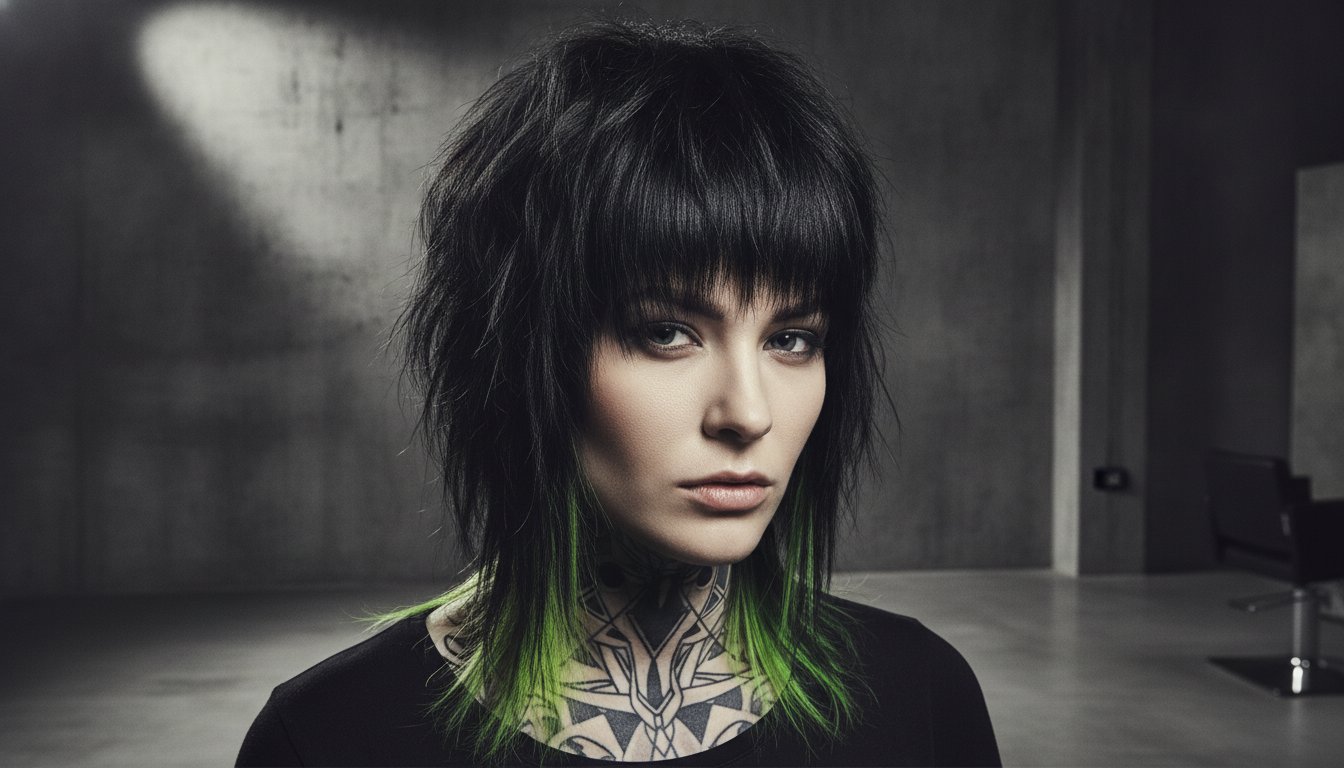
The wolfcut isn’t just a fleeting TikTok obsession. It’s a reclamation of subcultural identity. Think of it as the high-contrast lovechild of a 70s shag and an 80s mullet. It’s aggressive. It’s raw. It prioritises extreme crown volume and wispy, shattered ends that frame the face with intent. Reclaiming your individuality starts with the silhouette you present to the world. It is about reclaiming individuality, not just following a TikTok trend. If you want to avoid a generic look, you must understand the grit behind the terminology. Knowing how to ask your stylist for a wolfcut is the difference between looking like a rebel and looking like you’re heading to a PTA meeting.
Wolfcut vs. Shag vs. Mullet: Knowing the Difference
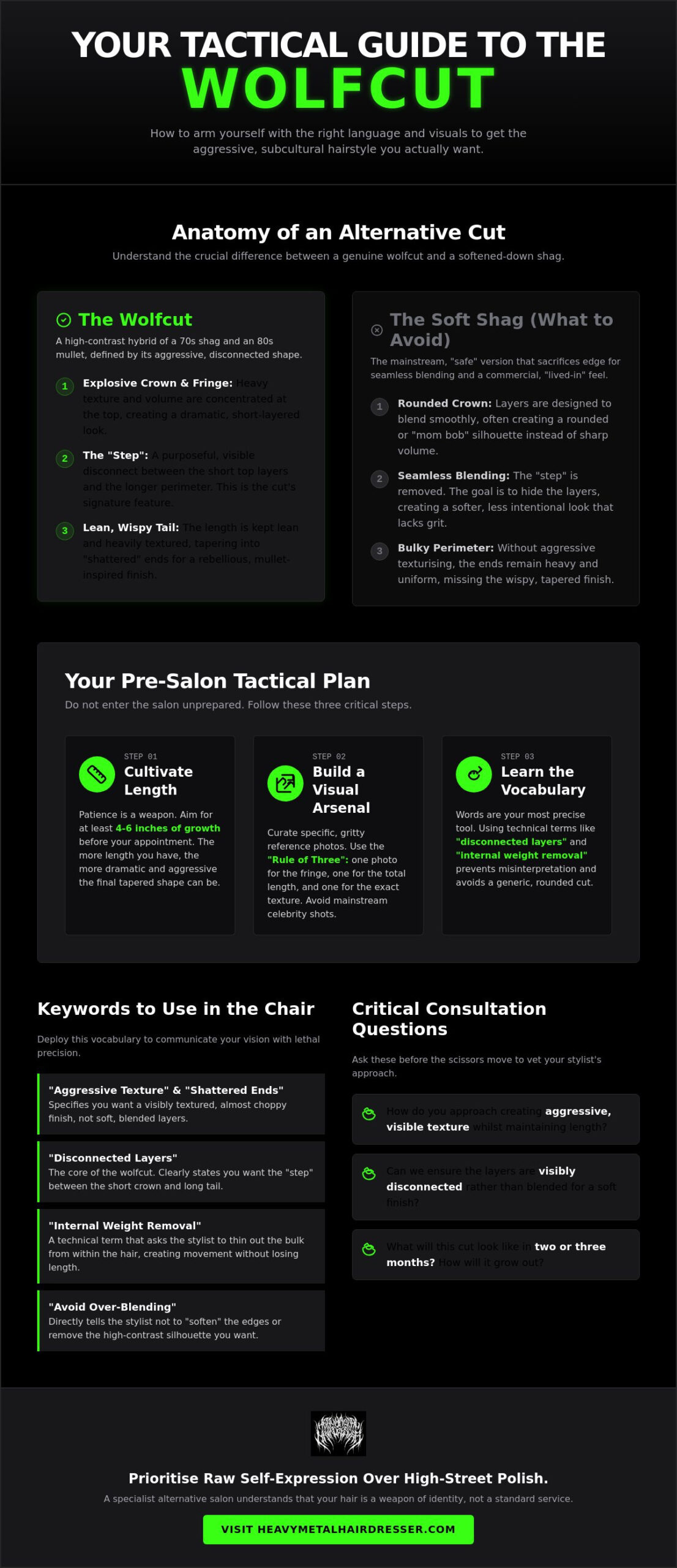
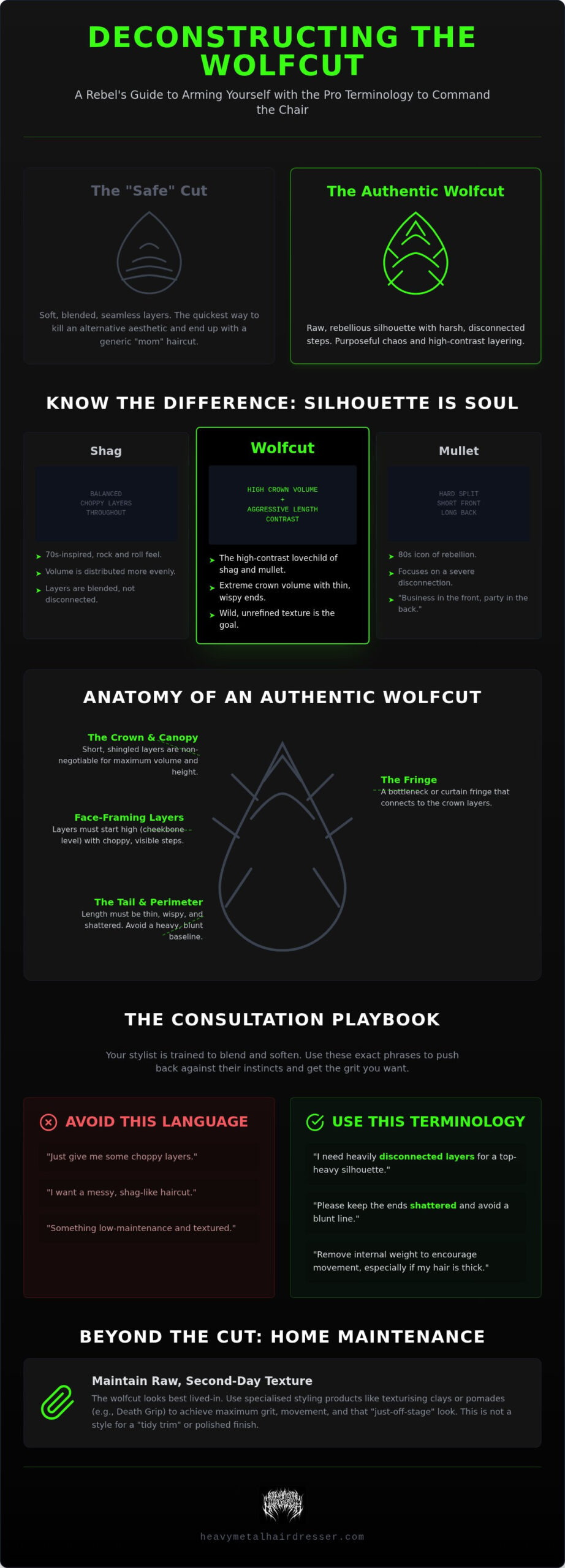
The silhouette defines the soul of the cut. A traditional shag is about balanced, choppy layers throughout. A mullet is a hard split between the short front and the long back. The wolfcut, often described as a modern variation of the shag, bridges these worlds. It keeps the heavy volume of the shag on top but borrows the aggressive length contrast of the mullet. This makes it a favourite amongst those seeking a non-conformist edge. The “wolf” element is found in the wild, unrefined texture. It’s the ultimate gender-neutral choice for alternative souls because it defies the polished expectations of the mainstream. It doesn’t care about traditional beauty standards. It only cares about movement, grit, and attitude.
The Danger of the “Safe” Haircut
Most stylists are trained to blend. They want everything to look seamless and “pretty”. For alternative styles, seamless is boring. When you’re learning how to ask your stylist for a wolfcut, you have to push back against their instinct to soften the edges. Traditional layering creates a soft gradient; the wolfcut demands harsh, disconnected steps. Without this disconnection, you end up with a “mom” haircut that lacks any bite. The wolfcut is a technical exercise in purposeful chaos and high-contrast layering. Demand that your stylist keeps the crown heavy and the ends shattered. This isn’t about a “tidy trim”. It’s about creating a shape that looks just as good after a night in a mosh pit as it does in the mirror.
The Anatomy of a Wolfcut: Breaking Down the Layers
To get the silhouette right, you need to understand the architecture of the cut. It is all about the top-heavy profile. Think maximum height and volume at the crown. This isn’t a stiff 60s beehive; it’s an organic, moving mass of texture that feels alive. When you are figuring out how to ask your stylist for a wolfcut, explain that the internal weight must be gutted. Thick hair needs this aggressive weight removal to achieve that signature flow. Without it, the style collapses under its own bulk and loses its edge. The “tail” is equally vital. The length should look thin, wispy, and intentional, avoiding any hint of a blunt, heavy baseline that might lean towards a standard long-layered look.
The fringe acts as the anchor for the entire frame. Whether you opt for a deep curtain bang or a narrower bottleneck fringe, it must connect to the shorter crown layers. This connection creates the “wolf” energy. If the fringe is too isolated, you lose the subcultural grit that makes this style so potent. It should feel like a cohesive, chaotic frame for your face.
The Crown and the Canopy
Short layers at the top are non-negotiable for that signature volume. Traditional layering often fails here because it is too uniform and blended. Instead, ask for “shingling”. This technique creates overlapping, shorter pieces that support each other, building height from the inside out. It is the secret to hair that stands up to a day of movement without looking flat or lifeless. For a deeper dive into these technical nuances, check out The Ultimate Wolf Hair Cut Guide for more on aggressive texture.
Face-Framing and Perimeter Grit
The layers must start high. We are talking cheekbones or even the eye line. This creates the heavy face-framing that defines the alternative aesthetic. Ensure the bottom length maintains a “mullet-lite” feel by keeping it significantly thinner than the top section. The transition between the fringe and the side layers should be choppy, not blended. You want visible steps. If you are ready to reclaim your look, consider booking one of our bespoke wolfcuts to get the technical precision your hair deserves. This perimeter grit ensures the style looks lived-in and raw from the moment you leave the chair. Keeping the ends shattered whilst maintaining crown density is the ultimate goal. It is about finding balance through purposeful imbalance.
Choosing Your Weapon: Wolfcut Variations for Every Vibe
The wolfcut isn’t a one-size-fits-all trend. It is a versatile weapon that adapts to your specific hair behaviour whilst maintaining its subcultural grit. Choosing the right variation depends on how much length you want to keep and how much aggression you want to project. The Long Wolfcut is the ideal choice for those who want to maintain their length but crave a silhouette that feels dangerous. It’s about shredding the mid-lengths to create movement that traditional layers simply cannot achieve. On the other hand, the Short Wolfcut pushes the boundaries closer to a modern mullet. It is high-aggression, high-impact, and perfect for anyone looking to make a bold, non-conformist statement.
Adapting the cut for your natural texture is where many stylists get it wrong. Straight hair requires deep, manual texturising to prevent it from looking flat. Curly hair needs a completely different approach to manage the way the weight sits. Understanding these nuances is a core part of how to ask your stylist for a wolfcut that actually works with your lifestyle rather than against it. You want a style that looks lived-in and raw, not something that requires hours of heat styling to look “right”.
The Wolfcut on Fine Hair
Don’t let thin strands trick you into thinking you can’t pull this off. Injecting chaos into thin hair is actually the best way to create an illusion of density. The secret lies in keeping the perimeter ends blunt whilst shattering the internal layers. This contrast provides a solid base that makes the hair look thicker, whilst the “shattered” layers at the crown add the necessary height. Executing a wolfcut on fine hair requires a specialised touch to ensure the hair doesn’t end up looking stringy. It’s about purposeful texture that builds volume where it usually falls flat.
Curly and Textured Wolfcuts
Curly hair was practically made for the wolfcut silhouette, but it requires a technical strategy to avoid the dreaded “shelf” effect. This happens when layers are cut too horizontally, creating blocks of hair rather than a fluid shape. Your stylist should use a “C-shape” cutting technique to follow the natural curve of your curls. Managing shrinkage is the biggest hurdle here. Demand that your stylist cuts the hair whilst it is dry. This is the only way to see exactly where the curls will sit once the weight is removed. When you are learning how to ask your stylist for a wolfcut, insist on a dry cut to ensure the final shape frames your face perfectly without any surprises once you leave the chair. It ensures the grit remains intact without sacrificing the health of your curls.
The Consultation Playbook: How to Speak Their Language
Walking into a salon and simply saying “give me a wolfcut” is a high-stakes gamble. Most stylists are conditioned to avoid extreme shapes because they are trained to prioritise “pretty” over “powerful”. To get the grit you crave, you must master the consultation. This is how to ask your stylist for a wolfcut without ending up with a generic, blended shag. Start by curating a visual mood board. Crucially, include photos of what you do NOT want. Showing examples of a safe, suburban layer cut helps your stylist understand the aggressive boundaries of your aesthetic.
Next, use the “D-Word”. Ask for “disconnected” layers. This tells the stylist you want visible, purposeful steps between the crown and the length. Demand “shattered” ends. This ensures they use a razor or deep point-cutting to remove any hint of a blunt baseline. Define your fringe limits early. Decide if the shortest layer should sit at your cheekbones or your eye line to frame your face with intent. Discuss the “tail” density too. If they leave too much hair at the bottom, the top-heavy silhouette will vanish. Finally, be honest about your maintenance. If you won’t touch a hairdryer, tell them. A true wolfcut should thrive on a bit of neglect and the right product.
Specific Phrases to Use (and Avoid)
Precision is your best defence against a boring cut. Instead of saying “just give me some layers”, try “I want aggressive internal texture”. This signals that you want the weight gutted from the inside out to create movement. Avoid the vague phrase “thin it out”, which often leads to over-processed, stringy ends. Instead, ask them to “remove weight from the mid-lengths”. If you want maximum shattered grit, ask for a razor cut. The razor creates a raw, uneven finish that traditional scissors simply cannot replicate. It’s about creating purposeful chaos in the silhouette.
The Reference Image Strategy
For those looking to enhance their new silhouette with expert colour work, consulting a blonde specialist Cincinnati can help ensure your highlights perfectly accentuate every disconnected layer.
Photos are a safety net, but only if they are realistic. Show images of people with your actual hair texture. If you have fine hair, showing a thick-haired influencer will only lead to a consultation meltdown. Point out specific elements you like: “I love the fringe here, but the length there”. This level of detail prevents technical misunderstandings. For those craving even more extreme shapes, explore our guide on the modern mullet haircut. Ready to stop compromising on your identity? Book your session with our alternative experts and get the high-aggression wolfcut you actually asked for.
Beyond the Cut: Styling and Maintenance with Heavy Metal Grit
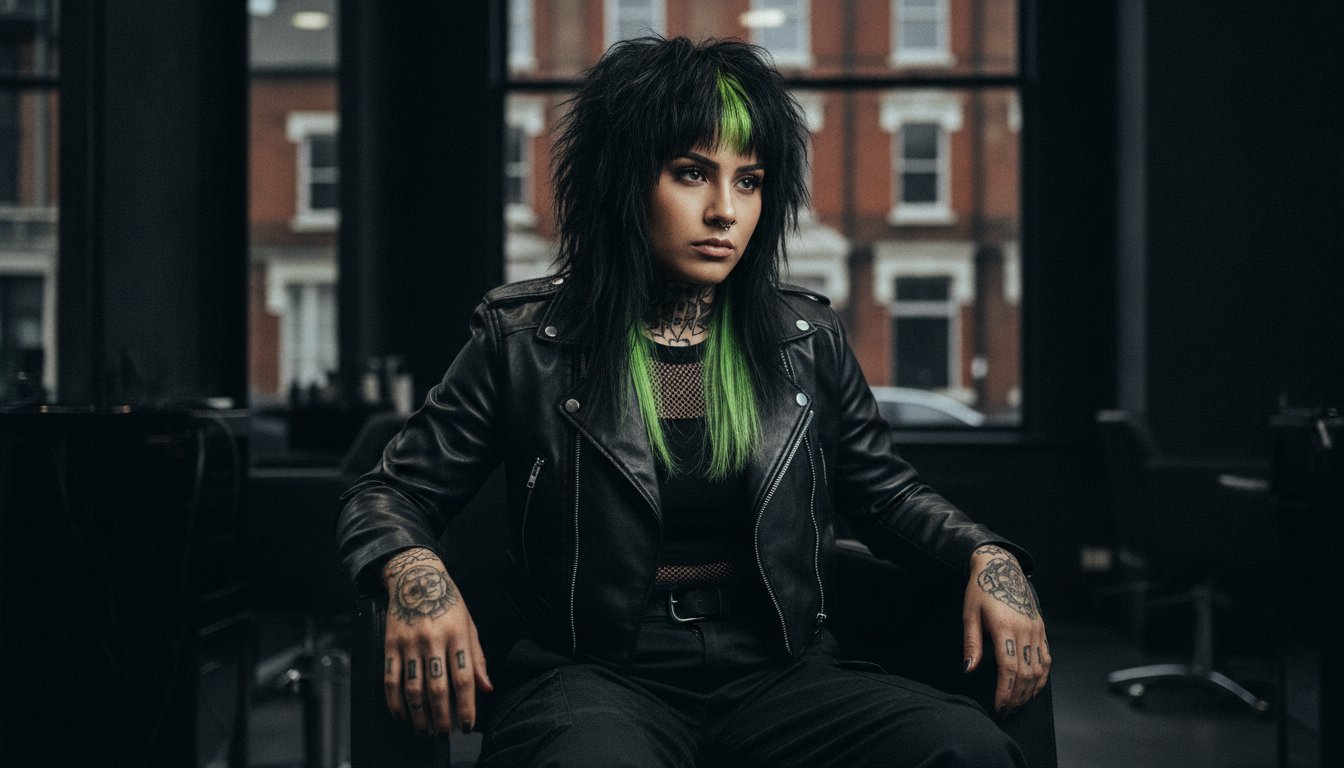
Forget the polished blow-dry. A wolfcut shouldn’t look like you’ve spent three hours with a round brush. It should look like you’ve just walked off a stage or out of a basement show. The “Air-Dry” Manifesto is your new religion. Heat damage kills the raw movement you fought for during the consultation. Instead, let your hair air-dry whilst scrunching in texture to encourage that natural, chaotic wave. This is where you see the true value of knowing how to ask your stylist for a wolfcut with disconnected layers. If the structure is sound, the hair will fall into a gritty silhouette on its own.
Second-day hair is often where this style hits its peak. The natural oils provide a built-in grit that fresh washes often lack. It passes the “Mosh Pit” test with ease. If your hair can survive a night of movement and still look intentional, the cut is a success. If it falls flat, you likely didn’t demand enough internal weight removal. Home maintenance is about preserving that “just-off-stage” energy without over-complicating the process. When you were learning how to ask your stylist for a wolfcut, you fought for disconnection. Don’t ruin it by styling it flat.
Essential Alternative Styling Tools
You need the right gear to keep the vision alive. Use Death Grip to define those shattered ends. It creates a piecey, aggressive texture that prevents the style from looking like a soft shag. For the crown, Hair To the Throne is your ultimate weapon. It provides the height and support needed to keep the top-heavy silhouette from collapsing. To find the best kit for your routine, check out our guide on alternative hair merch UK. Having the right tools ensures you maintain the same level of rebellion at home as you do in the salon chair.
Maintaining Your Wolfcut Between Salon Visits
The fringe is the first thing to lose its shape. Book a “Fringe-Only” appointment every few weeks to keep your vision clear and your frame sharp. You’ll know your layers have grown out too much when the “flow” turns into a “flop” and the crown loses its volume. A wolfcut is a living style that evolves as it grows, provided the initial “aggressive” structure is sound. Keep an eye on the transition between the side layers and the length. When the disconnection starts to blend back into a generic shape, it’s time to return for a refresh. Remind your stylist to gut the weight again to restore that high-contrast grit during your maintenance sessions.
Reclaim Your Identity with Purposeful Chaos
You now have the technical arsenal to ensure your next salon visit results in a weapon of self-expression rather than a suburban compromise. By mastering how to ask your stylist for a wolfcut using terms like “disconnected layering” and “shattered ends”, you’ve removed the risk of a safe, blended look. Remember that the core of this style lies in the top-heavy silhouette and the aggressive face-framing that prioritises grit over polish. Your hair is an extension of your subcultural identity; it deserves the precision of an expert who understands the music and the movement behind the aesthetic.
At Heavy Metal Hairdresser, we provide a gender-inclusive safe space where individuality is the only standard. Our expertise in aggressive textured layering has been seen on stages at Download and Bloodstock, proving that we know how to handle hair that needs to survive a mosh pit. Stop settling for stylists who are afraid of their scissors. Book your wolfcut transformation with the alternative masters today and step into a look that finally matches your energy. It’s time to embrace the chaos and wear your identity with pride.
Frequently Asked Questions
How do I explain a wolfcut to my stylist if they haven’t heard of it?
Explain the cut as a high-contrast hybrid of a 70s shag and an 80s mullet. Emphasise that you want disconnected layering rather than seamless blending. Use technical phrases like “shattered ends” and “aggressive crown volume” to bridge the gap. Knowing how to ask your stylist for a wolfcut means speaking their language. If they seem hesitant, insist on a top-heavy silhouette that focuses on movement rather than a traditional, polished finish.
Is a wolfcut high maintenance for everyday wear?
It is surprisingly low maintenance if the initial structure is sound. The style thrives on natural texture and a lived-in feel. You won’t need a round brush or a blow-dryer every morning. In fact, second-day hair often looks better because the natural oils add grit. Just a quick refresh with Death Grip on the ends is usually enough to maintain the aggressive silhouette. It is built for those who prefer an air-dry routine.
Can I get a wolfcut if I have very thin or fine hair?
Absolutely. Fine hair benefits from the chaos of this cut because it creates the illusion of density. Your stylist should keep the baseline perimeter blunt to provide a solid foundation. They then use shattered layers at the crown to build height where fine hair usually falls flat. This contrast between the heavy base and the airy top creates a much fuller look than traditional long layers ever could whilst maintaining an alternative edge.
What is the best fringe type for a wolfcut?
Bottleneck or deep curtain bangs are the gold standard for this silhouette. The fringe must connect to the shorter layers at the crown to avoid looking like an isolated block of hair. This framing is essential for the wolf energy. Ensure the shortest part of the fringe sits near the bridge of the nose, whilst the outer edges sweep down to meet the cheekbones for maximum impact and a gritty, face-framing finish.
How often should I get my wolfcut trimmed to keep it sharp?
Aim for a full trim every six to eight weeks to keep the layers from losing their flow. However, the fringe usually needs attention every three to four weeks to keep your vision clear. If you wait too long, the crown volume will drop and the disconnection will start to look like a generic, overgrown mess. Regular maintenance ensures the aggressive structure of the cut remains sharp, intentional, and subcultural.
Will a wolfcut work with my natural curls?
Curls and the wolfcut are a perfect match. The key is finding a stylist who performs a dry cut to account for natural shrinkage and bounce. This prevents the dreaded “shelf” effect where layers look too horizontal. Using a “C-shape” cutting technique allows the curls to stack vertically, building volume at the crown whilst keeping the ends wispy and light. It is a game-changer for maintaining texture without the bulk.
What is the difference between a wolfcut and a butterfly cut?
The difference lies in the finish and the grit. A butterfly cut is a polished, highly blended style designed for a “blowout” look with soft, sweeping layers. A wolfcut is its rebellious sibling. It prioritises disconnected steps, shattered ends, and a raw, unrefined texture. Whilst both use layering to create volume, the wolfcut is a technical exercise in purposeful chaos, whereas the butterfly cut seeks a seamless, traditional beauty standard.
Can a wolfcut be styled to look professional for work?
You can easily tone down the aggression for a professional environment. Tucking the side layers behind your ears or pulling the length into a low, textured ponytail softens the silhouette. You can also use a light cream to smooth the shattered ends for a more “controlled” texture. Knowing how to ask your stylist for a wolfcut that remains versatile is key. It is a shape-shifting style that adapts to the office without losing its soul.