
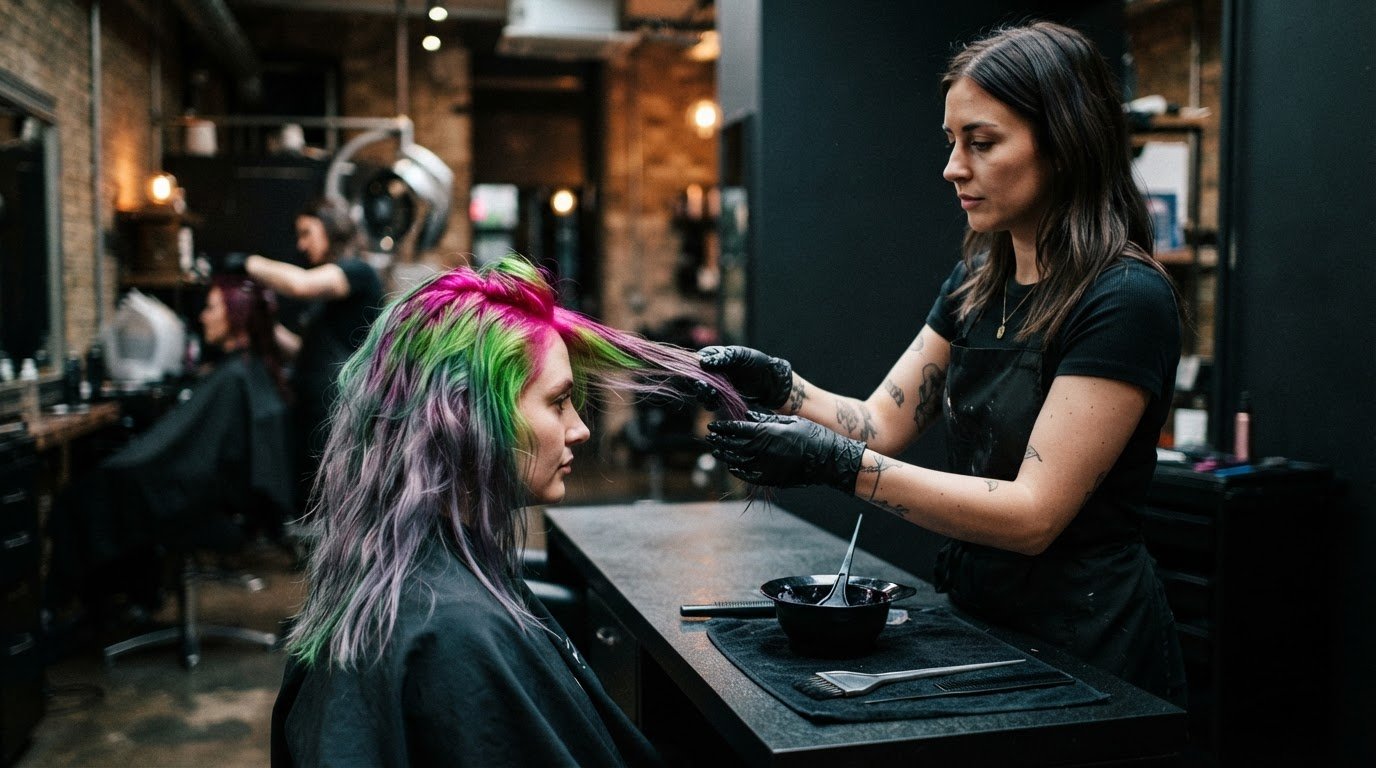
The fastest way to strip vivid colour can be the quickest route to dry, unpredictable hair. If you’re searching for how to remove vivid hair dye without damage, resist treating removal like a race. Bright shades can fade unevenly or cling on longer than expected, and your hair’s history affects what happens next.
It’s understandable to want the colour gone now, especially when DIY advice points in different directions. But safer fading is usually a patient process, not a stripping contest. This guide explains why vivid dye lingers, how to weigh cautious at-home steps, and which harsh choices could leave your hair feeling rough or fragile.
We’ll also explain how fading differs from bleach, what to consider before trying a removal method, and when a colour change is best planned with a stylist. Heavy Metal Hairdresser specialises in vivid colour, with an individual approach that keeps hair condition and self-expression in the same frame. Sometimes the smartest next look starts with a careful plan.
Key Takeaways
- Identify whether your colour is semi-permanent or another dye type before choosing a fading method.
- Understand how natural fading, colour removers and lightening differ in pace, uncertainty and potential stress on your hair.
- For how to remove vivid hair dye without damage, take a cautious step-by-step approach: assess your hair, test first and reassess before doing more.
- Follow product label directions and avoid rushing into repeated treatments if your hair feels fragile.
- Patchy colour, multiple dye layers or a major colour change may call for a stylist’s tailored plan.
Why vivid hair dye can be stubborn to remove without damage
Ready for a new colour? You don’t need to wage war on your hair to get there. The safer goal in how to remove vivid hair dye without damage is to manage the remaining pigment whilst protecting your hair’s condition. A gradual fade may be more realistic than expecting every trace of colour to vanish at once.
Vivid shades often use direct-deposit colour, but the result depends on more than the shade on the box. Previous lightening, hair porosity, overlapping applications and at-home colour history can all affect the outcome. A cautious plan starts with understanding what’s on your hair, not reaching for the strongest remover you can find.
What kind of vivid hair dye is in your hair?
Direct-deposit colour adds coloured pigment without the same developer-based process used by oxidative colour. Oxidative dyes develop through a chemical reaction inside the hair shaft and can also change natural pigment. Formulas vary, and vivid colours may be used alongside other colour processes. Product labels, ingredient lists and salon records can help identify what was used. Different formulas respond differently, so no single removal result is certain.
The chemistry of hair coloring helps explain why dye types behave differently: colour can sit on or within the hair, whilst oxidative processes work differently from simple pigment deposit. That distinction matters when choosing a next step. If you’re unsure what was used, don’t assume the colour name tells the whole story. Keep the packaging or note the brand and shade, if you can.
Why the same colour can fade differently on different hair
Hair that’s been lightened may be more porous, meaning its outer structure can be more open and absorb colour readily. That can help vivid pigment look intense, but it may also make the fade unpredictable: some areas release colour sooner whilst others hold on. Hair with different histories from root to tip can behave like several canvases, not one.
Layering adds another complication. Reapplying the same shade can build pigment in some sections, and overlapping colours may reveal different tones as they soften. A blue over a faded base, for example, may not fade to the same shade across the head. A photo, even in clear light, can’t show the hair’s porosity or full colour history, and a shade name can’t predict the final result.
Think back through the full timeline: home dye, salon colour, bleach, and any sections that have been coloured more often. If the history is patchy or uncertain, that’s useful information, not a reason to panic. A stylist can assess your hair and discuss realistic options before a bigger change. Heavy Metal Hairdresser specialises in vivid colour, and its vivid hair colour guide explores how bold colour can become part of your individual look. Knowing how your current colour got there is the first step towards changing it with care.
How vivid dye interacts with the hair shaft as it fades
Colour doesn’t simply sit on hair like paint on a smooth wall. Each strand has an outer protective layer called the cuticle, made of overlapping scales, and an inner area where colour changes can take place. As pigment loosens or washes away, the shade you see shifts. That visible fade doesn’t necessarily mean every trace of colour has gone or that your natural colour has returned.
This distinction matters when working out how to remove vivid hair dye without damage. A softened pink might leave a warm stain; a blue may reveal a muted greenish cast. Those remnants are not a reliable guide to what a future colour will look like. The hair’s underlying tone and condition still matter.
Direct dye, oxidative colour, and the difference that matters
Direct dye is colour deposited onto the hair, whilst oxidative colour develops through a chemical process involving a developer. The formulas work differently, so they may fade or respond to removal in different ways. Neither type guarantees a clean fade. Before choosing a method, check the product label or salon records to identify what was used. The American Cancer Society’s hair dye safety guidance also points to precautions such as following product directions.
Porosity, previous lightening, and leftover pigment
Porosity describes how readily hair takes in and releases moisture and colour. Lightening can alter the cuticle, so treated lengths may absorb vivid pigment differently from less-processed roots. That history can affect how colour fades and how much tint remains.
Think of a head of hair as a timeline. New growth may have little or no vivid pigment, mid-lengths may have one application, and the ends may have several layers or prior lightening. As colour softens, each area can reveal a different shade. The change may look especially uneven in bright bathroom lighting or against a light background.
Check your hair in natural daylight, looking at the roots, mid-lengths and ends separately. Note whether the colour appears even, where it lingers, and whether the lengths feel more fragile than the roots. This gives you a more useful starting point than judging your whole head under one light. It still can’t predict an exact endpoint: previous treatments and residual pigment make each head of hair its own case.
If the colour history is unclear or the fade is already patchy, a stylist can assess your hair and discuss a controlled route towards your next look. Heavy Metal Hairdresser specialises in vivid colour, and Simon Tuckwell’s individual approach keeps expression and hair condition in view. Explore professional guidance for your colour change to make sense of what the remaining pigment might mean before deciding what comes next.
Vivid dye removal methods compared: what is gentler and what carries more risk?
There’s no single removal route that suits every vivid shade or hair history. Method choice depends on the dye type and your hair’s history. The strongest option isn’t automatically the cleanest: aggressive stripping can leave unwanted tones behind and put more stress on hair, without delivering the even result you hoped for.
Natural fading
Pace: Gradual. Uncertainty: It can fade unevenly and may leave a tint. Potential stress: Depends on what you do to encourage fading; repeated washing or drying methods can still affect condition.
Colour-removal products
Pace: Depends on the formula and dye. Uncertainty: Results vary, and these products aren’t interchangeable. Potential stress: Depends on the product and your hair’s condition.
Lightening
Pace: Can shift colour more quickly, but isn’t a predictable shortcut. Uncertainty: May reveal underlying or leftover tones. Potential stress: Higher, because lightening can affect both artificial colour and natural pigment.
Gradual fading versus dedicated colour-removal products
Allowing colour to soften gradually may feel less abrupt than a major chemical change, but patience matters. A faded shade can still look patchy or linger in porous lengths. Colour-removal products are a separate option, but one remover’s directions and intended use don’t automatically apply to another. Read and follow the specific label, and don’t assume the product will restore your original base colour. A result that looks lighter isn’t necessarily a blank canvas.
When weighing up how to remove vivid hair dye without damage, ask not only “Which method works fastest?” but also “What could this reveal, and how might my hair respond?” That pause can prevent a rushed decision from becoming a bigger colour correction.
Why bleach, household hacks, and repeated stripping can backfire
Bleach is not the same as a colour remover. It lightens by changing pigment, including natural pigment, and can reveal warm or unexpected undertones rather than lifting vivid colour neatly away. Home mixtures and repeated harsh treatments add uncertainty: ingredients, strengths and combinations may not be designed for hair, whilst repeated processing can leave lengths feeling rough or weak.
Don’t stack treatments just because the first result looks incomplete. If your hair becomes unusually fragile or stretchy, or your scalp feels uncomfortable, stop and avoid applying more. Those signs call for caution, not another round of stripping. A stylist can assess the colour and condition together, then help plan a more controlled change that protects the possibility of your next look.
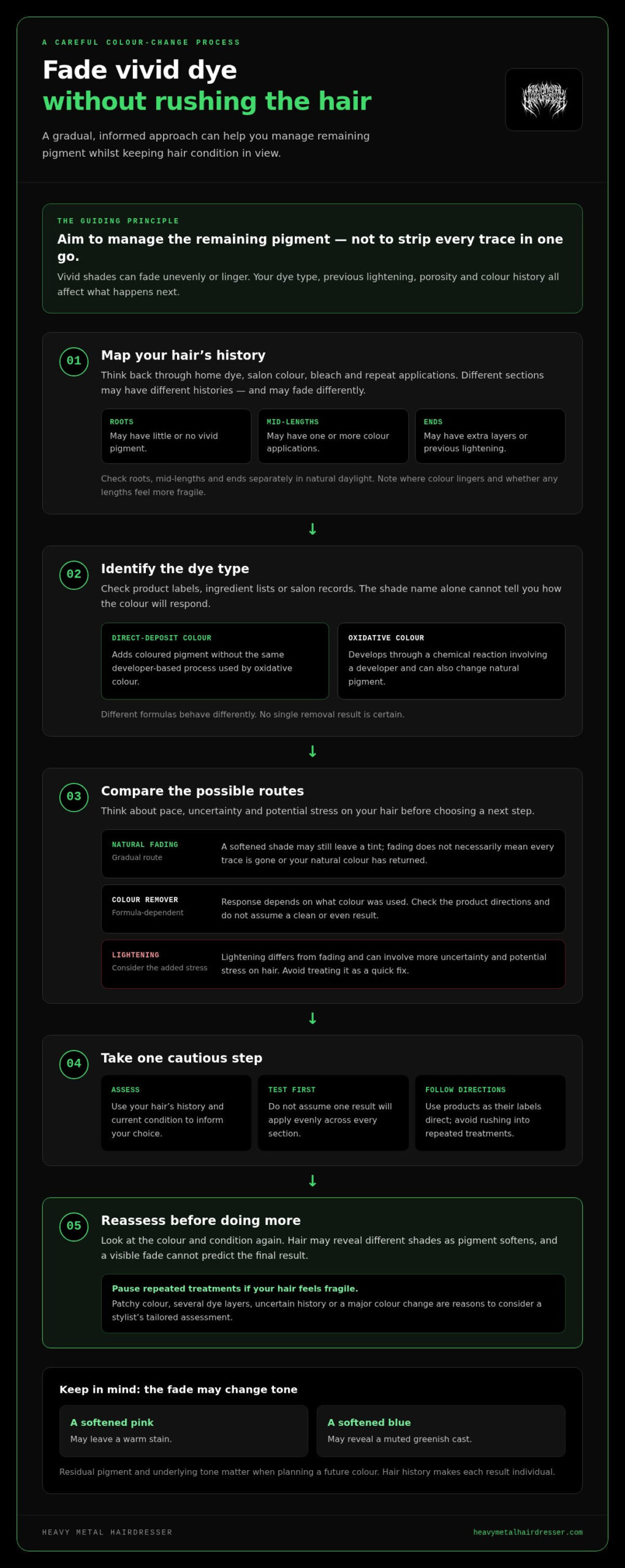
How to fade vivid hair dye more cautiously at home
A careful home approach is less about doing more and more about making each step count. Before trying a fading product or changing your routine, take stock of the colour and the hair underneath it. A small, controlled test can reveal a lot before you commit to treating every section.
- Identify the dye. Check the packaging, product label or salon records, if you have them. Note whether the colour was direct-deposit or part of an oxidative process, and record any previous lightening or colour applications. If you can’t identify the formula, don’t assume a method will suit it.
- Assess your hair’s condition. Look and feel through the roots, mid-lengths and ends. Notice areas that feel unusually dry, weak or stretchy, and where colour is more heavily layered. A method that seems manageable on one section may be too much for another.
- Test one discreet strand. Choose a small, hidden piece that reflects the lengths and colour history you plan to treat. Follow the chosen product’s instructions exactly, including its safety guidance. Don’t add ingredients or change how it’s used.
- Rinse, observe and reassess. Record the visible colour change and how the strand feels once dry. Compare the result with untreated hair before deciding whether to proceed. A test is a guide, not a promise that the whole head will respond evenly.
A cautious strand test before treating your whole head
Choose a strand from an area that’s been coloured or lightened, rather than testing only on untouched roots if your lengths are the concern. Note the starting shade, follow the product label, then check the strand in natural light. If the colour shifts sharply, looks markedly uneven, or the hair feels compromised afterwards, stop. Don’t treat the rest of your hair on the strength of that result.
Aftercare while the colour fades
Handle your hair gently and condition it in a way that suits its needs and any product directions. Avoid another removal attempt until you’ve assessed how the first one affected both colour and feel. More treatments aren’t automatically more progress.
Take a quick photo in consistent natural lighting before a change and after the strand test. Check the same areas each time, rather than relying on memory or comparing pictures taken in different lighting. This makes it easier to spot whether the colour is shifting and whether the hair is holding up.
Stop and reassess if the test strand becomes unusually fragile, stretchy or rough, if the result is sharply uneven, or if your scalp feels uncomfortable. Don’t push through warning signs. If the colour history is complicated or you’re unsure what the test means, Heavy Metal Hairdresser specialises in vivid colour. Plan your next colour change with a stylist before taking a bigger step.
When a stylist can help remove vivid hair dye more safely
DIY fading has limits. If your colour is layered, your hair feels fragile, or the next look is a major shift, tailored guidance can help you weigh the options before adding more stress. Getting support isn’t admitting defeat. It’s choosing a plan based on the hair you have, not an imagined result from a photo or a shade name.
Signs that DIY fading is no longer the best move
Pause if you see distinct bands, stubborn patches of staining or unexpected tones that become more obvious as the colour fades. A noticeable change in how your hair feels or behaves is another reason to avoid further processing. If you’re unsure whether your hair can tolerate another step, don’t use another treatment to find out.
Complex colour history makes at-home predictions especially unreliable. The roots may have one application, the lengths several, and the ends may have been lightened before the vivid shade went on. A stylist can consider those differences rather than treating every section as if it will respond alike. That’s useful if you’re aiming for a dramatic change, where an uneven starting point may affect the route and result.
What a careful consultation can clarify
A useful conversation starts with the full colour history: what was applied, where it was applied, and whether the hair has been lightened or treated before. Bring product details or salon records if you have them. The stylist can assess your hair’s condition, discuss what you want next, and explain realistic options, including whether a gradual transition makes more sense than chasing an immediate change.
Be clear about what matters most to you. Is your priority to preserve length, move towards a particular shade, or simply soften the vivid colour for now? Clear priorities help shape a plan around your hair’s condition and your tolerance for change, without promising an exact endpoint before the hair has been assessed.
Planning the next colour without losing your individuality
Vivid colour isn’t a mistake to erase. It can be a bold part of how you express yourself, and changing it doesn’t mean giving that up. Heavy Metal Hairdresser specialises in vivid colour in an inclusive space that celebrates individual identity. Founded by creative stylist Simon Tuckwell, the salon approaches colour as personal expression, with hair condition part of the conversation about what comes next.
Before deciding, consider whether you’re comfortable with more than one stage of change, or whether you’d rather explore an interim shade whilst the colour shifts. A stylist can tailor the discussion to your hair’s history and condition, helping you understand the trade-offs without pushing you towards a particular look. For a considered next step with how to remove vivid hair dye without damage, share your colour history and desired result with a stylist experienced in vivid colour.
If you’re ready to plan a more controlled change, discuss a careful vivid-colour change with Heavy Metal Hairdresser.
Choose a next look that feels like you
Your next colour doesn’t need to be decided in a rush. Give yourself room to work out how you want your hair to look and feel, whether that means letting the vivid shade soften, shifting towards something new or planning a gradual change. The best next step is one you can make with confidence, not pressure.
If the colour feels complicated or you’re unsure how to remove vivid hair dye without damage, a tailored conversation can help turn uncertainty into a plan. Heavy Metal Hairdresser’s specialist vivid colour work sits within an inclusive salon environment that celebrates individual identity. Founded by creative stylist Simon Tuckwell, the salon treats colour as personal expression. Your colour story is yours to shape, and changing it doesn’t mean losing what makes it personal.
Explore vivid colour work with Heavy Metal Hairdresser, and take your next step towards a look that still feels unmistakably you.
Frequently Asked Questions
How long does vivid hair dye take to fade naturally?
There’s no fixed timeline: the fade depends on the dye, how deeply the colour shows, and how your hair responds to washing and everyday wear. A vivid shade may soften gradually yet leave a tint behind. If you’re planning another colour, don’t rely on a calendar estimate. Judge your hair’s current shade and condition before deciding what to do next.
Does clarifying shampoo remove vivid hair dye?
Clarifying shampoo may help loosen some surface colour, but it can’t guarantee complete removal. It’s designed to cleanse thoroughly, not return hair to its original shade. Frequent use may leave hair feeling dry, particularly if it’s already processed. Follow the shampoo’s directions, condition afterwards as appropriate, and pause if your lengths start to feel rough rather than repeating washes to chase a faster fade.
Can I colour my hair again straight after fading vivid dye?
Not necessarily. Whether you can colour again depends on the method you’ve used, the product instructions and how your hair feels afterwards. A fresh shade may also look different over lingering pigment than it does on a clean base. Before applying colour all over, test a small strand with the intended colour, following its label directions. If the result is unpredictable or the hair feels weak, hold off and get tailored advice.
Will vivid hair dye come out completely?
Not always. Some colour may fade until it’s barely visible, whilst a trace can remain in the hair and affect the next shade. This matters most if you’re aiming for a pale or very different colour, where leftover pigment may show through or alter the result. Be prepared for a transition rather than assuming the colour will disappear entirely. A stylist can help assess whether the remaining tone needs to be factored into your plan.
Is colour remover safe for vivid hair dye?
It depends on the remover, the dye formula and your hair’s condition. A product made for one type of colour may not suit another, so check its intended use and read the full instructions before applying it. Use it only as directed, and don’t combine it with other treatments unless its label says to. If you can’t identify the dye or your hair has a complicated treatment history, get professional guidance first.
Can vivid hair dye damage your hair as it fades?
Fading on its own doesn’t automatically mean the dye is damaging your hair. Dryness or weakness can be linked to previous lightening, your hair’s existing condition or attempts to speed up removal. Notice how your hair behaves during routine care: if it starts snapping more easily or feels unusually weak when wet, stop adding treatments. Focus on gentle handling and let your hair’s condition guide your next move.
Why is my vivid hair dye fading unevenly?
Uneven fading can reflect differences in how colour was applied or how each section of hair has been treated. Styling and washing habits can also affect areas that get the most handling or exposure. Check the shade when your hair is fully dry and under neutral daylight, then note where the difference appears. If you’re seeing distinct bands or a sudden change, avoid trying to correct just one patch without a plan.