Posted on

Metal Festival Hairstyles 2026: The Ultimate Mosh Pit Survival Guide

Metal Festival Hairstyles 2026: The Ultimate Mosh Pit Survival Guide

If you think your pristine, salon-fresh look is going to survive the first ten minutes of the main stage opener, you’re in for a rude awakening. Planning the perfect metal festival hairstyles isn’t just about the initial impact. It’s about structural survival. We’ve all been there. Waking up in a tent on day two with a matted bird’s nest where your vibrant wolfcut used to be. It’s frustrating when the sun bleaches your neon green and the humidity turns your texture into a flat, sad mess. You shouldn’t have to choose between looking like a legend and actually enjoying the music.

This guide shows you how to balance aggressive self-expression with structural survival so your hair looks killer from the first riff to the final encore. We’ll dive into mosh-pit-proof techniques, ways to keep your shags and wolfcuts textured without a mirror, and the secret to making those vivid colours last under the relentless festival sun. Whether you’re headbanging at Download or Bloodstock, it’s time to master the art of the structural shag and discover how tools like Death Grip keep your look stage-ready for three days straight.

Key Takeaways

  • Learn why metal festival hairstyles require a focus on structural integrity and “pit-proof” engineering rather than mainstream aesthetics.
  • Discover how wolfcuts and shags provide the aggressive texture and built-in volume needed to survive three days of camping and headbanging.
  • Master alternative braiding techniques and vivid colour protection to keep your look sharp and high-impact without fearing the fade.
  • Follow our 3-day survival roadmap to transition your hair from day one fresh to a gritty, intentional masterpiece by the final encore.
  • Gain insider secrets from our backstage experience at Download and Bloodstock to ensure your style remains stage-ready in the heart of the pit.

The Brutal Reality: Why Metal Festival Hairstyles Need More Than Just Glitter

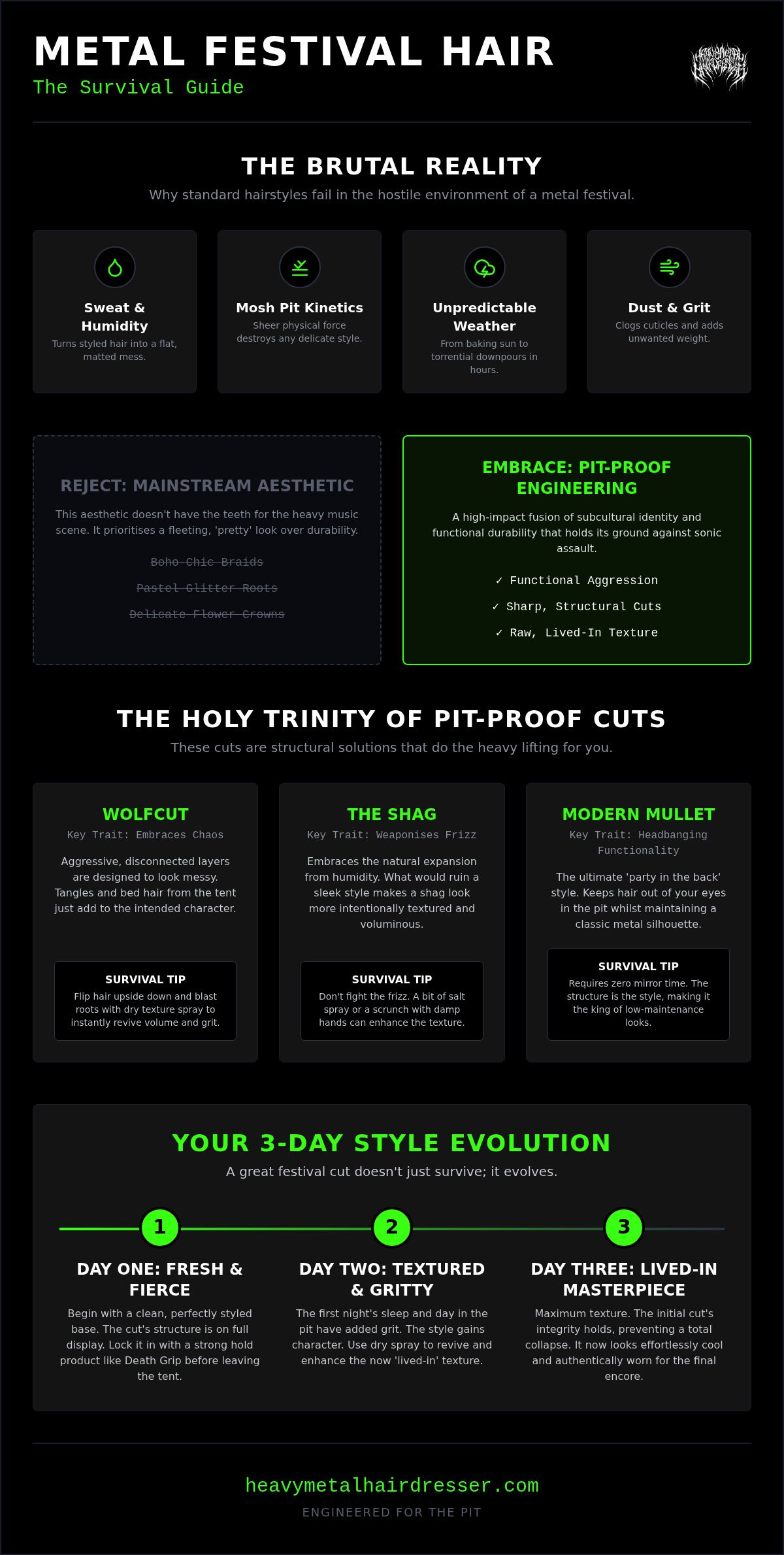
Don’t bring your flower crowns to Donington or Catton Park. The environment at a heavy music event is hostile. Sweat, flying beer, and the sheer kinetic force of a mosh pit will destroy a basic blow-dry in minutes. Traditional metal festival hairstyles aren’t about looking “pretty” for a fleeting selfie. They’re about surviving the chaos. We define pit-proof hair as the intersection of aggressive self-expression and structural integrity. It’s a style that stays out of your eyes while you’re headbanging but still looks intentional when the final encore finishes. In this world, “perfect” hair is the enemy. If your look relies on every strand staying in place, you’ve already lost the battle against the decibels.

The Survival Equation: Sweat, Dust, and Decibels

The UK summer climate is famously unpredictable. You’ll likely deal with baking heat one hour and a torrential downpour the next. Traditional polished styles fail because they rely on stillness. At a festival, your hair is in constant motion. Dust from the site clogs your cuticles; sweat from the pit acts like a glue you didn’t ask for. You need a style that thrives on this grit. Choosing a look that ages well over seventy-two hours is essential. A great festival cut shouldn’t just look good on Friday morning. It needs to evolve into a textured, lived-in masterpiece by Sunday night. We focus on styles that embrace the mess rather than fighting it.

Rejecting the Mainstream Festival Aesthetic

We’re moving far beyond the boho-chic braids and pastel glitter roots seen at Glastonbury or Coachella. That aesthetic doesn’t have the teeth for the heavy music scene. The History of heavy metal fashion shows a long-standing preference for raw, darker, and more rebellious looks that mirror the music’s intensity. It’s about identity and belonging to a subculture that values substance over surface-level trends. We prioritise deeper tones, sharper angles, and functional aggression. Metal festival hair is a high-impact fusion of subcultural identity and functional durability that holds its ground against the sonic assault of the main stage. It’s a rejection of the “clean girl” aesthetic in favour of something authentic, underground, and undeniably loud.

The Holy Trinity of Alt-Cuts: Wolfcuts, Shags, and Mullets for the Pit

Forget the curling iron. You won’t find a plug socket near your tent anyway. When we talk about metal festival hairstyles, we’re talking about cuts that do the heavy lifting for you. The ultimate wolf hair cut is built for this environment. Its aggressive layers and disconnected length mean that “messy” is the intended look. If you wake up on Saturday morning with your hair looking like a disaster, a wolfcut just calls that “extra character.” These styles aren’t just aesthetic choices. They are structural solutions for three days of sonic assault.

Wolfcuts: Injecting Chaos into Every Strand

A wolfcut hides “festival bed hair” better than almost any other style. Because the layers are already chaotic, the tangles you pick up in the pit blend into the silhouette. To keep it from going flat after 48 hours of camping, carry a dry texture spray. Flip your head upside down, spray the roots, and use your fingers to “scrunch” the life back into it. This resets the volume without needing a drop of water. You can even use our Death Grip product to lock in that height before you head to the main stage. It’s about maintaining that aggressive texture whilst everyone else’s hair is going limp.

The Shag and the Modern Mullet: Low Maintenance, High Impact

The modern mullet haircut is the undisputed king of headbanging functionality. It keeps the hair out of your eyes whilst leaving enough length in the back to maintain that classic metal silhouette. It’s the ultimate “party in the back” look that doesn’t require a mirror to fix. Similarly, the shag haircut embraces natural frizz. In the humid crowd of a mid-afternoon set, your hair will expand. A shag makes that expansion look like intentional texture rather than a mistake. It thrives on the heat.

Fringe maintenance is the only tricky part. Without a mirror, your fringe can become a sweaty mess. Keep a small comb and some dry shampoo in your bum bag. A quick blast and a finger-comb will keep your vision clear for the next circle pit. These styles are about working with your hair’s natural behaviour under pressure. If you want a look that thrives on the noise, consider booking a professional alt-cut session before your next weekend in the mud. We specialise in creating shapes that look better the more you move.
Metal Festival Hairstyles 2026: The Ultimate Mosh Pit Survival Guide

Vivid Colour and Creative Braiding: Standing Out Amongst the Sea of Black

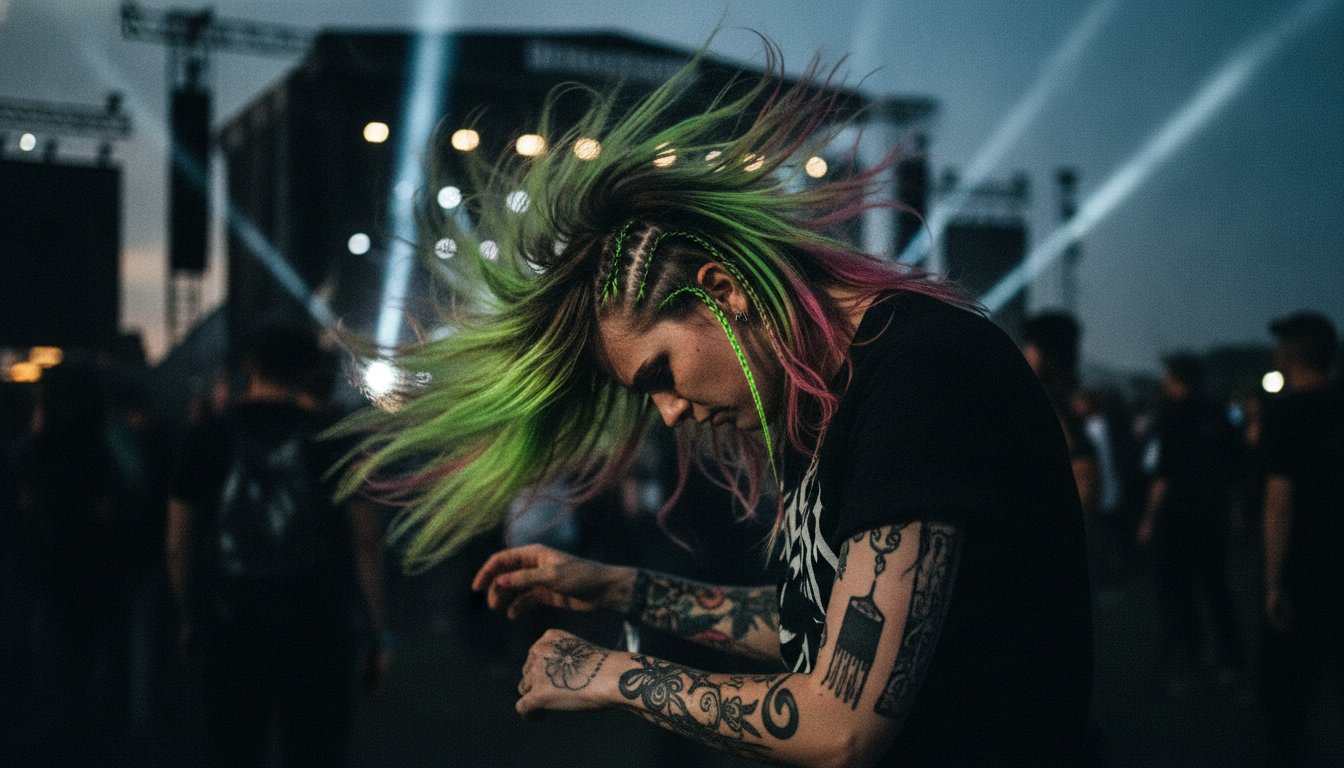
Metal festivals are a sea of black band tees. Breaking that monotony with vivid hair colour is the ultimate power move. Your hair becomes a beacon in the crowd. But the UK summer isn’t kind to high-pigment shades. Between the relentless UV exposure and the salt in your sweat, your neon green can turn to a muddy swamp by day three. You need a strategy that goes beyond hope. Temporary flair like coloured hair extensions or hair tinsels can add a flash of rebellion without the long-term commitment. If you’re battling root regrowth, don’t hide it. Use it. Creative styling or heavy accessories can turn “neglect” into an intentional, grittier aesthetic that fits the scene.

Protecting Your Pigment in the Pit

UV rays are the primary enemy of alternative shades. They break down the chemical bonds of your dye. Sweat is a close second. It’s acidic. It opens the hair cuticle and lets that expensive pigment wash right out. To stop the fade, pack a UV-protection spray and plenty of dry shampoo to avoid water-based washing in the campsite showers. A professional vivid application before the festival season is your best defence. We saturate the hair to ensure there’s enough depth to survive the onslaught. It’s about building a foundation that lasts longer than the headliner’s set. Metal festival hairstyles need this high-pigment resilience to stay sharp until the final encore.

Aggressive Braiding: Beyond the French Braid

Braiding for alternative looks isn’t about looking “pretty.” It’s about structural armour. Tight, scalp-focused Viking braids or undercut braids provide a harder edge and genuine protection. They keep your hair locked down during the most intense mosh pits. You won’t have to worry about your hair getting caught in someone else’s studs or zips. It’s functional durability with a subcultural bite.

Enhance the look by incorporating rings, chains, or charms directly into the weave. It adds a metallic weight that feels right at home at Bloodstock. If you want to keep the hair off your face entirely, create a braided faux-hawk. It’s a high-impact silhouette that stays sharp regardless of how much you move. This is hair that works as hard as you do. It’s about maintaining your identity whilst everyone else is losing theirs in the mud. Don’t settle for mainstream braids when you can have something that actually belongs on the main stage.

Maintaining your identity often goes beyond styling choices to the permanent art you carry; to learn more about Krets Tattoo and their professional advice on keeping your ink sharp in the pit, exploring their guide is a great way to prepare whilst planning your festival look.

Survival Tactics: How to Keep Your Style Sharp Through Three Days of Chaos

Your hair’s journey over a weekend is an evolution. Day 1 is the peak. It’s salon-fresh, sharp, and ready for the first circle pit. By Day 2, the sweat and dust have settled in. This is where most people panic. Don’t. Day 3 is the “Gritty Masterpiece” phase. It’s when your metal festival hairstyles look most authentic. The goal is to manage that descent into chaos so you look like a rockstar, not a swamp creature. You’re aiming for a look that thrives on the grime of the campsite whilst maintaining its core shape.

Dry shampoo is often a trap for the alternative community. It can leave a chalky residue that looks like dandruff against dark hair or leather jackets. Alternative hair often needs “grip” rather than “clean”. You want to maintain the architecture of your cut. Using textured styling products allows you to rebuild height and definition without needing a shower. It’s about adding grit to the right places to keep the layers from collapsing under the weight of the humidity.

Pit-Proofing Your Style: A Professional Guide

Securing your look for the pit requires a tactical approach. First, identify the “kill zone”. This is the hair at the nape of your neck most prone to matting against your jacket studs or bag straps. Section this off and braid it tightly if possible to prevent a giant knot. Second, apply “Death Grip” products to your structural points. Focus on the roots and the mid-lengths where you need the most lift. Finally, perform the “headbang test”. If your hair hits your face or obscures your vision too much, pin it back. Your style should move with you, not against you.

The Festival Toolkit: What Every Alt-Stylist Packs

Your campsite bag needs a few non-negotiables. These essentials ensure your metal festival hairstyles remain legendary from Friday noon to Monday morning. We recommend packing:

  • Silk scrunchies: These won’t snap your hair when you’re trying to untangle a three-day knot.
  • Wide-tooth combs: The only tool for removing dust without destroying your natural texture.
  • UV protection spray: Essential for keeping your vivid colours from turning into a dull mess.

A bandana is the ultimate emergency tool. If your style completely collapses mid-set, wrap it up. It hides the mess whilst looking like a deliberate style choice. It’s about being prepared for the moment the rain hits or the pit gets too intense. If you’re ready to engineer a look that survives the main stage, grab our professional styling gear to master the art of the mosh-pit-proof cut.

Backstage Expertise: Why Heavy Metal Hairdresser is Your Festival Style Partner

Our authority on metal festival hairstyles isn’t theoretical. It was forged in the heat of the UK’s most legendary stages. We’ve spent years working backstage at festivals like Download and Bloodstock. We know what it takes for a band’s look to survive a headline set under punishing lights and pyrotechnics. That same technical expertise goes into every cut we perform for the fans. Your hair is more than just an accessory. It’s a badge of identity. It’s a way to signal your place in the subculture whilst ensuring you don’t spend the entire weekend worrying about a mirror.

We are a gender-inclusive safe space where being different is the standard. We reject the clinical feel of mainstream salons. Our space is built for the rebels and the innovators. Beyond the chair, we’re also training the next generation of stylists. Our alternative hair courses teach professional standards in texture, grit, and high-impact colour. We want to ensure that the underground scene always has access to experts who understand our aesthetic.

From the Stage to the Pit: Professional Standards

Styling for the heavy music community requires a unique technical vocabulary. We fuse traditional barbering with creative, avant-garde styling to create gender-neutral looks that work for everyone. Our stylists understand the physics of headbanging. We know how a wolfcut behaves when it’s drenched in sweat. We know exactly where to apply Death Grip to keep a mohawk standing until the final encore. Our commitment is to celebrate your individuality through bold, unapologetic hair that refuses to blend in.

Join the Rebellion: Book Your Festival Refresh

A pre-festival cut and colour is your best investment for the summer. It’s about setting the foundation for the chaos to come. When you consult with our specialists, we don’t just talk about trends. We help you find your unique festival “weapon”. Whether it’s a structural shag that thrives on grit or a high-pigment vivid that stands out in the crowd, we engineer it for longevity. Don’t leave your look to chance. Prepare for the pit with the people who actually live and breathe this culture. Book your alternative styling session today and ensure your hair is ready for the noise.

Own the Main Stage: Secure Your Festival Identity

Your hair shouldn’t be the thing that stops you from hitting the pit. We’ve shown you that the best metal festival hairstyles are built on structural integrity and intentional texture rather than fleeting perfection. Whether you’re rocking a wolfcut that thrives on grit or aggressive Viking braids that lock your identity down, the secret is professional engineering. You need a look that ages into a masterpiece across the weekend. It’s about choosing a style that works with the chaos instead of fighting it.

As specialists in wolfcuts, shags, and mullets, we understand the specific physics of headbanging. Our experience styling bands backstage at Download and Bloodstock means we know exactly how to make your style stage-ready. We provide a gender-inclusive safe space for alternative souls who refuse to conform to mainstream beauty standards. Don’t wait until you’re in the mud to realise your style isn’t up to the task. Book your festival-ready alternative cut and colour at Heavy Metal Hairdresser today. Let’s build a look that survives the final encore and looks killer in every photo. See you in the pit.

Frequently Asked Questions

How do I prevent my hair from matting in a mosh pit?

Sectioning and braiding the hair at the nape of your neck is the most effective way to prevent matting. This area is where hair rubs against bag straps and jacket studs. Use a high-hold product like Death Grip to keep strands slick and secure. If you have long hair, consider a high ponytail to keep it above the friction line.

What are the best hairstyles for long hair at a metal festival?

Braided styles like Dutch braids or “Viking” scalp braids are the best metal festival hairstyles for long hair. They offer maximum security during headbanging and won’t get caught in other people’s gear. If you prefer keeping it down, ensure you have a layered cut like a shag. This allows for natural movement and prevents the hair from becoming a heavy, unmanageable weight.

How can I keep my wolfcut looking textured without washing it?

Use a dry texture spray or salt spray to reactivate the layers in your wolfcut. Flip your head upside down and scrunch the product into the mid-lengths to restore the aggressive volume. Avoid heavy oils that weigh the hair down in the heat. A quick blast of dry shampoo at the roots can soak up excess sweat whilst keeping that signature gritty silhouette intact.

Can I wear vivid hair colour to a dusty festival without it ruining?

Yes, but you must protect the pigment from UV rays and acidic sweat. Use a dedicated UV-protection spray every morning before heading to the arena. Dust adds a matte texture that can look cool, but it can also make colour look dull. Avoid washing your hair in campsite showers. Instead, use professional colour-safe dry products to maintain that high-pigment impact until you get home.

Are braids appropriate for a heavy metal aesthetic?

Absolutely, provided they are styled with an aggressive edge rather than a boho vibe. Focus on tight, scalp-focused braids or “undercut” styles that mimic a shaved side. You can weave in metallic rings, charms, or even small chains to align the look with heavy metal street-wear. Braids are functional armour for the pit, keeping your hair out of your face whilst maintaining a fierce silhouette.

What should I pack in my hair survival kit for a three-day festival?

Your kit should include a wide-tooth comb, silk scrunchies, UV-protection spray, and a high-hold texture product. Pack a bandana for emergency “Day 3” fixes when the grit becomes unmanageable. These essentials ensure your metal festival hairstyles remain stage-ready even when you’re living in a tent. Focus on multi-use products that provide grip without needing water or a plug socket.

How do I refresh my fringe when camping at a festival?

Refresh your fringe by using a small amount of dry shampoo and a fine-tooth comb. Spray the product onto the comb first rather than directly onto your forehead to avoid skin irritation. Work it through the roots to lift the hair away from your face. If it’s too greasy to save, use pins to create a small quiff or tuck it into a bandana.

What is the best way to protect my hair from UV damage at an outdoor gig?

Applying a professional UV-shielding spray is the most effective defence against sun damage. The sun’s rays act like bleach, breaking down both natural and vivid pigments whilst making the hair brittle. If you’re spending all day at the main stage, consider wearing a headscarf during the peak afternoon hours. This physical barrier prevents the scalp from burning and keeps your hair’s structural integrity intact.

Posted on

Styling a Shag with Natural Texture: Embrace the Raw, Alternative Grit

Styling a Shag with Natural Texture: Embrace the Raw, Alternative Grit

Your hair isn’t a problem to be solved; it’s a weapon waiting to be sharpened. You’ve likely walked out of a salon with a fresh cut only to find that, once you’re back at home, styling a shag with natural texture results in a look that feels more “suburban mum” than “subterranean punk.” It’s a common frustration. You want aggressive layers and raw movement, but you end up with hair that looks too round, too pretty, or just plain frizzy.

We get it. The mainstream beauty industry wants to sell you “polished” and “manageable,” but we’re here to help you embrace the chaos. This guide is about ditching the flat, greasy finishes of traditional products and learning how to weaponise your hair’s natural behaviour for a look that is truly mosh-pit ready. We’ll break down the “Death Grip” approach to styling; we will show you which tools actually create grit and prove that your natural texture is the engine behind the ultimate alternative aesthetic. It’s time to stop taming your hair and start letting it scream.

Key Takeaways

  • Learn how to move away from “pretty” styles and embrace a high-contrast, aggressive finish that celebrates your hair’s natural behaviour.
  • Understand how shattered layers and crown height work together to create that iconic, stage-ready rockstar silhouette.
  • Master the art of styling a shag with natural texture using salt sprays and the “Death Grip” approach for maximum grit and hold.
  • Discover the “Low-Fi” wash ritual and why over-conditioning is the enemy of a truly raw, alternative look.
  • Get expert tips on keeping your shag sharp and managing fringe growth between your professional salon sessions.

Beyond the “Pretty” Shag: Redefining Texture for Alt-Souls

Most magazines want to sell you a “soft” shag. They talk about “effortless chic” and “70s throwbacks” that look like they belong on a greeting card. We aren’t here for that. An alternative shag is high-contrast, aggressive, and thrives on absolute chaos. If you look at the history of the shag, it wasn’t born in a high-end boutique. It was forged in the underground. Styling a shag with natural texture means leaning into the grit. It’s about rejecting the round, blow-dried finish in favour of something that looks like it just survived a three-day festival.

Stop fighting your hair. The industry has spent decades telling you that your natural behaviour needs to be corrected. They want you to iron out the kinks and smooth down the flyaways. We think that’s a waste of potential. Your hair already knows how to be cool. You just need to give it the right framework and the permission to be loud.

Why Natural Texture is Your Best Ally

Your hair’s natural movement is the engine of this cut. When we talk about “shattered” layers, we mean hair that has a mind of its own. Natural waves and curls provide the internal structure that makes a shag look alive. Whilst mainstream stylists might try to “tame” your frizz, we see it as a tool. Frizz is just unorganised volume. When you stop fighting it, you gain the height and width needed for a truly edgy silhouette. Plus, a textured cut grows out better. It doesn’t lose its shape; it just evolves into a new version of itself.

Mainstream vs. Alternative Styling Philosophies

There is a massive divide in how people approach hair. Mainstream philosophy is obsessed with control. It wants everything smooth, shiny, and perfectly placed. It’s the “clean girl” aesthetic applied to a haircut that was meant to be messy. Our approach at Heavy Metal Hairdresser is the opposite. We prioritise identity over perfection. We want your hair to look gritty, matt, and unapologetically loud.

Styling a shag with natural texture requires a shift in mindset. You have to stop viewing “messy” as a failure. In our world, perfection is boring. We use techniques like the “Death Grip” to build hold without sacrificing the raw feel of the hair. It’s about creating a look that feels authentic to you, whether you’re on stage or in the pit. Don’t aim for a salon-polished finish. Aim for a look that tells people exactly who you are before you even open your mouth.

The Anatomy of Texture: How Your Cut Interacts with Your Hair

The architecture of a shag is designed to set your hair free. It isn’t just about cutting hair shorter; it’s about removing weight in specific zones to let your natural pattern take over. When you’re styling a shag with natural texture, you’re working with the physics of the cut. Every “shattered” layer is a deliberate choice to encourage a wave or a curl to spring to life. If you’ve ever felt like your hair was a heavy curtain, this is the demolition it needs. Mainstream stylists often rely on round brushes to “finish” a look, but that just creates a dated, pretty flick. We want raw energy instead.

Your hair type dictates how these layers behave. Coarse hair thrives on aggressive thinning, whilst fine hair needs strategic internal layers to avoid looking limp. The goal is a silhouette that looks lived-in before you even touch a product. It’s about movement. It’s about attitude. It’s about making sure your hair doesn’t just sit there; it performs.

Understanding Your Hair’s Behaviour Under Layers

Removing bulk is the secret to movement. For those with waves or curls, layers remove the weight that drags your pattern flat. Suddenly, your hair has the freedom to bounce and coil. Straight hair requires a different approach. It needs “internal” texture, essentially hidden layers, to prevent it from looking like a flat sheet. If you’ve been experimenting with bleach or vivid colours, your texture will be even more responsive to grit. Processed hair often has more “grab,” which is perfect for an aggressive, textured look. You can find some basic tips for styling a shag, but the real magic happens when you understand your specific hair’s unique rebellion.

The Crown: Where the Chaos Begins

The crown is the most vital part of an alternative shag. This is where we create that iconic “wolfy” height that separates a subcultural cut from a standard salon layer. Short, choppy layers at the top provide the foundation for volume that doesn’t require a blow-dryer. We want to avoid the “helmet hair” effect, where the top looks like a solid, unmoving block. By using specific texturising techniques, we ensure the hair stays separated and gritty. You can inject volume into the roots simply by using your hands and the right product. It’s about creating a silhouette that looks sharp and intentional from every angle. If you’re ready to commit to the chaos, check out our shag haircuts to see how we transform standard textures into something legendary.

Styling a Shag with Natural Texture: Embrace the Raw, Alternative Grit

Styling Weapons: Choosing Products for Grit and Chaos

Mainstream beauty editors love suggesting expensive hydrating mists and silk-infused conditioners. They claim these products are essential for a healthy look. They are wrong. If you want a raw, alternative finish, hydration is often your enemy. It weighs the hair down, smoothes the cuticle, and kills the very friction that makes a shag look alive. Styling a shag with natural texture requires a “Death Grip” philosophy. We want products that provide hold, build massive friction, and keep the hair looking matt and aggressive. You aren’t aiming for “healthy” in the traditional sense; you’re aiming for stage-ready grit.

Your styling kit should be a collection of weapons designed to defy gravity. Forget shiny pomades or greasy waxes. Those are for retro grease monkeys. For a subcultural shag, we prioritise dry, tactile finishes that allow the hair to stand up and stay there. We use products that work with your hair’s natural rebellion rather than trying to sedate it.

Salt Sprays and Texture Tonics

Salt spray is the absolute backbone of any alternative kit. It mimics the effect of sea air or sweat, providing the “built-in” grit necessary for a lived-in look. For the best results, apply your spray to towel-dried hair. This allows the product to bond with the hair as it dries, creating a foundation of texture from the inside out. Focus your application on the mid-lengths. This is where you want to enhance that “choppy” effect. Whilst some cheap sprays can feel like literal glue, a high-quality texture tonic provides an aggressive hold without the plastic-like crunch. It should feel like hair, only tougher.

Pastes and Clays: Defining the Shattered Ends

Once your hair is dry, you need to define the chaos. This is where matt pastes and clays come into play. Our “Hair To the Throne” styling approach relies on a matt finish to keep the look modern and edgy. Shine reflects light and makes layers look blended; matt finishes absorb light and make those shattered ends pop. Use the “scrunch and twist” technique. Take a small amount of clay, rub it between your palms until it’s warm, and then aggressively scrunch it into the ends of your layers. This creates separation and prevents the cut from looking like one solid mass.

Don’t forget the power of dry shampoo as a primary styling tool. Don’t wait until your hair is dirty to use it. Applying a blast of dry shampoo to clean roots provides instant lift and a dusty, gritty texture that helps the crown layers stand up. It’s about building layers of product that work together to maintain that mosh-pit ready silhouette all day long. Avoid over-applying. You want to enhance the natural movement, not bury it under a mountain of gunk. Start small and build the chaos until it feels right.

The Styling Ritual: Step-by-Step Texture Resurrection

Mainstream advice often suggests “plopping” your hair or sleeping in tight braids to create waves. Those methods result in uniform, artificial patterns that look like you’re trying too hard. We want a resurrection, not a fabrication. Styling a shag with natural texture starts with the “Low-Fi” wash. If your hair is too silky or over-conditioned, it will never hold the grit of the Death Grip. Skip the heavy masks. Apply a light conditioner only to the very ends of your hair. You want the mid-lengths to feel slightly raw and responsive to product, not slippery and sedated.

Once you’re out of the shower, towel-dry your hair aggressively. This isn’t a spa; it’s a preparation for chaos. Apply your chosen salt sprays or texture tonics whilst the hair is damp. Then, use the “Scruff” technique. This involves using your fingers to rake, shake, and manually manipulate the hair into its shattered positions. Forget the brush. Your hands are the only tools you need to encourage your hair’s natural rebellion. The final step of the ritual is the head-bang. It sounds like a cliché, but a vigorous shake of the head allows the layers to settle into a lived-in silhouette that looks authentic rather than staged.

The Air-Dry Method for Effortless Grit

If you have the time, air-drying is the best way to maintain the integrity of your natural pattern. Organise your fringe whilst it is soaking wet; get it sitting exactly where you want it. After that, follow the “Hands-Off” rule. Touching your hair whilst it is drying breaks the natural clumps and creates a fuzzy, uncontrolled mess. You want purposeful grit, not a halo of fluff. Once the hair is about 90% dry, give it one final, aggressive scrunch to break the product cast. This releases the movement whilst keeping the hold firmly in place.

Diffusing for Maximum Aggression

When you need more volume, a diffuser is your best weapon. Don’t use it to create “pretty” ringlets. Instead, use low heat and high airflow to mimic a wind-blown, stage-ready texture. Focus the airflow directly at the roots to achieve that iconic “Hair To the Throne” height. Scrunch the hair into the diffuser bowl to boost your natural waves, but keep the movement fast and erratic. This prevents the hair from looking too “done” and ensures the finish remains sharp and alternative. If you want to master these techniques at a professional level, check out our alternative hair courses to sharpen your skills.

Maintaining the Resurrection: Keeping Your Shag Sharp

Mainstream salons love a schedule. They’ll tell you that you need a trim every six weeks to keep your hair looking “healthy” and “neat.” We think that’s rubbish. An alternative shag is one of the few cuts that actually improves as it grows in. The layers settle. The edges soften. It starts to look like it belongs to you rather than a stylist. Styling a shag with natural texture becomes easier as the hair gains a bit of weight and history. You aren’t chasing a fresh-from-the-chair look. You’re cultivating a signature that looks better the messier it gets.

Managing your fringe is the only real hurdle in the long game. Between professional sessions, keep your fringe shaggy rather than blunt. If it starts to hit your eyes, don’t reach for the kitchen scissors to create a straight line. That kills the aggression. Instead, use a bit of your matt paste to piece it out and push it to the sides. This keeps the frame around your face sharp without losing the “shattered” aesthetic we’ve built. Admit defeat only when the crown height starts to sag or the back feels too heavy to hold a curl. That’s when it’s time for a professional reset. Styling a shag with natural texture shouldn’t be a daily battle; it should be a sustainable rebellion.

Day Two Survival: The Mosh-Pit Refresh

You don’t need to wash your hair to bring the chaos back. In fact, day-two hair often has more natural grit than clean hair. To reactivate your products, use a light water spritz followed by a fresh blast of salt spray. This wakes up the “Death Grip” foundation you built on day one. Dry shampoo is your best friend here. Don’t just use it for oil. Use it to inject “backstage” volume into the crown by blasting the roots and massaging with your fingertips. If the mid-lengths are looking too wild, tie back the top sections with a small clip or band. This maintains the shaggy silhouette whilst keeping the hair out of your face during the day.

Beyond the Cut: The Heavy Metal Hairdresser Experience

Your hair is your most visible form of self-expression. Choosing a wolf hair cut specialist ensures that your stylist understands subcultural aesthetics and the music that drives them. We don’t do “pretty.” We do raw, aggressive, and authentic. It is about more than just the technique; it’s about finding a safe space where your identity is celebrated and your hair’s natural behaviour is respected. Learning how to maintain a shag haircut is a journey of self-discovery. When you embrace the natural behaviour of your hair, you stop being a slave to the mirror. You become the authority on your own look. Keep it gritty. Keep it loud. Keep it yours.

Claim Your Chaos: Own the Raw Alternative Silhouette

Your hair is a statement of intent. You’ve learned that styling a shag with natural texture isn’t about control; it’s about collaboration with the chaos. By ditching the round brush and embracing the “Death Grip” philosophy, you’ve moved beyond the polished mainstream. You are now in a space where your identity takes centre stage. Whether you’re air-drying for effortless grit or diffusing for maximum aggression, the power is in your hands. Don’t let the beauty industry sedate your style.

We are the experts in aggressive, stage-ready hair. As seen backstage at Download Festival, we specialise in wolfcuts and shags that defy the ordinary. We provide a gender-inclusive safe space where your subcultural identity is celebrated, not just tolerated. Stop settling for “pretty” when you were born for the pit. Your natural movement is your greatest weapon. Use it.

Join the resurrection and book your alternative transformation. It’s time to stop taming your hair and start letting it scream. Stay loud; stay gritty.

Frequently Asked Questions

Can I style a shag with natural texture if my hair is pin-straight?

Yes, you absolutely can. Pin-straight hair relies on the internal “shattered” layers of the cut to create movement where there is usually none. When styling a shag with natural texture on straight hair, use a heavy-duty salt spray on damp hair followed by a matt clay to piece out the ends. This builds the necessary friction to prevent the hair from looking flat or lifeless.

How do I stop my natural texture from looking frizzy instead of shaggy?

Frizz is simply volume that hasn’t been given a direction yet. To stop it from looking uncontrolled, follow the “Hands-Off” rule whilst your hair is drying to prevent breaking up the natural clumps. Once your hair is almost entirely dry, use a small amount of matt paste to define the ends. This turns fuzzy volume into purposeful, aggressive texture that looks intentional.

What are the best products for styling a shag with natural waves?

Salt sprays and texturising clays are the primary weapons for styling a shag with natural texture. You should avoid heavy, oil-based serums or “smoothing” creams that weigh the hair down and kill the volume. Look for products that provide a matt finish and high friction, as these keep your layers separated and sharp throughout the day.

Do I need a diffuser to style a shag with natural texture?

You don’t strictly need one, but it is a game-changer for volume. Air-drying is perfect for a low-maintenance, lived-in look, but a diffuser allows you to inject massive aggression into the crown. It is the fastest way to achieve “Hair To the Throne” height and boost your natural pattern without creating “pretty” or uniform ringlets.

How often should I wash my hair when maintaining a textured shag?

Aim to wash your hair only two or three times a week. Over-washing strips the natural oils and grit that help an alternative cut hold its shape. A “Low-Fi” wash schedule ensures your hair remains responsive to texturising products whilst preventing it from becoming too silky or slippery to style effectively.

Can I have a shag if I have very curly or coily hair?

Absolutely, and it is one of the best cuts for high-density textures. A shag on curly or coily hair is all about strategic weight removal to let your natural pattern breathe. By cutting shorter layers into the crown, we allow your coils to spring up and create a high-contrast, voluminous shape that rejects mainstream beauty standards.

What is the “Death Grip” technique for alternative hair?

The “Death Grip” is our signature styling philosophy. It involves using high-hold, matt-finish products to lock in a raw and durable silhouette. This technique ensures your hair stays stage-ready through a full set or a night in the mosh-pit without losing its aggressive edge or collapsing into a flat mess.

How do I style my fringe if it has a cowlick or weird natural movement?

Style your fringe whilst it is soaking wet to get ahead of the natural movement. Use your fingers to direct the hair into place, leaning into the cowlick’s direction rather than trying to iron it out. Once dry, use a bit of matt clay to make the “weird” movement look like a deliberate, alternative style choice.

Posted on

How Often Should a Wolfcut Be Trimmed? The Alt-Hair Survival Guide

How Often Should a Wolfcut Be Trimmed? The Alt-Hair Survival Guide

Your wolfcut isn’t a “set and forget” accessory. It’s a living, breathing piece of subcultural architecture that demands respect. If you treat it like a standard haircut, you’ll end up with a flat, generic mullet within weeks. You know the feeling when those aggressive layers start to lose their bite and that razor-sharp fringe begins to blind you. It’s a total vibe killer when the weight shifts to the bottom and your crown volume disappears into nothingness.

One of the most common questions we hear in the studio is: how often should a wolfcut be trimmed to keep that textured edge? We get it. You want to maintain the grit without losing the length you’ve worked hard for. This is your survival guide to keeping your look sharp and unapologetically bold. We’re breaking down the exact signs of a failing shape and the timeline you need to follow to ensure your crown stays high and your layers stay lethal. Let’s make sure your hair never loses its soul whilst you’re out there making noise.

Key Takeaways

  • Master the timeline for your specific length, discovering exactly how often should a wolfcut be trimmed to stop your layers from losing their bite.
  • Identify the critical signs of shape collapse, such as the dreaded “Triangle Head” effect and heavy fringe curtains that kill your crown volume.
  • Tailor your maintenance to your hair type, from frequent internal trims for thick manes to longer gaps that help fine hair build necessary bulk.
  • Protect your aesthetic from DIY disasters by learning why professional layering is the only way to keep the back of your cut looking sharp.
  • Keep your crown volume aggressive and your texture sharp by focusing on strategic reshaping rather than just cutting off length.

Understanding the Wolfcut Growth Cycle: Why Layers Drop

The wolfcut is a high-texture hybrid that demands structural upkeep to maintain its aggressive silhouette. Unlike a standard trim where you’re just lopping off dead ends, maintaining this look is about managing the tension between the disconnected layers. It’s a modern twist on the shag and mullet that thrives on a heavy crown and a lot of internal movement. When you’re wondering how often should a wolfcut be trimmed, you have to look at the architecture of the cut rather than just the calendar.

As your hair grows, gravity becomes the enemy. That massive volume at the top starts to migrate south. If you don’t keep up with the maintenance, your sharp, rebellious wolfcut will inevitably collapse into a flat, uninspired shag. Keeping the “bite” in your layers requires more than just a perimeter cut; it requires strategic internal weight removal. This ensures the hair can still move and stack properly without looking like a solid block of hair. Professional layering is about more than length. It’s about maintaining the “textured grit” that defines your identity.

The Shag vs. Mullet Balance

The top-heavy aesthetic is the soul of the wolfcut. It’s what gives the style its subcultural grit and separates it from mainstream, blended styles. However, this balance is fragile. As the hair grows, the crown loses its lift, and the silhouette shifts. Your fringe length is the primary dictator of the cut’s behaviour. Once those bangs hit your eyes or lose their choppiness, the rest of the layers follow suit, losing their definition. You can keep the length increasing whilst maintaining the grit, but only if you’re keeping the internal structure in check. Without regular intervention, the mullet-inspired tail will start to look disconnected in a bad way, rather than a deliberate, edgy way.

Gravity and the ‘Collapse’ Phase

There comes a specific point in the growth cycle where your layers stop looking textured and start looking blocky. This is the collapse phase. You’ll notice the back length quickly overwhelms the shorter, face-framing pieces that give the wolfcut its edge. Whilst heavy texture can disguise the early stages of growth, it eventually reaches a tipping point. Without a professional touch to reshape the layers, the weight distribution shifts entirely to the bottom, creating a wide, flat shape that lacks the aggressive energy of the original cut. Knowing how often should a wolfcut be trimmed is about catching this collapse before it ruins your aesthetic and leaves you with a shape that’s impossible to style at home.

The General Timeline: When to Book Your Next Session

Booking your next appointment isn’t just about calendar management. It’s about vibe preservation. If you’re wondering how often should a wolfcut be trimmed, the answer lies in your specific length and how much “bite” you want to maintain. For short, aggressive shapes with massive crown volume, you’re looking at a 6 to 8-week cycle. Longer, more relaxed versions can push it to 8 or 12 weeks before the silhouette starts to fail. 2026 trends are leaning into a slightly more lived-in, gritty growth, but there’s a fine line between “effortless” and “unmanaged.” You want it to look like you’ve just come from a festival, not like you’ve forgotten where your hairdresser lives.

If your look relies on a heavy, face-framing fringe, you’ll need to be more disciplined. A bottleneck fringe or a choppy curtain bang usually requires a quick tidy every 3 to 4 weeks just to keep your vision clear. Beyond the fringe, you need routine trims to preserve the layers and prevent the weight from dragging the whole look down. Keeping your appointment regular ensures the texture stays sharp rather than turning into a matted mess. It’s the difference between a deliberate style and a shape that’s simply given up.

The 6-Week Refresh

This is the sweet spot for anyone rocking a shorter wolfcut or a high-contrast vivid colour. At six weeks, we focus on re-establishing that essential disconnection between the top and the bottom. We tighten up the face-framing layers and ensure the fringe hasn’t lost its choppiness. It’s also the perfect time to refresh your roots, ensuring your aesthetic stays as loud as your personality. If you want to keep your wolfcut looking like it was done yesterday, this is your gold standard. It keeps the “step” in your layers aggressive and prevents the crown from going flat.

The 12-Week ‘Total Rebuild’

For those growing out their length or rocking a mid-length shag, twelve weeks is the absolute limit. By this point, the layers have likely grown out into a more uniform shape, and the nape area probably looks a bit too much like an accidental mullet. A total rebuild involves redefining the entire silhouette. We strip out the internal bulk that’s accumulated and re-carve the texture to bring back the volume. Removing bulk from the nape is critical here. Without it, the weight distribution shifts, and you lose that aggressive taper. We focus on thinning out the back whilst maintaining the length, ensuring the movement stays fluid and the shape stays sharp.

How Often Should a Wolfcut Be Trimmed? The Alt-Hair Survival Guide

Signs Your Layers Are Losing Their Edge

Your wolfcut isn’t just a hairstyle; it’s a statement. When it starts to fail, it doesn’t just look “long,” it looks defeated. You’ll notice the aggressive texture begins to soften into a generic shape. This is the moment you need to ask how often should a wolfcut be trimmed to keep that subcultural edge. If your hair is no longer reflecting your grit, the architecture has likely collapsed. It’s about the soul of the cut, not just the length of the strands.

Visual Red Flags

Check your profile in the mirror. Is that crown volume still defying gravity, or has it migrated south? One of the most obvious signs of a failing wolfcut is the “Triangle Head” effect. This happens when the top goes flat whilst the bottom gets excessively wide. Your disconnected layers should look like a series of sharp, intentional steps. If they’ve started to blend into one solid mass, you’ve officially entered the danger zone. The “invisible fringe” problem is another major red flag. This occurs when your layers blend too much and lose their definition, making the cut look muddy rather than sharp.

Look at your fringe. A fresh wolfcut fringe is choppy, airy, and rebellious. As it grows out, it turns into a “fringe curtain.” It loses its bite and starts to hang heavy over your eyes. This isn’t just about visibility; it’s about the loss of the “wolf” silhouette. When the face-framing pieces start to blend into the side length, the whole aggressive energy of the cut disappears. You lose that raw, underground aesthetic that made the cut yours in the first place.

Styling Difficulties

We talk a lot about “Mosh Pit Resilience” in the studio. A proper wolfcut should fall back into place no matter how hard you move. If you find yourself constantly readjusting or if your hair feels “heavy” rather than “textured” during your styling routine, the weight distribution is off. You shouldn’t need half a bottle of product to achieve the same volume you had in week one. If you’re struggling to find the original lines, The Ultimate Wolf Hair Cut Guide can help you identify exactly where your shape has gone rogue.

Finally, pay attention to the nape of your neck. Tangling at the nape is a massive indicator that your disconnected layers have become too heavy. This matting happens because the internal structure is no longer supporting the length. Knowing how often should a wolfcut be trimmed depends on these subtle shifts in behaviour. Once the grit turns to mush, it’s time to get back in the chair and reclaim your edge.

Hair Type Variables: Thick, Fine, and Curly Schedules

Your hair type is the blueprint for your maintenance schedule. It dictates how the weight moves, how the layers stack, and ultimately, how often should a wolfcut be trimmed to keep its soul. A thick mane behaves very differently to fine strands or a head of curly chaos. If you ignore your natural texture, your wolfcut will eventually start to fight you rather than work for you. We don’t believe in one-size-fits-all hair; we believe in structural precision that respects your identity.

Chemical history also plays a massive role in the “feel” of your trim. If you’re rocking vivid colours or high-lift bleach, your hair porosity changes. This can make the ends feel “crunchy” or “snagged” faster than virgin hair. You might find yourself needing a micro-trim more frequently just to keep the movement fluid and the texture looking intentional rather than damaged. It’s about maintaining that healthy, rebellious grit without the fried-end look.

Managing Thick, Alternative Manes

Heavy hair is the king of volume but the enemy of shape. For thick hair, “de-bulking” is far more important than removing length. If you leave it too long, your layers will grow out into a solid, immovable “helmet” that lacks any movement. To prevent this, we recommend an internal trim every 6 to 8 weeks. This isn’t just about the perimeter. It’s about carving out the weight so your hair remains light and responsive. Use a product like Death Grip between sessions to maintain that essential separation and stop your thick layers from merging into a flat wall of hair.

Fine Hair and Curly Chaos

Fine hair is the opposite beast. You actually want a bit of growth to add much-needed bulk to the silhouette. You can often push your schedule to 10 or 12 weeks, as the extra length helps the wolfcut feel more substantial. However, you have to watch for “scraggly” ends. Once the bottom layer loses its density, the aggressive top-heavy look starts to feel disconnected in a weak way. We focus on keeping the ends blunt whilst maintaining the choppiness throughout the crown.

Curly and wavy wolfcuts are a different world entirely. These require a “dry cut” approach. We need to see how the curls sit in their natural state as they grow. Curly wolfcuts actually look better with a bit of “lived-in” growth, but they still need strategic reshaping to maintain the aggressive silhouette. It’s a delicate balance of keeping the curl pattern intact whilst ensuring the crown remains high and the ends stay tapered. If you’re ready to reclaim your shape, book your next wolfcut session with a specialist who understands your specific texture.

Professional Maintenance vs. DIY Disasters

The temptation to grab the kitchen scissors at midnight is real. We’ve all been there. But a wolfcut isn’t a standard trim; it’s an intricate map of disconnection and tension. Trying to hack at your own hair usually leads to a blunt, heavy mess that loses all its subcultural grit. You simply cannot see the back of your head well enough to maintain the aggressive taper that defines this look. When you ask how often should a wolfcut be trimmed, the answer is always “by a professional who understands the scene.”

The “kitchen scissor fringe” is the quickest way to kill your aesthetic. Instead of the airy, choppy texture you want, you end up with a solid, blocky line that looks more like a primary school bowl cut than a rebellious statement. A specialist stylist knows how to organise the layers so they grow out gracefully, ensuring your shape remains lethal even as it gains length. It’s about more than just cutting; it’s about structural integrity and preserving your individuality. A professional session ensures that the “bite” in your layers is restored with precision rather than luck.

The Art of Professional Layering

In our studio, Simon Tuckwell and the crew don’t just “cut hair.” They use specific angles to carve out aggressive texture that works with your natural movement. There is a massive difference between a standard trim and a total re-shape. A re-shape is where the magic happens, restoring the crown volume and thinning the nape to perfection. This level of precision is why the style has seen such a massive shag haircut resurrection across the UK alternative scene. We ensure every layer has a purpose and every cut adds to the overall grit of the silhouette.

Home Care Between Appointments

Waiting for your next session doesn’t mean letting your style go to seed. You need to maintain the lift at the crown to keep the silhouette sharp and the layers distinct. Using Hair To the Throne is the best way to keep that volume high whilst you’re between trims. When it comes to washing and drying, less is usually more. We recommend a “no-brush” rule to preserve that gritty, lived-in texture. Brushing out a wolfcut often turns it into a frizzy cloud, destroying the separation that makes the layers pop. Treat your hair with the same attitude you bring to your wardrobe. Treat your maintenance like a ritual, and your hair will return the favour.

Coming into the salon should feel like a reset. It’s an inclusive safe space where your identity is celebrated, not just tolerated. Professional maintenance isn’t just a chore; it’s a way to reclaim your edge and ensure you’re walking out with the confidence to take on any mosh pit. Don’t risk a DIY disaster when you can have passionate expertise instead. Your hair is your crown; keep it sharp.

Reclaim Your Edge and Protect the Grit

A wolfcut is more than a trend; it’s a commitment to a specific, rebellious energy. Maintaining that sharp, top-heavy volume requires a strategic approach to your hair’s architecture. Whether you’re managing thick manes every six weeks or letting fine hair build bulk for twelve, the goal remains the same: aggressive texture that refuses to blend in. Knowing exactly how often should a wolfcut be trimmed ensures you never wake up with a collapsed silhouette or a heavy fringe that hides your identity.

Don’t let your layers lose their bite or settle for a generic, blocky look. Our studio is a gender-neutral safe space where we specialise in alternative styling for those who live outside the mainstream. We’re the go-to experts for touring bands and artists who need their look to survive the heat of the stage. Book your wolfcut maintenance session with the Heavy Metal Hairdresser crew today. It’s time to restore your crown volume and keep your subcultural grit alive. Stay loud, stay sharp, and never settle for a flat shape.

Frequently Asked Questions

Can I trim my own wolfcut fringe at home?

Don’t do it unless you’re prepared for a blocky, blunt disaster. A wolfcut fringe relies on delicate, choppy disconnection that is nearly impossible to replicate with kitchen scissors in a bathroom mirror. Professional stylists use specific angles to ensure the fringe blends into the face-framing layers without losing its rebellious edge. One wrong snip and you’ve traded your alt-aesthetic for a primary school bowl cut.

Will my wolfcut turn into a mullet if I don’t trim it?

It’s almost inevitable that an untended wolfcut will migrate into mullet territory. Because the hair at the nape usually grows faster and feels heavier, the balance of the cut shifts downwards as the crown layers lose their lift. Without regular intervention to thin out the back and re-shape the top, you’ll lose the “wolf” silhouette and end up with a flat, unintentional mullet that lacks any structural grit.

How do I tell my hairdresser I want to keep the length but fix the layers?

Ask for an “internal re-shape” or “strategic weight removal” rather than a standard trim. Tell them you want to preserve the perimeter length whilst refreshing the disconnected layers at the crown to bring back the volume. Bringing a photo of your hair from week one is the best way to show exactly where the “bite” has disappeared. Most alternative specialists understand that the soul of the cut lives in the layers, not the ends.

Does a wolfcut require a lot of styling every day?

It is a low-maintenance style, but it certainly isn’t no-maintenance. The cut is designed to look lived-in and gritty, so you don’t need a polished blow-dry. However, you’ll still need a minute or two to scrunch in some texture product to keep the layers from falling flat. It’s built for mosh pit resilience, meaning it should look better the more you move, provided the internal structure is still holding up.

What happens if I wait 6 months between trims?

Waiting half a year will cause the structural architecture of the cut to fail entirely. When clients ask how often should a wolfcut be trimmed, we warn them that six months is far too long for a high-texture style. By that point, the weight distribution will have shifted so far south that your hair will look like a solid, heavy mass. You’ll likely need a total rebuild rather than a simple refresh to reclaim your original edge.

Is a wolfcut good for hair that is thinning?

Yes, it’s actually one of the best alternative styles for creating the illusion of density. By cutting short, aggressive layers into the crown, we create natural lift and volume where thinning is often most visible. The choppy texture prevents the hair from hanging limp and flat against the scalp. It’s a powerful way to reclaim your identity and build a bold silhouette regardless of your hair’s natural thickness.

Should I get a wolfcut if I have very curly hair?

Absolutely, but ensure you find a stylist who performs dry cuts. Curly hair adds a massive amount of natural texture and “bite” to the wolfcut, making it look even more aggressive and unique. The key is carving out the layers whilst the hair is dry so the stylist can see exactly how each curl stacks. It’s a brilliant way to manage curly chaos whilst keeping an edgy, subcultural aesthetic.

How do I maintain the vivid colour in my wolfcut between trims?

Time your colour refreshes to match your 6-8 week trim cycle. Between studio visits, use cold water for washing and stick to sulphate-free, colour-safe products to prevent the grit from turning into a faded mess. If you’re rocking high-contrast vivids, the “collapse phase” of your layers often coincides with your roots showing. Refreshing both at the same time ensures your aesthetic stays loud and your silhouette stays sharp.

Posted on

Versatile Wolfcut Styling Ideas: Weaponising Texture for the Alt Scene

Versatile Wolfcut Styling Ideas: Weaponising Texture for the Alt Scene

A wolfcut isn’t just a haircut; it’s a tactical choice for the subcultural frontlines that shouldn’t expire by lunchtime. Finding versatile wolfcut styling ideas that actually hold up against a night in a crowded basement venue is the difference between looking like an icon or a damp mop. You’re likely tired of those razor-sharp layers turning into a flat, lifeless mess before you’ve even finished your first drink. It’s frustrating when your fringe won’t sit right or your hair looks more “suburban chic” than “underground rebel.”

We’re here to help you reclaim your edge. You’ll learn how to weaponise aggressive texture to ensure your volume survives the heaviest mosh pit whilst keeping that raw, authentic spirit. This isn’t about looking neat; it’s about mastering professional-level grit at home. We’ll dive into specific techniques for every subcultural setting, from low-maintenance daytime grit to high-impact vivid glamour that commands the room.

Key Takeaways

  • Realise why aggressive texture is the lifeblood of this cut, transforming a simple shag into a tactical subcultural statement.
  • Discover versatile wolfcut styling ideas that let you pivot from a gritty, lived-in daytime vibe to a high-octane performance aesthetic.
  • Learn how to adapt your styling behaviour to your natural hair density to ensure your layers never fall flat or look too mainstream.
  • Identify the essential alternative toolkit, including products like Hair To the Throne, needed to weaponise your texture and maintain long-lasting volume.
  • Understand the importance of a specialist stylist who respects gender-inclusive spaces and understands the nuances of heavy metal and alternative hair.

The Wolfcut Manifesto: Why Versatility is its Greatest Weapon

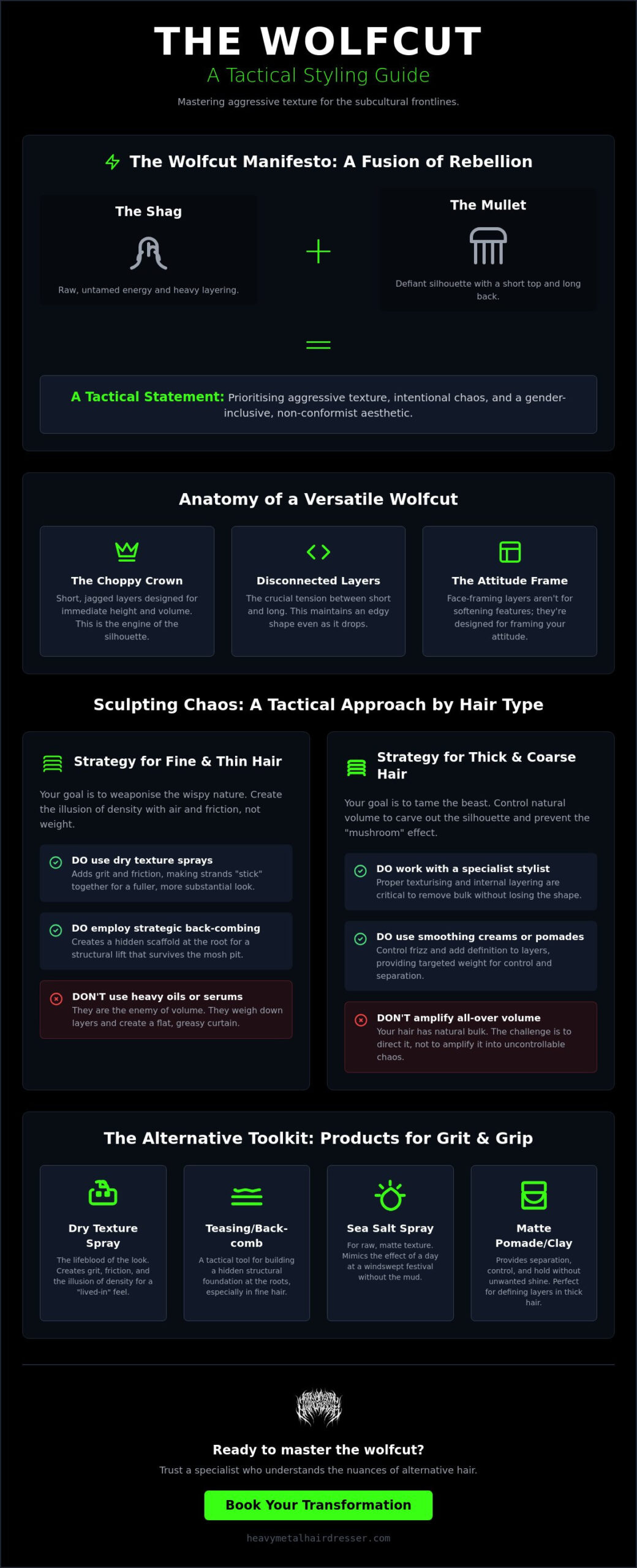
The wolfcut isn’t a fleeting social media fad. It’s a calculated act of rebellion against the polished, sterile standards of the high street. By fusing the raw, untamed energy of the Shag haircut with the defiant silhouette of a mullet, this style has become a uniform for the independent. Its power lies in its adaptability. You need versatile wolfcut styling ideas that allow you to shift from a gritty, lived-in day look to a high-impact, stage-ready aesthetic without losing your identity.

Mainstream volume is often about soft, touchable bounce. In the alt scene, we weaponise texture. We want aggressive texture. This means grit, grip, and intentional chaos. It’s hair that looks like it has a history, whether that’s surviving a three-day festival or a chaotic night in a basement venue. Whether your hair is shoulder-length or grazing your waist, the wolfcut maintains its fierce silhouette by prioritising movement over perfection. When you’re searching for versatile wolfcut styling ideas, you’re looking for ways to maintain that aggressive texture through every mood change.

Beyond the Trend: A Subcultural Staple

The DNA of this cut reaches back to the 70s punk explosion and the 80s rock gods who refused to play by the rules. It isn’t just about looking cool. It’s about a gender-inclusive, non-conformist approach to beauty. Your wolfcut is a canvas for your individuality. You decide the level of aggression. Some prefer a softer, blurred transition whilst others want jagged, disconnected layers that scream for attention. It’s about pride in being outside the mainstream. It’s about being seen on your own terms.

The Anatomy of a Versatile Wolfcut

A true wolfcut relies on a specific structural tension. You have the short, choppy crown that provides immediate height and the longer, wispy ends that create that signature wolf tail effect. Traditional salons often shy away from this level of disconnection, but it’s exactly what makes the cut so functional. Face-framing layers here aren’t designed to soften your features; they’re designed to frame your attitude. For a full technical breakdown of how we build these layers, check out the ultimate wolf hair cut guide. This structure ensures that even when your hair starts to drop, it still retains its edgy shape.

Sculpting Chaos: Styling Ideas for Every Hair Texture

Texture is the soul of this cut. Without it, you aren’t wearing a wolfcut; you’re just wearing a sad, flat mullet. The secret to versatile wolfcut styling ideas lies in how you organise your layers rather than just fluffing them up. You need to understand your hair’s natural behaviour to weaponise its potential. It’s about architecture, not just mess. Your choice of grit matters far more than your choice of shampoo. Shampoo merely cleans the canvas. Grit provides the structural integrity needed to survive a humid basement show or a long day on the streets.

The goal is to create a silhouette that feels intentional. This means directing your layers to frame your face whilst maintaining a jagged, disconnected crown. Whether your hair is fine and flyaway or thick and stubborn, the wolfcut is adaptable. It just requires a different tactical approach to styling products and heat. If you’re ready to commit to a new silhouette, our Wolfcuts service ensures the foundation is built correctly from day one.

Injecting Life into Fine and Thin Hair

Fine hair isn’t a disadvantage for these rebel cuts. It’s actually a secret weapon for achieving that sharp, wispy aesthetic that defines the alt scene. The first rule is simple: stop using heavy oils. They are the enemy of the wolfcut crown. They weigh down your layers and turn your volume into a flat, greasy curtain by midday. You want products that add air and friction, not slip and shine.

Back-combing is a strategic tool for fine hair volume in 2026, providing a hidden scaffold at the roots for your style to sit on. Don’t overdo it. You’re looking for a structural lift, not a bird’s nest. Use dry texture sprays to create the illusion of density amongst your thin strands. By leaning into the naturally wispy nature of your hair, you turn thinness into a deliberate stylistic choice. It creates a ghostly, ethereal edge that thicker hair simply cannot replicate.

Taming the Beast: Managing Thick and Coarse Layers

Thick hair has the opposite problem. It naturally wants to expand outwards, creating a “mushroom” effect that ruins the lean, aggressive silhouette of the wolfcut. Managing this density requires aggressive thinning and texturising at the salon level. We focus on de-bulking the mid-lengths to remove internal weight whilst keeping the ends sharp and jagged. This allows the hair to move freely rather than sitting as a solid block.

To control the chaos, you need products with serious hold. Use Death Grip style products to weigh down unruly flyaways whilst maintaining that essential height at the crown. It’s about finding versatile wolfcut styling ideas that embrace the natural volume of thick hair without letting it take over. Apply your product to damp hair and use your fingers to direct the layers downwards and inwards towards the face. This keeps the look sharp, focused, and unapologetically bold.

Versatile Wolfcut Styling Ideas: Weaponising Texture for the Alt Scene

One Cut, Four Identities: Versatile Styling Transitions

Your hair should be as adaptable as your playlist. One day you’re drowning in shoegaze; the next, you’re front and centre for a blackened death metal set. The beauty of this cut lies in its ability to morph alongside your mood. When exploring versatile wolfcut styling ideas, remember that your fringe acts as the visual anchor for every subcultural shift. It dictates the entire vibe of your facial structure. Shifting from a daytime, lived-in look to a high-octane performance aesthetic isn’t about a total overhaul. It’s about tactical adjustments to how you direct your texture and heat.

Creative colour also changes the game. If you’ve invested in a high-pigment transformation, your styling choices need to respect that investment. Heat can be a thief of vibrance. Mastering versatile wolfcut styling ideas whilst maintaining a neon or pastel hue requires a different set of rules. You aren’t just styling for shape; you’re styling to showcase the depth of your palette without stripping the soul out of your strands.

The Mosh Pit Survival Look: Raw and Relentless

In the pit, shine is your enemy. You need grip. This look thrives on the “rough-dry and pray” method. Apply a heavy-duty salt spray to damp hair and blast it with a diffuser until it’s bone dry and gritty. The goal is a matte finish that looks better the more you sweat. If your hair feels slightly “crunchy” at first, don’t panic. That friction is what keeps your volume from collapsing during the first breakdown. For more mosh-proof techniques, check out our festival hair survival guide. This aesthetic is unapologetically raw and built to last until the lights come up.

Sleek and Sharp: The Cyber-Goth Edit

Industrial club culture demands a different kind of aggression. Here, we trade matte grit for sharp, futuristic precision. Use a straightener to “flick” your layers outwards rather than tucking them in. This creates a jagged, almost serrated silhouette that feels mechanical. Incorporating a firm-hold hair gel allows you to create “wet-look” spikes at the crown. These spikes should feel intentional and structural. A heavy, blunt fringe is essential here to anchor the look and provide a stark contrast to the chaotic, flicked layers at the back.

Vivid and Violent: Styling with Creative Colour

If you’re rocking a split dye or “peek-a-boo” colours, your styling should reveal those hidden layers. Use your fingers to piece out the sections where different pigments meet. This adds a sense of movement and “violence” to the colour transition. To protect your shade, always use the cold-air setting on your hairdryer to set your style. This seals the cuticle and locks in the pigment. For a deep dive into maintaining your saturation, our vivid hair colour guide covers everything you need to know about high-pigment survival.

The Alternative Toolkit: Products for Grit and Grip

Traditional beauty products are designed for “touchable” softness and high-shine finishes. In the alternative scene, that level of slip is a liability. It makes your hair too slippery to hold a silhouette. To master versatile wolfcut styling ideas, you need products that fight back. You need friction. Without enough grit, those choppy layers will simply slide into a flat, uninspired mess by midday. You need Hair To the Throne levels of hold to keep a wolfcut crown from collapsing under its own weight.

Texture isn’t just mess; it’s organised chaos. Professional styling is about building a hidden scaffold within the strands. You want to manipulate the hair so it looks like it’s falling apart whilst it’s actually locked in place. This requires a specific kit. High-wattage diffusers and wide-tooth combs are essential for moving the hair without smoothing out the jagged, disconnected edges that give the cut its soul. It’s about architecture, not just fluffing things up.

Texture Over Polish: Why Tradition Fails

Shiny pomades are for the mainstream. They add weight and a polished finish that feels entirely out of place on a rebel cut. Matte pastes are a far better choice. They provide a dry, lived-in look that highlights the sharp disconnection between your crown and your ends. Death Grip style texture dust is the secret weapon for 2026 wolfcuts, providing instant root lift that defies gravity without the greasy aftermath. You can achieve maximum verticality without that dated, crunchy hairspray feeling by focusing your product at the roots and mid-lengths, leaving the ends wispy and free to move.

Heat Styling Without Losing the Edge

If you’re working with natural curls, the “diffuse and crunch” method is your best tactic. Use a high-heat, low-airflow setting to dry the hair whilst scrunching in your texture product. This locks in the coil without creating the soft frizz found in traditional styles. For those with straight hair, avoid the “beach wave” trend. It’s too soft and suburban. Instead, use a flat iron to create “S-waves.” This involves bending the hair in alternating directions to create a jagged, darker aesthetic that feels more industrial than coastal. It adds volume without the bounce.

Having the right gear is just as important as the technique you use. For a curated selection of the best styling tools and accessories for the alt scene, check out our alternative hair merch UK gear guide. Stop using supermarket tools for a specialist look. If you’re ready to weaponise your texture, secure the professional tools that the experts use to keep their crowns high.

Mastering the Wolfcut with Heavy Metal Hairdresser

High-street chains often treat alternative styles as a fleeting phase or a watered-down version of a celebrity trend. They try to make your hair look “neat” or “socially acceptable,” which is the quickest way to kill the spirit of a wolfcut. At Heavy Metal Hairdresser, we don’t do neat. We understand that your hair is a tactical extension of your subcultural identity. We use creative cutting techniques that ensure your hair styles itself, making your search for versatile wolfcut styling ideas far easier. A specialist understands that versatile wolfcut styling ideas only work if the internal weight has been removed correctly during the initial cut.

Our space is more than just a salon. It’s a gender-inclusive safe space and a centre for those who live outside the mainstream. We’ve built a community where being different isn’t just tolerated; it’s the requirement. Whether you’re here for a total transformation or a tactical maintenance session, you’re amongst peers who respect your aesthetic. We don’t just cut hair; we build the foundations for your self-expression. If the foundation is solid, the texture will do the heavy lifting for you every single morning.

Why a Specialist Cut Changes Everything

The biggest advantage of a specialist is the dry-cut. We see the shape evolve in its natural state, which is vital for a cut that relies on disconnected layers and aggressive texture. We don’t just follow a Pinterest photo. We tailor every layer to your specific subcultural vibe, whether you need the jagged edges of a 70s punk or the sleek, futuristic lines of a cyber-goth edit. To see how we’ve mastered this blend of history and modern grit, take a look at the shag haircut resurrection and how it continues to dominate the UK alternative scene.

Booking Your Transformation

Ready to reclaim your identity? When you book your consultation, don’t be afraid to ask for the unconventional. Tell us about your playlist, your subculture, and how much “aggression” you want in your silhouette. We’ll help you find the most versatile shape for your lifestyle and hair type. Our commitment to providing a safe, inclusive environment means you can express yourself without judgment or the need to conform to traditional beauty standards. Stop settling for “chic” when you were born for “chaos.” Book your wolfcut session today and join a community that weaponises texture for the independent spirit.

Own Your Silhouette: Reclaim Your Identity

Your hair shouldn’t be a source of stress; it should be your loudest form of self-expression. We’ve explored how to weaponise aggressive texture and shift your vibe between different subcultural settings. Mastering versatile wolfcut styling ideas means moving beyond mainstream rules and embracing the grit that makes your identity unique. From choosing the right toolkit to understanding how your specific hair density behaves, you now have the tactical knowledge to keep your crown high. You’ve learned that the right foundation, built by a specialist, ensures your layers work with you rather than against you.

Don’t settle for a watered-down version of yourself. As specialists in alternative textures and vivid colours, we understand the nuances of the scene. We’ve earned international acclaim for our band and festival styling, and our salon remains a fiercely gender-inclusive safe space for everyone. It’s time to stop fighting your hair and start leading the pack. Claim your identity and book your wolfcut at Heavy Metal Hairdresser. Your transformation is waiting; let’s build something unapologetic together.

Frequently Asked Questions

How do I style a wolfcut if I have very fine hair?

Focus on lightweight grit and root lift to prevent your layers from falling flat. Avoid heavy silicones or oils that weigh down the crown. Use a dry texture spray to add friction amongst your strands. This creates the illusion of density whilst maintaining that signature wispy edge.

Can a wolfcut be styled to look professional for work?

Yes, you can easily tone down the aggression for a more polished aesthetic. Use a lightweight styling cream to smooth the top layers and tuck the longer ends behind your ears. This keeps the structural shape whilst appearing more mainstream for conservative environments or formal settings.

What is the best way to maintain volume in a wolfcut throughout the day?

Use a high-performance texture powder like Death Grip at the roots for a structural scaffold. This allows you to reactivate your volume by simply ruffling your hair with your fingers. It is the ultimate solution for versatile wolfcut styling ideas that need to survive from your morning commute to the mosh pit.

Do I need to use heat tools to style my wolfcut every morning?

No, this cut is designed to embrace and weaponise your natural texture. You can often achieve a great look with just a salt spray and a quick rough-dry or even by air-drying. Heat tools are only essential when you want to create specific “flicked” layers or a sharper, industrial silhouette.

How does a wolfcut differ from a modern mullet in terms of styling?

The wolfcut features more extensive face-framing and softly blended layers compared to the sharp disconnect of a mullet. Styling a wolfcut focuses on the volume of the crown and the frame around the eyes. A mullet usually prioritises much shorter sides and a more drastic contrast between the front and the back.

What are the best products for a gritty, matte wolfcut finish?

Reach for matte clays, salt sprays, and specialist texture dusts that provide maximum friction. Avoid anything labelled “high shine” or “smoothing” as these products make the hair too slippery to hold its shape. Our Death Grip range is specifically built to provide this level of subcultural grit and hold.

How can I style my wolfcut to show off my vivid hair colour?

Use piece-y styling techniques to define individual sections and reveal hidden layers of pigment. If you have a split dye or peek-a-boo colour, a small amount of matte paste helps separate the layers. This adds movement that showcases the full depth and saturation of your vivid transformation.

Is a wolfcut easy to style for beginners?

It is one of the most forgiving cuts for beginners because it thrives on intentional mess and imperfection. You don’t need technical precision; you just need the right products and attitude. These versatile wolfcut styling ideas become second nature once you stop trying to make every hair sit perfectly in place.