Posted on

Cost of Vivid Hair Colour UK: What Shapes the Price in 2026

Cost of Vivid Hair Colour UK: What Shapes the Price in 2026

The shade in the bowl is only part of the bill. The cost of vivid hair colour UK salons quote reflects the work behind your look, not just the dye itself. A pot of colour bought online can make the salon total feel like a mystery, particularly if you’re unsure whether your hair needs lightening or its colour history could change the plan.

That uncertainty is understandable. The route to electric pink, deep blue or a full-spectrum look depends on your starting point as much as your end goal. Pre-lightening, colour correction, hair length and density, the number of shades involved and the time needed can all shape a quote. Vivid shades also fade, so the first appointment may be the start of an ongoing colour routine.

This guide explains what can affect the work involved and how to plan a look around your priorities, hair history and appetite for maintenance. You’ll also find out what to bring to a colour discussion, from inspiration images to details of previous colouring, so you can make a more informed plan.

Key Takeaways

  • The cost of vivid hair colour UK salons quote reflects the time, technique and planning behind your result, not just the dye.
  • Your hair’s length, density and colour history can affect the work involved, especially if lightening or correction is needed.
  • DIY dye prices and salon service costs cover different things, so compare the application and work involved, not just the product price.
  • Bring inspiration images, details of your hair history and an honest idea of the upkeep you’re comfortable with to your colour discussion.
  • Heavy Metal Hairdresser combines vivid colour with alternative style in an inclusive space where your look can reflect you.

What does the cost of vivid hair colour in the UK actually cover?

A pot of vivid dye has a product price. A salon colour service covers a wider process: the expertise, materials, time and finishing work involved in creating a result suited to your hair. That may include assessing your starting colour, planning how to reach your chosen shade, applying the colour and finishing the look. The exact work varies, so the cost of vivid hair colour UK salons quote is not a single standard price for each shade.

Retail pages help you compare dye shades and formats, but they don’t show the work behind a salon appointment. A planned service takes into account how your hair needs to be prepared and how the colour will be placed. For an overview of dye types and processes, see Hair coloring techniques and types.

Why the shade alone does not set the cost

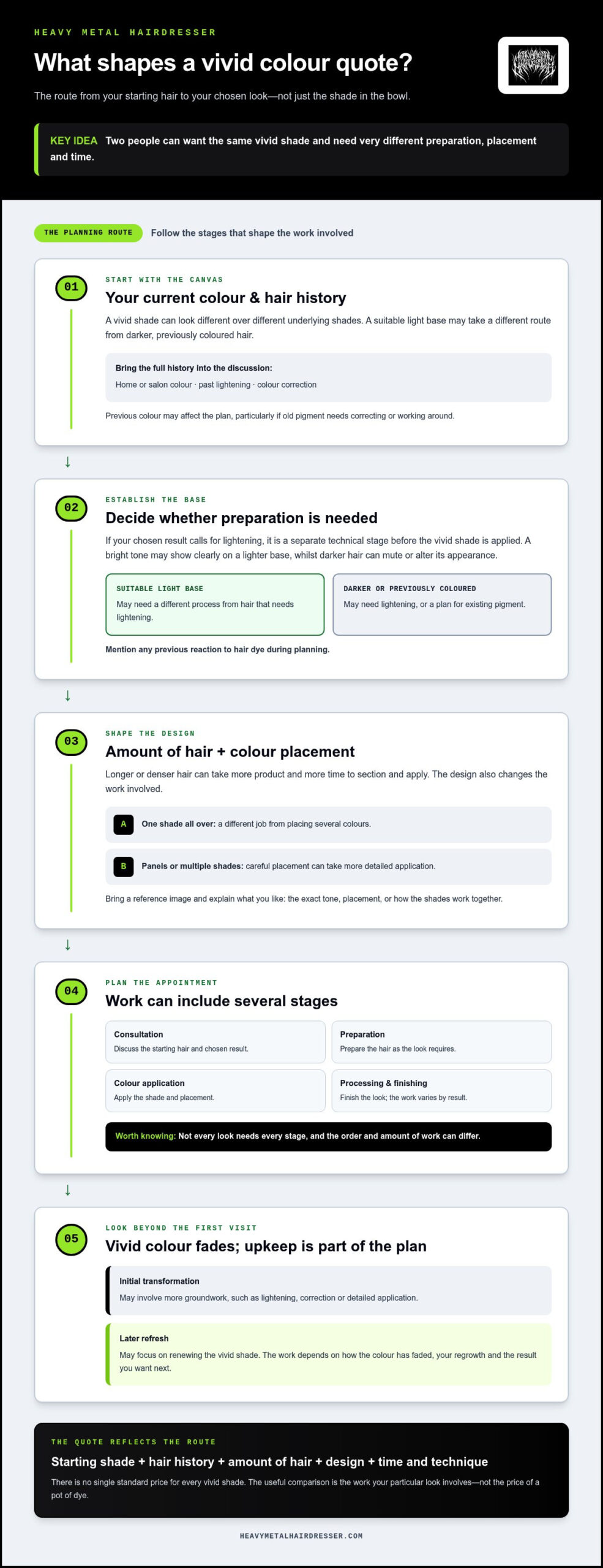
Your starting colour changes the groundwork. A vivid shade applied over a suitable light base may need a different process from the same shade on darker, previously coloured hair. Refreshing an existing colour is also a different project from creating a multi-tone transformation with several sections and shades. The target may be the same, but the route can differ.

For example, two people might bring in the same reference for bright blue. One may already have a light base; the other may need lightening and a plan for old dye. The desired shade matches, but the preparation and time involved may not.

What a professional colour appointment can involve

Depending on the result, an appointment may involve a consultation, preparation, colour application, processing time and finishing. Not every look needs every stage, and the order and amount of work can differ. Applying one vivid shade over a suitable existing base is not the same undertaking as placing several colours carefully or preparing the hair first.

Salon colour costs vary between clients because the starting hair, preparation, colour placement and finishing work vary too.

That’s why the price of dye alone can’t tell you what a salon service involves. The product is one part of the process, not a measure of the time or technique needed to achieve the look. Consider the whole result you want: where the colour should sit, how many shades you’re imagining and whether you want a vivid refresh or a bigger change.

There isn’t one UK-wide price that covers every vivid colour appointment. The useful question is what work your particular look involves. Understanding the steps gives you a better basis for planning a result that suits your priorities, rather than judging the job by the price of a pot.

Which factors shape vivid hair colour costs most?

A quote is shaped by the work your hair needs, not just the shade you’ve picked. Your starting colour, previous treatments and design details all affect the time, products and technique involved. Two people asking for vivid purple can need very different appointments, even if their inspiration images look almost identical.

Starting colour, hair history, and lightening

Vivid colour can look different over different underlying shades. A bright tone may show clearly on a lighter base, whilst darker hair can mute or alter its appearance. If your chosen result calls for lightening, that is a separate technical stage before the vivid shade is applied. Hair previously coloured at home or in a salon can also affect the plan, particularly if old pigment needs correcting or working around.

Be upfront about your hair history, including home dye, past lightening and colour correction. Even details that seem minor can help the stylist understand what preparation may be involved. If you’ve had a reaction to hair dye, mention it during planning and read the NHS guidance on hair dye reactions.

Length, density, placement, and colour complexity

Longer or denser hair can take more product and more time to section and apply. Placement matters too. One shade applied all over is a different job from vivid panels tucked through the hair or several colours arranged to create contrast. More detailed placement takes careful application, so the design itself can affect the work involved.

A colour quote is shaped by your starting shade and hair history, the amount of hair to cover, and the time needed to place and finish your chosen design.

For a useful planning conversation, think beyond the colour name. Bring a reference image and describe what you like about it: the exact tone, the placement or the way the shades work together. Your stylist can discuss a practical route to that effect, rather than treating every image of the same colour as the same job.

The first appointment may involve more groundwork than a later refresh. An initial transformation might need lightening, correction or a detailed application. A refresh may focus on renewing the vivid shade once the base is established. The work involved in a refresh depends on how the colour has faded, your regrowth and the result you want next. Include that ongoing commitment in your plans, not just the first appointment.

Clear details make for a clearer discussion. Explore Heavy Metal Hairdresser’s vivid colour work as you plan a look around your hair history and preferred level of upkeep.

DIY dye or salon vivid colour: what are you paying for?

A pot of dye and a salon appointment aren’t like-for-like purchases. With home colouring, you choose and apply a product yourself. A salon service involves planning the result around your existing colour, then applying the shade with a chosen placement and finish. The cost of vivid hair colour UK readers see discussed online can be difficult to compare if one figure is for a product and the other covers professional time and work.

Neither route is automatically right for everyone. Consider the change you want, your hair’s current condition, how complex the design is and how confident you feel applying colour evenly. Refreshing a familiar shade is different from changing direction. Applying one shade across accessible lengths is also different from creating carefully separated panels or several tones.

When home colour may suit a simple refresh

If you’re refreshing a shade that’s already present and feel comfortable colouring your hair, home application may suit you. You choose when to apply the product, but you’re also responsible for following the instructions, covering the intended areas and judging how the colour may look over your existing base. Product choice alone can’t guarantee the exact shade shown on a pack or screen.

Before starting, read the product instructions in full and consider whether your hair’s history and condition suit your goal. Refreshing a shade is not the same as trying to remove old colour, lighten darker hair or create a sharply divided, multi-colour design. Those changes involve different planning and application challenges.

What professional application adds to the process

A salon-led approach can tailor placement and shade choices to your starting colour and desired finish. This can be useful if your hair has layers of previous dye, you’re considering a more complex design or colour correction may be part of the plan. A stylist can discuss the route to the look with you, rather than relying on a product label to account for your individual hair.

Professional planning doesn’t make every outcome identical, and not every vivid look needs an elaborate process. The aim is to match the approach to the person and the design. For a simple refresh, the main difference may be who applies the colour. For a transformation, planning and placement can make up a larger part of the work.

Compare the routes by asking yourself what you value most:

  • Planning: Are you refreshing a familiar shade or changing direction?
  • Placement: Is it one all-over colour, or do you want defined panels and multiple tones?
  • Control: Are you comfortable applying colour evenly, especially at the back of your head?
  • Experience: Would you rather manage the process yourself or have a stylist shape the application around your desired result?

DIY product cost isn’t a direct measure of salon service cost. One covers a colour product; the other may include planning, application and finishing. Weigh those differences alongside the upkeep you’re prepared to take on, then choose the route that suits your hair, your look and your comfort level.
Cost of Vivid Hair Colour UK: What Shapes the Price in 2026

How to plan your vivid colour budget before an appointment

A useful colour conversation starts with three things: the result you want, your hair’s history and the level of upkeep that feels realistic. Having these details ready helps focus the discussion and gives your stylist a clearer picture of the work you have in mind. It also helps you decide which parts of an ambitious idea matter most if the full look needs adapting.

Bring a clear brief, not just a single inspiration image

Collect a few reference images that show the placement, intensity and overall colour direction you’re drawn to. Then pinpoint what catches your eye in each one: the vivid tone, a hidden panel, a sharp split or the way several shades sit together. Images are starting points, not promises of an identical result. Your natural colour, previous dye and hair condition all affect how an idea can translate to your hair.

Before the appointment, note the details that can affect the plan:

  • Your goal: Describe the look you want and what you’d prioritise if the design needs simplifying.
  • Your colour history: Include home dye, salon colour, lightening and any correction, even if it was a while ago.
  • Your hair now: Note what you’ve noticed about its condition and any areas with different colour or previous treatments.
  • Your maintenance preference: Be honest about how often you’d like to refresh the colour and how much home care feels manageable.

Your maintenance preference matters. If you love a detailed, high-impact look but want minimal upkeep, say so. Your priorities can help shape a design that keeps the defining features of your inspiration whilst fitting your day-to-day routine. The cost of vivid hair colour UK salons quote depends on the work involved, so a clear brief is more useful than arriving with a shade name alone.

Include upkeep in the wider budget conversation

Think beyond the first appointment. A vivid transformation may involve different work from a later refresh, and your plans might also include home-care products. Consider how often you’d like to maintain the colour and whether you’re comfortable refreshing it yourself between salon visits. Those preferences help you discuss a result that suits both your style and your ongoing commitment.

Before settling on an idea, make sure you can explain the look in plain language: what you want changed, what you want to keep and how much upkeep you’re prepared for. You don’t need technical terms. Clear references and honest details give the colour conversation a solid starting point.

Explore Heavy Metal Hairdresser’s vivid colour work for inspiration as you plan a look that feels like you.

How Heavy Metal Hairdresser approaches vivid colour

Vivid colour is a way to make your hair say something about you. At Heavy Metal Hairdresser, creative colour sits alongside alternative styling, with your individual look at the centre of the conversation. Founded by creative stylist Simon Tuckwell, the salon brings a bold, alternative point of view to colour and works with your idea rather than forcing it into a one-size-fits-all template.

That matters when you’re weighing up the cost of vivid hair colour UK salons quote. A shade name alone can’t describe the full look or the work it may involve. Your colour direction, starting point and desired level of detail all help shape the plan. The conversation starts with what you want to express, then develops a visual direction around you.

Colour that backs your individual aesthetic

Whether your inspiration is a flash of colour, a full vivid transformation or something more intricate, bring the references that feel like you. Talk about what draws you to them: the tone, placement, contrast or overall attitude. A collaborative discussion helps turn visual inspiration into a plan that reflects your personal aesthetic and takes your hair’s starting point into account.

Heavy Metal Hairdresser’s alternative identity is rooted in creative work, including styling for bands and artists and backstage festival work at Download and Bloodstock. The salon is also a gender-inclusive safe space. You don’t need to fit a particular mould to explore vivid colour here. Your style is the brief.

Make the next step feel straightforward

Bring three useful things to your colour discussion: an honest account of your hair history, reference images that show the details you like, and a realistic sense of how often you want to maintain the result. If you’re unsure how to describe the idea, point to the parts of each image you want to capture. You don’t need to arrive with a finished technical plan.

Your desired colour can be discussed in relation to your current hair and the upkeep you’re comfortable with. If the original inspiration needs adapting, focus on which features matter most to you and how to keep the look personal. That gives you a clearer basis for understanding the proposed work and deciding whether the plan fits your priorities.

Vivid colour should feel like self-expression, not a rulebook. Heavy Metal Hairdresser pairs creative colour work with an alternative aesthetic and a welcoming, identity-affirming environment. The conversation is about your look, your hair and the direction you want to take it.

Make your next colour move yours

Choosing vivid colour is a chance to make your look feel more like you. Let the budget conversation support that choice: decide what matters most, bring your ideas and be open to shaping the details around your hair and preferred upkeep. The cost of vivid hair colour UK salons quote is part of the picture, alongside how confidently the finished look expresses your style.

At Heavy Metal Hairdresser, alternative colour is about individuality in a gender-inclusive, identity-affirming space. Creative stylist and founder Simon Tuckwell brings experience that includes backstage work at Download and Bloodstock, alongside a bold approach to personal style. Your inspiration can be the starting point for a colour direction that feels distinctly yours.

Ready to turn the idea in your head into your next look? Plan your vivid colour look with Heavy Metal Hairdresser.

Frequently Asked Questions

How much does vivid hair colour cost in the UK?

There isn’t one dependable figure for every vivid colour appointment. The cost of vivid hair colour UK salons quote depends on the work needed to create your result. For a clearer discussion, describe your goal and hair history, then ask what stages are planned and what the quote covers. This helps you compare like with like, including whether the appointment involves lightening, colour application or finishing, rather than comparing it with a pot of dye.

Why can vivid hair colour cost more than a single-process colour?

Vivid colour can involve more than applying one shade, particularly if the look needs lightening, several tones or precise placement. But a vivid appointment doesn’t automatically involve every stage. Refreshing one existing shade may be a different undertaking from creating contrast between multiple colours. Focus on the result you want and the work it calls for, rather than assuming a vivid shade always means a more involved service.

Does vivid hair colour always require bleaching?

No, vivid colour doesn’t always require bleaching. Whether lightening is needed depends on your current colour, the shade you want and how bright or noticeable you’d like the result to be. A darker base may show some shades differently from a lighter one. Think about the effect you want in everyday light, not only in a filtered reference photo, and discuss how your starting shade may influence the finish.

Can I get vivid hair colour over previously dyed hair?

It may be possible, but previous dye can affect how a new vivid shade appears and what approach is suitable. Be specific about home colour, salon treatments and any lightening, including roughly when they happened if you remember. If you’ve used several shades or tried to correct a result yourself, mention that too. A complete history gives the stylist a better basis for discussing realistic options for your hair.

Is salon vivid hair colour worth the cost compared with DIY dye?

It depends on the look you’re after and how confident you are applying colour yourself. For a small refresh of a familiar shade, you may prefer to manage the process at home. A dramatic change or a design with sharply separated colours calls for more planning and controlled placement. Compare the time, application and potential complexity involved in each route, rather than treating the price of a dye product as the price of a salon service.

What should I bring to a vivid colour appointment?

Bring reference images that show different angles or details of the look, rather than relying on one cropped picture. Note what you like in each, such as the shade, brightness or position of the colour. If you have photos of your hair before and after earlier colour changes, they can help explain its history. Be ready to describe how much time you want to spend maintaining the look, too.

Posted on

Unconventional Hair Salon UK: The 2026 Guide to Alternative Excellence

Unconventional Hair Salon UK: The 2026 Guide to Alternative Excellence

Why does a trip to the local hairdresser feel like a constant battle to defend your identity against a stylist who just wants to “fix” your fringe? You’ve likely sat in that chair before, explaining that you want your wolfcut to look jagged and your textures to feel aggressive, only to have them “tame” it into something acceptable for a corporate office you’ve never stepped foot in. Finding an unconventional hair salon UK that actually speaks your language shouldn’t feel like a secret underground mission. You deserve a space where your heavy metal aesthetic or non-conformist identity isn’t just tolerated, but celebrated with technical mastery.

We agree that the traditional beauty industry often fails those of us living on the fringes of the mainstream. This guide is your roadmap to finding a specialist who understands that hair is a manifesto, not just a service. We’ll show you how to identify inclusive spaces that ditch outdated gendered pricing and offer expert advice on maintaining those sharp, death-grip shapes. We are diving into everything you need to ensure your next cut is a true reflection of who you are, whilst keeping you informed on the latest 2026 UK safety standards for your favourite products.

Key Takeaways

  • Ditch the “pretty” standard. Learn why an unconventional hair salon UK is essential for those who want their hair to reflect subcultural grit rather than mainstream trends.
  • Spot technical mastery. Discover how to identify stylists who actually understand aggressive textures and disconnected shapes like shags and wolfcuts.
  • Prioritise your identity. Find out why gender-neutral pricing and inclusive environments are the non-negotiable foundations of a true alternative space.
  • Prepare for your transformation. Learn how to use music, art, and subcultural references to communicate your vision during a specialist consultation.
  • Gain subcultural credibility. Understand how professional expertise meets underground culture through industry leaders who live the lifestyle they style.

Why Choose an Unconventional Hair Salon in the UK?

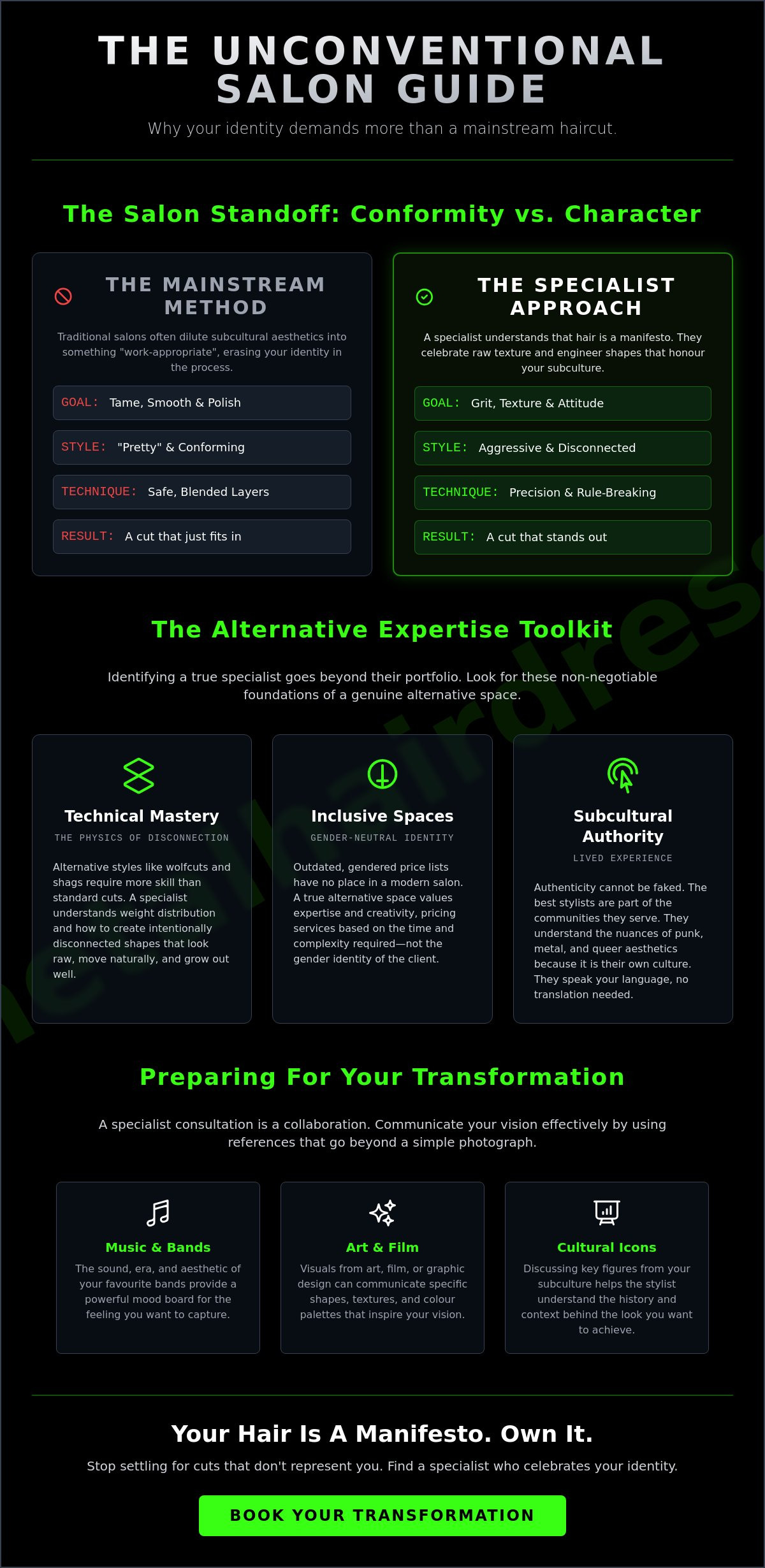
Traditional high street salons are built on a foundation of “pretty.” Their training manuals are filled with techniques designed to smooth, tame, and polish. But if you’re hunting for an unconventional hair salon UK, “pretty” is usually the last thing on your mind. You want personality. You want grit. You want a cut that screams rather than whispers. Most mainstream stylists treat alternative styles as a phase or a mistake to be corrected. They see a shag and try to blend the layers. They see a mullet and try to make it look “work-appropriate.” This dilution of subcultural aesthetics is exactly why choosing a specialist space matters. It’s the difference between a haircut that fits in and one that stands out.

Alternative hair is often dismissed as “messy” by those who don’t live the lifestyle. In reality, these styles require a higher level of technical mastery than traditional, uniform looks. Executing a perfectly disconnected shape that grows out well takes extreme precision. It’s about knowing exactly where to break the rules of symmetry and balance. An unconventional hair salon UK doesn’t just cut hair; they engineer shapes that defy traditional structure. This is a technical specialism, not just a passing trend. It requires a stylist who understands the physics of aggressive texture and the weight of subcultural history.

The Problem with Mainstream Hairdressing

Mainstream hairdressing education has a long-standing bias toward conformity. Whilst the history of the hairdressing profession shows a constant evolution of style, the modern high street has become stagnant. Standard layers are the default. These techniques are designed for safety, not for the aggressive disconnection required for a true wolfcut or shag. When a conservative stylist tries to “normalise” your vision, they aren’t just giving you a bad haircut; they’re erasing your identity. A specialist understands that raw texture isn’t a problem to be solved. It’s a feature to be amplified and celebrated.

The Value of Subcultural Authority

Authority in the alternative scene isn’t something you can learn from a textbook. It’s lived experience. A stylist who spends their weekends at Bloodstock or Download understands the specific requirements of a subcultural cut. They know that your hair needs to survive a mosh pit and still look legendary the next morning. They speak the language of punk, metal, and queer aesthetics because they are part of those communities. This isn’t just about hair; it’s about shared references. They don’t need a Pinterest board to understand your vibe because they’re already living it. This shared culture ensures your hair remains a manifesto of your true self.

The Toolkit: Identifying Real Alternative Expertise

Real expertise isn’t found in a glossy brochure. It’s found in the sharp, aggressive lines of a cut that refuses to follow the rules. An unconventional hair salon UK stands apart because its stylists have mastered the art of disconnection. They don’t just trim. They sculpt. This requires a toolkit that goes beyond standard shears. It involves using high-performance products like Death Grip to lock in shapes that would collapse in a traditional setting. If a stylist tries to tell you that a mullet is just a “short back and sides with a bit of length,” they don’t have the technical toolkit you need. You need grit, not excuses.

Modern, progressive spaces are also redefining how the industry operates. Beyond technical skill, these specialists embrace transparent structures like gender-neutral pricing in London salons and across the UK. This shift reflects an understanding that expertise should be priced by time and complexity, not by outdated social categories. When you visit a true unconventional hair salon UK, you’re paying for a specialist skill set that understands your subculture from the inside out.

Wolfcuts and Shags: The Physics of Disconnection

A true textured layers haircut is a masterclass in weight distribution. It’s about removing bulk where it isn’t needed to create movement that looks raw and intentional. Mainstream salons often play it safe, resulting in a “soft” shag that lacks the bite of its subcultural roots. Without the right precision, a wolf hair cut quickly becomes flat and lifeless. You need a stylist who understands how to stack layers to build volume that stands up to the elements. It’s about physics, not just fashion.

Creative Colour Mastery

Saturating your identity in pigment is a high-stakes game. Achieving a high-impact vivid hair color requires a deep chemical understanding that traditional training often skims over. It’s about more than just picking a shade from a chart. It involves custom blending tones to match a specific subcultural aesthetic whilst protecting the hair’s structural integrity. If you want a neon green that doesn’t fade into a muddy mess after one wash, you need a specialist who knows the science behind the slab. Ready to reclaim your look? Explore how we handle aggressive alternative shapes at our studio.

Unconventional Hair Salon UK: The 2026 Guide to Alternative Excellence

Beyond the Cut: Inclusive Spaces and Gender-Neutral Identity

An unconventional hair salon UK is more than just a place to get a wolfcut; it is a sanctuary. For the LGBTQ+ and neurodivergent communities, the traditional salon chair can be a place of intense anxiety. Stylists who don’t “get it” often try to soften your edges or question your choice of an aggressive shape. We believe individuality should be celebrated, not just tolerated. A safe space is essential when you are expressing a non-conformist identity. It is about walking into a room where you don’t have to justify your existence or your aesthetic. This is where subcultural grit meets radical acceptance.

The need for these specialised spaces is amplified by the current state of the trade. Because there is a notable lack of UK hairdressing industry regulation, anyone can technically open a shop and claim expertise. This makes finding a salon that prioritises both technical mastery and social safety even more critical. You need to know your stylist isn’t just winging it with your identity or your hair. In an unconventional hair salon UK, the “safe space” label isn’t a marketing gimmick; it is a fundamental requirement of the subcultures we serve.

Breaking the Binary in British Barbering

We’re done with “men’s” and “women’s” cuts. It is an outdated binary that doesn’t reflect the reality of our community. Alternative salons are leading the charge by removing gendered service menus entirely. We charge for time and skill. If you are getting a complex shag, the price shouldn’t change based on your gender. This affirms your identity from the moment you book. Inclusive language isn’t an “extra” feature here; it is the baseline. It ensures that every client feels seen and respected before the first clip of the shears.

A Community-Driven Vibe

Forget the clinical, white-walled salons filled with elevator music and gossip magazines. We want a raw, percussive atmosphere that mirrors the music we love. Our studios feel like the backstage of a gig or an underground club. It is high-energy. It is unfiltered. This environment fosters a sense of belonging amongst those who have always felt like outsiders. You aren’t just a client; you’re part of a scene. This community-driven vibe is what separates a true alternative destination from a mainstream shop trying to look “edgy.”

Preparing for Your Transformation: What to Expect

A transformation at an unconventional hair salon UK is a collaborative riot. It is not a passive experience where you sit back and let someone else decide your fate. You are here because you have a vision that the high street couldn’t handle. To get the best results, you need to arrive prepared to talk about more than just “inches off the bottom.” We are looking for the subcultural pulse behind the request. Whether you are aiming for a jagged wolfcut or a saturated vivid masterpiece, the prep work starts long before the first snip. When you choose an unconventional hair salon UK, you are choosing a stylist who prioritises your subcultural identity above all else.

Forget the sanitised boards of Pinterest. Real alternative inspiration often lives in music, album art, and the raw energy of underground fashion. Bring us references that mean something to you. If a specific bassline or a gritty film aesthetic inspired your new look, tell us. This helps your stylist understand the “vibe” as much as the technical requirements. If you are prepping for high-pigment colour, start focusing on hair health weeks in advance. A strong canvas is essential for a high-impact result that lasts whilst maintaining structural integrity.

The Consultation: Speaking the Same Language

The consultation is where we align on the level of grit you want. We need to know about your lifestyle. Do you spend your summers in a mosh pit? Does your hair need to survive a week at Bloodstock? These details matter. They dictate how we stack your layers and where we place the weight. Be honest about your maintenance habits. If you want a high-impact vivid tone, we need to set realistic expectations. Some transformations are multi-session journeys to ensure your hair remains healthy and resilient. We don’t believe in taking shortcuts that compromise the health of your hair.

Post-Salon Survival

Keeping an aggressive shape sharp requires the right arsenal. Mainstream conditioners will only weigh down your texture. Instead, use Hair To the Throne to maintain that essential volume and grit. You can also check out the shag hairdressers guide to prevent your layers from falling flat between appointments. Managing a vivid fade is part of the process. Use cold water and avoid sulphate-heavy products to keep your identity saturated for as long as possible. If you’re heading to a festival, our festival hair styling UK survival guide will show you exactly how to keep your alternative look intact through three days of mud and mosh pits. Ready to start your journey? Book your specialist transformation now and reclaim your aesthetic.

Heavy Metal Hairdresser: The UK’s Destination for Subcultural Style

Simon Tuckwell didn’t set out to build another generic shop. He founded Heavy Metal Hairdresser to bridge the gap between high-end professional barbering and the raw, creative chaos of underground styling. This is the definitive unconventional hair salon UK for those who refuse to settle for “standard.” Whilst most salons are restricted by city borders or local trends, we have become a national destination. People travel from every corner of the country because they know we don’t just cut hair; we understand the subcultural pulse behind the look. We are a hub where technical mastery meets a fiercely independent spirit.

Our credibility isn’t manufactured. It’s forged in the mud and noise of the UK’s biggest alternative festivals. By styling bands and working backstage at Download and Bloodstock, we’ve tested our techniques in the most demanding environments possible. This level of authority is why we now offer alternative hair courses UK to train the next generation of stylists. We aren’t just cutting hair; we are building a rebellion. We want to ensure that the art of subculture styling survives and thrives, far away from the diluted versions found on the high street.

From the Stage to the Salon

The techniques we use in the studio are the same ones we use when preparing stage hair for musicians. This isn’t about looking good for a photo; it’s about mosh pit survival. Our “Death Grip” philosophy ensures that your aggressive shape or disconnected layers stay exactly where they belong, no matter how hard you move. We’ve taken the lessons learned from the stage and applied them to every client who walks through our doors. This unique perspective is why we are recognised as a leading unconventional hair salon UK. We know that your hair is a manifesto, and it needs to hold its ground. For a deeper dive into keeping your look battle-ready at events, explore our complete guide to festival hair styling UK and learn how to weaponise your texture against the elements.

Join the Rebellion

Your hair is the loudest form of self-expression you own. Don’t let a conservative stylist quiet it down. Booking your spot at the UK’s most unapologetic salon is the first step toward reclaiming your identity. Beyond the chair, you can explore our branded merchandise and professional-grade styling tools designed for alternative textures. We are here to provide the expertise, the environment, and the arsenal you need to stay true to yourself. This is more than a haircut. It is a commitment to being outside the mainstream. It is time to join the community that celebrates your individuality without compromise.

Reclaim Your Aesthetic Identity

Stop compromising your vision for the sake of mainstream “polishing.” You’ve seen how technical specialism in aggressive layering and disconnected shapes is the only way to achieve a look that actually sticks. Finding an unconventional hair salon UK is about more than just a trim; it’s about entering a world where your subcultural references are the baseline, not an “edgy” request. We’ve explored how a true expert prioritises your identity through gender-neutral pricing and a safe, inclusive environment.

This isn’t just theory. It’s a practice forged backstage at Download and Bloodstock, combined with Red Dot Design award-level creativity. You deserve a stylist who speaks your language and builds shapes that survive the mosh pit. It’s time to stop letting conservative salons “tame” your hair and start celebrating your grit. Book your transformation with the Heavy Metal Hairdresser crew today. Your hair is your manifesto. Make sure it’s being written by someone who understands the culture.

Frequently Asked Questions

What makes a hair salon “unconventional” compared to a standard one?

An unconventional hair salon UK prioritises technical mastery of subcultural shapes over mainstream beauty standards. Unlike standard shops that try to “tame” or “fix” alternative styles, these spaces celebrate raw texture and aggressive disconnection. They speak the language of underground scenes, ensuring your hair is a manifesto of your identity rather than a corporate-friendly compromise. It is about expertise in the grit and physics of alternative hair.

Do alternative hair salons in the UK offer gender-neutral pricing?

Yes, leading alternative spaces have ditched outdated gendered menus in favour of pricing based on time and technical skill. This ensures that everyone pays for the complexity of the work rather than being shoehorned into a binary category. It is a fundamental part of being an inclusive, modern studio that respects all identities. You are paying for the stylist’s time and the difficulty of the cut.

How do I find a specialist for a wolfcut or modern mullet?

Look for portfolios that showcase aggressive texture and intentional disconnection rather than soft, blended layers. Search for stylists who specifically list wolfcuts or shag haircuts as their core specialisms. Check their social media for “mosh pit survival” styles and a clear understanding of subcultural aesthetics. If their work looks too “polished” or safe, they probably aren’t the specialist you need.

Is it worth travelling to a specialist salon for vivid hair colour?

Travelling to a specialist is absolutely worth it to ensure the structural integrity of your hair during high-pigment transformations. Vivid colour is a chemical specialism that requires a deeper understanding of saturation and custom blending than standard salons offer. A specialist ensures your identity stays saturated without the muddy fade or chemical damage often seen in mainstream work. They know how to handle the science of the slab.

Can an unconventional salon handle traditional hair types and textures?

An unconventional hair salon UK excels at handling all hair types because their technical foundation is based on physics and weight distribution. Whether your hair is fine, thick, or curly, a specialist understands how to stack layers to create volume or remove bulk. They use the same precision required for a wolfcut to make any hair texture behave exactly how you want it to. Skill is universal.

What should I bring to my first alternative hair consultation?

Bring references that capture the “vibe” of your desired look, such as album art, music videos, or subcultural fashion. Don’t just stick to Pinterest. Show your stylist what inspired the move toward an alternative shape. Be ready to discuss your lifestyle, including your festival habits and how much time you spend on daily maintenance. This helps us align on the level of grit you want.

Are alternative hair salons safe spaces for the LGBTQ+ community?

True alternative salons are historically safe spaces where being different is the standard, not the exception. These environments are built on radical acceptance and use inclusive language as a baseline, not an afterthought. They provide a sanctuary for the LGBTQ+ and neurodivergent communities. This ensures you can express your non-conformist identity without judgement or the need to justify your existence to a stylist who doesn’t get it.

How often do I need to maintain a shag or wolfcut?

You should typically book a maintenance appointment every 8 to 12 weeks to keep aggressive shapes from falling flat. Whilst these cuts are designed to grow out with character, a refresh ensures the layers stay sharp and the volume remains where it is needed. Using texture-specific products like Death Grip can help extend the life of your style and maintain that essential grit between salon visits.