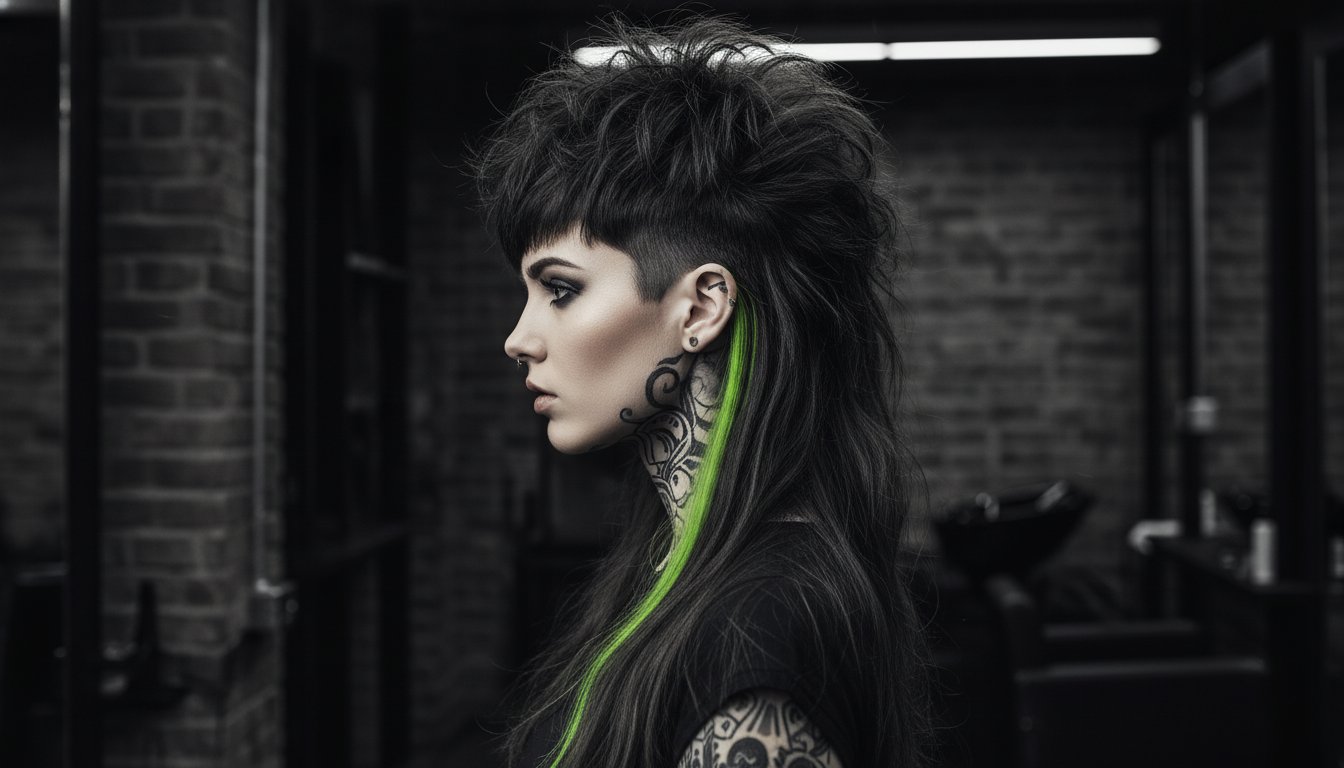
Did you know that TikTok searches for the long wolfcut have surged by a massive 680% this year? It’s the ultimate style for anyone craving a gritty, subcultural edge without sacrificing their hard-earned length. You’re likely tired of your hair feeling heavy and lifeless, or watching your layers vanish into a flat, shapeless curtain because a stylist was too afraid to get aggressive with the shears.
It’s a common frustration in the alternative scene. You want the volume of a shag and the bite of a mullet, but you don’t want to lose the length that defines your look. We’re going to show you how to balance those extreme, high-impact layers whilst maintaining the raw, high-volume edge of a true wolfcut.
This guide covers everything from the technical secrets of aggressive texturising to the specific products you need for that perfect, undone finish. You’ll learn how to communicate your vision to your stylist and discover a styling routine that keeps your texture sharp and your length flowing. It’s time to stop settling for safe hair and start embracing a cut that actually reflects who you are.
Key Takeaways
- Learn why this style is the ultimate middle ground for those who want waist-length drama without losing that gritty, disconnected edge.
- Discover how to navigate the “Aggression Scale” to find your perfect balance of chaos between a classic shag and a full-blown mullet.
- Uncover the technical secrets of weight removal and disconnected layering that define a high-impact long wolfcut whilst keeping your length intact.
- Ditch the brush and master a low-maintenance styling routine designed to defeat gravity and inject volume into heavy, alternative strands.
- Explore the “Heavy Metal Hairdresser” philosophy that treats your hair as a vital piece of your subcultural identity rather than just a service.
What defines a Long Wolfcut in the Alternative Scene?
The long wolfcut is a strategic rebellion against the boring and the basic. It isn’t just a haircut; it’s a high-impact collision between extreme, disconnected layers and waist-length drama. While mainstream salons might offer soft layers, the alternative scene demands something far more visceral. This is the ultimate middle ground for alt-souls who want to keep their length but refuse to look like everyone else.
Metal and grunge subcultures have long since reclaimed this silhouette. It’s about movement, grit, and a refusal to be polished. In these circles, hair is a badge of identity. A long wolfcut provides that raw, unrefined edge that complements a band tee and heavy boots perfectly. It’s for those who want their hair to look as loud as the music they listen to whilst maintaining a silhouette that feels powerful and intentional.
The Evolution of the Wolfcut
The DNA of this style stretches back to the 70s rock icons who pioneered the Shag (haircut). What started with icons like Joan Jett and Patti Smith has evolved into something much sharper and more aggressive. In the UK alternative scene, this cut refuses to die because it bridges the gap between chaos and control. While TikTok might have made it a viral trend a few years back, it has transitioned into a subcultural staple. It’s no longer a passing fad; it’s a foundational look for anyone who lives outside the mainstream and values a gritty, underground aesthetic.
Long Wolfcut vs. Standard Layers
Most stylists are terrified of the “shelf”. In a standard layered cut, the goal is usually a seamless, invisible blend. In a long wolfcut, the shelf is the point. Soft layers are the enemy here. They disappear into the length and leave your hair looking flat and lifeless. A true wolfcut relies on identifying the “step” and the “shelf” to create that aggressive, predatory profile that stands out in a crowd.
The face-frame is the most critical element of this transition. It shouldn’t be a gentle taper or a subtle fringe. It needs to be a bold, choppy frame that highlights the eyes and jawline. This creates the specific wolfish appearance that gives the style its name. Without that aggressive framing, you’re just left with long hair that has a few stray layers. With it, you have a high-impact silhouette that retains its grit even when your hair reaches your lower back. It’s about creating a cut that looks as good in the pit as it does on stage.
Comparing Your Options: Long Wolfcut vs. Shags vs. Mullets
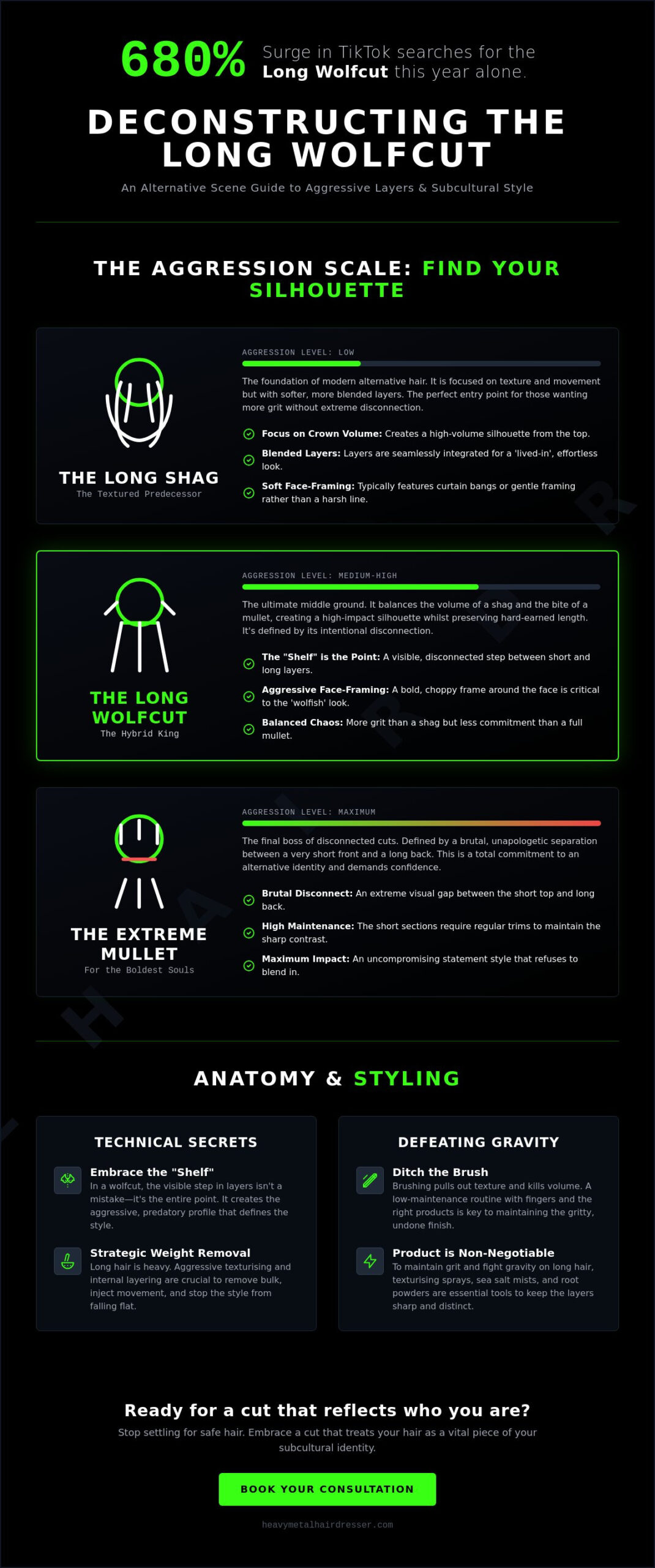
Choosing your silhouette is about more than just aesthetics. It’s about how much chaos you’re willing to carry. Think of it as an “Aggression Scale” where your personal brand of rebellion dictates the level of disconnection in your hair. Length changes the physics of a cut. Longer hair has more weight, which can drag down texture if the cut isn’t aggressive enough. Each style handles this weight differently, and picking the wrong one can leave your hair feeling like a heavy blanket rather than a statement of intent.
Choosing your weapon also depends on your hair’s natural behaviour. Some styles thrive on density, while others use strategic weight removal to create movement where there was once only stillness. Before you sit in the chair, you need to know where you sit on that scale.
The Long Shag: The Textured Predecessor
Shags are the foundation of modern alternative hair. This style focuses heavily on crown volume and soft, face-framing curtain bangs. While it’s packed with movement, it’s generally considered “softer” than its wolfish descendant. The layers are typically more blended, creating a lived-in look that feels effortless. If you aren’t ready for harsh steps or shelves, The Shag Haircut Resurrection explains why this classic remains a staple in the UK scene. It’s the perfect entry point for those transitioning from standard layers to something with more grit.
The Extreme Mullet: For the Boldest Souls
At the far end of the scale sits the extreme mullet. This is defined by a brutal, unapologetic disconnect between the short, choppy front and the long, flowing back. Many people realise halfway through a consultation that their “extreme” wolfcut is actually a mullet in disguise. It’s a total commitment to an alternative identity. It demands confidence and a stylist who isn’t afraid to take things too far. The maintenance is higher here, as that short fringe needs regular attention to keep the contrast sharp and intentional.
The Long Wolfcut: The Hybrid King
This long wolfcut remains the ultimate hybrid. It steals the crown volume from the shag and the dramatic length of a mullet, blending them into a cohesive, predatory shape. It’s the most inclusive option because it works on almost every face shape. You keep the “wolf” vibe through aggressive texturising whilst ensuring your hair stays long enough to satisfy your inner goth. It’s about balance. You get the high-impact volume at the top without losing the length that makes you feel like yourself. If you’re ready to commit to the look, our specialist Wolfcuts can help you find the exact level of aggression your hair needs.
- Fine Hair: Needs the aggressive layering of a wolfcut to create the illusion of thickness and height.
- Thick Hair: Benefits from the weight removal found in a mullet to stop the crown from becoming a “helmet.”
- Curly/Wavy Texture: Naturally suits the shag’s softer transitions but looks incredible with wolfcut volume.
Anatomy of an Aggressive Long Wolfcut: Technical Secrets
Mastering the long wolfcut requires more than just enthusiasm and a pair of shears. It’s a technical battle against the natural weight of long hair. Mainstream stylists often fear the “shelf”, but in an alternative cut, that disconnect is exactly what provides the grit. The secret lies in aggressive internal weight removal. This isn’t just thinning; it’s a strategic carving of the hair to ensure the length doesn’t drag down the volume at the crown. Without this, your hair will inevitably fall flat within hours of styling. For a deeper dive into the anatomy and attitude behind this look, our ultimate wolf hair cut guide covering aggressive texture and subcultural grit breaks down every technical element in full detail.
Disconnected layers are the engine of this aesthetic. Unlike traditional layers that blend seamlessly, wolfcut layers are designed to stand out. They create the choppy, shattered profile that defines the subcultural look. To avoid a “Karen” cut or a basic soccer-mom shag, you must use the right terminology with your stylist. Ask for “shattered ends” and “internal weight removal” rather than “soft layers”. Mention “over-direction” to keep the length at the back whilst creating that extreme, short-to-long contrast. If they look confused, they probably aren’t the right stylist for your identity.
Managing the Crown Volume
The goal at the crown is anti-gravity height. We achieve this by cutting shorter, internal layers that act as a support system for the top sections. These micro-layers prevent the “flat-head” look that often plagues long hair. Texturising shears are used here to create “air” within the hair, allowing the strands to sit up rather than lie flat. It’s about creating a structure that thrives on movement and resists the downward pull of waist-length strands.
The Face-Frame and Fringe
The fringe is the anchor of the entire long wolfcut. Whether you opt for heavy curtain bangs or a blunt micro-fringe, this section dictates the energy of the cut. A micro-fringe offers a sharper, more punk-inspired edge, whilst curtain bangs provide a 70s rock-and-roll vibe. More importantly, the face-frame must “connect” the short, voluminous top to the long, gritty bottom. This framing also serves a functional purpose in the alternative scene; it’s designed to highlight your septum piercings, bridge bars, and heavy jewellery. It’s hair that works with your hardware, not against it.
- Point Cutting: Essential for creating those jagged, non-uniform ends.
- Internal Carving: Removes bulk from the mid-lengths to allow for maximum movement.
- Disconnected Sections: The key to achieving that high-contrast, aggressive silhouette.
Styling the Length: Defeating Gravity and Maintaining Grit
Forget the round brush. If you’re aiming for a long wolfcut that actually looks alternative, you need to ditch the traditional blow-dry. Brushes are for basics; they smooth out the very texture we’ve worked so hard to carve into your hair. We want grit, not gloss. Air-drying and rough-drying are your best friends here. By letting your hair dry naturally or using a diffuser on a low setting, you encourage the disconnected layers to separate and find their own rhythm. It’s about embracing the chaos rather than trying to tame it. If you want to go further with your technique, our guide on how to style a wolfcut for aggressive texture and subcultural grit covers every unapologetic method for keeping that volume sharp and that finish deliberately undone.
Gravity is the constant enemy of length. As your hair grows, the weight pulls at the crown, threatening to flatten your volume. Fighting this requires a tactical approach to your morning routine. You don’t need a full wash every day to keep the edge sharp. A day-two wolfcut often looks better than a fresh one because the natural oils add a level of “lived-in” filth that products can only dream of replicating. Just focus on reviving the roots and the fringe to keep the predatory silhouette intact.
When you do use heat, aim for “defined chaos.” Use a flat iron or a wand to add random, inconsistent bends to the longer sections. Don’t curl the ends; keep them straight and jagged. This maintains the aggressive, “just-rolled-out-of-the-pit” aesthetic that defines the subculture. If you’re ready to take the plunge into a new look, book your next wolfcut transformation with a stylist who understands the assignment.
Essential Products for Alternative Texture
Your product kit should be built for impact. Salt sprays provide that raw, beach-to-moshpit grit, whilst dry texture sprays offer the “anti-gravity” lift needed at the crown. For those piecey, aggressive ends, use a small amount of Death Grip or a similar heavy-duty paste. Rub it between your palms and scrunch it into the tips of your layers to highlight the disconnection. If you’ve paired your cut with Vivid Hair Colour, remember that high-pigment shades demand specific heat protection. Never hit your hair with a flat iron without a barrier, or you’ll watch your identity fade down the drain.
The 5-Minute Morning Routine
- Step 1: Dampen the fringe and crown with a spray bottle to reset any bed-head flat spots.
- Step 2: Apply a professional root-lifting spray or powder to the top layers for immediate height.
- Step 3: Flip your head upside down and rough-dry the roots. This forces the hair to dry away from the scalp, defeating gravity.
- Step 4: Finish by scrunching a tiny amount of texture paste into the ends to define the shattered layers and add weight where it’s actually wanted.
Why Simon Tuckwell is the Master of the Long Wolfcut
Simon Tuckwell doesn’t just cut hair; he builds identities. Known as the Heavy Metal Hairdresser, his philosophy is simple. Your hair isn’t a service. It’s a statement. Mastering a long wolfcut requires an understanding of the subcultures that birthed it. Simon has spent years at the intersection of music and fashion, ensuring that every snip reflects the raw energy of the underground scene. He’s a rebellious expert who acts as a guide for those seeking to express themselves through unconventional means.
The atmosphere in the chair is different here. It’s a fiercely independent, gender-neutral space where your alternative identity is celebrated. We’ve moved away from the polished, clinical vibe of high-street salons in favour of something authentic. There’s no forced small talk about holidays. Instead, you get passionate expertise and a deep respect for your individuality. It’s a sanctuary for those who feel outside the mainstream. It’s about providing a safe, supportive space for you to express your most unconventional self without compromise.
From Download Festival to the Salon Floor
Simon’s experience comes from the front lines. He understands the specific needs of musicians and festival-goers because he’s been there. A long wolfcut needs to do more than look good in a mirror. It needs to survive. Our cuts are engineered for durability. Whether you’re headlining or headbanging, the texture stays sharp and the volume holds its ground. We know how hair behaves under stage lights and in the middle of a crowd. Check out our Festival Hair Backstage case study to see how we style for mosh pit survival.
Professional Education for the Next Generation
We don’t just hoard our technical secrets. We teach the craft. Simon is dedicated to raising the standard of alternative styling across the UK. Through our Alternative Hair Courses, we empower the next generation of stylists to master aggressive texture and weight removal. We’re building a community of rebels who refuse to play by the traditional rules of the beauty industry. We believe in passing on the skills that allow people to feel like their truest selves.
Taking the leap is the first step towards a more authentic you. Don’t leave your length in the hands of someone who doesn’t get it. Whether you’re after a subtle shift or a total overhaul, we’ve got you. Our booking process is straightforward. No gatekeeping. No judgement. Just high-impact hair that reflects your soul. Book your consultation today, join the rebellion, and let’s create something legendary.
Claim Your Alternative Identity
Aggressive weight removal is the secret to keeping your length whilst achieving that predatory, high-volume crown. You’ve discovered that ditching the brush and embracing rough-drying ensures your texture stays gritty and your layers remain sharp. Don’t let a mainstream stylist who fears the “shelf” dilute your vision. You deserve a cut that survives the pit and reflects your soul.
Simon Tuckwell is a Red Dot Award Winning Stylist and a specialist in alternative and metal subculture hair. Our salon is a gender-inclusive safe space where your identity is the priority. It’s a community, not a clinical service. It’s time to stop settling for safe hair and start looking like the person you actually are.
Book your long wolfcut transformation with Simon Tuckwell and join a rebellion that celebrates the unconventional. Your hair is your badge of honour. Wear it loud.
Frequently Asked Questions
Will a long wolfcut work on thin or fine hair?
Yes, a long wolfcut is actually a secret weapon for fine hair. The aggressive layering and internal weight removal create a structural support system that makes your hair look significantly thicker. By removing the dead weight that usually drags fine hair down, you achieve the high-volume crown that defines the alternative aesthetic without losing your length.
How often do I need to get my long wolfcut trimmed to keep the shape?
Plan for a maintenance trim every 8 to 12 weeks. Whilst the length at the back can grow for months without losing its edge, the shorter layers at the top will eventually lose their anti-gravity lift. A regular tidy-up ensures the disconnection remains sharp and the volume stays focused at the crown where it belongs.
Can I have a long wolfcut without a fringe?
Technically yes, but the fringe is the anchor of the entire silhouette. If you’re truly anti-fringe, opt for extreme, cheekbone-length curtain bangs instead. This maintains the aggressive face-frame without a full commitment to a forehead-covering fringe, keeping that predatory wolfish profile intact and intentional.
How do I stop my long wolfcut from looking like a 1980s mullet?
Focus on the length and the texture of the ends. To avoid the retro helmet look, ensure your stylist uses shattered, point-cut ends rather than blunt lines. Keeping the length past your shoulders creates a modern, subcultural vibe that feels more like a heavy metal statement than a vintage throwback. It’s about the grit, not the perm.
Is the long wolfcut suitable for curly or wavy hair types?
Absolutely, it is one of the best cuts for enhancing natural texture. The disconnected layers allow curls to stack on top of each other, creating massive volume without the dreaded triangle shape. It’s a low-maintenance dream for wavy hair because the cut does all the heavy lifting for you, especially when air-dried.
What should I ask my hairdresser for if I want a long wolfcut?
Ask for aggressive, disconnected layers and internal weight removal. Avoid using words like soft or blended. Be specific about wanting a shattered finish on the ends and a bold face-frame. If you want to keep your length, tell them you want the aggression focused on the top and mid-lengths whilst leaving the perimeter long. If you want to go into your consultation fully prepared, our wolf hair cut guide on aggressive texture and subcultural grit gives you the exact language and technical knowledge to get the result you’re after.
Does a long wolfcut require a lot of styling products?
It requires the right products, not necessarily a large quantity. You only need a solid salt spray for grit and a texture powder or paste for the crown. These tools help you defeat gravity and maintain that undone, gritty finish without making your hair feel heavy or greasy. It’s about quality over quantity.
Can I tie my hair back in a ponytail with a long wolfcut?
Yes, you can still tie it back, but expect some bits to fall out. Because the top layers are significantly shorter, they will likely frame your face even when the rest is pulled back. It creates a cool, intentional undone look that works perfectly with an alternative identity and highlights any facial piercings or jewellery.