Posted on

Low Maintenance Wolfcut: The Ultimate Guide to Effortless Alternative Texture

Low Maintenance Wolfcut: The Ultimate Guide to Effortless Alternative Texture

A truly low maintenance wolfcut isn’t about doing less; it’s about a haircut that works harder so you don’t have to. We’ve all seen the “mullet-lite” disaster that collapses the second you leave the chair. You’re likely tired of chasing high-maintenance trends that demand a blow-dryer and a prayer every single morning. It’s frustrating when your hair only looks “alternative” for the first hour of the day. You want a style that respects your identity without forcing you back into a gendered, over-polished beauty routine.

This guide cuts through the noise to show you how technical grit creates a look that thrives on air-drying and grows out without losing its edge. With over 2.24 million monthly searches in early 2026, the wolfcut has become a defining phenomenon for those of us living outside the mainstream. We’ll explore how to prioritise internal structure over superficial styling. You’ll learn exactly how to achieve that lethal, unstyled texture that maintains its shape whilst you’re out living your life. We are ditching the fluff and focusing on the raw, effortless reality of the modern shag.

Key Takeaways

  • Learn why a truly low maintenance wolfcut relies on internal technical carving rather than hours spent with a blow-dryer.
  • Discover the “Mosh Pit Method” for achieving raw, gritty texture whilst prioritising air-drying over heat styling.
  • Understand why razor cutting is the essential technique for removing bulk and creating the effortless, lived-in movement you crave.
  • Debunk common myths regarding hair density and fringes to ensure your cut is tailored specifically to your hair type and alternative identity.
  • Find out how a gender-inclusive salon environment can transform your hair journey into a celebration of your non-conformist aesthetic.

What is a Low Maintenance Wolfcut? Defining the Alternative Dream

The wolfcut isn’t just a fleeting social media aesthetic; it’s a technical powerhouse. This style is a deliberate, aggressive hybrid of the 1970s Shag (haircut) and the rebellious 1980s mullet. Reimagined for 2026, it has evolved from a polished “Instagrammable” look into something far more gritty and utilitarian. A true low maintenance wolfcut prioritises the architecture of the hair over the products you put in it. We aren’t interested in the “TikTok trend” versions that collapse without thirty minutes of heat styling. We want a cut that looks lethal the moment you roll out of bed. It’s about wash-and-go texture that feels authentic to your subcultural roots. This is hair designed for the mosh pit, not just the front-facing camera.

The difference between a salon-standard wolfcut and a technically sound, alternative version lies in the grit. Traditional stylists often try to “pretty up” the layers, leading to a style that requires constant maintenance to keep its shape. Our approach focuses on technical grit. We use the hair’s natural behaviour to our advantage. If your hair wants to flick, we let it. If it wants to swell, we carve out the space for it to do so without looking messy. This isn’t about being lazy; it’s about being smart with the hair’s natural geometry.

The Anatomy of a Low-Maintenance Cut

Achieving zero effort starts with how the hair is carved. A technically sound wolfcut uses specific structural elements to ensure it doesn’t fall flat the second you leave the studio. It’s about building a foundation that supports itself.

  • Aggressive Crown Layers: Short, choppy layers at the top create natural volume. This eliminates the need for backcombing or heavy volumising sprays that just end up feeling greasy.
  • Internal Weight Removal: We remove bulk from the inside out using specialised techniques. This ensures your hair moves whilst you walk, preventing that heavy, “helmet” look that plagues poorly executed mullets.
  • Self-Styling Face Frames: These layers are cut to “flick” naturally against your bone structure. You won’t need a round brush or a flat iron to get that signature alternative silhouette.

Why Alternative Souls Favour the Wolfcut

This cut thrives on imperfection. It celebrates the raw, the undone, and the authentic. For the alternative community, the wolfcut is a badge of independence. It breaks away from traditional, gendered beauty binaries, offering a style that is inherently inclusive. It’s a safe space for your identity to breathe. Whether you’re pairing it with vivid hair colour or a wardrobe full of vintage subcultural staples, this cut adapts to you. It isn’t about fitting a mould; it’s about shattering it entirely. The low maintenance wolfcut is the ultimate choice for those who value their time and their truth equally. It’s a gritty, high-energy aesthetic that says you’ve got better things to do than stand in front of a mirror.

The Technical Grit: Why Your Stylist Holds the Key to Zero Effort

Zero effort is a technical illusion. When hair feels like a flat, lifeless helmet, it isn’t a failure of your hair type; it’s a failure of architecture. A low maintenance wolfcut succeeds because of how it is carved, not how it is styled. We focus on removing bulk exactly where it isn’t needed, allowing the hair to collapse and expand in a way that looks intentional. This is the difference between a haircut that looks good for a week and one that stays lethal for 3-4 months. It’s about building a shape that respects your natural growth cycle rather than fighting against it.

The weapon of choice matters. Whilst traditional salons rely on thinning scissors that often create frizz and “mullet-lite” disasters, we favour razor cutting. Razors create shattered ends and a tapered, lived-in feel that scissors simply cannot replicate. We also build in disconnection. By intentionally breaking the flow between the crown and the length, we prevent your hair from looking like a boring, traditional bob. If you want a look that truly reflects your subcultural edge, you should consult with a specialist who understands technical grit. This approach ensures your hair looks aggressive and purposeful without needing a single minute of heat styling.

Internal Weight Removal vs. Surface Layers

If a stylist only cuts surface layers, you end up with the dreaded “poodle” look. This is where you have massive volume on top that doesn’t blend into the bottom, creating a dated and high-maintenance silhouette. Internal weight removal is the secret. We use point cutting to create jagged finishes that allow the hair to breathe from the inside out. This internal carving ensures the hair sits flat where it should and swells where you want it, embracing chaos without the bulk.

Asking Your Stylist for the Right Shape

Communication is everything when you’re sitting in the chair. Don’t just ask for “layers”; that’s too vague. Use specific terms like “shattered ends,” “internal texture,” and “aggressive crown layers.” We always recommend asking for a dry cut. Cutting hair whilst it’s dry allows the stylist to see how your natural texture behaves in real-time. It’s also helpful to bring references from the Ultimate Wolf Hair Cut Guide to ensure you and your stylist are on the same wavelength. This clarity prevents the “mullet-lite” fear and guarantees a result that aligns with your alternative identity.

Low Maintenance Wolfcut: The Ultimate Guide to Effortless Alternative Texture

Styling for the Unstyled: Embracing Chaos with Zero Effort

If you’re reaching for a blow-dryer, you’ve already lost the battle. The Mosh Pit Method is the only way to style a low maintenance wolfcut without stripping away its rebellious soul. Whilst mainstream guides push a five-step blow-dry routine involving round brushes and heat protectants, we know that heat is often the enemy of authentic grit. This cut is designed to thrive on air-drying. The goal is a look that feels lived-in from the moment you wake up. By the time you reach day two or three, the bedhead effect actually enhances the jagged silhouette we carved into the hair. It’s about embracing the chaos of your identity rather than trying to polish it into submission.

The “scrunch and forget” technique is your best friend here. If you have natural waves or curls, the internal weight removal we discussed earlier allows your hair to spring up without the bulk. You don’t need to spend twenty minutes in front of a mirror. Just apply your product, give it a rough scrunch, and get on with your day. A truly lethal wolfcut looks better after a few hours of real-world wear. It’s hair that moves whilst you walk and settles into a shape that is uniquely yours. We prioritise technical structure so that your morning routine becomes entirely optional.

Air-Drying for Maximum Texture

Achieving that raw, “crunchy” texture starts the moment you step out of the shower. Ditch the heavy bath towels that cause frizz. Instead, use a microfibre cloth to gently squeeze out moisture whilst keeping the natural wave pattern intact. To define those shattered ends, apply a tiny amount of texture paste or sea salt spray. Avoid heavy silicones at all costs. They weigh down the aggressive crown layers and turn your alternative dream into a flat, greasy mess. You want products that add grit, not weight. If you’re struggling with persistent frizz that disrupts your unstyled silhouette, White Ivy Hair Studio explains how treatments like nanoplasty can help manage texture from within.

The “Death Grip” Approach to Styling

When you need your look to stay aggressive through a long night, lean into high-hold, matte products. Clays and salt sprays are perfect for creating a “lived-in” feel that doesn’t look shiny or over-styled. The only part of the cut that might require thirty seconds of attention is the fringe. A quick blast of dry shampoo or a tiny bit of clay can keep it from looking flat against your forehead. For those looking to maintain this vibe at home, check out alternative hair merch UK for the right tools to keep your texture looking sharp. This approach ensures your identity remains the centre of attention without a high-maintenance price tag.

Wolfcut Maintenance Myths: Debunking the High-Effort Narrative

Mainstream beauty blogs are notorious for spreading misinformation about alternative hair. If you’ve spent any time on Reddit, you’ve probably heard people moan that a wolfcut is a high-maintenance trap. They’re wrong. A low maintenance wolfcut is actually one of the most resilient, long-lasting styles you can commit to. The problem isn’t the cut; it’s usually the lack of technical grit in the execution. Let’s tear down the myths that keep people trapped in boring, traditional styles.

One of the loudest lies is that you need thick hair to make this work. Fine hair actually thrives with this silhouette. By carving in shorter crown layers, we create the illusion of density and natural volume that thin hair usually lacks. It’s about adding much-needed chaos to strands that otherwise sit flat and lifeless. Another common myth is that it requires a fringe. Whilst a jagged fringe is a staple, it isn’t a requirement. Curtain bangs or even a completely fringe-less look can be just as aggressive if the internal texture is right. Your identity shouldn’t be limited by a fringe you don’t want to style. Heat is also often the enemy of subcultural grit, making the texture look too polished and taking the focus away from the centre of the aesthetic. Air-drying isn’t just easier; it’s better for the look.

Adapting the Wolfcut for Fine Hair

Fine hair doesn’t need to fear the razor. Shorter crown layers create a foundation for lift that lasts all day. We make sure to avoid over-thinning the ends, which keeps the silhouette feeling solid rather than wispy. To maintain the volume without the weight, swap out heavy waxes for lightweight hair dusts. This keeps the texture aggressive without the grease. A low maintenance wolfcut on fine hair is all about strategic carving to ensure the hair doesn’t collapse under its own weight.

The Longevity of the Shape

This is the ultimate choice for anyone who hates the salon chair. A well-engineered wolfcut stays lethal for months. As the hair grows, it naturally evolves into a beautiful shag haircut. The mullet-inspired roots mean the back can gain significant length whilst the face-framing layers continue to do the heavy lifting. You only need to book a refresh when the crown layers start to lose their height. If you want a style that respects your time and your identity, you should book your next wolfcut with an expert who understands alternative texture.

The Heavy Metal Hairdresser Way: Custom Texture for Your Identity

Simon Tuckwell and the team don’t care about “perfect” hair. We care about your identity. Traditional salons are often obsessed with symmetry and clinical polish, but that’s not our world. We bring expertise born in the pit, from years spent backstage at Download Festival straight to the salon floor. We understand that a low maintenance wolfcut isn’t just a style choice; it’s a statement of who you are. We prioritise technical grit because we want you to leave the chair feeling like the most authentic version of yourself. This is where subcultural passion meets high-level craft. We don’t follow the rules of the beauty industry; we write our own. Your hair should be an extension of your soul, not a carbon copy of a magazine cover.

Our approach is about building a foundation that lasts. We’ve spent years mastering the art of the low maintenance wolfcut to ensure it survives the reality of your life. Whether you’re at a gig, at work, or just rolled out of bed, your hair should look intentional. We focus on the architecture of the cut so that the “unstyled” look remains aggressive and sharp. We are here for the outliers, the rebels, and everyone who feels out of place in a traditional salon setting. This is hair with an attitude. For those who carry this uncompromising spirit over to their cars, Naked Frog Vehicle Tuning provides specialist engine remapping to ensure your vehicle is as finely tuned as your subcultural aesthetic.

Inclusive Styling for Alternative Souls

We’ve built a gender-inclusive safe space where being different is the standard. Traditional hair environments can be suffocating, especially for the queer and alternative community. We’ve ditched the gendered price lists and the clinical vibes in favour of a raw, welcoming atmosphere. Here, your alternative aesthetic is the centre of attention. We want to empower you to feel confident in your own gritty, unstyled skin. Our clients love us because we don’t try to “fix” their hair; we enhance their rebellion. It’s about creating a look that thrives in the real world, amongst the noise and the chaos. We aren’t just cutting hair; we’re affirming your right to exist exactly as you are.

Take the Craft Further

If you’re as obsessed with the architecture of alternative hair as we are, you can learn the secrets behind our methods. We don’t gatekeep our techniques. You can check out our alternative hair courses UK to master the art of subculture styling yourself. Whether you’re a stylist looking to level up or just part of the community, we’ve got the gear and the knowledge to keep your texture sharp. We believe in sharing the craft to ensure alternative culture stays alive and aggressive. It’s time to stop settling for “good enough” and start demanding hair that actually fits your soul. Book your session for a custom wolfcut today and join a community that celebrates the outliers. Your hair is your armour. Let’s make it lethal.

Claim Your Alternative Identity

Your hair is the most visible part of your identity. Don’t settle for a look that requires you to fight your natural texture every single morning. We’ve shown that a low maintenance wolfcut succeeds through technical carving and internal weight removal. It isn’t about a cupboard full of expensive products or hours spent in front of a mirror. By ditching the blow-dryer and embracing the “Mosh Pit Method,” you reclaim your time. You maintain an aggressive, shattered silhouette that grows out beautifully over several months.

We bring expertise born in the pits of Download and Bloodstock to every session. As social media acclaimed alternative specialists, we’ve built a gender-inclusive safe space where your non-conformist spirit is the centre of attention. It’s time to step away from traditional salon expectations. Embrace a look that is as fiercely independent as you are. You deserve a style that looks lethal without the daily grind.

Book your low-maintenance wolfcut transformation at Heavy Metal Hairdresser. We’re ready to help you shatter the mould and find your grit.

Frequently Asked Questions

Is a wolfcut actually low maintenance for everyone?

A wolfcut is low maintenance for almost everyone if the technical carving is correct. It relies on your hair’s natural behaviour rather than daily heat styling or blow-drying. If your stylist prioritises technical grit and removes internal weight properly, the cut does the heavy lifting. Even those with stubborn, pin-straight hair find it easier to manage because the layers create built-in movement that doesn’t require constant attention.

Can I have a wolfcut without a fringe?

You can absolutely have a wolfcut without a fringe. Whilst the classic silhouette often features a jagged, heavy fringe, curtain bangs or even a completely open face-frame can look just as aggressive. The key is maintaining those short, voluminous layers at the crown to keep the signature profile. It’s about your specific identity and what makes you feel confident, not a set of rigid salon rules.

What does a wolfcut look like when it is unstyled and air-dried?

An unstyled, air-dried low maintenance wolfcut looks raw, gritty, and intentionally undone. You’ll see a shattered, lived-in texture that moves whilst you walk rather than a polished, “perfect” finish. It embraces your natural waves and “imperfections,” creating a look that actually gets better as the day goes on. This is the essence of the “Mosh Pit Method” we discussed, where the hair thrives on chaos and air-drying.

How often should I get my wolfcut trimmed to keep the shape?

You should aim for a trim every 12 to 16 weeks to maintain the internal structure. Because this style is rooted in the mullet and the shag, it evolves into a lethal, longer version of itself as it grows out. You won’t need a full overhaul every time you visit the studio. A quick refresh of the crown layers and internal texture is usually enough to keep the grit alive.

Is the wolfcut suitable for fine or thin hair textures?

The wolfcut is perfect for fine or thin hair because it builds natural volume where you need it most. The short layers at the top create the illusion of density and lift without needing heavy, greasy products. By carving out the weight from the inside out, we prevent thin hair from looking flat or lifeless. It’s a game-changer for anyone tired of their hair looking limp.

How do I ask my hairdresser for a low maintenance wolfcut?

Ask your stylist for “internal weight removal” and “shattered ends” using a razor rather than thinning scissors. Tell them you want a low maintenance wolfcut that prioritises air-drying and natural texture over heat styling. It’s helpful to request a dry cut so you can see how your hair sits in real-time. Specifically asking for “aggressive crown layers” ensures the volume stays where it belongs without any extra effort.

Does a wolfcut look good on older alternative people?

Alternative style has no age limit, and the wolfcut looks incredible on older subcultural souls. It’s a timeless hybrid that adds a bold, energetic edge to your aesthetic whilst the face-framing layers provide a softer finish. This cut is about attitude and identity, not a number on a birth certificate. It’s the perfect way to maintain your rebellious spirit without the high-maintenance salon routine.

What are the best products for a wash-and-go wolfcut?

The best products for a wash-and-go look are matte salt sprays and lightweight hair dusts. Stick to high-hold products that add grit without the weight, and avoid heavy silicones that cause the layers to collapse. You want your hair to feel raw and textured, not over-polished. A tiny bit of matte clay can also help define the shattered ends whilst keeping the overall vibe effortless and unstyled.

Posted on

Wolfcut on Fine Hair: Injecting Aggressive Volume and Subcultural Grit

Wolfcut on Fine Hair: Injecting Aggressive Volume and Subcultural Grit

What if the aggressive layering you’ve been told to fear is actually the only way to rescue your fine hair from its flat, lifeless existence? Most mainstream stylists will tell you to keep your ends blunt to preserve density, but you know that just leaves you looking like everyone else. You are likely tired of hair that lacks movement and a salon experience that simply doesn’t understand your alternative aesthetic.

We agree that playing it safe is the quickest way to stay invisible. This article is your blueprint for mastering the wolfcut on fine hair, proving that strategic, disconnected layers can actually mimic density through deliberate chaos. You will learn how to inject subcultural grit into thin strands without losing the weight you need to feel confident in your identity.

We are diving deep into the technical secrets of this hybrid shag and mullet. From aggressive crown volume to the essential styling rituals that prevent your texture from falling flat, we will show you how to own a look that is as bold as your music taste. It is time to stop settling for limp strands and start embracing a silhouette that actually has some teeth.

Key Takeaways

  • Learn how to distinguish between fine and thin strands to ensure your cut builds maximum visual density through strategic chaos.
  • Master the technical art of disconnected layering to inject aggressive height into your crown without sacrificing your perimeter length.
  • Compare the mullet-heavy influence of the wolfcut against the classic shag to decide which alternative silhouette fits your specific vibe.
  • Discover why minimal product is the secret to maintaining a wolfcut on fine hair whilst mastering the “scrunch and go” technique.
  • Find out why mainstream salons often play it too safe and how to identify an expert who understands subcultural aesthetics and inclusive spaces.

Can You Get a Wolfcut on Fine Hair? (The Truth About Density)

You’ve likely been told that your hair is too “delicate” for a heavy, textured cut. Mainstream stylists often play it safe, leaving you with a blunt bob that feels like a safety net rather than a style choice. It is time to kill the myth that you need a thick mane to pull off this look. The truth is that a wolfcut on fine hair isn’t just possible; it is a tactical volume hack for strands that usually refuse to cooperate.

This style is the rebellious offspring of the classic Shag haircut and the 80s mullet. It is built on the principle of deliberate chaos. Whilst thick hair can sometimes become a heavy, unmanageable helmet, fine hair allows for a lighter, more ethereal version of the silhouette that still packs a punch. By leaning into the subcultural grit of the cut, you transform flat strands into a statement of intent.

Fine vs. Thin: Knowing Your Canvas

Most people confuse fine hair with thin hair, but they aren’t the same thing. Fine hair refers to the diameter of the individual strand. Thin hair refers to the number of follicles on your head. You can have plenty of hair, but if the strands are fine, they lack the internal structure to stand up on their own. This is exactly why the wolfcut works. Because fine hair is lightweight, it doesn’t take much to create lift. It holds texture better than heavy, thick hair that often collapses under its own weight. If your hair is healthy and hasn’t been destroyed by over-bleaching, it is the perfect canvas for aggressive layering.

The Volume Illusion: How Texture Creates Fullness

The secret to making a wolfcut on fine hair look massive is the crown. By cutting shorter, choppy layers at the top, we remove the weight that drags your hair down. This provides immediate, aggressive lift. We then use “shattered ends” to create a sense of movement. Instead of a solid line at the bottom that highlights how little hair there is, these jagged edges trick the eye into seeing more density. It is about creating a silhouette that looks intentional and edgy rather than accidental and limp.

  • Short crown layers provide instant vertical lift.
  • Shattered ends break up the perimeter to hide a lack of density.
  • The disconnected shape creates pockets of air that mimic thickness.

Fine hair is the ultimate medium for the wolfcut because its weightless nature allows for maximum vertical lift and a gritty, airy texture that thick hair simply cannot replicate.

The Technical Blueprint: Strategic Layering for Fine Strands

Most people think layering fine hair is a recipe for disaster. They imagine stringy ends and a see-through perimeter. That only happens when the technical execution is lazy. To master a wolfcut on fine hair, we use a blueprint that prioritises internal scaffolding over surface-level aesthetics. It is about building a structure that supports itself from the inside out. We don’t just cut hair; we engineer volume.

Traditional methods often fail because they remove too much bulk from the wrong places. We focus on disconnected layering. This means the top sections don’t necessarily blend into the bottom ones. This disconnection allows us to create aggressive height and volume at the crown whilst keeping the base thick enough to maintain a strong silhouette. This approach is widely considered one of the best hairstyles for thin hair because it uses gravity to its advantage rather than fighting it. You get the grit of a mullet with the fullness of a shag.

Internal Structure: The Secret to Longevity

We utilise a “short-to-long” layering technique. By cutting shorter pieces underneath longer ones, we create a supportive base that literally pushes the top hair upwards. This prevents your style from collapsing by lunchtime. It is a precise mapping process. During your consultation, we look at your specific growth patterns and cowlicks. We don’t fight them. We use them to fuel the chaos. If you want to see how this technical mapping changes the game, check out our professional Wolfcuts.

Razor vs. Scissors: Choosing the Right Tool

The tool we choose dictates the level of subcultural grit in your finished look. Scissors are great for precision and maintaining weight. However, a razor is often the secret weapon for fine strands. It creates a “frazzled” edge that adds instant texture and a lived-in feel. It mimics the natural wear and tear of a subcultural lifestyle without the actual damage.

  • The Razor: Best for adding “grit” and removing weight from the very ends to encourage natural wave and movement.
  • The Scissors: Essential for the perimeter. We use them to keep the baseline solid so your hair never looks sparse or accidental.
  • Point Cutting: A technique used to soften the layers so they stack perfectly without looking like an old-fashioned “step” cut.

Strategic weight placement is the final piece of the puzzle. We keep the density around your face and the back perimeter whilst hollowing out the mid-sections. This creates the illusion of a massive, textured mane without sacrificing the health of your hair. It is a calculated risk that pays off in pure, unadulterated volume. This ensures your wolfcut on fine hair stays looking intentional and aggressive for weeks.

Wolfcut on Fine Hair: Injecting Aggressive Volume and Subcultural Grit

Wolfcut vs. Shag: Which Alternative Cut Wins for You?

Choosing between these two silhouettes is a matter of how much noise you want to make. Whilst they share a common ancestor, the wolfcut is the aggressive, mullet-inspired sibling of the classic shag. It is louder. It is sharper. It is designed to disrupt. For those rocking a wolfcut on fine hair, the choice usually boils down to how much crown volume you can handle before it feels like too much chaos.

The main difference lies in the weight distribution. A shag distributes texture evenly from top to bottom. A wolfcut, however, concentrates the “bite” at the crown and around the face. This top-heavy energy is a massive win for fine strands that usually sit flat against the scalp. If you are trying to decide which path to take, our guide to shag hairdressers offers a deeper dive into the more balanced, 70s-inspired alternative.

The Case for the Wolfcut

Go for the wolfcut if you want an aggressive face frame. This style is built for people who want their hair to look like it has a pulse. It integrates perfectly with long wolfcut aesthetics, allowing you to keep your length whilst the top does all the heavy lifting. It is the ultimate choice for straight, fine hair that lacks natural movement. The disconnected layers force the hair to stand up, creating a silhouette that looks full even if you hasn’t washed it in two days. It requires a bit more daily grit, but the payoff is a look that defines your identity.

The Case for the Classic Shag

The shag is your best bet if you prefer a softer, more “lived-in” alternative vibe. It is less about the mullet spike and more about the rockstar tumble. Because the layers are more blended, the shag often preserves more perceived length for thin hair. It is easier to maintain. You can wake up, shake it out, and go. It doesn’t demand the same level of aggressive styling as the wolfcut. Choose this if you want an alternative edge that feels a bit more effortless and 70s-inspired. It is a safer bet for those who are still nervous about losing too much density whilst experimenting with a wolfcut on fine hair for the first time.

Styling the Chaos: Maintaining Volume and Grit at Home

The cut is only half the battle. If you want your wolfcut on fine hair to actually stand up and scream, you need a home ritual that doesn’t involve drowning your strands in heavy grease. Most mainstream advice tells you to use “smoothing” serums. Ignore them. Smooth is the enemy of the wolfcut. We want friction. We want grit. We want hair that looks like it has been through a three-day festival. You can find a deeper breakdown of these aesthetics in our guide on how to style a wolfcut.

The “less is more” rule is non-negotiable here. Fine strands are incredibly easy to weigh down. If you overdo the product, your aggressive layers will turn into limp, oily strings. Focus on building texture whilst the hair is damp to lock in the shape before gravity takes over. It is about working with the hair’s natural behaviour rather than trying to force it into a polished, clinical box.

Product Selection for Fine Hair

Heavy waxes and traditional pomades are the fastest way to kill your volume. They are too dense for fine hair to support. Instead, you need tools that provide hold without the weight. We recommend using Death Grip to achieve that gritty, matte finish that defines the alternative aesthetic. It provides enough “stick” to keep your crown layers high without making them greasy.

Dry shampoo is your secret volume-building weapon. Don’t wait for your hair to get dirty. Apply it to clean, dry roots to create immediate lift and a matte texture. It acts like a tiny scaffolding system for your strands, preventing them from sliding against each other and falling flat. This is essential for maintaining that subcultural edge throughout the day.

The Art of the Air-Dry

If you have the time, air-drying can produce the most authentic results. The key is prep. Whilst your hair is still soaking wet, apply a lightweight salt spray or texture mist. Use your hands to “scrunch” the hair upwards towards the scalp. This locks in the natural wave and encourages those shorter layers to separate and stack.

  • Root Clipping: Use small metal clips to lift the hair at the crown whilst it dries. This prevents the “flat top” look.
  • Hands Off: Once you’ve scrunched, stop touching it. Playing with drying hair creates “fuzz” rather than “frazzle.”
  • Embrace the Frizz: A bit of flyaway hair adds to the subcultural grit. It looks raw and real.

When you need maximum drama, reach for the diffuser. Set your hair dryer to a low heat and low speed. Cup the hair in the diffuser bowl and push it up towards the scalp. This mimics the air-dry process but amplifies the volume significantly. It is the best way to ensure your wolfcut on fine hair has the structural integrity to survive a night out. Ready to take your texture to the next level? Grab our Death Grip and start building the silhouette you deserve.

Why Your Stylist Matters: Finding an Alternative Expert

You wouldn’t ask a pop producer to mix a black metal record. The same logic applies to your hair. Most high-street salons are built on a foundation of “traditional beauty.” They are trained to make hair look polished, symmetrical, and safe. When you walk in asking for a wolfcut on fine hair, their instinct is to talk you out of it. They worry about “losing thickness” because they don’t understand how to create volume through strategic chaos. They see fine strands as a limitation; we see them as an opportunity for maximum lift.

Finding the best wolfcut hairdresser UK wide means finding someone who lives the subculture. You need a stylist who understands that “grit” isn’t a mistake; it’s the point. We don’t just follow a template. We look at your aesthetic, your music, and your identity to build a shape that feels like you. It is about more than a haircut. It is about providing an inclusive, gender-neutral safe space where you can be unapologetically yourself without being judged by mainstream standards.

Beyond the Mainstream: The Alt-Hair Advantage

Alternative stylists understand the nuances of the scene. We know the difference between a 70s rockstar tumble and a modern, aggressive mullet. We celebrate individuality by focusing on what makes your hair unique rather than trying to force it into a commercial box. Our expertise allows us to push the boundaries of texture whilst still protecting the integrity of your strands. We know that fine hair requires a delicate touch but a bold vision to achieve that iconic, frazzled look. We understand the “grit” versus just the “cut.”

Your Wolfcut Journey Starts Here

Preparing for your first appointment is about communication. Bring photos, but also be ready to talk about your daily routine. We prioritise the health of your strands above all else. If your hair is struggling, we will help you build a plan to get it strong enough for the aggressive layering you crave. We are here to be your guides in this transformation, ensuring you walk out with a silhouette that actually has some teeth. Don’t settle for a stylist who plays it safe. You deserve a look that reflects your true self.

  • Be specific about the “disconnected” look you want during the consultation.
  • Ask how they plan to maintain the perimeter density whilst adding crown height.
  • Ensure they understand your commitment to an alternative aesthetic over a commercial one.

It’s time to stop settling for “sensible” hair that doesn’t represent who you are. Embrace the grit. Own the volume. Your transformation is waiting. Book your appointment now for one of our signature Wolfcuts and finally get the hair your identity deserves.

Own Your Texture and Identity

Fine hair is no longer an excuse for a boring, flat silhouette. You’ve seen how disconnected layering and internal structure turn limp strands into a massive statement. Mastering a wolfcut on fine hair is about embracing the chaos and trusting the technical blueprint. From the aggressive lift at the crown to the gritty, matte finish of the right product, you now have the tools to maintain your subcultural edge at home. It’s about working with your hair, not against it.

Stop letting mainstream salons play it safe with your identity. We are specialists in aggressive texture and have spent years as backstage festival stylists perfecting these raw, authentic shapes. Our studio is a gender-inclusive safe space where your individuality is the priority. It’s time to stop settling for invisible hair that doesn’t represent who you are. Your hair should be as loud as your favourite record.

Book your wolfcut transformation with the alternative experts and finally own your silhouette. We can’t wait to help you reveal the most authentic version of yourself. Your new identity starts here.

Frequently Asked Questions

Will a wolfcut make my fine hair look even thinner?

A wolfcut on fine hair actually creates the illusion of more density through strategic, disconnected layers. By removing weight from the crown, your hair gains vertical lift rather than hanging limp and flat. We keep the perimeter solid so you don’t lose that essential baseline thickness. It is about engineering volume where you need it most whilst maintaining a strong silhouette.

How often should I trim my wolfcut to keep the volume?

You should aim for a trim every six to eight weeks to keep the silhouette sharp and the volume high. Fine hair grows out quickly, and once those crown layers lose their height, the overall shape starts to collapse. Regular maintenance ensures the “bite” of the cut stays aggressive. It keeps your texture looking intentional rather than accidental or overgrown.

Can I pull off a wolfcut with fine, straight hair?

Absolutely, fine straight hair is the perfect canvas for a gritty, alternative look. The layers provide the movement and “chaos” that straight strands usually lack. Without these choppy sections, straight hair often looks lifeless. A wolfcut forces the hair to stack, creating a silhouette that feels alive and rebellious without needing a natural wave.

What are the best products for a wolfcut on fine hair?

Stick to lightweight, matte products that won’t drown your strands in grease. Dry shampoos and salt sprays are excellent for building friction and lift at the root. For that ultimate subcultural grit, we recommend using Death Grip. It provides the necessary “stick” to hold your crown high without the heavy weight of traditional waxes or pomades.

Do I need to style my wolfcut every single day?

You don’t need a full styling routine every day if the technical cut is sound. A wolfcut is designed to look better as it “lives in” and gains a bit of natural texture. A quick blast of dry shampoo or a damp-hand scrunch is usually enough to revive the shape. The goal is a raw, effortless vibe that doesn’t look like you’ve spent hours in front of a mirror.

Is a wolfcut high maintenance for thin hair types?

It is more about the right ritual than high maintenance. Once you master the “scrunch and go” technique, it’s often faster than trying to blow-dry fine hair to look smooth and full. The cut does about 80% of the work for you. You just need to provide the finishing grit to keep the layers from looking too polished or clinical.

What is the difference between a wolfcut and a mullet for fine hair?

A wolfcut is essentially a more shaggy, face-framing evolution of the classic mullet. Whilst a mullet has a distinct “short front, long back” split, the wolfcut uses heavy layers to bridge that gap. For fine strands, the wolfcut offers more consistent volume across the entire head. It feels more like a 70s rockstar look than a traditional 80s mullet.

How do I explain a wolfcut to my hairdresser if I have fine hair?

Ask for “disconnected internal layering” and a “shattered perimeter” during your consultation. Tell them you want to prioritise crown volume without making the ends look stringy or sparse. Bringing photos is helpful, but ensure they understand you want an alternative, gritty finish. A specialist in alternative aesthetics will understand the need for volume over traditional perfection.

Posted on

The Long Wolfcut: Mastering Aggressive Texture without Losing Your Length

The Long Wolfcut: Mastering Aggressive Texture without Losing Your Length

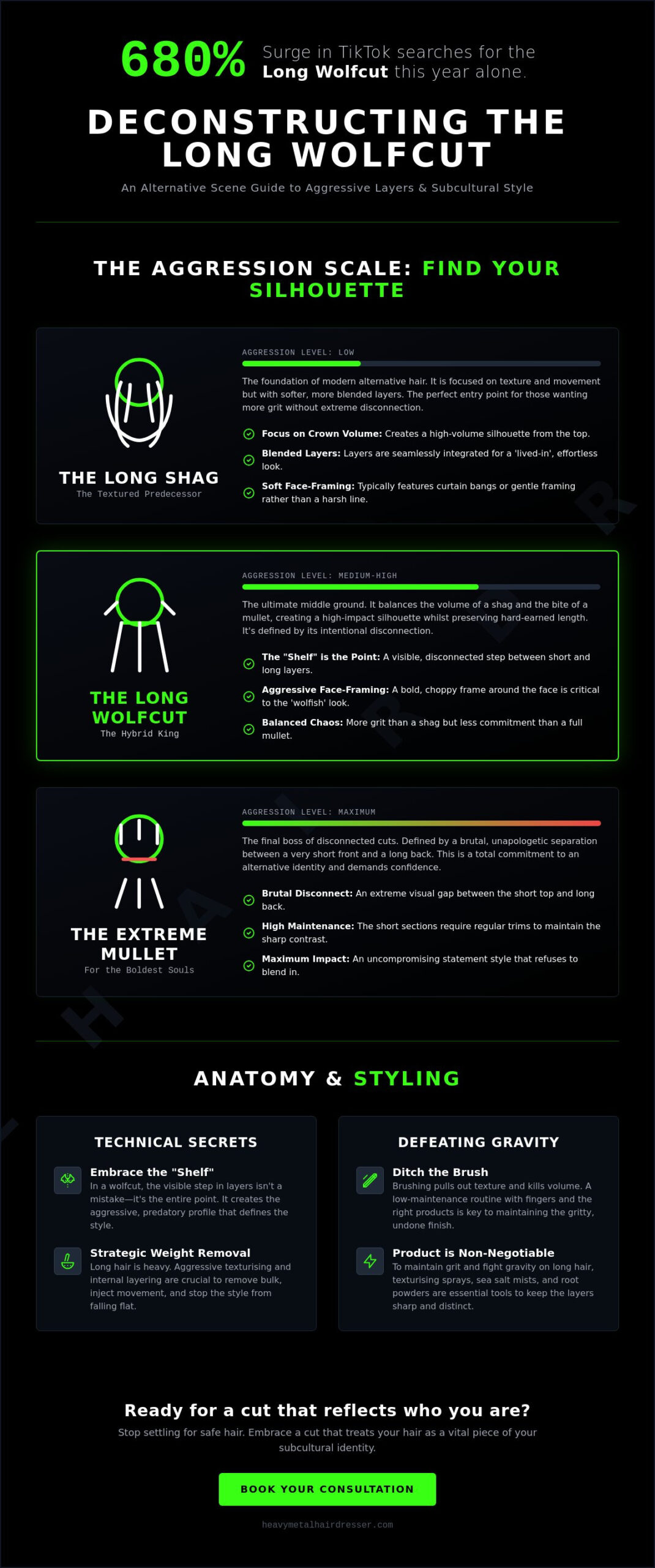
Did you know that TikTok searches for the long wolfcut have surged by a massive 680% this year? It’s the ultimate style for anyone craving a gritty, subcultural edge without sacrificing their hard-earned length. You’re likely tired of your hair feeling heavy and lifeless, or watching your layers vanish into a flat, shapeless curtain because a stylist was too afraid to get aggressive with the shears.

It’s a common frustration in the alternative scene. You want the volume of a shag and the bite of a mullet, but you don’t want to lose the length that defines your look. We’re going to show you how to balance those extreme, high-impact layers whilst maintaining the raw, high-volume edge of a true wolfcut.

This guide covers everything from the technical secrets of aggressive texturising to the specific products you need for that perfect, undone finish. You’ll learn how to communicate your vision to your stylist and discover a styling routine that keeps your texture sharp and your length flowing. It’s time to stop settling for safe hair and start embracing a cut that actually reflects who you are.

Key Takeaways

  • Learn why this style is the ultimate middle ground for those who want waist-length drama without losing that gritty, disconnected edge.
  • Discover how to navigate the “Aggression Scale” to find your perfect balance of chaos between a classic shag and a full-blown mullet.
  • Uncover the technical secrets of weight removal and disconnected layering that define a high-impact long wolfcut whilst keeping your length intact.
  • Ditch the brush and master a low-maintenance styling routine designed to defeat gravity and inject volume into heavy, alternative strands.
  • Explore the “Heavy Metal Hairdresser” philosophy that treats your hair as a vital piece of your subcultural identity rather than just a service.

What defines a Long Wolfcut in the Alternative Scene?

The long wolfcut is a strategic rebellion against the boring and the basic. It isn’t just a haircut; it’s a high-impact collision between extreme, disconnected layers and waist-length drama. While mainstream salons might offer soft layers, the alternative scene demands something far more visceral. This is the ultimate middle ground for alt-souls who want to keep their length but refuse to look like everyone else.

Metal and grunge subcultures have long since reclaimed this silhouette. It’s about movement, grit, and a refusal to be polished. In these circles, hair is a badge of identity. A long wolfcut provides that raw, unrefined edge that complements a band tee and heavy boots perfectly. It’s for those who want their hair to look as loud as the music they listen to whilst maintaining a silhouette that feels powerful and intentional.

The Evolution of the Wolfcut

The DNA of this style stretches back to the 70s rock icons who pioneered the Shag (haircut). What started with icons like Joan Jett and Patti Smith has evolved into something much sharper and more aggressive. In the UK alternative scene, this cut refuses to die because it bridges the gap between chaos and control. While TikTok might have made it a viral trend a few years back, it has transitioned into a subcultural staple. It’s no longer a passing fad; it’s a foundational look for anyone who lives outside the mainstream and values a gritty, underground aesthetic.

Long Wolfcut vs. Standard Layers

Most stylists are terrified of the “shelf”. In a standard layered cut, the goal is usually a seamless, invisible blend. In a long wolfcut, the shelf is the point. Soft layers are the enemy here. They disappear into the length and leave your hair looking flat and lifeless. A true wolfcut relies on identifying the “step” and the “shelf” to create that aggressive, predatory profile that stands out in a crowd.

The face-frame is the most critical element of this transition. It shouldn’t be a gentle taper or a subtle fringe. It needs to be a bold, choppy frame that highlights the eyes and jawline. This creates the specific wolfish appearance that gives the style its name. Without that aggressive framing, you’re just left with long hair that has a few stray layers. With it, you have a high-impact silhouette that retains its grit even when your hair reaches your lower back. It’s about creating a cut that looks as good in the pit as it does on stage.

Comparing Your Options: Long Wolfcut vs. Shags vs. Mullets

Choosing your silhouette is about more than just aesthetics. It’s about how much chaos you’re willing to carry. Think of it as an “Aggression Scale” where your personal brand of rebellion dictates the level of disconnection in your hair. Length changes the physics of a cut. Longer hair has more weight, which can drag down texture if the cut isn’t aggressive enough. Each style handles this weight differently, and picking the wrong one can leave your hair feeling like a heavy blanket rather than a statement of intent.

Choosing your weapon also depends on your hair’s natural behaviour. Some styles thrive on density, while others use strategic weight removal to create movement where there was once only stillness. Before you sit in the chair, you need to know where you sit on that scale.

The Long Shag: The Textured Predecessor

Shags are the foundation of modern alternative hair. This style focuses heavily on crown volume and soft, face-framing curtain bangs. While it’s packed with movement, it’s generally considered “softer” than its wolfish descendant. The layers are typically more blended, creating a lived-in look that feels effortless. If you aren’t ready for harsh steps or shelves, The Shag Haircut Resurrection explains why this classic remains a staple in the UK scene. It’s the perfect entry point for those transitioning from standard layers to something with more grit.

The Extreme Mullet: For the Boldest Souls

At the far end of the scale sits the extreme mullet. This is defined by a brutal, unapologetic disconnect between the short, choppy front and the long, flowing back. Many people realise halfway through a consultation that their “extreme” wolfcut is actually a mullet in disguise. It’s a total commitment to an alternative identity. It demands confidence and a stylist who isn’t afraid to take things too far. The maintenance is higher here, as that short fringe needs regular attention to keep the contrast sharp and intentional.

The Long Wolfcut: The Hybrid King

This long wolfcut remains the ultimate hybrid. It steals the crown volume from the shag and the dramatic length of a mullet, blending them into a cohesive, predatory shape. It’s the most inclusive option because it works on almost every face shape. You keep the “wolf” vibe through aggressive texturising whilst ensuring your hair stays long enough to satisfy your inner goth. It’s about balance. You get the high-impact volume at the top without losing the length that makes you feel like yourself. If you’re ready to commit to the look, our specialist Wolfcuts can help you find the exact level of aggression your hair needs.

  • Fine Hair: Needs the aggressive layering of a wolfcut to create the illusion of thickness and height.
  • Thick Hair: Benefits from the weight removal found in a mullet to stop the crown from becoming a “helmet.”
  • Curly/Wavy Texture: Naturally suits the shag’s softer transitions but looks incredible with wolfcut volume.

The Long Wolfcut: Mastering Aggressive Texture without Losing Your Length

Anatomy of an Aggressive Long Wolfcut: Technical Secrets

Mastering the long wolfcut requires more than just enthusiasm and a pair of shears. It’s a technical battle against the natural weight of long hair. Mainstream stylists often fear the “shelf”, but in an alternative cut, that disconnect is exactly what provides the grit. The secret lies in aggressive internal weight removal. This isn’t just thinning; it’s a strategic carving of the hair to ensure the length doesn’t drag down the volume at the crown. Without this, your hair will inevitably fall flat within hours of styling. For a deeper dive into the anatomy and attitude behind this look, our ultimate wolf hair cut guide covering aggressive texture and subcultural grit breaks down every technical element in full detail.

Disconnected layers are the engine of this aesthetic. Unlike traditional layers that blend seamlessly, wolfcut layers are designed to stand out. They create the choppy, shattered profile that defines the subcultural look. To avoid a “Karen” cut or a basic soccer-mom shag, you must use the right terminology with your stylist. Ask for “shattered ends” and “internal weight removal” rather than “soft layers”. Mention “over-direction” to keep the length at the back whilst creating that extreme, short-to-long contrast. If they look confused, they probably aren’t the right stylist for your identity.

Managing the Crown Volume

The goal at the crown is anti-gravity height. We achieve this by cutting shorter, internal layers that act as a support system for the top sections. These micro-layers prevent the “flat-head” look that often plagues long hair. Texturising shears are used here to create “air” within the hair, allowing the strands to sit up rather than lie flat. It’s about creating a structure that thrives on movement and resists the downward pull of waist-length strands.

The Face-Frame and Fringe

The fringe is the anchor of the entire long wolfcut. Whether you opt for heavy curtain bangs or a blunt micro-fringe, this section dictates the energy of the cut. A micro-fringe offers a sharper, more punk-inspired edge, whilst curtain bangs provide a 70s rock-and-roll vibe. More importantly, the face-frame must “connect” the short, voluminous top to the long, gritty bottom. This framing also serves a functional purpose in the alternative scene; it’s designed to highlight your septum piercings, bridge bars, and heavy jewellery. It’s hair that works with your hardware, not against it.

  • Point Cutting: Essential for creating those jagged, non-uniform ends.
  • Internal Carving: Removes bulk from the mid-lengths to allow for maximum movement.
  • Disconnected Sections: The key to achieving that high-contrast, aggressive silhouette.

Styling the Length: Defeating Gravity and Maintaining Grit

Forget the round brush. If you’re aiming for a long wolfcut that actually looks alternative, you need to ditch the traditional blow-dry. Brushes are for basics; they smooth out the very texture we’ve worked so hard to carve into your hair. We want grit, not gloss. Air-drying and rough-drying are your best friends here. By letting your hair dry naturally or using a diffuser on a low setting, you encourage the disconnected layers to separate and find their own rhythm. It’s about embracing the chaos rather than trying to tame it. If you want to go further with your technique, our guide on how to style a wolfcut for aggressive texture and subcultural grit covers every unapologetic method for keeping that volume sharp and that finish deliberately undone.

Gravity is the constant enemy of length. As your hair grows, the weight pulls at the crown, threatening to flatten your volume. Fighting this requires a tactical approach to your morning routine. You don’t need a full wash every day to keep the edge sharp. A day-two wolfcut often looks better than a fresh one because the natural oils add a level of “lived-in” filth that products can only dream of replicating. Just focus on reviving the roots and the fringe to keep the predatory silhouette intact.

When you do use heat, aim for “defined chaos.” Use a flat iron or a wand to add random, inconsistent bends to the longer sections. Don’t curl the ends; keep them straight and jagged. This maintains the aggressive, “just-rolled-out-of-the-pit” aesthetic that defines the subculture. If you’re ready to take the plunge into a new look, book your next wolfcut transformation with a stylist who understands the assignment.

Essential Products for Alternative Texture

Your product kit should be built for impact. Salt sprays provide that raw, beach-to-moshpit grit, whilst dry texture sprays offer the “anti-gravity” lift needed at the crown. For those piecey, aggressive ends, use a small amount of Death Grip or a similar heavy-duty paste. Rub it between your palms and scrunch it into the tips of your layers to highlight the disconnection. If you’ve paired your cut with Vivid Hair Colour, remember that high-pigment shades demand specific heat protection. Never hit your hair with a flat iron without a barrier, or you’ll watch your identity fade down the drain.

The 5-Minute Morning Routine

  • Step 1: Dampen the fringe and crown with a spray bottle to reset any bed-head flat spots.
  • Step 2: Apply a professional root-lifting spray or powder to the top layers for immediate height.
  • Step 3: Flip your head upside down and rough-dry the roots. This forces the hair to dry away from the scalp, defeating gravity.
  • Step 4: Finish by scrunching a tiny amount of texture paste into the ends to define the shattered layers and add weight where it’s actually wanted.

Why Simon Tuckwell is the Master of the Long Wolfcut

Simon Tuckwell doesn’t just cut hair; he builds identities. Known as the Heavy Metal Hairdresser, his philosophy is simple. Your hair isn’t a service. It’s a statement. Mastering a long wolfcut requires an understanding of the subcultures that birthed it. Simon has spent years at the intersection of music and fashion, ensuring that every snip reflects the raw energy of the underground scene. He’s a rebellious expert who acts as a guide for those seeking to express themselves through unconventional means.

The atmosphere in the chair is different here. It’s a fiercely independent, gender-neutral space where your alternative identity is celebrated. We’ve moved away from the polished, clinical vibe of high-street salons in favour of something authentic. There’s no forced small talk about holidays. Instead, you get passionate expertise and a deep respect for your individuality. It’s a sanctuary for those who feel outside the mainstream. It’s about providing a safe, supportive space for you to express your most unconventional self without compromise.

From Download Festival to the Salon Floor

Simon’s experience comes from the front lines. He understands the specific needs of musicians and festival-goers because he’s been there. A long wolfcut needs to do more than look good in a mirror. It needs to survive. Our cuts are engineered for durability. Whether you’re headlining or headbanging, the texture stays sharp and the volume holds its ground. We know how hair behaves under stage lights and in the middle of a crowd. Check out our Festival Hair Backstage case study to see how we style for mosh pit survival.

Professional Education for the Next Generation

We don’t just hoard our technical secrets. We teach the craft. Simon is dedicated to raising the standard of alternative styling across the UK. Through our Alternative Hair Courses, we empower the next generation of stylists to master aggressive texture and weight removal. We’re building a community of rebels who refuse to play by the traditional rules of the beauty industry. We believe in passing on the skills that allow people to feel like their truest selves.

Taking the leap is the first step towards a more authentic you. Don’t leave your length in the hands of someone who doesn’t get it. Whether you’re after a subtle shift or a total overhaul, we’ve got you. Our booking process is straightforward. No gatekeeping. No judgement. Just high-impact hair that reflects your soul. Book your consultation today, join the rebellion, and let’s create something legendary.

Claim Your Alternative Identity

Aggressive weight removal is the secret to keeping your length whilst achieving that predatory, high-volume crown. You’ve discovered that ditching the brush and embracing rough-drying ensures your texture stays gritty and your layers remain sharp. Don’t let a mainstream stylist who fears the “shelf” dilute your vision. You deserve a cut that survives the pit and reflects your soul.

Simon Tuckwell is a Red Dot Award Winning Stylist and a specialist in alternative and metal subculture hair. Our salon is a gender-inclusive safe space where your identity is the priority. It’s a community, not a clinical service. It’s time to stop settling for safe hair and start looking like the person you actually are.

Book your long wolfcut transformation with Simon Tuckwell and join a rebellion that celebrates the unconventional. Your hair is your badge of honour. Wear it loud.

Frequently Asked Questions

Will a long wolfcut work on thin or fine hair?

Yes, a long wolfcut is actually a secret weapon for fine hair. The aggressive layering and internal weight removal create a structural support system that makes your hair look significantly thicker. By removing the dead weight that usually drags fine hair down, you achieve the high-volume crown that defines the alternative aesthetic without losing your length.

How often do I need to get my long wolfcut trimmed to keep the shape?

Plan for a maintenance trim every 8 to 12 weeks. Whilst the length at the back can grow for months without losing its edge, the shorter layers at the top will eventually lose their anti-gravity lift. A regular tidy-up ensures the disconnection remains sharp and the volume stays focused at the crown where it belongs.

Can I have a long wolfcut without a fringe?

Technically yes, but the fringe is the anchor of the entire silhouette. If you’re truly anti-fringe, opt for extreme, cheekbone-length curtain bangs instead. This maintains the aggressive face-frame without a full commitment to a forehead-covering fringe, keeping that predatory wolfish profile intact and intentional.

How do I stop my long wolfcut from looking like a 1980s mullet?

Focus on the length and the texture of the ends. To avoid the retro helmet look, ensure your stylist uses shattered, point-cut ends rather than blunt lines. Keeping the length past your shoulders creates a modern, subcultural vibe that feels more like a heavy metal statement than a vintage throwback. It’s about the grit, not the perm.

Is the long wolfcut suitable for curly or wavy hair types?

Absolutely, it is one of the best cuts for enhancing natural texture. The disconnected layers allow curls to stack on top of each other, creating massive volume without the dreaded triangle shape. It’s a low-maintenance dream for wavy hair because the cut does all the heavy lifting for you, especially when air-dried.

What should I ask my hairdresser for if I want a long wolfcut?

Ask for aggressive, disconnected layers and internal weight removal. Avoid using words like soft or blended. Be specific about wanting a shattered finish on the ends and a bold face-frame. If you want to keep your length, tell them you want the aggression focused on the top and mid-lengths whilst leaving the perimeter long. If you want to go into your consultation fully prepared, our wolf hair cut guide on aggressive texture and subcultural grit gives you the exact language and technical knowledge to get the result you’re after.

Does a long wolfcut require a lot of styling products?

It requires the right products, not necessarily a large quantity. You only need a solid salt spray for grit and a texture powder or paste for the crown. These tools help you defeat gravity and maintain that undone, gritty finish without making your hair feel heavy or greasy. It’s about quality over quantity.

Can I tie my hair back in a ponytail with a long wolfcut?

Yes, you can still tie it back, but expect some bits to fall out. Because the top layers are significantly shorter, they will likely frame your face even when the rest is pulled back. It creates a cool, intentional undone look that works perfectly with an alternative identity and highlights any facial piercings or jewellery.