Posted on

Sea Salt Spray: Alt-Styling Guide for Gritty Volume

Sea Salt Spray: Alt-Styling Guide for Gritty Volume

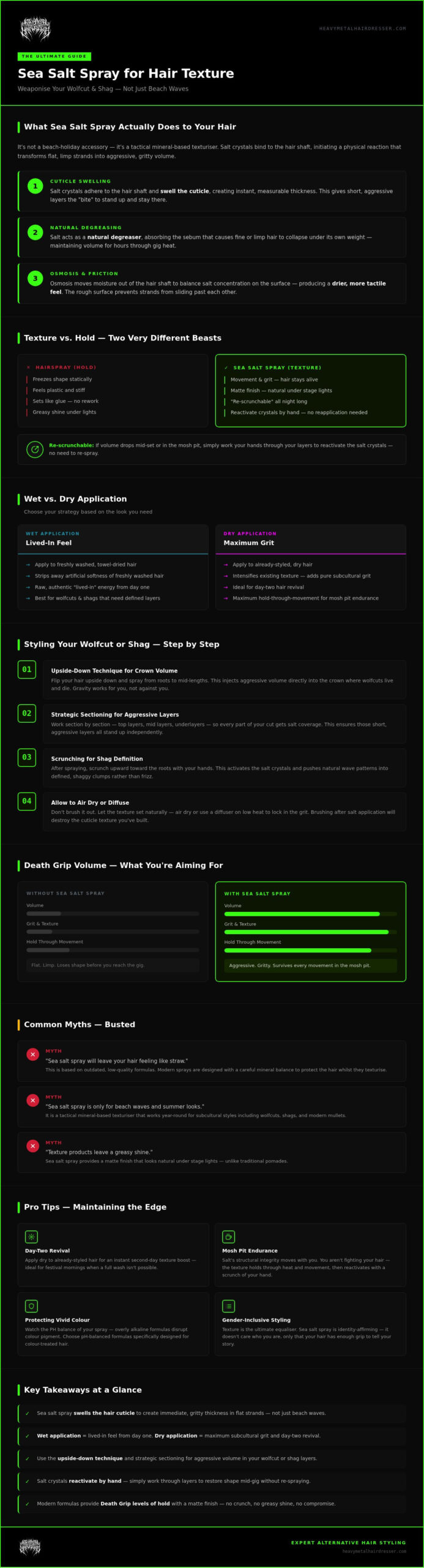
Stop treating your sea salt spray like a holiday accessory. Most tutorials promise sun-kissed waves, but we know you aren’t looking for a trip to the coast; you’re looking for a riot. If you’ve been struggling with flat, limp hair that loses its shape before you’ve even reached the gig, you need a different approach. Using sea salt spray for hair texture isn’t about looking soft; it’s about weaponising your wolfcut with aggressive, gritty volume that actually stays put.

It’s frustrating when your alternative style feels more polite than punk because your product leaves your strands feeling like a crunchy, dry mess. We agree that generic beauty industry advice just doesn’t cut it for subcultural styles like shags and wolfcuts. This guide promises to transform your routine by teaching you the expert art of injecting raw, long-lasting grit into your hair. We will explore the specific techniques needed to master wet versus dry application and how to achieve Death Grip levels of volume that hold through every movement.

Key Takeaways

  • Forget beach waves; learn how sea salt spray for hair texture works by swelling the hair cuticle to create immediate, gritty thickness in flat strands.
  • Master the difference between wet and dry application to choose between a lived-in feel or maximum subcultural grit.
  • Use the “upside down” technique and strategic sectioning to inject aggressive volume into the crown and layers of your wolfcut or shag.
  • Discover how to revive your style for day two and keep your texture sharp through the intensity of a festival mosh pit.
  • Level up your styling game with “Death Grip” levels of hold that celebrate your individuality without the dreaded crunch of traditional products.

Beyond the Beach: Why Sea Salt Spray is the Ultimate Alt-Hair Weapon

Most brands want you to believe that sea salt spray belongs on a breezy coastline during a summer holiday. They’re wrong. For those of us in the alternative scene, sea salt spray for hair texture is a tactical tool used to weaponise a wolfcut or a shag. It’s a mineral-based texturiser designed to mimic the rough, gritty feel of ocean air without the annoying sand. The unique mineral composition of sea salt allows it to bind to the hair, creating a tactile roughness that makes aggressive layers stand out rather than falling flat.

This isn’t just about ‘beach waves’. That’s a limited marketing term that ignores the raw potential of subcultural styling. Using sea salt spray for hair texture allows you to bypass the generic advice and focus on what matters: grit. Whether you’re a metalhead, a punk, or someone who simply refuses to conform, texture is the ultimate equaliser. It’s gender-inclusive and identity-affirming; it doesn’t care who you are, only that your hair has enough ‘grip’ to tell a story.

The Anti-Polished Aesthetic

The mainstream is currently obsessed with the ‘clean girl’ look, featuring slicked-back buns and high-shine finishes. We aren’t. Our aesthetic is deliberately rebellious and unapologetically gritty. For us, ‘messy’ isn’t an accident; it’s an expert-led style choice that signals you belong in the pit, not a corporate office. Sea salt spray is essential for creating that ‘lived-in’ vibe from day one. It strips away the artificial softness of freshly washed hair, replacing it with a raw energy that feels authentic to the underground.

Texture vs. Hold: Understanding the Difference

It’s vital to understand that texture and hold are different beasts. Hairspray is designed to freeze a shape in time; it’s static and often feels plastic. Sea salt spray is about movement and grit. It provides a matte finish that looks natural under stage lights, helping you achieve those Death Grip levels of texture without the greasy shine of traditional pomades.

Because it doesn’t set like a glue, your hair remains ‘re-scrunchable’ throughout the night. If your volume starts to drop mid-set or whilst you’re in the mosh pit, you can simply work your hands through your layers to reactivate the salt crystals. This flexibility is what gives alternative styles their longevity. You aren’t fighting against your hair; you’re giving it the structural integrity to move with you.

The Science of Grit: How Salt Transforms Flat Strands

Don’t just spray and hope for the best. To master your style, you need to understand why salt works. When you apply sea salt spray for hair texture, you’re initiating a physical reaction on every individual strand. Salt crystals adhere to the hair shaft and swell the cuticle, creating instant thickness. This structural change is essential for anyone sporting a modern mullet haircut, as it provides the necessary “bite” for those short, aggressive layers to stand up and stay there.

Sea salt also acts as a natural degreaser. It absorbs the natural oils that usually cause fine or limp hair to collapse under its own weight. By soaking up sebum, the salt allows your hair to maintain its volume for hours. This is particularly useful amongst alternative subcultures where hair needs to survive the heat of a gig without turning into a greasy mess. It’s about creating a foundation of friction that keeps your hair from lying flat.

Cuticle Swelling and Volume

At a microscopic level, salt crystals create a rough surface on the hair. This friction prevents strands from sliding past each other, which is how you achieve that coveted shaggy look. Osmosis in hair care is the process where moisture moves out of the hair shaft to balance the salt concentration on the surface, resulting in a drier, more tactile feel. Whilst this sounds intense, it’s the secret to that “rough” texture that defines the alt-aesthetic.

Many fear that salt will leave their hair feeling like straw. This is a common myth based on outdated, low-quality formulas. Modern sprays are designed with a careful mineral balance to protect the hair whilst they texturise. If you want to dive deeper into how products interact with different hair types, our Hair Courses offer expert insight into the technical side of alternative styling.

Protecting Your Vivid Colour

Maintaining vivid hair colour requires a specific strategy when using salt products. Salt can be abrasive, but the real danger to your pigment is a disrupted PH balance. Sprays that are too alkaline will blow the cuticle wide open, causing your neon pinks or deep teals to bleed out in the shower. Always look for PH-balanced formulations that keep the cuticle tight whilst still providing that gritty finish.

To avoid long-term pigment fade, rinse your hair thoroughly after a day of heavy styling. Letting salt sit on your strands for days can lead to dehydration, which makes the hair porous and less able to hold onto dye. A quick rinse with cool water is usually enough to remove the crystals without stripping your identity-affirming shades. This keeps your colour punchy and your texture sharp for your next session.

Wet vs. Dry Application: Mastering Your Texture Strategy

Don’t limit yourself to one method. The way you apply sea salt spray for hair texture dictates whether you look effortlessly cool or ready for a riot. It’s about control. Applying to damp hair builds a foundation of volume from within the strand, whilst dry application creates a surface-level grit that looks unapologetically raw. Understanding when to use each technique is what separates a professional finish from a flat mess.

For those seeking maximum root lift, the “blow-dry hack” is your secret weapon. Mist the spray directly onto damp roots before drying. The heat expands the salt crystals, propping up the hair at the base for a structural height that won’t collapse. You can also “cocktail” your spray by layering it with other products. If you need more hold, apply salt spray first for grit, then finish with a small amount of Death Grip to lock the shape. Dosage matters too: start with 3 to 5 pumps for fine hair, whilst thicker manes can handle 8 to 10 sprays without feeling weighed down.

The Damp Start: Subtle, Natural Flow

Applying to damp hair is the best route for a softer, wavy shag. It allows the product to distribute evenly as the hair dries, preventing any “patchy” texture. Follow these steps for a natural alternative aesthetic:

  • Mist towel-dried hair from mid-lengths to ends.
  • Scrunch the hair upwards towards the scalp to encourage natural movement.
  • Let it air-dry to achieve that “woke up like this” vibe.

This method is particularly effective for those with naturally curly or wavy hair types. It defines the curl pattern whilst adding enough “bite” to keep the layers from looking too polished. It’s the perfect foundation for a lived-in look that feels authentic.

The Dry Finish: Aggressive, Gritty Chaos

When you need instant impact, go for a dry finish. This technique is the absolute secret to a wolf hair cut with maximum “bite” and separation. Spraying onto bone-dry hair creates immediate friction, allowing you to piece out specific sections and create that iconic, jagged silhouette. It’s less about flow and more about aggressive, textured chaos.

The “scrunch and blast” technique involves squeezing the hair with your palm whilst applying a quick burst of heat from a hair dryer to instantly freeze the gritty texture in place. This creates a matte, high-impact finish that stays sharp through a full day of movement. It’s the go-to method for anyone who wants their alternative cut to look as rebellious as it feels. By focusing on the ends and the crown, you can create a silhouette that defies gravity and celebrates your individuality.
Sea Salt Spray: Alt-Styling Guide for Gritty Volume

How to Style Your Wolfcut or Shag with Sea Salt Spray

Forget the round brush. Polished finishes are for people who want to look like they’ve never been to a gig. To get the best out of sea salt spray for hair texture, you need to use your hands; brushes only smooth out the grit you’ve worked so hard to create. Start by sectioning your hair into manageable chunks. Focus your energy on the crown and those face-framing layers that give your cut its aggressive shape.

The “Upside Down” technique is your best friend for injecting volume into the under-layers. Tip your head forward, mist the spray through the lengths, and scrunch upwards towards the scalp. This creates a foundation of lift that supports the top layers. Once you’re upright, manipulate individual “flicks” in your wolfcut to sharpen the silhouette. Pinch the ends of the disconnected layers with a small amount of product to create a jagged, intentional look that refuses to blend in.

Defining the Wolfcut Layers

Wolfcuts rely on the contrast between the short, choppy top and the longer “tail” at the back. If that tail looks limp, the whole aesthetic falls apart. Use sea salt spray for hair texture to bridge the gap between these disconnected sections. By adding grit to the longer lengths, you ensure the hair has enough “bite” to hold its shape without looking stringy or greasy. Focus on the mid-lengths to keep the movement fluid but controlled; this prevents the hair from hanging flat against your neck.

The Shag Resurrection: 70s Grit, 2026 Style

Our shag hairdressers know that the secret to a modern shag is the “halo” of texture around the head. You want volume that radiates outwards. To avoid “flat-head” syndrome, concentrate your product on the mid-lengths rather than just the very top. This creates a balanced silhouette that feels heavy in the right places whilst maintaining that rebellious, non-conformist edge.

If you have a heavy fringe or curtain bangs, salt spray is a game-changer. A light mist provides a non-greasy finish that keeps hair from clumping together. It allows your fringe to move naturally whilst maintaining enough structure to stay out of your eyes during a set. If you’re ready to commit to a new look, book your next Wolfcut with our expert team to get the perfect foundation for your style.

Maintaining the Edge: Pro Tips for Long-Lasting Texture

Your style shouldn’t die just because the gig ended. Mastering the use of sea salt spray for hair texture means knowing how to keep that grit alive through the aftermath. Day two hair is often where the best alternative shapes are born. If your layers feel flat after a night of sleep, don’t reach for the shampoo. Instead, apply a light mist of salt spray and hit it with a blast of cool air from your dryer. This reactivates the minerals, lifting the hair away from the scalp without the need for a full restyle.

Embracing the “Death Grip” mindset means accepting that your hair will have a tactile, slightly tangled quality. This isn’t a mistake; it’s the foundation of the identity. The friction created by the salt is what allows a wolfcut to maintain its height and separation through movement. If you’re constantly trying to brush it smooth, you’re fighting the product. Let the texture build. The more “lived-in” it feels, the more authentic the silhouette becomes.

Eventually, every style needs a reset. You’ll know it’s time for a deep cleanse when your hair starts to feel “tacky” or heavy rather than gritty. Mineral buildup can eventually dull your colour if left too long. Use a clarifying treatment once a week to strip back the salt and product residue; this gives your strands a fresh start for your next round of styling.

Festival and Gig Readiness

When you’re three days deep into a festival, salt spray is your best friend. It’s a superior alternative to dry shampoo for alt-styles because it adds volume whilst absorbing sweat and oil. We’ve seen this in action with stage hair for musicians, where texture has to survive the intense heat of stage lights and mosh pits. Organise a small “touch-up kit” with a travel-sized spray to keep your fringe from clumping during long days in the pit.

The Heavy Metal Hairdresser Philosophy

We believe hair is the ultimate form of self-expression. It’s why we champion gender-neutral styling and encourage our community to experiment with unconventional shapes. Whether you’re rocking a shag or a jagged mullet, your hair should be a reflection of your subcultural pride. We provide the technical expertise, but the attitude is all yours. Ready to take your texture to the next level? Book in for a textured cut and let’s weaponise your style.

Weaponise Your Style

Mastering sea salt spray for hair texture is about more than just volume; it’s about reclaiming your identity from the polished mainstream. You’ve learned that grit is a tactical choice. By understanding the science of cuticle swelling and the difference between wet and dry application, you can now inject aggressive, long-lasting energy into every layer of your wolfcut or shag. Don’t fear the tangles or the matte finish. Those are the marks of a style that refuses to conform.

We bring our backstage festival styling expertise directly to the chair, providing a gender-inclusive safe space for every alternative identity. As alternative hair specialists, we know that your hair is your loudest statement. It’s time to ditch the generic advice and embrace the raw, underground aesthetic you deserve. Your texture should be as loud as your music.

Book Your Textured Wolfcut or Shag at Heavy Metal Hairdresser and let us help you find your edge. Stay loud, stay gritty, and never settle for flat hair again.

Frequently Asked Questions

Does sea salt spray work on straight hair for texture?

Yes, sea salt spray is one of the most effective tools for adding grit to naturally straight hair. It works by creating friction between individual strands, which prevents them from sliding past each other and lying flat. For straight hair, applying to damp roots before blow-drying provides the most structural lift. It transforms “slippery” hair into a workable, gritty canvas that is perfect for maintaining the jagged layers of a mullet or shag.

Will sea salt spray dry out my hair or cause damage?

Salt is naturally dehydrating, but professional-grade formulas are balanced with conditioning agents to mitigate this effect. It won’t cause long-term damage if you use it correctly and maintain a solid hydration routine. If your hair is already chemically treated or naturally brittle, look for sprays that contain added oils. Using a hydrating mask once a week ensures your strands stay supple whilst you enjoy that rebellious, matte texture.

Can I use sea salt spray every day on my wolfcut?

You can use it daily, but we recommend “refreshing” your style rather than layering heavy amounts of new product every morning. Over-application can lead to mineral buildup, which eventually makes the hair feel heavy and tacky rather than gritty. A light mist on day two is usually enough to reactivate the salt crystals already in your hair. If you do style daily, ensure you use a clarifying shampoo once a week to reset your strands.

Is sea salt spray safe for bleached or vivid coloured hair?

It is safe, but you must be mindful of the pH balance of your chosen product. Some sea salt spray for hair texture options can be slightly alkaline, which might cause vivid dyes to fade faster by opening the hair cuticle. Always opt for professional, pH-balanced sprays to protect your neon or pastel shades. Rinsing with cool water after a long day of styling helps keep the cuticle closed and your identity-affirming colour punchy.

How do I stop sea salt spray from making my hair feel crunchy?

Crunchiness is usually a sign of over-application or a formula with too much alcohol. To avoid this, start with just a few pumps and build the texture gradually. You can also “cocktail” the spray by applying a tiny amount of hair oil to your ends first. Once the hair is dry, give it a final scrunch with your hands to break any “cast” formed by the salt. This leaves the hair feeling gritty and textured but still touchable.

What is the difference between sea salt spray and sugar spray?

The primary difference lies in the finish and the level of “bite” they provide. Sea salt spray creates a matte, gritty finish with significant volume, making it the go-to for aggressive alternative styles. Sugar spray offers a shinier finish and a softer, more “grippy” hold that feels less drying. While sugar is great for polished waves, salt is the undisputed king for anyone seeking that raw, lived-in energy essential for shags and wolfcuts.

Can I use sea salt spray with a hair dryer or diffuser?

Using heat is actually the secret to achieving maximum volume. When you apply sea salt spray for hair texture to damp hair and then use a diffuser, the heat causes the salt crystals to expand. This process props up the hair at the root, creating a structural height that air-drying alone cannot match. For an alternative, messy look, use a diffuser on a low heat setting to encourage jagged movement without creating unwanted frizz.

How do I wash out sea salt spray properly?

To fully remove mineral deposits, you should use a clarifying shampoo once a week. Regular shampoos can sometimes leave behind a residue, especially if you have been layering product for a festival or a long weekend. Focus the shampoo on your scalp and mid-lengths to break down the salt and sebum. Always follow up with a deep conditioner or a hydrating treatment to restore the moisture balance that the salt provides during the styling process.
Posted on

Wolfcut Without Bangs: The High-Impact Evolution of Alternative Hair

Wolfcut Without Bangs: The High-Impact Evolution of Alternative Hair

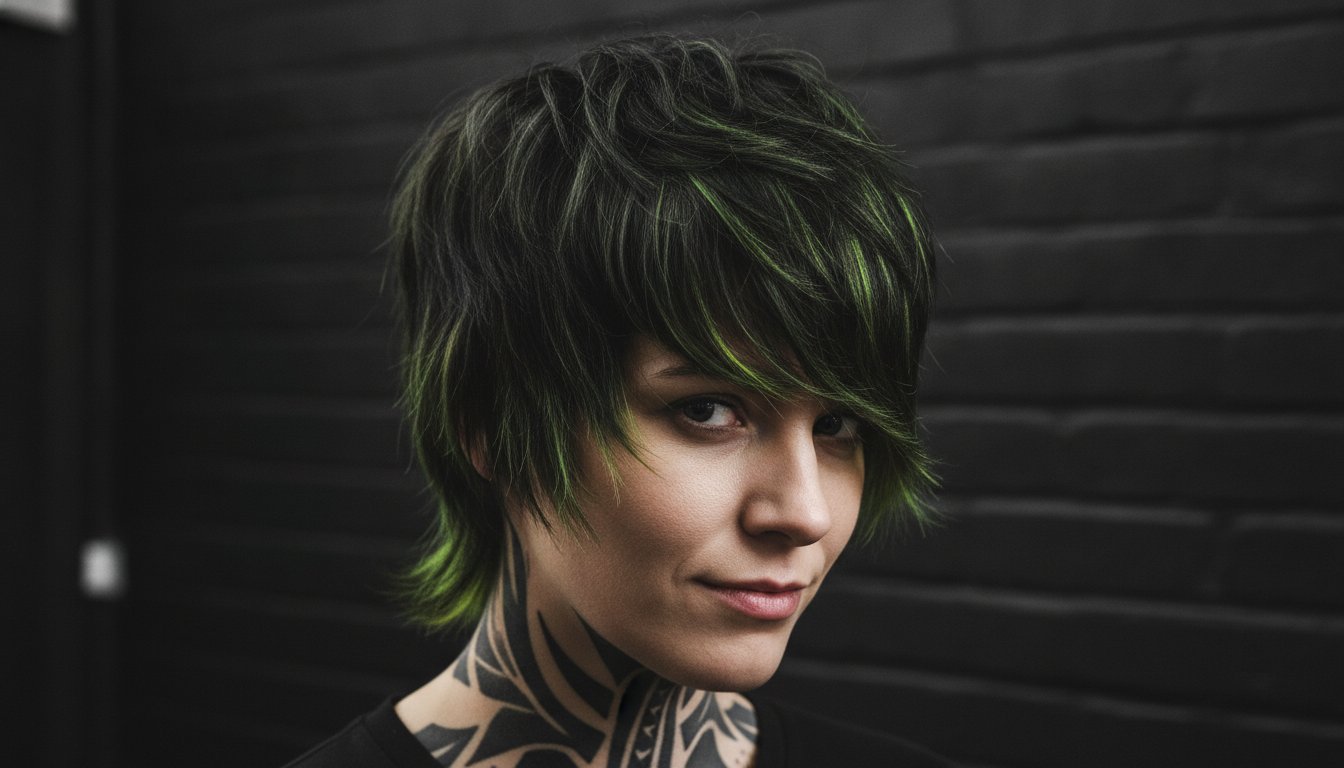
The most radical thing you can do to a wolfcut is strip away the very thing everyone claims defines it. Forget the forehead-skimming fringe that needs a trim every fortnight. A wolfcut without bangs isn’t a watered-down version of the trend; it’s a high-impact, low-maintenance evolution for those who prefer their style with a bit more grit and a lot less fuss. If you’ve ever felt that traditional alternative styles are too high-maintenance for your lifestyle, you’re not alone.

We know the struggle of a fringe that gets greasy by midday or irritates your eyes whilst you’re in the pit. It’s frustrating when mainstream salons don’t understand that you want the raw, shaggy texture without the commitment of a heavy curtain. This guide will help you master the wolfcut without bangs, giving you the technical knowledge to get exactly what you want from your stylist. You’ll discover how to maintain that rebellious edge through clever layering and learn the styling secrets that keep your texture looking sharp from the stage to the street.

Key Takeaways

  • Understand the technical difference between standard layering and the aggressive, internal thinning required for a high-impact alternative look.
  • Learn why the wolfcut without bangs offers a cleaner, more versatile aesthetic whilst retaining the raw, shaggy texture of the classic shag-mullet hybrid.
  • Get the lowdown on styling your layers for maximum grit using products designed to provide a “Death Grip” hold without the crunch.
  • Discover how to navigate the salon consultation to ensure your stylist understands the “no bangs” vision without compromising your subcultural edge.
  • Explore why this fringe-free evolution is the perfect gender-neutral option for anyone looking to ditch the high-maintenance cycle of frequent fringe trims.

Wolfcut Without Bangs: The Fringe-Free Revolution in Alt-Hair

Mainstream fashion outlets will tell you a wolfcut isn’t “real” without a heavy, forehead-skimming fringe. They’re wrong. The wolfcut without bangs is the raw, evolved form of the shag-mullet hybrid, stripped of the clutter but keeping all of the bite. It’s a high-impact choice for those who want the aggressive layering of an alternative cut without the constant upkeep of a curtain bang. This isn’t a watered-down version of a trend. It’s a technical refinement that puts the focus back on raw, unrefined texture and movement.

A bang-less wolfcut is a prioritisation of crown volume and mid-length movement that keeps the focus on raw, unrefined texture. We’re seeing a massive shift in subcultural hair toward styles that can survive a weekend at Download or Bloodstock without needing a mirror every ten minutes. People are tired of the “high street” version of alternative hair that requires forty minutes of blow-drying just to look “messy.” Ditching the fringe is about reclaiming your time whilst doubling down on your aesthetic.

Why Ditch the Fringe? The Benefits of a Bang-Less Cut

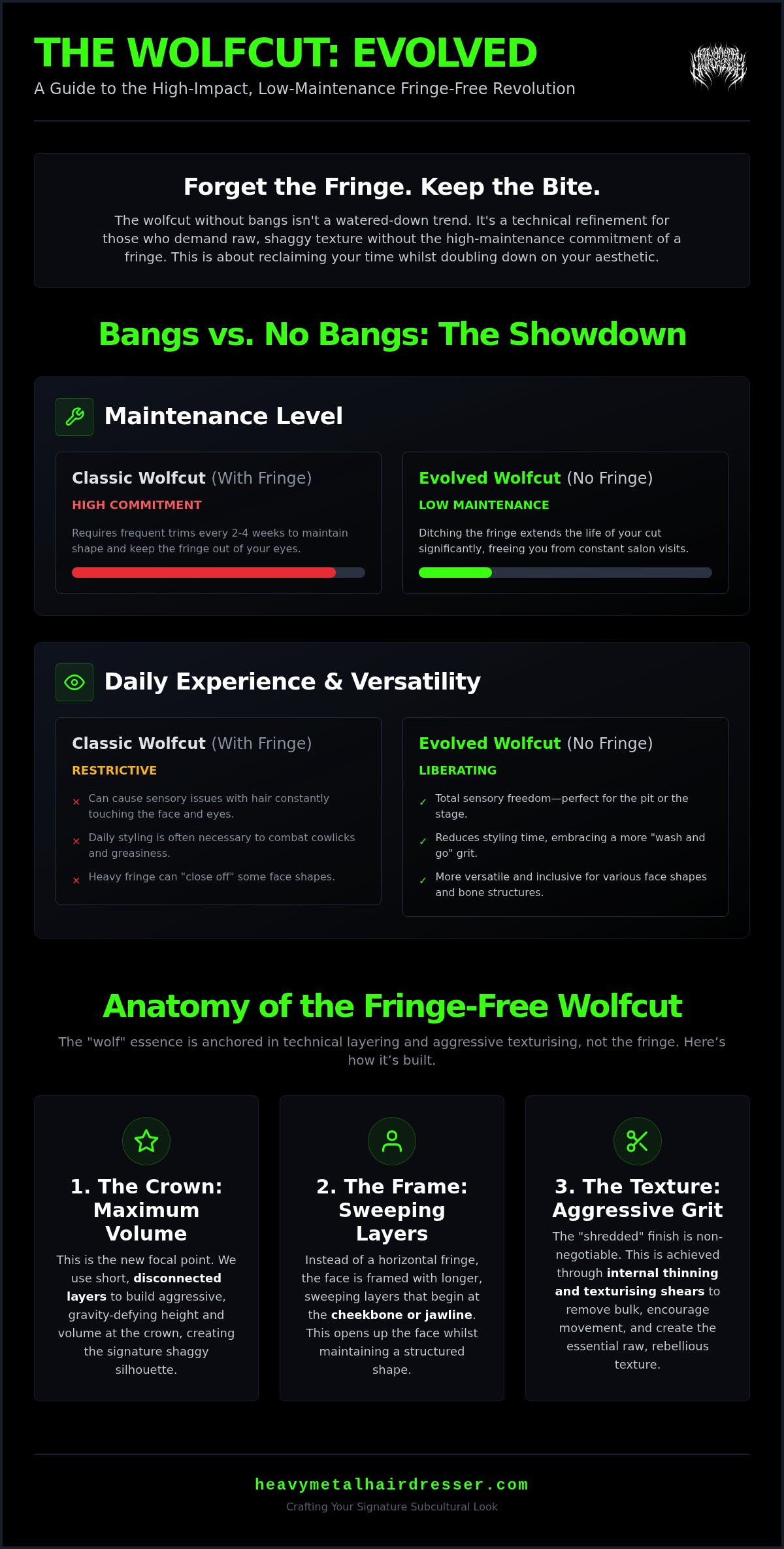
The move toward a wolfcut without bangs is driven by a need for functional rebellion. Traditional wolfcuts look incredible, but they demand loyalty. If you aren’t prepared for three-week trim cycles, that fringe quickly becomes a nuisance. Ditching it offers several immediate wins:

  • Reduced Maintenance: You’ll save hours of styling time. No more battling cowlicks or heat-styling your fringe every morning just to make it sit right.
  • Sensory Freedom: For many in our community, hair touching the face or eyes is a sensory nightmare. Removing the fringe keeps your vision clear whilst you’re in the pit or on stage.
  • Face Shape Versatility: Heavy bangs can sometimes “close off” a face. A bang-less variation allows your features to breathe and can be more inclusive for different bone structures.

Maintaining the “Wolf” Essence Without the Bangs

You don’t lose the “wolf” identity just because you lose the bangs. The “wild” essence of the cut simply shifts its anchor point. Instead of relying on a face-frame to do the heavy lifting, the focus moves to extreme crown volume. We use short, disconnected layers to build height that looks intentional and aggressive. This isn’t your standard long-layer cut from a suburban salon. It’s about internal thinning and texturising that creates grit. The silhouette remains sharp, keeping that signature “shaggy” weight at the top that tapers into lean, rebellious lengths. It’s about movement, not a polished finish.

Anatomy of the Bang-Less Wolfcut: Layers, Texture, and Flow

A wolfcut without bangs isn’t a happy accident. It’s a deliberate, technical architecture designed for maximum grit. High street salons often play it safe with blended, soft layers. We don’t. To achieve that unapologetic heavy metal aesthetic, we lean into aggressive texturising and internal thinning. This process isn’t about thinning for the sake of it. It’s about removing bulk to allow the hair to move, breathe, and stand up. It’s about creating a cut that looks just as good in a mosh pit as it does on stage.

The weapon of choice is always the texturising shear. These tools create the “shredded” finish that defines the subcultural look. Without a fringe to frame the face, the rest of the cut has to work twice as hard to maintain its identity. You can find the foundation for these aggressive techniques in our Ultimate Wolf Hair Cut Guide. By focusing on the internal structure, we ensure the hair has enough “bite” to hold its shape without needing a forehead-skimming fringe to anchor the style.

The Crown: Where the Chaos Lives

The crown is the engine room of the wolfcut without bangs. Without a fringe to draw the eye, we focus on creating extreme height and shredded texture at the top. The secret weapon here is disconnected layers. These are layers that don’t transition smoothly into one another. They are short, sharp, and intentionally jagged. This disconnection creates a silhouette that feels wild and unrefined. It ensures the crown volume balances the lack of a fringe, preventing the hair from looking bottom-heavy or like a standard long layer cut. It’s about building a shape that defies gravity.

Face-Framing Without the Fringe

Removing the fringe doesn’t mean removing the frame. We swap the horizontal bang for longer, sweeping layers that start at the cheekbone or jaw. These “curtain” layers blend into the mid-lengths rather than cutting across the forehead. The cheekbone-length layer becomes the new focal point for the bang-less variation. It provides that signature shaggy feel whilst keeping your face open. This technique avoids the “flat front” look that usually happens when people simply stop cutting their bangs. These layers are carved out to encourage natural flick and movement, creating a dynamic frame that highlights your identity.

This approach ensures that your hair doesn’t just fall flat against your face, which is the most common fear when ditching the bangs. Instead, the hair is encouraged to move away from the eyes, creating a high-attitude flow that feels both intentional and effortless. If you’re ready to master these aggressive textures, our alternative hair guides provide the technical breakdown you need to communicate your vision to your stylist.

Bangs vs. No Bangs: Which Wolfcut Variation Suits Your Vibe?

Choosing between the classic wolfcut and the fringe-free version isn’t just about how you look in the mirror. It’s about how you live your life. The classic version is iconic, but the wolfcut without bangs is for the person who wants the grit without the daily commitment. Don’t worry about losing your subcultural edge. You won’t look “less alternative” just because your forehead is visible. The attitude of a wolfcut comes from the shredded layers and the raw texture, not just a bit of hair over your eyebrows. If you’re looking for something slightly less aggressive but still rooted in the scene, check out The Shag Haircut Resurrection for a softer approach.

Whether you have thick, unruly curls or fine, straight hair changes the game. Thick-haired individuals often find that a fringe adds too much bulk to the front of the head. Removing it allows the weight to be redistributed into those aggressive, choppy layers we discussed earlier. For those with finer hair, a fringe can sometimes look thin or “gappy.” Keeping the front sections longer and integrated into the side layers creates the illusion of density and volume that a sparse fringe simply cannot provide.

Face Shape Considerations for the Bang-Less Wolfcut

A bang-less look creates verticality. This is a massive win for round or heart-shaped faces that can sometimes feel “squashed” by a heavy curtain of hair. By exposing the forehead, you draw the eye upward and elongate the silhouette. If you have a square or rectangular face, your stylist can adjust the layer height to start around the cheekbone. This softens a strong jawline whilst keeping the overall vibe sharp. Plus, an open face is the perfect canvas for bold makeup and facial piercings that usually get hidden behind a fringe. It’s about letting your identity take centre stage.

Maintenance Realities: Fringe vs. No Fringe

Let’s talk about the clock. A traditional fringe needs a professional trim every six weeks to stay out of your eyes and maintain its shape. The wolfcut without bangs operates on a much more relaxed three-month cycle. It’s the ultimate low-maintenance alternative style for those who hate being tied to a salon chair. You also bypass the daily battle with cowlicks or stubborn hair growth patterns at the hairline that make bangs a nightmare to style. Instead of ten minutes blow-drying your fringe every morning, you can spend two minutes scrunching in some product and letting it air-dry. It’s hair that works for your schedule, not against it.

Wolfcut Without Bangs: The High-Impact Evolution of Alternative Hair

How to Style Your Wolfcut Without Bangs for Maximum Grit

Forget the round brush and the polished blow-dry. We’re aiming for that raw, unrefined energy that looks like you’ve just walked out of a basement show. Styling a wolfcut without bangs is about enhancing the architecture we’ve already cut into your hair. You want the front sections to have enough “bite” to stay away from your eyes without looking like a dated side-part. It should look like a choice, not an accident.

The secret is using products that provide a “death grip” hold. You need a formula that locks in the texture without the crunchy, wet look of traditional gel. When you pair this aggressive texture with vivid hair colour, the layers truly start to pop. High-pigment tones catch the light on those shredded edges, making the lack of a fringe feel like a deliberate, high-fashion statement. It’s about saturating your identity in colour whilst maintaining that gritty edge.

The Air-Dry Method for Raw Texture

This is the ultimate “wash and go” style for the alternative scene. Apply your texturising product to damp hair, focusing on the mid-lengths and the crown. Use a “scrunch and squeeze” motion to encourage the hair’s natural movement. To keep the front from falling flat, flip your hair upside down whilst you scrunch. This builds essential volume at the root. It ensures those cheekbone-length layers have enough lift to frame your face without needing a fringe to anchor them. It’s organic, effortless, and actually looks better as the day goes on.

Heat Styling for Aggressive Volume

If your hair is naturally flat, you’ll need some heat to wake it up. Use a diffuser on a low heat setting to amplify the disconnected layers at the crown. Don’t touch the hair too much; let the air do the heavy lifting. If you want more definition, use a flat iron to create “bends” rather than curls. Simply clamp a section, twist the iron 90 degrees, and slide it down. This creates a jagged, lived-in texture that looks dangerous. Finish the front sections with a blast of texture dust. It “bulks up” the hair fibres, giving the front pieces the structural integrity to stay put and maintain that alternative silhouette.

Ready to ditch the fringe and claim your signature look? Book your transformation with a stylist who understands the underground.

The Heavy Metal Hairdresser Experience: Crafting Your Signature Look

Mainstream salons often fear the unconventional. At Heavy Metal Hairdresser, we live for it. Founded by creative stylist Simon Tuckwell, our space is an unapologetic sanctuary for those who find beauty in the underground. We specialise in the aggressive textures of wolfcuts and shags, but our mission goes deeper than the blade. This is a gender-inclusive safe space where your identity is celebrated, not merely tolerated. Whether you are seeking a wolfcut without bangs or a neon-saturated mullet, we ensure the result is as fierce as the music that inspires us.

Our connection to the music scene isn’t a marketing gimmick; it’s our DNA. We’ve earned international acclaim for styling bands at festivals like Download and Bloodstock. We understand the specific energy of alternative subcultures because we are part of them. When you step into our environment, you aren’t just getting a haircut. You are engaging with experts who understand why a “high street” layer job won’t cut it for someone who lives for the pit. We bridge the gap between technical proficiency and subcultural grit.

Bespoke Layering for Your Identity

We don’t do “cookie-cutter” hair. Every wolfcut without bangs we create is a bespoke architecture designed for your specific bone structure and subculture. Our consultation process is a dialogue. We want to know about your favourite bands, your lifestyle, and how you move through the world. This helps us determine exactly where those disconnected layers should sit to maximise your crown volume. Transitioning from a “normal” cut to an aggressive wolfcut can feel daunting. We guide you through that evolution, ensuring the silhouette remains rebellious whilst fitting your daily reality. We don’t just cut hair; we carve out a signature look that belongs only to you.

Join the Community

Heavy Metal Hairdresser is more than a salon. It’s a hub for alternative souls across the UK. From our vivid colour transformations to our precision technical cuts, we provide a space where being different is the standard. We encourage every client to embrace their individuality and claim their “Hair To the Throne.” This is about the confidence that comes from finally looking like the person you feel like inside. There are no walk-in appointments here because every session deserves our undivided, expert attention. If you’re ready to ditch the mainstream and embrace a high-impact, low-maintenance aesthetic, it’s time to book your transformation. Join a community that values raw authenticity over clinical perfection.

Claim Your Alternative Edge

Ditching the fringe doesn’t mean sacrificing your bite. The wolfcut without bangs is a masterclass in functional rebellion. It trades high-maintenance trims for raw, crown-focused volume. You’ve seen how internal thinning and disconnected layers build a silhouette that thrives in the pit and stays sharp on the street. It’s about prioritising your identity whilst keeping your routine lean. This fringe-free evolution proves that alternative style isn’t about following a template. It’s about carving out a shape that fits your lifestyle and your subculture perfectly.

Ready to evolve your look? Heavy Metal Hairdresser is a gender-inclusive safe space specialising in aggressive texture and vivid colour. We don’t do walk-ins or rushed appointments. Every client receives a dedicated 1-on-1 session to ensure their bespoke cut is executed with precision and attitude. We understand the nuances of underground culture because we live it every day. Book your bespoke Wolfcut evolution at Heavy Metal Hairdresser and leave the high-street clones behind. Your hair is your loudest statement. Make it count.

Frequently Asked Questions

Can I get a wolfcut without bangs if I have thin hair?

Yes, a wolfcut without bangs is actually ideal for thin hair. By ditching the fringe, you keep more density in the front sections instead of thinning them out for bangs. We use internal texturising to build structural height at the crown. This creates the illusion of a much thicker mane. It’s about clever architecture that prioritises volume where you need it most without sacrificing that signature shaggy silhouette.

How is a wolfcut without bangs different from a mullet?

The main difference lies in the balance and length of the layers. A mullet is aggressively short on the sides with a distinct “tail” at the back. A wolfcut is a more integrated hybrid of a shag and a mullet. It features heavy layering all over the head for a more rounded, voluminous shape. Without bangs, the wolfcut leans further into a classic shaggy aesthetic whilst keeping the aggressive, shredded texture at the crown.

What should I ask my hairdresser for if I want a wolfcut with no fringe?

Tell your stylist you want a texture-heavy shag-mullet hybrid but without a horizontal fringe. Ask for aggressive, disconnected layers and internal thinning to create grit. Specifically request face-framing layers that start at your cheekbone or jawline rather than your forehead. It helps to mention you want a “shredded” finish. This technical language ensures they understand you aren’t looking for a standard, blended high-street layer job but something with more bite.

Is a bang-less wolfcut high maintenance?

No, it’s significantly lower maintenance than the classic version. You don’t have to deal with the “six-week fringe trim” cycle or the daily battle to style a cowlick at the hairline. A wolfcut without bangs allows for a much easier “wash and go” routine. You can simply apply a bit of product, scrunch, and let it air-dry. It’s the perfect choice for anyone who wants a high-impact look without being tied to a mirror.

Does a wolfcut without bangs work for professional environments?

Absolutely. The absence of a heavy fringe often makes the style feel more open and versatile. Whilst it still carries a rebellious, subcultural edge, it can be styled more conservatively for the office if required. You can tuck the longer face-framing layers behind your ears or use a bit of product to smooth the texture. It’s a high-attitude cut that adapts to your environment without stripping away your individual identity.

Can I add vivid colour to a wolfcut without bangs?

Vivid colour is the perfect partner for this cut. High-pigment tones like neon green, deep purple, or blood red make those aggressive layers truly stand out. Because the cut relies on texture rather than a fringe for its impact, adding vivid colour helps to define the “shredded” edges. It saturates your identity and ensures that your hair makes a statement. At Heavy Metal Hairdresser, we specialise in combining these technical cuts with high-pigment sensation.

How often do I need to trim a wolfcut if I don’t have bangs?

You should aim for a professional trim every three months. Without a fringe to maintain, you can comfortably stretch your salon visits to around twelve weeks. The aggressive layers are designed to grow out organically, maintaining their “wild” shape even as they gain length. If you notice the crown volume starts to feel heavy or flat, that’s your signal to book back in for some internal thinning to restore the grit and movement.

Is the wolfcut without bangs gender-neutral?

Every cut we perform is unapologetically gender-neutral. Heavy Metal Hairdresser is a safe space where hair has no gender. The wolfcut without bangs is a particularly inclusive choice because it focuses on raw texture and volume rather than traditional masculine or feminine shapes. It’s about self-expression and subcultural identity. We tailor the layering to your specific bone structure and vibe, ensuring you feel confident and empowered regardless of how you identify.

Posted on

How to Add Texture to Fine Hair: Gritty Volume Guide

How to Add Texture to Fine Hair: Gritty Volume Guide

Fine hair isn’t a curse that condemns you to a lifetime of limp, child-like strands; it is a blank slate for absolute chaos. Most stylists will tell you to play it safe with volumising foams that leave you looking like a polished mannequin, but we know that doesn’t hold up when the pit opens at Bloodstock. You are likely tired of your style collapsing before the first set is even over. Learning how to add texture to fine hair isn’t about chasing shine or soft bounce. It’s about building a foundation of grit that refuses to quit.

We’re here to help you ditch the greasy, heavy products and embrace a high-impact, rebellious aesthetic. This guide reveals how to transform flat hair into a textured masterpiece using alternative styling techniques and products with a serious bite. We will dive into why the wolfcut is the ultimate weapon for fine-haired legends and how to master the Death Grip aesthetic for a look that stays aggressive all night. From gritty powders to layered cutting secrets, you’re about to get the blueprint for hair that finally matches your energy.

Key Takeaways

  • Learn how aggressive layers like the wolfcut remove weight to create natural lift and movement in flat hair.
  • Discover exactly how to add texture to fine hair using gritty, lightweight products that won’t leave your style feeling greasy or weighed down.
  • Master styling techniques like the ‘Rough Dry’ to ensure your hair maintains its chaotic, high-impact shape throughout the day.
  • Find out why ‘Death Grip’ levels of hold and vivid hair colours are essential for creating the perception of thicker, more aggressive texture.
  • Stop following traditional salon rules and start using a foundation of grit to build a look that reflects your independent spirit.

Understanding Fine Hair and the Quest for Gritty Texture

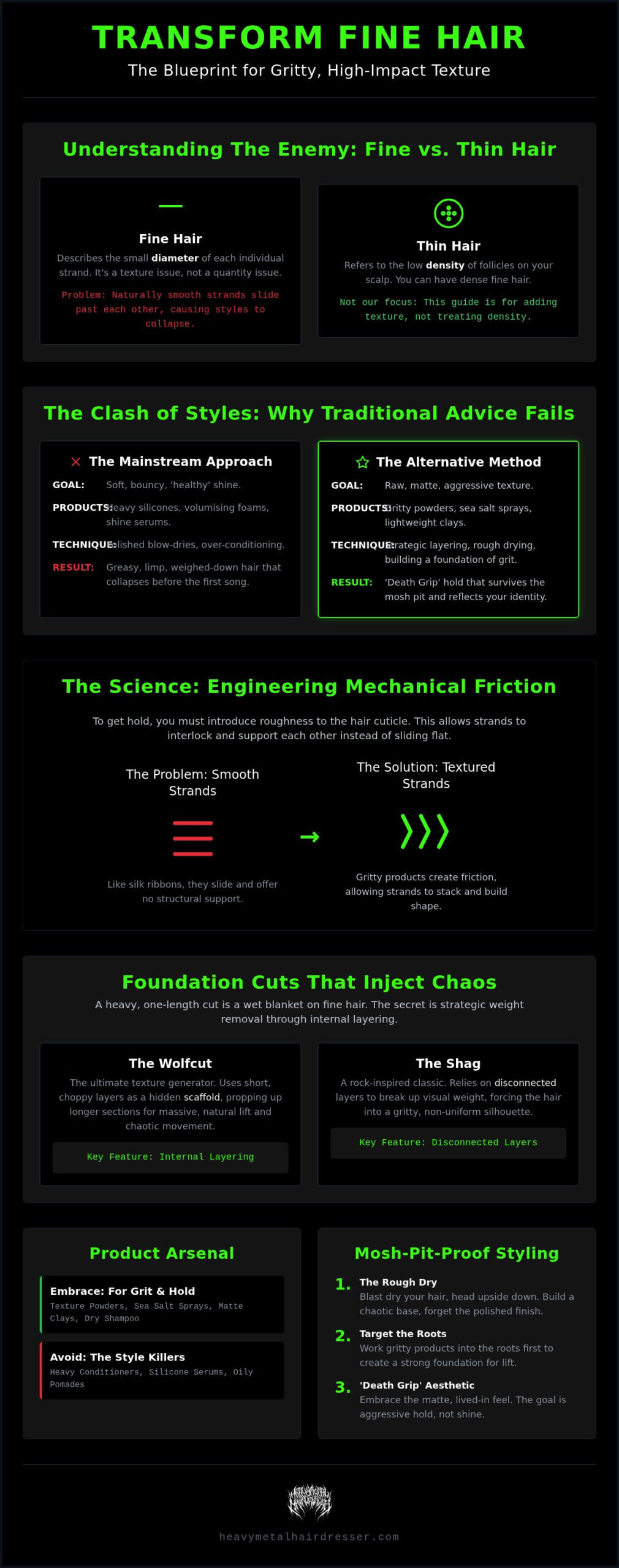
Fine hair is a diameter problem. It is a common mistake to confuse fine hair with thin hair, but they aren’t the same thing. Thin hair refers to the density of follicles on your scalp, whilst fine hair describes the actual thickness of each individual strand. You can have a massive amount of hair and it still feels limp because the strands themselves are delicate and lack structural integrity. This is why your hair often looks ‘child-like’ or loses its shape the moment you step out of the house. It’s frustrating to spend an hour styling only to see it collapse into a flat, uninspired mess before you’ve even reached the venue.

Traditional volumising products are usually designed for a mainstream, polished look. They focus on ‘plumping’ the hair with slippery polymers that create a soft, bouncy finish. This might work for a generic blow-dry, but it’s a disaster for alternative styles. When you’re trying to figure out how to add texture to fine hair for a shag or a wolfcut, you don’t want bounce; you want bite. You need a rebellious solution that replaces that unwanted silkiness with raw, unyielding friction.

The Science of Friction and Hold

Fine hair strands are naturally smooth. They slide past each other like silk ribbons, which is exactly why your style refuses to hold its height. To fix this, you have to introduce roughness to the hair cuticle. By creating microscopic levels of unevenness on the surface, the strands can finally stack and support one another instead of sliding into a heap. This mechanical interaction is what allows you to build a shape that actually stays put. Hair grit is the essential mechanical friction required to stop layers from sliding flat and maintain an aggressive, alternative shape.

Why Mainstream Advice Fails the Alt Scene

Most salon advice obsesses over ‘healthy shine’ and ‘silky results’. For those of us in the underground scene, shine is often the enemy of style. Over-conditioning is a frequent trap for fine-haired legends; it coats the strands in heavy silicones that weigh everything down and kill any chance of volume. We don’t want our hair to feel like a shampoo commercial. We want it to feel authentic, raw, and lived-in. Embracing matte finishes and gritty textures is the only way to achieve a ‘Death Grip’ level of hold. When you ditch the polish and start using products that provide real texture, you gain the confidence to wear bold, layered cuts that reflect your true identity.

The Foundation: Cuts That Inject Chaos into Thin Strands

Mainstream salons love a safe, blunt bob. They will tell you that layers are the enemy of fine hair and that keeping it all one length is the only way to avoid a ‘stringy’ look. It is a myth designed to keep you looking polished and predictable. In reality, a heavy, one-length cut is the fastest way to make fine hair look like a wet blanket. When you are figuring out how to add texture to fine hair, the secret lies in strategic weight removal. By carving out bulk from the internal sections, you create the space needed for the remaining hair to spring upward. It is about engineering lift, not just cutting length.

Removing weight isn’t about thinning the hair out until it’s transparent. It’s about a technical process called internal layering. This involves cutting shorter, hidden sections beneath the top canopy of your hair. These internal layers provide the structural integrity that fine hair lacks on its own. They literally push the outer layers out and up, creating the illusion of a much denser, more aggressive mane. It is a bold approach that prioritises movement and attitude over traditional perfection.

The Power of the Shag and the Wolfcut

The wolf hair cut is the ultimate texture generator for fine strands. It relies on a series of short, choppy layers that act as a scaffold. These shorter pieces sit underneath the longer ones, propping them up and preventing that dreaded limp appearance. Similarly, the shag haircut uses disconnected layers to create a gritty, rock-inspired silhouette. This disconnection is vital; it breaks up the visual weight and forces the hair to move in a chaotic, non-uniform way. If you want a style that survives the energy of a live show, you need a foundation that embraces this controlled mess.

Alternative Fringe Techniques

A fringe is a high-impact way to manipulate the perception of density. Instead of a wispy, safe bang, we opt for micro-fringes or heavy, shattered edges. Point-cutting is the weapon of choice here. By cutting into the ends at an aggressive angle, we remove the ‘ledge’ and create a jagged finish that looks thicker because of the varied lengths. A textured fringe draws the eye to the face and adds immediate visual weight where it matters most. It turns a flat style into a rebellious statement. If you’re ready to ditch the boring advice, explore our alternative styling world and find a cut that actually fits your identity.

Product Warfare: Choosing Tools for Maximum Grit

Fine hair is a lightweight fighter. It cannot handle the heavy hitters that thicker hair thrives on. If you load up on dense creams or buttery waxes, your style will surrender before you even leave the house. The golden rule for how to add texture to fine hair is simple: lightweight formulas with high-impact results. You want products that offer structural support without adding physical mass. It is about creating chemical friction, not heavy coatings that lead to a flat, greasy collapse.

Salt sprays are the gold standard for a reason. They provide that jagged, ‘crunchy’ grit that defines the alternative aesthetic. Whilst sugar sprays are an option, they often lean too far into the ‘soft’ category. Salt opens the cuticle slightly, giving you the raw edge needed for an aggressive wolfcut. Texture powders are your tactical weapon for targeted lift. They create ‘dirty’ grit at the roots, allowing you to sculpt height that refuses to budge. Do not wait for day three to use dry shampoo. Apply it to clean hair as a volume builder. It adds a matte, airy quality that makes the hair look twice as thick from the start. To find these types of high-performance formulas from a curated selection of modern beauty brands, check out BÆR.

Start your routine with a lightweight mousse whilst the hair is damp. This creates a ‘skeleton’ for the style to hang on once it is dry. You must avoid any product containing heavy oils or silicones. These ingredients are the primary causes of ‘slumping’ in fine strands. When applying your salt spray, mist it from a distance. Do not drench the hair or you will end up with a matted mess that is impossible to manage. You want a light, even coat to prep the surface for the heat and movement to come.

Finishing Tools for the Alternative Edge

Matte clays are the only choice for an authentic underground look. Greasy pomades will turn fine hair into a slicked-down disaster. A matte finish absorbs light, making the hair appear more dense and textured than it actually is. Texture sprays are the perfect alternative for people who hate the stiff, plastic feel of traditional hairspray. They offer a flexible hold that allows for movement whilst maintaining the ‘Death Grip’ you need to keep your shape. Layering is the final secret. A bit of powder at the roots, a mist of salt spray during the dry, and a touch of matte clay to finish. This multi-layered approach ensures your texture survives the energy of the mosh pit.

How to Add Texture to Fine Hair: Gritty Volume Guide

Styling Techniques for the Mosh Pit and Beyond

Once you have the right products, the real magic happens in the application. Traditional styling often relies on round brushes and precise sectioning. This is too polished for our scene. If you want to know how to add texture to fine hair that survives a headlining set, you need to get your hands dirty. Forget the smoothing nozzle. Your fingers are the best tools you own for creating natural, chaotic movement that doesn’t look like you’ve tried too hard. It is about working with the hair, not forcing it into a clinical shape.

Diffusing is often associated with curls, but it is a secret weapon for fine, straight hair too. By using a diffuser to ‘scrunch’ the hair whilst drying, you force the strands into irregular patterns. This creates a foundation of ripples and waves that adds massive visual volume. If you need even more height, try internal back-combing. Instead of teasing the surface, create small ‘knots’ at the root underneath the top layer. This provides invisible lift that keeps your style from looking flat without the obvious frizz of traditional teasing. It is a structural fix that stays hidden whilst doing all the heavy lifting.

The Art of the Scruffy Blow-Dry

A scruffy blow-dry is the antithesis of the salon blowout. Follow this three-step process for maximum grit:

  • Step 1: Apply your chosen prep product, like a lightweight mousse or salt spray, to damp hair.
  • Step 2: Flip your head upside down. This uses gravity to pull the roots away from the scalp.
  • Step 3: Blast with high heat but low airflow. High air will just blow the fine strands flat; low air allows the texture to set.

Avoid brushes entirely. Brushing smooths the cuticle, which is the opposite of what we want. Use your hands to rake and scrunch as you dry. Finally, use the ‘cool shot’ button. Cold air locks the hair cuticle in its new, chaotic position, ensuring the volume doesn’t immediately deflate. Investing in a dryer that offers precise speed and temperature controls makes dialling in this kind of rough texture much simpler; find out more about advanced styling appliances built for tailored control. This method builds a raw foundation that is ready for any alternative style.

Survival Styling: Keeping Texture at Festivals

Festivals are the ultimate test for fine hair. By day three, the combination of sweat and dry shampoo can make things tricky. To refresh your look without a shower, mist your hair with a tiny bit of salt spray and scrunch it back to life. If you know you won’t have time to style in the morning, sleep in braids. Use the ‘pancake’ technique by gently pulling at the edges of each braid loop to make it look massive and wide. When you undo them, you will have an aggressive, crimped texture that lasts all day. If a beanie has crushed your volume, flip your head and shake out the roots with some texture powder. For more expert tips on maintaining your edge, book a session with our alternative specialists.

Maintaining Your Alternative Edge and Professional Support

Fine hair maintenance is a constant battle against gravity and transparency. Whilst we have covered the specific cuts and gritty products needed for impact, professional upkeep is the final piece of the puzzle. Regular ‘dusting’ is vital. This isn’t a traditional trim that removes length; it is a precise removal of split ends that prevents your hair from looking wispy at the perimeter. Keeping the ends crisp and strong ensures that your internal layers have a solid foundation to sit on. It keeps the hair looking dense and intentional rather than neglected.

Communication is your best tool when you are in the stylist’s chair. Most mainstream hairdressers hear the word ‘volume’ and immediately think of soft, bouncy blow-dries. That is not our world. When discussing how to add texture to fine hair, tell your stylist you want ‘grit’ and ‘friction’. Use descriptors like raw, jagged, or aggressive. You want layers that stack on top of each other to create mechanical lift. A stylist who understands alternative subcultures will know exactly how to carve those shapes without trying to ‘beautify’ or smooth out your rebellious edge.

The Colour Illusion

Colour is a structural weapon in your quest for maximum texture. Opting for vivid hair colour does more than just signal your identity; it creates the perception of depth. Multi-tonal shades and ‘root shadows’ are particularly effective for fine-haired legends. By keeping the base of the hair slightly darker, you create an illusion of density at the scalp. There is also a physical benefit to lightener known as the ‘bleach swell’. The chemical process slightly expands the hair cuticle, making individual strands feel thicker and giving them a rougher surface that holds onto styling products with far more tenacity.

Finding Your Style Master

You need a specialist in alternative hair who won’t flinch when you ask for a disconnected mullet or a shattered shag. Finding a gender-neutral, inclusive salon is about more than just the aesthetic; it is about finding a safe space for authentic self-expression. Ask your hairdresser how they handle textured layering and whether they prioritise the ‘dry cut’ for fine hair. A dry cut allows the stylist to see exactly how your fine strands react to weight removal in real-time. This level of professional support ensures your style remains a high-impact masterpiece that reflects your independent spirit every single day.

Master the Chaos and Claim Your Texture

Fine hair is no longer a limitation once you stop fighting its nature and start manipulating its structure. You have ditched the slippery, mainstream products and embraced aggressive, internal layering. Now, you know exactly how to add texture to fine hair for a look that survives the loudest mosh pits. It is about building a foundation of grit that holds up from the first set at Bloodstock to the final encore. Your hair is a canvas for rebellion; it’s time to treat it like one.

Your style should be as loud as your music. Don’t settle for limp, child-like strands when you can have high-impact volume that reflects your true identity. As specialists in gender-neutral alternative cuts and expert vivid colour work, our team understands the nuances of subcultural style. We have styled bands for Download and Bloodstock; now it’s your turn. Book your transformation with the UK’s alternative hair experts and step into a space where being different is celebrated. Your most rebellious hair days are just beginning.

Frequently Asked Questions

Can I really have a wolfcut if my hair is very fine?

Yes. Wolfcuts are actually ideal for fine hair because the aggressive layering removes weight and creates structural lift. Instead of a flat curtain, you get a stacked, architectural shape. The key is internal layering that props up the top sections. This technique transforms limp strands into a high-impact silhouette that looks much denser than it actually is. It is the ultimate solution for anyone craving an alternative edge.

What is the best product to add grit to fine hair without it feeling greasy?

Texture powders and dry shampoos are the ultimate tools for non-greasy grit. These products absorb excess oils whilst providing a matte, ‘dirty’ friction at the roots. Unlike heavy waxes or pomades, powders are virtually weightless. They allow you to sculpt height that stays put without that dreaded clumping. For a maximum hold that survives the energy of a live show, we recommend a layered ‘Death Grip’ approach.

How often should I wash fine hair if I want to maintain texture?

You should aim to wash fine hair every two to three days to maintain the best gritty texture. Washing every day strips the hair of natural oils and any product build-up that actually helps hold a style. Use a dry shampoo on non-wash days to manage any unwanted shine. This keeps the strands feeling slightly rougher, which is exactly what you need for an authentic, lived-in alternative aesthetic.

Does sea salt spray damage fine hair over time?

Sea salt spray can be drying if used excessively, but it isn’t inherently damaging when applied correctly. The salt works by opening the cuticle to create friction. To protect your strands, use a lightweight, silicone-free conditioner on wash days. This balances the crunch of the spray whilst keeping the hair healthy. It is a vital tool for anyone learning how to add texture to fine hair without resorting to heavy creams.

How do I stop my fine hair from going flat after an hour?

The secret is layering your products and avoiding moisture-heavy finishes. Start with a lightweight mousse on damp hair to build a skeleton, then finish with a matte texture spray. If you rely on a single product, the weight will eventually cause the style to slump. Ensure you use a ‘cool shot’ on your hairdryer to lock the cuticle in place. This creates a structural bond that effectively resists gravity.

Is back-combing bad for fine hair?

Traditional back-combing can be harsh, but internal teasing is a safer way to get lift. Instead of roughly scraping the surface, create small, hidden knots at the base of the hair. This provides a structural cushion that supports the rest of the style. Always use a proper wide-tooth comb to gently brush it out before washing. This technique gives you that rebellious height without causing long-term breakage or unwanted frizz.

How can I add texture to fine hair without using heat?

Braiding damp hair overnight is the most effective heat-free method for adding texture. Use the ‘pancake’ technique by pulling the loops of the braids apart to create wide, irregular crimps. When you undo them in the morning, mist with a salt spray for an instant, gritty finish. This method creates a chaotic, non-uniform wave pattern that looks far more authentic than the results from a traditional curling iron or wand.

What’s the difference between volume and texture for thin hair?

Volume is about the physical height and space your hair occupies, whereas texture is about the surface feel and definition of the strands. You can have volume without texture, which often looks like a soft, polished bubble. For alternative styles, you want both. Texture provides the bite and separation that makes a wolfcut look aggressive. Understanding how to add texture to fine hair ensures your volume doesn’t look like a generic blowout.

Posted on

Advanced Wolfcut Training UK: Master the Art of Subcultural Grit

Advanced Wolfcut Training UK: Master the Art of Subcultural Grit

Most ‘wolfcuts’ coming out of traditional academies are just glorified shags with the edges rounded off. They lack the grit of the underground. You know that standard, polished training feels far too safe for your clients who demand something raw and authentic. It’s frustrating when ‘creative’ courses still cling to the same old rules of symmetry whilst ignoring the pulse of the subcultures you actually care about. By investing in advanced wolfcut training UK, you’ll finally learn to bridge the gap between technical precision and subcultural rebellion. We’re going to dive deep into the art of aggressive disconnection and gender-neutral aesthetics. You’ll gain the confidence to create hair that doesn’t just look good but feels like a statement of identity. From mastering the technical ‘step’ to finishing with Death Grip for that gritty, lived-in texture, this is your roadmap to becoming a visionary in the alternative scene. Let’s get to work.

Key Takeaways

  • Define the advanced wolfcut as a technical hybrid of the shag and mullet, moving beyond basic layering into aggressive, disconnected tiers.
  • Understand why corporate hair academies often fail to capture subcultural grit and how to preserve intentional texture in your creative work.
  • Level up your skills with advanced wolfcut training UK to master crown volume and face-framing without compromising on alternative identity.
  • Master the art of gender-inclusive consultations to tailor aggressive styles to individual face shapes whilst maintaining a safe space ethos.
  • Elevate your finishes using specialised products like Death Grip and Hair To the Throne to achieve that authentic, festival-ready grit.

Why Traditional UK Hair Training Fails the Modern Wolfcut

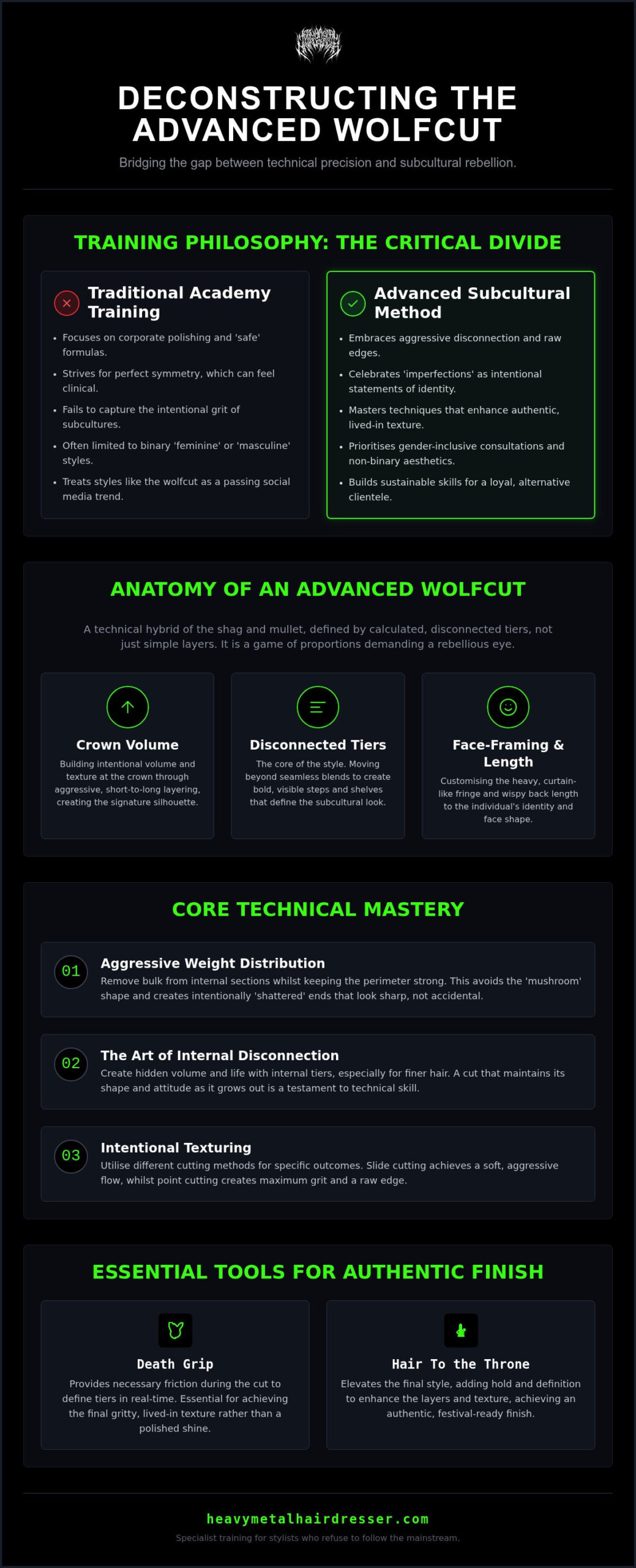
Corporate hair academies love a formula. They teach you how to make every head of hair look identical, polished, and ‘safe’. But for anyone operating in the UK’s alternative scene, that approach is a death sentence for creativity. The modern wolfcut is a technical hybrid of the shag and the mullet, demanding a level of intentional grit that standard NVQ paths simply don’t cover. It isn’t just about hacking away at the length; it’s about understanding how to build volume and texture whilst respecting the client’s identity.

UK salon culture is shifting rapidly. We’re seeing a massive move towards expressive, non-binary identities where hair is used as a tool for self-actualisation rather than just a traditional beauty standard. If your training only covers ‘feminine’ layers or ‘masculine’ fades, you’re failing a huge portion of the community. The wolfcut is a balance of aggressive layering and soft internal flow.

The Gap Between Corporate Polishing and Subcultural Grit

Traditional training focuses on perfect symmetry. In the world of metal and punk, symmetry feels clinical and wrong. When you take advanced wolfcut training UK, you learn that the ‘imperfections’ are actually the point. Alternative clients avoid mainstream salons because they’re tired of being told their hair looks ‘messy’ or ‘unfinished’. They want the aggressive, disconnected tiers that define subcultural style. Mastering these techniques requires unlearning the corporate need to smooth everything over. You need to know when to leave a raw edge and how to use products like Death Grip to enhance that gritty finish rather than hiding it under a layer of shine spray.

Moving Beyond the ‘Social Media Trend’ Label

Don’t let the viral videos fool you. This style isn’t just a TikTok fad that will disappear by next season. It is a legitimate modern variation of the shag that has evolved to meet a demand for high-texture, low-maintenance hair. Professional training should focus on the longevity of the cut and the health of the hair, ensuring the style looks as good six weeks later as it did in the chair. By enrolling in independent hair courses, you aren’t just learning a trend; you’re building a sustainable creative business. You’re becoming the expert that subcultures trust because you understand the difference between a costume and an identity. It’s about technical authority, not just chasing likes.

Technical Mastery: The Anatomy of an Advanced Wolfcut

An advanced wolfcut isn’t just a messy shag. It’s a calculated technical feat. To master it, you need to understand the three essential pillars: crown volume, face-framing, and length. Unlike standard layering, which aims for a seamless blend, an advanced wolfcut relies on aggressive, disconnected tiers to create that signature subcultural grit. You can find more foundational context in the ultimate wolf hair cut guide.

Whilst the UK hairdressing and beauty industry continues to expand, many professionals remain stuck in basic NVQ habits. They struggle with the technical difference between a layer and a tier. A layer is a transition; a tier is a statement. When performing advanced wolfcut training UK, we teach you to use Death Grip during the cutting process. It provides the necessary friction to define these tiers before the hair even hits the floor, allowing you to see the texture evolve in real-time.

Aggressive Layering and Weight Distribution

Removing bulk is the biggest hurdle. You want that shaggy silhouette without the hair looking like a mushroom. We focus on removing weight from the internal sections whilst keeping the perimeter strong. This creates ‘shattered’ ends that look intentional and sharp. You have to balance the heavy, curtain-like fringe against the wispy back length. It is a game of proportions that demands a rebellious eye and a steady hand to ensure the weight sits exactly where the subculture demands it.

The Art of Internal Texture and Disconnection

Disconnection is your best friend, especially for clients with fine hair. By creating hidden volume through internal tiers, you give the hair a life of its own. We look at slide cutting for soft, aggressive flow versus point cutting for maximum grit. The goal is a cut that grows out gracefully. It should maintain its shape even as the layers drop over several months. If you want to dive deeper into these technical secrets, exploring our Hair Courses is the next logical step for your creative career.

Customisation: Tailoring the Wolfcut to Individual Identity

Every wolfcut should be as unique as the person wearing it. You aren’t just repeating a pattern; you’re tailoring a silhouette to a specific face shape and hair density. This approach mirrors the subcultural grit of British punk fashion, where individual expression always trumped mass production. Through advanced wolfcut training UK, we help you master the nuances of the consultation. It’s about building a safe space where clients feel seen. Vivid colours can then be applied to emphasise the technical tiers you’ve carved out. A masterfully executed cut prioritises the raw, subcultural truth of the client’s soul over the polished, corporate ego of the traditional salon.

Adapting the Cut for Different Hair Textures

Thick, curly hair can quickly turn into a ‘mushroom’ if you aren’t careful. You need to carve out internal weight without killing the natural bounce. For thin strands, it’s about injecting chaos. Use internal layers to create an illusion of density and movement where there was none before. Knowing how to style a modern mullet or wolfcut with Hair To the Throne is vital for these varied textures. It adds that essential hold whilst keeping the movement aggressive and raw. You want the hair to look like it has lived a life, not like it just stepped out of a box.

Gender-Inclusive Styling: Breaking the Binary with Scissors

The wolfcut is the ultimate gender-neutral weapon. It ignores traditional ‘male’ or ‘female’ boxes entirely. In our courses, we focus on removing gendered language from the entire process. Stop talking about ‘softening’ features or ‘masculinising’ a profile. Instead, talk about shape, weight, and attitude. We create shapes that empower clients to feel confident in their skin. By breaking the binary with your scissors, you aren’t just cutting hair; you’re affirming an identity. This is where subcultural authority meets genuine care. It’s about giving the client the tools to exist loudly in a world that often wants them to be quiet.

Advanced Wolfcut Training UK: Master the Art of Subcultural Grit

Traditional NVQ paths are built for the masses. They provide the basics whilst independent creative styling courses offer the rebellion. When you seek out advanced wolfcut training UK, you aren’t just looking for another certificate to hang on the wall. You’re looking for subcultural authority. You want a mentor who understands that hair isn’t just about aesthetics; it’s about belonging to a community that values grit over polish. Corporate academies often focus on linear learning paths that feel clinical and safe. Independent alternative hair courses UK break that mould by teaching you the technicalities of ‘the break’ and ‘the tier’ in a way that respects the raw energy of the underground.

What to Look for in a Specialist Academy

Does the academy have a real-world connection to the alternative scene? You should look for ‘Wolfcut Hair Course’ specifics rather than generic ‘creative cutting’ modules. A specialised centre should feel like a safe space where inclusive values aren’t just a buzzword but a core ethos. Small group training is essential here. You need eyes-on feedback when mastering complex, textured cuts. If the training environment feels too much like a clinical office, it probably won’t help you find the creative flow needed for aggressive, disconnected styles.

The Importance of Hands-On Subculture Experience

There is a massive difference between ‘studio’ hair and ‘mosh pit’ survival hair. Learning from stylists who spend their summers backstage at festivals like Download or Bloodstock matters. These experts know how hair behaves under pressure, sweat, and movement. They bring those backstage techniques back to the salon, allowing you to give your everyday clients a cut that lasts through a gig and still looks incredible the next morning. It is about technical durability. By choosing a mentor with genuine subcultural authority, you gain the insider knowledge required to create authentic, lived-in textures that corporate training simply cannot replicate. Ready to level up your craft? Explore our specialised Hair Courses and start your journey into advanced creative cutting.

Master the Wolfcut with Heavy Metal Hairdresser Training

Heavy Metal Hairdresser isn’t your average training provider. We’re built on the frontlines of the alternative scene. Our approach is raw, authentic, and backed by years of styling bands at festivals like Download and Bloodstock. When you sign up for advanced wolfcut training UK with us, you’re getting more than just a technique. You’re getting the Red Dot-level creative vision that defines the underground. Our ‘Wolfcut Hair Course’ is designed for stylists who are tired of playing it safe. You’ll walk away with the technical ability to create aggressive, disconnected textures and the confidence to handle any alternative identity that walks through your door. It’s time to stop following the mainstream and start leading the rebellion.

Unconventional Techniques from the Frontline of Alt-Hair

We don’t do ‘pretty’ layers. We do grit. A huge part of our training involves the ‘Death Grip’ method. It’s about using friction and product during the cut to define aggressive tiers. You’ll also explore how the wolfcut relates to the modern mullet, mastering the technical overlap between these two subcultural icons. One of the most practical skills we teach is finishing. A cut needs to look incredible in the chair, but it also needs to survive a three-day festival. We show you how to structure the hair so it looks even better after three days of sweat, music, and chaos. This is battle-tested hair design.

Building Confidence in Creative Styling

Most stylists are terrified of taking off too much weight. They’ve been trained to preserve length at all costs. We help you overcome that fear. Real creative cutting requires you to be bold. It requires you to trust your vision. Through our advanced wolfcut training UK, you’ll develop your own ‘voice’ as a stylist. This isn’t about copying our style; it’s about finding yours. Redefine your professional path and join the rebellion against corporate boredom. We’re currently preparing for our 2026 intake. Space is limited because we keep groups small to ensure you get the attention you deserve. Head over to our Hair Courses page to secure your spot and start your evolution.

Take the Lead in the UK Alternative Scene

The wolfcut isn’t just another service on your menu; it is an entry point into a vibrant, underserved community. You have seen why standard layering fails the raw energy of subculture and how technical disconnection creates the aggressive tiers your clients actually want. Mastering these shapes requires a mentor who lives the lifestyle, bringing backstage festival knowledge from Download and Bloodstock directly into a gender-inclusive safe space. By investing in advanced wolfcut training UK, you are choosing to prioritise identity over industry norms. You’ll gain expertise in creative colour and textured styling that corporate academies simply cannot replicate.

Don’t let your skills stay safe and predictable. It’s time to sharpen your tools and join the rebellion against the polished mainstream. Whether you’re aiming to master internal weight distribution or the ‘Death Grip’ finishing method, our expert-led sessions provide the technical authority you need to thrive. Book your spot on our Advanced Wolfcut Training Course and redefine your creative future. We can’t wait to see the grit you bring to the chair.

Frequently Asked Questions

Is a wolfcut difficult to learn for an intermediate stylist?

Learning a wolfcut is a challenge for intermediate stylists because it demands a departure from the polished rules of traditional training. You must master technical disconnection and aggressive weight distribution whilst maintaining a balance between the crown and length. It isn’t just about layers; it’s about creating a silhouette that feels raw and intentional. Our training helps you bridge this gap by focusing on subcultural grit rather than corporate symmetry.

What tools do I need for an advanced wolfcut hair course?

You’ll need your standard professional cutting kit, including high-quality scissors, sectioning clips, and combs. However, we also focus on the use of specialised products like Death Grip during the cutting process to define tiers and texture. We provide specific tools for texturising during the session, but bringing your favourite shears is recommended. The goal is to learn how to manipulate hair with more than just a blade to achieve that authentic finish.

Is the wolfcut suitable for all hair types and textures?

Absolutely, the wolfcut is highly adaptable across all hair types and textures. For clients with thick, curly hair, the focus is on removing internal bulk to avoid a mushroom effect. For those with fine hair, we use internal tiers to inject volume and chaos. Using products like Hair To the Throne ensures that whether the hair is wavy or pin-straight, the aggressive texture remains defined and stays looking gritty for days.

How does alternative hair training differ from standard NVQ courses?

Standard NVQ courses prioritise clinical precision and mainstream beauty standards that often feel too safe. In contrast, advanced wolfcut training UK focuses on subcultural authority and gender-inclusive styling. We teach you how to break the rules of symmetry and embrace the unfinished look required for metal and punk aesthetics. It is about understanding the identity behind the hair, moving away from corporate formulas to create something truly bespoke and rebellious.

Can I attend a wolfcut course if I don’t work in an alternative salon?

Yes, our courses are open to any stylist who wants to level up their creative game. You don’t need to be based in a dedicated alternative salon to benefit from learning these techniques. Clients everywhere are looking for more expressive, non-binary styles that break away from traditional trends. Bringing these advanced skills back to your own chair allows you to offer something unique and technical that sets you apart from the competition.

What is the best way to maintain a wolfcut between salon visits?

Maintenance is about embracing the lived-in feel rather than fighting it. We recommend air-drying with a bit of Death Grip to enhance the natural movement of the tiers. The wolfcut is designed to look better as it ages, so clients don’t need to worry about a perfect salon blow-dry every morning. It’s about technical durability, ensuring the cut maintains its aggressive shape even after three days of music and movement at a festival.

Are these hair courses accredited for professional development?

Our hair courses are designed for professional development, focusing on high-level creative skills that go beyond basic certification. Whilst they offer a different path to traditional NVQs, they provide the technical authority and subcultural insight needed to thrive in the modern UK hair scene. Stylists gain valuable experience by learning from experts with real-world festival and band styling backgrounds, ensuring they stay relevant in an industry that is rapidly evolving.

Posted on

Heavy Metal Hairstyles: The Definitive Guide to Subcultural Grit and Texture

Heavy Metal Hairstyles: The Definitive Guide to Subcultural Grit and Texture

Most hairdressers try to “fix” your hair by making it look polite. They see the raw energy of heavy metal hairstyles and instinctively try to soften the edges or blend the layers until the soul of the cut is gone. If you’ve ever walked out of a salon looking more high-street than front-row at Download, you know the frustration. Your hair shouldn’t be a compromise. It should be a statement of subcultural grit that holds its ground in a mosh pit.

We understand that true alternative hair requires precise engineering, not just a messy finish. You want aggressive layers that provide maximum volume and a silhouette that stays sharp through the chaos of a gig. In this guide, we’ll master the technical anatomy of these cuts and show you how to use tools like Death Grip to keep your texture locked in. From the mechanics of a perfect wolfcut to finding a stylist who respects the underground, you’re about to learn how to build a look that refuses to be tamed.

Key Takeaways

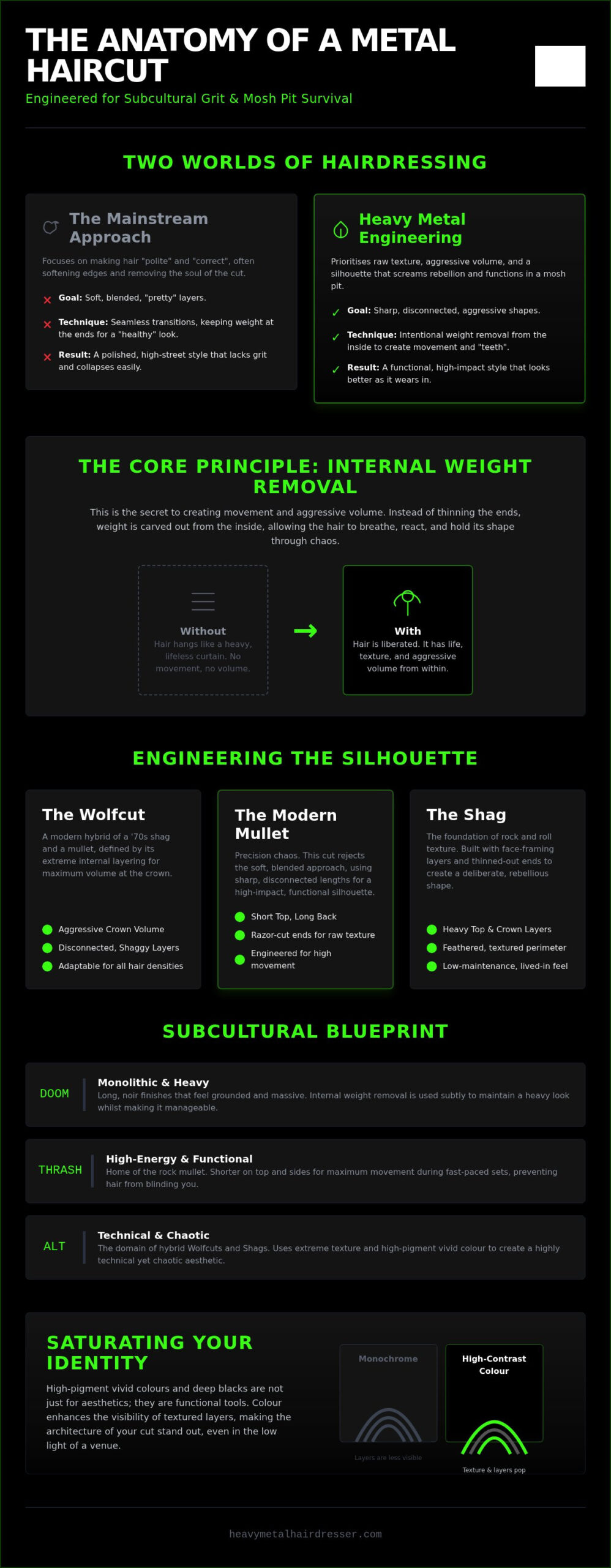
  • Understand why internal weight removal is the secret to creating heavy metal hairstyles that prioritise movement and aggressive volume.
  • Master the technical anatomy of wolfcuts and shags to ensure your silhouette remains sharp and intentionally disconnected.
  • Discover how high-pigment vivid colours and deep blacks enhance the visibility of textured layers for a high-impact finish.
  • Learn how to engineer a low-maintenance foundation that survives the heat of the mosh pit and looks better as it wears in.
  • Recognise the importance of inclusive, alternative spaces that celebrate individuality and reject traditional beauty industry jargon.

Defining the Heavy Metal Aesthetic: More Than Just Long Hair

Heavy metal is a sonic assault; your hair should match that energy. It isn’t just about growing your hair out for a decade and hoping for the best. It’s about the technical engineering of a silhouette that screams rebellion. While the high street obsesses over “pretty” layers that blend into nothingness, heavy metal hairstyles prioritise raw texture and aggressive volume. This isn’t about looking polished or approachable. It’s about looking like you belong at the front of the stage, ready for whatever the night throws at you.

The core difference between a mainstream “messy” look and a subcultural cut lies in intentional weight removal. Mainstream styles keep weight at the ends to look healthy and soft. We strip that weight out. This creates “teeth” in the hair; sharp, deliberate edges that define your look even when you’re drenched in sweat. As a central part of Heavy metal fashion, your hair acts as a visual extension of your musical identity. It’s a flag you fly to signal you’re fiercely independent and part of a community that values authenticity over trends. Traditional layers fail here because they lack the grit required to survive a two-hour set.

The Cultural Weight of the Metal Silhouette

The silhouette has evolved significantly since the 80s glam era. Back then, the scene was defined by hairspray and teasing to achieve massive height. Today, we’ve moved toward gritty, functional textures that don’t require a canister of spray to stay upright. Modern metal hair prioritises movement. It needs to look just as good mid-headbang as it does when you’re standing still. We focus on creating a shape that communicates a bold and rebellious personality. It’s about edges that look sharp and deliberate. Every snip is designed to give the hair a life of its own.

Subcultural Variations: From Doom to Thrash

The specific genre you listen to often dictates the engineering of your cut. The metal community is diverse, and the hair should reflect that. We don’t believe in one-size-fits-all solutions for alternative identities.

  • Doom Metal: These looks are often monolithic and heavy. We use internal weight removal to keep the hair manageable whilst maintaining those long, noir finishes that feel grounded and massive.
  • Thrash and Speed Metal: This scene birthed the rock mullet. These are high-energy cuts built for speed. They’re often shorter on top and through the sides to allow for maximum movement without blinding you during a fast-paced set.
  • Modern Alt-Metal: This is where we see the rise of the hybrid Wolfcuts and Shags. These styles use extreme texture and vivid colour saturation to create a look that’s both technical and chaotic.

Engineering the Cut: The Anatomy of Shags, Mullets, and Wolfcuts

Standard hairdressing schools teach you how to make hair look “correct.” They focus on seamless transitions and perfect blending. For heavy metal hairstyles, we throw those rules out. Alternative hair is about engineered chaos. We use disconnected layers and razor-cut ends to create a silhouette that looks aggressive rather than accidental. This technical departure is essential because mainstream techniques simply cannot handle the structural demands of the scene.

The secret lies in internal weight removal. If the hair is too heavy, it hangs like a curtain. It won’t move when you’re headbanging. By carving out weight from the inside, we allow the hair to breathe and react. This connection between the physical cut and the sociology of the heavy metal subculture is vital; the hair must function as part of the performance. It’s about creating a foundation that looks raw but remains technically sound.

The Wolfcut: Aggressive Internal Layering

Aggressive internal layering is what defines the wolf hair cut as the ultimate weapon for modern heavy metal hairstyles. It takes the chaotic volume of a 70s shag and marries it to the aggressive length of a mullet. The technical focus here is the crown. We use shorter, internal layers to support the top, ensuring the volume doesn’t collapse under its own weight. This is adaptable for everyone. Whether you have thick, coarse hair or fine strands, the internal layering can be customised to provide the right amount of grit. Amongst those with denser hair, we remove more weight from the mid-lengths to prevent a mushroom effect, whilst finer hair requires strategic “pockets” of shorter hair to push the longer layers out.

The Modern Mullet: Precision Chaos

Forget the “disaster” mullets of the past. The modern mullet haircut is a technical masterpiece of balance and contrast. We focus on a short, textured front that frames the face, leading into a heavily layered back. The goal is a cohesive silhouette that feels intentional. To keep it sharp, you need products that provide a matte, gritty finish. Using something like Death Grip can help maintain that aggressive texture throughout a long night. If you’re looking to master these aggressive textures yourself, our Hair Courses provide a deep dive into the technical side of alternative styling. It’s about building a foundation that thrives on the edge.

Heavy Metal Hairstyles: The Definitive Guide to Subcultural Grit and Texture

Vivid Colour and Texture: Saturating Your Identity

Colour isn’t just an aesthetic choice; it’s a structural tool. In the world of heavy metal hairstyles, we use high-pigment shades to define the architecture of the cut. When you have aggressive layers and razor-cut ends, vivid hair colour acts as a spotlight. It catches the “teeth” of the hair, making those disconnected sections pop against each other. Without the right saturation, even the most technical wolfcut can look flat and lifeless under stage lights.

For those who prefer a classic aesthetic, we engineer the “Liquid Noir” finish. This isn’t just a basic box-black. It’s a deep, reflective violet-black or blue-black that creates shadow and depth. By understanding the history of heavy metal in fashion, we know that black hair is a foundational element of the scene. We use professional pigments to ensure the hair looks healthy and metallic rather than dull. It provides a solid, monolithic base that contrasts perfectly with the chaotic movement of a mosh-ready silhouette.

Saturating the Pit: Strategic Colour Placement

We don’t just slap colour on; we place it where it matters. We often use “under-lights” or hidden panels of neon greens, deep purples, or blood reds. These panels remain subtle whilst you’re standing still but reveal themselves the moment you start moving. This creates a percussive visual effect during headbanging. Using contrasting colours highlights the disconnected layers of a shag, giving the hair a sense of three-dimensional grit. Maintaining this vibrancy requires a commitment to high-intensity care, but the payoff is a look that refuses to fade into the background.

Creating Grit: The Role of Texture

Your hair is a weapon, but the pit is a war zone. Heat, sweat, and physical movement are the natural enemies of volume. If your cut isn’t engineered correctly, you’ll walk out of the first set looking like a drowned rat. This is why we prioritise a foundation that thrives on chaos. Heavy metal hairstyles shouldn’t just look good in the salon mirror. They need to survive the crushing energy of a front-row crowd without losing their aggressive silhouette. We build these looks to wear in, not wear out.

As backstage hair stylists at festivals like Download and Bloodstock, we’ve seen every hair disaster imaginable. The secret to survival is structural integrity at the roots. If the base is solid, the rest of the hair can move freely whilst maintaining its shape. A low-maintenance foundation allows the texture to become more defined as the night goes on. You want a look that gains character from the grit of the environment rather than collapsing under it.

Post-Gig Hair Recovery and Care

Recovering from a three-day festival requires a tactical approach. Your scalp will be a graveyard of product buildup and sweat. Start with a clarifying wash, but focus solely on the roots to avoid stripping your ends. If you’re rocking vivid colours, a cold water rinse is non-negotiable. It keeps the hair cuticle closed and locks in those high-pigment tones amongst the carnage. Use a deep conditioning treatment on the mid-lengths, but don’t overdo it. Too much moisture will weigh down your aggressive layers and kill the volume we worked so hard to create.

Stage-Ready Styling: Locking It In

For extreme volume that lasts a full headlining set, you need the right arsenal. We use Hair To the Throne to build height that refuses to quit. Apply it to damp roots and blow-dry upside down to defy gravity from the start. If you notice your hair going flat between bands, don’t reach for more spray. Instead, use your fingers to vigorously massage the scalp. This reactivates the product and creates instant lift. To ensure your texture stays sharp through every headbang, finish with Death Grip. It provides the grit needed to keep those disconnected layers separated and fierce. If you’re ready for a look that can handle the heat, book one of our Shag Haircuts to get the ultimate mosh-proof foundation.

Beyond the Binary: The Inclusive Alternative Salon Experience

Mainstream salons are built on a catalogue model. They want you to look like everyone else. When you ask for heavy metal hairstyles, they see a problem to be solved rather than an identity to be celebrated. They try to soften the edges. They blend the disconnected layers. Before you know it, your aggressive shag has been turned into a polite, high-street bob. This happens because mainstream training lacks the technical foundation for subcultural grit. It’s a clinical environment that often feels alienating for those of us who live outside the norm.

Walking into an overly polished salon can be anxiety-inducing. You shouldn’t have to explain why you want your hair to look raw or gritty. At Heavy Metal Hairdresser, we’ve built a sanctuary for the rebellious. We don’t just tolerate your individuality; we celebrate it. Our space is organised to feel like the community we belong to. It’s authentic, high-energy, and built on a foundation of mutual respect.

Why Traditional Salons Fail Metalheads

Mainstream stylists are trained in symmetry and softness. They often struggle with the intentional weight removal required for alternative cuts. They view “messy” as a mistake. In the world of metal, “messy” is an engineered outcome. The clinical atmosphere of traditional salons also creates a barrier. It’s hard to talk about subcultural aesthetics when the person cutting your hair doesn’t know the difference between Doom and Thrash. You need a Style Master who speaks your language and understands the nuances of the underground scene without you having to translate your identity.

The Heavy Metal Hairdresser Philosophy

We reject gendered pricing. Hair doesn’t have a gender; it has length, density, and a story. Our consultations are identity-affirming and focused on what makes you feel powerful. This gender-neutral approach ensures that everyone in the scene feels seen and respected. Our expertise isn’t just technical; it’s born from a genuine love for the music and the lifestyle. We aren’t just cutting hair; we’re empowering you to express your true self through heavy metal hairstyles. Whether you’re coming in for one of our signature Wolfcuts or a technical Shag, you’re entering a space where being different is the standard. We provide the tools, the expertise, and the sanctuary you need to own your silhouette.

Own Your Silhouette: The Future of Your Alternative Identity

For those looking to further customise their alternative identity with professional piercings, you can learn more about Stellar Malaysia to discover safe and hygienic services that complement your new aesthetic.

Heavy metal hair is more than a look; it’s a structural commitment to your subculture. We’ve explored how internal weight removal and aggressive layering create the foundation for heavy metal hairstyles that refuse to collapse. You now know how to lock in that texture using professional tools and how to recover your grit after a three-day festival stint.

Don’t settle for a high-street stylist who tries to soften your edge. You deserve a space that understands the percussive energy of the pit and the technical demands of a wolfcut. Our team brings authentic backstage expertise from Download and Bloodstock to every chair. We specialise in aggressive texture and high-pigment vivid colours within a fiercely independent, gender-inclusive safe space.

Ready to stop compromising? Book your alternative transformation at Heavy Metal Hairdresser today. It’s time to build a look as loud as your favourite record.

Frequently Asked Questions

What is the best haircut for a heavy metal aesthetic?

The best haircuts for a heavy metal aesthetic are those that prioritise aggressive texture and non-conformist silhouettes, such as wolfcuts, shags, and technical mullets. These styles rely on internal weight removal to allow for movement and volume. Unlike mainstream cuts, these heavy metal hairstyles use disconnected layers to create a raw, gritty edge. The goal is a shape that looks intentional and rebellious, perfectly matching the high-energy atmosphere of the underground music scene.

How do I maintain volume in my hair during a mosh pit?

Maintaining volume in the pit requires building structural integrity at the roots before you even arrive at the venue. Use a product like Hair To the Throne on damp hair and blow-dry upside down to defy gravity. For extra security, apply Death Grip to lock those textured layers in place. If your hair starts to go flat between bands, vigorously massage your scalp with your fingertips to reactivate the product and restore instant lift.

Can I have a heavy metal hairstyle if I have fine or thin hair?

You can definitely rock heavy metal hairstyles with fine or thin hair by using strategic internal layering. Instead of traditional blending, we create pockets of shorter hair that physically push the longer layers outward. This technique generates volume and the illusion of density without needing massive amounts of hair. A shag or a wolfcut is particularly effective here, as the disconnected ends add a gritty texture that makes fine strands appear much thicker.

How often should I get my wolfcut or shag trimmed to keep it sharp?

Most clients find that getting a trim every 8 to 12 weeks keeps their silhouette looking sharp. These alternative cuts are engineered to wear in rather than wear out, meaning they often gain character as they grow. However, once the internal weight begins to settle at the bottom, the volume at the crown will start to collapse. Regular maintenance ensures the aggressive layers continue to provide the movement needed for a stage-ready look.

What are the best products for creating a gritty, textured look?

The best products for a gritty look are those that provide a matte, lived-in finish rather than a polished shine. Salt sprays and dry texture pastes are essential for separating layers and adding friction. We recommend using Death Grip for maximum hold and a dry feel that lasts through a full set. Avoid heavy oils or silicones, as these will weigh down your aggressive layers and make the hair look too polite for the scene.

Is a mullet or a shag better for someone with thick, curly hair?

Both styles are excellent, but the choice depends on how you want to manage your volume. A shag is ideal for distributing curls evenly across the head, creating a massive, monolithic silhouette. A mullet is better if you want to remove significant weight from the sides whilst keeping length at the back. Both rely on technical internal weight removal to ensure your curls don’t become a mushroom shape, keeping the texture aggressive and defined.

How do I stop my vivid hair colour from fading at a music festival?

To stop your vivid hair colour from fading, you must commit to cold water rinses and minimal washing during the event. Hot water opens the hair cuticle, allowing high-pigment dyes to escape. Use a dry shampoo to manage sweat and oil without stripping the colour. If you’re at a multi-day festival like Download, wear a hat or use UV-protective sprays to shield your hair from the sun, which is a major cause of pigment loss.

Are heavy metal hairstyles gender-neutral?

Yes, heavy metal hairstyles are entirely gender-neutral and focus on individual identity rather than traditional binaries. At Heavy Metal Hairdresser, we operate as a gender-inclusive safe space where pricing is based on the technical complexity of the cut and hair length. Whether you want a wolfcut, a shag, or a mullet, the engineering of the style is designed to empower your specific personality and subcultural belonging, regardless of your gender identity.

Posted on

The Shag Haircut for Fine Hair: Injecting Texture into Thin Strands (2026 Guide)

The Shag Haircut for Fine Hair: Injecting Texture into Thin Strands (2026 Guide)

Your fine hair isn’t a curse; it’s a blank canvas for the most aggressive texture you’ve ever seen. You’ve likely been told to keep your hair blunt to save the volume. You’ve been warned that heavy layers will make your strands look stringy or weak. It’s a boring lie fed to you by mainstream salons that don’t understand the grit of a true alternative aesthetic. We know the frustration of a style that goes flat before you’ve even finished your morning coffee.

The truth is that a shag haircut for fine hair is the ultimate hack for achieving effortless, rock-star volume without losing your identity. By using strategic, alternative cutting techniques, we can inject life into thin strands and create a look that celebrates your natural texture rather than fighting it. In this 2026 guide, we’ll show you how to ditch the “weight” and embrace the chaos. We’ll explore the specialised methods used to build height at the crown and the essential products like Death Grip that keep your fringe defiant all day long. Get ready to transform your flat hair into a high-volume masterpiece.

Key Takeaways

  • Ditch the blunt cuts and learn how razor techniques create the “lived-in” texture fine hair needs without sacrificing perimeter thickness.
  • Discover why the shag haircut for fine hair is the ultimate solution for resurrecting 70s rock grit and banning flat, lifeless strands.
  • Compare the silhouettes of the shag, wolfcut, and mullet to find which aggressive style preserves the most weight for your hair density.
  • Master the “no-blow-dry” philosophy and learn how to use specialised products like Death Grip to lock in volume that actually lasts.
  • Find out why an inclusive, alternative-focused salon is the only place that prioritises your identity over mainstream beauty standards.

Why the shag haircut for fine hair is the ultimate alternative solution

Forget what the high-street stylist told you. They usually want you to keep your hair blunt. They claim it adds “weight” or “bulk”. In reality, that weight acts like a lead anchor, dragging your style into the dirt within minutes of you leaving the house. The modern shag is a high-texture, multi-layered beast featuring a heavy fringe that demands attention. It is the perfect shag haircut for fine hair because it replaces boring, flat lines with a chaotic, multi-dimensional silhouette that actually stays upright.

To understand why this works, look at the history of the shag haircut. Born in the 70s and refined by rock legends, it was never meant to be “pretty” or polished. It was about grit. Today, it serves as a strategic visual lie. By creating hundreds of different lengths across the head, you increase the surface area of the hair. This creates the illusion of a massive, thick mane where there was once just a thin, transparent veil. It is about taking up space and refusing to let your hair go unnoticed.

The “Thin Hair” Myth: Why layers are your friend

The biggest fear for anyone with fine hair is that layers will “thin it out” or make the ends look stringy. This is absolute rubbish. When you leave fine hair at one length, the cumulative weight of the ends pulls the roots flat against the scalp. By carving out short layers at the crown, we remove that anchor. These shorter pieces act as structural support, pushing the rest of the hair up and creating a lift that no amount of backcombing can replicate. We aren’t removing bulk; we’re re-organising it to work for your silhouette. Weight in fine hair causes collapse; texture causes expansion.

Shag vs. The Mainstream: Choosing grit over polish

Traditional salons often try to give you “soft, blended layers”. That is fine if you want to look like a catalogue model, but it is useless for an alternative identity. We prioritise aggressive texture and a rebellious silhouette over “sensible” styles. This isn’t about a smooth finish; it is about a raw, lived-in aesthetic that looks better the more you mess with it. This style represents the shag haircut resurrection currently tearing through the UK scene. It is about reclaiming your look and refusing to settle for a boring cut just because your hair is fine.

The technical breakdown: how we cut for volume, not just layers

Most stylists approach a shag haircut for fine hair with a sense of dread. They worry that removing hair will leave the client with a transparent, stringy mess. We don’t. We use technical precision to build an internal scaffold that holds the hair up. It is about removing weight in the right places whilst reinforcing the perimeter to maintain density. This isn’t just a haircut; it’s an architectural project for your head.

The goal is to create a style that looks massive but feels weightless. We achieve this by focusing on the relationship between the crown and the length. If you’re ready to ditch the flat look, come see us for a bespoke shag haircut that actually works with your texture.

Razor cutting vs. Scissor cutting for fine strands

Scissors create blunt, heavy lines. On fine hair, these lines can look too “perfect” or stiff, which is the opposite of the lived-in, alternative aesthetic we want. Scissors can also make fine hair look “choppy” in a way that feels accidental rather than intentional. We prefer the razor. A blade allows us to taper the ends of the hair, mimicking the natural wear and tear of a rock-and-roll lifestyle. It gives the hair a soft, diffused edge that blends seamlessly with other layers.

This technique is vital for fine hair because it prevents the “staircase” effect where you can see exactly where one layer ends and the next begins. The razor is the ultimate weapon of choice for carving out gritty, organic texture in fine hair without the clinical stiffness of scissors.

The importance of the crown: building the “nest”

The secret to a high-volume shag lies in the “nest” at the crown. We use internal layering techniques, cutting shorter pieces underneath the top sections. These hidden layers act as “kickers,” propping up the surface hair and preventing it from falling flat. It creates a structural lift that stays put even without heavy styling. This is how we achieve that iconic, messy height that defines the alternative look.

To keep the style from looking like an accidental mullet, we manage the transition from the fringe to the side layers with extreme care. We often integrate curtain bangs to frame the face. These bangs bridge the gap between the heavy fringe and the shorter crown layers, creating a “deadly” combination that looks intentional and edgy. For those who want to preserve maximum length, we might suggest a “shullet” hybrid. This preserves the density at the bottom whilst allowing the crown to go wild, ensuring you don’t lose that precious “weight” at the ends.

Choosing your weapon: Shag vs. Wolfcut vs. Mullet

Picking between these three isn’t just about style. It’s about how your specific hair density behaves under pressure. A shag haircut for fine hair typically offers a more rounded, blended silhouette. It is the most forgiving of the three. It focuses on uniform layers that create a seamless flow from the heavy fringe down to the ends. If you want volume without looking like you’ve had a fight with a lawnmower, the shag is your baseline. It feels authentic, gritty, and lived-in without requiring a massive leap of faith.

The wolfcut and mullet are more aggressive. They rely on disconnection. This means there is a sharp jump in length between the top and the bottom. For fine hair, the shag preserves the most weight at the perimeter. This is crucial if you’re worried about your ends looking transparent. Maintenance also varies. A shag can usually last eight to twelve weeks. A wolfcut needs the crown refreshed every six to eight weeks. A mullet needs regular attention to the sides and top to keep the contrast sharp and the attitude high.

The Wolfcut on fine hair: Injecting chaos

The wolfcut is the louder, more chaotic cousin of the shag haircut for fine hair. It uses heavily disconnected layers to create a massive illusion of density at the crown. By stacking short layers on top of longer ones, it forces the hair to stand up. For many, it is the ultimate way to express a subcultural identity. Check out the ultimate wolf hair cut guide for a deeper dive into this aggressive silhouette.

Is it too risky for very thin hair? Our expert verdict is no, provided the disconnection isn’t too extreme. If your hair is exceptionally thin at the ends, we might suggest a “soft” wolfcut. This keeps the crown wild whilst ensuring the bottom doesn’t vanish into thin air. It is about balance, not just bravery. We work with your natural texture to ensure the “wolf” doesn’t swallow your style whole.

The Modern Mullet: For the truly bold

For those who want to push boundaries, the modern mullet haircut is the ultimate fine-hair hack. It is arguably the most gender-neutral style in our arsenal. By keeping the back long and dense, we preserve the appearance of “weight” that fine-haired people often fear losing. Meanwhile, the top and sides are cut short and heavily textured. This creates a high-contrast look that makes even the finest hair look intentional and aggressive. It is a statement of defiance against boring, flat hair. It says you’re here, you’re different, and you don’t care about mainstream “rules” for thin hair.

The Shag Haircut for Fine Hair: Injecting Texture into Thin Strands (2026 Guide)

How to style your shag for maximum grit and hold

Traditional styling advice is a trap for fine hair. They want you to use round brushes and high heat to force volume into existence. That is a waste of time. A proper shag haircut for fine hair is designed to be low-maintenance and high-impact. We advocate for a “No-Blow-Dry” philosophy. Air-drying preserves the authentic, raw texture of the razor cut. It prevents your hair from looking like a frizzy mess and instead lets it settle into its natural, gritty rhythm. It is about working with your hair, not fighting it.

Salt sprays are often the first thing people reach for, but they are a double-edged sword. On fine strands, too much salt leads to dehydration and breakage. It makes the hair look matte but feels like straw. You want the grit without the damage. This is why strategic product choice is your best friend. You need products that provide hold without the heavy, greasy residue of mainstream waxes.

The Product Arsenal: Death Grip & Hair To the Throne

To get that defiant height, start with Hair To the Throne. Apply it to your roots whilst the hair is still damp. It provides the structural support needed for crown-focused volume without feeling sticky or stiff. Once your hair is dry, it is time for the heavy hitter. Death Grip is essential for keeping your layers separated and gritty. It provides a tactile hold that defines the ends of your shag and keeps the silhouette aggressive.

The trick with fine hair is avoiding “product slump”. Start with a tiny amount of Death Grip. You can always add more, but if you overload fine strands, they will collapse. Use just enough to define the fringe and the face-framing layers. This ensures your texture stays sharp all day without the weight pulling your roots flat.

The “Mosh-Pit Survival” styling routine

Whether you are at a gig or a festival, you need a routine that takes five minutes. Apply your products, use the “scrunch and go” method to encourage the layers to pop, and get out the door. It is that simple. If you are heading to a weekend event, check out our festival hair survival guide for backstage tips on keeping your hair alive in the pit.

Refreshing your look on day two is easy. Don’t wash it. Use a small amount of Death Grip to piece out the fringe and add a bit of water to reactivate the Hair To the Throne at the roots. It keeps the alternative edge without the need for a full reset. If you are ready to overhaul your routine, you can order Death Grip and Hair To the Throne to start building your own arsenal.

Why Heavy Metal Hairdresser is the home of the alternative shag

We don’t do “traditional”. If you are looking for a polished, suburban bob, you are in the wrong place. Heavy Metal Hairdresser is built for the outsiders, the rebels, and the people who have been told their hair is “too difficult” for an edgy look. Mastering a shag haircut for fine hair requires more than just a pair of scissors; it requires an understanding of subcultural identity. Our expertise wasn’t born in a clinical beauty school. It was forged backstage at festivals like Download and Bloodstock, styling bands who need hair that survives a set and looks killer under the lights.

Lead stylist Simon Tuckwell approaches every head of hair as a unique piece of DNA. We don’t use templates. We look at your growth patterns, your texture, and your lifestyle to create a bespoke silhouette. We understand that fine hair needs an aggressive, technical touch to keep it from falling flat. We celebrate individuality by refusing to follow mainstream rules that prioritise “safety” over style. Here, being different is the standard. It is about taking your thin strands and giving them a voice.

A safe space for alternative souls

Finding a stylist who actually understands your music and your aesthetic is a game-changer. You shouldn’t have to explain why you want a heavy, face-shrouding fringe or disconnected layers. We already get it. We’ve built a gender-inclusive safe space where your identity is the priority, not a box to be checked. This commitment is reflected in our business model; we’ve binned gendered pricing in favour of a system that values time and craft over outdated social norms.

Your first consultation isn’t a lecture. It is a direct dialogue. We talk about your hair’s history, your styling habits, and exactly how much grit you want to achieve. We want you to leave feeling like the best version of yourself, not a watered-down version of a trend. It is about creating a look that feels like home and reflects the subcultures you belong to.

Ready to resurrect your hair?

Stop settling for hair that collapses the moment you walk out the door. It is time to embrace the resurrection of the 70s rock aesthetic with a modern, technical twist. Whether you want a rounded shag, a sharp wolfcut, or a defiant mullet, we are ready to transform your thin strands into a high-volume masterpiece. For stylists who want to master these aggressive techniques themselves, we also offer alternative hair courses to help spread the art of subculture styling.

Your transformation is just a booking away. Don’t let your fine hair dictate your identity any longer. Book your shag haircut for fine hair today and join a community that values authenticity over everything else. Let’s build a silhouette that actually says something.

Stop Settling for Flat Hair and Reclaim Your Volume

Fine hair is no longer a reason to hide behind a boring, one-length cut. You’ve discovered that the secret to thickness isn’t “weight,” but strategic, aggressive texture. By embracing the razor and the internal scaffold of a shag haircut for fine hair, you can finally achieve a silhouette that reflects your alternative identity. Whether you choose the rounded flow of a shag or the high-contrast grit of a mullet, you are choosing a style that works with your natural DNA instead of fighting it.

At Heavy Metal Hairdresser, we don’t follow the mainstream rules that leave your hair looking flat. Our expertise is forged backstage at festivals like Download and Bloodstock, and our gender-inclusive safe space is built for the outsiders. Led by Simon Tuckwell’s Red Dot level creative vision, we are ready to resurrect your strands with technical precision. It is time to ditch the polished lies of traditional salons and embrace the chaos of a truly bespoke cut.

Ready to transform your look? Book Your Transformation at Heavy Metal Hairdresser and step into a style that actually says something. Your hair is a blank canvas; let’s make it a masterpiece.

Frequently Asked Questions

Does a shag haircut make fine hair look thinner or thicker?

A shag haircut for fine hair makes it look significantly thicker by creating a multi-dimensional silhouette. Instead of one flat layer, the strategic internal scaffolding of shorter crown pieces pushes the rest of the hair up. This creates the illusion of a massive, dense mane. We focus on removing weight that causes collapse whilst reinforcing the perimeter to ensure you don’t lose that essential feeling of fullness.

How often should I get my shag haircut trimmed to keep it sharp?

To keep the silhouette sharp and the volume at its peak, you should aim for a trim every eight to twelve weeks. Fine hair is prone to split ends which can make your layers look stringy rather than gritty. Regular maintenance ensures the crown layers stay light enough to maintain their lift. If you wait too long, the cumulative weight of the growth will drag the style flat, ruining the alternative edge.

Can I have a shag haircut if my hair is naturally very straight and fine?

Absolutely. Straight, fine hair often lacks natural movement, which is exactly why a shag is the perfect solution. We use razor cutting to carve out organic texture that straight strands simply cannot achieve with blunt scissors. By tapering the ends and building height at the crown, we give straight hair a rebellious, lived-in character. It transforms a limp, “perfect” look into something raw and intentional.

What is the best fringe style for a fine hair shag?

A heavy, face-shrouding fringe or curtain bangs are the best options for fine hair. These styles bridge the gap between your shortest crown layers and the longer perimeter. A thick fringe creates a focal point of density right at the front, making the rest of your hair appear fuller by association. It adds an aggressive, subcultural grit that defines the entire look and frames your face with purpose.

Is a razor cut safe for fine, fragile hair?

Razor cutting is perfectly safe for fine hair when executed by a specialist who understands the tool’s mechanics. It is actually preferable to scissors because it creates a diffused, tapered edge that blends seamlessly. This prevents the harsh, “staircase” effect often seen in traditional layered cuts. As long as the blade is fresh and the technique is precise, it avoids the damage associated with blunt, dragging tools.

How do I style a shag haircut for fine hair without it going flat?

Styling a shag haircut for fine hair requires a “less is more” approach to prevent it from going flat. Start with Hair To the Throne at the roots whilst damp to build structural support. Once air-dried, apply a tiny amount of Death Grip to the ends to separate layers and add grit. This combination locks in volume without the greasy weight of mainstream products, keeping your texture defiant from morning until the mosh pit.

Can I transition from a bob to a shag with fine hair?

Transitioning from a bob to a shag is a common journey for those reclaiming their alternative identity. We start by introducing internal texture and shorter layers at the crown whilst allowing your perimeter length to grow. It is about shifting the weight from the bottom of the cut to the top. This process prevents the “awkward stage” by ensuring your hair always has a deliberate, textured silhouette as it evolves.

What styling products should I avoid with a fine hair shag?

You must avoid heavy, oil-based waxes and thick pomades designed for coarser textures. These products are too heavy for fine strands and will cause your style to collapse into a greasy mess within hours. Similarly, be cautious with excessive salt sprays; whilst they provide grit, they can dehydrate fine hair and lead to breakage. Stick to lightweight, specialised products like Death Grip that offer hold without the leaden weight.

Posted on

The Shag Haircut: A Professional Guide to Alternative Texture and Grit

The Shag Haircut: A Professional Guide to Alternative Texture and Grit

Most salons treat the shag as a soft, feminine trend, but they’re missing the point entirely. If you’ve been searching for a shag haircut nottingham that doesn’t look like a standard blow-dry, you already know the frustration of being misunderstood by mainstream stylists. You don’t want “pretty” layers; you want a cut that feels like your favourite record sounds. It’s about raw energy and a refusal to conform to traditional beauty standards.

We agree that your hair should be as loud as your subculture. It’s exhausting explaining your aesthetic to someone who only understands the clinical or the polished. This guide promises to show you how to weaponise the modern shag to express your subcultural identity with expert techniques and aggressive texture. We’ll preview the specific styling methods used to get that mosh pit ready finish, including how to use Death Grip to maintain your grit. It’s time to stop settling for “feminine” and start looking like yourself.

Key Takeaways

  • Learn how the 2026 shag resurrection weaponises 70s rock aesthetics to express your authentic alternative identity.
  • Distinguish between the ‘Alt-Cut’ trinity to ensure your shag haircut nottingham provides the balanced, high-texture shape your style demands.
  • Discover why aggressive razor cutting and disconnected layers are essential for achieving movement that defies mainstream “pretty” standards.
  • Master mosh pit ready styling using Death Grip and Hair To the Throne to maintain a raw, lived-in look.
  • Understand the importance of a gender-inclusive safe space where your subcultural references are celebrated rather than merely tolerated.

Defining the Resurrection: What is a Shag Haircut in 2026?

The shag is back, but it’s meaner than before. Forget the feathered fluff of the early 2000s; the 2026 resurrection is built on aggressive texture and unapologetic volume. This isn’t just a haircut. It’s a subcultural flag. Across the UK, the 70s rock aesthetic is tearing through the alternative scene, reclaiming a look once defined by icons like Joan Jett and David Bowie. If you’ve been hunting for a shag haircut nottingham that actually has some bite, you’re likely tired of salons trying to “soften” your edges. A true alternative shag prioritises grit over grooming.

This style serves as the ultimate tool for gender-neutral self-expression. It doesn’t care about traditional masculine or feminine silhouettes. Instead, it focuses on the individual’s bone structure and subcultural references. While mainstream stylists might offer a “layered cut,” they often lack the understanding of why a shag needs to look slightly undone. The history of the shag haircut shows it was always meant to be rebellious. In 2026, we’ve dialled that rebellion up. It’s a high-texture, multi-layered beast featuring a short crown and a heavy fringe that demands attention.

The Core Elements of an Alternative Shag

Height is everything. We use short, choppy layers to create anti-gravity volume that won’t fall flat by mid-gig. The face is framed by heavy curtain fringe or bottleneck bangs, giving you a look that’s both mysterious and aggressive. We avoid the “too-perfect” finish at all costs. Disconnected ends are essential. They provide that feathered, bitey texture that distinguishes a subcultural masterpiece from a standard high-street trim. It’s about movement that feels organic rather than manufactured.

Why the Shag Rules the Mosh Pit

You don’t want hair that requires a three-step blow-dry every morning. The shag thrives on low-maintenance behaviour. It actually looks better the more it’s lived-in. Whether you have pin-straight strands or tight curls, this cut adapts to your natural movement. It’s built to survive the heat of a mosh pit and still look intentional the next day. As it grows out, it maintains its grit for months, evolving into a longer, equally textured version of itself. It’s the perfect choice for anyone who values authenticity over an appointment schedule.

Shag, Wolfcut, or Mullet: Choosing Your Subcultural Weapon

Picking your silhouette is like choosing your battle gear. You aren’t just looking for a change; you’re looking for a weapon. The ‘Alt-Cut’ trinity consists of the shag, the wolfcut, and the mullet. Each offers a different level of rebellion. The Shag is your balanced classic. It provides all-over texture and maximum volume. It’s the go-to for anyone wanting a shag haircut nottingham that feels grounded in rock history rather than high-street trends.

The Wolfcut is a wilder hybrid. It’s animalistic. It blends the heavy, face-framing layers of a shag with the elongated, disconnected back of a mullet. Then there’s the Mullet itself. It’s the ultimate statement of defiance. Short on top, long at the back, and entirely unapologetic. It’s the “business in the front, party in the back” vibe, but stripped of its 80s cheese and replaced with modern, gritty aggression.

Which Shape Suits Your Identity?

We don’t follow traditional beauty rules here. Forget “flattering” your face shape in the mainstream sense. It’s about matching your cut to your subculture. Goths often lean towards sharper, more angular shags that frame the face with mystery. Punks might demand more disconnected, jagged layers that scream for attention. If you’re into metal, you want hair that moves when you do. Combining these shapes with vivid hair colour elevates the cut from a style to a statement. High-pigment neons or deep, blood-red tones highlight the texture we’ve carved into your hair, making every layer pop.

Texture and Density: What Your Hair Can Handle

Fine hair often feels like a limitation, but the shag is a secret weapon for volume. By injecting chaos through short crown layers, we create height where there was none. For those with a massive amount of hair, we have to master the shag for thick hair by removing internal weight. This allows the layers to move without looking like a helmet. Curly-haired folk should embrace the shag too. It gives natural curls a defined structure, preventing the dreaded “triangle” shape and letting each coil breathe. If you’re ready to stop blending in, our expert stylists can help you choose the shape that fits your scene perfectly.

The Anatomy of an Alt-Cut: Aggressive Layers and Disconnected Texture

Mainstream salons love a blunt edge. It’s safe. It’s predictable. For a genuine shag haircut nottingham, safety is the enemy. Alternative styles demand movement that blunt lines simply cannot provide. We don’t want a “clean” finish that looks like a school photo. We want a cut that feels raw and intentional. This requires a complete shift in how hair is approached. We aren’t just trimming; we’re sculpting a silhouette that defies the norm.

Razor cutting is the foundation of the modern alternative shag. Unlike shears, which create a hard stop at the end of the hair shaft, a razor creates feathered, “bitey” ends. This technique allows for precise internal weight removal. It is the only way to ensure your shag doesn’t collapse into a mushroom shape. By carving out the bulk from the inside, we create space for the layers to breathe and move. Disconnected layering further separates the alt-cut from the mainstream. The top and bottom don’t always need to meet in a smooth transition. That intentional gap is what gives the style its shredded, rebellious edge.

The Tools of the Trade

Your stylist should reach for a razor. Shears have their place, but the razor is where the character is built. Techniques like point cutting and slithering are used to shred the ends, removing the “perfection” that kills an alternative vibe. We almost always cut dry. Cutting wet hair is like painting in the dark. By cutting dry, we see exactly how the texture lives and falls in real-time. It allows us to react to your hair’s natural behaviour, ensuring the grit is built into the structure of the cut rather than just styled in at the end.

The Fringe: The Soul of the Shag

The fringe is the anchor of the rockstar silhouette. It’s the first thing people see. We customise the length to highlight your cheekbones or eyes, depending on your individual vibe. A heavy fringe is essential for that brooding, effortless look. It shouldn’t be thin or wispy. We blend the fringe into the side layers whilst maintaining that signature disconnected edge. This ensures your fringe feels integrated into the cut but still retains its own aggressive identity. It frames the face with intent, providing the necessary weight to balance out the shorter crown layers.

The Shag Haircut: A Professional Guide to Alternative Texture and Grit

Mosh Pit Survival: How to Maintain and Style Your Shag

A true alternative cut isn’t meant to be precious. It’s meant to be lived in. If you’ve secured a shag haircut nottingham, you’ve already done the hard work of finding the right shape. Now you need to keep it alive. The secret to a perfect shag is actually doing less. Over-washing is the quickest way to kill your texture. Your hair needs its natural oils to maintain that gritty, non-conformist edge. Aim for a “day three” look as your baseline.

When you do style, use the right weapons. Hair To the Throne provides that regal, anti-gravity volume at the roots. For the ends, Death Grip offers the extreme hold needed to survive a headline set. Between salon visits, you can refresh your layers by simply dampening the hair and re-applying product. This keeps the shape sharp without needing a full wash and dry cycle. It ensures your shag haircut nottingham remains as aggressive as the day it was cut.

Your 5-minute morning routine is simple. Shake it out. Mist the mid-lengths with a bit of water. Apply your volume product to the roots. Scrunch the ends with a bit of grip. Blast with a hair dryer for sixty seconds if you’re in a rush. Done. It’s about effortless aggression that looks intentional.

Styling for the Stage and the Pit

Air-drying is great for a lazy day, but diffusing delivers the grittiest finish. It forces the hair into textured patterns that air-drying misses. Use the “scrunch and pray” method. Cup the hair in the diffuser, push it up towards the scalp, and let the heat create chaos. To protect your festival hair from heat, sweat, and the occasional flying beer, stick to dry shampoos and heavy-duty texture sprays. These products absorb the mess whilst adding to the volume, turning a disaster into a style choice.

Maintenance and Trim Cycles

Even the best shag needs a tune-up. Book a fringe trim every 4 to 6 weeks to keep your vision clear. The beauty of this cut is the “shag grow-out.” It is the easiest style to transition into a mullet as the back gains length. If you’re rocking a vivid colour, use sulphate-free products to keep the pigment saturated. Sharp texture looks best when the colour is just as loud. If you are ready to maintain that edge, book your next session to keep your layers bitey and your volume high.

Beyond the Chair: Why Your Shag Needs an Alternative Specialist

High-street salons are built for the masses. They aim for “polished,” “pretty,” and “safe.” When you walk in asking for a shag haircut nottingham, mainstream stylists often hesitate. They’re afraid to cut enough hair off. They don’t understand the subcultural weight of a short crown or a shredded fringe. An alternative specialist doesn’t have that fear. We understand that your hair is a weapon of self-expression. It’s the difference between a stylist who follows a manual and one who understands the music vibrating through the floor.

Identity matters. We operate as a gender-inclusive safe space where being different is the standard. Mainstream spots often try to fit alternative folk into binary boxes; we refuse to play that game. Whether you’re Goth, Punk, or Metal, your identity is celebrated here. It’s about creating an environment where you don’t have to explain why you want “bitey” ends or a disconnected silhouette. We speak your language. We know the references you’re chasing because we live them too.

The Heavy Metal Hairdresser Difference

Simon Tuckwell built this brand on a foundation of technical mastery and underground grit. We aren’t just cutting hair; we’re crafting identities. Our team has spent years backstage at festivals like Download and Bloodstock. We’ve styled the bands you listen to. We know how a shag haircut nottingham needs to perform under stage lights and in the rain of a festival field. Our salon is a gender-neutral zone. Individuality is the only rule we follow. We prioritise the person in the chair over the trends in the magazines.

Join the Tribe

Your transformation starts with a consultation. Bring your references. Bring photos of your favourite artists or album covers. We want to see the vibe you’re chasing. To complete your look, you can explore our Alternative Hair Merch UK. It’s the ultimate gear for maintaining that subcultural grit long after you leave the chair. Every haircut should be an act of rebellion against the mundane. It’s time to stop settling for “standard” and start looking like yourself. Book your session and let’s create something that actually represents who you are.

Weaponise Your Identity with Aggressive Texture

The modern shag isn’t just a haircut; it’s a subcultural resurrection that demands technical precision and raw attitude. You’ve learned that achieving the perfect shag haircut nottingham requires more than just layers. It requires aggressive texture, disconnected sections, and a specialist who isn’t afraid to cut with intent. Whether you’re aiming for a wolfcut hybrid or a classic rockstar silhouette, your hair should survive the pit and look better for it.

We’ve spent years honing our craft backstage at festivals like Download and Bloodstock, bringing that same high-energy expertise to our gender-inclusive safe space. We celebrate every alternative identity and understand the nuances of the scenes you inhabit. It’s time to stop compromising on your vision and start working with experts who respect your grit. We specialise in the wolfcut and shag resurrection, ensuring your look is authentic to your subculture.

Book your aggressive shag transformation with our alternative specialists today and join a tribe that values individuality above all else. Your hair is your statement. Make it loud.

Frequently Asked Questions

Is a shag haircut suitable for fine hair?

A shag is the ultimate solution for fine hair because it injects life into flat strands. By carving out short layers at the crown, we create anti-gravity volume that makes hair appear much thicker than it is. This technique prevents the hair from hanging limp and heavy. If you’re looking for a shag haircut nottingham that doesn’t fall flat by lunch, focusing on these aggressive internal layers is the only way to go.

How often should I get my shag haircut trimmed?

You should book a trim every 4 to 8 weeks to keep the shape intentional. The fringe usually needs attention sooner, around the 4-week mark, to keep your vision clear. One of the best things about this style is the “shag grow-out” phase. Because the layers are so textured, it transitions naturally into a longer, grittier silhouette that eventually evolves into a modern mullet before you even need a full restyle.

Can a shag haircut work for people with curly hair?

Curly hair and shags are a perfect match because the layers remove the bulk that causes the dreaded “triangle” shape. By adding disconnected texture, we allow each curl to breathe and bounce independently. This results in a more defined, wilder aesthetic that celebrates your natural pattern. It is one of the most inclusive shapes for textured hair, providing a rockstar silhouette that looks effortless and raw without needing constant manipulation.

What is the difference between a shag and a wolfcut?

The main difference lies in the aggression of the silhouette. A shag is a balanced, all-over textured classic that focuses on volume and face-framing layers. A wolfcut is a wilder, more animalistic hybrid that blends those shag layers with the elongated back of a mullet. While both prioritise grit, the wolfcut is more disconnected. Choosing the right one depends on how much of a “party in the back” rebellion you want to project.

How do I style a shag haircut without using heat?

Styling without heat is all about the “scrunch and pray” method using high-quality products. Apply your texture cream to damp hair, scrunch it aggressively towards the scalp, and let it air-dry. This encourages your natural movement to take centre stage. It creates a lived-in, mosh pit ready look that feels more authentic than a polished blow-dry. This approach is perfect for maintaining the health of your hair whilst keeping the grit sharp.

What products are best for adding texture to a shag cut?

You need products that offer both volume and extreme hold. We recommend Hair To the Throne for creating that essential height at the crown and Death Grip for ensuring your textured ends stay “bitey” all day. These tools are designed for alternative styles that need to survive high-energy environments. Using a sea salt spray or a dry texture dust can also help refresh your shag haircut nottingham between washes without losing the original shape.

Is the shag haircut considered a gender-neutral style?

The shag is a fiercely gender-neutral style that prioritises individual identity over traditional binaries. It doesn’t care about “masculine” or “feminine” rules. Instead, it focuses on bone structure and subcultural references. This makes it a powerful choice for anyone seeking a safe space to express their authentic self. It’s a versatile canvas that adapts to whoever is sitting in the chair, regardless of how they identify within the alternative scene.

How do I explain an alternative shag to a stylist?

Bring references that highlight exactly what you want. Show photos of bands or artists whose texture you admire. Use technical terms like “disconnected layers,” “razor-cut ends,” and “internal weight removal.” Avoid asking for “standard layers,” as this often leads to a mainstream, “pretty” finish. Tell your stylist you want the cut to look slightly shredded and aggressive. A specialist who understands underground culture will immediately know what you mean and won’t be afraid to take off enough length.

Posted on

Queer Friendly Hairdresser Nottingham: The National Standard for Alternative Inclusivity

Queer Friendly Hairdresser Nottingham: The National Standard for Alternative Inclusivity

93% of trans and non-binary people have been misgendered at a hair salon, and nearly a third feel stressed before every single visit. It’s exhausting to walk into a space that claims to be inclusive only to be met with gendered pricing or a stylist who tries to ‘soften’ your alternative edge. You shouldn’t have to defend your identity whilst sitting in a styling chair.

We agree that a haircut is a powerful act of self-expression, not a box-ticking exercise for the mainstream. Finding a queer friendly hairdresser Nottingham is about more than a rainbow sticker; it’s about discovering a subcultural sanctuary where technical alt-hair expertise meets identity-affirming care. You deserve a stylist who speaks your language and understands that your hair is your armour.

You’ll learn how to identify a truly inclusive salon and why we’ve built a space that celebrates shags, mullets, and the rebellious spirit of the underground. We are setting the national standard for what it means to be unapologetically alternative.

Key Takeaways

  • Understand that genuine inclusivity means deconstructing the gender binary, moving far beyond simple symbols or rainbow stickers.
  • Discover how to find a queer friendly hairdresser Nottingham who specialises in alternative subcultures like punk and heavy metal.
  • Learn the benefits of gender-neutral pricing models that charge based on time, skill, and product usage rather than outdated gender categories.
  • Get actionable advice on navigating your first alt-hair appointment, from choosing the right reference photos to vetting your stylist’s expertise.
  • Explore the intersection of queer identity and alternative hair, focusing on how styles like wolfcuts and shags serve as powerful tools for self-expression.

What Defines a Truly Queer Friendly Hairdresser in 2026?

A queer-friendly salon isn’t just a place where people are “nice” to you. It’s a space that actively deconstructs the gender binary in hair. In 2026, the standard has shifted. We’ve moved beyond surface-level acceptance. A genuine queer friendly hairdresser Nottingham understands that hair is a tool for self-actualisation, not a way to fit into a pre-assigned category. It’s about dismantling the “men’s” and “women’s” sections of a service menu and replacing them with technical expertise that respects who you are.

Rainbow stickers on the window are only the starting point. They’re a signal, but they aren’t the substance. True inclusivity lives in the identity-affirming language used by the staff and a deep-seated respect for pronouns that never wavers. The ongoing history of LGBTQ+ movements shows that visibility is only half the battle; the real work happens in the private spaces where we express our true selves. A safe space salon is an environment where individuality is the primary design principle.

Beyond the Rainbow: Active Inclusivity

Active inclusivity requires work behind the scenes. Staff training on LGBTQ+ issues is non-negotiable. It’s about understanding the nuances of gender identity and the specific anxieties that come with a salon visit. The consultation is the most critical part of the process. This is where we establish safe and respectful boundaries. We don’t assume; we ask. This level of intentionality doesn’t just help the queer community. These “safe spaces” are also vital for neurodivergent and alternative clients who find traditional, high-energy salon environments overwhelming. We prioritise clarity, consent, and comfort over corporate polish.

The Problem with Traditional Salon Etiquette

Mainstream beauty standards are often rigid. Traditional stylists have a habit of “feminising” or “masculinising” a cut based on their own assumptions, often without the client’s consent. This damages trust and can lead to genuine gender dysphoria. We reject those outdated rules. If you want a jagged, aggressive wolfcut or a blunt shag, that’s exactly what you’ll get. We don’t try to soften your edges to make you more “palatable” for the high street. Alternative spaces feel like home because they embrace subcultural expression rather than clinical perfection. Whilst high-street centres focus on a “polished” look, we focus on the raw, authentic vibe that reflects your soul.

Subculture as a Sanctuary: The Intersection of Alt-Hair and Queer Identity

Subculture isn’t just a style choice; it’s a sanctuary. For decades, the heavy metal and punk scenes have offered a home to those rejected by the status quo. Queer individuals have always been at the heart of these movements, using aggressive aesthetics to signal their presence and find their tribe. As a queer friendly hairdresser Nottingham, we don’t just mimic these styles. We live them. Our roots are in the mud of Download and Bloodstock festivals, styling bands who demand hair that survives a mosh pit and expresses a raw, unfiltered soul. This isn’t corporate “alt”; it’s authentic rebellion.

Texture is a powerful tool for identity reclamation. When a stylist uses a razor to create jagged, “aggressive” layers, they aren’t just cutting hair. They’re helping you build a silhouette that feels right. The wolf hair cut has become a gender-neutral staple for a reason. It defies the neat, gendered expectations of the high street. By creating inclusive spaces that understand these subcultural nuances, we ensure your hair reflects your internal reality. We know that for many, a haircut is the first step in coming home to themselves.

The Wolfcut and the Shag: Gender-Neutral Weapons

The rise of shag hairdressers across the UK isn’t an accident. These styles are weapons against the binary. Through chaotic layering and disconnected lengths, shags and wolfcuts erase traditional gender markers. Technically, we use texture to either sharpen or soften features based on your goals, not your assigned gender. A heavy fringe can provide a sense of safety, whilst a cropped mullet can feel like a declaration of war against the mundane. It’s about balance and technical precision. If you are ready for a change, you can explore our specialist Wolfcuts to see how we transform traditional shapes into alternative statements.

Vivid Colour as Identity Expression

Choosing vivid hair colour is a move away from “natural” expectations toward expressive realities. For many non-binary and trans clients, high-pigment shades are a way to saturate their identity in a visible, undeniable way. Seeing your internal self reflected in a neon green or deep violet has a profound psychological impact. It’s about taking up space. We reject the idea that hair should be “discreet” or “conventional.” In our world, your hair is a high-decibel announcement of who you are. We use the best pigments to ensure your colour stays as loud and proud as you do, regardless of whether you’re in a mosh pit or a board room.

The Death of Gendered Pricing: Transitioning to Inclusive Structures

Charging based on gender is a relic of a boring, binary past. It makes zero technical sense. A buzz cut is a buzz cut. A complex, textured wolfcut requires the same level of skill whether the person in the chair is a man, woman, or non-binary. In 2026, this shift is no longer a radical idea; it is a necessary evolution for the UK hair industry. We see it as a baseline for any queer friendly hairdresser Nottingham. Using UK Parliament research on gender-based pricing as a reference, it’s clear that the “pink tax” has historically penalised anyone not fitting a narrow masculine mould. We have killed that model in favour of fairness and craft.

Why “Short Cut” and “Long Cut” Replace “Men” and “Women”

We have binned the “Men’s” and “Women’s” labels. Instead, we look at the clock and the craft. If you are coming in for one of our specialist Wolfcuts, you are paying for the time it takes to carve out those layers and the expertise required to get it right. This time-based structure is a massive win for trans and non-binary individuals, especially whilst they are transitioning. It removes the stress of being forced into a category just to get a price. It’s fair. It’s logical. It’s how it should be. Technical logic should always beat outdated social norms. We charge for time, skill, and product usage, ensuring everyone is treated with the same respect at the till.

Booking with Confidence

Transparency starts before you even walk through the door. A booking system that forces you to pick a gender is an immediate red flag. It tells you the salon is still stuck in the old ways. When you find a queer friendly hairdresser Nottingham, the booking process should be as fluid as your identity. The relief of not having to choose a “gender” on a digital form cannot be understated. It sets the tone for the entire visit. If you are unsure about a new place, ask them how they structure their fees before you arrive. If they mention “time” and “skill” rather than “gender,” you are likely in safe hands. Inclusive pricing isn’t a marketing add-on; it is a marker of a salon that truly understands queer culture and respects your autonomy.

Queer Friendly Hairdresser Nottingham: The National Standard for Alternative Inclusivity

Finding a queer friendly hairdresser Nottingham shouldn’t feel like a high-stakes gamble. It’s about vetting the space before you even step through the door. Start with their social media. If their portfolio is a sea of identical beach waves and clinical lighting, they probably won’t understand your need for subcultural grit. Look for a diverse range of clients and staff who celebrate being outside the mainstream. When you book, use reference photos that align with your true identity. Don’t worry about the gender of the person in the photo; focus on the shape and the energy. Be explicit about your boundaries. If you don’t want a “feminine” finish or “masculine” tapering, say it. A real expert will respect that boundary instantly.

The Power of the Consultation

A 15-minute chat is the foundation of a successful transformation. This is especially true for complex styles like the modern mullet haircut. During this time, use specific keywords to bridge the gap between your vision and the stylist’s hands. Focus on terms like “texture,” “grit,” and “disconnected layers.” Ask for a “gender-neutral” approach to the silhouette. This is also the time to discuss maintenance. Alternative cuts often have an awkward phase as they grow out; a good stylist will plan the cut to look intentional at every stage. If you’re ready to start that conversation, book your consultation with us today.

Red Flags to Watch Out For

Pay attention to the language used on the salon’s website. If it’s littered with gendered terms or traditional beauty jargon, proceed with caution. A major red flag is a stylist who tries to “correct” your vision. If you ask for a jagged, aggressive cut and they suggest “softening it up to suit your face shape,” they are really trying to push you back toward the mainstream. A lack of diversity in their portfolio or amongst the staff usually signals a lack of lived experience with the queer community. You deserve a space where your identity isn’t a “challenge” to be managed, but a reality to be celebrated. Trust your gut. If the vibe feels too polished or clinical, it might not be the sanctuary you need.

Heavy Metal Hairdresser: Redefining Inclusivity in the UK

Simon Tuckwell founded this brand on a simple premise: you shouldn’t have to choose between a high-end technical cut and a space where you feel safe. We’ve spent years rejecting the beige, “polished” world of traditional styling. Instead, we’ve built a community-driven vibe where being different isn’t just tolerated. It is celebrated. As a premier queer friendly hairdresser Nottingham, we act as a guide for those who want to express their identity through unconventional means. We have stripped away the clinical feel of the high street to create a raw, authentic environment that feels like home for the underground. This is a sanctuary where your subcultural roots are the foundation of every style we create.

Expertise Born from the Pit

Our technical standards weren’t developed in a quiet studio. They were forged backstage at Download and Bloodstock festivals. Styling bands who perform under intense lights and fans who live in mosh pits requires a specific kind of mastery. A queer friendly hairdresser Nottingham needs to know that an alternative cut has to be as durable as it is expressive. We specialise in shag hairdressers level cuts and wolfcuts that maintain their grit and texture long after you leave the chair. This unapologetically bold approach is what sets us apart. We aren’t just cutting hair; we are building armour for your identity. We take that same festival-grade intensity and apply it to every client who walks through our doors.

Your Identity, Your Hair

We believe you are the only expert on your own identity. Our job is to provide the technical proficiency to bring that identity to life. If you are tired of the “feminising” or “masculinising” filters of mainstream salon culture, you have found your tribe. We have removed the jargon and the judgment. Whether you are looking for one of our signature wolf hair cut styles or want to explore our Hair Courses to master the craft yourself, the focus remains on you. We also offer specialist services like Hair To the Throne and Death Grip for those who want to push their aesthetic even further.

Join the alternative revolution. We offer more than just a service; we offer a space where your subcultural roots and queer identity are the priority. It is time to stop settling for stylists who don’t “get” it. Stop explaining yourself and start expressing yourself. Explore our Branded Merchandise to show your support, or better yet, book your spot today. Your hair is the loudest thing about you. Let’s make sure it’s saying the right thing. We are here to ensure that your external reality finally matches your internal fire.

Own Your Identity: The Future of Alternative Hair

The days of defending your identity in a styling chair are over. You now know that a truly inclusive space is built on technical mastery and a radical rejection of the gender binary. From the aggressive texture of a wolfcut to the intentional chaos of a shag, your hair is a declaration of who you are. We have moved the needle by redefining hair for the UK alternative scene, ensuring that every cut is an act of self-expression rather than a social requirement.

By choosing a queer friendly hairdresser Nottingham that operates with gender-neutral pricing as standard, you are supporting a fairer, more transparent industry. Our expert stylists specialise in shags, mullets, and wolfcuts that don’t just look good; they feel right. It’s time to step away from the clinical high street and into a space where being different is the highest form of praise. You are the expert on yourself, and we are just here to provide the technical fire to match your vision.

Join the alternative revolution and book your gender-inclusive appointment today. We can’t wait to see the real you.

Frequently Asked Questions

What makes a hairdresser “queer-friendly”?

A queer-friendly salon goes far beyond surface-level acceptance or a rainbow sticker on the window. It is a space that actively deconstructs the gender binary in hair through identity-affirming language and pronoun respect. We provide an environment where individuality is the primary design principle. This means technical expertise in alternative styles is used to reflect your true self rather than forcing you into “masculine” or “feminine” boxes defined by the mainstream.

Do you offer gender-neutral pricing for all services?

Yes, we have completely scrapped outdated, gendered price lists in favour of a fairer model. We charge based on time, technical skill, and product usage for every client. This ensures that a queer friendly hairdresser Nottingham remains transparent and accessible for everyone. Whether you are getting a simple buzz cut or a complex, layered wolfcut, the price reflects the craft involved rather than your gender identity or the categories on a traditional booking form.

Can I get an alternative haircut like a wolfcut if I have thin hair?

Absolutely. Wolfcuts and shags are highly adaptable to different hair types. For those with thin hair, we focus on internal layering to create volume and grit without sacrificing the density of your ends. We use technical razor cutting and specific styling products like Death Grip to add aggressive texture and movement. During your consultation, we’ll discuss how to tailor the silhouette to your specific hair type whilst maintaining the raw, alternative edge you want.

What should I expect during my first consultation at a safe space salon?

Expect a collaborative dialogue where your identity is the priority. We won’t assume your gender or how you want your hair to look based on your appearance. We’ll discuss your hair history, your subcultural influences, and your lifestyle. You can share reference photos and set clear boundaries regarding “feminine” or “masculine” finishes. It is a low-pressure environment designed to ensure we are on the same page before any cutting begins, prioritising your comfort and vision.

Is the salon accessible for neurodivergent or anxious clients?

We prioritise clarity and consent to make our space as welcoming as possible for everyone. Our salon avoids the clinical, high-energy vibe of traditional high-street centres. We offer a safe space where we explain every step of the process. If you have specific sensory needs or experience salon anxiety, please let us know during booking. We can adjust the music or provide a quieter experience to ensure you feel respected and comfortable throughout your visit.

How do I maintain my vivid hair colour between appointments?

Longevity comes down to aftercare and using high-quality products. We recommend washing your hair with cool water and using sulphate-free cleansers to prevent pigment loss. Limiting heat styling and using professional-grade UV protection will also keep your colour looking loud and proud. We offer expert advice on specific products during your appointment to ensure your vivid shades stay saturated and expressive for as long as possible between your visits to our alternative sanctuary.

Do you specialise in gender-affirming haircuts for trans and non-binary people?

Yes, providing gender-affirming care is a core value of our brand. We understand that a haircut is often a vital step in self-actualisation. Our stylists are experts at using texture and silhouette to align your external look with your internal reality. Finding a queer friendly hairdresser Nottingham means working with someone who listens without judgement. We focus on creating the exact shape you want, whether that involves sharpening your features or softening your profile.

Can I book a specialist for a shag or mullet specifically?

All our stylists are experts in the alternative trinity: shags, mullets, and wolfcuts. We don’t do traditional bridal styling or children’s cuts; we focus entirely on the alternative scene. You can book in for these specific styles with confidence, knowing your stylist has mastered the technical grit required for these shapes. We also offer Guest Spots for travelling artists and Hair Courses for those who want to learn our signature rebellious techniques and subcultural mastery.

Posted on

Vivid Hair Colour: The Alternative Guide to High-Pigment Identity

Vivid Hair Colour: The Alternative Guide to High-Pigment Identity

Your hair isn’t a canvas for some fleeting high-street trend; it’s a high-decibel broadcast of your identity. If you’ve ever walked out of a traditional salon feeling like a “project” rather than a person, you know the frustration of stylists who don’t understand the soul of a shag or the aggressive edge of a wolfcut. You deserve vivid hair colour that commands attention without fading into a muddy mess after just two washes. We agree that settling for dull pigments or compromised hair health is a sacrifice you shouldn’t have to make to express your subcultural roots.

This guide masters the art of alternative saturation. It shows you how to achieve and own the boldest hues in the UK while keeping your strands resilient. Having styled backstage at festivals like Download and Bloodstock, we understand that your look needs to survive the pit and the after-party alike. We’ll explore the impact of the 2026 cosmetic regulations on pigment safety, the secrets to maintaining punchy tones, and how to find a creative peer who shares your values. It’s time to stop blending in. Start saturating your style with professional expertise that actually respects your aesthetic.

Key Takeaways

  • Master the canvas theory to understand why extreme lifts require professional bond builders to protect your hair’s structural integrity.
  • Ditch high-street fashion tints for the deep subcultural saturation that defines a true alternative identity.
  • Extend the life of your pigments with a maintenance guide that covers everything from the cold-water rule to heat damage.
  • Learn how textured cuts like shags and wolfcuts provide the perfect aggressive foundation for high-impact vivid hair colour.
  • Discover why gender-neutral pricing and safe-space values are vital for an inclusive and identity-affirming salon experience.

What is Vivid Hair Colour? Beyond the Mainstream Trend

Vivid hair colour isn’t a temporary flirtation with a trend. It’s a permanent commitment to an alternative existence. Unlike the “fashion tints” found in high-street windows, true vivids are high-pigment, semi-permanent dyes that live entirely outside the natural spectrum. We’re talking about saturation that hits as hard as a kick drum. While mainstream salons treat these shades as accessories, we see them as a visual manifestation of your musical and personal soul. It’s about taking up space and refusing to be muted.

The mainstream aesthetic often chases a “polished” look, where every strand is perfectly placed and the colours are designed to blend in. Our approach is the polar opposite. We embrace the raw, the gritty, and the authentic. To understand the foundations of these pigments, looking into The Science of Hair Colour helps explain how semi-permanent molecules sit on the hair shaft, but science only gets you halfway. The rest is about subcultural intuition. It’s knowing that a neon green isn’t just a colour; it’s a nod to a specific era of punk or a particular underground scene.

The Spectrum of Alternative Saturation

Choosing your palette is a high-stakes decision. In the alternative community, primary colours rule the roost. While the mainstream is currently obsessed with washed-out pastels that disappear after a single rinse, we focus on deep blood reds, electric blues, and toxic yellows. These shades offer a tonal depth that pastels simply can’t match. When we apply vivid hair colour, we aren’t just looking for brightness. We’re looking for a saturation that feels heavy and intentional, ensuring your identity remains front and centre whether you’re under stage lights or streetlights.

Why Subcultural Expertise Matters

A standard hairdresser might be a wizard with a blonde balayage, but they’ll often struggle with high-contrast vivid placements. They don’t always “get” how a bolt of violet should interact with the aggressive layers of a wolfcut or the choppy fringe of a shag. Subcultural expertise matters because the cut and the colour are inseparable. We don’t just slap dye on a head; we use the texture of the hair to dictate where the pigment should live. Our consultations aren’t about “looking pretty” in a conventional sense. They’re about finding the intersection between your aesthetic influences and the technical reality of your hair. We speak the same language as you, which means we don’t need a translator to understand your vision for a gritty, non-conformist look.

The Science of Saturated Pigment: How We Build the Look

Building a high-impact alternative look isn’t about luck. It’s about chemistry. To achieve the kind of saturation that stops people in the street, we use the “canvas theory.” Unlike traditional permanent dyes that penetrate the hair shaft and alter your natural pigment, vivid dyes are direct dyes. They’re large molecules that sit on the surface and stain the cuticle. Because they don’t contain ammonia to lift your natural colour, your hair needs to be pre-lightened first. Think of it like painting with a highlighter pen. If you draw on brown paper, the colour disappears. If you draw on white paper, it glows. We create that white or pale yellow “paper” through precise bleaching.

We don’t believe in taking shortcuts with your hair’s health. Many salons use high-volume developers to blast the hair open quickly, but that’s a recipe for “fried” strands and rapid fading. We advocate for a “low and slow” approach. By using lower volume developers over a longer period, we lift the hair gently. This preserves the structural integrity of the hair fibres. When the cuticle remains healthy and intact, it holds onto those vivid pigment molecules much longer. For those seeking vivid hair colour that actually lasts, this technical patience is non-negotiable.

Lifting to the Correct Level

Not every vivid shade requires the same base. If you’re chasing a neon lime or a pale mint, we have to lift your hair to a “level 10” blonde, which looks like the inside of a banana skin. Any remaining yellow pigment will turn your blue into green or your pink into orange. However, if you’re going for a deep blood red or a moody forest green, a “level 8” base with some underlying warmth actually adds tonal depth. We follow the “clean base” rule for multi-tonal applications to ensure colours don’t bleed into a muddy mess. Understanding Hair Dye Safety Regulations and the limits of your hair’s chemistry ensures we never push your strands past their breaking point.

Integrity Over Intensity

We refuse to compromise hair health for a single-session transformation. If your hair is already compromised, we’ll tell you straight. We use professional-grade bond builders like Olaplex during the bleaching process to repair the disulphide bonds that give hair its strength. These treatments aren’t just an optional “add-on”; they’re essential for anyone living an alternative lifestyle where hair is frequently bleached and re-coloured. Structural integrity is the foundation of long-lasting colour. Without it, your pigment has nothing to hold onto, and your vivid dream will wash down the drain in a week. For a look that stays punchy through every mosh pit, you need a stylist who prioritises hair health as much as the aesthetic.

Vivid Hair Colour Maintenance: Mosh Pit Survival Guide

“Vivids fade too fast.” It’s the most common excuse for staying beige. But here’s the reality check: high-pigment saturation is a lifestyle, not a set-it-and-forget-it service. If you’re treating your hair like a standard high-street dye job, you’re going to lose that punchy edge within a fortnight. Maintaining your look requires a tactical approach to home care that respects the chemistry we’ve built. To keep your vivid hair colour Nottingham looking fresh, you have to change how you think about hair health.

The #1 rule is simple: heat is the enemy. Every time you blast your hair with hot water, you’re opening the cuticle and letting those expensive pigment molecules escape. Think of it like a mosh pit for your hair cells; you want to keep things tight and controlled. Cold water is your best friend. It seals the cuticle and locks in the saturation. Beyond temperature, your choice of product is vital. Sulphate-free shampoos are non-negotiable. Sulphates are harsh detergents that strip colour faster than a bad review. For an extra boost, a colour-depositing conditioner can refresh your tones between salon visits.

The Alternative Wash Routine

Step one: stop washing your hair every day. It’s unnecessary and aggressive. When you do wash, focus the shampoo on the roots and let the suds rinse through the ends. This prevents over-cleaning the most porous parts of your hair. Dry shampoo is the unsung hero of the alternative scene. It absorbs oil without disturbing the pigment, allowing you to stretch the time between wet washes whilst keeping your volume high. The “rinse and repeat” cycle is a myth designed to sell more product. For us, less frequent washing means sharper colour and healthier strands.

Festival and Gig Survival

Whether you’re at Download or a basement gig, your wolf hair cut and colour take a beating. Sweat, grit, and beer are part of the experience, but they don’t have to ruin your look. Before heading into the pit, consider a leave-in conditioner with UV protection. Sun exposure is a silent colour killer, especially for neons and electric blues. It bleaches the pigment and leaves your hair feeling parched.

After the weekend, your hair needs a detox. Use a gentle, clarifying treatment to remove product build-up without nuking your base. If your face-framing “money pieces” are looking a bit tired, a quick home refresh with a direct dye can bridge the gap until your next appointment. Owning a bold identity means doing the work to keep it loud. If you’re ready for a refresh, we can always help you organise your next transformation.

Vivid Hair Colour: The Alternative Guide to High-Pigment Identity

Beyond the Binary: Inclusivity in Alternative Styling

Traditional salons often feel like a stage where you’re forced to perform a version of yourself that doesn’t fit. For the queer and alternative communities, a salon shouldn’t just be a place for a trim; it must be a safe space. We’ve built an environment where being different is the baseline, not the exception. This is about more than just aesthetics. It’s about finding a stylist who understands that your vivid hair colour Nottingham search isn’t just about a trend. It’s about visibility and safety in a world that often demands conformity. We foster a community where your subcultural identity is celebrated, providing a psychological sanctuary from the judgmental gaze of the high street.

We’ve ditched the outdated “men’s” and “women’s” menus. Hair has no gender, and neither does our pricing. We charge based on time, technical complexity, and the skill required to execute your vision. Whether you’re getting a short textured crop or a full-head vivid saturation, the price reflects the work, not the binary. This transparency removes the “pink tax” and ensures everyone feels respected from the moment they book. It’s a direct rejection of the clinical, gendered norms that have dominated the beauty industry for far too long.

Identity-Affirming Hair

Vivid colour is a powerful tool for gender expression. It can be a flag, a shield, or a shout. We see the stylist as a collaborative partner in your journey. We don’t dictate what “looks good” based on traditional beauty standards. Instead, we listen to how you want to feel. Our chair is a place where your identity is affirmed through every brushstroke of pigment. Whether you’re using high-saturation tones to align with your gender identity or simply to reclaim your personal power, we’re here to make that vision a reality without judgment.

The Safe Space Consultation

An inclusive consultation goes beyond just looking at reference photos. We talk about pronouns. We discuss neurodivergence and sensory needs. If you need a silent appointment or have specific sensitivities to sound or touch, we accommodate that. Our salon is a high-energy, percussive environment, but it’s also a sanctuary. We’ve created a space where you can be your loudest self or your most quiet, knowing you’re amongst peers who truly get it. We prioritize your comfort as much as the final result, ensuring the process is as identity-affirming as the colour itself.

If you’re ready to express your true self in an environment that respects your boundaries, book your identity-affirming consultation with our expert team today.

The Heavy Metal Hairdresser Way: Saturating the UK Scene

Simon Tuckwell didn’t build this salon to fit in. He built it to provide a sanctuary for those who’ve been told their look is “too much” by traditional high-street stylists. The Heavy Metal Hairdresser Way is about merging technical precision with a gritty, underground soul. We don’t just “do” hair; we engineer it to survive. Whether it’s the aggressive, choppy texture of a “Death Grip” style or the gravity-defying height of “Hair To the Throne” volume, our work is a direct rejection of the mundane. We’ve created a space where your subcultural identity isn’t just tolerated. It’s the entire point of the process.

Our expertise isn’t theoretical. It’s forged in the mud and heat of the UK’s biggest alternative stages. By styling for bands at festivals like Download and Bloodstock, we’ve mastered the art of durability and high-impact visual performance. When you’re searching for vivid hair color Nottingham, you aren’t just looking for a new shade. You’re looking for a result that stays saturated and sharp through a three-day festival set or a heavy night in the pit. We bring that same backstage intensity to every chair in our salon, ensuring your colour hits as hard as a headline set.

From Download to the Salon

We take that backstage intensity and translate it into wearable, aggressive styles for your everyday life. This is where modern mullet haircuts meet high-decibel pigments. We understand that a mullet, a shag, or a wolfcut needs a specific type of saturation to truly pop. A standard flat colour won’t do justice to the layers and movement we create. Our techniques ensure your colour doesn’t just look good in the salon mirror. It looks lethal under the strobe lights of a basement gig and holds its own against the grit of the real world. We use the same road-tested standards for our clients that we use for the artists on stage.

Joining the Community

We aren’t a walk-in factory. We’re a peer-led community of innovators and rebels. Preparing for your first session with us means understanding that we value your hair’s health as much as its hue. Safety is paramount, which is why a patch test is mandatory at least 48 hours before any pigment touches your head. This isn’t just a formality; it’s about protecting your canvas for future transformations. During your consultation, we’ll map out your identity journey and discuss how your chosen palette interacts with your lifestyle. We’re here to be your knowledgeable guides, helping you navigate the world of high-pigment saturation with confidence. If you’re ready to stop blending in and start saturating your identity, book your alternative colour session now and join the movement.

Own Your Alternative Saturation

Your hair is the loudest part of your identity. We’ve explored how to achieve high-decibel saturation through technical precision and how to protect that pigment in the heat of a mosh pit. From the essential “canvas theory” to the cold-water rules of maintenance, mastering your look is about respecting the chemistry as much as the subculture. You no longer have to settle for stylists who don’t understand the grit of a wolfcut or the soul of a shag.

Founded by Simon Tuckwell, our salon is a gender-inclusive safe space built for rebels and innovators. Having worked backstage at Download and Bloodstock, we bring festival-grade durability and expertise to every chair. If you’re tired of being judged in traditional salons and want a vivid hair color Nottingham experience that truly affirms who you are, it’s time to join our community. Stop blending in with the mainstream and start saturating your world with unapologetic pigment. We’re ready to help you manifest your loudest identity.

Secure your spot at Heavy Metal Hairdresser and let’s build your high-pigment identity today.

Frequently Asked Questions

How long does vivid hair colour actually last?

Vivid hair colour usually remains punchy for four to eight weeks before noticeable fading begins. Its longevity depends entirely on your maintenance routine and the initial saturation level. Cold water washes and sulphate-free products are essential for keeping those pigments locked inside the hair shaft. If you’re frequently in the mosh pit or under harsh UV lights at festivals, you’ll need a more rigorous home care plan to prevent premature dullness.

Do I have to bleach my hair to get bright colours?

You almost certainly need to pre-lighten your hair to achieve high-impact vivid results. Think of your hair as a canvas; dark hair acts like a black background that swallows up bright pigments. To make neons or primary colours glow, we have to lift the natural pigment to a pale blonde base. Without this step, the colour will look like a subtle tint rather than the high-decibel saturation our community demands.

Can I get vivid hair colour if I have dark or dyed hair?

Achieving a vivid hair color Nottingham result on dark or previously dyed hair is possible, but it requires a strategic approach. We have to strip away existing artificial pigments or lift through natural dark tones to create a clean base. This process might take multiple sessions if you’ve used box dyes or have very stubborn hair. We prioritise your hair’s structural integrity, ensuring we don’t push the lifting process faster than your strands can handle.

How much does a vivid hair colour session cost in the UK?

Pricing for creative colour in the UK varies significantly based on the complexity of the placement and the time required. Most alternative salons move away from gendered pricing, instead charging for the technical skill and product usage involved in the transformation. You should expect to pay for the pre-lightening stage, the vivid application, and any bond-building treatments used to protect your hair. Always book a consultation to get an accurate estimate based on your specific hair goals.

Is vivid hair colour damaging for my hair?

The vivid dye itself is non-damaging because it doesn’t use developer or ammonia; it’s actually quite conditioning. The potential for damage lies in the pre-lightening process required to create your canvas. We mitigate this risk by using professional bond builders and opting for a low and slow bleaching method. When managed by an expert, your hair stays healthy and resilient whilst maintaining the boldest alternative shades on the scene.

What is the difference between semi-permanent and vivid hair dye?

Vivid hair dyes are essentially high-pigment semi-permanent direct dyes. Traditional semi-permanents often aim for natural tones and offer lower saturation. Vivids are formulated with much larger pigment molecules designed to stain the hair cuticle with intense, non-natural colours. They don’t penetrate the cortex like permanent dye, which is why they eventually wash out. This allows for total creative freedom without the long-term commitment of traditional oxidative hair colouring methods.

How do I stop my vivid hair colour from bleeding onto my clothes?

Bleeding is a common side effect of high-pigment saturation, especially during the first few washes. To minimise this, always rinse your hair with the coldest water you can stand to seal the cuticle shut. Use old or dark-coloured towels and pillowcases to avoid staining your favourite gear. Applying a leave-in sealant or a light hair oil can also help create a barrier that keeps the pigment on your strands rather than your clothes.

Can I go from black to neon in one salon visit?

Going from jet black to a neon shade in a single visit is a massive technical challenge that often compromises hair health. If your hair is naturally dark and healthy, we might achieve it; however, previously dyed black hair usually requires several sessions to lift safely. We refuse to nuking your hair just for a quick fix. A multi-stage journey ensures your vivid hair color Nottingham transformation stays vibrant and your hair remains strong.

Posted on

Common Mullet Cutting Mistakes: Alternative Grit 2026

Common Mullet Cutting Mistakes: Alternative Grit 2026

Forget everything the high street told you about “blending” and “tidiness”. If your mullet looks like it belongs in an accountancy firm circa 1985, you haven’t got an alternative style; you’ve got a disaster. True grit comes from embracing aggressive, purposeful disconnection, not trying to make a subcultural icon look “safe” or “presentable”.

We know the frustration of asking for a sharp, rockstar silhouette and walking out with a “helmet” effect on top. It’s a common story: you lose too much length at the back too quickly, or the transition looks like a genuine accident rather than a deliberate stylistic choice. We’re here to help you identify the common mullet cutting mistakes to avoid so you can finally achieve that textured, aggressive finish that grows out with intent. Whether you’re rocking a wolfcut or a heavy shag, balance and weight distribution are everything.

In this guide, we’ll dive into the technical traps that ruin a bold cut. You’ll learn how to maintain that crucial length at the nape and why products like Hair To the Throne are essential for that gritty, lived-in texture. Get ready to turn a mediocre cut into a fierce statement of identity.

Key Takeaways

  • Ditch the “helmet” effect by mastering the balance between aggressive layers and intentional disconnection for a sharper silhouette.
  • Identify the common mullet cutting mistakes to avoid, such as over-layering the crown or cutting the fringe too narrow, which can kill the flow of your style.
  • Discover why thinning shears often sap the soul from an alternative cut and why techniques like point-cutting create more authentic grit.
  • Learn the “internal thinning” trick to reduce bulk and restore a failing shape without sacrificing your hard-earned length.
  • Understand how to use subcultural identity and musical taste as a technical guide for creating a truly bespoke, rock-inspired look.

Why Most Mullets Fail: Understanding the Alternative Silhouette

A mullet isn’t just a haircut; it’s a subcultural statement. When you get it right, it’s pure rock and roll. When you get it wrong, you’re one step away from a bad fancy dress party. The biggest problem with most modern attempts is a lack of understanding regarding the alternative silhouette. We aren’t aiming for the soft, feathered look of a 1980s pop star. The 2026 aesthetic is about aggressive layers and grit. If your stylist tries to play it safe, they’ll likely fall into the trap of making it look “tidy,” which is the fastest way to kill the vibe.

One of the common mullet cutting mistakes to avoid is the “Helmet Mistake.” This happens when too much weight is left on top, creating a rounded shape that sits awkwardly above the length. It ruins the vertical flow. Instead of a tapering silhouette, you get a top-heavy mess that feels dated. Another disaster is the “Step Error.” This occurs when the transition between buzzed sides and the long back is too blunt. It looks like a mistake because it is one. A successful cut requires nuanced weight distribution, ensuring the nape length feels like a rebellious extension of the crown.

Looking back at the history of the mullet, we see it has always been about contrast. However, the modern version demands a specific type of tension between the short and long sections. You want it to look intentional, not accidental.

The Shullet vs. The Extreme Mullet

Choosing your silhouette is the first step. The “shullet” is a softer, shag-inspired hybrid that works for fine hair or anyone wanting a less aggressive transition. Its biggest pitfall is losing the “mullet” identity by over-blending the sides. The extreme mullet thrives on high-contrast sides, often skin-faded, paired with massive length at the back. For thick hair, this allows you to remove bulk whilst maintaining a powerful shape that frames the face without overwhelming it.

The Role of Intentional Disconnection

Blending is often the enemy of alternative hair. Traditional barbering demands seamless transitions; we embrace the gap. Many confuse a “bad cut” with “bold disconnection.” A bad cut looks messy because foundations are weak. Bold disconnection looks sharp because lines are deliberate. It provides that raw aesthetic that sets you apart. Truly, intentional disconnection is the hallmark of the modern mullet haircut. By dodging common mullet cutting mistakes to avoid, you ensure your hair screams attitude, not an accidental error.

Technical Traps: Sectioning and Balance Blunders

Technical mastery isn’t about being neat; it’s about being deliberate. If you don’t understand the architecture of the skull, your alternative cut will fall flat. Literally. One of the primary common mullet cutting mistakes to avoid is the ‘Crown Collapse’. This happens when you over-layer the crown in a desperate bid for volume. Instead of height, you strip away the structural integrity. The hair loses its ability to defy gravity, leaving you with a limp top that doesn’t match the energy of the back.

Failing to plan the ear-clearance is another profile-killer. We call it the ‘Sideburn Struggle’. If you don’t carve out the space around the ear with precision, the hair just clumps together. It loses that sharp, aggressive edge. Similarly, over-direction is a silent killer. Pulling the hair too far forward whilst cutting the sides creates massive ‘holes’ in the length behind the shoulder. It’s a major reason why mullet hairstyles fail during the grow-out phase. You want a solid wall of hair at the back, not a patchy curtain.

Mastering the Radial Section

The radial section is the backbone of your architecture. It is the line that separates the ‘business’ from the ‘party’. Most stylists botch the transition from the top to the nape because they treat them as two separate haircuts. You need to maintain weight behind the ears whilst aggressively removing it from the temples. This creates a forward-pushing energy that looks fierce. If you’re serious about mastering these pivots, our alternative hair courses break down these subcultural silhouettes in detail.

Fringe Fails and Forehead Framing

The fringe defines the face. Go too narrow, and you’ll elongate the features until they look unbalanced. A wide, heavy fringe provides the necessary horizontal weight to counter the vertical length of the mullet. Avoid the ‘bowl cut’ trap by keeping your connection to the sides intentionally jagged. Use a spray of Hair To the Throne during the process. It allows you to see how the fringe behaves with texture, ensuring you don’t accidentally create a flat, lifeless line that kills the rock-inspired aesthetic.

Texture and Tools: Why ‘Tidy’ is the Enemy of Alternative Hair

Clean lines are for office blocks. In the world of alternative hair, “tidy” is just another word for boring. If your mullet looks like it was measured with a spirit level, you’ve missed the point entirely. One of the common mullet cutting mistakes to avoid is treating the texture as an afterthought. You cannot just cut a basic shape and hope for the best. You have to carve the attitude into the hair fibre itself. A mullet that is too polished feels like a costume, not a lifestyle.

The “Over-Thinning” Disaster is a classic trap. Using standard thinning shears often creates a cloud of frizz rather than defined, piecey texture. It strips the hair of its weight and its soul. Similarly, reaching for clippers to “clean up” the edges is a mistake. Clippers create a clinical, manufactured finish that lacks character. If you want a cut that screams subculture, you need the jagged, irregular edges that only a razor or deep point-cutting can provide. You’re aiming for a silhouette that looks like it has already survived a three-day festival. Don’t fight the hair’s natural behaviour, either. Cowlicks in the nape area are gifts. If you try to force a uniform line across a rebellious growth pattern, the hair will kick out awkwardly. Work with the movement and let the hair dictate the grit.

Razor Cutting vs. Point Cutting

Reach for the razor when you want that lived-in, mosh pit ready texture. It provides a feathered, aggressive edge that scissors simply cannot replicate. A common razor mistake is scraping the cuticle; you must slice through the weight with a fresh, sharp blade to keep the hair looking healthy whilst remaining raw. For thicker manes, deep point-cutting is your best friend. It injects chaos into the interior. This removes bulk without making the hair look thin or wispy, maintaining that heavy metal weight we crave.

The Importance of Product Choice

A great cut is only half the battle. If you finish a gritty mullet with a high-shine pomade, you’ve turned a rockstar into a car salesman. A dry, matte finish is essential for modern alternative grit. It highlights the layers and keeps the look authentic. This is where Death Grip comes in. It is designed to create that aggressive, piecey texture that holds its shape through the heaviest sets. Using the wrong product can make a technical masterpiece look like a genuine mistake.

Common Mullet Cutting Mistakes: Alternative Grit 2026

How to Fix a Bad Mullet: Step-by-Step Restoration

Most high-street barbers will tell you that a botched cut requires a buzz cut and a fresh start. They’re wrong. A bad mullet isn’t a death sentence; it’s just a shape that has lost its way. To save the style, you must first assess the damage. Is it a weight issue, a length issue, or a balance issue? Usually, it’s a combination of all three. If you’ve fallen victim to common mullet cutting mistakes to avoid, such as the dreaded “step” or an accidental 80s accountant vibe, there are tactical ways to reclaim your grit without losing your hard-earned length.

The “Internal Thinning” trick is your best friend here. By removing bulk from the inside of the hair rather than the surface, you can collapse a “helmet” shape whilst keeping the exterior silhouette intact. If your layers look too uniform or “neat,” you need to “shag it out.” This involves deep, irregular point-cutting to break up those polite lines and inject some much-needed chaos. If you’ve got genuine “holes” or uneven patches, creative colour can be a lifesaver. Using a darker root or vivid block panels can mask technical errors and make a shaky transition look like a deliberate stylistic choice.

Re-balancing the Profile

Restoring the silhouette requires a methodical approach to weight distribution. Follow these steps to get the shape back on track:

  • Step 1: Shorten the top sections. This creates a more vertical, aggressive lift that moves the focus away from the bulk at the sides.
  • Step 2: Carve out the sides. Use a razor to tighten the area around the ears, which emphasises the disconnection between the front and the back.
  • Step 3: Texturise the perimeter. Soften any “boxy” or square corners at the nape to ensure the length flows naturally rather than hanging like a flat curtain.

When to Call in a Professional

There comes a point where DIY intervention only makes the problem worse. If you’ve hacked into the hairline or lost the structural integrity of the crown, you need a rescue mission. An alternative hair specialist sees the shape through a different lens than a standard barber. We don’t look for symmetry; we look for attitude and subcultural relevance. A professional “re-boot” doesn’t just fix the hair; it restores your confidence to wear a bold style with pride. If your current look feels like a joke, book a restoration session and let us turn that disaster into a masterpiece.

Mastering the Modern Mullet: The Heavy Metal Hairdresser Approach

We don’t believe in factory-line haircuts. At Heavy Metal Hairdresser, our philosophy is rooted in the individual, not the trend. A mullet shouldn’t be a uniform; it should be a bespoke piece of architecture that reflects who you are. Avoiding common mullet cutting mistakes to avoid isn’t just about technical skill; it’s about cultural literacy. We don’t just look at your hair; we look at your life. Our stylists are trained to see the person behind the mane, ensuring every snip serves a purpose.

The consultation is where the magic happens. We often ask, “What music do you listen to?” It sounds like small talk, but it’s a technical guide. A punk-inspired mullet requires a different weight distribution and level of aggression than something leaning towards a 70s glam-rock vibe. By understanding your subcultural roots, we can tailor the texture to match your energy. We focus on creating aggressive texture that doesn’t just look good in the mirror; it lasts between salon visits. It’s about building a shape that evolves whilst maintaining its edge.

Education for the Rebellious Stylist

Mastering these unconventional shapes requires a different kind of training. Our Alternative Hair Courses UK are designed for stylists who want to break the rules with precision. We teach the “backstage” techniques honed at festivals like Download and Bloodstock, where hair has to survive heat, sweat, and movement. Learning to master the wolf hair cut provides the perfect foundation for mullet mastery. It teaches you how to balance extreme layers with wearable grit, ensuring you never fall into the trap of a “safe” mainstream finish.

Final Styling Secrets

Maintenance shouldn’t be a chore. The best alternative cuts thrive on a “scrunch and go” mindset that embraces natural chaos. Apply Hair To the Throne to damp roots and mid-lengths to achieve maximum volume and a gritty, lived-in feel that stays tall. Once dry, use your fingers to break up the sections for that piecey, rock-inspired silhouette. If you want a look that stays sharp without losing its soul, it is time to ditch the high-street approach. Common mullet cutting mistakes to avoid become a thing of the past when you work with experts who live and breathe this scene. Ready for a cut that doesn’t miss? Book your transformation with the Heavy Metal crew.

Claim Your Subcultural Silhouette

Ditching the mainstream doesn’t mean settling for a technical disaster. You now know that a true alternative mullet relies on aggressive texture and intentional disconnection, not the safe, blended lines of the high street. By identifying the common mullet cutting mistakes to avoid, you’ve already taken the first step toward a silhouette that actually speaks your language. Whether you’re fixing a DIY mishap or refining a wolfcut, focus on weight distribution and the raw energy of the razor.

Our crew lives for this grit. As stylists for Download and Bloodstock festivals, we’ve mastered the art of hair that survives the pit whilst looking fierce. We provide a gender-inclusive safe space where vivid colour and aggressive texture are the standard, not the exception. Don’t let a mediocre barber kill your vibe with a “tidy” trim that lacks soul. It’s time to wear your identity with pride and precision.

Join the Revolution: Book Your Alternative Cut at Heavy Metal Hairdresser. Your best look is waiting.

Frequently Asked Questions

How do I stop my mullet from looking like a 1980s haircut?

Focus on aggressive texture and intentional disconnection rather than soft, feathered blending. Modern mullets thrive on sharp contrast and irregular layers that create a gritty silhouette. Avoid the “helmet” effect by keeping the top weight light and the sides tight. Using a razor instead of clippers adds a raw, lived-in edge that feels contemporary. It is about embracing a rock-inspired attitude that rejects the polished finish of decades past.

Can I cut a mullet on curly hair without it looking messy?

Absolutely, curly hair provides natural volume that makes an alternative mullet look incredible. The key is to cut the hair whilst dry to see exactly how each curl sits and bounces. Avoid over-thinning the ends, which leads to frizz. Instead, use deep point-cutting to remove bulk. This ensures your curls frame your face with intent rather than looking like an accidental mop of hair that has lost its shape.

What should I do if I cut the top of my mullet too short?

If the top is too short, you should lean into a “shullet” or wolfcut hybrid to re-balance the shape. Shorten the transition area between the crown and the nape to create a more cohesive vertical line. This is one of the common mullet cutting mistakes to avoid, but it is fixable. Use a matte product like Death Grip to add piecey texture, which helps mask the lack of length whilst it grows back with intent.

How do I explain an alternative mullet to a traditional barber?

Show them clear visual references from subcultural scenes rather than celebrity magazines. Use specific terms like “intentional disconnection” and “jagged texture”. Tell them you want to avoid a “tidy” finish and prefer a razor-cut edge. If they seem hesitant about leaving the back long whilst skin-fading the sides, they might not be the right fit. A traditional barber often prioritises symmetry over the aggressive grit that defines this style.

Is it possible to have a mullet with fine or thin hair?

Yes, fine hair can look surprisingly dense with the right technical approach. You need to focus on internal weight removal to create lift at the root without stripping the perimeter. Avoid using heavy oils or waxes that collapse the shape. Instead, use a volume-boosting spray like Hair To the Throne. This provides the structural support needed to maintain a bold silhouette without the hair appearing sparse or stringy whilst you move.

How often should I trim my mullet to keep the shape sharp?

You should aim for a professional trim every six to eight weeks to maintain the aggressive silhouette. The “party” at the back grows at the same rate as the “business” at the front, which can lead to a loss of balance. Regular maintenance ensures the disconnection remains deliberate. If you wait too long, the layers begin to blend into a generic shag, losing that sharp, alternative edge that sets you apart.

What are the best products for styling a textured mullet?

The best results come from products that provide a dry, matte finish with high hold. We recommend Hair To the Throne for initial volume and grit on damp hair. Once dry, use Death Grip to define individual sections and create a piecey, aggressive look. These tools help you avoid common mullet cutting mistakes to avoid by providing the structural support that a technical cut needs to truly shine in a high-energy environment.

Can a mullet be professional for a workplace environment?

A well-executed mullet is a powerful statement of identity that can absolutely work in professional settings. It comes down to the balance of the cut and how you carry it. A modern mullet with clean, intentional lines looks like a high-fashion choice rather than a lack of grooming. By focusing on a sharp silhouette and healthy hair, you project confidence and creativity, which are valued traits in any modern career path whilst staying authentic.