Posted on

Wolfcut vs Shag for Fine Hair: Injecting Volume and Chaos into Thin Strands

Wolfcut vs Shag for Fine Hair: Injecting Volume and Chaos into Thin Strands

What if the very layers you’ve been told to avoid are actually the secret to resurrecting flat, lifeless strands? Most high-street stylists play it safe with thin hair, leaving you with a blunt, uninspired chop that does nothing for your identity. We know the struggle of choosing between a wolfcut vs shag for fine hair when you’re terrified that aggressive texture will result in stringy, see-through ends. It’s a valid fear when you’ve spent years fighting for every bit of density you have.

But here’s the truth: fine hair doesn’t need less texture. It needs smarter, more intentional internal layering that forces volume at the crown whilst keeping the perimeter solid. You’re about to discover which of these heavy-hitting styles will finally give you that low-effort, high-impact volume you crave. We’ll compare the structural differences, discuss the Death Grip you need for all-day hold, and help you choose a look that reflects your subcultural soul without leaving your hair looking thin.

Key Takeaways

  • Stop fearing the chop; learn how internal texture creates explosive volume without sacrificing the thickness of your ends.
  • Break down the wolfcut vs shag for fine hair debate to find your perfect balance between a 70s rock aesthetic and a modern mullet hybrid.
  • Get the lowdown on rough-drying techniques and lightweight products that keep your fine hair from falling flat by midday.
  • Discover why maintaining a solid perimeter is the secret to making aggressive layers look intentional rather than see-through.
  • Find out why high-street stylists often fail alternative aesthetics and how a specialist safe space protects your identity.

Defining the Wolfcut and Shag for the Alternative Scene

Stop settling for “safe” cuts that leave you looking like everyone else. The shag and the wolfcut are the ultimate “fuck you” to the flat, uninspired strands that mainstream stylists try to manage with blunt trims and boring layers. These shapes aren’t just about hair; they’re about reclaiming your subcultural identity. When you’re weighing up a wolfcut vs shag for fine hair, you’re looking for a silhouette that screams expertise and rebellion. We aren’t here for “pretty” layers. We’re here for texture that has teeth.

These styles are inherently inclusive and gender-neutral. They don’t care about traditional expectations of what “feminine” or “masculine” hair should look like. Instead, they focus on the individual. They offer a gritty, underground aesthetic that works for anyone ready to embrace the chaos. It’s about how you feel when you leave the chair, knowing your hair finally matches your soul. It’s a raw, authentic vibe that prioritises self-expression over everything else.

The Shag: Volume via the Crown

The shag is a 70s-inspired beast that has evolved into a modern staple for the alternative community. It focuses on short, interior layers to force height and movement where fine hair usually falls flat. Whilst the history of the shag is rooted in rock and roll, the current iteration is much more aggressive. It relies on a heavy, purposeful fringe to anchor the look. This creates a “rockstar” silhouette that provides massive volume at the crown without needing the distinctive “tail” of a mullet. It’s the perfect middle ground for those wanting texture whilst keeping some sense of overall density.

The Wolfcut: Chaos via Contrast

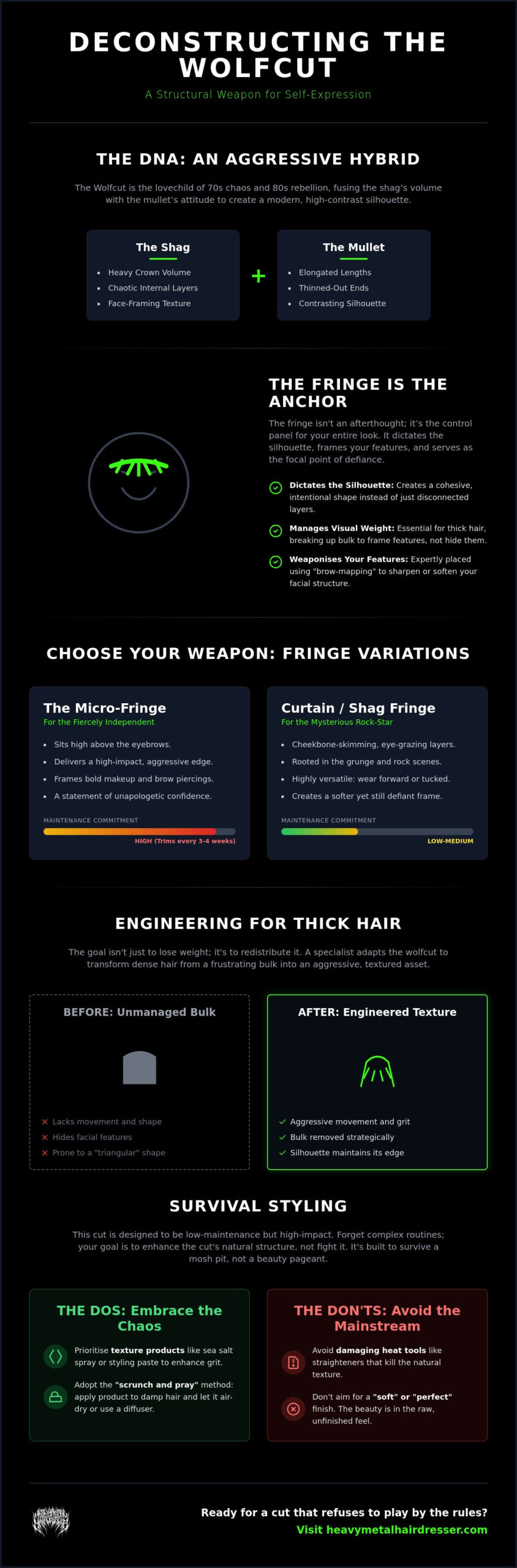
Think of the wolfcut as the aggressive lovechild of a classic shag and a traditional mullet. It thrives on extreme disconnection between the top and bottom sections. This isn’t a “blended” look; it’s a statement of contrast. You get aggressive face-framing layers that mimic a wolf’s mane, providing a frame for your features that feels both wild and intentional. It’s built for the mosh pit. If you want your wolfcut vs shag for fine hair choice to lean toward maximum “edge,” this is the winner. The layers are choppy and raw, designed to look like you’ve just stepped off a festival stage. It’s about creating a shape that stays messy and stays loud all day long.

The Technical Battle: Layers, Volume, and Fine Hair

Traditional layering is a death sentence for thin strands. It’s the reason so many people with fine hair are terrified of the scissors, fearing they’ll leave the salon with wispy, transparent ends. When a high-street stylist follows a standard textbook map, they often remove too much weight from the perimeter. This leaves you with those dreaded “see-through” ends. We don’t do that. When deciding between a wolfcut vs shag for fine hair, the technical approach must be about preservation. We carve the hair internally. This creates a hidden scaffold that pushes the top hair up, giving you height without making the bottom look like a wet cat.

It’s about more than just aesthetics. Throughout history, the cultural significance of hairstyles has shown that a cut is a tool for empowerment. For the alternative community, a strong silhouette is a non-negotiable part of our identity. We use specific techniques like point-cutting or razor work to inject movement amongst the strands. This isn’t about thinning the hair out. It’s about creating space for the hair to live and breathe. It is a precise, expert process that respects your hair’s density whilst forcing it to behave.

Internal Layering vs Surface Choppiness

Surface layers often fail fine hair because they lack the structural strength to stand up. They just sit there, heavy and flat. We focus on internal layering instead. This involves removing tiny amounts of weight from the middle of the hair shaft to create “hidden” support structures. Think of it like a corset for your hair. By using a razor, we create soft, jagged ends that lock into each other. This forces the hair to stack and lift naturally. If you want to see how we master these techniques, check out our textured hair services.

The Fringe Factor for Fine Hair

The fringe is the most important part of any alternative cut. For fine hair, a deep, wide fringe is a total game-changer. It pulls hair from the crown forward, which instantly makes the front of your hair look twice as thick. Whether you choose curtain bangs or a jagged micro-fringe, it anchors the entire style. This choice is vital when weighing up a wolfcut vs shag for fine hair, as the fringe defines the silhouette. To stop your bangs from going limp by lunch, we recommend the Death Grip technique. This involves using high-grit products to freeze the texture in place, ensuring your chaos stays exactly where you want it.

Wolfcut vs Shag for Fine Hair: Injecting Volume and Chaos into Thin Strands

Comparison: Wolfcut vs Shag on Thin Strands

Choosing between a wolfcut vs shag for fine hair comes down to your appetite for chaos. Both styles offer a definitive middle finger to flat, lifeless hair. However, they distribute weight in entirely different ways. One builds a fortress of volume around your face. The other thrives on aggressive disconnection. Understanding how these shapes interact with your specific density is the difference between a cut that stays bold and one that falls flat by lunch.

The Volume Winner: The Shag

The shag is the undisputed champion for those who prioritise the appearance of overall density. It concentrates all the choppy action exactly where fine hair needs it most: at the crown. By creating a “halo” of shorter, interior layers, it effectively disguises a flat crown and gives the illusion of a much fuller mane. It is also the lower-maintenance option for your morning routine. A quick blast of Hair To the Throne on damp hair followed by a rough dry is usually enough to wake up the texture. It is designed for the person who wants maximum impact with minimum morning organisation. The shag keeps your ends looking solid whilst forcing the top to stand up and shout.

The Edge Winner: The Wolfcut

If you are chasing a more aggressive, “mullet-lite” silhouette, the wolfcut is your weapon. It provides an edgy, high-contrast look that is perfect for showing off vivid colours or high-contrast dyes amongst your layers. Because the sections are more disconnected, it creates a wilder vibe that looks incredible in a mosh pit or under stage lights. The trade-off is that it requires slightly more styling effort. On very thin strands, those aggressive layers can occasionally look limp without the right support. You will need to be comfortable using product to keep the “wolf” mane from losing its bite throughout the day.

When it comes to the long game, the shag wins on the growth-out phase. Because the layers are more integrated, it ages gracefully whilst you are avoiding the salon. It often evolves into a beautiful, long-textured look over several months. The wolfcut, with its heavy face-framing and shorter top, usually requires more frequent trims to maintain that specific, sharp silhouette. If you are a regular at festivals and don’t mind the upkeep, the wolfcut is a masterpiece of alternative styling. If you want a cut that stays filthy and voluminous for months on end with zero effort, stick with the shag.

Styling Secrets for Fine Hair: From Flat to Filthy

Ditch the round brush. That’s for people who want to look like a 90s news anchor. We want grit. We want hair that looks like it’s been through a three-day festival and come out the other side with a story to tell. Styling a wolfcut vs shag for fine hair requires a complete shift in mindset. You aren’t trying to smooth the hair down; you’re trying to wake it up. The goal is a “filthy” texture that stays all day without collapsing under its own weight.

The process starts on damp hair. Apply a lightweight volumiser to give the strands some skeletal support. Don’t overdo it, as fine hair is easily weighed down by heavy resins. Once prepped, rough dry your hair to about 80%. Forget precision. Use your hands to toss the hair around, encouraging the natural chaos of the layers. This is where the foundation of your volume is built. After that, it’s time for the heavy hitters. Use Hair To the Throne for a boost of majestic height or Death Grip for that aggressive, gritty texture that defines the alternative look. Finish by finger-styling individual sections to define the layers without flattening the lift you’ve just created.

The ‘No-Blowout’ Blowout

Round brushes are the enemy of alternative texture. They create a polished, “pretty” finish that completely kills the vibe of a wolfcut or shag. Instead, use a diffuser or just your bare hands. Scrunch the hair upwards whilst drying to maximise the movement amongst your fine strands. This technique forces the internal layers we discussed earlier to stack against each other. If you’ve got vivid colours or high-contrast dyes, always use heat protection. Fine hair is fragile, and the last thing you want is for your electric purple to fade into a muddy mess because you blasted it with unprotected heat. Ready for a change? You can book your textured cut with our experts today.

Second-Day Survival Tips

Your hair usually looks better on day two anyway. The natural oils add a weight that helps the grit stick. Use dry shampoo as a styling tool rather than just a cleaner. Spray it into the roots and mid-lengths to add even more volume and a matte finish. If your fringe starts to look a bit sad, just wash the fringe in the sink and restyle it. It’s a five-minute hack that saves the entire look. This keeps the rest of your hair’s “grit” intact whilst ensuring your face-framing layers stay sharp and intentional. This is how you maintain the edge of a wolfcut or shag whilst keeping your hair healthy and vibrant.

Why Your High Street Stylist Might Kill Your Fine Hair Shag

Most high street stylists are trained to make hair look “nice” according to a narrow, polished standard. They’ve spent years learning how to blend everything into a soft, “pretty” finish that completely misses the point of an alternative aesthetic. When you’re debating a wolfcut vs shag for fine hair, you don’t want blended. You want aggression. You want a cut that has a voice. A mainstream stylist will often play it so safe that they end up removing the very weight you need to maintain density. They leave you with a limp, uninspired mess that doesn’t reflect your identity. A high street stylist might see a photo of a shag and try to make it “wearable” for the office. We see that same photo and figure out how to make it survive a twelve-hour set in a dark club.

We live and breathe this scene. Our expertise comes from festival stages and band styling, not just a textbook. We understand that your hair is a core part of your subcultural identity. It’s a signal to the rest of the world. In a safe-space salon like ours, you never have to justify why you want something “too messy” or “too loud.” We already get it. We know that fine hair needs smarter layering, not just “more” layers. We focus on keeping the perimeter solid whilst forcing volume where it counts. You aren’t just another appointment to us; you’re a member of a community that values self-expression above conformity.

The Alternative Specialist Advantage

We specialise in the textures that others avoid. We know how to use products like Death Grip to lock in that second-day grit from the moment you leave the chair. We also understand the delicate balance of maintaining vivid colours whilst carving out aggressive layers. It’s about a Rockstar standard of styling that prioritises character. You’re entering a space where being different is celebrated rather than merely tolerated. We don’t just cut hair; we build shapes that empower you to express your true self. Our stylists are knowledgeable guides who understand the nuances of alternative fashion and music subcultures.

Booking Your Transformation

Preparing for your appointment should be as exciting as the cut itself. Don’t just bring generic Pinterest boards. Bring photos of your favourite bands, festival shots, or subcultural icons. We want to see the energy you’re trying to capture. Our services are gender-inclusive and focused entirely on the individual. We’ll tailor the internal structure to suit your fine strands and your personal style perfectly. You can expect a raw, authentic environment where your identity is respected and your hair is transformed. Book your wolfcut or shag now and let’s inject some chaos into your look.

Reclaim Your Texture

Fine hair doesn’t have to be flat hair. You’ve seen how internal layering and strategic disconnection can turn thin strands into a high-volume statement. Whether you’ve settled the wolfcut vs shag for fine hair debate or you’re still weighing up the edge of a mullet-hybrid against the classic rockstar shag, the power is in the technique. We don’t do “pretty” layers here. We build shapes that survive the mosh pit and reflect who you actually are. It’s about grit, character, and refusing to settle for a mainstream trim.

As specialists in textured grit and subcultural style, we’ve spent years perfecting looks for touring bands and festival performers. Our salon is a gender-inclusive safe space where your identity is the priority. Stop fighting your hair and start embracing the chaos it’s capable of. Secure your spot with the UK’s alternative hair specialists today. You’re one appointment away from the volume you’ve been told was impossible. It’s time to look as loud as you feel.

Frequently Asked Questions

Is a wolfcut better than a shag for very thin hair?

A shag is generally superior for very thin hair because it maintains a more solid perimeter whilst forcing volume at the crown. When comparing a wolfcut vs shag for fine hair, the wolfcut’s extreme disconnection can sometimes leave the bottom looking too sparse if your density is low. The shag uses internal layers to build a halo of thickness that disguises flat spots and keeps your ends looking healthy and full.

Will a shag haircut make my fine hair look like it’s balding?

How often should I trim my wolfcut to keep the texture sharp?

You should book a trim every 6 to 8 weeks to keep the texture sharp and intentional. Because the wolfcut relies on high-contrast layers, the shape can start to look “grown-out” and lose its bite as the shorter sections reach the mid-lengths. Regular maintenance ensures the face-framing remains aggressive and the crown stays lifted, preventing your fine strands from looking unkempt rather than styled for the scene.

Can I have a wolfcut if I have fine hair and a round face?

You can absolutely rock a wolfcut with a round face. The key is how the specialist carves the face-framing layers to create angles and elongate the silhouette. By placing the shortest layers around the cheekbones or jawline, we can sharpen your features whilst the volume at the crown adds necessary height. It is a custom job that focuses on your unique bone structure rather than a one-size-fits-all template.

What are the best British styling products for fine, textured hair?

The best British-made products for this look are Death Grip and Hair To the Throne. We created these specifically to handle the “flat to filthy” transition without the weight of traditional waxes. Hair To the Throne provides the initial lift at the roots, whilst Death Grip adds that essential gritty texture to the layers. They are designed for alternative styles that need to survive a long set or a rainy festival.

Do I need to bleach my hair to get the best out of these styles?

Bleaching isn’t a requirement, but texture is always more visible on lightened or coloured hair. Dark, virgin hair can sometimes hide the intricate layering of a shag or wolfcut in certain lighting. Many of our clients opt for vivid colours or high-contrast dyes to make those jagged edges pop. However, we can carve plenty of movement into natural hair using the right technical “carving” methods during your transformation.

Is the wolfcut still in style for 2026?

The wolfcut remains a dominant force in 2026. It has evolved from the viral 2021 trend into a more refined, “grown-up” version that still prioritises rebellion. With over 1.2 billion views on TikTok as of March 2026, it’s clear that this hybrid style is a mainstay of alternative fashion. The current trend focuses on more blended, wearable layers whilst keeping that signature aggressive crown and face-framing mane that defines the look.

Can a shag be gender-neutral or is it a feminine cut?

The shag is an entirely gender-neutral style that belongs to the rockstar aesthetic, not a specific gender. It’s a silhouette that focuses on identity and subculture rather than traditional masculine or feminine norms. Whether you’re aiming for a 70s glam-rock vibe or a modern underground look, the shag is a versatile tool for self-expression. It works for anyone ready to ditch boring high-street standards for something raw and authentic.

Posted on

Shag vs Mullet: What’s the Difference and Which One Rules Your Style?

Shag vs Mullet: What’s the Difference and Which One Rules Your Style?

Most people think the difference between a shag and a mullet is just a few inches of hair at the nape, but they’re dead wrong. If you’re hunting for a new look, you’ve probably spent hours staring at “shullets” and wolfcuts trying to figure out shag vs mullet what’s the difference without much luck. It’s easy to feel stuck between wanting an aggressive, textured vibe and fearing you’ll end up with a dated, “bad” mullet that belongs in a dusty photo album.

We get it. Describing your favourite level of texture to a stylist shouldn’t feel like a test you’re about to fail. This guide will give you the technical breakdown of how these styles actually work. We’ll look at the “Death Grip” levels of texture that define a modern shag versus the disconnected, rebellious edge of a 2026 mullet. By the end, you’ll know exactly which cut suits your hair’s natural flow and have the confidence to book an alternative stylist who speaks your language.

Key Takeaways

  • Understand the technical divide between the connected layers of a shag and the deliberate disconnection that defines a modern mullet.
  • Get the definitive answer to shag vs mullet what’s the difference so you can describe your desired texture to your stylist with total confidence.
  • Explore hybrid styles like the wolfcut and shullet to find a middle ground between rock-and-roll volume and an aggressive silhouette.
  • Learn how to tailor these alternative cuts to your specific face shape and natural hair texture for a look that actually works for you.
  • Discover the essential toolkit, including Death Grip texture paste, to keep your layers sharp and mosh-pit-ready through any gig.

Defining the Chaos: What is a Shag and What is a Mullet?

The UK alternative scene doesn’t do boring hair. From the muddy pits of Bloodstock to the neon streets of Camden, textured styles are the current uniform. But when you’re ready for a change, you need to know shag vs mullet what’s the difference before you sit in the chair. These styles share a DNA of heavy texture and attitude, yet they occupy totally different spaces on the subcultural spectrum. One feels like a late-night vinyl session in 1975; the other feels like a punk show in a basement. Whether you’re rocking a natural shade or a vivid colour, these cuts thrive on movement and a refusal to blend in.

The 70s Soul of the Shag

The shag is a 70s icon that never truly died. It was born in the era of Joan Jett and Mick Jagger, designed to look like you just rolled out of bed after a stadium set. It’s defined by uniform, heavy layers and a rock-and-roll fringe that sits heavy over the eyes. Unlike other styles that rely on length, the shag is all about volume at the crown and face-framing texture that softens the jawline. The shag is a connected masterpiece of movement where every layer flows seamlessly into the next. It’s the go-to for anyone wanting effortless cool without the harsh lines of more aggressive cuts. We specialise in Shag Haircuts that prioritise this fluid, lived-in feel, making it a firm favourite amongst those who want volume without the commitment of a disconnected cut.

The 80s Rebellion of the Mullet

If the shag is effortless, the mullet is a loud, aggressive defiance of the status quo. Historically, the Mullet (haircut) was the ultimate “business in the front, party in the back” statement. Today, it’s been reimagined for 2026. We’ve ditched the crispy perms and stiff hairsprays for gritty, textured layers and sharp disconnection. The modern mullet is defined by the stark contrast between short temples and a long nape. There is a deliberate “gap” where the front doesn’t meet the back, creating a silhouette that demands attention. It’s a style for those who want to stand outside the mainstream and embrace a bit of chaos.

Whilst both styles use “Death Grip” levels of texture, the emotional vibe is the real divider. Choosing between them depends on whether you want the cohesive, shaggy volume of a rock star or the disconnected, rebellious edge of a punk. Knowing shag vs mullet what’s the difference helps you communicate that specific energy to your stylist so you don’t end up with a look that feels too safe. It’s about more than just hair; it’s about the subcultural attitude you carry into the room.

The Technical Divide: Connection vs Disconnection

Understanding shag vs mullet what’s the difference comes down to one technical concept: connection. In the hair world, connection means the layers flow into each other without a sudden jump in length. Disconnection is the opposite. It is a deliberate break where one section of hair is significantly longer than the part right next to it. This technical choice dictates how your hair moves in the pit and how much effort you will put into styling it every morning. It is the difference between a fluid, rock-and-roll silhouette and a sharp, aggressive frame.

Anatomy of a Shag: The Seamless Flow

A shag is a connected masterpiece. Every layer is technically linked to the one above it. We use square layers that blend into the overall length to create maximum movement without any harsh steps. The fringe is the anchor here. It frames the eyes and flows directly into the side layers, creating a rounded, shaggy silhouette that works at any length. Whether you are rocking a chin-length bob or waist-deep waves, the shag keeps everything cohesive. It is the best option for those who want that “messy” look whilst keeping the hair feeling like one unified style. If you are looking for a cut that moves with you, our Shag Haircuts are designed to provide that perfect, connected flow.

Anatomy of a Mullet: The Aggressive Break

The mullet is built on an aggressive break. It is fundamentally a disconnected cut. You have the “tail” at the back, but the sides are kept tight, often involving a fade or a sharp “step” that separates the front from the back. The top section stands independently from the length at the nape. This creates that signature drop-off that defines the look. It is a weapon of choice for anyone wanting a silhouette that stands out from a mile away. The modern mullet ditches the soft blending of the past for a gritty, intentional gap that highlights the contrast between short temples and a long nape.

The secret to both styles is the “pivot point”. This is the area behind the ear where the hair transitions from the front framing to the back length. In a shag, this transition is soft and blended. In a mullet, the pivot point is where the disconnection happens. It is where the front ends and the length begins. Whilst a shag can be almost any length, a mullet strictly requires that “tail” to maintain its identity. Knowing shag vs mullet what’s the difference technically allows you to tell your stylist exactly where you want that transition to happen, ensuring you walk out with the right level of aggression for your style.

Shag vs Mullet: What’s the Difference and Which One Rules Your Style?

Beyond the Basics: The Wolfcut and the Shullet

Sometimes the choice isn’t binary. You might find yourself caught in the middle, wanting the heavy volume of a rock-and-roll icon but craving the aggressive silhouette of a modern rebel. This is where hybrids like the Wolfcut and the Shullet come into play. Whilst we’ve already established shag vs mullet what’s the difference in terms of technical connection, these hybrid styles blur those lines to create something entirely new. They offer a way to experiment with alternative texture without committing to the extreme disconnection of a traditional mullet or the softer flow of a classic shag.

The Wolfcut: Where Shag Meets Round Layers

The Wolfcut isn’t just a fleeting social media trend. It is a technical evolution that combines the best parts of our Shag Haircuts with the wilder frame of a mullet. It is characterised by heavy, round layers and intense face-framing that mimics a lion’s mane. This style is a firm favourite for those with fine hair because the internal layering creates a massive volume boost that flatter styles simply can’t achieve. To keep the “wolfish” grit alive, you need to lean into the messiness. It thrives on movement and looks best when it’s slightly unhinged. If you want to get into the weeds of this specific look, check out The Ultimate Wolf Hair Cut Guide for a deeper dive into its aggressive texture.

The Shullet: The Stealth Choice

For the undecided or those amongst us who need to maintain a level of “professionalism” whilst still repping the scene, the Shullet is the stealth weapon of choice. Think of it as a mullet with the training wheels still on. It features more length on the sides than a standard mullet, allowing for a softer transition from the fringe to the back. It maintains a “connected” feel, but pushes the length at the nape to ensure the “party” in the back is still very much invited. The Shullet is also the perfect grow-out style. If you’ve been rocking a disconnected mullet and want to transition back to a more unified look, this hybrid bridges the gap perfectly.

Choosing between these hybrids depends on your end goal. If you want maximum volume and a mane-like frame, the Wolfcut is your winner. If you want to dip your toe into the mullet aesthetic without the harsh “step” behind the ear, the Shullet is the way to go. Understanding shag vs mullet what’s the difference allows you to see how these hybrids borrow from both worlds to create a custom level of aggression. Whether you’re heading to a gig or just heading to work, these mid-ground styles ensure your hair remains a core part of your identity without feeling like a costume.

Which Weapon Should You Choose? Face Shapes and Texture

Picking your next look isn’t just about chasing a subcultural vibe. It’s about how the geometry of the cut hits your face. When you’re weighing up shag vs mullet what’s the difference for your own reflection, you need to consider how your natural texture and bone structure play into the final result. A cut that looks incredible on a rail-thin punk might need a totally different layering strategy for someone with a thick, curly mane. Understanding shag vs mullet what’s the difference in a technical sense is step one; knowing how it sits on your head is step two. It’s about finding the version of these styles that rules your specific look.

Matching the Cut to Your Face Shape

Round faces thrive on height and vertical lines. A mullet is a secret weapon here because the tight sides and vertical length at the back elongate the face. Alternatively, a shag with massive volume at the crown creates a similar lifting effect that prevents the hair from looking bottom-heavy. Square faces, on the other hand, benefit from the soft, feathery layers of a shag that break up a strong jawline. These layers soften the corners of the face whilst maintaining an edgy silhouette. If you have a heart-shaped face, a heavy, textured fringe is non-negotiable. It balances a wider forehead and draws the focus straight to the eyes, creating a more symmetrical frame.

Texture: From Fine Strands to Thick Manes

Your hair’s natural behaviour dictates the technical approach. Thick hair requires aggressive internal layering to remove bulk without losing the silhouette. We use deep point-cutting to ensure the hair moves freely rather than sitting like a solid block. Fine hair needs the opposite strategy. We build “fake” volume through short, choppy crown layers that give the illusion of a thicker mane. For those with natural curls, the modern mullet is a godsend. The disconnection allows curls to bounce independently without the dreaded “triangle hair” effect that often plagues standard haircuts.

Once the shape is locked in, vivid hair colour can be used to highlight those aggressive layers. High-contrast shades make the texture pop in ways natural colours simply can’t. When you sit down for your consultation, use keywords like “grit”, “internal weight removal”, and “Death Grip texture” to ensure your stylist knows you aren’t looking for a standard salon trim. If you’re ready to commit to a look that actually fits your identity, book your transformation with our specialists today and get the texture you deserve.

Living with the Look: Maintenance and Mosh Pit Survival

A killer haircut is only half the battle. Once you’ve settled the debate of shag vs mullet what’s the difference and walked out of the salon, you need to keep that texture alive. These aren’t styles meant for a clinical, polished environment. They are built for the stage, the pit, and the three-day festival bender. Keeping your layers from falling flat requires a strategy that prioritises grit over perfection. If your hair looks too “done,” you’ve probably missed the point. You want it to look like it has lived a little, even on day one.

Styling with Death Grip and Grit

The “scrunch and go” method is your best friend for maximum chaos. Start with damp hair and a heavy dose of sea salt spray to provide a foundation of tackiness. Follow this up with our Death Grip texture paste. Work a small amount through your palms and aggressively scrunch it into the mid-lengths and ends. This creates that lived-in, “second-day” grit immediately after a wash. For those with natural wave or curl, using a diffuser on a low heat setting helps bake in the texture without creating unwanted frizz. You can find more details on how to style a modern mullet for specific product application tips that keep your silhouette sharp.

Professional Maintenance

Even the most rebellious cuts need a regular return to the chair to avoid turning into a total disaster. The maintenance schedule differs significantly based on the technical structure of your cut. Shags are generally more forgiving. You should expect to return every 8 to 12 weeks to keep the connected layers moving and prevent the crown from getting too heavy. Mullets require more frequent attention because of the disconnection. You’ll want a tidy-up every 4 to 6 weeks to keep the “business” sides tight and the silhouette aggressive.

  • Shag Maintenance: Focus on weight removal and fringe trims every 8 to 12 weeks.
  • Mullet Maintenance: Tighten the sides and clean up the nape every 4 to 6 weeks.
  • The Dusting Technique: A method we use to keep ends healthy without losing your hard-earned length.

To refresh your style between washes, skip the shampoo and use a dry texture spray or a bit more sea salt. This maintains the essential oils that give alternative hair its character whilst keeping the volume high. Understanding shag vs mullet what’s the difference in maintenance ensures you don’t let your style lose its edge before the next gig. Keep it gritty, keep it textured, and don’t be afraid to let it get messy.

Own Your Alternative Identity

Choosing between a shag and a mullet isn’t just about hair length; it’s about how you want to move through the world. You now understand shag vs mullet what’s the difference: it is the technical choice between fluid, connected volume and sharp, disconnected aggression. Whether you are leaning towards a classic rock-and-roll shag or a gritty, modern mullet, your hair should be a direct reflection of your subcultural grit. It is about more than just a trim. It is about finding a look that survives the pit and looks even better the next morning.

We don’t do traditional. Our team at Heavy Metal Hairdresser consists of backstage festival styling experts who live for aggressive texture and vivid colour. We pride ourselves on being a gender-inclusive safe space where your individuality is the only rule we follow. If you are tired of explaining your “vibe” to stylists who just don’t get it, it is time to change your scene. Ready to ditch the norm? Book your alternative cut at Heavy Metal Hairdresser today.

Stop settling for safe hair. Embrace the chaos, trust the technical expertise, and walk out with a style that actually says something.

Frequently Asked Questions

Is a wolf cut the same as a shag?

A wolfcut is a hybrid, not a direct replica of a shag. Whilst a shag is all about connected, fluid layers, the wolfcut borrows the round layers of a shag and pairs them with the aggressive silhouette of a mullet. It creates a mane-like frame around the face that is much heavier than a traditional 70s shag. It’s the perfect middle ground if you are still debating shag vs mullet what’s the difference for your own style.

Can I have a mullet if I have curly hair?

Curly hair and mullets are a perfect match. The natural bounce of curls helps the disconnected sections look more organic and less like a deliberate “step” in the hair. This cut is actually a godsend for curly textures because it removes the internal weight that usually causes hair to flare out into a triangle shape. It keeps the volume at the crown and the party at the back without the frizz.

Will a shag haircut make my fine hair look thinner?

A shag is actually one of the best cuts for fine hair. By adding short, choppy layers at the crown, we build “fake” volume that makes thin strands look much fuller. Instead of a flat, heavy silhouette, you get movement and lift that prevents the hair from looking limp. It’s all about technical weight removal and creating texture where it’s needed most to boost your natural mane.

How do I ask my hairdresser for a modern mullet without it looking like the 80s?

The secret to a 2026 mullet is texture and grit. Ask your stylist for “disconnected layers” and “tight temples” rather than a soft, blended transition. Avoid any mention of perms or round brushes. You want the ends to look choppy and lived-in. Bringing a photo of a modern, textured cut ensures you don’t walk out looking like a dated relic. Understanding shag vs mullet what’s the difference helps you specify the level of disconnection you want.

Do shags and mullets require a lot of styling time?

These styles are built for people who hate spending an hour in front of the mirror. They thrive on being slightly unhinged and messy. Most only require a quick scrunch with sea salt spray or a bit of Death Grip texture paste to look stage-ready. They are designed to look better as the day goes on, making them ideal for long festival weekends where you need your hair to survive the mosh pit.

What is the best fringe for a shag haircut?

A heavy, eye-grazing fringe is the definitive anchor for any shag. It should be textured and connected to the face-framing layers to create a seamless flow. If you want something less intense, curtain bangs offer a similar vibe but are easier to pin back. The goal is to create a frame that highlights your eyes whilst maintaining that rock-and-roll attitude that defines the style’s 70s roots.

Can a mullet be professional for work?

Absolutely, especially if you opt for a “shullet” hybrid. By keeping the sides slightly longer and the transition more blended, you can maintain a professional look whilst keeping the length at the nape. It’s about controlling the level of aggression in the cut. A well-maintained, textured mullet can look sharp and intentional in any environment, provided you keep the “business” sides tidy and use the right product to control the chaos.

How do I grow out a mullet into a shag?

Transitioning from a mullet to a shag is all about patience and connection. You need to let the sides grow out whilst keeping the back length in check. Once the hair behind your ears reaches a certain length, your stylist can blend it into the back sections. This removes the disconnected gap, turning your aggressive mullet into a cohesive, heavily layered shag over a few strategic appointments at the salon.

Posted on

Styling a Shag with Natural Texture: Embrace the Raw, Alternative Grit

Styling a Shag with Natural Texture: Embrace the Raw, Alternative Grit

Your hair isn’t a problem to be solved; it’s a weapon waiting to be sharpened. You’ve likely walked out of a salon with a fresh cut only to find that, once you’re back at home, styling a shag with natural texture results in a look that feels more “suburban mum” than “subterranean punk.” It’s a common frustration. You want aggressive layers and raw movement, but you end up with hair that looks too round, too pretty, or just plain frizzy.

We get it. The mainstream beauty industry wants to sell you “polished” and “manageable,” but we’re here to help you embrace the chaos. This guide is about ditching the flat, greasy finishes of traditional products and learning how to weaponise your hair’s natural behaviour for a look that is truly mosh-pit ready. We’ll break down the “Death Grip” approach to styling; we will show you which tools actually create grit and prove that your natural texture is the engine behind the ultimate alternative aesthetic. It’s time to stop taming your hair and start letting it scream.

Key Takeaways

  • Learn how to move away from “pretty” styles and embrace a high-contrast, aggressive finish that celebrates your hair’s natural behaviour.
  • Understand how shattered layers and crown height work together to create that iconic, stage-ready rockstar silhouette.
  • Master the art of styling a shag with natural texture using salt sprays and the “Death Grip” approach for maximum grit and hold.
  • Discover the “Low-Fi” wash ritual and why over-conditioning is the enemy of a truly raw, alternative look.
  • Get expert tips on keeping your shag sharp and managing fringe growth between your professional salon sessions.

Beyond the “Pretty” Shag: Redefining Texture for Alt-Souls

Most magazines want to sell you a “soft” shag. They talk about “effortless chic” and “70s throwbacks” that look like they belong on a greeting card. We aren’t here for that. An alternative shag is high-contrast, aggressive, and thrives on absolute chaos. If you look at the history of the shag, it wasn’t born in a high-end boutique. It was forged in the underground. Styling a shag with natural texture means leaning into the grit. It’s about rejecting the round, blow-dried finish in favour of something that looks like it just survived a three-day festival.

Stop fighting your hair. The industry has spent decades telling you that your natural behaviour needs to be corrected. They want you to iron out the kinks and smooth down the flyaways. We think that’s a waste of potential. Your hair already knows how to be cool. You just need to give it the right framework and the permission to be loud.

Why Natural Texture is Your Best Ally

Your hair’s natural movement is the engine of this cut. When we talk about “shattered” layers, we mean hair that has a mind of its own. Natural waves and curls provide the internal structure that makes a shag look alive. Whilst mainstream stylists might try to “tame” your frizz, we see it as a tool. Frizz is just unorganised volume. When you stop fighting it, you gain the height and width needed for a truly edgy silhouette. Plus, a textured cut grows out better. It doesn’t lose its shape; it just evolves into a new version of itself.

Mainstream vs. Alternative Styling Philosophies

There is a massive divide in how people approach hair. Mainstream philosophy is obsessed with control. It wants everything smooth, shiny, and perfectly placed. It’s the “clean girl” aesthetic applied to a haircut that was meant to be messy. Our approach at Heavy Metal Hairdresser is the opposite. We prioritise identity over perfection. We want your hair to look gritty, matt, and unapologetically loud.

Styling a shag with natural texture requires a shift in mindset. You have to stop viewing “messy” as a failure. In our world, perfection is boring. We use techniques like the “Death Grip” to build hold without sacrificing the raw feel of the hair. It’s about creating a look that feels authentic to you, whether you’re on stage or in the pit. Don’t aim for a salon-polished finish. Aim for a look that tells people exactly who you are before you even open your mouth.

The Anatomy of Texture: How Your Cut Interacts with Your Hair

The architecture of a shag is designed to set your hair free. It isn’t just about cutting hair shorter; it’s about removing weight in specific zones to let your natural pattern take over. When you’re styling a shag with natural texture, you’re working with the physics of the cut. Every “shattered” layer is a deliberate choice to encourage a wave or a curl to spring to life. If you’ve ever felt like your hair was a heavy curtain, this is the demolition it needs. Mainstream stylists often rely on round brushes to “finish” a look, but that just creates a dated, pretty flick. We want raw energy instead.

Your hair type dictates how these layers behave. Coarse hair thrives on aggressive thinning, whilst fine hair needs strategic internal layers to avoid looking limp. The goal is a silhouette that looks lived-in before you even touch a product. It’s about movement. It’s about attitude. It’s about making sure your hair doesn’t just sit there; it performs.

Understanding Your Hair’s Behaviour Under Layers

Removing bulk is the secret to movement. For those with waves or curls, layers remove the weight that drags your pattern flat. Suddenly, your hair has the freedom to bounce and coil. Straight hair requires a different approach. It needs “internal” texture, essentially hidden layers, to prevent it from looking like a flat sheet. If you’ve been experimenting with bleach or vivid colours, your texture will be even more responsive to grit. Processed hair often has more “grab,” which is perfect for an aggressive, textured look. You can find some basic tips for styling a shag, but the real magic happens when you understand your specific hair’s unique rebellion.

The Crown: Where the Chaos Begins

The crown is the most vital part of an alternative shag. This is where we create that iconic “wolfy” height that separates a subcultural cut from a standard salon layer. Short, choppy layers at the top provide the foundation for volume that doesn’t require a blow-dryer. We want to avoid the “helmet hair” effect, where the top looks like a solid, unmoving block. By using specific texturising techniques, we ensure the hair stays separated and gritty. You can inject volume into the roots simply by using your hands and the right product. It’s about creating a silhouette that looks sharp and intentional from every angle. If you’re ready to commit to the chaos, check out our shag haircuts to see how we transform standard textures into something legendary.

Styling a Shag with Natural Texture: Embrace the Raw, Alternative Grit

Styling Weapons: Choosing Products for Grit and Chaos

Mainstream beauty editors love suggesting expensive hydrating mists and silk-infused conditioners. They claim these products are essential for a healthy look. They are wrong. If you want a raw, alternative finish, hydration is often your enemy. It weighs the hair down, smoothes the cuticle, and kills the very friction that makes a shag look alive. Styling a shag with natural texture requires a “Death Grip” philosophy. We want products that provide hold, build massive friction, and keep the hair looking matt and aggressive. You aren’t aiming for “healthy” in the traditional sense; you’re aiming for stage-ready grit.

Your styling kit should be a collection of weapons designed to defy gravity. Forget shiny pomades or greasy waxes. Those are for retro grease monkeys. For a subcultural shag, we prioritise dry, tactile finishes that allow the hair to stand up and stay there. We use products that work with your hair’s natural rebellion rather than trying to sedate it.

Salt Sprays and Texture Tonics

Salt spray is the absolute backbone of any alternative kit. It mimics the effect of sea air or sweat, providing the “built-in” grit necessary for a lived-in look. For the best results, apply your spray to towel-dried hair. This allows the product to bond with the hair as it dries, creating a foundation of texture from the inside out. Focus your application on the mid-lengths. This is where you want to enhance that “choppy” effect. Whilst some cheap sprays can feel like literal glue, a high-quality texture tonic provides an aggressive hold without the plastic-like crunch. It should feel like hair, only tougher.

Pastes and Clays: Defining the Shattered Ends

Once your hair is dry, you need to define the chaos. This is where matt pastes and clays come into play. Our “Hair To the Throne” styling approach relies on a matt finish to keep the look modern and edgy. Shine reflects light and makes layers look blended; matt finishes absorb light and make those shattered ends pop. Use the “scrunch and twist” technique. Take a small amount of clay, rub it between your palms until it’s warm, and then aggressively scrunch it into the ends of your layers. This creates separation and prevents the cut from looking like one solid mass.

Don’t forget the power of dry shampoo as a primary styling tool. Don’t wait until your hair is dirty to use it. Applying a blast of dry shampoo to clean roots provides instant lift and a dusty, gritty texture that helps the crown layers stand up. It’s about building layers of product that work together to maintain that mosh-pit ready silhouette all day long. Avoid over-applying. You want to enhance the natural movement, not bury it under a mountain of gunk. Start small and build the chaos until it feels right.

The Styling Ritual: Step-by-Step Texture Resurrection

Mainstream advice often suggests “plopping” your hair or sleeping in tight braids to create waves. Those methods result in uniform, artificial patterns that look like you’re trying too hard. We want a resurrection, not a fabrication. Styling a shag with natural texture starts with the “Low-Fi” wash. If your hair is too silky or over-conditioned, it will never hold the grit of the Death Grip. Skip the heavy masks. Apply a light conditioner only to the very ends of your hair. You want the mid-lengths to feel slightly raw and responsive to product, not slippery and sedated.

Once you’re out of the shower, towel-dry your hair aggressively. This isn’t a spa; it’s a preparation for chaos. Apply your chosen salt sprays or texture tonics whilst the hair is damp. Then, use the “Scruff” technique. This involves using your fingers to rake, shake, and manually manipulate the hair into its shattered positions. Forget the brush. Your hands are the only tools you need to encourage your hair’s natural rebellion. The final step of the ritual is the head-bang. It sounds like a cliché, but a vigorous shake of the head allows the layers to settle into a lived-in silhouette that looks authentic rather than staged.

The Air-Dry Method for Effortless Grit

If you have the time, air-drying is the best way to maintain the integrity of your natural pattern. Organise your fringe whilst it is soaking wet; get it sitting exactly where you want it. After that, follow the “Hands-Off” rule. Touching your hair whilst it is drying breaks the natural clumps and creates a fuzzy, uncontrolled mess. You want purposeful grit, not a halo of fluff. Once the hair is about 90% dry, give it one final, aggressive scrunch to break the product cast. This releases the movement whilst keeping the hold firmly in place.

Diffusing for Maximum Aggression

When you need more volume, a diffuser is your best weapon. Don’t use it to create “pretty” ringlets. Instead, use low heat and high airflow to mimic a wind-blown, stage-ready texture. Focus the airflow directly at the roots to achieve that iconic “Hair To the Throne” height. Scrunch the hair into the diffuser bowl to boost your natural waves, but keep the movement fast and erratic. This prevents the hair from looking too “done” and ensures the finish remains sharp and alternative. If you want to master these techniques at a professional level, check out our alternative hair courses to sharpen your skills.

Maintaining the Resurrection: Keeping Your Shag Sharp

Mainstream salons love a schedule. They’ll tell you that you need a trim every six weeks to keep your hair looking “healthy” and “neat.” We think that’s rubbish. An alternative shag is one of the few cuts that actually improves as it grows in. The layers settle. The edges soften. It starts to look like it belongs to you rather than a stylist. Styling a shag with natural texture becomes easier as the hair gains a bit of weight and history. You aren’t chasing a fresh-from-the-chair look. You’re cultivating a signature that looks better the messier it gets.

Managing your fringe is the only real hurdle in the long game. Between professional sessions, keep your fringe shaggy rather than blunt. If it starts to hit your eyes, don’t reach for the kitchen scissors to create a straight line. That kills the aggression. Instead, use a bit of your matt paste to piece it out and push it to the sides. This keeps the frame around your face sharp without losing the “shattered” aesthetic we’ve built. Admit defeat only when the crown height starts to sag or the back feels too heavy to hold a curl. That’s when it’s time for a professional reset. Styling a shag with natural texture shouldn’t be a daily battle; it should be a sustainable rebellion.

Day Two Survival: The Mosh-Pit Refresh

You don’t need to wash your hair to bring the chaos back. In fact, day-two hair often has more natural grit than clean hair. To reactivate your products, use a light water spritz followed by a fresh blast of salt spray. This wakes up the “Death Grip” foundation you built on day one. Dry shampoo is your best friend here. Don’t just use it for oil. Use it to inject “backstage” volume into the crown by blasting the roots and massaging with your fingertips. If the mid-lengths are looking too wild, tie back the top sections with a small clip or band. This maintains the shaggy silhouette whilst keeping the hair out of your face during the day.

Beyond the Cut: The Heavy Metal Hairdresser Experience

Your hair is your most visible form of self-expression. Choosing a wolf hair cut specialist ensures that your stylist understands subcultural aesthetics and the music that drives them. We don’t do “pretty.” We do raw, aggressive, and authentic. It is about more than just the technique; it’s about finding a safe space where your identity is celebrated and your hair’s natural behaviour is respected. Learning how to maintain a shag haircut is a journey of self-discovery. When you embrace the natural behaviour of your hair, you stop being a slave to the mirror. You become the authority on your own look. Keep it gritty. Keep it loud. Keep it yours.

Claim Your Chaos: Own the Raw Alternative Silhouette

Your hair is a statement of intent. You’ve learned that styling a shag with natural texture isn’t about control; it’s about collaboration with the chaos. By ditching the round brush and embracing the “Death Grip” philosophy, you’ve moved beyond the polished mainstream. You are now in a space where your identity takes centre stage. Whether you’re air-drying for effortless grit or diffusing for maximum aggression, the power is in your hands. Don’t let the beauty industry sedate your style.

We are the experts in aggressive, stage-ready hair. As seen backstage at Download Festival, we specialise in wolfcuts and shags that defy the ordinary. We provide a gender-inclusive safe space where your subcultural identity is celebrated, not just tolerated. Stop settling for “pretty” when you were born for the pit. Your natural movement is your greatest weapon. Use it.

Join the resurrection and book your alternative transformation. It’s time to stop taming your hair and start letting it scream. Stay loud; stay gritty.

Frequently Asked Questions

Can I style a shag with natural texture if my hair is pin-straight?

Yes, you absolutely can. Pin-straight hair relies on the internal “shattered” layers of the cut to create movement where there is usually none. When styling a shag with natural texture on straight hair, use a heavy-duty salt spray on damp hair followed by a matt clay to piece out the ends. This builds the necessary friction to prevent the hair from looking flat or lifeless.

How do I stop my natural texture from looking frizzy instead of shaggy?

Frizz is simply volume that hasn’t been given a direction yet. To stop it from looking uncontrolled, follow the “Hands-Off” rule whilst your hair is drying to prevent breaking up the natural clumps. Once your hair is almost entirely dry, use a small amount of matt paste to define the ends. This turns fuzzy volume into purposeful, aggressive texture that looks intentional.

What are the best products for styling a shag with natural waves?

Salt sprays and texturising clays are the primary weapons for styling a shag with natural texture. You should avoid heavy, oil-based serums or “smoothing” creams that weigh the hair down and kill the volume. Look for products that provide a matt finish and high friction, as these keep your layers separated and sharp throughout the day.

Do I need a diffuser to style a shag with natural texture?

You don’t strictly need one, but it is a game-changer for volume. Air-drying is perfect for a low-maintenance, lived-in look, but a diffuser allows you to inject massive aggression into the crown. It is the fastest way to achieve “Hair To the Throne” height and boost your natural pattern without creating “pretty” or uniform ringlets.

How often should I wash my hair when maintaining a textured shag?

Aim to wash your hair only two or three times a week. Over-washing strips the natural oils and grit that help an alternative cut hold its shape. A “Low-Fi” wash schedule ensures your hair remains responsive to texturising products whilst preventing it from becoming too silky or slippery to style effectively.

Can I have a shag if I have very curly or coily hair?

Absolutely, and it is one of the best cuts for high-density textures. A shag on curly or coily hair is all about strategic weight removal to let your natural pattern breathe. By cutting shorter layers into the crown, we allow your coils to spring up and create a high-contrast, voluminous shape that rejects mainstream beauty standards.

What is the “Death Grip” technique for alternative hair?

The “Death Grip” is our signature styling philosophy. It involves using high-hold, matt-finish products to lock in a raw and durable silhouette. This technique ensures your hair stays stage-ready through a full set or a night in the mosh-pit without losing its aggressive edge or collapsing into a flat mess.

How do I style my fringe if it has a cowlick or weird natural movement?

Style your fringe whilst it is soaking wet to get ahead of the natural movement. Use your fingers to direct the hair into place, leaning into the cowlick’s direction rather than trying to iron it out. Once dry, use a bit of matt clay to make the “weird” movement look like a deliberate, alternative style choice.

Posted on

Curly Wolf Cut Inspiration: 2026 Guide to Aggressive Texture and Rockstar Grit

Curly Wolf Cut Inspiration: 2026 Guide to Aggressive Texture and Rockstar Grit

Your curls aren’t a problem to be tamed. They’re a weapon of self-expression that most high-street stylists are too terrified to touch. If you’re tired of walking out of a salon with a polite, triangle-shaped bob when you actually wanted a riot, you’re finally in the right place. Learning how to style a curly wolf cut is about more than just managing frizz; it’s about reclaiming your alternative identity through aggressive texture and intentional chaos. We know the struggle of the damp UK weather turning a sharp look into a soft mess. We’re here to kill that cycle once and for all.

You deserve a cut that celebrates your natural grit rather than trying to polish it away. In this 2026 guide, we’ll show you how to transform your curls into a rebellious masterpiece using expert layering techniques and subcultural inspiration. We’ll break down the specific products needed for that rockstar finish and explain how to maintain the disconnected layers that define this movement. Get ready to embrace a style that’s as unapologetic as the music that inspired it. It’s time to let the wolf out.

Key Takeaways

  • Understand why the curly wolf cut thrives on “disconnection” and aggressive layering to create volume that defies boring, mainstream standards.
  • Explore the best wolf cut variations for your specific curl pattern, from high-volume cropped explosions to long-layered grit.
  • Master how to style a curly wolf cut using moisture-locking techniques and grit-focused products to ensure your texture survives the British weather.
  • Discover how face-framing layers can be carved out to accentuate your features whilst maintaining a raw, rockstar edge.
  • Learn why choosing an alternative specialist is essential for achieving an intentional, rebellious silhouette that celebrates your unique identity.

What is a Curly Wolf Cut? Reclaiming Your Texture with Aggressive Layers

The curly wolf cut isn’t just another passing salon trend. It’s a high-contrast, heavily layered technical rebellion that blends the volume of a shag with the sharp, elongated silhouette of a mullet. Unlike mainstream cuts that aim for a soft, blended look, the wolf cut thrives on intentional disconnection. This means your shorter crown layers don’t have to meet the length in a traditional, polite way. It’s about creating a mane that looks aggressive and entirely your own. It’s a style that demands to be noticed.

Curls are the secret weapon for this specific aesthetic. Natural texture provides the raw volume needed for that iconic “mane” effect without forcing you to spend hours with heat tools. This look is a direct evolution of the 70s rock scene, now adapted for the 2026 alternative community. It’s for the people who want their hair to reflect their music, their politics, and their identity. By reclaiming your natural texture through these bold shapes, you’re stepping away from the clinical perfection of the high street and into something much more authentic.

The Hybrid Origin: Shag Meets Mullet

This style is a chaotic love child. The shag haircut provides the internal texture that keeps the hair moving and alive. Historically, the Shag (haircut) was defined by its messy, effortless layers; however, the wolf cut takes this further by adding the aggressive tail of a mullet. This combination creates a face-framing grit that looks sharp and purposeful. Whilst straight-hair versions of this cut can sometimes look flat, the curly variant is far more wolf-like because it holds its shape through sheer natural energy and bounce.

Why Curls and Wolf Cuts are a Deadly Duo

If you have natural curls, you’ve likely spent years fighting the triangle hair problem. Traditional long layers often result in a flat top and an awkwardly wide bottom. The wolf cut kills this silhouette. By using aggressive, shorter layers at the crown, we eliminate weight where you don’t want it and add height where you do. Curls naturally support the vertical lift required for a successful wolf cut crown. When you’re figuring out how to style a curly wolf cut, you’ll realise the cut itself does most of the heavy lifting. Here is why curls are the ultimate canvas:

  • Vertical Lift: Curls have the structural integrity to stand up at the crown, creating height that lasts.
  • Weight Removal: Aggressive layering stops the heavy bottom effect common in thick hair types.
  • Natural Grit: The inherent frizz and bounce of curls provide that “dirty” rockstar finish effortlessly.

Knowing how to style a curly wolf cut starts with respecting these natural mechanics. The goal is to enhance the behaviour of your hair rather than trying to force it into a shape it doesn’t want to hold. By leaning into the chaos of your curls, you achieve a level of volume and texture that straight-haired people can only dream of.

Curly Wolf Cut Inspiration: 5 Styles to Unleash Your Inner Rockstar

The shift towards experimental hair isn’t just a TikTok phase. It’s a wider cultural movement that celebrates the “shullet” and other high-energy hybrids. As noted by The Guardian on modern hair trends, these edgy silhouettes are part of a broader push for bold, identity-affirming looks. Choosing the right variation depends entirely on your curl pattern and how much chaos you’re willing to embrace. Learning how to style a curly wolf cut begins with picking a silhouette that works with your texture rather than fighting against it.

The Cropped Wolf: High-Volume Chaos

This version is a short, high-volume explosion of curls. It’s the perfect choice for Type 3 textures that naturally want to reach for the sky. We focus on extreme crown height and subtle temple-shaving to create a sharper, more aggressive silhouette. This cut is ideal if you want to highlight your jawline and cheekbones whilst keeping the maintenance low. It works best for tighter curls that can hold their own weight without drooping into a sad puddle by midday.

The Long-Layered Wolf: Heavy Metal Flow

You don’t have to sacrifice your length to join the pack. The long-layered wolf keeps your hair below the shoulders whilst shredding the top layers for maximum grit. It’s designed for movement. If you’re planning on spending your weekend in the pit, this is the cut for you. We manage the weight of long curly hair by removing bulk from the mid-lengths, ensuring your wolf shape stays intact even after hours of headbanging. It’s durable, raw, and unapologetically loud.

For those who want a classic rock aesthetic, the ‘Joan Jett’ Curly Wolf is the ultimate dark horse. This style is moody, heavy on the fringe, and typically kept in darker tones to emphasise the texture. It’s a timeless look that relies on a thick, curly fringe to frame the eyes. Once you’ve picked your vibe, knowing how to style a curly wolf cut becomes a matter of choosing the right grit for the finish. Whether you want it matte and “dirty” or defined and glossy, the foundation is in the layers.

If you’re looking for maximum impact, the Vivid Wolf is the answer. Pairing aggressive layers with vivid hair colour turns your hair into a high-pigment statement. The layers help the different tones pop, creating a multidimensional effect that looks incredible under stage lights. For a less aggressive entry point, the Soft-Wave Wolf offers a gateway for those with looser curl patterns. It’s a more blended approach that still maintains the iconic volume without the extreme disconnection of its shorter cousins. If you’re ready to commit to the pack, our specialists in bespoke wolfcuts are ready to carve out your new identity.

Curly Wolf Cut Inspiration: 2026 Guide to Aggressive Texture and Rockstar Grit

Anatomy of the Cut: Disconnected Layers and Face-Framing Grit

Mainstream stylists will tell you that layers should always blend seamlessly. They are wrong. For a true wolf cut, we embrace disconnection. This is the technical gap between the short, voluminous crown and the longer, shaggy tail. It creates a silhouette that traditional cuts simply can’t touch. By keeping the top layers aggressively short, we force the curls to stand up and create that iconic mane. This isn’t a mistake; it’s a calculated choice. Understanding this architecture makes learning how to style a curly wolf cut significantly easier because the shape is built into the hair’s foundation.

Carving out the face-frame is where we organise the chaos. We use your natural curls to accentuate your favourite features. Whether it’s a sharp jawline or high cheekbones, the layers are shredded using razors or deep point-cutting. This creates raw, aggressive edges that look lived-in from day one. It’s about grit, not glamour. We don’t want a “done” look; we want a cut that looks like it’s seen a few late nights at a basement show. From bottleneck bangs to aggressive micro-fringes, the goal is to centre the face whilst letting the rest of the texture run wild.

Managing Volume without the Triangle Disaster

The triangle shape is the curse of the curly community. We kill it through strategic thinning. Instead of just removing hair, we remove bulk from the “corners” of the silhouette. This prevents the hair from flaring out at the bottom like an unwanted bell. During the cut, over-direction is vital. By pulling the hair forward or upward whilst cutting, we create the specific geometry that allows the tail to remain visible whilst the crown stays high. It ensures the back doesn’t become a solid, heavy block of texture that hides your neck.

The Importance of the Fringe

A wolf cut without a fringe is just a long mullet. Curly bangs are the anchor of this entire alternative aesthetic. Never fear the forehead-fringe; natural texture makes it look effortless and rebellious. We match the fringe density to the rest of the cut’s chaos to ensure it doesn’t look like an afterthought. Whether you opt for soft bottleneck bangs or an aggressive micro-fringe, it centres the face and completes the rockstar grit. When you’re mastering how to style a curly wolf cut, the fringe is usually the piece that ties the whole identity together.

The shredded technique is what separates our work from a standard high-street trim. By using razors, we can thin out the ends of the curls to create a wispy, “shredded” effect that enhances the wolf-like appearance. This prevents the curls from looking too “perfect” or “bouncy,” keeping the vibe firmly in the alternative scene. It’s about weaponising your texture to create a look that is as fierce as it is functional.

How to Style and Maintain Your Curly Wolf Cut

Put down the round brush. If you have been told to blow-dry your curls into submission with a ceramic barrel, you have been lied to. Mastering how to style a curly wolf cut requires a shift in mindset. We aren’t looking for a polished, bouncy finish; we are aiming for aggressive, gritty texture that looks intentional and raw. This five-step process ensures your mane stays high and your silhouette stays sharp even in the dampest UK weather.

  • Step 1: Start with soaking wet hair. Curls need moisture to clump properly. Apply a decent leave-in conditioner to lock that hydration in before you even think about styling.
  • Step 2: Apply a grit-focused styling product. This is where you set the tone for the “dirty” rockstar finish. Work the product through from mid-lengths to ends.
  • Step 3: Diffuse on low heat or air-dry whilst “scrunching” the hair upwards. This encourages the specific wolf-shape and prevents the weight of the water from dragging your crown down.
  • Step 4: Once dry, use a hair pick or your fingers to “explode” the crown layers. Pull the hair away from the scalp to create maximum height and volume.
  • Step 5: Finish with a light-hold salt spray. This locks in the chaos and ensures your silhouette doesn’t collapse an hour after you leave the house.

The No-Brush Rule: Preserving the Curl Pattern

Brushes are for bobs. For a wolf cut, they are the enemy. Using a brush on dry curls creates a fuzzy, undefined mess that ruins the aggressive clumping this style relies on. Wide-tooth combs or your own fingers are the only tools you need. By avoiding brushes, you maintain the “piecey” look that defines the subcultural aesthetic. It allows the disconnected layers to stand out as individual shards of texture rather than a single, frizzy cloud. If you want to keep that sharp, shredded edge, keep the bristles away from your head.

Essential Products for Gritty, Textured Curls

The right kit makes the difference between a flat mess and a rockstar mane. When learning how to style a curly wolf cut, you need products that add hold without the grease. Look for our Death Grip style texture pastes to define the ends and add necessary weight to the tail. For the crown, our Hair To the Throne volume powders are essential. They provide instant vertical lift that lasts all day. Avoid heavy silicones at all costs. They weigh down the wolf silhouette and make your curls look greasy rather than gritty. You want your hair to feel lived-in, not unwashed.

Maintaining this look is about embracing the natural evolution of your hair throughout the day. A little bit of frizz amongst the layers actually adds to the aesthetic, provided the foundation of the cut is solid. If you are ready to ditch the mainstream and embrace a style that actually fits your identity, it is time to book in with a specialist who understands the assignment.

Why Heavy Metal Hairdresser is the Ultimate Destination for Your Wolf Cut

We don’t do traditional. If you’re looking for a polite bridal updo or a standard high-street trim, you’re in the wrong place. We specialise in the wolf hair cut and its rebellious cousins. Our stylists understand that your hair is a weapon of self-expression; it is the intersection of music, identity, and raw technical skill. We have spent years mastering the art of disconnected layers so you don’t have to settle for a generic result that dies the moment you leave the salon chair.

Clients travel from across the UK to sit in our chairs because we speak their language. When you ask for rockstar grit, we don’t reach for a thinning shear and hope for the best. We use razors and point-cutting to build a silhouette that survives the real world. Whether you are looking for a fresh transformation or need expert advice on how to style a curly wolf cut for a weekend-long festival, we have the specialised knowledge to make it happen. We don’t just cut hair. We craft an identity.

An Inclusive Space for Alternative Identities

We are a gender-inclusive safe space. We believe hair has no gender; our cuts are designed for people, not binaries. We celebrate individuality above all else. The salon environment feels like home for the metal and underground community because it is our home too. Your consultation won’t be a list of “shoulds” based on mainstream beauty standards. It will be a conversation about your favourite bands, your subcultural references, and how you want to feel when you look in the mirror. We listen, we understand, and then we create.

Expert Styling for the Mosh Pit and Beyond

Our work is built to last. We have styled backstage at festivals like Download and Bloodstock, so we know exactly what it takes for a look to survive a three-day weekend in a field. We design our wolf cuts to endure the chaos of the mosh pit whilst remaining sharp for your everyday life. Beyond the technicality of the cut, we provide professional advice on how to style a curly wolf cut to keep your texture aggressive and your vivid colours saturated. Join the national community of rockers, artists, and rebels who trust our craft. It’s time to own your texture and weaponise your curls.

Weaponise Your Texture and Claim Your Identity

Your curls were never meant to be hidden or tamed into a polite silhouette. By embracing the aggressive layers and intentional disconnection of the wolf cut, you are choosing a style that weaponises your natural volume. We have covered the technical anatomy of the cut and the essential steps for how to style a curly wolf cut with rockstar grit. Now it’s time to stop settling for mainstream bobs. It is time to start wearing a look that actually reflects your soul.

Heavy Metal Hairdresser is a gender-inclusive safe space where your alternative vision is the priority. Our expert stylists specialise in the textured, shredded edges that define the UK’s underground scene. We have built a national reputation for delivering rockstar-standard cuts that survive festivals and mosh pits alike. Don’t leave your texture to chance at a traditional salon that doesn’t understand the assignment. You deserve a stylist who speaks your language.

Book your aggressive curly wolf cut at Heavy Metal Hairdresser and let our team carve out your new identity. Your hair is your loudest statement; make sure it is saying exactly what you want it to.

Frequently Asked Questions

Is a wolf cut good for curly hair?

A wolf cut is arguably better for curly hair than straight hair. The natural bounce of curls supports the aggressive crown height that defines this look without needing constant heat styling. It eliminates the flat-top problem and prevents the dreaded triangle shape by removing bulk from the mid-lengths and corners.

How do I ask my hairdresser for a curly wolf cut?

Ask for a high-contrast, disconnected hybrid of a shag and a mullet. Be specific about wanting shorter layers at the crown and a visible, shredded tail. Avoid using the word “blended” as this leads to a generic high-street cut rather than a true alternative silhouette. Always bring photos of alternative styles to ensure they understand the grit you’re after.

Will a curly wolf cut make my hair look frizzy?

It won’t make your hair frizzy if the technical execution and product choice are correct. Whilst some grit is intentional for the rockstar aesthetic, you can control unwanted frizz by learning how to style a curly wolf cut with moisture-locking leave-in conditioners and diffusers. It is about creating organised chaos rather than a neglected mess.

Can I have a wolf cut if I have thin curly hair?

Yes, thin curly hair actually benefits from the aggressive layering used in this style. By removing the weight that drags thin curls down, the wolf cut creates an illusion of much higher volume and density at the top. It makes your mane look fuller and more intentional by weaponising the texture you already have.

How often should I trim my curly wolf cut?

Aim for a trim every 8 to 12 weeks to maintain the specific geometry of the layers. Because this cut relies on disconnection, letting it grow out too long can cause the crown to lose its height and the tail to lose its sharp, shredded edge. Regular maintenance keeps the rockstar silhouette looking fresh and purposeful.

Do I need to style my curly wolf cut every day?

Not at all. This style actually thrives on “day two” or “day three” texture. Once you’ve mastered how to style a curly wolf cut after wash day, you’ll find it only needs a quick refresh with salt spray or volume powder between washes. It’s built for a low-maintenance, lived-in vibe that handles the UK weather with ease.

What is the difference between a curly shag and a curly wolf cut?

The wolf cut is the more aggressive, disconnected cousin of the shag. Whilst a traditional shag features layers that blend into one another for a softer look, a wolf cut prioritises a sharper contrast between the short crown and the long back. It is essentially a shag with the attitude and silhouette of a mullet.

Can I get a wolf cut without a fringe if I have curls?

You can, but the fringe is the anchor that provides the classic rockstar frame for the face. If you really want to skip the bangs, ask your stylist for heavy, shredded face-framing layers that start around the cheekbones. This maintains the aggressive silhouette and centres the face without the full forehead coverage.

Posted on

Textured Styling Products for Alternative Hair: The Grit and Chaos Guide

Textured Styling Products for Alternative Hair: The Grit and Chaos Guide

Mainstream hair brands want you to look clean and polished, but your subcultural identity thrives on grit and rebellion. It’s a common frustration; you spend all morning carving out the perfect wolfcut, but within an hour, the volume has vanished and your hair feels greasy rather than lived-in. Most textured styling products found on the high street simply aren’t engineered for the aggressive layers of a shag or the structural demands of a mullet. You need something that survives the pit, not just the commute.

We’re here to help you weaponise your texture and reclaim your style from the bland and the boring. You’ll discover how to achieve that elusive “just rolled out of a gig” look using professional-grade tools like Death Grip and Hair To the Throne. This guide explores the essential kit for alternative subcultures, focusing on long-lasting volume and the raw aesthetic that defines our community. We’ll break down which formulas provide the best hold for heavy layers whilst ensuring your hair stays as bold as your music taste.

Key Takeaways

  • Understand why traditional “clean” finishes fail alternative cuts and how to embrace intentional chaos for better layer separation.
  • Discover how to select the right textured styling products, from salt sprays for matte grit to powders that provide instant root lift.
  • Master specific techniques to build aggressive volume in wolfcuts and enhance the 70s-inspired layers of a modern shag.
  • Find the perfect balance for your hair type, whether you need lightweight solutions for fine strands or heavy-duty control for thick manes.
  • Learn why stage-ready tools like Death Grip and Hair To the Throne are essential for maintaining subcultural grit through the longest gigs.

The Rebellion Against Flat Hair: Why Alternative Cuts Demand Aggressive Texture

The mainstream hair industry is obsessed with “clean” volume. They want you to look like you’ve just stepped out of a shampoo advert. For us, that’s the enemy. Alternative texture isn’t about soft waves or polished finishes. It’s about grit, separation, and intentional chaos. It’s the difference between a haircut that looks “nice” and one that looks like it belongs on a stage. We don’t do “nice”. We do impact.

If you’ve ever walked out of a salon with a fresh wolfcut only to have it fall flat before you’ve even reached the station, you know the struggle. Without the right textured styling products, aggressive layers lose their soul. They become heavy and lifeless. A shag without grit is just a messy bob. Professional-grade tools like Death Grip and Hair To the Throne bridge the gap between that initial salon vision and daily survival in the real world. They provide the structural integrity required to keep those layers fighting against gravity whilst maintaining a raw, unwashed aesthetic that screams authenticity.

The Silhouette of the Shag and Wolfcut

Layers create the shape. That’s the foundation. But products define the attitude. Traditional hairsprays are often the enemy here; they create a stiff, plastic helmet that kills movement. You need weightless grit. This allows the hair to move, breathe, and react whilst staying elevated. Every hairstyling product in your arsenal should serve the silhouette, not suffocate it. When you use textured styling products designed for subcultures, you’re giving those short crown layers the strength to stay upright without feeling like a greasy mess. It’s about building a skeleton of volume that survives the pit.

Texture as a Tool for Self-Expression

We’re moving beyond the “pretty” standards that have dominated the industry for decades. Your hair is a signal. It tells the world which tribes you belong to and which bands you’re spinning. Owning an alternative identity means rejecting the idea that hair should be soft or touchable in a conventional sense. It should be expressive. It should be raw. Whether you’re backstage at a festival or just heading to the local pub, the right product ensures your hair remains a testament to your non-conformity. It empowers you to break the rules of traditional beauty.

Grit is the essential, non-negotiable element that transforms a standard haircut into a weapon of alternative identity in 2026.

Decoding the Toolkit: Salt Sprays, Clays, and the Science of Grit

Building a subcultural silhouette requires more than just a pair of shears. You need a curated arsenal of textured styling products that work as hard as you do. Mainstream brands often miss the mark by focusing on “touchable” hair. We want hair that has a story to tell. Your toolkit should start with sea salt sprays. These aren’t for beachy waves; they’re for creating a raw, matt foundation that looks like you’ve spent three days in a festival field. It’s the “beach-gone-wrong” vibe that provides the necessary friction for layers to grab onto.

For those chasing extreme height, texture powders are your best friend. Products like Hair To the Throne inject instant volume directly at the root. They absorb excess oils and provide a dry, gritty feel that keeps even the heaviest wolfcut from collapsing. If you’re looking for sharp separation at the ends of a mullet or shag, matt clays and pastes are the answer. Death Grip offers that extreme hold needed to define individual pieces without adding unwanted shine. Finally, dry wax sprays act as the secret weapon for reworkable, lived-in texture that stays flexible throughout the night.

Hold vs. Shine: Finding the Alternative Sweet Spot

Matt finishes are the gold standard for alternative aesthetics. Shine often reads as “greasy” or “clean,” neither of which fits a gritty, subcultural look. You need a product that absorbs light rather than reflecting it. Understanding hold levels is equally vital. Sometimes you need the iron-clad security of a Death Grip hold for a night in the pit. Other times, you want the soft, chaotic movement of a salt spray. Reworkability is the key here. You want to be able to run your hands through your hair at a gig and have it look even better than when you arrived.

The Art of Product Layering

Success lies in the order of operations. Start with a wet-to-dry base by applying salt spray to damp hair before blow-drying. This creates structural integrity from the inside out. Once dry, finish with powders or clays to lock in the chaos. This prevents the “greasy” trap that happens when you overload dry hair with heavy pastes. Consider the science behind these formulas; research has highlighted potential dangers of hair styling products when combined with extreme heat. Use your tools wisely to keep your mane healthy and your style sharp. If you’re ready to upgrade your kit, check out our professional textured styling products designed for the stage.

Textured Styling Products for Alternative Hair: The Grit and Chaos Guide

Styling the Icons: How to Use Textured Products for Wolfcuts, Shags, and Mullets

The cut is your foundation, but the attitude comes from how you finish it. Whether you’re rocking a shaggy wolfcut or a sharp modern mullet, the way you apply textured styling products dictates whether you look stage-ready or just messy. It’s about intentionality. We want to enhance those aggressive layers and ensure they don’t just sit there; they need to stand out and demand attention. Your hair should look like it has a story to tell.

For the wolfcut, it’s all about building aggressive volume that frames the face without looking like a helmet. You want height at the crown and separation through the mid-lengths. The shag, on the other hand, leans into those 70s-inspired layers but swaps the disco polish for modern, gritty textures. It’s a look that thrives on the “just rolled out of a tour bus” vibe. Then there’s the modern mullet. You need to keep the “business” at the front tidy and controlled whilst letting the “party” at the back stay wild and uninhibited. It’s a delicate balance of control and chaos.

Mastering the Wolfcut Flow

To get the best out of a wolfcut, start by applying salt spray to damp hair. Scrunch it in aggressively to encourage natural movement and waves. Once dry, use a texture powder like Hair To the Throne at the crown. This prevents the dreaded “flat-head” look and keeps your layers elevated throughout the day. You can also learn how to style a modern mullet using these same principles of building height and defining edges. The goal is to create a silhouette that feels alive and reactive.

Mullet Maintenance and Grit

When it comes to the mullet, focus your product on the “tail” for maximum impact. This is where you want the most texture and grit. Use a matt paste to define the fringe and sideburns, giving them a sharp, deliberate finish. For those heading into the pit, we recommend the “Death Grip” technique. Apply a small amount of Death Grip paste to the roots and mid-lengths to secure extreme shapes. It ensures your style survives the most intense sets without losing its edge. This level of hold is essential for festival survival, helping your texture last through a three-day weekend of sweat and sound.

Festival environments are the ultimate test for your hair. Between the humidity and the lack of showers, your textured styling products need to be resilient. Layering your products as discussed in the previous section ensures that even as the weekend progresses, your hair maintains its subcultural grit. Don’t be afraid to top up with a little extra powder on day three to absorb oil and refresh that volume. It’s about keeping the energy high until the final encore.

Choosing Your Weapon: Texture Solutions for Fine Strands vs. Thick Manes

Not every mane reacts the same to the pit. Your genetic starting point dictates which textured styling products will weaponise your look and which will leave it looking like a damp rag. Fine strands need a completely different tactical approach compared to thick, unruly manes. It’s about matching the product density to your hair’s structural integrity. If you get this wrong, you’re fighting a losing battle against gravity.

The goal is to enhance the cut you’ve paid for. Whether you’re working with delicate curls or a heavy, straight curtain of hair, the right product choice ensures your subcultural identity remains front and centre. We don’t believe in one-size-fits-all solutions. We believe in specialized tools for specialized people.

Injecting Chaos into Fine Hair

Fine hair is notorious for falling flat under the weight of traditional waxes or heavy pomades. You need lightweight, dry formulas that provide lift without the anchor. Root-lifting powders are the magic bullet here. They provide instant, aggressive volume for a wolf hair cut without the greasy residue that kills movement. Matte finishes are your secret weapon; they create the illusion of thickness by roughening the cuticle and absorbing light. Avoid heavy oils at all costs, as they’ll make your layers look stringy rather than gritty.

Taming and Texturising Thick Hair

Thick hair has plenty of natural volume, but it often lacks definition. Without the right control, a shag or mullet can quickly turn into an amorphous “blob” of hair. You need heavier clays like Death Grip to manage the bulk and provide the necessary separation. These products allow you to carve out space within the mass so the actual geometry of the cut remains visible. This approach also helps manage the inevitable humidity and sweat of a live show, keeping your signature look intact from the first song to the encore.

For curly and wavy alt-cuts, the challenge is enhancing that natural movement without inviting frizz. You want grit, not fluff. A light dusting of powder or a strategic application of salt spray whilst damp can define those coils without making them look “pretty” or polished. Regardless of your hair type, remember the “less is more” rule. Product buildup is the ultimate vibe-killer. It creates a heavy, waxy film that prevents your hair from reacting naturally to your movement. Start with a small amount and build the chaos gradually. Ready to find your perfect match? Explore our range of professional textured styling products and take control of your style.

Professional Standards: Why Death Grip and Hair To the Throne Rule the Pit

Mainstream brands are designed in boardrooms by people who have never set foot in a mosh pit. Our philosophy is different. These products were born from the stage, refined in the sweat of backstage festival tents, and perfected for the people who live for the noise. We don’t care about “salon-smooth” finishes. We care about survival. When you’re using textured styling products that have been tested under the glare of stage lights at festivals like Download and Bloodstock, you know they won’t let you down halfway through the set. They’re built for the heat.

Death Grip is our answer to the demand for extreme hold and subcultural grit. It’s the ultimate matt paste for those who need their style to stay locked in place regardless of the chaos around them. For those who believe bigger is always better, Hair To the Throne provides the “bigger is better” alternative volume that defines the modern scene. These aren’t just bottles on a shelf; they are the alternative hair merch UK essentials for 2026. They represent a standard of performance that traditional products can’t touch.

The Backstage Pedigree

Styling for prominent bands and artists taught us that hair needs to react to energy. It needs to be resilient. We’ve spent years in the heat of the pit, ensuring that every formula can withstand humidity, movement, and the intense environment of a live show. This isn’t just about aesthetics; it’s about performance. We are also fiercely committed to inclusive, gender-neutral styling. Your identity is yours to define. Our tools are built to support that expression regardless of who you are or how you identify. We provide the grit; you provide the soul.

Join the Resurrection

It’s no surprise that shag hairdressers across the UK now trust these formulations to finish their most aggressive cuts. We’ve moved past the era of clinical, over-polished hair. The Heavy Metal Hairdresser community is about embracing the raw and the authentic. We provide the expertise and the gear, but you provide the attitude. These textured styling products are your invitation to join a movement that values individuality over conformity. It’s time to stop settling for products that can’t keep up with your lifestyle. Grab your gear and start the chaos.

Own the Chaos: Take Your Texture to the Stage

Stop settling for hair that quits before the first band has even finished their set. You now have the blueprint to weaponise your layers and select the right textured styling products for your specific hair type. Whether you’re managing the bulk of a thick mane or injecting vital life into fine strands, the secret lies in professional-grade grit that refuses to fall flat. We’ve moved beyond the era of polished perfection into a space where intentional chaos and raw authenticity rule the day.

These tools aren’t corporate experiments born in a boardroom. They are gender-inclusive, subculture-approved formulations designed by alternative hair specialist Simon Tuckwell. Every product in our arsenal has been tested backstage at Download and Bloodstock to ensure it survives the heat of stage lights and the intensity of the pit. It’s time to stop fighting your hair and start defining your identity on your own terms with gear that shares your DNA.

Grab Death Grip and Hair To the Throne: The Ultimate Texture Toolkit

Your hair is your signal to the world. Make it loud, make it gritty, and never apologise for the chaos you create.

Frequently Asked Questions

What is the best textured styling product for a wolfcut?

A combination of sea salt spray and texture powder is the gold standard for a wolfcut. Start with salt spray on damp hair to build a foundation. Once dry, use a product like Hair To the Throne at the crown to ensure those short layers don’t fall flat. This pairing provides the aggressive volume and separation needed for the cut’s signature silhouette without making it feel heavy or polished.

Can I use texture powder on fine hair without it looking greasy?

Texture powder is actually the best solution for fine hair because it’s a dry formula. Unlike waxes or oils, it absorbs excess sebum at the scalp. This keeps your hair looking matt and voluminous rather than weighed down or greasy. It’s the most effective way to use textured styling products on delicate strands whilst maintaining a raw, gritty finish that lasts through the longest gigs.

How do I keep my shag haircut looking gritty but not dirty?

Keeping a shag looking gritty rather than dirty comes down to choosing matt finishes. Avoid high-shine pomades or heavy oils that trap environmental grime. Use a matt clay like Death Grip to define the ends and create separation. This ensures the layers look intentional and sharp. If it starts feeling heavy, a quick blast with a hairdryer can refresh the product and redistribute the grit without a wash.

Is sea salt spray bad for your hair if you use it every day?

Daily use of sea salt spray can be drying because of the salt content. It’s designed to roughen the cuticle for that lived-in feel, but you need to balance it with a high-quality conditioner. If your hair starts feeling brittle, skip a day or use a leave-in treatment. It’s about maintaining hair health whilst chasing that “backstage at Download” aesthetic that requires a certain level of friction.

What is the difference between hair wax and matt clay for mullets?

Hair wax often provides a greasy, shiny finish that doesn’t suit alternative styles. Matt clay, like Death Grip, offers a stiffer hold with zero shine. For a mullet, clay is superior because it defines the “tail” and fringe without making them look oily. It provides the structural integrity needed to keep the party at the back looking wild but deliberate, even in the middle of a mosh pit.

How do I style alternative hair so it lasts through a music festival?

Festival survival requires a strategic layering of dry textured styling products. Start with a salt spray base on day one and use texture powders to refresh volume on days two and three. These products absorb sweat and oil, keeping your style alive. Avoid anything water-based that might melt in the rain or humidity, opting for heavy-duty clays to lock your shape down for the duration of the weekend.

Can I use textured styling products on vivid hair colours?

You can absolutely use these products on vivid hair colours. Most professional-grade texture tools are designed to be colour-safe and won’t strip your dye. However, be mindful of product buildup, as a heavy film can make bright dyes look dull or muted. Use a clarifying shampoo once a week to strip away the grit and let your neon or pastel shades pop before reapplying your styling kit.

How do I get volume at the roots of a heavily layered cut?

Texture powder is the undisputed king for getting volume at the roots of aggressive layers. Apply a small amount of Hair To the Throne directly to the scalp area on dry hair. Massage it in with your fingertips to activate the grit. This creates a structural skeleton at the base of your hair, keeping those short crown layers elevated even if the rest of your hair is naturally heavy.

Posted on

Fixing a Shag Haircut That’s Too Short: The Alt-Hair Survival Guide

Fixing a Shag Haircut That's Too Short: The Alt-Hair Survival Guide

That “hedgehog” reflection in the mirror isn’t a hair disaster; it’s the raw foundation for your most aggressive style yet. You went in for a rockstar shag and walked out feeling like a suburban mum with layers that are far too feminine and way too choppy. It’s a total gut punch when your subcultural identity is stripped away by a stylist who didn’t understand the assignment. We know exactly how it feels to lose that edge. Fixing a shag haircut that’s too short is about more than just waiting for it to grow. It’s about taking control of the chaos.

We agree that looking “too suburban” when you wanted to look like a riot grrrl is a nightmare. This survival guide is here to help you resurrect your look and pivot that botched cut into a deadly alternative shape with professional grit. You’ll discover a clear plan to grow out those awkward layers whilst keeping your aesthetic intact. We’ll also cover styling tricks to hide the mistakes and show you how to pivot the mess into a deliberate wolfcut or a sharp mullet. Your style isn’t dead; it’s just in transition.

Key Takeaways

  • Learn how to pivot a botched, disconnected cut into a deliberate wolfcut or modern mullet to reclaim your subcultural edge.
  • Discover the technical secrets to fixing a shag haircut that’s too short by rebalancing internal weight and texture.
  • Master the “scrunch and grit” styling method to hide the “hedgehog effect” and add volume to flat, awkward layers.
  • Understand how to use professional-grade gear like Hair To the Throne to maintain an aggressive silhouette whilst your hair transitions.
  • Find out why specialist alternative salons act as the ultimate recovery centre for reclaiming your identity after a mainstream hair disaster.

The Shag Disaster: Why Your Cut Feels Too Short and How to Stop the Panic

The mirror doesn’t lie, but it can be incredibly cruel after a bad salon visit. You walked in asking for a rockstar silhouette and walked out with a “can I speak to the manager” special. It feels too feminine. It feels too safe. Most importantly, it feels like your subcultural identity has been sanded down by someone who didn’t understand the assignment. It’s a gut punch. But before you spiral, realise that fixing a shag haircut that’s too short is a process of resurrection rather than just a repair job. We aren’t just trying to “fix” a mistake; we’re pivoting the chaos into a new, more aggressive shape.

First, you must respect the 24-hour rule. Freshly cut hair is often in a state of shock. The cuticle is agitated, the weight has shifted, and the layers haven’t had time to live in your natural texture. Give it a full day and a proper sleep before you make any drastic decisions. Hair that looks stiff and “hedgehog-like” immediately after a cut often softens once it’s been lived in for a few hours. Stop the panic. Put down the kitchen scissors. We’re going to find the pivot point that turns this disaster into a statement.

Why Mainstream Stylists Often Botch the Alternative Shag

Mainstream hair education prioritises “blending” and “softness” above all else. This is the suburban approach. It’s designed to make hair look polite and inconspicuous. A true shag needs aggressive grit and visible, choppy texture. When a stylist over-blends, they kill the attitude of the cut. They often remove too much weight from the crown in an attempt to make it “wearable,” which leaves the top flat and the bottom looking thin and disconnected. They’re trying to follow a standard template whilst you’re looking for something that breaks the rules.

Assessing the Damage: Is it Too Short or Just Too Blunt?

Look closely at the silhouette to understand the Anatomy of a Failed Shag. Are there “shelves” in your hair? Shelving happens when the layers don’t communicate with each other, creating blocky, disconnected steps. Check the fringe as well. If the stylist has cut the fringe too far back towards your ears, they’ve fundamentally altered your face shape. Identifying these technical errors is the first step in fixing a shag haircut that’s too short. Ultimately, a botched shag is simply a lack of intentional weight distribution.

Anatomy of a Failed Shag: Understanding Layers, Weight, and Length

A successful shag is a delicate balance of internal texture and perimeter length. When this ratio is off, the whole silhouette collapses. Most people think fixing a shag haircut that’s too short requires extensions or months of hiding under a beanie, but the real solution often lies in the weight distribution. A shag that feels “wrong” is usually suffering from a lack of movement. If the ends are too blunt, the hair becomes a solid block of weight. This is especially true for those with high hair density. Amongst alternative styles, thick hair suffers most from half-hearted layering because it ends up looking like a mushroom rather than a rockstar.

Fixing the problem often involves adding more texture rather than waiting for length. By shattering the edges and removing internal bulk, you can make the short layers look like a deliberate choice. It’s about creating a flow where there is currently a blockage. If your hair feels stuck, it’s because the weight hasn’t been properly distributed to allow for that signature lived-in movement.

The ‘Hedgehog’ Effect: When Top Layers Go Rogue

The “hedgehog effect” happens when a stylist applies a traditional bob mindset to an alternative cut. They leave the crown too heavy and the layers too blunt. Instead of a soft, textured halo, you get short spikes that stick out at odd angles. You can identify this by looking for a lack of transition between the crown and the nape. To manage these unruly, short top sections, using a heavy-duty product like Death Grip is essential. It allows you to pin down rogue layers and force them into a more cohesive, aggressive shape whilst you wait for the transition to settle.

Disconnected Layers vs. Blended Chaos

Alternative hair thrives on intentional disconnection. It’s the difference between a “mistake” and a “statement.” If your stylist was scared of the cut, they likely left the layers half-finished. This results in a look that feels more like a primary school bowl cut than a subcultural icon. You need to know how to deal with a bad haircut by identifying if the ends have been properly shattered. If the edges are blunt, the shag will never have the grit it needs. If you’re ready to stop hiding and start reclaiming your look, booking a session for professional Shag Haircuts is the fastest way to regain your confidence.

Fixing a Shag Haircut That's Too Short: The Alt-Hair Survival Guide

Strategic Pivots: Transforming a Short Shag into a Wolfcut or Modern Mullet

Most mainstream advice tells you to hide. They suggest headbands, clips, or growing it out into a boring bob. We disagree. A shag that’s “too short” isn’t a failure; it’s a raw transition into an even bolder shape. Instead of playing defence, go on the attack. Lean into the grit. By embracing aggressive texture, you make the mistake look like a deliberate subcultural choice. Fixing a shag haircut that’s too short is far more effective when you pivot towards styles that actually thrive on choppy, disconnected layers.

Your hair hasn’t lost its soul; it has just lost its direction. When you stop trying to make the layers look “normal” and start making them look dangerous, the panic disappears. The key is intentionality. If the layers look like they were meant to be that short, the “botched” feeling evaporates instantly. You aren’t just hiding a bad cut. You are evolving your aesthetic into something more independent and fierce.

The Wolfcut Pivot: Injecting Chaos into Thin Strands

If your crown layers feel like a hedgehog, you’re already halfway to a wolf hair cut. This style uses those shorter top sections to create a wild mane effect. By keeping the sides slightly more textured and maintaining width around the cheekbones, you create a silhouette that feels intentional. This pivot is a lifesaver for people with fine hair. The shorter layers provide the lift and volume that longer, heavier shags often lack. It turns “too short” into “perfectly voluminous.”

The Modern Mullet: Reclaiming Your Soul

A fringe cut too far back or too high is the ultimate panic trigger. The fix? Make the back the star of the show. The modern mullet is the ultimate rebel recovery for a botched shag. It reclaims the “cool” factor by leaning into the contrast between the short front and the longer nape. You can learn how to style a modern mullet using gritty tools that emphasise the disconnect. It’s a high-energy look that tells the world you meant to do this. Fixing a shag haircut that’s too short becomes a statement of independence rather than a desperate repair job.

Style Comparison: Shag vs. Wolfcut vs. Mullet

Choosing your weapon for hair resurrection depends on your hair type and face shape. A wolfcut offers a softer, more face-framing flow that suits heart and oval shapes. The mullet is pure aggression, perfect for square or round faces that need verticality and edge. If you want to keep some femininity, stick to the wolfcut’s blended chaos. If you want to burn the suburban look to the ground, the mullet is your best friend. Whilst the wolfcut prioritises a wild flow, the mullet’s aggression is unmatched for pure subcultural grit.

The Grow-Out Protocol: Professional Styling Techniques for Transitional Hair

Toss your round brush in the bin. It is the enemy of alternative texture. If you are currently fixing a shag haircut that’s too short, your best weapon isn’t a heat tool; it’s the right product. Transitioning out of a botched cut requires a “scrunch and grit” mindset. You want to lean into the messiness rather than trying to smooth it over. Smooth hair reveals every technical flaw. Gritty hair makes those flaws look like intentional design choices. Use Hair To the Throne to inject massive volume into flat, short crown layers. This creates the height needed to balance out the shorter perimeter.

Stop fighting the layers. Start manipulating them. When you embrace the chaos of a transitional cut, you reclaim the power over your image. The goal is to make the hair look lived-in and raw. This isn’t about perfection; it’s about subcultural survival. By focusing on volume and grit, you turn a suburban nightmare into a gritty, independent statement that feels authentic to who you are.

Manipulation with Texture Products

Death Grip is your survival gear. Whilst mainstream guides suggest salt spray, it often lacks the hold required for heavy metal hair. It is too watery. It is too soft. You need a product that allows you to sculpt piecey, aggressive texture that stays put. Create “faux-length” by lightly straightening the very bottom layers whilst using Death Grip to volumise the top. This contrast in texture draws the eye vertically, making the hair appear longer than it actually is. It is a technical illusion that works every time.

The Art of the ‘In-Between’ Fringe

Bangs that are an inch too short can feel like a disaster. Stop trying to blow-dry them flat. Embrace the micro-bang. Use Death Grip to create a “shattered” or spiky fringe look that feels punk rather than accidental. By separating the fringe into distinct, textured pieces, you remove the “bowl cut” weight. Blend these pieces into your side layers to create a seamless, aggressive transition. It turns a mistake into a high-fashion statement that looks entirely on purpose.

Vivid Colour as a Tactical Distraction

Structural mistakes in a cut are often visible because the colour is flat. Introducing vivid hair colour can completely redefine the silhouette. High-pigment tones draw the eye to the saturation rather than the layer length. Use “money pieces” around the face or hidden panels of neon to break up the “hedgehog” effect. A bold colour choice signals that your entire look is a deliberate expression of identity. If you’re tired of the transitional struggle, grab some Branded Merchandise and wear your alt-identity with pride whilst your layers catch up.

Resurrecting Your Style with Heavy Metal Hairdresser Expertise

Mainstream stylists see a mistake; we see a blank canvas for something better. Our shag hairdressers specialise in the resurrection of botched cuts. We don’t do “polite.” We do identity. If you’re currently fixing a shag haircut that’s too short, you’ve found the ultimate recovery centre. This is a gender-inclusive safe space where your subcultural identity is the priority, not a trend. We understand the gut punch of a cut that feels too feminine or too suburban. We’re here to burn that look to the ground.

Simon Tuckwell built this brand on the idea that hair should be aggressive, textured, and entirely personal. With international acclaim and a history of festival styling, Simon understands that “wearable” doesn’t have to mean “boring.” We don’t just trim hair; we sculpt it to fit the person beneath. Stop hiding under that beanie. Your resurrection starts the moment you walk through our doors. We take those disconnected layers and turn them into a statement of independence.

Simon Tuckwell’s Vision for Alternative Hair

We’ve moved far beyond the binary of “men’s” and “women’s” hair. A shag or a mullet is a shape, not a gender. This philosophy extends to our professional gear. Death Grip and Hair To the Throne aren’t just styling products; they are survival tools for alternative life. They provide the grit needed to make short layers stand up and fight. This commitment to subculture has made our salon a national destination for those rejected by mainstream beauty standards. We celebrate the outsiders because we are the outsiders.

Booking Your Recovery Session

When you book a “fix-it” session, don’t just ask for a trim. Tell us your history. Explain where the previous stylist lost their nerve and where the layers became disconnected. Ask for a rebalance of internal weight and shattered ends. Bring reference photos of the most aggressive wolfcuts or mullets you can find. Communicating your alternative goals to a specialist ensures we can pivot the mess into a masterpiece. Fixing a shag haircut that’s too short is about reclaiming your power over your image.

Book your style resurrection at Heavy Metal Hairdresser.

Reclaim Your Edge and Start Your Resurrection

Stop hiding under beanies and waiting for time to heal the damage. You now have the blueprint for turning a “hedgehog” disaster into a deliberate subcultural statement. Whether you pivot into a wild wolfcut or a sharp modern mullet, the key is to embrace aggressive texture and ditch the suburban rules. Fixing a shag haircut that’s too short isn’t about achieving a polished, mainstream perfection. It’s about reclaiming your soul through grit, volume, and intentional disconnection. You are one strategic pivot away from your best look yet.

We specialise in aggressive texture and subcultural grit. Our salon provides a gender-inclusive safe space for all identities who have been rejected by traditional beauty standards. As nationally recognised alternative hair masters, we see every botched cut as an opportunity to create something legendary. You deserve a style that reflects your internal fire, not one that makes you feel invisible. Stop the panic and start the transformation today.

Reclaim your alternative identity at Heavy Metal Hairdresser.

Your hair is a weapon of self-expression. It is time to use it with pride.

Frequently Asked Questions

Can I fix a short shag without losing more length?

Yes, you can absolutely reclaim your style without sacrificing your current perimeter. The secret lies in rebalancing the internal weight and shattering the ends to create movement. By removing bulk from the middle sections, the hair stops looking like a solid block and starts flowing. It is about technical texture rather than cutting the base. This approach makes the existing length look deliberate and aggressive rather than accidental.

How long does it take for a botched shag to grow into a wolfcut?

You can usually expect a transition period of two to four months for the perimeter to drop sufficiently. Hair grows approximately half an inch per month on average. Since a wolfcut relies on a heavier mane at the top and longer length at the bottom, you simply need to let the base grow whilst keeping the top layers textured. It is a fast pivot that rewards patience with a lethal silhouette.

What are the best products for styling short, choppy layers?

Ditch the weak salt sprays and opt for heavy-duty tools like Death Grip and Hair To the Throne. You need a product with enough hold to sculpt aggressive pieces and prevent the “hedgehog” effect. These professional-grade formulas provide the grit required to keep short layers from falling flat. They allow you to manipulate the hair into a raw, lived-in shape that stays put through the chaos of your day.

Is it possible to turn a short shag into a modern mullet?

Absolutely, and it is actually one of the most effective methods for fixing a shag haircut that’s too short. If your fringe or side layers feel too high, lean into the disconnect by shortening the sides even further. This emphasises the length at the back and creates a sharp, rebellious silhouette. It turns a technical error into a high-energy statement of subcultural independence that looks entirely on purpose.

How do I hide a fringe that was cut too short?

Stop trying to hide behind boring clips and embrace the micro-fringe aesthetic. Use a gritty texture paste to shatter the edges and create a piecey, punk look that frames the face with attitude. By separating the fringe into distinct sections, you remove the heavy “bowl cut” weight. It transforms a “too short” mistake into a deliberate, high-fashion choice that signals you are in total control of your image.

Should I go back to the same hairdresser to fix my shag?

If the original stylist didn’t understand your alternative aesthetic, they are unlikely to fix it correctly. Mainstream education prioritises blending and softness, which is the opposite of what a gritty shag needs. They may try to “fix” the cut by softening it further, which only strips away more of your identity. Seek out a specialist recovery centre that understands subcultural grit and aggressive layering instead.

Can vivid colour help hide a bad haircut?

High-pigment colour is the ultimate tactical distraction for a botched cut. It draws the eye to the saturation and tone rather than the structural flaws in the layers. Introducing bold panels or neon money pieces can redefine your entire silhouette. When your colour is this loud, the length of your layers becomes secondary to the overall impact of your look. It confirms that your style is a conscious expression of self.

Posted on

The Razor Cut Shag Hairstyle: Achieving Aggressive Texture and Lived-In Grit

The Razor Cut Shag Hairstyle: Achieving Aggressive Texture and Lived-In Grit

Stop settling for ‘neat’ when you were born for chaos. A pair of scissors creates a shape, but a straight razor carves an identity. If you’re chasing that raw, aggressive texture that screams underground rather than suburban, the razor cut shag hairstyle is your weapon of choice. It’s the sharp-edged antidote to hair that looks too ‘done’ or lacks the soul of a subcultural icon. You shouldn’t have to fight your hair to make it look authentic.

We know the frustration of leaving a chair with layers that feel too safe or volume that disappears before you’ve even left the shop. You want hair that feels alive, messy, and unapologetically you. This is about more than just a trim; it’s about a mood. You’ll discover why the razor cut shag is the ultimate expression of alternative identity and how to master its chaotic, textured flow. We’ll explore why this technique is the secret to effortless volume in fine hair and why it actually looks better the longer you leave it whilst it grows out. It’s time to embrace the grit.

Key Takeaways

  • Learn how a straight razor carves shattered, seamless ends to inject mechanical movement that traditional scissors simply cannot replicate.
  • Discover why the razor cut shag hairstyle is the ultimate weapon for debulking thick hair and creating aggressive volume in fine strands.
  • Break the rules of traditional styling by subverting face shape norms to build a bespoke look that prioritises your alternative identity.
  • Master the air-dry philosophy and learn which minimal tools you actually need to maintain that gritty, lived-in texture every single day.
  • Explore the deep connection between underground culture and hair, and why your style serves as a powerful statement of belonging.

What is a Razor Cut Shag Hairstyle? Beyond the 70s Revival

Forget everything you think you know about 1970s retro fluff. This isn’t a vintage throwback; it’s a subcultural revolution. The modern razor cut shag hairstyle is a high-contrast blend of aggressive internal layering and a wispy, lived-in perimeter. In 2026, it has become the definitive uniform for the UK alternative scene, from the backrooms of Camden to the DIY venues of Manchester. It’s the style for those who want their hair to look like it has a pulse.

Whilst the history of the shag haircut is rooted in the rock ‘n’ roll rebellion of the past, the contemporary version swaps soft transitions for shattered edges. We often get asked about the difference between a traditional shag and the trending Wolfcuts. While both play with disconnected lengths, the wolfcut leans harder into a mullet-inspired silhouette with more weight around the ears. A true razor shag is more about that chaotic, seamless flow where the crown layers melt into the length without a visible ‘step’ in sight.

The Anatomy of a Shag: Crown, Fringe, and Length

The secret to that ‘woke up like this’ volume lies in the internal architecture. Short-to-long layering at the crown creates immediate lift, forcing the hair to stand up and move. Your choice of fringe defines the entire vibe. You might opt for aggressive micro-bangs to highlight your brow or heavy, eyebrow-skimming curtains for a more mysterious, indie-sleek look. The perimeter must remain wispy. Blunt edges kill the movement; we want those bottom layers to look like they’ve been through a storm and survived.

Razor vs Scissor: Why the Tool Matters

Scissors are for precision and blunt lines. Razors are for carving soul into the hair. When a stylist uses a pair of scissors, they create a flat, blunt edge that can feel heavy and stagnant. A straight razor carves the hair at a 45-degree taper. This allows the ends to ‘nestle’ into each other, creating that signature shattered effect. It’s the ultimate method for removing weight from thick, bulky hair whilst building incredible volume in fine strands.

Let’s kill a common myth right now. A razor does not cause split ends. That only happens when a stylist uses a dull blade or poor technique. In the hands of a rebellious expert using a fresh, sharp blade, the razor is the safest way to achieve a textured finish that grows out beautifully for months. It’s about movement, grit, and refusing to look like everyone else.

The Razor Advantage: Why It’s the Ultimate Weapon for Texture

Scissors are blunt instruments. Razors are surgical tools for the soul. When we craft a razor cut shag hairstyle, we aren’t just shortening your hair; we’re re-engineering how it behaves. The magic lies in the mechanical movement. Unlike the flat, square ends left by shears, a razor-carved tip is slanted at a 45-degree taper. This allows the hair to ‘nestle’ into itself. Strands don’t just sit on top of each other like stacked bricks; they interlock. This creates a fluid movement that responds to your every turn, giving you that ‘ugly-cool’ flow that scissors simply cannot replicate.

This technique is the ultimate weapon for weight removal. Thick hair often suffers from ‘the triangle’—that dreaded pyramid shape where the bottom looks heavy and the top looks flat. Razors allow us to debulk from the interior without leaving those chunky, visible ‘steps’ that often ruin a layered cut. It’s about creating air. We want space between the layers so your hair can breathe and move independently. If you’re ready to ditch the suburban polish and embrace a more authentic aesthetic, checking out the work at heavymetalhairdresser.com will show you exactly how this grit transforms a look.

The true reward of this technique is the ‘lived-in’ feel. A fresh scissor cut often looks too crisp, almost like a wig. A razor cut looks intentional from day one, but it actually peaks two weeks later. As the hair grows, the tapered ends soften further. The texture becomes more aggressive and the layers settle into a shape that looks like you’ve lived in it. It’s hair that thrives on a bit of neglect.

Carving Shape into Thick Hair

Thick, curly, or unruly hair needs a stylist who isn’t afraid to take up space. We use a ‘slide cutting’ motion, gliding the blade down the hair shaft to remove bulk whilst maintaining length. This prevents the ‘helmet’ effect. By carving out internal channels of weight, we give your natural texture a place to go. The result is a silhouette that feels light but looks massive and impactful.

Injecting Chaos into Fine, Flat Hair

Fine hair doesn’t need ‘neat’ ends; it needs a foundation. We use the razor to create a series of shorter, hidden layers that act as a structural support system. These ‘kickstand’ layers push the longer hair up, creating immediate volume at the crown. Shattered, uneven ends create an illusion of density. Whilst a blunt cut can make thin hair look like a flat sheet, a razor cut shag hairstyle adds the dimension and grit needed to make it look intentionally wild and full.

The Razor Cut Shag Hairstyle: Achieving Aggressive Texture and Lived-In Grit

Customising Your Shag: From Indie-Sleek to Aggressive Metal Layers

Forget the outdated charts telling you which cut matches your face shape. Traditional salons are obsessed with symmetry and ‘flattering’ the features. We aren’t. Your razor cut shag hairstyle should be a reflection of your subcultural allegiance, not a desperate attempt to look balanced. If you want to lean into an ‘anti-flattering’ aesthetic that prioritises raw character over suburban perfection, you’re in the right place. We subvert the rules to create a silhouette that feels like you, regardless of what the mainstream magazines say.

For those chasing maximum impact, the ‘Aggressive Shag’ is the gold standard. It features extreme crown height and intentionally disconnected lengths that create a jagged, high-energy profile. It is the hair equivalent of a wall of distortion. On the other end of the spectrum, the ‘Indie Shag’ offers a softer, more blended transition. It draws inspiration from the 90s Britpop era, using the razor to create a sleeker, more melodic flow that still retains that essential lived-in grit. Both styles rely on the blade to carve out space, but the pressure and angle of the stroke change the entire mood.

Texture is nothing without depth. Integrating vivid hair colour is the ultimate way to highlight the shattered ends a razor provides. High-pigment tones settle into the nooks and crannies of the layers, making every carved-out section pop. Whether it is a deep forest green or a high-contrast cobalt, colour acts as the spotlight for your texture. The way light hits the tapered ends of a coloured shag creates a multi-dimensional effect that blunt cuts can’t achieve.

The Role of the Fringe in Your Identity

Your fringe is the focal point of your frame. A micro-fringe, cut short and sharp with the razor, screams punk and hardcore. It is bold and leaves nowhere to hide. If you prefer a more gothic or mysterious vibe, a heavy, ‘shrouded’ fringe that skims the eyelashes creates a protective veil. We blend these into the ‘sideburn’ layers to ensure the frame is cohesive. This prevents the cut from looking like separate pieces stuck together and ensures the texture flows naturally from the forehead to the shoulders.

Curly and Wavy Shags: Embracing the Natural Pattern

Many stylists are terrified to touch curls with a razor. They’re wrong. For 2b to 3c patterns, the razor is a revelation. We use a ‘curl-by-curl’ razor approach, carving into the natural bend of the hair to encourage bounce and prevent the dreaded ‘poodle’ effect. By keeping the layers elongated and removing internal weight, we allow your waves to spring to life without the frizz. It is about working with the hair’s natural behaviour, not forcing it into submission.

The Survival Guide: Styling and Maintaining Your Razor Cut Shag

You didn’t get a razor cut shag hairstyle to spend forty minutes fighting with a blow-dryer and a round brush. That’s for the suburban crowd. The whole point of this cut is its ability to look incredible with zero heat. Our air-dry philosophy is simple: wash, apply product, and then leave it alone. The more you touch your hair whilst it’s drying, the more you disturb that shattered texture we’ve worked so hard to carve into the lengths.

Your fingers are your best friends here. A wide-tooth comb is the only mechanical tool you need, and only to detangle whilst the hair is wet. Anything finer will smooth out the grit and kill the volume. If you’re heading into a mosh pit or spending a weekend amongst the dust of a festival, your shag is built for the chaos. Sweat and movement actually enhance the lived-in feel. If the crown starts to look flat after a few sets, a quick ‘head bang’ and a finger-scrunch are usually enough to reset the volume and regain that aggressive profile.

Maintenance schedules for a shag are surprisingly forgiving. Because the razor taper allows the hair to grow out without heavy ‘steps’, you can often wait 10 to 12 weeks for a full reshape. However, your fringe is the exception. To keep your punk edge sharp and your sightline clear, we recommend a quick fringe trim every 4 weeks. It keeps the frame of your face intentional whilst the rest of the layers continue to evolve into their gritty, second-month prime.

Product Selection for Gritty Texture

Salt sprays are essential for achieving that ‘just off the stage’ matte finish. They provide the grip needed to stop the hair from looking too soft or clean. For extreme hold during high-energy sets, you can learn how to style a modern mullet or shag using heavy-duty products like Death Grip. It provides the structural integrity your layers need to stay upright and defiant. To revive second-day layers without a full wash, our ‘Hair To the Throne’ method—using a light water mist followed by a vigorous scrunch—brings the bounce and separation back instantly.

The Wash Day Ritual

When it comes to shampooing a shag, less is always more. Over-washing strips the character and natural oils that help the hair ‘clump’ into those beautiful, shattered sections. Aim for once or twice a week at most. Co-washing—using a cleansing conditioner—is a game-changer for keeping those razor-tapered ends hydrated whilst allowing the roots to maintain their natural lift. When drying, use a microfibre towel to scrunch the hair upwards towards the scalp. This encourages the natural wave and ensures the ends remain wispy rather than frizzy. If you need the ultimate hold for a night out, grab some Death Grip to lock your texture in place.

The Heavy Metal Hairdresser Identity: More Than Just a Cut

We don’t just run a salon; we curate a culture. Walking into our space should feel like stepping into the front row of a basement show. It is loud, authentic, and entirely unapologetic. A razor cut shag hairstyle is more than a trend to us. It is a badge of honour for those who exist outside the mainstream. Our identity is forged in the fires of heavy music and underground aesthetics. We’ve spent years honing our craft backstage at festivals like Download and Bloodstock, working with the artists who define the very scenes our clients live and breathe. We understand the music because we are part of it.

Our goal is to empower you to be the loudest person in any room you enter. Your hair should be a visual representation of your internal volume. We aren’t here to make you look ‘presentable’ by society’s boring standards. We are here to help you claim your space. Every stroke of the razor is a deliberate act of rebellion against the polished, clinical feel of traditional hairdressing. We value self-expression above all else and act as a knowledgeable guide for those seeking to express their identity through unconventional means. You deserve a style that feels as intense as your favourite record.

Inclusive Styling for Every Body

We operate as a fiercely independent, gender-inclusive safe space. The binary is dead, and hair has no gender. The shag is perhaps the ultimate gender-neutral silhouette, providing a canvas that can be dialled up or down to suit anyone. Consultation is a collaboration here. We don’t just talk about length; we talk about your subcultural references. Whether you’re pulling inspiration from 80s thrash metal or modern hardcore, we listen. You’ll find yourself amongst like-minded souls who celebrate difference rather than merely tolerating it.

Mastering the Craft: Join the Revolution

We are passionate about spreading this gritty, rebellious expertise. The ‘Simon Tuckwell’ approach combines the surgical precision of high-end barbering with the creative chaos of alternative styling. It is a methodical yet vital way of working that we now share through our alternative hair courses UK. We want to arm the next generation of stylists with the tools to carve out their own path. If you’re ready to stop blending in and start standing out, it is time to take the leap. Book your resurrection and claim your style today. Your new identity is waiting.

Claim Your Alternative Identity

You’ve seen how the razor cut shag hairstyle isn’t just about layers; it’s about carving an identity into every strand. By choosing a blade over blunt scissors, you’re embracing mechanical movement and that raw, shattered texture that defines the UK alternative scene. Whether you’re chasing the aggressive height of a metal shag or the melodic flow of an indie-sleek look, you now have the blueprint to master the chaos. It’s hair that thrives on grit and looks even better as it grows out.

We’ve spent years refining these techniques whilst working backstage at Download and Bloodstock festivals. As award-winning alternative hair specialists, we provide a gender-inclusive safe space where we prioritise your subcultural references. You’ll be amongst like-minded rebels who value raw character over suburban symmetry. We don’t do polish. We do authenticity.

Ready for a resurrection? Book your alternative razor cut now. Step out of the mainstream and into a style that actually reflects the internal volume of your soul. We’ll see you in the chair.

Frequently Asked Questions

Will a razor cut make my hair frizzy?

A razor cut won’t make your hair frizzy provided the stylist uses a brand-new, sharp blade. Frizz usually happens when a dull blade pulls or tears the hair cuticle instead of slicing it cleanly. When executed with precision, the razor actually seals the hair’s surface, creating that signature shattered texture without the fluff. It is all about the technique and the quality of the tool.

How often do I need to get my razor shag trimmed?

You should plan for a full reshape every 10 to 12 weeks to maintain the silhouette. However, the fringe is the focal point of the razor cut shag hairstyle and grows out faster. We suggest popping in for a quick fringe trim every 4 weeks to keep your frame sharp and your vision clear whilst the rest of the layers evolve into their gritty prime.

Can I get a razor cut if I have very fine hair?

Fine hair is actually one of the best candidates for a razor cut. The blade allows us to carve out shorter “supporting” layers underneath the top sections. These act like structural kickstands, pushing the hair up and creating immediate, gritty volume that blunt scissor cuts simply cannot achieve. It is the ultimate hack for flat hair that needs more soul.

What is the difference between a shag and a wolfcut?

The main difference lies in the silhouette and the degree of disconnection. A Wolfcut is a hybrid that leans harder into a mullet shape, featuring more aggressive weight around the ears and a heavy crown. A traditional razor shag focuses on a more cohesive, seamless flow of layers that melt into the length for a softer, lived-in vibe that feels more organic.

Do I have to style my shag every day?

You don’t have to style your shag every day; it is designed to thrive on a bit of neglect. This cut is built for the air-dry philosophy. Most of our clients find their hair looks better on day two or three after the natural oils have had time to settle. A quick finger-scrunch or a light mist of salt spray is usually all you need to revive the grit.

Is a razor cut safe for bleached or vivid coloured hair?

Razor cuts are perfectly safe for bleached or vivid coloured hair, provided the hair still has decent structural integrity. The tapered ends created by the razor actually help high-pigment tones look more multi-dimensional. We will always assess your hair health first to ensure the blade will enhance the texture without compromising the strands or causing unnecessary stress to the hair shaft.

Can I have a shag without a fringe?

You can absolutely wear a shag without a fringe, though it changes the mood of the style. Instead of a traditional bang, we can carve out long, face-framing layers that start around the cheekbones or jawline. This still provides the movement and grit of a razor cut shag hairstyle whilst keeping your forehead clear and the look more indie-sleek and streamlined.

What products are best for a razor cut shag?

Texture is everything, so we recommend salt sprays for a matte, stage-ready finish. For those needing extreme hold during a long set or a night out, products like Death Grip are essential for locking your layers in place. To revive your style between washes, using the Hair To the Throne method with a light water mist will bring that chaotic flow back to life instantly.

Posted on

The Shag Haircut for Oval Faces: Aggressive Texture for the Perfect Canvas

The Shag Haircut for Oval Faces: Aggressive Texture for the Perfect Canvas

Most stylists treat your oval face like a piece of delicate porcelain that needs careful, boring framing. We think that is a total waste of a perfectly good canvas. You are likely tired of being told your balanced features require a safe, mainstream look that drains your personality. You want volume. You want grit. Finding a specialist who can master a shag haircut for oval face symmetry shouldn’t feel like an impossible chore. You are probably struggling to find a stylist who actually understands alternative subcultures instead of just offering another cookie-cutter trim. It is frustrating when you want to look like yourself, not a carbon copy of everyone else in the city centre.

This article will show you how to weaponise that natural symmetry by injecting the raw, aggressive texture of a modern alternative shag. We will explore how to achieve high-impact, textured layers that stay looking sharp whilst you are down the front at a festival. You will learn how to maintain that gritty volume without the high-maintenance faff. We are moving past the 70s housewife clichés to bring you a look that celebrates your identity through chaotic, beautiful texture.

Key Takeaways

  • Learn why the natural balance of an oval face makes it the ultimate canvas for extreme, high-contrast layers.
  • Discover the secret of internal layering to create volume that survives the most aggressive festivals.
  • Compare silhouettes to see whether a rounder shag haircut for oval face or a tapered wolfcut best reflects your style whilst maintaining volume.
  • Master mosh-pit proof styling techniques using Death Grip for raw, unshakeable grit.
  • Find out why choosing a specialist who understands alternative subcultures is vital for your identity.

Beyond the Basics: Why the Shag Haircut for Oval Faces is an Alternative Power Move

Mainstream beauty magazines love to harp on about oval faces being “perfect” and “balanced”. They usually follow that up with advice on how to keep things safe, soft, and utterly boring. We don’t do safe. An oval face isn’t a prize to be protected; it is a high-performance canvas built for chaos. The shag haircut for oval face shapes isn’t about maintaining some arbitrary standard of symmetry. It is about weaponising that balance to support the most aggressive, jagged, and high-contrast layers possible. We aren’t interested in traditional “softness” that blends into the background. We want hair that bites.

The alternative shag is a heavily layered beast that thrives on contrast. Whilst the history of the shag shows its roots in 70s rock rebellion, the modern alternative version pushes those boundaries even further. It moves away from the feathered, commercial looks of the past and dives headfirst into raw, gritty texture. This is a psychological shift. You are no longer cutting your hair to “hide flaws” or “balance” your jawline. You are cutting it to express an identity that refuses to be mainstream. Aggressive texture is the hallmark of the Heavy Metal Hairdresser aesthetic, and your face shape is the ultimate foundation for this experimentation.

The Symmetry Advantage

Because your features are naturally balanced, you have the unique freedom to be completely unreasonable with your hair. You can handle heavy, blunt fringes and micro-bangs that would overwhelm a different bone structure. We love breaking that natural symmetry by using disconnected layers. These jagged, intentional gaps add an edgy, non-conformist vibe that feels authentic to the underground scene. Whilst others have to worry about their hair looking too “busy”, you can push for extreme crown volume and face-framing shards that scream for attention. You aren’t just wearing a haircut; you are wearing a statement of intent.

Shag vs. Traditional Layers

There is a massive divide between “salon-pretty” layers and the gritty, subcultural texture we live for. Traditional layers are designed to blend seamlessly, creating a polite, polished finish that belongs in a corporate office. Our shags are designed to do the opposite. We want visible weight, sharp transitions, and hair that looks even better after a night in a mosh pit. The shag is the superior choice for those who live amongst the alternative scene because it prioritises character over conformity. The alternative shag is a precision tool for subcultural rebellion, not just another passing trend on a social media feed.

The Anatomy of a Gritty Shag: Layers, Bangs, and Subcultural Weight

Building a successful shag haircut for oval face symmetry requires more than just random hacking. It is about the engine room of the cut: the internal layer. We carve out hidden volume within the hair’s structure to ensure the look doesn’t collapse after three hours at a gig. This internal architecture provides the lift needed for that messy, effortless vibe whilst keeping the silhouette intentional. Without it, you are just left with flat hair and a few sad layers that lack any real conviction.

The weight distribution in an alternative shag is a deliberate choice. Whilst a mullet aggressively removes weight from the sides to create a stark contrast, a gritty shag keeps more “subcultural weight” at the bottom. This prevents the hair from looking too wispy or thin amongst the heavy layering. We use specific techniques to achieve this shredded look:

  • The Razor: This is our primary weapon for creating tapered, jagged ends that shears simply cannot replicate.
  • Internal Channeling: Removing bulk from the inside to create “pockets” of air and movement.
  • Deep Point Cutting: Using the tips of the shears to hack into the length for a raw, unfinished feel.

This approach creates a lived-in texture that feels authentic from the moment you leave the chair. It ensures your hair has enough substance to survive the humidity of a basement show without losing its shape.

Bangs That Bite: Choosing Your Fringe

Your fringe is the focal point of the entire look. For those with an oval face, micro-bangs are a high-impact choice. They elongate the forehead and create a bold, non-conformist frame for your features. If you prefer something more classic but still dark, heavy, eyebrow-skimming curtain bangs are the way to go. They bridge the gap between your eyes and cheekbones, providing a moody, textured frame that works perfectly with a shag haircut for oval face. Piecey, textured fringes are great for maintaining visibility whilst keeping that underground aesthetic intact.

Disconnected Layers: Injecting Chaos

Disconnected layers are the secret to avoiding the dreaded “soccer mum” trap. Instead of blending every layer into a soft, polite curve, we create “steps” in the hair. This technique mimics the raw energy of 70s punk icons and ensures the texture remains aggressive. These sharp transitions in length provide the “bite” that defines an alternative look. If you are ready to ditch the mainstream and embrace the chaos, you can book in for a specialist shag haircut with a team that actually understands the scene. We keep the ends sharp, jagged, and unapologetically loud.

The Shag Haircut for Oval Faces: Aggressive Texture for the Perfect Canvas

Shag vs. Wolfcut: Choosing Your Weapon for an Oval Face Shape

Mainstream salons often use these terms interchangeably. They shouldn’t. Choosing between a shag and a wolfcut is about deciding how much chaos you want to invite into your daily life. The wolfcut is the aggressive lovechild of a classic shag and a 70s mullet. It takes the texture of the shag and marries it to the extreme silhouette of a mullet. For anyone hunting for a shag haircut for oval face symmetry, the choice depends entirely on where you want the weight to sit and how much of a statement you want to make.

The shag is a versatile beast. It offers a gritty, textured look that can be dressed up or down depending on the setting. The wolfcut is a dedicated commitment to an alternative aesthetic. It is louder, sharper, and unapologetically bold. Both styles thrive on an oval canvas, but they communicate very different energies to the world. You need to decide if you want a look that evolves with you or one that demands constant attention to maintain its aggressive edge.

The Silhouette Showdown

The shag creates a balanced “halo” of volume around your head. It surrounds the face with layers that provide movement without losing the essential bottom weight we discussed earlier. This halo effect is particularly effective for an oval face because it highlights your cheekbones whilst keeping the overall look grounded. It feels intentional but lived-in. The wolfcut is different. It is top-heavy by design. It focuses on massive volume at the crown and then tapers down into thin, wispy ends. This creates a more predatory, aggressive silhouette that draws the eye upward. If you want to see how that extreme taper looks in action, check out The Ultimate Wolf Hair Cut Guide: Aggressive Texture and Subcultural Grit.

Maintenance and Grow-out

The shag is your long-term companion. Because it keeps more weight at the bottom, it evolves beautifully as it grows out. You don’t lose the shape the moment your hair gains an inch of length. It simply becomes a longer, moodier version of itself. This makes the shag haircut for oval face shapes ideal for those who cannot always make it to the styling centre every six weeks. The wolfcut is more demanding. Because it relies on that sharp, disconnected contrast between the heavy top and the wispy length, it can lose its “bite” quickly. It requires more frequent trips to a specialist to keep the silhouette from looking messy in a bad way. You can learn more about the resurgence of these styles in The Shag Haircut Resurrection: Why It Rules the UK Alternative Scene. Pick your weapon based on your lifestyle and how often you want to be in the stylist’s chair.

Mosh-Pit Proof: Styling Your Shag with Death Grip Grit

A fresh shag haircut for oval face symmetry looks killer in the salon mirror. But the real test happens at 11 PM. You are three pints in, the bass is rattling your teeth, and the humidity is hitting 90 percent. Traditional styling advice fails here. You don’t need “shine” or “silkiness”. You need unshakeable grit that survives the barrier. The secret to a long-lasting shag starts with a hard truth: stop washing it so much. A shag always looks better on second-day hair. Natural oils provide the necessary tack that helps those aggressive layers stick together rather than flying away into a frizzy mess.

We built Death Grip for exactly this scenario. It isn’t just another product; it is the ultimate tool for creating texture that refuses to quit. This product creates a matte, lived-in finish that turns your hair from a “style” into an identity. Whether you prefer air-drying for that raw, “undone” look or using a diffuser to bake in the volume, Death Grip provides the foundation. For a deeper look at how we keep hair looking sharp under extreme conditions, read our Festival Hair: A Backstage Case Study in Mosh Pit Survival. We want your hair to look as good at the end of the set as it did at the start.

The “Death Grip” Technique

To get the most out of your shag haircut for oval face, follow this three-step ritual. First, apply Death Grip to damp roots. This builds maximum lift from the scalp and ensures your crown volume doesn’t deflate under the weight of the day. Second, “scruff” the mid-lengths. Use your hands to aggressively work the product through, separating those disconnected layers we carved out earlier. Finally, finish the ends. Twist small sections with your fingers to keep them sharp and defined. This prevents the “shredded” look from turning into a fuzzy cloud whilst you are moving amongst the crowd.

Survival at the Barrier

Gigs are chaotic. Your hair will get messed up. That is the point. However, you can fix your shag in seconds without needing a comb or a mirror. Use the “head-flip” method. Flip your hair forward, give the roots a quick massage with your fingertips to reactivate the product, and throw it back. The internal layers will snap back into place. For mid-festival maintenance when things get truly dire, Hair To the Throne is your essential backup. It provides a quick refresh without stripping away the grit you have worked so hard to build. If you want to master these techniques in person, grab a spot with our styling crew and let us show you how it is done.

Join the Rebellion: Getting Your Alternative Shag at Heavy Metal Hairdresser

High-street chains are built on a foundation of “fixing” people. They want to smooth your frizz, soften your edges, and make you fit into a tidy, corporate box. We don’t. At Heavy Metal Hairdresser, we see your features as the ultimate canvas for a shag haircut for oval face symmetry that actually has some teeth. Simon Tuckwell and the crew aren’t just cutting hair; they’re architects of subcultural identity. We understand that your hair is a weapon of self-expression. Choosing a specialist “metal barber” means you don’t have to explain why you want your layers shredded or your fringe jagged. We already know because we live amongst the same scenes you do.

Our expertise isn’t limited to the chair. We’re a national authority on texture, sharing our craft through intensive Hair Courses and frequent Guest Spots at the best alternative spots in the UK. We don’t follow trends; we set the pace for the underground. We celebrate your individuality and empower you to feel confident in your own skin, regardless of how much you want to push the boundaries of “normal”. Our goal is to ensure you leave the chair feeling like the most authentic version of yourself.

A Safe Space for Self-Expression

We’ve built a gender-inclusive safe space where the binary simply doesn’t exist. Our consultations aren’t about “men’s” or “women’s” styles. They’re about you. We focus on your identity and how you want to move through the world. This is a creative hub for the queer and alternative communities to feel safe and seen. When you step into our centre for your first visit, expect a high-energy dialogue that respects your pronouns and your aesthetic. We celebrate individuality because being different is our baseline, not an exception to the rule.

Book Your Resurrection

Preparing for your transformation is a collaborative process. Bring inspiration from the pit, your favourite album art, or just a raw vibe. We take those references and craft a shag haircut for oval face that feels authentically yours. This isn’t just a trim; it’s a resurrection of your personal style. Whether you’re looking for an aggressive wolfcut or a classic alternative shag, we have the technical proficiency to make it happen. Stop settling for mainstream mediocrity and start aiming for something that bites back. Book your alternative shag transformation today and let’s get to work.

Own Your Canvas: The Future of Your Texture

You have the perfect foundation. Now it is time to stop playing by the mainstream rules and start injecting some real character into your look. We have explored how internal layering builds unshakeable volume and why your balanced features allow for the most aggressive disconnected layers. Whether you choose a classic alternative shag or the predatory silhouette of a wolfcut, you are no longer just framing your face; you are expressing your identity. You deserve a look that carries as much weight as your favourite records.

A shag haircut for oval face symmetry is your ticket to a low-maintenance, high-impact aesthetic that thrives on grit. At Heavy Metal Hairdresser, we are specialists in alternative texture. Our stylists have prepped bands for Download and Bloodstock, and we bring that same raw expertise to our gender-inclusive safe space. We are here to empower your rebellion against the boring and the basic. We don’t just cut hair; we build confidence through subcultural expertise.

Book your aggressive shag transformation at Heavy Metal Hairdresser today. It is time to look as loud as you feel. We can’t wait to see you in the chair.

Frequently Asked Questions

Is a shag haircut high maintenance for an oval face?

No, a shag is actually one of the lowest maintenance styles you can choose. It thrives on air-drying and second-day hair, meaning you spend less time faffing with a blow-dryer and more time living your life. The natural balance of your features ensures the shag haircut for oval face symmetry looks intentional even when it is messy. It is designed to look better as it gets lived-in and gritty.

Can I have a shag haircut if I have very fine or thin hair?

Yes, fine hair actually benefits massively from the internal layering techniques we use. We carve out hidden volume within the structure to prevent your hair from looking flat or limp. By removing weight in specific areas, we create lift that fine hair usually lacks. Using a product like Death Grip adds the necessary grit to keep those layers separated and full of life throughout the day.

What is the difference between a shag and a wolfcut for an oval face?

The main difference lies in the silhouette and weight distribution. A shag creates a rounder, halo-like volume that surrounds your face with textured layers. A wolfcut is more aggressive, featuring a top-heavy crown that tapers down into thin, wispy ends. Whilst both look killer on an oval canvas, the shag offers a more balanced, versatile vibe whilst the wolfcut makes a sharper, mullet-inspired statement.

Do I need to style my shag every day to make it look good?

You definitely don’t need a daily styling ritual to keep a shag looking sharp. The goal of an alternative shag is a raw, “undone” aesthetic that celebrates chaos. Most days, a quick head-flip and a bit of scruffing with your fingers is enough to reactivate the texture. It is a style built for the mosh pit, not the boardroom, so perfection is never the objective.

Will a shag haircut make my oval face look too long?

A well-executed shag haircut for oval face shapes actually prevents the face from looking elongated. We use heavy bangs or micro-bangs to break up the vertical line of the forehead. Face-framing layers are cut to hit at the cheekbones or jawline, drawing the eye outward rather than downward. This clever use of horizontal texture ensures your face looks perfectly framed rather than stretched.

What products are best for styling an alternative shag at home?

Grit and texture are your best friends, so skip the heavy oils and silicones. Death Grip is our go-to for creating that unshakeable, matte finish that defines the alternative scene. For mid-week refreshes, Hair To the Throne provides instant volume resurrection without the need for a full wash. These tools ensure your layers stay sharp and aggressive without feeling greasy or weighed down.

How often should I get my shag trimmed to keep the layers sharp?

You should aim for a trim every 8 to 12 weeks to maintain the internal architecture. Because the shag is designed to be lived-in, it evolves beautifully as it grows out. You won’t lose the essential shape the moment you gain an inch of length. This long-term durability makes it a favourite amongst those who prefer spending their time at festivals rather than sat in a stylist’s chair.

Is the shag haircut gender-neutral?

Absolutely, the shag is a completely gender-neutral style that prioritises subcultural identity over traditional binaries. It is a versatile tool for self-expression that looks incredible on everyone. We focus on your personal aesthetic and bone structure during our consultations to ensure the cut reflects who you are. Our studio is a safe space where your identity is celebrated through the art of aggressive texture.

Posted on

Wolfcut with Fringe: The Ultimate Guide to Aggressive Texture and Grit

Wolfcut with Fringe: The Ultimate Guide to Aggressive Texture and Grit

Most people treat a haircut like a polite suggestion; we treat it like a structural weapon for self-expression. You aren’t here for a sanitised, salon-standard trim that loses its soul the moment you step out the door. You’re likely worried about your new look feeling like just another fleeting TikTok trend or, worse, watching your fringe go limp before the first band even hits the stage. We get it. If you’re hunting for a wolfcut for thick hair, the goal isn’t just to lose weight; it’s to gain an aggressive, unbothered silhouette that actually stays put.

You deserve a style that feels authentic and survives the chaos of a mosh pit. We’re going to master the art of the wolfcut with fringe, from choosing the specific fringe weapon that suits your vibe to building a maintenance routine that outlasts a festival weekend. We’ll dive into the technical grit of texture and the specific products that ensure your hair never feels flat or mainstream again. This is your guide to a high-impact cut that refuses to play by the rules.

Key Takeaways

  • Define the wolfcut as a raw hybrid of the 70s shag and 80s mullet, anchored by a fringe that dictates your entire alternative silhouette.
  • Master fringe customisation using brow-mapping to ensure your bangs feel intentional and align perfectly with your specific face shape.
  • Learn to engineer a wolfcut for thick hair by removing bulk and creating aggressive movement that maintains its grit without constant styling.
  • Adopt a “scrunch and pray” maintenance routine that prioritises the cut’s natural structure over damaging heat tools to survive any festival.
  • Understand why an alternative specialist is essential for keeping your texture sharp and avoiding the “softening” typical of high-street salons.

The Wolfcut with Fringe: An Aggressive Evolution of Alternative Hair

The wolfcut isn’t a polite request for attention; it’s a demand. It stands as the aggressive lovechild of the 70s shag and the 80s mullet, born from the sweat of underground music scenes and refined by modern subcultures that refuse to blend in. This isn’t just another fleeting trend you saw on a screen. It is a structural evolution designed for movement, chaos, and raw individual expression. If you are hunting for a wolfcut for thick hair, you aren’t just looking to lose bulk. You’re looking to weaponise your hair’s natural density into an unyielding, mosh-pit-ready silhouette that refuses to play by the rules.

Shag vs. Mullet: The DNA of the Wolfcut

The architectural DNA of this cut is unapologetically retro yet fiercely modern. It inherits the heavy crown volume and chaotic internal layers of the classic shag haircut, which provides that signature “top-heavy” look that defies gravity. This is then fused with the elongated, thinned-out lengths of a modern mullet to create a shape that feels both dangerous and deliberate. In many professional circles, it is recognised as a variation of the shag that pushes contrast to its absolute limit. Ultimately, the wolfcut serves as a high-contrast, multi-layered frame that transforms your face into a focal point of alternative defiance.

Why the Fringe Changes the Game

The fringe is the anchor of the entire look. Without it, the wolfcut is just a collection of disconnected layers; with it, the cut becomes a cohesive statement. A bold fringe allows you to reclaim your aesthetic identity, acting as either a protective shield or a defiant spotlight. It is also inherently gender-inclusive, breaking down traditional beauty binaries by prioritising texture and shape over outdated “pretty” standards. For anyone navigating a wolfcut for thick hair, the fringe is essential for managing visual weight. It breaks up the mass of the hair, ensuring the aggressive texture frames your features rather than hiding them. It’s about balance, grit, and the refusal to look like everyone else on the high street.

Selecting Your Fringe: From Micro-Bangs to Curtain Chaos

Choose your weapon. Your fringe is the most customisable part of the entire haircut. It’s the focal point that decides if your look is a quiet tribute to the past or a loud assault on the present. When you sit in the chair, we start with brow-mapping. Your forehead height and the architecture of your brow bone dictate where that weight should sit. A well-placed fringe can sharpen a jawline or soften a high forehead; it is never about hiding. It is about deciding which features you want to weaponise.

We frequently lean into disconnection. This means your fringe doesn’t always have to flow perfectly into the side layers. In the context of unexpected hair trends, the most striking results come from sharp contrasts. A disconnected fringe creates a visual break that highlights the eyes and adds to that raw, unfinished grit. If you are managing a wolfcut for thick hair, this disconnection is your best friend. It allows us to remove significant bulk from the front without losing the density required for the rest of the silhouette.

The Micro-Fringe: For the Fiercely Independent

If you want high-impact, you go short. The micro-fringe sits well above the eyebrows. It acts as a frame for bold makeup or brow piercings. It is a statement of fierce independence. This isn’t a low-maintenance choice. You’ll need a trim every three to four weeks to keep it looking sharp. If it grows out too far, it loses that aggressive edge and starts to look accidental. It requires commitment, but the payoff is an unmistakable, alternative profile that stands out in any crowd.

Curtain Bangs and Heavy Shag Fringes

For those who prefer a mysterious, rock-star aesthetic, the curtain bangs shag haircut style is the ultimate move. These cheekbone-skimming layers create a heavy, eye-grazing effect. They are deeply rooted in the grunge scene and offer incredible versatility. You can wear them forward for maximum grit or master ‘the tuck’ where you style the longer pieces behind the ears to open up your face. This style is particularly effective for a wolfcut for thick hair because it uses the hair’s natural volume to create a heavy curtain of texture that frames the face perfectly.

If you’re ready to find a shape that actually fits your identity, explore our Wolfcuts and claim your new look.

Wolfcut with Fringe: The Ultimate Guide to Aggressive Texture and Grit

Texture Engineering: Adapting the Wolfcut for Thick Hair

The wolfcut is not a fragile trend that collapses under the weight of your hair. It is a structural blueprint. When we talk about a wolfcut for thick hair, we are talking about mechanical precision. We don’t just hack away at the lengths; we engineer the density. The cutting angle is the deciding factor. It determines whether we are stacking volume to create a crown or carving out bulk to allow for movement. Internal layering acts as the hidden scaffolding. It supports the shape from the inside out, ensuring the silhouette stays aggressive even after a long night in a sweaty venue.

Professional techniques for adapting the wolfcut for thick hair focus on managing heavier textures to ensure the hair doesn’t become a triangular mess. We look at the hair as a three-dimensional object. By adjusting the tension and the angle of the blade, we strip away the “helmet” effect that thick hair often suffers from. This creates a cut that feels light but looks heavy with attitude. It is about removing the burden of weight whilst keeping the visual impact of the mass.

Taming the Beast: Wolfcuts for Thick, Heavy Hair

Thick hair is both a weapon and a challenge. To keep the silhouette from becoming a solid wall, we use channel cutting. This technique creates literal air pockets between the layers. It allows the hair to move independently rather than moving as one heavy, unyielding mass. This is vital for the fringe. A solid block of hair on the forehead is a disaster for this look. We piece it out and point-cut the edges to ensure it has that raw, feathered grit whilst removing enough weight to prevent it from falling flat. You want texture, not a curtain.

Injecting Chaos into Fine and Thin Strands

The most common objection we hear is that fine hair can’t handle the layers. That is a myth. You just need a different strategy. For fine hair, we keep the ends blunt to maintain the illusion of weight whilst keeping crown layers short for maximum lift. Be wary of stylists who want to use a razor for everything. Over-thinning fine hair with a razor can lead to frizz and limpness. Instead, a wolfcut on fine hair should focus on strategic disconnection to build volume where it matters most. It’s about creating the appearance of chaos without sacrificing the hair’s integrity. You don’t need a massive amount of hair to have a massive amount of presence.

Survival Styling: Maintaining Your Wolfcut in the Real World

Styling shouldn’t be a chore. It should be a reaction. A well-engineered wolfcut for thick hair relies on its structural integrity rather than a 40-minute battle with a hairdryer. We advocate for a wash and go philosophy that respects the natural movement of your strands. If the layers are cut with precision, the hair will fall into an aggressive, intentional shape on its own. You aren’t aiming for salon-perfect smoothness; you’re aiming for a silhouette that looks even better after a few hours of chaos.

For those with natural waves, the “scrunch and pray” method is your primary weapon. Apply your product to damp hair, scrunch the lengths upwards to encourage the internal layers to pop, and let the air do the rest. Your fringe will always be the first part to lose its edge. Instead of washing your whole head, use a spray bottle and a comb to refresh the fringe between washes. This resets the direction and volume in seconds without stripping the grit from the rest of your hair. This is about staying mosh-pit ready, ensuring your look survives the humidity of a basement gig whilst maintaining its subcultural soul.

Grit and Hold: The Alternative Stylist’s Toolkit

To achieve that piecey, aggressive texture that defines the wolfcut, Death Grip is essential. It provides the necessary hold to keep your layers defined and sharp without looking like a plastic helmet. If you struggle with flat roots, Hair To the Throne adds significant volume at the crown without the crunchy residue of traditional high-street mousses. These textured styling products are engineered to maintain your shape amongst the heat and sweat of a live show. You need products that work as hard as you do.

Ready to weaponise your texture? Grab your supply of Death Grip to keep your layers locked and loaded.

The Air-Dry Revolution

Authentic alternative looks are rarely born under a hairdryer. To get the best results, start with damp, towel-dried hair. Apply your styling product from the mid-lengths to the ends, avoiding the roots unless you’re using a dedicated volumiser. Avoiding high heat prevents the “fluffy” finish that ruins the raw grit of a wolfcut. It allows the natural weight of a wolfcut for thick hair to settle into its intended grooves. For that lived-in, backstage vibe, finish with a light mist of salt spray to enhance the separation of your layers. It’s a low-effort, high-impact approach that keeps your identity front and centre.

Beyond the Chair: Why Your Wolfcut Needs an Alternative Specialist

Your hair is a declaration. It is the first thing people see and the last thing they forget. When you’re committing to a wolfcut for thick hair, the last thing you need is a stylist who wants to “tame” your mane. Traditional high-street hairdressers are often trained to prioritise polish and symmetry. They might look at your request and try to soften the edges, blending your layers until the aggressive grit disappears. They’ll turn a subcultural staple into a suburban bob because they don’t understand the rebellion behind the silhouette. You don’t want a “nice” haircut. You want a structural weapon that reflects your identity.

Seeking out an alternative specialist means walking into a safe space where individuality is the standard, not the exception. We live and breathe the same culture you do. We understand that the chaos of the layers is the point. A specialist knows how to handle the weight of a wolfcut for thick hair without stripping away its soul. They understand the subcultural context, from the 80s punk roots to the modern metalcore aesthetic. You aren’t just paying for a service; you’re collaborating with a creative visionary who understands that being different is something to be celebrated, not corrected.

Inclusive Styling and Identity

We’ve binned the outdated rules of the traditional beauty industry. Our environment is built on inclusive consultation processes where your identity is respected from the moment you sit down. This includes gender-neutral pricing because a haircut should be about the technical work and the vision, not your biology. If you want to push your look further, a specialist can help you pair your new shape with vivid hair colour for maximum impact. We see your hair as a tool for self-empowerment. It is the ultimate medium for showing the world exactly who you are without saying a single word.

The Heavy Metal Hairdresser Promise

We aren’t just people with scissors; we’re part of the community. Our team has spent years styling for the mud, sweat, and mayhem of UK festivals like Download and Bloodstock. We know how a wolfcut needs to perform when you’re three days into a festival weekend and haven’t seen a hairdryer. Our promise is simple: we will never “soften” your look to make it more palatable for the mainstream. We want you to walk out feeling like the most authentic, powerful version of yourself. Your hair belongs to you, and we’re just here to help you weaponise it.

Stop settling for “safe” styles that don’t fit your vibe. Book your wolfcut transformation with an alternative specialist and claim the texture you deserve.

Claim Your Identity: Weaponise Your Texture

A wolfcut with a fringe is more than just a trend; it’s a structural evolution of your personal style. By mastering the balance between crown volume and a disconnected fringe, you move beyond the mainstream and into a silhouette that is unapologetically yours. We’ve explored how a wolfcut for thick hair isn’t about fighting your natural density, but engineering it into a shape that survives the chaos of a festival weekend.

Your hair should be a tool for self-empowerment, not a chore to be managed. At our gender-inclusive safe space, we don’t just cut hair; we build identities that belong at the front of the stage. As specialists who have styled for Download and Bloodstock, we live for the grit and raw texture that traditional salons try to hide. It’s time to stop settling for sanitised styles and start wearing a cut that actually reflects your soul.

Book Your Aggressive Wolfcut Transformation and step into a space where being different is the only rule we follow. You’re ready to own your look.

Frequently Asked Questions

How often do I need to trim a wolfcut with a fringe?

You should book a trim every 6 to 8 weeks to keep the layers from losing their aggressive shape. The fringe usually requires a refresh every 3 to 4 weeks if you want to maintain that sharp, intentional line. If you let it go too long, the weight starts to pull the volume out of the crown. Regular maintenance ensures the cut stays structural rather than just messy.

Can I get a wolfcut for thick hair if it is naturally curly?

A wolfcut for thick hair is a game-changer for natural curls and coils. The heavy layering removes the “triangle” shape that often plagues curly hair, allowing your ringlets to bounce and move independently. We use specific channel-cutting techniques to ensure the curls stack perfectly without becoming an unmanageable mass. It is one of the best ways to weaponise natural volume.

What is the difference between a wolfcut and a shag?

The wolfcut is the more aggressive, disconnected evolution of the classic shag. Whilst a shag focuses on blended, soft layers, the wolfcut leans into the high-contrast silhouette of a mullet with a heavy, thinned-out bottom. It is less about “pretty” movement and more about raw, subcultural grit. It demands more attitude and less polish than its 70s predecessor.

Will a wolfcut with fringe make my face look rounder?

A wolfcut with a fringe won’t make your face look rounder if the layers are engineered to sharpen your jawline. We use the fringe to create a focal point and use shorter layers around the cheekbones to add structure. It’s about vertical volume at the crown, which actually elongates the face. We customise the disconnection to suit your specific bone structure.

Is a wolfcut high maintenance for someone who hates styling?

This cut is actually a dream for those who hate styling because it relies on the cut’s internal structure. If the technical work is done correctly, you can simply wash, scrunch, and go. You don’t need a hairdryer to look intentional. The layers do the heavy lifting, providing a built-in shape that looks better the more lived-in it gets over a weekend.

Can I pull off a wolfcut with a fringe if I have a very small forehead?

You can definitely pull off this look with a small forehead by starting the fringe deeper into the crown. This creates the illusion of more height and space. We avoid flat, horizontal lines and instead opt for piecey, textured bangs that don’t swallow your features. It’s all about where the weight is placed during the initial mapping of the wolfcut for thick hair.

What happens if I decide to grow out my wolfcut fringe?

Growing out a wolfcut fringe is relatively painless because the bangs are already part of a heavily layered system. As they grow, they naturally blend into the shorter face-framing layers of the cut. You won’t have that awkward middle stage where the hair has nowhere to go. It just evolves into a longer, shaggier version of itself without losing its alternative edge.

Do I need specific products to keep the wolfcut texture?

Specific products are essential for maintaining that raw, mosh-pit ready texture. You need something like Death Grip to provide a piecey, aggressive hold that defines individual layers. For the crown, Hair To the Throne adds the necessary lift at the root without making your hair feel crunchy or over-processed. Good products turn a flat haircut into a structural statement that lasts.

Posted on

How to Style a Modern Mullet: The Ultimate Guide to Textured Grit

How to Style a Modern Mullet: The Ultimate Guide to Textured Grit

A modern mullet isn’t just a haircut; it’s an engineered architectural feat that requires high-performance grit to stay defiant. You likely know the frustration of leaving the studio looking like a legend only to have your hair collapse into a flat, lifeless mess whilst you’re halfway through your day. Perhaps you’ve overcompensated with heavy pastes, ending up with a greasy finish that kills the very movement you wanted to celebrate. It’s a common struggle when you’re trying to balance raw texture with a hold that actually lasts.

We’re going to show you exactly how to style a modern mullet using professional techniques and the aggressive, textured styling products, such as Death Grip, needed to keep your silhouette sharp. You’ll master the art of creating high-volume, defiant texture that doesn’t quit, regardless of your hair density. This guide covers everything from choosing the right matte finishes to using professional tools with total confidence. By the end, you’ll have a style that survives a weekend festival or a packed gig without losing its edge.

Key Takeaways

  • Stop the sag. Learn why aggressive texture is the only way to maintain a sharp, defiant silhouette that doesn’t go flat by midday.
  • Gear up. Understand the critical difference between matte clays and greasy oils to ensure your finish stays gritty rather than oily.
  • Master the technique. We break down how to style a modern mullet using directional blow-drying to build massive volume at the crown.
  • Pit-proof your hair. Discover the “double-product” layering method designed to keep your style locked in through festivals and high-energy gigs.
  • Find your tribe. See how expert guidance provides a safe, inclusive space for unconventional self-expression and subcultural pride.

The Modern Mullet Aesthetic: Why Texture is Non-Negotiable

The 1980s version of this cut was often a stiff, synthetic-looking disaster. Today’s silhouette is aggressive and raw. It’s about engineering movement. If your hair sits flat against your skull, you’ve lost the fight. Modern styling is about creating a shape that looks intentional but feels chaotic whilst maintaining structural integrity. The history of the mullet shows it was once a punchline. Now, it’s a weapon of choice for the alternative crowd.

Knowing how to style a modern mullet starts with understanding that grit is a requirement, not an option. This isn’t about being neat or refined. We’re building a subcultural identity. It’s the difference between a traditional taper that looks safe and a hybrid Wolfcut that demands attention. You want a look that says you’ve been at a gig for three days, but you still look sharper than anyone in the room.

The Anatomy of an Aggressive Mullet

It’s all about the weight distribution. You want a heavy, textured fringe that balances out the length at the nape. Disconnected layers are the secret here. They allow the hair to move independently. This creates that jagged, architectural look. Your hair needs memory. By using the right prep products, you teach the follicles to hold a defiant shape rather than collapsing into a boring, straight line. Without that internal support, the “party in the back” just looks like a sad, limp tail.

Texture vs. Mess: Finding the Balance

There’s a fine line between looking like you’ve mastered your style and looking like you just rolled out of a ditch. The goal is a matte, gritty finish. Avoid the wet look at all costs. Greasy gels and heavy oils are for the mainstream. We want separation that highlights creative colour work. When you’re learning how to style a modern mullet, focus on creating layers of depth. Whether you’ve got neon panels or deep obsidian tones, texture makes those shades pop by catching the light in all the right, jagged places. If you’re still exploring which silhouette suits your features and lifestyle, our guide to alt hair styles shaping the UK underground scene is an essential starting point.

Choosing Your Weapon: Essential Textured Styling Products

Most mainstream grooming guides will suggest a lightweight cream or a soft wax for your hair. Forget that. If you want to know how to style a modern mullet that actually holds its shape, you need to understand the difference between high-performance grit and weak, greasy alternatives. Traditional products often rely on heavy oils or silicones. These are the enemies of the modern silhouette. They add weight. They create a wet look that feels dated and clinical. For a truly authentic underground aesthetic, matte finishes are non-negotiable. You want your hair to look like it has its own gravity.

Choosing your product depends on your hair’s density and length. Fine hair needs lightweight powders that provide dry grip without clumping. Thick hair requires heavy-duty clays to force coarse strands into submission. Short sections benefit from high-hold pastes for sharp, directional spikes. Longer nape sections work best with sea salt sprays to maintain movement whilst adding texture. It’s about matching the product’s strength to the hair’s resistance.

Death Grip: The Ultimate Hold for Extreme Shapes

When you’re building a style that needs to defy physics, you reach for Death Grip. This isn’t your average clay. It’s designed for structural integrity. Use it specifically in the mohawk section at the crown to build height that doesn’t collapse. It provides a death-defying hold that stays matte and never flakes, even after hours of movement. Warm a small amount between your palms until it’s invisible. Work it from the roots to the ends for maximum control. This ensures your aggressive silhouette remains intact from the first coffee to the final encore.

Hair To the Throne: Volume and Texture in One

If your hair feels flat or lifeless by midday, you need to inject some chaos. Hair To the Throne is a texture dust that provides instant root lift. It’s the secret weapon for anyone with fine or thin hair who wants that aggressive, high-volume look. Just a small puff at the base of the hair allows you to sculpt and reshape your mullet throughout the day. You can find this and other essential tools in our Alternative Hair Merch UK guide. Using a powder instead of a spray prevents the hair from becoming saturated or greasy.

Mastering how to style a modern mullet is easier when you have the right arsenal. If you’re unsure which product suits your specific density, you can always browse our professional styling range to find your perfect match. Having the right tools means you can focus on the expression rather than worrying about your hair falling flat before the first set is even over.

Step-by-Step Guide: How to Style a Modern Mullet

Styling isn’t just a morning routine; it’s a ritual of construction. If you want to master how to style a modern mullet, you must start with the right foundation. Freshly washed hair is often too soft and slippery to hold an aggressive shape. This is why “second-day hair” is your best friend. The natural oils provide a tacky base that helps styling products grab the hair more effectively. If you must wash, use a minimal amount of conditioner to avoid weighing down the follicles.

Volume at the crown is what separates a defiant silhouette from a flat, dated look. Directional blow-drying is essential here. Use a medium heat setting and direct the airflow upwards at the roots around the crown and mohawk section. This forces the hair to stand up, creating the height needed for a modern profile. Once the roots are set, you can focus on the lengths. When applying your chosen product, follow the “back-to-front” rule. Start at the nape and work towards the fringe. This prevents you from overloading the front of your hair with too much weight, which is the fastest way to end up with a greasy, flat mess.

The Pre-Style: Setting the Foundation

Start whilst your hair is still damp. Mist a sea salt spray through the mid-lengths and ends to create initial grit. If you have natural waves or curls, rough-dry using a diffuser. This encourages the hair to clump into organic sections rather than frizzing out. As you dry, identify the “break points” in your layers. These are the spots where the hair naturally separates. Use these gaps to your advantage by scrunching the hair upwards to lock in that messy, lived-in texture before you even touch a styling clay.

The Finish: Locking in the Chaos

Take a small amount of Death Grip or a similar high-hold clay. Warm it thoroughly between your palms until it’s completely melted. This prevents clumping and ensures even distribution. Use a “claw” technique, raking your fingers through the hair from the roots to define individual texture sections. This creates separation and depth. Once you’re happy with the shape, use the cold shot button on your hairdryer. The blast of cold air sets the product and locks the structural integrity of your style in place. Detail the fringe and sideburns last with whatever residue is left on your fingers for a sharp, intentional finish that lasts through the heaviest sets.

How to Style a Modern Mullet: The Ultimate Guide to Textured Grit

Pit-Proofing Your Style: Durability for the Alternative Soul

Humidity is the silent killer of alternative shapes. Sweat turns a sharp silhouette into a limp, soggy mess within minutes of hitting the floor. If you want to know how to style a modern mullet that survives a three-day festival, you need a strategy for extreme durability. It isn’t just about the initial look. It’s about how that look holds up when the temperature rises and the air gets thick. Relying on a single product is a rookie mistake. True endurance requires a structural foundation that can withstand the chaos of a live environment.

The “double-product” layering technique is the only way to ensure your hair stays defiant. Start by applying a texturising dust or sea salt spray to damp hair as a primer. This creates an internal skeleton. Once dry, layer your high-hold clay over the top to seal the shape. This method prevents the hair from absorbing atmospheric moisture, which is what usually causes a style to collapse. If you find yourself losing height whilst in the middle of a crowd, a quick scrunch with dry hands can often reactivate the powder at the roots, giving you an instant lift without needing a mirror.

Survival in the Mosh Pit

When you’re in the pit, you need water-resistant gear. Traditional waxes often melt with body heat, leading to product running into your eyes mid-set. This is painful and unnecessary. Use a matte clay with a high melting point and finish with a professional-grade setting spray. This acts like a shellac, locking the outer layers into a rigid, protective barrier. For more insider tips on keeping your aesthetic intact during high-intensity sets, check out our Festival Hair: A Backstage Case Study. It’s the ultimate blueprint for mosh pit survival.

Between Salon Visits

A modern mullet requires maintenance to keep its aggressive edge. As the nape grows out, it can start to look shaggy in the wrong way. Keep the silhouette clean by using a small amount of product to pull the back sections downwards and outwards. If you’re brave enough to trim your own fringe, use the tips of your scissors to snip vertically. This maintains the jagged, textured finish rather than creating a blunt, suburban line. Managing vivid colours during this stage is also vital. Avoid over-washing, as the heavy styling products needed for grit can be tough on semi-permanent dyes. Use a dry shampoo to refresh the roots instead of a full scrub whenever possible.

If your current style has lost its structural integrity and you need a professional reset, book an appointment with our creative team to get your edge back. We understand the nuances of alternative growth cycles and can help you navigate the awkward stages without sacrificing your subcultural identity.

The Heavy Metal Hairdresser Advantage

A haircut is a statement, but the environment where you get it matters just as much as the blade. The Heavy Metal Hairdresser isn’t your standard barber shop. It’s a sanctuary for the unconventional. We provide a gender-inclusive safe space where self-expression isn’t just allowed; it’s the entire point. Simon Tuckwell and our creative team live and breathe the subcultures we serve. We understand that your hair is a vital part of your identity. You won’t find clinical white walls or generic small talk here. You’ll find a community that celebrates the gritty, the raw, and the rebellious.

Mastering how to style a modern mullet is easier when you’ve had a professional foundation laid by experts who know the architecture of alternative hair. We don’t just follow trends. We engineer shapes that work with your natural texture and lifestyle. Whether you’re looking for a jagged Wolfcut or a sharp, tapered mullet, our team ensures the weight distribution is perfect for your specific hair density. This expertise ensures that when you leave our chair, you have a style that’s built to last and easy to maintain.

Professional Gear for Professional Results

The products we use aren’t selected by accident. Death Grip and Hair To the Throne were specifically engineered for this scene. They provide the aggressive hold and matte grit that mainstream brands simply can’t match. Using salon-grade tools at home is the only way to replicate the results you get in the studio. It’s the difference between a silhouette that survives a high-energy gig and one that collapses before you’ve even left the house. You can also represent the culture by grabbing our Branded Merchandise, ensuring your aesthetic is consistent from your head to your gear.

Master the Craft Yourself

We believe in empowering our community. If you want to take your styling skills to the next level, our Alternative Hair Courses UK are designed to teach you the technical secrets of the trade. We show you how to style a modern mullet like a pro every single morning, giving you total control over your look. It’s about more than just hair. It’s about having the confidence to express who you are without compromise. We share the technical proficiency needed to handle different densities and layers so you can maintain that “just-walked-out-of-the-studio” energy every day.

Ready to reclaim your identity with a style that actually speaks for you? Whether you need a fresh transformation or the gear to keep your current look sharp, we’ve got you covered. Book your next session or grab your gear here and join a community that values your individuality as much as you do.

Own Your Silhouette: The Future of Your Grit

Mastering how to style a modern mullet is about more than just looking the part; it’s about engineering a shape that refuses to quit. By prioritising matte, aggressive texture over greasy finishes and using directional drying to build structural volume, you’ve taken control of your aesthetic. Whether you’re layering products for mosh pit durability or detailing your fringe for a sharp finish, you now have the professional blueprint for subcultural hair that stays defiant.

We don’t just talk about this scene; we live it. Our team consists of award-winning creative director Simon Tuckwell and stylists who have prepped bands for the stages of Download and Bloodstock. We provide a gender-inclusive safe space where your identity is celebrated, not just managed. You deserve gear that matches your energy and expertise that understands your community. It’s time to stop settling for flat hair and start commanding attention with a silhouette that speaks for itself.

Grab your Death Grip and Hair To the Throne here to lock in your transformation. Stay rebellious, stay gritty, and keep your edge sharp.

Frequently Asked Questions

What is the best product for a messy mullet?

Matte clays and texturising powders are the superior choice for achieving a messy, lived-in finish. You want products like Death Grip that provide a dry, gritty hold without the greasy shine of traditional waxes. This allows you to sculpt defiant shapes that look raw whilst maintaining structural integrity throughout the day. Avoid heavy oils that weigh the hair down and kill the volume.

How do I get more volume in the back of my mullet?

Injecting volume into the nape requires a combination of root-lifting powder and heat. Apply a puff of Hair To the Throne directly to the base of the hair and use a hairdryer with a diffuser to scrunch the lengths upwards. This creates the structural memory needed for the hair to stand out from the neck rather than hanging flat against your skin.

Can I style a mullet if I have very straight hair?

You can absolutely style a modern mullet with straight hair by using aggressive texturisers to force movement into the strands. Start with sea salt spray on damp hair and rough-dry to create a base grit. Once dry, use a high-hold matte clay to pinch and twist individual sections. This creates the illusion of choppy layers and jagged depth where there is no natural wave.

How often should I wash my hair when using heavy textured products?

Washing every two to three days is ideal for maintaining the necessary grit for styling. Heavy products actually perform better on hair that isn’t stripped of its natural oils. Use a dry shampoo between washes to refresh the roots without losing the architectural foundation you’ve built. This prevents the hair from becoming too soft and slippery to hold an aggressive shape.

What is the difference between a modern mullet and a wolfcut?

A modern mullet features a sharper contrast with shorter sides, whereas a Wolfcut is a shaggier, more blended hybrid. Wolfcuts typically have more volume around the face and softer transitions between the fringe and the nape. Both styles rely on aggressive texture, but the mullet prioritises a more disconnected, aggressive silhouette that stands out from the crowd.

How do I stop my mullet from looking like a “Dad” haircut?

Avoid wet-look gels and neat, blended transitions to keep your style firmly in the alternative camp. A “Dad” mullet looks accidental; a modern one looks engineered. Focus on matte finishes, jagged fringes, and disconnected layers that highlight the contrast. Using professional tools ensures the look is intentional and sharp rather than dated and suburban.

Can I use these styling techniques on a short mullet?

The principles of volume and grit apply perfectly to short mullets regardless of the length at the nape. You still need to use directional blow-drying and matte clays to create height at the crown. This ensures the silhouette remains aggressive and intentional. Even with shorter hair, the goal is to create a defiant shape that doesn’t collapse by midday.

Is Death Grip suitable for all hair types?

Death Grip is engineered to handle everything from fine, wispy strands to thick, stubborn hair. Its high-performance matte formula provides a death-defying hold without weighing down thinner textures or looking greasy on denser hair. It is the ultimate tool for anyone learning how to style a modern mullet with total confidence and professional results.