Posted on

Scene Hair: A Professional Guide to the Alternative Look

Scene Hair: A Professional Guide to the Alternative Look

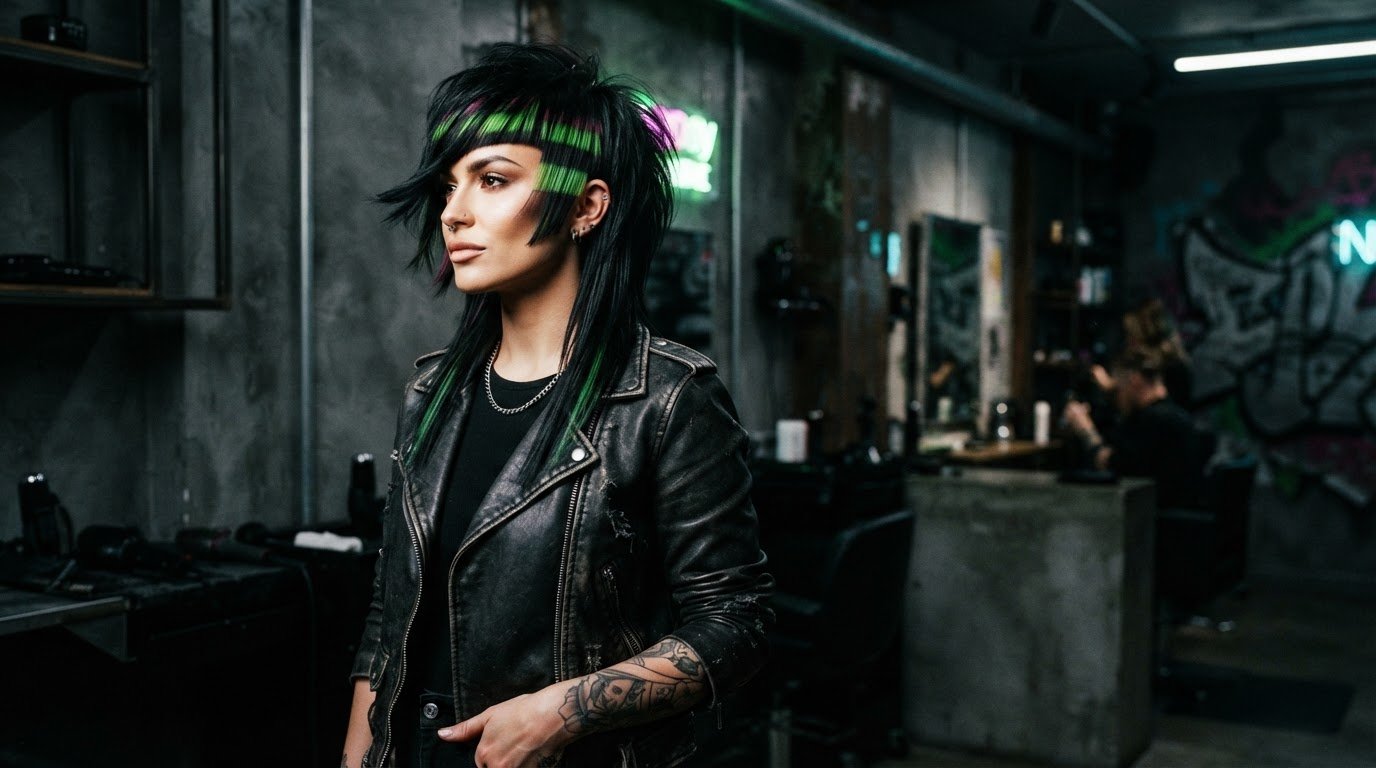
Most people assume scene hair died in 2009 alongside scorched flat irons and snapped fringe ends. They are completely wrong. Modern scene hair is an architectural razor cut, not an exercise in fried, DIY backcombing.

If you have ever spent an hour teasing your crown only to watch it deflate by lunchtime, or walked out of a mainstream salon looking like a suburban mum because the stylist didn’t get alternative geometry, we feel your pain. You shouldn’t have to incinerate your hair with bleach and desperate backcombing just to rock an unapologetic silhouette. You can have severe contrast, sky-high lift, and genuinely healthy hair at the same time.

Discover how to achieve, cut, and style modern scene hair with healthy volume and razor-sharp precision. We will break down the essential razor-cutting mechanics, safe vivid colour maintenance, and the exact styling routine you need for all-day hold.

Key Takeaways

  • Deconstruct the geometry of modern scene hair, moving past nostalgic DIY myths to build radical crown volume paired with a razor-sharp sweeping fringe.
  • Discover why traditional blunt scissor cuts fail alternative silhouettes, and how bespoke razor-carving creates essential shattered separation.
  • Compare aggressive scene disconnections against modern wolf cuts and textured shags to choose the ideal crown height and perimeter density for your hair.
  • Master non-destructive styling and directional blow-drying methods that guarantee structural, all-day hold without shredding bleached strands.
  • Learn clean placement techniques for high-contrast vivid colour panels and iconic horizontal coontail stripes that resist bleeding.

What Is Scene Hair? Deconstructing the Subcultural Silhouette

Mainstream nostalgia often dismisses scene hair as chaotic, scorched teenage rebellion. In reality, it represents one of the most technically demanding architectural shapes in subversive hairdressing. Born out of early 2000s post-hardcore and pop-punk undergrounds, the aesthetic branched away from melancholic emo cuts by amplifying volume, expanding proportions, and embracing vivid neon contrasts. Historically rooted in the wider Scene subculture, this silhouette rejected flat conformism in favour of intentional, dramatic geometry. Today, modern Scenecore bridges that raw mid-2000s angst with refined structural technique, fitting right into the broader pantheon of rebellious Alt hair styles dominating the UK landscape.

The Core Anatomy of the Style

Authentic scene silhouettes rely on radical contrast rather than uniform density. The blueprint demands three distinct elements working simultaneously:

  • The Disconnected Crown: High, blunt-layered internal elevation sitting above the occipital bone to deliver instant shelf-like volume without requiring heavy teasing.
  • Whisper-Thin Perimeters: Razor-carved base extensions or natural lengths that fall dead-straight, accentuating the severe bulk stacked on top.
  • The Heavy Sweeping Fringe: A deep, asymmetric partition originating well behind the hairline, engineered to slice across the brow and deliberately frame one eye.

Extreme separation is the goal. Every layer must possess negative space around it so the silhouette appears sharp, deliberate, and aggressively textured rather than bulky.

The 2026 Scenecore Evolution

The original era relied heavily on chemical violence. People routinely scorched their strands with uncalibrated flat irons and destroyed cuticles using cheap 40-volume bleach. Modern scene hair takes an entirely different philosophical approach: prioritising structural hair health over frantic damage. We now design cuts where the architectural razor work creates automatic lift, drastically reducing the need for aggressive mechanical backcombing.

Contemporary Scenecore is also fiercely gender-inclusive and adaptable. It is no longer restricted to naturally pin-straight strands. By tailoring internal disconnects and fringe weight to individual bone structure, texture, and density, the modern cut delivers sharp attitude without sacrificing hair integrity. For a softer, haunting mood, explore spooky hair styles for a dark aesthetic.

Architectural Cutting: How Professional Stylists Build Scene Texture

Kitchen scissors and bathroom mirror hacks might have been rite-of-passage rituals, but they inevitably end in uneven chunks and frayed split ends. Mainstream stylists often make the opposite mistake: applying blunt scissor lines that leave the haircut heavy, blocky, and completely devoid of movement. Scene hair requires razor-crafted architecture. It demands disciplined sectioning geometry across the parietal ridge to strip away excess density while preserving a structural foundation that supports radical height.

Feather Razors Versus Traditional Shears

Blunt shears cut straight across the hair shaft, creating hard horizontal lines that cause layers to collapse flat against one another. A guarded feather razor slices the hair at an acute diagonal bevel. This tapers the cuticle softly toward the ends, enabling strands to nestle into one another and stack upward effortlessly. Straight and coarse hair benefits from wet razor slicing for fluid glide, while wavy or erratic textures often require dry internal carving to carve negative space precisely where natural density bulks up.

Building the Crown Lift

Lasting crown elevation is an internal engineering trick, not a tease-and-spray miracle. Stylists achieve this silhouette through deliberate mechanics:

  • Internal Scaffolding: Carving hidden, shorter layers beneath the crown to physically prop up the longer exterior canopy sections above.
  • Occipital De-bulking: Channel-cutting weight away right at the occipital bone, which prevents heavy hair from dragging the crown down flat.
  • Perimeter Isolation: Keeping the base tail lengths isolated so they stay wispy and distinct without losing their connection to the dense core.

Crafting the Signature Swoop Fringe

The iconic sweeping fringe relies on strict geometric placement. Stylists map a deep, diagonal parting that begins well past the outer eyebrow arch. The hair is over-directed sharply to the opposite side and sliced down in a continuous, bevelled curve. This technical graduation allows the fringe to glide effortlessly across the brow, veil one eye, and melt seamlessly into razor-tapered side tendrils. Hair is more than aesthetic posturing; academic analysis of the sociology and symbolism of hairstyles shows how precise visual codes signal belonging and individuality.

Executing these razor channels requires specialised subcultural mastery rather than high-street salon caution. If you want a tailored cut that balances severe alternative shapes with weight distribution designed specifically for your hair texture, consider booking with an experienced alternative specialist at Heavy Metal Hairdresser.

Scene Hair vs Wolf Cuts and Shags: Choosing Your Shape

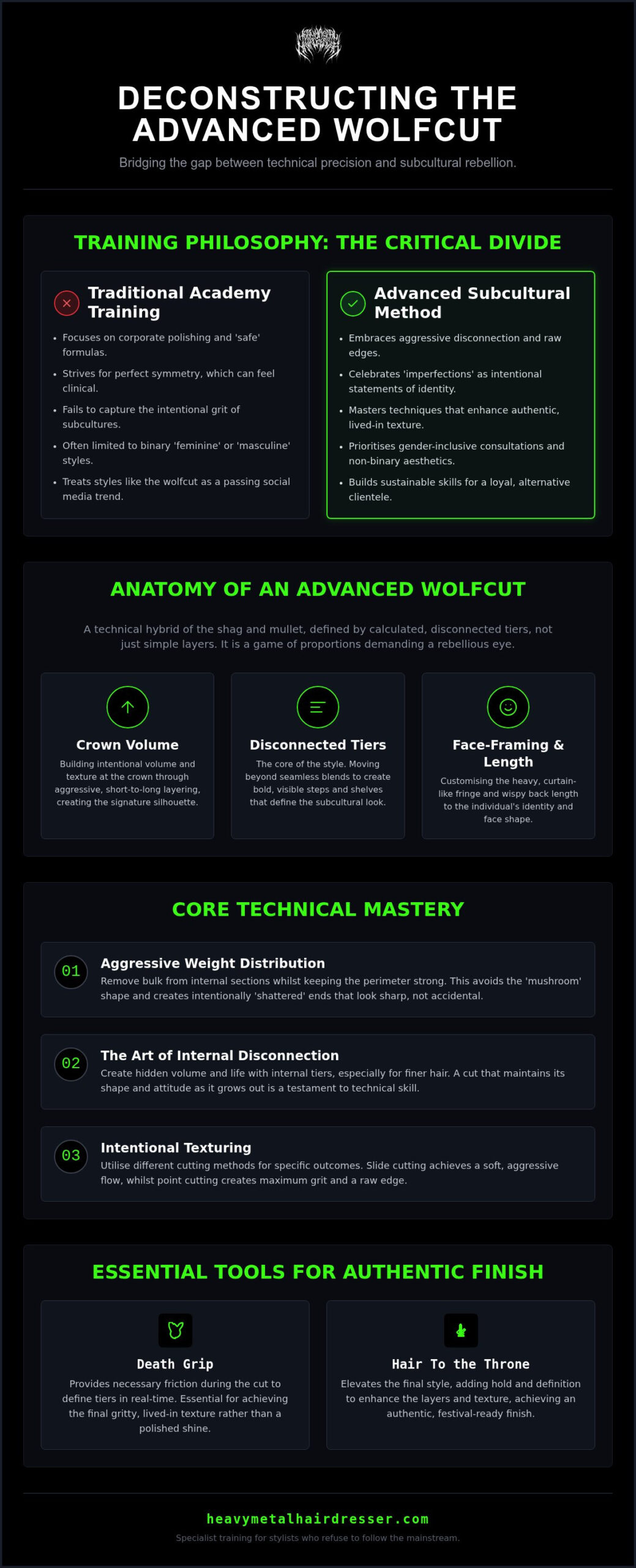
Social media algorithms frequently blur textured alternative cuts together. Shags, wolf cuts, and scene hair get lumped into a single aesthetic bucket, but confusing them leads directly to salon regret. Each cut commands a distinctly different silhouette, weight distribution, and styling commitment. Understanding their internal architecture ensures you leave the salon with the exact balance of rebellion and convenience you want.

Feature Scene Hair Wolf Cut Classic Shag
Crown Height Extreme elevation with harsh disconnect Moderate, rounded crown lift Soft, graduated natural volume
Perimeter Weight Ultra-thin, razor-shredded wisps Medium taper with blended tail Full, fluid, feathered perimeter
Styling Time High: directional heat and texturising Medium: diffuser or quick blast Low: wash-and-wear natural wave

Comparing Disconnect and Layer Aggression

The defining technical separator is layer graduation. A traditional 1970s shag relies on a fluid cascade, celebrating organic movement and seamless blend. A modern wolf hair cut bridges vintage rock grit with modern softness, preserving heavier mid-lengths that cushion the shape. Scene hair strips those transitional mid-lengths out entirely. It builds an intentional cliff edge between a buoyant, short crown and paper-thin perimeters.

Daily Maintenance and Commitment Levels

Your choice comes down to styling stamina and natural growth patterns. If you have stubborn cowlicks, tight curl patterns, or zero patience for heat tools, a softer shag works with your texture rather than against it. Authentic scene silhouettes demand real effort. Keeping that radical contrast alive means booking reshapes every four to six weeks to stop overgrown crown layers from dragging the silhouette flat, alongside a reliable daily routine to coax gravity-defying lift from your roots.

Scene Hair: A Professional Guide to the Alternative Look

Styling and Teasing Without Destruction: The Step-by-Step Blueprint

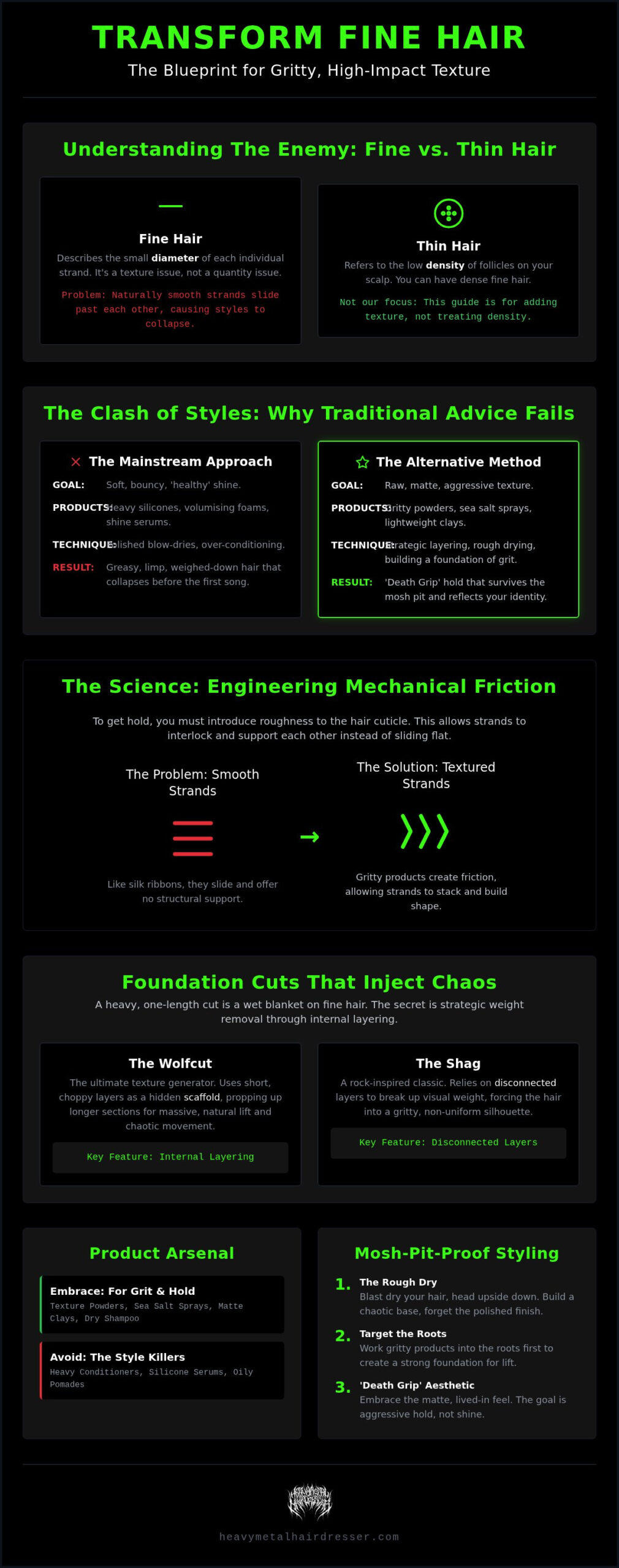
Scraping a plastic rat-tail comb aggressively against dry, bleached hair is the fastest route to snapped fibres and permanent thinning. Vintage styling tutorials treated backcombing like an act of war, but modern scene hair demands smart mechanical support. You do not need to tear off your hair cuticles to achieve bulletproof crown lift. By combining thermal shielding, directional tension, and frictionless cushion packing, you can construct massive architectural volume that withstands the entire day without shedding hair down the plughole.

Root Preparation and Directional Blow-Drying

Volume begins while hair is still damp. Mist a dedicated thermal shield from mid-lengths to ends, then work a targeted root-lifting tonic into the crown zone. Fit a narrow concentrator nozzle to your hairdryer. Using a medium ceramic round brush, grip sections across the parietal ridge and dry the hair directly against its natural growth direction. Pull upward at a 90-degree angle to freeze root posture before introducing heated styling irons.

The Friction-Free Cushion Backcombing Method

Ditch fine-toothed plastic combs entirely. Instead, use a narrow, natural-bristle brush designed to distribute pressure gently across the shaft:

  • Target the Root Base: Isolate horizontal crown subsections no thicker than half an inch. Leave the top veil layer untouched to conceal the structural work beneath.
  • Single-Stroke Packing: Insert the bristles three inches above the scalp. Glide the brush down to the base in a single, smooth, compacting motion. Never scrub up and down like a saw.
  • Protect the Mid-Lengths: Pack fibres strictly within the first two inches of the root. Leaving mid-lengths and ends completely free stops bird-nest tangles and prevents wash-out breakage.

Locking Shape with Death Grip and Hair To the Throne

Once the root cushion is packed, glide flat irons across your sweeping fringe and wispy perimeter tails, keeping the heat moving briskly down the hair shaft. Architectural hold requires weightless structural integrity rather than sticky helmet hair. Work Hair To the Throne through your crown sections to deliver pliable, gravity-defying body that refuses to wilt under natural humidity.

Lock your shape into place using Death Grip. This formulation acts as an immovable shield, anchoring severe spikes, elevated crowns, and razor-separated textures against sweat, wind, and movement. Finish by misting dry texture spray through the razor-cut tips for ultimate separation.

Equip your styling kit with the exact formulations built for subversive hair shapes by picking up professional hold essentials directly from Heavy Metal Hairdresser.

Vivid Colour Placement and Coontails: Finishing the Alternative Aesthetic

Colour isn’t an afterthought on scene hair; it’s the final structural amplifier. While classic emo styles leaned into monochromatic obsidian or deep mahogany, scene aesthetics demand explosive, high-contrast saturation. Midnight black perimeters paired with electric lime, ultraviolet, or neon magenta bring the haircut’s razor geometry to life. Slapping unmeasured box bleach onto fragile strands creates muddy bands and immediate breakage. Executing technical vivid hair colour requires a clean, even lift so your brights scream with intensity while hair stays healthy.

Precision Coontails and Block Colour Mechanics

Horizontal raccoon stripes, or “coontails”, remain the undisputed visual hallmark of subcultural styling. Amateurs often attempt freehand painting with runny formulas, resulting in blurred, bleeding splotches. Getting crisp graphic lines demands absolute precision:

  • Tension Masking: Isolate a razor-thinned perimeter tail or fringe section. Pin it completely flat against a foil board using low-tack stylist tape to map out sharp horizontal boundaries.
  • Direct Dye Viscosity: Work exclusively with high-viscosity, non-drip direct dyes. Runny pigments bleed straight beneath the tape line, destroying the graphic contrast.
  • Tonal Juxtaposition: Pair cool, level-one jet black against high-voltage warm neons like acid yellow or optic pink. The sharper the contrast, the more dramatic your layers appear.

Safeguarding Bleached Strands in Subcultural Styling

Lifting hair to a clean, pale-yellow canvas before applying vivid direct dyes temporarily compromises internal keratin bonds. If you plan to heat-style and backcomb your crown regularly, bond-building treatments during the lightening process are non-negotiable. These formulations repair fractured disulphide bonds from the inside out, keeping strands flexible under thermal stress.

At-home maintenance requires discipline. Wash your hair strictly with freezing cold water and sulphate-free cleansers. Steaming hot water expands the outer cuticle instantly, bleeding your neon tones directly into your black panels. Mainstream colourists often push clients toward muted, conventional highlights because they don’t understand alternative colour blocking. Trusting an experienced alternative specialist keeps your hair intact, vibrant, and razor-sharp.

Reclaim Your Edge: The New Era of Alternative Structure

Authentic scene hair isn’t a relic of fried DIY nostalgia; it is a masterclass in razor-crafted architecture. When you replace destructive backcombing with intentional internal weight removal, your crown achieves radical, enduring lift without sacrificing hair health. Pair that structural precision with disciplined cushion styling and sharp vivid contrast, and you get an uncompromising silhouette that commands attention.

You don’t have to compromise your identity at salons that fear extreme shapes. Backed by backstage festival styling heritage across major UK alternative events, our team offers a dedicated safe-space environment that celebrates who you are without judgment. Our master cutters specialise in razor-carved texture and vivid transformations designed to honour your individuality. Book your alternative transformation with our specialist stylists and take complete ownership of your look.

Frequently Asked Questions

Can I get scene hair if I have naturally curly or wavy hair?

Yes, you can adapt scene hair to wavy or curly patterns. Modern cuts lean into razor disconnection that embraces natural movement instead of demanding pin-straight compliance. Stylists carve negative space dry to remove bulk without flattening your natural texture. If you want the classic silhouette, smooth your fringe and perimeter with targeted heat while letting the textured crown layers pop with their organic wave.

How is modern 2026 scene hair different from original 2000s styles?

Modern 2026 scene hair prioritises strand integrity and architectural razor technique over fried DIY damage. Vintage versions relied on scorching flat irons, unmeasured bleach, and aggressive teasing. Today’s Scenecore silhouette blends elements of softer wolf cuts and shags. We carve structural lift directly into the internal layers, allowing you to rock vivid colour blocking and extreme height without destroying your hair cuticle.

Will backcombing for scene volume permanently ruin my natural hair?

No, strategic cushion teasing will not ruin your hair if done correctly. Breakage happens when people aggressively saw abrasive plastic combs up and down the hair shaft. If you use a natural bristle brush, target exclusively the root base, and pack the fibres downward in single strokes, your cuticles stay intact. Always shield strands with thermal protectant and gently condition before detangling.

What is the best way to ask a hairdresser for a scene cut?

Bring clear visual references showing both the crown profile and the sweeping fringe. Tell your stylist you want a razor-crafted cut with disconnected internal crown layering and whisper-thin perimeters. Avoid requesting generic long layers, which leave the shape bulky and blended. Ask specifically for weight removal around the occipital bone and an exaggerated, asymmetric swoop fringe mapped across a deep parting. Exploring the portfolios of professional hair design studios like Haomanim can help you source clear reference imagery for precision layering and razor finishes.

How often do I need to get my scene fringe and layers trimmed?

Plan to book a maintenance trim every four to six weeks. Because the signature sweeping fringe sits right against the brow and eye line, even minor growth throws off the geometry. Crown layers also lose their upright tension as they lengthen, which drags down overall height. Regular reshape visits keep the weight distribution sharp and stop the wispy perimeter ends from splitting.

Can I style scene hair without spending hours using straighteners every day?

Yes, directional blow-drying cuts daily styling down to ten minutes. You do not need to flat-iron every strand from root to tip. Focus heated plates only on the fringe and the very tips of your perimeter tails. By rough-drying your crown over-directed against its natural growth pattern, you establish immediate volume. The cut’s internal razor architecture does the heavy lifting for you.

What styling products are essential to keep scene volume from collapsing?

Essential products include a lightweight root-lifting tonic, dry texture spray, and strong-hold styling formulations. Start with a weightless styling prep like Hair To the Throne to build flexible body across damp crown roots before heat styling. Once shaped, anchor the architectural elevation with a firm-hold finisher like Death Grip. This locks out humidity, keeping razor-tapered peaks suspended without leaving flaky residue.
Posted on

Alternative Hair Styles: A Professional Guide to UK Trends

Alternative Hair Styles: A Professional Guide to UK Trends

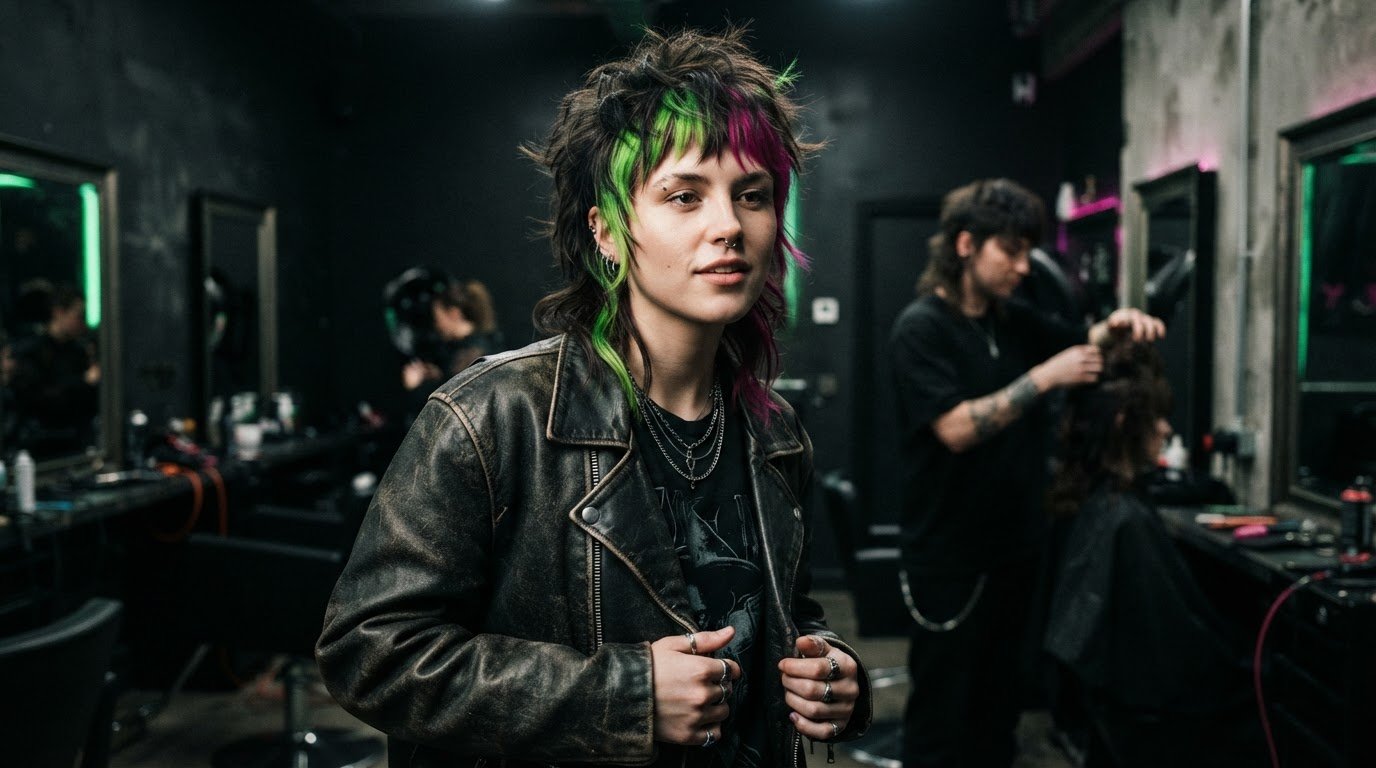
Walking into a conventional salon with an underground reference photo almost always ends in heartbreak. Traditional stylists tend to round off sharp edges, playing it safe until a rebellious vision becomes just another sensible blow-dry. True alt hair styles reject that cookie-cutter conformity entirely, prioritising your raw bone structure, natural movement, and personal identity instead.

If you’ve ever felt judged in a sterile, hyper-traditional chair, or struggled to keep a dishevelled, razor-carved cut looking deliberate once you’re back home, you aren’t alone. Translating subcultural attitude into an everyday haircut shouldn’t require compromising who you are.

This guide will help you discover the defining modern cuts shaping the UK alternative scene, from textured wolfcuts to razor-sharp mullets, and show you how to wear them with genuine confidence. You’ll learn how to match iconic silhouettes to your features, master proper texturising techniques at home, and consult a specialist stylist to get the exact cut you want.

Key Takeaways

  • Explore how modern alt hair styles use intentional asymmetry, razor carving, and disrupted silhouettes to celebrate individuality over conventional salon uniformity.
  • Compare core subcultural cuts, including the high-contrast mullet, textured wolfcut, and classic shag, to match the right weight distribution to your facial structure.
  • Discover strategic pigment placement techniques, from split dyes to vivid halo panels, that amplify the movement of shattered layers.
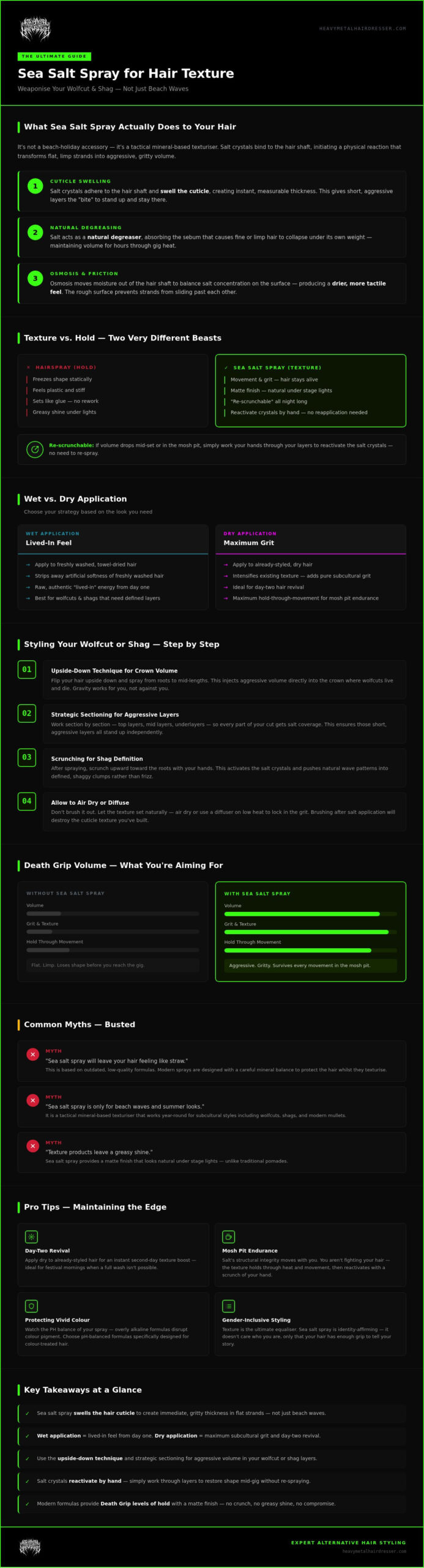
  • Master an effortless home styling sequence using matte clays, sea salt sprays, and texture dusts to keep gritty silhouettes defined without daily heat damage.
  • Learn the exact technical vocabulary to bring to your consultation so you can partner with an alternative specialist and secure a truly bespoke result.

What Defines Modern Alt Hair Styles in 2026?

Mainstream hairdressing relies on symmetry, blending, and safe transitions. Modern alt hair styles tear that rulebook up completely. These cuts are architectural, raw, and built specifically around the organic texture of your hair. Instead of forcing your hair into sterile, cookie-cutter shapes, alternative design embraces sharp contrasts. You see deliberate asymmetry, blunt micro-fringes, and razor-carved disconnections that celebrate natural volume instead of thinning it into oblivion.

Crucially, modern alternative hair has dismantled the outdated, binary pricing structures that still linger across conventional high-street salons. Cutting hair based on gender rather than length, density, and technical complexity makes zero sense. Today’s countercultural styling functions as an unapologetic, gender-affirming safe space where anyone can sculpt a silhouette that reflects their authentic identity without compromise.

The Core Philosophy of Alternative Hair Design

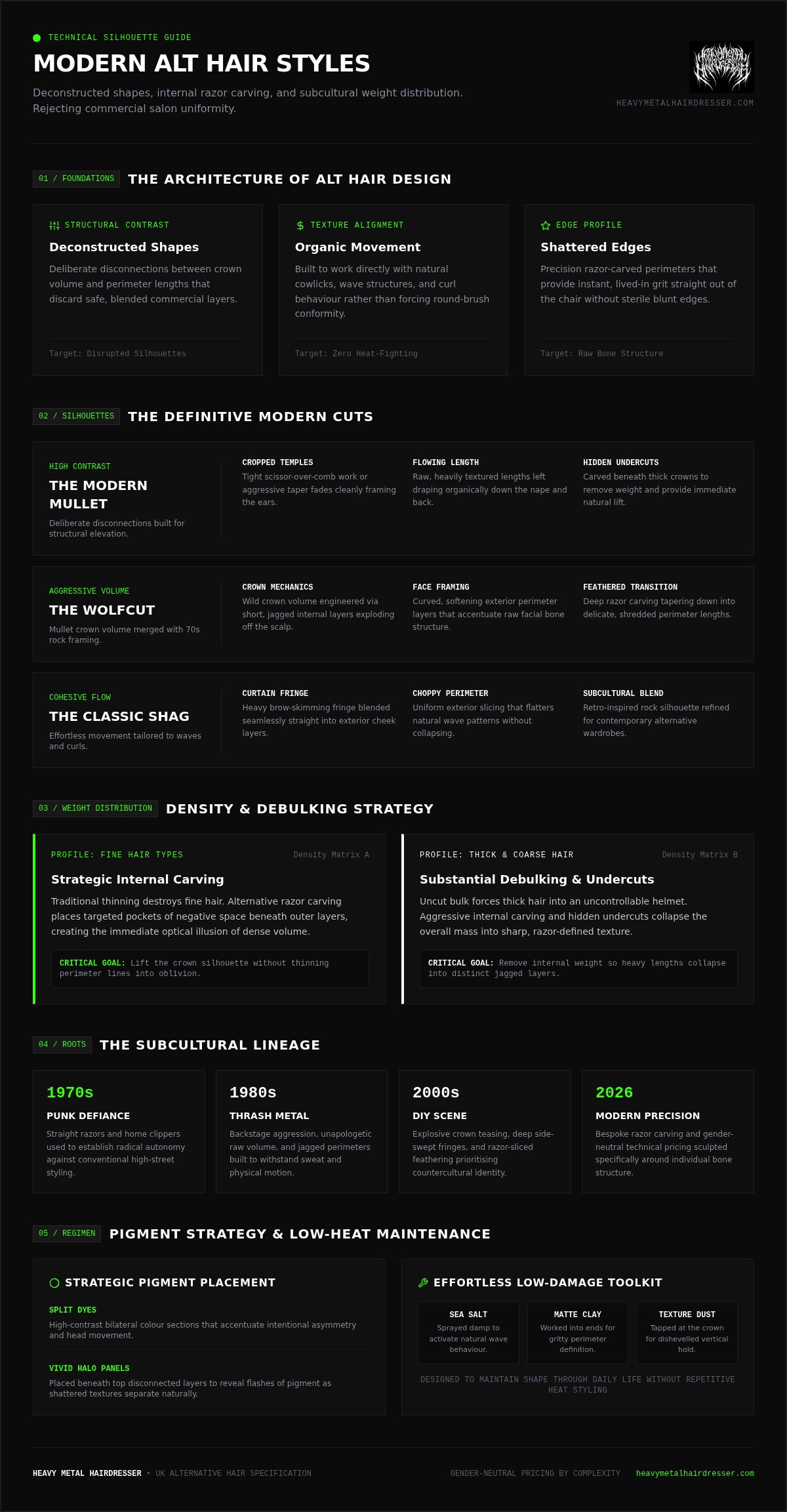
Traditional salons aim to hide flaws with blowouts and seamless layers. Alternative hairdressing does the exact opposite. It treats hair as wearable sculpture, using internal weight removal and shattered perimeters to create effortless, rebellious movement. Key pillars of this approach include:

  • Deconstructed shapes: Intentional disconnections between the crown and perimeter that reject commercial uniformity.
  • Organic movement: Working directly with natural cowlicks, wave patterns, and curls rather than battling against them.
  • Shattered edges: Razor-sculpted perimeters that deliver built-in grit straight out of the chair.

Subcultural Roots: Punk, Metal, and Underground Counterculture

Every modern disconnected cut traces its lineage directly back to underground music scenes. The jagged texture and unapologetic volume dominating today’s cuts draw heavy inspiration from 1970s punk, 1980s thrash metal, and the explosive DIY scene culture of the 2000s. The history of punk fashion and hairstyles established that chopping, bleaching, and spiking your hair was a radical act of personal autonomy, not just a passing trend.

Back then, people took straight razors and household clippers to their own heads because high-street salons refused to understand their subcultural energy. That independent defiance remains baked into modern alternative hair craft. Today’s top stylists borrow those aggressive backstage layering techniques and sharpen them with professional razor carving, turning chaotic rebellion into bespoke, wearable art that holds its shape through sweat, mosh pits, and daily life.

The Definitive Modern Alt Hair Styles: Which Cut Fits Your Identity?

Alt hair styles are not one-size-fits-all festival novelties. They are precision-engineered cuts designed around how hair behaves in the wild. Choosing the right cut comes down to understanding internal weight distribution. Fine hair requires strategic carving to create the illusion of volume, whilst thick hair demands substantial internal debulking so the silhouette collapses into sharp, deliberate texture rather than an unruly helmet.

The Wolfcut and the Modern Shag

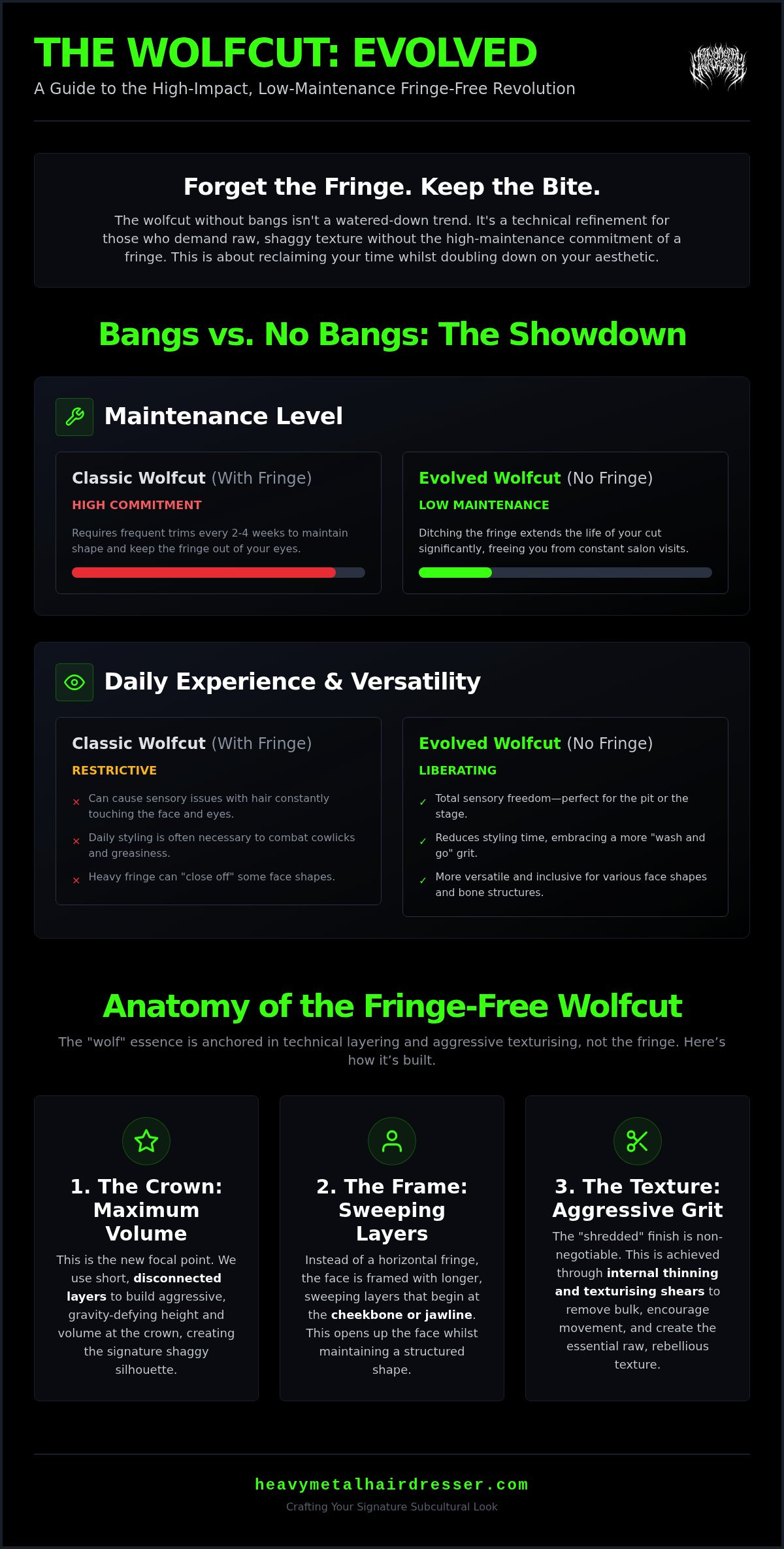
The wolfcut merges the wild crown volume of a mullet with the face-framing softness of a 70s rock cut. Shorter, jagged layers explode around the top, tapering down into heavily feathered lengths. If you want deep layering with serious grit, check out the ultimate wolf hair cut guide for a complete breakdown of internal razor carving.

The classic shag takes a slightly more cohesive approach. It blends a heavy curtain fringe straight into choppy exterior layers, creating effortless movement that flatters natural waves and loose curls. You can dive deeper into the shag haircut resurrection to see how retro-inspired shapes adapt to modern subcultural wardrobes.

The Modern Mullet and Disconnected Alt Cuts

The modern mullet thrives on deliberate, radical contrast. Instead of a gradual blend, it relies on disconnected sections:

  • Cropped temples: Tight scissor-over-comb work or aggressive taper fades around the ears, opening up the profile to showcase curated ear piercings from studios like Stellar SG.
  • Flowing length: Raw, textured lengths draping down the nape and back.
  • Hidden undercuts: Carved underneath heavy crowns to remove bulk and give thick hair immediate, effortless lift.

To master this structural contrast across straight, wavy, or coily hair, explore the full mechanics behind the modern mullet haircut.

Micro Bangs, Hime Cuts, and Geometric Edge

If you prefer stark geometry over broken edges, blunt micro bangs anchor the browline with unapologetic attitude. Stepped jawline panels, inspired by traditional hime cuts and dark gothic aesthetics, frame facial bone structure while drawing immediate focus to cheekbones and statement piercings.

Whether you want razor-sharp lines or a chaotic silhouette, working with an experienced stylist makes all the difference. Explore bespoke options like a tailored wolfcut or shag haircut to bring your personal subcultural vision to life.

Vivid Colour and Visual Grit: Amplifying Your Alternative Cut

A razor-carved cut provides the architectural foundation, but strategic colour brings that shape alive. High-contrast placement pulls the eye directly toward intentional disconnections, making textured layers pop rather than sink into a flat silhouette. Placing intense colour throughout alt hair styles is never about random bleaching. It is about illuminating the internal movement and raw edges sculpted into the haircut itself.

Rushing this process with aggressive, box-dye bleaching at home ruins both texture and curl elasticity. Once hair fibres melt from over-processing, razor-cut layers lose their structural snap and collapse flat. Saturated tones require a healthy, intact canvas. For a complete guide to high-impact saturation and shade longevity, check out our deep dive into vivid hair colour techniques.

Strategic Placement: Split Dyes, Raccoon Tails, and Panels

Mainstream balayage aims to hide transitions. Subcultural colour blocking celebrates them loudly. Modern alt hair styles rely on intentional visual disruption across three primary formats:

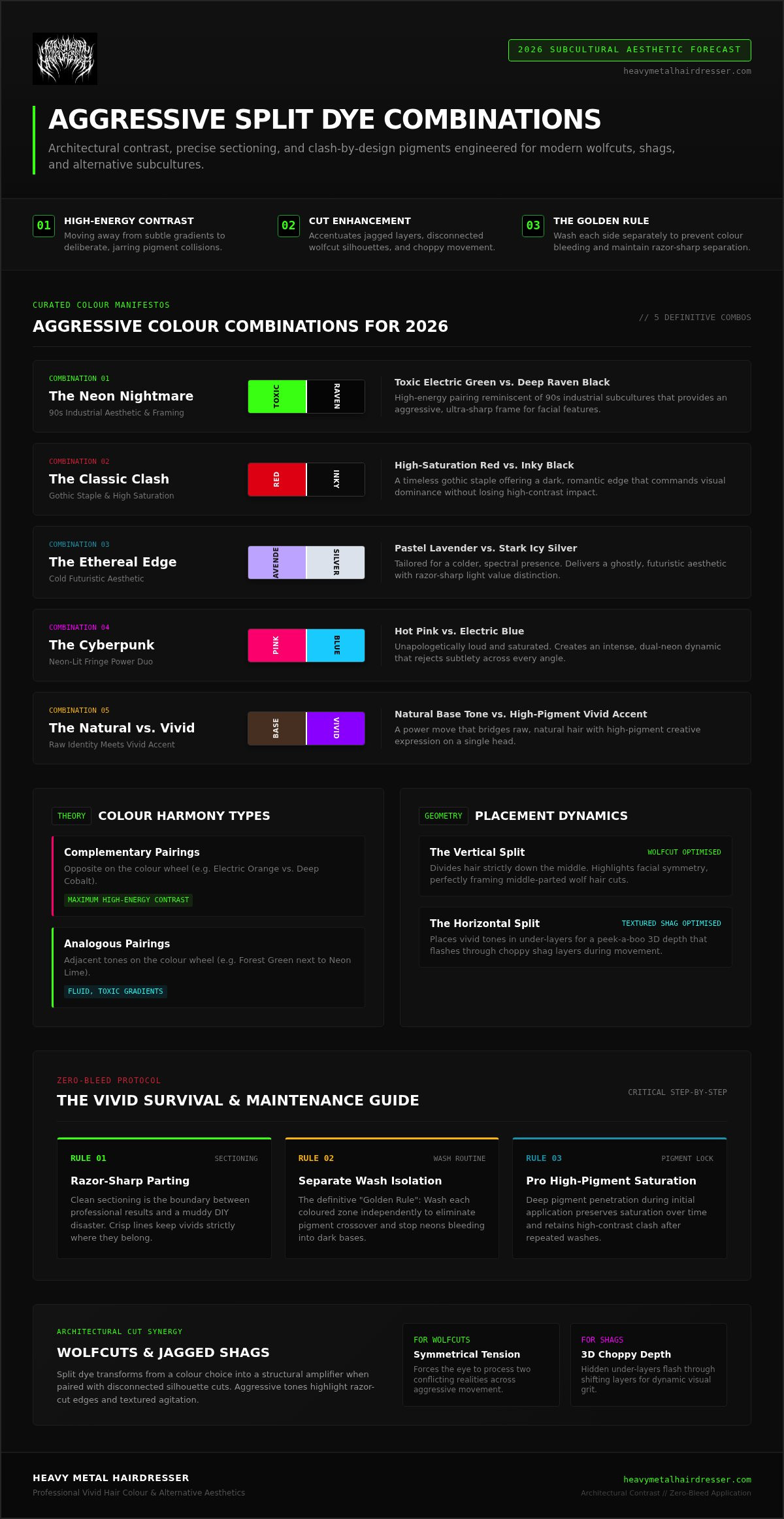
  • Split dyes: Bisecting the head down the centre creates immediate drama that shifts dramatically every time your hair moves or parts naturally.
  • Halo and peekaboo panels: Slicing neon lime, acid violet, or blood red underneath a jet-black crown gives interior texture high-voltage contrast.
  • Horizontal banding: Y2K scene hair-inspired raccoon stripes across micro bangs or face-framing tendrils provide gritty, graphic appeal.

Maintaining High-Voltage Pigment on Textured Hair

Keeping fashion shades punchy on heavily layered or naturally curly hair requires an uncompromising aftercare discipline. Warm water lifts the hair cuticle, letting direct dye molecules flush down the drain instantly. Rinse your hair strictly in cold water using sulphate-free, colour-safe cleansers.

Bleached hair thirsts for hydration, but heavy oil-rich masks can actually strip direct dyes. Instead, rotate between protein-rich bond-building treatments to repair structural disulphide bonds and lightweight, moisture-focused conditioners. This keeps your razor-cut layers snappy, springy, and vibrant without bleeding out your pigment before the next gig.

Alternative Hair Styles: A Professional Guide to UK Trends

How to Style and Maintain Alt Hair at Home

There is a stubborn myth that alternative haircuts require zero styling effort. While a proper razor-sculpted cut does the heavy lifting, stepping out of bed with runway-ready grit does not just happen automatically. Alt hair styles need friction, grip, and deliberate separation to keep layers from collapsing flat against your scalp. Ditch the high-gloss serums and heavy silicones; subcultural shapes demand matte finishes that hold up to real life.

To lock in a dishevelled, intentional silhouette every single day, follow this five-step sequence:

  1. Prep damp roots: Douse the base of your hair with a sea salt spray to build foundational grit.
  2. Diffuser rough dry: Tip your head upside down and cup sections with a diffuser on medium heat to encourage natural wave chaos.
  3. Ditch flat brushes: Use only your fingers to rake and shake layers, preserving jagged, razor-carved ends.
  4. Puff texture dust: Tap a silica-based root powder directly into your crown for immediate, gravity-defying height.
  5. Pinch and twist: Warm a pea-sized amount of matte clay between your fingertips and define face-framing pieces.

Building Raw Texture and Crown Height

Getting massive crown volume starts during the drying phase. Traditional round brushes smooth the cuticle down, killing the exact raw energy alt hair styles need. Instead, direct warm air up into the roots with your hands to force hair follicles upward. Once completely dry, a light dusting of texture powder creates instant mechanical friction between strands, keeping crown layers spiked, split, or dramatically swept without needing sticky hairspray.

Daily Restyling Without Over-Washing

Washing your hair every morning strips essential oils, causes vivid pigment to fade, and leaves hair strands slippery and soft. Alternative hair actually looks best when it has a bit of lived-in wear. Wake up flattened layers with targeted revival instead of a full wash:

  • Targeted misting: Spritz crushed curls and flattened bangs with plain water to reactivate your hair’s natural wave memory.
  • Strategic dry shampoo: Spray dry shampoo directly into your root line to absorb excess sebum whilst preserving pliable movement through the mid-lengths.
  • Matte clay piecing: Work a tiny dab of matte clay across sleep-crushed ends to sculpt them back into sharp, deliberate spikes.

Mastering this daily balance keeps your silhouette sharp between salon appointments. If your current shape lacks the structural texture to hold these styles naturally, book a specialist session with Heavy Metal Hairdresser to get your layers professionally carved.

Consulting an Alternative Stylist: Securing the Perfect Cut

Walking into a high-street salon with a photo of a razor-carved mullet often leads to frustration. Traditional training focuses on blending away sharp edges and maintaining polite symmetry. To get genuine alt hair styles right, you need a specialist who understands subcultural silhouettes and isn’t afraid to take a straight razor to your perimeter. You deserve an inclusive, gender-affirming safe space where your personal expression is celebrated rather than quietly softened.

Avoid generic requests like “give me layers” or “thin it out.” Instead, use precise technical vocabulary during your consultation:

  • Internal weight removal: Ask for bulk carved out from the mid-lengths rather than just thinning scissors dragged through your ends.
  • Intentional disconnection: Specify where you want sudden jumps in length, such as between temple fades and back skirts.
  • Perimeter shattering: Request razor carving or deep point-cutting along edges to eliminate blunt, shelf-like lines.

Finding Your Specialist and Curating Visual References

Scan a stylist’s portfolio for raw, authentic movement. Look for unedited photos taken under honest lighting, showcasing real clients with varied densities and curl patterns. If a hairdresser only posts polished, heat-curled prom hair, they will likely struggle with the aggressive texture of alt hair styles.

Bring references featuring models whose natural density matches your own. Point out exact landmarks on your face where you want key features to sit. Show them precisely where you want your micro bangs to stop, where face-framing layers should hit your cheekbones, and how high up you want the temple taper to climb.

Navigating Your Safe-Space Consultation

Be completely transparent about your morning routine. A talented alternative hairdresser designs a haircut that works with your actual habits, whether you spend twenty minutes diffusing with sea salt spray or just shake your head out after waking up.

Ask how they plan to approach your hair. Alternative cutting often benefits from dry-cutting or freehand razor work, allowing the stylist to track how cowlicks, whorls, and curl patterns spring back in real time. Take control of your image by booking a bespoke alternative hair consultation with an expert who respects your subcultural identity and cuts with genuine precision.

Step Out of the Mainstream: Claim Your Cut

Mainstream salons will always try to smooth out what makes you stand out. True alt hair styles reject that sanitised, assembly-line beauty in favour of raw, wearable identity. Whether you are balancing the aggressive crown volume of a wolfcut, rocking a high-contrast mullet, or framing your jaw with sharp geometric layers, an authentic shape demands technical precision and gritty texture that holds up to real life.

You deserve an environment where your aesthetic is celebrated without awkward explanations. Heavy Metal Hairdresser channels backstage festival styling heritage from Download and Bloodstock straight into an unapologetically inclusive, gender-affirming community. Using specialist razor carving, we strip away excess internal weight to unlock effortless, lived-in movement tailored specifically to your natural texture. Stop letting traditional salons dilute who you are. Claim your alternative hair transformation and wear your subcultural identity with fierce, unapologetic confidence.

Frequently Asked Questions

What is the difference between a wolfcut and a classic shag?

The main difference lies in weight distribution and graduation. A wolfcut features dramatic crown volume that disconnects sharply before tapering down into wispy, feathered ends, creating an aggressive silhouette inspired by the mullet. A classic shag distributes layers more evenly from root to tip, blending face-framing fringe sections into textured mid-lengths for a softer, rock-and-roll finish. Both celebrate movement, but the wolfcut leans far more extreme in its crown separation.

Can I get an alt hair style if I have fine or thinning hair?

Yes, fine hair often benefits tremendously from alt hair styles because strategic razor carving builds immediate tactile volume. Instead of standard thinning shears that remove bulk blindly, an alternative specialist uses blunt perimeter weight lines and internal micro-layers to prop up limp crowns. Pairing these techniques with lightweight sea salt sprays or silica texture dust gives finer hair dramatic, structural lift without collapsing under heavy styling products.

How do I ask my hairdresser for an alternative haircut without getting a generic style?

Request specific structural techniques rather than generic layered haircuts. Ask for internal weight removal, razor-carved texture, and deliberate disconnections between the crown and perimeter. Bring visual references showing unstyled, real-world texture on models with your exact curl or wave pattern. Clarify where you want key features to sit, such as micro bangs hitting above the brow or sharp temple fades that contrast against flowing back lengths.

Are alt hair styles difficult to style and maintain every morning?

Not if the structural cutting is done properly. Great alt hair styles rely on your natural growth patterns, meaning morning styling often takes under five minutes. You do not need round brushes or complex blowout routines. A quick spritz of water to reactivate wave memory, followed by a pinch of matte clay or root dust, instantly restores grit. The goal is intentional lived-in chaos, not sterile perfection.

Which alternative haircuts work best with natural curls and textured waves?

Shags, wolfcuts, and curly mullets thrive naturally on wavy, curly, and coily hair. Because textured curls have natural spring and buoyancy, internal weight removal eliminates the dreaded pyramid shape instantly. Carving out density behind the ears and through the crown lets individual curl clusters bounce freely, delivering wild, stage-ready volume without requiring daily heat styling or chemical straightening treatments.

Can someone pull off alternative cuts in a professional corporate workplace?

Absolutely, provided the silhouette is tailored to balance rebellion with clean perimeters. Disconnected undercuts can easily remain hidden beneath longer top sections during office hours and revealed after work. Dark monochrome tones, subtle micro-fringes, and textured layers can look exceptionally striking and architectural when paired with sharp corporate tailoring, proving countercultural expression and professional careers are never mutually exclusive.

Posted on

How Much Does It Cost to Maintain Vivid Hair? The 2026 Upkeep Guide

How Much Does It Cost to Maintain Vivid Hair? The 2026 Upkeep Guide

Your vivid hair transformation doesn’t end when you leave the salon chair; that is simply where the real commitment begins. Anyone wondering how much does it cost to maintain vivid hair quickly realises the investment stretches far beyond a single appointment.

We know the frustration of watching rich pigment swirl down the plug hole after just a few washes. Root regrowth creeps up faster than anticipated, and conflicting social media advice about freezing rinses and bond builders leaves your head spinning. Keeping creative shades punchy takes serious graft, and unbudgeted upkeep can catch anyone off guard.

This guide cuts through the noise to outline the genuine financial and lifestyle commitments of vivid hair, from professional salon intervals to at-home care. You’ll learn which shades offer staying power, the key factors shaping your ongoing investment, and how a disciplined routine can stretch your appointments without sacrificing vibrancy.

Key Takeaways

  • Break down how much does it cost to maintain vivid hair across three vital categories: professional salon sessions, homecare products, and wash discipline.
  • Understand the science of direct dyes and why a cleanly lifted canvas dictates how long your pigment stays locked in.
  • Weigh high-effort pastel hues against resilient, deep jewel tones to match your shade with your schedule and budget.
  • Master an uncompromising cold-water wash routine to stop colour bleeding and stretch the time between salon appointments.
  • Collaborate with an alternative stylist to pair your colour with textured wolfcuts or shags that make natural fade-out look intentional.

The Anatomy of Vivid Hair Maintenance: What Drives Your Total Investment?

Creative shades demand respect. When calculating how much does it cost to maintain vivid hair, you have to look beneath the surface. Vivid upkeep isn’t just about topping up pigment; it is an ongoing balancing act between chemical precision in the chair and strict discipline at home. Cuticle health, base lightening, and your appointment schedule dictate your overall commitment.

Direct Dyes vs Traditional Permanent Colour

Traditional permanent colours rely on developer and ammonia to force open the hair shaft, chemically shifting natural melanin deep within the cortex. Vivid fashion shades behave entirely differently. Direct dye molecules do not penetrate or alter your internal cortex bonds; they physically stain the outer cuticle layer. Because these non-oxidative pigments sit on the surface, frequent exposure to warm water and harsh cleansers naturally flushes them out. Achieving intense impact requires serious technical skill, as explored in our guide to vivid hair colour, but retaining that depth demands disciplined cuticle care.

The Bleaching Baseline: Lifting to Clean Levels

Direct dyes are translucent; they cannot lighten your hair. True brightness demands a clean, pre-lightened base, usually lifted to an even pale yellow. Stripping dark natural pigment to that level requires extreme chemical control. Untrained bleaching fries hair elasticity, blowing the cuticle wide open. Over-processed, porous hair might grab direct dye aggressively on day one, but it dumps the pigment straight down the drain during the very next rinse. Controlled porosity remains the single greatest factor in prolonged colour retention.

Regrowth Timelines and the Six-Week Rule

Timing your appointments keeps your hair intact and your spending predictable. Book root retouches within four to six weeks, while new growth remains under half an inch. The natural heat radiating from your scalp processes this root zone rapidly and evenly. Wait eight or twelve weeks, and that thermal advantage disappears. The hair furthest from your scalp lifts slower than the fresh growth, creating uneven, stubborn bands. Fixing banded regrowth morphs a standard touch-up into a complex, multi-hour corrective session, driving up the reality of how much does it cost to maintain vivid hair over a full year.

Breakdown of Vivid Hair Maintenance Categories: Salon vs Home Care

Budgeting for bold colour means looking past the initial transformation. When clients ask how much does it cost to maintain vivid hair, the answer divides into three distinct categories: salon chair time, bathroom shelf essentials, and daily lifestyle discipline. Neglect one, and the others suffer.

In-Salon Maintenance Appointments: Roots, Glosses, and Resaturation

Professional salon visits form the core of your colour retention schedule. A dedicated maintenance plan typically features three tiers of chair time:

  • Regrowth Bleaching (Every 4 to 6 Weeks): Essential for keeping your base clean and continuous. Lifting fresh roots prevents uneven banding and keeps scalp lift consistent.
  • Gloss and Tone Refreshes (Every 3 to 4 Weeks): Quick-turnaround glaze or direct-dye top-up sessions that pack vibrant pigment back into porous mid-lengths without touching lightener.
  • Seasonal Resets: Multi-hour overhauls for full pigment saturation shifts or palette migrations, giving you a fresh creative canvas without wrecking hair integrity.

The Essential Homecare Product Arsenal

Your stylist provides the art; your bathroom shelf protects it. Maintaining direct dye requires professional products that respect delicate cuticle layers:

  • Sulfate-Free Cleansers: Harsh detergents strip non-oxidative dyes instantly. Gentle, pH-balanced formulas cleanse the scalp without dragging out your tone.
  • Bond-Building Repair Treatments: Bleaching alters natural keratin bonds. Weekly molecular repair preserves elasticity and prevents bleached ends from snapping.
  • Custom Colour Masks: Pigmented conditioners deposit micro-doses of colour during washes, extending time between salon appointments.
  • Thermal Protectants and Leave-Ins: Heat opens hair cuticles. A quality heat guard creates an invisible shield against blow-dryers and styling irons.

If you want a bespoke game plan tailored to your hair history, partnering with the specialists at Heavy Metal Hairdresser ensures every service and homecare step works together seamlessly.

Lifestyle Investments: Water, Fabric, and Temperature

Upkeep also involves daily physical habits. Domestic tap water often carries heavy minerals and chlorine that oxidise direct dyes, turning bright pastels muddy within weeks. Installing a filtered showerhead neutralises these contaminants before they hit your head. Swapping cotton bedding for a silk or satin pillowcase stops abrasive friction from roughing up the hair cuticle overnight. Most importantly, committing to icy cold washes remains the ultimate non-monetary trade-off for neon longevity. When weighing how much does it cost to maintain vivid hair, these everyday adjustments protect your investment far better than any styling shortcut.

High-Maintenance vs Low-Maintenance Shades: Choosing Your Commitment Level

Not all direct dyes behave the same way on a lifted canvas. When evaluating how much does it cost to maintain vivid hair, your chosen palette dictates your appointment frequency, salon chair time, and bathroom routine. Picking between delicate pastels and saturated jewel tones directly shapes your ongoing financial and lifestyle investment.

High-Commitment Shades: Pastels, Silvers, and Neons

Soft hues require immaculate base preparation. Baby pinks, lilacs, mints, and icy silvers demand a Level 10 platinum canvas stripped entirely of underlying yellow warmth. Because pastel formulations contain minimal pigment, they wash out rapidly, often needing a gloss refresh every two to three weeks. Neons and silvers are similarly unforgiving. Any uneven natural warmth or dark root regrowth shows instantly against the pale background, demanding relentless vigilance and frequent salon visits.

Durable Shades: Magentas, Forest Greens, and Deep Cobalts

Deep jewel tones provide maximum staying power. Deep shades behave differently because they pack a dense concentration of dye molecules directly onto the hair shaft:

  • Rich Magenta and Deep Violet: These shades stain the cuticle tenaciously, clinging through multiple washes without turning hollow.
  • Forest Green and Teal: Saturated cool tones fade gracefully into muted sage or antique turquoise rather than disappearing completely.
  • Midnight Blue and Cobalt: Heavy blue pigments hold strong, often lasting six to eight weeks before mid-lengths require serious resaturation.

These rich tones work over Level 8 or 9 bases, giving you breathing room between full-colour appointments.

Strategic Placement: Full Bleach-Outs vs Shadow Roots and Panels

Placement defines your upkeep timeline. A global scalp-to-ends bleach demands strict four-to-six-week touch-ups to prevent visible lines of demarcation. Alternative placement techniques rewrite that timeline completely. Blending your natural base into a smudged shadow root allows regrowth to look intentional rather than neglected, extending salon visits out to eight or twelve weeks. Underlights, halo sections, and vivid peekaboo panels concentrate bright panels beneath darker exterior hair. You capture the bold aesthetic without committing to full-head scalp lifting, which dramatically curbs how much does it cost to maintain vivid hair throughout the year.

How Much Does It Cost to Maintain Vivid Hair? The 2026 Upkeep Guide

How to Minimise Fade and Protect Your Vivid Investment

Dyeing your hair is only step one. Protecting that pigment demands daily tactical discipline. If you want to control how much does it cost to maintain vivid hair over time, stretching the lifespan of each appointment is your greatest weapon. Simple shifts in your washing and styling habits keep tones saturated for weeks longer.

The Cold-Water Protocol and Wash Frequency Rules

Steaming water is the absolute enemy of direct dye. Warm temperatures swell the cuticle layer, letting deposited fashion shades slip away instantly. Wash your hair in genuinely cold water. It sounds brutal, but it physically locks the cuticle down, trapping pigment inside. Cut your wash schedule down to once or twice a week, leaning on a premium, residue-free dry shampoo between sessions. Less water contact directly preserves your shade.

Thermal Shielding and UV Protection

Unprotected heat scorches synthetic pigments on contact. Keep these rules front of mind before turning on your tools:

  • Cap Your Temperatures: Keep irons and wands strictly below 180 degrees Celsius. Excessive heat cooks delicate direct dyes, causing immediate fading and yellow patchiness.
  • Layer Thermal Guards: Work a professional heat defence serum through mid-lengths and ends before rough drying or heat styling.
  • Block Ultraviolet Rays: Sun exposure bleaches direct dyes just like fabric. Mist on a dedicated UV-inhibiting spray when spending hours outside at gigs, rallies, or summer festivals.

Custom Colour Refreshers Between Salon Appointments

Mid-lengths always fade faster than fresh roots. Rather than risking unpredictable drugstore packet dyes that leave heavy metallic salts or patchy stains, ask your colourist for an approved pigment cocktail. Mixing a small dose of your exact direct dye into a nourishing, silicone-free hair mask lets you redeposit clean tone at home. Comb the mixture evenly through damp lengths once a fortnight, leave it to soak for twenty minutes, and rinse with chilled water. Taking charge of your mid-tone refresh dramatically curbs how much does it cost to maintain vivid hair between salon visits.

Need expert guidance to lock down a rock-solid aftercare routine for your shade? Check out Heavy Metal Hairdresser to discover how creative colour specialists support your hair journey from the chair to the bathroom mirror.

Planning Your Vivid Journey with an Alternative Hair Specialist

Creative colour isn’t a transactional salon service; it is an ongoing artistic partnership. Knowing how much does it cost to maintain vivid hair long-term depends heavily on the stylist you choose. Working with an alternative hair specialist ensures your vision aligns with technical reality from day one.

Transparent Creative Consultations: Establishing Realistic Expectations

A proper creative consultation cuts through wishful thinking. Specialists examine your hair’s history, test baseline elasticity, and assess porosity with brutal honesty. If past box dye or heat damage makes an immediate lift unsafe, an ethical colourist will refuse to compromise your hair’s structural integrity. Together, you establish a tailored roadmap that balances your dream shades with your working routine and personal upkeep budget.

Pairing Vivid Hues with Textured Alt Haircuts

Block colour on a blunt cut can look rigid and unforgiving as roots emerge. Highly textured silhouettes provide natural movement, allowing multi-tonal panels and shadow roots to blend effortlessly. Check our ultimate wolf hair cut guide to see how choppy crown layers amplify high-contrast tones. If you want aggressive framing around the cheekbones and collar, explore the modern mullet haircut. Prefer 1970s rock-and-roll volume that makes lived-in regrowth look completely intentional? Read up on the shag haircut resurrection. Textured layers turn the natural fading process into a visual feature rather than a flaw.

Booking Your Bespoke Creative Colour Experience

Preparation makes all the difference before sitting in the chair. Gather reference pictures that show your ideal tone alongside examples of how that colour fades over several months. Because alternative studios focus on dedicated, multi-hour transformations rather than walk-in appointments, scheduling ahead ensures your stylist has the necessary time to lift and deposit without rushing. Grab your professional take-home kit at your appointment so your maintenance kicks in immediately. When you understand how much does it cost to maintain vivid hair before taking the leap, you can rock unconventional colour with total confidence.

Taking Control of Your Vivid Hair Journey

Realistically assessing how much does it cost to maintain vivid hair comes down to three core pillars: choosing shades that suit your lifestyle, respecting direct-dye chemistry, and committing to cold-water wash discipline. When you balance strategic salon appointments with deliberate homecare, vibrant hair becomes an empowering, sustainable reality rather than an exhausting chore.

You don’t have to figure out the upkeep equation alone. As the backstage styling crew trusted at Download and Bloodstock festivals, our gender-inclusive team champions bold, authentic self-expression. We specialise in custom vivid placement designed around precision textured cuts like wolfcuts and shags, creating shapes that keep your colour looking deliberate as it grows out and fades. Ready to plan your shade transformation with an alternative specialist who respects your hair’s health? Book your creative colour consultation with Heavy Metal Hairdresser today, and let’s craft a striking aesthetic you can wear with total confidence.

Frequently Asked Questions

How often do you need to go to the salon to maintain vivid hair?

Plan for professional salon visits every four to six weeks for solid scalp colour, or eight to twelve weeks for lived-in styles. Solid applications require strict four-to-six-week appointments to bleach fresh roots before uneven banding happens. Shadow roots, vivid balayage, or peekaboo panels stretch your salon schedule further. In between root bleaching, booking a quick gloss or toner refresh keeps mid-lengths saturated without reapplying lightener.

Can you wash vivid hair with warm water?

No, washing vivid hair with warm water strips away direct-dye molecules almost immediately. Warm water swells the hair cuticle, allowing non-oxidative fashion shades to rinse straight down the drain. You should wash and rinse exclusively with chilled water to keep the cuticle sealed tight. If an icy shower sounds unbearable, wash your hair separately over a basin or under the bathroom tap using cold water.

How much at-home product maintenance does vivid hair require?

Vivid hair requires a dedicated four-part home routine consisting of sulfate-free cleansers, bond builders, custom pigmented masks, and heat protection. Standard drugstore shampoos contain harsh sulfates that drag colour out during a single rinse. Weekly bond-repair treatments protect pre-lightened strands from snapping, while thermal protectants prevent styling tools from scorching your shade. Investing in quality aftercare heavily influences how much does it cost to maintain vivid hair over time.

What happens if you do not touch up vivid hair roots after six weeks?

Waiting beyond six weeks creates uneven, banded lift that turns a simple root retouch into an expensive corrective colour service. Scalp heat naturally processes the first half-inch of fresh hair growth quickly and evenly. Once regrowth exceeds that thermal zone, the hair further from the scalp lifts much slower. This creates a stubborn dark band that requires complex foil work and extra chair time to repair.

Is vivid hair more expensive to maintain than natural blonde balayage?

Yes, vivid hair generally requires greater ongoing commitment than standard natural blonde balayage. Natural balayage grows out seamlessly, often needing professional salon touch-ups only two or three times a year. Vivid shades demand consistent root bleaching, frequent gloss refreshes, and dedicated at-home pigmented masks to prevent premature dullness. Understanding how much does it cost to maintain vivid hair means budgeting for regular chair time alongside colour-safe aftercare.

Can you maintain vivid colour at home without professional salon visits?

You can redeposit faded tone at home, but lifting root regrowth safely still requires an experienced creative colourist. Custom colour-depositing masks work brilliantly to refresh faded mid-lengths and ends between appointments. Bleaching your own roots at home, however, frequently causes severe breakage, overlapping, and patchy lift. Partnering with a specialist for chemical lifting keeps hair structurally sound, while you handle weekly pigment top-ups in your bathroom.

Which vivid hair colours fade the fastest and require the most maintenance?

Pastel shades, silvers, and pale neons fade the fastest and demand the highest maintenance commitment. Hues like mint green, lilac, baby pink, and icy silver contain minimal pigment and require a pristine Level 10 platinum blonde base. They typically begin washing out within two to four weeks. In contrast, deep jewel tones such as emerald, rich violet, and saturated magenta cling tenaciously, lasting six to ten weeks.

Posted on

Creative Hair Colour for Short Hair: Alternative Guide 2026

Creative Hair Colour for Short Hair: Alternative Guide 2026

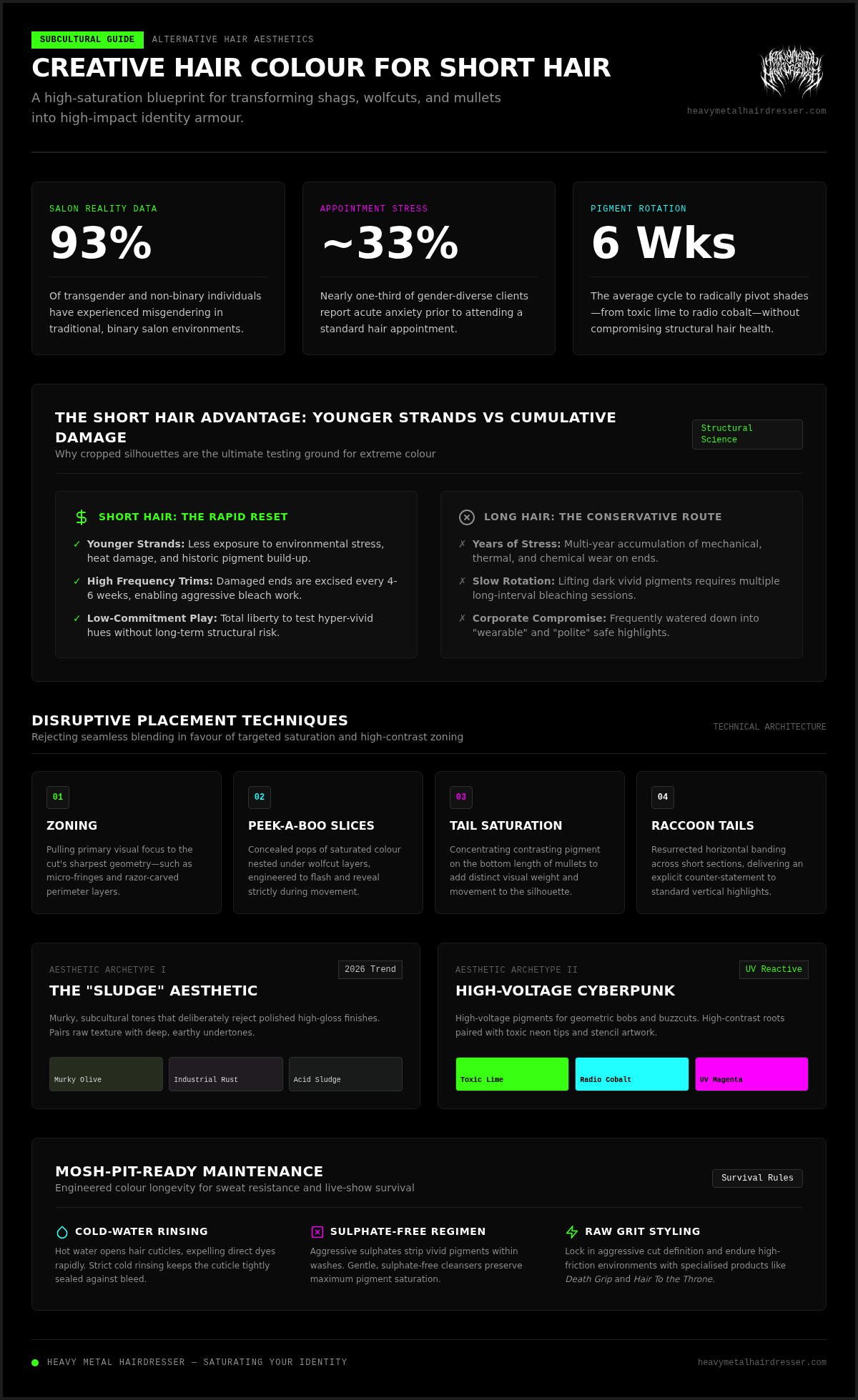
Short hair isn’t a retreat into “low maintenance” or corporate compliance; it’s a high-saturation weapon for aggressive self-expression. If you’ve ever walked out of a mainstream salon feeling like a “polite” version of yourself, you know the frustration of having your subcultural identity diluted by stylists who fear the bleach. Finding authentic creative hair colour for short hair shouldn’t mean settling for safe highlights or a “wearable” bob. You want your hair to scream, not whisper. We know that your cropped, textured cut is the ultimate canvas for vivid pigment, not a limitation to be managed by someone who doesn’t understand your music or your scene.

This guide is your blueprint for transforming shags, wolfcuts, and buzzcuts into high-impact statements that survive the front row. We’ll show you how to saturate your identity through technical placement that defies the standard rules of the industry. You’ll discover the secrets to mosh-pit-ready maintenance using Death Grip and Hair To the Throne, learn why short hair is the perfect playground for radical pigment rotations, and get the technical lowdown on the “acid and sludge” tones dominating the 2026 alternative aesthetic. From UV-reactive neon stencils to the science of sweat-resistant colour, it’s time to stop looking polished and start looking like yourself.

Key Takeaways

  • Learn how creative hair colour for short hair acts as a high-saturation weapon for self-expression, offering a frequent “reset” button for experimental styles.
  • Master targeted placement techniques like “zoning” and “peek-a-boo” tones to accentuate the aggressive texture of shags, mullets, and wolfcuts.
  • Explore 2026’s most rebellious palettes, from the murky depths of the “Sludge” aesthetic to high-voltage cyberpunk neons for geometric bobs.
  • Get the non-negotiable rules for mosh-pit-ready maintenance, including cold-water rinsing and sulphate-free cleansing to lock in your pigment.
  • Understand why a gender-inclusive, subcultural salon environment is essential for saturating your identity through unconventional hair aesthetics.

Why Creative Colour is the Ultimate Power Move for Short Hair

Short hair is often dismissed by mainstream stylists as a “practical” choice. That’s a myth we’re here to kill. In our world, a cropped cut is a high-saturation weapon. It’s about taking up space. It’s about refusing to blend in. When you choose creative hair colour for short hair, you aren’t just changing your look; you’re arming your identity. This is the ultimate power move because it prioritises your subcultural soul over corporate compliance.

The Freedom of the Short Hair Reset

Shorter hair means you’re working with “younger” strands. Long hair carries years of environmental stress, heat damage, and old pigment. Short hair offers a constant reset button. You can push the boundaries of hair coloring science without the fear of “killing” your ends. Since you’re trimming regularly, you can pivot from toxic lime to industrial cobalt every six weeks. It’s a low-commitment playground for high-impact results. You maintain hair health whilst chasing the most aggressive neons or “sludge” tones dominating 2026 aesthetics. If a colour choice feels “too much” for a specific week, it’ll be cut out and replaced before you know it.

Inclusivity and Identity in Alternative Colour

This isn’t about being “pretty” by mainstream standards. It’s about being seen. For many in the queer and alternative communities, vivid hair acts as a lighthouse. It signals a safe space and a shared identity. Research shows that 93% of transgender and non-binary individuals have been misgendered in traditional, binary salons. Furthermore, nearly one-third of gender-diverse people report acute anxiety before a standard appointment. We reject that clinical approach. We don’t care if a shade is “flattering” for your skin tone according to an outdated textbook. We care if it feels authentic to your spirit. Traditional beauty jargon fails the alternative soul because it prioritises “polite” aesthetics over radical self-expression.

We’re moving far beyond the soft, feathered pixie cut. We’re talking about razor-carved shags, disconnected mullets, and wolfcuts. These aggressive shapes demand creative hair colour for short hair that highlights their grit. Use saturation to define the internal layers of a wolfcut or the sharp perimeter of a micro-fringe. Pair that pigment with products like Death Grip or Hair To the Throne to maintain the raw, textured finish your cut deserves. By saturating your identity in pigment, you turn a haircut into subcultural armour. It’s a declaration that you don’t belong to the mainstream, and you’re perfectly fine with that.

Placement Techniques: Saturating Texture and Grit

Mainstream salons love a “seamless blend.” We don’t. In the alternative scene, placement is about disruption. When applying creative hair colour for short hair, we use “zoning” to pull focus to the most aggressive parts of the cut. If you’ve got a micro-fringe or razor-carved layers, a flat colour kills the vibe. We want high-contrast roots and face-framing neons that scream. This isn’t about looking “done.” It’s about looking intentional.

The “grown-out” look isn’t a sign of neglect. It’s a deliberate aesthetic choice. Darker roots against toxic yellow or radio cobalt ends create a gritty, underground silhouette. Whilst pushing these boundaries, refer to dermatologist tips for color-treated hair to keep your scalp and cuticle in check during the lightening process. Healthy hair holds pigment longer. It provides the structural integrity needed for high-impact saturation.

Colouring the Modern Mullet and Wolfcut

A mullet lives and dies by its movement. To make those “tails” stand out, we often saturate the ends with a contrasting vivid hair colour. This creates a visual weight that draws the eye to the length. For a wolfcut, we use peek-a-boo slices. These are hidden pops of colour tucked under the top layers. They only reveal themselves when you move. This technique adds a sense of depth that doesn’t compromise the choppy, textured finish of the cut. It’s subtle, but only by our standards.

The Raccoon Tail Resurrection

The 2000s scene aesthetic is back, but it’s evolved. Horizontal banding, or “raccoon tails,” is the ultimate middle finger to traditional hair colouring. This technique involves creating sharp, horizontal stripes of contrasting colour. It works best on shorter, choppy sections where the lines can be seen clearly. Think jet black against electric violet or bleach blonde against blood crimson. It’s high-effort and high-impact. It requires a steady hand to keep the lines crisp on short hair. It’s not for the faint of heart, but it’s perfect for anyone wanting to reclaim a classic subcultural look.

If you’re ready to stop playing it safe, our team can help you map out a placement strategy that fits your specific cut. You can book a session with our specialists to start your transformation and find a look that actually represents you.

Iconic Examples: Matching Colour to Your Alt Aesthetic

Your hair is a visual extension of the music you live for. Choosing creative hair colour for short hair isn’t just about what looks “good” in a mirror; it’s about what resonates in a basement show or a festival field. Whether you’re leaning into the “acid and sludge” tones of the doom scene or the high-voltage neons of a cyberpunk rave, your palette defines your tribe. We don’t do “natural” here. We do authentic.

The “Sludge” aesthetic is for those who find beauty in the murky. It blends deep, mossy greens, swampy greys, and oil-slick blacks to create a look that feels lived-in and raw. In contrast, Cyberpunk Neons use electric blues and hot pinks to sharpen the edges of geometric bobs, turning a classic shape into a futuristic statement. If you’re chasing a Classic Punk vibe, blood reds and oranges on modern mullet haircuts offer a timeless, high-energy silhouette. For a more ethereal but still edgy finish, the “Ghost” look pairs platinum whites with subtle, bleeding pastels that feel like a faded memory on the scalp.

Aggressive Palettes for the Mosh Pit

High-contrast black and neon pairings are the rockstar standard for a reason. They don’t disappear in the strobe lights. When you’re saturating your hair in these high-pigment shades, it’s vital to follow FDA safety guidelines for hair dyes to avoid scalp irritation or chemical burns from improper application. Primary colours like cyan, magenta, and yellow provide a raw, DIY punk feel that rejects the “expensive” look of salon-grade balayage. Your colour should reflect the subculture you belong to, not the one you’re supposed to impress at a corporate office.

Texture-First Colour Choices

Colour can either highlight or hide your cut. To make textured layers pop, we use contrasting tones that separate the hair visually, ensuring the razor-carved details aren’t lost in a sea of flat pigment. A matte finish often feels more authentic in alt-spaces, especially when paired with a gritty styling product like Death Grip. While glossy finishes are the industry standard, “unnatural” matte shades often look more intentional and “tough.” In the world of alternative hair, looking a little rough around the edges is a badge of honour. It shows you’ve been in the pit, and your hair survived the chaos.

Creative Hair Colour for Short Hair: Alternative Guide 2026

Maintenance and Mosh Pit Survival

You’ve spent hours in the chair saturating your identity. Don’t let a single weekend at Download wash it down the drain. Maintaining creative hair colour for short hair requires a tactical approach, especially when your lifestyle involves sweat, friction, and the occasional beer shower in the pit. Your hair is an investment in your subcultural identity. Protect it with the same energy you use to defend your spot at the front rail.

Cold water washing is the non-negotiable rule of vivid longevity. Hot water swells the hair cuticle, acting like an open door for those expensive pigments to escape. Wash with the coldest water you can stand. It keeps the hair shaft sealed and the colour locked in place. Pair this with sulphate-free cleansing. Sulphates are aggressive detergents that strip vivids faster than a bad soundcheck. Human sweat has a pH between 4.5 and 7.0. Combined with high body heat in a crowd, it becomes a pigment-leaching nightmare. Neutralise that risk by using gentle, professional-grade products that respect the bond between the dye and your hair.

UV protection is equally vital for outdoor festivals and summer gigs. UV rays act as a natural bleach, particularly on high-voltage neons like toxic yellow or radio cobalt. If you’re spending twelve hours in the sun, use a UV-shielding spray or embrace the subcultural tradition of a well-placed beanie or bandana. It’s about keeping that saturation sharp until your next salon visit.

The Alt-Hair Survival Routine

Lock in your look whilst maintaining that essential texture with “Hair To the Throne”. This isn’t your standard supermarket glop. It’s built to sustain the grit and saturation of alternative cuts without dulling the vibrancy of the dye. For extended festival weekends where a shower is a distant dream, dry shampoo is your tactical advantage. Apply it to your roots *before* you start sweating. This absorbs moisture at the scalp before it can dissolve your pigment, keeping your shag or wolfcut looking intentional rather than greasy.

Emergency Fade Fixes

Fading is a reality of the vivid life, but it doesn’t have to be a disaster. Use colour-depositing conditioners between appointments to keep the saturation levels high. Sometimes, you might choose to embrace the “pastel fade.” A washed-out electric violet can look incredible if the underlying bleach work was clean. However, if the tone turns muddy or brassy, it’s time to re-saturate. Avoid the temptation of home-dye “fixes.” Box dyes are unpredictable and often contain metallic salts that can cause catastrophic reactions during your next professional lightening session.

Don’t let your identity wash away. Grab your maintenance gear or book a colour refresh with our team today.

Saturating Your Identity at Heavy Metal Hairdresser

Heavy Metal Hairdresser isn’t a salon. It’s a sanctuary. We’ve built a space where “different” isn’t just tolerated; it’s the standard. If you’ve spent years feeling invisible in clinical, white-walled salons, you’ve found your tribe. We specialise in saturating identities. Whether you’re after a razor-sharp wolfcut or creative hair colour for short hair that defies the binary, we’re here to make it happen. Our environment is a gender-inclusive safe space designed for unconventional souls who refuse to blend into the corporate grey.

Simon Tuckwell’s heritage is rooted in the noise. From styling bands backstage at Download to the gritty fields of Bloodstock, the salon’s DNA is pure alternative culture. We understand that your hair is subcultural armour. This isn’t about vanity. It’s about being authentic to your scene. We bring that festival-ready energy into every session, ensuring your look survives the pit and looks incredible under the lights. We don’t just cut hair; we build the visual identity of the underground.

We’re also committed to evolving the industry. Our alternative hair courses are changing the game for stylists who want to master the art of subculture styling. We teach the technical grit required for aggressive textures and high-saturation vivids. By sharing this knowledge, we’re ensuring that the alternative community always has a home, no matter where they are. We’re training the next generation of rebellious experts to respect the craft and the community.

Expertise Beyond the Mainstream

Our philosophy is simple: bold, independent, and expert. We don’t follow trends; we create the silhouettes that define them. Technical excellence in vivid colour is our baseline. We celebrate individuality amongst a community that refuses to be boxed in. At Heavy Metal Hairdresser, you aren’t just a client. You’re a collaborator in a vision of radical self-expression. We use our expertise to empower you, providing the technical foundation for your most ambitious aesthetic goals.

Your Next Move

Ready to commit? A creative consultation is where the transformation starts. We don’t just look at your hair; we look at your aesthetic. Bring your favourite band merch or a screenshot of a 2026 sludge palette. We’ll talk about maintenance, placement, and how to make that creative hair colour for short hair pop against your specific cut. Prepare for your appointment by arriving with an open mind and a clear sense of who you are. We’ll handle the technical side. You bring the attitude. Join our community and let’s build something that screams.

Claim Your Subcultural Armour

Short hair isn’t a limitation; it’s a strategic advantage for anyone ready to push their aesthetic into the red. By mastering the science of technical placement and the discipline of mosh-pit-ready maintenance, you turn your cut into a visual manifesto. We’ve explored how creative hair colour for short hair serves as a high-saturation weapon for self-expression, moving far beyond the polite, corporate standards of the mainstream. Your hair should be a declaration of who you are, not a compromise for where you work.

You deserve a stylist who speaks your language and understands your scene. As the team behind the looks at Download and Bloodstock, we bring festival-grade expertise to every appointment. Our salon is a gender-inclusive safe space where your identity is celebrated, not managed. We specialise in the aggressive textures and vivid pigments that define alternative culture. Stop settling for “wearable” and start looking like yourself.

Book your identity-affirming transformation at Heavy Metal Hairdresser. Your next evolution is waiting. Let’s make it loud.

Frequently Asked Questions

Will creative hair colour damage my short hair?

Professional application won’t ruin your hair. Short hair is the ultimate playground because you trim it every few weeks, effectively cutting away old damage. This frequent “reset” button means you can push the limits of bleach and pigment more than someone with long hair. We use high-quality bond builders to keep the cuticle intact whilst you chase the most aggressive neons or sludge tones.

How long does vivid colour last on short hair?

You can expect high-saturation vivids to stay sharp for 4 to 6 weeks. On shorter fades or buzz cuts, the colour might feel like it’s disappearing faster because the natural root growth is more obvious. To extend the life of your creative hair colour for short hair, use cold water and sulphate-free products. Avoid hot showers and harsh detergents that strip pigment faster than a bad soundcheck.

Can I get creative colour if I have a very short buzz cut?

A buzz cut is a high-impact canvas for graphic stencilling and bold blocks. Since the hair is so short, we can achieve maximum brightness with minimal risk. You can experiment with leopard prints, geometric patterns, or solid neon saturations that would be impossible on longer lengths. It is a low-commitment, high-energy way to signal your subcultural identity without the baggage of long-term hair maintenance.

What is the best creative colour for a wolfcut?

High-contrast placement is the standard for a wolfcut. Use “zoning” to highlight the aggressive, razor-carved layers or try “peek-a-boo” slices that reveal themselves when you move. Acid greens, toxic yellows, or blood reds work perfectly to define the internal texture. Pair these shades with a product like Death Grip to keep the grit and movement of the cut front and centre.

How often should I get my short creative colour touched up?

Most alternative souls rebook every 4 to 6 weeks to keep their saturation levels high. If you have a disconnected mullet or faded temples, you might want a refresh every 3 weeks to manage the root growth. Frequent visits allow us to rotate your palette or deepen the sludge tones before they turn muddy. Regular trims also ensure your textured layers stay sharp and intentional.

Is creative hair colour gender-neutral?

Absolutely. We reject binary beauty standards entirely. Creative hair colour for short hair is a tool for identity-affirmation that belongs to everyone. Our salon operates as a gender-inclusive safe space where your hair reflects your spirit, not a societal box. We focus on technical excellence and subcultural grit, ensuring every client feels empowered to express their authentic self through high-pigment, non-conformist aesthetics.

What should I bring to a creative colour consultation?

Bring visual references that capture your specific vibe. This could be a screenshot of a cyberpunk rave, your favourite band’s album art, or a piece of merch with a killer colour palette. We want to understand your subcultural identity, not just a “look.” Be prepared to discuss your lifestyle, especially if you spend a lot of time in the pit or at outdoor festivals.

Can I use normal shampoo on vivid hair colour?

Avoid standard supermarket shampoos at all costs. Most contain harsh sulphates and salts that strip vivid pigments in a single wash. To maintain your saturation, use professional-grade, sulphate-free products like Hair To the Throne. These are designed to cleanse without opening the hair cuticle, keeping your colour locked in. Always wash with cold water to ensure your pigment survives your next gig.

Posted on

Best Shampoo for Vibrant Hair Colour: Alt-Care Guide 2026

Best Shampoo for Vibrant Hair Colour: Alt-Care Guide 2026

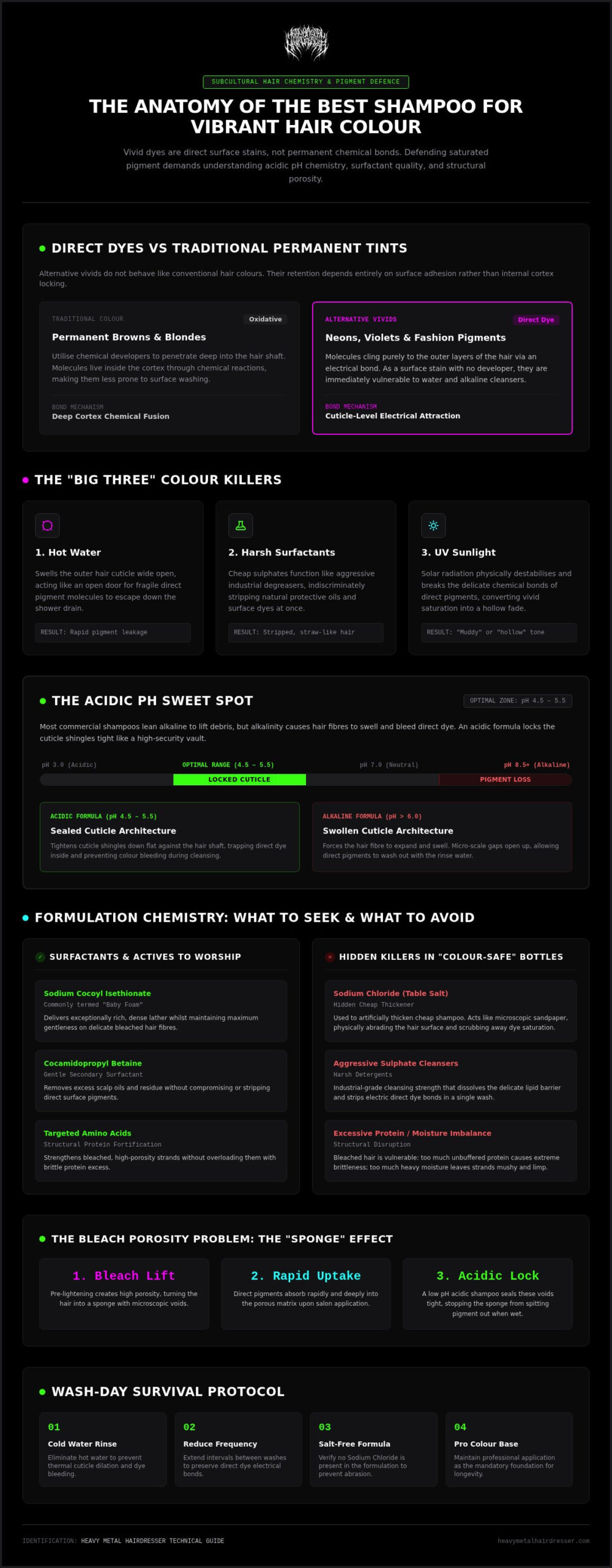
Your hair colour isn’t a “beauty trend”; it’s a tactical declaration of who you are. Watching that expensive neon green or deep violet swirl down the shower drain after just forty-eight hours feels like a personal betrayal. Most high-street bottles claim to be “colour-safe,” but they’re often far too aggressive for the delicate chemistry of direct dyes. Finding the best shampoo for vibrant hair colour requires moving past the marketing fluff and into the grit of acidic pH levels and pigment-locking technology.

We know you’re tired of straw-like textures and conflicting advice from mainstream blogs that simply don’t understand the nuances of subcultural aesthetics. You deserve saturated pigment that stays vivid for weeks and hair that remains textured enough to style a perfect shag. This guide reveals how to defend your vivid pigment with a tactical selection of shampoos that keep alternative hair colours saturated and defiant. We’re diving into the science of acidic pH levels, the reality of UK water minerals, and the specific products that ensure your identity survives the sweat and chaos of a weekend-long festival.

Key Takeaways

  • Understand why vivid dyes fade faster than permanent shades by learning how pigments sit on the hair cuticle.
  • Discover why a low acidic pH between 4.5 and 5.5 is the most critical feature when choosing the best shampoo for vibrant hair colour.
  • Learn how to spot hidden salts in high-street “colour care” bottles that strip your pigment and leave hair feeling like straw.
  • Master the survival routine for your alternative aesthetic by switching to cold water washes and reducing your washing frequency.
  • Recognise why even the highest quality shampoo requires a professional vivid colour application as a foundation for long-lasting saturation.

The Science of the Fade: Why Your Vibrant Colour Escapes

Vivid hair isn’t just a shade; it’s a structural challenge. Unlike permanent browns or blondes that use chemical reactions to live deep inside the hair shaft, alternative pigments are “direct dyes.” This means the molecules cling to the outer layers of the hair. It’s an electrical bond, not a permanent marriage. Because these pigments sit on the surface, they are vulnerable to every element they touch. Understanding this is the first step in choosing the best shampoo for vibrant hair colour to protect your investment.

Your hair is constantly under siege. We identify the “Big Three” colour killers that turn your neon dream into a pastel nightmare:

  • Hot Water: It swells the hair cuticle, acting like an open door for pigment to walk right out.
  • Harsh Surfactants: Cheap sulphates act like industrial degreasers. They strip away the oils and the dye molecules simultaneously.
  • UV Rays: Sunlight physically breaks down the chemical bonds of the pigment. This leads to that dreaded “muddy” or “hollow” fade.

For those rocking wolf hair cuts or heavily layered shags, vibrancy isn’t just about shine. It’s about saturation. We want deep, defiant tones that hold their own against the grit and texture of an alt aesthetic. Traditional beauty standards prioritise a glassy finish, but alt-hair needs a balance. You need a formula that maintains pigment density without making your textured layers feel limp or greasy.

The Porosity Problem

To get those neons to pop, we usually have to bleach the hair first. This process creates high porosity. Think of your hair like a sponge with giant holes. It takes the colour in beautifully, but it “spits” it back out the moment it gets wet. Using the best shampoo for vibrant hair colour helps manage this by keeping the pH level acidic. A low pH seals those “holes” in the hair strand, trapping the dye inside the cuticle where it belongs.

Vivids vs. Traditional Tints

Standard “colour-safe” shampoos are often designed for oxidative dyes. These are the colours that use a developer to penetrate the hair. To understand the chemistry of semi-permanent hair colour, you have to realise that vivids are essentially a stain. They don’t have a developer to lock them into the cortex. This is why you see that “bleeding” effect in the shower. If your shampoo is too alkaline, it encourages this bleeding. It turns your expensive salon visit into a colourful puddle on the shower floor. You need a cleanser that respects the delicate surface-level bond of direct pigments.

The Anatomy of the Best Shampoo for Vibrant Hair Colour

Walking into a shop and grabbing anything labelled “colour-safe” is a rookie mistake. For alternative shades, sulphate-free is merely the starting line. If you want to find the best shampoo for vibrant hair colour, you have to look under the hood at the chemical formulation. Your goal is a bottle that respects the fragile bond between your hair and that neon pigment whilst keeping the structure of your bleached strands intact.

The most critical factor is the pH level. Most commercial shampoos are slightly alkaline to help lift dirt, but alkalinity is the enemy of a sealed cuticle. According to research on shampoo pH and cuticle damage, alkaline formulas cause the hair fibre to swell. This swelling allows your expensive direct dye to leak out during every wash. You need a formula sitting in the acidic sweet spot of pH 4.5 to 5.5. This keeps the cuticle shingles pressed down tight, locking your colour in a high-security vault.

Beyond pH, you need to manage the protein and moisture balance. Bleached hair is essentially wounded hair. Too much protein makes it brittle; too much moisture makes it mushy. The best shampoo for vibrant hair colour provides a hit of amino acids for strength without sacrificing the slip needed for detangling. Look specifically for “salt-free” labels too. Many brands use sodium chloride (table salt) as a cheap thickener. It’s abrasive, acting like sandpaper on your hair’s surface and scrubbing away your saturation.

Surfactants to Worship

Not all bubbles are created equal. You want surfactants that cleanse the scalp without declaring war on your ends. Sodium Cocoyl Isethionate, often called “baby foam,” is a dream for vivids. It provides a rich lather that is incredibly gentle on the hair. Pair this with Cocamidopropyl Betaine to ensure you’re removing excess oil without stripping your pigment. This level of gentle care is vital for maintaining modern mullet haircuts, where you need to preserve the natural movement and texture of the hair whilst keeping those aggressive pops of colour looking sharp. If you’re struggling to find the right balance, our experts at Heavy Metal Hairdresser can help you map out a custom care routine.

UV Blockers and Antioxidants

Sunlight is a natural bleach. If you spend your summers at Download or Bloodstock, the UV rays will eat your hair colour for breakfast. Look for ingredients like sunflower seed extract and Vitamin E. These act as biological shields, neutralising the free radicals that cause oxidative stress and shade distortion. Protecting your hair whilst out in the pit is just as important as the shampoo you use at home. These antioxidants prevent the “ghosting” effect where your vibrant blue turns into a muddy, washed-out grey after just one sunny afternoon.

Mainstream vs. Alt-Professional: Comparing Your Options

Vivid hair isn’t cheap. So why wash it with something that costs less than your morning coffee? Buying a budget bottle from the supermarket is a gamble you’ll likely lose. These brands talk a big game about “colour protection,” but their priority is the mass market, not your specific shade of radioactive pink. Finding the best shampoo for vibrant hair colour means looking past the flashy label and into the ingredient list. High-street options are often bulked out with fillers that do more harm than good.

The Hidden Killers in Cheap Bottles

Sodium Chloride is the biggest offender in the budget aisle. It is essentially table salt. Manufacturers use it to thicken cheap formulas, but for your hair, it acts like sandpaper. It is an abrasive that scrubs away your saturation with every wash. Then there are silicones. They provide a “plastic” shine that masks the fact your hair is actually dying for moisture. Budget formulas also lean heavily on alcohol-based drying agents to make the hair feel “clean,” but they leave your strands feeling like straw and your pigment looking hollow.

Specialist Vivid Maintenance Brands

Investing in professional brands is about protecting your vivid hair colour from the inside out. Pro formulas are significantly more concentrated. You use a pea-sized amount rather than a palmful. This makes the cost-per-wash comparable to budget bottles in the long run because the bottle lasts three times longer. Many of these specialist brands now include bond-builders that repair the damage from bleaching whilst you cleanse. Some even offer depositing shampoos, which act as a tactical boost to replace lost pigment between salon visits.

To make the most of these high-end formulas, you should follow dermatologist guidelines for washing hair. This means focusing your shampoo purely on the scalp. Don’t scrub your ends. Let the suds rinse through the lengths naturally as you rinse. This tactic reduces friction on your most fragile, pigment-heavy strands. Choosing the best shampoo for vibrant hair colour from an alt-professional brand also ensures your money supports ethical, often vegan and cruelty-free, businesses that actually understand the subcultures they serve.

Best Shampoo for Vibrant Hair Colour: Alt-Care Guide 2026

The Wash-Day Ritual: Mosh Pit Survival for Your Hair

Washing your hair shouldn’t be a mindless daily habit. For alternative colours, it is a calculated risk. Every time you step under the shower head, you’re inviting the water to steal your pigment. Even with the best shampoo for vibrant hair colour, your technique determines whether your shade lasts three weeks or three months. You have to treat your wash day like a tactical operation designed to defend your identity against the elements.

The first rule is the “Cold Water Challenge.” You have to embrace the freeze. Hot water is a solvent that swells the hair fibre and forces the cuticle open. Cold water keeps those shingles flat. It is uncomfortable, but it is the only way to stop the dye from bleeding into the drain. If you can’t handle a full cold shower, wash your hair over the sink to keep the rest of your body warm. It is a small price to pay for a neon that stays neon.

Strategic cleansing is your next line of defence. Focus your effort entirely on the scalp where the oil lives. Your ends don’t need scrubbing; they are the most porous and fragile part of your hair. The running suds from the best shampoo for vibrant hair colour will clean the lengths sufficiently as they rinse through. When you’re finished, don’t rub your hair with a towel. Pat it dry gently. Friction is a physical force that can literally scrape pigment off the surface of pre-bleached hair strands.

Surviving the Pit

Festivals like Bloodstock or Download are endurance tests for your aesthetic. Sweat, beer, and dust are inevitable. Instead of a full wash in a questionable campsite shower, use dry shampoo to absorb oils at the root. You can mask day-three grease by leaning into an aggressive, textured look. Using Death Grip allows you to maintain that lived-in grit without stripping your colour. If your fringe gets too gritty, a quick-refresh with cold water and a tiny drop of cleanser can buy you another twenty-four hours of saturation.

The ‘Conditioner First’ Myth-Bust

You might have heard that “reverse washing” protects your pigment. Whilst it can help very fine hair avoid being weighed down, it isn’t a magic fix for colour retention. You need the shampoo to hit the scalp first to remove debris properly. The real secret is the final step of the ritual. Always finish with an acidic rinse or a final cold blast. This ensures the cuticle is fully locked before you step out into the air. If your current routine is failing to keep your shade bold, book a consultation at Heavy Metal Hairdresser to overhaul your maintenance strategy.

Beyond the Bottle: Professional Vivid Care Strategies

Even the most expensive bottle of the best shampoo for vibrant hair colour won’t save a botched job. If your foundation is weak, your maintenance is just a slow retreat. A professional vivid hair colour application ensures the pigment is driven deep into the cuticle from day one. This isn’t just about slapping dye on; it’s about the chemistry of the lift. If the hair isn’t prepped with the right porosity, the colour will slide off regardless of what you use in the shower.

Specialists understand that vivids require a different level of respect than standard tints. We know when to push the bleach and when to stop to preserve the hair’s integrity. A solid foundation means your home care actually has something to work with. You’ll find that the best shampoo for vibrant hair colour works twice as hard when it’s protecting a professionally saturated base. It’s the difference between a colour that lasts three weeks and one that stays defiant for months.

Your hair’s shape plays a massive role in how your colour is perceived. A textured shag haircut is the ultimate partner for vivids. The layers create shadows and highlights that make even a slightly faded neon look intentional and gritty. It adds movement that flat, one-length cuts lack. When your colour starts to shift, the movement of a shag keeps the look alive. It masks the regrowth and the inevitable tonal changes that happen between salon visits.

The Power of Professional Toner

Salon-grade toners are the secret weapon. They are formulated to neutralise specific undertones that emerge as your vivids fade. Unlike home “box” fixes that often contain harsh metallic salts, professional toners are gentle and bespoke. We can create personalised colour-maintenance cocktails that you can use at home to keep your saturation at peak levels. This ensures your “grit” and texture remain intact without the muddy buildup associated with cheap drugstore products.

Inclusive Style, Exclusive Results

Choosing a salon that understands alternative subcultures is vital. You aren’t just a client; you’re part of a community that values self-expression above all else. We provide a safe-space environment where your identity is celebrated, not just tolerated. We know the difference between a “mistake” and a deliberate aesthetic choice. When you’re ready for a colour that defies the mainstream, book your vivid session today. Knowing when it’s time for a professional refresh is the final step in your tactical defence strategy.

Defend Your Identity and Keep Your Colour Defiant

Maintaining a saturated aesthetic requires more than just luck; it demands a tactical approach to chemistry and care. You’ve learned that the best shampoo for vibrant hair colour must be acidic to lock the cuticle and free from abrasive salts that scrub away your hard-earned pigment. By mastering the cold-water wash and focusing your efforts on the scalp, you ensure your neon or deep-jewel tones survive the chaos of the mosh pit and the heat of the summer sun.

Your hair is a declaration of who you are, and it deserves a foundation built by experts who live and breathe alternative subcultures. As vivid colour specialists and backstage festival stylists, we provide a gender-inclusive safe space where your self-expression is the priority. Don’t let your identity fade into the background. Secure your vibrant identity – Book with Heavy Metal Hairdresser today and keep your shade as bold as your spirit. Your hair has never been in better hands.

Frequently Asked Questions

How often should I wash my hair to keep the colour vibrant?

Aim for washing your hair only once or twice a week to maintain maximum saturation. Every time you wet your hair, you risk pigment loss, so training your hair to last longer between washes is vital. Use a high-quality dry shampoo to manage oil at the roots without disturbing the lengths. This reduced frequency ensures the best shampoo for vibrant hair colour can do its job without being overused on fragile, pre-bleached strands.

Does cold water really make a difference for hair colour?

Cold water is one of the most effective tools for defending your shade. High temperatures cause the hair cuticle to swell and lift, which allows the large direct dye molecules to escape into the drain. Rinsing with cold water keeps the cuticle shingles flat and locked against the hair shaft. It might be uncomfortable in the shower, but it is the simplest way to ensure your neon or jewel tones stay defiant for weeks longer.

Can I use dry shampoo on vibrant hair colour?

Dry shampoo is a non-negotiable part of an alternative hair care routine. It allows you to skip traditional water-based washes, which are the primary cause of pigment fading. By absorbing excess sebum at the scalp, you can maintain the texture of your wolfcut or shag without stripping the colour from your ends. It is the perfect tactical solution for multi-day festivals where access to cold water and professional products is limited.

Is sulphate-free shampoo enough to stop my hair from fading?

Sulphate-free is just the baseline and isn’t a guarantee against fading. Many “sulphate-free” formulas still contain harsh surfactants or high levels of sodium chloride that can be just as abrasive as traditional detergents. You also need to ensure the formula has an acidic pH between 4.5 and 5.5. Finding the best shampoo for vibrant hair colour means looking for a product that balances gentle cleansing with cuticle-sealing chemistry rather than just relying on a label.

What ingredients should I avoid in a colour-safe shampoo?

Avoid sodium chloride, which is often used as a cheap thickener but acts like sandpaper on your pigment. You should also stay away from drying alcohols and high-alkaline ingredients that force the hair cuticle to open. Silicones should be used cautiously; whilst they provide shine, they can create a plastic-like buildup that prevents moisture from reaching the hair. Stick to professional, niche-focused brands that prioritise the structural health of bleached, alternative hair over mass-market filler ingredients.

Should I use a colour-depositing shampoo every time I wash?

Using colour-depositing shampoos every time can lead to uneven pigment buildup and tonal distortion. These products are tactical tools designed to refresh your shade, not replace your primary cleanser. We recommend using them every second or third wash to top up the vibrancy without making the hair feel heavy or muddy. Always follow up with a moisture-rich conditioner to ensure your hair stays soft and manageable despite the extra pigment load.

How do I stop my vivid hair colour from bleeding onto my pillow?

Ensure your hair is 100% dry before your head hits the pillow to prevent dye transfer. Damp hair is more porous and prone to “bleeding” onto fabrics through friction and moisture. Switch to a silk or satin pillowcase in a dark colour like black or deep purple to hide any accidental staining. If you’ve just had a fresh vivid application, laying a dark towel over your pillow for the first few nights provides an extra layer of protection.

Can I use heat styling tools on vibrant coloured hair?

Heat styling tools can be used, but you must be cautious as high heat physically “cooks” the pigment out of the hair. Always apply a professional-grade heat protectant and keep your tools on a lower temperature setting, ideally below 180 degrees. Excessive heat causes immediate fading and can turn vibrant blues or purples into dull, muddy shades. For textured styles like shags, try air-drying or using salt-free texturising sprays to embrace your natural grit instead.

Posted on

Split Dye Hair Colour Combinations: The 2026 Guide to Bold Alternative Contrasts

Split Dye Hair Colour Combinations: The 2026 Guide to Bold Alternative Contrasts

A symmetrical split dye is the ultimate middle finger to boring, one-dimensional hair. It is a visual manifesto for the outsiders who refuse to fade into the background. You already know that finding the right split dye hair colour combinations is about more than just picking two random shades from a swatch book. It is about creating an architectural contrast that respects the jagged layers of a shag or the aggressive movement of a fresh wolfcut.

We know the struggle. You are likely tired of your vibrant neon bleeding into your deep base during the first wash, leaving you with a murky, unintentional mess. You want tones that clash with purpose, not by accident. This 2026 guide is here to strip away the guesswork and hand you the keys to professional-grade alternative aesthetics. We will explore the most aggressive pairings of the year, from toxic greens against deep violets to icy platinums clashing with heavy reds. You will learn how to maintain that razor-sharp line between shades whilst ensuring both tones stay as vivid as the day they were applied. It is time to stop playing it safe and start wearing your identity with total confidence.

Key Takeaways

  • Identify the most aggressive split dye hair colour combinations for 2026 to ensure your look is both aesthetic and unapologetically bold.
  • Learn how to use high-contrast shades to highlight the disconnected layers and jagged texture of shags and wolfcuts.
  • Master the maintenance “Golden Rule” by washing each side separately to prevent colour bleeding and keep your vivids sharp.
  • Understand the theory behind horizontal and vertical colour placement to create a visual narrative that suits your identity.
  • Discover why expert vivid application is the only way to achieve the sharp, high-pigment results that define alternative hair subcultures.

Mastering the Art of the Half-and-Half: Why Split Dye Works

Split dye is a visual riot. It is the deliberate, architectural division of your hair into two distinct zones of high-pigment saturation. While some see it as a “half-and-half” gimmick, we treat it as a sophisticated application of professional hair colouring techniques. Subcultures have long embraced this look because it rejects the boring binary of natural hair. It is a loud, proud declaration of identity that demands attention. It tells the world you don’t have to choose just one version of yourself.

Finding the perfect split dye hair colour combinations requires a solid grasp of colour theory. You generally have two routes to take. Complementary pairings sit opposite each other on the colour wheel, such as electric orange clashing against a deep cobalt. These offer the most aggressive, high-energy contrast. Analogous pairings, like forest green sitting next to a neon lime, create a more fluid, toxic gradient. Both styles require an expert eye to ensure the tones don’t just sit next to each other, but actually elevate the entire aesthetic.

Precision is everything in this game. Clean sectioning is the literal line between a professional masterpiece and a muddy DIY disaster. If your sections aren’t razor-sharp, your colours will bleed during the initial rinse. This ruins the high-contrast finish and leaves you with a murky middle ground that looks accidental rather than intentional. We prioritise crisp lines to ensure your vivid hair colour stays exactly where it belongs.

The Vertical Split: Symmetry and Subversion

The vertical split is the ultimate statement in symmetry. By dividing the hair exactly down the middle, you create a graphic frame that highlights your facial features with surgical precision. It is a classic move for anyone rocking a middle-parted wolf hair cut. This placement subverts traditional beauty standards by forcing the eye to process two conflicting realities at once. It is bold. It is unapologetic. It turns your face into the centrepiece of a high-contrast art installation.

The Horizontal Split: Hidden Layers and Movement

Horizontal splits are about mystery and movement. By placing a different tone in the under-layers, you create a “peek-a-boo” effect that only reveals itself when you move or tie your hair up. This works exceptionally well for heavily textured shags. As the choppy layers shift, the hidden colour flashes through, adding depth and grit to the cut. Using darker under-tones can make the top layer pop, giving your hair a 3D quality that flat, single-process colours simply cannot match. It is the perfect choice for those who want their split dye hair colour combinations to feel more integrated and dynamic.

Aggressive Split Dye Hair Colour Combinations for 2026

The 2026 forecast for alternative hair is clear. We are moving away from subtle gradients and leaning into absolute, jarring contrast. Your choice of split dye hair colour combinations should feel like a deliberate collision of worlds. It is about more than just picking two pretty shades. It is about selecting tones that fight for dominance whilst somehow creating a cohesive, subcultural masterpiece.

  • The Neon Nightmare: This pairing features a toxic, electric green set against a deep, raven black. It is high-energy, reminiscent of 90s industrial aesthetics, and provides a sharp frame for the face.
  • The Classic Clash: High-saturation red paired with inky black remains a gothic staple. It offers a dark, romantic edge that never loses its impact.
  • The Ethereal Edge: For those who prefer a colder vibe, pastel lavender against a stark, icy silver creates a ghostly, futuristic look.
  • The Cyberpunk: Hot pink and electric blue are the ultimate high-energy duo. This combination is unapologetically loud and perfect for those who live in the neon-lit fringes of the scene.
  • The Natural vs. Vivid: Keeping your natural base on one side whilst saturating the other in a high-pigment accent is a power move. It bridges the gap between your raw identity and your creative expression.

Choosing the right path requires an understanding of how these pigments live together. If you are ready to ditch the ordinary, our crew at Heavy Metal Hairdresser can help you map out a contrast that actually lasts.

High-Contrast Pairings for Maximum Impact

Black is the ultimate anchor. Whether you are using a deep raven or a blue-toned charcoal, pairing a dark base with a vivid shade creates a “comic book” pop-art aesthetic. This high-contrast approach makes the lighter side appear even brighter. Managing the transition between two high-intensity pigments is where most people fail at home. Professional application ensures that the boundary remains crisp, preventing your hot pink from bleeding into your jet black and creating a muddy, purple mess.

Pastel and Muted Split Dye Aesthetics

Not every split needs to be neon to be aggressive. A “Sunset Split” using warm oranges and soft pinks offers a tonal contrast that feels intentional and artistic. Muted pairings like mint and lilac provide a softer alternative look that still breaks the rules. However, these shades are demanding. Pastel splits require meticulous bleaching to a level 10 base and a strict maintenance routine to prevent the delicate pigments from fading into nothingness. They are high-maintenance, but the payoff is a unique, ethereal grit that stands out in any crowd.

Complementing the Cut: Split Dye for Wolfcuts and Shags

A killer cut deserves a killer colour. They are not separate entities; they are a partnership. A wolf hair cut is defined by its disconnected layers and raw, jagged texture. Applying split dye hair colour combinations to these shapes isn’t just about aesthetics. It is about structural emphasis. When you place a stark contrast between the top crown and the length, you reveal the jagged architecture that makes these alternative styles so iconic. It pulls the viewer’s eye into the depth of the cut.

Modern shags benefit from a “fringe and frame” approach. By splitting the colour directly through the fringe, you create an immediate focal point that anchors your entire look. Mullets, however, thrive with a front-to-back split. Keeping the short, aggressive front sections one tone whilst the long back is another creates a 3D effect that traditional highlights simply cannot touch. Do not be afraid of chaos. Using irregular or jagged sectioning instead of a perfect, sterile line can actually match the subcultural grit of a textured cut much better than a clean salon finish.

Dynamic Movement with Textured Layers

Styling is the secret sauce for making your split pop. When you use textured styling products like salt sprays or matte clays, you create “flicks” in the hair. These choppy ends catch the light and showcase the dual tones as they move. For those with fine hair, split dye hair colour combinations are a secret weapon for volume. The contrast creates visual weight and shadows. This makes a thin shag look twice as thick by adding layers of perceived density that a single-process colour lacks.

Framing the Face with Creative Colour

Placement should always be strategic. A lighter shade placed near the eyes can brighten your features and make your gaze more intense. Conversely, using a darker tone along the jawline of a wolfcut adds a natural contouring effect that sharpens your profile. If a full half-and-half feels too overwhelming, the “Money Piece” split is a solid hybrid. It focuses the contrast exclusively on the face-framing strands. This gives you that high-impact alternative edge without needing to saturate your entire head in two different pigments.

Split Dye Hair Colour Combinations: The 2026 Guide to Bold Alternative Contrasts

The Survival Guide: Maintaining Your Vivid Split Dye

You have invested in the contrast. Now you have to fight to keep it. Split dye is a high-maintenance relationship that requires discipline and the right arsenal. It looks razor-sharp on day one, but day thirty depends entirely on your shower habits. If you treat your dual tones like a standard box dye, you will end up with a muddy, blurred mess that ruins the architectural intent of the cut.

The Golden Rule is non-negotiable. Wash each side separately. It sounds tedious, but it is the only way to prevent cross-contamination. If you rinse your neon green and raven black together under a hot shower head, the black will win every single time. Clip one side up whilst you work on the other. Use professional, sulphate-free products designed specifically for vivid hair colour to ensure the pigment stays locked inside the hair shaft rather than swirling down the drain.

Cold water is your best friend. Heat opens the hair cuticle and invites the colour to escape. Keep it ice-cold during the rinse to seal the deal. Between washes, rely heavily on dry shampoo to stretch out the time between water exposure. The less you wash your split dye hair colour combinations, the longer they will stay aggressive and punchy.

Preventing the Dreaded Colour Bleed

Barrier creams are essential for the first few weeks. Smear a thick layer of petroleum jelly or a professional barrier cream along your parting and hairline before you even think about getting your hair wet. This creates a physical shield that prevents pigment from migrating across the line. Never scrub the two sides together whilst they are wet. Friction is the enemy of a crisp split. When you step out of the shower, use two separate towels or very carefully pat-dry each side. One rogue rub with a shared towel can transfer enough pigment to stain your lighter side permanently.

Professional Refresh vs. DIY Disaster

Refreshing your look at home is where things usually go south. The risk of overlapping bleach on previously lightened sections is massive. This leads to “chemical haircuts” and irreversible breakage. If your roots are coming through or one side has faded faster than the other, book a session with our crew for a professional top-up. We know how to manage the transition between different split dye hair colour combinations without compromising your hair health. Transitioning from a deep red to a silver, for example, requires a strategic removal process that DIY attempts simply cannot replicate safely.

Saturate Your Identity: Professional Split Dye at Heavy Metal Hairdresser

Heavy Metal Hairdresser is not your average high-street salon. It is a gender-inclusive safe space where the rules of traditional beauty are intentionally broken. We specialise in the aggressive, high-contrast split dye hair colour combinations that make other stylists nervous. Our chair is a refuge for those who want their exterior to match their internal frequency. We don’t do “subtle” here. We do saturating, high-pigment transformations that demand a double-take.

Mastering the “impossible” split is our bread and butter. Simon Tuckwell and the crew have spent years perfecting the chemistry of vivids to ensure your lines stay crisp and your tones stay pure. We understand how different pigments interact on a molecular level. This expertise allows us to execute pairings that would normally turn into a muddy mess in less experienced hands. Whether you are chasing a toxic sludge green or a stark, icy silver contrast, we provide the technical precision required for a professional alternative finish.

Our work is built for real life. We know your hair needs to survive more than just a curated Instagram post. It needs to survive the mosh pit, the festival circuit, and the daily grind. We bring our backstage experience from major UK festivals like Download and Bloodstock directly to the salon floor. This means we use application techniques designed for maximum longevity and grit. Your journey starts with a bespoke vivid colour consultation where we map out your vision and ensure your hair health remains the priority.

Beyond the Binary: Inclusive Colour for Everyone

We are fiercely committed to providing identity-affirming hair services for the entire UK alternative community. We have binned the traditional beauty jargon in favour of subcultural grit and authentic expression. Your hair is your manifesto. We are just the architects helping you build it. We focus on creating a look that feels like a true reflection of your personality rather than following a fleeting trend. This is a space where being different is the standard, not the exception.

Join the Resurrection

The alternative scene is undergoing a massive revival, and we are at the centre of it. We have become the primary destination for shag hairdressers and alt-stylists who understand the synergy between a jagged cut and a bold colour. We don’t just cut hair; we sculpt identities. If you are ready to ditch the boring and embrace the bold, it is time to take the leap. Book your split dye transformation today and let us help you saturate your identity in high-pigment sensation.

Claim Your Contrast and Break the Binary

Your hair is the loudest part of your identity. It should never be an afterthought or a safe compromise. We have explored how to choose split dye hair colour combinations that respect the jagged architecture of your cut and how to keep those tones from bleeding into a murky mess. Whether you are leaning into a toxic neon collision or a classic gothic clash, the goal is always high-impact, intentional contrast that tells your story before you even speak.

At Heavy Metal Hairdresser, we offer a gender-inclusive safe space where your subcultural identity is the absolute priority. Our crew brings the same raw energy used backstage at Download and Bloodstock festivals to every bespoke vivid transformation in the salon. We specialise in the synergy between aggressive texture and high-pigment saturation, ensuring your look survives the mosh pit and the daily grind with equal grit.

It is time to stop settling for predictable, one-note hair that fades into the background. Book your aggressive split dye transformation at Heavy Metal Hairdresser today and let us help you build a look that is unapologetically yours. Your next evolution is waiting for you in the chair.

Frequently Asked Questions

How do I stop my split dye hair from bleeding together?

You must wash each side of your head separately to prevent cross-contamination. Use ice-cold water and professional sulphate-free shampoo to keep the hair cuticle closed and the pigment locked in. Applying a thick barrier cream or conditioner to the lighter side whilst rinsing the darker side acts as a physical shield. If you scrub both sides together whilst wet, you will end up with a muddy, blurred mess that ruins the contrast.

Can I split dye my hair at home or should I go to a salon?

Whilst you can try it at home, a professional salon is the only way to guarantee a razor-sharp parting and zero bleed. Professional stylists have the technical skill to section with surgical precision and manage the chemistry of different pigments simultaneously. DIY attempts often result in patchy application or “chemical haircuts” from overlapping bleach. For high-contrast split dye hair colour combinations, the expertise of an alternative specialist is always worth the investment.

What are the best split dye combinations for dark hair?

The most aggressive combinations for naturally dark hair involve using black as a heavy anchor against a high-pigment neon. Electric green, vivid red, or deep violet all pop brilliantly against a raven base. You only need to bleach one half of your head to a high level, which preserves the health of your natural side. This creates a massive visual impact whilst keeping the maintenance manageable for those with darker starting tones.

How long does split dye hair colour usually last?

Most vivid split dyes will remain punchy for approximately four to six weeks before they start to noticeably fade. This timeline depends heavily on how often you wash your hair and the quality of your aftercare products. Using professional-grade, sulphate-free shampoos and rinsing with cold water will extend the life of your pigment. Avoiding heat styling and direct sunlight also helps prevent your dual tones from losing their saturation too quickly.

Will a split dye look good on a wolfcut or shag?

Split dye is the perfect partner for textured cuts like wolfcuts and shags because it emphasises the disconnected layers. The two-tone contrast reveals the jagged architecture of the cut, making the choppy ends and flicked layers stand out. It adds a 3D quality that a single-process colour lacks. By using different split dye hair colour combinations, you can highlight the fringe of a shag or add depth to the crown of a wolfcut.

What happens if I want to change one of the colours in my split dye?

Changing one side requires a strategic professional removal process to ensure you don’t ruin the hair health or stain the other side. Transitioning from a dark pigment to a lighter one is complex and usually takes several sessions. We use specific stripping techniques that target one half whilst protecting the remaining colour. Never try to bleach out a stubborn vivid at home, as you risk permanent damage and an uneven, patchy base.

Is split dye high maintenance compared to a full head of colour?

It is significantly higher maintenance because you cannot just wash and go like you would with a single tone. You have to manage two different fade rates and be incredibly careful during the rinsing process to prevent bleeding. However, the visual payoff for alternative identities is unmatched. It is a commitment to a specific aesthetic that requires more time in the shower and regular salon top-ups to keep the contrast looking sharp.

Posted on

Sea Salt Spray: Alt-Styling Guide for Gritty Volume

Sea Salt Spray: Alt-Styling Guide for Gritty Volume

Stop treating your sea salt spray like a holiday accessory. Most tutorials promise sun-kissed waves, but we know you aren’t looking for a trip to the coast; you’re looking for a riot. If you’ve been struggling with flat, limp hair that loses its shape before you’ve even reached the gig, you need a different approach. Using sea salt spray for hair texture isn’t about looking soft; it’s about weaponising your wolfcut with aggressive, gritty volume that actually stays put.

It’s frustrating when your alternative style feels more polite than punk because your product leaves your strands feeling like a crunchy, dry mess. We agree that generic beauty industry advice just doesn’t cut it for subcultural styles like shags and wolfcuts. This guide promises to transform your routine by teaching you the expert art of injecting raw, long-lasting grit into your hair. We will explore the specific techniques needed to master wet versus dry application and how to achieve Death Grip levels of volume that hold through every movement.

Key Takeaways

  • Forget beach waves; learn how sea salt spray for hair texture works by swelling the hair cuticle to create immediate, gritty thickness in flat strands.
  • Master the difference between wet and dry application to choose between a lived-in feel or maximum subcultural grit.
  • Use the “upside down” technique and strategic sectioning to inject aggressive volume into the crown and layers of your wolfcut or shag.
  • Discover how to revive your style for day two and keep your texture sharp through the intensity of a festival mosh pit.
  • Level up your styling game with “Death Grip” levels of hold that celebrate your individuality without the dreaded crunch of traditional products.

Beyond the Beach: Why Sea Salt Spray is the Ultimate Alt-Hair Weapon

Most brands want you to believe that sea salt spray belongs on a breezy coastline during a summer holiday. They’re wrong. For those of us in the alternative scene, sea salt spray for hair texture is a tactical tool used to weaponise a wolfcut or a shag. It’s a mineral-based texturiser designed to mimic the rough, gritty feel of ocean air without the annoying sand. The unique mineral composition of sea salt allows it to bind to the hair, creating a tactile roughness that makes aggressive layers stand out rather than falling flat.

This isn’t just about ‘beach waves’. That’s a limited marketing term that ignores the raw potential of subcultural styling. Using sea salt spray for hair texture allows you to bypass the generic advice and focus on what matters: grit. Whether you’re a metalhead, a punk, or someone who simply refuses to conform, texture is the ultimate equaliser. It’s gender-inclusive and identity-affirming; it doesn’t care who you are, only that your hair has enough ‘grip’ to tell a story.

The Anti-Polished Aesthetic

The mainstream is currently obsessed with the ‘clean girl’ look, featuring slicked-back buns and high-shine finishes. We aren’t. Our aesthetic is deliberately rebellious and unapologetically gritty. For us, ‘messy’ isn’t an accident; it’s an expert-led style choice that signals you belong in the pit, not a corporate office. Sea salt spray is essential for creating that ‘lived-in’ vibe from day one. It strips away the artificial softness of freshly washed hair, replacing it with a raw energy that feels authentic to the underground.

Texture vs. Hold: Understanding the Difference

It’s vital to understand that texture and hold are different beasts. Hairspray is designed to freeze a shape in time; it’s static and often feels plastic. Sea salt spray is about movement and grit. It provides a matte finish that looks natural under stage lights, helping you achieve those Death Grip levels of texture without the greasy shine of traditional pomades.

Because it doesn’t set like a glue, your hair remains ‘re-scrunchable’ throughout the night. If your volume starts to drop mid-set or whilst you’re in the mosh pit, you can simply work your hands through your layers to reactivate the salt crystals. This flexibility is what gives alternative styles their longevity. You aren’t fighting against your hair; you’re giving it the structural integrity to move with you.

The Science of Grit: How Salt Transforms Flat Strands

Don’t just spray and hope for the best. To master your style, you need to understand why salt works. When you apply sea salt spray for hair texture, you’re initiating a physical reaction on every individual strand. Salt crystals adhere to the hair shaft and swell the cuticle, creating instant thickness. This structural change is essential for anyone sporting a modern mullet haircut, as it provides the necessary “bite” for those short, aggressive layers to stand up and stay there.

Sea salt also acts as a natural degreaser. It absorbs the natural oils that usually cause fine or limp hair to collapse under its own weight. By soaking up sebum, the salt allows your hair to maintain its volume for hours. This is particularly useful amongst alternative subcultures where hair needs to survive the heat of a gig without turning into a greasy mess. It’s about creating a foundation of friction that keeps your hair from lying flat.

Cuticle Swelling and Volume

At a microscopic level, salt crystals create a rough surface on the hair. This friction prevents strands from sliding past each other, which is how you achieve that coveted shaggy look. Osmosis in hair care is the process where moisture moves out of the hair shaft to balance the salt concentration on the surface, resulting in a drier, more tactile feel. Whilst this sounds intense, it’s the secret to that “rough” texture that defines the alt-aesthetic.

Many fear that salt will leave their hair feeling like straw. This is a common myth based on outdated, low-quality formulas. Modern sprays are designed with a careful mineral balance to protect the hair whilst they texturise. If you want to dive deeper into how products interact with different hair types, our Hair Courses offer expert insight into the technical side of alternative styling.

Protecting Your Vivid Colour

Maintaining vivid hair colour requires a specific strategy when using salt products. Salt can be abrasive, but the real danger to your pigment is a disrupted PH balance. Sprays that are too alkaline will blow the cuticle wide open, causing your neon pinks or deep teals to bleed out in the shower. Always look for PH-balanced formulations that keep the cuticle tight whilst still providing that gritty finish.

To avoid long-term pigment fade, rinse your hair thoroughly after a day of heavy styling. Letting salt sit on your strands for days can lead to dehydration, which makes the hair porous and less able to hold onto dye. A quick rinse with cool water is usually enough to remove the crystals without stripping your identity-affirming shades. This keeps your colour punchy and your texture sharp for your next session.

Wet vs. Dry Application: Mastering Your Texture Strategy

Don’t limit yourself to one method. The way you apply sea salt spray for hair texture dictates whether you look effortlessly cool or ready for a riot. It’s about control. Applying to damp hair builds a foundation of volume from within the strand, whilst dry application creates a surface-level grit that looks unapologetically raw. Understanding when to use each technique is what separates a professional finish from a flat mess.

For those seeking maximum root lift, the “blow-dry hack” is your secret weapon. Mist the spray directly onto damp roots before drying. The heat expands the salt crystals, propping up the hair at the base for a structural height that won’t collapse. You can also “cocktail” your spray by layering it with other products. If you need more hold, apply salt spray first for grit, then finish with a small amount of Death Grip to lock the shape. Dosage matters too: start with 3 to 5 pumps for fine hair, whilst thicker manes can handle 8 to 10 sprays without feeling weighed down.

The Damp Start: Subtle, Natural Flow

Applying to damp hair is the best route for a softer, wavy shag. It allows the product to distribute evenly as the hair dries, preventing any “patchy” texture. Follow these steps for a natural alternative aesthetic:

  • Mist towel-dried hair from mid-lengths to ends.
  • Scrunch the hair upwards towards the scalp to encourage natural movement.
  • Let it air-dry to achieve that “woke up like this” vibe.

This method is particularly effective for those with naturally curly or wavy hair types. It defines the curl pattern whilst adding enough “bite” to keep the layers from looking too polished. It’s the perfect foundation for a lived-in look that feels authentic.

The Dry Finish: Aggressive, Gritty Chaos

When you need instant impact, go for a dry finish. This technique is the absolute secret to a wolf hair cut with maximum “bite” and separation. Spraying onto bone-dry hair creates immediate friction, allowing you to piece out specific sections and create that iconic, jagged silhouette. It’s less about flow and more about aggressive, textured chaos.

The “scrunch and blast” technique involves squeezing the hair with your palm whilst applying a quick burst of heat from a hair dryer to instantly freeze the gritty texture in place. This creates a matte, high-impact finish that stays sharp through a full day of movement. It’s the go-to method for anyone who wants their alternative cut to look as rebellious as it feels. By focusing on the ends and the crown, you can create a silhouette that defies gravity and celebrates your individuality.

Sea Salt Spray: Alt-Styling Guide for Gritty Volume

How to Style Your Wolfcut or Shag with Sea Salt Spray

Forget the round brush. Polished finishes are for people who want to look like they’ve never been to a gig. To get the best out of sea salt spray for hair texture, you need to use your hands; brushes only smooth out the grit you’ve worked so hard to create. Start by sectioning your hair into manageable chunks. Focus your energy on the crown and those face-framing layers that give your cut its aggressive shape.

The “Upside Down” technique is your best friend for injecting volume into the under-layers. Tip your head forward, mist the spray through the lengths, and scrunch upwards towards the scalp. This creates a foundation of lift that supports the top layers. Once you’re upright, manipulate individual “flicks” in your wolfcut to sharpen the silhouette. Pinch the ends of the disconnected layers with a small amount of product to create a jagged, intentional look that refuses to blend in.

Defining the Wolfcut Layers

Wolfcuts rely on the contrast between the short, choppy top and the longer “tail” at the back. If that tail looks limp, the whole aesthetic falls apart. Use sea salt spray for hair texture to bridge the gap between these disconnected sections. By adding grit to the longer lengths, you ensure the hair has enough “bite” to hold its shape without looking stringy or greasy. Focus on the mid-lengths to keep the movement fluid but controlled; this prevents the hair from hanging flat against your neck.

The Shag Resurrection: 70s Grit, 2026 Style

Our shag hairdressers know that the secret to a modern shag is the “halo” of texture around the head. You want volume that radiates outwards. To avoid “flat-head” syndrome, concentrate your product on the mid-lengths rather than just the very top. This creates a balanced silhouette that feels heavy in the right places whilst maintaining that rebellious, non-conformist edge.

If you have a heavy fringe or curtain bangs, salt spray is a game-changer. A light mist provides a non-greasy finish that keeps hair from clumping together. It allows your fringe to move naturally whilst maintaining enough structure to stay out of your eyes during a set. If you’re ready to commit to a new look, book your next Wolfcut with our expert team to get the perfect foundation for your style.

Maintaining the Edge: Pro Tips for Long-Lasting Texture

Your style shouldn’t die just because the gig ended. Mastering the use of sea salt spray for hair texture means knowing how to keep that grit alive through the aftermath. Day two hair is often where the best alternative shapes are born. If your layers feel flat after a night of sleep, don’t reach for the shampoo. Instead, apply a light mist of salt spray and hit it with a blast of cool air from your dryer. This reactivates the minerals, lifting the hair away from the scalp without the need for a full restyle.

Embracing the “Death Grip” mindset means accepting that your hair will have a tactile, slightly tangled quality. This isn’t a mistake; it’s the foundation of the identity. The friction created by the salt is what allows a wolfcut to maintain its height and separation through movement. If you’re constantly trying to brush it smooth, you’re fighting the product. Let the texture build. The more “lived-in” it feels, the more authentic the silhouette becomes.

Eventually, every style needs a reset. You’ll know it’s time for a deep cleanse when your hair starts to feel “tacky” or heavy rather than gritty. Mineral buildup can eventually dull your colour if left too long. Use a clarifying treatment once a week to strip back the salt and product residue; this gives your strands a fresh start for your next round of styling.

Festival and Gig Readiness

When you’re three days deep into a festival, salt spray is your best friend. It’s a superior alternative to dry shampoo for alt-styles because it adds volume whilst absorbing sweat and oil. We’ve seen this in action with stage hair for musicians, where texture has to survive the intense heat of stage lights and mosh pits. Organise a small “touch-up kit” with a travel-sized spray to keep your fringe from clumping during long days in the pit.

The Heavy Metal Hairdresser Philosophy

We believe hair is the ultimate form of self-expression. It’s why we champion gender-neutral styling and encourage our community to experiment with unconventional shapes. Whether you’re rocking a shag or a jagged mullet, your hair should be a reflection of your subcultural pride. We provide the technical expertise, but the attitude is all yours. Ready to take your texture to the next level? Book in for a textured cut and let’s weaponise your style.

Weaponise Your Style

Mastering sea salt spray for hair texture is about more than just volume; it’s about reclaiming your identity from the polished mainstream. You’ve learned that grit is a tactical choice. By understanding the science of cuticle swelling and the difference between wet and dry application, you can now inject aggressive, long-lasting energy into every layer of your wolfcut or shag. Don’t fear the tangles or the matte finish. Those are the marks of a style that refuses to conform.

We bring our backstage festival styling expertise directly to the chair, providing a gender-inclusive safe space for every alternative identity. As alternative hair specialists, we know that your hair is your loudest statement. It’s time to ditch the generic advice and embrace the raw, underground aesthetic you deserve. Your texture should be as loud as your music.

Book Your Textured Wolfcut or Shag at Heavy Metal Hairdresser and let us help you find your edge. Stay loud, stay gritty, and never settle for flat hair again.

Frequently Asked Questions

Does sea salt spray work on straight hair for texture?

Yes, sea salt spray is one of the most effective tools for adding grit to naturally straight hair. It works by creating friction between individual strands, which prevents them from sliding past each other and lying flat. For straight hair, applying to damp roots before blow-drying provides the most structural lift. It transforms “slippery” hair into a workable, gritty canvas that is perfect for maintaining the jagged layers of a mullet or shag.

Will sea salt spray dry out my hair or cause damage?

Salt is naturally dehydrating, but professional-grade formulas are balanced with conditioning agents to mitigate this effect. It won’t cause long-term damage if you use it correctly and maintain a solid hydration routine. If your hair is already chemically treated or naturally brittle, look for sprays that contain added oils. Using a hydrating mask once a week ensures your strands stay supple whilst you enjoy that rebellious, matte texture.

Can I use sea salt spray every day on my wolfcut?

You can use it daily, but we recommend “refreshing” your style rather than layering heavy amounts of new product every morning. Over-application can lead to mineral buildup, which eventually makes the hair feel heavy and tacky rather than gritty. A light mist on day two is usually enough to reactivate the salt crystals already in your hair. If you do style daily, ensure you use a clarifying shampoo once a week to reset your strands.

Is sea salt spray safe for bleached or vivid coloured hair?

It is safe, but you must be mindful of the pH balance of your chosen product. Some sea salt spray for hair texture options can be slightly alkaline, which might cause vivid dyes to fade faster by opening the hair cuticle. Always opt for professional, pH-balanced sprays to protect your neon or pastel shades. Rinsing with cool water after a long day of styling helps keep the cuticle closed and your identity-affirming colour punchy.

How do I stop sea salt spray from making my hair feel crunchy?

Crunchiness is usually a sign of over-application or a formula with too much alcohol. To avoid this, start with just a few pumps and build the texture gradually. You can also “cocktail” the spray by applying a tiny amount of hair oil to your ends first. Once the hair is dry, give it a final scrunch with your hands to break any “cast” formed by the salt. This leaves the hair feeling gritty and textured but still touchable.

What is the difference between sea salt spray and sugar spray?

The primary difference lies in the finish and the level of “bite” they provide. Sea salt spray creates a matte, gritty finish with significant volume, making it the go-to for aggressive alternative styles. Sugar spray offers a shinier finish and a softer, more “grippy” hold that feels less drying. While sugar is great for polished waves, salt is the undisputed king for anyone seeking that raw, lived-in energy essential for shags and wolfcuts.

Can I use sea salt spray with a hair dryer or diffuser?

Using heat is actually the secret to achieving maximum volume. When you apply sea salt spray for hair texture to damp hair and then use a diffuser, the heat causes the salt crystals to expand. This process props up the hair at the root, creating a structural height that air-drying alone cannot match. For an alternative, messy look, use a diffuser on a low heat setting to encourage jagged movement without creating unwanted frizz.

How do I wash out sea salt spray properly?

To fully remove mineral deposits, you should use a clarifying shampoo once a week. Regular shampoos can sometimes leave behind a residue, especially if you have been layering product for a festival or a long weekend. Focus the shampoo on your scalp and mid-lengths to break down the salt and sebum. Always follow up with a deep conditioner or a hydrating treatment to restore the moisture balance that the salt provides during the styling process.

Posted on

Wolfcut Without Bangs: The High-Impact Evolution of Alternative Hair

Wolfcut Without Bangs: The High-Impact Evolution of Alternative Hair

The most radical thing you can do to a wolfcut is strip away the very thing everyone claims defines it. Forget the forehead-skimming fringe that needs a trim every fortnight. A wolfcut without bangs isn’t a watered-down version of the trend; it’s a high-impact, low-maintenance evolution for those who prefer their style with a bit more grit and a lot less fuss. If you’ve ever felt that traditional alternative styles are too high-maintenance for your lifestyle, you’re not alone.

We know the struggle of a fringe that gets greasy by midday or irritates your eyes whilst you’re in the pit. It’s frustrating when mainstream salons don’t understand that you want the raw, shaggy texture without the commitment of a heavy curtain. This guide will help you master the wolfcut without bangs, giving you the technical knowledge to get exactly what you want from your stylist. You’ll discover how to maintain that rebellious edge through clever layering and learn the styling secrets that keep your texture looking sharp from the stage to the street.

Key Takeaways

  • Understand the technical difference between standard layering and the aggressive, internal thinning required for a high-impact alternative look.
  • Learn why the wolfcut without bangs offers a cleaner, more versatile aesthetic whilst retaining the raw, shaggy texture of the classic shag-mullet hybrid.
  • Get the lowdown on styling your layers for maximum grit using products designed to provide a “Death Grip” hold without the crunch.
  • Discover how to navigate the salon consultation to ensure your stylist understands the “no bangs” vision without compromising your subcultural edge.
  • Explore why this fringe-free evolution is the perfect gender-neutral option for anyone looking to ditch the high-maintenance cycle of frequent fringe trims.

Wolfcut Without Bangs: The Fringe-Free Revolution in Alt-Hair

Mainstream fashion outlets will tell you a wolfcut isn’t “real” without a heavy, forehead-skimming fringe. They’re wrong. The wolfcut without bangs is the raw, evolved form of the shag-mullet hybrid, stripped of the clutter but keeping all of the bite. It’s a high-impact choice for those who want the aggressive layering of an alternative cut without the constant upkeep of a curtain bang. This isn’t a watered-down version of a trend. It’s a technical refinement that puts the focus back on raw, unrefined texture and movement.

A bang-less wolfcut is a prioritisation of crown volume and mid-length movement that keeps the focus on raw, unrefined texture. We’re seeing a massive shift in subcultural hair toward styles that can survive a weekend at Download or Bloodstock without needing a mirror every ten minutes. People are tired of the “high street” version of alternative hair that requires forty minutes of blow-drying just to look “messy.” Ditching the fringe is about reclaiming your time whilst doubling down on your aesthetic.

Why Ditch the Fringe? The Benefits of a Bang-Less Cut

The move toward a wolfcut without bangs is driven by a need for functional rebellion. Traditional wolfcuts look incredible, but they demand loyalty. If you aren’t prepared for three-week trim cycles, that fringe quickly becomes a nuisance. Ditching it offers several immediate wins:

  • Reduced Maintenance: You’ll save hours of styling time. No more battling cowlicks or heat-styling your fringe every morning just to make it sit right.
  • Sensory Freedom: For many in our community, hair touching the face or eyes is a sensory nightmare. Removing the fringe keeps your vision clear whilst you’re in the pit or on stage.
  • Face Shape Versatility: Heavy bangs can sometimes “close off” a face. A bang-less variation allows your features to breathe and can be more inclusive for different bone structures.

Maintaining the “Wolf” Essence Without the Bangs

You don’t lose the “wolf” identity just because you lose the bangs. The “wild” essence of the cut simply shifts its anchor point. Instead of relying on a face-frame to do the heavy lifting, the focus moves to extreme crown volume. We use short, disconnected layers to build height that looks intentional and aggressive. This isn’t your standard long-layer cut from a suburban salon. It’s about internal thinning and texturising that creates grit. The silhouette remains sharp, keeping that signature “shaggy” weight at the top that tapers into lean, rebellious lengths. It’s about movement, not a polished finish.

Anatomy of the Bang-Less Wolfcut: Layers, Texture, and Flow

A wolfcut without bangs isn’t a happy accident. It’s a deliberate, technical architecture designed for maximum grit. High street salons often play it safe with blended, soft layers. We don’t. To achieve that unapologetic heavy metal aesthetic, we lean into aggressive texturising and internal thinning. This process isn’t about thinning for the sake of it. It’s about removing bulk to allow the hair to move, breathe, and stand up. It’s about creating a cut that looks just as good in a mosh pit as it does on stage.

The weapon of choice is always the texturising shear. These tools create the “shredded” finish that defines the subcultural look. Without a fringe to frame the face, the rest of the cut has to work twice as hard to maintain its identity. You can find the foundation for these aggressive techniques in our Ultimate Wolf Hair Cut Guide. By focusing on the internal structure, we ensure the hair has enough “bite” to hold its shape without needing a forehead-skimming fringe to anchor the style.

The Crown: Where the Chaos Lives

The crown is the engine room of the wolfcut without bangs. Without a fringe to draw the eye, we focus on creating extreme height and shredded texture at the top. The secret weapon here is disconnected layers. These are layers that don’t transition smoothly into one another. They are short, sharp, and intentionally jagged. This disconnection creates a silhouette that feels wild and unrefined. It ensures the crown volume balances the lack of a fringe, preventing the hair from looking bottom-heavy or like a standard long layer cut. It’s about building a shape that defies gravity.

Face-Framing Without the Fringe

Removing the fringe doesn’t mean removing the frame. We swap the horizontal bang for longer, sweeping layers that start at the cheekbone or jaw. These “curtain” layers blend into the mid-lengths rather than cutting across the forehead. The cheekbone-length layer becomes the new focal point for the bang-less variation. It provides that signature shaggy feel whilst keeping your face open. This technique avoids the “flat front” look that usually happens when people simply stop cutting their bangs. These layers are carved out to encourage natural flick and movement, creating a dynamic frame that highlights your identity.

This approach ensures that your hair doesn’t just fall flat against your face, which is the most common fear when ditching the bangs. Instead, the hair is encouraged to move away from the eyes, creating a high-attitude flow that feels both intentional and effortless. If you’re ready to master these aggressive textures, our alternative hair guides provide the technical breakdown you need to communicate your vision to your stylist.

Bangs vs. No Bangs: Which Wolfcut Variation Suits Your Vibe?

Choosing between the classic wolfcut and the fringe-free version isn’t just about how you look in the mirror. It’s about how you live your life. The classic version is iconic, but the wolfcut without bangs is for the person who wants the grit without the daily commitment. Don’t worry about losing your subcultural edge. You won’t look “less alternative” just because your forehead is visible. The attitude of a wolfcut comes from the shredded layers and the raw texture, not just a bit of hair over your eyebrows. If you’re looking for something slightly less aggressive but still rooted in the scene, check out The Shag Haircut Resurrection for a softer approach.

Whether you have thick, unruly curls or fine, straight hair changes the game. Thick-haired individuals often find that a fringe adds too much bulk to the front of the head. Removing it allows the weight to be redistributed into those aggressive, choppy layers we discussed earlier. For those with finer hair, a fringe can sometimes look thin or “gappy.” Keeping the front sections longer and integrated into the side layers creates the illusion of density and volume that a sparse fringe simply cannot provide.

Face Shape Considerations for the Bang-Less Wolfcut

A bang-less look creates verticality. This is a massive win for round or heart-shaped faces that can sometimes feel “squashed” by a heavy curtain of hair. By exposing the forehead, you draw the eye upward and elongate the silhouette. If you have a square or rectangular face, your stylist can adjust the layer height to start around the cheekbone. This softens a strong jawline whilst keeping the overall vibe sharp. Plus, an open face is the perfect canvas for bold makeup and facial piercings that usually get hidden behind a fringe. It’s about letting your identity take centre stage.

Maintenance Realities: Fringe vs. No Fringe

Let’s talk about the clock. A traditional fringe needs a professional trim every six weeks to stay out of your eyes and maintain its shape. The wolfcut without bangs operates on a much more relaxed three-month cycle. It’s the ultimate low-maintenance alternative style for those who hate being tied to a salon chair. You also bypass the daily battle with cowlicks or stubborn hair growth patterns at the hairline that make bangs a nightmare to style. Instead of ten minutes blow-drying your fringe every morning, you can spend two minutes scrunching in some product and letting it air-dry. It’s hair that works for your schedule, not against it.

Wolfcut Without Bangs: The High-Impact Evolution of Alternative Hair

How to Style Your Wolfcut Without Bangs for Maximum Grit

Forget the round brush and the polished blow-dry. We’re aiming for that raw, unrefined energy that looks like you’ve just walked out of a basement show. Styling a wolfcut without bangs is about enhancing the architecture we’ve already cut into your hair. You want the front sections to have enough “bite” to stay away from your eyes without looking like a dated side-part. It should look like a choice, not an accident.

The secret is using products that provide a “death grip” hold. You need a formula that locks in the texture without the crunchy, wet look of traditional gel. When you pair this aggressive texture with vivid hair colour, the layers truly start to pop. High-pigment tones catch the light on those shredded edges, making the lack of a fringe feel like a deliberate, high-fashion statement. It’s about saturating your identity in colour whilst maintaining that gritty edge.

The Air-Dry Method for Raw Texture

This is the ultimate “wash and go” style for the alternative scene. Apply your texturising product to damp hair, focusing on the mid-lengths and the crown. Use a “scrunch and squeeze” motion to encourage the hair’s natural movement. To keep the front from falling flat, flip your hair upside down whilst you scrunch. This builds essential volume at the root. It ensures those cheekbone-length layers have enough lift to frame your face without needing a fringe to anchor them. It’s organic, effortless, and actually looks better as the day goes on.

Heat Styling for Aggressive Volume

If your hair is naturally flat, you’ll need some heat to wake it up. Use a diffuser on a low heat setting to amplify the disconnected layers at the crown. Don’t touch the hair too much; let the air do the heavy lifting. If you want more definition, use a flat iron to create “bends” rather than curls. Simply clamp a section, twist the iron 90 degrees, and slide it down. This creates a jagged, lived-in texture that looks dangerous. Finish the front sections with a blast of texture dust. It “bulks up” the hair fibres, giving the front pieces the structural integrity to stay put and maintain that alternative silhouette.

Ready to ditch the fringe and claim your signature look? Book your transformation with a stylist who understands the underground.

The Heavy Metal Hairdresser Experience: Crafting Your Signature Look

Mainstream salons often fear the unconventional. At Heavy Metal Hairdresser, we live for it. Founded by creative stylist Simon Tuckwell, our space is an unapologetic sanctuary for those who find beauty in the underground. We specialise in the aggressive textures of wolfcuts and shags, but our mission goes deeper than the blade. This is a gender-inclusive safe space where your identity is celebrated, not merely tolerated. Whether you are seeking a wolfcut without bangs or a neon-saturated mullet, we ensure the result is as fierce as the music that inspires us.

Our connection to the music scene isn’t a marketing gimmick; it’s our DNA. We’ve earned international acclaim for styling bands at festivals like Download and Bloodstock. We understand the specific energy of alternative subcultures because we are part of them. When you step into our environment, you aren’t just getting a haircut. You are engaging with experts who understand why a “high street” layer job won’t cut it for someone who lives for the pit. We bridge the gap between technical proficiency and subcultural grit.

Bespoke Layering for Your Identity

We don’t do “cookie-cutter” hair. Every wolfcut without bangs we create is a bespoke architecture designed for your specific bone structure and subculture. Our consultation process is a dialogue. We want to know about your favourite bands, your lifestyle, and how you move through the world. This helps us determine exactly where those disconnected layers should sit to maximise your crown volume. Transitioning from a “normal” cut to an aggressive wolfcut can feel daunting. We guide you through that evolution, ensuring the silhouette remains rebellious whilst fitting your daily reality. We don’t just cut hair; we carve out a signature look that belongs only to you.

Join the Community

Heavy Metal Hairdresser is more than a salon. It’s a hub for alternative souls across the UK. From our vivid colour transformations to our precision technical cuts, we provide a space where being different is the standard. We encourage every client to embrace their individuality and claim their “Hair To the Throne.” This is about the confidence that comes from finally looking like the person you feel like inside. There are no walk-in appointments here because every session deserves our undivided, expert attention. If you’re ready to ditch the mainstream and embrace a high-impact, low-maintenance aesthetic, it’s time to book your transformation. Join a community that values raw authenticity over clinical perfection.

Claim Your Alternative Edge

Ditching the fringe doesn’t mean sacrificing your bite. The wolfcut without bangs is a masterclass in functional rebellion. It trades high-maintenance trims for raw, crown-focused volume. You’ve seen how internal thinning and disconnected layers build a silhouette that thrives in the pit and stays sharp on the street. It’s about prioritising your identity whilst keeping your routine lean. This fringe-free evolution proves that alternative style isn’t about following a template. It’s about carving out a shape that fits your lifestyle and your subculture perfectly.

Ready to evolve your look? Heavy Metal Hairdresser is a gender-inclusive safe space specialising in aggressive texture and vivid colour. We don’t do walk-ins or rushed appointments. Every client receives a dedicated 1-on-1 session to ensure their bespoke cut is executed with precision and attitude. We understand the nuances of underground culture because we live it every day. Book your bespoke Wolfcut evolution at Heavy Metal Hairdresser and leave the high-street clones behind. Your hair is your loudest statement. Make it count.

Frequently Asked Questions

Can I get a wolfcut without bangs if I have thin hair?

Yes, a wolfcut without bangs is actually ideal for thin hair. By ditching the fringe, you keep more density in the front sections instead of thinning them out for bangs. We use internal texturising to build structural height at the crown. This creates the illusion of a much thicker mane. It’s about clever architecture that prioritises volume where you need it most without sacrificing that signature shaggy silhouette.

How is a wolfcut without bangs different from a mullet?

The main difference lies in the balance and length of the layers. A mullet is aggressively short on the sides with a distinct “tail” at the back. A wolfcut is a more integrated hybrid of a shag and a mullet. It features heavy layering all over the head for a more rounded, voluminous shape. Without bangs, the wolfcut leans further into a classic shaggy aesthetic whilst keeping the aggressive, shredded texture at the crown.

What should I ask my hairdresser for if I want a wolfcut with no fringe?

Tell your stylist you want a texture-heavy shag-mullet hybrid but without a horizontal fringe. Ask for aggressive, disconnected layers and internal thinning to create grit. Specifically request face-framing layers that start at your cheekbone or jawline rather than your forehead. It helps to mention you want a “shredded” finish. This technical language ensures they understand you aren’t looking for a standard, blended high-street layer job but something with more bite.

Is a bang-less wolfcut high maintenance?

No, it’s significantly lower maintenance than the classic version. You don’t have to deal with the “six-week fringe trim” cycle or the daily battle to style a cowlick at the hairline. A wolfcut without bangs allows for a much easier “wash and go” routine. You can simply apply a bit of product, scrunch, and let it air-dry. It’s the perfect choice for anyone who wants a high-impact look without being tied to a mirror.

Does a wolfcut without bangs work for professional environments?

Absolutely. The absence of a heavy fringe often makes the style feel more open and versatile. Whilst it still carries a rebellious, subcultural edge, it can be styled more conservatively for the office if required. You can tuck the longer face-framing layers behind your ears or use a bit of product to smooth the texture. It’s a high-attitude cut that adapts to your environment without stripping away your individual identity.

Can I add vivid colour to a wolfcut without bangs?

Vivid colour is the perfect partner for this cut. High-pigment tones like neon green, deep purple, or blood red make those aggressive layers truly stand out. Because the cut relies on texture rather than a fringe for its impact, adding vivid colour helps to define the “shredded” edges. It saturates your identity and ensures that your hair makes a statement. At Heavy Metal Hairdresser, we specialise in combining these technical cuts with high-pigment sensation.

How often do I need to trim a wolfcut if I don’t have bangs?

You should aim for a professional trim every three months. Without a fringe to maintain, you can comfortably stretch your salon visits to around twelve weeks. The aggressive layers are designed to grow out organically, maintaining their “wild” shape even as they gain length. If you notice the crown volume starts to feel heavy or flat, that’s your signal to book back in for some internal thinning to restore the grit and movement.

Is the wolfcut without bangs gender-neutral?

Every cut we perform is unapologetically gender-neutral. Heavy Metal Hairdresser is a safe space where hair has no gender. The wolfcut without bangs is a particularly inclusive choice because it focuses on raw texture and volume rather than traditional masculine or feminine shapes. It’s about self-expression and subcultural identity. We tailor the layering to your specific bone structure and vibe, ensuring you feel confident and empowered regardless of how you identify.

Posted on

How to Add Texture to Fine Hair: Gritty Volume Guide

How to Add Texture to Fine Hair: Gritty Volume Guide

Fine hair isn’t a curse that condemns you to a lifetime of limp, child-like strands; it is a blank slate for absolute chaos. Most stylists will tell you to play it safe with volumising foams that leave you looking like a polished mannequin, but we know that doesn’t hold up when the pit opens at Bloodstock. You are likely tired of your style collapsing before the first set is even over. Learning how to add texture to fine hair isn’t about chasing shine or soft bounce. It’s about building a foundation of grit that refuses to quit.

We’re here to help you ditch the greasy, heavy products and embrace a high-impact, rebellious aesthetic. This guide reveals how to transform flat hair into a textured masterpiece using alternative styling techniques and products with a serious bite. We will dive into why the wolfcut is the ultimate weapon for fine-haired legends and how to master the Death Grip aesthetic for a look that stays aggressive all night. From gritty powders to layered cutting secrets, you’re about to get the blueprint for hair that finally matches your energy.

Key Takeaways

  • Learn how aggressive layers like the wolfcut remove weight to create natural lift and movement in flat hair.
  • Discover exactly how to add texture to fine hair using gritty, lightweight products that won’t leave your style feeling greasy or weighed down.
  • Master styling techniques like the ‘Rough Dry’ to ensure your hair maintains its chaotic, high-impact shape throughout the day.
  • Find out why ‘Death Grip’ levels of hold and vivid hair colours are essential for creating the perception of thicker, more aggressive texture.
  • Stop following traditional salon rules and start using a foundation of grit to build a look that reflects your independent spirit.

Understanding Fine Hair and the Quest for Gritty Texture

Fine hair is a diameter problem. It is a common mistake to confuse fine hair with thin hair, but they aren’t the same thing. Thin hair refers to the density of follicles on your scalp, whilst fine hair describes the actual thickness of each individual strand. You can have a massive amount of hair and it still feels limp because the strands themselves are delicate and lack structural integrity. This is why your hair often looks ‘child-like’ or loses its shape the moment you step out of the house. It’s frustrating to spend an hour styling only to see it collapse into a flat, uninspired mess before you’ve even reached the venue.

Traditional volumising products are usually designed for a mainstream, polished look. They focus on ‘plumping’ the hair with slippery polymers that create a soft, bouncy finish. This might work for a generic blow-dry, but it’s a disaster for alternative styles. When you’re trying to figure out how to add texture to fine hair for a shag or a wolfcut, you don’t want bounce; you want bite. You need a rebellious solution that replaces that unwanted silkiness with raw, unyielding friction.

The Science of Friction and Hold

Fine hair strands are naturally smooth. They slide past each other like silk ribbons, which is exactly why your style refuses to hold its height. To fix this, you have to introduce roughness to the hair cuticle. By creating microscopic levels of unevenness on the surface, the strands can finally stack and support one another instead of sliding into a heap. This mechanical interaction is what allows you to build a shape that actually stays put. Hair grit is the essential mechanical friction required to stop layers from sliding flat and maintain an aggressive, alternative shape.

Why Mainstream Advice Fails the Alt Scene

Most salon advice obsesses over ‘healthy shine’ and ‘silky results’. For those of us in the underground scene, shine is often the enemy of style. Over-conditioning is a frequent trap for fine-haired legends; it coats the strands in heavy silicones that weigh everything down and kill any chance of volume. We don’t want our hair to feel like a shampoo commercial. We want it to feel authentic, raw, and lived-in. Embracing matte finishes and gritty textures is the only way to achieve a ‘Death Grip’ level of hold. When you ditch the polish and start using products that provide real texture, you gain the confidence to wear bold, layered cuts that reflect your true identity.

The Foundation: Cuts That Inject Chaos into Thin Strands

Mainstream salons love a safe, blunt bob. They will tell you that layers are the enemy of fine hair and that keeping it all one length is the only way to avoid a ‘stringy’ look. It is a myth designed to keep you looking polished and predictable. In reality, a heavy, one-length cut is the fastest way to make fine hair look like a wet blanket. When you are figuring out how to add texture to fine hair, the secret lies in strategic weight removal. By carving out bulk from the internal sections, you create the space needed for the remaining hair to spring upward. It is about engineering lift, not just cutting length.

Removing weight isn’t about thinning the hair out until it’s transparent. It’s about a technical process called internal layering. This involves cutting shorter, hidden sections beneath the top canopy of your hair. These internal layers provide the structural integrity that fine hair lacks on its own. They literally push the outer layers out and up, creating the illusion of a much denser, more aggressive mane. It is a bold approach that prioritises movement and attitude over traditional perfection.

The Power of the Shag and the Wolfcut

The wolf hair cut is the ultimate texture generator for fine strands. It relies on a series of short, choppy layers that act as a scaffold. These shorter pieces sit underneath the longer ones, propping them up and preventing that dreaded limp appearance. Similarly, the shag haircut uses disconnected layers to create a gritty, rock-inspired silhouette. This disconnection is vital; it breaks up the visual weight and forces the hair to move in a chaotic, non-uniform way. If you want a style that survives the energy of a live show, you need a foundation that embraces this controlled mess.

Alternative Fringe Techniques

A fringe is a high-impact way to manipulate the perception of density. Instead of a wispy, safe bang, we opt for micro-fringes or heavy, shattered edges. Point-cutting is the weapon of choice here. By cutting into the ends at an aggressive angle, we remove the ‘ledge’ and create a jagged finish that looks thicker because of the varied lengths. A textured fringe draws the eye to the face and adds immediate visual weight where it matters most. It turns a flat style into a rebellious statement. If you’re ready to ditch the boring advice, explore our alternative styling world and find a cut that actually fits your identity.

Product Warfare: Choosing Tools for Maximum Grit

Fine hair is a lightweight fighter. It cannot handle the heavy hitters that thicker hair thrives on. If you load up on dense creams or buttery waxes, your style will surrender before you even leave the house. The golden rule for how to add texture to fine hair is simple: lightweight formulas with high-impact results. You want products that offer structural support without adding physical mass. It is about creating chemical friction, not heavy coatings that lead to a flat, greasy collapse.

Salt sprays are the gold standard for a reason. They provide that jagged, ‘crunchy’ grit that defines the alternative aesthetic. Whilst sugar sprays are an option, they often lean too far into the ‘soft’ category. Salt opens the cuticle slightly, giving you the raw edge needed for an aggressive wolfcut. Texture powders are your tactical weapon for targeted lift. They create ‘dirty’ grit at the roots, allowing you to sculpt height that refuses to budge. Do not wait for day three to use dry shampoo. Apply it to clean hair as a volume builder. It adds a matte, airy quality that makes the hair look twice as thick from the start. To find these types of high-performance formulas from a curated selection of modern beauty brands, check out BÆR.

Start your routine with a lightweight mousse whilst the hair is damp. This creates a ‘skeleton’ for the style to hang on once it is dry. You must avoid any product containing heavy oils or silicones. These ingredients are the primary causes of ‘slumping’ in fine strands. When applying your salt spray, mist it from a distance. Do not drench the hair or you will end up with a matted mess that is impossible to manage. You want a light, even coat to prep the surface for the heat and movement to come.

Finishing Tools for the Alternative Edge

Matte clays are the only choice for an authentic underground look. Greasy pomades will turn fine hair into a slicked-down disaster. A matte finish absorbs light, making the hair appear more dense and textured than it actually is. Texture sprays are the perfect alternative for people who hate the stiff, plastic feel of traditional hairspray. They offer a flexible hold that allows for movement whilst maintaining the ‘Death Grip’ you need to keep your shape. Layering is the final secret. A bit of powder at the roots, a mist of salt spray during the dry, and a touch of matte clay to finish. This multi-layered approach ensures your texture survives the energy of the mosh pit.

How to Add Texture to Fine Hair: Gritty Volume Guide

Styling Techniques for the Mosh Pit and Beyond

Once you have the right products, the real magic happens in the application. Traditional styling often relies on round brushes and precise sectioning. This is too polished for our scene. If you want to know how to add texture to fine hair that survives a headlining set, you need to get your hands dirty. Forget the smoothing nozzle. Your fingers are the best tools you own for creating natural, chaotic movement that doesn’t look like you’ve tried too hard. It is about working with the hair, not forcing it into a clinical shape.

Diffusing is often associated with curls, but it is a secret weapon for fine, straight hair too. By using a diffuser to ‘scrunch’ the hair whilst drying, you force the strands into irregular patterns. This creates a foundation of ripples and waves that adds massive visual volume. If you need even more height, try internal back-combing. Instead of teasing the surface, create small ‘knots’ at the root underneath the top layer. This provides invisible lift that keeps your style from looking flat without the obvious frizz of traditional teasing. It is a structural fix that stays hidden whilst doing all the heavy lifting.

The Art of the Scruffy Blow-Dry

A scruffy blow-dry is the antithesis of the salon blowout. Follow this three-step process for maximum grit:

  • Step 1: Apply your chosen prep product, like a lightweight mousse or salt spray, to damp hair.
  • Step 2: Flip your head upside down. This uses gravity to pull the roots away from the scalp.
  • Step 3: Blast with high heat but low airflow. High air will just blow the fine strands flat; low air allows the texture to set.

Avoid brushes entirely. Brushing smooths the cuticle, which is the opposite of what we want. Use your hands to rake and scrunch as you dry. Finally, use the ‘cool shot’ button. Cold air locks the hair cuticle in its new, chaotic position, ensuring the volume doesn’t immediately deflate. Investing in a dryer that offers precise speed and temperature controls makes dialling in this kind of rough texture much simpler; find out more about advanced styling appliances built for tailored control. This method builds a raw foundation that is ready for any alternative style.

Survival Styling: Keeping Texture at Festivals

Festivals are the ultimate test for fine hair. By day three, the combination of sweat and dry shampoo can make things tricky. To refresh your look without a shower, mist your hair with a tiny bit of salt spray and scrunch it back to life. If you know you won’t have time to style in the morning, sleep in braids. Use the ‘pancake’ technique by gently pulling at the edges of each braid loop to make it look massive and wide. When you undo them, you will have an aggressive, crimped texture that lasts all day. If a beanie has crushed your volume, flip your head and shake out the roots with some texture powder. For more expert tips on maintaining your edge, book a session with our alternative specialists.

Maintaining Your Alternative Edge and Professional Support

Fine hair maintenance is a constant battle against gravity and transparency. Whilst we have covered the specific cuts and gritty products needed for impact, professional upkeep is the final piece of the puzzle. Regular ‘dusting’ is vital. This isn’t a traditional trim that removes length; it is a precise removal of split ends that prevents your hair from looking wispy at the perimeter. Keeping the ends crisp and strong ensures that your internal layers have a solid foundation to sit on. It keeps the hair looking dense and intentional rather than neglected.

Communication is your best tool when you are in the stylist’s chair. Most mainstream hairdressers hear the word ‘volume’ and immediately think of soft, bouncy blow-dries. That is not our world. When discussing how to add texture to fine hair, tell your stylist you want ‘grit’ and ‘friction’. Use descriptors like raw, jagged, or aggressive. You want layers that stack on top of each other to create mechanical lift. A stylist who understands alternative subcultures will know exactly how to carve those shapes without trying to ‘beautify’ or smooth out your rebellious edge.

The Colour Illusion

Colour is a structural weapon in your quest for maximum texture. Opting for vivid hair colour does more than just signal your identity; it creates the perception of depth. Multi-tonal shades and ‘root shadows’ are particularly effective for fine-haired legends. By keeping the base of the hair slightly darker, you create an illusion of density at the scalp. There is also a physical benefit to lightener known as the ‘bleach swell’. The chemical process slightly expands the hair cuticle, making individual strands feel thicker and giving them a rougher surface that holds onto styling products with far more tenacity.

Finding Your Style Master

You need a specialist in alternative hair who won’t flinch when you ask for a disconnected mullet or a shattered shag. Finding a gender-neutral, inclusive salon is about more than just the aesthetic; it is about finding a safe space for authentic self-expression. Ask your hairdresser how they handle textured layering and whether they prioritise the ‘dry cut’ for fine hair. A dry cut allows the stylist to see exactly how your fine strands react to weight removal in real-time. This level of professional support ensures your style remains a high-impact masterpiece that reflects your independent spirit every single day.

Master the Chaos and Claim Your Texture

Fine hair is no longer a limitation once you stop fighting its nature and start manipulating its structure. You have ditched the slippery, mainstream products and embraced aggressive, internal layering. Now, you know exactly how to add texture to fine hair for a look that survives the loudest mosh pits. It is about building a foundation of grit that holds up from the first set at Bloodstock to the final encore. Your hair is a canvas for rebellion; it’s time to treat it like one.

Your style should be as loud as your music. Don’t settle for limp, child-like strands when you can have high-impact volume that reflects your true identity. As specialists in gender-neutral alternative cuts and expert vivid colour work, our team understands the nuances of subcultural style. We have styled bands for Download and Bloodstock; now it’s your turn. Book your transformation with the UK’s alternative hair experts and step into a space where being different is celebrated. Your most rebellious hair days are just beginning.

Frequently Asked Questions

Can I really have a wolfcut if my hair is very fine?

Yes. Wolfcuts are actually ideal for fine hair because the aggressive layering removes weight and creates structural lift. Instead of a flat curtain, you get a stacked, architectural shape. The key is internal layering that props up the top sections. This technique transforms limp strands into a high-impact silhouette that looks much denser than it actually is. It is the ultimate solution for anyone craving an alternative edge.

What is the best product to add grit to fine hair without it feeling greasy?

Texture powders and dry shampoos are the ultimate tools for non-greasy grit. These products absorb excess oils whilst providing a matte, ‘dirty’ friction at the roots. Unlike heavy waxes or pomades, powders are virtually weightless. They allow you to sculpt height that stays put without that dreaded clumping. For a maximum hold that survives the energy of a live show, we recommend a layered ‘Death Grip’ approach.

How often should I wash fine hair if I want to maintain texture?

You should aim to wash fine hair every two to three days to maintain the best gritty texture. Washing every day strips the hair of natural oils and any product build-up that actually helps hold a style. Use a dry shampoo on non-wash days to manage any unwanted shine. This keeps the strands feeling slightly rougher, which is exactly what you need for an authentic, lived-in alternative aesthetic.

Does sea salt spray damage fine hair over time?

Sea salt spray can be drying if used excessively, but it isn’t inherently damaging when applied correctly. The salt works by opening the cuticle to create friction. To protect your strands, use a lightweight, silicone-free conditioner on wash days. This balances the crunch of the spray whilst keeping the hair healthy. It is a vital tool for anyone learning how to add texture to fine hair without resorting to heavy creams.

How do I stop my fine hair from going flat after an hour?

The secret is layering your products and avoiding moisture-heavy finishes. Start with a lightweight mousse on damp hair to build a skeleton, then finish with a matte texture spray. If you rely on a single product, the weight will eventually cause the style to slump. Ensure you use a ‘cool shot’ on your hairdryer to lock the cuticle in place. This creates a structural bond that effectively resists gravity.

Is back-combing bad for fine hair?

Traditional back-combing can be harsh, but internal teasing is a safer way to get lift. Instead of roughly scraping the surface, create small, hidden knots at the base of the hair. This provides a structural cushion that supports the rest of the style. Always use a proper wide-tooth comb to gently brush it out before washing. This technique gives you that rebellious height without causing long-term breakage or unwanted frizz.

How can I add texture to fine hair without using heat?

Braiding damp hair overnight is the most effective heat-free method for adding texture. Use the ‘pancake’ technique by pulling the loops of the braids apart to create wide, irregular crimps. When you undo them in the morning, mist with a salt spray for an instant, gritty finish. This method creates a chaotic, non-uniform wave pattern that looks far more authentic than the results from a traditional curling iron or wand.

What’s the difference between volume and texture for thin hair?

Volume is about the physical height and space your hair occupies, whereas texture is about the surface feel and definition of the strands. You can have volume without texture, which often looks like a soft, polished bubble. For alternative styles, you want both. Texture provides the bite and separation that makes a wolfcut look aggressive. Understanding how to add texture to fine hair ensures your volume doesn’t look like a generic blowout.

Posted on

Advanced Wolfcut Training UK: Master the Art of Subcultural Grit

Advanced Wolfcut Training UK: Master the Art of Subcultural Grit

Most ‘wolfcuts’ coming out of traditional academies are just glorified shags with the edges rounded off. They lack the grit of the underground. You know that standard, polished training feels far too safe for your clients who demand something raw and authentic. It’s frustrating when ‘creative’ courses still cling to the same old rules of symmetry whilst ignoring the pulse of the subcultures you actually care about. By investing in advanced wolfcut training UK, you’ll finally learn to bridge the gap between technical precision and subcultural rebellion. We’re going to dive deep into the art of aggressive disconnection and gender-neutral aesthetics. You’ll gain the confidence to create hair that doesn’t just look good but feels like a statement of identity. From mastering the technical ‘step’ to finishing with Death Grip for that gritty, lived-in texture, this is your roadmap to becoming a visionary in the alternative scene. Let’s get to work.

Key Takeaways

  • Define the advanced wolfcut as a technical hybrid of the shag and mullet, moving beyond basic layering into aggressive, disconnected tiers.
  • Understand why corporate hair academies often fail to capture subcultural grit and how to preserve intentional texture in your creative work.
  • Level up your skills with advanced wolfcut training UK to master crown volume and face-framing without compromising on alternative identity.
  • Master the art of gender-inclusive consultations to tailor aggressive styles to individual face shapes whilst maintaining a safe space ethos.
  • Elevate your finishes using specialised products like Death Grip and Hair To the Throne to achieve that authentic, festival-ready grit.

Why Traditional UK Hair Training Fails the Modern Wolfcut

Corporate hair academies love a formula. They teach you how to make every head of hair look identical, polished, and ‘safe’. But for anyone operating in the UK’s alternative scene, that approach is a death sentence for creativity. The modern wolfcut is a technical hybrid of the shag and the mullet, demanding a level of intentional grit that standard NVQ paths simply don’t cover. It isn’t just about hacking away at the length; it’s about understanding how to build volume and texture whilst respecting the client’s identity.

UK salon culture is shifting rapidly. We’re seeing a massive move towards expressive, non-binary identities where hair is used as a tool for self-actualisation rather than just a traditional beauty standard. If your training only covers ‘feminine’ layers or ‘masculine’ fades, you’re failing a huge portion of the community. The wolfcut is a balance of aggressive layering and soft internal flow.

The Gap Between Corporate Polishing and Subcultural Grit

Traditional training focuses on perfect symmetry. In the world of metal and punk, symmetry feels clinical and wrong. When you take advanced wolfcut training UK, you learn that the ‘imperfections’ are actually the point. Alternative clients avoid mainstream salons because they’re tired of being told their hair looks ‘messy’ or ‘unfinished’. They want the aggressive, disconnected tiers that define subcultural style. Mastering these techniques requires unlearning the corporate need to smooth everything over. You need to know when to leave a raw edge and how to use products like Death Grip to enhance that gritty finish rather than hiding it under a layer of shine spray.

Moving Beyond the ‘Social Media Trend’ Label

Don’t let the viral videos fool you. This style isn’t just a TikTok fad that will disappear by next season. It is a legitimate modern variation of the shag that has evolved to meet a demand for high-texture, low-maintenance hair. Professional training should focus on the longevity of the cut and the health of the hair, ensuring the style looks as good six weeks later as it did in the chair. By enrolling in independent hair courses, you aren’t just learning a trend; you’re building a sustainable creative business. You’re becoming the expert that subcultures trust because you understand the difference between a costume and an identity. It’s about technical authority, not just chasing likes.

Technical Mastery: The Anatomy of an Advanced Wolfcut

An advanced wolfcut isn’t just a messy shag. It’s a calculated technical feat. To master it, you need to understand the three essential pillars: crown volume, face-framing, and length. Unlike standard layering, which aims for a seamless blend, an advanced wolfcut relies on aggressive, disconnected tiers to create that signature subcultural grit. You can find more foundational context in the ultimate wolf hair cut guide.

Whilst the UK hairdressing and beauty industry continues to expand, many professionals remain stuck in basic NVQ habits. They struggle with the technical difference between a layer and a tier. A layer is a transition; a tier is a statement. When performing advanced wolfcut training UK, we teach you to use Death Grip during the cutting process. It provides the necessary friction to define these tiers before the hair even hits the floor, allowing you to see the texture evolve in real-time.

Aggressive Layering and Weight Distribution

Removing bulk is the biggest hurdle. You want that shaggy silhouette without the hair looking like a mushroom. We focus on removing weight from the internal sections whilst keeping the perimeter strong. This creates ‘shattered’ ends that look intentional and sharp. You have to balance the heavy, curtain-like fringe against the wispy back length. It is a game of proportions that demands a rebellious eye and a steady hand to ensure the weight sits exactly where the subculture demands it.

The Art of Internal Texture and Disconnection

Disconnection is your best friend, especially for clients with fine hair. By creating hidden volume through internal tiers, you give the hair a life of its own. We look at slide cutting for soft, aggressive flow versus point cutting for maximum grit. The goal is a cut that grows out gracefully. It should maintain its shape even as the layers drop over several months. If you want to dive deeper into these technical secrets, exploring our Hair Courses is the next logical step for your creative career.

Customisation: Tailoring the Wolfcut to Individual Identity

Every wolfcut should be as unique as the person wearing it. You aren’t just repeating a pattern; you’re tailoring a silhouette to a specific face shape and hair density. This approach mirrors the subcultural grit of British punk fashion, where individual expression always trumped mass production. Through advanced wolfcut training UK, we help you master the nuances of the consultation. It’s about building a safe space where clients feel seen. Vivid colours can then be applied to emphasise the technical tiers you’ve carved out. A masterfully executed cut prioritises the raw, subcultural truth of the client’s soul over the polished, corporate ego of the traditional salon.

Adapting the Cut for Different Hair Textures

Thick, curly hair can quickly turn into a ‘mushroom’ if you aren’t careful. You need to carve out internal weight without killing the natural bounce. For thin strands, it’s about injecting chaos. Use internal layers to create an illusion of density and movement where there was none before. Knowing how to style a modern mullet or wolfcut with Hair To the Throne is vital for these varied textures. It adds that essential hold whilst keeping the movement aggressive and raw. You want the hair to look like it has lived a life, not like it just stepped out of a box.

Gender-Inclusive Styling: Breaking the Binary with Scissors

The wolfcut is the ultimate gender-neutral weapon. It ignores traditional ‘male’ or ‘female’ boxes entirely. In our courses, we focus on removing gendered language from the entire process. Stop talking about ‘softening’ features or ‘masculinising’ a profile. Instead, talk about shape, weight, and attitude. We create shapes that empower clients to feel confident in their skin. By breaking the binary with your scissors, you aren’t just cutting hair; you’re affirming an identity. This is where subcultural authority meets genuine care. It’s about giving the client the tools to exist loudly in a world that often wants them to be quiet.

Advanced Wolfcut Training UK: Master the Art of Subcultural Grit

Traditional NVQ paths are built for the masses. They provide the basics whilst independent creative styling courses offer the rebellion. When you seek out advanced wolfcut training UK, you aren’t just looking for another certificate to hang on the wall. You’re looking for subcultural authority. You want a mentor who understands that hair isn’t just about aesthetics; it’s about belonging to a community that values grit over polish. Corporate academies often focus on linear learning paths that feel clinical and safe. Independent alternative hair courses UK break that mould by teaching you the technicalities of ‘the break’ and ‘the tier’ in a way that respects the raw energy of the underground.

What to Look for in a Specialist Academy

Does the academy have a real-world connection to the alternative scene? You should look for ‘Wolfcut Hair Course’ specifics rather than generic ‘creative cutting’ modules. A specialised centre should feel like a safe space where inclusive values aren’t just a buzzword but a core ethos. Small group training is essential here. You need eyes-on feedback when mastering complex, textured cuts. If the training environment feels too much like a clinical office, it probably won’t help you find the creative flow needed for aggressive, disconnected styles.

The Importance of Hands-On Subculture Experience

There is a massive difference between ‘studio’ hair and ‘mosh pit’ survival hair. Learning from stylists who spend their summers backstage at festivals like Download or Bloodstock matters. These experts know how hair behaves under pressure, sweat, and movement. They bring those backstage techniques back to the salon, allowing you to give your everyday clients a cut that lasts through a gig and still looks incredible the next morning. It is about technical durability. By choosing a mentor with genuine subcultural authority, you gain the insider knowledge required to create authentic, lived-in textures that corporate training simply cannot replicate. Ready to level up your craft? Explore our specialised Hair Courses and start your journey into advanced creative cutting.

Master the Wolfcut with Heavy Metal Hairdresser Training

Heavy Metal Hairdresser isn’t your average training provider. We’re built on the frontlines of the alternative scene. Our approach is raw, authentic, and backed by years of styling bands at festivals like Download and Bloodstock. When you sign up for advanced wolfcut training UK with us, you’re getting more than just a technique. You’re getting the Red Dot-level creative vision that defines the underground. Our ‘Wolfcut Hair Course’ is designed for stylists who are tired of playing it safe. You’ll walk away with the technical ability to create aggressive, disconnected textures and the confidence to handle any alternative identity that walks through your door. It’s time to stop following the mainstream and start leading the rebellion.

Unconventional Techniques from the Frontline of Alt-Hair

We don’t do ‘pretty’ layers. We do grit. A huge part of our training involves the ‘Death Grip’ method. It’s about using friction and product during the cut to define aggressive tiers. You’ll also explore how the wolfcut relates to the modern mullet, mastering the technical overlap between these two subcultural icons. One of the most practical skills we teach is finishing. A cut needs to look incredible in the chair, but it also needs to survive a three-day festival. We show you how to structure the hair so it looks even better after three days of sweat, music, and chaos. This is battle-tested hair design.

Building Confidence in Creative Styling

Most stylists are terrified of taking off too much weight. They’ve been trained to preserve length at all costs. We help you overcome that fear. Real creative cutting requires you to be bold. It requires you to trust your vision. Through our advanced wolfcut training UK, you’ll develop your own ‘voice’ as a stylist. This isn’t about copying our style; it’s about finding yours. Redefine your professional path and join the rebellion against corporate boredom. We’re currently preparing for our 2026 intake. Space is limited because we keep groups small to ensure you get the attention you deserve. Head over to our Hair Courses page to secure your spot and start your evolution.

Take the Lead in the UK Alternative Scene

The wolfcut isn’t just another service on your menu; it is an entry point into a vibrant, underserved community. You have seen why standard layering fails the raw energy of subculture and how technical disconnection creates the aggressive tiers your clients actually want. Mastering these shapes requires a mentor who lives the lifestyle, bringing backstage festival knowledge from Download and Bloodstock directly into a gender-inclusive safe space. By investing in advanced wolfcut training UK, you are choosing to prioritise identity over industry norms. You’ll gain expertise in creative colour and textured styling that corporate academies simply cannot replicate.

Don’t let your skills stay safe and predictable. It’s time to sharpen your tools and join the rebellion against the polished mainstream. Whether you’re aiming to master internal weight distribution or the ‘Death Grip’ finishing method, our expert-led sessions provide the technical authority you need to thrive. Book your spot on our Advanced Wolfcut Training Course and redefine your creative future. We can’t wait to see the grit you bring to the chair.

Frequently Asked Questions

Is a wolfcut difficult to learn for an intermediate stylist?

Learning a wolfcut is a challenge for intermediate stylists because it demands a departure from the polished rules of traditional training. You must master technical disconnection and aggressive weight distribution whilst maintaining a balance between the crown and length. It isn’t just about layers; it’s about creating a silhouette that feels raw and intentional. Our training helps you bridge this gap by focusing on subcultural grit rather than corporate symmetry.

What tools do I need for an advanced wolfcut hair course?

You’ll need your standard professional cutting kit, including high-quality scissors, sectioning clips, and combs. However, we also focus on the use of specialised products like Death Grip during the cutting process to define tiers and texture. We provide specific tools for texturising during the session, but bringing your favourite shears is recommended. The goal is to learn how to manipulate hair with more than just a blade to achieve that authentic finish.

Is the wolfcut suitable for all hair types and textures?

Absolutely, the wolfcut is highly adaptable across all hair types and textures. For clients with thick, curly hair, the focus is on removing internal bulk to avoid a mushroom effect. For those with fine hair, we use internal tiers to inject volume and chaos. Using products like Hair To the Throne ensures that whether the hair is wavy or pin-straight, the aggressive texture remains defined and stays looking gritty for days.

How does alternative hair training differ from standard NVQ courses?

Standard NVQ courses prioritise clinical precision and mainstream beauty standards that often feel too safe. In contrast, advanced wolfcut training UK focuses on subcultural authority and gender-inclusive styling. We teach you how to break the rules of symmetry and embrace the unfinished look required for metal and punk aesthetics. It is about understanding the identity behind the hair, moving away from corporate formulas to create something truly bespoke and rebellious.

Can I attend a wolfcut course if I don’t work in an alternative salon?

Yes, our courses are open to any stylist who wants to level up their creative game. You don’t need to be based in a dedicated alternative salon to benefit from learning these techniques. Clients everywhere are looking for more expressive, non-binary styles that break away from traditional trends. Bringing these advanced skills back to your own chair allows you to offer something unique and technical that sets you apart from the competition.

What is the best way to maintain a wolfcut between salon visits?

Maintenance is about embracing the lived-in feel rather than fighting it. We recommend air-drying with a bit of Death Grip to enhance the natural movement of the tiers. The wolfcut is designed to look better as it ages, so clients don’t need to worry about a perfect salon blow-dry every morning. It’s about technical durability, ensuring the cut maintains its aggressive shape even after three days of music and movement at a festival.

Are these hair courses accredited for professional development?

Our hair courses are designed for professional development, focusing on high-level creative skills that go beyond basic certification. Whilst they offer a different path to traditional NVQs, they provide the technical authority and subcultural insight needed to thrive in the modern UK hair scene. Stylists gain valuable experience by learning from experts with real-world festival and band styling backgrounds, ensuring they stay relevant in an industry that is rapidly evolving.