Posted on

Alternative Hairstyles for Over 40s: Bold Cuts Without the Rules

Alternative Hairstyles for Over 40s: Bold Cuts Without the Rules

Age doesn’t come with a haircut rulebook. If the styles you’re finding feel too safe, too trend-led or aimed at someone else, alternative hairstyles for over 40s offer another route: cuts with character, shaped around who you are, not the number of candles on your cake.

It’s fair to wonder whether a bold shag, wolfcut or mullet will work with your hair texture and morning routine. The right cut should feel like you, not like a costume you have to maintain. Length, layers and styling all affect the finished shape, so personalising the silhouette matters more than copying a trend exactly.

Here, you’ll find expressive, age-inclusive cut ideas and practical ways to compare texture, upkeep and day-to-day styling. Heavy Metal Hairdresser specialises in shags, wolfcuts, mullets and textured cuts, with each look centred on individuality. Bring your instincts, your hair’s natural behaviour and a few reference images into the conversation. There are no age-based rules to follow, only a cut that feels right for you.

Key Takeaways

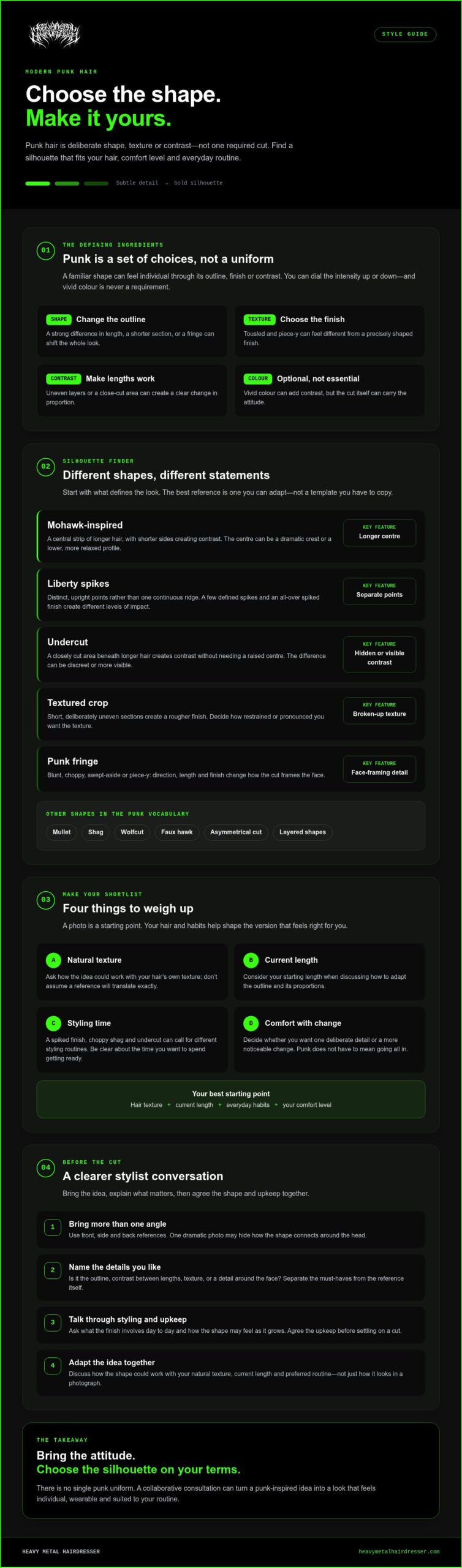
  • Explore shags, wolfcuts, modern mullets and textured crops to find a silhouette that matches the kind of edge you want.
  • See how straight, wavy, curly and coily hair can change the shape and styling needs of alternative hairstyles for over 40s.
  • Compare cut length and styling effort to narrow down options that fit your everyday routine.
  • Choose reference images that show the cut’s shape, then note what you want to keep, change or make easier.
  • Specialist alternative cutting can adapt an idea to your hair and personal style.

Alternative hairstyles for over 40s: style has no age limit

Want a change that feels more like you, without a list of age-based rules attached? You’re not alone in wanting hair with personality rather than a prescribed “suitable” look. Alternative hairstyles for over 40s aren’t a special category with their own restrictions. They’re expressive cuts and styling choices, from a subtle shift in shape to a full-on statement, chosen because they speak to the person wearing them.

Hair has long been part of personal grooming, fashion, and cosmetics, as well as a way to express taste and identity. That expression doesn’t expire at a certain age. Your years alone don’t decide whether you can wear a cropped cut, keep your length, add vivid colour or choose something more pared back. Hair texture, its current condition and how you like to style it are more useful starting points than an age bracket.

Why alternative hair is not reserved for one generation

Rules that prescribe short, subdued or conventional hair after a certain age reduce people to a stereotype. Bin them. Some people want a dramatic silhouette; others prefer an offbeat detail that only shows when their hair moves. Both count. Your gender, hair history and style goals are yours to define, so there’s no single look that represents everyone over 40.

Alternative can mean contrast, texture or shape, not just bright colour or a dramatic chop. Layers can add movement without sacrificing length; a sharper outline can make a cut feel more deliberate. The point is choice, not proving you’re bold enough.

What makes a cut feel right for you

Start with the details you’re drawn to. Do you like a cut that falls into place with natural movement, or one you can sculpt into a more defined shape? Do you want to keep length around your face, expose the neckline or bring out your natural texture? These preferences turn a general mood into a shape your stylist can work with.

Then weigh up the upkeep you’ll genuinely enjoy. A cut that relies on daily styling may not suit a wash-and-go routine, while a low-effort shape still needs to work with how your hair falls and grows. Think about the styling time you have, the tools you use and how often you want to refresh the shape. Heavy Metal Hairdresser’s specialist textured cutting adapts the silhouette to your hair’s behaviour rather than forcing it into a generic template.

The takeaway: age doesn’t dictate a cut. Identity, texture and upkeep help shape a look that feels like yours.

Alternative hairstyles for over 40s: four cuts with expressive edge

Think of these cuts as starting points, not prescriptions. The same silhouette can shift with your hair’s texture, length, fringe and layer placement. None belongs to a particular age or face shape. For wider inspiration, explore Alternative Hair Styles: A Professional Guide to UK Trends, then focus on the details that catch your eye.

Shag and wolfcut: movement, layers and lived-in texture

A shag uses layers to build a broken-up, lived-in outline, often with a fringe or face-framing pieces. A wolfcut pushes the contrast further, combining shorter layers around the crown with longer lengths below. Both can create movement, but the result depends on how your hair naturally sits. Fringe shape, layer placement and overall length all change the silhouette, so the cut can be adapted rather than copied wholesale. For a closer look at the shag, see The Shag Haircut Resurrection.

Modern mullet and shorter textured cuts: sharper silhouettes

A modern mullet plays with contrast: shorter sections shape the front and sides, while more length remains through the back. That difference can be subtle or pronounced, depending on how the sections blend. It’s a distinctive outline with plenty of room for personal interpretation.

If you’d rather go shorter, a textured crop gives you a compact shape with detail through the top; a layered bob keeps more length while adding movement around the ends. Either can be tailored with softer or more defined layers. Texture affects the finish: straight hair may show a clean, choppy outline, while waves or curls can shift the shape and separation. For more wolfcut detail, look up The Ultimate Wolf Hair Cut Guide.

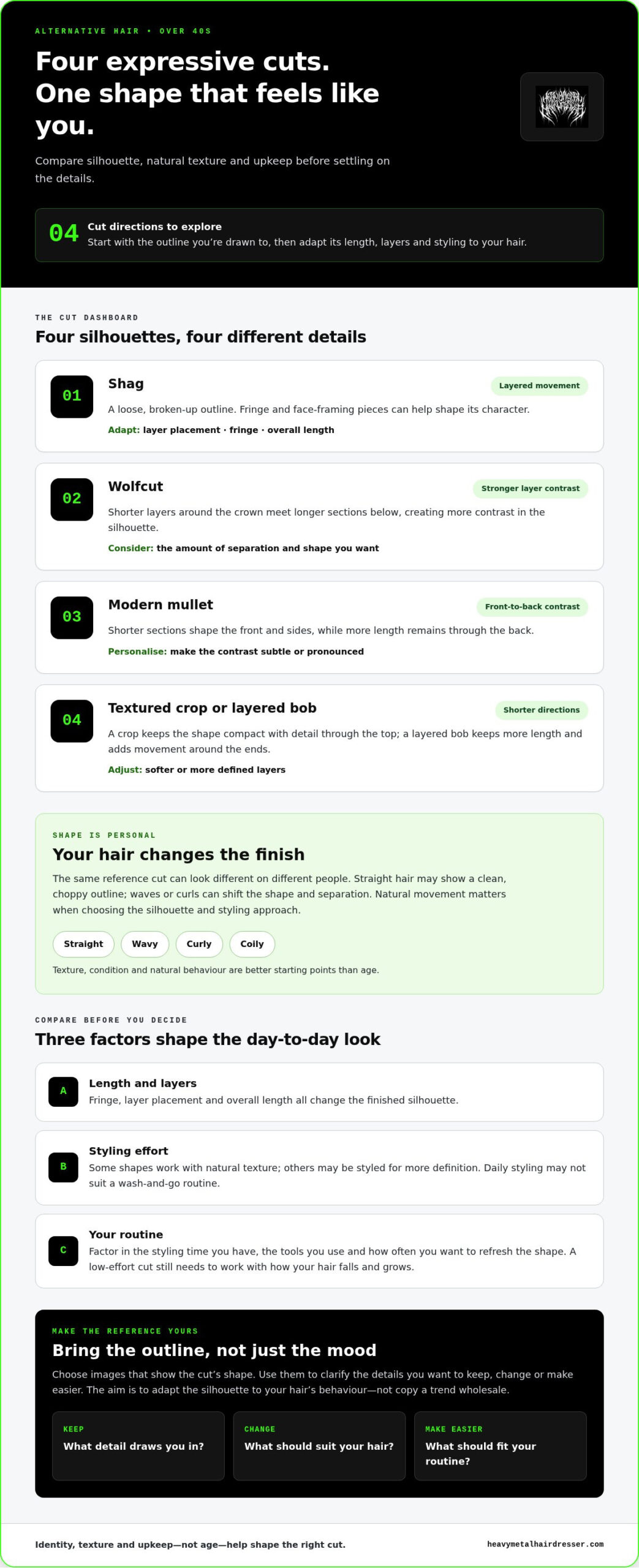
  • Shag: layered and loose, with fringe and length shaping its character.
  • Wolfcut: more contrast between shorter crown layers and longer sections.
  • Modern mullet: shorter front and sides balanced by length at the back.
  • Textured crop or layered bob: shorter options, with different lengths and layers to play with.

Save reference images that show the outline you like, not just the colour or overall mood. Heavy Metal Hairdresser specialises in alternative, textured cutting and can translate that inspiration into a shape that works with your hair. Explore Heavy Metal Hairdresser’s alternative hair expertise for ideas grounded in expressive cuts.

How to compare alternative cuts by texture, length and upkeep

A cut can look completely different on two people, even when they bring the same reference image. Compare the shape you want with your hair’s natural movement and the time you’re happy to spend styling it. This gives you a more useful shortlist than choosing by age or face-shape rules. Use the table as a starting point, not a formula.

Cut direction Silhouette Styling effort Possible adaptation
Shag Layered, broken-up movement Can be worn with natural texture or styled for more definition Adjust layer placement, fringe and length
Wolfcut Shorter crown layers with longer sections Depends on how much separation and shape you want to create Adapt the contrast and layering to your hair’s density and movement
Modern mullet Shorter front and sides, with length through the back Can be worn more softly or styled to emphasise the contrast Change the length difference and how the sections blend
Textured crop or layered bob Shorter overall, with detail from texture or layers Varies with the finish you prefer Keep the outline softer or more defined, and tailor the layers

Match the cut to how your hair naturally behaves

Straight, wavy, curly and coily hair each respond differently to layering. Straight hair may show the outline and separation clearly; waves can create their own movement; curls and coils can change how length and layers sit. Density, growth patterns and natural direction matter too. They’re useful design information, not problems to correct. Heavy Metal Hairdresser’s textured cutting shapes layers around those behaviours instead of expecting every head of hair to follow the same template.

Balance the look you want with its upkeep

Be honest about your routine. Do you like shaping your hair each morning, or would you rather let its natural texture do the work? A deliberate, piecey finish may call for more hands-on styling than a softer, less structured shape. Neither is better. Choose the level of effort you’ll enjoy repeating.

Consider three separate upkeep factors: length, which affects how the shape sits as it grows; fringe, which may need attention to keep its intended position; and colour, if you choose to add it. Vivid colour is optional. A strong cut can make its mark through silhouette and texture alone. Your hair and preferences are individual, so discuss how the shape may change over time instead of relying on a universal maintenance schedule.

The best alternative hairstyles for over 40s aren’t dictated by a face-shape chart. Start with the outline you love, then weigh it against your texture and everyday styling habits.
Alternative Hairstyles for Over 40s: Bold Cuts Without the Rules

Plan your alternative hairstyle before changing your look

A clear brief turns “I want something different” into a useful conversation about shape, texture and routine. You don’t need the perfect haircut vocabulary. A few visual references and honest notes about what works for you can help your stylist understand the direction you have in mind.

Build a clear visual brief for your haircut

Collect a handful of images that show a similar length, texture or styling goal to your own. Look beyond colour and overall mood: focus on the cut’s outline, fringe, layers and where the shape sits around the head. Save examples you like, but also note what feels impractical or unlike you. A photo is inspiration, not a demand for an exact copy.

Talk through styling habits and personal boundaries

Your usual routine matters as much as the reference. Explain how you wear your hair on an ordinary day, how much styling you enjoy and what you’d rather avoid. Share how your texture behaves, what you want to keep from your current cut and what you’re ready to change. You can be excited about a new silhouette and still have boundaries around length, fringe or daily effort.

Use this quick prep list before your appointment:

  • Gather references: Choose images that show the shape you’re drawn to, ideally with hair texture or length close to yours.
  • Name your priorities: Pick the details you care about most, such as movement, a fringe, a sharper outline or keeping length.
  • Set your boundaries: Describe what you want to keep, change or avoid in your current cut. Be clear about any big changes you’re unsure about.
  • Talk upkeep: Explain your everyday styling habits and discuss how the proposed shape may behave as it grows.

For alternative hairstyles for over 40s, this preparation keeps the choice personal rather than trend-led. You don’t need to arrive with every detail decided. Give your stylist enough information to shape the idea around your hair and the way you want to wear it.

Ready to explore a cut with more character? Explore alternative cutting work from Heavy Metal Hairdresser, including shags, wolfcuts, mullets and textured styles.

Make the look yours with inclusive alternative hair expertise

A reference photo can spark an idea, but your cut shouldn’t be a carbon copy. A shape that works in a picture also needs to make sense with your hair’s texture, natural movement and the way you like to style it. A skilled alternative haircut takes that conversation into account: keep the parts that feel like you, reshape what doesn’t, and find the details that give the look its edge.

A cut should reflect the person wearing it

Bring images as a visual starting point. One might show the fringe you love; another could capture a layered outline or the balance between shorter and longer sections. Explain what you want from each, as well as what you’d change. Heavy Metal Hairdresser can use those cues to discuss shape, texture and styling effort, then adapt the idea to your hair and personal taste.

There’s no need to treat your age, identity or hair texture as something to work around. They’re part of the full picture, alongside your preferences and routine. Maybe you want a shag that moves without losing length, a wolfcut with a softer contrast, or a mullet shaped to feel distinctly yours. The useful question isn’t whether a style is “right for your age”. It’s whether the cut expresses what you want and feels wearable in your everyday life.

From inspiration to your next cut

Keep the decision simple: choose a direction, think through the upkeep you’re comfortable with, then communicate your priorities clearly. That gives your stylist a strong starting point without locking you into every detail before the conversation begins.

Heavy Metal Hairdresser is an inclusive alternative salon founded by stylist Simon Tuckwell, with specialist work in shags, wolfcuts, mullets and textured styling. The focus is individuality: adapting the chosen silhouette to the person wearing it, rather than forcing hair into an age-based template. This specialist experience helps turn a broad reference or half-formed idea into a more personal cut plan.

Exploring alternative hairstyles for over 40s should feel like opening up possibilities, not narrowing them down. Keep the details you love, be honest about what fits your routine, and let your inspiration lead the conversation.

Explore Heavy Metal Hairdresser’s alternative hair services when you’re ready to take the next step.

Choose a cut that feels like your next chapter

Age doesn’t set the limits. The best alternative hairstyles for over 40s start with what you want to express, then take your natural texture, preferred length and styling routine into account. Shags, wolfcuts, mullets and shorter textured shapes can all be adapted; vivid colour is a choice, not a requirement.

Bring images that show the shape you love, and be clear about what you want to keep, change or avoid. That gives your stylist room to turn inspiration into a cut that feels personal, rather than simply copying a reference.

Heavy Metal Hairdresser, founded by barber and creative stylist Simon Tuckwell, specialises in shags, wolfcuts, mullets and textured styling. Its backstage festival work includes Download and Bloodstock, but the focus stays on the individual in the chair and the look they want to make their own.

Explore alternative cuts and find a look that feels like you. Your next style doesn’t need permission from a rulebook. Make it yours.

Frequently Asked Questions

Can you wear alternative hairstyles over 40?

Yes, you can wear an alternative hairstyle at any age. A shag, wolfcut, mullet or vivid colour isn’t reserved for a particular generation or identity. Choose a shape that suits your personal taste, hair texture and everyday routine, rather than following rules about what you should wear after 40. Heavy Metal Hairdresser can adapt reference ideas around your hair’s natural behaviour and the look you want to express.

What is a low-maintenance alternative hairstyle for over 40s?

A low-maintenance option is one that works with your natural texture and doesn’t demand more daily styling than you enjoy. A softer layered bob or shag may suit someone who prefers a relaxed finish, while a sharply defined crop may need more deliberate shaping. No cut is automatically easy for everyone. Talk through how you usually wear your hair and what effort feels realistic before choosing a shape.

Can a wolfcut work on mature hair?

Yes, a wolfcut can be adapted for different hair textures and life stages. Its shorter layers around the crown and longer sections below can be adjusted to suit your hair’s density, movement and preferred length. The name alone doesn’t determine whether it’ll work for you. Discuss how your hair sits naturally, how much styling you want to do and how pronounced you’d like the layered contrast to look.

Is a modern mullet suitable for over-40s?

A modern mullet can suit anyone drawn to its contrast between shorter front and side sections and more length at the back. That contrast can be subtle or bold, with the shape tailored to your hair and taste. If you’re unsure about a dramatic change, discuss a softer outline or a less pronounced difference in length. Your age doesn’t rule it in or out; your preferences should lead.

How do I choose an alternative haircut for my hair texture?

Start by noticing how your hair behaves without forcing it into a particular shape. Straight, wavy, curly and coily hair can respond differently to the same layers, fringe or length. Consider density, natural movement and growth patterns, then gather reference images that show a similar texture or cut outline. Heavy Metal Hairdresser’s experience with textured alternative cuts helps adapt the shape to your hair and the way you like to style it.

Do alternative hairstyles for over 40s have to be brightly coloured?

No, alternative hairstyles for over 40s don’t have to include vivid colour. A cut can make a statement through its silhouette, layers, fringe or texture alone. Colour is an optional way to shift the overall feel, whether you prefer a subtle change or a brighter expression. If you’re choosing a new cut, decide whether colour is part of the idea or a separate choice; neither is required to make the look personal.

How should I prepare for a bold haircut?

Collect a few images that show the shape you like, not only a colour or general mood. Note details such as length, fringe and layers, plus what feels impractical or unlike you. Before your appointment, think about what you want to keep, change or avoid in your current cut, and how much daily styling you enjoy. Sharing your hair’s natural behaviour and your priorities gives your stylist a clear starting point.
Posted on

Finding a Hairdresser Who Understands Your Style: A No-Nonsense Guide

Finding a Hairdresser Who Understands Your Style: A No-Nonsense Guide

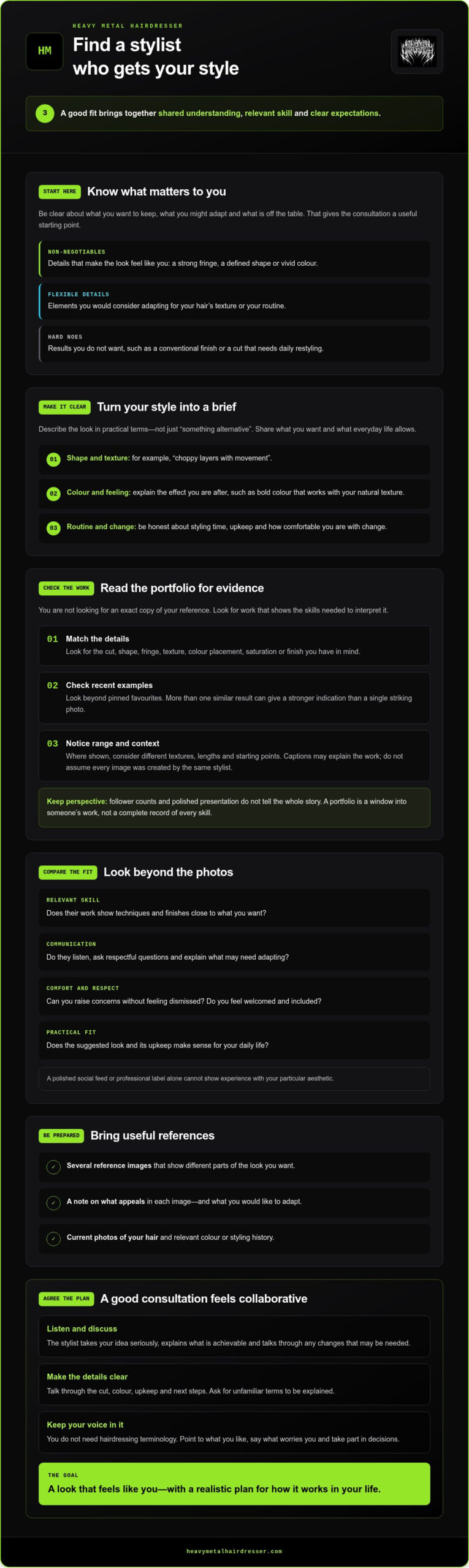
Your reference photo isn’t the problem. The wrong stylist is. You know the feeling: you show someone the sharp, shaggy, unapologetically you look you want, and leave with a safer, more conventional version. Finding a hairdresser who understands my style starts with spotting the difference between someone who can repeat a trend and someone whose work shows they understand your aesthetic.

It’s fair to feel unsure. A polished social feed doesn’t always show whether a stylist has experience with the cut or colour you want, and describing a look can feel like a test you didn’t prepare for. You deserve to feel heard and respected, and to take part in decisions rather than being talked out of your own style.

This guide will help you assess whether a stylist’s portfolio shows work close to the look you want, recognise signs of a good consultation and make that conversation count. We’ll cover what to bring, what to ask and how to agree a clear plan for your cut, colour, upkeep and next steps. No guesswork. No settling for “close enough”.

Key Takeaways

  • Finding a hairdresser who understands my style starts with knowing what matters to me, from the look I want to how much upkeep I can manage.
  • Review a stylist’s recent work for comparable texture, shape, finish and colour technique, rather than expecting an identical face or exact reference.
  • Look beyond follower counts and dramatic transformations. Assess portfolio relevance, communication, inclusivity and practical fit.
  • Bring several reference images, note what appeals to you in each, and share current photos of your hair and relevant colour or styling history.
  • Choose someone who listens, discusses realistic options and helps you agree a clear plan for the look and what comes next.

Finding a Hairdresser Who Understands Your Style Starts With Your Priorities

It’s frustrating to ask for a cut or colour with a bit of edge and feel the idea get softened before the scissors even come out. The answer isn’t to find someone who’ll agree to everything. It’s to find someone with relevant skill who listens, explains their thinking and respects your individuality.

Stylist fit means shared understanding, relevant skill and clear expectations. Technique matters, but so do communication, comfort and an honest conversation about upkeep. A look that only works after a long styling session may not suit your daily life. Be clear about what you want to keep, what you’re open to changing and what’s firmly off the table.

  • Non-negotiables: details that make the look feel like you, such as a strong fringe, defined shape or vivid colour.
  • Flexible details: elements you’d consider adapting to suit your hair’s texture or your routine.
  • Hard noes: results you don’t want, such as a conventional finish or a cut that needs daily restyling.

Turn your personal style into a clear brief

Describe the shape, texture, colour and overall feeling you’re after. “Choppy layers with movement” or “a bold colour that still works with my natural texture” gives you more to discuss than “something alternative”. Separate must-haves from inspiration you’re happy to adapt. Be honest about how much time you’ll spend styling, the upkeep you can manage and how comfortable you are with change. These details help shape a look that fits your life, not just a picture.

Decide what a good appointment should feel like

A collaborative stylist listens without rushing to replace your idea, asks respectful questions and explains what may need adapting. You don’t need professional hairdressing terminology. Point to what you like, describe what worries you and ask for unfamiliar terms to be explained. Feeling welcomed matters, especially when a cut or colour is tied to identity. A neutral overview of the cosmetology profession, including the term licensed cosmetologist, offers background, but a label alone doesn’t show experience with your particular aesthetic.

Notice how the conversation feels. Can you raise concerns without being dismissed? Does the stylist explain what’s achievable and what maintenance could involve? Specialist experience can be relevant: for example, Heavy Metal Hairdresser focuses on alternative cuts, textured styling and vivid colour. Your own priorities remain the test. Look for a respectful exchange and a clear understanding of the look you want.

How to Check Whether a Hairdresser Can Deliver Your Style

A portfolio is more useful than a promise, but one striking photo doesn’t prove consistent experience. Look for repeated examples of the techniques and finishes you want, especially if your reference is outside the mainstream. Whether you are looking for textured salon cuts or sharp fades and grooming from specialists like Sam’s Scissors Barbershop, you’re not searching for someone who has copied your exact picture. You’re checking whether their work shows the skills needed to interpret it.

Read a portfolio for relevant evidence

Use this process to review public work without getting distracted by follower counts or polished presentation:

  1. Start with the details you want. Is the cut layered, blunt, heavily textured or shaped around a fringe? For colour, look for the placement, saturation and finish that appeal to you.
  2. Check recent examples. Scan beyond pinned favourites and look for more than one result using a similar technique. Consistency across different posts is a stronger clue than a single perfect match.
  3. Look for range. Where the portfolio shows it, notice how the stylist works with different hair textures, lengths and starting points. The faces don’t need to resemble yours. The relevant shape, texture and finish do.
  4. Read the context. Captions or service descriptions may explain what was done. Don’t assume a particular stylist created every image, or that one photo proves experience with every technique.

Social media is a window into someone’s work, not a complete record of every skill. If the portfolio shows little of the details you care about, treat that as a question to ask, not proof either way. For wider inspiration, explore this alternative hair styles guide, then use your chosen references to look for relevant evidence.

Match your reference to the right expertise

Get specific about the skill behind the look. If you want loose, layered movement, compare examples with this shag haircut guide. For a choppier, heavily textured shape, the wolf hair cut guide can help you name what you’re drawn to. If colour is the main event, use the vivid hair colour guide to explore the effect you want. The same principle applies if your look centres on sharp fades or tailored beard shaping, where dedicated craftspeople like Straight 8 Barbers show how barbering requires its own distinct technical expertise.

Then compare like with like. A stylist may show bold colour but not the placement you’re after, or plenty of layers without examples of your preferred texture. That distinction helps you ask sharper questions before deciding whether their experience fits. If alternative cuts, textured styling or vivid colour are your focus, you can also browse Heavy Metal Hairdresser’s alternative hair work as one example of a specialist portfolio.

Compare Hairdressers by Skill, Communication and Style Compatibility

A busy social feed or dramatic before-and-after can catch your eye, but neither tells the whole story. A striking transformation doesn’t prove the stylist has experience with your particular cut, colour technique or hair texture. Popularity can’t tell you whether you’ll feel comfortable speaking up, either.

The strongest match combines relevant work with clear, respectful communication. Compare each stylist against the same priorities, not unrelated signals such as follower counts. That makes it easier to weigh technical evidence alongside how they treat you and whether the practical details suit your life.

Use a simple stylist comparison scorecard

For each candidate, note what you can actually see or learn. Use “strong”, “unclear” or “needs asking” rather than forcing a score when you don’t have enough evidence. The aim isn’t to find a flawless profile. It’s to identify the right questions before you commit.

Spot green flags and reasons to pause

Green flags include clarifying what you like about a reference, offering options and explaining any limits without dismissing your idea. A stylist may reasonably say a particular result needs adapting to your hair or routine. That’s different from steering you towards a conventional look without listening.

Pause if your references are brushed aside, a result is promised without discussion, or you feel pressured to decide before your questions are answered. Ask what alternative approach they’d suggest and why. If the response still doesn’t feel respectful, it’s reasonable to look elsewhere. When finding a hairdresser who understands my style, your judgement of the conversation belongs on the scorecard alongside the work itself.

Finding a Hairdresser Who Understands Your Style: A No-Nonsense Guide

Prepare for a Hair Consultation That Gets Your Style Across

A useful consultation isn’t a hairdressing vocabulary test. It’s a chance to show what you mean, share details that affect your hair and check whether you and the stylist picture the same result. A little preparation can turn “I want something like this” into a clear, collaborative conversation.

Bring references that explain the feeling, not just the finish

Choose a few images that show different parts of the look you want. One might capture the shape, another the fringe or texture, and another the colour placement. Add a current photo of your own hair so the stylist can see the starting point instead of relying on memory or an old picture.

Make a quick note beside each reference. Keep it simple:

  • What I like: the choppy layers, the weight around the face or the placement of the colour.
  • What I don’t want copied: the length, styling finish or another detail that isn’t right for me.
  • My hair history: relevant colour or chemical treatments, past cuts and how you usually style your hair.
  • My routine: how much time you’re happy to spend styling and what upkeep feels manageable.

Your routine matters. A reference can show the finished look, but it can’t tell the stylist how much daily effort you’re willing to put in. Be candid. Your routine is part of the brief, not an inconvenience.

Ask questions that reveal whether you are being heard

Use open questions to make the conversation practical and check that the stylist understands the effect you’re after:

  • “How might this shape work with my hair’s texture and the way I wear it?”
  • “What would you adapt from these references, and why?”
  • “How much styling or upkeep might this look need?”
  • “What’s another option if this detail isn’t suitable for my hair?”

Listen for a clear explanation that connects your reference to your hair and routine. It’s reasonable for a stylist to suggest changes, but you should understand the reason and have space to respond. If you’re finding a hairdresser who understands my style, shared understanding matters more than knowing technical terms.

Before anything begins, summarise the plan aloud in your own words: the shape or colour you’ve agreed, what will be adapted, what remains flexible and what upkeep to expect. Invite the stylist to correct anything you’ve misunderstood. That final check can catch a mismatch before it becomes a result you didn’t ask for.

If expressive cuts or colour are your direction, explore Heavy Metal Hairdresser’s alternative hair work as you prepare your references.

Choose a Hairdresser Who Respects Your Style and Makes the Next Step Clear

You don’t need a stylist who says yes to every idea. You need someone who understands what you’re aiming for, can show relevant work and explains recommendations without sanding off the parts that make the look yours. A good stylist may suggest adapting a reference to suit your hair or routine. The difference is that they explain why, listen to your response and make the decision with you.

If you’re worried they’ll default to something more conventional, look for evidence before you decide: work that reflects the cut or colour you want, plus a conversation where your questions are taken seriously. Ask what they’d keep from your reference, what they’d change and why. If the answer skips over your preferences or leaves you uncertain about the plan, it’s reasonable to pause and consider another fit.

Know when you have found the right kind of stylist

Look for three things working together: the stylist understands the details you’ve pointed out, explains options in a way you can follow and respects your personal expression. They don’t have to promise an exact copy of a reference. They should be able to discuss what’s realistic for your hair, clarify any changes and make room for your input.

Trust both kinds of evidence: what you can see in their work and how you felt during the consultation. Did you feel listened to? Could you ask questions without being made to feel difficult? Finding a hairdresser who understands my style isn’t about chasing a perfect guarantee. It’s about leaving with a clear, shared direction and confidence in the next step.

Explore a salon built around alternative expression

For readers drawn to expressive cuts and colour, Heavy Metal Hairdresser offers an example of an alternative, inclusive salon. Its work focuses on shags, wolfcuts, mullets, textured styling and vivid colour, with individuality welcomed in a safe-space environment. Founded and operated by lead stylist Simon Tuckwell, the salon also brings backstage festival experience at Download and Bloodstock. These details can help you decide whether its focus aligns with your aesthetic, just as you’d assess any stylist against your own priorities.

If that alternative focus feels like a match for the work you’re exploring, learn more about Heavy Metal Hairdresser.

Choose a Stylist Who Gets the Real You

Finding a hairdresser who understands my style isn’t about finding someone who’ll copy a reference exactly. It’s about choosing a stylist whose work shows relevant skill, who listens without steering you towards a safer version and who can agree a realistic plan with you. Look for evidence in their portfolio, ask direct questions and trust how the conversation feels.

That combination matters most when your look is personal. Heavy Metal Hairdresser is an alternative, inclusive salon where individuality is celebrated, with specialist work including shags, wolfcuts, mullets and vivid colour. Lead stylist Simon Tuckwell also brings backstage festival experience at Download and Bloodstock.

If that focus feels aligned with your aesthetic, explore Heavy Metal Hairdresser’s alternative styling. Keep your references close, your questions ready and your standards intact. Your style deserves to be understood, not toned down.

Frequently Asked Questions

How do I find a hairdresser who understands my style?

Look for a stylist whose portfolio shows relevant work and whose consultation feels collaborative. Compare examples for the shape, texture, finish or colour technique you want, then ask how they’d adapt your reference to your hair and routine. Finding a hairdresser who understands my style means weighing visible skill alongside communication. You should leave the conversation with a clear, realistic plan, not feeling talked out of your idea.

What should I look for in a hairdresser’s portfolio?

Look for more than one example of the techniques and finish you want, ideally across different clients and hair textures. A face or hair type doesn’t need to match yours exactly. Focus on details such as layered shape, fringe, texture, colour placement and how the result sits. Read captions for context, but treat social media as evidence to discuss, not proof of every skill a stylist may have.

Should I bring photos to a hair consultation?

Yes. Bring several references that show useful details, such as the overall shape, fringe, texture or colour placement. Note what you like in each and what you don’t want copied. Include a current photo of your hair and be ready to explain relevant colour or styling history. Photos help you communicate, but you don’t need professional terminology or an exact replica.

What questions should I ask a new hairdresser?

Ask how your reference could work with your hair texture and everyday routine, what they’d adapt and why, and what upkeep the look may involve. If a detail seems unsuitable, ask what alternative they’d suggest. Before proceeding, summarise the agreed cut or colour, what may change and what remains flexible. This gives the stylist a chance to correct any misunderstanding and helps you decide whether the plan feels right.

How can I tell if a hairdresser is inclusive and will respect my identity?

Notice whether the stylist listens to your preferences, uses respectful language and makes space for you to explain what the look means to you. You can ask how they approach identity-led styling and whether their portfolio reflects work aligned with your aesthetic. Heavy Metal Hairdresser describes itself as an inclusive safe space where individuality is celebrated, with a focus on alternative cuts, textured styling and vivid colour.

What if a hairdresser says my reference will not work?

Ask them to explain what may not work and why, then invite them to suggest an alternative that keeps the details you care about. A thoughtful stylist may recommend adapting a reference to suit your hair or routine while still respecting your goal. If they dismiss your idea, pressure you into a different look or can’t explain their recommendation clearly, you’re entitled to pause and seek another opinion.

Posted on

Androgynous Haircuts for Long Hair: Shapes, Layers and Ideas

Androgynous Haircuts for Long Hair: Shapes, Layers and Ideas

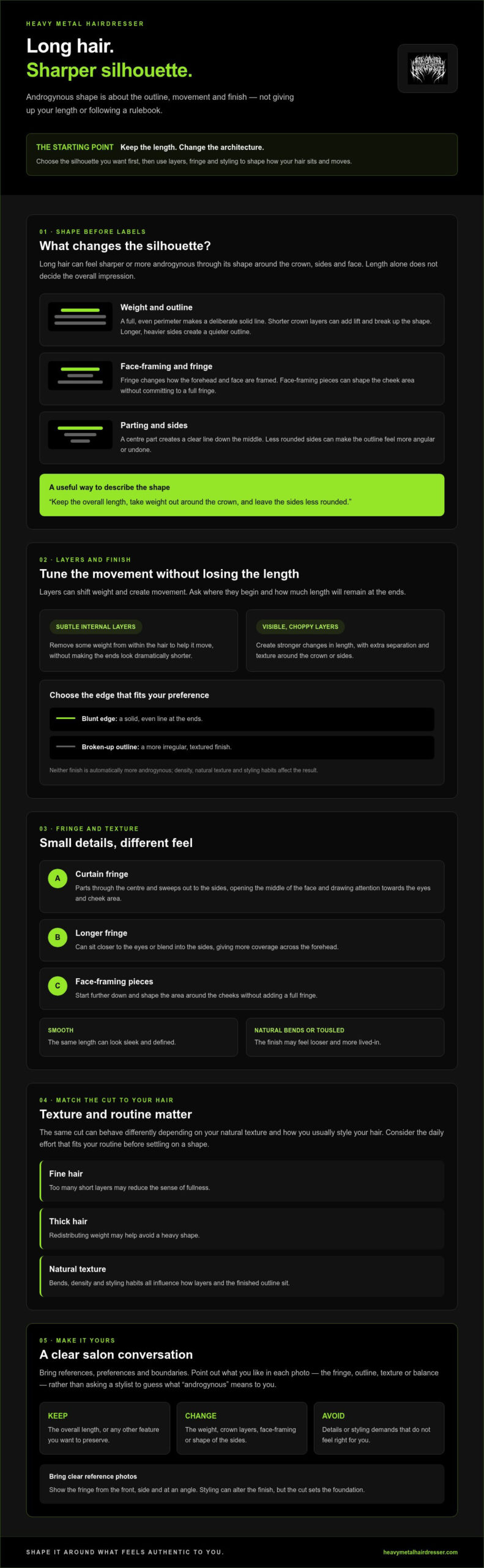
What if a sharper, more androgynous shape didn’t mean giving up your length? The right layers, fringe and texture can change how long hair sits and moves without taking it all off. Androgynous haircuts for long hair aren’t about following a gendered rulebook. They’re about finding a silhouette that feels like you.

It’s frustrating when an inspiration photo gives you the vibe but not the haircut behind it. A shag, wolfcut or softly layered shape can each create a different outline, and your natural texture and styling habits will affect the result. Instead of asking for something simply “androgynous”, it helps to pin down the details you want to change.

This guide compares long-hair cut ideas by their shape, movement and styling needs, and explains how layers and fringe affect the silhouette. You’ll also find practical ways to describe what you want, from keeping the ends long to adding shorter pieces around your face. Bring references, preferences and boundaries. The goal is a cut that feels authentic, not like a compromise.

Key Takeaways

  • Choose the silhouette first: the outline, weight and face-framing can change the feel of long hair without relying on gender labels.
  • Use layers and fringe to control movement and shape, and decide whether you prefer a solid edge or a more textured finish.
  • Compare different androgynous haircuts for long hair by how much length they keep, the shape they create and the styling effort they need.
  • Consider your natural texture and how much daily styling fits your routine before settling on a cut.
  • Take clear references to your stylist and explain what you want to keep, change and avoid. Styling can alter the finish, but the cut sets the foundation.

What makes long hair look androgynous? Start with shape, not labels

An androgynous haircut is a personal expression created through shape, texture and styling, not a fixed hairstyle or gender rule. The term androgynous can describe different forms of gender expression; in hair, it doesn’t prescribe one approved look. Long hair can feel less traditionally gendered through its outline and movement while staying long. Keep the length, change the architecture.

Start by deciding where you want the hair to carry weight. A full, even outline gives the ends a smooth, deliberate line; shorter crown layers can add lift and break up the shape. Face-framing pieces bring attention to the front, while longer, heavier sides create a quieter silhouette. These details work together, so a cut isn’t defined by one feature alone.

Can long hair still read as androgynous?

Absolutely. Length alone doesn’t decide whether a style feels masculine, feminine or androgynous. Shape around the crown, sides and face can change the overall impression without removing length. For example, a long cut with a flatter crown and less rounded sides may feel sharper than one with soft volume throughout. Start with the feeling you want, not a rule about what long hair “should” look like.

Which details change the silhouette most?

Layers can shift weight and create movement; fringe changes how the forehead and face are framed. A centre part creates a clear line down the middle, while a less rounded outline can make the shape feel more angular or undone. No single detail suits every face, identity or hair type, so treat these as options to discuss rather than instructions.

Texture and finish matter, too. Worn smooth, the same length can look sleek and defined; left with natural bends or a tousled finish, it may feel looser and more lived-in. A shag or wolfcut can build visible movement through the crown and sides while keeping the ends long. The contrast between the shorter layers and the length gives the silhouette its character.

For a salon conversation, describe the shape in plain language: “Keep the overall length, take weight out around the crown, and leave the sides less rounded.” Bring reference photos and point out what you like in each one, such as the fringe, outline, texture or balance. That gives a stylist something specific to interpret, without asking them to guess what androgyny means to you. The best androgynous haircuts for long hair are shaped around your preferences and the way your hair behaves.

How layers, fringe and texture shape androgynous long hair

Once you’ve chosen the broad silhouette, layers and fringe help tune its balance. They can change where the hair sits, how much movement it has and what catches the eye, without dictating a gendered result. The same length can feel soft, graphic, relaxed or deliberately jagged, depending on how it’s cut and worn.

What do layers add to long androgynous hair?

Subtle internal layers remove some weight from within the hair, helping it move without making the ends look dramatically shorter. More visible, choppy layers create stronger changes in length, with extra separation and texture around the crown or sides. Both approaches can retain length at the perimeter, but they create different shapes.

That perimeter matters. A blunt edge gives the ends a solid, even line; a broken-up outline looks more irregular and textured. Neither is automatically more androgynous. Density, natural texture and how you usually style your hair all affect the result. Fine hair may lose a sense of fullness with too many short layers, while thick hair may need weight redistributed to avoid a heavy shape. Ask your stylist where the layers will begin and how much length will remain at the ends.

Should you add a fringe or face-framing layers?

A curtain fringe parts through the centre and sweeps out to the sides, opening the middle of the face and drawing attention towards the eyes and cheek area. A longer fringe can sit closer to the eyes or blend into the sides, giving more coverage across the forehead. Face-framing pieces start further down, shaping the area around the cheeks without committing to a full fringe.

These are visual choices, not gender signals. A fringe can sharpen or soften the outline depending on its length, density and finish. Cultural ideas about long hair and femininity also have a history; BBC Science Focus explores the cultural forces and individual differences behind that association. Your cut doesn’t have to follow those assumptions.

Bring reference images that show the fringe from the front, side and at an angle. Point out what appeals to you, such as the amount of forehead coverage, how the sides connect or how much movement sits around the eyes. A stylist can adapt the idea to your hair rather than copy a picture blindly. The cut builds the shape; styling decides how softly or sharply that shape shows up. For a personalised approach to shags, wolfcuts and textured shapes, explore alternative haircut expertise.

Five androgynous haircut ideas for long hair, compared

Think of these as starting points, not gender categories. Each can be adapted to your texture, preferred outline and how much length you want to keep. The best gender-neutral haircut reference is one that shows details you like, not a rule you have to follow. Heavy Metal Hairdresser works with shags, wolfcuts and mullets, all shapes that can be tailored to personal expression.

  • Long shag: Layers build movement through the crown and sides while the ends can stay long. The outline feels textured and relaxed. Styling effort is usually low to moderate, depending on your natural texture and how defined you want the layers to look. See more long shag haircut ideas for inspiration.
  • Long wolf cut: Shorter, choppier layers on top contrast with length at the back, creating a bolder, more lifted silhouette than a softer shag. It retains length at the back, though the shorter sections make the shape more noticeable. Styling effort can be moderate if you want to bring out the layers. Explore wolf cut shapes and texture for more detail.
  • Elongated mullet: A shorter, shaped front and sides meet a longer back. Keep that contrast subtle for a quieter outline, or make it more pronounced for a sharper, more dramatic shape. Length retention is strongest at the back; styling effort depends on how much definition you want at the top and sides. A modern mullet guide can help you compare variations.
  • Blunt-and-textured shape: A solid perimeter keeps the ends looking full, while selective texture breaks up the surface and adds movement. This direction preserves a clear sense of length without heavily layering the whole cut. Styling effort is often low if you prefer the natural finish, or higher if you want a carefully defined contrast.
  • Layered fringe: Keep the length through the back and add a fringe that blends into face-framing layers. The result draws attention towards the front without dramatically changing the overall length. Choose a soft, longer fringe for an easier grow-out, or a stronger shape for more impact; styling effort varies with your fringe’s texture and finish.

Which long cut gives you texture without losing length?

A long shag generally spreads movement through the shape, while a wolf cut tends to create stronger contrast between shorter upper layers and longer ends. Both can retain length, but ask your stylist where the layers will start and how much weight they’ll remove. For more inspiration across alternative hairstyles and shapes, compare references that show the outline as well as the texture.

How can a long mullet create a sharper outline?

The shorter front and sides make the longer back stand out. A subtle blend gives a softer shift; a more pronounced difference creates a bolder profile. Bring references that show the front, side and back, then explain how much contrast feels right to you. That makes it easier to personalise the shape rather than copy a cut wholesale.

Androgynous Haircuts for Long Hair: Shapes, Layers and Ideas

How to choose a long androgynous haircut for your hair and routine

Use this process to turn saved inspiration into a cut brief your stylist can work with. You don’t need the perfect name for the style. Be clear about the shape you want, what you want to keep and how much effort you’re happy to put in each day.

  1. Name the shape. Describe the outline or mood you’re after: sharper sides, more movement at the crown, a less rounded shape or a softer frame around your face.
  2. Assess your texture. Look at how your hair sits naturally, including its density, wave or curl pattern and where it gains volume.
  3. Choose the details. Decide whether you want a fringe, face-framing layers, a blunt edge or more visible texture. Bring reference images showing the front, sides and back, plus your hair in its usual, unstretched state.
  4. Talk through upkeep. Be honest about your daily routine. Ask what the cut will look like air-dried or with minimal styling, and what you’d need to do to recreate the reference.

How do hair texture and density affect the result?

Straight hair may show a clean outline and distinct layers; waves and curls can bring extra movement and change how short sections sit. Fine hair can lose some visual fullness if too much weight is removed, while dense hair may need careful shaping to avoid a bulky outline. None of these textures rules out a silhouette. Show your stylist how your hair behaves day to day, not only how it looks after heat styling or stretching it out.

What should you tell your stylist before the cut?

Describe the mood and outline you want instead of relying on a gendered haircut label. Agree your boundaries first: which lengths must stay, and where shorter layers or fringe are welcome. Talk through styling time and upkeep before cutting begins. If you’re unsure about a big change, say so; your stylist can discuss how different amounts of layering might affect the shape before you commit.

Bring a few references, but explain what you like in each one. One may show the fringe you want; another may capture the outline or texture. That gives your stylist room to translate the details into a cut that works with your hair and preferences, rather than copying a look that depends on a different texture or styling routine.

Heavy Metal Hairdresser is an inclusive alternative salon with experience in shags, wolfcuts, mullets and textured styling. To see examples of these approaches, view alternative haircut inspiration.

Make your long androgynous haircut yours with styling and expert guidance

The cut gives your hair its underlying shape. Styling changes how that shape reads from day to day. A centre or side part can shift the balance; a natural finish lets your own texture lead, while more defined texture makes layers stand out. Tucking one or both sides behind your ears can expose the face and create a cleaner outline without changing the cut.

How can styling change the mood of long hair?

Try small switches before making a major change. Move your parting, wear your fringe differently or tuck the sides back, then notice which version feels most like you. A relaxed, natural finish may soften a layered shape; a more defined finish can make the same layers feel sharper and more deliberate. You don’t need an elaborate routine. The right approach is the one you’ll actually use.

Keep expectations grounded: styling can shift the mood, but it can’t replace a cut’s structure. If you want a strong outline or shorter layers at the crown, those details need to be built into the cut. If you’re still deciding, experiment with fringe placement and partings first. They offer a low-commitment way to test how you like the hair to frame your face.

How can you find a stylist who understands your vision?

Look for examples of textured cuts that share the outline you want, rather than searching only by a gendered label. In your conversation, ask how the shape will work with your natural texture and how the agreed length will be protected. Make your boundaries clear before cutting begins, including where you’re comfortable with shorter layers and what you want left untouched.

Use that discussion to confirm practical details, too: how the cut may sit when air-dried, what styling it needs and how often its shape may need attention. An inclusive stylist should make space for your preferences without prescribing what a masculine, feminine or androgynous look must be. Bring references, ask questions and agree on a shape that feels right to you.

Heavy Metal Hairdresser is an alternative, inclusive salon with experience in shags, wolfcuts, mullets and textured styling. Its approach centres individual identity, not a one-size-fits-all idea of androgyny. For examples of how these shapes can be adapted, explore Heavy Metal Hairdresser’s work.

Keep your length. Make the shape your own.

Androgynous haircuts for long hair don’t depend on one approved style. Layers, fringe, texture and outline can change the feel of your hair while keeping the length that matters to you. Start by naming the shape you want, showing what you like in your references and agreeing your boundaries with your stylist before the cut begins.

Then make it yours. A change of parting or finish can bring out a different mood, but the cut provides the structure beneath it. Your hair, your identity, your call.

Heavy Metal Hairdresser is an inclusive alternative salon founded by barber and creative stylist Simon Tuckwell, with expertise in expressive, textured cuts. The salon has also worked backstage at Download and Bloodstock. Explore Heavy Metal Hairdresser’s alternative, inclusive approach and see how a personalised shape can bring your references to life.

Keep the length you love. Choose the edge that feels like you.

Frequently Asked Questions

Can you have an androgynous haircut with long hair?

Yes, long hair can have an androgynous shape without losing its length. The overall impression depends on more than how long it is: layers, weight around the crown and sides, fringe, outline and styling all play a part. Choose the features that feel right for you, whether that means a sharper silhouette, visible texture or a softer, more relaxed finish. There’s no single rule to follow.

What is the best androgynous haircut for long hair?

There isn’t one best cut for everyone. A long shag can add movement through the shape, while a wolf cut often has a stronger contrast between shorter upper layers and longer sections at the back. A blunt outline or layered fringe offers other ways to change the silhouette. For androgynous haircuts for long hair, consider your natural texture, length boundaries and styling routine before choosing a direction.

Will layers make long hair look shorter?

Not necessarily. Layers can remove or redistribute weight while leaving the perimeter, the visible outline at the ends, long. Subtle internal layers may add movement without a dramatic change to the overall length. More visible, shorter layers can make the shape look more textured and create stronger contrast with the ends. Ask your stylist where the layers will begin and agree which length you want to preserve.

Can a wolf cut look androgynous on long hair?

Yes. A long wolf cut can combine shorter, choppier layers around the crown with longer sections at the back, creating a textured silhouette without removing all the length. The result can be adapted: ask for softer transitions if you want less contrast, or more pronounced layers for a bolder shape. Your hair’s density and texture affect how those layers sit, so bring references that show the shape from different angles.

How do I ask a hairdresser for an androgynous haircut?

Describe the shape and feeling you want rather than relying on a label alone. You might ask to keep the ends long, add movement at the crown or create a less rounded outline. Show reference pictures from the front, side and back, and point out which details you like. Agree where shorter layers can go, what length must stay and how much styling you’re willing to do before cutting begins.

Do androgynous long haircuts need a lot of styling?

It depends on the cut, your natural texture and how polished or defined you want the finish. Some layered shapes can be worn with minimal effort; others may need more attention to bring out their separation and movement. Ask how the cut will sit when worn naturally and what it takes to recreate your chosen reference. Be honest about your routine, so the shape works beyond the salon.

Can I make my long hair look more androgynous without cutting it short?

Yes. You can keep your length and experiment with how you wear it. Try changing your parting, shifting your fringe, adding natural-looking texture or tucking the sides behind your ears. A low ponytail or simple bun can also change the overall presentation. These styling choices won’t alter the cut’s underlying shape, but they let you explore different moods before deciding whether you want a more lasting change.

Posted on

Styling a Wolfcut as It Grows Out: Keep the Shape in 2026

Styling a Wolfcut as It Grows Out: Keep the Shape in 2026

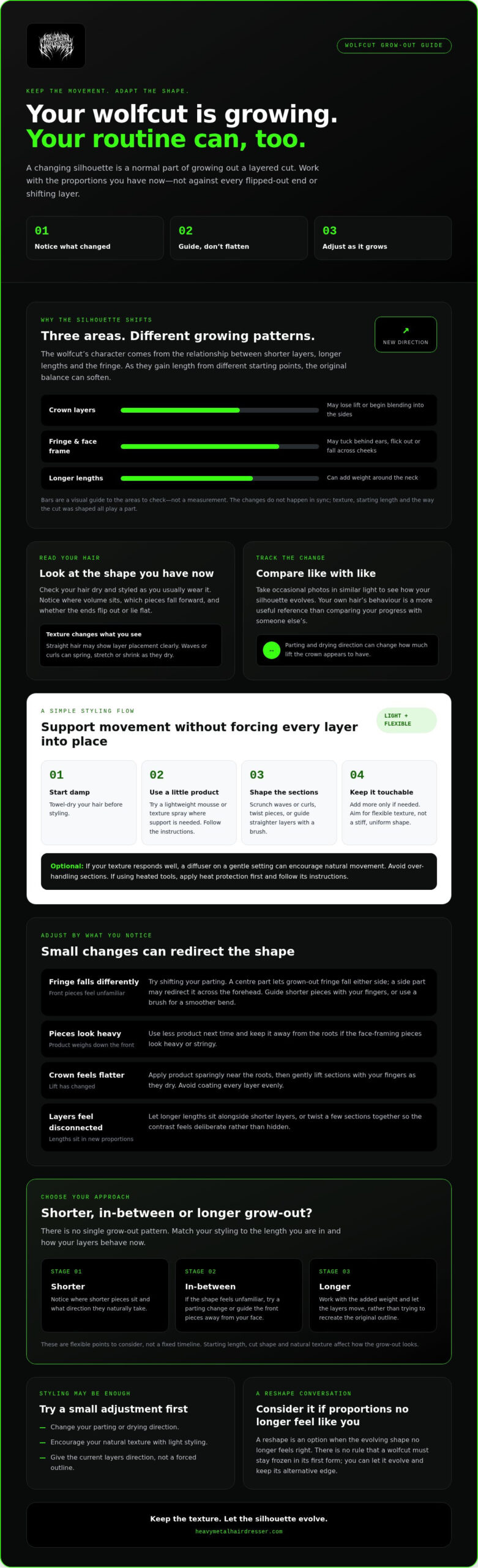
A growing wolfcut doesn’t need to be wrestled back into its original shape. Styling a wolfcut as it grows out means working with its new proportions, not fighting every flipped-out end or shifting layer. If shorter pieces sit differently and the overall shape feels less defined, you’re not imagining it. As your hair grows, your routine can change too.

The aim is to keep the texture and movement that make the cut yours, without turning every morning into a styling battle. This guide covers adaptable ways to wear your wolfcut through changing lengths, from encouraging natural texture to giving stubborn layers direction. You’ll also learn what to try when the shape feels off and when a conversation with a stylist about a reshape could help. A small styling adjustment may be enough. If you want expert support, Heavy Metal Hairdresser specialises in wolfcuts and alternative cuts, with options to discuss what suits your look and comfort.

Key Takeaways

  • Learn why the balance between shorter layers, longer lengths and fringe shifts as your wolfcut grows.
  • Use a simple damp-hair routine to encourage movement without forcing every layer into place.
  • Match your styling approach to whether your cut is in a shorter, in-between or longer grow-out stage.
  • Track changes in your silhouette with occasional photos taken in similar light.
  • Find out when styling a wolfcut as it grows out may be enough, and when a reshape conversation could help.

Styling a wolfcut as it grows out: why the shape changes

A changing silhouette is a normal part of growing out a layered cut, not a sign that you’ve done anything wrong. A wolfcut’s shape comes from the relationship between shorter crown layers, longer lengths around the sides and back, and the fringe or face-framing pieces. As these sections gain length from different starting points, the balance that made the original cut distinctive can soften.

That structure is part of the cut’s character. A wolfcut is a modern variation of the shag, with layers that create movement and a deliberately undone shape. As the layers lengthen, they may sit closer to the head, blend into surrounding sections or fall in a new direction. The original silhouette can become less obvious, even when the hair still has texture and personality.

There’s no single grow-out pattern. Your starting length, the way the cut was shaped and your natural texture all affect what you see. Straight hair may show changes in layer placement clearly; waves or curls can spring, stretch or shrink as they dry. Styling habits matter too. A parting or drying direction that once lifted the crown might now make it sit flatter. Start by noticing what your hair is doing now, rather than expecting it to follow a fixed timeline.

What changes first as wolfcut layers grow?

The crown layers may lose some lift or begin blending into the sides. Face-framing pieces might reach a length where they tuck behind your ears, flick out or fall across your cheeks, while the longer sections add weight around the neck. These changes don’t happen in sync because each area started at a different length and may behave differently with your texture.

Look at your hair when it’s dry and styled as you usually wear it. Notice where the volume sits, which pieces keep falling forward, and whether the ends flip out or lie flat. This gives you a more useful picture of your shape than comparing your progress with someone else’s hair.

Is the awkward wolfcut stage unavoidable?

Some lengths may feel unfamiliar, especially when the fringe and face-framing sections no longer sit as they did. That doesn’t mean the stage is a failure. Try changing your parting, directing the front pieces away from your face or bringing out your natural texture. A small change in direction can give the layers a different kind of energy.

Growing it out doesn’t mean giving up its alternative edge. You can keep the movement loose and lived-in, let the shape evolve or explore a reshape if the proportions no longer feel like you. There’s no rule that says a wolfcut must stay frozen in its first form.

How to style a growing wolfcut without flattening its texture

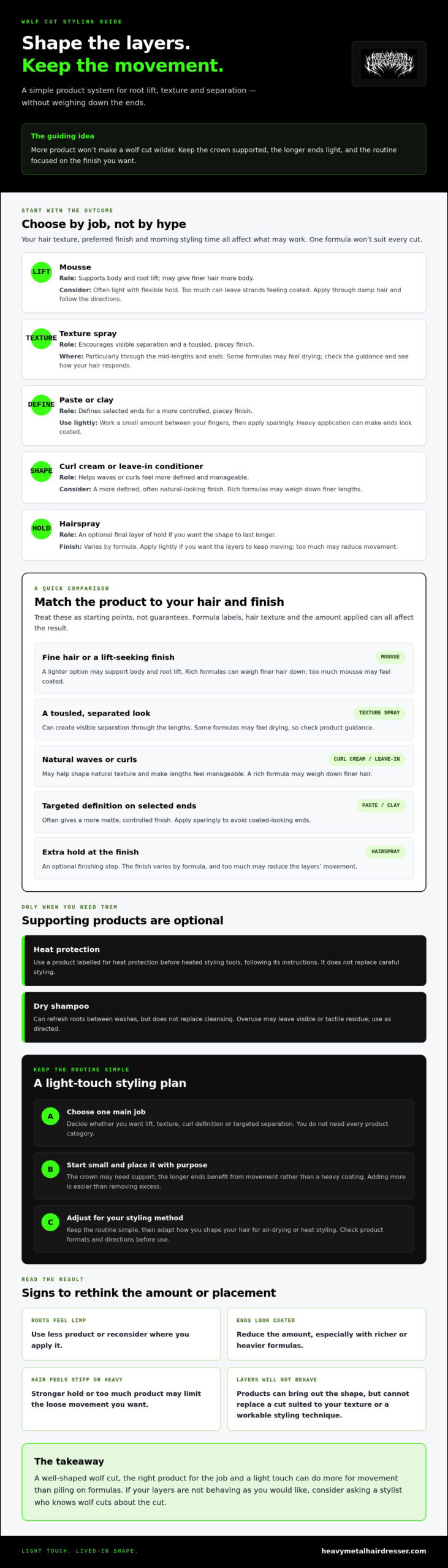
Keep your routine light and let the lengths move. Start with damp, towel-dried hair, then work a small amount of suitable styling product through the areas that need support. A lightweight mousse or texture spray can help encourage lift and definition. Follow the product instructions, and add more only if your hair needs it.

Shape sections according to how they sit now. Scrunch waves or curls, twist a few pieces around your fingers, or guide straighter layers into place with a brush. You’re not trying to recreate the exact outline of the original cut. Give the current layers enough direction to look intentional.

Lightweight, adaptable styling helps preserve movement by supporting the layers without weighing them into a stiff, uniform shape. For more upkeep ideas, see this wolf cut maintenance routine, then adjust the approach to suit your hair and preferred finish.

How to shape the fringe and face-framing layers

Try shifting your parting before adding more product. A centre part can let grown-out fringe fall on either side, while a side part may redirect it across the forehead. Use your fingers to separate and guide shorter pieces, or a brush for a smoother bend. If those pieces look heavy or stringy, use less product next time and keep it away from the roots.

How to work with crown layers and longer lengths

For soft lift at the crown, apply product sparingly near the roots and gently lift sections with your fingers as they dry. Avoid coating every layer evenly; varied, touchable texture often looks more natural. Let longer lengths sit alongside the shorter layers, or twist a few sections together so the contrast feels deliberate rather than hidden.

If your texture responds well, a diffuser can help dry your hair while encouraging its natural movement. Try a gentle setting and avoid over-handling the sections; results vary with hair texture and drying technique. If you use heated tools, apply heat protection first and follow its instructions. Aim for a flexible finish, not a locked-in shape.

Styling a wolfcut as it grows out doesn’t require a complicated kit or a perfect blow-dry. To explore how an alternative-cut specialist might approach your current shape, learn more about Heavy Metal Hairdresser’s wolfcut expertise.

Which styling approach suits each wolfcut grow-out stage?

Use the shape in front of you as your guide, not a calendar. “Shorter”, “in-between” and “longer” describe how your layers sit in relation to each other, not how long you’ve been growing your hair. The table offers starting points, not strict rules. Your texture, density and preferred finish all affect what works.

What you notice Low-effort option More defined option
Shorter layers still dominate; the crown has more shape than the lengths. Let the crown dry naturally and guide the longer pieces around your face with your fingers. Separate a few crown sections for texture, then shape the fringe in the direction you want it to fall.
In-between lengths are beginning to blend, but some layers still stand apart. Change your parting and scrunch or smooth the hair according to its natural texture. Use fingers or a brush to define selected sections, keeping the finish varied rather than uniform.
Longer lengths now carry more of the silhouette, with softer or less obvious layering. Wear the lengths loose and let the remaining layers move around them. Give a few face-framing or crown pieces extra direction to bring definition back into the outline.

When the shorter layers still dominate

Let the crown texture do its thing while the longer sections frame your face. Don’t try to make every layer match. For a softer finish, leave the sections less separated; for a pieceier effect, define a few strands with your fingers and a small amount of suitable product. Directing the fringe to the side, forward or away from your face can change the balance without changing the cut.

When the lengths begin to blend together

As layers merge, define a few pieces and leave others relaxed. This keeps movement visible without making the style look overly arranged. Try a different parting or finish before deciding you need to trim back towards the old shape. If an experiment doesn’t work, wash it out or reset your hair with your usual routine. Not every look has to stick.

As the cut gets longer, resist hiding the shorter layers beneath the lengths. Let them sit together, or bring out a few selectively to keep some contrast. These are options, not universal fixes. Choose an approach that suits your hair today, whether that’s barely-there texture or a more deliberate shape.

Styling a Wolfcut as It Grows Out: Keep the Shape in 2026

A practical routine for managing wolfcut growth between trims

A repeatable routine makes it easier to tell whether your wolfcut needs a styling tweak or simply more time. Keep the steps flexible: your texture, preferred finish and available time matter more than following a strict schedule. For more context on the cut and its terminology, explore the ultimate wolfcut guide.

A repeatable wash-day and refresh routine

On wash day, start with clean, damp hair. Choose styling support for the result you want: texture for separation, hold for more definition or smoothing support for a softer finish. Use products according to their instructions, and don’t assume you need the same amount or approach every time.

Change one thing at a time as you style. Try a new parting, a different drying direction or a lighter hand with product, then notice how your hair responds. When you’re short on time, focus on the sections that most affect the outline, such as the fringe or crown, and let the rest settle naturally.

For a useful visual check, take an occasional photo in similar light and from a similar angle. Compare the overall silhouette, not every strand. Are the front pieces sitting differently? Has the crown lost the lift you like? Photos can help distinguish a temporary styling frustration from a change in shape that keeps bothering you.

When should you ask for a reshape?

Consider speaking with a stylist if the outline persistently feels difficult to style or no longer feels like you. A reshape conversation doesn’t automatically mean losing length. It’s a chance to explain the direction you want and discuss what might work with the hair you have now.

Make the conversation specific. Bring your photos and describe your desired length, the sections that frustrate you and the features you want to keep, such as crown texture or face-framing layers. If you’re unsure whether to keep growing it or bring back a more layered shape, comparing related cuts may help. The shag haircut guide offers context on another textured shape.

Styling a wolfcut as it grows out doesn’t mean managing every stage alone. Heavy Metal Hairdresser specialises in wolfcuts and alternative textured cuts. You can explore its wolfcut expertise if you’d like a stylist’s perspective on your current shape.

Keep your growing wolfcut yours: styling support and next steps

Choose what feels right for your hair: keep growing, change how you style the layers or explore a reshape that suits the length you have now. There’s no single correct finish, and you don’t have to preserve the cut exactly as it was on day one.

Styling a wolfcut as it grows out can mean trying small changes and seeing what works. If you’d like another perspective, a stylist experienced with wolfcuts and textured cuts can talk through options for your current shape. Heavy Metal Hairdresser specialises in alternative cuts, including wolfcuts. Any discussion should start with your preferences, not a promised result.

What to bring to a wolfcut reshape conversation

Reference images can help make your ideas clear. Bring examples of shapes you like, as well as details you’d rather avoid. Be open about how much time you want to spend styling, how your hair behaves and how much length you’d like to retain. You know what feels like you; a stylist can discuss how those preferences might work with your hair as it is now.

How to choose your next move

If a change of parting, direction or styling finish makes the shape feel more like yours, an adjustment at home may be enough for now. If the outline repeatedly frustrates you, certain sections remain difficult to wear or the cut no longer reflects how you want to look, a conversation with a stylist could help clarify your options. It’s a discussion, not a commitment to cut.

There’s no rush to decide. Explore wolfcut and alternative styling to learn more about Heavy Metal Hairdresser’s approach and consider what feels right for your hair. Whether you keep growing, restyle or reshape, the best wolfcut is the one you want to wear.

Let your wolfcut evolve on your terms

As your layers change, the shape shifts too. The key to styling a wolfcut as it grows out is adapting your routine to the proportions you have now. Light, flexible styling can keep movement without forcing every piece into its old place. If a parting or texture tweak brings the cut back into balance, keep growing. If the shape persistently feels wrong, a reshape conversation can help you consider your options without committing to a particular result.

Heavy Metal Hairdresser specialises in wolfcuts, shags, mullets and textured styling. Founder Simon Tuckwell is a barber and creative stylist, with backstage experience at Download and Bloodstock. That alternative-cutting background can inform a conversation about what may suit your current length and the look you want to wear.

Explore alternative wolfcut styling and discuss your next cut with Heavy Metal Hairdresser. Keep growing, restyle or reshape. Your hair, your call, and the best wolfcut is the one that feels like you.

Frequently Asked Questions

How do you style a wolfcut while growing it out?

Style the lengths you have now rather than trying to recreate the original outline. Start with damp hair, use a little suitable product for your preferred finish, then shape selected sections with your fingers or a brush. You might redirect the fringe, encourage texture at the crown or let the longer pieces fall naturally. Adjust one thing at a time and see how your hair responds.

How long does it take to grow out a wolfcut?

There’s no fixed timeframe. It depends on your starting length, how much length you want and how your hair grows. A wolfcut also has several layers, so the shape can change before the overall length feels substantially different. Rather than relying on a calendar, notice how the fringe, crown and longer sections sit in relation to each other. Occasional photos in similar light can help you track those changes.

Can you grow out a wolfcut without cutting it?

Yes, you can let a wolfcut grow without cutting it. The layers and fringe will continue to change as they gain length, and you can adapt your parting or styling to suit the evolving shape. Some people prefer to leave every section untouched; others choose to discuss a reshape if the outline becomes difficult to wear. A cut isn’t required to grow it out, and the choice is yours.

What should you do with wolfcut layers as they grow?

Let the layers work with their new proportions instead of forcing them into their original positions. If the crown still has visible texture, bring out a few pieces; if the layers are blending, try a different parting or define selected sections. Keep the finish flexible, and avoid adding more product if shorter pieces start to look heavy or separated. Let your hair’s texture and the look you enjoy guide your approach.

How do you style wolfcut bangs when they get longer?

Experiment with the direction and parting. Longer fringe can be guided to either side, worn across the forehead or blended into face-framing pieces, depending on its length and how it naturally falls. Use your fingers for a relaxed finish or a brush for a smoother bend. Apply product sparingly, especially if the fringe is fine or easily weighed down. If it keeps falling in a way you dislike, ask a stylist about options.

Does a wolfcut look good at every length?

A wolfcut can evolve through different lengths, but whether you like the look is personal. As it grows, the balance between crown layers, fringe and longer sections changes, so the original silhouette may soften or take on a different character. Styling can help you explore the in-between shape, but there’s no obligation to love every stage. Choose the length and finish that feel comfortable and expressive for you.

When should you get a wolfcut reshaped?

Consider discussing a reshape if the outline persistently feels difficult to style or no longer reflects the look you want. Bring reference images, explain which sections bother you and say how much length you’d like to keep. A conversation with a stylist experienced in wolfcuts and textured cuts can help clarify possible directions, but it doesn’t commit you to a cut. If a styling change is working, there’s no need to rush.

Posted on

Professional Wolfcut for Work: Style It Your Way

Professional Wolfcut for Work: Style It Your Way

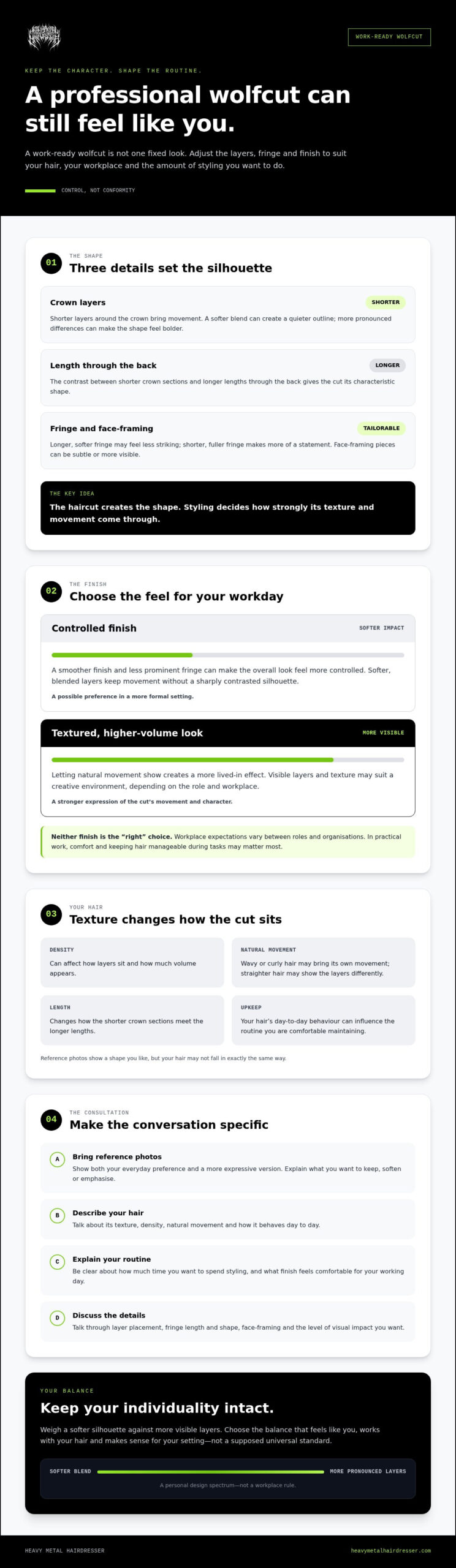
A professional wolfcut for work is shaped by control, not conformity. Softer, more blended layers can keep the cut’s movement without making the silhouette feel too dramatic. Fringe length and shape can also be tailored to your comfort and workplace. The result can still look unmistakably like you.

It’s fair to wonder whether choppy layers will feel too bold on a Monday morning, or whether your fringe will take more time to style than you have. Workplace expectations can make personal style feel like something to tone down. But adapting your wolfcut doesn’t mean sanding off its edges.

This guide explains how layer placement, fringe and texture change the overall look, and how to style your cut around your hair and working day. You’ll also find practical points to discuss with a stylist, from the finish you want to the upkeep you’re comfortable with. Keep the character. Make the routine work for you.

Key Takeaways

  • A professional wolfcut for work isn’t one fixed look. Consider your workplace expectations and the level of visual impact that feels right to you.
  • Shorter crown layers, longer lengths and fringe all affect the shape. Discuss these details with your stylist to customise the result.
  • Compare a controlled finish with a higher-volume, textured look to find an approach that suits your workday and styling routine.
  • Take reference photos to your stylist and explain your hair texture, daily routine and how much time you want to spend styling.
  • Weigh a softer silhouette against more visible layers, then choose a balance that keeps your individuality intact.

Can a professional wolfcut work in your workplace?

It’s understandable to wonder whether a distinctive cut will feel out of place at work. A wolfcut can be adapted to different working environments, but “work-ready” doesn’t mean there’s one correct version. Think of it as a customised layered shape, not a fixed office template. The balance of shorter layers, longer lengths and fringe can be adjusted to suit your hair, preferences and day-to-day life.

The cut sits within a broader shag tradition. The variation of the shag known as the wolfcut takes on mullet-like characteristics, but that doesn’t dictate how bold the finished look must be. The haircut creates the shape; styling decides how strongly its texture and movement come through. Your working environment may influence that choice, but it doesn’t have to erase your individuality.

What makes a wolfcut feel more understated?

Small design choices can change the overall impression. A longer, softer fringe may feel less striking than a short, heavy one. Less pronounced layers can add movement without creating a sharply contrasted silhouette. Face-framing length also affects how strongly the cut frames your features.

Styling can soften or emphasise texture without changing the haircut itself. A smoother finish may feel more controlled, while letting your natural movement show creates a more lived-in effect. Neither is the “right” choice. Consider what feels comfortable for you, rather than treating workplace appearance as a set of rigid rules.

Does a wolfcut suit different professional settings?

Workplaces aren’t all cut from the same cloth. In a formal setting, you might prefer a more controlled finish or less prominent fringe. A creative environment may leave room for visible layers and texture. In practical work, comfort and keeping hair manageable during tasks may matter most. These are possibilities, not rules: expectations vary between roles and organisations.

If you’re unsure, check any relevant workplace guidance or ask an appropriate contact how appearance expectations apply to your role. That gives you a clearer starting point before deciding on the cut’s shape or styling. A considered work look and personal expression can coexist. The aim is to choose a version that feels like you and makes sense for your setting, not to meet a supposed universal standard.

How wolfcut layers, fringe and texture shape the finished look

A wolfcut gets its movement from contrast: shorter layers around the crown meet longer lengths through the back. That mix draws on shag and mullet shapes, as described in the history of the wolf cut. The balance matters. More pronounced differences between the layers can make the shape feel bolder, while a softer blend may give it a quieter outline.

The same wolfcut can look controlled or untamed depending on how you style its layers, fringe and natural texture. The haircut sets the structure; your styling choices bring out different parts of it. That flexibility is useful if you want a professional wolfcut for work that can shift in feel without losing its character.

How can fringe and layers be tailored for work?

Fringe isn’t one-size-fits-all. A longer or more softly shaped fringe may feel less prominent, while a shorter, fuller fringe can make more of a statement. Face-framing pieces can also range from subtle shaping to a stronger, more visible edge. These are options to explore with your stylist, not rules for what’s acceptable at work.

Bring reference photos that show both your everyday preference and a more expressive version of the cut. Pointing out what you like in each can help clarify which details you want to keep, soften or emphasise. Use the consultation to discuss how the fringe and layers frame your face, and how much visual impact feels like you.

What should you consider about your hair texture?

Your hair’s density and natural movement affect how layers sit, how much volume appears and what upkeep may involve. Wavy or curly hair may bring its own movement to the shape; straighter hair may show the layers differently. Length matters too, because it changes how the shorter crown sections meet the longer lengths. A reference photo can show the shape you like, but your hair may not fall in exactly the same way.

Be upfront about how your hair behaves day to day and how much time you want to spend styling it. The ultimate wolfcut guide offers broader cut fundamentals to help you prepare. Heavy Metal Hairdresser specialises in wolfcuts and textured styles, so exploring its wolfcut expertise may also help you think through the shape you want.

Professional wolfcut styling: subtle finish or full-volume attitude?

A wolfcut doesn’t have to show up at maximum volume every day. You can keep the same cut and change how much texture, lift and definition you bring forward. A controlled finish might suit a day when you want a neater outline; a more tousled shape can bring out the cut’s movement when you feel like it. Your hair texture, the cut itself and your styling technique all affect the result, so use these approaches as starting points rather than guaranteed outcomes.

Finish Visual effect General effort May suit
Controlled Smoother, more contained layers Low to moderate, depending on your routine Days when you want a tidier outline
Textured, higher volume More lift, separation and movement May take more hands-on shaping When you want the cut’s edge to stand out

How can you create a tidier workday finish?

Keep it simple. Direct your fringe into the shape you prefer, smooth only the sections that feel unruly, or use your fingers to define a few layers. You don’t need to flatten the whole cut or reach for heated tools every morning. If you use a hairdryer or another heated tool, use heat protection and follow the product instructions.

Try the routine on a day when you have time to see how your hair responds. Guiding the fringe away from your face or calming the sides may be enough to create a more controlled outline. What works will depend on how your layers fall and how much natural movement your hair has.

How do you bring the wolfcut’s texture back after work?

If you want a more expressive finish later, loosen any sections you’ve smoothed and reshape the layers with your fingers. You could bring out more separation or volume, depending on your texture and the look you’re after. There’s no need to maintain two separate looks: keep your everyday finish as it is if that feels right.

For more ideas on working with the cut’s movement, explore this wolfcut styling guide. If you’re considering a professional wolfcut for work, a stylist can help you discuss a cut and finish around your texture and routine. Heavy Metal Hairdresser specialises in wolfcut haircuts, with individuality at the centre of its approach.

Professional Wolfcut for Work: Style It Your Way

How to ask your stylist for a work-ready wolfcut

“The best brief tells your stylist how you want the cut to look, how you wear it day to day and how much effort you want to put into styling it.” That gives them something more useful to work with than the word “professional” alone. Use this consultation checklist to make the details clear before the cut begins.

  • 1. Gather references. Choose photos that show the shape from more than one angle where possible. Include a workday finish you like and a more expressive version if you want the option to change things up.
  • 2. Explain what you like. Point out the details in each image: perhaps the fringe length, shorter crown layers, face-framing pieces or overall silhouette. Say what you’d rather avoid, too.
  • 3. Describe your routine. Tell your stylist what your working day involves, how much time you realistically want to spend styling your hair and whether you prefer a subtle or more noticeable finish.
  • 4. Agree the cut and upkeep. Talk through layer placement, fringe, natural texture and how the shape may behave as it grows out. Ask what maintenance and styling the proposed cut may involve before you decide.

What reference photos should you bring?

Bring images that show the cut itself, not just a finished look from one angle. A side view can reveal how the shorter layers meet the longer lengths; a front view can show the fringe and face-framing shape. Choose examples of both everyday styling and the bolder finish you might want sometimes. Explain what appeals to you in each, so your stylist can distinguish the details you want from the parts you don’t.

What should you agree before the cut?

Be specific about your styling time. If you want a quick routine, say so; if you’re happy to spend longer shaping the layers, make that clear. Ask how the chosen fringe and layer placement may change as they grow out, and what adjustments might help maintain the shape. These conversations help tailor a professional wolfcut for work to your hair and real routine, rather than an idealised reference photo.

Heavy Metal Hairdresser specialises in wolfcuts and textured styles. If you’re considering a cut shaped around your preferences, explore its wolfcut expertise and use these questions to guide your consultation.

Choose a wolfcut that feels like you at work and beyond

A softer silhouette can keep the layers less prominent, while more visible shaping brings extra movement and edge. Either way, the cut needs to fit your real routine. A more textured finish may take more hands-on styling, depending on your hair and the shape you choose. A controlled finish might suit you better if mornings are already full. There’s no single version that earns the label “work-ready”. Your setting, preferences and any relevant workplace expectations all matter.

Is a professional wolfcut right for your routine?

Ask yourself two things: how much of the wolfcut’s character do you want to show, and how much time do you genuinely want to spend styling it? You might prefer a quieter outline for everyday wear, or choose more pronounced layers because that’s the look that feels most like you. Neither choice needs to be permanent. Your styling can shift with your mood and plans.

A consultation can help refine details such as fringe, layer placement and shape around your texture and routine. It’s a chance to talk through what you want and what upkeep may involve, not a promise of a particular result. Choose a look you feel good wearing on an ordinary workday, not just one that looks right in a reference photo.

Where can you explore specialist wolfcut styling?

Heavy Metal Hairdresser is an inclusive alternative salon specialising in wolfcuts and textured styling. Its individuality-led approach means the conversation can centre on your preferences and how you want the cut to work for you. The salon is a gender-inclusive space; everyone’s needs are different, so consider what matters to you when deciding where to discuss your haircut.

A professional wolfcut for work doesn’t have to mean choosing between fitting your routine and keeping your edge. It’s about finding a balance that feels wearable to you, whether that means softer layers, a bolder shape or something in between. To see more, explore Heavy Metal Hairdresser and its wolfcut and textured styling work.

Make your next cut work on your terms

A professional wolfcut for work isn’t one preset shape. Fringe, layer placement and texture influence its overall feel, while styling lets you choose a more controlled finish or bring out extra movement. The right balance depends on your workplace expectations, your comfort and the time you want to spend getting ready.

Before committing, talk with your stylist about your everyday routine, the level of edge you want and how the cut may grow out. Bring reference images that show both the shape you like and how you’d wear it. A clear conversation can help turn your ideas into a cut tailored to your hair and preferences, without asking you to leave your individuality at the door.

Heavy Metal Hairdresser specialises in wolfcuts and textured alternative styles. Founded by barber and creative stylist Simon Tuckwell, the salon is an inclusive, gender-inclusive environment. Explore Heavy Metal Hairdresser to see its work and services, and start planning a wolfcut that works on your terms.

Frequently Asked Questions

Can a wolfcut look professional for work?

Yes, a wolfcut can suit a professional setting when its shape and styling feel right for you and your workplace. A softer silhouette or more defined layers are both options, not universal standards. Consider any relevant appearance guidance, then discuss how fringe, layer placement and natural texture could shape the result. A professional wolfcut for work can keep the cut’s distinctive movement without requiring the same bold finish every day.

How do I make a wolfcut look more subtle at work?

Try directing your fringe neatly, smoothing selected sections or defining the layers without adding extra volume. You don’t need to flatten the whole cut: a small adjustment around the face or crown may create a more controlled outline. What works depends on your hair and haircut, so try a simple routine and see how it wears through your working day. Your own comfort matters more than following a rigid rule.

Is a wolfcut high maintenance?

Maintenance varies with your hair texture, the cut’s shape and the finish you want. A look that relies on defined volume may take more daily styling than one worn closer to your natural movement. Before committing, tell your stylist how much time you want to spend getting ready and ask how the layers may behave as they grow. That conversation can help you choose a shape that fits your routine, rather than an idealised photo.

Can you wear a wolfcut with a fringe in a formal workplace?

Often, yes, but the right choice depends on your workplace’s expectations and your preferences. A longer or softer fringe may feel less prominent, while a shorter, fuller fringe makes more of a statement. You can also style fringe away from your face on days you want a more controlled look. If expectations aren’t clear, check relevant workplace guidance before deciding what shape feels comfortable.

How should I explain a professional wolfcut to my hairdresser?

Describe the shape you want rather than relying on “professional” alone. Explain your preferred layer length, fringe, face-framing detail and how much movement or contrast you’d like. Bring reference photos from different angles, ideally showing both an everyday finish and a bolder version. Point out what appeals in each image, and describe your hair texture and routine. That gives your hairdresser a clearer brief to discuss and tailor with you.

Can a wolfcut be styled differently for work and weekends?

Yes. The same haircut can look more controlled for work and more textured or voluminous at other times. You might smooth selected sections or guide your fringe into place for one finish, then loosen the layers with your fingers for extra movement. How much the look changes depends on your hair and styling technique. Switching it up is optional, though; you don’t need to maintain two separate looks.

What should I ask before getting a wolfcut for work?

Ask how the proposed layers and fringe will work with your natural texture, how much styling the shape may need and how it could change as it grows out. Explain your work routine and any relevant appearance expectations, then agree the level of visual impact you feel comfortable with. It’s also useful to ask which details can be adjusted if you want a softer or more expressive finish. A clear conversation helps you make an informed choice.

Posted on

Modern Punk Hairstyles: 2026 Cuts, Shapes and Styling Ideas

Modern Punk Hairstyles: 2026 Cuts, Shapes and Styling Ideas

A punk cut doesn’t have to feel like a costume. Modern punk hairstyles can be sharp, messy, subtle or full-volume, with the silhouette doing as much talking as the colour. The key is finding a shape that feels like you, not just one that looks striking in a photo.

Upkeep matters, too. A spiked finish, a choppy shag and an undercut can call for very different styling routines. Your hair’s texture, your comfort with bold changes and the time you want to spend getting ready all belong in the decision. There’s no single punk uniform, and vivid colour is never a requirement.

This guide explores the defining shapes behind modern punk looks, from mullets, shags and wolfcuts to faux hawks and asymmetrical cuts. You’ll get a clearer sense of how each might work with your hair and routine, what styling effort to expect, and what to discuss with a stylist before committing. Bring the attitude, then choose the silhouette on your terms.

Key Takeaways

  • Modern punk hairstyles use deliberate shape, texture or contrast, with room to dial the intensity up or down.
  • Learn to tell mohawk-inspired shapes, liberty spikes, undercuts, textured crops and punk fringes apart.
  • Use your natural texture, current length and everyday styling habits to guide your shortlist, not a photo alone.
  • Bring front, side and back references to a stylist, then agree the must-have details and upkeep before settling on a shape.
  • A collaborative consultation can help turn a punk-inspired idea into a look that feels individual, not like a uniform.

What makes a modern punk hairstyle feel punk today?

Punk hair uses deliberate shape, texture or contrast to express individuality. The defining feature isn’t one required cut. It’s the choice to make the hair feel intentional, whether that means a sharp change in outline or a rough, broken-up finish. Modern punk hairstyles can be quietly disruptive or boldly confrontational, and both ends of that spectrum belong.

Look at the details, not just the overall label. A fringe, a close-cut section, uneven layers or a strong difference in length can shift a familiar shape into punk territory. Vivid colour can add another layer of contrast, but it isn’t a rule. The cut itself can carry the attitude. For those pairing alternative hair with bespoke body art, you can explore Realism Tattoos to see how striking, detailed visual work helps express personal individuality.

How punk hair moved beyond one recognisable uniform

Punk is a broad source of visual influence, not a checklist everyone has to follow. Mohawks and spikes are recognisable references, but they’re only part of a much wider vocabulary of shape and texture. The Punk fashion history overview offers context for the DIY ethos and visual signals associated with the movement.

Search-snippet definition: Punk hair uses deliberate shape, texture or contrast to express individuality, from subtle accents to striking silhouettes.

What makes a punk look feel modern rather than copied

Proportion makes a difference. A familiar outline can feel fresh when its layers, fringe or shorter sections are adapted rather than copied exactly. Texture matters, too. A tousled, piece-y finish creates a different mood from a precisely shaped one. These are choices to explore with a stylist, not fixed rules for a particular hair type.

You don’t need extreme height or vivid colour to make the look your own. Start with a reference, then pick out what appeals: perhaps the outline, the contrast between lengths or a particular detail around the face. Ask how that idea could be interpreted for your current length and natural texture, rather than treating the photograph as a template.

Be honest about your routine, too. Some finishes need more hands-on styling than others, and a shape that changes as it grows may feel different from one you want to keep sharply defined. Your hair’s texture, the time you like to spend styling and your comfort with a noticeable change all affect the result. Use those preferences to set the intensity. Punk doesn’t have to mean going all in. It can start with one deliberate detail that feels right to you.

Modern punk hairstyles: mohawks to textured crops

These looks share an alternative edge, but their silhouettes are not interchangeable. Some build height, some expose a close-cut section, and others rely on broken-up layers or a strong fringe. The V&A punk exhibition gives wider cultural context. Use your own references as a starting point, not a blueprint you have to copy.

Mohawks, liberty spikes and other high-impact shapes

A mohawk-inspired cut centres attention on a strip of longer hair, with shorter sides creating contrast. You can adjust the height and width, so the central section might become a dramatic crest or keep a lower, more relaxed profile. Liberty spikes are different: the impact comes from separating the hair into distinct, upright points rather than shaping one continuous ridge. The finish you want affects the styling routine, so ask what it involves day to day.

  • Mohawk-inspired shapes: Keep the sides and central section contrast pronounced for a sharper statement, or soften the difference for a less stark outline.
  • Liberty spikes: Choose a few defined spikes for a controlled hit of drama, or go for a more all-over, spiked finish. Discuss the hold and styling involved before settling on the shape.
  • Undercuts: A closely cut area beneath longer hair creates contrast without requiring a raised centre. Keep it discreet beneath the top layers, or make the difference more visible.

Take reference images showing the front, side and back. A single dramatic photograph can hide how the shape connects around the head. Those different angles help you explain the profile you’re after.

Undercuts, textured crops and punk fringes

Not every punk silhouette needs height. A textured crop uses short, deliberately uneven sections for a rougher finish, with the texture kept restrained or made more pronounced. A punk fringe can shift the whole mood, too. Blunt, choppy, swept-aside or piece-y: its direction, length and finish change how the cut frames the face. Talk through how each detail might work with your hair and preferred styling habits rather than assuming a reference will translate exactly.

  • Textured crops: Ask for a defined, broken-up outline, then discuss how much texture you want to style into it.
  • Punk fringes: Decide whether the fringe should lead the look or sit as one detail within the cut.
  • Layered shapes: Heavy Metal Hairdresser offers shag haircuts and wolfcuts, which can be useful directions to explore if you’re drawn to movement and layers. For more inspiration, see this modern shag haircut guide.

There’s no universal winner. If you’re weighing up shapes, an alternative stylist can help turn your references into a cut that reflects your taste and routine. Explore alternative haircut expertise from Heavy Metal Hairdresser.

How to choose a modern punk hairstyle for your hair and comfort level

The right cut isn’t simply the boldest one in the reference gallery. Modern punk hairstyles can vary in impact depending on the silhouette, how much contrast shows and how you style the shape day to day. Before choosing, notice what your hair does naturally, how long it is now and what you’re willing to do to maintain the look.

Match the silhouette to your texture and routine

Describe your hair as it behaves on an ordinary day, including how it sits when air-dried and what you usually do to style it. Then discuss how a proposed shape might work with that texture and length. A photo can’t guarantee the same result on different hair, so ask a stylist to assess your hair and explain the options.

Be specific about your routine, too. How much time do you want to spend styling? Do you prefer using products or keeping the process simple? How often would you be comfortable having the shape refreshed? Your answers help set expectations for the finish and its upkeep. A shape can change as it grows. Some details may be softened or grown out, but the timing depends on the cut and your hair.

Look Visual impact Styling approach Questions for a stylist
Mohawk-inspired shape Strong length contrast, adjustable from subtle to striking Style the centre up or leave it with a lower profile How would the sides and central section sit as they grow?
Liberty spikes Distinct, upright points draw the eye Ask what finish and hold are involved for the look you want How much daily styling would this version take?
Undercut detail Contrast can be hidden beneath longer hair or made prominent Wear the top down or expose the shorter section What will the grow-out look like, and how can it be reshaped?
Textured crop or fringe Shorter outline; fringe direction and texture shift the mood Keep the finish understated or define the texture more How might my natural texture affect the fringe and shape?

Choose your level of punk commitment

Pick the feature you want to lead: length contrast, texture, height or colour. A fringe or discreet undercut can bring an alternative edge without making height the focus. A more pronounced central shape or spiked finish makes a louder statement. The Punk Art Movement’s discussion of punk’s DIY spirit is a useful reminder that personal choices matter more than following a uniform.

If a longer, layered silhouette is calling, explore this modern mullet haircut guide for another shape to discuss. For help translating a reference into a cut that fits your preferences, explore alternative haircut expertise at Heavy Metal Hairdresser.

Modern Punk Hairstyles: 2026 Cuts, Shapes and Styling Ideas

How to explain your punk hairstyle idea and style it at home

A strong reference starts a conversation, not a contract. To make modern punk hairstyles easier to translate into a real cut, bring images that show the shape from the front, side and back. One dramatic angle might capture the mood but hide the details that decide how the silhouette sits around your head.

Bring references that communicate the shape, not just the attitude

Collect a few examples with features you can describe. Is it the uneven texture, a sweeping fringe or the contrast between longer and shorter sections? For each image, name what you like and what you’d change. Be clear about what feels too extreme and which detail you want to keep. That gives your stylist room to adapt the idea to your hair, rather than copy a look that may not match your routine.

Use this quick sequence to keep the discussion focused:

  • Gather references: Choose images that show the silhouette and finish you’re drawn to, from more than one angle.
  • Name the must-haves: Pick out the details you want to preserve, such as a particular fringe or visible contrast.
  • Talk through your routine: Explain how you style your hair now, what you’re comfortable doing at home and how you feel about regular reshaping.
  • Agree the shape: Ask how the idea can be adjusted for your current length and natural texture before deciding on the cut.

Before committing, ask what maintenance may involve and how the shape might change as it grows. Some details may be easier to alter than others, but grow-out varies with the cut and your hair. Get a clear picture of those trade-offs first.

Build a styling routine around your chosen finish

Texture, separation and height call for different styling approaches. The right routine depends on the finished cut, your hair and the products you choose, so avoid buying a stack of products based on a photo. Ask your stylist to demonstrate the finish and talk you through the steps using products suited to your look.

Keep the walkthrough practical. Ask what to do first, how to create the agreed shape and which steps you can skip for a softer finish. If a particular technique feels fiddly, say so. A routine you can realistically repeat is more useful than a dramatic result you can’t recreate.

Drawn to a layered wolfcut variation? Explore this wolf haircut guide for more on that shape. To learn about Heavy Metal Hairdresser’s alternative cuts, explore their hair services.

Make modern punk hair your own with an alternative stylist

The strongest punk look isn’t a required uniform. It’s a considered shape that feels like yours, whether you want a quiet edge or a cut that makes a sharper statement. An alternative stylist can help translate what you like in your references into choices about proportion, texture and upkeep, while keeping your comfort level in the conversation.

What to look for in an alternative haircut consultation

Look for someone who listens to what you’re asking for and can explain the shape in clear, practical language. You should be able to talk openly about the parts you’re drawn to, the changes you’re not ready for and how much time you want to spend styling. You don’t need to arrive with every detail decided. A collaborative discussion can help clarify the direction.

Use this checklist to keep the conversation grounded:

  • Silhouette: What overall outline do you want, and how should it look from the front, side and back?
  • Intensity: Which features should stand out, and which should stay subtle?
  • Texture: How do you want your hair to move and sit in its natural state?
  • Upkeep: What might styling, reshaping and growing the cut out involve?
  • Comfort: What feels exciting, and what would feel like too much change right now?

Your identity and boundaries are part of the brief. Say what you want the cut to express, and be clear about anything you don’t want changed. Heavy Metal Hairdresser describes its salon environment as gender-inclusive and welcoming, so clients can explore individual looks without being expected to fit a particular idea of punk.

Turn inspiration into a cut that feels like you

A reference image can show a detail you love, but the final cut doesn’t have to reproduce it exactly. Perhaps you want the movement of one style, the fringe from another and a softer outline overall. A stylist can help discuss how those elements might work together with your hair and everyday routine. Vivid colour is another option, not a requirement.

Heavy Metal Hairdresser was founded by barber and creative stylist Simon Tuckwell, whose alternative styling experience includes backstage festival work at Download and Bloodstock. That background is relevant when you’re looking to discuss expressive shapes and make an inspiration-led idea your own.

Take your time, bring your references and ask the questions that matter to you. You can explore Heavy Metal Hairdresser to see the salon’s work and consider your own direction.

Choose a punk shape that feels like yours

The best modern punk hairstyles aren’t about copying a finished look or following a fixed uniform. They’re about choosing a silhouette, texture and level of contrast that fit your taste, then being honest about the styling and upkeep you’re comfortable with. A few clear references and a good conversation can turn a bold idea into a shape that feels genuinely personal.

Heavy Metal Hairdresser brings alternative cutting expertise across shags, mullets and wolfcuts, within an inclusive salon environment focused on individuality. Founder and stylist Simon Tuckwell’s experience includes festival styling work at Download and Bloodstock. That background can inform a conversation about adapting inspiration into your own direction.

Ready to explore the possibilities? Explore Heavy Metal Hairdresser and take the next step when it feels right. Your hair, your rules. Make the shape your own.

Frequently Asked Questions

What are the most popular modern punk hairstyles?

Modern punk hairstyles include mohawk-inspired shapes, liberty spikes, undercuts, textured crops, punk fringes, shags, wolfcuts and mullets. Each has a different silhouette: some use height or a strong contrast between lengths, whilst others rely on layers and a choppy finish. Trends shift, and no single look suits everyone’s taste or routine. Use these styles as starting points, then discuss which details you’d like to adapt with a stylist.

Can punk hairstyles work with short or fine hair?

They can be explored with short or fine hair, but the cut and styling plan need individual assessment. A stylist can look at your current length, natural texture and the silhouette you want, then explain what may be achievable and how you might style it. Bring references that show the shape clearly, not just the overall attitude. Avoid assuming a photo will translate exactly: hair and finished results differ from person to person.

Are modern punk hairstyles always shaved or brightly coloured?

No. Shaved sections and vivid colour are optional, not requirements for a punk-inspired look. A fringe, textured layers, an uneven outline or a deliberate contrast in length can create an alternative feel without either. If you like colour, treat it as another design choice to discuss, rather than the whole point of the cut. Explain how visible you want the change to feel, and explore a shape that matches your comfort level.

How do I choose a punk haircut that suits my hair texture?

Start by describing how your hair behaves naturally, including how it sits when you leave it to dry and what you usually do to style it. Bring references and point out the shape or texture you’re drawn to. Then discuss your routine, preferred styling effort and current length with a stylist. They can assess your hair individually and explain possible options, without assuming a particular look will work the same way for everyone.

How difficult is it to maintain a modern punk hairstyle?

Upkeep depends on the silhouette, the finish you want at home and how often you prefer to reshape the cut. A tousled crop and a carefully styled set of spikes call for different routines, but the effort also depends on your hair and chosen products. Ask a stylist to demonstrate the finish, explain what daily styling involves and describe how the shape may change as it grows. Choose a routine you can live with.

What should I show a stylist when asking for a punk haircut?

Bring references that show the front, side and back, so the stylist can see the full silhouette rather than one dramatic angle. Choose images that reveal the texture and details you actually want. Explain what you like in each, what you’d change and which features feel too extreme. Be clear about your preferred intensity, current styling habits and any boundaries. This gives you both a practical starting point for agreeing the shape.

Can I make a punk hairstyle more subtle for everyday wear?

Yes, you can discuss a softer take on a punk silhouette. Options might include a less pronounced contrast between lengths, a textured finish rather than dramatic height, or a fringe as the main feature. The right adjustment depends on the cut and your hair, so ask a stylist how the shape could be adapted and styled day to day. You can keep the attitude without choosing every bold detail at once.

Posted on

Best Products for Styling a Wolf Cut: A UK Guide for 2026

Best Products for Styling a Wolf Cut: A UK Guide for 2026

More product won’t make your wolf cut look wilder. The wrong formula can flatten its layers, limit movement and leave fine hair coated in residue. If you’re searching for the best products for styling a wolf cut, build a small routine that gives your roots lift while keeping the ends light and textured. Less fuss, better shape.

It’s frustrating when a cut looks full of life in the salon but refuses to behave at home. Your hair texture, the finish you want and the time you have each morning all affect which products may work for you. This UK guide compares product types for volume, definition and separation, with practical pointers for fine, wavy, curly and thicker hair. You’ll learn how to keep the look undone rather than overworked, and when advice from a stylist who knows wolf cuts could help you make more of your layers.

Key Takeaways

  • The best products for styling a wolf cut depend on your hair texture, the finish you want and how much time you want to spend styling.
  • Compare product types by their role, hold and finish before choosing. One formula won’t suit every cut.
  • Limp roots or coated-looking ends can be signs to use less product or rethink where you apply it.
  • Keep your routine simple, then adjust how you shape your hair for air-drying or heat styling.
  • Check product formats and directions before use. If your layers aren’t behaving as you’d like, consider asking a stylist about the cut.

Best products for styling a wolf cut: what each product type actually does

A styling product system is a small set of products with different jobs. One might add lift, another define texture, and an optional finisher may help hold the shape. You don’t need every category. The wolf cut’s layered lengths and shorter crown sections can need different treatment: the crown may need support, while the longer ends benefit from movement rather than a heavy coating.

The cut sits within the shag family. Wikipedia describes the wolf cut as a popular 2020s variation of the shag, with a deliberately layered shape. Products can help bring out that shape, but they can’t replace a cut suited to your texture or a styling technique that works with how your hair naturally falls.

Which product types create lift, texture and separation?

Choose a product for the effect you want, then start with a small amount. Hair texture and application both affect the result, so use these as starting points rather than guarantees.

  • Mousse: Applied through damp hair, mousse may support root lift and give finer hair some body. Too much can leave hair feeling coated, so follow the directions and use a light hand.
  • Texture spray: This can create visible separation and a tousled finish, particularly through the mid-lengths and ends. Some formulas may feel drying, so check the product guidance and see how your hair responds.
  • Paste or clay: These can define individual ends or create a more piecey finish. Work a small amount between your fingers first, then apply it sparingly. Adding more is easier than removing excess.
  • Cream or leave-in conditioner: These may help wavy or curly lengths feel more defined and manageable. Rich formulas can weigh down finer hair, so consider your texture and the finish you want.

Do you need heat protection, dry shampoo or hairspray?

These are supporting options, not compulsory steps. Choose one for a specific need, and check its directions rather than layering on extras by default.

  • Heat protection: Use a product labelled for heat protection before heated styling tools, following its instructions. It’s relevant when you’re blow-drying with heat or using a heated tool, but it doesn’t replace careful styling.
  • Dry shampoo: This can refresh the roots between washes. It doesn’t replace cleansing, and overuse may leave visible or tactile residue, so use it as directed.
  • Hairspray: This is an optional final step if you want extra hold. Choose a finish that suits your look, and apply lightly if you want the layers to keep moving.

Think of the cut, your hands and your products as a team. A well-shaped wolf cut and a light touch often do more for movement than piling on formulas.

How to compare wolf-cut styling products by hold, finish and hair texture

Choose a product for the job you want it to do, not because it promises to be a universal solution. Light, flexible hold can keep movement loose and touchable. Stronger hold may help a shape stay more defined, but can feel stiff or heavy if you use too much. Finish matters too: a matte product looks less glossy, while a lighter cream may leave hair looking more natural.

Use the table as a starting point. Labels and results vary by formula, and the amount you apply can change the outcome as much as the product category. Davines outlines several hair products for styling a wolf cut.

Product category Styling role Typical finish May suit Watch for
Mousse Supports body and root lift Often light, with flexible hold Fine hair or anyone seeking lift Too much can leave strands feeling coated
Texture spray Encourages visible separation Textured, sometimes matte People after a piecey, tousled look Some formulas may feel drying; check the directions
Curl cream or leave-in Helps shape natural waves or curls More defined, often natural-looking Naturally textured hair Rich formulas may weigh down finer lengths
Paste or clay Defines selected ends Often more matte and controlled Anyone wanting targeted separation Heavy application can make ends look coated
Hairspray Adds a final layer of hold Varies by formula People wanting their shape to last longer Too much may reduce movement

What should fine, thick or naturally textured hair look for?

Fine hair can lose lift under a rich formula, so begin with a lighter option and apply it sparingly. With thicker hair, working in sections can help distribute product through the layers instead of loading the surface. Naturally wavy or curly hair has its own pattern, which affects how the shorter crown and longer lengths sit. Work with that movement rather than expecting the same finish as straight hair.

Matte, natural or defined: choose the finish you actually want

Matte texture tends to look less shiny and more separated. A natural-looking finish keeps the hair closer to its own appearance, with less obvious product definition. These finishes are different from volume: you can lift the roots while keeping the ends soft, or define a few ends without adding height at the crown. Think about your usual styling time and how much separation you want before choosing a formula.

Takeaway: Match product weight and hold to your hair texture and the movement you want. Adjust the amount before switching categories. If you’re weighing up the cut as well as the routine, explore wolf-cut work from a specialist salon.

The biggest wolf-cut product mistake: using too much or chasing one “best” formula

A highly rated product can still be wrong for your hair. Fine strands, dense hair and naturally wavy or curly textures respond differently. The same formula can also behave differently depending on how much you use. The best products for styling a wolf cut aren’t a single universal pick. They’re the products that suit your hair, the cut’s shape and the finish you want.

Look for clues before adding more. Roots that fall flat, ends that look coated or strands that clump together may mean you’ve applied too much, chosen a formula that’s too rich or combined products that don’t work well together. Hair condition and styling technique can affect the result too, so don’t assume every disappointing day means you need a new product.

How can you avoid flat roots and heavy-looking layers?

Keep your test simple. Follow the product directions, apply it where intended and use a little at a time. If a formula is designed for root lift, work near the roots rather than coating the ends. With thicker hair, separate it into small sections to help distribute product more evenly. Avoid trying several new products at once. If the finish changes, you won’t know which product made the difference.

  • Try one new product in your usual routine.
  • Use less than you think you need, then add a small amount only if the result calls for it.
  • Notice what changes at the roots, through the layers and at the ends.
  • Adjust one thing at a time, such as the amount or where you apply it.

This gives you a clearer read than changing your products and technique all at once. Follow the label, especially if it says whether the product should be used on damp or dry hair.

When is the product not the problem?

A wolf cut changes as it grows. Layers that once framed the crown and moved freely may sit differently as their lengths shift, so a grown-out cut won’t necessarily style like it did when freshly shaped. Your hair’s texture and length also affect the silhouette. A technique that lifts one head of hair might not create the same shape in another.

If you’ve pared back your routine and tried a consistent technique but the shape still won’t behave as you expect, consider asking a stylist to assess the cut itself. Heavy Metal Hairdresser specialises in wolfcuts and textured alternative styling, so a specialist perspective may help you work out whether the issue is the product, the technique or the layers.

Best Products for Styling a Wolf Cut: A UK Guide for 2026

Build a simple wolf-cut styling routine for your texture and daily habits

Your routine doesn’t need a crowded shelf. Start with clean or refreshed hair, choose one main product for the result you want, shape the layers, then pause and assess. You’ll get a clearer idea of what’s working before adding anything else. For more context on how the cut’s layers shape the finish, see the ultimate wolf cut guide.

A low-fuss routine for everyday texture

Work with your texture and schedule. On damp hair, apply your chosen product as directed, then scrunch, tousle or shape a few sections with your hands. The same approach won’t suit every head of hair: curls may respond to scrunching, while straighter hair may need shaping around the crown. If you air-dry, let your hair settle before deciding whether it needs more. If you use heated tools, apply a suitable heat-protection product first and follow its label.

  1. Prepare: Begin with clean or refreshed hair, then detangle if needed.
  2. Apply: Use one main styling product, following its directions and starting with a modest amount.
  3. Shape: Encourage the movement you want by scrunching or working through selected sections.
  4. Assess: Let your hair dry or finish styling, then check the roots and ends before adding anything.

Product labels matter. Follow the stated directions, and stop using a product if you notice irritation or another unwanted effect.

Adjust the routine when your wolf cut needs more definition

Separate the goal. Root lift is about giving the crown more height; defining the mid-lengths and ends is about bringing out selected layers. Focus your main product where it’s needed rather than coating every section. A finishing product is optional, not a compulsory final step. If you want to explore other product categories, browse this guide to textured styling products, then check each item’s format and directions to see whether it suits your routine.

The best products for styling a wolf cut are the ones you can use consistently without fighting your texture or daily habits. If you’re unsure whether the issue is your routine or the shape itself, explore wolf-cut work from a specialist stylist and consider what cut advice could help.

Choose wolf-cut products with specialist advice and verified product details

There’s no magic formula for every wolf cut. Choose products by your hair texture, the finish and hold you want, and the time you’ll realistically spend styling. A product that supports a quick, loose routine may not suit someone aiming for more defined sections. Keep your goal clear, check the label and try one product at a time.

Heavy Metal Hairdresser offers Death Grip and Hair To the Throne. Before choosing either, check the product information for its format, ingredients, directions and suitability. Don’t assume a product is right for a particular texture or promises a specific hold or finish based on its name alone. Compare its stated details with your styling needs.

What to check before choosing an in-house styling product

Before choosing Death Grip or Hair To the Throne, check what form each product takes, how it’s meant to be used and what the product information says about its intended use. Look for directions, ingredients and any stated suitability guidance. Match the details to your hair, preferred finish and everyday routine, and follow the label.

  • Format: Is it a spray, cream, paste or another type of product?
  • Directions: Is it intended for damp or dry hair, and where should it be applied?
  • Suitability: Does the product information identify hair types or styling goals?
  • Finish and hold: Are these described in the product information, rather than assumed?

If you can’t find these details, avoid choosing based on assumptions. The best products for styling a wolf cut are useful only when you know what they’re designed to do and how they fit your routine.

When professional wolf-cut advice can make the difference

Products are only part of the picture. A stylist can consider how your layers sit, your hair’s texture and length, and how you prefer to style it day to day. That can help clarify whether you’re trying to change the finish with product or working with a cut shape that needs a fresh assessment. No one can promise one result for every head of hair.

Heavy Metal Hairdresser specialises in wolfcuts and textured alternative styling. For wider inspiration, explore this wolf-cut and altcut style guide. If you want to learn more about the salon’s work and approach, explore Heavy Metal Hairdresser.

Find your wolf cut’s next styling move

The best products for styling a wolf cut aren’t about piling on more. Choose a formula that suits your texture, the finish you want and the time you have, then use it sparingly. If your layers fall flat or feel coated, reassess the amount and application before writing off the whole routine. The cut’s shape and your styling technique matter just as much as the products on your shelf.

Heavy Metal Hairdresser specialises in wolfcuts and textured styling, with creative stylist Simon Tuckwell leading the salon. The salon has also worked backstage at Download and Bloodstock. For advice grounded in alternative hair and textured cuts, explore Heavy Metal Hairdresser and find your next styling move.

Your wolf cut doesn’t need to look polished or follow anyone else’s rules. Start with one small change, work with your natural texture and make the style your own.

Frequently Asked Questions

What are the best products for styling a wolf cut?

The best products for styling a wolf cut depend on your hair texture, the finish you want and how much time you’ll spend styling. Mousse may help support lift, texture spray can encourage separation, and curl cream may suit someone looking to define natural curls or waves. Paste or clay can add definition to selected ends. Start with one product, follow its directions and judge the result before adding another.

How do I make my wolf cut look more textured?

Use a product designed to create texture or separation, applying it as directed and focusing on the sections you want to define. For example, tousle the mid-lengths or shape a few ends with your fingers rather than coating every strand. Use a small amount first, then check how your layers sit once your hair is dry. Your cut shape and natural texture also influence the final effect.

Can I style a wolf cut without heat?

Yes, you can style a wolf cut without heated tools. Apply a suitable product to clean or refreshed hair according to its label, then scrunch, tousle or shape sections with your hands if that works for your texture. Let your hair air-dry and assess the finish before adding anything else. The result depends on your hair’s natural pattern, the cut and the products you choose.

Is mousse or texture spray better for a wolf cut?

Neither is automatically better. Mousse may be useful if your goal is lift or body, while texture spray may suit a more separated, tousled finish. Formula and application matter, so check the directions and begin with a small amount. If your hair feels coated or loses movement, try less product or reconsider whether that category matches the result you want.

How can I stop styling products weighing down my wolf cut?

Start with one product and use it sparingly. Apply it only where its directions recommend, rather than coating every layer, then let your hair dry or finish styling before deciding whether you need more. Limp roots or coated-looking ends can be signs to reduce the amount or reconsider the formula. If you use several products at once, change one at a time so you can identify what affects the finish.

Do I need a different product for fine hair and thick hair?

Possibly. Fine hair may be easier to weigh down, so a lighter formula and careful application can be a sensible starting point. With thick hair, applying product through smaller sections may help distribute it more evenly. These are starting points, not rules: length, natural texture, cut shape and styling habits all matter. Choose for the result you want, follow the label and adjust based on how your hair responds.

Posted on

Raccoon Tail Hair: The Ultimate Scene Aesthetic Guide

Raccoon Tail Hair: The Ultimate Scene Aesthetic Guide

The stripes aren’t the hard part. Getting the contrast and placement to feel like you, rather than a costume from someone else’s mood board, is where Raccoon Tail Hair comes alive. Alternating bands across a section bring instant scene-era attitude, but they’re not the same as a single, solid skunk stripe. Whether you’re considering bold black-and-white or a softer colour pairing, plan first, especially if your hair has been coloured before.

This guide explains what defines the look and how you can adapt it, from sharp and high-contrast to subtle, vivid or tucked away. You’ll find practical points to discuss with a stylist, including stripe placement, colour history, hair condition and upkeep. Heavy Metal Hairdresser’s alternative-culture roots and vivid-colour experience offer a relevant starting point, but the pattern isn’t a fixed trend template. It’s yours to make your own.

Key Takeaways

  • Raccoon Tail Hair can look sharp and high-contrast or softer and more understated, depending on your colour choices.
  • Stripe width, spacing and placement all affect the finished look. Decide how bold or subtle you want the pattern to feel.
  • Your colour history and hair condition can affect which options are achievable, so discuss them with a stylist before colouring.
  • Gather reference images and decide where you’d like the stripes to sit before a creative colour consultation.
  • Consider how much maintenance you’re comfortable with, so your colour plan fits your routine.

What Is Raccoon Tail Hair? The Striped Alternative Colour Look Explained

Raccoon Tail Hair is a colour pattern made from contrasting bands across a section of hair, creating a striped, tail-inspired effect.

The pattern relies on repetition: one colour meets another, then the contrast returns along the same section. Black and white is a recognisable pairing, but it’s only one option. Deep brown with copper, or a muted shade against a brighter colour, can create a different mood while keeping the signature rhythm.

There’s no single template. Stripes can be broad or fine, close-set or spaced apart, and placed in one panel or several. Their direction and position can also change how the pattern reads. The idea is recognisable, but the details are yours to shape.

What makes the raccoon tail pattern recognisable?

Look for repeated changes in colour along a section, rather than one uninterrupted block of vivid colour. A single solid panel can create contrast, but it doesn’t have the alternating bands that give this pattern its tail-inspired feel.

Stripe size and spacing matter. Wider bands create a bolder, more graphic effect, while finer, closer stripes can feel busier and more detailed. Colour pairing sets the mood; placement and direction affect how visible the pattern is as your hair moves or is styled.

Is raccoon tail hair only for scene style?

The look is strongly associated with alternative fashion and the scene subculture, particularly its 2000s cultural references. For background on that scene, see this overview of the scene subculture. It’s a reference point, not a dress code or a rule about who can wear the pattern.

Make it loud with sharp, high-contrast stripes, or keep the difference between shades restrained for a subtler effect. The pattern can be adapted to different hair lengths, identities and personal aesthetics. You don’t need a particular cut or a full alternative wardrobe to make it feel like yours. Choose the direction that fits your style, rather than copying someone else’s version of the trend.

How Colour, Contrast and Placement Shape Raccoon Tail Hair

Colour sets the mood; placement decides where the pattern catches the eye and how it looks with your parting, hair length and everyday styling. Consider both before settling on a reference. Striking shades in a discreet section can look very different from the same colours placed prominently around the face.

Which colour contrast should you choose?

High contrast, such as a light stripe beside a dark one, makes each band stand out clearly. Adjacent vivid shades, like purple with pink or blue with green, can still feel punchy but create a different kind of contrast. Pairing shades with less difference in lightness gives the pattern a quieter presence. There’s no default: choose the effect that suits your style.

Your starting colour matters. Existing colour and previous lightening can affect what’s achievable and how a colourist plans the process, so don’t assume a reference will translate exactly onto your hair. Ask what steps might be needed to create your preferred contrast and whether your hair’s current condition can support the plan. The FDA’s guidance on safety precautions for hair dye is a useful general reference. Follow the instructions supplied with any colour product and ask a qualified professional about your individual situation.

Pairing direction Visual effect
Light and dark Clear, graphic bands with strong separation.
Adjacent vivid shades Colour-rich stripes that feel energetic without relying only on light-dark contrast.
Closer shades A more restrained pattern, where the stripes are less immediate.

Stripe design changes the impact too. Wider bands tend to look bolder and more graphic; narrower bands can create a finer, busier rhythm. Close-set bands make a dense pattern, while more space between them gives each colour room to register. These are visual choices, not rules. Bring references showing different widths or pairings, and note which details feel authentic rather than copying a look wholesale.

Where should the stripes sit?

A visible section makes the pattern easy to show, while a discreet accent may appear mainly when you move or style your hair a certain way. Length affects how much of each band is visible; your parting and usual styling can expose or conceal particular sections. Tell your stylist how you normally wear your hair, then discuss placement that suits the effect you want.

For a sense of Heavy Metal Hairdresser’s approach to alternative creative colour, you can explore the salon’s creative colour work. Ask about your hair and desired design rather than assuming every pattern is available.

Raccoon Tail Hair Options: Choose a Version That Fits Your Hair

There’s no single version to copy. Start by deciding how visible you want the stripes to be, then consider your hair’s colour history, condition and the upkeep you’re comfortable with. Bold, vivid bands create a strong statement; closer, more restrained shades give the pattern a quieter feel. Neither is the “right” choice. The aim is a design that suits your hair and feels like you.

Direction Visibility Maintenance to discuss Ask your stylist
Bold, vivid stripes Strong colour separation makes the pattern stand out. How the shades may fade and what care or colour refreshes could involve. What process could achieve this contrast on my current hair?
Restrained contrast A subtler effect, with bands that may blend more into the overall look. How to keep the differences between shades looking intentional over time. Which tones would create a noticeable pattern without a sharp contrast?

Can you get raccoon tail hair on different hair lengths?

Hair length affects the space available for each band. On a shorter section, a stylist may need to adjust stripe width or spacing so the pattern reads clearly; more length allows a different rhythm. No length is a requirement. Discuss how the design could work with your cut and the ways you usually wear it, rather than treating a reference as a fixed template.

How does your existing colour affect the plan?

Bring your full colour history to the conversation. Note previous dye, lightening and at-home colour, including roughly when you last coloured it if you know. This helps a colourist assess your starting point alongside your hair’s condition before recommending a process. Don’t expect a reference image to translate exactly: achievable shades and contrast depend on your hair and a professional assessment.

If you’re exploring brighter shades, the guide to vivid hair colour can help you think about the colour direction you want. Use it as inspiration, then discuss how that idea might work with your hair’s history and condition.

Before settling on a plan, be ready to discuss the effect you want, the upkeep that suits your routine and any concerns about your hair’s condition. A clear conversation helps turn inspiration into a considered option, not a promise of an exact result.

Raccoon Tail Hair: The Ultimate Scene Aesthetic Guide

How to Prepare for Raccoon Tail Hair and Care for the Colour

Good preparation turns a striking idea into a useful conversation. Before discussing Raccoon Tail Hair, get clear on the effect you want, while staying open to adjustments if your hair’s history or condition changes what’s achievable.

  • Collect references: Save examples that show the stripe pattern, colour pairing and placement you like. Include a few alternatives, not just one exact result.
  • Document your colour history: Note previous dye, lightening and at-home colour, including what was used if you know. Be upfront about anything that might affect the plan.
  • Define your contrast: Describe whether you want distinct light-and-dark bands or a more restrained difference between shades. Mention how visible you want the pattern with your usual styling.

A colourist should assess your hair’s condition and discuss realistic options before colouring. If the planned process isn’t suitable, ask what could change: the contrast, colours, placement or overall design. A clear alternative is better than forcing a target that your hair may not safely support.

What should you ask before a colour appointment?

Take your references and colour history into the discussion. Ask how your current colour may affect the pattern, whether the placement suits how you wear your hair, and what upkeep the result could involve. If there are concerns about condition, ask what adjustments the stylist recommends and why. Make sure you understand the options before deciding how to proceed.

How can you help the colour stay looking intentional?

Get aftercare advice tailored to the colour work and follow the instructions for any products recommended or used. Washing habits, heat styling and product choices can affect how vivid colour lasts, but the right routine depends on your hair and the specific process. Ask your colourist what to do, what to avoid and when to check in if the colour changes in a way you didn’t expect.

For dedicated upkeep guidance, read these vivid hair colour maintenance tips. If you’re still shaping your palette, explore expressive hair colour ideas for more inspiration.

Ready to discuss your colour history, references and options? Enquire about creative colour suitability, including whether your preferred direction could work for your hair.

Bring Your Raccoon Tail Hair Idea to a Creative Colour Consultation

You’ve got the reference. Now turn it into a conversation about what you want, what your hair can support and how the result might fit your everyday style. Treat Raccoon Tail Hair as a starting point for personal expression, not a pattern you have to copy stripe for stripe.

What should you bring to a creative colour consultation?

A few well-chosen details can make it easier to explain the look you have in mind. Bring:

  • Reference images: Choose examples that show the stripe pattern and colour contrast you like. If you prefer one image’s placement and another’s colour pairing, point that out.
  • Your colour history: Share relevant previous dye, lightening or at-home colour work. Be as accurate as you can, even if the result wasn’t what you expected.
  • Your placement preference: Describe where you’d like the stripes and how visible you want them with your usual parting and styling.
  • Your upkeep comfort zone: Be honest about the time and effort you’re prepared to put into maintaining the colour.

Bring questions, too. Ask how your starting colour might affect the design and what could change if your preferred contrast isn’t realistic for your hair. Clear expectations help you weigh the options before deciding on a look.

How can a stylist make the idea your own?

A stylist can use your references to discuss how stripe placement and contrast might be adapted to your preferences, colour history and hair condition. That could mean considering a different position, a softer colour pairing or another approach to the effect you want. The aim is a considered conversation, not a promise that every reference can be recreated exactly.

Heavy Metal Hairdresser brings an alternative, inclusive perspective and experience with vivid colour. That background is relevant to a creative colour discussion, but it doesn’t confirm that a specific raccoon-tail pattern is available. Ask about your idea and its suitability before assuming the exact service can be provided.

Your style should feel like yours, whether the finished direction stays close to the original reference or takes a different turn. For more on the salon’s creative colour approach, explore creative colour with Heavy Metal Hairdresser.

Make the Stripes Your Own

Raccoon Tail Hair works best as personal expression, not a pattern you have to reproduce exactly. Contrast and placement shape the visual impact, while your colour history and hair condition help determine which options are realistic. Bring references and be ready to discuss the effect you want and the upkeep that fits your life.

Heavy Metal Hairdresser brings experience with vivid colour and alternative styling, including backstage work at Download and Bloodstock. Its inclusive approach celebrates individuality, but the salon’s experience doesn’t guarantee that this specific pattern is available. Enquire about your idea and its suitability before assuming it can be recreated.

Explore creative colour with Heavy Metal Hairdresser and start a colour conversation around your style. Keep the inspiration, stay open to thoughtful adjustments, and make the final look unmistakably yours.

Frequently Asked Questions

What is raccoon tail hair?

Raccoon tail hair is a striped colour pattern made from alternating bands of contrasting colour on a section of hair. The stripes can be wide or fine, closely spaced or more separated, and placed where you want the pattern to show. Black and white is a familiar pairing, but softer shades and vivid colours work too. It’s distinct from a single solid block of contrasting colour.

How do you get raccoon tail hair?

A stylist sections the hair and applies alternating colours to create defined bands. Bring reference images showing the contrast and placement you like, and share your hair’s colour history before a colourist assesses the plan. The process depends on your starting colour and the effect you’re aiming for, so ask what’s achievable and how the stripes could be adapted to your hair.

Can you do raccoon tail hair at home?

You can experiment at home, but creating neat, evenly spaced stripes with clean colour separation can be tricky, especially if the plan involves lightening. Temporary clip-in striped extensions offer a way to try the look without colouring your own hair. For permanent or vivid colour, read product instructions carefully and consider speaking with a qualified colourist first, particularly if your hair has been coloured before.

Does raccoon tail hair work on short hair?

Yes, the pattern can be adapted for short hair. The available length affects how wide the bands can be and how much space there is between them, so a stylist may adjust the stripe design to suit your cut. There’s no required hair length. Discuss how you part and style your hair, and where you’d like the stripes to be visible.

How long does raccoon tail hair colour last?

There isn’t one set lifespan for raccoon tail hair colour. How long it looks fresh can depend on the colour process, your starting shade, washing habits, heat styling and the products you use. Ask your colourist what to expect for the shades and technique planned, and when you might want a refresh. Follow the aftercare instructions they provide for your colour service.

Can raccoon tail hair be done without bleaching?

Sometimes, but it depends on your starting colour and the contrast you want. A vivid or lighter stripe may require lightening to show clearly against darker hair; a closer, subtler pairing may offer different options. No result should be promised before your hair is assessed. Tell the colourist about previous dye or lightening and ask which colour combinations are realistic for your hair.

How do you maintain raccoon tail hair?

Follow the care instructions your colourist gives you, as the right routine depends on the colours and process used. Washing frequency, heat styling and product choices can affect how vivid colour looks over time. Ask which products are suitable, how to use heat carefully and what signs of fading to expect. If you’re unsure about a care step, check with your colourist rather than guessing.

Posted on

Wolfcuts and Altcuts: Your Guide to Edgy British Styles

Wolfcuts and Altcuts: Your Guide to Edgy British Styles

A cut that gets softened until its sharp edges disappear isn’t the cut you asked for. Wolfcuts & altcuts are about individuality, not making every silhouette behave. If you’ve left a mainstream salon with layers that feel too polite, or wondered how a wolfcut differs from a shag, mullet or another altcut, you’re in the right place.

You don’t have to choose between a bold look and hair that works for you. The right shape should suit your texture, length and identity while keeping the attitude that drew you to it. Heavy layers can also be easier to style at home once you know which tools and techniques bring them to life.

This guide compares wolfcuts and other altcut silhouettes, helps you think through what might work for your hair, and shares practical styling advice for a lived-in, textured finish. You’ll also learn what to look for in a stylist who understands alternative hair and respects your vision. Heavy Metal Hairdresser is a gender-inclusive space, with experience styling bands and artists and working backstage at Download and Bloodstock. No sanding off the edges.

Key Takeaways

  • Wolfcuts & altcuts cover a range of shapes, from shag-inspired layers to disconnected mullets. Learn what distinguishes each silhouette.
  • Compare the textured movement of a modern shag with the more pronounced contrast of a mullet.
  • Fine hair isn’t automatically off-limits for bold layers. A considered shape can add movement while retaining fullness through the ends.
  • Build a practical styling routine with damp-hair prep and rough-drying or diffusing.
  • Look for an alt-hair stylist who understands the look you want and creates a gender-inclusive space where your vision is respected.

What are Wolfcuts & Altcuts? Defining the New Alternative Standard

A wolfcut isn’t simply a shag with a mullet bolted on. It’s a deliberately shaped silhouette, with shorter, choppier layers creating lift through the crown and longer lengths retaining movement around the face and back. The result has contrast and direction rather than a uniform cascade of layers. Wikipedia describes a variation of the shag called a wolf cut, placing it within the shag’s wider haircut history.

Altcuts is the bigger picture. The term can include shullets, jellyfish cuts and disconnected mullets, each playing with shape, separation and proportion in a different way. The shared principle is movement over sleekness. Think controlled chaos: the cut should have intention, but it doesn’t need to sit perfectly in place to look finished.

Wolfcuts & altcuts bring music, identity and personal style into the shape of a cut. They aren’t one fixed trend, but a way to create personality through proportion and texture.

The Anatomy of a Professional Wolfcut

The shape depends on more than piling layers on top. A stylist can remove internal weight strategically to help the hair separate and flick instead of collapsing into a heavy outline. Face-framing layers can sharpen the silhouette around the cheekbones and jaw. A curtain fringe can anchor the look, linking the shorter crown to the longer sides. Its length and density matter: it should feel like part of the cut, not an afterthought.

The Subcultural Roots: From Punk to the Mosh Pit

The wolfcut’s shag-and-mullet DNA echoes the long relationship between alternative hair and rock, from the free-moving shapes associated with 1970s rock to the louder styles seen around modern festival culture. The point isn’t to copy a specific era, but to carry its defiant spirit forward.

For heavy metal and underground communities, hair can be part of the signal: a visible refusal to blend in. The shift is from perfection to personality. Texture, unevenness and an unapologetic outline aren’t flaws to correct; they’re part of the design. Heavy Metal Hairdresser brings that subcultural context into its work, with experience styling prominent bands and artists and working backstage at Download and Bloodstock. A strong altcut should look intentional, but it should still feel like you.

The Altcut Spectrum: Choosing Your Silhouette

There’s no single altcut uniform. A modern shag brings heavy texture with a softer, more wearable edge, while an aggressive mullet makes the contrast more pronounced, with shorter lengths on top and longer hair at the back. A shullet sits between the two, blending shag-like layers into a mullet shape. The Guardian captured that easy-going appeal in its piece on the easy, breezy shullet.

Want a sharper reveal? Disconnects create a visible jump between lengths, while an undercut can hide that contrast beneath the top layers. These details let you dial up the edge without changing the whole outline. Bring reference images that show the shape you want, and point out what you’d rather avoid. That gives your stylist a clearer brief than a style name alone.

Long Wolfcut vs Short Wolfcut: Choose Your Weapon

A long wolfcut keeps the length while adding crown volume, face-framing movement and rougher ends. It can suit anyone who wants drama without losing the weight of longer hair. A short wolfcut puts texture front and centre; less length can make the silhouette feel punchier, though it still needs shaping and styling. Think about your daily routine: how much time do you want to spend lifting the roots, separating layers or encouraging a flick? Be honest about that before choosing.

Altcuts for Different Face Shapes

Face shape can guide the conversation, but it shouldn’t dictate the cut. Soft, face-framing layers can break up strong lines around a square face; extra height at the crown can lengthen a rounder silhouette. Proportion, texture and personal taste matter just as much. Wolfcuts & altcuts are about making the shape yours, not following a chart. If you want to explore how a specialist approaches individual silhouettes, see Heavy Metal Hairdresser’s alternative hair work.

For a wearable shag, ask for texture that moves without losing the outline. For a full-throttle mullet, be specific about the contrast between the crown, sides and back. If you’re drawn to both, a shullet can bridge the gap. There’s no face-shape rule that outranks your own taste.

Injecting Chaos into Thin Strands: The Wolfcut on Fine Hair

Fine hair can wear a wolfcut. The idea that it must stay blunt and untouched confuses fine strands with low density and assumes layers always reduce impact. A considered cut can use texture to build lift and movement. The key is control: remove weight where it helps the shape, but keep enough fullness through the ends to avoid a wispy outline.

Ask whether a dry-cutting approach would suit your hair. Seeing the strands in their natural fall can help a stylist judge where the layers sit and how much weight to remove. Shattered ends add separation and a broken-up edge, creating the impression of movement without cutting broad, thin sections. Explore the technique in this guide to the wolfcut on fine hair.

Technical Secrets for Fine Hair Volume

For lift, a stylist may shorten selected crown layers so they don’t lie flat against the head. The back needs a considered shape too: remove too much from the bottom and the mullet outline can turn see-through. Keeping a stronger perimeter, then adding texture selectively above it, can help preserve the look of fullness while creating a more jagged finish. Strand thickness, density and natural movement all affect how a wolfcut or altcut should be shaped.

At home, start with a light touch. A small amount of salt spray or texturiser can encourage separation and grip, but too much product may weigh fine strands down or make them feel stiff. Work it through sparingly, then add more only where the shape needs definition.

Styling for Maximum Oomph

Use a diffuser to encourage natural bends and lift without blasting the layers into a flat sheet. Cup sections gently and move the diffuser around your head; avoid scrubbing the hair, which can disturb the shape. If your hair responds better to your hands, try scrunch-drying: press the ends upwards towards the roots as you rough-dry, then let the layers settle before adding more product.

Keep the finish lived-in, not shellacked. Heavy creams and waxes can collapse fine hair, especially near the roots. Start with clean, damp hair and a light texturising product, then dry until it’s almost set before deciding whether you need extra grit. A little separation often gives a wolfcut more bite than coating every strand.

Wolfcuts and Altcuts: Your Guide to Edgy British Styles

How to Style a Wolfcut: Mastering Aggressive Texture

A wolfcut comes alive through separation, lift and a bit of deliberate disorder. You don’t need a polished blow-out. Build the shape, then let the layers do their thing. Adjust the amount of product and heat to your hair’s texture and the finish you want.

  • Prep: Work a texturising primer through damp hair, concentrating on the lengths rather than saturating the roots with product.
  • Build the shape: Rough-dry for a relaxed finish, or use a diffuser to encourage natural bends and lift. Direct air towards the roots for volume, then dry the fringe and face-framing pieces into place.
  • Define: Warm a small amount of matte clay or texture paste between your hands. Pinch it into selected layers and ends for separation instead of coating every strand.
  • Disorganise: Use your fingers or a wide-tooth comb to break up neat sections and shift the layers into a less uniform shape.
  • Set: If you need extra staying power, mist with a high-hold hairspray from a distance. Use a light veil, then scrunch or lift the hair rather than pressing it flat.

Essential Tools for the Alt-Hair Kit

A diffuser is useful for building texture without flattening natural movement, particularly if your hair waves or curls. It isn’t the only option: rough-drying can work well when you want a looser, less defined finish. Matte clays and texture pastes tend to create a drier, more separated look than shine-heavy pomades, which can make layers appear smoother and more grouped. Use a flat iron to make soft S-waves by gently bending the hair in alternating directions rather than winding it into uniform curls. Keep the iron moving and follow its safety instructions.

Maintaining the Grit Between Salon Visits

On second-day hair, dry shampoo can do more than refresh the roots. Used sparingly, it can add grip and help revive flattened layers. For a tired fringe, dampen just the fringe, reshape it with your fingers or a brush, then dry it into place. No full wash needed. For more on how to style a wolfcut between washes, use the guide as a starting point and adapt the method to your own texture.

Wolfcuts & altcuts look strongest when the finish still moves. Start with less product than you think you need, then build definition only where the layers lose their shape. For a cut shaped around texture and attitude, explore alternative haircuts at Heavy Metal Hairdresser.

Finding Your Style Master: The Alt-Hair Specialist

A dramatic cut needs more than someone who can use scissors. The right stylist should understand the references, attitude and shape you’re asking for, then adapt the cut to your hair and everyday routine. When searching for a wolfcut hairdresser, look for someone who respects the subculture behind the silhouette rather than automatically softening it into a more conventional shape.

That respect matters in the chair too. For non-binary and gender-diverse people, a gender-inclusive safe space means being able to talk about the look you want without fitting it into a gendered haircut category. Describe the length, shape and feeling you’re after. You can also share any language or boundaries that will help you feel comfortable.

Make your vision easy to read. Bring a mood board with different angles, point out the details you love, and name what you don’t want copied. Music references can help too: describe the energy, whether it’s raw and jagged or more flowing and dramatic. Wolfcuts & altcuts are personal; a clear brief helps your stylist shape the idea around you.

The Heavy Metal Hairdresser Philosophy

Heavy Metal Hairdresser was founded by Simon Tuckwell, a barber and creative stylist. Its work includes styling for prominent bands and artists, plus backstage festival work at Download and Bloodstock. That experience brings a connection to the scene, but your cut shouldn’t be a copy of someone else’s look. It should reflect your identity, texture and appetite for change.

Creative colour can push an altcut into a different register, highlighting its layers or making its shape more graphic. If vivid shades are part of your vision, explore this guide to vivid hair colour as a way to think through how colour and silhouette might work together.

Booking Your Transformation

Before committing to a new shape, discuss your reference images, current hair, styling routine and the amount of change you’re ready for. Ask how the proposed layers will sit, what upkeep they’ll need and how the cut could grow out. You don’t need specialist vocabulary; clear examples and honest answers are enough. Heavy Metal Hairdresser offers Wolfcuts for people seeking an alternative silhouette. Explore Wolfcuts at Heavy Metal Hairdresser and take your next step towards a cut that feels like yours.

Make Your Next Cut Unmistakably Yours

The right alternative cut is more than a silhouette. It’s a shape built around your texture, your identity and the level of edge you want to wear. Wolfcuts & altcuts can bring lift and movement to fine hair, retain their grit with a considered styling routine, and range from shag-inspired layers to full-throttle mullet contrast.

Your stylist should understand the vision, not dilute it. Heavy Metal Hairdresser offers alternative haircuts, vivid colour and a gender-inclusive space where you can talk through the look you want on your own terms. Its work celebrates individuality rather than copying a trend.

Ready to turn your references into a cut with real attitude? Explore Wolfcuts at Heavy Metal Hairdresser. Bring your ideas, own your edges and make the next look yours.

Frequently Asked Questions

Is a wolfcut high maintenance for daily styling?

A wolfcut can be low-fuss day to day if its layers work with your natural texture. Some mornings, a quick rough-dry or a little texturiser may be enough; other hair types need more shaping to bring out the flick and volume. Tell your stylist how much time you actually want to spend styling it. The cut should fit your routine, not turn every morning into a full production.

Can I get a wolfcut if I have curly hair?

Yes, curly hair can work with a wolfcut, provided the shape is designed around your curl pattern and how much your hair shrinks as it dries. Ask the stylist to consider where curls will sit when dry, especially around the fringe and crown. Bring photos of your hair on an ordinary day, not only freshly styled. That helps set expectations for the outline and finished length.

What is the difference between a wolfcut and a shag?

A wolfcut generally combines shag-like layers with a stronger mullet influence, often creating more contrast between the crown and the longer back. A shag can have heavy texture too, but its outline may feel more evenly layered and less pronounced at the back. The names aren’t rigid rules, though. Show your stylist the exact shape you mean, since one person’s idea of a wolfcut may differ from another’s.

How often should I trim my altcut to keep the shape?

There isn’t one trimming schedule for every altcut. A sharp fringe, close undercut or very defined disconnect may need attention sooner than a longer, more blended shag. Watch how the shape changes as it grows and book a trim when the outline stops sitting as you like. At your appointment, ask your stylist what to monitor and how your specific cut is likely to grow out.

Will a wolfcut work with a very short fringe?

Yes, a very short fringe can pair with a wolfcut for a stark, graphic contrast. Decide how it connects to the crown and face-framing layers, or whether you want it to stand apart. Consider how your fringe behaves as it grows and whether you’re comfortable styling it. Bring reference photos showing the fringe from the front and side, then discuss how your hair’s texture may affect its shape.

How do I stop my wolfcut layers from looking flat?

Start by lifting the roots as you dry your hair, using your fingers to direct the airflow beneath the layers. A diffuser can encourage natural movement, while a light texturiser can add separation where the hair needs it. Use small amounts and build gradually, especially if your strands are fine. Heavy product or applying too much near the roots can weigh the shape down instead of giving it more life.

Are wolfcuts gender-neutral?

Yes. A wolfcut is a shape, not a gender category. Its length, fringe, layering and level of contrast can be adapted to suit the person wearing it. Explain what you want the cut to express, and use reference images if words don’t quite capture it. A gender-inclusive stylist should listen without forcing your ideas into a gendered menu. Wolfcuts & altcuts are for anyone who connects with their attitude and shape.

Can I transition from a bob to a wolfcut easily?

Often, yes, but the result depends on your bob’s length, layers and current outline. A stylist may be able to reshape the top and sides straight away while keeping enough length at the back for the silhouette you want. If your bob is very short or blunt, you may need a gradual transition rather than one dramatic change. Bring photos and ask which parts are achievable now and which may need time to grow.

Posted on

Scene Hair: A Professional Guide to the Alternative Look

Scene Hair: A Professional Guide to the Alternative Look

Most people assume scene hair died in 2009 alongside scorched flat irons and snapped fringe ends. They are completely wrong. Modern scene hair is an architectural razor cut, not an exercise in fried, DIY backcombing.

If you have ever spent an hour teasing your crown only to watch it deflate by lunchtime, or walked out of a mainstream salon looking like a suburban mum because the stylist didn’t get alternative geometry, we feel your pain. You shouldn’t have to incinerate your hair with bleach and desperate backcombing just to rock an unapologetic silhouette. You can have severe contrast, sky-high lift, and genuinely healthy hair at the same time.

Discover how to achieve, cut, and style modern scene hair with healthy volume and razor-sharp precision. We will break down the essential razor-cutting mechanics, safe vivid colour maintenance, and the exact styling routine you need for all-day hold.

Key Takeaways

  • Deconstruct the geometry of modern scene hair, moving past nostalgic DIY myths to build radical crown volume paired with a razor-sharp sweeping fringe.
  • Discover why traditional blunt scissor cuts fail alternative silhouettes, and how bespoke razor-carving creates essential shattered separation.
  • Compare aggressive scene disconnections against modern wolf cuts and textured shags to choose the ideal crown height and perimeter density for your hair.
  • Master non-destructive styling and directional blow-drying methods that guarantee structural, all-day hold without shredding bleached strands.
  • Learn clean placement techniques for high-contrast vivid colour panels and iconic horizontal coontail stripes that resist bleeding.

What Is Scene Hair? Deconstructing the Subcultural Silhouette

Mainstream nostalgia often dismisses scene hair as chaotic, scorched teenage rebellion. In reality, it represents one of the most technically demanding architectural shapes in subversive hairdressing. Born out of early 2000s post-hardcore and pop-punk undergrounds, the aesthetic branched away from melancholic emo cuts by amplifying volume, expanding proportions, and embracing vivid neon contrasts. Historically rooted in the wider Scene subculture, this silhouette rejected flat conformism in favour of intentional, dramatic geometry. Today, modern Scenecore bridges that raw mid-2000s angst with refined structural technique, fitting right into the broader pantheon of rebellious Alt hair styles dominating the UK landscape.

The Core Anatomy of the Style

Authentic scene silhouettes rely on radical contrast rather than uniform density. The blueprint demands three distinct elements working simultaneously:

  • The Disconnected Crown: High, blunt-layered internal elevation sitting above the occipital bone to deliver instant shelf-like volume without requiring heavy teasing.
  • Whisper-Thin Perimeters: Razor-carved base extensions or natural lengths that fall dead-straight, accentuating the severe bulk stacked on top.
  • The Heavy Sweeping Fringe: A deep, asymmetric partition originating well behind the hairline, engineered to slice across the brow and deliberately frame one eye.

Extreme separation is the goal. Every layer must possess negative space around it so the silhouette appears sharp, deliberate, and aggressively textured rather than bulky.

The 2026 Scenecore Evolution

The original era relied heavily on chemical violence. People routinely scorched their strands with uncalibrated flat irons and destroyed cuticles using cheap 40-volume bleach. Modern scene hair takes an entirely different philosophical approach: prioritising structural hair health over frantic damage. We now design cuts where the architectural razor work creates automatic lift, drastically reducing the need for aggressive mechanical backcombing.

Contemporary Scenecore is also fiercely gender-inclusive and adaptable. It is no longer restricted to naturally pin-straight strands. By tailoring internal disconnects and fringe weight to individual bone structure, texture, and density, the modern cut delivers sharp attitude without sacrificing hair integrity. For a softer, haunting mood, explore spooky hair styles for a dark aesthetic.

Architectural Cutting: How Professional Stylists Build Scene Texture

Kitchen scissors and bathroom mirror hacks might have been rite-of-passage rituals, but they inevitably end in uneven chunks and frayed split ends. Mainstream stylists often make the opposite mistake: applying blunt scissor lines that leave the haircut heavy, blocky, and completely devoid of movement. Scene hair requires razor-crafted architecture. It demands disciplined sectioning geometry across the parietal ridge to strip away excess density while preserving a structural foundation that supports radical height.

Feather Razors Versus Traditional Shears

Blunt shears cut straight across the hair shaft, creating hard horizontal lines that cause layers to collapse flat against one another. A guarded feather razor slices the hair at an acute diagonal bevel. This tapers the cuticle softly toward the ends, enabling strands to nestle into one another and stack upward effortlessly. Straight and coarse hair benefits from wet razor slicing for fluid glide, while wavy or erratic textures often require dry internal carving to carve negative space precisely where natural density bulks up.

Building the Crown Lift

Lasting crown elevation is an internal engineering trick, not a tease-and-spray miracle. Stylists achieve this silhouette through deliberate mechanics:

  • Internal Scaffolding: Carving hidden, shorter layers beneath the crown to physically prop up the longer exterior canopy sections above.
  • Occipital De-bulking: Channel-cutting weight away right at the occipital bone, which prevents heavy hair from dragging the crown down flat.
  • Perimeter Isolation: Keeping the base tail lengths isolated so they stay wispy and distinct without losing their connection to the dense core.

Crafting the Signature Swoop Fringe

The iconic sweeping fringe relies on strict geometric placement. Stylists map a deep, diagonal parting that begins well past the outer eyebrow arch. The hair is over-directed sharply to the opposite side and sliced down in a continuous, bevelled curve. This technical graduation allows the fringe to glide effortlessly across the brow, veil one eye, and melt seamlessly into razor-tapered side tendrils. Hair is more than aesthetic posturing; academic analysis of the sociology and symbolism of hairstyles shows how precise visual codes signal belonging and individuality.

Executing these razor channels requires specialised subcultural mastery rather than high-street salon caution. If you want a tailored cut that balances severe alternative shapes with weight distribution designed specifically for your hair texture, consider booking with an experienced alternative specialist at Heavy Metal Hairdresser.

Scene Hair vs Wolf Cuts and Shags: Choosing Your Shape

Social media algorithms frequently blur textured alternative cuts together. Shags, wolf cuts, and scene hair get lumped into a single aesthetic bucket, but confusing them leads directly to salon regret. Each cut commands a distinctly different silhouette, weight distribution, and styling commitment. Understanding their internal architecture ensures you leave the salon with the exact balance of rebellion and convenience you want.

Feature Scene Hair Wolf Cut Classic Shag
Crown Height Extreme elevation with harsh disconnect Moderate, rounded crown lift Soft, graduated natural volume
Perimeter Weight Ultra-thin, razor-shredded wisps Medium taper with blended tail Full, fluid, feathered perimeter
Styling Time High: directional heat and texturising Medium: diffuser or quick blast Low: wash-and-wear natural wave

Comparing Disconnect and Layer Aggression

The defining technical separator is layer graduation. A traditional 1970s shag relies on a fluid cascade, celebrating organic movement and seamless blend. A modern wolf hair cut bridges vintage rock grit with modern softness, preserving heavier mid-lengths that cushion the shape. Scene hair strips those transitional mid-lengths out entirely. It builds an intentional cliff edge between a buoyant, short crown and paper-thin perimeters.

Daily Maintenance and Commitment Levels

Your choice comes down to styling stamina and natural growth patterns. If you have stubborn cowlicks, tight curl patterns, or zero patience for heat tools, a softer shag works with your texture rather than against it. Authentic scene silhouettes demand real effort. Keeping that radical contrast alive means booking reshapes every four to six weeks to stop overgrown crown layers from dragging the silhouette flat, alongside a reliable daily routine to coax gravity-defying lift from your roots.

Scene Hair: A Professional Guide to the Alternative Look

Styling and Teasing Without Destruction: The Step-by-Step Blueprint

Scraping a plastic rat-tail comb aggressively against dry, bleached hair is the fastest route to snapped fibres and permanent thinning. Vintage styling tutorials treated backcombing like an act of war, but modern scene hair demands smart mechanical support. You do not need to tear off your hair cuticles to achieve bulletproof crown lift. By combining thermal shielding, directional tension, and frictionless cushion packing, you can construct massive architectural volume that withstands the entire day without shedding hair down the plughole.

Root Preparation and Directional Blow-Drying

Volume begins while hair is still damp. Mist a dedicated thermal shield from mid-lengths to ends, then work a targeted root-lifting tonic into the crown zone. Fit a narrow concentrator nozzle to your hairdryer. Using a medium ceramic round brush, grip sections across the parietal ridge and dry the hair directly against its natural growth direction. Pull upward at a 90-degree angle to freeze root posture before introducing heated styling irons.

The Friction-Free Cushion Backcombing Method

Ditch fine-toothed plastic combs entirely. Instead, use a narrow, natural-bristle brush designed to distribute pressure gently across the shaft:

  • Target the Root Base: Isolate horizontal crown subsections no thicker than half an inch. Leave the top veil layer untouched to conceal the structural work beneath.
  • Single-Stroke Packing: Insert the bristles three inches above the scalp. Glide the brush down to the base in a single, smooth, compacting motion. Never scrub up and down like a saw.
  • Protect the Mid-Lengths: Pack fibres strictly within the first two inches of the root. Leaving mid-lengths and ends completely free stops bird-nest tangles and prevents wash-out breakage.

Locking Shape with Death Grip and Hair To the Throne

Once the root cushion is packed, glide flat irons across your sweeping fringe and wispy perimeter tails, keeping the heat moving briskly down the hair shaft. Architectural hold requires weightless structural integrity rather than sticky helmet hair. Work Hair To the Throne through your crown sections to deliver pliable, gravity-defying body that refuses to wilt under natural humidity.

Lock your shape into place using Death Grip. This formulation acts as an immovable shield, anchoring severe spikes, elevated crowns, and razor-separated textures against sweat, wind, and movement. Finish by misting dry texture spray through the razor-cut tips for ultimate separation.

Equip your styling kit with the exact formulations built for subversive hair shapes by picking up professional hold essentials directly from Heavy Metal Hairdresser.

Vivid Colour Placement and Coontails: Finishing the Alternative Aesthetic

Colour isn’t an afterthought on scene hair; it’s the final structural amplifier. While classic emo styles leaned into monochromatic obsidian or deep mahogany, scene aesthetics demand explosive, high-contrast saturation. Midnight black perimeters paired with electric lime, ultraviolet, or neon magenta bring the haircut’s razor geometry to life. Slapping unmeasured box bleach onto fragile strands creates muddy bands and immediate breakage. Executing technical vivid hair colour requires a clean, even lift so your brights scream with intensity while hair stays healthy.

Precision Coontails and Block Colour Mechanics

Horizontal raccoon stripes, or “coontails”, remain the undisputed visual hallmark of subcultural styling. Amateurs often attempt freehand painting with runny formulas, resulting in blurred, bleeding splotches. Getting crisp graphic lines demands absolute precision:

  • Tension Masking: Isolate a razor-thinned perimeter tail or fringe section. Pin it completely flat against a foil board using low-tack stylist tape to map out sharp horizontal boundaries.
  • Direct Dye Viscosity: Work exclusively with high-viscosity, non-drip direct dyes. Runny pigments bleed straight beneath the tape line, destroying the graphic contrast.
  • Tonal Juxtaposition: Pair cool, level-one jet black against high-voltage warm neons like acid yellow or optic pink. The sharper the contrast, the more dramatic your layers appear.

Safeguarding Bleached Strands in Subcultural Styling

Lifting hair to a clean, pale-yellow canvas before applying vivid direct dyes temporarily compromises internal keratin bonds. If you plan to heat-style and backcomb your crown regularly, bond-building treatments during the lightening process are non-negotiable. These formulations repair fractured disulphide bonds from the inside out, keeping strands flexible under thermal stress.

At-home maintenance requires discipline. Wash your hair strictly with freezing cold water and sulphate-free cleansers. Steaming hot water expands the outer cuticle instantly, bleeding your neon tones directly into your black panels. Mainstream colourists often push clients toward muted, conventional highlights because they don’t understand alternative colour blocking. Trusting an experienced alternative specialist keeps your hair intact, vibrant, and razor-sharp.

Reclaim Your Edge: The New Era of Alternative Structure

Authentic scene hair isn’t a relic of fried DIY nostalgia; it is a masterclass in razor-crafted architecture. When you replace destructive backcombing with intentional internal weight removal, your crown achieves radical, enduring lift without sacrificing hair health. Pair that structural precision with disciplined cushion styling and sharp vivid contrast, and you get an uncompromising silhouette that commands attention.

You don’t have to compromise your identity at salons that fear extreme shapes. Backed by backstage festival styling heritage across major UK alternative events, our team offers a dedicated safe-space environment that celebrates who you are without judgment. Our master cutters specialise in razor-carved texture and vivid transformations designed to honour your individuality. Book your alternative transformation with our specialist stylists and take complete ownership of your look.

Frequently Asked Questions

Can I get scene hair if I have naturally curly or wavy hair?

Yes, you can adapt scene hair to wavy or curly patterns. Modern cuts lean into razor disconnection that embraces natural movement instead of demanding pin-straight compliance. Stylists carve negative space dry to remove bulk without flattening your natural texture. If you want the classic silhouette, smooth your fringe and perimeter with targeted heat while letting the textured crown layers pop with their organic wave.

How is modern 2026 scene hair different from original 2000s styles?

Modern 2026 scene hair prioritises strand integrity and architectural razor technique over fried DIY damage. Vintage versions relied on scorching flat irons, unmeasured bleach, and aggressive teasing. Today’s Scenecore silhouette blends elements of softer wolf cuts and shags. We carve structural lift directly into the internal layers, allowing you to rock vivid colour blocking and extreme height without destroying your hair cuticle.

Will backcombing for scene volume permanently ruin my natural hair?

No, strategic cushion teasing will not ruin your hair if done correctly. Breakage happens when people aggressively saw abrasive plastic combs up and down the hair shaft. If you use a natural bristle brush, target exclusively the root base, and pack the fibres downward in single strokes, your cuticles stay intact. Always shield strands with thermal protectant and gently condition before detangling.

What is the best way to ask a hairdresser for a scene cut?

Bring clear visual references showing both the crown profile and the sweeping fringe. Tell your stylist you want a razor-crafted cut with disconnected internal crown layering and whisper-thin perimeters. Avoid requesting generic long layers, which leave the shape bulky and blended. Ask specifically for weight removal around the occipital bone and an exaggerated, asymmetric swoop fringe mapped across a deep parting. Exploring the portfolios of professional hair design studios like Haomanim can help you source clear reference imagery for precision layering and razor finishes.

How often do I need to get my scene fringe and layers trimmed?

Plan to book a maintenance trim every four to six weeks. Because the signature sweeping fringe sits right against the brow and eye line, even minor growth throws off the geometry. Crown layers also lose their upright tension as they lengthen, which drags down overall height. Regular reshape visits keep the weight distribution sharp and stop the wispy perimeter ends from splitting.

Can I style scene hair without spending hours using straighteners every day?

Yes, directional blow-drying cuts daily styling down to ten minutes. You do not need to flat-iron every strand from root to tip. Focus heated plates only on the fringe and the very tips of your perimeter tails. By rough-drying your crown over-directed against its natural growth pattern, you establish immediate volume. The cut’s internal razor architecture does the heavy lifting for you.

What styling products are essential to keep scene volume from collapsing?

Essential products include a lightweight root-lifting tonic, dry texture spray, and strong-hold styling formulations. Start with a weightless styling prep like Hair To the Throne to build flexible body across damp crown roots before heat styling. Once shaped, anchor the architectural elevation with a firm-hold finisher like Death Grip. This locks out humidity, keeping razor-tapered peaks suspended without leaving flaky residue.