Posted on

Olaplex Treatment for Vivid Hair: What It Can, and Can’t, Do

Olaplex Treatment for Vivid Hair: What It Can, and Can’t, Do

Bond care can support hair that feels stressed, but it won’t keep vivid colour blazing on its own. If lightening or repeat colouring has left your hair feeling fragile, it’s understandable to wonder whether an olaplex treatment for vivid hair could help without dulling or shifting your colour.

The key is understanding what bond-building care is intended to do and where its limits are. It focuses on hair condition; maintaining colour is a separate part of the plan. A treatment doesn’t promise stronger-than-before hair, prevent fading or replace aftercare between appointments.

Here, we’ll explain what bond-building claims mean in practice, what to consider when timing treatment around vivid colour, and how to set realistic expectations. Heavy Metal Hairdresser specialises in expressive vivid colour, with looks shaped around personal style rather than a formula. The aim is to consider both your hair’s condition and the colour you want.

Key Takeaways

  • Consider an olaplex treatment for vivid hair as one possible part of a considered routine, not as a colour-depositing product or a guarantee against fading.
  • Before planning treatment, note your colour and lightening history, how your hair feels now, and the shade you want next.
  • Follow the instructions for the specific product. Timing and suitability depend on the treatment, colour process and hair condition.
  • Choose care by purpose: conditioning, colour-depositing products and heat protection each play a different role alongside bond-building care.
  • Build your vivid colour plan around your own style and goals. A treatment may be one element, not a requirement or a guaranteed fix.

Olaplex treatment for vivid hair: what bond-building can, and cannot, do

Vivid colour makes a statement. Reaching a bright pink, electric blue or sharp green may involve lightening first, which can leave hair feeling rough, stretchy or fragile. It’s natural to look for care that supports your hair. An olaplex treatment for vivid hair may be part of that conversation, but it isn’t a colour-maintenance product or a magic undo button.

Bond-building treatments are designed to support aspects of the hair’s internal structure that can be affected by chemical processing. That’s different from conditioner, which mainly helps hair feel smoother and easier to detangle, and colour-depositing products, which add pigment to refresh a shade. Each has a different job, and one doesn’t automatically replace the others.

What does bond-building treatment mean for coloured hair?

Hair bonds are part of the structure that helps each strand hold together. Bleaching and colouring can affect that structure, although the impact varies with the hair’s history, condition and the process used. Olaplex’s core technology is associated with bis-aminopropyl diglycol dimaleate and disulfide bonds; the Olaplex Wikipedia page gives a general overview of the ingredient and the brand’s claims.

A treatment may leave hair feeling more manageable, but a softer feel doesn’t prove that every form of damage has been reversed. Nor does an improvement in feel mean the hair is permanently restored or immune to future stress. Treat the result as one part of your routine, not a reason to repeat lightening without considering your hair’s condition.

Bond care supports the hair fibre; it doesn’t stop vivid pigment from fading. That distinction is central to realistic colour planning.

Does Olaplex protect vivid colour from fading?

Bond care and pigment retention address separate concerns. A bond-building treatment is aimed at hair structure; it isn’t a dye that replenishes vivid pigment or a barrier that guarantees a shade will stay bright. Washing, heat styling and the colour formulation can all influence how a vivid shade changes over time. Your starting colour, previous lightening and home routine matter too, so the same care plan won’t suit everyone.

That doesn’t make bond care irrelevant. If your hair has been through chemical services, its condition can affect what’s practical for your next colour plan. Fading needs its own strategy. Consider how often you wash, how you use heat and which products you use to maintain the shade, rather than expecting one treatment to address every concern.

Keep the goals distinct: decide what your hair needs for feel and manageability, then plan how to maintain the colour you want. Looking at these as separate needs helps you choose care without expecting a single treatment to do everything.

How an Olaplex treatment fits alongside vivid hair colouring

Planning vivid colour involves more than picking a shade. Your starting colour, previous chemical work and current hair condition all shape what may be realistic. If you’re considering an olaplex treatment for vivid hair, treat it as one decision within the colour plan, not a fixed step that belongs before or after every service.

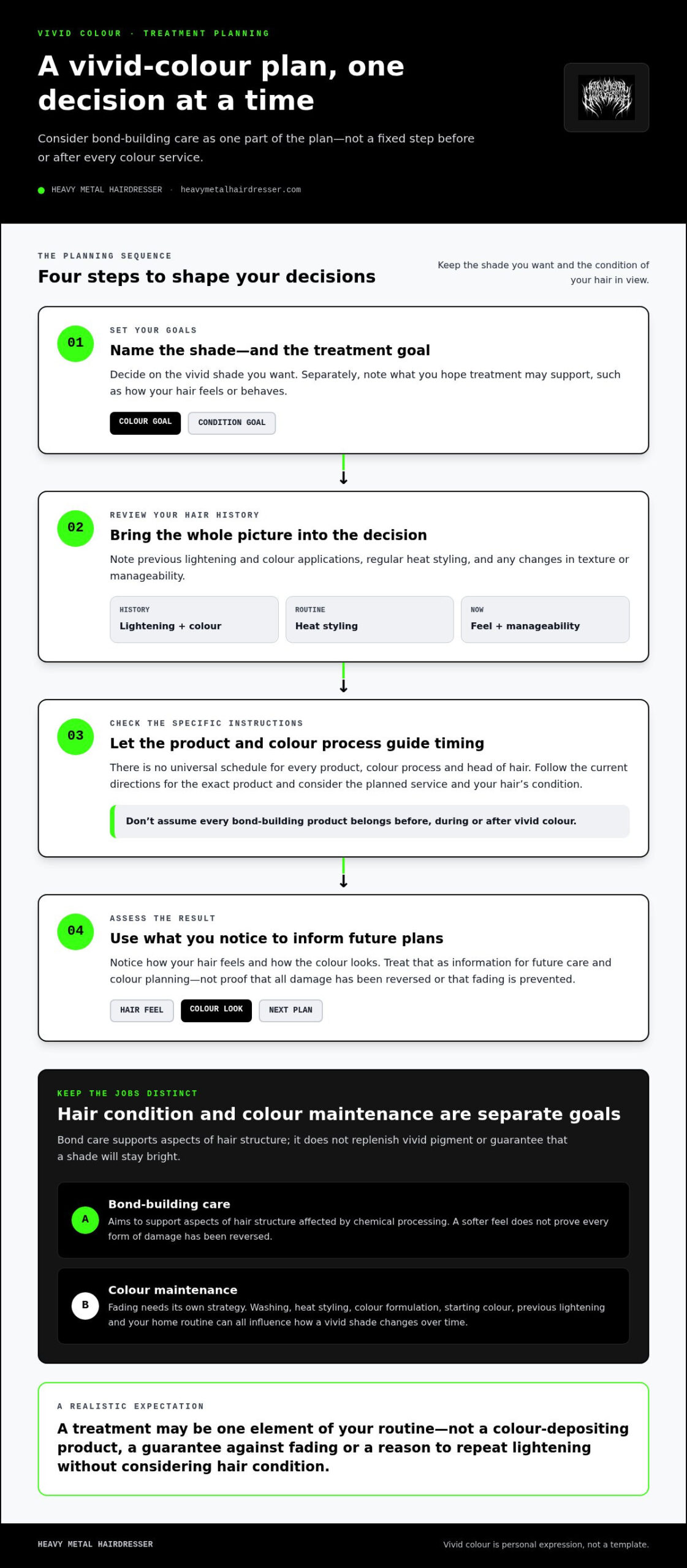
Use this sequence to organise your decisions:

  1. Set your goals. Decide on the shade you want and what you hope a treatment will support, such as how your hair feels or behaves.
  2. Review your hair history. Note previous lightening and colour applications, regular heat styling, and any changes in texture or manageability.
  3. Follow the specific instructions. The product directions and planned colour process determine how and when a treatment should be used.
  4. Assess the result. Notice how your hair feels and how the colour looks. Use that information to inform future care and colour plans.

This helps separate the shade goal from the condition goal. A particular vivid result may depend on your starting colour and the work required to reach it. A bond-building product doesn’t guarantee that every target shade is achievable in one appointment.

What should you consider before vivid colour and treatment?

Bring the whole picture into the decision. Hair that has been lightened several times may behave differently from hair with little chemical history. Heat styling and how your hair feels now also offer useful context. Be specific about what you want: a vivid shade is a colour goal, while improved feel or manageability is a separate treatment goal. Keeping them distinct makes expectations more grounded.

Can treatment and colour work happen in the same appointment?

There’s no universal schedule for every product, colour process and head of hair. If a treatment is being considered, its appropriate order depends on the current manufacturer instructions and the planned service. Read the directions for the exact product rather than relying on a routine shared for another formula or colour process. Your hair’s starting condition matters too.

Let the product directions and planned colour process determine treatment timing. That’s more useful than assuming every bond-building product belongs before, during or after vivid colour. Directions can be product-specific, so use current manufacturer guidance rather than treating old advice or social media routines as a universal formula.

At Heavy Metal Hairdresser, vivid colour is personal expression, not a template. A considered plan starts with the shade you’re drawn to and your hair’s condition, then sets realistic expectations for the work involved. Explore our creative vivid colour work as you shape a look that feels like yours.

Olaplex treatment versus other care for vivid hair

Vivid hair care isn’t a one-product mission. A shade can lose intensity while the hair feels rough or tangles easily, and those concerns call for different kinds of care. An olaplex treatment for vivid hair sits alongside conditioning, pigment-refreshing products and heat protection rather than replacing them.

Bond care, conditioning and colour-depositing products: what differs?

Each category has a different purpose. Bond-building care is intended to support aspects of the hair’s internal structure. Conditioner focuses on surface feel, helping hair feel smoother and easier to detangle. Colour-depositing products add visible pigment to refresh or shift a shade. Heat-protection products are intended for use when styling with heat, according to their label directions.

Care category Main purpose Consider it when…
Bond-building care Supports hair structure, according to the product’s claims. You’re considering care for hair affected by chemical processing.
Conditioning Helps with feel, smoothness and detangling. Your hair feels rough or is difficult to comb through.
Colour-depositing products Add pigment to refresh the visible shade. Your vivid colour looks less intense and you want to maintain its appearance.
Heat protection Provides a layer of care for heat styling, as described on the product label. You use heated styling tools and want to include a heat-protection step.

These are broad categories, not guarantees. Formulas and claims vary, so read the current label and directions for the specific product. A colour-depositing formula, for example, may not suit every shade or starting colour; check its intended use before applying it.

Which hair concerns might each approach address?

Match the care to the concern. If hair feels rough or catches when you comb it, conditioning may help with surface feel and manageability. If a vivid shade looks dull, a suitable colour-depositing product may refresh the visible pigment. If you regularly use heated tools, follow the directions for a heat-protection product. If you’re considering bond-building care after chemical services, check its stated purpose and instructions.

Don’t treat one concern as proof of another. Tangling alone doesn’t diagnose structural damage, and a smoother feel doesn’t tell you whether colour is fading. Pigment refresh won’t serve the same purpose as conditioning or bond care either. Choose based on what you’ve noticed, and change one part of your routine at a time if you want to understand how it affects your hair.

Colour upkeep and hair-condition care are complementary, not interchangeable: one supports the shade you see, while the other addresses different needs of the hair. Keeping those jobs separate makes it easier to build a routine around your look without expecting one product to solve every concern.
Olaplex Treatment for Vivid Hair: What It Can, and Can’t, Do

A practical checklist for vivid hair treatment decisions

A clear plan starts with details, not a promise on a product label. Before choosing an olaplex treatment for vivid hair, separate what you want your colour to look like from what you want your hair to feel like. That gives you a more useful basis for deciding which care steps make sense.

What information helps shape a realistic colour-care plan?

Pull together a quick snapshot of your hair and your goal. A vivid shade is personal, and the route to it depends partly on what your hair has already been through. Consider:

  • Colour history: Previous colour applications and lightening, including work done at home.
  • Current condition: Whether your hair feels rough, tangles easily or seems different from its usual texture.
  • Home routine: The products you use and how often you style with heat.
  • Your colour goal: The shade you’re aiming for and how it compares with your starting colour.
  • Your treatment goal: What you’d like to support, such as manageability or how your hair feels.

Be specific. “I want a deep violet” describes the colour; “I want my hair to feel easier to comb” describes a care goal. Neither guarantees a particular outcome, but both help keep expectations grounded. For more inspiration on planning a bold shade, explore a vivid hair colour guide alongside your treatment research.

How can you support vivid colour between appointments?

Everyday care and an in-salon bond-building treatment are separate parts of a routine. Home habits shape how you handle and style your hair over time. A salon treatment included in a colour plan is a distinct step with its own product instructions. Don’t copy another person’s schedule or assume their results will apply to your hair.

  • Handle hair gently, especially if it tangles. Avoid rough brushing or pulling through knots.
  • Be mindful of heat styling, and follow the directions on any heat-protection product you use.
  • Use aftercare products according to their labels, particularly when a product is intended for coloured hair.
  • Follow the current manufacturer instructions for any bond-building product rather than guessing its timing or frequency.

There’s no universal wash schedule that guarantees a vivid shade will last. If fading is your main concern, focus on dedicated vivid-colour maintenance advice; treatment for hair condition is a different decision. For colour shaped around your own expression and starting point, explore Heavy Metal Hairdresser’s vivid colour work.

Vivid colour care at Heavy Metal Hairdresser: make the plan yours

Your hair colour should look like you, not like someone else’s reference photo copied detail for detail. At Heavy Metal Hairdresser, creative vivid colour work sits alongside an inclusive approach that celebrates individuality. Planning a bold look means considering both the expression you want and the hair you’re starting with.

Bring your colour goals and hair history into the conversation

Share the details that can shape a realistic plan: previous colour and lightening, any at-home applications, how your hair feels now and the shade you’re drawn to. It also helps to describe your day-to-day routine. A colour that needs frequent refreshing may not suit everyone’s habits, and regular heat styling can influence what care feels practical for you.

Be clear about both goals. You might want a vivid, saturated tone and hair that feels easier to manage. Those are connected parts of your overall plan, but they aren’t the same outcome. An olaplex treatment for vivid hair isn’t a required step for everyone, and no bond-building treatment can guarantee a particular shade, feel or lifespan for colour.

Good planning makes room for your preferences. Bring inspiration if you have it, and talk about what you like in the image: the depth, brightness, placement or overall mood. That gives the colour conversation more to work with than a shade name alone. Your chosen expression leads; the plan should respond to you.

Choose realistic expectations over miracle claims

Bond care, colour work and ongoing maintenance each have their own role. A treatment may be considered as one part of an approach to hair condition, while the colour plan addresses the shade you want and aftercare supports it between appointments. None is a universal fix. Your starting point, colour history and intended result all matter, so thoughtful advice is more useful than a sweeping promise.

That’s the spirit behind personalised vivid colour at Heavy Metal Hairdresser. The aim isn’t to make everyone fit the same colour formula. It’s to create space for different identities, tastes and ideas, while keeping expectations grounded in the hair in front of you. Bold colour deserves care and consideration, not fear or false guarantees.

If you’re ready to explore a look that feels unmistakably yours, explore vivid colour at Heavy Metal Hairdresser.

Make your next colour move with confidence

Your next step can be simple: gather a few images that capture the mood you want, note what your hair has been through, and think about what matters in your day-to-day routine. That gives your colour goals a solid starting point without locking you into a shade or treatment before the conversation begins.

Keep the olaplex treatment for vivid hair question in perspective. Let your hair history and the product’s own directions guide any treatment decision rather than chasing a miracle claim. You deserve a plan built around your hair and the look you want to express.

Heavy Metal Hairdresser brings creative styling and vivid colour work together, informed by backstage festival work and styling for prominent bands and artists. The salon’s inclusive approach makes room for individuality, not a one-size-fits-all version of bold. Explore vivid colour at Heavy Metal Hairdresser and start shaping a look that feels like yours. Go bold, with care and confidence.

Frequently Asked Questions

Is Olaplex good for vivid hair?

It may be relevant if your concern is how your hair feels after colouring or lightening, but it isn’t a pigment-refresh product. The best fit depends on your hair’s history and the specific formula, so a routine that suits freshly lightened hair may not suit hair with repeated colour applications. Check the current manufacturer instructions and keep expectations individual: bond care doesn’t promise to prevent fading or reverse every kind of damage.

Can Olaplex make vivid hair colour fade?

There isn’t a reliable universal yes-or-no answer for every product and vivid shade. How a treatment interacts with colour can depend on the formula, colouring process and your hair’s condition. Notice whether the change is in the visible pigment or the way your hair feels; those are different things. Follow the current product directions, and don’t expect any treatment to keep a shade unchanged indefinitely.

Should you use Olaplex before or after vivid hair dye?

There’s no single timing rule for every Olaplex product or colour service. Use the current instructions for the exact product alongside the colour plan, rather than assuming treatment is automatically needed before or after dye. An at-home product, for example, may have different directions from one intended for a salon process. Keep decisions specific to the formula and service, and avoid borrowing someone else’s schedule.

Does Olaplex repair damaged hair permanently?

No treatment should be treated as a permanent return to hair that has never been coloured or lightened. A particular product may be intended to support hair’s appearance or feel, but wording and directions vary, so check its current manufacturer information. If your hair feels better after using a product, that can still be useful; it simply isn’t proof that all damage has been undone or that future chemical services carry no risk.

Is Olaplex the same as a deep conditioner for coloured hair?

No. Bond-building treatments and conditioners belong to different care categories. A conditioner may help hair feel softer or easier to manage, while bond-building claims relate to the specific product’s stated purpose. Read the label rather than assuming all treatments work alike. Neither category replaces vivid-pigment maintenance, and one product may not address every concern, such as tangling, dull colour and heat styling.

What should you do if vivid hair feels dry after colouring?

Start by reviewing what’s changed: recent colour or lightening, heat styling, and any new products. Handle your hair gently and use suitable care products only as their directions advise. Dry-feeling hair and fading colour aren’t the same issue, so note whether the change is in texture, shade or both. An article can’t diagnose a sudden or persistent change; a tailored assessment can help you decide what to do next.
Posted on

Haircuts for Creative Professionals: Find Your Workday-Ready Look

Haircuts for Creative Professionals: Find Your Workday-Ready Look

What if your haircut could carry your creative identity into the studio, office or meeting room without feeling like a costume? Haircuts for creative professionals can balance self-expression with a shape that feels right for your working day. The practical questions are how a bold silhouette will work with your hair, how it will feel in your workplace and how much effort it needs on a rushed morning.

You don’t need to settle for a safe, forgettable cut or commit to a high-maintenance look that doesn’t fit your life. Start with what you want your hair to say, then consider your natural texture and everyday styling habits. Individual doesn’t have to mean impractical.

Explore shags, wolfcuts and mullets, and compare how their layers, outlines and styling needs differ. You’ll also find ways to describe the finish you want at your salon consultation, including how much movement, definition and daily upkeep feels right. The aim is a cut that feels unmistakably yours at work and beyond.

Key Takeaways

  • Haircuts for creative professionals can balance personal expression with the look you want to bring to work.
  • Compare the shag, wolfcut and modern mullet by silhouette and styling effort to find a direction worth exploring.
  • Use your hair’s texture, density and natural movement to set realistic expectations for how a reference cut may translate.
  • Before your salon consultation, decide which features matter most and how much time you want to spend styling your hair each day.
  • Heavy Metal Hairdresser specialises in alternative haircuts, including wolfcuts, shags and mullets, informed by Simon Tuckwell’s creative styling and festival work.

Haircuts for creative professionals: expression without a workday costume

A haircut can be part of how you show up creatively without turning every workday into a performance. A graphic fringe, unruly layers or a sharper outline can signal taste and personality. The right balance depends on what feels like you, not on an imaginary office rulebook. A designer presenting to clients, a maker working in a studio and a creative lead moving between meetings may all want something different from their hair.

An adaptable creative haircut expresses your identity and still feels workable through an ordinary day. That doesn’t mean sanding off every bold edge. Professional suitability isn’t the same as conventionality, and there’s no single haircut that earns its place in a creative workplace. Think about how the cut moves, how it sits when you’re focused on a task and whether you feel comfortable wearing it in the settings you work in.

What makes a haircut feel creative rather than corporate?

Shape, movement and texture do the talking. Soft, broken-up layers can give a cut a lived-in feel, while a strong outline can make a quieter shape look deliberate. Personal references matter too, whether they come from music, fashion, art or a past version of your own style. The shag’s history offers useful context: The Shag Haircut: A Historical Perspective traces the cut’s evolution and its connection to the wolf cut.

Creative expression can stay subtle, go full-volume or land somewhere in between. You might choose a detail that shows when your hair moves rather than changing the whole silhouette dramatically. Neither option is more authentic. Start with your own taste and comfort, not a stereotype about how a creative person is supposed to look.

Start with how you want to feel at work

Before choosing a reference image, name the impression you want your haircut to make. Do you want to feel composed and quietly distinctive, or more visibly bold? Then picture the real rhythm of your working day: a client meeting, a hands-on task, time at a desk or a mix of all three. This can help you decide where you want the cut’s character to stand out.

  • Low-key refinement: Consider shape and subtle texture that feel individual without dominating your overall look.
  • Visible character: Think about more defined movement, a noticeable fringe or layers that shift as you move.
  • A disruptive silhouette: Explore a stronger outline if that feels comfortable across the settings you work in.

These are starting points, not rules. A cut that feels confident in a client-facing role may look different from one suited to a practical studio routine, and your comfort matters in both. Bring the impression you want to your salon conversation, then describe what you want to keep, change or make more noticeable. That gives the haircut a direction rooted in your identity rather than a workplace costume.

Compare creative haircuts: shag, wolfcut and modern mullet

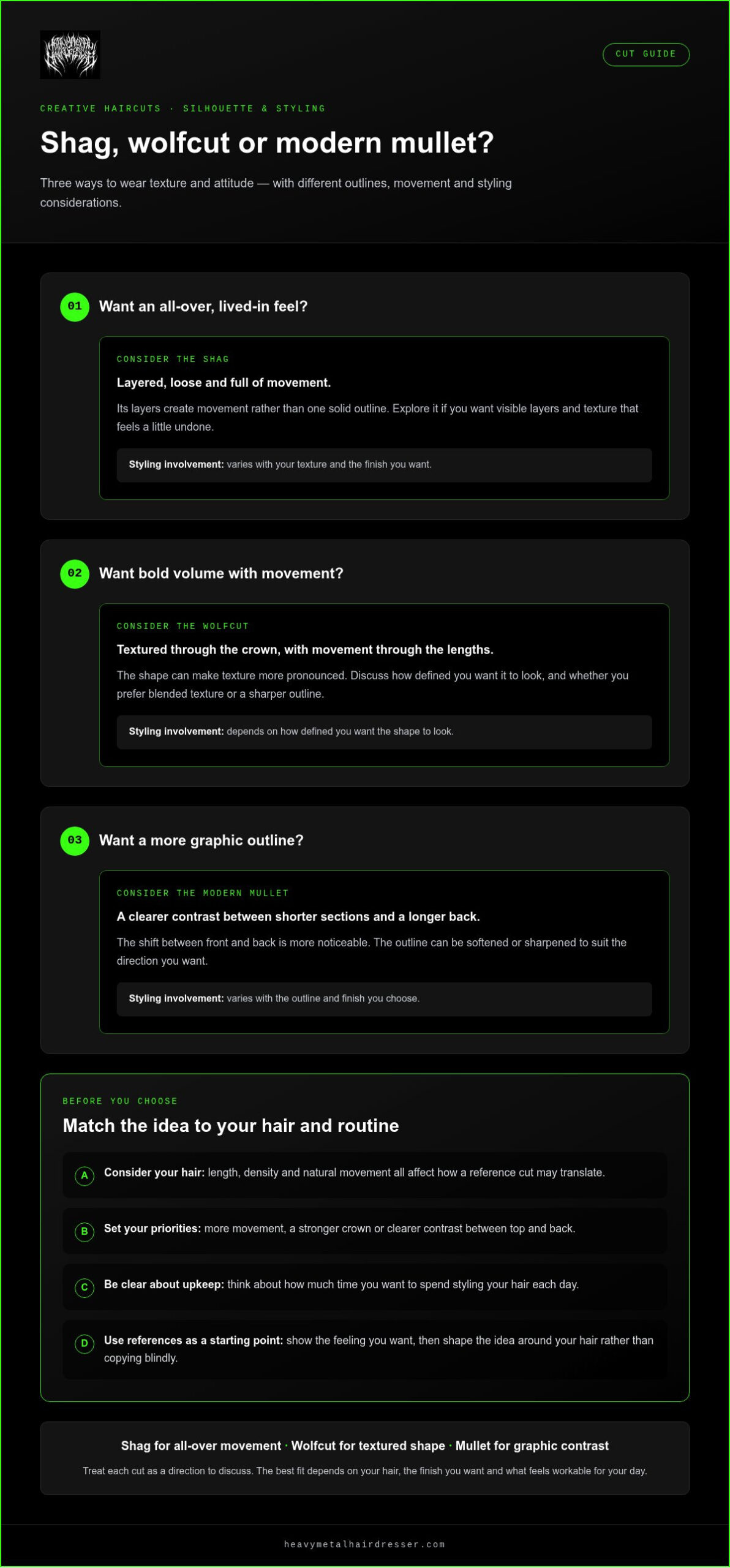
These cuts all bring texture and attitude, but they create different outlines. A shag leans into layered movement, a wolfcut often pushes that texture into a bolder shape, and a mullet makes the contrast between the front and back more noticeable. Use this comparison as a starting point, not a promise of how a cut will sit on your hair. Length, density and natural movement all affect the result.

Cut Silhouette and character Styling involvement May suit you if…
Shag Layered, loose and full of movement Varies with texture and desired finish You want a lived-in shape with visible layers
Wolfcut Textured and more pronounced through the crown Depends on how defined you want the shape to look You like bold volume with movement through the lengths
Modern mullet A clearer contrast between shorter sections and a longer back Varies with the outline and finish you choose You want a more graphic, unmistakable silhouette

Choose a shag for all-over movement, a wolfcut for textured shape or a mullet for a more graphic contrast between top and back. Treat each as a direction to discuss. A reference photo can show the feeling you’re after, while your stylist can shape the idea around your hair rather than copy it blindly.

A shag for movement and lived-in texture

A shag’s layers give the hair movement rather than one solid outline. If you’re drawn to texture that feels loose and a little undone, it’s a useful shape to explore. The amount and placement of the layers can be discussed in relation to your preferences and hair. The shag haircut guide offers more context on its alternative appeal.

A wolfcut or mullet for a stronger silhouette

A wolfcut can bring together a textured crown and movement through the lengths, while a mullet puts more emphasis on the shift between shorter sections and a longer back. The line between them can be softened or sharpened. Ask yourself whether you prefer blended texture or a more graphic outline. Explore the wolfcut guide and modern mullet guide for more detail.

For haircuts for creative professionals, the most useful comparison is the one that helps you explain your priorities: more movement, a stronger crown or a clearer length contrast. If you’re leaning towards one of these alternative shapes, explore Heavy Metal Hairdresser’s haircut expertise as you refine the direction you want to take.

Will an expressive haircut work in a professional setting?

Yes, an expressive haircut can work in a professional setting. Professional doesn’t automatically mean conventional, and there’s no single office look for every creative role. Your workplace might involve a shared studio, client presentations, practical work or a changing mix of settings. Consider the context you actually move through rather than assuming every employer or client expects the same appearance.

A more striking shape can feel energising and make your personal style visible. It can also draw attention, which you may enjoy or prefer to dial back on certain days. That’s a trade-off to weigh, not a reason to rule out the cut. The outline, length, texture and finish all affect its overall feel, and your comfort matters as much as the impression it makes.

How can you adjust the feel without erasing the cut?

Styling gives you options, not a duty to make your hair more acceptable. Defined texture can bring layers or a fringe forward; a relaxed finish can make the same shape feel softer and less deliberate. Neither changes the haircut’s identity. They’re simply different ways to wear it, depending on your mood, the day’s plans and how you like your hair to sit.

Think about what you’d genuinely enjoy doing. If you want a cut that can shift between a more defined finish and a looser one, describe both to your stylist. Be clear about how much daily styling feels realistic, too. A dramatic shape won’t automatically feel right in every workplace, and a subtler finish won’t suit everyone. The aim is choice, not camouflage.

Choosing your comfort level with visibility

Consider three features, from low-key to high-impact: contrast, texture and length difference. You might want plenty of movement but a softer outline, or a noticeable contrast with less emphasis on styling. There’s no score to get right. This quick check helps turn a general feeling, such as “I want something alternative”, into details a stylist can work with.

  • Contrast: Do you want a blended outline or a sharper change between sections?
  • Texture: Would you prefer understated movement or layers that stand out?
  • Length difference: Should the shape feel even, or should the variation be part of its character?

Bring references that show both the shape you’re drawn to and how it looks in everyday wear. Save images with different finishes, and point out what you like in each: the fringe, the outline, the texture or the way the lengths sit. For haircuts for creative professionals, confidence isn’t a universal dress code. It’s a personal sense of feeling like yourself in the places your work takes you. Heavy Metal Hairdresser’s alternative haircut expertise centres individuality, giving you space to explore a shape that feels like yours.

Haircuts for Creative Professionals: Find Your Workday-Ready Look

Match your haircut to your hair, routine and creative role

A reference photo shows the destination, not necessarily the route your hair will take. Density, length and natural movement all affect how a shape sits. To find a cut that works beyond the picture, make the decision in this order: name the silhouette you want, consider how your hair behaves, then factor in the styling you’re happy to do on an ordinary morning.

  1. Clarify the shape. Describe what you want to notice first, such as a strong outline, more movement or a particular fringe.
  2. Account for your hair. Consider its density, length and natural movement, and how those qualities might change the reference.
  3. Be realistic about upkeep. Say how you usually wear your hair and how much time you want to spend styling it.

Translate inspiration into useful reference images

Build a small set of images that shows the shape from the front, side and back, where possible. For each one, point to the detail you like: the outline, a fringe, the amount of texture or how the layers fall. Include an example of what you don’t want, too. It can clarify your boundaries, such as avoiding too much length contrast or a fringe that sits across your eyes.

Use references to communicate, not to demand an exact copy. The same cut can look different on hair with greater density, a different length or a distinct natural pattern of movement. Explaining why a photo appeals to you gives your stylist more to work with than the image alone.

Talk through texture, upkeep and the shape you want

Describe a normal day with your hair: whether you air-dry it, how you wear it during practical tasks and which styling steps you’ll actually keep up. If you want a cut to work with your natural movement, say so. A stylist can use those details to adapt the reference and shape the silhouette around your hair rather than assuming it will behave like someone else’s.

Your creative role can help clarify the brief, too. Think about whether your day involves focused studio work, hands-on tasks or regular client-facing time, then explain what needs to feel comfortable through those moments. For broader ideas, the professional guide to alternative hair styles offers further inspiration to bring into the conversation.

Consultation checklist:

  • The silhouette or feature you want most
  • Reference images showing the shape from different angles
  • Details you like, plus anything you want to avoid
  • Your hair’s usual texture, movement, density and length
  • Your everyday routine and realistic styling time
  • How you want the cut to feel during your working day

Take the checklist into your consultation and use it to keep the conversation specific. Haircuts for creative professionals work best when a clear brief is adapted to the hair and routine you actually have. Book a creative haircut consultation and bring your references, preferences and everyday routine into the discussion.

Find your creative haircut with Heavy Metal Hairdresser

You’ve compared shapes and considered how your hair behaves. Now turn those ideas into a clear salon conversation. Heavy Metal Hairdresser specialises in shags, wolfcuts, mullets and textured styling, with room to explore a silhouette that reflects your identity rather than a prescribed office look. The focus is on your preferred shape, how you wear your hair and what feels right for everyday life.

Bring your references and your real-life routine

Bring a few images that show what draws you to a cut, and be ready to explain the detail: perhaps it’s the loose layers, a strong outline or the way the fringe frames the face. Add an example that shows what you’d rather avoid. That contrast makes your preferences clearer than a style name alone.

Talk honestly about your routine, too. Explain whether you air-dry your hair, how you wear it during practical tasks and how much styling time you want to spend. Hair density, length and natural movement can all affect how a reference translates. At Heavy Metal Hairdresser, these details help shape a conversation around your preferred silhouette and the way your own hair behaves. Your inspiration sets the direction, with your individuality at the centre.

It’s fine if you’re still deciding between two shapes. Say what you like about each and where you feel unsure. A useful haircut discussion isn’t about arriving with all the answers. It’s about making your preferences specific enough to explore together.

Make your next move towards a cut with character

Simon Tuckwell founded and leads Heavy Metal Hairdresser, bringing creative styling experience from collaborations with bands and artists and backstage work at Download and Bloodstock. That context informs the salon’s alternative approach, but you don’t need a stage look. Your cut can be as subtle or statement-making as feels right to you.

The salon’s inclusive environment celebrates individuality. Whether you’re exploring a shag, considering the textured shape of a wolfcut or drawn to a mullet’s length contrast, your work, hair and styling habits can all help guide the discussion. There’s no single version of creative style you need to fit.

Before your consultation, narrow your shortlist to the features you want most, the details you’d avoid and the upkeep that feels realistic. That gives you a strong starting point for finding haircuts for creative professionals that feel personal and workable. Explore Heavy Metal Hairdresser and start planning your creative haircut.

Make your next haircut feel like yours

Your next cut doesn’t have to define your whole style. Think of it as a choice for this version of you: the one heading into your current work, everyday routines and whatever comes next. Haircuts for creative professionals can make space for self-expression without locking you into one look or one way of wearing it.

Bring your ideas into the salon with an open mind. A useful conversation can turn a strong instinct into a shape that feels personal, wearable and distinctly yours. You don’t need a perfect script or a final answer before you start. Begin with what you’re curious to try.

Explore Heavy Metal Hairdresser and plan a cut with character. Your next look can be bold, understated or somewhere in between. Choose what feels right for you, and wear it your way.

Frequently Asked Questions

Is there a haircut that looks creative but still feels professional?

Yes, a creative cut can feel professional because professionalism isn’t tied to one approved shape. Your role, workplace and personal style all matter. For example, a softly shaped fringe can read differently from a sharply defined one, even with similar layers. Consider how you want to feel during a video call or presentation, then choose a finish that supports your confidence without asking you to hide the parts of your look you value.

Can I have a bold haircut if I work with clients?

Yes, client-facing work doesn’t automatically rule out expressive hair. Think about the settings you work in, from informal creative reviews to formal presentations, and the impression you want to make in each. You might prefer a striking outline or choose a shape whose details are more noticeable up close. Share that context with your stylist and talk through the finish you’re drawn to. Responses vary, so centre the choice on your comfort.

How do I explain the haircut I want to a stylist?

Bring a few clear reference images and name the detail that catches your eye in each. One might show the fringe you like, another the shape around the ears or the way the back sits. Explain what you want to avoid, too. Then describe how you normally wear your hair, including whether you tie it back or tuck it behind your ears. A shared conversation gives your stylist more to work with than a cut’s name alone.

Are creative haircuts suitable for natural texture?

Yes, a creative shape can be planned around your natural texture rather than treated as a one-size-fits-all template. Tell your stylist what your hair does after washing, how it moves as it dries and where it tends to sit. For instance, a reference with loose waves may translate differently on straighter or curlier hair. Agree on the silhouette and finish you want while allowing the details to suit your own hair.

Do creative professional haircuts need lots of daily styling?

Not necessarily. The effort depends on your hair, the chosen shape and how defined you want the finish to look. Before settling on a cut, describe an ordinary morning: do you have time to shape your fringe, or would you rather leave your hair to fall naturally? Be candid about what you’ll actually do. That helps your stylist discuss a shape and finish that align with your preferred routine, without assuming every cut needs the same upkeep.

Should I choose a haircut based on my job title?

No, a job title alone can’t tell you which cut will feel right. Creative professionals work in different settings and have individual tastes, even within the same field. Consider your actual working day, the moments when you want to feel most at ease and how much expression you want your hair to carry. Your routine matters too. There’s no required look that proves you’re capable; choose a shape that feels comfortable and true to you.

Posted on

Building Confidence with a New Hairstyle: A Practical Guide

Building Confidence with a New Hairstyle: A Practical Guide

What if building confidence with a new hairstyle starts with changing less, not more? A fresh cut can feel exciting and unnerving at the same time, especially if you’re worried the result won’t feel like you or match the picture in your head. You don’t need to make a dramatic leap to choose a change that means something.

A good starting point is a look that reflects your identity and feels right to wear day to day. That means sharing what you like and dislike, explaining what matters to you and being part of decisions as the cut takes shape. Your preferences count, whether you’re considering a shag, a wolfcut or a subtle change to shape and texture.

This guide will help you decide how much change feels manageable, explain your ideas clearly and approach a consultation with confidence. You’ll also find practical ways to get used to your new look at your own pace. There’s no pressure to become someone else. The aim is to make more room to feel like yourself.

Key Takeaways

  • Confidence means feeling comfortable and recognisable in your look, not chasing someone else’s idea of “perfect”.
  • Start with how you want your hair to feel day to day, then use inspiration to explore styles and options.
  • Reference images and clear preferences can help make your consultation a conversation in which your voice matters.
  • Give yourself time to adjust: try familiar outfits, notice how the style feels and see it in different light.
  • Building confidence with a new hairstyle comes down to personal choice and comfort. An expressive cut can celebrate what makes you you.

Why can a new hairstyle affect your confidence?

Hair is part of how you meet the world. It frames your face, moves with you and can become so familiar that even a small change feels significant. That’s why building confidence with a new hairstyle can bring mixed reactions: anticipation, doubt or a flash of vulnerability. Those feelings don’t necessarily mean you’ve made the wrong choice. They can simply be part of adjusting to something personal and visible.

What does confidence with a new hairstyle actually mean?

It doesn’t mean looking flawless or matching a beauty ideal. It means feeling at ease with the shape, texture or colour you’ve chosen, and recognising yourself when you catch your reflection. Confidence can also mean having a say in the decision and knowing your preferences helped shape the result.

That’s different from choosing a style because a trend promises to make you more attractive, or because you feel you ought to look a certain way. A shag, wolfcut or vivid colour might feel expressive to one person and not quite right for another. You get the final say. Feeling comfortable and recognisable in your look matters more than whether it follows a trend.

Why can changing your hair feel like a big deal?

Familiarity carries weight. You may know exactly how your hair sits, how it behaves in the rain or how you style it before heading out. A new cut can change that everyday routine and the silhouette you’re used to seeing. Because hair is so visible, you might also wonder how other people will react. Those worries are understandable, but they don’t mean judgement is inevitable.

Hair can express identity, mood or a desire for change, but it isn’t a shortcut to self-esteem. The concept of self-esteem is broader than appearance, and a hairstyle can’t promise a lasting change in how you feel about yourself. It can, however, give you a fresh way to show parts of who you are.

Confidence is personal, not a haircut outcome. A style doesn’t need to transform your life to be worthwhile. It can simply feel more like you, give you room to experiment or help you enjoy your reflection on an ordinary day. Excitement and uncertainty can sit side by side while you work out what feels right.

How to choose a hairstyle change that feels like you

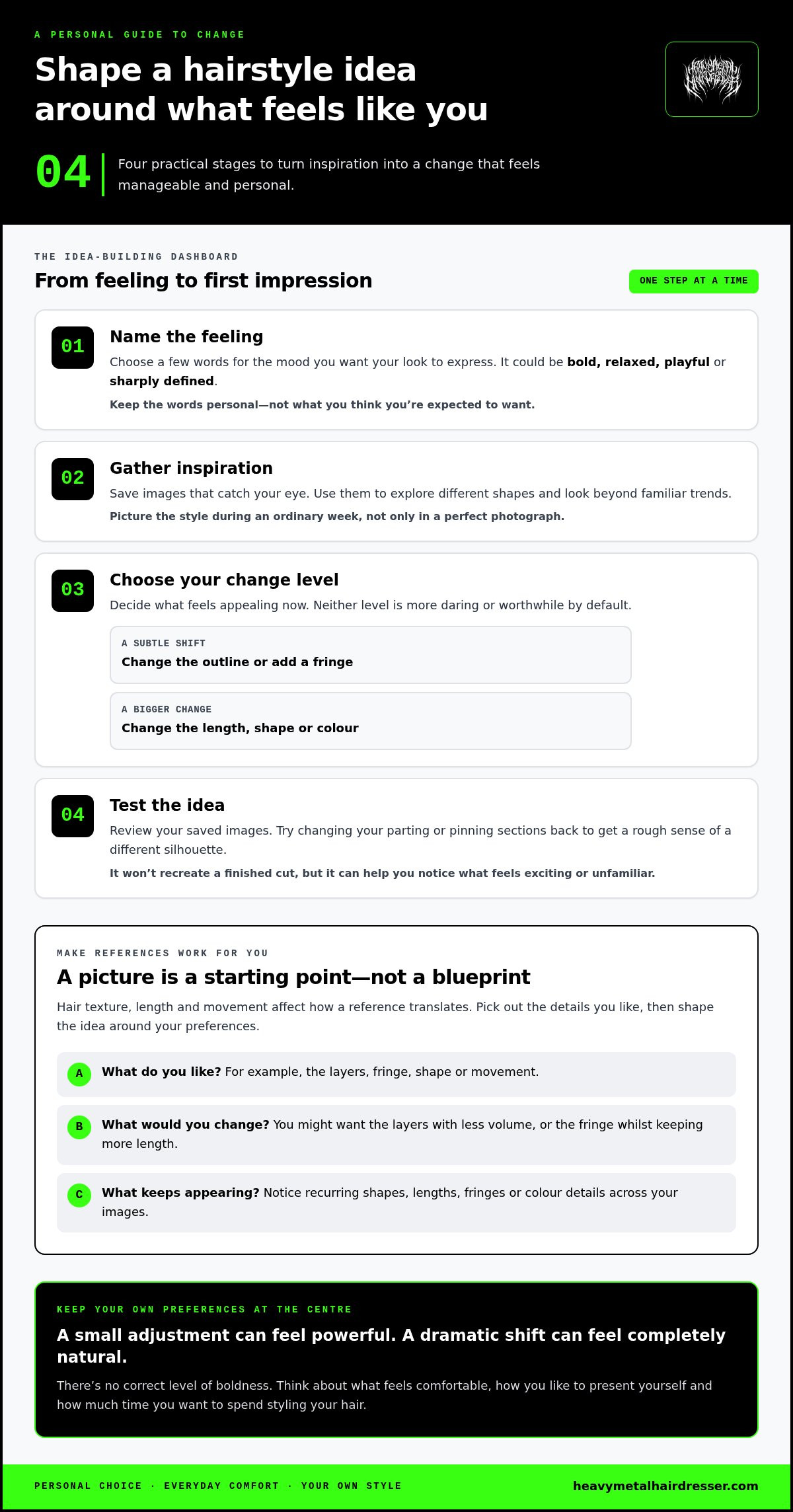
A hairstyle can look brilliant in a saved photo and still feel wrong for your everyday life. Start with what you want the change to express, then use inspiration to shape an idea around your preferences. There’s no correct level of boldness. A small adjustment can feel powerful; a dramatic shift can feel completely natural.

Start with the feeling you want your hair to express

Choose a few words for the mood you’re after: bold, relaxed, playful, sharply defined or something else entirely. Picture the style during an ordinary week, not just in a perfect photograph. Consider how you like to present yourself, what feels comfortable and how much time you want to spend styling your hair. Your preferences are a more useful starting point than rigid rules about which cuts suit a particular face shape.

  1. Name the feeling. Write down what you want your look to communicate. Keep the words personal, rather than choosing what you think you’re expected to want.
  2. Gather inspiration. Save images that catch your eye. A visual guide to alternative hairstyles can help you explore different shapes and look beyond familiar trends.
  3. Choose your change level. Decide whether you’re drawn to a subtle shift, such as changing the outline or adding a fringe, or a bigger change to length, shape or colour. Neither is more daring or worthwhile by default.
  4. Test the idea. Review your saved images and note what keeps appearing. Try changing your parting or pinning sections back to get a rough sense of a different silhouette. It won’t recreate a finished cut, but it can help you notice what feels exciting or unfamiliar.

Make the change feel manageable

Inspiration is a starting point, not a demand for an identical result. Hair texture, length and movement all affect how a reference translates. Instead of treating a picture as a strict blueprint, pick out the details you like. Perhaps you want the layers but less volume, or love the fringe but want to keep more length. Those specifics give you clearer options to discuss.

For each image, note what you like and what you’d change. Look for recurring shapes, lengths, fringes or colour details across your collection. If you’re drawn to layered texture and movement, a shag is one expressive cut to explore, with room to focus on the features that appeal to you.

Keep your shortlist centred on how you want your hair to feel in real life: easy-going, distinctive, low-key or full of attitude. That’s the point of building confidence with a new hairstyle: making a choice that feels like yours, rather than copying someone else’s look. If you’re drawn to expressive cuts, explore Heavy Metal Hairdresser’s approach to individual style as you shape your ideas.

How to explain your idea and feel involved in the consultation

You don’t need a perfect name for the cut or a fully formed vision before you sit down. A consultation is a conversation, not a test. Your stylist brings creative and technical knowledge; you bring details only you know: what feels like you, what you’re curious about and what you’d rather avoid. Clear communication is shared work, not a performance.

What should you bring or say about your hairstyle idea?

Bring a few varied reference images rather than relying on one photo as an exact blueprint. Different examples can show the shape, fringe, texture or overall mood you like. You might, for instance, prefer the movement in one image and the shorter outline in another. A wolf haircut guide can also help you explore the shape and find details to discuss.

Put what you see in the pictures into plain language. Try, “I want it to feel lived-in, with movement around my face” or “I like the shape, but I’m unsure about a short fringe.” Be just as clear about your boundaries. You could say, “I want to keep enough length to tie it back” or “I’m open to layers, but not a major change in colour.” Specifics give your stylist something useful to work with.

  • What appeals: name the mood, shape or detail that keeps catching your eye.
  • What doesn’t: point out anything in the images you’d rather not copy.
  • What’s non-negotiable: explain what you want to keep, such as length, fringe shape or a familiar parting.
  • What you’re open to: identify where you’re happy to explore options together.

How can you stay part of the decision?

As your stylist interprets your idea, ask questions if you’re unsure. “How would that shape connect to the movement I like?” or “What would change if we kept more length?” can make the options easier to picture. You’re not challenging their expertise; you’re checking that the plan still reflects what you came in wanting.

Say if a suggestion feels exciting, confusing or too big a leap. Ask for an explanation in everyday terms, talk through a smaller adjustment or pause before agreeing to a significant change. You don’t need to pretend you’re certain to keep the conversation moving. A good discussion makes room for your concerns as well as your stylist’s ideas.

That back-and-forth can make a difference when you’re building confidence with a new hairstyle. You don’t need to arrive with every answer. Bring your references, name your limits and stay involved as the shape takes form. If expressive cuts are your thing, explore Heavy Metal Hairdresser’s alternative approach to hair for ideas rooted in personal style.

Building Confidence with a New Hairstyle: A Practical Guide

How to settle into your new hairstyle without second-guessing it

A changed silhouette can feel unfamiliar at first, even if you chose it with care. You’re seeing a new outline where your eyes expect the old one, and that first reaction doesn’t have to be your final verdict. Give yourself time to notice the details before deciding how you feel about the whole look. Uncertainty is information, not proof you made a mistake.

What can you do when the change feels unfamiliar at first?

Try not to judge the cut from one glance in one mirror. Look at it in different light and from different angles, and notice your response without forcing yourself to love it straight away. Ask yourself: what feels exciting? What feels comfortable? Is there a detail that doesn’t match the idea you discussed? This can help separate the surprise of change from a specific concern you may want to explore.

Keep your first impressions simple. Make a quick note on your phone, such as “like the movement, unsure about the fringe” or “feels lighter, still getting used to the sides”. Naming the exact detail gives you more to work with than a sweeping thought like “I hate it”. If you’re still unsure, that’s allowed. A style may feel more familiar as you see it in everyday settings.

How can you practise wearing the look your way?

Take a low-pressure approach at first. Try the shape with a familiar outfit, a favourite jacket or accessories you already feel good in. Experiment with simple variations that fit your usual routine, such as wearing your fringe differently or letting your natural texture show. You’re learning how the cut moves and feels, not auditioning for a new identity.

  • See it in different light. Notice how the shape looks near a window and in your usual indoor lighting.
  • Pair it with the familiar. Choose clothes or accessories that already feel like you, so the hair is the only new element you’re getting used to.
  • Notice comfort. Pay attention to how it feels as you move through your day, not just how it looks in a posed reflection.
  • Record what clicks. Make a private note of the details you enjoy and anything you’re still adjusting to. You don’t have to post it, photograph it or turn the process into a performance.

There’s no universal adjustment timetable. Some changes feel familiar quickly; others take longer to settle into. Building confidence with a new hairstyle can mean learning which small styling choices make the shape feel more like your own, rather than expecting instant certainty. Let curiosity lead for a while. If a detail continues to feel wrong, describe it clearly and consider what might help.

If you’re ready to explore a personal cut shaped around your identity and comfort, discover Heavy Metal Hairdresser’s expressive approach to hair.

Find confidence in a hairstyle that celebrates your individuality

A hairstyle can express who you are, but it doesn’t have to carry the weight of transforming your life. Confidence can come from having a say in the change, communicating what matters to you and choosing a look that feels comfortable in your own skin. The right choice isn’t the one that earns the loudest reaction. It’s the one that feels like yours.

What does an inclusive, alternative hair experience make room for?

It makes room for different identities, tastes and comfort levels without treating anyone as an exception. Heavy Metal Hairdresser is an inclusive alternative salon where expressive cuts and vivid colour offer ways to explore personal style, not rules about how anyone should look. Shags, mullets, wolfcuts and textured styling can be approached to reflect the person wearing them. No style belongs to one gender or personality type.

That flexibility matters. You might want a striking silhouette, a hint of texture or a vivid colour that feels like a deliberate statement. Or you may be drawn to an alternative cut but want to keep familiar elements that help you feel at ease. You don’t need to perform confidence or arrive with a fully formed new persona. Your look can be bold, understated, experimental or somewhere in between.

Creative expertise can help turn a visual idea into a considered style. Heavy Metal Hairdresser was founded by stylist Simon Tuckwell, whose backstage festival experience includes Download and Bloodstock. That experience informs a creative perspective, but it doesn’t mean one particular cut will suit everyone. The key question is whether the idea connects with your identity and feels good to wear.

Take a low-pressure next step towards your new look

Exploring doesn’t mean committing on the spot. Look at different shapes and notice what holds your attention. Is it the movement of a shag, the texture of a wolfcut, the outline of a mullet or a flash of colour? You don’t need to settle on a finished look straight away. Collect the details that appeal to you and keep your priorities in view.

  • Stay open to ideas. Inspiration can help you discover a direction you hadn’t considered.
  • Keep your priorities clear. Think about what you want to preserve, what you’d like to change and what feels comfortable in everyday life.
  • Let the choice be yours. A look doesn’t need to follow a trend or meet anyone else’s expectations to feel right.

That’s the heart of building confidence with a new hairstyle: choosing a look that reflects you, with room to explore and decide at your own pace. If you’re curious about expressive cuts and colour, explore Heavy Metal Hairdresser’s alternative styling and see which ideas speak to you.

Make space for a look that feels like yours

Your next step doesn’t have to be a dramatic leap. It might be noticing a shape you’re drawn to, saving a reference or deciding which familiar detail you want to keep. Let your preferences lead, and give yourself room to explore without needing every answer upfront.

Building confidence with a new hairstyle isn’t about proving you’re fearless or choosing the boldest possible change. It’s about making room for your voice, being honest about what feels comfortable and letting your style evolve at a pace that suits you.

Heavy Metal Hairdresser brings an inclusive, alternative perspective to expressive hair, informed by creative roots in festival styling. If you’re ready to explore a look that feels like you, take a look around and let inspiration build naturally.

Explore Heavy Metal Hairdresser’s alternative styling. Your look, your call.

Frequently Asked Questions

Can a new hairstyle really improve your confidence?

A new hairstyle can support confidence, but it can’t guarantee a lasting change in how you feel about yourself. You might feel more at ease showing your natural texture, for example, or enjoy a cut that makes you less inclined to hide behind your hair. The effect is personal and can vary from day to day. Treat a style as one form of self-expression, not a fix for deeper struggles with self-esteem.

How do I know whether a hairstyle will suit me?

There’s no single rule that can decide whether a style suits you. Consider how your hair naturally falls, including its texture, density and growth patterns. A fringe, for instance, may sit differently if your hair grows in a particular direction. Ask how the cut might look without a salon finish, too. The aim isn’t to pass a suitability test, but to understand what the style may involve in everyday life.

Is it normal to feel nervous before getting a new haircut?

Yes, nerves are a normal response to changing something you see every day. Try to pinpoint what’s behind them: are you unsure about the length, worried about other people’s reactions or feeling rushed to decide? That distinction can help you work out what to say before the cut begins. Feeling nervous doesn’t automatically mean you should cancel, but you deserve enough space to make the choice freely.

Should I change my hairstyle gradually or go for a dramatic change?

Choose the pace that feels right for you, not the one that sounds more impressive. A gradual change can give you time to explore one feature, such as a new fringe, before changing more. A dramatic shift may appeal if you’ve thought it through and want a clear break from your current look. Consider which parts of the change feel exciting and which feel like pressure.

What if I regret getting a new hairstyle?

First, identify what you regret rather than deciding that everything is wrong. Is it the overall length, the fringe, the shape around your face or simply seeing such a different silhouette? Some details may be styled differently, while others need time to change. Avoid making a second big decision in a rush. Explain the specific concern to your stylist and discuss realistic options before deciding what to do next.

Can a hairstyle express my identity if I do not follow trends?

Absolutely. Building confidence with a new hairstyle doesn’t depend on choosing what’s fashionable. A shape, texture or colour can feel meaningful because it reflects your taste, culture, mood or sense of self. You might prefer a subtle detail, intricate protective styling from salons such as Bertha’s Image African Braids, or an unconventional cut that stands apart from current trends. There’s no gendered rulebook for who can wear a shag, mullet or wolfcut. Your reasons for choosing it are what make the look personal.

Posted on

How to Remove Vivid Hair Dye Without Damage: A Careful 2026 Guide

How to Remove Vivid Hair Dye Without Damage: A Careful 2026 Guide

The fastest way to strip vivid colour can be the quickest route to dry, unpredictable hair. If you’re searching for how to remove vivid hair dye without damage, resist treating removal like a race. Bright shades can fade unevenly or cling on longer than expected, and your hair’s history affects what happens next.

It’s understandable to want the colour gone now, especially when DIY advice points in different directions. But safer fading is usually a patient process, not a stripping contest. This guide explains why vivid dye lingers, how to weigh cautious at-home steps, and which harsh choices could leave your hair feeling rough or fragile.

We’ll also explain how fading differs from bleach, what to consider before trying a removal method, and when a colour change is best planned with a stylist. Heavy Metal Hairdresser specialises in vivid colour, with an individual approach that keeps hair condition and self-expression in the same frame. Sometimes the smartest next look starts with a careful plan.

Key Takeaways

  • Identify whether your colour is semi-permanent or another dye type before choosing a fading method.
  • Understand how natural fading, colour removers and lightening differ in pace, uncertainty and potential stress on your hair.
  • For how to remove vivid hair dye without damage, take a cautious step-by-step approach: assess your hair, test first and reassess before doing more.
  • Follow product label directions and avoid rushing into repeated treatments if your hair feels fragile.
  • Patchy colour, multiple dye layers or a major colour change may call for a stylist’s tailored plan.

Why vivid hair dye can be stubborn to remove without damage

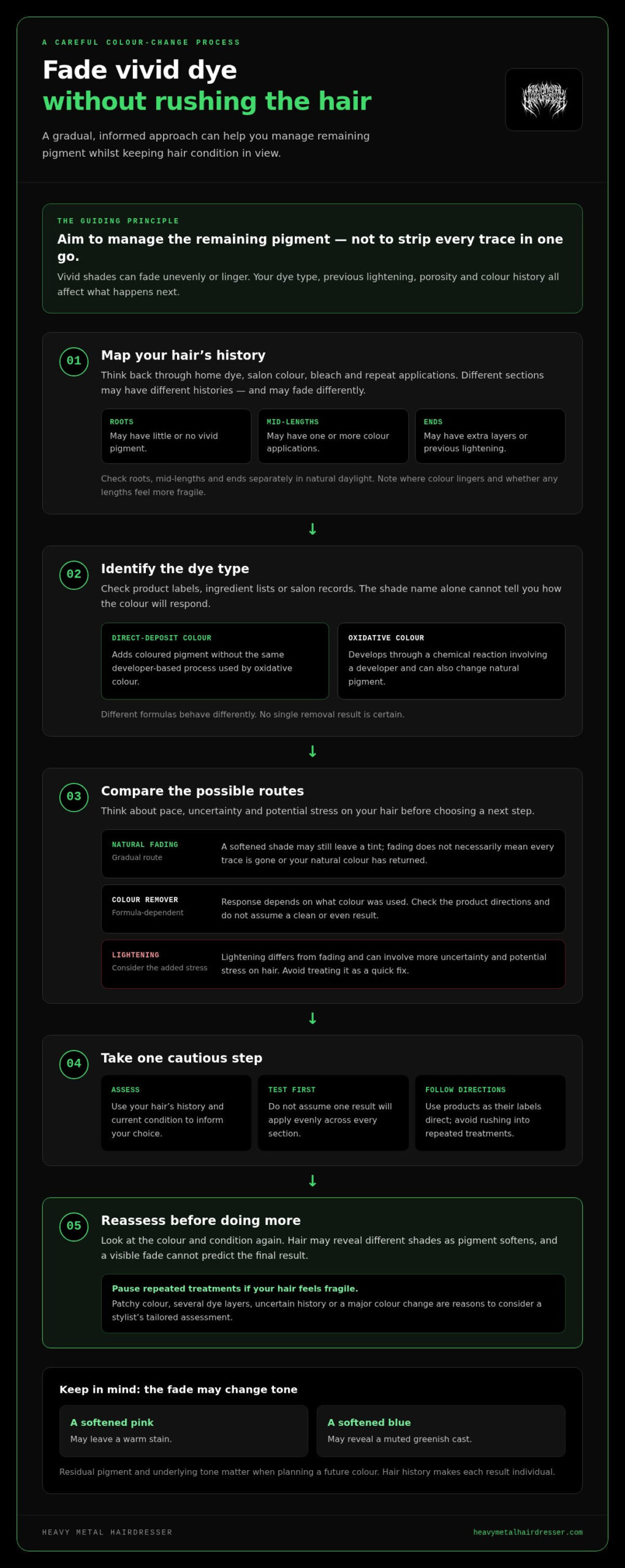
Ready for a new colour? You don’t need to wage war on your hair to get there. The safer goal in how to remove vivid hair dye without damage is to manage the remaining pigment whilst protecting your hair’s condition. A gradual fade may be more realistic than expecting every trace of colour to vanish at once.

Vivid shades often use direct-deposit colour, but the result depends on more than the shade on the box. Previous lightening, hair porosity, overlapping applications and at-home colour history can all affect the outcome. A cautious plan starts with understanding what’s on your hair, not reaching for the strongest remover you can find.

What kind of vivid hair dye is in your hair?

Direct-deposit colour adds coloured pigment without the same developer-based process used by oxidative colour. Oxidative dyes develop through a chemical reaction inside the hair shaft and can also change natural pigment. Formulas vary, and vivid colours may be used alongside other colour processes. Product labels, ingredient lists and salon records can help identify what was used. Different formulas respond differently, so no single removal result is certain.

The chemistry of hair coloring helps explain why dye types behave differently: colour can sit on or within the hair, whilst oxidative processes work differently from simple pigment deposit. That distinction matters when choosing a next step. If you’re unsure what was used, don’t assume the colour name tells the whole story. Keep the packaging or note the brand and shade, if you can.

Why the same colour can fade differently on different hair

Hair that’s been lightened may be more porous, meaning its outer structure can be more open and absorb colour readily. That can help vivid pigment look intense, but it may also make the fade unpredictable: some areas release colour sooner whilst others hold on. Hair with different histories from root to tip can behave like several canvases, not one.

Layering adds another complication. Reapplying the same shade can build pigment in some sections, and overlapping colours may reveal different tones as they soften. A blue over a faded base, for example, may not fade to the same shade across the head. A photo, even in clear light, can’t show the hair’s porosity or full colour history, and a shade name can’t predict the final result.

Think back through the full timeline: home dye, salon colour, bleach, and any sections that have been coloured more often. If the history is patchy or uncertain, that’s useful information, not a reason to panic. A stylist can assess your hair and discuss realistic options before a bigger change. Heavy Metal Hairdresser specialises in vivid colour, and its vivid hair colour guide explores how bold colour can become part of your individual look. Knowing how your current colour got there is the first step towards changing it with care.

How vivid dye interacts with the hair shaft as it fades

Colour doesn’t simply sit on hair like paint on a smooth wall. Each strand has an outer protective layer called the cuticle, made of overlapping scales, and an inner area where colour changes can take place. As pigment loosens or washes away, the shade you see shifts. That visible fade doesn’t necessarily mean every trace of colour has gone or that your natural colour has returned.

This distinction matters when working out how to remove vivid hair dye without damage. A softened pink might leave a warm stain; a blue may reveal a muted greenish cast. Those remnants are not a reliable guide to what a future colour will look like. The hair’s underlying tone and condition still matter.

Direct dye, oxidative colour, and the difference that matters

Direct dye is colour deposited onto the hair, whilst oxidative colour develops through a chemical process involving a developer. The formulas work differently, so they may fade or respond to removal in different ways. Neither type guarantees a clean fade. Before choosing a method, check the product label or salon records to identify what was used. The American Cancer Society’s hair dye safety guidance also points to precautions such as following product directions.

Porosity, previous lightening, and leftover pigment

Porosity describes how readily hair takes in and releases moisture and colour. Lightening can alter the cuticle, so treated lengths may absorb vivid pigment differently from less-processed roots. That history can affect how colour fades and how much tint remains.

Think of a head of hair as a timeline. New growth may have little or no vivid pigment, mid-lengths may have one application, and the ends may have several layers or prior lightening. As colour softens, each area can reveal a different shade. The change may look especially uneven in bright bathroom lighting or against a light background.

Check your hair in natural daylight, looking at the roots, mid-lengths and ends separately. Note whether the colour appears even, where it lingers, and whether the lengths feel more fragile than the roots. This gives you a more useful starting point than judging your whole head under one light. It still can’t predict an exact endpoint: previous treatments and residual pigment make each head of hair its own case.

If the colour history is unclear or the fade is already patchy, a stylist can assess your hair and discuss a controlled route towards your next look. Heavy Metal Hairdresser specialises in vivid colour, and Simon Tuckwell’s individual approach keeps expression and hair condition in view. Explore professional guidance for your colour change to make sense of what the remaining pigment might mean before deciding what comes next.

Vivid dye removal methods compared: what is gentler and what carries more risk?

There’s no single removal route that suits every vivid shade or hair history. Method choice depends on the dye type and your hair’s history. The strongest option isn’t automatically the cleanest: aggressive stripping can leave unwanted tones behind and put more stress on hair, without delivering the even result you hoped for.

Natural fading
Pace: Gradual. Uncertainty: It can fade unevenly and may leave a tint. Potential stress: Depends on what you do to encourage fading; repeated washing or drying methods can still affect condition.

Colour-removal products
Pace: Depends on the formula and dye. Uncertainty: Results vary, and these products aren’t interchangeable. Potential stress: Depends on the product and your hair’s condition.

Lightening
Pace: Can shift colour more quickly, but isn’t a predictable shortcut. Uncertainty: May reveal underlying or leftover tones. Potential stress: Higher, because lightening can affect both artificial colour and natural pigment.

Gradual fading versus dedicated colour-removal products

Allowing colour to soften gradually may feel less abrupt than a major chemical change, but patience matters. A faded shade can still look patchy or linger in porous lengths. Colour-removal products are a separate option, but one remover’s directions and intended use don’t automatically apply to another. Read and follow the specific label, and don’t assume the product will restore your original base colour. A result that looks lighter isn’t necessarily a blank canvas.

When weighing up how to remove vivid hair dye without damage, ask not only “Which method works fastest?” but also “What could this reveal, and how might my hair respond?” That pause can prevent a rushed decision from becoming a bigger colour correction.

Why bleach, household hacks, and repeated stripping can backfire

Bleach is not the same as a colour remover. It lightens by changing pigment, including natural pigment, and can reveal warm or unexpected undertones rather than lifting vivid colour neatly away. Home mixtures and repeated harsh treatments add uncertainty: ingredients, strengths and combinations may not be designed for hair, whilst repeated processing can leave lengths feeling rough or weak.

Don’t stack treatments just because the first result looks incomplete. If your hair becomes unusually fragile or stretchy, or your scalp feels uncomfortable, stop and avoid applying more. Those signs call for caution, not another round of stripping. A stylist can assess the colour and condition together, then help plan a more controlled change that protects the possibility of your next look.

How to Remove Vivid Hair Dye Without Damage: A Careful 2026 Guide

How to fade vivid hair dye more cautiously at home

A careful home approach is less about doing more and more about making each step count. Before trying a fading product or changing your routine, take stock of the colour and the hair underneath it. A small, controlled test can reveal a lot before you commit to treating every section.

  1. Identify the dye. Check the packaging, product label or salon records, if you have them. Note whether the colour was direct-deposit or part of an oxidative process, and record any previous lightening or colour applications. If you can’t identify the formula, don’t assume a method will suit it.
  2. Assess your hair’s condition. Look and feel through the roots, mid-lengths and ends. Notice areas that feel unusually dry, weak or stretchy, and where colour is more heavily layered. A method that seems manageable on one section may be too much for another.
  3. Test one discreet strand. Choose a small, hidden piece that reflects the lengths and colour history you plan to treat. Follow the chosen product’s instructions exactly, including its safety guidance. Don’t add ingredients or change how it’s used.
  4. Rinse, observe and reassess. Record the visible colour change and how the strand feels once dry. Compare the result with untreated hair before deciding whether to proceed. A test is a guide, not a promise that the whole head will respond evenly.

A cautious strand test before treating your whole head

Choose a strand from an area that’s been coloured or lightened, rather than testing only on untouched roots if your lengths are the concern. Note the starting shade, follow the product label, then check the strand in natural light. If the colour shifts sharply, looks markedly uneven, or the hair feels compromised afterwards, stop. Don’t treat the rest of your hair on the strength of that result.

Aftercare while the colour fades

Handle your hair gently and condition it in a way that suits its needs and any product directions. Avoid another removal attempt until you’ve assessed how the first one affected both colour and feel. More treatments aren’t automatically more progress.

Take a quick photo in consistent natural lighting before a change and after the strand test. Check the same areas each time, rather than relying on memory or comparing pictures taken in different lighting. This makes it easier to spot whether the colour is shifting and whether the hair is holding up.

Stop and reassess if the test strand becomes unusually fragile, stretchy or rough, if the result is sharply uneven, or if your scalp feels uncomfortable. Don’t push through warning signs. If the colour history is complicated or you’re unsure what the test means, Heavy Metal Hairdresser specialises in vivid colour. Plan your next colour change with a stylist before taking a bigger step.

When a stylist can help remove vivid hair dye more safely

DIY fading has limits. If your colour is layered, your hair feels fragile, or the next look is a major shift, tailored guidance can help you weigh the options before adding more stress. Getting support isn’t admitting defeat. It’s choosing a plan based on the hair you have, not an imagined result from a photo or a shade name.

Signs that DIY fading is no longer the best move

Pause if you see distinct bands, stubborn patches of staining or unexpected tones that become more obvious as the colour fades. A noticeable change in how your hair feels or behaves is another reason to avoid further processing. If you’re unsure whether your hair can tolerate another step, don’t use another treatment to find out.

Complex colour history makes at-home predictions especially unreliable. The roots may have one application, the lengths several, and the ends may have been lightened before the vivid shade went on. A stylist can consider those differences rather than treating every section as if it will respond alike. That’s useful if you’re aiming for a dramatic change, where an uneven starting point may affect the route and result.

What a careful consultation can clarify

A useful conversation starts with the full colour history: what was applied, where it was applied, and whether the hair has been lightened or treated before. Bring product details or salon records if you have them. The stylist can assess your hair’s condition, discuss what you want next, and explain realistic options, including whether a gradual transition makes more sense than chasing an immediate change.

Be clear about what matters most to you. Is your priority to preserve length, move towards a particular shade, or simply soften the vivid colour for now? Clear priorities help shape a plan around your hair’s condition and your tolerance for change, without promising an exact endpoint before the hair has been assessed.

Planning the next colour without losing your individuality

Vivid colour isn’t a mistake to erase. It can be a bold part of how you express yourself, and changing it doesn’t mean giving that up. Heavy Metal Hairdresser specialises in vivid colour in an inclusive space that celebrates individual identity. Founded by creative stylist Simon Tuckwell, the salon approaches colour as personal expression, with hair condition part of the conversation about what comes next.

Before deciding, consider whether you’re comfortable with more than one stage of change, or whether you’d rather explore an interim shade whilst the colour shifts. A stylist can tailor the discussion to your hair’s history and condition, helping you understand the trade-offs without pushing you towards a particular look. For a considered next step with how to remove vivid hair dye without damage, share your colour history and desired result with a stylist experienced in vivid colour.

If you’re ready to plan a more controlled change, discuss a careful vivid-colour change with Heavy Metal Hairdresser.

Choose a next look that feels like you

Your next colour doesn’t need to be decided in a rush. Give yourself room to work out how you want your hair to look and feel, whether that means letting the vivid shade soften, shifting towards something new or planning a gradual change. The best next step is one you can make with confidence, not pressure.

If the colour feels complicated or you’re unsure how to remove vivid hair dye without damage, a tailored conversation can help turn uncertainty into a plan. Heavy Metal Hairdresser’s specialist vivid colour work sits within an inclusive salon environment that celebrates individual identity. Founded by creative stylist Simon Tuckwell, the salon treats colour as personal expression. Your colour story is yours to shape, and changing it doesn’t mean losing what makes it personal.

Explore vivid colour work with Heavy Metal Hairdresser, and take your next step towards a look that still feels unmistakably you.

Frequently Asked Questions

How long does vivid hair dye take to fade naturally?

There’s no fixed timeline: the fade depends on the dye, how deeply the colour shows, and how your hair responds to washing and everyday wear. A vivid shade may soften gradually yet leave a tint behind. If you’re planning another colour, don’t rely on a calendar estimate. Judge your hair’s current shade and condition before deciding what to do next.

Does clarifying shampoo remove vivid hair dye?

Clarifying shampoo may help loosen some surface colour, but it can’t guarantee complete removal. It’s designed to cleanse thoroughly, not return hair to its original shade. Frequent use may leave hair feeling dry, particularly if it’s already processed. Follow the shampoo’s directions, condition afterwards as appropriate, and pause if your lengths start to feel rough rather than repeating washes to chase a faster fade.

Can I colour my hair again straight after fading vivid dye?

Not necessarily. Whether you can colour again depends on the method you’ve used, the product instructions and how your hair feels afterwards. A fresh shade may also look different over lingering pigment than it does on a clean base. Before applying colour all over, test a small strand with the intended colour, following its label directions. If the result is unpredictable or the hair feels weak, hold off and get tailored advice.

Will vivid hair dye come out completely?

Not always. Some colour may fade until it’s barely visible, whilst a trace can remain in the hair and affect the next shade. This matters most if you’re aiming for a pale or very different colour, where leftover pigment may show through or alter the result. Be prepared for a transition rather than assuming the colour will disappear entirely. A stylist can help assess whether the remaining tone needs to be factored into your plan.

Is colour remover safe for vivid hair dye?

It depends on the remover, the dye formula and your hair’s condition. A product made for one type of colour may not suit another, so check its intended use and read the full instructions before applying it. Use it only as directed, and don’t combine it with other treatments unless its label says to. If you can’t identify the dye or your hair has a complicated treatment history, get professional guidance first.

Can vivid hair dye damage your hair as it fades?

Fading on its own doesn’t automatically mean the dye is damaging your hair. Dryness or weakness can be linked to previous lightening, your hair’s existing condition or attempts to speed up removal. Notice how your hair behaves during routine care: if it starts snapping more easily or feels unusually weak when wet, stop adding treatments. Focus on gentle handling and let your hair’s condition guide your next move.

Why is my vivid hair dye fading unevenly?

Uneven fading can reflect differences in how colour was applied or how each section of hair has been treated. Styling and washing habits can also affect areas that get the most handling or exposure. Check the shade when your hair is fully dry and under neutral daylight, then note where the difference appears. If you’re seeing distinct bands or a sudden change, avoid trying to correct just one patch without a plan.

Posted on

Cost of Vivid Hair Colour UK: What Shapes the Price in 2026

Cost of Vivid Hair Colour UK: What Shapes the Price in 2026

The shade in the bowl is only part of the bill. The cost of vivid hair colour UK salons quote reflects the work behind your look, not just the dye itself. A pot of colour bought online can make the salon total feel like a mystery, particularly if you’re unsure whether your hair needs lightening or its colour history could change the plan.

That uncertainty is understandable. The route to electric pink, deep blue or a full-spectrum look depends on your starting point as much as your end goal. Pre-lightening, colour correction, hair length and density, the number of shades involved and the time needed can all shape a quote. Vivid shades also fade, so the first appointment may be the start of an ongoing colour routine.

This guide explains what can affect the work involved and how to plan a look around your priorities, hair history and appetite for maintenance. You’ll also find out what to bring to a colour discussion, from inspiration images to details of previous colouring, so you can make a more informed plan.

Key Takeaways

  • The cost of vivid hair colour UK salons quote reflects the time, technique and planning behind your result, not just the dye.
  • Your hair’s length, density and colour history can affect the work involved, especially if lightening or correction is needed.
  • DIY dye prices and salon service costs cover different things, so compare the application and work involved, not just the product price.
  • Bring inspiration images, details of your hair history and an honest idea of the upkeep you’re comfortable with to your colour discussion.
  • Heavy Metal Hairdresser combines vivid colour with alternative style in an inclusive space where your look can reflect you.

What does the cost of vivid hair colour in the UK actually cover?

A pot of vivid dye has a product price. A salon colour service covers a wider process: the expertise, materials, time and finishing work involved in creating a result suited to your hair. That may include assessing your starting colour, planning how to reach your chosen shade, applying the colour and finishing the look. The exact work varies, so the cost of vivid hair colour UK salons quote is not a single standard price for each shade.

Retail pages help you compare dye shades and formats, but they don’t show the work behind a salon appointment. A planned service takes into account how your hair needs to be prepared and how the colour will be placed. For an overview of dye types and processes, see Hair coloring techniques and types.

Why the shade alone does not set the cost

Your starting colour changes the groundwork. A vivid shade applied over a suitable light base may need a different process from the same shade on darker, previously coloured hair. Refreshing an existing colour is also a different project from creating a multi-tone transformation with several sections and shades. The target may be the same, but the route can differ.

For example, two people might bring in the same reference for bright blue. One may already have a light base; the other may need lightening and a plan for old dye. The desired shade matches, but the preparation and time involved may not.

What a professional colour appointment can involve

Depending on the result, an appointment may involve a consultation, preparation, colour application, processing time and finishing. Not every look needs every stage, and the order and amount of work can differ. Applying one vivid shade over a suitable existing base is not the same undertaking as placing several colours carefully or preparing the hair first.

Salon colour costs vary between clients because the starting hair, preparation, colour placement and finishing work vary too.

That’s why the price of dye alone can’t tell you what a salon service involves. The product is one part of the process, not a measure of the time or technique needed to achieve the look. Consider the whole result you want: where the colour should sit, how many shades you’re imagining and whether you want a vivid refresh or a bigger change.

There isn’t one UK-wide price that covers every vivid colour appointment. The useful question is what work your particular look involves. Understanding the steps gives you a better basis for planning a result that suits your priorities, rather than judging the job by the price of a pot.

Which factors shape vivid hair colour costs most?

A quote is shaped by the work your hair needs, not just the shade you’ve picked. Your starting colour, previous treatments and design details all affect the time, products and technique involved. Two people asking for vivid purple can need very different appointments, even if their inspiration images look almost identical.

Starting colour, hair history, and lightening

Vivid colour can look different over different underlying shades. A bright tone may show clearly on a lighter base, whilst darker hair can mute or alter its appearance. If your chosen result calls for lightening, that is a separate technical stage before the vivid shade is applied. Hair previously coloured at home or in a salon can also affect the plan, particularly if old pigment needs correcting or working around.

Be upfront about your hair history, including home dye, past lightening and colour correction. Even details that seem minor can help the stylist understand what preparation may be involved. If you’ve had a reaction to hair dye, mention it during planning and read the NHS guidance on hair dye reactions.

Length, density, placement, and colour complexity

Longer or denser hair can take more product and more time to section and apply. Placement matters too. One shade applied all over is a different job from vivid panels tucked through the hair or several colours arranged to create contrast. More detailed placement takes careful application, so the design itself can affect the work involved.

A colour quote is shaped by your starting shade and hair history, the amount of hair to cover, and the time needed to place and finish your chosen design.

For a useful planning conversation, think beyond the colour name. Bring a reference image and describe what you like about it: the exact tone, the placement or the way the shades work together. Your stylist can discuss a practical route to that effect, rather than treating every image of the same colour as the same job.

The first appointment may involve more groundwork than a later refresh. An initial transformation might need lightening, correction or a detailed application. A refresh may focus on renewing the vivid shade once the base is established. The work involved in a refresh depends on how the colour has faded, your regrowth and the result you want next. Include that ongoing commitment in your plans, not just the first appointment.

Clear details make for a clearer discussion. Explore Heavy Metal Hairdresser’s vivid colour work as you plan a look around your hair history and preferred level of upkeep.

DIY dye or salon vivid colour: what are you paying for?

A pot of dye and a salon appointment aren’t like-for-like purchases. With home colouring, you choose and apply a product yourself. A salon service involves planning the result around your existing colour, then applying the shade with a chosen placement and finish. The cost of vivid hair colour UK readers see discussed online can be difficult to compare if one figure is for a product and the other covers professional time and work.

Neither route is automatically right for everyone. Consider the change you want, your hair’s current condition, how complex the design is and how confident you feel applying colour evenly. Refreshing a familiar shade is different from changing direction. Applying one shade across accessible lengths is also different from creating carefully separated panels or several tones.

When home colour may suit a simple refresh

If you’re refreshing a shade that’s already present and feel comfortable colouring your hair, home application may suit you. You choose when to apply the product, but you’re also responsible for following the instructions, covering the intended areas and judging how the colour may look over your existing base. Product choice alone can’t guarantee the exact shade shown on a pack or screen.

Before starting, read the product instructions in full and consider whether your hair’s history and condition suit your goal. Refreshing a shade is not the same as trying to remove old colour, lighten darker hair or create a sharply divided, multi-colour design. Those changes involve different planning and application challenges.

What professional application adds to the process

A salon-led approach can tailor placement and shade choices to your starting colour and desired finish. This can be useful if your hair has layers of previous dye, you’re considering a more complex design or colour correction may be part of the plan. A stylist can discuss the route to the look with you, rather than relying on a product label to account for your individual hair.

Professional planning doesn’t make every outcome identical, and not every vivid look needs an elaborate process. The aim is to match the approach to the person and the design. For a simple refresh, the main difference may be who applies the colour. For a transformation, planning and placement can make up a larger part of the work.

Compare the routes by asking yourself what you value most:

  • Planning: Are you refreshing a familiar shade or changing direction?
  • Placement: Is it one all-over colour, or do you want defined panels and multiple tones?
  • Control: Are you comfortable applying colour evenly, especially at the back of your head?
  • Experience: Would you rather manage the process yourself or have a stylist shape the application around your desired result?

DIY product cost isn’t a direct measure of salon service cost. One covers a colour product; the other may include planning, application and finishing. Weigh those differences alongside the upkeep you’re prepared to take on, then choose the route that suits your hair, your look and your comfort level.

Cost of Vivid Hair Colour UK: What Shapes the Price in 2026

How to plan your vivid colour budget before an appointment

A useful colour conversation starts with three things: the result you want, your hair’s history and the level of upkeep that feels realistic. Having these details ready helps focus the discussion and gives your stylist a clearer picture of the work you have in mind. It also helps you decide which parts of an ambitious idea matter most if the full look needs adapting.

Bring a clear brief, not just a single inspiration image

Collect a few reference images that show the placement, intensity and overall colour direction you’re drawn to. Then pinpoint what catches your eye in each one: the vivid tone, a hidden panel, a sharp split or the way several shades sit together. Images are starting points, not promises of an identical result. Your natural colour, previous dye and hair condition all affect how an idea can translate to your hair.

Before the appointment, note the details that can affect the plan:

  • Your goal: Describe the look you want and what you’d prioritise if the design needs simplifying.
  • Your colour history: Include home dye, salon colour, lightening and any correction, even if it was a while ago.
  • Your hair now: Note what you’ve noticed about its condition and any areas with different colour or previous treatments.
  • Your maintenance preference: Be honest about how often you’d like to refresh the colour and how much home care feels manageable.

Your maintenance preference matters. If you love a detailed, high-impact look but want minimal upkeep, say so. Your priorities can help shape a design that keeps the defining features of your inspiration whilst fitting your day-to-day routine. The cost of vivid hair colour UK salons quote depends on the work involved, so a clear brief is more useful than arriving with a shade name alone.

Include upkeep in the wider budget conversation

Think beyond the first appointment. A vivid transformation may involve different work from a later refresh, and your plans might also include home-care products. Consider how often you’d like to maintain the colour and whether you’re comfortable refreshing it yourself between salon visits. Those preferences help you discuss a result that suits both your style and your ongoing commitment.

Before settling on an idea, make sure you can explain the look in plain language: what you want changed, what you want to keep and how much upkeep you’re prepared for. You don’t need technical terms. Clear references and honest details give the colour conversation a solid starting point.

Explore Heavy Metal Hairdresser’s vivid colour work for inspiration as you plan a look that feels like you.

How Heavy Metal Hairdresser approaches vivid colour

Vivid colour is a way to make your hair say something about you. At Heavy Metal Hairdresser, creative colour sits alongside alternative styling, with your individual look at the centre of the conversation. Founded by creative stylist Simon Tuckwell, the salon brings a bold, alternative point of view to colour and works with your idea rather than forcing it into a one-size-fits-all template.

That matters when you’re weighing up the cost of vivid hair colour UK salons quote. A shade name alone can’t describe the full look or the work it may involve. Your colour direction, starting point and desired level of detail all help shape the plan. The conversation starts with what you want to express, then develops a visual direction around you.

Colour that backs your individual aesthetic

Whether your inspiration is a flash of colour, a full vivid transformation or something more intricate, bring the references that feel like you. Talk about what draws you to them: the tone, placement, contrast or overall attitude. A collaborative discussion helps turn visual inspiration into a plan that reflects your personal aesthetic and takes your hair’s starting point into account.

Heavy Metal Hairdresser’s alternative identity is rooted in creative work, including styling for bands and artists and backstage festival work at Download and Bloodstock. The salon is also a gender-inclusive safe space. You don’t need to fit a particular mould to explore vivid colour here. Your style is the brief.

Make the next step feel straightforward

Bring three useful things to your colour discussion: an honest account of your hair history, reference images that show the details you like, and a realistic sense of how often you want to maintain the result. If you’re unsure how to describe the idea, point to the parts of each image you want to capture. You don’t need to arrive with a finished technical plan.

Your desired colour can be discussed in relation to your current hair and the upkeep you’re comfortable with. If the original inspiration needs adapting, focus on which features matter most to you and how to keep the look personal. That gives you a clearer basis for understanding the proposed work and deciding whether the plan fits your priorities.

Vivid colour should feel like self-expression, not a rulebook. Heavy Metal Hairdresser pairs creative colour work with an alternative aesthetic and a welcoming, identity-affirming environment. The conversation is about your look, your hair and the direction you want to take it.

Make your next colour move yours

Choosing vivid colour is a chance to make your look feel more like you. Let the budget conversation support that choice: decide what matters most, bring your ideas and be open to shaping the details around your hair and preferred upkeep. The cost of vivid hair colour UK salons quote is part of the picture, alongside how confidently the finished look expresses your style.

At Heavy Metal Hairdresser, alternative colour is about individuality in a gender-inclusive, identity-affirming space. Creative stylist and founder Simon Tuckwell brings experience that includes backstage work at Download and Bloodstock, alongside a bold approach to personal style. Your inspiration can be the starting point for a colour direction that feels distinctly yours.

Ready to turn the idea in your head into your next look? Plan your vivid colour look with Heavy Metal Hairdresser.

Frequently Asked Questions

How much does vivid hair colour cost in the UK?

There isn’t one dependable figure for every vivid colour appointment. The cost of vivid hair colour UK salons quote depends on the work needed to create your result. For a clearer discussion, describe your goal and hair history, then ask what stages are planned and what the quote covers. This helps you compare like with like, including whether the appointment involves lightening, colour application or finishing, rather than comparing it with a pot of dye.

Why can vivid hair colour cost more than a single-process colour?

Vivid colour can involve more than applying one shade, particularly if the look needs lightening, several tones or precise placement. But a vivid appointment doesn’t automatically involve every stage. Refreshing one existing shade may be a different undertaking from creating contrast between multiple colours. Focus on the result you want and the work it calls for, rather than assuming a vivid shade always means a more involved service.

Does vivid hair colour always require bleaching?

No, vivid colour doesn’t always require bleaching. Whether lightening is needed depends on your current colour, the shade you want and how bright or noticeable you’d like the result to be. A darker base may show some shades differently from a lighter one. Think about the effect you want in everyday light, not only in a filtered reference photo, and discuss how your starting shade may influence the finish.

Can I get vivid hair colour over previously dyed hair?

It may be possible, but previous dye can affect how a new vivid shade appears and what approach is suitable. Be specific about home colour, salon treatments and any lightening, including roughly when they happened if you remember. If you’ve used several shades or tried to correct a result yourself, mention that too. A complete history gives the stylist a better basis for discussing realistic options for your hair.

Is salon vivid hair colour worth the cost compared with DIY dye?

It depends on the look you’re after and how confident you are applying colour yourself. For a small refresh of a familiar shade, you may prefer to manage the process at home. A dramatic change or a design with sharply separated colours calls for more planning and controlled placement. Compare the time, application and potential complexity involved in each route, rather than treating the price of a dye product as the price of a salon service.

What should I bring to a vivid colour appointment?

Bring reference images that show different angles or details of the look, rather than relying on one cropped picture. Note what you like in each, such as the shade, brightness or position of the colour. If you have photos of your hair before and after earlier colour changes, they can help explain its history. Be ready to describe how much time you want to spend maintaining the look, too.

Posted on

Vivid Hair Colour Correction Specialist UK: Get Back to Bold

Vivid Hair Colour Correction Specialist UK: Get Back to Bold

What if getting back to bold starts with slowing down? Uneven, faded or unexpectedly dark vivid colour can make the next move feel risky, especially if you’re concerned about your hair’s condition. If you’re searching for a vivid hair colour correction specialist UK, you need a clear plan, not pressure to chase a quick fix.

Colour correction is creative work, but it needs a considered approach. The route forward depends on your current colour, its history, your hair’s condition and the look you want. Some changes may take more than one appointment. At Heavy Metal Hairdresser, creative stylist Simon Tuckwell provides vivid colour correction alongside alternative hair services, with an inclusive approach that makes room for individual style and expression.

This guide explains what vivid colour correction can involve, what to share before your appointment and why a gradual approach may make sense. It also covers the practical factors that shape a plan, so you can explore expressive colour with realistic expectations and your hair’s condition in mind.

Key Takeaways

  • Colour correction can address uneven, faded or unexpected vivid results, with the approach tailored to your starting point.
  • Your previous colour and hair history help shape a realistic route towards the look you want.
  • A vivid hair colour correction specialist UK can help you understand whether your colour goal may need a staged approach.
  • Bring your colour history, clear priorities and current photos taken in natural light to show your starting shade.
  • Choose a colour goal that feels like you, and make hair condition part of the conversation from the start.

Vivid Hair Colour Correction: What It Can Fix and When to Seek a Specialist

You had one colour in mind, but the mirror shows something else: patchy sections, a shade that’s gone muddy, or vivid pigment clinging where you didn’t want it. That mismatch can feel frustrating, but adding another colour on top without a plan may not solve the underlying problem.

Vivid hair colour correction is a tailored process for addressing unwanted or uneven results and planning a more intentional direction. The approach depends on what’s on your hair now, what’s been applied before, how your hair is responding and the colour you want next. There isn’t one universal fix. Correction might mean balancing the overall look, changing the colour direction or working towards a new shade in stages.

Corrective colour work addresses a colour problem; applying another shade simply adds a new layer to the story. That distinction matters when existing colour is uneven or your goal involves a substantial change. For a useful foundation on how colour methods differ, see this overview of hair-colouring processes and types.

What counts as vivid hair colour correction?

Correction can involve addressing a bright colour that has faded inconsistently, sections that have taken differently, lingering stains or tones that don’t match the intended result. For example, you might want to even out a patchwork effect before choosing a fresh vivid shade. That’s different from starting with an agreed colour goal and simply applying it. The right route depends on the existing result, not a one-size-fits-all formula.

Colour can look different across the head because each section may have a different history. One area might have been coloured repeatedly, while another has less pigment. A useful assessment therefore looks at the overall picture, rather than making a snap judgement from one swatch or photograph.

When does vivid colour need specialist attention?

Persistent unevenness, unexpected tones that remain after washing, or a complicated mix of previous colours are good reasons to seek specialist input. Repeated home applications can make the starting point harder to read: the colour history may vary from section to section, and the visible shade won’t always tell the whole story. Sharing what you’ve used and when gives your stylist more context.

Bring the full story, even if it involves box colour, bold experiments or a shade you’d rather forget. There’s no judgement here. At Heavy Metal Hairdresser, vivid colour correction is part of the salon’s creative colour work, alongside alternative cuts and styling. Creative stylist Simon Tuckwell’s work with bands and artists informs an approach that makes space for individual expression. The plan takes account of both the look you want and the hair you have now.

Why Vivid Colour Correction Depends on Hair History and Starting Shade

A vivid shade doesn’t land on a blank canvas if your hair has been coloured before. Existing pigment, earlier applications and the condition of different sections all affect what can happen next. An inspiration photo is a useful guide, not a guarantee of an identical result. The colour needs to be planned around the hair in front of you.

The main factors shaping a correction plan are your current pigment, previous colour applications, hair condition and the result you’re aiming for. A vivid hair colour correction specialist UK considers those elements together, rather than choosing a formula based on the target shade alone. Even hair that looks like one consistent colour may have different layers of colour history underneath.

How previous colour changes the route forward

Previous vivid shades can leave different amounts of pigment behind, and darker overlays may influence what shows through a later colour. At-home colour matters too, particularly if you’ve applied it more than once or used different shades on different sections. Colour layered over colour can behave differently from hair that hasn’t been coloured, so the same approach won’t necessarily give the same result across the whole head.

Be candid about what you’ve used, where you applied it and roughly when. You don’t need a perfect record. A box colour, a quick experiment or an old shade you’d rather forget is useful information, not a reason for judgement. If you can, bring product names or photographs of the packaging. Leaving out a past application gives an incomplete picture; sharing what you know helps shape a more informed discussion.

Why hair condition and underlying pigment matter

Hair porosity describes how readily the hair takes in and holds moisture and colour. If different areas have different porosity, colour may take or fade unevenly. Underlying pigment matters too: a vivid result is affected by the colour already present beneath or within the hair, so a target shade may need adapting to the starting point. An image can show the mood and depth you like, while a specialist helps translate that inspiration into a plan for your current hair.

Hair condition is part of the planning, not a promise that every correction can happen without affecting it. A specialist may weigh the desired change against how the hair feels and responds, then discuss a more measured route if that better supports its condition. A precise shade can’t be reliably diagnosed or promised from a brief description alone. Assessment matters.

If colour safety is on your mind, the US FDA information on hair dye safety covers possible reactions and precautions. It’s background reading, not a substitute for advice about your individual colour history. Bring your inspiration and an honest account of past colour to give the conversation a stronger starting point. You can also explore Heavy Metal Hairdresser’s vivid colour work for creative inspiration.

Vivid Colour Correction Expectations: Staged Change Versus a Quick Fix

Wanting your chosen shade back now is understandable. But correction doesn’t always mean leaving with the exact target colour after one appointment. The route depends on your starting colour, what’s been done before, the hair’s condition and the change you want. A vivid hair colour correction specialist UK can help set out a direction that balances your goal with what your hair can reasonably manage.

A staged approach isn’t a failed result. It can mean making a useful first change, then reassessing before deciding on the next step. An interim colour might be more even, closer in tone or a better base for moving towards your chosen look. The plan should be tailored to you, rather than forced to match a photograph in one leap.

Staged approach Quick-fix expectation
Works towards the target in considered steps, with the hair’s response informing the next move. Assumes the target shade can be reached immediately, whatever the starting point.
Can treat a realistic interim result as progress towards the bigger goal. May overlook how existing colour or unevenness could affect the outcome.
Leaves room to adjust the direction as the colour and condition are assessed. Focuses on the final shade before the route there is understood.

Can vivid colour correction happen in one appointment?

Some changes may be achievable in one appointment; in other cases, the starting colour, previous processes and desired result call for a more gradual plan. There’s no reliable appointment count to promise from a shade description alone. Shifting a faded vivid tone is a different project from moving away from a deep, layered colour towards a much lighter one. Your stylist can explain the intended direction and what a realistic first result might look like.

Correction versus covering the colour with another shade

Adding a new vivid shade can be a valid creative choice, especially if it suits the colour already there. But simply layering colour over a problem may not resolve patchiness or unwanted tones underneath. Corrective work starts by identifying what needs changing, then shaping a route towards the goal. Covering the colour isn’t always wrong; it may simply answer a different brief.

Bring a clear idea of what matters most to you: a particular tone, more even colour or a gradual move towards a bigger transformation. That gives the plan a useful anchor without locking you into an unrealistic instant result. If you’re still exploring your next bold direction, the vivid hair colour guide can help you find inspiration to discuss.

Vivid Hair Colour Correction Specialist UK: Get Back to Bold

How to Prepare for a Vivid Hair Colour Correction Appointment

A little preparation can make the colour conversation clearer and more useful. You don’t need a perfect timeline or the right technical vocabulary. Bring what you know, show what you’re aiming for and explain what you’d like to change. That gives your stylist a clearer picture of both the starting point and the goal.

What to bring and explain before colour correction

Gather current photos that show your hair in natural light. Take a few angles if you can, and avoid filters or coloured lighting that could shift how the shade appears. Add a small selection of inspiration images that feel achievable, rather than relying on one heavily edited reference. Note previous vivid shades, darker dyes, home applications and recent colour changes. There’s no need to feel embarrassed about experiments; honest details help shape a more informed discussion.

Use this simple sequence to get ready:

  1. Record your colour history. List the shades and applications you remember, including home dyes. If you’re unsure of dates or products, say so rather than guessing.
  2. Take current photos. Photograph your hair in natural light so the existing shade and any differences between sections are easier to discuss.
  3. Choose a few references. Pick images that show the colour, depth or placement you’re drawn to. A reference communicates direction, not a guaranteed copy.
  4. Name your priority. Decide whether you most want to address unwanted tones, make the colour look more even or move towards a different vivid shade.
  5. Share your no-go list. Explain what you want to avoid, such as a particular tone, an all-over application or losing contrast. Your preferences matter.

How to set a clear, flexible colour goal

Describe the feeling and placement you want as well as the shade. For example, you might prefer a saturated look across the whole head or bold colour concentrated in particular sections. If placement is part of your vision, this alternative hair styles guide can help you put that visual direction into words. Keep the goal flexible: the reference is a starting point for a conversation about what suits your current colour.

Preparation is about helping your stylist understand your colour history and priorities, not trying to fix the result at home before the appointment. Ongoing vivid-colour maintenance is a separate topic; for this conversation, focus on what’s on your hair now and what you hope to change. Heavy Metal Hairdresser brings individual goals and colour stories into its vivid colour work without judgement.

Ready to bring your colour history and ideas into the conversation? Explore vivid colour with Heavy Metal Hairdresser.

A Vivid Hair Colour Correction Specialist for Bold, Individual Colour

Colour correction isn’t just about changing what’s on your hair. It’s about finding a way forward that respects your colour history, your hair’s current condition and the look you want to express. At Heavy Metal Hairdresser, vivid colour correction and creative styling are part of an inclusive alternative salon where individuality comes first.

Creative colour work without the judgement

Unconventional shades, past experiments and complicated colour histories are welcome in the conversation. This is a gender-inclusive space where personal style is celebrated, not squeezed into a standard template. You don’t need to arrive with a perfect explanation or apologise for a colour choice that didn’t go to plan. Be honest about what’s happened and clear about what you want next. That gives the colour discussion a useful place to begin.

Founded and operated by barber and creative stylist Simon Tuckwell, Heavy Metal Hairdresser brings an alternative perspective to expressive hair. Simon’s creative work includes backstage styling at Download and Bloodstock, as well as work with bands and artists. That experience sits naturally alongside vivid colour, where individuality and intention matter as much as the shade itself. Every colour goal has its own starting point and route.

Take the next step towards your colour reset

A considered plan starts with the details that make your hair yours: its colour history, its condition now and the direction you want to take. Those factors help shape a realistic path, whether your aim is to rebalance a colour or move towards a different vivid look. A reference image can help communicate the mood you’re after, while an open discussion leaves room to shape the idea around your starting point.

If you’re exploring a new direction as well as a colour reset, Heavy Metal Hairdresser’s professional vivid hair colour offers inspiration for bold, expressive looks. Bring your ideas, your colour story and the result you want to work towards. The conversation can start with what feels like you.

Ready to explore your next colour direction? Take the next step towards your colour reset with Heavy Metal Hairdresser, and make space for colour that reflects your individuality.

Make Your Next Colour Move Your Own

Your next colour doesn’t have to follow anyone else’s rules. Maybe you’re ready to return to a familiar vivid shade, or perhaps this reset is your chance to push into a completely new direction. You don’t need every detail mapped out before you begin. A clear sense of what feels like you is enough to start a useful creative conversation.

Working with a vivid hair colour correction specialist UK can help turn that intention into a considered direction, shaped around your hair and your personal style. Bring your curiosity, your references and the colour you’re excited to explore. There’s room for bold ideas, honest discussion and a look that feels individual rather than copied.

Explore vivid colour work at Heavy Metal Hairdresser and take the next step towards colour that speaks in your own voice. Your next chapter can be every bit as vivid as you are.

Frequently Asked Questions

Is vivid hair colour correction possible after using box dye?

Yes, correction may be possible after box dye, but the dye can affect what options are realistic and how the colour behaves. Tell your specialist the brand or shade if you know it, how often you’ve applied it and roughly when. If you can’t remember every detail, say so. Avoid adding another home colour before your appointment; it changes the canvas and makes your colour history harder to interpret.

Can a hair colour correction specialist fix uneven vivid colour?

A specialist can assess uneven vivid colour and plan an approach for your particular starting point. The result depends on existing pigment, previous applications and hair condition, so there isn’t one treatment that suits every case. A vivid hair colour correction specialist UK can discuss whether the aim is to soften the contrast, balance sections or work towards a new shade. Some patterns may need a gradual approach rather than a single change.

How many appointments can vivid hair colour correction take?

There’s no fixed appointment count for vivid colour correction. The number depends on your starting shade, colour history and target, including how large a change you want. A shift between similar tones may have a different route from moving away from a deep, layered colour. If a staged plan is recommended, ask what each step is intended to achieve. A considered pace is more useful than a promised timeline that ignores your hair.

What happens if vivid hair colour fades unevenly?

Different areas can fade at different rates, especially if they have been coloured or treated differently. Take clear photographs of the current result in daylight, including the sides and back if possible, so the pattern is easier to discuss. Try not to cover the faded areas impulsively with another shade, as this adds more colour history. A specialist can assess the variation and discuss a suitable direction without promising identical colour everywhere.

Can I go from dark hair to vivid colour in one appointment?

It depends on your current shade, the vivid colour you want and whether previous colour is present. A change from a lighter base to a bold tone is a different starting point from moving from dark, previously coloured hair to a bright result. Some transformations may need to happen gradually. An individual plan can set a realistic first step without treating a one-appointment makeover as guaranteed.

Should I remove vivid hair dye at home before seeing a specialist?

It’s generally better to avoid trying colour removal at home before your appointment. A removal product can change the starting point, and the outcome may be harder to assess if more than one process has been used. Make a note of any products or methods you’ve already tried, even if the result was disappointing. Arriving with the colour as it is gives your specialist a clearer picture to discuss.

Can a vivid colour correction specialist work with an unusual colour goal?

Yes, an unusual colour goal can be part of the discussion. Bring a clear reference and explain what draws you to it, such as the tone, placement or overall feel. Also share what you’d rather avoid. Your current colour and hair condition will help shape the route, so an image is inspiration rather than a promise of an exact copy. Bold self-expression belongs in the conversation.

Posted on

Styling a Mullet as It Grows: Keep the Shape, Lose the Awkward Stage

Styling a Mullet as It Grows: Keep the Shape, Lose the Awkward Stage

What if the awkward stage isn’t a bad haircut, but a shape that hasn’t caught up with your growth? Styling a mullet as it grows means working with the changing layers, not fighting them. One month, the fringe behaves; the next, the sides kick out and the back feels like it belongs to another cut. That doesn’t mean your mullet’s lost its edge.

Different sections can sit and behave differently as they gain length, and a few practical tweaks can help the whole look feel intentional. Adjust the direction and finish to suit your current layers, and pay attention to how your hair settles as it dries. The aim isn’t to force every mullet into the same shape. It’s to keep yours feeling like you.

Here’s what to adjust as your layers shift, how to tell when styling is enough, and when a reshaping trim could bring the cut back into balance. You don’t have to surrender to the in-between stage. Give your mullet room to evolve while keeping the attitude intact.

Key Takeaways

  • Learn how dampness, sectioning and styling direction can shift your mullet’s shape at different lengths.
  • Build a simple at-home routine that you can adapt to your hair’s texture and changing layers.
  • See where styling a mullet as it grows can help, and where it can’t correct an imbalance on its own.
  • Know what a stylist can assess during a shape reset, from weight and texture to your preferred silhouette.
  • Use reference photos to show both your current cut and the direction you want it to take.

Why styling a mullet as it grows means working with the changing shape

A mullet isn’t one length. Its identity comes from the relationship between the fringe, sides, crown and back. As each section gains length, that balance shifts. The outline that felt sharp after a cut can become softer, heavier or more tousled without the haircut having gone wrong.

A growing mullet is a cut in transition: its fringe, sides, crown and back change in length and proportion, altering the silhouette and movement. The classic contrast between shorter sections and a longer back has plenty of variations, as the history of the mullet haircut shows. There’s no single correct shape to preserve. Your version can evolve with you.

Hair doesn’t necessarily grow at dramatically different rates in different areas. The layers start at different lengths and sit differently as they extend. Texture, density, natural growth patterns and the original cut all affect how that change looks. Styling can steer the shape and bring out its movement, but it can’t remove excess weight or rebuild a silhouette that needs reshaping.

Which parts of a mullet change the look as they grow?

The fringe sets the face-framing outline. As it lengthens, it may fall into your eyes, sweep to one side or blend more closely with the crown. Longer sides can soften the contrast around the ears and cheeks, while thicker or outward-growing sections may obscure it. Extra length at the crown can create lift or make the top feel heavier. The back adds flow and proportion, but if it gains length while the rest stays compact, the cut may feel disconnected. Read the sections together, not in isolation.

What should a mullet look like between growth stages?

Judge the whole silhouette from the front, sides and back. One unruly piece doesn’t automatically mean the shape has failed. Check whether the fringe, sides and back still feel connected, and whether the overall movement suits the look you want. Your hair’s texture and density matter: waves may spread as they dry, curls can spring up, and finer hair may sit closer to the head. The same length can create a different outline on different people.

That’s where styling a mullet as it grows earns its keep. Small changes to direction, separation and finish can make an in-between shape look deliberate. If the proportions still feel off after experimenting, a professional shape reset can refine the cut in a way daily styling alone can’t.

How to style a mullet as it grows through each length stage

Let the current length set the plan. A growing mullet doesn’t need the same finish at every stage, and you don’t have to force it into the shape it had after the cut. Start with hair that’s damp, not dripping, then check how it naturally falls before reaching for a brush or styling product. Small shifts in direction can change the silhouette more than adding extra hold.

To style changing layers without weighing them down, start with damp hair, work in small sections, direct each area where you want it to sit, and use only enough product to support its natural texture. Fine hair may need a lighter touch; thick hair can benefit from careful sectioning. For curls and waves, encourage their pattern rather than brushing it out.

Styling shorter layers while the mullet settles

With shorter fringe and crown layers, use your fingers or a brush to guide the hair away from your eyes and towards the shape you want. Shape the roots to help lift the crown, or smooth the fringe to one side for a more deliberate outline. Add a small amount of a suitable styling product to bring out texture, then stop before the hair feels coated. The goal is control, not uniformity.

As the layers lengthen into the in-between stage, they may fall differently from one wash to the next. Try directing the fringe and crown separately, then let them settle before deciding whether anything needs adjusting. If a section keeps springing out, work with its natural direction instead of repeatedly pressing it flat.

Working with longer sides and back length

Longer sections can merge into one mass if they’re all pushed the same way. Separate the sides and back with your fingers while the hair is damp, then decide where you want movement and where you want a smoother line. For a textured finish, let the layers separate naturally as they dry. For a sleeker shape, guide them into place with a brush and keep the finish controlled rather than stiff.

Parting can shift the balance, too. A change in direction may move weight away from a side that feels bulky or bring the crown and back into closer visual alignment. Check the shape from the front and sides, not just straight on in the mirror. For ideas on cuts that work with your texture and silhouette, explore mullet and textured haircut inspiration.

There’s no single stage-by-stage formula. Watch how your hair behaves as it dries, adjust the direction of each section and keep the movement that makes your mullet yours.

Can styling a mullet as it grows prevent an awkward stage?

Styling can make a changing mullet look more intentional, but it can’t correct every imbalance. Redirecting the fringe, separating layers or adding texture may improve the outline for now. Styling products can’t alter the cut itself or remove weight that’s making the shape feel bulky.

An awkward phase doesn’t automatically call for a dramatic chop. Sometimes a small change in parting or finish is enough; sometimes the cut needs a considered reshape. The right move depends on what’s bothering you and where you want your mullet to go.

What styling can change, and what it cannot

At home, you can change the appearance of your layers by adjusting their direction, texture and separation. A fringe swept aside may feel less disruptive, while defined sections can help the sides and back read as part of one silhouette. These are visual adjustments, not a new haircut. Results also vary with your hair’s texture, density and length, so a technique that works for one mullet may not suit another.

Approach Pros Limits
At-home styling Quickly adjusts direction, texture and separation without changing the cut. Can’t remove unwanted weight or reliably correct persistent imbalance.
Professional reshaping Can refine the balance, weight and texture to suit your preferred silhouette. Changes the cut, so discuss how much length you want to keep.

Signs the shape needs more than a styling tweak

Look for a pattern, not one rogue strand. If the same section consistently sits outside the silhouette you’re aiming for, or heavy ends make the shape feel weighed down, styling may only disguise the issue. Pay attention if getting your fringe, sides and back to sit together is becoming a daily battle. That’s useful information about the cut, not a sign you’ve failed.

Styling a Mullet as It Grows: Keep the Shape, Lose the Awkward Stage

Simple routine for styling a growing mullet at home

A repeatable routine makes the changing shape easier to read. Start with clean hair, then choose your finish: towel-dried hair gives you a softer, less controlled result, while damp hair is easier to direct before styling. Curly or coily hair may respond best to working with its natural pattern; straight or wavy hair can take more brushing or finger-shaping to create movement.

The wash-day and styling sequence

  • Prepare: Gently squeeze out excess water. If you’re using heat, apply heat protection before drying.
  • Find the trouble spot: Start with the area that needs the most direction, such as a fringe falling forward or a crown that won’t lift.
  • Work in sections: Guide the fringe, crown, sides and back separately with your fingers or a brush. Direct each section where you want it to sit, rather than styling the whole cut as one block.
  • Add a light finish: Use a small amount of a suitable styling product, spreading it through your hands before applying. Add more only if needed. Too much can flatten fine hair or make longer layers clump together.
  • Check the shape: Once dry, look at the mullet from the front, side and back. Adjust only the sections that interrupt the silhouette.

Adjusting technique for texture and daily wear

For a softer, natural finish, use your fingers to encourage the hair’s own movement and keep product minimal. For more definition, separate small sections and apply a little styling cream or paste where you want extra control. Fine, straight hair may need less product; thicker hair may need more deliberate sectioning. Curly hair often benefits from moisture and definition, rather than techniques that disrupt the curl pattern. Let your texture lead.

You don’t need to restart the whole routine between washes. Dampen and reshape just the fringe, crown or ends that have lost their direction. Notice what works in different weather or on busy days; your best routine is the one you can repeat and that keeps your shape feeling like yours.

Quick troubleshooting

  • Flat roots: Lift the roots with your fingers or a brush as you dry, focusing on the crown.
  • Bulky sides: Direct the sides closer to the head, or try a different parting to shift the balance.
  • Unruly ends: Smooth or separate just the ends with a small amount of product, then check how they fall once dry.

For help deciding how your mullet’s shape can evolve, explore personalised mullet styling advice.

When a growing mullet needs a professional shape reset

Sometimes the issue isn’t how you style your mullet. It’s how the cut is sitting now. If the ends feel heavy, the layers no longer connect, or one area keeps breaking away from the silhouette you want, a stylist can assess the balance, weight and texture, then shape the next stage around your preferred look. A reset doesn’t have to erase your mullet or take off all the length. It can be a considered adjustment that makes the cut easier to wear as it grows.

For more context on how shape and texture can work together, explore this modern mullet haircut guide. You can also browse the modern mullet styling guide for ideas to help explain the finish you’re aiming for.

What to bring to a mullet reshaping appointment

Make the conversation specific. Bring reference images that show the front, profile and back, including a photo of your current cut and examples of the direction you’d like it to take. Pictures help show details that words like “shaggy” or “more balanced” can leave open to interpretation.

Talk about your real routine, too. Explain how you usually wear your hair, whether you style it daily and what feels difficult to manage. Be honest about how much length you want to keep. That gives your stylist a clearer starting point for discussing what can be refined without losing the parts of the mullet you love.

If you’re unsure what to ask for, use the images as a starting point, not a rigid blueprint. A shape should work with your own texture and habits, not just look right in a photograph. Your stylist can help translate the references into an approach that suits the hair you have now.

Keep the cut evolving with your identity

There isn’t one correct mullet to grow towards. Layers can be adapted to work with your natural texture, the proportions you like and the way you want to express yourself. Heavy Metal Hairdresser specialises in mullets and alternative textured cuts, shaping each look around the individual rather than forcing everyone into the same silhouette.

Styling a mullet as it grows can keep it workable between cuts, while a thoughtful reshape can guide where it goes next. For more ideas on how a mullet can evolve with you, explore Heavy Metal Hairdresser.

Keep your mullet moving in the right direction

Styling a mullet as it grows is about adapting, not forcing it to stay frozen in one shape. Direct shorter layers where you want them, work with your natural texture and use a light hand so movement stays alive. If styling stops making the silhouette feel balanced, a thoughtful reshape can guide the next stage without wiping out the cut you’ve been growing.

Every mullet should reflect the person wearing it. Heavy Metal Hairdresser specialises in mullets, wolfcuts, shags and alternative textured cuts, with an individual approach shaped by founder Simon Tuckwell’s experience as a barber and creative stylist. The salon’s work has also gained international recognition through social media and backstage festival work.

Ready to keep your shape evolving on your terms? Explore Heavy Metal Hairdresser and keep your mullet evolving. Your in-between stage isn’t a dead end. It’s part of the look taking shape.

Frequently Asked Questions

How do you style a mullet while it is growing out?

Style each section according to how it falls, rather than trying to force the whole cut into one shape. Start with damp or towel-dried hair, direct the fringe and crown with your fingers or a brush, then separate the sides and back. Use a small amount of product to support the finish you want. Styling a mullet as it grows is about working with its changing proportions and natural texture.

How often should you trim a mullet as it grows?

There’s no fixed schedule, as it depends on your preferred shape, texture and how quickly the cut feels out of balance. As a general guide, a trim every 6 to 8 weeks can help keep a growing mullet intentional without taking it back to its original length. Tell your stylist what you’re growing towards and how much length you want to keep, so any reshape supports that goal.

Can you grow a mullet without cutting it?

Yes, you can leave it untrimmed and allow all sections to gain length. The trade-off is that the fringe, sides, crown and back may become harder to balance as they change. Styling can help direct the hair, but it can’t remove weight or reshape the underlying cut. If you’re happy to let the silhouette evolve freely, keep growing; if not, a light shape adjustment is an option.

What should you do when the sides of a mullet get bulky?

Try directing the sides closer to your head while the hair is damp, or change your parting to shift where the weight sits. Use only a little product, since too much can make the area feel heavier. If the sides repeatedly push out or obscure the outline you want, styling may only disguise the bulk. A stylist can assess whether a targeted reshape would bring the silhouette back into balance.

Can you style a mullet with naturally curly or wavy hair?

Absolutely. Work with your natural pattern instead of brushing it into a finish that won’t last. For waves, guide sections with your fingers and let them settle; for curls, use a moisturising styling product suited to your hair and avoid disrupting the curl pattern as it dries. The same mullet can look different across textures, so adjust your technique to the movement and volume your hair naturally creates.

How can you make a growing mullet look less awkward?

Focus on the whole outline, not one section that’s misbehaving. Direct the fringe away from your face, separate layers that have fallen together and adjust the parting or direction to rebalance the shape. A small amount of product can add control without stiffening the hair. If the proportions still feel disconnected after styling, you don’t necessarily need a dramatic cut; a considered reshape may be enough.

When should you see a stylist about a growing mullet?

Consider a professional reshape if the ends feel heavy, sections persistently sit outside your preferred silhouette, or styling becomes increasingly difficult. Bring photos of your current cut and the direction you want, and be clear about the length you’d like to keep. Heavy Metal Hairdresser specialises in mullets and alternative textured cuts, shaping looks around individual style and natural texture rather than one fixed template.

Posted on

How to Find an Inclusive Hairdresser: A No-BS Guide

How to Find an Inclusive Hairdresser: A No-BS Guide

A rainbow badge doesn’t prove a hairdresser will respect you. The real test is what happens in the chair: whether they use your name and pronouns, listen to the look you want and treat your self-expression as normal. If you’re wondering how to find an inclusive hairdresser, look beyond the slogans.

It makes sense to feel cautious. You might worry about being misgendered, judged for your style or talked into a cut that doesn’t feel like you. A good appointment should be about your hair, not defending who you are.

This guide will help you spot practical signs of inclusion before booking, assess a salon’s portfolio and reviews, and feel more prepared for a consultation. You’ll find useful questions to ask and ways to describe the cut or aesthetic you’re after, whether that means a sharp crop, a shag or a full-on wolfcut. No guessing games: just clearer signals, better conversations and more confidence in choosing a hairdresser who welcomes individuality.

Key Takeaways

  • Learn how to find an inclusive hairdresser by looking beyond welcoming language to the salon’s work, communication and consultation approach.
  • Compare practical signals without treating inclusive wording as a guarantee.
  • Bring reference images to show the shape, texture, colour and level of change you have in mind.
  • Share your name, pronouns and personal boundaries in whatever way feels comfortable to you.
  • See how Heavy Metal Hairdresser’s alternative cuts and creative styling make room for individuality and self-expression.

How to Find an Inclusive Hairdresser: What Inclusion Should Feel Like

Choosing a hairdresser can feel personal, especially if a past appointment left you misgendered, judged or unheard. Hair can be tied to identity, culture and how you want to show up in the world. It’s understandable to want more than a sharp pair of scissors and a vague promise to be welcoming.

An inclusive hairdresser listens without assumptions, respects how you identify and makes room for your comfort, needs and style. Inclusion shows up in everyday behaviour, from the first booking interaction through to the final styling.

What does an inclusive hairdresser actually do?

They use the name and pronouns you ask them to use, and correct a mistake without making you responsible for comforting them. They ask what you want your hair to do and how you want it to look, rather than steering you towards a “men’s” or “women’s” cut based on your appearance.

They also recognise that clients bring different identities, hair textures, aesthetics and comfort levels. You might want a subtle trim, a dramatic wolfcut or something that breaks familiar rules. Respectful care means taking your goals seriously without treating them as a problem.

Why a safe-space claim is only the starting point

A safe-space statement can be a positive signal, but a slogan alone won’t tell you how a salon handles booking, listens during a consultation or responds if something feels uncomfortable. Look for a consistent picture across its public information, examples of its work and the way it communicates.

Hair discrimination remains a concern, including around natural textures and protective hairstyles. Respectful treatment is more than a marketing detail. Still, a badge, label or polished post can’t tell you everything about a salon’s practice, so consider it one signal among several.

In short, inclusion should feel like being recognised, listened to and free to describe the look you want. You shouldn’t have to perform, explain your identity or accept someone else’s idea of what suits you. As you work out how to find an inclusive hairdresser, focus on whether a salon’s actions match its words.

How to Assess an Inclusive Hairdresser Before You Book

Once you know what respectful care should feel like, use a simple three-step check before booking. You’re not trying to predict every detail. You’re looking for practical signs that the hairdresser’s skills, communication and approach line up with what you need.

Read the salon’s language, services and portfolio

1. Scan the wording and service descriptions. Look for language that recognises different identities and personal styles without making assumptions about who should choose which cut. Clear descriptions of techniques and results can help you work out whether a stylist’s work suits what you’re after. For example, a shag or wolfcut presented as a style, rather than sorted into gendered boxes, keeps the focus on the haircut.

2. Study the portfolio for relevant work. Look for a range of cuts, textures and forms of self-expression, then compare the examples with your own hair and the look you’re considering. If you want a heavily textured shape or vivid colour, photos of similar creative work can help you assess the stylist’s range. They’re evidence of skill, not proof of how every client is treated.

This broader expectation of representation also reaches beyond hair. Bentley University discusses why inclusive beauty brands matter, including the value of recognising needs that have often been overlooked.

Use the first interaction as useful evidence

3. Notice how booking communication feels. Is the information clear? Does the reply address your question without making assumptions about your gender, appearance or reasons for wanting a particular style? You can share a preference or concern, such as “I’d like to keep my sides short” or “Please use they/them pronouns”, and notice whether the response is straightforward and respectful.

You’re not obliged to disclose anything personal to earn decent treatment. If an exchange feels dismissive, confusing or uncomfortable, you can pause and trust your judgement. You don’t have to talk yourself into a situation that feels wrong.

These checks make how to find an inclusive hairdresser a practical decision, not a leap of faith. At Heavy Metal Hairdresser, barber and creative stylist Simon Tuckwell brings an individual-focused approach to expressive cuts, textured styling and vivid colour. Explore Heavy Metal Hairdresser’s alternative hair work to see the creative styles in the portfolio.

How to Compare Hairdressers Without Mistaking Marketing for Inclusion

Inclusive wording matters, but it can’t guarantee how every interaction will go. A rainbow symbol or a line about being welcoming is one piece of information, not a full picture. To make a fair comparison, weigh several signals together and focus on what you can observe rather than guessing a salon’s intentions.

Industry guidance on creating safe and inclusive salon environments can help explain what respectful practice may involve. Use that context to consider the evidence in front of you, not to expect a flawless performance from every salon.

Which signals deserve the most weight?

Give more weight to details that connect directly to your appointment: clear service information, examples of work relevant to your desired result, responsive communication and a consultation that leaves room for questions. A testimonial can add useful context, especially if it describes the stylist listening or adapting. But one person’s positive experience can’t promise that yours will be identical.

Signal More useful evidence Weaker evidence on its own
Stated values Specific language about respectful communication, names or personal style. A general “everyone welcome” slogan with no further detail.
Relevant work Portfolio examples showing cuts, textures or creative results similar to what you want. A single attractive photograph that doesn’t show the range of work.
Communication A clear, considered response to a practical question or preference. A badge, flag or symbol without any interaction to add context.
Consultation Space to explain your goals, ask questions and discuss options. Assuming a friendly tone alone means your needs have been understood.

The point isn’t to score a salon or label it as good or bad. It’s to compare the information available and notice whether different signals support one another. A strong portfolio shows creative ability; respectful communication gives you a better sense of how that skill may translate into a client experience.

What if a salon’s public information is limited?

Limited online detail doesn’t prove inclusion, and it doesn’t prove exclusion. Some salons simply share less publicly. If you’re still interested, use the first booking exchange or consultation to gather more information. Ask a focused question about the cut you want or explain one preference, then notice whether the reply is clear, respectful and relevant.

You get to decide what feels comfortable. If the answer leaves you uneasy, take time before booking and trust your own judgement. That decision is personal, not an accusation. The practical answer to how to find an inclusive hairdresser is to compare observable evidence, then consider whether the overall picture feels right to you.

How to Find an Inclusive Hairdresser: A No-BS Guide

How to Prepare for an Inclusive Hair Consultation

You don’t need a perfect script or a fully formed plan before you sit down. A few reference images and clear notes about what matters to you can turn “I want something different” into a shared starting point. You’re allowed to be unsure, too. The consultation should leave space to explore options, not pressure you into a decision.

Share the result you want, not just a haircut name

A style name can mean different things to different people. Bring images that show the shape, layers, fringe, colour placement or overall energy you’re drawn to. For a shag or wolfcut, one photo might show the silhouette you like, whilst another captures the texture or fringe you want. Use them as clues, not a demand for an exact copy.

Explain what you want to keep, change or avoid, including how much time you want to spend styling your hair day to day. For example: “I like the layers in this picture, but I want to keep the length,” or “I’m interested in vivid colour, but I’d like to talk through how noticeable the change would be.” You can also mention past experiences that affect what feels comfortable, but you don’t owe anyone a personal history.

Set boundaries and keep the conversation yours

Sharing your name, pronouns or preferred forms of address is your choice. If it feels useful, you could say, “I go by Alex and use they/them pronouns,” or simply offer your name without explaining anything further. You can also set practical boundaries, such as asking before a major change or saying you’d rather not discuss a particular topic.

Before agreeing to a big shift in length, shape or colour, ask what the change involves and what it may mean for your everyday styling. You might say, “Could you talk me through that option first?” or “I’m not ready to decide yet.” A good consultation is a conversation, not a one-way instruction. You can ask for an adjustment, clarify something that doesn’t feel right or pause the discussion.

Consent and comfort aren’t a one-time checkbox. Keep speaking up as the plan takes shape, and expect your preferences to be part of the conversation throughout. If you’re exploring expressive cuts, discover shags and wolfcuts from Heavy Metal Hairdresser, where individuality and alternative styling take centre stage.

An Inclusive Hairdresser Should Make Room for Your Individual Style

Respectful care and creative freedom belong together. A stylist shouldn’t prescribe a look based on your identity or treat an alternative cut or vivid colour as something you need to justify. Their job is to listen to what you want and use their skill to help shape your vision.

That might mean a shag with movement, a mullet with a sharper silhouette, a wolfcut with plenty of texture or colour that turns the volume up. Alternative hair isn’t one fixed look. It’s a way to explore what feels right for you, whether that means a bold transformation or a subtle shift.

Alternative hair is about self-expression, not fitting a mould

Good creative work starts with your goals, not assumptions about who you are or what you “should” wear. You can take inspiration from a trend without having to fit its usual mould. If you’re exploring ideas, the guide Alternative Hair Styles: A Professional Guide to UK Trends can help you discover different directions and find language for the look you want.

For an inclusive stylist, individuality is part of the brief. Your hair can be soft, sharp, colourful, understated or gloriously unconventional. The point is that the result should feel like yours.

Find a stylist whose creative work speaks to you

Heavy Metal Hairdresser is a gender-inclusive alternative salon founded by barber and creative stylist Simon Tuckwell. The salon specialises in expressive cuts including shags, mullets and wolfcuts, as well as vivid colour and textured styling. Tuckwell’s backstage work at Download and Bloodstock, alongside styling for bands and artists, reflects a background in creative hair. That experience informs the salon’s creative approach, while every look starts with the client’s own ideas.

Explore examples of the styles that catch your eye. The Ultimate Wolf Hair Cut Guide can help you think through wolfcut variations, while the Vivid Hair Colour guide offers inspiration if you’re considering a brighter palette. Look for details that match your own vision, then use them to guide a conversation about your style.

If you’re still weighing up how to find an inclusive hairdresser, bring together the signals that matter: respectful communication, relevant creative work and a willingness to listen. Explore Heavy Metal Hairdresser’s alternative styling and consider whether its approach feels right for you. Your next look should start with what you want.

Choose a stylist who makes space for you

Inclusion isn’t a badge or a slogan. It’s the feeling that your hairdresser listens, respects your preferences and takes your ideas seriously. As you decide how to find an inclusive hairdresser, look for consistent signals: clear communication, work that speaks to your goals and a consultation where you can ask questions, share boundaries and shape the plan together.

That freedom should include your personal style, too. Heavy Metal Hairdresser is a gender-inclusive alternative salon founded by barber and creative stylist Simon Tuckwell, with alternative cuts, textured styling and vivid colour at its core. His backstage experience at Download and Bloodstock brings creative expertise, whilst respectful care starts with listening to you.

Ready to explore what your next look could be? Explore Heavy Metal Hairdresser and find your next look. Bring your ideas, trust your instincts and make room for a style that feels like you.

Frequently Asked Questions

What makes a hairdresser inclusive?

An inclusive hairdresser treats clients with respect, listens to what they want and avoids assumptions about identity or style. That can mean using your name and pronouns, explaining options clearly and giving you room to ask questions. Inclusion also means taking different textures, aesthetics and comfort levels seriously. Look for consistent behaviour across booking, consultation and styling, rather than relying on a slogan or symbol alone.

How can I tell if a hairdresser is LGBTQ+ friendly?

Look for more than a label. Check whether the salon uses respectful language, shows work that reflects varied styles and responds thoughtfully to questions about your preferences. Reviews may offer useful context, but one person’s experience can’t guarantee yours. The best clues are practical and consistent: clear information, relevant portfolio examples and communication that treats your identity as ordinary, not something you need to defend.

Should I tell my hairdresser my pronouns before an appointment?

Only if you want to. You can share your pronouns when booking, during the consultation or not at all. A simple “I use they/them pronouns” or “Please call me Alex” is enough; you don’t owe anyone an explanation. You might also choose to share a preferred form of address. A respectful stylist should follow your lead and make the conversation feel straightforward.

What should I ask an inclusive hairdresser before booking?

Ask questions that help you understand the work and the appointment, such as “Do you have examples of this kind of cut?” or “How would you approach this shape with my hair texture?” You could also ask how the consultation works or explain a preference about names, pronouns or boundaries. Notice whether the reply is clear and respectful. You’re gathering useful information, not asking for a perfect guarantee.

What if I feel uncomfortable during a hair appointment?

You can speak up, ask for a pause or stop the conversation. Try direct wording such as “I’m not comfortable with that” or “Could we talk through the next step first?” You don’t have to justify your boundary. If the situation still feels wrong, you can decide not to continue. Your comfort matters, and asking for clarification or an adjustment is a reasonable part of the appointment.

Can an inclusive hairdresser work with alternative styles and vivid colour?

Yes. Inclusion and creative expertise can go hand in hand, though it’s sensible to look for work relevant to the result you want. Heavy Metal Hairdresser is a gender-inclusive alternative salon specialising in shags, mullets, wolfcuts, vivid colour and textured styling. Founder Simon Tuckwell also has backstage festival experience at Download and Bloodstock. Use portfolio examples to discuss your own goals and the style you’re considering.

How do I explain the haircut I want if I do not know the technical terms?

Use reference images and describe what you notice in them. You might point out the overall shape, length, fringe, layers or colour placement, then say what you’d like to keep or avoid. Everyday descriptions work well: “I want more movement around my face” or “I like the texture, but want to keep my length.” You don’t need specialist vocabulary; the consultation is a chance to clarify the idea together.

Posted on

Emo Haircut Ideas 2026: Fringe, Layers and Colour with Attitude

Emo Haircut Ideas 2026: Fringe, Layers and Colour with Attitude

The heavy side fringe is iconic, but it isn’t the only way to make emo hair hit hard. The best emo haircut ideas 2026 treat the look as a toolkit, not a uniform: choppy layers, a shag-inspired wolfcut, a shorter shape or a flash of vivid colour can all bring attitude without repeating the same template. If your inspiration board shows the vibe but not the cut behind it, start by identifying the details you want to borrow.

Fringe, length and texture change the whole effect, and the right balance depends on your hair and how you want to express yourself. Fine, straight hair, for example, can gain movement from carefully placed layers, while very fine ends may need enough weight to keep their shape. Colour can emphasise the silhouette, but it isn’t essential.

Here, we’ll explore distinct emo directions for 2026, from sweeping fringe and piece-y layers to shorter cuts and bold or dimensional colour. You’ll find ways to compare each shape, adapt it to your hair and explain what you want to your stylist, so the finished look feels unmistakably yours.

Key Takeaways

  • Use emo haircut ideas 2026 as a starting point, then choose the details that feel true to you.
  • Compare five haircut directions by their shape and styling needs, not just by the reference photo.
  • Match length, fringe and layers to your hair texture and the amount of daily styling you’re comfortable with.
  • Make your stylist brief clearer with several references, specific details you like and boundaries you want respected.
  • An inclusive alternative stylist can adapt textured cutting and colour to the shape you choose.

What makes emo haircut ideas recognisable in 2026?

Emo hair uses expressive shape, texture and styling to communicate personal identity. Some visual cues have staying power: a fringe directed across or around the face, visible layers, and contrast between fuller sections and sharper, lighter ends. Colour, length, parting and whether the finish looks polished or undone are all yours to decide.

An emo haircut is a personal, expressive shape built through direction, texture and contrast, not one required fringe or length. That distinction matters when exploring emo haircut ideas 2026. The year offers a lens for fresh interpretations, not proof that one silhouette has taken over. The emo subculture has a rich history, and its familiar visual cues can be adapted rather than copied wholesale.

Which details give an emo haircut its signature shape?

A directional fringe draws the eye. It might skim the forehead, frame one side of the face or blend into shorter front layers. Choppy layers add separation, making sections look deliberately piece-y rather than smoothly blended. Together, these details create contrast through movement around the face, lift at the crown or finer ends beneath a fuller outline.

Length and layer placement change the silhouette. Longer hair can carry sweeping front pieces and tapered ends; a shorter cut can concentrate texture around the crown and fringe. More volume at the top makes the outline bolder, while layers that begin lower down keep more weight through the upper lengths. No single parting, gender expression or hair length defines emo style. Choose a shape that works with your hair and feels like you.

How does 2026 emo hair differ from a throwback recreation?

A scene-era reference might pair long, straight lengths with a dramatic side fringe and strong dark-and-bright contrast. A more individual interpretation could keep the directional fringe but change the length, soften the contrast or add movement through a shag-inspired shape. These are creative options, not a ranking of what’s most popular.

Choose the elements you want to keep and the ones you’d rather leave in the archive. You might borrow a familiar fringe but make the layers more relaxed, or keep a sharply textured outline with a different parting. For another subculture reference, explore our Scene hair guide. Treat all your references as starting points, not rules.

Five emo haircut ideas for 2026, from heavy fringe to textured layers

These are different directions, not a ranking of what’s “in”. The best emo haircut ideas 2026 are the ones you can adapt to your length, texture and styling routine. Hair continually borrows from its past and reshapes it for the present, part of the wider evolution of hairstyling. Start by choosing a silhouette, then decide how much drama you want to add.

  • Long choppy fringe: Long lengths frame the face, while a pronounced fringe sweeps across the forehead and irregular layers break up the outline. Optional styling: Define a few fringe pieces for a sharper, more deliberate finish.
  • Textured mid-length: A cut around the shoulders keeps movement through the ends, while a directional fringe brings focus to the face. Wear it loose or tuck it back. Optional styling: Add texture through the ends for a more undone finish.
  • Short crop: A close, textured outline puts the focus on the crown and front, with an asymmetrical or side-directed fringe adding movement. Short doesn’t have to mean subtle. Optional styling: Lift the top slightly to emphasise the contrast between longer and shorter sections.
  • Layered shag blend: A shag-influenced shape combines shorter layers around the crown with length through the sides and back. The result can feel tousled while keeping its emo edge. Optional styling: Separate the layers for a light, piece-y finish. For more on the cut itself, explore our shag haircut guide.
  • Colour-accented shape: The silhouette can be long, mid-length or short, with colour placed to highlight the fringe, layers or ends. Optional styling: Add a contrasting panel or vivid ends. Colour is an addition, not a requirement; the cut can carry the attitude on its own.

Which long or mid-length emo cut gives layers room to move?

Long face-framing layers keep the overall length while creating movement around the cheeks and jaw. A mid-length cut gives the outline a lighter feel, and its directional fringe can work with the way you part or style your hair. Both shapes can draw on shag cutting, but the amount of layering and where it begins will change the result. If keeping length matters to you, make that clear when discussing how much to remove.

Can short emo hair still feel expressive and unmistakable?

Absolutely. A short crop can use an angled fringe, textured crown or close sides to create contrast without relying on long lengths. Vivid panels or contrasting tones can sharpen the shape, but they’re optional; placement should complement the cut rather than dictate it. Heavy Metal Hairdresser creates textured cuts shaped around individual style. Explore alternative hair styling.

Which emo haircut suits your hair texture, length and styling habits?

There’s no single hair type, length or heavy fringe required for emo hair. The right cut depends on how your hair naturally falls, the shape you want and how much time you’re willing to spend styling it. Use this comparison to prepare for a conversation, not as a set of rules. A reference photo may sit differently on your hair because texture and density affect how layers fall.

Hair and length Texture considerations Fringe preference Daily styling effort
Long, fine or straight Layers can add movement; keeping enough weight may help the ends look fuller. Long, directional fringe or softer face-framing pieces. Low to medium, depending on how defined you want the layers.
Mid-length, thick or straight Discuss where to remove bulk so the shape doesn’t feel too heavy. Pronounced fringe or a less committed side sweep. Medium if you want a distinct, piece-y finish.
Mid-length, wavy Natural movement can make layers sit differently from a straight reference. Flexible fringe that works with your usual parting. Low to medium, depending on whether you define the wave.
Short, fine or thick Density affects crown volume and how sharply the outline reads. Asymmetrical fringe or shorter, textured front pieces. Medium; sharper shapes may need more frequent reshaping.
Any length, curly Talk through curl pattern and shrinkage, as dry length and shape can differ from a stretched reference. Fringe shaped to work with your natural curl and preferred styling. Varies with your routine and the finish you want.

How should hair texture shape an emo haircut choice?

Consider density as well as texture. Thick hair may need carefully placed layers to create movement without losing the silhouette. With fine hair, a more measured approach can help the ends avoid looking overly sparse. Straight hair tends to show the cut’s lines clearly, while waves and curls bring their own movement. Mention your natural wave or curl pattern, any shrinkage and how you usually wear your hair. The cut should make sense without assuming you’ll spend ages styling it every morning.

How much fringe styling and upkeep are you comfortable with?

A pronounced fringe makes a strong statement, but you may need to restyle it to keep it sitting as you like. Softer face-framing pieces offer more flexibility and can be swept aside. Short, sharp outlines can lose their edge as they grow, so consider how often you’re comfortable reshaping the cut. Be honest about your routine: if you want minimal daily effort, say so. These emo haircut ideas 2026 should fit your life as well as your reference board.

Emo Haircut Ideas 2026: Fringe, Layers and Colour with Attitude

How to turn emo haircut inspiration into a clear stylist brief

A reference photo captures a mood, not the whole haircut. Bring several images and explain what you want to borrow from each, along with anything you’d rather avoid. That makes it easier to turn inspiration into a shape that works with your hair and routine.

A strong reference brief names the shape you want and the practical limits it needs to respect. Use this five-step process to make the conversation clearer:

  1. Gather references. Choose a few images that show the overall silhouette, fringe and layers. Include different angles where possible, so the shape isn’t only clear from the front.
  2. Spot the shared details. Is it the long side-swept fringe, choppy ends, crown volume or length you keep saving? Point to the specific feature in each image rather than asking for a copy of one person’s whole look.
  3. Set your boundaries. Explain what you don’t want, too. You might love the layers but want to keep your length, or want an expressive fringe that doesn’t cover your eyes.
  4. Talk through upkeep. Describe how you usually wear your hair, how much styling you’re comfortable with and how often you’re happy to reshape the cut.
  5. Agree the shape. Discuss fringe direction, where the layers begin, the outline and how the cut will sit with your natural texture before settling on a plan.

What should you show and say during an emo haircut consultation?

Be specific about your references. You could say, “I like the fringe in this photo, but I want the length from this one and less bulk through the ends.” Describe your usual styling routine and how much change feels right, whether that’s a subtle shift or a sharper new outline. Your identity and boundaries belong in the conversation. The aim is a cut that feels like you, not someone else’s idea of emo hair.

How can you keep the cut wearable between appointments?

Choose an approach that suits the shape and your routine. You may prefer to let natural movement do the work, or use a small amount of styling product to define the layers. Haircut upkeep and colour upkeep are separate considerations: a vivid panel can complement the shape, but it doesn’t dictate the cut. If colour is part of your plan, our vivid hair colour guide covers colour-specific considerations.

Bring your references and a clear sense of what you want from the cut. Heavy Metal Hairdresser offers alternative hair styling shaped around individual texture and identity.

Make 2026 emo haircut ideas your own with an alternative stylist

A strong reference is a starting point, not a template to copy. The same fringe or layered silhouette can sit differently depending on your hair’s texture, density and natural movement. Keep the part that speaks to you, then shape the rest around your features, styling habits and the way you want to express yourself.

A collaborative approach helps translate an image into practical choices: where the layers begin, how the fringe moves, which sections keep their weight and how the outline works with your hair as it naturally falls. You can keep the attitude of a reference without being locked into somebody else’s exact cut.

What can a specialist bring to an emo-inspired cut?

Textured-cutting experience can turn broad ideas like “choppy” or “piece-y” into a considered shape. Heavy Metal Hairdresser is an inclusive alternative salon founded by barber and creative stylist Simon Tuckwell. The salon specialises in textured cuts, shags, mullets and wolfcuts, bringing a focus on movement and silhouette to alternative hair. The approach is to listen, adapt and create a cut that feels like yours, rather than fitting everyone into one fringe or formula.

Your identity and boundaries are part of the brief. Be clear about what you want to emphasise, what you’d rather avoid and how much change feels right. An inclusive approach makes room for personal expression without assuming that emo hair has one gender, length or look.

Where can your next alternative haircut idea take you?

Before choosing, weigh up four things: the shape you’re drawn to, how your texture behaves, how much daily styling you enjoy and what feels like your own expression. A sharp fringe may be the right statement; softer layers might better suit your routine. Vivid colour can add another layer of personality, but it’s optional. The cut should still feel right without it.

Use emo haircut ideas 2026 to spark possibilities, then bring your preferences into a conversation about a personalised shape. Heavy Metal Hairdresser’s alternative haircuts, textured styling and vivid colour work give you room to explore different directions with individuality at the centre.

Explore Heavy Metal Hairdresser’s alternative hair services and find a direction that feels unmistakably yours.

Make your next emo cut unmistakably yours

The strongest emo haircut ideas 2026 aren’t one-size-fits-all. Start with the silhouette that speaks to you, then consider how your texture, preferred fringe and styling routine will shape the result. Colour can sharpen the look, but it’s never a requirement. A few clear reference photos and honest notes about what you want, and don’t want, can help turn inspiration into a cut that feels personal.

Heavy Metal Hairdresser brings textured cutting and alternative styling together with an inclusive approach to self-expression. Founded by barber and creative stylist Simon Tuckwell, the salon’s experience includes backstage festival work at Download and Bloodstock. Its focus on textured cuts and vivid colour gives you room to explore a shape and finish that fit your identity.

Explore alternative haircuts with Heavy Metal Hairdresser and take the next step towards a look that feels like you. Your hair, your rules.

Frequently Asked Questions

What are the best emo haircut ideas for 2026?

The best emo haircut ideas 2026 are the ones that suit your hair and personal style, rather than a trend ranking. Consider a long choppy fringe, textured mid-length layers, a short crop, a shag-influenced shape or a cut with optional colour accents. Compare the silhouette and upkeep of each direction, then adapt the fringe and layers to your natural texture and the way you like to wear your hair.

Can you get an emo haircut with short hair?

Yes, short hair can carry a strong emo shape. A textured crop can use an asymmetrical fringe, side-directed front pieces or contrast between the crown and sides to create movement and attitude. Length isn’t the defining factor. Before choosing a reference, consider how the shorter outline will sit with your hair’s density and texture, and whether you’re comfortable styling the fringe or maintaining a sharper shape as it grows.

Is emo hair only suitable for straight hair?

No. Emo hair can be adapted for straight, wavy and curly textures. Natural movement affects how layers fall, and curls may appear shorter when dry than they do when stretched. Share your usual styling routine and texture with your stylist, then discuss how the shape will behave without extensive styling. A straight-haired reference can still inspire the fringe or silhouette, but the cut may need adapting to your hair’s natural pattern.

How do I explain an emo haircut to my stylist?

Bring several reference images and point out exactly what you like in each: the fringe direction, layer placement, overall length or outline. Say what you want to avoid, too, such as losing too much length or having a fringe cover your eyes. Explain your natural texture, usual styling routine and how much upkeep feels realistic. Clear details help turn the mood of a reference into a shape tailored to you.

How do you style an emo fringe?

Start with damp hair and direct the fringe the way you want it to sit as you dry it. For a straighter finish, use a heat protectant before applying heat, and work in sections rather than repeatedly passing over the same area. A small amount of texture paste or styling wax can separate the ends. The exact routine depends on your hair’s texture and fringe shape, so choose a finish that feels comfortable and manageable.

Can an emo haircut work without a heavy side fringe?

Absolutely. A heavy side fringe is a recognisable option, not a requirement. You can keep an emo-inspired feel with visible layers, face-framing pieces, crown texture or an asymmetrical outline, while choosing a lighter fringe or no fringe at all. Tell your stylist how much of your face you want the hair to frame and how you normally part it. The aim is a distinctive shape that feels right to you.

What is the difference between emo hair and scene hair?

Emo and scene styles overlap, and people may mix elements from both. Emo hair is often associated with directional fringe, layered lengths and a more restrained or introspective overall look. Scene styling can lean towards a more deliberately exaggerated silhouette, with heightened volume and vivid colour as possible accents. These are broad influences, not strict rules. Your haircut can draw from either, both or neither, depending on the expression you want.

Posted on

How to Make a Mullet Look Good: Shape, Texture and Styling

How to Make a Mullet Look Good: Shape, Texture and Styling

A mullet doesn’t look good just because it’s bold. It looks good when the proportions feel deliberate on you. If you’re wondering how to make a mullet look good, start with the balance between the fringe and sides, the layers at the crown and the length at the back. Get that relationship right, and the contrast feels like a choice, not a haircut gone rogue.

It’s fair to wonder whether the shape will suit your face, work with your natural texture or demand a complicated routine every morning. There isn’t one template to suit everyone. A mullet can be softened, sharpened, layered or kept subtle to work with your features, hair and personal style. This guide will help you choose proportions, find styling approaches that fit your day-to-day and explain the details you want to your stylist. Think less copy-and-paste trend, more personal shape with just the right amount of attitude.

Key Takeaways

  • Learn how to make a mullet look good by balancing the fringe, sides, crown and back to suit the effect you want.
  • See how straight, wavy, curly, fine or thick hair can shape the cut’s movement and silhouette.
  • Build a simple styling routine that brings out your natural texture without weighing it down.
  • Spot common choices that can make a mullet feel unbalanced, including copying a reference without adapting it to your hair.
  • Prepare clear references and details about your daily routine so your stylist can shape a mullet around you.

How to Make a Mullet Look Good: Start with Shape, Not Hype

Worried a mullet will look dated or leave you feeling awkward? The cut isn’t locked to one era or one extreme silhouette. Learning how to make a mullet look good starts with treating it as a shape designed to work from every angle, rather than a trend to copy blindly. The contrast between short and long can be soft and blended, sharply defined or somewhere in between. What matters is that the parts feel connected and intentional on you.

There’s no universally flattering version. A bold, high-contrast outline might feel right for one person; another may prefer a quieter shift in length. Neither is more authentic. Your preferred attitude, your hair’s natural movement and the way the cut sits around your head all help determine the proportions.

What makes a mullet look balanced rather than accidental?

Think of the front, sides, crown and back as one silhouette. The fringe frames your face. Side length controls how much contrast you see, while crown layers connect the shorter sections to the longer back. If those areas fight each other, the shape can feel disconnected. Thoughtful blending or a deliberate, crisp break makes the contrast look like a choice.

A balanced mullet connects the front, sides, crown and back into one intentional shape, whether its contrast is soft or sharp.

That doesn’t mean every section has to blend seamlessly. A visible change in length can be the point. Decide where that change sits and how it works with the rest of the outline.

How do modern mullets differ from the stereotype?

The familiar retro silhouette is part of the cut’s story, not a rulebook. The history of the mullet shows how its look and cultural meaning have shifted over time. Contemporary versions can keep a strong short-front, long-back contrast while personalising the details instead of defaulting to one exaggerated shape.

Fringe, side length, layering and texture each change the attitude. A softer fringe and blended sides can make the outline feel relaxed; shorter sides and stronger separation create a sharper statement. Shaggy layers bring movement, while a cleaner outline can feel more controlled. For a wider look at different cut variations, explore this modern mullet haircut guide.

Use references to show the feeling you’re after, not to demand an exact copy. The same outline can sit very differently depending on hair texture, length and growth pattern. A textured cut can translate those visual cues into a shape that feels like yours, with the contrast dialled up or down to match your preference.

Choose Mullet Proportions That Work with Your Features and Hair

The same mullet can look soft and understated on one person, then sharp and full of attitude on another. The difference often comes down to proportion: fringe shape, side length, crown layers and how far the back falls. Face shape can be one consideration, but it isn’t a rulebook. Think about what you’d like to emphasise, how you wear your hair and how much contrast feels like you.

Which mullet details can change the overall effect?

A longer fringe can bring more focus to the eyes, while a shorter or more open fringe reveals more of the face. Sides left longer create a gentler transition into the back; tighter sides make the shift more visible. Crown layers can add lift and movement, though the result depends on your hair’s density and natural behaviour. More length at the back makes the silhouette more pronounced, while a shorter tail keeps it restrained.

Use the table as a starting point for discussing the feel you want, not as a fixed formula.

Design choice Possible visual effect Discussion prompt
Longer, softer fringe A relaxed frame with less exposed forehead How should the fringe sit when it grows out?
Shorter sides Stronger contrast and a sharper outline How defined do I want the transition to look?
More crown layering Extra movement or lift, depending on density Where would layers work with my natural volume?
Longer back A more noticeable tail and elongated silhouette What back length will feel wearable day to day?

How should hair texture influence your mullet?

Texture changes how the cut moves, so the finished shape won’t always match a reference exactly. Straight hair can show clean lines and distinct layers; wavy hair may bring extra movement. Curls can add spring and width, while fine hair may need lighter layering to preserve a sense of fullness. Thick hair can carry more weight, so its density and growth patterns matter when deciding where to remove bulk and where to keep length.

Bring references, then talk through what your hair does naturally and how much styling you’re happy to do. A wolf cut shares a layered, textured feel with some mullets, but shifts the overall balance; explore this wolf hair cut guide if you’re weighing up those shapes. For a cut shaped around your texture and preferences, explore Heavy Metal Hairdresser.

Style a Mullet So the Texture Looks Intentional

Styling shouldn’t bury the cut under product or turn your morning into a wrestling match. The goal is to make the shape readable: bring out the layers, give the fringe direction and let the back move naturally. Start with a small amount of suitable styling product to add definition without flattening the hair. You can always add more.

How can you bring out texture without overworking the hair?

Begin with clean, damp hair and work with its natural movement. Your routine will depend on your texture and the finish you want, but this simple sequence gives you room to adjust:

  1. Remove excess water. Gently towel-dry so your hair is damp, not dripping.
  2. Apply a small amount of product. Warm it between your hands, then spread it through the areas that need definition. Use less at first, especially if your hair is fine or easily weighed down.
  3. Shape with your fingers. Separate a few layers, guide the fringe and encourage movement through the crown and back. Avoid combing everything into place if you want a lived-in finish.
  4. Check the outline. Let the hair settle, then add a little more product only where the texture needs extra control.

Finger styling is one option, not a rule. Wavy or curly hair may need a gentler touch to keep its movement; straighter hair might benefit from more deliberate separation. Follow what your hair does rather than forcing it into a finish it won’t hold comfortably.

What everyday styling choices make the cut feel like yours?

Small changes shift the mood. Try a different parting, sweep the fringe to one side or leave it loose. For a piecey finish, separate a few strands with your fingertips. Tousle the crown for a more relaxed feel, smooth the surface for a cleaner outline, or add definition selectively for a sharper, more controlled shape.

A lived-in finish can still look intentional. Keep the overall silhouette clear, even if individual strands fall freely. If the fringe and crown have movement while the longer back keeps its shape, the cut reads as considered rather than unfinished. That’s a practical way to make a mullet look good without repeating the exact same styling every day.

For a deeper routine and more ways to work with texture, read how to style a modern mullet. To explore personalised alternative cuts and texture, visit Heavy Metal Hairdresser.

How to Make a Mullet Look Good: Shape, Texture and Styling

Avoid the Mullet Mistakes That Make the Shape Feel Unbalanced

A mullet doesn’t have to be extreme to look deliberate. A softer transition, a shorter back or sides that keep more length can still give the cut its distinct character. The common mistake is assuming bigger contrast automatically means a better mullet. Strong proportions matter more than pushing every feature to its limit.

An intentional mullet makes its contrast feel designed; an unfinished shape looks as if its different lengths weren’t considered together. If yours feels off, notice where the balance breaks down. The fringe may feel too heavy beside close-cut sides, or the back may seem disconnected from the crown. Naming the issue gives you a clearer starting point than deciding the whole cut is wrong.

Why can a mullet look different from the reference photo?

A photograph captures one person’s texture, density, length, growth patterns and styling. Your hair brings a different mix, so even a similar cut can fall another way. Use references to communicate what attracts you, rather than expecting an identical result. Is it the fringe, the length around the sides, the crown layers or the shape at the back? Pointing to those details helps turn inspiration into a cut that works with your hair.

Styling affects the comparison, too. A reference might show carefully defined texture, while your hair is air-dried or brushed smooth. Before changing the cut, try styling it to bring out the intended movement. If the outline still feels wrong, discuss which proportion you’d like adjusted.

Can you make a mullet softer or easier to grow out?

Yes, you can dial back the contrast through proportion and blending. Keeping more length at the sides or choosing a less pronounced back can create a gentler silhouette. If you have future length goals, mention them before settling on the strongest contrast. That gives the shape a direction beyond its first day.

Growing out depends on the starting cut and how your hair grows, so there’s no universal timeline or guaranteed smooth transition. Between cuts, keep the look readable with a styling approach that suits your texture. If the outline starts to lose its shape, a refresh can focus on the areas that feel bulky or disconnected rather than making everything shorter. Let how the cut sits for you, rather than a fixed schedule, guide the timing.

If you want a mullet shaped around your references, texture and plans for growing it out, explore a personalised mullet cut with Heavy Metal Hairdresser.

Get a Mullet Cut That Feels Like You

A reference photo is a starting point, not a blueprint. The best way to explain how to make a mullet look good for you is to show what you’re drawn to, then add the details that make the cut wearable in your everyday life. A stylist can translate those preferences into a shape that works with your hair, rather than reproducing someone else’s silhouette.

What should you tell your stylist before getting a mullet?

How does a personalised alternative cut come together?

A considered cut brings your preferences, texture and upkeep into the same conversation. Your stylist can use your references to understand the mood you’re after, then adapt the layers and proportions to how your hair naturally sits. That might mean keeping more length in one area, changing the fringe or adjusting the contrast so the shape feels cohesive on you.

At Heavy Metal Hairdresser, alternative haircutting and textured styling centre individuality rather than a one-template result. It’s an inclusive space where self-expression is welcome, but that doesn’t mean every mullet should look the same. The aim is to find a version that feels expressive and comfortable for the person wearing it.

Before you settle on the details, make sure the conversation covers both the look you want and the effort you’re happy to put into it. A cut that suits your texture and routine is easier to make your own.

If you’re ready to explore a mullet shaped around your preferences, take a look at the expressive cuts and textured styling at Heavy Metal Hairdresser.

Make the Mullet Your Own

Knowing how to make a mullet look good comes down to more than chasing dramatic contrast. Choose proportions that work with your features and hair, style to bring out its natural texture, and use references to explain the details you want rather than demand an exact copy. A strong cut should feel like you, not a template.

Heavy Metal Hairdresser was founded by barber and creative stylist Simon Tuckwell, bringing alternative haircutting and textured styling to an inclusive space where individual expression is celebrated. The salon’s backstage festival work includes Download and Bloodstock, but the starting point for your cut is your own style, texture and daily routine.

Ready to explore a mullet shaped around your expression? Explore a mullet cut shaped around you. Bring your references, share what feels right and make the look your own.

Frequently Asked Questions

Can anyone make a mullet look good?

A mullet can be adapted to many hair types and personal styles, but no single version suits everyone. The key is finding proportions that work with your natural texture, preferred level of contrast and everyday routine. Bring reference images and point out what you’d keep or soften, such as the fringe or length at the back. The aim is a shape that feels like you, not a copied template.

How do I make a mullet look less extreme?

Ask for a softer balance between the sides and back, and discuss fringe length, layering and blending before the cut. A mullet can still read clearly without dramatic contrast. Reference images can help show the level of boldness you prefer. Your current length and natural texture also affect how subtle the finished shape can be, so talk through how the cut is likely to sit and move with your hair.

Does a mullet suit fine or thin hair?

A mullet can work with fine or thin hair, but the cut should account for its density, movement and natural volume. Talk through how much layering will create shape without making the ends feel too sparse. Styling can help define texture, but it can’t change your hair’s underlying density. Bring examples you like and explain how much daily styling feels realistic, so the proportions can be tailored accordingly.

How do I style a mullet at home?

Start with clean, damp hair and work with its natural movement. Apply a small amount of suitable styling product, then add more only if needed. Use your fingers to separate layers or guide the fringe, and choose a finish that suits you, from tousled to defined or smooth. Your cut and hair type will affect the routine, so ask your stylist to show you a technique you can manage at home.

Can curly or wavy hair work with a mullet?

Yes, waves and curls can give a mullet natural movement and a distinct silhouette. The cut should account for how your hair sits when dry, along with its density and growth pattern. Think about whether you want to define your texture or keep it softer, and share your usual styling routine. Reference images with a curl or wave pattern similar to yours can help communicate the finish you have in mind.

How often should you get a mullet trimmed?

There’s no single trim schedule that works for every mullet. It depends on how quickly your hair grows, how sharply defined the cut is and how much change you’re comfortable with between appointments. A softer, lived-in shape may feel different from a highly structured one as it grows. Notice which areas lose their outline first, then use that as a guide when deciding when a refresh would help.

Can a mullet be grown out if I change my mind?

Yes, but growing out a mullet takes patience and depends on its starting length, layers and contrast. Mention your future length goals before choosing the cut, so the strongest proportions can take them into account. As it grows, occasional reshaping may help the changing lengths feel more intentional. There’s no single quick trim that makes every section grow evenly, so expect the transition to vary with your hair.