Posted on

Alternative Hair Courses UK: Master Subculture Styling in 2026

Alternative Hair Courses UK: Master Subculture Styling in 2026

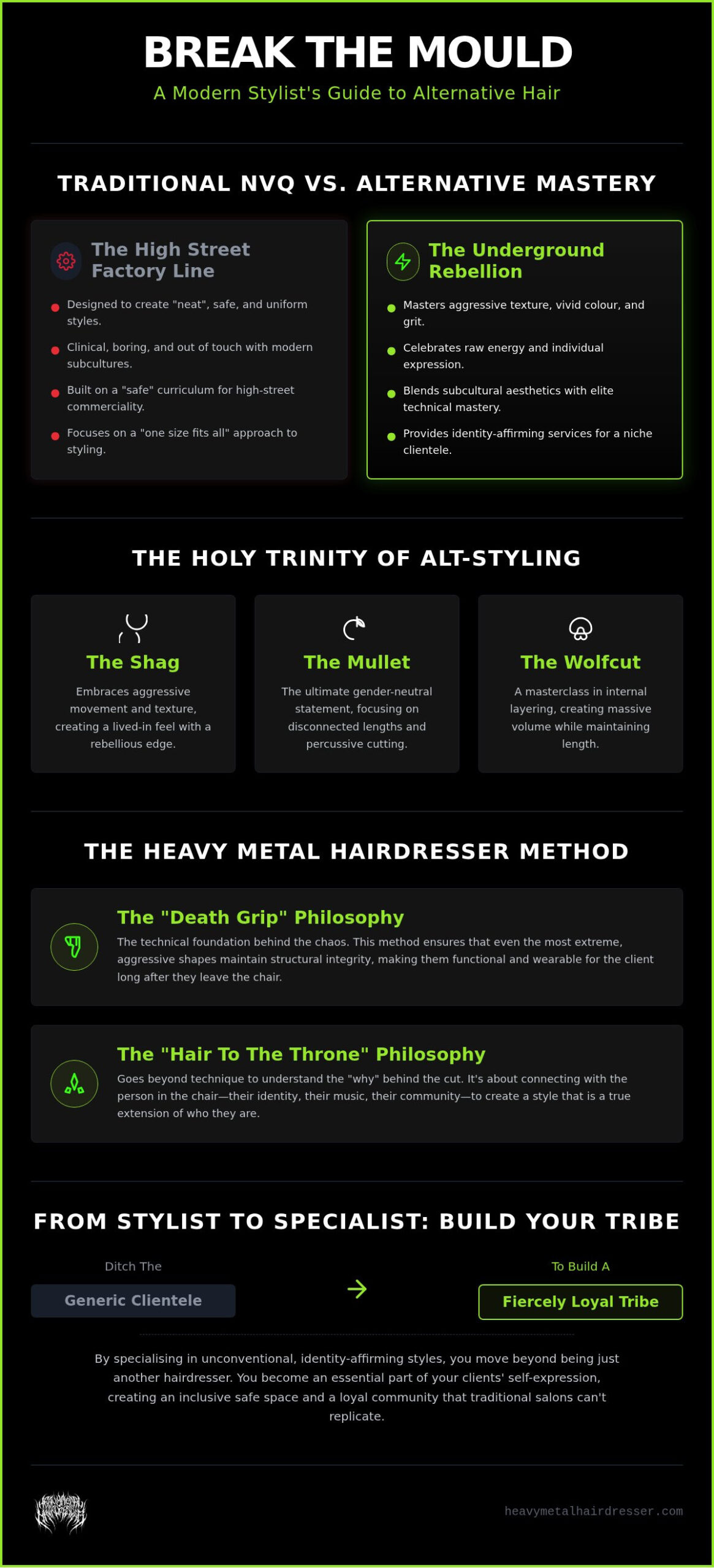
Most traditional hair NVQs are designed to turn you into a human factory line, churning out “neat” bobs and safe highlights that look exactly like everything else on the high street. It’s clinical, it’s boring, and it’s completely out of touch with the raw energy of the scene. If you’re searching for alternative hair courses UK, it’s because you’re tired of being told to “tidy up” those edges when your soul is screaming for more grit and less polish. You didn’t pick up a pair of shears to play it safe; you did it to create something that actually matters to the people who don’t fit the mainstream mould.

In this guide, we’ll show you how to master aggressive texture, vivid colour, and gender-neutral styling through the UK’s most rebellious professional training. You’ll learn how to dominate the wolfcut and the modern mullet while building a truly inclusive safe space for your niche clientele. We’ll preview the “Death Grip” and “Hair To the Throne” philosophies, giving you the technical precision needed to break the rules with confidence in 2026. It’s time to ditch the corporate fluff and start building a career that celebrates being different.

Key Takeaways

  • Master the percussive cutting techniques required to perfect the “Holy Trinity” of alt-hair: the shag, the mullet, and the wolfcut.
  • Understand why alternative hair courses UK are the future for stylists who value subcultural grit over clinical, “neat” NVQ standards.
  • Learn to implement the “Death Grip” and “Hair To the Throne” philosophies to deliver aggressive movement and gender-neutral results.
  • Discover how to attract your “tribe” and build a fiercely loyal client base by specialising in unconventional, high-pigment styles.
  • Gain insight into Simon Tuckwell’s 2026 training method, blending a raw underground aesthetic with elite technical mastery.

Redefining the Standard: Why Alternative Hair Courses in the UK are Surging

Alternative hair education is the precise intersection where underground subculture meets elite technical mastery. It isn’t just about being “messy” or “edgy” for the sake of it. It’s about understanding the architectural foundation of a cut and then knowing exactly how to break the rules to achieve a specific aesthetic. In 2026, the UK hair scene has shifted. The demand for raw, expressive styles has overtaken the desire for the clinical, “perfect” finishes of the past. Clients are no longer satisfied with a generic look. They want hair that mirrors their identity. This demand for specialist expertise that respects individual traits is seen everywhere, from alternative fashion to high-end pet care providers like H&H Dog, who focus on the specific needs and intelligence of each animal.

Traditional NVQ frameworks often fail the creative, non-conformist stylist. These programmes are built on a “safe” curriculum designed for high-street commerciality. They rarely provide the tools needed to navigate the aggressive texture and high-pigment world of alternative styling. Because of this, alternative hair courses UK have become the essential pathway for those who want to master the craft without losing their soul to corporate standards. Modern stylists need more than just a certificate; they need the ability to provide identity-affirming services that resonate with the pulse of the streets.

The Death of the “One Size Fits All” Salon

Subcultures like metal, punk, and goth are no longer confined to the shadows. They are actively influencing mainstream trends, but the execution remains niche. If you look at the history of punk fashion, you’ll see that hair has always been a primary tool for rebellion and self-identification. Modern clients are seeking specialists who understand this heritage. They aren’t looking for a generalist who might accidentally give them a “mum-shag” when they asked for a gritty, percussive mullet. This shift has fuelled the rise of the independent stylist identity across the UK. Stylists are now building loyal tribes by specialising in specific, identity-affirming looks that traditional salons simply can’t replicate.

Bridging the Gap Between Art and Industry

Alternative courses provide the missing link that traditional hairdressing education ignores. While a standard college course might teach you how to remove weight, it won’t teach you how to use that weight to create a silhouette that fits a specific subcultural vibe. It’s about the “why” behind the cut. You need to understand the person in your chair, their music, and their community. Alternative hair courses are professional training for unconventional aesthetics. By focusing on the intentionality of the style, these courses empower stylists to move beyond the chair and into the world of artistic expression.

Mastering Aggressive Texture: The Core Curriculum of Alt-Styling

To master alternative hair, you have to embrace the chaos of the “Holy Trinity”: the shag, the mullet, and the wolfcut. These aren’t just styles; they’re statements of rebellion. While standard UK hairdressing qualifications focus on the mechanics of a uniform, polished cut, our approach prioritises percussive cutting techniques. This involves a rhythmic, almost aggressive way of removing weight to create movement and grit that feels lived-in from the moment the client leaves the chair. It’s about building a shape that holds its own without needing a salon blow-dry every morning.

Structural integrity is the secret behind the “messy” aesthetic. Without a solid foundation, an alternative cut just looks like a mistake. We teach you how to maintain that balance by using the “Death Grip” texture philosophy. This method ensures that even the most extreme shapes remain functional and wearable. If you want to dive deeper into these techniques, our alternative hair courses UK provide the hands-on experience needed to bridge the gap between theory and the stage. It’s about giving you the confidence to hack into a silhouette while knowing exactly where the weight needs to live.

The Anatomy of the Modern Wolfcut

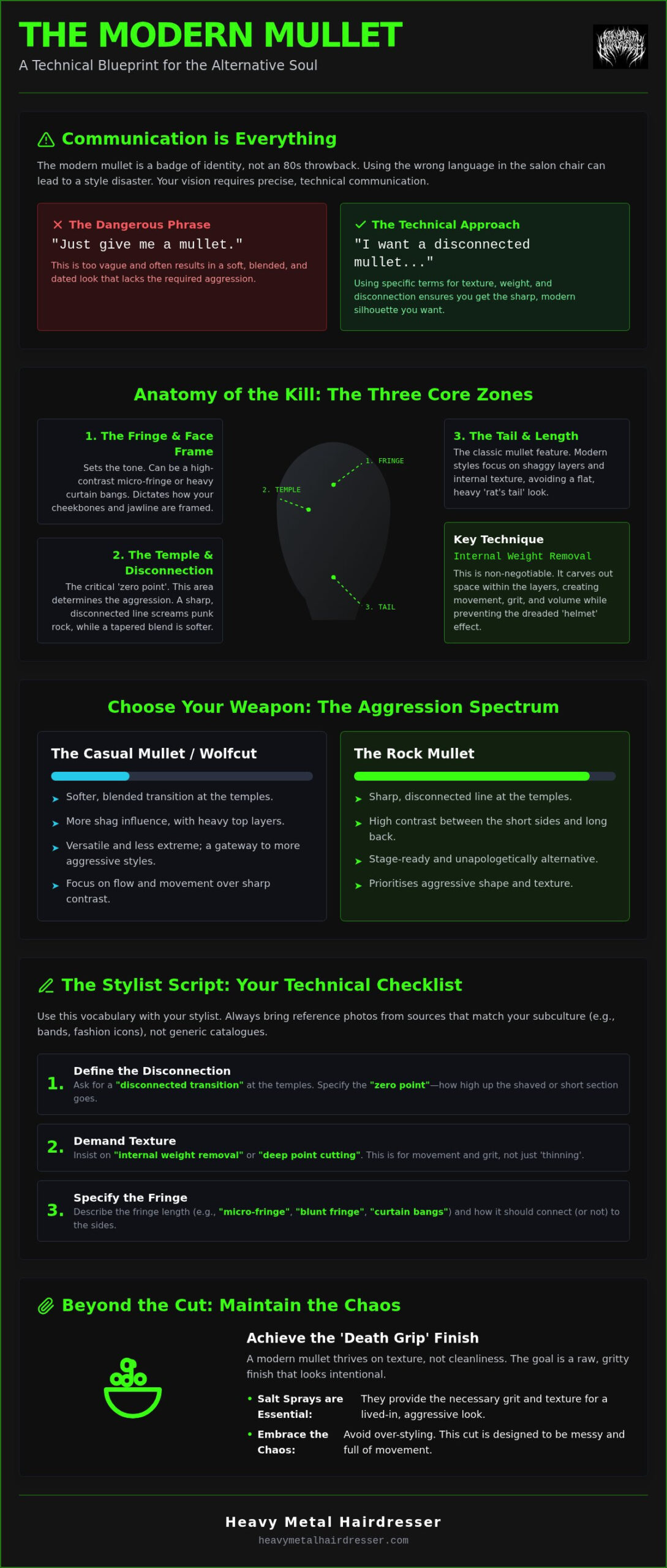
The wolfcut is a masterclass in internal layering. It’s the perfect solution for creating massive volume in fine hair without sacrificing the length at the back. We focus on adapting this cut for different face shapes, ensuring the edge remains sharp regardless of the canvas. Using a razor provides a soft, shattered finish that screams subculture, whilst scissor-thinning offers a more controlled, chunky texture. Knowing when to switch between these tools is what separates a professional from a hobbyist. You’ll learn to read the hair’s natural behaviour to decide which tool will deliver the most authentic result.

Vivid Colour Mastery: Beyond the Rainbow

Alternative hair isn’t complete without high-pigment, long-lasting colour. We move beyond simple “rainbow” hair to focus on saturation techniques that ensure longevity and depth. Subcultural looks like “peek-a-boo” panels and “split-dye” placements require strategic planning to avoid muddying during the rinse. It’s about pushing the boundaries of chemical lifting whilst fiercely protecting the hair’s health. You’ll learn how to achieve maximum impact with minimal damage—perhaps by utilising professional smoothing systems from Hair Bar NYC Professional—ensuring your clients can keep expressing their identity without compromising their hair’s integrity. Mastery in this area allows you to create bespoke shades that reflect a client’s specific musical or fashion tribe.

Traditional beauty schools often feel like clinical waiting rooms. They’re filled with beige walls and a heavy focus on passing tick-box assessments that prioritise speed over soul. If you’ve ever felt out of place in that environment, it’s because those courses aren’t designed for you. They’re designed for the mainstream. When you choose alternative hair courses UK, you’re stepping into a high-energy theatre of creativity where the playlist is just as vital as the technical theory. We swap the clinical atmosphere for subcultural grit, focusing on the raw energy that defines the underground scene.

The “vibe” isn’t just a buzzword; it’s a technical requirement. You can’t create an authentic subcultural statement if you don’t understand the culture itself. A standard high-street cut follows a rigid template. A subcultural statement, however, is a bespoke architectural build that respects the history of the wearer’s identity. It’s about knowing the difference between a soft, romantic shag and a jagged, aggressive mullet that feels like it belongs on a stage. You’re learning to translate music and attitude into hair. This level of expertise only comes from training that values the person in the chair as much as the technique used to style them.

Learning from the Pit: Backstage Festival Experience

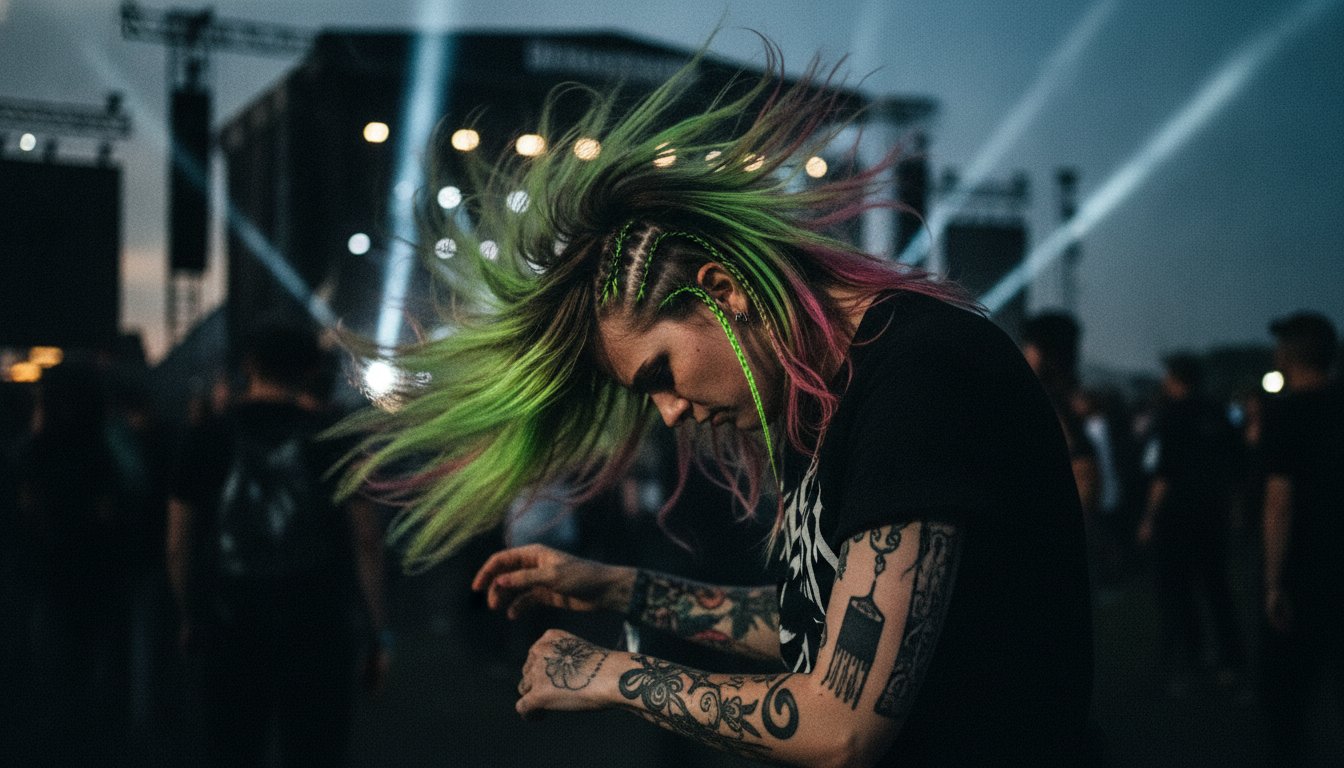
Styling for heavyweights like Download and Bloodstock festivals is a completely different beast compared to a standard Saturday morning in a salon. It’s fast, it’s loud, and the pressure is immense. Hair doesn’t just need to look good for a photo; it needs to survive a mosh pit and three days of camping. We bring this “mosh-pit survival” mentality into our training. You’ll learn how to create durable, high-impact looks that maintain their shape even under the most extreme conditions. This backstage experience is invaluable, teaching you the shortcuts and technical hacks that only the most seasoned alternative stylists know.

The Inclusive Safe Space as a Technical Skill

In 2026, being a great stylist means being an inclusive one. Gender-inclusive styling is the future of the UK hair industry, and it requires a specific technical approach. We don’t just talk about being “welcoming”; we teach the technical execution of gender-neutral consultations. This involves breaking down the traditional binary of “masculine” and “feminine” shapes to focus on what actually suits the client’s features and identity. Learning how to build a gender neutral hair salon environment is a core part of our curriculum. It’s about ensuring every client who walks through your door feels seen, safe, and celebrated for exactly who they are.
Alternative Hair Courses UK: Master Subculture Styling in 2026

Building a Portfolio with Identity: Practical Steps for Aspiring Stylists

Building a professional portfolio in the alternative scene isn’t about showing how well you can follow a manual. It’s about showing how effectively you can break it. Most traditional portfolios look like a sanitised catalogue from a local department store, but your “tribe” doesn’t shop there. To attract the non-conformists, your digital presence needs to bleed the same grit as the subcultures you serve. Authentic social media representation means posting the raw, percussive results of your work, not just the finished, polished product. Show the texture, show the movement, and show the personality of the human in your chair.

Specialising in the “Holy Trinity” of the shag, the mullet, and the wolfcut creates a level of client loyalty that generalist salons can’t touch. Clients seeking these looks are often used to being misunderstood by stylists who try to “tidy up” their edge. When you demonstrate that you understand the architectural weight of these styles, you stop being a service provider and become a trusted collaborator. Organise your professional development around your favourite subcultures. If you live for the energy of the pit, let that influence every cut you make. This focus makes you the go-to expert for a niche community that values authenticity above all else.

Branded merchandise also plays a massive role in building your personal brand. It isn’t just about selling t-shirts; it’s about creating a visual flag that signals your belonging to the community. When a client wears your gear, they’re endorsing your aesthetic and your values. It helps solidify your position as a rebellious expert who understands the nuances of the scene. If you’re ready to master these techniques and build your own brand, our professional hair courses provide the technical foundation you need to stand out.

Choosing the Right Course for Your Career Path

Not all alternative hair courses UK are created equal. You need to evaluate the content with a critical eye. Is the curriculum truly alternative, or is it just a commercial course with a “rock” label slapped on the front? Check the pedigree of the educators. You want to learn from people who actually live the subculture and work backstage at the festivals you attend. Look for training that offers hands-on “aggressive texture” modules. If they aren’t teaching you how to hack into a silhouette with technical precision, they aren’t giving you the tools you need for 2026.

Marketing Yourself to the Alternative Scene

When you describe your work, use the language of the scene. Incorporating the “Death Grip” and “Hair To the Throne” philosophies into your marketing shows that you have a technical system behind the chaos. It builds authority. Your portfolio should be a celebration of non-conformity, featuring diverse models and identity-affirming styles. You can even include shots of your kit and alternative hair merch UK to show your commitment to the aesthetic. This level of detail tells your future clients that you don’t just “do” alternative hair; you understand the soul of it.

The Heavy Metal Hairdresser Method: Professional Training for the Unconventional

Simon Tuckwell didn’t launch this movement to follow the latest high-street trends. He built it to destroy them. The vision for our alternative hair courses UK is rooted in the belief that elite technical precision and subcultural identity belong together. We’ve taken the raw, percussive energy of the festival circuit and distilled it into a professional training method. It’s about mastering the craft at the highest level whilst maintaining a fiercely independent edge. We don’t just teach you how to cut hair; we teach you how to command a silhouette.

Attending a Heavy Metal Hairdresser masterclass feels more like a backstage collaboration than a clinical lecture. You can expect grit, massive volume, and high-impact pigment that pushes the boundaries of traditional colour theory. We’re here to empower stylists to create gender-neutral safe spaces whilst delivering deadly, architectural cuts. This isn’t just about hair; it’s about building a community where being different is the standard. You’ll learn to navigate the nuances of the scene with the confidence of a rebellious expert who knows exactly when to break the rules.

The “Hair To the Throne” Education Philosophy

Our “Hair To the Throne” philosophy focuses on the crown as the structural anchor of every alternative style. We teach you how to manipulate internal weight to create shapes that defy gravity and convention. This hands-on training covers everything from the most aggressive shags to the most intricate, unconventional mullets. You get direct mentorship from stylists who actually work the pits at Bloodstock and Download. We focus on the “why” behind every section, ensuring you leave with the technical mastery to handle any hair type with a “Death Grip” on precision.

Join the Revolution: Booking Your Spot

Making the jump from a standard commercial stylist to an alternative specialist is the most empowering move you can make in 2026. Our upcoming course schedule is packed with intensive sessions designed to overhaul your technical approach and your creative mindset. We cover advanced saturation techniques for vivids and the percussive cutting methods that define the modern wolfcut. These sessions move fast and keep you engaged from the first clip to the final style. Don’t let your talent wither in a beige salon environment. It’s time to Master the art of subculture styling today and start attracting the tribe you were meant to serve.

Own the Future of Subculture Styling

The era of beige, one-size-fits-all hairdressing is dead. In 2026, the most successful stylists are those who refuse to play it safe. You’ve seen how mastering the “Holy Trinity” of the shag, mullet, and wolfcut can transform your career and attract a tribe that truly values your grit. By choosing alternative hair courses UK that prioritise technical precision over corporate fluff, you’re not just learning a skill; you’re joining a revolution.

We bring Red Dot level design to every cut and years of backstage festival expertise to our masterclasses. As gender-inclusive safe space pioneers, we’ll show you how to build a business that celebrates identity without compromise. It’s time to stop following the rules and start writing your own. Your creative edge is your greatest asset. Don’t let it go to waste. We’re ready to help you sharpen your shears and find your voice in the underground scene.

Master the craft of subculture styling with Heavy Metal Hairdresser

Frequently Asked Questions

Are alternative hair courses in the UK accredited for professional insurance?

Accreditation varies, but because the UK industry is currently unregulated, you don’t legally need a specific qualification to practice. Most professional insurers accept certificates of completion from established experts like Simon Tuckwell. Our training focuses on elite technical precision, providing you with the documented proof of competence needed to secure your policy. Always check with your specific provider to ensure your niche styling is fully covered.

Do I need previous hairdressing experience to attend an alternative hair course?

You generally need a solid grasp of the basics to get the most out of our specialist training. While some alternative hair courses UK offer introductory modules, our masterclasses focus on advanced percussive cutting and high-pigment saturation. If you already know how to handle your shears but want to ditch the boring high-street bobs for something grittier, you’re in the right place. We bridge the gap between basic skill and subcultural mastery.

What is the difference between a wolfcut and a modern shag in a professional context?

The difference lies in the architectural weight and the silhouette’s aggression. A modern shag is all about soft, lived-in layers and a balanced fringe that feels effortless. The wolfcut is the shag’s rebellious younger sibling, featuring much shorter, disconnected internal layers and a heavier, more dramatic mullet-style back. We teach you how to read the hair’s natural behaviour to decide which style best suits your client’s face shape and identity.

How long do these specialist hair courses usually last?

Duration depends on the intensity of the curriculum you choose. Short, high-energy masterclasses often last a single day, focusing on one specific technique like the “Death Grip” texture method. More comprehensive programmes can span several days or weeks, allowing for deep dives into vivid colour placement and backstage festival styling. We keep the rhythm fast and the content focused, ensuring you spend less time in a classroom and more time hacking into silhouettes.

Will I learn how to use vivid hair colours on dark hair?

Yes, mastering the chemical lift is a core part of our vivid colour training. You’ll learn how to push the boundaries of lightening whilst fiercely protecting the hair’s integrity. We focus on high-pigment saturation techniques that ensure neon and pastel shades pop against even the darkest natural bases. It’s about understanding the science of the lift to create the perfect canvas for subcultural looks like split-dyes and peek-a-boo panels.

Can I specialise in alternative hair as a mobile stylist in the UK?

Absolutely, specialising in a niche like alternative hair is a brilliant move for mobile stylists. By becoming the go-to expert for wolfcuts and mullets, you’ll build a loyal tribe that will wait for your specific expertise. You don’t need a static chair to deliver elite technical precision. Our alternative hair courses UK give you the confidence to provide identity-affirming services in any setting, from a client’s kitchen to a backstage festival tent.

What tools do I need to bring to an aggressive texture cutting course?

You’ll need your primary arsenal for creating grit and movement. This typically includes:

  • High-quality professional shears
  • A sharp cutting razor for shattered edges
  • Thinning or texturising scissors
  • Sectioning clips and a sturdy cutting comb

We focus on using these tools with percussive techniques to remove weight and build unconventional shapes. We provide the mannequins and the high-energy atmosphere; you just bring the steel and the attitude.

Is there a focus on gender-neutral styling in your training?

Inclusion is at the heart of everything we do. We don’t just mention gender-neutral styling; we treat it as a fundamental technical skill. You’ll learn how to conduct consultations that ignore the traditional binary, focusing instead on features and self-expression. Our “Hair To the Throne” philosophy ensures every cut is bespoke to the individual. We empower you to build a safe space where every client feels seen and celebrated for their unique identity.
Posted on

Metal Festival Hairstyles 2026: The Ultimate Mosh Pit Survival Guide

Metal Festival Hairstyles 2026: The Ultimate Mosh Pit Survival Guide

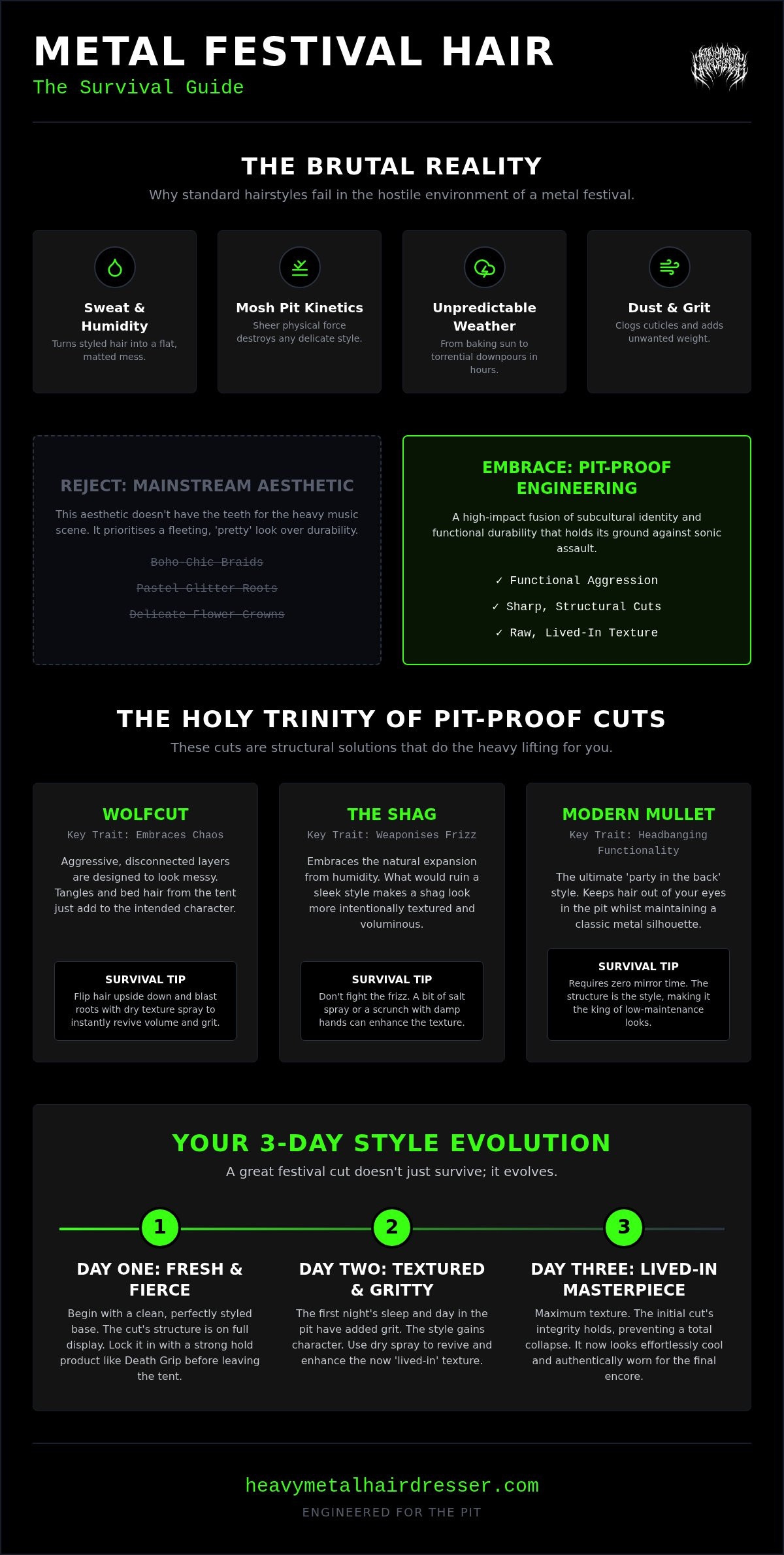
If you think your pristine, salon-fresh look is going to survive the first ten minutes of the main stage opener, you’re in for a rude awakening. Planning the perfect metal festival hairstyles isn’t just about the initial impact. It’s about structural survival. We’ve all been there. Waking up in a tent on day two with a matted bird’s nest where your vibrant wolfcut used to be. It’s frustrating when the sun bleaches your neon green and the humidity turns your texture into a flat, sad mess. You shouldn’t have to choose between looking like a legend and actually enjoying the music.

This guide shows you how to balance aggressive self-expression with structural survival so your hair looks killer from the first riff to the final encore. We’ll dive into mosh-pit-proof techniques, ways to keep your shags and wolfcuts textured without a mirror, and the secret to making those vivid colours last under the relentless festival sun. Whether you’re headbanging at Download or Bloodstock, it’s time to master the art of the structural shag and discover how tools like Death Grip keep your look stage-ready for three days straight.

Key Takeaways

  • Learn why metal festival hairstyles require a focus on structural integrity and “pit-proof” engineering rather than mainstream aesthetics.
  • Discover how wolfcuts and shags provide the aggressive texture and built-in volume needed to survive three days of camping and headbanging.
  • Master alternative braiding techniques and vivid colour protection to keep your look sharp and high-impact without fearing the fade.
  • Follow our 3-day survival roadmap to transition your hair from day one fresh to a gritty, intentional masterpiece by the final encore.
  • Gain insider secrets from our backstage experience at Download and Bloodstock to ensure your style remains stage-ready in the heart of the pit.

The Brutal Reality: Why Metal Festival Hairstyles Need More Than Just Glitter

Don’t bring your flower crowns to Donington or Catton Park. The environment at a heavy music event is hostile. Sweat, flying beer, and the sheer kinetic force of a mosh pit will destroy a basic blow-dry in minutes. Traditional metal festival hairstyles aren’t about looking “pretty” for a fleeting selfie. They’re about surviving the chaos. We define pit-proof hair as the intersection of aggressive self-expression and structural integrity. It’s a style that stays out of your eyes while you’re headbanging but still looks intentional when the final encore finishes. In this world, “perfect” hair is the enemy. If your look relies on every strand staying in place, you’ve already lost the battle against the decibels.

The Survival Equation: Sweat, Dust, and Decibels

The UK summer climate is famously unpredictable. You’ll likely deal with baking heat one hour and a torrential downpour the next. Traditional polished styles fail because they rely on stillness. At a festival, your hair is in constant motion. Dust from the site clogs your cuticles; sweat from the pit acts like a glue you didn’t ask for. You need a style that thrives on this grit. Choosing a look that ages well over seventy-two hours is essential. A great festival cut shouldn’t just look good on Friday morning. It needs to evolve into a textured, lived-in masterpiece by Sunday night. We focus on styles that embrace the mess rather than fighting it.

Rejecting the Mainstream Festival Aesthetic

We’re moving far beyond the boho-chic braids and pastel glitter roots seen at Glastonbury or Coachella. That aesthetic doesn’t have the teeth for the heavy music scene. The History of heavy metal fashion shows a long-standing preference for raw, darker, and more rebellious looks that mirror the music’s intensity. It’s about identity and belonging to a subculture that values substance over surface-level trends. We prioritise deeper tones, sharper angles, and functional aggression. Metal festival hair is a high-impact fusion of subcultural identity and functional durability that holds its ground against the sonic assault of the main stage. It’s a rejection of the “clean girl” aesthetic in favour of something authentic, underground, and undeniably loud.

The Holy Trinity of Alt-Cuts: Wolfcuts, Shags, and Mullets for the Pit

Forget the curling iron. You won’t find a plug socket near your tent anyway. When we talk about metal festival hairstyles, we’re talking about cuts that do the heavy lifting for you. The ultimate wolf hair cut is built for this environment. Its aggressive layers and disconnected length mean that “messy” is the intended look. If you wake up on Saturday morning with your hair looking like a disaster, a wolfcut just calls that “extra character.” These styles aren’t just aesthetic choices. They are structural solutions for three days of sonic assault.

Wolfcuts: Injecting Chaos into Every Strand

A wolfcut hides “festival bed hair” better than almost any other style. Because the layers are already chaotic, the tangles you pick up in the pit blend into the silhouette. To keep it from going flat after 48 hours of camping, carry a dry texture spray. Flip your head upside down, spray the roots, and use your fingers to “scrunch” the life back into it. This resets the volume without needing a drop of water. You can even use our Death Grip product to lock in that height before you head to the main stage. It’s about maintaining that aggressive texture whilst everyone else’s hair is going limp.

The Shag and the Modern Mullet: Low Maintenance, High Impact

The modern mullet haircut is the undisputed king of headbanging functionality. It keeps the hair out of your eyes whilst leaving enough length in the back to maintain that classic metal silhouette. It’s the ultimate “party in the back” look that doesn’t require a mirror to fix. Similarly, the shag haircut embraces natural frizz. In the humid crowd of a mid-afternoon set, your hair will expand. A shag makes that expansion look like intentional texture rather than a mistake. It thrives on the heat.

Fringe maintenance is the only tricky part. Without a mirror, your fringe can become a sweaty mess. Keep a small comb and some dry shampoo in your bum bag. A quick blast and a finger-comb will keep your vision clear for the next circle pit. These styles are about working with your hair’s natural behaviour under pressure. If you want a look that thrives on the noise, consider booking a professional alt-cut session before your next weekend in the mud. We specialise in creating shapes that look better the more you move.

Metal Festival Hairstyles 2026: The Ultimate Mosh Pit Survival Guide

Vivid Colour and Creative Braiding: Standing Out Amongst the Sea of Black

Metal festivals are a sea of black band tees. Breaking that monotony with vivid hair colour is the ultimate power move. Your hair becomes a beacon in the crowd. But the UK summer isn’t kind to high-pigment shades. Between the relentless UV exposure and the salt in your sweat, your neon green can turn to a muddy swamp by day three. You need a strategy that goes beyond hope. Temporary flair like coloured hair extensions or hair tinsels can add a flash of rebellion without the long-term commitment. If you’re battling root regrowth, don’t hide it. Use it. Creative styling or heavy accessories can turn “neglect” into an intentional, grittier aesthetic that fits the scene.

Protecting Your Pigment in the Pit

UV rays are the primary enemy of alternative shades. They break down the chemical bonds of your dye. Sweat is a close second. It’s acidic. It opens the hair cuticle and lets that expensive pigment wash right out. To stop the fade, pack a UV-protection spray and plenty of dry shampoo to avoid water-based washing in the campsite showers. A professional vivid application before the festival season is your best defence. We saturate the hair to ensure there’s enough depth to survive the onslaught. It’s about building a foundation that lasts longer than the headliner’s set. Metal festival hairstyles need this high-pigment resilience to stay sharp until the final encore.

Aggressive Braiding: Beyond the French Braid

Braiding for alternative looks isn’t about looking “pretty.” It’s about structural armour. Tight, scalp-focused Viking braids or undercut braids provide a harder edge and genuine protection. They keep your hair locked down during the most intense mosh pits. You won’t have to worry about your hair getting caught in someone else’s studs or zips. It’s functional durability with a subcultural bite.

Enhance the look by incorporating rings, chains, or charms directly into the weave. It adds a metallic weight that feels right at home at Bloodstock. If you want to keep the hair off your face entirely, create a braided faux-hawk. It’s a high-impact silhouette that stays sharp regardless of how much you move. This is hair that works as hard as you do. It’s about maintaining your identity whilst everyone else is losing theirs in the mud. Don’t settle for mainstream braids when you can have something that actually belongs on the main stage.

Maintaining your identity often goes beyond styling choices to the permanent art you carry; to learn more about Krets Tattoo and their professional advice on keeping your ink sharp in the pit, exploring their guide is a great way to prepare whilst planning your festival look.

Survival Tactics: How to Keep Your Style Sharp Through Three Days of Chaos

Your hair’s journey over a weekend is an evolution. Day 1 is the peak. It’s salon-fresh, sharp, and ready for the first circle pit. By Day 2, the sweat and dust have settled in. This is where most people panic. Don’t. Day 3 is the “Gritty Masterpiece” phase. It’s when your metal festival hairstyles look most authentic. The goal is to manage that descent into chaos so you look like a rockstar, not a swamp creature. You’re aiming for a look that thrives on the grime of the campsite whilst maintaining its core shape.

Dry shampoo is often a trap for the alternative community. It can leave a chalky residue that looks like dandruff against dark hair or leather jackets. Alternative hair often needs “grip” rather than “clean”. You want to maintain the architecture of your cut. Using textured styling products allows you to rebuild height and definition without needing a shower. It’s about adding grit to the right places to keep the layers from collapsing under the weight of the humidity.

Pit-Proofing Your Style: A Professional Guide

Securing your look for the pit requires a tactical approach. First, identify the “kill zone”. This is the hair at the nape of your neck most prone to matting against your jacket studs or bag straps. Section this off and braid it tightly if possible to prevent a giant knot. Second, apply “Death Grip” products to your structural points. Focus on the roots and the mid-lengths where you need the most lift. Finally, perform the “headbang test”. If your hair hits your face or obscures your vision too much, pin it back. Your style should move with you, not against you.

The Festival Toolkit: What Every Alt-Stylist Packs

Your campsite bag needs a few non-negotiables. These essentials ensure your metal festival hairstyles remain legendary from Friday noon to Monday morning. We recommend packing:

  • Silk scrunchies: These won’t snap your hair when you’re trying to untangle a three-day knot.
  • Wide-tooth combs: The only tool for removing dust without destroying your natural texture.
  • UV protection spray: Essential for keeping your vivid colours from turning into a dull mess.

A bandana is the ultimate emergency tool. If your style completely collapses mid-set, wrap it up. It hides the mess whilst looking like a deliberate style choice. It’s about being prepared for the moment the rain hits or the pit gets too intense. If you’re ready to engineer a look that survives the main stage, grab our professional styling gear to master the art of the mosh-pit-proof cut.

Backstage Expertise: Why Heavy Metal Hairdresser is Your Festival Style Partner

Our authority on metal festival hairstyles isn’t theoretical. It was forged in the heat of the UK’s most legendary stages. We’ve spent years working backstage at festivals like Download and Bloodstock. We know what it takes for a band’s look to survive a headline set under punishing lights and pyrotechnics. That same technical expertise goes into every cut we perform for the fans. Your hair is more than just an accessory. It’s a badge of identity. It’s a way to signal your place in the subculture whilst ensuring you don’t spend the entire weekend worrying about a mirror.

We are a gender-inclusive safe space where being different is the standard. We reject the clinical feel of mainstream salons. Our space is built for the rebels and the innovators. Beyond the chair, we’re also training the next generation of stylists. Our alternative hair courses teach professional standards in texture, grit, and high-impact colour. We want to ensure that the underground scene always has access to experts who understand our aesthetic.

From the Stage to the Pit: Professional Standards

Styling for the heavy music community requires a unique technical vocabulary. We fuse traditional barbering with creative, avant-garde styling to create gender-neutral looks that work for everyone. Our stylists understand the physics of headbanging. We know how a wolfcut behaves when it’s drenched in sweat. We know exactly where to apply Death Grip to keep a mohawk standing until the final encore. Our commitment is to celebrate your individuality through bold, unapologetic hair that refuses to blend in.

Join the Rebellion: Book Your Festival Refresh

A pre-festival cut and colour is your best investment for the summer. It’s about setting the foundation for the chaos to come. When you consult with our specialists, we don’t just talk about trends. We help you find your unique festival “weapon”. Whether it’s a structural shag that thrives on grit or a high-pigment vivid that stands out in the crowd, we engineer it for longevity. Don’t leave your look to chance. Prepare for the pit with the people who actually live and breathe this culture. Book your alternative styling session today and ensure your hair is ready for the noise.

Own the Main Stage: Secure Your Festival Identity

Your hair shouldn’t be the thing that stops you from hitting the pit. We’ve shown you that the best metal festival hairstyles are built on structural integrity and intentional texture rather than fleeting perfection. Whether you’re rocking a wolfcut that thrives on grit or aggressive Viking braids that lock your identity down, the secret is professional engineering. You need a look that ages into a masterpiece across the weekend. It’s about choosing a style that works with the chaos instead of fighting it.

As specialists in wolfcuts, shags, and mullets, we understand the specific physics of headbanging. Our experience styling bands backstage at Download and Bloodstock means we know exactly how to make your style stage-ready. We provide a gender-inclusive safe space for alternative souls who refuse to conform to mainstream beauty standards. Don’t wait until you’re in the mud to realise your style isn’t up to the task. Book your festival-ready alternative cut and colour at Heavy Metal Hairdresser today. Let’s build a look that survives the final encore and looks killer in every photo. See you in the pit.

Frequently Asked Questions

How do I prevent my hair from matting in a mosh pit?

Sectioning and braiding the hair at the nape of your neck is the most effective way to prevent matting. This area is where hair rubs against bag straps and jacket studs. Use a high-hold product like Death Grip to keep strands slick and secure. If you have long hair, consider a high ponytail to keep it above the friction line.

What are the best hairstyles for long hair at a metal festival?

Braided styles like Dutch braids or “Viking” scalp braids are the best metal festival hairstyles for long hair. They offer maximum security during headbanging and won’t get caught in other people’s gear. If you prefer keeping it down, ensure you have a layered cut like a shag. This allows for natural movement and prevents the hair from becoming a heavy, unmanageable weight.

How can I keep my wolfcut looking textured without washing it?

Use a dry texture spray or salt spray to reactivate the layers in your wolfcut. Flip your head upside down and scrunch the product into the mid-lengths to restore the aggressive volume. Avoid heavy oils that weigh the hair down in the heat. A quick blast of dry shampoo at the roots can soak up excess sweat whilst keeping that signature gritty silhouette intact.

Can I wear vivid hair colour to a dusty festival without it ruining?

Yes, but you must protect the pigment from UV rays and acidic sweat. Use a dedicated UV-protection spray every morning before heading to the arena. Dust adds a matte texture that can look cool, but it can also make colour look dull. Avoid washing your hair in campsite showers. Instead, use professional colour-safe dry products to maintain that high-pigment impact until you get home.

Are braids appropriate for a heavy metal aesthetic?

Absolutely, provided they are styled with an aggressive edge rather than a boho vibe. Focus on tight, scalp-focused braids or “undercut” styles that mimic a shaved side. You can weave in metallic rings, charms, or even small chains to align the look with heavy metal street-wear. Braids are functional armour for the pit, keeping your hair out of your face whilst maintaining a fierce silhouette.

What should I pack in my hair survival kit for a three-day festival?

Your kit should include a wide-tooth comb, silk scrunchies, UV-protection spray, and a high-hold texture product. Pack a bandana for emergency “Day 3” fixes when the grit becomes unmanageable. These essentials ensure your metal festival hairstyles remain stage-ready even when you’re living in a tent. Focus on multi-use products that provide grip without needing water or a plug socket.

How do I refresh my fringe when camping at a festival?

Refresh your fringe by using a small amount of dry shampoo and a fine-tooth comb. Spray the product onto the comb first rather than directly onto your forehead to avoid skin irritation. Work it through the roots to lift the hair away from your face. If it’s too greasy to save, use pins to create a small quiff or tuck it into a bandana.

What is the best way to protect my hair from UV damage at an outdoor gig?

Applying a professional UV-shielding spray is the most effective defence against sun damage. The sun’s rays act like bleach, breaking down both natural and vivid pigments whilst making the hair brittle. If you’re spending all day at the main stage, consider wearing a headscarf during the peak afternoon hours. This physical barrier prevents the scalp from burning and keeps your hair’s structural integrity intact.

Posted on

Modern 70s Shag Haircut: Aggressive Layers and Subcultural Grit

Modern 70s Shag Haircut: Aggressive Layers and Subcultural Grit

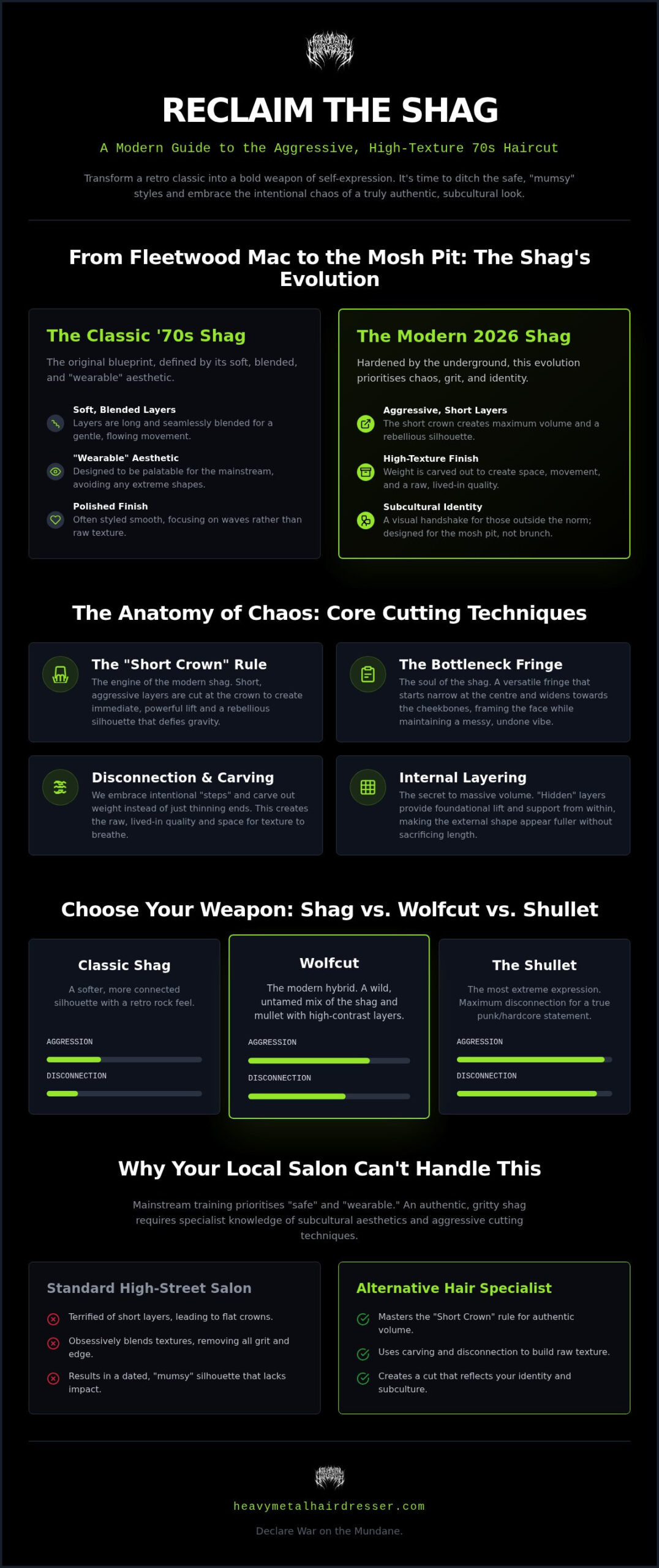
A haircut isn’t just a style choice. It is a declaration of war against the mundane. For too long, the traditional hair industry has neutered the most rebellious looks in history, turning subcultural anthems into soft, “mumsy” shadows of their former selves. You don’t want a polite trim that disappears into the crowd. You want a 70s shag haircut modern enough to bite, defined by aggressive layers and an unapologetic edge that refuses to blend in.

We know the frustration of walking out of a standard salon looking far too polished and losing your identity in the process. It is time to reclaim the grit. In this guide, you will discover how to transform a retro classic into a bold weapon of self-expression with high-impact texture and alternative styling. We are breaking down the technical secrets of the cut, the essential products like Death Grip to keep your layers sharp, and how to find a specialist who actually understands your subculture. Prepare to ditch the volume struggles and embrace the chaos of a truly authentic look.

Key Takeaways

  • Learn how the 70s shag haircut modern movement has evolved from soft retro waves into a high-texture, aggressive statement for 2026.
  • Master the “Short Crown” rule and bottleneck fringe techniques to ensure your layers provide maximum volume and subcultural edge.
  • Compare the nuances of classic shags, wolfcuts, and the “shullet” to find the exact silhouette that mirrors your personal style.
  • Get to grips with professional “rough dry” techniques and foundational products like Hair To the Throne to maintain volume at home.
  • Understand why specialist alternative hair training is the key to avoiding “mumsy” results and achieving a truly gritty, textured finish.

From Stevie Nicks to the Pit: The Evolution of the 70s Shag

The shag isn’t a museum piece. It’s a living, breathing creature. Whilst the icons of the 70s gave us the blueprint, the 70s shag haircut modern version has evolved into something much more aggressive. It’s defined by a high-texture finish and multi-layered depth. The engine of this cut is the short crown. This isn’t about looking like you’ve just stepped off a Fleetwood Mac album cover; it’s about subcultural grit. Modern shags are built to be lived in. They thrive on the friction of everyday life.

We’ve moved past the “louche 70s” aesthetic of velvet and bell-bottoms. By 2026, the shag has been hardened by the underground. Heavy metal and alternative scenes kept this silhouette alive when the mainstream forgot it. It prioritises chaos over polish. It’s about movement that looks better the more you sweat. This evolution isn’t just about fashion; it’s about identity. The cut serves as a visual handshake for those who live outside the norm.

Why Traditional “Wearable” Shags Often Miss the Mark

Mainstream salons love the word “wearable.” Usually, that’s code for “boring” or “safe.” They are terrified of short layers. They give you soft, blended textures that go flat by lunchtime. An alternative soul needs a cut that survives a mosh pit, not just a brunch date. Without that aggressive weight removal and those short, choppy crown layers, you’re left with a dated, “mumsy” silhouette that lacks any real punch. A real shag needs to be hacked into, not politely trimmed. It requires a level of technical bravery that most high-street stylists simply haven’t been taught.

The 2026 Shift: Aggressive Texture and Identity

The modern landscape has embraced the shag as a gender-neutral staple. It is a tool for self-expression that transcends old-school beauty standards. Much of this recent energy comes from the rise of the wolf hair cut, which injected even more “wildness” into the classic shag structure. Finding a 70s shag haircut modern enough for your aesthetic means looking beyond the high street. To get it right, you need a stylist who speaks your language. Mainstream training doesn’t cover this level of technical aggression. Choosing someone who understands subcultural aesthetics ensures your hair looks like a choice, not an accident. This is where a specialist alternative hair course comes in. It equips stylists with the tools to create hair that actually belongs on a stage or in the pit.

The Anatomy of Chaos: Defining Modern Shag Layers

The 70s shag haircut modern aesthetic lives or dies by the crown. In traditional salons, stylists are taught to keep layers long and “safe” to avoid overwhelming the client. We do the opposite. The “Short Crown” rule is our engine. By cutting short, aggressive layers at the top of the head, we create immediate lift and a silhouette that screams attitude. It’s not about being messy for the sake of it. It’s about intentional structural chaos.

Disconnection is another weapon in our arsenal. Whilst mainstream hairdressing obsessively blends every line, we embrace intentional “steps.” These slight breaks in the transition from short to long layers provide the grit needed for a subcultural look. It gives the hair a lived-in, raw quality that survives the day without falling flat. We don’t just thin the hair; we remove weight through carving. This technique creates space for movement, allowing the texture to breathe rather than just looking ragged at the ends.

The Fringe: The Soul of the Shag

The fringe is where your identity sits. You can opt for heavy, lash-grazing 70s bangs for a classic rock feel or a modern bottleneck fringe for something more versatile. A bottleneck fringe starts narrow at the centre and widens towards the cheekbones, creating a frame that highlights your features whilst maintaining that messy, undone vibe. The key is the blend. We carve the fringe so it flows seamlessly into the side layers, ensuring there are no awkward gaps. We adjust the depth based on your forehead height to make sure the weight sits exactly where it needs to.

Internal Layering vs. External Shape

True texture comes from what you can’t see. Internal layering involves “hidden” layers that provide foundational lift without sacrificing your overall length. This is how we achieve that massive, airy volume on fine hair. Instead of standard point cutting, we use a carving technique to sculpt the hair. This method creates deeper channels of texture. To truly make these layers pop, many of our clients integrate vivid hair colour. High-pigment tones like deep violets or toxic greens highlight the depth of the cut, making every layer visible. If you’re ready to ditch the flat, suburban look, booking one of our specialist Shag Haircuts is the first step toward reclaiming your edge.

Modern 70s Shag Haircut: Aggressive Layers and Subcultural Grit

Choosing Your Weapon: Classic Shag vs. Modern Wolfcut Hybrid

Picking your silhouette is a tactical decision. The 70s shag haircut modern revival offers a spectrum of aggression. On one end, you have the classic Stevie Nicks aesthetic. It’s iconic, featuring heavy fringe and face-framing layers that feel louche and rock-and-roll. On the other end, we have the hybrids. The “Shullet” (shag-mullet) is the choice for those who want to lean into an aggressive nape length whilst keeping the choppy top layers of a shag. It’s a high-impact look that demands attention and refuses to play by the rules.

Your hair type dictates the technical approach. Thicker manes require significant weight removal to prevent the hair from looking like a helmet. We carve into the bulk to create channels of movement. Fine hair, however, needs a structural foundation. We use short crown layers to build height, ensuring the hair doesn’t collapse under its own weight. Whether you want a “Bob-Shag” that hits the jaw or a waist-length alternative mane, the goal is always the same: maximum texture with zero compromise.

The Wolfcut Hybrid: For Maximum Aggression

The wolf hair cut is the shag’s wilder, more textured cousin. This hybrid approach is perfect if you want a “rockstar” finish that feels raw and unfiltered. It takes the volume of a shag and mixes it with the disconnected, wispy ends of a mullet. To keep the look sharp, you need to understand how to maintain the modern mullet haircut elements within the shag structure. It’s about keeping the back long and shredded whilst the top stays chaotic and high-volume. This isn’t just a haircut; it’s an anthem of rebellion.

Texture Matching: Straight, Wavy, or Curly?

The shag is the ultimate cut for natural waves. It organises the chaos, allowing your natural bend to sit perfectly without looking messy in a bad way. For those with straight hair, the challenge is managing “the fluff.” You need the right products to add grit and stop the layers from looking too soft. Curly shags are a game-changer for avoiding the dreaded “triangle” shape. By layering internally, we distribute the volume evenly, letting your curls stack vertically rather than bunching out at the sides. It creates a balanced, rebellious silhouette that celebrates your natural texture instead of fighting it.

Styling the Grit: Maintaining Volume and Texture at Home

Your new cut is only as good as your styling routine. A 70s shag haircut modern silhouette requires more than just a quick air dry. If you leave it to nature, it will go flat. You need to embrace the “Rough Dry” technique. Heat is your friend. Flip your head upside down. Use a hairdryer with a nozzle and blast the roots against the grain. This creates the vertical lift that defines the style. It is about building a shape that looks chaotic but feels structurally solid. You aren’t just drying hair; you are engineering volume.

Foundational volume is non-negotiable. We use Hair To the Throne to prime the hair before the heat hits it. It provides the skeletal support needed to keep those short crown layers from collapsing. Once the hair is dry, you need to define the ends. This is where Death Grip comes in. It creates that “piecey,” aggressive texture that separates a subcultural shag from a standard trim. Don’t be afraid of the “Second-Day” rule. Shags often look their best after a night in the pit. The natural oils and a bit of movement add a level of grit that fresh products can’t always replicate. It is a style that develops character over time.

The Volume Foundation: Prep and Prime

Mainstream conditioners are often the enemy of a gritty shag. They are frequently too heavy and slick. They coat the hair in silicone, weighing down the layers and killing the volume. If you must use conditioner, keep it strictly on the very ends of the hair. Your roots need to stay thirsty for volume boosters. Applying textured styling products whilst the hair is damp creates a foundation for the entire look. It ensures your hair stays high whilst you are moving through your day. This priming stage is what prevents the “flat-top” look that ruins a good shag.

Defining the Layers: The “Death Grip” Method

To get that aggressive finish, you need to work with the individual layers. Take a small amount of Death Grip. Warm it between your palms until it is pliable. Use your fingers to “pinch” and twist the ends of your layers. This creates sharp definition and prevents the hair from looking like a solid, untextured block. It is about creating separation. If your layers go flat between washes, don’t panic. A quick blast of heat and a fresh pinch of product will revive the shape in seconds. You can grab your own Death Grip and styling essentials directly from our shop to keep your grit alive at home.

Why Your Local Salon Can’t Handle This Level of Texture

Most high-street salons are factories for the mundane. They see a 70s shag haircut modern request and immediately try to “soften” it. They are trained in symmetry and traditional beauty standards, which are the natural enemies of subcultural grit. When you want aggressive layers and a disconnected silhouette, you cannot rely on someone who spends their day doing “wearable” bobs. You need a specialist who understands that your hair is an extension of your identity, not just a service on a price list. We don’t do “polite” hair. We do hair that makes a statement.

This technical gap is real. Standard hairdressing qualifications rarely touch on the carving and weight removal techniques required for alternative styles. It is why a specialist alternative hair course is so vital for the modern stylist. It equips them with the technical bravery to hack into the hair and create the movement that defines our scene. We don’t just cut hair; we build silhouettes that survive the chaos of your life. Whether you are in the front row or on the stage, your hair needs to hold its ground.

The Specialist Edge: Understanding the Aesthetic

You should never have to explain what a wolfcut is to your stylist. You shouldn’t have to justify why you want your crown layers short and choppy. At Heavy Metal Hairdresser, we speak your language. Our consultations aren’t about what is “flattering” by mainstream standards; they are about what makes you feel like yourself. We have spent years bridging the gap between music and hair, styling bands at festivals like Download and Bloodstock. We know how hair needs to behave when you are moving. We respect your subcultural identity because we live it too. It is about a shared understanding of the aesthetic.

Beyond the Cut: Joining the Community

Walking into a salon should feel like stepping into a backstage festival vibe, not a clinical waiting room. We have built a gender-inclusive safe space where being different is the baseline. By choosing an independent business that celebrates individuality, you are supporting a community that refuses to be diluted. It is time to reclaim your edge and stop settling for “mumsy” layers. You can book your 70s shag haircut modern transformation by securing one of our Shag Haircuts or checking for our latest Guest Spots. Don’t let a standard salon neuter your style. Let’s create something that actually represents who you are.

Reclaim Your Identity with Aggressive Texture

Your hair is the loudest thing about you. It shouldn’t be neutered by a stylist who doesn’t get it. We’ve broken down why the 70s shag haircut modern aesthetic demands technical aggression, from those vital short crowns to the intentional chaos of disconnected layers. You now have the tools to maintain that gritty texture at home using products like Death Grip and the knowledge to choose a silhouette that actually mirrors your identity. Whether you lean into a wolfcut hybrid or a classic rock-and-roll shag, the goal is always the same: zero compromise on your subcultural edge.

We aren’t just high-street hairdressers. We are specialists in alternative texture who have styled the stages of Download and Bloodstock festivals. Our salon is a gender-inclusive safe space built for the rebels, the outsiders, and anyone who refuses to blend in. Stop settling for “wearable” and start wearing a weapon of self-expression that survives the pit and the everyday grind.

Book your aggressive shag transformation at Heavy Metal Hairdresser. It’s time to reclaim your edge and join a community that celebrates exactly who you are. Your transformation starts here.

Frequently Asked Questions

Is a 70s shag haircut high maintenance?

No, a shag is actually one of the most low-maintenance styles for alternative identities. It is designed to be lived-in and thrives on movement rather than perfection. Unlike blunt cuts that look unkempt as they grow, the aggressive layering in a shag evolves into new, intentional shapes over time. It is a cut built for survival, looking better the more it is “messed up” by your daily life.

Can I have a shag haircut if I have very fine hair?

Yes, a 70s shag haircut modern style is the ultimate solution for fine hair that lacks volume. By cutting short, technical layers into the crown, we remove the weight that usually pulls fine hair flat. This creates foundational lift and makes your hair appear significantly thicker. It transforms limp strands into a high-impact, textured silhouette that holds its shape without collapsing.

What is the difference between a shag and a wolfcut?

The main difference lies in the level of disconnection and the silhouette. A shag is a multi-layered cut that focuses on volume and texture throughout the entire head for a cohesive, messy look. A wolfcut is a hybrid that mixes shag layers with the longer, wispy nape of a mullet. Wolfcuts often feature more dramatic “steps” between layers, whereas a shag maintains a more consistent, albeit chaotic, flow.

How often should I get my shag haircut trimmed?

You should get your shag trimmed every 8 to 12 weeks to maintain the structural integrity of the layers. Whilst the cut grows out better than most, the short crown layers eventually lose their lift as they gain length and weight. A quick tidy-up ensures the internal weight removal stays effective and your fringe doesn’t become unmanageable. It keeps the grit sharp and the volume high.

Do I need to style my shag every day to make it look good?

You don’t need to perform a full styling routine every morning. Most shags look their best on day two or three when the natural texture has settled. A quick refresh with a hairdryer at the roots or a small pinch of product on the ends is usually enough to revive the shape. It is a “get up and go” style that celebrates bedhead chaos rather than polished perfection.

Will a shag haircut work with a round face shape?

Absolutely, a shag is incredibly adaptable for round face shapes. We use face-framing layers and bottleneck fringes to create vertical lines that elongate the appearance of the face. By adding height and volume at the crown, we shift the visual focus upwards. It is a highly customisable cut that we adjust to highlight your features whilst maintaining its unapologetic, subcultural edge.

What products are best for a gritty, textured shag finish?

For a truly gritty finish, you need products that add friction and skeletal support. Start with a volume primer like Hair To the Throne to build a foundation whilst the hair is damp. Once dry, use a technical wax or clay like Death Grip to “pinch” and define the ends of your layers. Avoid heavy oils or silicones, as these will flatten the texture and make the cut look greasy rather than gritty.

Posted on

Queer Friendly Hairdresser: Finding a Safe Space for Identity-Affirming Style in 2026

Queer Friendly Hairdresser: Finding a Safe Space for Identity-Affirming Style in 2026

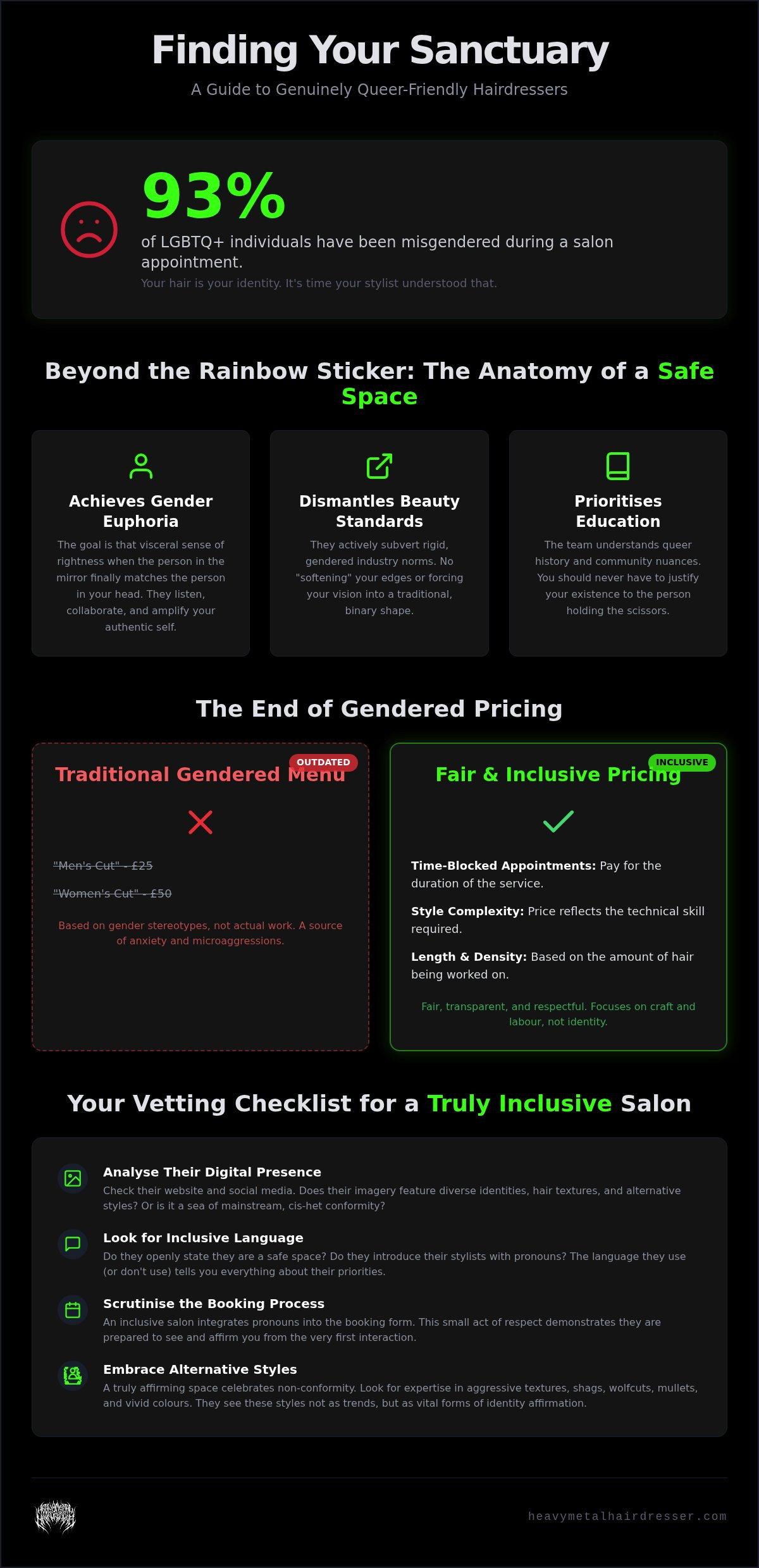
Did you know that a staggering 93% of LGBTQ+ individuals have been misgendered during a salon appointment? It is a gut-punch of a statistic that confirms what many of us feel the moment we step into a clinical, traditional shop. You are likely searching for a queer friendly hairdresser because you are tired of the “correction” talk. You have sat in that chair, heart racing, whilst a stylist tries to “soften” your sharp edges or force your non-conformist vision into a gendered box. You deserve more than a “feminised” mullet or a “masculine” buzz cut. You deserve gender euphoria.

We agree that your hair is the ultimate expression of your identity, and it is time your stylist understood that too. This guide helps you discover a truly inclusive sanctuary that celebrates your soul through raw, rebellious, and expert alternative styling. We will explore how to find salons that ditch gendered pricing, specialise in aggressive textures like shags and wolfcuts, and prioritise your authentic self over outdated industry norms. From understanding the impact of the CROWN Act to identifying genuine safe spaces, we are mapping out the future of identity-affirming style in 2026.

Key Takeaways

  • Identify the markers of a genuine queer friendly hairdresser who dismantles traditional beauty standards rather than just tolerating them.
  • Ditch the anxiety of “Men’s” or “Women’s” menus by learning how time-based, gender-neutral pricing creates a fairer experience.
  • Master the art of the subcultural silhouette with expert insights into how wolfcuts and shags provide a versatile, androgynous edge.
  • Use our vetting checklist to screen a salon’s digital presence and booking behaviour for genuine inclusivity and pronoun awareness.
  • Transform your look into a source of gender euphoria by choosing a sanctuary that prioritises your authentic self over clinical perfection.

Beyond the Rainbow Sticker: What a Queer Friendly Hairdresser Actually Does

A rainbow sticker in a shop window is a nice gesture, but it isn’t a badge of expertise. A genuine queer friendly hairdresser does not just tolerate your presence; they actively affirm your identity through every stage of the service. This means dismantling the rigid, gendered beauty standards that have dominated the industry for decades. It is about recognising that hair is often the most vital external manifestation of one’s gender identity. When a stylist understands this, the goal shifts from a standard trim to achieving gender euphoria.

Gender euphoria is that visceral sense of rightness. It is the moment the person in the mirror finally matches the person in your head. Reaching that state requires a stylist who treats the consultation as a collaborative, non-judgmental dialogue. They don’t lecture; they listen. They don’t try to mould your vision to fit a traditional, binary shape. They use their technical skill to amplify your authentic self, ensuring the cut feels like a homecoming rather than a compromise.

The Anatomy of a Safe Space Salon

Safety starts before you even reach the chair. An inclusive salon integrates pronouns into the booking process to ensure you are never misgendered. This small act of respect lowers the baseline anxiety that many trans and non-binary individuals feel in service environments. Beyond the booking, staff education is paramount. A safe space requires a team that understands queer history and the specific nuances of our community. They know the difference between a “bad” cut and an intentional, identity-affirming choice. It is about creating an environment where you don’t have to explain or justify your existence to the person holding the scissors.

Subverting the Traditional Salon Experience

Many traditional salons feel clinical, overly polished, or intimidatingly “high-fashion.” These spaces often feel exclusionary to those who live outside the mainstream. We believe in a different energy. There is a powerful overlap between alternative aesthetics, like heavy metal and punk, and queer safe spaces. Both cultures value rebellion and individuality. A queer friendly hairdresser in an alternative setting understands “coded” hairstyles. They recognise the subcultural weight of a specific crop or a particular texture. They won’t try to “soften” your look to make it more palatable for a traditional audience. They embrace the grit, the aggression, and the non-conformity that makes your style yours.

The End of Gendered Pricing: Why Inclusive Salons Are Changing the Game

The “Men’s Cut” and “Women’s Cut” labels are relics of a binary past. They don’t reflect the actual work; they reflect a stereotype. For a trans or non-binary person, the checkout counter can be a source of intense anxiety. Being charged based on a gender you don’t inhabit is more than just a financial sting. It’s a microaggression. A queer friendly hairdresser knows that your identity shouldn’t dictate your bill. Inclusive salons are burning these outdated menus. By adopting time-based or complexity-based pricing, we ensure the focus remains on the craft. This shift is essential to empower LGBTQ+ communities by removing the financial barriers to authentic self-expression.

Inclusive pricing reflects the actual labour and skill involved in a transformation. It ensures that every client is treated with the same respect, regardless of where they sit on the gender spectrum. It’s about fairness. It’s about valuing the stylist’s time and the client’s vision equally.

This ethos of fairness and transparent cost-mapping is becoming a standard in the wider beauty world; for example, salons like fingerSPA demonstrate this by providing clear price guides that help clients plan their self-care routines with confidence.

Complexity vs. Gender: A Fairer Model

Traditional pricing assumes women have long, complex hair and men have short, simple hair. That is total rubbish. A precision queer friendly hairdresser understands that technical wolf hair cuts require more skill than a basic trim. Pricing should reflect that reality. Most inclusive salons now use three main criteria:

  • Time-blocked appointments: You pay for the duration of the service. This allows for detailed consultations and precision work.
  • Style complexity: A full transformation is priced differently than a maintenance fringe trim.
  • Hair length: Short, medium, or long hair determines the amount of product used and the time needed for drying.

This model provides total transparency. You know exactly what you will pay before you sit in the chair. No surprises. No gendered “tax” at the end of your session.

Why Traditional Salons Struggle to Adapt

The UK hairdressing education system has long been split into “Barbering” and “Hairdressing.” This legacy makes it hard for many high-street stylists to pivot. They are taught to see hair through a binary lens from day one. Binary pricing reinforces harmful stereotypes about hair maintenance and social roles. It is a stubborn habit that needs to break. We encourage you to ask about pricing models before you book. If a salon still uses “Men’s” and “Women’s” labels, they might not be the safe space you need. If you want to see how we handle things, you can explore our gender-neutral services and see the difference for yourself.

Queer Friendly Hairdresser: Finding a Safe Space for Identity-Affirming Style in 2026

Alternative Style as Identity Affirmation: Wolfcuts, Mullets, and Queer Expression

Hair is a battleground for self-expression. For the queer community, “outsider” styles aren’t just fleeting trends; they are survival tools. They signal subcultural belonging. They reclaim space in a world that often demands conformity. A queer friendly hairdresser understands that a haircut is a manifesto. It is the difference between looking like everyone else and finally looking like yourself. These styles allow you to take ownership of your narrative before you even speak a word.

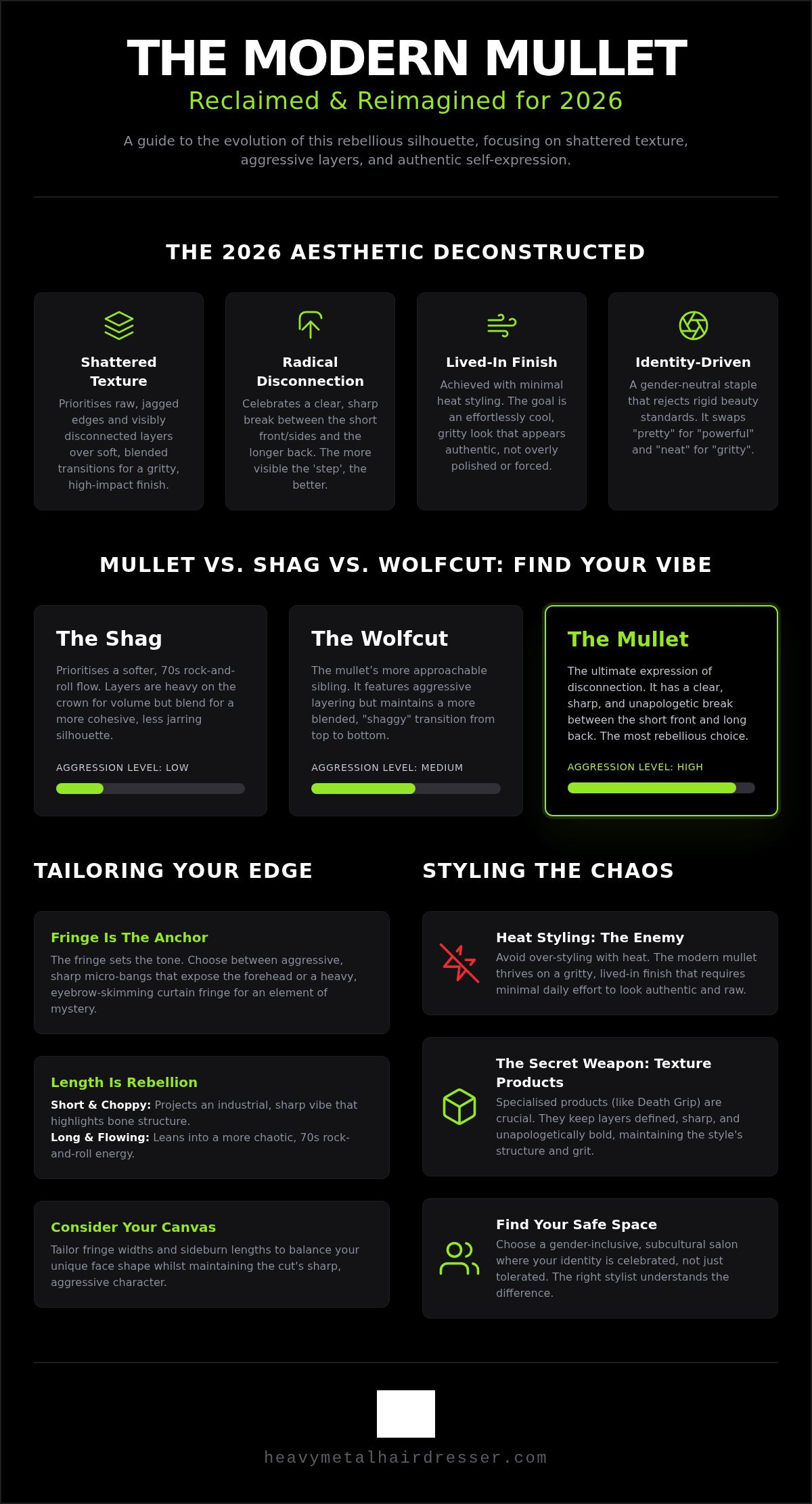
The Modern Mullet has become a queer staple for a reason. It is the ultimate act of rebellion. It refuses to play by the rules of “pretty” or “professional.” It is raw. It is gritty. It is unapologetic. When you wear a mullet, you aren’t just getting a trim; you are announcing your presence. It’s a silhouette that defies the binary, offering a shape that feels both aggressive and soft at the same time.

The Power of the Wolfcut and Shag

Aggressive layers and heavy texture are the building blocks of an androgynous silhouette. Technical wolf hair cuts provide a versatile frame that can be tailored to soften or sharpen your features. It is about using hair to match your internal gender expression. The shag haircut is another high-impact, low-maintenance weapon in the queer style arsenal. It works for all hair types because it embraces chaos over clinical perfection.

You need a specialist for these styles. Traditional stylists often try to “fix” the layers, making them too neat or symmetrical. They don’t get the “ugly-cool” aesthetic. A queer friendly hairdresser knows that the beauty is in the mess. They understand how to use a razor to create that lived-in, subcultural grit that defines the alternative scene. They prioritise the vibe over the rulebook.

Vivid Colour: Saturating Your Identity

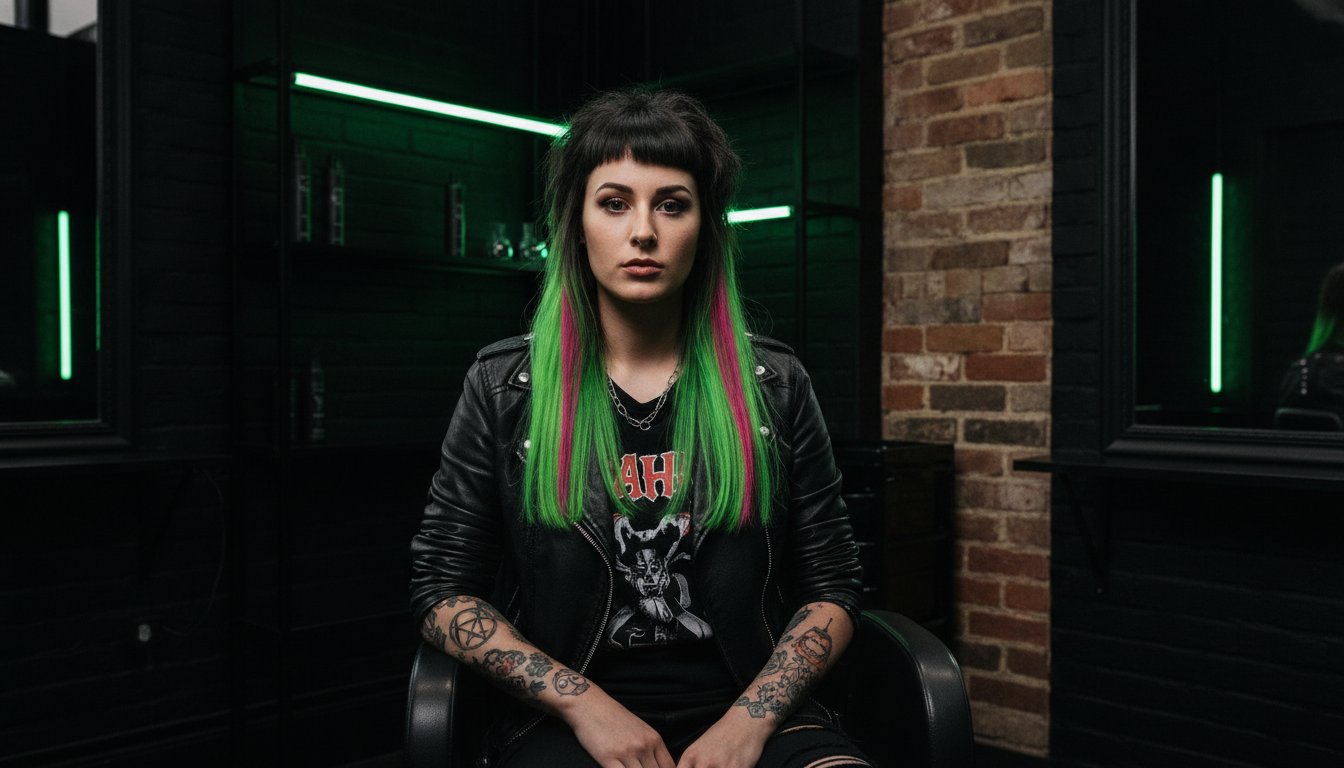
Colour is a flag. Using vivid hair colour is a way to reclaim your image from the mundane. Whether it is a neon green buzz cut or deep purple shag layers, high-pigment work signals that you aren’t here to blend in. It is about taking total control of how the world sees you. It turns your hair into a canvas for your identity.

This work is technically demanding. High-pigment saturation requires a specialist who understands the chemistry of alternative dyes. You can’t just slap on some box dye and hope for the best. A professional ensures your hair stays healthy whilst achieving maximum vibrance. They prioritise hair health because your identity shouldn’t come at the cost of your hair’s integrity. It is about long-term maintenance and keeping that saturation sharp amongst the daily grind.

How to Vet Your Next Salon: A Checklist for Safe and Inclusive Haircare

Finding a queer friendly hairdresser shouldn’t feel like a high-stakes gamble. You are looking for a sanctuary, not just a trim. The search starts long before you step through the door. It begins with digital sleuthing to separate the genuine allies from those just chasing the “pink pound.” You need to see evidence of their values in their work and their systems. If a salon claims to be inclusive but their Instagram grid is a sea of traditional, heteronormative bridal hair, that’s a disconnect. Look for a diverse range of gender expressions. If you don’t see someone who looks like you in their portfolio, they might not have the technical or cultural understanding to bring your vision to life.

Your research should extend to the booking behaviour. A truly inclusive space integrates respect into its infrastructure. Check if their booking system asks for pronouns or offers gender-neutral service options based on time and complexity. These details aren’t just “nice to have.” They are the foundations of a low-anxiety environment. Reading reviews from other queer and alternative clients is also vital. Look for mentions of the atmosphere. Did they feel seen? Was their identity respected? A stylist’s response to these reviews tells you everything you need to know about their salon culture.

Red Flags to Watch Out For

Trust your gut. If you see these signs, it is likely that the salon hasn’t done the work to be a safe space:

  • Binary pricing: “Men’s” and “Women’s” prices displayed prominently on the window or website.
  • Traditional portfolios: A total lack of alternative or gender-non-conforming styles in their gallery.
  • Dismissive behaviour: Stylists who seem confused, awkward, or dismissive when you ask about their gender-affirming practices.

Green Flags: Signs of a Genuine Safe Space

A genuine queer friendly hairdresser makes their stance clear. Look for explicit inclusive language in their “About” or “FAQ” sections. They should be proud of their commitment. Another massive green flag is a team that specialises in subcultural, non-binary cuts like the modern mullet. This shows they understand the link between hair and identity. They should also demonstrate a visible commitment to the community, whether through queer-owned business practices or supporting local LGBTQ+ events. If you are ready to ditch the traditional salon stress, you can book your next session at our inclusive alternative salon and experience the difference for yourself.

Heavy Metal Hairdresser: A National Safe Space for Alternative Identities

Heavy Metal Hairdresser is not your typical high-street shop. It is a rebellion against the clinical, “polished” world of traditional beauty. Founded by Simon Tuckwell, this is a sanctuary built specifically for those who live outside the mainstream. It is a place where being different is the standard, not the exception. As a queer friendly hairdresser, we don’t just offer a service; we offer a homecoming. We have stripped away the pretension of the traditional salon experience to create a raw, high-energy environment where your identity is the priority.

Our commitment to gender-inclusive styling is woven into everything we do. We don’t see hair through a binary lens. We see it as a canvas for self-expression. Whether you are looking for aggressive texture or a complete colour overhaul, we provide a space where you can be your authentic self without explanation. This is a destination for the outsiders, the rebels, and everyone who has ever felt out of place in a standard stylist’s chair.

Expertise Born from Subculture

Simon Tuckwell’s background in music and alternative styling is the heartbeat of this salon. Our team has spent years immersed in the energy of festival culture, working backstage at legendary events like Download and Bloodstock. This experience informs our rebellious ethos. We don’t just understand alternative style; we live it. The intersection of heavy metal grit and queer inclusivity is where we thrive. It is a shared language of non-conformity and pride.

Clients travel from across the UK to visit us because we offer a unique perspective they can’t find elsewhere. We specialise in the technical “chaos” of wolfcuts and shags, styles that require a deep understanding of subcultural nuances. We know that your hair is a signal to your community. We respect that weight. We use our expertise to ensure that signal is loud, clear, and perfectly aligned with who you are.

Book Your Identity-Affirming Transformation

Your first visit to Heavy Metal Hairdresser is a collaborative process. We ditch the outdated power dynamic of the “expert” and the client. Instead, we have a direct dialogue. We want to know what makes you feel like yourself. We discuss the technical details of how aggressive layers or high-pigment saturation can match your internal gender expression. There is no judgment here. There is only a shared goal of achieving gender euphoria through expert craft.

The result is a cut that fits your soul. We prioritise your comfort and your vision at every step, ensuring the environment remains low-anxiety and high-impact. It is time to stop settling for stylists who try to “soften” your edges or fit you into a box. It is time to embrace a style that is as bold and independent as you are. Join the rebellion and book your inclusive hair session today.

Reclaim Your Identity in the Chair

You have seen that finding a genuine queer friendly hairdresser is about more than just a safe space; it is about finding an expert who respects your vision and your budget. We have moved past the era of gendered pricing and clinical, exclusionary vibes. It is time to embrace the aggressive textures and subcultural grit that reflect your true self. Whether it is a precision wolfcut, a textured shag, or a rebellious modern mullet, your hair should be a source of euphoria, not anxiety. You deserve a stylist who understands that your look is a manifesto.

Ditch the traditional salon stress. We have built a national destination where gender-neutral pricing is the standard and identity-affirming style is the goal. We specialise in the “chaos” of alternative cuts that high-street shops simply don’t get. Stop settling for “traditional” and join a community that celebrates your non-conformity. Secure your spot at the UK’s premier alternative safe space. Your identity is valid. Your style is yours to define. We are ready when you are.

Frequently Asked Questions

What exactly is a queer-friendly hairdresser?

A queer-friendly hairdresser is a stylist who actively affirms LGBTQ+ identities through their language, pricing, and technical skills. It goes beyond mere tolerance; it is about creating a space where your gender expression is understood and celebrated. They understand the nuances of identity-affirming styles and ensure you aren’t forced into a traditional, binary box. This professional prioritises your comfort and uses their expertise to help you achieve gender euphoria.

Why is gender-neutral pricing important in a hair salon?

Gender-neutral pricing ensures that clients are charged based on the time, skill, and hair length involved rather than their gender identity. Traditional “Men’s” and “Women’s” menus are discriminatory and often force trans or non-binary individuals to choose a label that doesn’t fit. By removing these binary categories, a queer friendly hairdresser creates a fairer, more transparent environment that values the stylist’s labour and the client’s authentic self equally.

How do I know if a salon is actually a safe space for trans people?

Look for concrete signs like pronoun inclusion in booking systems and explicit anti-discrimination policies on their website. A genuine safe space often showcases a diverse range of gender expressions in their portfolio rather than just heteronormative styles. Check reviews from other trans and non-binary clients to gauge the atmosphere. If the salon uses gender-neutral pricing and has staff educated in queer history, it is a strong indicator of a supportive environment.

Can I get a wolfcut or mullet at a traditional hairdresser?

You can ask, but traditional stylists often lack the technical understanding of aggressive, subcultural textures. They might try to “fix” or “soften” the layers to make them more palatable for a mainstream audience. A specialist queer friendly hairdresser understands the “ugly-cool” aesthetic and uses razors or precision shears to create the grit and movement these styles require. It is always better to choose a stylist who lives the alternative subculture.

What should I look for in a stylist’s portfolio if I’m non-binary?

Seek out a portfolio that features androgynous silhouettes, sharp crops, and non-conformist textures. You want to see that the stylist can navigate the space between traditional “masculine” and “feminine” aesthetics without defaulting to binary tropes. Look for examples of wolfcuts, shags, or buzz cuts with creative patterns. If their gallery shows a broad spectrum of gender expression, they likely have the technical range to respect your specific identity-affirming goals.

Do queer-friendly salons only do ‘alternative’ styles?

No, they cater to all styles, but they do so with an inclusive mindset. Whilst many specialise in rebellious aesthetics like punk or grunge, their primary mission is identity affirmation. Whether you want a simple trim or a high-pigment saturation, the focus remains on your comfort and respect. The difference is the environment; you won’t be judged or misgendered, regardless of whether your style is unconventional or more understated.

How do I explain my gender-affirming hair goals to a new stylist?

Use specific reference photos that reflect your desired silhouette and be clear about how you want the cut to make you feel. Instead of using gendered terms, describe the texture, length, and shape you want. A good stylist will lead a collaborative consultation to understand your vision. Don’t be afraid to state your pronouns and explain why certain features are important for your gender euphoria. Clear communication ensures your hair matches your soul.

Is it okay to ask a hairdresser about their inclusivity policies before booking?

It is absolutely encouraged to ask about a salon’s policies to ensure your safety and comfort. A professional, inclusive business will welcome these questions and be happy to explain their approach to gender-neutral pricing, pronoun use, and staff training. If a shop seems dismissive or confused by your enquiry, it is a sign they might not be the right fit. Your hair journey should always start in a place of mutual respect.

Posted on

Vivid Hair Colour Specialist Nottingham: The Alt-Hair Destination Guide

Vivid Hair Colour Specialist Nottingham: The Alt-Hair Destination Guide

Your hair isn’t a temporary fashion experiment; it’s a subcultural manifesto that traditional, clinical salons simply aren’t equipped to handle. Most stylists treat neon pigments as a novelty, leaving you with fading shades and a cut that misses the mark on your aesthetic. You’ve likely felt the sting of paying for a transformation only to see your identity wash down the drain within a week. It is time to stop settling for stylists who don’t understand the difference between a standard trim and a precision wolfcut.

Finding a vivid hair colour specialist who actually respects your alternative roots shouldn’t be an impossible task. You deserve a space where your style is celebrated and your colour stays saturated for more than two washes. This guide will show you how to achieve high-impact results that last. We will cover the essential chemistry of alternative pigments, the importance of technical texture, and how to maintain your look long after you leave the chair. Discover how to protect your hair investment and find a community that truly gets your vibe.

Key Takeaways

  • Learn why high-impact pigment requires technical mastery of chemistry rather than a basic high-street foil service.
  • Discover how a vivid hair colour specialist Nottingham uses low and slow bleaching to keep hair healthy for maximum saturation.
  • Identify the dangers of DIY kits and why professional expertise is vital to avoid chemical damage or patchy results.
  • Master the cold water rule and maintenance secrets to keep your alternative aesthetic fresh through every gig.
  • Find out why a gender-inclusive and music-influenced salon is the key to having your subcultural identity truly respected.

Defining the Vivid Hair Colour Specialist in Nottingham and Beyond

Vivid hair colour isn’t just about picking a bright shade from a swatch book. It is a technical discipline that requires a deep understanding of both chemical mastery and subcultural identity. While a traditional high-street salon might excel at standard “foil and tint” services, they often lack the grit and specialist knowledge required for high-impact neon or deep jewel tones. A true vivid hair colour specialist Nottingham understands that these pigments don’t behave like standard browns or blondes. They require a stylist who merges technical expertise with an appreciation for the “alt” aesthetic.

This isn’t a service you find on every street corner. It is a destination. People travel from across the UK to find a stylist who speaks their language and respects their vision. They want someone who knows that a shock of electric blue is a manifesto of who they are, not just a seasonal trend. We treat every appointment as a collaboration, ensuring your hair reflects your internal world without compromise.

The Chemistry of Creative Pigment

Vivid dyes work differently than the oxidative colours used in mainstream salons. Standard dyes use a chemical reaction to penetrate the hair shaft, but creative pigments require a more nuanced approach. Vivid hair colour is a non-oxidative pigment process. These pigments act more like a stain, sitting on the outer layers of the hair. This makes the “canvas” preparation absolutely crucial for the final result.

Achieving that perfect neon green or soft pastel lilac depends entirely on the pre-lightening stage. You cannot just slap dye over dark hair and expect it to pop. A vivid hair colour specialist Nottingham manages the bleaching process with extreme care. We ensure the hair is light enough to show the pigment whilst protecting its structural integrity. It is a precise balancing act of chemistry and patience.

Why “Specialist” Matters for Alternative Styles

Integrity is everything. Pushing the boundaries of saturation shouldn’t mean sacrificing the health of your hair. Beyond the technical, the consultation is a safe space where your identity is celebrated. We don’t judge the “weird” or the “unconventional.” This is a space where being different is the standard, and your stylist acts as a knowledgeable guide through your transformation.

Saturating Your Identity: The Technical Mastery of Creative Colour

High-impact colour isn’t an accident. It’s the result of a calculated, technical process that begins long before the pigment touches your hair. To get those neon yellows and deep magentas to actually stay, you need more than just a bottle of dye. You need a vivid hair colour specialist Nottingham who understands the intricate relationship between hair porosity and pigment suspension. This is where the science of subculture meets the art of the alternative.

The foundation of every great vivid service is the pre-lightening stage. We advocate for a “low and slow” bleaching method. Blasting your hair with high-volume peroxide might get you to a pale blonde quickly, but it leaves the cuticle shredded. When the cuticle is blown wide open, your expensive vivid colour will simply wash out in two days. By lifting the hair gently, we maintain the hair’s “grip,” allowing the direct dyes to anchor themselves properly. Unlike permanent oxidative dyes, vivids are non-damaging pigments that live or die by the quality of the canvas beneath them.

Achieving Maximum Saturation

Saturation is about more than just slapping on a lot of product. It requires strategic sectioning, especially when working with heavily textured styles like Shag Haircuts or Wolfcuts. We use specific techniques to ensure even distribution across every layer. If you’re looking for multi-tonal effects like colour melting, prism hair, or split dyes, precision is everything. We prevent “muddying” by understanding how different shades interact on the colour wheel. You don’t want your electric blue bleeding into your sunset orange and creating a murky grey. If you’re looking to level up your own skills, our Hair Courses dive deep into these advanced application methods.

Maintaining Hair Integrity Amongst the Chaos

Pushing your hair to a level 10 blonde for a pastel transformation is a risk. We mitigate that risk with advanced bond-building treatments that work at a molecular level. These treatments repair the disulphide bonds broken during the lightening process, ensuring your hair feels like hair, not straw. A specialist always prioritises the long-term health of your mane. During your consultation, we’ll be honest about what’s possible. If your hair has years of black box dye, we won’t promise a neon mint green in one session. We’ll build a roadmap that gets you to your goal without your hair ending up on the floor. It’s about expressive colour without the compromise of chemical burns or breakage.

Vivid Hair Colour Specialist Nottingham: The Alt-Hair Destination Guide

Professional Vivids vs DIY Disasters: Why Expertise Matters

The temptation of a ten pound box of bleach and a tub of chemist-bought dye is real. We get it. But there is a massive gap between a bathroom floor DIY job and the precision work of a vivid hair colour specialist Nottingham. High-street bleach kits are usually “one size fits all” chemicals with aggressive volumes of peroxide. They don’t account for your hair’s history, previous dye layers, or current structural integrity. This lack of control leads to uneven lifting, patchy “leopard” spots, and in the worst cases, chemical burns that can permanently damage your scalp and follicles.

Professionals use high-grade pigments with superior suspension technology. These outlast high-street alternatives because they are designed for maximum saturation without the cheap fillers found in budget brands. When we handle “bleach over bleach” scenarios, we use protective barriers and low-strength developers to lift the hair without snapping the protein bonds. It’s a precise operation that requires a steady hand and a deep understanding of hair structure. We aren’t just applying colour; we are managing a chemical process to keep your hair on your head.

The Risk of Home Bleaching

One of the most common DIY fails is the “hot roots” phenomenon. The heat from your scalp causes the bleach to process significantly faster at the base, leaving you with glowing yellow roots and muddy, dark ends. Achieving complex placements like split dyes or prism effects is nearly impossible when you can’t see the back of your own head. You end up with a blurred mess instead of the sharp, intentional lines of an alt-aesthetic. Professional vivids are an investment in hair longevity.

Corrective Colour: When DIY Goes Wrong

If the damage is already done, we step in with corrective expertise. Removing stubborn home dyes like box-black or “staining” pigments like forest green requires a surgical approach. We use specialised removers that target synthetic pigment without destroying the natural hair fibre. Neutralising a botched blue or green requires a master’s knowledge of the colour wheel to avoid a murky, grey result. At Heavy Metal Hairdresser, we don’t judge the DIY attempt; we just focus on the recovery. We use advanced bond-builders to stabilise the hair whilst we work to get your subcultural identity back on track with the saturation you originally wanted.

Preparing for Your Transformation: Maintenance and Mosh Pits

Walking into the salon is only half the battle. To ensure your pigment stays as aggressive as your playlist, you need a solid game plan. Arrive at your session with hair that’s clean but not freshly washed that morning. Avoid heavy waxes or styling goop. We need to see your natural texture and base colour without the interference of product buildup. As a vivid hair colour specialist Nottingham, we’ve seen how poor prep can slow down the lightening process. Bring your reference photos, but be prepared for an honest conversation about what’s achievable in one sitting.

Once you leave the chair, the cold water rule becomes your new religion. Heat is the primary enemy of creative pigment. Hot water swells the hair cuticle, allowing those expensive direct dyes to simply rinse away. It’s painful, but washing with cold water is the only way to keep your neon shades from turning into muddy pastels. Use sulfate-free cleansers. Sulfates are harsh detergents that strip colour faster than a mosh pit strips your dignity. If you’re heading to a festival like Download or Bloodstock, pack a hat. UV rays act like a low-level bleach, fading your saturation before the headliner even takes the stage. Rinse out sweat and grime immediately after a set to stop salt from dehydrating your strands.

The Survival Guide for Saturated Strands

Preservation is about washing frequency. Aim for once or twice a week at most. Dry shampoo is your best friend here. It absorbs the grit and oil without disturbing the pigment. When you do wash, use a pigment-depositing conditioner to top up the vibrancy. This is especially vital for high-maintenance shades like silver or peach. If you’ve paired your colour with a bold shape, check out our guide on how to maintain a shag haircut to keep the layers looking sharp between appointments.

Styling for Maximum Impact

Vivid colour thrives on texture. Flat, sleek hair often hides the depth of a multi-tonal melt. Use sea salt sprays or matte clays to break up the surface and let the light hit different pigments. Be careful with heat tools. Straighteners and curlers can literally cook the colour out of your hair if the temperature is too high. Always use a professional heat protector and keep the settings low. You can find our recommended textured styling products in our gear guide to ensure your finish has that essential subcultural edge.

Your hair is a statement. Treat it like one. If you’re ready to ditch the boring browns and embrace the noise, secure your spot with a vivid hair colour specialist Nottingham today.

Heavy Metal Hairdresser: Expressive Colour Without Compromise

Heavy Metal Hairdresser isn’t just a salon; it’s a sanctuary for the unconventional. Simon Tuckwell founded this space to bridge the gap between high-end technical mastery and raw, subcultural grit. We’ve built a national destination for those who refuse to settle for the clinical, judgmental atmosphere of traditional high-street shops. Here, your aesthetic is understood without you having to explain it. If you’ve been searching for a vivid hair colour specialist Nottingham that actually understands the weight of a heavy metal influence, you’ve found your tribe. We don’t just follow trends. We define them for the outcasts and the innovators who live outside the mainstream.

Our connection to the music scene runs deep. Our stylists are regularly found backstage at festivals like Download and Bloodstock, working with the bands and crews who keep the alternative scene alive. This insider knowledge allows us to merge high-impact pigments with precision Wolfcuts and textured Shag Haircuts. We create cohesive, aggressive looks that stand out in any crowd. It’s about more than just dye; it’s about a technical subcultural statement that merges grit with chemistry. We encourage our clients to travel for this expertise because your identity deserves a specialist who truly “gets” it.

More Than Just a Haircut

We operate as a gender-inclusive safe space where every identity is celebrated rather than merely tolerated. Traditional beauty industry jargon and gendered price lists have no place here. Our services are inclusive and gender-neutral as a standard. We believe your hair should reflect your internal world, not a corporate box. Being amongst like-minded alternative souls creates a community atmosphere that you won’t find in a standard salon. We provide a space where being different is the norm, and our technical proficiency ensures your hair stays healthy whilst pushing the boundaries of saturation.

For those looking to document their alternative identity during a wedding, finding a creative who understands your vibe is essential. Twig & Vine Photography specialises in capturing these moments with a unique edge; learn more about their hybrid approach to photography and film.

Booking Your Vivid Revolution

Starting your transformation requires a collaborative, methodical approach. We prioritise your safety and hair health above all else, which is why a patch test is a non-negotiable part of our process. We want to see your vision, so bring your mood boards of alternative inspiration. Whether it’s digital art, subcultural icons, or music video aesthetics, we’ll translate that energy into a technical reality. This is an investment in your self-expression. Don’t leave your identity in the hands of someone who doesn’t share your passion. It’s time to stop compromising on your aesthetic and start your evolution. Book your vivid hair colour specialist session and secure your spot in the chair.

Ignite Your Subcultural Transformation

Your hair is the loudest part of your identity; don’t let it be silenced by a clinical salon that doesn’t understand your roots. We’ve explored how technical mastery of pre-lightening and the “cold water” rule are the only ways to ensure your pigment survives the pit. Choosing a vivid hair colour specialist Nottingham means choosing a stylist who merges chemical precision with a deep respect for the alternative scene. You aren’t just a client; you are part of a community that values saturated expression above all else.

As official stylists for festivals like Download and Bloodstock, we live and breathe the same music you do. We specialise in the intersection of aggressive wolfcuts and neon pigments, providing a gender-inclusive safe space where your vision is the blueprint. It’s time to stop settling for patchy home jobs and fading high-street tints. Your evolution starts with a specialist who understands the grit behind the glamour. Join the revolution and book your vivid colour session today. Let’s create something unapologetic.

Frequently Asked Questions

How long does vivid hair colour usually last?

Expect your vibrancy to hold for approximately 4 to 8 weeks depending on the specific shade and your aftercare routine. Pastels and silver tones sit on the shorter end of that scale, whilst deep purples and blues have more staying power. Using professional-grade, sulfate-free products is the only way to ensure your pigment doesn’t vanish after a single wash.

Do I need to bleach my hair to get vivid colours?

Yes, achieving high-impact neon or pastel results requires a lightened canvas so the pigment can actually show. Since vivid dyes are non-oxidative, they cannot lift your natural hair colour on their own. We use a methodical, low-and-slow bleaching process to reach the necessary blonde level without compromising the structural integrity of your hair fibres.

Can I get vivid hair colour if I have dark hair?

Absolutely, but it involves a multi-step journey to safely lift your base. A vivid hair colour specialist Nottingham will assess your hair’s history to create a realistic roadmap. We transition dark hair to a pale blonde foundation first, ensuring the hair remains healthy enough to anchor the creative pigment for a saturated, professional finish.

Is vivid hair colour damaging to my hair?

The vivid pigment itself is actually conditioning and non-damaging; the only risk lies in the pre-lightening stage. We mitigate this by using advanced bond-building treatments during the bleaching process to repair disulphide bonds as we work. This approach allows for extreme transformations whilst keeping your hair feeling like hair rather than straw or cotton wool.

How often should I touch up my creative colour?

Most of our alternative community returns every 6 to 10 weeks for root maintenance and a pigment refresh. If you are rocking high-maintenance placements like split dyes or prism hair, you might want to visit sooner. Lived-in vivids or heavier textures like wolfcuts can often stretch a bit longer between professional sessions without losing their edge.

What is the best way to stop vivid hair colour from fading?

Wash your hair with the coldest water you can stand and drastically reduce your washing frequency. Heat is the primary enemy of creative pigment as it forced the hair cuticle open. Use dry shampoo to manage oil between rinses and always apply a professional heat protector before using any styling tools to prevent “cooking” the colour out.

Are your hair services gender-inclusive?

Yes, we are an unapologetically gender-neutral and inclusive safe space for everyone. Our pricing is based entirely on the time required and the technical complexity of the service, never on gender. We believe that self-expression through alternative hair should be accessible and supportive for all members of our subcultural community without exception.

Do I need a patch test before a vivid colour appointment?

Yes, a patch test is a mandatory safety requirement at least 48 hours before your transformation begins. Even as a vivid hair colour specialist Nottingham, we never skip this step. It ensures you don’t have an adverse reaction to the lightening agents or pigments, keeping your experience in the chair as safe as it is creative.

Posted on

Modern Mullet for Women: 2026 Guide to Texture and Grit

Modern Mullet for Women: 2026 Guide to Texture and Grit

The mullet isn’t a haircut. It’s a textured weapon for self-expression. Most people still associate it with dated 80s tropes, but the modern mullet for women in 2026 is a different beast entirely. It’s sharp. It’s gritty. It prioritises raw texture over tired traditions. We understand the fear of looking costumey or ending up with a cut that feels more like a joke than a statement. You deserve a style that reflects your subcultural roots without the high-street polished fluff.

We agree that finding a stylist who truly understands alternative aesthetics is often a nightmare. You want a look that feels authentic, not forced. This guide promises to help you reclaim this rebellious silhouette with a modern, feminine edge that focuses on movement and grit. We will dive into the best ways to style aggressive layers at home, how to choose products like Death Grip for that perfect finish, and why your choice of salon matters for your identity. It’s time to stop blending in and start leaning into the texture.

Key Takeaways

  • Master the 2026 evolution of the modern mullet for women by focusing on shattered texture and face-framing layers rather than dated, stiff silhouettes.
  • Learn how to tailor fringe widths and side-burn lengths to balance your unique face shape while maintaining a sharp, aggressive edge.
  • Discover why heat styling is often the enemy of alternative hair and how to achieve a gritty, lived-in finish with minimal daily effort.
  • Identify why specialised texture products like Death Grip are the secret to keeping your layers defined and your style unapologetically bold.
  • Understand the importance of finding a gender-inclusive, subcultural safe space where your identity is celebrated, not just tolerated.

The Modern Mullet for Women: A Subcultural Resurrection

The modern mullet for women is no longer a historical curiosity or an ironic costume. It has emerged in 2026 as a sophisticated, high-energy hybrid that blends the effortless flow of a 70s shag with the jagged edges of 80s punk. Understanding the history of the mullet reveals a style that has always belonged to the outsiders. Today’s iteration is more refined and intentional. It’s a gender-neutral staple that has moved from the fringes of alternative subcultures into the centre of high-fashion editorial work, particularly amongst those who value self-expression. This cut empowers you to reject the rigid, polished standards of traditional femininity. It replaces “pretty” with “powerful.” It swaps “neat” for “gritty.” By choosing this silhouette, you’re making a bold statement about your identity and your refusal to conform to high-street expectations.

Deconstructing the 2026 Mullet Aesthetic

Modernity in this style is defined by disconnection. We aren’t looking for the smooth, invisible transitions taught in traditional beauty schools. Instead, the 2026 aesthetic celebrates visible “steps” and shattered ends. The fringe acts as the anchor for the entire look. You might choose aggressive micro-bangs that expose the forehead or a heavy, eyebrow-skimming curtain fringe that adds mystery. These elements provide the face-framing texture that makes the modern mullet for women so versatile. To achieve that signature grit, stylists often reach for specialised texture products like Death Grip, ensuring the layers stay separated and sharp. To elevate the look further, many in the alternative scene incorporate vivid, high-contrast colour. Placing a neon streak or a deep jewel tone through the choppy layers helps to highlight the movement and the technical skill behind the cut.

Mullet vs. Shag vs. Wolfcut: Identifying Your Vibe

Distinguishing between these textured styles is vital for communicating with your stylist. While they all share a love for layers, the “aggression” level varies significantly. Identifying which vibe fits your personality helps you maintain confidence in your new look. At Heavy Metal Hairdresser, we specialise in these aggressive silhouettes, ensuring every client walks out with a cut that is technically perfect and authentically them.

  • The Shag: This style prioritises 70s rock-and-roll flow. It features heavy layers around the crown to create volume but maintains a softer, more cohesive silhouette that works well with natural waves.
  • The Wolfcut: Think of this as the mullet’s younger, more approachable sibling. It offers aggressive layering but keeps the transition from the short top to the long back more blended and “shaggy.”
  • The Mullet: This is the ultimate expression of disconnection. There is a clear, sharp break between the short hair at the front and sides and the length at the back. It is the most rebellious of the three, demanding a stylist who isn’t afraid to take risks with the shears.

Decoding the Layers: Which Modern Mullet Suits You?

Choosing the right level of aggression is the first step. The modern mullet for women is a modular weapon for your identity. It’s not about following a template. It’s about deciding how much “grit” you want to project. Length dictates the volume of your rebellion. A short, chopped-up version feels industrial and sharp. A longer, flowing silhouette leans into a chaotic, rock-and-roll energy. It’s a choice between a precision strike and a wall of sound.

Texture is the soul of this cut. We aren’t looking for “blended” layers that disappear into one another. We want a “shattered” finish. This means visible disconnection and raw edges. The modern mullet resurgence has shown that this style thrives in queer and androgynous spaces because it defies traditional symmetry. You can opt for a “soft” mullet with gentle transitions or go for a high-contrast “death-hawk” hybrid. This involves buzzed sides and a sharp, textured ridge that demands attention. If you’re unsure which level of grit suits your identity, our experts at Heavy Metal Hairdresser can help you map out the perfect silhouette.

The Short Modern Mullet: Bold and Unapologetic

The short version is a masterclass in highlighting bone structure. By stripping away the weight around the sides, your jawline and cheekbones become the focus. We use sharp internal layers to create height and movement without the bulk. This isn’t a low-effort cut; it’s a high-impact statement.

  • Add undercut details or side-shaves for a more industrial, underground look.
  • Keep the “tail” sharp and defined with regular trims every six to eight weeks.
  • Use a heavy-duty product like Death Grip to maintain the separation in those shorter, internal layers.

The Long Mullet: Flow, Movement, and Chaos

Longer lengths allow for a more chaotic, lived-in vibe. It’s the perfect middle ground for those who want to keep their length but hate the “flatness” of traditional long hair. For those seeking maximum volume, the ultimate wolf hair cut guide is a great resource for seeing how long layers can be pushed to their limit. The long mullet prioritises movement. It’s hair that looks better the more you move.

  • Inject maximum volume into the crown using shorter, shattered layers to avoid the “flat top” look.
  • Use the length as a canvas for creative colour melts, like neon greens fading into deep blacks.
  • Focus on air-drying and sea salt sprays to let your natural texture enhance the “shattered” ends.

Communication with your stylist is vital. Don’t just ask for a mullet. Tell them how “shattered” you want the ends. Show them exactly where you want the disconnection to start. If you want it to look like you’ve been at a festival for three days, say so. That’s the energy we’re after.

Modern Mullet for Women: 2026 Guide to Texture and Grit

Tailoring the Shape: Face Shapes and Hair Textures

Forget the lie that you need a specific face shape to pull off a modern mullet for women. That’s high-street propaganda. Any face can host this silhouette. It’s simply a matter of geometry. We don’t use templates. We use technical tailoring to ensure the cut works for your bone structure rather than against it. It’s about balance, not restriction. By manipulating the width of the fringe or the length of the side-burns, we can sharpen a jawline or soften a forehead whilst keeping that rebellious edge intact.

Round faces benefit from a narrower, more vertical fringe. This draws the eye up and down, creating an elongating effect. Keeping the side-burns longer and more pointed helps to “slice” through the width of the cheeks. For square faces, we do the opposite. A wider fringe that bleeds into the side layers helps to round off the corners of the face. We use shattered, uneven layers to break up harsh lines. The goal is to make the cut look like it grew out of your identity, not like it was pasted onto your head.

Mullets for Fine and Thin Hair

Fine hair often gets a bad reputation in alternative circles. People think they can’t achieve the volume needed for a proper mullet. They’re wrong. The secret lies in internal layering. By cutting shorter “support” layers underneath the top sections, we push the hair up from the roots. This creates the illusion of density without needing a massive amount of hair. Shattered ends are your best friend here. Blunt cuts make thin hair look limp and heavy; jagged, uneven ends make it look airy and voluminous. Death Grip provides the necessary hold for fine hair, ensuring those aggressive internal layers don’t fall flat by midday. This ensures your texture stays “up” even when the weather is working against you.

Taming the Beast: Mullets for Curly and Coarse Hair

Curls and coarse textures are built for the modern mullet. They provide a natural, organic chaos that straight hair has to work hard to mimic. However, thick hair needs careful management to avoid the dreaded “mushroom” effect. We focus on thinning out the mid-lengths using specialised techniques that remove bulk without sacrificing the curl pattern. This allows the hair to sit closer to the head where it needs to, whilst the “tail” at the back remains wild and full. Moisture is vital for curly mullets, but we avoid the greasy, polished look of traditional products. You want a finish that is hydrated but matte. A gritty, lived-in texture allows the curls to clump together in a way that looks intentional and raw, rather than frizzy and neglected.

Styling the Chaos: Maintaining Your Edge

The modern mullet for women thrives on imperfection. If you are spending an hour with a flat iron, you are doing it wrong. We advocate for a “less is more” approach. Alternative hair should look lived-in, not manufactured. High-street salons love a sleek finish, but we want grit. Heat styling is often the enemy here. Excessive heat strips the hair of its natural movement and flattens the aggressive layers we have worked so hard to create. Instead, embrace the chaos. Your survival kit should prioritise texture over shine. For a deeper dive into the specific tools you will need, check out our guide on how to style a modern mullet.

The 5-Step Morning Routine for Maximum Texture

You don’t need a salon-grade blowout every day. You just need the right products and five minutes. Follow this routine to keep your modern mullet for women looking sharp and aggressive.

  • Step 1: Refresh the crown. Use a matte-finish volume powder at the roots to revive any flatness from sleep.
  • Step 2: Define the tails. Work a small amount of Hair To the Throne through the ends of your back layers to keep them separated and gritty.
  • Step 3: Use a diffuser. If your hair is damp, use a diffuser on low heat and low speed to encourage natural movement without frizz.
  • Step 4: Finger-comb. Put the brush down. Use your fingers to break up the layers and create a dishevelled, intentional mess.
  • Step 5: Lock it in. A final mist of texture spray or a tiny dab of Death Grip ensures the “shattered” look stays put all day.

Maintaining the Cut Between Salon Visits

A mullet is a high-precision cut that requires regular upkeep to stay looking “alt” rather than just “messy.” The most critical part is the fringe. Once your bangs start hitting your eyes, the balance of the silhouette is gone. Book a fringe trim every three to four weeks to keep your vision clear and your style sharp. You can also learn how to maintain your shag between salon visits using our professional tips, as many of the same rules apply to aggressive layering.

Watch for signs that your layers are losing their edge. If the top of your head feels heavy or the “tail” starts blending too seamlessly with the rest of your hair, your mullet is growing out into a standard long cut. Don’t let your identity fade. When the grit disappears, it is time to head back to the chair. Ready for a refresh? Book your next session with our specialists to reclaim your texture and keep your edge.

Heavy Metal Hairdresser: A National Safe Space for Alt-Style

Heavy Metal Hairdresser isn’t just a salon; it’s a sanctuary. We don’t just cut hair. We curate identities. For many, the modern mullet for women is the final piece of a puzzle that traditional high-street shops refuse to solve. They lack the subcultural vocabulary. They fear the aggression of the layers. We lean into it. Our mission is built on celebrating individuality over conformity. We’ve binned the clinical, overly polished feel of the service industry in favour of a raw, underground aesthetic that feels like home. It’s a space where being different is the standard, not the exception.

Our reputation as a national leader in alternative hair means clients regularly travel from across the UK to sit in our chairs. They aren’t just coming for a trim. They’re coming for a transformation. To complete that shift, many choose to integrate vivid hair colour into their new silhouette. Saturating your modern mullet for women in high-pigment neon or deep, gothic tones ensures your identity is visible from across the room. We specialise in high-contrast, aggressive colour that accentuates every shattered layer.

Beyond the Cut: The Inclusive Salon Experience

We’ve ditched the traditional beauty jargon. You won’t hear us talking about “soft feathering” or “subtle blends.” We talk about grit, disconnection, and movement. This language shift is part of our commitment to creating a safe space for queer, neurodivergent, and alternative souls. We understand that for many in our community, a trip to a standard salon can be an exercise in masking. Not here. Our stylists are supportive peers who understand the nuances of alternative subcultures because they live them. During your consultation, we don’t just look at your hair. We look at your vibe, your music, and your lifestyle to ensure the cut reflects the real you.

Join the Rebellion: Booking Your Transformation

Ready to reclaim your edge? Preparing for your first alternative appointment is about more than just finding a photo. Think about the “aggression” level you want. Consider how much time you’re willing to spend on maintenance. If you aren’t near our main base, keep an eye out for our national Guest Spots and festival pop-ups. We’ve brought our specialised texture to places like Download and Bloodstock, proving that great hair belongs in the mud and the mosh pit. We don’t do walk-ins. We don’t do traditional bridal hair. We do rebellion. Book your modern mullet transformation today and stop settling for a style that doesn’t belong to you.

Reclaim Your Identity with Raw Texture

The shift toward the modern mullet for women is more than a style choice. It is a reclamation of subcultural power. You have learned that texture beats tradition every time. Whether you are injecting height into fine strands or taming wild curls, the secret lies in aggressive disconnection and shattered ends. We don’t do polished. We do authentic. Your hair is a weapon of self-expression; it should never feel like a costume.

Our stylists have honed their craft backstage at Download and Bloodstock festivals, bringing that same high-energy grit to our gender-inclusive safe space. We specialise in technical precision and specialised Death Grip texture techniques to ensure your layers stay sharp. Stop settling for high-street clones that don’t get your vibe. Secure your chair at the UK’s home of alternative hair and let us build a silhouette that actually reflects who you are. It is time to lean into the chaos and own your edge.

Frequently Asked Questions

Is a modern mullet hard to style at home?

No, it’s actually designed for low-effort grit. It relies on air-drying and finger-combing rather than a technical blowout. You just need to refresh the crown with a bit of volume powder and define the ends with a textured product. It’s hair that looks better the messier it gets. You don’t need a flat iron; you just need your fingers and five minutes.

Can I have a modern mullet if I have very thin hair?

Yes, and it’s actually one of the best cuts for creating the illusion of density. We use internal support layers to push the hair up from the roots. This prevents it from sitting flat against your scalp. Shattered ends add a sense of airiness and movement that blunt cuts lack. It’s a technical way to make thin strands look far more substantial.

How often should I get my mullet trimmed to keep it looking sharp?

You should book a maintenance appointment every six to eight weeks to preserve the overall silhouette. However, the fringe often needs attention much sooner. If you have micro-bangs or heavy curtain bangs, a quick visit every three to four weeks keeps your vision clear. Regular trims ensure the aggressive disconnection between the front and back doesn’t fade into a messy, shapeless grow-out.

Will a mullet suit a round face shape?

Absolutely, as long as the geometry is tailored to your features. A narrower fringe and longer, pointed side-burns will elongate the face. We avoid wide, horizontal lines that add bulk to the cheeks. It’s about using vertical disconnection to sharpen your bone structure. Any face can host a modern mullet for women when the layers are cut with precision.

What is the difference between a wolfcut and a modern mullet?

The main difference is the level of disconnection. A wolfcut is softer and more blended, acting as a hybrid between a shag and a mullet. It has a more cohesive flow. A modern mullet for women is more aggressive. It features a clear, sharp break between the short hair at the front and the long hair at the back. It’s a bolder, more rebellious statement.

Do I need to use specific products for a textured mullet?

Yes, texture is the lifeblood of this style. You need a matte-finish product like Death Grip to maintain separation and height. Traditional high-street waxes or gels are often too heavy and greasy for this look. You want something that provides a gritty, lived-in finish without weighing down the layers. Salt sprays and volume powders are also essential for keeping that shattered aesthetic alive.

Can I grow out a mullet easily if I change my mind?

Growing it out requires patience but is entirely manageable with the right stylist. As the back grows, we gradually trim the length to meet the shorter front layers. This eventually transitions the cut into a shag or a wolfcut. It’s a journey of evolving textures rather than a single awkward phase. We simply shift the balance of the weight until you reach your new goal.

Is the modern mullet considered a gender-neutral haircut?

Yes, it is a staple of androgynous and queer fashion. This cut rejects traditional feminine beauty standards in favour of a silhouette that works for any identity. It focuses on the individual’s bone structure and subcultural roots rather than binary gender expectations. It’s a versatile weapon for self-expression that belongs to anyone brave enough to wear it. In our salon, it’s a symbol of total inclusivity.

Posted on

What to Ask for a Modern Mullet: The Ultimate Alt-Scene Guide

What to Ask for a Modern Mullet: The Ultimate Alt-Scene Guide

What if the only thing standing between you and a killer alternative silhouette is a single technical term your stylist doesn’t understand? Sitting in a generic salon chair is often a gamble, especially when you’re trying to explain that you want a look that’s more metalcore than middle management. You’ve likely felt that rising panic as the scissors get too close to your ears, worrying you’ll walk out looking like an 80s tribute act rather than a modern icon. Knowing exactly what to ask for a modern mullet is the difference between a haircut that feels like a costume and one that defines your identity.

We’ve all been there, staring into the mirror at a ‘safe’ trim that completely ignores our subcultural roots. You deserve a style that matches your energy and respects the grit of the scene. This guide is your technical blueprint to mastering the terminology and reference points needed to advocate for your aesthetic. We’ll break down the spectrum of aggression, from soft wolfcuts to sharp, disconnected layers. You’ll learn how to describe the specific Death Grip texture that keeps a look raw; ensuring you leave the chair with a modern mullet that actually fits your alternative soul.

Key Takeaways

  • Stop the 80s disaster before it starts by learning why ‘just a mullet’ is the most dangerous phrase you can say in the chair.
  • Master the mechanics of the fringe, temple, and tail to ensure internal weight removal creates movement rather than a helmet look.
  • Follow our technical script to know exactly what to ask for a modern mullet, focusing on the ‘zero point’ at the temples and the specific fringe ‘drop’.
  • Embrace the chaos of textured hair and learn how salt sprays help you maintain that aggressive, ‘Death Grip’ finish at home.
  • Identify your ideal level of aggression, whether it’s a blended ‘Casual Mullet’ or a high-contrast, stage-ready ‘Rock Mullet’.

The Mullet Identity Crisis: Why Communication is Everything

Walking into a high-street salon and uttering the m-word is a high-stakes gamble. For most stylists, the term triggers a flashback to 80s sitcoms and questionable synth-pop bands. But for the alternative community, the mullet is a sacred silhouette. It’s a badge of queer identity, a staple of the metal scene, and a middle finger to corporate grooming standards. The anxiety you feel in the chair is real. You’re trying to bridge the gap between a mainstream professional and a subcultural vision. If you don’t master the specifics of what to ask for a modern mullet, you risk walking out with a generic disaster rather than a 2026 masterpiece.

The danger lies in the phrase ‘just a mullet’. It’s too open to interpretation. A stylist who spends their day doing ‘short back and sides’ will default to what they know. They’ll give you a safe, blended version that lacks the aggression and soul of the scene. You aren’t looking for a haircut that merely tolerates your identity; you need one that screams it. This requires a shift in how we talk about hair, moving away from clinical descriptions and towards technical, intentional choices.

Finding a barber who understands technical instructions is essential for any complex cut. Professional teams like Upmen Barbers demonstrate the importance of precision grooming, ensuring that every detail of your specific vision is executed with skill and consistency.

Defining the Modern Mullet in 2026

The modern mullet is a high-texture, multi-length silhouette with purposeful weight distribution. Gone are the days of the ‘blended’ look where the transition from front to back was a smooth, boring gradient. Today’s version thrives on intentional disconnection. We aren’t just letting the back grow; we’re aggressively carving out the temples and prioritising face-framing layers that highlight your features. While the history of the mullet shows it has always been about contrast, the 2026 iteration is more about the ‘shag’ influence and internal weight removal. It’s about how the hair moves, not just where it ends.

Why Traditional Jargon Fails You

Mastering the vocabulary is essential because traditional jargon often fails the alternative client. When you’re deciding what to ask for a modern mullet, you have to ditch the ‘short on top’ clichés. To a traditional barber, that might mean a tidy crew cut with a rat’s tail. To an alt-specialist, it means an aggressive Death Grip texture with a heavy, blunt fringe. Traditional jargon lacks the nuance of the scene. Texture in a mainstream shop often means a few snips with thinning shears. In our world, it means deep, internal layering that creates grit and volume. This is why reference photos are non-negotiable. Don’t pull them from a generic magazine. Find them in the pits at Bloodstock or from queer fashion icons who understand the balance of the shape. You need a stylist who speaks your language and understands that your hair is your armour.

Anatomy of the Kill: Understanding Modern Mullet Mechanics

A mullet isn’t just a haircut; it’s a structural engineering project. If you don’t understand the mechanics, you’re likely to walk out with a shape that feels accidental rather than aggressive. When considering what to ask for a modern mullet, you must break the look down into three primary zones: the fringe, the temple, and the tail. Each zone requires a different level of attention to ensure the final silhouette is balanced and sharp. The secret to a look that doesn’t resemble a dated 70s helmet is internal weight removal. This isn’t just thinning the hair; it’s about carving out space within the layers to allow for movement and grit.

In the UK alternative scene, the ‘Wolf-Mullet’ hybrid has become the dominant shape. It merges the heavy, shaggy layers found in Wolfcuts with the classic elongated back of a traditional mullet. This hybrid works because it provides volume on top without the rigid, flat feel of older styles. You can choose your transition intensity here. A tapered transition is softer and more blended, whilst a disconnected transition creates a sharp, jarring line at the temples that screams punk rock. Understanding these mechanics gives you the power to advocate for your aesthetic in the chair.

The Fringe and Face Framing

Your fringe sets the entire tone of the look. A micro-fringe is a high-contrast choice that pushes the aggression of the style, whilst heavy curtain bangs offer a more versatile, 90s-grunge vibe. The sideburn area is the most critical part of face framing. This is where you dictate the level of exposure for your cheekbones and jawline. Integrating the fringe with the top layers ensures a seamless flow, preventing the hair from looking like two separate pieces stuck together. It’s about creating a frame that highlights your identity.

The Tail: Length vs. Density

The tail is your statement piece, but length isn’t everything. Modern alt-styles have moved away from the thin, wispy tails of the past in favour of textured density. You want the back to feel substantial, even if it’s heavily layered. When you’re deciding what to ask for a modern mullet, specify where you want the ‘step’ to occur. This is the transition point between the shorter top and the longer back. Choosing a length that complements your neck shape and jawline ensures the silhouette remains flattering even at its most extreme; providing a balanced look that grows out beautifully.

What to Ask for a Modern Mullet: The Ultimate Alt-Scene Guide

Choosing Your Weapon: From ‘Soft-Serve’ to Aggressive Alt-Shapes

A mullet isn’t a singular choice; it’s a spectrum of aggression. Your placement on that spectrum depends on how much you want to rattle the cages of the mainstream. For some, the goal is a subtle nod to the scene that survives a corporate meeting. For others, it’s a full-throttle assault on convention. When you’re deciding what to ask for a modern mullet, you first need to identify which subcultural ‘weapon’ fits your lifestyle. The Casual Mullet is the entry point. It features low contrast and blended transitions, making it office-friendly whilst maintaining that rebellious silhouette. It’s the ‘business’ side of the coin, kept tidy enough to avoid HR interventions.

Moving up the scale, we find the Rock Mullet. This is the stage-ready version, heavy on the texture and designed for movement. It prioritises grit over perfection. If you want something softer and more feminine, the ‘Shullet’ or Mullet-Shag is your best bet. It leans into the 70s aesthetic, using shaggy layers to create a frame that’s both edgy and ethereal. At the furthest end of the spectrum lies the Death-Metal Mullet. This is about maximum grit, featuring extreme disconnection and shaved temples. It’s a look that doesn’t ask for permission.

The Aggressive Alt-Mullet

This is where the ‘Death Grip’ texture truly shines. The aggressive alt-mullet is defined by its sharp, uncompromising lines. Key features include skin fades at the temples and an extreme length contrast between the fringe and the tail. Because this style relies on technical precision and a deep understanding of subculture, it requires a ‘Metal Barber’ or an alt-specialist. You can’t get this level of grit at a generic centre. When researching your modern mullet haircut, look for portfolios that showcase raw, disconnected shapes rather than polished, mainstream fades. This style is about owning your space with a look that’s as loud as a double-kick pedal.

The Soft-Serve Modern Mullet

If you need to keep a professional edge, the soft-serve version is your secret weapon. You can still have the mullet shape without the shock factor. The trick is using ‘hidden’ disconnection. This involves shorter layers tucked underneath longer ones, providing versatility for different settings. When considering what to ask for a modern mullet that feels more organic, focus on texture over sharp lines. You want the hair to look lived-in. Ask for point-cutting and internal weight removal to create a soft, shaggy flow. This approach allows the hair to fall naturally, giving you a look that’s effortless but still undeniably alternative. It’s about being a wolf in sheep’s clothing.

The Stylist Script: Exactly What to Ask for at the Chair

You’ve found the right salon. Now don’t bottle it. Communication is the only tool that prevents a ‘Billy Ray’ disaster. Knowing exactly what to ask for a modern mullet requires a step-by-step approach that leaves zero room for stylist guesswork. Start by defining the ‘Zero Point’. This is the shortest area at your temples. It dictates the aggression of the look. If you want a high-contrast finish, this point needs to be tight to the skin.

Next, specify the Fringe ‘Drop’. Tell them exactly where you want the fringe to hit your face. Is it a micro-fringe above the brows or a heavy curtain that hits the cheekbones? Once the frame is set, request ‘Internal Texture’. Mainstream stylists love to ‘thin out’ hair with bulk shears, but that just makes it flat. You want internal weight removal that creates volume and grit. Discuss the ‘Connection’ next. Decide if you want the top to blend into the back or if you want a sharp, disconnected step that highlights the length. Finally, finalise the ‘Tail’ shape. A square tail provides a masculine, heavy edge, whilst a pointed tail offers a classic rock vibe.

Technical Terms to Drop (The Cheat Sheet)

Use these terms to show you know your craft. Ask for ‘Point Cutting’ for a jagged, textured finish or ‘Razor Cutting’ if you want maximum raw grit and lived-in ends. Request ‘Square Layers’ to maintain a sharp, aggressive edge rather than a round, soft silhouette. In a mullet context, a ‘Taper’ is a gradual blend that keeps things somewhat tidy. A ‘Fade’ usually means taking the temples down to the skin for a high-contrast look that demands attention; you can learn more about Razorhead Barbershop and how they use precision fades to create this sharp, alternative grit. Mastering this vocabulary ensures your stylist treats the cut with the technical respect it deserves.

The Reference Photo Protocol

Photos are your best friend, but only if they’re realistic. Find images that match your actual hair density. If you have fine hair, showing a photo of a thick-haired metalhead will only lead to disappointment. Showing three photos (Front, Side, Back) is non-negotiable for a 360-degree vision. If you’re leaning more towards a shaggy, blended look, check out The Ultimate Wolf Hair Cut Guide to see how those layers differ from a standard mullet. Ready to reclaim your identity? Book your session with an alt-specialist who speaks your language and understands the scene.

Beyond the Cut: Maintaining the Chaos and Texture

Squeaky clean hair is the ultimate enemy of a modern mullet. If your hair is too soft, the architecture collapses and the aggression vanishes. You want grit. You want lived-in texture that looks like you’ve just stepped off a stage at Download. Mastering what to ask for a modern mullet is only half the battle. The other half is refusing to over-wash your hair. Natural oils are your best friend, providing the weight and hold that fresh shampoo strips away. Between washes, use a dry shampoo or a blast of cold air to refresh the volume without losing the soul of the cut.

Refreshing your look doesn’t mean starting from scratch. Focus on the fringe and the crown where the hair tends to go flat. Use your fingers to manipulate the internal layers we carved out during the session. If the tail starts to look too ‘neat’, you’ve lost the vibe. The goal is a look that feels effortless but remains technically sharp. This maintenance phase is where you truly own the silhouette, ensuring the transition between the business and the party stays as jarring as intended.

The Salt and Grit Strategy

Base texture starts on damp hair. A high-quality salt spray provides the foundation, giving the layers something to ‘grip’ onto. Once dry, a matte paste is essential for defining the shape. Use a Death Grip style paste to separate the tail and add weight to the ends. This isn’t about a polished finish; it’s about chaotic precision. For those with natural waves or curls, the ‘scrunch-and-leave’ method is superior to any brush. It encourages the organic movement we detailed in our guide on how to style a modern mullet, preventing the hair from looking frizzy or over-processed.

Integrating Vivid Colour

A mullet is a structural statement, but vivid hair colour turns it into a masterpiece. High-contrast placements like skunk stripes or neon dip-dyes on the tail highlight the disconnection we created in the chair. It makes the ‘step’ between the top and back more visible, adding a layer of visual aggression that sets you apart from the mainstream. When you’re deciding what to ask for a modern mullet, think about how colour can enhance your frame. A darker root with high-pigment ends adds depth and grit. Just remember to balance the heavy styling products with a solid conditioning routine. You need to maintain hair health whilst using matte pastes to ensure your pigment stays vibrant and your texture stays raw.

Reclaim Your Identity in the Chair

You’ve now got the technical blueprint to ensure your next trip to the stylist isn’t a gamble. By defining your zero point and demanding internal texture instead of simple thinning; you’ve mastered what to ask for a modern mullet that actually represents your subcultural roots. Remember that the transition between the business and the party is entirely yours to control. Whether you’re aiming for a soft-serve shag or a high-contrast death-metal silhouette, the mechanics remain the same. It’s about purposeful weight distribution and the grit to own your space.

Don’t settle for a mainstream salon that treats your identity like a passing trend. You deserve a space that understands the scene and the importance of aggressive texture. We are a gender-inclusive safe space for all identities, bringing years of backstage styling experience from the UK’s biggest metal festivals like Download and Bloodstock. We don’t just cut hair; we build armour. It’s time to walk out of the salon with a shape that finally matches the volume of your life.

Book your session with the alternative experts at Heavy Metal Hairdresser and let’s create your masterpiece together. Your hair is the ultimate expression of your independence; make it count.

Frequently Asked Questions

What is the difference between a modern mullet and a wolfcut?

A modern mullet is defined by high contrast between the short temples and the elongated tail. A wolfcut is a shaggy, heavily layered hybrid that prioritises volume around the crown and face. Whilst the wolfcut leans into a softer, wilder aesthetic; the mullet is about that sharp, intentional disconnection. Knowing this distinction is vital when deciding what to ask for a modern mullet that fits your specific vibe.

Can I get a modern mullet if I have very fine or thin hair?

Yes, you absolutely can. Fine hair actually benefits from the shorter layers on top as it creates natural lift and volume. The key is to avoid thin, wispy ends in the tail. Ask for bluntness at the base of the length and internal weight removal on top. This creates the illusion of density whilst maintaining the aggressive texture needed for an alternative silhouette that doesn’t fall flat.

How often do I need to get a mullet trimmed to keep it looking ‘modern’?

To keep the silhouette sharp, aim for a trim every six to eight weeks. If you’ve opted for a skin fade or tight taper at the temples, you might need a ‘clean up’ every three to four weeks to maintain the contrast. Regular maintenance prevents the ‘business’ side from growing into the ‘party’ side, which is what often leads to that accidental, dated 80s look.

Do I need to style my mullet every day for it to look good?

Not necessarily. The beauty of a textured, alternative cut is that it thrives on being lived-in. You don’t need a full blow-dry every morning. Most days, a quick blast of salt spray and some finger-scrunching are enough to reactivate the grit. It’s about embracing the chaos. If the fringe looks flat, just refresh that specific section rather than washing your entire head and stripping your oils.

What should I avoid saying to my hairdresser when asking for a mullet?

Avoid vague phrases like ‘just a mullet’ or ‘short back and sides’. These are the most dangerous words in a salon. They leave too much to the stylist’s interpretation, often resulting in a generic, dated shape. Instead, use the technical script we provided. Be specific about your zero point and disconnection to ensure you walk out with a look that actually fits the alternative scene.

Is a modern mullet considered a gender-neutral haircut?

The modern mullet is a cornerstone of gender-inclusive styling. It’s a versatile silhouette that transcends traditional masculine or feminine grooming standards. In the alternative and queer communities, it serves as a powerful tool for self-expression. It’s about the attitude and the architecture of the cut rather than who is wearing it. It’s a safe, bold choice for anyone looking to break the binary and reclaim their identity.

Can I have a modern mullet with curly hair without it looking like the 80s?

You can, and it looks incredible. To avoid the 80s ‘perm’ look, your stylist needs to focus on internal weight removal. This prevents the hair from forming a solid, round helmet shape. By carving out the temples and using disconnected layers, the curls fall in a shaggy, modern way. It’s about creating a silhouette that feels intentional and sharp rather than accidental and poofy; ensuring your texture stays raw.

What are the best products for a textured mullet look?

Grit is your best friend. Start with a high-quality salt spray on damp hair to build a base of texture. For the final finish, a matte paste like Death Grip is essential for defining the tail and adding separation to the layers. Avoid anything with a high shine or heavy silicone. These will make the hair look greasy and flat rather than the raw, rebellious finish you’re actually aiming for.

Posted on

Growing Out a Pixie Cut into a Shag: The Alternative Style Guide 2026

Growing Out a Pixie Cut into a Shag: The Alternative Style Guide 2026

The dreaded “awkward phase” is a complete myth fabricated to keep you trapped in a cycle of boring maintenance trims. You don’t have to settle for a flat, accidental mullet or a mushroom shape whilst growing out a pixie cut into a shag. If you feel like your crown has lost its soul while your sides are expanding at an alarming rate, you are not alone. It is a common frustration that often leads people to chop it all off again just to feel some sense of control. We agree that the transition should feel like a deliberate style statement rather than a desperate wait for length.

This guide promises to hand you the roadmap for the next twelve months, turning every centimetre of growth into an intentional, subcultural look. You will learn how to pivot through “stepping stone” styles like the wolfcut and the modern mullet using gritty products like Death Grip to maintain texture. We are diving into alternative styling techniques that prioritise volume and edge over clinical perfection. From managing the width to mastering the internal layers, here is how you reclaim your identity during the grow-out.

Key Takeaways

  • Master the “Back-to-Front” rule to keep your nape tight whilst the top length catches up, ensuring your silhouette remains sharp and intentional.
  • Discover how growing out a pixie cut into a shag is a stylistic evolution through “stepping stone” looks like the modern mullet and the wolfcut.
  • Learn why grit is your best friend, using alternative texturisers like Death Grip to create volume and avoid the flat, lifeless look of clean hair.
  • Establish a strategic 8-12 week trim cycle that prioritises internal layering to remove bulk without sacrificing your hard-earned length.
  • Identify the specific markers of a finished shag and how to maintain that rebellious, textured silhouette once you have reached your goal.

The Road from Pixie to Shag: Embracing the Transition

Forget everything you have heard about “waiting” for your hair to grow. It isn’t a passive process; it’s a calculated evolution. Growing out a pixie cut into a shag is the shift from a tight, structured crop to a chaotic, layered masterpiece that actually breathes. Many people fail because they treat the grow-out like a straight line, but the reality is more about managing volume than just adding inches.

Your hair often feels “poofy” or bottom-heavy during this stage because the density is sitting in the wrong place. As your pixie expands, the weight at the crown and sides creates a “helmet” effect that kills your silhouette. We fix this by carving out internal weight. By removing bulk from the inside whilst keeping the perimeter untouched, we transform that poof into intentional texture. It’s about making the hair collapse in the right places so the length can finally shine.

Expect a 6 to 12-month journey to reach your goal. The first three months are usually spent reclaiming the nape and letting the fringe grow. By month six, you are hitting wolfcut territory. If you want to bypass the long wait for natural growth, The Collective ATX provides specialised extension services that can add immediate length and density to your look. By the one-year mark, you have reached full shag status with enough length to support those heavy, face-framing layers.

Why the Shag is the Perfect ‘End Game’

In 2026, the shag remains the ultimate goal for alternative souls. It isn’t just a haircut; it’s a middle finger to the polished, “clean girl” aesthetic that dominates the mainstream. Looking at the history of the shag, you will see it has always been the uniform of rock legends and rebels who value grit over perfection. This style honours those 70s rock roots whilst feeling completely modern through aggressive, disconnected layers. It works for every texture. Curls get more bounce, and straight hair gets the movement it usually lacks. It is the lowest maintenance shape you’ll ever own because it’s designed to look better the messier it gets.

Understanding the ‘Awkward Phase’ Myth

Competitors often frame this transition as a period of “imprisonment” or a struggle to be endured. They are wrong. We reframe “awkward” as “experimental.” That weird length between your ears and jaw is a subcultural opportunity, not a mistake. You know your pixie is ready to evolve when the sides feel too wide and your fringe starts hitting your lashes. The transitional shag is an intentional hybrid where aggressive texture meets emerging length to create a look that is entirely your own.

Strategic Shaping: Why Trims Are Essential Whilst Growing Length

If you follow the generic advice to “just let it grow”, you will end up with a helmet. It’s that simple. Strategic trims are the only way to survive growing out a pixie cut into a shag without reaching for the clippers in frustration. The secret is the “Back-to-Front” rule. You must keep the nape and perimeter tight whilst the top and crown layers catch up. This prevents that accidental mushroom look that kills your confidence. We recommend visiting the salon every 8-12 weeks. This isn’t for a trim in the traditional sense. It’s a strategic weight removal session that prioritises the future shape over immediate length. You’re essentially clearing a path for the top layers to fall into.

When you sit in the chair, stop asking to have your hair “thinned out”. That’s old-school jargon that leads to frizzy, characterless ends that lack the necessary grit. Ask for “internal texture” or “channel cutting” instead. This technique removes bulk from the middle of the hair shaft, allowing the hair to collapse and move naturally. It creates the architecture you need for a rebellious silhouette. You might also want to look into specific styling products for pixie grow-out to help manage these shifting volumes and maintain a sense of control.

Step 1: The Nape Maintenance

Hair at the nape of your neck always seems to grow at double speed. Left unchecked, it creates a “business mullet” that looks accidental rather than edgy. We use a razor to keep these edges soft and lived-in. This allows the crown layers to drop down and eventually blend into the length without creating a harsh line. If you’re struggling with the silhouette, booking a professional Shag Haircut during this phase can redefine your shape without sacrificing your hard-earned progress. It’s about keeping the perimeter sharp whilst the interior evolves.

Step 2: Building the ‘Curtain’ Fringe

The fringe is your most powerful weapon during this transition. It defines the “shag” illusion even when the back is still short. Transition your pixie bangs into heavy, face-framing curtain layers as soon as the length allows. This creates an immediate wolfcut vibe that feels intentional. By blending the fringe into the sideburns, you bridge the gap between short hair and a textured shag. It’s the ultimate shortcut to looking like you have a finished style rather than a work in progress. A heavy fringe draws the eye up, masking the lack of length elsewhere.

Clean hair is the enemy of progress. When you are growing out a pixie cut into a shag, soft and silky strands are your biggest obstacle. They slip, they lay flat, and they reveal every uneven centimetre of growth. You need friction to turn a transitional length into a style. Salt sprays and dry texturisers are essential for creating that “mosh pit” volume that makes a messy grow-out look like a choice. Instead of hiding your hair under a hat, use grit to make it stand up and fight back.

Heat styling is your next tactical move. Forget the curling wand; it creates curls that are far too polished for this aesthetic. Use a flat iron to create “S” waves in your short layers. By rocking the iron back and forth as you move down the hair shaft, you create a jagged, lived-in texture that breaks up the roundness of a growing pixie. This technique adds width in the right places and gives your hair the movement it needs to transition into a wolfcut silhouette.

The ‘Death Grip’ Method for Short Layers

Maximum texture starts with a solid foundation. Apply Death Grip to damp hair to create a gritty, rebellious base before you even reach for the dryer. Once dry, use your fingers to “scrunch” and “pinch” the ends of your layers. This defines the piecey, alternative finish that is the hallmark of a true shag. You should focus on the crown for aggressive height to elongate your profile and counteract the widening sides. This height keeps the look edgy and prevents the hair from looking like a neglected bowl cut.

Managing ‘Poof’ and Volume

The “poof” stage is inevitable, but you can control it. Use Hair To the Throne to lift the roots whilst keeping the ends sharp and directed. If one side is growing faster or feeling wider, use the “tuck and pin” technique. Tucking one side behind the ear and securing it with a plain bobby pin creates an asymmetrical, edgy look that feels completely intentional. Embrace the frizz. In the world of alternative styling, frizz is just another word for texture. It adds to the rockstar aesthetic and gives your hair the “lived-in” soul that a fresh pixie lacks.

Growing Out a Pixie Cut into a Shag: The Alternative Style Guide 2026

Stepping Stones: The Mullet and Wolfcut Evolution

Mainstream beauty magazines treat the mullet as a disaster to be hidden with headbands. They are stuck in 2015. In 2026, the modern mullet is the most tactical move you can make whilst growing out a pixie cut into a shag. It isn’t a failure of length; it’s a high-fashion pivot. By leaning into the mullet, you solve the biggest pain point of the grow-out: the awkward bulk behind the ears. Instead of fighting the fact that your nape is growing faster than your crown, you turn it into a deliberate silhouette that screams intention.

Tell your stylist you want a deliberate “Rock Mullet” rather than a generic trim. This means keeping the back length whilst aggressively texturising the sides and top. It creates a disconnected, edgy look that feels like a choice, not an accident. If you’re looking for specific inspiration on how to wear this, check out our guide on the Modern Mullet Haircut to see how we use grit to define the shape. Stylists often try to “blend” everything to make it look “neat”. You don’t want neat. You want disconnection that honours your subcultural roots.

The Power of the Modern Mullet

The 2026 Rock Mullet is defined by aggressive texture and sharp perimeters. It’s the perfect solution for those months when your hair feels too thick on the sides but too short for a full shag. By keeping the sides tight and the back long, you maintain an alternative edge that works in mosh pits and boardrooms alike. Use your Death Grip to keep the top piecey and elevated. This keeps the focus on the attitude of the cut rather than the specific length. It allows you to maintain your grit whilst the sides slowly catch up to the rest of the party.

Evolving into the Wolfcut

As your top layers finally reach your jawline, you are ready for the wolfcut. This is the ultimate “medium” length stepping stone. It blends the aggressive, short layers of a mullet with the shaggy, face-framing volume of a full shag. It’s a softer, more voluminous version of the grow-out that still retains that subcultural bite. For a deep dive into the technical side of this style, read The Ultimate Wolf Hair Cut Guide. It’s the perfect way to bridge the gap before your hair is long enough for a traditional shag silhouette. Ready to stop hiding and start evolving? Book your Wolfcuts session today and turn that awkward length into a masterpiece.

Final Shag Shaping and Long-Term Maintenance

The moment of arrival is unmistakable. After months of growing out a pixie cut into a shag, your hair finally has enough weight to swing and enough length to support heavy, disconnected layers. It is no longer a “growing out” style; it is a destination. Reaching this point doesn’t mean you stop visiting the salon. To keep a shag from looking like a dated relic or a shapeless mass, you must prioritise internal architecture over raw length. A true shag lives and dies by its layers. If you stop carving out the interior, the weight will drag the crown flat and turn your rebellious silhouette into a boring triangle.

Maintaining this look requires a stylist who understands that “length” is secondary to “vibe.” You need a safe space where your identity is celebrated, not just managed. Traditional salons might try to “smooth” your ends or “tidy” your layers. That is the quickest way to lose the alternative edge you have spent a year building. We focus on keeping the shape aggressive and the texture raw, ensuring your hair remains a reflection of your subcultural roots rather than a generic trend.

Maintaining the Texture

Your shag needs regular “dusting” to stay sharp. This isn’t a full haircut. It’s a precise session where we refresh the internal layers to ensure the hair continues to collapse and move. Without this, the ends become too heavy and the “mosh pit” volume disappears. You also need to rotate your products based on the weather and your hair’s mood. Use Death Grip when you want that aggressive, piecey grit for a gig. On days when you want a softer, lived-in feel, switch to lighter texturisers or Hair To the Throne for root lift. Keeping it “alt” is about intentional messiness. If it starts looking too round or “done,” it’s time for more internal weight removal.

Vivid Colour and the Shag

Vivids are the ultimate way to reclaim your identity during and after the grow-out. A shag is the best possible canvas for creative, high-pigment shades because the layers create natural depth and movement for the colour to play with. We love using face-framing vivids to highlight the aggressive texture around your eyes and cheekbones. It draws attention to the cut’s architecture rather than the length. If you are ready to fully saturate your look, explore our approach to Vivid Hair Colour. High-contrast panels or “skunk stripes” look incredible peeking through shaggy layers, giving you a look that is unapologetically bold and fiercely independent.

Own Your Evolution

The journey of growing out a pixie cut into a shag is more than just a wait for length; it is a tactical evolution of your identity. You have learned that the “awkward phase” is a choice, not a requirement. By keeping the nape tight and prioritising internal weight removal, you maintain a deliberate silhouette at every stage. Grit is your greatest ally. Using products like Death Grip ensures that your hair always has the subcultural edge it needs to stand out rather than laying flat and lifeless.

Stop hiding under hats and start leaning into the transition. Whether you are currently rocking a rock mullet or ready for a full wolfcut, your hair deserves expert hands that understand alternative aesthetics. We are specialists in aggressive texture and subcultural grit, providing a gender-inclusive safe space for all identities. Our award-winning creative styling ensures you never feel “trapped” by a shape you don’t want. Ready to transform your grow-out into a masterpiece? Book your alternative grow-out session at Heavy Metal Hairdresser. Every centimetre of growth is an opportunity to express who you are. Keep it messy, keep it loud, and keep growing.

Frequently Asked Questions

How long does it take to grow out a pixie cut into a shag?

It typically takes between 6 and 12 months to reach a full shag silhouette. The exact duration depends on your hair’s natural growth rate and starting length; if you are looking for ways to support your hair’s health and density, you can read more about the restoration solutions offered by The Hair Clinic. You will usually spend the first three months reclaiming the nape and fringe. By month six, you hit wolfcut territory. Staying consistent with internal weight removal ensures the journey feels like a style evolution rather than a boring wait for length.

Will my hair look like a mullet whilst growing it out?

It will likely resemble a mullet, but the secret is making it look intentional. Instead of an accidental “business mullet,” ask for a deliberate Rock Mullet. This involves keeping the nape length whilst texturising the sides. Emulating this stepping stone is the most tactical way of growing out a pixie cut into a shag. It turns a potential disaster into a high-fashion alternative statement that screams grit.

Can I grow out a pixie cut into a shag with curly hair?

Curly hair is the perfect canvas for a shag because it has built-in volume. The layers in a shag allow curls to stack and bounce rather than creating a flat, heavy shape. You will find that curls actually make the transition easier. They hide uneven lengths and provide the natural grit that straight hair often lacks. Focus on moisture and internal shaping to keep the curls defined and rebellious.

How often should I trim my hair whilst growing out a pixie?

Visit your stylist every 8 to 12 weeks for strategic shaping sessions. These aren’t traditional trims that sacrifice length. Instead, they focus on internal weight removal and keeping the nape tight. This prevents the “helmet” effect that often causes people to give up. Regular maintenance ensures your hair collapses in the right places whilst the crown layers catch up to the rest of your hard-earned length.

What are the best products for styling a transitional shag?

Death Grip and Hair To the Throne are the ultimate tools for maximum subcultural grit. Death Grip provides the rebellious, piecey texture needed to define short layers. Hair To the Throne offers the root lift required to keep the crown from looking flat. Avoid heavy oils or silicones that weigh the hair down. You want friction and volume to make the transition look intentional, edgy, and unapologetically loud.

How do I deal with the ‘awkward stage’ behind my ears?

Tuck the hair behind your ears or keep the nape perimeter sharp with a razor. The area behind the ears often feels the bulkiest during the grow-out. Use a bobby pin for an asymmetrical look or ask your stylist to carve out internal weight from the sides. This prevents the hair from expanding horizontally. It keeps your profile sleek whilst the top length slowly fills in to create your shag.

Can I get a wolfcut if my hair is still quite short?

Yes, a short wolfcut is the ideal intermediate style for alternative souls. You don’t need long hair to start the layering process. A wolfcut focuses on aggressive, disconnected layers at the crown and a heavy fringe. It bridges the gap between a pixie and a full shag perfectly. It gives you a finished, subcultural look even when you are still many months away from your final length goal.

Should I use a razor or scissors for a shag grow-out?

A razor is generally better for creating the lived-in, jagged texture that defines a shag. It allows the stylist to taper the ends so they don’t look “freshly cut” or blunt. Scissors are useful for structural trims, but the razor provides the movement and grit required for alternative styles. It helps the hair blend naturally as it grows, making the transition feel much smoother and more authentic.

Posted on

Wolfcut vs Shag for Fine Hair: Injecting Volume and Chaos into Thin Strands

Wolfcut vs Shag for Fine Hair: Injecting Volume and Chaos into Thin Strands

What if the very layers you’ve been told to avoid are actually the secret to resurrecting flat, lifeless strands? Most high-street stylists play it safe with thin hair, leaving you with a blunt, uninspired chop that does nothing for your identity. We know the struggle of choosing between a wolfcut vs shag for fine hair when you’re terrified that aggressive texture will result in stringy, see-through ends. It’s a valid fear when you’ve spent years fighting for every bit of density you have.

But here’s the truth: fine hair doesn’t need less texture. It needs smarter, more intentional internal layering that forces volume at the crown whilst keeping the perimeter solid. You’re about to discover which of these heavy-hitting styles will finally give you that low-effort, high-impact volume you crave. We’ll compare the structural differences, discuss the Death Grip you need for all-day hold, and help you choose a look that reflects your subcultural soul without leaving your hair looking thin.

Key Takeaways

  • Stop fearing the chop; learn how internal texture creates explosive volume without sacrificing the thickness of your ends.
  • Break down the wolfcut vs shag for fine hair debate to find your perfect balance between a 70s rock aesthetic and a modern mullet hybrid.
  • Get the lowdown on rough-drying techniques and lightweight products that keep your fine hair from falling flat by midday.
  • Discover why maintaining a solid perimeter is the secret to making aggressive layers look intentional rather than see-through.
  • Find out why high-street stylists often fail alternative aesthetics and how a specialist safe space protects your identity.

Defining the Wolfcut and Shag for the Alternative Scene

Stop settling for “safe” cuts that leave you looking like everyone else. The shag and the wolfcut are the ultimate “fuck you” to the flat, uninspired strands that mainstream stylists try to manage with blunt trims and boring layers. These shapes aren’t just about hair; they’re about reclaiming your subcultural identity. When you’re weighing up a wolfcut vs shag for fine hair, you’re looking for a silhouette that screams expertise and rebellion. We aren’t here for “pretty” layers. We’re here for texture that has teeth.

These styles are inherently inclusive and gender-neutral. They don’t care about traditional expectations of what “feminine” or “masculine” hair should look like. Instead, they focus on the individual. They offer a gritty, underground aesthetic that works for anyone ready to embrace the chaos. It’s about how you feel when you leave the chair, knowing your hair finally matches your soul. It’s a raw, authentic vibe that prioritises self-expression over everything else.

The Shag: Volume via the Crown

The shag is a 70s-inspired beast that has evolved into a modern staple for the alternative community. It focuses on short, interior layers to force height and movement where fine hair usually falls flat. Whilst the history of the shag is rooted in rock and roll, the current iteration is much more aggressive. It relies on a heavy, purposeful fringe to anchor the look. This creates a “rockstar” silhouette that provides massive volume at the crown without needing the distinctive “tail” of a mullet. It’s the perfect middle ground for those wanting texture whilst keeping some sense of overall density.

The Wolfcut: Chaos via Contrast

Think of the wolfcut as the aggressive lovechild of a classic shag and a traditional mullet. It thrives on extreme disconnection between the top and bottom sections. This isn’t a “blended” look; it’s a statement of contrast. You get aggressive face-framing layers that mimic a wolf’s mane, providing a frame for your features that feels both wild and intentional. It’s built for the mosh pit. If you want your wolfcut vs shag for fine hair choice to lean toward maximum “edge,” this is the winner. The layers are choppy and raw, designed to look like you’ve just stepped off a festival stage. It’s about creating a shape that stays messy and stays loud all day long.

The Technical Battle: Layers, Volume, and Fine Hair

Traditional layering is a death sentence for thin strands. It’s the reason so many people with fine hair are terrified of the scissors, fearing they’ll leave the salon with wispy, transparent ends. When a high-street stylist follows a standard textbook map, they often remove too much weight from the perimeter. This leaves you with those dreaded “see-through” ends. We don’t do that. When deciding between a wolfcut vs shag for fine hair, the technical approach must be about preservation. We carve the hair internally. This creates a hidden scaffold that pushes the top hair up, giving you height without making the bottom look like a wet cat.

It’s about more than just aesthetics. Throughout history, the cultural significance of hairstyles has shown that a cut is a tool for empowerment. For the alternative community, a strong silhouette is a non-negotiable part of our identity. We use specific techniques like point-cutting or razor work to inject movement amongst the strands. This isn’t about thinning the hair out. It’s about creating space for the hair to live and breathe. It is a precise, expert process that respects your hair’s density whilst forcing it to behave.

Internal Layering vs Surface Choppiness

Surface layers often fail fine hair because they lack the structural strength to stand up. They just sit there, heavy and flat. We focus on internal layering instead. This involves removing tiny amounts of weight from the middle of the hair shaft to create “hidden” support structures. Think of it like a corset for your hair. By using a razor, we create soft, jagged ends that lock into each other. This forces the hair to stack and lift naturally. If you want to see how we master these techniques, check out our textured hair services.

The Fringe Factor for Fine Hair

The fringe is the most important part of any alternative cut. For fine hair, a deep, wide fringe is a total game-changer. It pulls hair from the crown forward, which instantly makes the front of your hair look twice as thick. Whether you choose curtain bangs or a jagged micro-fringe, it anchors the entire style. This choice is vital when weighing up a wolfcut vs shag for fine hair, as the fringe defines the silhouette. To stop your bangs from going limp by lunch, we recommend the Death Grip technique. This involves using high-grit products to freeze the texture in place, ensuring your chaos stays exactly where you want it.

Wolfcut vs Shag for Fine Hair: Injecting Volume and Chaos into Thin Strands

Comparison: Wolfcut vs Shag on Thin Strands

Choosing between a wolfcut vs shag for fine hair comes down to your appetite for chaos. Both styles offer a definitive middle finger to flat, lifeless hair. However, they distribute weight in entirely different ways. One builds a fortress of volume around your face. The other thrives on aggressive disconnection. Understanding how these shapes interact with your specific density is the difference between a cut that stays bold and one that falls flat by lunch.

The Volume Winner: The Shag

The shag is the undisputed champion for those who prioritise the appearance of overall density. It concentrates all the choppy action exactly where fine hair needs it most: at the crown. By creating a “halo” of shorter, interior layers, it effectively disguises a flat crown and gives the illusion of a much fuller mane. It is also the lower-maintenance option for your morning routine. A quick blast of Hair To the Throne on damp hair followed by a rough dry is usually enough to wake up the texture. It is designed for the person who wants maximum impact with minimum morning organisation. The shag keeps your ends looking solid whilst forcing the top to stand up and shout.

The Edge Winner: The Wolfcut

If you are chasing a more aggressive, “mullet-lite” silhouette, the wolfcut is your weapon. It provides an edgy, high-contrast look that is perfect for showing off vivid colours or high-contrast dyes amongst your layers. Because the sections are more disconnected, it creates a wilder vibe that looks incredible in a mosh pit or under stage lights. The trade-off is that it requires slightly more styling effort. On very thin strands, those aggressive layers can occasionally look limp without the right support. You will need to be comfortable using product to keep the “wolf” mane from losing its bite throughout the day.

When it comes to the long game, the shag wins on the growth-out phase. Because the layers are more integrated, it ages gracefully whilst you are avoiding the salon. It often evolves into a beautiful, long-textured look over several months. The wolfcut, with its heavy face-framing and shorter top, usually requires more frequent trims to maintain that specific, sharp silhouette. If you are a regular at festivals and don’t mind the upkeep, the wolfcut is a masterpiece of alternative styling. If you want a cut that stays filthy and voluminous for months on end with zero effort, stick with the shag.

Styling Secrets for Fine Hair: From Flat to Filthy

Ditch the round brush. That’s for people who want to look like a 90s news anchor. We want grit. We want hair that looks like it’s been through a three-day festival and come out the other side with a story to tell. Styling a wolfcut vs shag for fine hair requires a complete shift in mindset. You aren’t trying to smooth the hair down; you’re trying to wake it up. The goal is a “filthy” texture that stays all day without collapsing under its own weight.

The process starts on damp hair. Apply a lightweight volumiser to give the strands some skeletal support. Don’t overdo it, as fine hair is easily weighed down by heavy resins. Once prepped, rough dry your hair to about 80%. Forget precision. Use your hands to toss the hair around, encouraging the natural chaos of the layers. This is where the foundation of your volume is built. After that, it’s time for the heavy hitters. Use Hair To the Throne for a boost of majestic height or Death Grip for that aggressive, gritty texture that defines the alternative look. Finish by finger-styling individual sections to define the layers without flattening the lift you’ve just created.

The ‘No-Blowout’ Blowout

Round brushes are the enemy of alternative texture. They create a polished, “pretty” finish that completely kills the vibe of a wolfcut or shag. Instead, use a diffuser or just your bare hands. Scrunch the hair upwards whilst drying to maximise the movement amongst your fine strands. This technique forces the internal layers we discussed earlier to stack against each other. If you’ve got vivid colours or high-contrast dyes, always use heat protection. Fine hair is fragile, and the last thing you want is for your electric purple to fade into a muddy mess because you blasted it with unprotected heat. Ready for a change? You can book your textured cut with our experts today.

Second-Day Survival Tips

Your hair usually looks better on day two anyway. The natural oils add a weight that helps the grit stick. Use dry shampoo as a styling tool rather than just a cleaner. Spray it into the roots and mid-lengths to add even more volume and a matte finish. If your fringe starts to look a bit sad, just wash the fringe in the sink and restyle it. It’s a five-minute hack that saves the entire look. This keeps the rest of your hair’s “grit” intact whilst ensuring your face-framing layers stay sharp and intentional. This is how you maintain the edge of a wolfcut or shag whilst keeping your hair healthy and vibrant.

Why Your High Street Stylist Might Kill Your Fine Hair Shag

Most high street stylists are trained to make hair look “nice” according to a narrow, polished standard. They’ve spent years learning how to blend everything into a soft, “pretty” finish that completely misses the point of an alternative aesthetic. When you’re debating a wolfcut vs shag for fine hair, you don’t want blended. You want aggression. You want a cut that has a voice. A mainstream stylist will often play it so safe that they end up removing the very weight you need to maintain density. They leave you with a limp, uninspired mess that doesn’t reflect your identity. A high street stylist might see a photo of a shag and try to make it “wearable” for the office. We see that same photo and figure out how to make it survive a twelve-hour set in a dark club.

We live and breathe this scene. Our expertise comes from festival stages and band styling, not just a textbook. We understand that your hair is a core part of your subcultural identity. It’s a signal to the rest of the world. In a safe-space salon like ours, you never have to justify why you want something “too messy” or “too loud.” We already get it. We know that fine hair needs smarter layering, not just “more” layers. We focus on keeping the perimeter solid whilst forcing volume where it counts. You aren’t just another appointment to us; you’re a member of a community that values self-expression above conformity.

The Alternative Specialist Advantage

We specialise in the textures that others avoid. We know how to use products like Death Grip to lock in that second-day grit from the moment you leave the chair. We also understand the delicate balance of maintaining vivid colours whilst carving out aggressive layers. It’s about a Rockstar standard of styling that prioritises character. You’re entering a space where being different is celebrated rather than merely tolerated. We don’t just cut hair; we build shapes that empower you to express your true self. Our stylists are knowledgeable guides who understand the nuances of alternative fashion and music subcultures.

Booking Your Transformation

Preparing for your appointment should be as exciting as the cut itself. Don’t just bring generic Pinterest boards. Bring photos of your favourite bands, festival shots, or subcultural icons. We want to see the energy you’re trying to capture. Our services are gender-inclusive and focused entirely on the individual. We’ll tailor the internal structure to suit your fine strands and your personal style perfectly. You can expect a raw, authentic environment where your identity is respected and your hair is transformed. Book your wolfcut or shag now and let’s inject some chaos into your look.

Reclaim Your Texture

Fine hair doesn’t have to be flat hair. You’ve seen how internal layering and strategic disconnection can turn thin strands into a high-volume statement. Whether you’ve settled the wolfcut vs shag for fine hair debate or you’re still weighing up the edge of a mullet-hybrid against the classic rockstar shag, the power is in the technique. We don’t do “pretty” layers here. We build shapes that survive the mosh pit and reflect who you actually are. It’s about grit, character, and refusing to settle for a mainstream trim.

As specialists in textured grit and subcultural style, we’ve spent years perfecting looks for touring bands and festival performers. Our salon is a gender-inclusive safe space where your identity is the priority. Stop fighting your hair and start embracing the chaos it’s capable of. Secure your spot with the UK’s alternative hair specialists today. You’re one appointment away from the volume you’ve been told was impossible. It’s time to look as loud as you feel.

Frequently Asked Questions

Is a wolfcut better than a shag for very thin hair?

A shag is generally superior for very thin hair because it maintains a more solid perimeter whilst forcing volume at the crown. When comparing a wolfcut vs shag for fine hair, the wolfcut’s extreme disconnection can sometimes leave the bottom looking too sparse if your density is low. The shag uses internal layers to build a halo of thickness that disguises flat spots and keeps your ends looking healthy and full.

Will a shag haircut make my fine hair look like it’s balding?

How often should I trim my wolfcut to keep the texture sharp?

You should book a trim every 6 to 8 weeks to keep the texture sharp and intentional. Because the wolfcut relies on high-contrast layers, the shape can start to look “grown-out” and lose its bite as the shorter sections reach the mid-lengths. Regular maintenance ensures the face-framing remains aggressive and the crown stays lifted, preventing your fine strands from looking unkempt rather than styled for the scene.

Can I have a wolfcut if I have fine hair and a round face?

You can absolutely rock a wolfcut with a round face. The key is how the specialist carves the face-framing layers to create angles and elongate the silhouette. By placing the shortest layers around the cheekbones or jawline, we can sharpen your features whilst the volume at the crown adds necessary height. It is a custom job that focuses on your unique bone structure rather than a one-size-fits-all template.

What are the best British styling products for fine, textured hair?

The best British-made products for this look are Death Grip and Hair To the Throne. We created these specifically to handle the “flat to filthy” transition without the weight of traditional waxes. Hair To the Throne provides the initial lift at the roots, whilst Death Grip adds that essential gritty texture to the layers. They are designed for alternative styles that need to survive a long set or a rainy festival.

Do I need to bleach my hair to get the best out of these styles?

Bleaching isn’t a requirement, but texture is always more visible on lightened or coloured hair. Dark, virgin hair can sometimes hide the intricate layering of a shag or wolfcut in certain lighting. Many of our clients opt for vivid colours or high-contrast dyes to make those jagged edges pop. However, we can carve plenty of movement into natural hair using the right technical “carving” methods during your transformation.

Is the wolfcut still in style for 2026?

The wolfcut remains a dominant force in 2026. It has evolved from the viral 2021 trend into a more refined, “grown-up” version that still prioritises rebellion. With over 1.2 billion views on TikTok as of March 2026, it’s clear that this hybrid style is a mainstay of alternative fashion. The current trend focuses on more blended, wearable layers whilst keeping that signature aggressive crown and face-framing mane that defines the look.

Can a shag be gender-neutral or is it a feminine cut?

The shag is an entirely gender-neutral style that belongs to the rockstar aesthetic, not a specific gender. It’s a silhouette that focuses on identity and subculture rather than traditional masculine or feminine norms. Whether you’re aiming for a 70s glam-rock vibe or a modern underground look, the shag is a versatile tool for self-expression. It works for anyone ready to ditch boring high-street standards for something raw and authentic.

Posted on

Shag vs Mullet: What’s the Difference and Which One Rules Your Style?

Shag vs Mullet: What’s the Difference and Which One Rules Your Style?

Most people think the difference between a shag and a mullet is just a few inches of hair at the nape, but they’re dead wrong. If you’re hunting for a new look, you’ve probably spent hours staring at “shullets” and wolfcuts trying to figure out shag vs mullet what’s the difference without much luck. It’s easy to feel stuck between wanting an aggressive, textured vibe and fearing you’ll end up with a dated, “bad” mullet that belongs in a dusty photo album.

We get it. Describing your favourite level of texture to a stylist shouldn’t feel like a test you’re about to fail. This guide will give you the technical breakdown of how these styles actually work. We’ll look at the “Death Grip” levels of texture that define a modern shag versus the disconnected, rebellious edge of a 2026 mullet. By the end, you’ll know exactly which cut suits your hair’s natural flow and have the confidence to book an alternative stylist who speaks your language.

Key Takeaways

  • Understand the technical divide between the connected layers of a shag and the deliberate disconnection that defines a modern mullet.
  • Get the definitive answer to shag vs mullet what’s the difference so you can describe your desired texture to your stylist with total confidence.
  • Explore hybrid styles like the wolfcut and shullet to find a middle ground between rock-and-roll volume and an aggressive silhouette.
  • Learn how to tailor these alternative cuts to your specific face shape and natural hair texture for a look that actually works for you.
  • Discover the essential toolkit, including Death Grip texture paste, to keep your layers sharp and mosh-pit-ready through any gig.

Defining the Chaos: What is a Shag and What is a Mullet?

The UK alternative scene doesn’t do boring hair. From the muddy pits of Bloodstock to the neon streets of Camden, textured styles are the current uniform. But when you’re ready for a change, you need to know shag vs mullet what’s the difference before you sit in the chair. These styles share a DNA of heavy texture and attitude, yet they occupy totally different spaces on the subcultural spectrum. One feels like a late-night vinyl session in 1975; the other feels like a punk show in a basement. Whether you’re rocking a natural shade or a vivid colour, these cuts thrive on movement and a refusal to blend in.

The 70s Soul of the Shag

The shag is a 70s icon that never truly died. It was born in the era of Joan Jett and Mick Jagger, designed to look like you just rolled out of bed after a stadium set. It’s defined by uniform, heavy layers and a rock-and-roll fringe that sits heavy over the eyes. Unlike other styles that rely on length, the shag is all about volume at the crown and face-framing texture that softens the jawline. The shag is a connected masterpiece of movement where every layer flows seamlessly into the next. It’s the go-to for anyone wanting effortless cool without the harsh lines of more aggressive cuts. We specialise in Shag Haircuts that prioritise this fluid, lived-in feel, making it a firm favourite amongst those who want volume without the commitment of a disconnected cut.

The 80s Rebellion of the Mullet

If the shag is effortless, the mullet is a loud, aggressive defiance of the status quo. Historically, the Mullet (haircut) was the ultimate “business in the front, party in the back” statement. Today, it’s been reimagined for 2026. We’ve ditched the crispy perms and stiff hairsprays for gritty, textured layers and sharp disconnection. The modern mullet is defined by the stark contrast between short temples and a long nape. There is a deliberate “gap” where the front doesn’t meet the back, creating a silhouette that demands attention. It’s a style for those who want to stand outside the mainstream and embrace a bit of chaos.

Whilst both styles use “Death Grip” levels of texture, the emotional vibe is the real divider. Choosing between them depends on whether you want the cohesive, shaggy volume of a rock star or the disconnected, rebellious edge of a punk. Knowing shag vs mullet what’s the difference helps you communicate that specific energy to your stylist so you don’t end up with a look that feels too safe. It’s about more than just hair; it’s about the subcultural attitude you carry into the room.

The Technical Divide: Connection vs Disconnection

Understanding shag vs mullet what’s the difference comes down to one technical concept: connection. In the hair world, connection means the layers flow into each other without a sudden jump in length. Disconnection is the opposite. It is a deliberate break where one section of hair is significantly longer than the part right next to it. This technical choice dictates how your hair moves in the pit and how much effort you will put into styling it every morning. It is the difference between a fluid, rock-and-roll silhouette and a sharp, aggressive frame.

Anatomy of a Shag: The Seamless Flow

A shag is a connected masterpiece. Every layer is technically linked to the one above it. We use square layers that blend into the overall length to create maximum movement without any harsh steps. The fringe is the anchor here. It frames the eyes and flows directly into the side layers, creating a rounded, shaggy silhouette that works at any length. Whether you are rocking a chin-length bob or waist-deep waves, the shag keeps everything cohesive. It is the best option for those who want that “messy” look whilst keeping the hair feeling like one unified style. If you are looking for a cut that moves with you, our Shag Haircuts are designed to provide that perfect, connected flow.

Anatomy of a Mullet: The Aggressive Break

The mullet is built on an aggressive break. It is fundamentally a disconnected cut. You have the “tail” at the back, but the sides are kept tight, often involving a fade or a sharp “step” that separates the front from the back. The top section stands independently from the length at the nape. This creates that signature drop-off that defines the look. It is a weapon of choice for anyone wanting a silhouette that stands out from a mile away. The modern mullet ditches the soft blending of the past for a gritty, intentional gap that highlights the contrast between short temples and a long nape.

The secret to both styles is the “pivot point”. This is the area behind the ear where the hair transitions from the front framing to the back length. In a shag, this transition is soft and blended. In a mullet, the pivot point is where the disconnection happens. It is where the front ends and the length begins. Whilst a shag can be almost any length, a mullet strictly requires that “tail” to maintain its identity. Knowing shag vs mullet what’s the difference technically allows you to tell your stylist exactly where you want that transition to happen, ensuring you walk out with the right level of aggression for your style.

Shag vs Mullet: What’s the Difference and Which One Rules Your Style?

Beyond the Basics: The Wolfcut and the Shullet

Sometimes the choice isn’t binary. You might find yourself caught in the middle, wanting the heavy volume of a rock-and-roll icon but craving the aggressive silhouette of a modern rebel. This is where hybrids like the Wolfcut and the Shullet come into play. Whilst we’ve already established shag vs mullet what’s the difference in terms of technical connection, these hybrid styles blur those lines to create something entirely new. They offer a way to experiment with alternative texture without committing to the extreme disconnection of a traditional mullet or the softer flow of a classic shag.

The Wolfcut: Where Shag Meets Round Layers

The Wolfcut isn’t just a fleeting social media trend. It is a technical evolution that combines the best parts of our Shag Haircuts with the wilder frame of a mullet. It is characterised by heavy, round layers and intense face-framing that mimics a lion’s mane. This style is a firm favourite for those with fine hair because the internal layering creates a massive volume boost that flatter styles simply can’t achieve. To keep the “wolfish” grit alive, you need to lean into the messiness. It thrives on movement and looks best when it’s slightly unhinged. If you want to get into the weeds of this specific look, check out The Ultimate Wolf Hair Cut Guide for a deeper dive into its aggressive texture.

The Shullet: The Stealth Choice

For the undecided or those amongst us who need to maintain a level of “professionalism” whilst still repping the scene, the Shullet is the stealth weapon of choice. Think of it as a mullet with the training wheels still on. It features more length on the sides than a standard mullet, allowing for a softer transition from the fringe to the back. It maintains a “connected” feel, but pushes the length at the nape to ensure the “party” in the back is still very much invited. The Shullet is also the perfect grow-out style. If you’ve been rocking a disconnected mullet and want to transition back to a more unified look, this hybrid bridges the gap perfectly.

Choosing between these hybrids depends on your end goal. If you want maximum volume and a mane-like frame, the Wolfcut is your winner. If you want to dip your toe into the mullet aesthetic without the harsh “step” behind the ear, the Shullet is the way to go. Understanding shag vs mullet what’s the difference allows you to see how these hybrids borrow from both worlds to create a custom level of aggression. Whether you’re heading to a gig or just heading to work, these mid-ground styles ensure your hair remains a core part of your identity without feeling like a costume.

Which Weapon Should You Choose? Face Shapes and Texture

Picking your next look isn’t just about chasing a subcultural vibe. It’s about how the geometry of the cut hits your face. When you’re weighing up shag vs mullet what’s the difference for your own reflection, you need to consider how your natural texture and bone structure play into the final result. A cut that looks incredible on a rail-thin punk might need a totally different layering strategy for someone with a thick, curly mane. Understanding shag vs mullet what’s the difference in a technical sense is step one; knowing how it sits on your head is step two. It’s about finding the version of these styles that rules your specific look.

Matching the Cut to Your Face Shape

Round faces thrive on height and vertical lines. A mullet is a secret weapon here because the tight sides and vertical length at the back elongate the face. Alternatively, a shag with massive volume at the crown creates a similar lifting effect that prevents the hair from looking bottom-heavy. Square faces, on the other hand, benefit from the soft, feathery layers of a shag that break up a strong jawline. These layers soften the corners of the face whilst maintaining an edgy silhouette. If you have a heart-shaped face, a heavy, textured fringe is non-negotiable. It balances a wider forehead and draws the focus straight to the eyes, creating a more symmetrical frame.

Texture: From Fine Strands to Thick Manes

Your hair’s natural behaviour dictates the technical approach. Thick hair requires aggressive internal layering to remove bulk without losing the silhouette. We use deep point-cutting to ensure the hair moves freely rather than sitting like a solid block. Fine hair needs the opposite strategy. We build “fake” volume through short, choppy crown layers that give the illusion of a thicker mane. For those with natural curls, the modern mullet is a godsend. The disconnection allows curls to bounce independently without the dreaded “triangle hair” effect that often plagues standard haircuts.

Once the shape is locked in, vivid hair colour can be used to highlight those aggressive layers. High-contrast shades make the texture pop in ways natural colours simply can’t. When you sit down for your consultation, use keywords like “grit”, “internal weight removal”, and “Death Grip texture” to ensure your stylist knows you aren’t looking for a standard salon trim. If you’re ready to commit to a look that actually fits your identity, book your transformation with our specialists today and get the texture you deserve.

Living with the Look: Maintenance and Mosh Pit Survival

A killer haircut is only half the battle. Once you’ve settled the debate of shag vs mullet what’s the difference and walked out of the salon, you need to keep that texture alive. These aren’t styles meant for a clinical, polished environment. They are built for the stage, the pit, and the three-day festival bender. Keeping your layers from falling flat requires a strategy that prioritises grit over perfection. If your hair looks too “done,” you’ve probably missed the point. You want it to look like it has lived a little, even on day one.

Styling with Death Grip and Grit

The “scrunch and go” method is your best friend for maximum chaos. Start with damp hair and a heavy dose of sea salt spray to provide a foundation of tackiness. Follow this up with our Death Grip texture paste. Work a small amount through your palms and aggressively scrunch it into the mid-lengths and ends. This creates that lived-in, “second-day” grit immediately after a wash. For those with natural wave or curl, using a diffuser on a low heat setting helps bake in the texture without creating unwanted frizz. You can find more details on how to style a modern mullet for specific product application tips that keep your silhouette sharp.

Professional Maintenance

Even the most rebellious cuts need a regular return to the chair to avoid turning into a total disaster. The maintenance schedule differs significantly based on the technical structure of your cut. Shags are generally more forgiving. You should expect to return every 8 to 12 weeks to keep the connected layers moving and prevent the crown from getting too heavy. Mullets require more frequent attention because of the disconnection. You’ll want a tidy-up every 4 to 6 weeks to keep the “business” sides tight and the silhouette aggressive.

  • Shag Maintenance: Focus on weight removal and fringe trims every 8 to 12 weeks.
  • Mullet Maintenance: Tighten the sides and clean up the nape every 4 to 6 weeks.
  • The Dusting Technique: A method we use to keep ends healthy without losing your hard-earned length.

To refresh your style between washes, skip the shampoo and use a dry texture spray or a bit more sea salt. This maintains the essential oils that give alternative hair its character whilst keeping the volume high. Understanding shag vs mullet what’s the difference in maintenance ensures you don’t let your style lose its edge before the next gig. Keep it gritty, keep it textured, and don’t be afraid to let it get messy.

Own Your Alternative Identity

Choosing between a shag and a mullet isn’t just about hair length; it’s about how you want to move through the world. You now understand shag vs mullet what’s the difference: it is the technical choice between fluid, connected volume and sharp, disconnected aggression. Whether you are leaning towards a classic rock-and-roll shag or a gritty, modern mullet, your hair should be a direct reflection of your subcultural grit. It is about more than just a trim. It is about finding a look that survives the pit and looks even better the next morning.

We don’t do traditional. Our team at Heavy Metal Hairdresser consists of backstage festival styling experts who live for aggressive texture and vivid colour. We pride ourselves on being a gender-inclusive safe space where your individuality is the only rule we follow. If you are tired of explaining your “vibe” to stylists who just don’t get it, it is time to change your scene. Ready to ditch the norm? Book your alternative cut at Heavy Metal Hairdresser today.

Stop settling for safe hair. Embrace the chaos, trust the technical expertise, and walk out with a style that actually says something.

Frequently Asked Questions

Is a wolf cut the same as a shag?

A wolfcut is a hybrid, not a direct replica of a shag. Whilst a shag is all about connected, fluid layers, the wolfcut borrows the round layers of a shag and pairs them with the aggressive silhouette of a mullet. It creates a mane-like frame around the face that is much heavier than a traditional 70s shag. It’s the perfect middle ground if you are still debating shag vs mullet what’s the difference for your own style.

Can I have a mullet if I have curly hair?

Curly hair and mullets are a perfect match. The natural bounce of curls helps the disconnected sections look more organic and less like a deliberate “step” in the hair. This cut is actually a godsend for curly textures because it removes the internal weight that usually causes hair to flare out into a triangle shape. It keeps the volume at the crown and the party at the back without the frizz.

Will a shag haircut make my fine hair look thinner?

A shag is actually one of the best cuts for fine hair. By adding short, choppy layers at the crown, we build “fake” volume that makes thin strands look much fuller. Instead of a flat, heavy silhouette, you get movement and lift that prevents the hair from looking limp. It’s all about technical weight removal and creating texture where it’s needed most to boost your natural mane.

How do I ask my hairdresser for a modern mullet without it looking like the 80s?

The secret to a 2026 mullet is texture and grit. Ask your stylist for “disconnected layers” and “tight temples” rather than a soft, blended transition. Avoid any mention of perms or round brushes. You want the ends to look choppy and lived-in. Bringing a photo of a modern, textured cut ensures you don’t walk out looking like a dated relic. Understanding shag vs mullet what’s the difference helps you specify the level of disconnection you want.

Do shags and mullets require a lot of styling time?

These styles are built for people who hate spending an hour in front of the mirror. They thrive on being slightly unhinged and messy. Most only require a quick scrunch with sea salt spray or a bit of Death Grip texture paste to look stage-ready. They are designed to look better as the day goes on, making them ideal for long festival weekends where you need your hair to survive the mosh pit.

What is the best fringe for a shag haircut?

A heavy, eye-grazing fringe is the definitive anchor for any shag. It should be textured and connected to the face-framing layers to create a seamless flow. If you want something less intense, curtain bangs offer a similar vibe but are easier to pin back. The goal is to create a frame that highlights your eyes whilst maintaining that rock-and-roll attitude that defines the style’s 70s roots.

Can a mullet be professional for work?

Absolutely, especially if you opt for a “shullet” hybrid. By keeping the sides slightly longer and the transition more blended, you can maintain a professional look whilst keeping the length at the nape. It’s about controlling the level of aggression in the cut. A well-maintained, textured mullet can look sharp and intentional in any environment, provided you keep the “business” sides tidy and use the right product to control the chaos.

How do I grow out a mullet into a shag?

Transitioning from a mullet to a shag is all about patience and connection. You need to let the sides grow out whilst keeping the back length in check. Once the hair behind your ears reaches a certain length, your stylist can blend it into the back sections. This removes the disconnected gap, turning your aggressive mullet into a cohesive, heavily layered shag over a few strategic appointments at the salon.