Posted on

Growing Out a Wolfcut Gracefully: The Alt-Hair Survival Guide

Growing Out a Wolfcut Gracefully: The Alt-Hair Survival Guide

The “awkward phase” is nothing more than a lack of vision. You didn’t choose a wolfcut because you wanted to look like everyone else, so why should your growth journey feel like a retreat into the mainstream? We know the frustration of watching those back layers outpace the top, leaving you with a mullet that feels more accidental than intentional. It’s a common struggle to feel your volume vanish as the hair gets heavier and the shape starts to sag. Growing out a wolfcut gracefully doesn’t mean you have to endure months of looking unstyled or boring.

This guide is your survival blueprint for transitioning your look without sacrificing a single drop of your alternative edge. We’ll show you how to evolve your silhouette into a killer long shag or a soft mullet that maintains its gritty, rockstar aesthetic. You’ll learn the essential techniques for keeping your texture alive and your volume high while your layers find their new rhythm. It’s time to stop waiting for your hair to grow and start directing its evolution. Let’s make sure your hair stays as bold as your identity throughout the entire process.

Key Takeaways

  • Stop fearing the structural chaos of new growth by understanding how to manage weight and disconnected layers.
  • Master the art of growing out a wolfcut gracefully by pivoting your silhouette into a long mullet or a heavy shag.
  • Learn why the “dusting” technique is the secret to removing split ends whilst protecting every millimetre of your progress.
  • Discover the essential styling tools and salt sprays needed to maintain volume and a gritty texture as your hair gets heavier.
  • Identify the perfect moment for a professional reshape that honours your subcultural identity instead of forcing a mainstream look.

The Wolfcut Growth Timeline: Embracing the Structural Chaos

A wolfcut is a structural masterpiece of chaos. It relies on a heavy fringe, aggressively disconnected layers, and wispy, tapered ends to create that signature silhouette. When you begin growing out a wolfcut gracefully, you aren’t just waiting for length. You’re re-engineering a shape while it’s still in motion. The biggest mistake people make is viewing this transition as a “broken” style. It isn’t. Your hair is simply evolving from one alternative statement to the next. The so-called awkward phase is usually just a failure of weight management. As your top layers gain length, they gain weight. Gravity takes over, the volume collapses, and the shape starts to sag. Understanding this anatomy is the first step to staying sharp whilst the layers find their new rhythm.

Texture plays a massive role in how this timeline unfolds. If you have straight hair, every centimetre of growth is visible. You might notice “staircase” layers where the transitions look blunt rather than blended. For those with curls or waves, the growth is more forgiving but can quickly turn “triangular” as the weight shifts to the bottom. Growth isn’t a passive waiting game. It’s a strategy. You have to decide whether you’re heading toward a seamless blend or keeping the disconnected grit that made you love the wolfcut in the first place.

The First Three Months: Managing the Mullet Effect

In the first ninety days, biological reality hits. The hair at your nape always seems to outpace the crown layers. This creates a bottom-heavy look that can feel accidental if you don’t lean into it. The smartest move is to embrace the modern mullet haircut during this window. By keeping the back long and intentionally textured, you maintain your alternative edge whilst the shorter top sections catch up. You’ll also face the eye-poking “fringe overhang.” Don’t reach for the kitchen scissors to chop it straight across. Keep the texture piecey and swept to the sides to maintain the rockstar aesthetic.

The Six-Month Mark: Transitioning to the Shag

By month six, the disconnected layers finally start to shake hands. The gap between your shortest crown layers and your mid-lengths closes. This is the point where you can officially claim a shag haircut as your new identity. The wolfcut is essentially the rebellious lovechild of the 70s Shag haircut and the 80s mullet, so this transition feels incredibly natural. To keep the look from falling flat, you must redirect volume from the sides back to the crown. Removing internal weight is vital here. It ensures your hair stays light enough to keep that essential height, even as the overall length increases. Growing out a wolfcut gracefully at this stage is all about blending those once-harsh lines into a cascading, textured flow.

Shifting Shapes: Evolving Your Wolfcut into a Shag or Mullet

Most traditional salons will tell you that once those choppy layers start to hit your shoulders, it’s time for a blunt bob. Ignore them. Cutting your hair into a uniform length is a retreat, not a strategy. Growing out a wolfcut gracefully is about leaning into the chaos and steering it toward a new alternative silhouette. You have two primary paths: the aggressive pivot into a long mullet or the soft landing of a heavy shag. Both options allow you to keep your length whilst maintaining that essential subcultural grit. It’s about working with the hair you have, rather than mourning the shape you used to have.

Visual distractions are your best friend during this period. Incorporating vivid hair colour is a pro move to mask uneven growth. High-contrast panels or a bold split-dye can draw the eye toward your colour choice and away from any “staircase” layers that haven’t quite blended yet. Keep your face-framing “bits” short and textured. Even if the rest of your hair is in a transitional state, a sharp, piecey fringe or cheek-skimming layers will keep your look feeling intentional and alt-focused.

The Rockstar Shag Evolution

If you want a more blended look, the shag is your destination. You’ll need to focus on connecting the “steps” of your wolfcut into a seamless, cascading flow. This means letting the crown layers grow whilst keeping the mid-lengths heavily textured. You can maintain that iconic “butterfly” wing effect by styling the layers away from the face, which adds vertical height even as gravity tries to pull it down. To keep the transition smooth, you should learn to Maintain and Style Wolf Cut Hair using techniques that prioritise movement over precision. Extreme texture is the secret here. It hides the gaps between your old layers and your new length.

Aggressive Mullet Maintenance

For those who want to keep things sharp, the long mullet is the ultimate exit strategy. Keep the sides tight and tucked whilst letting the back grow wild. This creates a high-impact contrast that feels deliberate rather than messy. The “party in the back” can quickly become a flat, heavy curtain if you aren’t careful. It needs constant thinning and internal weight removal to stay airy and rebellious. When you’re styling modern mullets in this mid-growth phase, focus on adding grit to the back with salt sprays or clay. If your hair feels like it’s losing its edge, it might be time to book one of our shag haircuts to reset the internal structure without losing your hard-earned length.

Growing Out a Wolfcut Gracefully: The Alt-Hair Survival Guide

The Art of the Maintenance Cut: Why “Dusting” Saves Your Soul

Ignore the generic advice on Quora telling you to chop your hair into a blunt bob and “start over.” That is a failure of imagination. Growing out a wolfcut gracefully does not mean abandoning the salon for six months. It means shifting your strategy from “shaping” to “preserving.” The secret weapon in your arsenal is a technique called dusting. Unlike a traditional trim that removes significant length, dusting is a surgical strike. Your stylist removes only the split ends that occur at the very tips of your layers. You don’t lose a single millimetre of progress, but you stop damage from travelling up the hair shaft and destroying your texture.

As your hair gains length, gravity becomes a relentless enemy. The volume that once defined your style starts to collapse under its own weight. This is where internal weight removal becomes vital. By thinning out the bulk from the inside of the cut, you keep the crown layers light and airy. This maintains the “lift” of your alternative silhouette without altering the external length. Even a quick 10-minute fringe reshape can completely pivot your look. It keeps the front of your hair feeling intentional and sharp whilst the back and sides do the heavy lifting of growing out.

How to Organise Your Salon Visits

Precision is everything when you are in the middle of a transition. To keep your shape from sagging, follow the 8-week rule. This is the sweet spot where your hair has grown enough to require a weight reset but hasn’t yet lost its structural integrity. When you sit in the chair, be specific with your language. Tell your stylist to “blunt the ends for strength, but keep the texture internal.” This ensures your hair looks thick and healthy at the bottom whilst staying piecey and rebellious at the top. If you feel the volume has vanished, it is a clear sign that the weight of your wolf hair cut has shifted too far down.

DIY Dangers: Why the Kitchen Scissors are the Enemy

We’ve all been there at 2 a.m., staring in the mirror and thinking we can “just fix” one heavy section. Put the kitchen scissors down. DIY trims are the fastest way to derail your progress. Professional sectioning is required for disconnected shapes to ensure the layers actually flow into one another. If you over-thin a section at home, you risk creating a “hole” in your silhouette that can only be fixed by cutting the rest of your hair shorter to match. A bad home trim doesn’t just look messy. It can set your growth timeline back by three to four months. Trust the process and keep the technical work to the experts.

Styling the Transition: Tools for Textured Grit

Gravity is a bastard. As your crown layers reach that mid-point growth, they lose the structural integrity that made the original cut pop. Growing out a wolfcut gracefully requires a shift in your styling arsenal. You aren’t just trying to keep it tidy; you’re fighting a daily battle against the “flat” look that threatens to turn your alt-hair into a suburban disaster. Salt sprays are non-negotiable here. They provide that essential beach-grunge grit that mimics the original’s aggressive texture. Dry shampoo is another secret weapon. Don’t just save it for day-three grease. Use it on clean hair at the roots to provide structural lift that gravity can’t easily defeat. It creates a “scaffold” for your hair, keeping the crown airy even as the back grows into a heavier mullet shape.

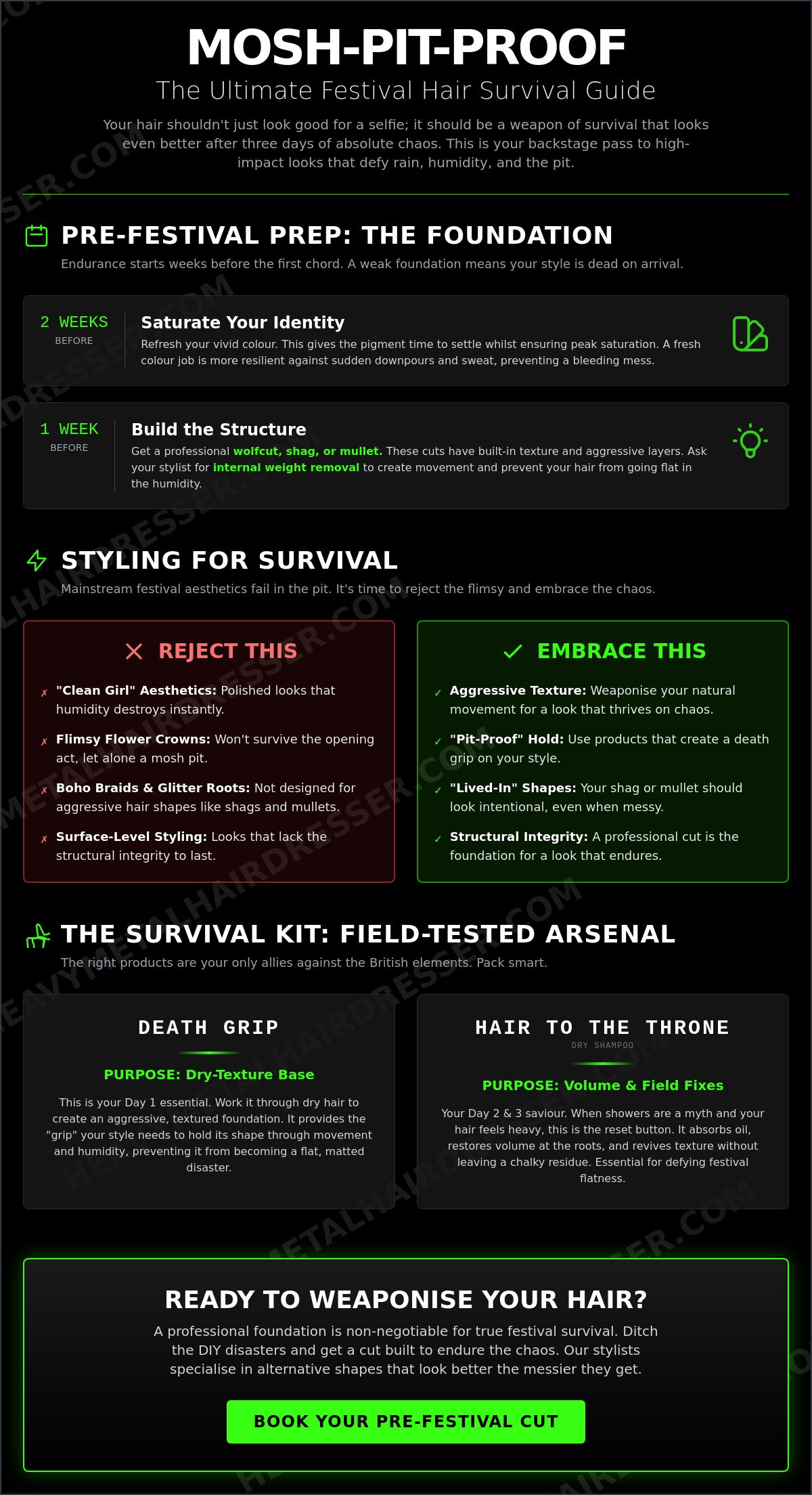
Death Grip & Hair To the Throne: Your Growth Weapons

Standard mousses and sprays from the supermarket won’t cut it for alternative shapes. They lack the aggressive hold needed for high-texture styles. Use Hair To the Throne specifically at the crown. It provides the massive volume needed when your hair starts feeling heavy and unmanageable. For the ends, apply Death Grip. It maintains that “shredded” look by grouping the tapered ends together without making them look greasy or weighed down. This is how you “fake” a wolfcut shape when the layers have technically grown out too far. By keeping the ends piecey and the top voluminous, you trick the eye into seeing the original silhouette. When you combine these two, you get a mosh-pit-ready finish that stays vertical whilst the rest of your hair is busy gaining length.

Heat Styling for Evolving Layers

Natural texture is your best ally. If you have any wave or curl at all, use a diffuser. It encourages the hair to shrink up and cluster, which hides the uneven gaps between growing layers. This prevents that “staircase” effect that straight-haired folks often struggle with during the transition. To keep those iconic wolfcut wings alive, use a flat iron for quick “flicks” at the mid-lengths. This directs the hair away from the face, maintaining that rebellious energy. Just remember: damaged hair doesn’t grow gracefully. It snaps. If you’re constantly heat styling to maintain your look, you must prioritise health. Always use heat protection to ensure your progress isn’t ruined by fried, brittle ends. Grab our branded merchandise and professional styling tools to keep your texture sharp and your identity intact.

Reclaiming Your Identity: Professional Exit Strategies

Growth is a journey, not a destination. You’ve navigated the structural chaos and mastered the art of growing out a wolfcut gracefully. Now you face the ultimate choice. Do you keep pushing for length, or do you commit to a total reshape? At the Heavy Metal Hairdresser, we don’t care about “standard” beauty rules. We don’t want to turn your alternative edge into something palatable for a corporate office. Our approach prioritises your individuality above all else. We look at your bone structure, your subcultural roots, and your lifestyle to map out a 12-month hair journey that feels like an upgrade, not a compromise. It is about evolving your look whilst keeping your soul intact.

Your vivid colour needs to evolve alongside your silhouette. Longer hair provides a larger canvas for high-pigment sensation. As your layers finally blend, we can transition your colour placement to highlight the new movement. This might mean shifting from a high-contrast split-dye to a deep, dimensional melt that flows with your new length. Booking a consultation is about more than just a trim. It is about vision. We map out where you want to be in a year. We ensure every maintenance session serves that final, aggressive goal. Don’t just let your hair happen to you. Direct it.

Beyond the Wolfcut

The end of the wolfcut is just the beginning of something more intense. You might find yourself gravitating toward a “Mega-Shag” with cascading, face-framing texture that hits your waist. Or perhaps you are ready for the “Floor-Length Mullet,” a silhouette that commands respect in any pit. Keeping your alternative hair merch UK aesthetic consistent is vital. Your hair and your gear should tell the same story of rebellion. For those who want to dive deeper into the mechanics of these shapes, our alternative hair courses UK offer a masterclass in subculture styling. Learn the “why” behind the weight distribution so you can own your look with total confidence.

Your Next Move

Don’t settle for a boring transition. Don’t let a mainstream stylist talk you into a “safe” look that erases your identity. Trust the experts who live and breathe alternative culture. We understand the nuances of the scene because we are the scene. Your hair is your loudest form of self-expression. Keep it loud. Keep it authentic. Growing out a wolfcut gracefully is only possible when you have a stylist who understands that “grace” can still have teeth. Book your maintenance session now. Let’s reclaim your identity together.

Own Your Alternative Evolution

Your hair is a living, evolving statement of your identity. It shouldn’t feel like a mistake just because you’re moving between shapes. We’ve explored how to navigate the structural chaos by pivoting into shags or mullets and why internal weight management is the secret to keeping your volume alive. Growing out a wolfcut gracefully is about taking control of the silhouette instead of letting gravity dictate your look. You’ve worked hard for your length. Don’t let a “messy phase” force you into a boring, mainstream chop.

Ready to map out your next twelve months? We are specialists in aggressive texture and vivid colour, bringing the same expertise we use as backstage festival stylists for Download and Bloodstock. We provide a gender-inclusive safe space where your individuality is the only rule we follow. Book your Wolfcut Evolution session at Heavy Metal Hairdresser today. Let’s make sure your transition is as bold and unapologetic as the subculture you belong to. Stay rebellious.

Frequently Asked Questions

How long does it actually take to grow out a wolfcut?

It typically takes between six and twelve months to transition from a choppy wolfcut to a more cohesive mid-length or long shag. Since hair grows at an average rate of about one centimetre per month, you are looking at a year-long evolution to fully blend the shortest crown layers. The exact timeline depends on your starting length and how aggressively the layers were disconnected. Be patient whilst the top sections catch up to the back.

Can I grow out a wolfcut without cutting it into a bob?

Absolutely, you don’t need to retreat into a blunt bob to fix your shape. By growing out a wolfcut gracefully through a shag or mullet pivot, you keep your alternative edge whilst the layers blend. This strategy focuses on weight management and internal texturing rather than a massive chop. It is about evolving the silhouette rather than starting from scratch with a mainstream style.

How do I stop my grown-out wolfcut from looking like a mullet?

You stop the accidental mullet effect by regularly trimming the length at the nape whilst letting the crown layers grow. If you don’t manage the back, the biological growth rate will naturally outpace the top and sides. Keep the back textured and piecey rather than heavy. This ensures the look remains an intentional alternative choice rather than a neglected or accidental shape.

What is the best product for styling a wolfcut during the awkward phase?

Salt sprays and dry shampoos are your best allies for maintaining grit when the layers feel heavy. Use a product like Hair To the Throne to provide structural lift at the crown when gravity starts to pull your volume down. For the ends, a texturising paste like Death Grip keeps the shape looking shredded and deliberate. These tools prevent your hair from looking flat and mainstream during the transition.

Do I need to trim my hair whilst growing it out?

Yes, regular maintenance cuts are essential to prevent split ends from travelling up the hair shaft and ruining your progress. Focus on “dusting” the very tips every eight weeks to preserve your length whilst removing damage. You also need professional weight removal from the internal layers. Without these small interventions, the hair becomes bottom-heavy and loses the rebellious lift that defines the wolfcut aesthetic.

How do I fix flat hair at the crown as my layers get longer?

You fix crown flatness by removing internal weight and using root-lifting styling techniques. As layers grow, they become heavier and pull the hair flat against the scalp. Ask your stylist for internal texturising to lighten the load without sacrificing the external length. Blow-drying your hair upside down with a diffuser also helps to reset the volume at the roots for more aggressive height.

Is it possible to transition a wolfcut into a shag?

Yes, transitioning into a shag is the most natural path for anyone growing out a wolfcut gracefully. Since both styles rely on heavy layers and a textured fringe, the wolfcut is essentially just a more disconnected version of the shag. By slowly blending the steps between the layers over several months, you create a seamless, cascading 70s-inspired flow that looks completely intentional and sharp.

Should I change my hair colour whilst growing out my layers?

Changing your colour is a brilliant way to distract from uneven lengths whilst reclaiming your identity. Bold, vivid colours or high-contrast panels draw the eye toward the pigment and away from any transitional layers that haven’t quite blended yet. It keeps your look feeling fresh and rebellious even when the shape is in flux. Use colour as a tool to anchor your alternative aesthetic during the growth journey.

Posted on

How to Fix Uneven Layers in a Wolf Cut: The Alt-Hair Resurrection Guide

How to Fix Uneven Layers in a Wolf Cut: The Alt-Hair Resurrection Guide

You stared into the mirror with a pair of kitchen shears and a dream, but now your silhouette looks more like a frantic mushroom than a rockstar. It’s a total gut punch when your subcultural identity feels compromised by a botched DIY job or a stylist who didn’t understand the assignment. Learning how to fix uneven layers in wolf cut styles is the only way to stop the panic and get your edge back. We know the frustration of seeing harsh horizontal lines whilst the ends of your hair look thin and stringy.

We agree that a bad cut feels like a loss of self, but those choppy steps are actually just raw materials for a more aggressive, authentic look. This guide will teach you the professional techniques to blend those mistakes, hide the “staircase” effect with clever texturising, and restore the volume your crown deserves. We’ll walk through everything from point-cutting methodology to using heavy-duty styling to reclaim your silhouette and turn a disaster into a defiant statement.

Key Takeaways

  • Identify the “shelf effect” and understand why blunt horizontal lines and tension issues create unintentional mushroom shapes.
  • Use salt sprays and texture pastes as immediate damage control to camouflage choppy steps and encourage natural movement.
  • Discover how to fix uneven layers in wolf cut styles using vertical point-cutting and slithering techniques that remove weight without sacrificing length.
  • Learn how to avoid the “bob trap” by using specialist language like “mullet refinement” or “re-shag” when seeking professional help.
  • Shift your perspective from merely fixing a mess to refining a masterpiece that reflects your authentic subcultural identity.

The Wolf Cut Crisis: Identifying Why Your Layers Look Uneven

You have ended up with a “shelf.” It is that harsh, horizontal line that makes your hair look like a set of stairs rather than a seamless flow of texture. This usually happens when the layers are cut too bluntly. A wolf cut relies on a specific internal weight distribution. If you or your stylist cut straight across without considering the head’s curvature, you get a “step.” Understanding the fundamentals of hair layering techniques is essential before you attempt to blend these lines out. Blunt lines kill the vibe.

Tension and elevation are the silent killers of a good shag. If you pull the hair too hard whilst cutting, it bounces back shorter than intended. This creates “hidden” unevenness that only appears once the hair is dry and living in its natural state. You might find the top looks like a heavy mushroom whilst the bottom looks stringy and thin. This crown-heavy silhouette is the hallmark of a wolf cut crisis. It is the difference between an intentional, aggressive silhouette and an accidental mullet that feels like a mistake. Learning how to fix uneven layers in wolf cut styles starts with this brutal, honest assessment.

The Science of the ‘Step’ in Shaggy Styles

Hair density dictates how your layers stack. If you have fine hair, aggressive “shredding” can make the ends disappear entirely; this leaves you with a disconnected block of hair on top. Thick hair, on the other hand, requires massive weight removal to prevent it from looking like a helmet. Most DIYers lose their guide line halfway through. They start with a clear plan but get lost amongst the sections. When you cut hair wet, it stretches. Once it dries, those layers “jump” up. This is usually when people start searching for how to fix uneven layers in wolf cut shapes.

Assessing the Damage: Is it Uneven or Just Unstyled?

Before you panic, try the “Shake Test.” Flip your head over, give it a vigorous shake, and let the hair fall naturally. This shows you where the weight is truly sitting. You might just have a few “holes” in the perimeter where too much length was taken. Other times, the internal layers are simply too choppy. Your natural wave pattern can also play tricks on you. If one side has more curl than the other, it will look uneven even if the lengths are identical. It is about identifying if the problem is the actual length or just the blend. Use your fingers to feel for density gaps rather than just trusting your eyes in a mirror.

Immediate Damage Control: Styling Tips to Hide Choppy Layers

Most people reach for the straighteners when they spot a mistake. Do not do that. Sleek, straight hair is the ultimate enemy of a botched cut. It exposes every blunt line and “shelf” we identified earlier. If you want to hide the evidence, you must lean into the chaos. Using salt sprays and gritty texture pastes is the fastest way to camouflage those harsh horizontal lines. These products encourage the hair to clump in an intentional, messy way that blurs the boundaries between layers.

The diffuser is your best friend right now. By drying your hair with a diffuser, you encourage natural movement and waves. This disrupts the visual path of a “staircase” step. If you have particularly short or choppy bits that will not behave, try strategic sectioning. Small mini-braids or using a tight “death grip” style clip to pin back the offending sections can turn a mistake into a deliberate alt-fashion choice. It is about making the unevenness look like a part of your subcultural aesthetic rather than an accident.

Volume acts as a shield. If you achieve Hair To the Throne levels of lift at the crown, it draws the eye upward and away from any thinness or unevenness at the bottom. The goal is to create a silhouette so bold that the individual layers become secondary to the overall shape. This is a vital temporary strategy whilst you figure out how to fix uneven layers in wolf cut styles for the long term.

The ‘Messy’ Fix for Fine Hair

Fine hair often separates, making gaps in the layers look like unintentional holes. Use dry shampoo on clean hair to add immediate grit. This prevents the layers from sliding against each other and revealing the shelf. Gentle back-combing at the roots can provide the necessary structure, but keep it at the base to avoid damaging your cuticles. Avoid heavy oils that might make the hair look stringy; you want maximum airiness to fill in the gaps.

Managing Bulk for Thick, Choppy Manes

Thick hair can look like a helmet when the layers are uneven. You need to use textured styling products to add weight to the ends. This helps the hair hang better rather than poofing out at the shelf. Try section-by-section drying to control exactly where the volume pops. If your face-framing layers are too short, use the “tuck and pin” method to hide them under longer sections until you can get a professional correction. Understanding how to fix uneven layers in wolf cut shapes often requires this kind of creative manipulation to get through the awkward growing-out phase.

How to Fix Uneven Layers in a Wolf Cut: The Alt-Hair Resurrection Guide

Technical Blending: How to Soften Steps and Shelves

Styling is a solid temporary fix, but eventually, you have to pick up the shears. The most common mistake in a botched wolf cut is cutting horizontally. Horizontal lines create shelves. To fix a step, you must cut vertically. This is Point Cutting 101. By snip-snipping into the hair at a steep vertical angle, you “shatter” the blunt edge. It turns a solid line into a soft, diffused graduation. Do not just hack away at the ends. You want to remove the weight that causes the hair to sit in a block, whilst keeping enough density so the cut does not look ratty or “over-shredded.”

Slithering and slicing are the professional secrets to removing bulk without sacrificing your hard-earned length. Slicing involves sliding open shears down the hair shaft to carve out weight. It creates a tapered effect that allows layers to “nest” into each other. If you are wondering how to fix uneven layers in wolf cut styles that feel too heavy, this is your answer. It thins the section from the inside out. Be careful, though. Over-thinning is a one-way ticket to a limp silhouette. You want to maintain that aggressive, alt-hair grit, not lose it entirely.

The “Invisible Layer” trick is a lifesaver for bridging a massive gap between a short crown and long ends. You find the “step” where the hair disconnects and cut a micro-layer right in the middle of that void. This acts as a bridge, helping the top and bottom sections communicate. Pair this with channel cutting, where you remove small “channels” of hair from the densest parts. This creates air within the style, allowing the layers to interlock naturally rather than stacking on top of each other like a staircase.

Softening the ‘Mushroom’ Top

Crown layers that are too heavy create a mushroom shape that kills the wolf cut vibe. To fix this, you need to “shatter” the ends of the crown layers. Focus on internal weight removal. This means thinning the middle of the hair section rather than the very tips. If you thin the ends too much, you lose the “aggressive” edge of the face-frame. Keep the perimeter strong but make the interior layers move. It turns a “mess” into a masterpiece with a few strategic snips.

Fixing the Length: When the Bottom is Too Thin

If your DIY attempt left the bottom looking stringy, you need to blunt the very ends. This creates a “false” sense of thickness. It might feel counterintuitive to cut more length when you want it long, but “dusting” the perimeter actually makes the layers above look more intentional. It connects the shag elements to the mullet base. You regain the “tail” effect by ensuring the bottom has enough visual weight to balance out the volume at the top. This is a crucial step in learning how to fix uneven layers in wolf cut silhouettes that have lost their balance.

The DIY vs. Professional Debate: When to Seek an Alternative Specialist

You have reached the limit of what kitchen shears and a bathroom mirror can achieve. If the “holes” in your hair are getting larger whilst your patience wears thin, it is time to call in the cavalry. Searching for how to fix uneven layers in wolf cut styles is one thing; actually executing it on the back of your own head is another. There comes a point where further DIY hacking just makes the “shelf” more permanent. Stop. Put the scissors down.

Beware of the “Bob Trap.” Most traditional high-street hairdressers see a choppy shag and think it is “damaged” or “messy.” Their instinct is to cut it into a sensible, level bob to “tidy it up.” This is the ultimate identity compromise. You didn’t want a sensible haircut; you wanted an aggressive, subcultural statement. Alternative salons are safe spaces for failed experiments. We don’t judge the kitchen scissors incident. We understand the aesthetic you are chasing. We see the vision, even if it is currently a bit lopsided.

Use specialist language to protect your length. Instead of asking a stylist to “fix” your hair, ask for a “re-shag” or a “mullet refinement.” This signals that you want to keep the disconnected, rebellious vibe rather than smoothing it over. If a stylist looks confused when you mention internal weight removal, walk out. You need someone who speaks the language of grit and texture. If you are ready to stop the DIY struggle, book a corrective session with an alternative specialist who understands the assignment.

The Cost of a ‘Correction’ vs. a New Cut

A professional corrective consultation is different from a standard trim. Your stylist needs to map out where the hair is missing and where it is too heavy. Honesty is vital. Tell them exactly what you did and which tools you used. This helps them understand the hair’s integrity. They will create a “growth plan” for you. This might mean keeping the top short whilst the bottom catches up, or using specific wolf hair cuts techniques to bridge the gaps. It is a marathon, not a sprint.

Finding an Alternative Specialist in the UK

Forget Google for a moment; Instagram is your best tool for finding alt-stylists. Look for portfolios that feature shags, mullets, and lived-in texture. You want to see hair that looks good messy, not just “prom hair” that has been curled to death. Check for stylists who specialise in razor cutting or aggressive point cutting. If their feed is full of “sensible” bobs and bridal updos, they probably aren’t the right fit for your resurrection. You need a rebel who has mastered the craft. Understanding how to fix uneven layers in wolf cut shapes requires a specific eye for subcultural silhouettes.

Reclaiming Your Identity: Professional Correction at Heavy Metal Hairdresser

At Heavy Metal Hairdresser, our philosophy is simple. We don’t “fix” your hair to look normal. Normal is boring. We refine it to look deadlier. When you walk in with a botched DIY job, we see the potential for a more aggressive, authentic silhouette. Simon Tuckwell’s approach to corrective texture is about finding the rhythm in the chaos. He moves from “mess” to “masterpiece” by using the existing unevenness as a foundation for a deeper, more complex shag. We understand how to fix uneven layers in wolf cut styles by working with the hair’s natural rebellion, not against it. It’s about reclaiming the edge you thought you lost.

Sometimes, the quickest way to reclaim your identity is through strategic distraction. Integrating vivid hair colour can mask the “shelf” effect whilst enhancing the layered shapes. High-pigment tones draw the eye to the movement of the hair rather than the technical steps of the cut. It’s a total sensory reset. We also provide a long-term maintenance plan. This ensures you keep the grit and attitude whilst your layers grow into their final, intentional form. We don’t just send you out the door; we give you a roadmap for your hair’s resurrection.

Beyond the Cut: The Heavy Metal Experience

We’ve built a gender-inclusive environment where your alternative aesthetic is the only priority. You aren’t just another appointment; you’re part of a community that celebrates being different. Our specialists will give you expert advice on using our textured styling products at home. This ensures your resurrection doesn’t end when you leave the salon chair. We show you how to manipulate your new layers to maintain that raw, underground vibe every single day. Booking a session for a total hair resurrection is the first step in stopping the mirror-induced panic.

Join the Alternative Community

We support the pit-ready lifestyle from backstage to the salon chair. If you’ve been inspired by the correction process, you can even sign up for our alternative hair courses to learn the craft yourself. We teach the technical grit needed to master how to fix uneven layers in wolf cut shapes and other subcultural classics. Whether you’re a stylist looking to level up or a fan of the scene, we welcome you. Don’t settle for a “sensible” fix that erases who you are. Book your wolf cut correction with the specialists today and get your edge back.

Own Your Resurrection and Reclaim Your Edge

Your hair isn’t a disaster; it’s a work in progress. You now know that the secret to how to fix uneven layers in wolf cut styles lies in leaning into grit rather than smoothing it over. Whether you’re blurring a “shelf” with salt spray or using vertical point-cutting to shatter a blunt line, the goal is always to protect your subcultural identity. Don’t let a traditional stylist talk you into a “sensible” bob that erases your edge. We understand that a wolf cut is more than a trend; it’s a statement of independence.

We specialise in shags, mullets, and aggressive wolf cuts for those who live outside the mainstream. With international acclaim for our alternative styling, we provide a gender-inclusive safe space where every identity is celebrated. We’ve seen every DIY mishap imaginable and transformed them into defiant masterpieces. It is time to stop the bathroom-mirror panic and trust the experts who speak your language. We’ll help you navigate the growth plan whilst keeping your aesthetic sharp and authentic.

Book Your Wolf Cut Resurrection at Heavy Metal Hairdresser

Your resurrection starts today. Stay loud, stay messy, and stay unapologetically you.

Frequently Asked Questions

Can I fix uneven layers without cutting more length off?

Yes, you can blend those steps using internal texturising and vertical point-cutting techniques rather than blunt perimeter cuts. This approach focuses on shattering the heavy, horizontal lines that create the shelf effect. By removing weight from the middle of the section, you soften the transition between layers. This allows you to keep your hard-earned length whilst restoring a seamless, rockstar silhouette.

How long does it take for a failed wolf cut to grow out?

It typically takes three to six months to see a total transformation in your hair’s silhouette. On average, hair grows about half an inch every month. You will need regular dusting trims to keep the perimeter strong whilst the shorter crown layers catch up. A specialist can create a growth plan that keeps your style looking intentional and gritty during this transition phase.

What tools do I need to blend my own choppy layers at home?

You need professional-grade hair shears; kitchen scissors will only cause split ends and more jagged unevenness. A fine-tooth comb for precise sectioning and a spray bottle for moisture are also essential. If you are learning how to fix uneven layers in wolf cut styles at home, invest in sharp, short-bladed shears for better control. Avoid cheap craft scissors at all costs if you want to save your aesthetic. For reliable results, using equipment from BarberNation: Professional Barber Tools and Grooming Supplies can help you achieve the professional precision required for complex texturising.

Is my hair too thin for a wolf cut if it looks ‘stringy’ at the bottom?

No, thin hair can still rock this look, but you need more internal structure and less aggressive shredding at the perimeter. Stringiness happens when too much weight is removed from the bottom sections. To fix this, blunt the very ends to create a false sense of density. This provides a solid base for the messy, textured crown layers to sit on whilst maintaining your edge.

Why does my wolf cut look like a mushroom or a bowl cut?

This happens when the crown layers are cut too heavy or too bluntly across the curvature of the head. It creates a disconnected cap of hair that looks more like a bowl than a wolf. You need to remove internal weight from the middle of those top layers. Use vertical slicing to help the crown nest into the length below rather than stacking on top of each other.

Should I use thinning shears to fix my choppy hair?

Use them sparingly or avoid them entirely if you want to maintain a sharp, aggressive edge. Thinning shears can often create a frizzy, diffused look rather than the defined texture a wolf cut requires. Vertical point cutting with standard shears gives you much more precision when blending harsh steps. It removes the bulk whilst keeping the individual layers looking deliberate and punchy.

How do I explain to a hairdresser that I want to keep the ‘messy’ look but fix the unevenness?

Use terms like mullet refinement or re-shagging to signal your alternative aesthetic to the stylist. Emphasise that you want to keep the disconnected, rebellious vibe but need the internal weight redistributed. Tell them you specifically want to avoid a neat bob or a traditional layered cut. A good specialist will understand that you want to refine the chaos, not erase it.

What is the difference between a wolf cut and a shag when correcting mistakes?

A wolf cut is more aggressive and mullet-adjacent, whilst a shag is generally more blended and rounder in shape. When figuring out how to fix uneven layers in wolf cut shapes, you prioritise keeping that top-heavy volume and a distinct, wispy tail. Shag corrections usually focus on a more uniform distribution of layers. The wolf cut always demands a more defiant, disconnected silhouette.

Posted on

Fixing a Bad Wolfcut Haircut: How to Salvage Your Alternative Aesthetic

Fixing a Bad Wolfcut Haircut: How to Salvage Your Alternative Aesthetic

A botched wolfcut isn’t a total disaster; it’s just an unfinished transition that requires a subcultural eye to correct. You probably went in looking for a rebellious, shaggy silhouette but ended up with the dreaded mushroom effect or visible steps that look like a primary school craft project. It’s a common nightmare when a stylist doesn’t understand the nuance of alternative hair. We know the panic of staring at bangs that are too short or layers that don’t blend.

This guide is your roadmap for fixing a bad wolfcut haircut without sacrificing your edge. You don’t have to cut it all off into a boring bob to start over. You’ll discover professional correction techniques, styling triage for the grow-out phase, and advice on finding a stylist who actually respects your identity. We are going to show you how to hide the mistakes whilst restoring an intentional, cool silhouette that feels like you again. It’s time to stop hiding under a beanie and start reclaiming your aesthetic with confidence.

Key Takeaways

  • Identify the “mushroom effect” and harsh layering steps that ruin your alternative silhouette and learn why they happened.
  • Master styling triage for fixing a bad wolfcut haircut by using heavy-duty texture products to blur unintentional asymmetry whilst it grows.
  • Understand how professional techniques like point cutting and crown weight redistribution can reconstruct a botched shape into a balanced gradient.
  • Use creative weapons like vivid colour and shadow roots to distract the eye from harsh lines and add depth to a flat, disconnected cut.
  • Find a specialist who actually understands the grit of alternative hair and provides a safe, inclusive space for your hair resurrection.

The Anatomy of a Failed Wolfcut: Why Your Layers Look More ‘Sheep’ than ‘Wolf’

A botched wolfcut is a special kind of heartbreak. You walked in wanting a rebellious, textured silhouette inspired by subcultural icons; you walked out looking like you’re wearing a mushroom-shaped helmet with straggly bits attached. Understanding the structural failure of your hair is the first step toward fixing a bad wolfcut haircut. Most disasters occur because a stylist tried to apply “safe,” traditional techniques to a shape that thrives on grit and disconnection.

The “Mushroom Effect” is the most common grievance. This happens when too much weight is left at the crown, creating a heavy, round bulb of hair that sits awkwardly on top of thin, wispy lengths. It kills the vibe because a wolfcut should feel shaggy and elongated. Then there is “The Shelf.” This occurs when layers are cut in distinct, horizontal blocks. Instead of a fluid gradient of texture, you get visible steps that look like a staircase. It’s the opposite of the effortless, lived-in aesthetic you were promised.

Don’t confuse a bad wolfcut with an intentional mullet. A mullet has a deliberate, aggressive short-to-long ratio that feels purposeful. A botched wolfcut just looks like a mistake. The wolf cut is fundamentally a modern evolution of the classic shag, relying on internal texture and movement rather than rigid perimeters. If your stylist used traditional blending methods, they likely stripped away the soul of the cut, leaving you with a dated, suburban mess instead of an alternative masterpiece.

The Problem with Traditional Layering

Standard salons often prioritise “seamless blending,” which is the enemy of the wolfcut. Traditional layering techniques use horizontal sections that create weight rather than removing it. In alternative hair design, we embrace disconnection. We want the fringe to feel separate from the side panels. We want the layers to have a jagged, percussive energy. When a stylist tries to make a wolfcut “polite” by blending everything together, you end up with a flat, lifeless shape that lacks any subcultural edge.

Signs Your Wolfcut Needs Professional Triage

If you’re unsure if fixing a bad wolfcut haircut is necessary, check for these red flags. First, look at the fringe. If the bangs are completely disconnected from the side panels in a way that looks accidental rather than edgy, the balance is off. Second, check for “holes” in the perimeter. This happens when a stylist removes too much weight from the bottom layers, leaving the ends looking transparent and weak. Finally, evaluate the crown height. If the top layers are so short they stand up whilst the bottom is still shoulder-length, the silhouette has collapsed. You don’t need a miracle; you need a reconstruction.

Immediate Triage: How to Style Your Way Out of a Hair Disaster

You’ve just looked in the mirror and realised the “vision” was a lie. It’s frustrating. But before you reach for the clippers or hide under a duvet, remember that texture is the ultimate cloaking device. Fixing a bad wolfcut haircut isn’t just about the scissors; it’s about the products in your bathroom cabinet. You can style your way out of a hair disaster by leaning into the very chaos that makes alternative hair so iconic. The goal isn’t perfection; it’s making the mistakes look like a conscious choice.

Embrace the messy aesthetic. A wolfcut is supposed to look lived-in and slightly feral. If your layers are uneven or asymmetrical, lean into it. Use your fingers to break up the hair rather than a comb. The more movement you create, the harder it is for someone to spot a “step” or a “shelf” in your layers. This is about reclaiming your identity and refusing to let a bad salon experience dull your edge.

Manipulating Texture to Hide Mistakes

Salt sprays and texture pastes are your new best friends. They add the necessary grit to “blur” those harsh staircase layers we discussed earlier. By roughening up the hair fibre, you break up the solid lines of a botched cut. If your layers feel too heavy at the crown, applying a product like Death Grip can provide the structural support needed to lift the hair and disguise the “mushroom” effect.

For those with natural waves, the “scrunch and set” method is a lifesaver. Dampen the hair, apply a generous amount of texture product, and scrunch upwards. This encourages the hair to clump in organic, messy patterns rather than hanging in the rigid, uneven sections left by a bad stylist. It’s a vital step in fixing a bad wolfcut haircut whilst you wait for a professional reconstruction.

Heat Styling for Silhouette Correction

Heat tools allow you to physically redirect where the hair sits. If you have short, awkward layers that stick out like a sore thumb, use a small flat iron to “flick” them outwards. This creates a jagged, intentional texture that mimics a successful shag. If the fringe is the problem, don’t leave it hanging flat. Use a round brush or a flat iron to sweep it into the side panels, creating a “curtain” effect that masks any disconnection.

A directional blow-dry can also save your silhouette. If the crown is flat but the bottom is bulky, blow-dry the roots upwards to create height. This balances the weight distribution and prevents the “sheep” look. Whilst these tricks work wonders, they are temporary fixes. If your current look is still causing you grief, consider booking a session for one of our professional Wolfcuts to get the structural correction you actually deserve.

Don’t forget the power of accessories. Bandanas, chunky clips, and beanies aren’t just for bad hair days; they are staples of the alternative aesthetic. Use them to pin back the sections that bother you most. This buys you time and keeps your confidence intact whilst your hair recovers.

Fixing a Bad Wolfcut Haircut: How to Salvage Your Alternative Aesthetic

Professional Reconstruction: Fixing Uneven Layers and Disconnected Shapes

Fixing a bad wolfcut haircut requires more than just a trim; it’s a surgical reconstruction of the silhouette. When your hair has been butchered by traditional techniques, the goal is to restore the balance between the crown and the perimeter. A specialist won’t just chop more hair off. They’ll focus on redistributing weight. If you’re suffering from the mushroom effect, the solution is removing internal bulk from the crown. This creates air and movement, allowing those heavy top layers to sit amongst the rest of the hair rather than on top of it like a lid.

The “Bridge” technique is the secret weapon for hair resurrection. It involves creating new, intermediate layers that link the short, disconnected crown to the longer bottom sections. It’s about building a transition where there was once a void. However, you must know when to stop. Cutting more layers into a shape that’s already too thin at the bottom will only make the problem worse. Sometimes the fix is about refining what’s there and then letting the hair rest. Growth is your ally, but a professional correction gives that growth a sense of purpose.

Blending the “Staircase” Effect

Visible steps in your hair are usually the result of a stylist cutting straight across the hair in horizontal blocks. To fix this, we use deep point cutting and slide cutting. By cutting into the hair at an angle, we shatter those hard lines. The razor is also essential here. It creates the soft, shaggy ends that define a true wolfcut. A specialist understands that the ends should feel lived-in and slightly frayed, not blunt and heavy. We’re aiming for a gradient of texture that feels fluid when you move.

Rescuing the Fringe and Face-Frame

If your fringe was cut too short or feels like a separate entity from the rest of your head, don’t panic. We can soften micro-bangs by point cutting the edges to remove the “blocky” look. Integrating these disconnected face-framing bits into the side panels is about finding the shortest point and creating a diagonal line that flows into the length. To keep everything looking intentional, use Hair To the Throne to maintain volume and grit in the corrected fringe. This ensures the front of your cut has the same rebellious energy as the back.

Vivid Colour and Creative Texturing: The Secret Weapons of Hair Correction

Most guides suggest “growing it out” as the primary fix for a hair disaster. We disagree. Waiting months for hair to grow whilst feeling like a stranger in the mirror is a waste of your aesthetic potential. Fixing a bad wolfcut haircut can be achieved through the art of visual deception. By integrating vivid hair colour, you aren’t just hiding a mistake; you’re evolving your style. Strategically placed pigment can draw the eye toward your best features and away from those awkward “steps” we identified earlier.

Shadow roots add perceived depth to a flat, botched crown. It’s about creating a 3D effect. If your stylist left you with a “mushroom” top, a darker root creates a shadow that makes the hair look more grounded and less puffy. Alternatively, the “Pop of Colour” trick involves highlighting the specific sections that actually work. If your fringe is the only part that survived the butcher’s chair, make it neon. It forces the viewer to focus on the intentionality of the colour rather than the unevenness of the layers. It shifts the narrative from a mistake to a deliberate, high-energy transformation.

Visual Deception with Colour

Darker tones are essential for filling “holes” in your perimeter. If a stylist removed too much weight, a deep charcoal or midnight blue underneath can make the hair appear thicker and more substantial. Neon tips on an uneven hemline turn a mistake into a deliberate “shattered” look. If the whole silhouette feels unsalvageable, a split-dye is the ultimate reset button. It creates a bold, symmetrical divide that distracts from any internal asymmetry. If you’re ready to flip the script on your disaster, check out our Vivid Colour services to start your recovery.

Adding Grit with Creative Texturing

There’s a massive difference between “thinning out” and “creative texturing.” Thinning often leads to the very wispy, weak ends that ruin a wolfcut. Creative texturing is the final boss of fixing a bad wolfcut haircut. It involves “shattering” the ends with a razor or point-cutting to create jagged, aggressive movement. This removes the blocky, heavy look of a bad cut without sacrificing the density you need to survive a night in the mosh pit. It’s about making the hair look intentionally distressed. This grit ensures that even amongst the sweat and chaos of a gig, your hair maintains its rebellious shape rather than falling flat.

Finding Your Specialist: Why Alternative Haircutting Requires a Different Breed of Stylist

Generic salons are often the scene of the crime. They treat alternative shapes like a standard trim, applying rigid, outdated rules to a style that thrives on rebellion. Fixing a bad wolfcut haircut isn’t about finding the nearest salon with a vacancy. It’s about finding a specialist who speaks your subcultural language. Most high-street stylists fear disconnection and aggressive texture. They try to “tame” the hair, which is exactly how you ended up with a mushroom-shaped disaster. You need a stylist who understands that a wolfcut is an attitude, not just a set of layers.

Look for portfolios that feature shag hairdressers and modern mullets. These styles require a specific technical mastery over weight distribution and internal movement. Beyond the technical, prioritize a gender-inclusive safe space. When you’re feeling vulnerable about a botched cut, you deserve an environment that respects your identity and your aesthetic. Heavy Metal Hairdresser specialists focus on individuality over mainstream trends. We don’t want to make you look like everyone else; we want to help you look like the best version of yourself.

Vetting an Alternative Stylist

Social media is your best tool for reconnaissance. When scrolling through a stylist’s Instagram, look past the polished, tonged curls. Does their work show “lived-in” grit? Do they showcase a variety of wolf hair cut designs on different hair types? Check if they use razors and unconventional tools. A razor is often the only way to achieve the shattered, wispy ends that a scissor simply cannot replicate. Finally, see if they’re active amongst alternative subcultures. A stylist who understands the energy of a festival or a mosh pit will understand why your hair needs to move the way it does.

The Consultation: Your Shield Against Another Disaster

The consultation is your opportunity to set boundaries. Don’t just bring “goal” photos; bring “disaster” photos of your current hair. Point out exactly where the previous stylist went wrong. Be specific. Use the terms we’ve discussed. Ask them directly: “How will you blend these steps without losing my length?” If they look confused or suggest a “nice bob” instead, walk out. Fixing a bad wolfcut haircut requires a specialist who isn’t afraid to get aggressive with texture. Ensure they understand your specific subcultural aesthetic, whether that’s Goth, Metal, Emo, or Punk. Your hair is your armour. Don’t let someone who doesn’t understand the battle take the lead.

Reclaim Your Alternative Edge

A botched cut is a temporary setback, not a permanent sentence. You now have the tools to identify the structural failures of a failed shape and the styling tricks to blur those harsh steps whilst you wait for a fix. We’ve shown you how vivid colour and deep point cutting can transform a mushroom disaster back into a sharp, intentional silhouette. Fixing a bad wolfcut haircut is ultimately about trusting the right hands to restore your subcultural grit and reclaim your identity.

It’s time to stop hiding under beanies and start your hair resurrection. Book your wolfcut rescue at Heavy Metal Hairdresser. We provide a gender-inclusive safe space and bring backstage festival styling expertise to every chair. As specialists in aggressive texture and vivid colour, we don’t just fix mistakes; we amplify your individuality. Your hair is your statement. Let’s make it a loud one.

Frequently Asked Questions

Can I fix a bad wolfcut at home with thinning shears?

No, you should put the shears down immediately. Using thinning shears at home is a recipe for a stringy, transparent disaster. Most people end up removing too much bulk from the wrong places, which only makes the “mushroom” effect look more aggressive. Professional correction requires precise point cutting and internal weight redistribution that simply cannot be replicated with a pair of cheap supermarket thinning scissors.

How long does it take for a botched wolfcut to grow out into a shag?

Expect a timeline of three to six months for the layers to blend into a more traditional shag silhouette. Hair typically grows about half an inch per month, so you’ll need that time for the short crown layers to catch up. During this period, booking regular “dusting” trims with a specialist ensures the shape stays intentional whilst you wait for the length to return.

My wolfcut looks like a mushroom; what did my stylist do wrong?

Your stylist likely used traditional horizontal sections and failed to remove enough internal weight from the crown. This creates a heavy “cap” of hair that sits awkwardly on top of thin lengths. In a successful wolfcut, the transition should be a fluid gradient of texture. When a stylist treats the top and bottom as two separate, blunt blocks, the result is that dreaded mushroom shape.

Should I straighten my hair to hide the uneven layers?

Straightening is actually the worst thing you can do for fixing a bad wolfcut haircut. Sleek, flat hair highlights every “step” and “shelf” in a botched cut, making the mistakes impossible to ignore. Instead, you should lean into your natural texture or use heat tools to create messy waves. This visual chaos blurs the harsh lines and makes the unevenness look like a deliberate subcultural choice.

What is the difference between a bad wolfcut and a modern mullet?

The difference lies entirely in intentionality and balance. A modern mullet has a purposeful, aggressive contrast between the short front and the long back. A bad wolfcut just looks like a structural collapse where the layers don’t talk to each other. Whilst a mullet celebrates the divide, a wolfcut is supposed to be a shaggy evolution of the two, requiring a much softer transition.

Can vivid colour really hide a bad haircut?

Vivid colour is a powerful weapon for visual deception. By placing bright neons or deep shadow roots strategically, you can redirect the viewer’s eye away from a botched layer and toward a bold focal point. It shifts the entire narrative of your look from a salon mistake to a high-energy, high-pigment statement. It’s about reclaiming control over your aesthetic when the scissors have failed you.

How much length will I lose if I get my wolfcut professionally corrected?

You shouldn’t lose significant length if you visit a specialist who understands alternative shapes. A pro will focus on “shattering” the harsh lines and redistributing internal weight rather than just chopping the bottom off. In most cases, we only need to trim a tiny amount of the perimeter to clean up the ends whilst we reconstruct the internal layers to restore the balance.

Is a wolfcut suitable for fine or thin hair if it was already ruined once?

Yes, but it requires a very delicate approach to texture. Fixing a bad wolfcut haircut on fine hair involves building internal support at the roots so the hair doesn’t fall flat. We focus on creating the illusion of density whilst removing just enough weight to allow for movement. If your hair was ruined before, it’s likely because the stylist took too much from the perimeter, leaving it looking transparent.

Posted on

Wolfcut vs Shag vs Mullet: Choosing Your Alternative Hair Identity

Wolfcut vs Shag vs Mullet: Choosing Your Alternative Hair Identity

Your hair is a weapon of self-expression that should scream louder than the mainstream noise. We know the fear. You’re scrolling through endless grids, terrified that a request for texture will land you a suburban “Karen” bob instead of the subcultural grit you crave. Deciphering the wolfcut vs shag vs mullet debate is exhausting whilst the terminology remains a chaotic mess of overlapping trends. You’re likely worried that your fine strands will look limp or your thick mane will turn into an accidental mushroom.

This guide deconstructs these three silhouettes to ensure you find the specific shape that matches your spirit. We’ll break down the structural differences between these choppy icons and explain how they interact with your natural hair type. By the end, you’ll have the technical vocabulary and the confidence to book an alternative specialist who understands your aesthetic. It’s time to stop guessing and start carving out a look that’s unapologetically yours.

Key Takeaways

  • Master the structural differences between the 70s-inspired shag, the high-contrast mullet, and the hybrid wolfcut.
  • Settle the wolfcut vs shag vs mullet debate by comparing silhouettes, ranging from rounded crown volume to tapered, aggressive edges.
  • Learn how to weaponise your natural texture to either inject volume into fine strands or manage bulk in thicker hair.
  • Evaluate maintenance requirements and styling rituals to ensure your look survives everything from daily life to the mosh pit.
  • Discover why trusting an alternative specialist is vital for a gender-inclusive experience that avoids a suburban haircut disaster.

The Unholy Trinity: Distinguishing the Wolfcut, Shag, and Mullet

Choosing your weapon is about more than just a trim. It’s about carving out a silhouette that refuses to blend in. The confusion in the wolfcut vs shag vs mullet debate is understandable because these styles share a common DNA. They all prioritise heavy texture, disconnected lengths, and a reckless disregard for traditional, “polished” blending. These aren’t just haircuts; they’re structural statements designed to weaponise your hair’s natural chaos.

The shag is the foundation of this unholy trinity. Born in the 1970s, it’s the queen of crown volume and choppy, short layers. If you look into shag haircut history, you’ll see it was the original rebellion against the stiff, structured styles of the previous decade. It’s built on a “halo” of layers that creates height at the top whilst keeping the ends feathered and light.

The mullet takes a more aggressive stance. It rejects the binary of short or long hair by forcing both into a single, high-contrast look. It’s defined by a sharp “step” between the sides and the back. There’s no soft transition here. It’s a deliberate disruption of the head’s natural shape. Modern variations have pushed this even further, moving from the subtle “rat-tail” to the high-fashion “power mullet” that dominates the underground scene.

The wolfcut is the K-pop-inspired hybrid that bridges the gap. It takes the heavy, voluminous top of a shag and marries it to the tapered, longer back of a mullet. It’s shaggier than a traditional mullet but more aggressive than a standard shag. This shared lineage of choppy layers is exactly why people struggle to tell them apart. They all live in the same house of grit; they just occupy different rooms.

The Shag: Volume and Fringe Focus

The shag is characterised by even weight distribution and heavy face-framing. It’s the perfect choice for anyone wanting maximum texture without the extreme tail of a mullet. The focus is always on the “halo” of volume around the crown. This look works best when paired with a “deadly” set of curtain bangs or a heavy, full fringe. It’s about creating a soft but messy frame for your face that looks just as good in a mosh pit as it does on the street.

The Mullet: Extreme Disconnection

Disconnection is the hallmark of the mullet. Unlike the wolfcut, which tries to blend the lengths slightly, the mullet celebrates the gap. The sides are often buzzed or cut extremely short, creating a massive contrast with the length at the nape. It’s a bold choice for those who want to completely disrupt their silhouette. Whether you’re rocking a micro-fringe or a slicked-back top, the mullet remains the ultimate symbol of subcultural independence.

Choosing Your Weapon: Key Differences in Shape and Silhouette

Understanding the wolfcut vs shag vs mullet debate requires looking at the physics of the hair. It’s about where the weight lives and how the silhouette interacts with the air. A shag is fundamentally round. It creates a halo of volume that encircles the head; maintaining fullness from the crown down to the jawline. It’s the softest of the three, even with its choppy layers. The weight is distributed evenly, making it feel lush and textured rather than aggressive.

The wolfcut shifts that weight upwards. It’s shaggier at the top but tapers aggressively as it reaches the shoulders. Think of it as a top-heavy explosion of texture that thins out into wispy, feathered ends. In contrast, the mullet keeps the sides flat and sleek. The visual weight sits entirely at the nape. When you look into the origin of the term ‘mullet’, you see a history of hair that defies standard proportions. It’s a silhouette that refuses to be “balanced” in the traditional sense, sitting heavy at the back whilst leaving the temples exposed.

Layering techniques also define the “grit” of your look. Razor-cutting is often the preferred method for these alternative styles. It creates shredded, irregular ends that scissor-cutting simply cannot replicate. Scissor-cut precision is great for structure, but the razor provides that lived-in, mosh-pit-ready energy. If you’re looking to truly transform your silhouette, you need a specialist who knows when to put down the shears and pick up the blade to carve out those disconnected channels.

Wolfcut vs Shag: The Battle of the Layers

The main difference here is the level of “bite” in the texture. Wolfcuts utilise more deliberate chaos at the crown than a traditional shag. Whilst a shag focuses on a cohesive, face-framing flow, the wolfcut wants to look like you’ve just woken up in a tour bus. It’s about more disconnected, shorter layers at the top that transition into longer, thinner lengths. Choose the shag if you want volume that feels full; choose the wolfcut if you want volume that feels sharp and tapered.

Mullet vs Wolfcut: The Disconnection Debate

The mullet is a deliberate “disaster” of two different lengths. There is no attempt to bridge the gap between the short temples and the long back. This extreme disconnection makes it a powerful tool for gender-neutral styling, rejecting traditional “beauty” standards. The wolfcut, however, seeks to blend that disconnection. It uses cascading layers to create a bridge between the top and the bottom. It offers more versatility for those who aren’t quite ready to commit to the stark, jarring contrast of a traditional power mullet.

Wolfcut vs Shag vs Mullet: Choosing Your Alternative Hair Identity

Hair Texture and Face Shape: Which Cut Suits Your Chaos?

Forget the outdated “rules” found in glossy magazines. The idea that your face shape or hair texture dictates your style is a myth designed to keep you looking “safe.” In the world of alternative styling, we don’t hide your features; we weaponise them. Whether you have pin-straight strands or a chaotic mane of curls, the wolfcut vs shag vs mullet debate is really about how you want to manipulate your specific texture to serve your aesthetic.

Curly and wavy manes are built for these silhouettes. These cuts thrive on movement and even a bit of frizz. Whilst traditional salons might try to “tame” your curls, we use them to build height and grit. The natural bounce of a wave provides the perfect foundation for the disconnected layers of a mullet or the feathered edges of a wolfcut. It’s about letting the hair live its own life whilst we provide the structural boundaries.

Injecting Volume into Fine Hair

Fine hair often feels like a curse when you’re craving an alternative edge. It goes flat, loses its shape, and refuses to hold volume. This is where the wolf hair cut acts as a genuine cheat code. By stacking short, choppy layers at the crown, we eliminate “flat-head” syndrome and create an illusion of density. The key is avoiding over-thinning at the ends. We keep the perimeter solid to maintain a strong silhouette whilst the top remains a chaotic explosion of texture. It’s the ultimate way to make thin strands look aggressive and intentional.

Taming the Beast: Thick and Coarse Hair

Thick hair can feel like a heavy helmet if it isn’t carved correctly. If you have a massive amount of hair, a traditional shag haircut is your best ally for bulk management. We use internal thinning techniques to remove weight from the “inside” of the cut. This allows the hair to move freely without losing that signature shaggy attitude. For those with coarse hair that holds too much heat, the mullet is a practical masterpiece. By taking the sides short, we reduce the overall mass of the hair whilst keeping the length at the back for maximum impact. It’s about maintaining a sharp, aggressive edge without the hair becoming an unmanageable mushroom shape.

The Reality Check: Maintenance, Styling, and Mosh Pit Survival

Styling for the Stage and the Pit

Sea salt sprays and dry textures are the lifeblood of alternative hair. They provide that “backstage” grit that makes layers look intentional rather than accidental. You’ll need textured styling products to maintain the structural integrity of your cut throughout the day. When you’re mid-way through a festival set, the last thing you want is your fringe blinding you. A quick blast of dry shampoo or a tactical hair-flip usually fixes the damage after a set. We recommend a “Death Grip” approach to your styling. This means using high-hold, matte products to freeze those aggressive layers in place. It ensures your hair remains defiant; even after hours of headbanging. It’s about creating a shape that doesn’t just look good in the mirror but survives the impact of a front-row crowd.

Maintenance Schedules

Life happens. Sometimes you can’t get to the chair for months. Your chosen silhouette in the wolfcut vs shag vs mullet hierarchy determines how graceful that growth-out phase will be.

  • Mullets: These require the most discipline. To keep the “party” in check, you’ll need frequent side-shaves. Once the sides start to blend with the back, you lose that signature disconnection.
  • Shags: The ultimate low-maintenance weapon. Shags can grow into beautiful, lived-in chaos for up to 12 weeks without losing their soul. The layers just get heavier and more “70s rock star.”
  • Wolfcuts: These sit in the middle. You’ll need crown trims every 6-8 weeks. If the top gets too heavy, the volume collapses, and you lose that “wolfy” aggression.

Don’t let your hair become a burden. If you’re ready to find a style that survives your lifestyle, secure your spot with a specialist who actually understands the scene and knows how to build a cut that lasts.

Claiming Your Identity at Heavy Metal Hairdresser

Walking into a traditional salon with a reference photo of a jagged, disconnected style often leads to disappointment. Most stylists are trained to blend, soften, and “correct” the very features that make alternative hair iconic. They see a “mistake” where you see a statement. They’ll likely try to “Karen-proof” your layers, leaving you with a safe, suburban bob instead of the grit you asked for. This is why the wolfcut vs shag vs mullet choice requires more than just a pair of scissors. It requires a specialist who speaks your language and respects your subcultural identity. At Heavy Metal Hairdresser, we don’t just cut hair; we weaponise it to reflect your internal chaos.

Beyond the Binary Styling

We believe hair has no gender. Your aesthetic shouldn’t be limited by outdated labels or binary expectations. Our focus is entirely on the silhouette that makes you feel powerful and seen. Whether you’re chasing the crown-heavy volume of a shag or the sharp, aggressive lines of a mullet, we create a safe space for your transformation. The salon is a sanctuary for the alternative community; a place where being different is the standard, not the exception. We work with you to ensure your haircut is a tool for self-expression that defies mainstream norms. It’s about carving out a shape that fits your soul, not a box.

Expertise You Can Trust

Simon Tuckwell’s approach to alternative haircutting is forged in the trenches of the UK music scene. From styling backstage at Download Festival to the daily grind in the salon chair, the experience here is authentic and raw. We understand the technical nuances of a modern mullet haircut better than anyone because we live and breathe this culture. We know how to carve out texture that survives a mosh pit whilst maintaining its shape for weeks. We don’t follow a template; we use razors and shears to sculpt a look that belongs to you alone. This isn’t a temporary trend for us; it’s a lifelong commitment to the scene.

Ready to stop compromising? Stop settling for stylists who want to “tame” your vision or make you look “presentable” for a corporate world you don’t belong to. Book your session at Heavy Metal Hairdresser today and join a community of outsiders who value authenticity over polish. Let’s find your perfect silhouette amongst the unholy trinity and give your hair the edge it deserves. Your transformation starts with a stylist who actually gets it.

Forge Your New Silhouette

You’ve deconstructed the unholy trinity. You now know that the wolfcut vs shag vs mullet choice isn’t about following a fleeting trend; it’s about claiming a structural silhouette that matches your subcultural grit. Whether you’re chasing the rounded crown volume of a shag, the tapered chaos of a wolfcut, or the defiant, high-contrast disconnection of a mullet, the power lies in the execution. We don’t just cut hair to fit a template. We carve it to weaponise your natural texture and reflect your identity.

We aren’t just another salon; we’re a sanctuary for the outsiders. As the official hair stylists for Download and Bloodstock festivals, we’ve mastered the art of creating looks that survive the pit and the stage. Our studio is a gender-inclusive safe space where your transformation is respected, understood, and celebrated. We specialise in the aggressive textures and sharp lines that traditional salons are too afraid to touch.

Stop settling for suburban trims that dilute your spirit. Book your alternative hair transformation with Simon Tuckwell and join a community that values raw authenticity over mainstream polish. It’s time to let your hair scream as loud as your music. Your new identity is waiting.

Frequently Asked Questions

What is the main difference between a wolfcut and a shag?

The main difference lies in the weight distribution and the final silhouette. A shag is about even volume and a rounder halo of texture that frames the entire face with a softer flow. A wolfcut is top-heavy. It prioritises extreme crown volume that tapers into wispy, thinner lengths at the bottom. Whilst they share choppy layers, the wolfcut feels more aggressive and tapered. The shag remains fuller around the jawline and temples.

Can I get a mullet if I have very fine hair?

You can absolutely rock a mullet with fine hair. In fact, the extreme disconnection of a mullet is a secret weapon for thin strands. By taking the sides short or even buzzed, you create a massive contrast that makes the hair on top and at the back look significantly denser. It’s about using negative space to build a more powerful silhouette without needing thick hair. This technique injects attitude into hair that usually feels limp.

How often do I need to trim a wolfcut to keep it looking sharp?

To keep a wolfcut looking sharp and defiant, you should book a professional trim every 6 to 8 weeks. Because this style relies on a specific balance of crown volume and tapered ends, even a small amount of growth can make the top look heavy and flat. Regular maintenance ensures those short, choppy layers stay high and aggressive rather than collapsing into a shapeless mess. It’s the only way to keep the grit alive as it grows.

Is a shag haircut high maintenance for someone who doesn’t style their hair?

A shag is the ultimate low-maintenance weapon for anyone who hates daily styling rituals. It’s designed to look better as it gets messier and more lived-in. If you’re a “wash and go” person, the natural texture of the cut does the work for you. You don’t need a blow-dryer to make it look intentional. Just use a bit of salt spray to enhance the grit and let the chaotic layers speak for themselves.

Which of these cuts is best for a round face shape?

The wolfcut is often the winner for a round face within the wolfcut vs shag vs mullet hierarchy. Its stacked layers at the crown provide vertical height that elongates the face. However, a mullet is equally effective. By keeping the sides sleek and flat, it narrows the head’s profile. Both styles reject the traditional “hiding” of features in favour of creating a bold, structural frame. They add edge where traditional cuts offer only softness.

What should I ask my hairdresser for if I want a “shullet”?

Ask your specialist for a hybrid that combines the heavy face-framing and crown layers of a shag with the distinct back length of a mullet. You want the volume of the 70s but with a clear “tail” at the nape. Be specific about wanting a less aggressive “step” than a traditional mullet whilst maintaining more disconnection than a standard shag. It’s about finding the middle ground between roundness and taper to create a custom shape.

Can I combine a wolfcut with vivid hair colour?

Combining a wolfcut with vivid hair colour is the ultimate way to saturate your identity. High-pigment tones like neon greens or deep purples highlight the jagged, razor-cut layers that make this style iconic. The movement of the cut allows different shades to peek through, creating a multidimensional look that feels alive and rebellious. It’s a powerful combination for anyone looking to fully weaponise their aesthetic and stand out from the crowd.

Will a mullet make me look like I’m from the 80s?

A modern mullet doesn’t have to look like a vintage relic. The 2026 version prioritises aggressive texture and sharp, intentional disconnection over the permed, poofy styles of the 80s. By pairing the long back with a micro-fringe or a textured top, you create a look that feels futuristic and subcultural rather than a costume. It’s about using the silhouette to disrupt the norm and celebrate your identity, not to replicate a specific decade’s fashion.

Posted on

How to Ask Your Stylist for a Wolfcut: The Ultimate Alternative Consultation Guide

How to Ask Your Stylist for a Wolfcut: The Ultimate Alternative Consultation Guide

Why settle for a lukewarm, mainstream trim when you could walk out with a haircut that actually looks like it has teeth? You know the anxiety of sitting in that chair, clutching your phone, and wondering if your stylist is about to “soften” your edges into something unrecognisable. It’s a common fear amongst those of us in alternative subcultures. If you’re worried about your layers being too polite or your fringe looking too “Pinterest-perfect,” you need a tactical plan. Mastering how to ask your stylist for a wolfcut is about more than just showing a photo; it’s about speaking the language of grit.

This is your ultimate blueprint for securing a cut that matches your energy. We’re going to arm you with the technical vocabulary, the specific visual prep, and the confidence to ensure your hair is a weapon of self-expression rather than a standard service. You’ll learn the difference between a soft shag and a lethal wolfcut. We’ll cover how to demand aggressive texture whilst keeping the length you love, ensuring you walk out feeling like yourself, only sharper.

Key Takeaways

  • Identify the wolfcut as a high-contrast hybrid of the 70s shag and 80s mullet to nail that specific, aggressive silhouette.
  • Learn exactly how to ask your stylist for a wolfcut using technical terms like “internal weight” and “tension” to avoid a generic or rounded “mom” haircut.
  • Build a visual arsenal of gritty, alternative reference photos that communicate your subcultural identity better than any mainstream celebrity snap.
  • Secure your look by asking critical consultation questions about the three-month grow-out and the stylist’s approach to aggressive texture.
  • Understand why seeking out a specialist alternative salon is the ultimate move for those who prioritise raw self-expression over high-street polish.

What Is a Wolfcut? Defining the Aggressive Shape You Want

The wolfcut isn’t just a trend; it’s a high-contrast evolution of subcultural style. Think of it as a lethal hybrid that takes the heavy, textured crown of a Shag (haircut) and marries it to the rebellious, elongated tail of an 80s mullet. This isn’t a cut for those who want to blend in. It’s defined by extreme volume at the top of the head that tapers into wispy, almost shattered ends. Whilst mainstream salons might try to “soften” the look, a true wolfcut thrives on its aggressive, disconnected layers.

The beauty of this shape lies in its inclusivity. It’s a gender-neutral silhouette that works across every hair texture, from pin-straight to tight coils. On curly hair, it prevents the dreaded “triangle” shape by removing weight where it isn’t needed. On straight hair, it creates movement where none existed before. When you’re figuring out how to ask your stylist for a wolfcut, you must emphasise that you want a shape that looks intentional and sharp, not something that has been blended into submission.

The Difference Between a Soft Shag and a Wolfcut

Many people confuse these two, but the difference is in the grit. A soft shag is all about seamless blending and a “lived-in” feel. In contrast, a wolfcut embraces the “step” between lengths. The crown is explosive and short, whilst the perimeter remains lean and elongated. It’s this high-contrast gap that gives the cut its alternative edge. If your stylist starts talking about “soft layers,” they might be veering too far into mainstream territory. You want layers that are purposeful, shattered, and unashamedly bold.

Why Length Matters Before You Hit the Chair

Patience is a virtue, even in the underground scene. For the most dramatic results, aim for at least four to six inches of growth before booking in. Your starting length dictates the “tail” of your wolfcut. If you’re transitioning from a buzz cut, you’ll likely end up with a “cub cut” (a shorter, bob-length version) first. If you’re coming from a bob, your stylist will need to focus on internal weight removal to ensure the shape doesn’t look like a mushroom. Knowing how to ask your stylist for a wolfcut means understanding that the longer your hair is to start, the more “aggressive” that taper can be.

  • The Crown: Needs to be short enough to create height.
  • The Tail: Needs enough length to maintain that wispy, mullet-inspired finish.
  • The Connection: Or lack thereof; the “step” is what makes it a wolfcut.

Gathering Your Visual Arsenal: How to Choose Reference Photos

Your reference photos are your primary communication tool. They are the bridge between the vision in your head and the scissors in your stylist’s hand. If you walk into a salon and show a photo of a “normie” celebrity with a soft, blow-dried shag, don’t be surprised when you leave with a safe, suburban bob. To get a result that actually feels alternative, you must curate your inspiration with intent. This is the first tactical step in how to ask your stylist for a wolfcut that carries real subcultural weight.

Avoid generic red-carpet shots. Instead, look for specialists who live and breathe wolf hair cuts to see how they handle the disconnect between the crown and the perimeter. Use the “Rule of Three” to eliminate confusion. Bring one photo specifically for the fringe, one for the total length, and one that highlights the exact texture you want. This prevents your stylist from guessing and ensures the “lethal” edge you’re after remains intact.

Matching Photos to Your Natural Hair Texture

Physics doesn’t care about your aesthetic. If you have pin-straight hair, showing a photo of a curly wolfcut is a recipe for disappointment. You need to find “real-world” photos that reflect your natural behaviour. Look for images where the hair hasn’t been over-styled with a round brush for social media. If you’re working with less density, search for wolfcuts for thin hair to see how aggressive layering can actually create the illusion of massive volume amongst finer strands.

Identifying the ‘Vibe’ of Your Layers

Decide early if you want “shattered” ends or a heavier, more blunt perimeter. Shattered ends provide that wispy, ethereal look often seen in underground Japanese street style. A blunt perimeter feels more like a classic 80s mullet. Consider your lifestyle too. A “long wolfcut” offers more versatility for updos, whilst a “short wolfcut” demands a commitment to the shape. Look for photos of the hair “in the wild,” perhaps at a gig or a festival, to see how the layers move when they aren’t fresh from the chair. If you’re looking for a specialist who understands this grit, exploring the work at heavymetalhairdresser.com can help refine your visual goals.

  • Fringe: Is it a heavy curtain bang or a jagged micro-fringe?
  • Length: Where does the longest point sit on your shoulders?
  • Texture: Are the layers chunky and visible or finely sliced?

How to Ask Your Stylist for a Wolfcut: The Ultimate Alternative Consultation Guide

The Technical Vocabulary: Keywords to Say to Your Stylist

Vague language is the enemy of an alternative look. If you just ask for “layers,” you’re leaving your identity in the hands of someone who might think you want a safe, 90s-style blowout. Knowing how to ask your stylist for a wolfcut requires a specific, technical lexicon. You must move past beauty industry clichés and use descriptors that prioritise grit over polish. This prevents the dreaded “mushroom” effect or, worse, a generic “mom” haircut that drains your subcultural energy.

Focus on “internal weight” and “tension.” These aren’t just buzzwords; they describe how the hair actually sits on your head. Requesting “internal texturising” helps remove bulk from the mid-lengths whilst keeping your perimeter lean. This ensures the shape stays narrow and sharp rather than puffing out into a round, feminine silhouette. You want the hair to look like it has been sculpted with a razor, not just trimmed with scissors.

Terms for the Crown and Layers

For the top of your head, be direct. Ask for “short, aggressive crown layers.” You want height that defies gravity and creates a rebellious profile. Tell your stylist you want “choppy, shattered ends” rather than blunt ones. This creates a lived-in feel that doesn’t require hours of styling. By removing weight internally, your stylist can give you that “explosive” volume at the crown whilst keeping the rest of the hair wispy and tapered.

Defining the Face Frame and Fringe

Your face frame is the focal point of the entire cut. Decide if you want “curtain bangs” that sweep away or a heavy, straight-across “bottleneck” fringe that sits lower on the forehead. Specify where you want the shortest face-framing pieces to start; cheekbone height adds high-fashion drama, whilst jawline length offers a slightly softer transition. If you want to lean into a modern mullet hybrid, mention “tapered sideburns” to narrow the silhouette and heighten the contrast.

Finally, be clear about the “disconnect.” This is the structural gap where the short layers on top don’t perfectly blend into the longer pieces at the bottom. It is the defining feature of the look. When researching how to ask your stylist for a wolfcut, remember that most traditional training focuses on seamless blending. You are asking them to break those rules. Demand that “step” between the crown and the length to ensure your look remains unapologetically alternative and fierce.

The Consultation: Questions to Ask Before the Scissors Move

The consultation is the final gatekeeper. It is where you test if the person holding the shears actually respects your subcultural identity or if they are just chasing a TikTok trend. This is a fiercely inclusive space. Your gender, your hair texture, and your personal aesthetic should be celebrated, not “corrected” to fit a mainstream mould. Learning how to ask your stylist for a wolfcut is as much about the questions you ask as the photos you show.

Ask them directly: “How will this shape grow out over the next three months?” A professional who understands alternative shapes will explain how the disconnected layers will settle into a wearable shag over time. If they look confused, they might be planning a cut that only looks good for twenty minutes. You also need to clarify the styling commitment. Ask if the cut will hold its grit without a professional blow-dry. A true wolfcut should look better after a night at a gig than it does fresh from the chair.

Don’t let a stylist talk you out of the look because of “thin hair.” This is a common objection in mainstream salons. Address it head-on. Explain that you want internal weight removal to create volume at the crown. Aggressive layering is a tool for texture, not a threat to density. If you want a result that doesn’t compromise on your vision, book your wolfcut consultation with an expert who values your individuality.

Testing Their Alternative Expertise

Ask if they have experience with the techniques used by specialist shag hairdressers. You want to know if they understand low-maintenance, high-impact shapes. Are they comfortable with aggressive layering patterns? If they seem hesitant to go “too short” on the crown, they might not be the right fit for your vision. A specialist will embrace the “step” and the grit rather than trying to blend it into submission.

Managing Your Expectations for Daily Styling

Discuss the products needed to maintain that raw, gritty texture. Enquire about air-dry techniques that enhance your hair’s natural rebellion. This is also the perfect time to talk about how vivid hair colour can be used to highlight the shattered ends of your new cut. High-pigment tones can turn a great shape into a masterpiece of self-expression; making every layer pop with intent.

  • The Grow-out: Will it require a trim every six weeks or every three months?
  • The Product: Do I need salt spray, wax, or a heavy-duty grip?
  • The Texture: How will my natural waves react to these aggressive layers?

The Heavy Metal Hairdresser Approach: Grit, Identity, and Texture

High-street chains often prioritise “pretty” over “personality.” They want to give you a haircut that fits into a corporate office or a family reunion. Simon Tuckwell’s philosophy is the complete opposite. It’s about celebrating individuality through aggressive texture and raw self-expression. When you’re deciding how to ask your stylist for a wolfcut, the most critical factor is the environment you choose. A specialist alternative salon isn’t just a place for a trim; it’s a sanctuary where your subcultural identity is the blueprint. It’s a gender-inclusive safe space where being different is the standard, not the exception.

Mainstream stylists might try to “fix” the disconnect or soften the layers to make the cut more “wearable.” In our world, the disconnect is the point. We use professional-grade tools and years of underground expertise to ensure your hair looks like a weapon of intent. This approach honours the history of the shape whilst pushing it into a modern, gritty reality. Your hair should reflect who you are, whether you’re in the middle of a mosh pit or standing on a stage. It’s about grit, not just glamour.

Maintenance Tools for the Wolfcut

A lethal cut requires the right arsenal to maintain its edge at home. To keep those shattered layers looking sharp, you need Death Grip. It’s the ultimate clay for creating that piecey, aggressive texture that defines the wolfcut. For the crown, Hair To the Throne provides the maximum volume and lift needed to defy gravity. Maintaining the look is a lifestyle choice. That’s why wearing alternative hair merch is just as important as the products you use; it signals your allegiance to the scene.

Booking Your Transformation

Don’t trust your vision to someone who doesn’t understand the nuances of alternative music and fashion. You need a specialist who knows the difference between a bad mullet and a masterfully executed wolfcut. Prepare for your appointment by reflecting on the grit you want to project. When you’re ready to commit to a shape that actually feels like you, Book your wolfcut consultation with the masters of texture. We don’t do “normal.” We do you, only louder.

  • The Specialist: Seek out those who live and breathe alternative culture.
  • The Prep: Bring your visual arsenal and your technical vocabulary.
  • The Result: A haircut that matches your energy and your identity.

Take Command of Your Alternative Identity

Walking into a salon with a vision is only half the battle. Now that you’ve mastered how to ask your stylist for a wolfcut, you have the tactical edge needed to protect your aesthetic. By using technical terms like internal weight and demanding a purposeful disconnect, you ensure your hair remains a weapon of self-expression. Remember to stick to the Rule of Three with your reference photos and never settle for a “soft” version of a shape that deserves grit.

If you’re tired of mainstream stylists who don’t understand the pit or the stage, it’s time to visit a specialist. Simon Tuckwell founded Heavy Metal Hairdresser as a fiercely gender-inclusive safe space for those who live outside the norm. Our team has styled for iconic events like the Download and Bloodstock festivals, so we know exactly how to handle aggressive texture. Secure your wolfcut with the alternative experts at Heavy Metal Hairdresser and walk out with a look that actually reflects who you are. Your identity is too valuable to be left to chance; own your style and stay loud.

Frequently Asked Questions

Can I get a wolfcut if I have very fine or thin hair?

Yes, you absolutely can. It is a total myth that layering makes thin hair look sparse. When you are researching how to ask your stylist for a wolfcut with finer strands, focus on “internal weight removal.” This technique creates height at the crown and prevents your hair from looking flat or lifeless. The aggressive layers actually build a structural silhouette that gives the illusion of much thicker hair.

How long does my hair need to be for a wolfcut?

Aim for at least four to six inches of length for the best results. This starting point ensures there is enough hair to create that signature wispy “tail” whilst maintaining volume on top. If your hair is currently shorter, you might start with a “cub cut,” which is a bob-length version of the shape. As it grows, your stylist can transition the layers into a full-blown wolfcut silhouette.

What is the difference between a wolfcut and a mullet?

The wolfcut is a high-contrast hybrid that offers more volume on the sides than a traditional mullet. Whilst a mullet is defined by very short sides and a long back, the wolfcut keeps the shaggy, face-framing layers of a 70s shag. It feels more “filled in” around the face. It’s the perfect choice if you want the rebellion of a mullet without the extreme “business in the front” contrast.

Do I have to style my wolfcut every day?

No, this cut is designed to thrive on low-maintenance grit. It actually looks better the second or third day after washing when your natural oils add some lived-in texture. You don’t need a round brush or a blow-dryer to make it work. Just scrunch in some salt spray or a bit of Death Grip clay and let it air-dry for that raw, rock-inspired finish.

Will a wolfcut work with my natural curls or waves?

Curls and waves are actually the perfect foundation for this shape. Natural texture adds immediate volume and movement that straight hair often has to fight for. When you’re figuring out how to ask your stylist for a wolfcut on curly hair, ensure they plan to cut it dry. This prevents the “triangle” effect and ensures the layers sit exactly where they should once the hair bounces back.

How often do I need to get my wolfcut trimmed?

Expect to book a tidy-up every 8 to 12 weeks. The beauty of this alternative shape is that it grows out into a beautiful, shaggy mess that still looks intentional. You only need to head back to the chair when the crown layers lose their “explosive” lift or the fringe starts to obscure your vision. It is one of the most forgiving cuts for those who hate frequent salon visits.

Can I have a wolfcut with vivid hair colours?

Vivid colours and wolfcuts are a match made in subcultural heaven. High-pigment tones like cherry cola or icy platinum highlight the “shattered” ends and make every aggressive layer pop. Because the cut has so much movement, the light hits different sections of the colour constantly. It turns your hair into a shifting, high-contrast weapon of self-expression that looks incredible under stage lights.

Is the wolfcut a gender-neutral hairstyle?

The wolfcut is unapologetically gender-inclusive and belongs to everyone. It is a shape defined by subcultural identity and personal grit rather than traditional gender norms. Whether you want to lean into a more masculine, mullet-heavy vibe or a softer, feminine shag, the technical principles remain the same. It is about sculpting a look that fits your soul, regardless of where you sit on the spectrum.

Posted on

How to Maintain Vivid Hair Colour: The Alt-Hair Survival Guide (2026)

How to Maintain Vivid Hair Colour: The Alt-Hair Survival Guide (2026)

Your shower floor shouldn’t look like a neon crime scene every time you scrub up. If you’re tired of watching your identity swirl down the drain after just two washes, you’re doing it wrong. Learning how to maintain vivid hair colour isn’t about gentle beauty tips; it’s a tactical regime of pigment preservation. We know the frustration of seeing a sunset ombre or electric blue fade into a muddy mess whilst your favourite white t-shirts end up permanently stained. It’s a high-stakes game that requires more than just a sulfate-free shampoo.

We agree that the “wash and go” lifestyle is dead for anyone sporting a high-voltage mane. You shouldn’t have to choose between a saturated shade and hair that doesn’t feel like literal straw. This guide promises to hand you the survival kit needed to keep your alternative hair aggressive for six weeks or more. We’re diving into the cold-water protocols, the pigment-depositing secrets that actually work, and the 2026 regulatory shifts you need to navigate to keep your look loud and your hair healthy enough to survive any mosh pit.

Key Takeaways

  • Understand that vivid dye is a surface stain, meaning every hot shower is a direct threat to your pigment’s longevity.
  • Adopt the “Ice Bucket” rule to physically lock the hair cuticle and stop the bleed during your washing routine.
  • Master how to maintain vivid hair colour by weaponising sulphate-free, pH-balanced products against rapid fading.
  • Shield your saturated shade from UV damage and sweat during festivals or high-energy gigs to keep your edge in the wild.
  • Utilise professional gloss reinforcements and custom-blended conditioners to ensure your colour stays aggressive for six weeks or more.

Understanding the Saturated Identity: Why Vivid Pigment Behaves Differently

Vivid hair colour isn’t your standard salon service; it is a high-stakes commitment to a subcultural identity. Unlike traditional permanent shades that use ammonia to penetrate the hair’s cortex and alter its natural melanin, vivids are direct dyes. They function as a non-oxidative pigment that relies on cuticle integrity for longevity. Think of it as a high-performance stain rather than a chemical transformation. Because these pigments sit on the outer layers of the hair shaft, they are constantly under threat from environmental factors and every day habits. If you want to master how to maintain vivid hair colour, you have to stop thinking about “dyeing” your hair and start thinking about “armouring” it.

Traditional hair coloring chemistry relies on a developer to lift the hair’s natural pigment and deposit new colour deep inside. Vivids don’t have that luxury. They are essentially “makeup for hair” that clings to the surface. This creates a unique challenge. Whilst permanent colour stays put until it grows out, vivid pigment is in a constant state of departure. Every time you wet your hair, you are essentially inviting that pigment to leave. Understanding this “staining” mechanism is the first step in stopping the bleed and keeping your alternative look aggressive for weeks rather than days.

The Porosity Problem

To achieve a neon or pastel result, your hair must first be a blank canvas. Pre-lightening or bleaching for vivid hair colour is a mandatory prerequisite for saturation. However, this process physically blasts the cuticle open. It creates a porous, “leaky” hair structure. If your hair is too damaged, it will “spit out” pigment faster than you can apply it. You need a certain level of aggressive texture for the dye to grip, but if the cuticle is blown out, the colour has no anchor. It’s a delicate balance between achieving the right lift and maintaining enough structural integrity to keep the door shut on your pigment.

Direct Dyes vs. Permanent Colour

The molecular size of your chosen shade determines its lifespan. In the world of direct dyes, not all pigments are created equal. Blue and green molecules are notoriously large and stubborn; they tend to hang around longer but can be a nightmare to remove. Pinks and reds are smaller and slip out of the hair shaft with minimal effort. This is why your “fade path” matters. A sunset ombre might fade into a beautiful peach, whilst a cool-toned purple might transition into a muddy grey if the hair’s porosity isn’t managed. Knowing how to maintain vivid hair colour requires you to anticipate how your specific subcultural shade will behave as it inevitably begins to ghost you.

  • Direct Dyes: Large molecules, sit on the cuticle, wash out over time.
  • Oxidative Dyes: Small molecules, enter the cortex, stay until they grow out.
  • Porosity: The “leaky” factor that determines how fast your colour escapes.

The Cold Water Protocol: Establishing a Low-Impact Washing Routine

Heat is the silent killer of alternative identity. When you blast your hair with hot water, you’re triggering a process called thermal expansion. This physically lifts the cuticle scales like shingles on a stormy roof, creating a wide-open exit for your expensive pigment. If you are obsessing over how to maintain vivid hair colour, your first battle is fought at the shower tap. Every degree of heat increases the solubility of the dye molecules, essentially melting your look away. Research into the chemistry of hair color fading proves that water temperature is one of the most aggressive factors in premature pigment loss.

To survive the fade, you must adopt the “Ice Bucket” rule. The water needs to be as cold as you can stand. It’s a shock to the system, but it’s the only way to lock the cuticle flat and trap the colour inside the hair shaft. Many in the community prefer washing their hair in the sink whilst keeping their body warm in the shower. This separation ensures you don’t compromise on your comfort whilst giving your hair the sub-zero treatment it requires to stay saturated. You are training your hair to survive on a once-a-week washing cycle. Transitioning takes patience, but reducing water exposure is the single most effective way to keep your edge.

Step-by-Step Washing Routine

Preparation is everything. Detangle your hair whilst it’s bone dry to minimise mechanical damage; wet hair is at its weakest and most prone to snapping. Once you’re under the cold tap, focus your sulphate-free cleanser strictly on the scalp area. There is no need to scrub your mid-lengths or ends. As the suds rinse away, they will naturally clean the rest of the hair without stripping the concentrated pigment from your most visible sections. Finish with a freezing rinse to ensure every cuticle scale is clamped shut.

The Dry Shampoo Alternative

Dry shampoo is the bridge between your “wash days.” It absorbs excess oils and adds the gritty, lived-in texture that makes alternative styles like shag haircuts or wolfcuts look their best. To avoid the dreaded white residue on darker or high-saturation shades, apply the spray at night. This allows the powder to fully absorb whilst you sleep, leaving you with refreshed hair that hasn’t touched a drop of water. Organise your week around a specific wash day to maximise your pigment’s lifespan and keep your routine disciplined.

  • Thermal Expansion: Heat opens the cuticle; cold locks it shut.
  • Scalp Focus: Clean the roots, protect the ends.
  • Frequency: Aim for one wash every 7 to 10 days.

Mastering how to maintain vivid hair colour is about discipline. It’s a tactical choice to prioritise your aesthetic over a steaming hot shower. By controlling the temperature and the frequency of your routine, you ensure your colour remains aggressive and your hair stays structurally sound for the long haul.

How to Maintain Vivid Hair Colour: The Alt-Hair Survival Guide (2026)

Chemical Warfare Against Fade: Choosing the Right Maintenance Arsenal

Your bathroom cabinet is the front line of pigment preservation. If you’re serious about how to maintain vivid hair colour, you need to stop using supermarket sludge that treats your hair like a dirty garage floor. Most generic shampoos are loaded with Sodium Lauryl Sulphate (SLS). This is an industrial-strength surfactant designed to strip grease, but on alternative hair, it simply erases your identity. It rips the pigment right off the surface of the hair shaft. You need a sulphate-free baseline to ensure your wash day doesn’t become a fade day.

Cuticle control is a game of chemistry. Hair naturally thrives at an acidic pH of 4.5 to 5.5, which keeps the cuticle layers tightly clamped. Most cheap soaps are alkaline, which forces the cuticle to swell and stay open. This is why professional, pH-balanced products are non-negotiable. Staying updated on FDA safety guidelines for hair dye is also crucial as regulations shift in 2026. With the voluntary phase-out of various synthetic additives and new EU restrictions, choosing reputable, professional-grade brands ensures you are protecting your scalp whilst keeping your saturated tone aggressive.

Pigmented conditioners are the ultimate cheat code for alternative hair. These “colour bombs” deposit a fresh layer of dye amongst your main wash days. They fill in the gaps where your original shade has started to ghost you. By using a custom-blended or high-pigment mask once a week, you can keep your electric blue or neon pink looking fresh-from-the-salon for double the usual time. It’s about constant reinforcement rather than just hoping for the best.

Ingredients to Blacklist

Clarifying shampoos are the ultimate enemy of the alternative soul. They are designed to strip everything away, which is a death sentence for semi-permanent pigment. You should also avoid heavy silicones. These ingredients create a plastic-like film that masks damage whilst allowing your colour to leak out underneath. Look for breathable, water-soluble formulas that don’t trap heat or block moisture from reaching the cortex.

The Power of Bond Builders

Pre-lightening is a chemical trauma that leaves your hair structure “leaky.” Bond-repairing technology is the only way to seal that damage. These treatments work at a molecular level to reconnect broken disulphide bonds. Regular use ensures the internal structure of your shag haircuts or mullets remains intact. It keeps your hair textured and edgy rather than allowing it to turn into a frizzy, snapping mess that can’t hold pigment.

  • Sulphate-Free: The bare minimum for keeping your pigment on your head.
  • pH-Balanced: Keeps the cuticle door locked shut.
  • Bond Builders: Repairs the structural damage from bleaching.
  • Pigmented Masks: Recharges your colour between salon visits.

Mosh Pit and Festival Survival: Protecting Your Colour in the Wild

Your hair doesn’t live in a vacuum. If you’re spending your weekends in the pit or camping at a three-day festival, your environment is actively trying to kill your colour. UV rays are essentially a slow-motion bleach job. They break down the chemical bonds of your direct dye, turning a vibrant emerald into a washed-out mint before the headliner even hits the stage. Knowing how to maintain vivid hair colour in the wild means anticipating these threats before they strike. It’s about tactical defence against sun, salt, and sweat.

Mechanical friction is another silent thief. Every time your hair rubs against a rough hoodie, a beanie, or someone else’s shoulder in a mosh pit, you’re losing pigment through abrasion. Protecting your festival hair requires a barrier of UV protectant and physical shielding to stop the fade. Sweat is equally destructive. The salinity in your perspiration acts as a mild solvent, loosening the grip of the pigment on your hair’s surface. If you want to keep your look aggressive, you need a plan that survives the chaos of the alternative lifestyle.

Sun and Chlorine Defence

The sun is your biggest enemy at outdoor events like Download or Bloodstock. UV-absorbing leave-in conditioners are non-negotiable. Think of it as SPF for your identity. If you’re heading to a pool or a lake, use the “Pre-Soak” method. Drench your hair in fresh water first. Your hair is like a sponge; if it’s already full of clean water, it can’t soak up the chlorine or salt that would otherwise strip your shade. A hat isn’t just a fashion choice; it’s a structural necessity for colour preservation during peak daylight hours.

Post-Gig Recovery

Once the dust settles, your recovery routine determines if your colour survives the weekend. Salt buildup from sweat needs to be removed gently. Avoid the temptation to scrub. Use a co-wash or a very mild cleanser to lift the grit whilst leaving the pigment intact. This is also the time to reinforce the shape of your style. Maintaining the flow of a wolf hair cut amongst the chaos requires a deep conditioning treatment to restore the moisture lost to sun and dry shampoo. If your hair feels like straw, it won’t hold the light, and your colour will look flat.

Don’t let a weekend of madness ruin months of maintenance. If you’re ready to master the most aggressive styles in the scene, check out our Hair Courses to learn the technical side of alternative hair. Learning how to maintain vivid hair colour is just the start of owning your aesthetic with confidence.

  • UV Barrier: Leave-in protection is mandatory for outdoor gigs.
  • Pre-Soak: Fresh water first to block salt and chlorine.
  • Physical Shielding: Use hats or braids to reduce mosh pit friction.
  • Gentle Recovery: Co-wash after heavy sweating to remove salt without stripping dye.

Professional Reinforcement: How Heavy Metal Hairdresser Keeps Your Edge

Home care is your daily grind, but professional reinforcement is how you stay top-tier. When you are mastering how to maintain vivid hair colour, you eventually hit a wall where home masks aren’t enough. Professional intervention is the difference between a shade that looks “lived-in” and one that looks neglected. We don’t just apply pigment; we engineer a long-term strategy for your hair’s survival. This includes providing custom-blended take-home conditioners matched exactly to your unique shade. These aren’t generic shop-bought fixes. They are concentrated pigment recharges designed to keep your alternative identity aggressive between appointments.

Expertise also matters when you want to change your vibe. Transitioning between bold colours, like moving from a deep cobalt to a neon pink, is a delicate operation. Doing this at home usually leads to total structural destruction and a muddy result. We specialise in “colour stripping” techniques that respect the hair’s integrity, ensuring you can evolve your look without losing your length or texture. It is a partnership built on technical proficiency and a shared understanding of subcultural grit.

The Gloss and Refresh Service

A professional “gloss” is the secret weapon of the alternative scene. This mid-appointment refresh is significantly cheaper and healthier than a full re-dye because we aren’t re-bleaching the canvas. We focus on closing the cuticle professionally after weeks of festival dust and mosh pit sweat. This service is essential for maintaining the aggressive layers of alternative styles. These cuts rely on light reflection and movement; if the colour looks flat or the ends look frizzy, the whole aesthetic collapses. A gloss service ensures your how to maintain vivid hair colour strategy includes structural repair alongside pigment saturation.

Identity-Affirming Consultations

You shouldn’t have to explain your subculture to your stylist. We provide inclusive, safe-space consultations that prioritise your identity over mainstream trends. We collaborate with you to plan a colour journey that minimises damage over months and years. Whether you are rocking a textured shag or a sharp mullet, we ensure your colour enhances the cut. Ready to stop the bleed and claim your look? Book your creative colour session at Heavy Metal Hairdresser and let’s build a regime that survives the wild.

  • Professional Gloss: Recharges pigment whilst sealing the cuticle.
  • Custom Blends: Take-home conditioners matched to your specific shade.
  • Safe Transitions: Expert colour changes without sacrificing hair health.
  • Subcultural Expertise: Stylists who speak your language and respect your edge.

Claim Your Saturated Future

Your hair is more than just a look; it’s a statement of intent. Mastering how to maintain vivid hair colour isn’t about following mainstream beauty rules. It’s about tactical choices. From adopting the sub-zero “Ice Bucket” washing rule to weaponising pH-balanced products against the fade, you now have the survival kit to keep your pigment aggressive for weeks. You’ve learned to shield your shade in the chaos of the mosh pit and when to call in professional reinforcements for that essential cuticle-locking gloss.

Don’t settle for a muted version of yourself. We are award-winning alternative hair specialists who understand the subcultural grit required to keep your edge. As a gender-inclusive safe space featured backstage at Download and Bloodstock, we don’t just dye hair; we engineer identities that survive the wild. It’s time to stop the bleed and keep your look loud. Your hair deserves a routine that matches your energy.

Join the rebellion and book your next creative colour session today. Your most saturated self is waiting. Stay loud, stay vibrant, and never let the mainstream dull your glow.

Frequently Asked Questions

How long does vivid hair colour typically last?

Vivid hair colour typically lasts between 4 to 8 weeks before it requires a significant refresh. This window depends heavily on your shade’s molecular size and your commitment to the cold water protocol. Blues and greens tend to linger longer whilst pinks and reds might ghost you earlier. If you want to know how to maintain vivid hair colour for the long haul, focus on pigment preservation from day one.

Can I use normal shampoo on my vivid hair?

Standard supermarket shampoos are the primary enemy of alternative hair. They are packed with harsh sulphates like Sodium Lauryl Sulphate that act like industrial degreasers on your scalp. These surfactants rip the pigment right off the hair shaft with every wash. Switch to a professional, sulphate-free, and pH-balanced formula to ensure your identity doesn’t end up swirling down the shower drain every time you scrub.

How often should I wash my hair to keep the colour bright?

You should aim to wash your hair no more than once a week to maximise vibrancy. Every water exposure is a risk factor for pigment loss. If you can push it to every 10 days by using dry shampoo at night, your colour will stay aggressive for much longer. Transitioning to a low-frequency cycle takes time, but your saturated tone will thank you for the restraint.

Does cold water really make a difference for hair colour?

Cold water is non-negotiable for locking the cuticle flat and trapping pigment inside the hair. Hot water causes thermal expansion, which physically lifts the hair’s outer layers and lets the dye escape. By using the “Ice Bucket” rule, you ensure the hair shaft remains sealed. It is a brutal routine, but it’s the most effective way to stop the bleed during your washing cycle.

Is it okay to use heat styling tools on vivid hair?

High heat will physically melt the pigment out of your hair, so use styling tools sparingly. If you must use a flat iron or wand, keep the temperature below 180°C and always apply a professional-grade heat protectant first. Heat styling on unprotected, bleached hair is a fast track to a dull, faded look. Prioritise air-drying or low-heat settings to keep your edge and structural integrity.

How do I stop my hair dye from bleeding onto my clothes?

Ensure your hair is completely dry before getting dressed, as moisture is the main vehicle for pigment transfer. If you’ve recently dyed your hair, a final freezing rinse with a splash of white vinegar can help seal the cuticle further. Use dark towels and pillowcases during the first two weeks to avoid permanent staining. Once the hair is bone dry, the bleeding usually stops unless you get caught in the rain.

Can I go swimming with vivid hair colour?

Chlorine and saltwater are aggressive solvents that will strip your colour in minutes. If you can’t avoid the pool, use the “Pre-Soak” method by drenching your hair in fresh water and applying a leave-in conditioner before diving in. This prevents your hair from soaking up the chemical-heavy pool water. Always rinse with fresh water immediately after your swim to remove any lingering residue that might dull your shade.

What is the best way to refresh my colour at home?

Using a pigmented conditioner or “colour bomb” is the most effective way to recharge your shade amongst salon visits. These products deposit a fresh layer of dye whilst deeply hydrating your bleached strands. It is a vital part of how to maintain vivid hair colour without the damage of constant re-dyeing. Apply the mask once a week to fill in any faded patches and keep your tone saturated and aggressive.

Posted on

How to Style a Modern Mullet: The Ultimate Guide to Textured Grit

How to Style a Modern Mullet: The Ultimate Guide to Textured Grit

A modern mullet isn’t just a haircut; it’s an engineered architectural feat that requires high-performance grit to stay defiant. You likely know the frustration of leaving the studio looking like a legend only to have your hair collapse into a flat, lifeless mess whilst you’re halfway through your day. Perhaps you’ve overcompensated with heavy pastes, ending up with a greasy finish that kills the very movement you wanted to celebrate. It’s a common struggle when you’re trying to balance raw texture with a hold that actually lasts.

We’re going to show you exactly how to style a modern mullet using professional techniques and the aggressive, textured styling products, such as Death Grip, needed to keep your silhouette sharp. You’ll master the art of creating high-volume, defiant texture that doesn’t quit, regardless of your hair density. This guide covers everything from choosing the right matte finishes to using professional tools with total confidence. By the end, you’ll have a style that survives a weekend festival or a packed gig without losing its edge.

Key Takeaways

  • Stop the sag. Learn why aggressive texture is the only way to maintain a sharp, defiant silhouette that doesn’t go flat by midday.
  • Gear up. Understand the critical difference between matte clays and greasy oils to ensure your finish stays gritty rather than oily.
  • Master the technique. We break down how to style a modern mullet using directional blow-drying to build massive volume at the crown.
  • Pit-proof your hair. Discover the “double-product” layering method designed to keep your style locked in through festivals and high-energy gigs.
  • Find your tribe. See how expert guidance provides a safe, inclusive space for unconventional self-expression and subcultural pride.

The Modern Mullet Aesthetic: Why Texture is Non-Negotiable

The 1980s version of this cut was often a stiff, synthetic-looking disaster. Today’s silhouette is aggressive and raw. It’s about engineering movement. If your hair sits flat against your skull, you’ve lost the fight. Modern styling is about creating a shape that looks intentional but feels chaotic whilst maintaining structural integrity. The history of the mullet shows it was once a punchline. Now, it’s a weapon of choice for the alternative crowd.

Knowing how to style a modern mullet starts with understanding that grit is a requirement, not an option. This isn’t about being neat or refined. We’re building a subcultural identity. It’s the difference between a traditional taper that looks safe and a hybrid Wolfcut that demands attention. You want a look that says you’ve been at a gig for three days, but you still look sharper than anyone in the room.

The Anatomy of an Aggressive Mullet

It’s all about the weight distribution. You want a heavy, textured fringe that balances out the length at the nape. Disconnected layers are the secret here. They allow the hair to move independently. This creates that jagged, architectural look. Your hair needs memory. By using the right prep products, you teach the follicles to hold a defiant shape rather than collapsing into a boring, straight line. Without that internal support, the “party in the back” just looks like a sad, limp tail.

Texture vs. Mess: Finding the Balance

There’s a fine line between looking like you’ve mastered your style and looking like you just rolled out of a ditch. The goal is a matte, gritty finish. Avoid the wet look at all costs. Greasy gels and heavy oils are for the mainstream. We want separation that highlights creative colour work. When you’re learning how to style a modern mullet, focus on creating layers of depth. Whether you’ve got neon panels or deep obsidian tones, texture makes those shades pop by catching the light in all the right, jagged places. If you’re still exploring which silhouette suits your features and lifestyle, our guide to alt hair styles shaping the UK underground scene is an essential starting point.

Choosing Your Weapon: Essential Textured Styling Products

Most mainstream grooming guides will suggest a lightweight cream or a soft wax for your hair. Forget that. If you want to know how to style a modern mullet that actually holds its shape, you need to understand the difference between high-performance grit and weak, greasy alternatives. Traditional products often rely on heavy oils or silicones. These are the enemies of the modern silhouette. They add weight. They create a wet look that feels dated and clinical. For a truly authentic underground aesthetic, matte finishes are non-negotiable. You want your hair to look like it has its own gravity.

Choosing your product depends on your hair’s density and length. Fine hair needs lightweight powders that provide dry grip without clumping. Thick hair requires heavy-duty clays to force coarse strands into submission. Short sections benefit from high-hold pastes for sharp, directional spikes. Longer nape sections work best with sea salt sprays to maintain movement whilst adding texture. It’s about matching the product’s strength to the hair’s resistance.

Death Grip: The Ultimate Hold for Extreme Shapes

When you’re building a style that needs to defy physics, you reach for Death Grip. This isn’t your average clay. It’s designed for structural integrity. Use it specifically in the mohawk section at the crown to build height that doesn’t collapse. It provides a death-defying hold that stays matte and never flakes, even after hours of movement. Warm a small amount between your palms until it’s invisible. Work it from the roots to the ends for maximum control. This ensures your aggressive silhouette remains intact from the first coffee to the final encore.

Hair To the Throne: Volume and Texture in One

If your hair feels flat or lifeless by midday, you need to inject some chaos. Hair To the Throne is a texture dust that provides instant root lift. It’s the secret weapon for anyone with fine or thin hair who wants that aggressive, high-volume look. Just a small puff at the base of the hair allows you to sculpt and reshape your mullet throughout the day. You can find this and other essential tools in our Alternative Hair Merch UK guide. Using a powder instead of a spray prevents the hair from becoming saturated or greasy.

Mastering how to style a modern mullet is easier when you have the right arsenal. If you’re unsure which product suits your specific density, you can always browse our professional styling range to find your perfect match. Having the right tools means you can focus on the expression rather than worrying about your hair falling flat before the first set is even over.

Step-by-Step Guide: How to Style a Modern Mullet

Styling isn’t just a morning routine; it’s a ritual of construction. If you want to master how to style a modern mullet, you must start with the right foundation. Freshly washed hair is often too soft and slippery to hold an aggressive shape. This is why “second-day hair” is your best friend. The natural oils provide a tacky base that helps styling products grab the hair more effectively. If you must wash, use a minimal amount of conditioner to avoid weighing down the follicles.

Volume at the crown is what separates a defiant silhouette from a flat, dated look. Directional blow-drying is essential here. Use a medium heat setting and direct the airflow upwards at the roots around the crown and mohawk section. This forces the hair to stand up, creating the height needed for a modern profile. Once the roots are set, you can focus on the lengths. When applying your chosen product, follow the “back-to-front” rule. Start at the nape and work towards the fringe. This prevents you from overloading the front of your hair with too much weight, which is the fastest way to end up with a greasy, flat mess.

The Pre-Style: Setting the Foundation

Start whilst your hair is still damp. Mist a sea salt spray through the mid-lengths and ends to create initial grit. If you have natural waves or curls, rough-dry using a diffuser. This encourages the hair to clump into organic sections rather than frizzing out. As you dry, identify the “break points” in your layers. These are the spots where the hair naturally separates. Use these gaps to your advantage by scrunching the hair upwards to lock in that messy, lived-in texture before you even touch a styling clay.

The Finish: Locking in the Chaos

Take a small amount of Death Grip or a similar high-hold clay. Warm it thoroughly between your palms until it’s completely melted. This prevents clumping and ensures even distribution. Use a “claw” technique, raking your fingers through the hair from the roots to define individual texture sections. This creates separation and depth. Once you’re happy with the shape, use the cold shot button on your hairdryer. The blast of cold air sets the product and locks the structural integrity of your style in place. Detail the fringe and sideburns last with whatever residue is left on your fingers for a sharp, intentional finish that lasts through the heaviest sets.

How to Style a Modern Mullet: The Ultimate Guide to Textured Grit

Pit-Proofing Your Style: Durability for the Alternative Soul

Humidity is the silent killer of alternative shapes. Sweat turns a sharp silhouette into a limp, soggy mess within minutes of hitting the floor. If you want to know how to style a modern mullet that survives a three-day festival, you need a strategy for extreme durability. It isn’t just about the initial look. It’s about how that look holds up when the temperature rises and the air gets thick. Relying on a single product is a rookie mistake. True endurance requires a structural foundation that can withstand the chaos of a live environment.

The “double-product” layering technique is the only way to ensure your hair stays defiant. Start by applying a texturising dust or sea salt spray to damp hair as a primer. This creates an internal skeleton. Once dry, layer your high-hold clay over the top to seal the shape. This method prevents the hair from absorbing atmospheric moisture, which is what usually causes a style to collapse. If you find yourself losing height whilst in the middle of a crowd, a quick scrunch with dry hands can often reactivate the powder at the roots, giving you an instant lift without needing a mirror.

Survival in the Mosh Pit

When you’re in the pit, you need water-resistant gear. Traditional waxes often melt with body heat, leading to product running into your eyes mid-set. This is painful and unnecessary. Use a matte clay with a high melting point and finish with a professional-grade setting spray. This acts like a shellac, locking the outer layers into a rigid, protective barrier. For more insider tips on keeping your aesthetic intact during high-intensity sets, check out our Festival Hair: A Backstage Case Study. It’s the ultimate blueprint for mosh pit survival.

Between Salon Visits

A modern mullet requires maintenance to keep its aggressive edge. As the nape grows out, it can start to look shaggy in the wrong way. Keep the silhouette clean by using a small amount of product to pull the back sections downwards and outwards. If you’re brave enough to trim your own fringe, use the tips of your scissors to snip vertically. This maintains the jagged, textured finish rather than creating a blunt, suburban line. Managing vivid colours during this stage is also vital. Avoid over-washing, as the heavy styling products needed for grit can be tough on semi-permanent dyes. Use a dry shampoo to refresh the roots instead of a full scrub whenever possible.

If your current style has lost its structural integrity and you need a professional reset, book an appointment with our creative team to get your edge back. We understand the nuances of alternative growth cycles and can help you navigate the awkward stages without sacrificing your subcultural identity.

The Heavy Metal Hairdresser Advantage

A haircut is a statement, but the environment where you get it matters just as much as the blade. The Heavy Metal Hairdresser isn’t your standard barber shop. It’s a sanctuary for the unconventional. We provide a gender-inclusive safe space where self-expression isn’t just allowed; it’s the entire point. Simon Tuckwell and our creative team live and breathe the subcultures we serve. We understand that your hair is a vital part of your identity. You won’t find clinical white walls or generic small talk here. You’ll find a community that celebrates the gritty, the raw, and the rebellious.

Mastering how to style a modern mullet is easier when you’ve had a professional foundation laid by experts who know the architecture of alternative hair. We don’t just follow trends. We engineer shapes that work with your natural texture and lifestyle. Whether you’re looking for a jagged Wolfcut or a sharp, tapered mullet, our team ensures the weight distribution is perfect for your specific hair density. This expertise ensures that when you leave our chair, you have a style that’s built to last and easy to maintain.

Professional Gear for Professional Results

The products we use aren’t selected by accident. Death Grip and Hair To the Throne were specifically engineered for this scene. They provide the aggressive hold and matte grit that mainstream brands simply can’t match. Using salon-grade tools at home is the only way to replicate the results you get in the studio. It’s the difference between a silhouette that survives a high-energy gig and one that collapses before you’ve even left the house. You can also represent the culture by grabbing our Branded Merchandise, ensuring your aesthetic is consistent from your head to your gear.

Master the Craft Yourself

We believe in empowering our community. If you want to take your styling skills to the next level, our Alternative Hair Courses UK are designed to teach you the technical secrets of the trade. We show you how to style a modern mullet like a pro every single morning, giving you total control over your look. It’s about more than just hair. It’s about having the confidence to express who you are without compromise. We share the technical proficiency needed to handle different densities and layers so you can maintain that “just-walked-out-of-the-studio” energy every day.

Ready to reclaim your identity with a style that actually speaks for you? Whether you need a fresh transformation or the gear to keep your current look sharp, we’ve got you covered. Book your next session or grab your gear here and join a community that values your individuality as much as you do.

Own Your Silhouette: The Future of Your Grit

Mastering how to style a modern mullet is about more than just looking the part; it’s about engineering a shape that refuses to quit. By prioritising matte, aggressive texture over greasy finishes and using directional drying to build structural volume, you’ve taken control of your aesthetic. Whether you’re layering products for mosh pit durability or detailing your fringe for a sharp finish, you now have the professional blueprint for subcultural hair that stays defiant.

We don’t just talk about this scene; we live it. Our team consists of award-winning creative director Simon Tuckwell and stylists who have prepped bands for the stages of Download and Bloodstock. We provide a gender-inclusive safe space where your identity is celebrated, not just managed. You deserve gear that matches your energy and expertise that understands your community. It’s time to stop settling for flat hair and start commanding attention with a silhouette that speaks for itself.

Grab your Death Grip and Hair To the Throne here to lock in your transformation. Stay rebellious, stay gritty, and keep your edge sharp.

Frequently Asked Questions

What is the best product for a messy mullet?

Matte clays and texturising powders are the superior choice for achieving a messy, lived-in finish. You want products like Death Grip that provide a dry, gritty hold without the greasy shine of traditional waxes. This allows you to sculpt defiant shapes that look raw whilst maintaining structural integrity throughout the day. Avoid heavy oils that weigh the hair down and kill the volume.

How do I get more volume in the back of my mullet?

Injecting volume into the nape requires a combination of root-lifting powder and heat. Apply a puff of Hair To the Throne directly to the base of the hair and use a hairdryer with a diffuser to scrunch the lengths upwards. This creates the structural memory needed for the hair to stand out from the neck rather than hanging flat against your skin.

Can I style a mullet if I have very straight hair?

You can absolutely style a modern mullet with straight hair by using aggressive texturisers to force movement into the strands. Start with sea salt spray on damp hair and rough-dry to create a base grit. Once dry, use a high-hold matte clay to pinch and twist individual sections. This creates the illusion of choppy layers and jagged depth where there is no natural wave.

How often should I wash my hair when using heavy textured products?

Washing every two to three days is ideal for maintaining the necessary grit for styling. Heavy products actually perform better on hair that isn’t stripped of its natural oils. Use a dry shampoo between washes to refresh the roots without losing the architectural foundation you’ve built. This prevents the hair from becoming too soft and slippery to hold an aggressive shape.

What is the difference between a modern mullet and a wolfcut?

A modern mullet features a sharper contrast with shorter sides, whereas a Wolfcut is a shaggier, more blended hybrid. Wolfcuts typically have more volume around the face and softer transitions between the fringe and the nape. Both styles rely on aggressive texture, but the mullet prioritises a more disconnected, aggressive silhouette that stands out from the crowd.

How do I stop my mullet from looking like a “Dad” haircut?

Avoid wet-look gels and neat, blended transitions to keep your style firmly in the alternative camp. A “Dad” mullet looks accidental; a modern one looks engineered. Focus on matte finishes, jagged fringes, and disconnected layers that highlight the contrast. Using professional tools ensures the look is intentional and sharp rather than dated and suburban.

Can I use these styling techniques on a short mullet?

The principles of volume and grit apply perfectly to short mullets regardless of the length at the nape. You still need to use directional blow-drying and matte clays to create height at the crown. This ensures the silhouette remains aggressive and intentional. Even with shorter hair, the goal is to create a defiant shape that doesn’t collapse by midday.

Is Death Grip suitable for all hair types?

Death Grip is engineered to handle everything from fine, wispy strands to thick, stubborn hair. Its high-performance matte formula provides a death-defying hold without weighing down thinner textures or looking greasy on denser hair. It is the ultimate tool for anyone learning how to style a modern mullet with total confidence and professional results.

Posted on

Wolfcut on Fine Hair: Injecting Aggressive Volume and Subcultural Grit

Wolfcut on Fine Hair: Injecting Aggressive Volume and Subcultural Grit

What if the aggressive layering you’ve been told to fear is actually the only way to rescue your fine hair from its flat, lifeless existence? Most mainstream stylists will tell you to keep your ends blunt to preserve density, but you know that just leaves you looking like everyone else. You are likely tired of hair that lacks movement and a salon experience that simply doesn’t understand your alternative aesthetic.

We agree that playing it safe is the quickest way to stay invisible. This article is your blueprint for mastering the wolfcut on fine hair, proving that strategic, disconnected layers can actually mimic density through deliberate chaos. You will learn how to inject subcultural grit into thin strands without losing the weight you need to feel confident in your identity.

We are diving deep into the technical secrets of this hybrid shag and mullet. From aggressive crown volume to the essential styling rituals that prevent your texture from falling flat, we will show you how to own a look that is as bold as your music taste. It is time to stop settling for limp strands and start embracing a silhouette that actually has some teeth.

Key Takeaways

  • Learn how to distinguish between fine and thin strands to ensure your cut builds maximum visual density through strategic chaos.
  • Master the technical art of disconnected layering to inject aggressive height into your crown without sacrificing your perimeter length.
  • Compare the mullet-heavy influence of the wolfcut against the classic shag to decide which alternative silhouette fits your specific vibe.
  • Discover why minimal product is the secret to maintaining a wolfcut on fine hair whilst mastering the “scrunch and go” technique.
  • Find out why mainstream salons often play it too safe and how to identify an expert who understands subcultural aesthetics and inclusive spaces.

Can You Get a Wolfcut on Fine Hair? (The Truth About Density)

You’ve likely been told that your hair is too “delicate” for a heavy, textured cut. Mainstream stylists often play it safe, leaving you with a blunt bob that feels like a safety net rather than a style choice. It is time to kill the myth that you need a thick mane to pull off this look. The truth is that a wolfcut on fine hair isn’t just possible; it is a tactical volume hack for strands that usually refuse to cooperate.

This style is the rebellious offspring of the classic Shag haircut and the 80s mullet. It is built on the principle of deliberate chaos. Whilst thick hair can sometimes become a heavy, unmanageable helmet, fine hair allows for a lighter, more ethereal version of the silhouette that still packs a punch. By leaning into the subcultural grit of the cut, you transform flat strands into a statement of intent.

Fine vs. Thin: Knowing Your Canvas

Most people confuse fine hair with thin hair, but they aren’t the same thing. Fine hair refers to the diameter of the individual strand. Thin hair refers to the number of follicles on your head. You can have plenty of hair, but if the strands are fine, they lack the internal structure to stand up on their own. This is exactly why the wolfcut works. Because fine hair is lightweight, it doesn’t take much to create lift. It holds texture better than heavy, thick hair that often collapses under its own weight. If your hair is healthy and hasn’t been destroyed by over-bleaching, it is the perfect canvas for aggressive layering.

The Volume Illusion: How Texture Creates Fullness

The secret to making a wolfcut on fine hair look massive is the crown. By cutting shorter, choppy layers at the top, we remove the weight that drags your hair down. This provides immediate, aggressive lift. We then use “shattered ends” to create a sense of movement. Instead of a solid line at the bottom that highlights how little hair there is, these jagged edges trick the eye into seeing more density. It is about creating a silhouette that looks intentional and edgy rather than accidental and limp.

  • Short crown layers provide instant vertical lift.
  • Shattered ends break up the perimeter to hide a lack of density.
  • The disconnected shape creates pockets of air that mimic thickness.

Fine hair is the ultimate medium for the wolfcut because its weightless nature allows for maximum vertical lift and a gritty, airy texture that thick hair simply cannot replicate.

The Technical Blueprint: Strategic Layering for Fine Strands

Most people think layering fine hair is a recipe for disaster. They imagine stringy ends and a see-through perimeter. That only happens when the technical execution is lazy. To master a wolfcut on fine hair, we use a blueprint that prioritises internal scaffolding over surface-level aesthetics. It is about building a structure that supports itself from the inside out. We don’t just cut hair; we engineer volume.

Traditional methods often fail because they remove too much bulk from the wrong places. We focus on disconnected layering. This means the top sections don’t necessarily blend into the bottom ones. This disconnection allows us to create aggressive height and volume at the crown whilst keeping the base thick enough to maintain a strong silhouette. This approach is widely considered one of the best hairstyles for thin hair because it uses gravity to its advantage rather than fighting it. You get the grit of a mullet with the fullness of a shag.

Internal Structure: The Secret to Longevity

We utilise a “short-to-long” layering technique. By cutting shorter pieces underneath longer ones, we create a supportive base that literally pushes the top hair upwards. This prevents your style from collapsing by lunchtime. It is a precise mapping process. During your consultation, we look at your specific growth patterns and cowlicks. We don’t fight them. We use them to fuel the chaos. If you want to see how this technical mapping changes the game, check out our professional Wolfcuts.

Razor vs. Scissors: Choosing the Right Tool

The tool we choose dictates the level of subcultural grit in your finished look. Scissors are great for precision and maintaining weight. However, a razor is often the secret weapon for fine strands. It creates a “frazzled” edge that adds instant texture and a lived-in feel. It mimics the natural wear and tear of a subcultural lifestyle without the actual damage.

  • The Razor: Best for adding “grit” and removing weight from the very ends to encourage natural wave and movement.
  • The Scissors: Essential for the perimeter. We use them to keep the baseline solid so your hair never looks sparse or accidental.
  • Point Cutting: A technique used to soften the layers so they stack perfectly without looking like an old-fashioned “step” cut.

Strategic weight placement is the final piece of the puzzle. We keep the density around your face and the back perimeter whilst hollowing out the mid-sections. This creates the illusion of a massive, textured mane without sacrificing the health of your hair. It is a calculated risk that pays off in pure, unadulterated volume. This ensures your wolfcut on fine hair stays looking intentional and aggressive for weeks.

Wolfcut vs. Shag: Which Alternative Cut Wins for You?

Choosing between these two silhouettes is a matter of how much noise you want to make. Whilst they share a common ancestor, the wolfcut is the aggressive, mullet-inspired sibling of the classic shag. It is louder. It is sharper. It is designed to disrupt. For those rocking a wolfcut on fine hair, the choice usually boils down to how much crown volume you can handle before it feels like too much chaos.

The main difference lies in the weight distribution. A shag distributes texture evenly from top to bottom. A wolfcut, however, concentrates the “bite” at the crown and around the face. This top-heavy energy is a massive win for fine strands that usually sit flat against the scalp. If you are trying to decide which path to take, our guide to shag hairdressers offers a deeper dive into the more balanced, 70s-inspired alternative. For a broader look at how wolfcuts and altcuts compare across edgy British styles, we break down the full spectrum of silhouettes so you can find the shape that truly fits your identity.

The Case for the Wolfcut

Go for the wolfcut if you want an aggressive face frame. This style is built for people who want their hair to look like it has a pulse. It integrates perfectly with long wolfcut aesthetics, allowing you to keep your length whilst the top does all the heavy lifting. It is the ultimate choice for straight, fine hair that lacks natural movement. The disconnected layers force the hair to stand up, creating a silhouette that looks full even if you hasn’t washed it in two days. It requires a bit more daily grit, but the payoff is a look that defines your identity.

The Case for the Classic Shag

The shag is your best bet if you prefer a softer, more “lived-in” alternative vibe. It is less about the mullet spike and more about the rockstar tumble. Because the layers are more blended, the shag often preserves more perceived length for thin hair. It is easier to maintain. You can wake up, shake it out, and go. It doesn’t demand the same level of aggressive styling as the wolfcut. Choose this if you want an alternative edge that feels a bit more effortless and 70s-inspired. It is a safer bet for those who are still nervous about losing too much density whilst experimenting with a wolfcut on fine hair for the first time.

Wolfcut on Fine Hair: Injecting Aggressive Volume and Subcultural Grit

Styling the Chaos: Maintaining Volume and Grit at Home

The cut is only half the battle. If you want your wolfcut on fine hair to actually stand up and scream, you need a home ritual that doesn’t involve drowning your strands in heavy grease. Most mainstream advice tells you to use “smoothing” serums. Ignore them. Smooth is the enemy of the wolfcut. We want friction. We want grit. We want hair that looks like it has been through a three-day festival. You can find a deeper breakdown of these aesthetics in our guide on how to style a wolfcut.

The “less is more” rule is non-negotiable here. Fine strands are incredibly easy to weigh down. If you overdo the product, your aggressive layers will turn into limp, oily strings. Focus on building texture whilst the hair is damp to lock in the shape before gravity takes over. It is about working with the hair’s natural behaviour rather than trying to force it into a polished, clinical box.

Product Selection for Fine Hair

Heavy waxes and traditional pomades are the fastest way to kill your volume. They are too dense for fine hair to support. Instead, you need tools that provide hold without the weight. We recommend using Death Grip to achieve that gritty, matte finish that defines the alternative aesthetic. It provides enough “stick” to keep your crown layers high without making them greasy.

Dry shampoo is your secret volume-building weapon. Don’t wait for your hair to get dirty. Apply it to clean, dry roots to create immediate lift and a matte texture. It acts like a tiny scaffolding system for your strands, preventing them from sliding against each other and falling flat. This is essential for maintaining that subcultural edge throughout the day.

The Art of the Air-Dry

If you have the time, air-drying can produce the most authentic results. The key is prep. Whilst your hair is still soaking wet, apply a lightweight salt spray or texture mist. Use your hands to “scrunch” the hair upwards towards the scalp. This locks in the natural wave and encourages those shorter layers to separate and stack.

  • Root Clipping: Use small metal clips to lift the hair at the crown whilst it dries. This prevents the “flat top” look.
  • Hands Off: Once you’ve scrunched, stop touching it. Playing with drying hair creates “fuzz” rather than “frazzle.”
  • Embrace the Frizz: A bit of flyaway hair adds to the subcultural grit. It looks raw and real.

When you need maximum drama, reach for the diffuser. Set your hair dryer to a low heat and low speed. Cup the hair in the diffuser bowl and push it up towards the scalp. This mimics the air-dry process but amplifies the volume significantly. It is the best way to ensure your wolfcut on fine hair has the structural integrity to survive a night out. Ready to take your texture to the next level? Grab our Death Grip and start building the silhouette you deserve.

Why Your Stylist Matters: Finding an Alternative Expert

You wouldn’t ask a pop producer to mix a black metal record. The same logic applies to your hair. Most high-street salons are built on a foundation of “traditional beauty.” They are trained to make hair look polished, symmetrical, and safe. When you walk in asking for a wolfcut on fine hair, their instinct is to talk you out of it. They worry about “losing thickness” because they don’t understand how to create volume through strategic chaos. They see fine strands as a limitation; we see them as an opportunity for maximum lift.

Finding the best wolfcut hairdresser UK wide means finding someone who lives the subculture. You need a stylist who understands that “grit” isn’t a mistake; it’s the point. We don’t just follow a template. We look at your aesthetic, your music, and your identity to build a shape that feels like you. It is about more than a haircut. It is about providing an inclusive, gender-neutral safe space where you can be unapologetically yourself without being judged by mainstream standards.

Beyond the Mainstream: The Alt-Hair Advantage

Alternative stylists understand the nuances of the scene. We know the difference between a 70s rockstar tumble and a modern, aggressive mullet. We celebrate individuality by focusing on what makes your hair unique rather than trying to force it into a commercial box. Our expertise allows us to push the boundaries of texture whilst still protecting the integrity of your strands. We know that fine hair requires a delicate touch but a bold vision to achieve that iconic, frazzled look. We understand the “grit” versus just the “cut.”

Your Wolfcut Journey Starts Here

Preparing for your first appointment is about communication. Bring photos, but also be ready to talk about your daily routine. We prioritise the health of your strands above all else. If your hair is struggling, we will help you build a plan to get it strong enough for the aggressive layering you crave. We are here to be your guides in this transformation, ensuring you walk out with a silhouette that actually has some teeth. Don’t settle for a stylist who plays it safe. You deserve a look that reflects your true self.

  • Be specific about the “disconnected” look you want during the consultation.
  • Ask how they plan to maintain the perimeter density whilst adding crown height.
  • Ensure they understand your commitment to an alternative aesthetic over a commercial one.

It’s time to stop settling for “sensible” hair that doesn’t represent who you are. Embrace the grit. Own the volume. Your transformation is waiting. Book your appointment now for one of our signature Wolfcuts and finally get the hair your identity deserves.

Own Your Texture and Identity

Fine hair is no longer an excuse for a boring, flat silhouette. You’ve seen how disconnected layering and internal structure turn limp strands into a massive statement. Mastering a wolfcut on fine hair is about embracing the chaos and trusting the technical blueprint. From the aggressive lift at the crown to the gritty, matte finish of the right product, you now have the tools to maintain your subcultural edge at home. It’s about working with your hair, not against it.

Stop letting mainstream salons play it safe with your identity. We are specialists in aggressive texture and have spent years as backstage festival stylists perfecting these raw, authentic shapes. Our studio is a gender-inclusive safe space where your individuality is the priority. It’s time to stop settling for invisible hair that doesn’t represent who you are. Your hair should be as loud as your favourite record.

Book your wolfcut transformation with the alternative experts and finally own your silhouette. We can’t wait to help you reveal the most authentic version of yourself. Your new identity starts here.

Frequently Asked Questions

Will a wolfcut make my fine hair look even thinner?

A wolfcut on fine hair actually creates the illusion of more density through strategic, disconnected layers. By removing weight from the crown, your hair gains vertical lift rather than hanging limp and flat. We keep the perimeter solid so you don’t lose that essential baseline thickness. It is about engineering volume where you need it most whilst maintaining a strong silhouette.

How often should I trim my wolfcut to keep the volume?

You should aim for a trim every six to eight weeks to keep the silhouette sharp and the volume high. Fine hair grows out quickly, and once those crown layers lose their height, the overall shape starts to collapse. Regular maintenance ensures the “bite” of the cut stays aggressive. It keeps your texture looking intentional rather than accidental or overgrown.

Can I pull off a wolfcut with fine, straight hair?

Absolutely, fine straight hair is the perfect canvas for a gritty, alternative look. The layers provide the movement and “chaos” that straight strands usually lack. Without these choppy sections, straight hair often looks lifeless. A wolfcut forces the hair to stack, creating a silhouette that feels alive and rebellious without needing a natural wave.

What are the best products for a wolfcut on fine hair?

Stick to lightweight, matte products that won’t drown your strands in grease. Dry shampoos and salt sprays are excellent for building friction and lift at the root. For that ultimate subcultural grit, we recommend using Death Grip. It provides the necessary “stick” to hold your crown high without the heavy weight of traditional waxes or pomades.

Do I need to style my wolfcut every single day?

You don’t need a full styling routine every day if the technical cut is sound. A wolfcut is designed to look better as it “lives in” and gains a bit of natural texture. A quick blast of dry shampoo or a damp-hand scrunch is usually enough to revive the shape. The goal is a raw, effortless vibe that doesn’t look like you’ve spent hours in front of a mirror.

Is a wolfcut high maintenance for thin hair types?

It is more about the right ritual than high maintenance. Once you master the “scrunch and go” technique, it’s often faster than trying to blow-dry fine hair to look smooth and full. The cut does about 80% of the work for you. You just need to provide the finishing grit to keep the layers from looking too polished or clinical.

What is the difference between a wolfcut and a mullet for fine hair?

A wolfcut is essentially a more shaggy, face-framing evolution of the classic mullet. Whilst a mullet has a distinct “short front, long back” split, the wolfcut uses heavy layers to bridge that gap. For fine strands, the wolfcut offers more consistent volume across the entire head. It feels more like a 70s rockstar look than a traditional 80s mullet.

How do I explain a wolfcut to my hairdresser if I have fine hair?

Ask for “disconnected internal layering” and a “shattered perimeter” during your consultation. Tell them you want to prioritise crown volume without making the ends look stringy or sparse. Bringing photos is helpful, but ensure they understand you want an alternative, gritty finish. A specialist in alternative aesthetics will understand the need for volume over traditional perfection.

Posted on

Festival Hair Styling UK: The Alternative Survival Guide for Mosh Pits and Mud

Festival Hair Styling UK: The Alternative Survival Guide for Mosh Pits and Mud

Your hair shouldn’t just look good for a selfie; it should be a weapon of survival that looks even better after three days of absolute chaos. You know the drill. You spend weeks perfecting a vivid shade or sharpening your wolfcut, only for the British humidity to turn it into a flat, tangled mess before the first headliner even hits the stage. Most festival hair styling UK guides are obsessed with “clean girl” aesthetics and flimsy flower crowns that wouldn’t last five minutes in a real mosh pit. It’s frustrating to see your alternative edge disappear the moment the clouds break or the crowd starts moving.

We’re here to fix that. This isn’t about looking “pretty” in a field; it’s about weaponising your natural texture and using a death grip on your style to survive the pit. We’ll show you how to maintain high-impact looks that defy the rain and stay sharp through every encore. You’re going to learn the backstage secrets for mosh-pit-proof hair, from locking in bleeding colours to keeping shags and mullets from becoming a matted disaster. Let’s get into the low-maintenance, high-impact techniques that keep you looking deadly from the first chord to the final muddy trek home.

Key Takeaways

  • Start with a professional foundation like a wolfcut or shag to ensure your hair has the structural integrity to survive the mud and movement.
  • Master the art of festival hair styling UK by prioritising aggressive texture and “pit-proof” hold over flimsy, mainstream aesthetics.
  • Weaponise your style with products like Death Grip to create a dry-texture base that maintains its edge through every mosh pit.
  • Keep your volume high and defy the British humidity using Hair To the Throne for essential field fixes when showers aren’t an option.
  • Apply backstage secrets from pro stylists at Download and Bloodstock to keep your alternative look stage-ready from the first set to the final encore.

Beyond the Glitter: Why Festival Hair Styling in the UK Demands More Grit

Forget the flower crowns and the perfectly polished waves. UK festivals are a different beast entirely. You’re there for the music, the chaos, and the community, not to spend four hours in front of a camping mirror. Real festival hair styling UK demands grit. It requires a style built on structural integrity rather than just surface-level sparkle. We define alternative festival hair as a statement of subcultural expression that refuses to buckle under pressure. Whilst the mainstream world chases the “clean girl” look, we’re here for the raw, gritty reality of the pit. Your hair isn’t just an accessory. It’s a weapon of identity that should stay sharp even when you’re covered in mud.

The Reality of the UK Festival Circuit

The British weather is notoriously hostile to alternative hair. High humidity will flatten your volume in seconds, and a sudden downpour can turn your vivid neon shades into a bleeding mess. You need to plan for the “mosh pit factor.” Physical resilience is non-negotiable. If your fringe isn’t locked down or your layers aren’t properly textured, your look will fall apart before the headliner starts. Mastering festival hair styling UK means leaning into the chaos rather than fighting it. Survival styling is about endurance. It’s about ensuring your shape holds up for a full three-day weekend without needing a salon-grade refresh every morning.

This physical resilience should extend to your skin as well; for those who want to maintain a healthy glow despite the grime, Radiant Skin House provides advanced aesthetic treatments that ensure your complexion is just as festival-ready as your hair.

Rejecting the Mainstream Aesthetic

Most festival advice fails alternative fans because it assumes everyone wants “boho braids.” Those styles don’t translate to shags, mullets, or wolfcuts. These aggressive shapes thrive on movement and texture, not being pinned into submission. Some might say these looks are moving out of the mainstream spotlight, but in the alternative scene, they remain the gold standard for rebellion. When you look at the history of punk hairstyles, it’s clear that hair has always been a tool for defiance. We embrace the “lived-in” look as a powerful, deliberate style choice. The Heavy Metal Hairdresser philosophy is built on inclusive, bold expression. We celebrate the grit. We want your hair to look just as deadly on Sunday night as it did on Friday morning.

Pre-Festival Prep: Setting the Foundation for Alternative Shapes

You can’t build a monument on sand. You can’t expect your hair to survive a weekend at Download or Bloodstock if the foundation is weak. Real festival hair styling UK starts weeks before you even think about packing your tent. It begins in the stylist’s chair. A professional textured layers haircut is your absolute secret weapon. It creates the movement and “grip” that keeps you looking sharp when the humidity hits and the dry shampoo starts to pile up. Without that structural base, you’re just fighting a losing battle against gravity.

Internal weight removal is the unsung hero of the alternative scene. Most high-street stylists just cut the perimeter and call it a day. We go deeper. By removing weight from the inside, we create pockets of air and texture that make field-styling effortless. This technique ensures your hair stays light and responsive. It won’t drag you down or go limp when you’re sweating in the middle of a crowd. A fresh wolfcut or shag provides that natural, feral movement you need. It’s hair that’s designed to be lived in, not just looked at.

The Cut is the Canvas

Shags and mullets are the ultimate festival shapes because they’re low maintenance by design. They offer high impact with minimal effort. Aggressive layering is the key. It prevents that dreaded “flat-head” look that usually sets in after forty-eight hours of camping. You want hair that looks intentional even when it’s messy. If you’re serious about your look, you need to consult with an unconventional hair salon UK. They understand that “pretty” isn’t the goal. Resilience is. Our Shag Haircuts are built to endure the chaos whilst maintaining their alternative edge.

Saturating Your Identity

Vivid colours are your badge of honour. Don’t let them wash away in a sudden British drizzle. Refresh your shade exactly two weeks before the event. This gives the pigment enough time to settle whilst maintaining peak saturation for the Friday night sets. Deep conditioning is your next essential step. It fills the porosity of the hair, making it much harder for rain or sweat to strip your colour. When choosing your dyes or prep products, always ensure they meet UK cosmetic safety regulations to avoid any nasty scalp reactions whilst you’re away from a proper shower. The pigment-lock process is a technical method of sealing the hair cuticle using pH-balanced treatments to ensure alternative vivids remain vibrant despite the elements. It turns your hair into a fortress of colour that refuses to fade when the going gets tough.

Festival Hair Styling UK: The Alternative Survival Guide for Mosh Pits and Mud

Mosh Pit Survival: Styling Your Wolfcut or Mullet for Longevity

A mosh pit isn’t a place for vanity; it’s a place for survival. If you’ve spent hours on your hair only for it to collapse during the first breakdown, you’ve done it wrong. Real festival hair styling UK is about creating a look that thrives on movement. You need a strategy that locks your shape in place whilst allowing it to breathe. Forget the flimsy clips and non-biodegradable tinsel sold by mainstream retailers. Those items are hazards in a crowd. Instead, follow these steps to weaponise your texture for the long haul.

  • Step 1: Build the Foundation. Start with a dry-texture base. You need “grip” amongst your layers so they don’t just slide against each other.
  • Step 2: Tactical Sectioning. Focus on high-volume areas like the fringe or crown. These are the first to fail. Secure the roots with targeted product application.
  • Step 3: Structural Braids. Implement small, “hidden” braids near the scalp. They provide structural security without diluting your alternative edge. You can find expert advice on festival hair trends that explains how to use these techniques for maximum durability.
  • Step 4: Percussive Locking. Don’t just spray and pray. Use a percussive application. Pat and scrunch high-hold products into the hair to ensure it penetrates the internal layers.
  • Step 5: The Reset. Embrace the chaos. Between sets, flip your head upside down and give it a vigorous shake. This resets the volume and redistributes the “lived-in” texture.

Tactical Braiding for Metalheads

Braids aren’t just for “boho” vibes. For metalheads, they are a functional necessity. Small, tight braids around the hairline keep hair out of your eyes whilst headbanging. Ditch the plastic beads. Incorporate metal rings or industrial hardware to maintain your subcultural identity. If you’re starting with a base like the one described in our wolf hair cut guide, these braids will naturally blend into your aggressive layers. They provide a secure anchor point that won’t budge no matter how hard the pit gets.

Managing the Modern Mullet

The mullet is the ultimate festival shape. You can keep the “business” front sharp and controlled whilst letting the “party” back flow freely. Use salt sprays to enhance the natural grit of a modern mullet haircut. It adds a matte finish that looks better the more you sweat. If you wake up with “tent-hair,” don’t panic. A quick blast of dry texture spray and a rough-up with your fingers will bring the shape back to life. This is the peak of festival hair styling UK: looking like you’ve been through hell and coming out the other side looking even better.

The Survival Kit: Products and Field Fixes for the British Elements

Your tent is a mess. The sky is grey. You haven’t seen a shower in forty-eight hours. This is where your survival kit separates the tourists from the veterans. Mainstream guides suggest glitter gels that turn your hair into a greasy oil slick. We don’t do that. For festival hair styling UK that actually lasts, you need tools that provide structural hold and aggressive texture without the weight. You’re building a look that survives the elements, not one that wilts at the first sign of a cloud.

Death Grip is your frontline defence. It’s the essential tool for extreme texture and hold that refuses to quit. When the humidity tries to kill your volume, Hair To the Throne is your backup. It keeps those layers elevated when a proper wash is just a distant memory. You’ll also need dry shampoo, but stop spraying it like a fire extinguisher. Apply it to your roots at night before you sleep. This allows it to absorb oil as it happens, preventing that chalky white residue in the morning sun. Pack snag-free elastics and heavy-duty pins. Plastic clips are a liability in a crowd; metal hardware is a necessity.

Weaponising Your Texture Tools

Applying textured styling products in a muddy field requires speed and precision. Don’t overthink it. Use the “scrunch and go” method. Emulsify a small amount of product in your palms and work it through the mid-lengths and ends of your layers. This creates a functional barrier against the inevitable British humidity. It keeps your wolfcut or shag from expanding into a frizzy cloud. If you want to keep your edge through the final encore, grab some Death Grip to lock in that essential grit.

Emergency Field Fixes

Rain is a certainty on the UK circuit. If your vivid colour starts to bleed during a sudden downpour, don’t panic. Use a dark bandana or a branded tee to absorb the excess pigment and protect your clothes. If your shag has collapsed under the weight of the weekend, flip your head and use your fingers to vigorously agitate the roots. A bit of sweat and some natural grit can actually help hold the shape if you work it with your hands. For a total morning refresh, apply a tiny amount of conditioner to your dry ends before using dry shampoo on the roots to create a balanced, lived-in texture that defies the campsite grime.

Backstage Expertise: Why Professional Styling Beats DIY Kits

You can spend your entire festival budget on DIY kits and “no drama” hacks, but they’ll never match the resilience of a professional foundation. Mainstream retailers want to sell you cheap plastic and flimsy sprays that fail the moment the first chord strikes. We take a different approach. Real festival hair styling UK is about professional-grade texture and subcultural expertise. Simon Tuckwell has spent years backstage at major festivals like Download and Bloodstock, perfecting the art of hair that refuses to quit. He knows the difference between “pretty” hair that looks good for five minutes and “stage-ready” hair that survives a headline set. One is an accessory; the other is a weapon of identity.

Our professional alternative hair courses UK focus on this exact structural integrity. We don’t teach stylists how to follow trends. We teach them how to build shapes that thrive on movement and aggression. When you get your hair cut or styled by someone who understands the rigours of the pit, you aren’t just getting a service. You’re getting a look engineered for endurance. It’s about empowering you with the same techniques used on musicians who headbang for ninety minutes straight under hot stage lights.

Styling for the Stage and the Pit

Insights from our festival hair backstage work show that resilience is a technical achievement. Professional techniques translate directly to the average festival-goer. We use specific sectioning and product layering that mainstream salons simply don’t understand. This expertise helps us build a community of expressive, confident individuals who don’t have to worry about their look collapsing. We want you to focus on the music and the chaos, knowing your hair is locked in and looking deadly.

The Heavy Metal Hairdresser Promise

We celebrate individuality and subculture through expert craft. Our salon is an unapologetically bold, fiercely independent, and gender-inclusive safe space for all alternative souls. We understand the nuances of your identity because we live it. We aren’t here to give you a “clean” or “polished” look that strips away your edge. We’re here to celebrate the grit. Whether you need a fresh wolfcut, a jagged shag, or a total colour transformation, we’ve got you covered. Don’t leave your look to chance with a DIY kit. Visit us for a pre-festival transformation and ensure you’re ready for the mud and the mosh pits. Book your session now and let’s weaponise your texture for the summer circuit.

Weaponise Your Look for the Pit

Survival in the British mud requires more than just luck. It requires a strategy built on structural integrity and the right products. You now have the blueprint for keeping your alternative edge sharp from the first set to the final encore. By focusing on a strong foundation like a wolfcut and using tactical braiding, you can defy the humidity and own the mosh pit. Mastering festival hair styling UK is about weaponising your texture so it looks even better after three days of chaos.

Don’t leave your identity to chance with flimsy DIY kits. Simon Tuckwell, an award-winning alternative hair specialist and veteran backstage stylist for Download and Bloodstock, understands the rigours of the stage. Our salon is a gender-inclusive safe space where we celebrate your subcultural grit and individual spirit. Book your pre-festival transformation at Heavy Metal Hairdresser and get a look that refuses to quit. Go out there, hit the pit, and let your hair be the loudest statement in the field.

Frequently Asked Questions

How can I keep my wolfcut looking textured without a hairdryer at a festival?

You can maintain your wolfcut’s texture by using a high-hold dry paste or clay whilst your hair is still slightly damp from the morning dew. Work a small amount of product through the layers and scrunch vigorously with your hands to create natural, jagged movement. This mimics the “lived-in” grit of a professional blow-dry without needing power. Avoid heavy creams that will flatten your shape in the British humidity.

What is the best way to prevent vivid hair colour from bleeding in the rain?

Preventing vivid colour from bleeding in the rain requires a professional “pigment-lock” treatment before you leave for the campsite. These treatments seal the hair cuticle, making it much harder for water to strip the dye. If a downpour hits, wear a dark bandana or a branded hood to absorb any excess moisture. Always rinse with the coldest water possible if you find a tap to keep those cuticles shut tight.

Can I headbang in a mosh pit without my hair becoming one giant mat?

You can headbang without matting by implementing small, tight braids at the nape of your neck to secure the most vulnerable hair. Avoid using cheap, sticky hairsprays that act like glue when you sweat. Instead, rely on dry texture products that allow the hair to move freely whilst maintaining its structural integrity. Give your hair a vigorous “reset shake” between sets to prevent the layers from tangling together.

Is it possible to style a shag haircut for a festival if I have very fine hair?

Styling a shag for fine hair is entirely possible if your stylist has utilised internal weight removal to create lift. For festival hair styling UK, fine-haired souls should pack a lightweight volumising powder to keep the roots from going flat. Focus on building height at the crown and keeping the ends wispy. This creates the illusion of thickness and prevents the “limp” look that often plagues finer textures after a day of camping.

What are the essential hair products to pack for a five-day UK festival?

Your five-day survival kit must include a high-grade dry shampoo, a gritty texture paste like Death Grip, and a volume booster like Hair To the Throne. These tools allow you to refresh your style without needing a full wash. Don’t forget heavy-duty pins and snag-free elastics for quick structural fixes. These essentials ensure your alternative look survives the mud, the rain, and the physical toll of the mosh pit.

How do I deal with greasy roots when I haven’t showered for three days?

Dealing with greasy roots after three days is best managed with a tactical application of dry shampoo before you go to bed. This allows the powder to absorb oils overnight as they are produced. If the grease is winning, use the “reverse-shampoo” hack by applying a tiny amount of conditioner to the dry ends and then blasting the roots with volume spray. A bold bandana or a pair of industrial clips can also hide the worst of the campsite grime.

Are there any festival hair styles that work for all genders and hair types?

Mullets and shags are the most inclusive festival styles as they work for all genders and almost every hair type. These shapes celebrate natural texture and offer a gender-neutral aesthetic that fits perfectly within the alternative scene. Because they rely on aggressive layering rather than precision styling, they are incredibly low-maintenance. This makes them the gold standard for anyone seeking a high-impact look for festival hair styling UK.

How can I incorporate alternative accessories like chains or rings into my hair safely?

Incorporating chains or rings into your hair is safe if you use small, tight braids as anchor points. Never clip heavy metal directly onto loose hair, as the weight will cause it to slide out or cause breakage during movement. Thread lightweight rings through your braids and secure them with a small elastic for extra grip. This ensures your hardware stays in place whilst you’re in the pit without damaging your natural hair. For those looking to create their own high-end bespoke accessories, RAW Merch provides a guide to premium customisation techniques like laser engraving.

Posted on

Expressive Hair Colour Ideas: Saturating Your Subcultural Identity in 2026

Expressive Hair Colour Ideas: Saturating Your Subcultural Identity in 2026

Most mainstream salons treat vivid pigments like a temporary trend. For us, your hair is the primary weapon in your subcultural arsenal. You’re likely tired of scrolling through Pinterest boards that feel far too preppy or generic for your aesthetic. It’s frustrating when stylists don’t understand that you aren’t looking for a “subtle pop.” You’re looking for total identity saturation. We know the struggle of keeping your look sharp whilst surviving the chaos of festival season without your shade fading into obscurity.

This article will show you how to weaponise expressive hair colour ideas to amplify your alternative aesthetic and finally express your true identity. You’ll discover the most aggressive trends for 2026, from the airy defiance of “Cloud Girl” platinum to the liquid-like depth of colour melting. We will also break down how to stay ahead of the latest EU and EAEU ingredient changes whilst ensuring your metallic hues and rich burgundies stay screaming from the stage to the street.

Key Takeaways

  • Learn why expressive hair colour is a deliberate act of identity saturation rather than just a fleeting salon trend.
  • Discover 2026’s “gritty vivid” palette, featuring expressive hair colour ideas like acid greens that actually improve as they wear in.
  • Learn how internal colouring techniques can amplify the texture and movement of alternative styles like shags and wolfcuts.
  • Explore the importance of safe space salons for achieving gender-affirming hair transformations that honour non-binary aesthetics.
  • Get the “Alt-Hair Survival Guide” for keeping your vivid pigments saturated and vibrant whilst surviving the chaos of festival season.

Defining Expressive Hair Colour: More Than Just a “Fun” Trend

Mainstream salons often treat vivid pigments as a “pop of colour” or a temporary “shake up” for your look. We don’t. For the alternative community, expressive hair colour is a deliberate act of identity saturation. It’s a declaration of war against the mundane. This isn’t about following a fleeting trend you saw on a morning talk show. It’s about externalising your internal landscape. When you choose a high-saturation shade, you aren’t just changing your appearance; you’re claiming your space in a world that often demands conformity.

Whilst the ancient art of hair dyeing has served as a status symbol for millennia, its role in subculture is specifically about rebellion. Traditional salon techniques like highlights or balayage are designed to look “natural” or “sun-kissed.” They aim to blend in. Expressive hair colour does the opposite. It demands to be seen. It uses pigments that don’t exist in nature to signal tribal belonging. There is a gritty, raw energy in a saturated head of hair that a “polished” mainstream look simply cannot replicate. It’s the difference between a studio recording and a live set in a basement venue.

Navigating the world with vivid hair has a profound emotional impact. It acts as a social filter. It attracts your tribe and repels the judgemental. There is power in that. You aren’t hiding. You’re standing at the front of the stage. This aesthetic prioritises the visceral over the “flattering.” It values the aggressive over the soft. It’s about wearing your subcultural grit like a badge of honour.

This sense of identity isn’t just for individuals; for businesses looking to attract their own ‘tribe’ and establish a powerful presence, Fireheart Digital offers the strategic marketing expertise needed to define your brand’s place in the market.

Identity Saturation vs. Temporary Trends

Alternative souls don’t settle for “temporary.” We have no interest in festival sprays that flake off before the first encore. We choose permanent, high-impact expressive hair color ideas because our identity isn’t a weekend costume. Whether it’s the neon defiance of punk or the deep, atmospheric hues of the metal scene, hair colour has always been a vital visual signal. It allows us to recognise each other amongst the crowd. It’s a commitment to a lifestyle, not just a look.

The Heavy Metal Hairdresser Philosophy

We’ve never played by the rules of “flattering” mainstream beauty. If a toxic green makes you feel like a god, then that colour is perfect. Our philosophy is unapologetically focused on individuality. We’ve honed this craft whilst styling at festivals like Download and Bloodstock, where hair is part of the subcultural armour. We understand that a Wolfcut or one of our signature Shag Haircuts is only half the story. The colour is what brings the cut to life. We prioritise your vision over industry clichés every single time.

The 2026 Vivid Palette: Alternative Hues for Subcultural Grit

2026 isn’t about perfection. It’s about grit. We are moving away from the plastic, over-filtered look of the past. We now embrace “gritty vivids.” These are pigments that evolve. They look better after three weeks of sweat, dry shampoo, and late-night sets. Acid Greens and Toxic Yellows are the go-to for high-energy, aggressive styles. They don’t just sit on the hair; they scream. If you prefer the shadows, Deep Blood Reds and Goth Purples offer a classic alternative staple with a modern, smoky twist.

For those seeking mystery, Oil Slick and Petrol tones provide multi-tonal depth. These shades shift under stage lights, revealing hidden dimensions. If you live for the night, Cyber Neon and UV-reactive shades turn your hair into a beacon under club blacklights. Whilst we push these boundaries, we never cut corners on hair dye safety. Using professional-grade pigments ensures your hair remains healthy enough to maintain these intense saturations.

Exploring expressive hair color ideas is about finding a shade that matches your frequency. If you’re ready to commit to a total identity shift, our vivid hair colour services are designed to help you stand out from the mainstream crowd.

Monochrome and High-Contrast Pairings

The “Cruella” split-dye remains a timeless power move. Black and white isn’t just a choice; it’s a statement of duality. Contrast blocking is also huge. Imagine a neon lime fringe against a deep raven base. These high-contrast pairings are perfect for defining the aggressive layers in a Shag Haircut or a Wolfcut. They create visual separation that makes the cut look sharper and more intentional. If you want to take high-contrast banding even further, Raccoon Tail Hair offers a scene-era approach to alternating stripes that can be adapted from sharp and bold to subtle and tucked away within your layers.

Muted Neons and “Faded” Aesthetics

We are seeing a massive rise in “dusty” vivids. These are colours that embrace the natural fade process from the first wash. Think smokey pinks and grimy lavenders. A “perfect” fade is often more expressive than a fresh-out-of-the-bottle hue. It shows history. It shows you’ve actually lived in your hair. These muted neons offer an edge that traditional pastels simply can’t touch. They feel lived-in, raw, and authentically you.

Placement and Technique: How Colour Enhances Alternative Cuts

A killer haircut is only half the battle. You can have the sharpest layers in the room, but if the colour placement is generic, the whole aesthetic falls flat. Traditional balayage is built for soft waves and “natural” transitions. It fails miserably when applied to aggressive shags and mullets. Those cuts thrive on contrast and intentionality. We use colour to map out the architecture of your hair. It’s about reinforcing the shape we’ve built with the shears.

One of our favourite techniques is “Internal Colouring.” These are hidden pops of vivid pigment tucked deep within the layers. They only reveal themselves when you’re moving, headbanging, or caught in a draught. It’s a subtle way to keep your look multi-dimensional without sacrificing the overall saturated vibe. We also lean heavily into the “Halo” effect. By framing the face with a high-contrast shade, we can highlight the blunt fringe of a wolfcut. This makes the silhouette look more deliberate and aggressive. It draws the eye exactly where we want it.

The sociology of hair shows that how we style ourselves is a direct reflection of our social standing and internal values. For us, placement isn’t just about what looks “good” in a mirror. It’s about what feels right for your subcultural identity. We use expressive hair color ideas to signal who you are before you even speak. If the placement is wrong, the signal gets lost in the noise.

Framing the Wolfcut with Vivid Pigment

The wolf hair cut is all about that “just-rolled-out-of-the-pit” texture. Generic all-over colour can make these disconnected layers look muddy. Instead, we use vivid pigment to accentuate the choppy ends. Choosing shades like toxic yellow or neon orange on the tips adds a layer of visual grit that makes the texture pop. This placement adds “grit” to textured layers, turning a messy cut into a masterpiece of subcultural defiance.

Saturating the Shag: Enhancing Movement

A shag haircut lives or dies by its movement. Multi-tonal colour adds the depth needed to make those short layers sing. We focus placement on the curtain bangs and face-framing “bits” to create a 3D effect. This technique is especially powerful for fine hair. By layering darker tones underneath and brighter neons on top, we can make your hair appear significantly thicker and more textured. It’s about creating a visual rhythm that matches the energy of the cut.

Expressive Hair Colour Ideas: Saturating Your Subcultural Identity in 2026

Breaking the Binary: Gender-Inclusive Colour and Safe Spaces

Mainstream beauty standards are a trap. They rely on rigid, outdated ideas of what is “flattering” based on a binary gender scale. In the alternative scene, we know those rules are dead. Hair colour is one of the most powerful tools available for gender-affirming self-expression. It allows you to sculpt an image that actually aligns with your internal reality. Whether you are non-binary, trans, or simply someone who rejects traditional norms, your hair should be a source of power. Finding a safe space hair salon is essential for this journey. You need a stylist who understands that your aesthetic goals aren’t about “looking pretty” for the status quo. They are about visibility and authenticity.

Communication in the chair should be free from binary jargon. You shouldn’t have to explain why you want a look that isn’t traditionally “feminine” or “masculine.” Instead, focus on the energy of the look. Do you want something aggressive, ethereal, or totally alien? A stylist who respects your identity will listen to these cues. They will help you weaponise expressive hair color ideas to create a silhouette that feels like home. This process is about more than just aesthetics. It is about claiming your right to exist exactly as you are.

Gender-Neutral Colour Palettes

We love exploring colours that transcend traditional norms. The “Anti-Beauty” movement is a massive influence here. It’s about choosing shades that deliberately challenge mainstream expectations. Think of “grimy” neons, muddy teals, or industrial greys. These tones don’t play by the rules of “boy” or “girl” colours. Using bold colour in this way helps many people feel more comfortable and confident in their own skin. It’s a way to signal your identity to the world without saying a single word. It acts as subcultural armour.

The Importance of an Inclusive Stylist

A bold hair colour specialist UK must understand identity as deeply as they understand bleach. When searching for a salon, look at their mission statement. Does it explicitly mention inclusivity? Does their portfolio show a diverse range of humans? Preparing for a consultation in a safe space should feel exciting, not anxiety-inducing. Your identity should be celebrated as the foundation of the creative process. If you are ready to start your journey in a space that truly sees you, book your consultation with our inclusive team today.

From the Mosh Pit to the Mirror: Survival and Maintenance

Expressive hair colour isn’t just a style choice. It’s an investment in your identity. We’ve discussed the aggressive neons and deep goth purples of 2026, but keeping those pigments saturated requires more than just a quick wash. Mainstream advice tells you to use generic “colour-safe” supermarket products. That won’t cut it here. If you want your subcultural armour to survive the pit, you need a specific maintenance strategy. You’ve spent hours in the chair perfecting your look. Don’t let it wash down the drain because of poor aftercare.

We encourage you to embrace the “beautiful fade.” Your hair is a journey. A high-impact shade that evolves into a gritty, dusty pastel tells a story of where you’ve been. However, there is a difference between a stylish fade and a muddy mess. Professional-grade products are non-negotiable. They are designed with higher pigment loads and gentler cleansers that respect the integrity of your hair. When you experiment with expressive hair color ideas, you’re signing up for a lifestyle that prioritises hair health alongside high-voltage impact.

The Cold Water Rule and Other Hard Truths

Maintaining high-pigment saturation isn’t always comfortable. It requires discipline and the right habits. Follow these three steps to protect your vivids:

  • Step 1: Wash with the coldest water you can stand. Hot water forces the hair cuticle open, allowing those precious vivid pigments to escape. Cold water seals the cuticle shut, locking the colour in place.
  • Step 2: Minimise heat styling. Excessive heat literally “cooks” the pigment out of your hair strands. If you must use a dryer, keep it on a cool setting and always use a professional heat protectant.
  • Step 3: Use sulphate-free, professional cleansers. Sulphates are aggressive detergents that strip away everything, including your identity. Stick to professional formulas specifically engineered for vivids.

Pro Maintenance Tips for Alternative Souls

Surviving festival season whilst keeping your hair bright is a massive challenge. When you’re camping at Download or Bloodstock, dry shampoo is your primary weapon. It absorbs oil without the need for a colour-stripping wash. It also adds that essential “grit” back into your texture. For a deeper dive into preserving your shade, check out our full list of vivid hair colour maintenance tips.

Finally, don’t wait until your hair is unrecognisable to book your “refresh” appointment. Regular maintenance ensures your identity stays saturated. Most vivids benefit from a top-up every 6 to 8 weeks. This keeps the depth of your oil slick or cyber neon tones consistent. Your hair is your signal to the world. Keep it loud. Keep it clear.

Claim Your Subcultural Identity in High Definition

Your hair is the most visible piece of armour you own. It signals your tribe and filters out the noise of the mainstream. We’ve explored how the 2026 palette of gritty neons and deep goth purples can transform your look. You now know that the right placement is what makes a Wolfcut or Shag Haircut truly lethal. From the cold water rule to the beauty of a lived-in fade, maintaining your saturation is a commitment to your true self. These expressive hair color ideas are more than just a change of pace; they are a declaration of who you are in a world that demands conformity.

At Heavy Metal Hairdresser, we live for this rebellion. Led by award-winning colourist Simon Tuckwell, our team serves as the official backstage stylists for festivals like Download and Bloodstock. We provide a fiercely inclusive, gender-affirming safe space where your identity is celebrated, not just tolerated. Ready to weaponise your aesthetic? Book your identity-saturating colour session at Heavy Metal Hairdresser today. Stand out. Stay loud. Stay you.

Frequently Asked Questions

How long does expressive hair colour typically last before it starts to fade?

Most vivid pigments stay saturated for 4 to 8 weeks, depending on the specific shade and your commitment to aftercare. Cool tones like blues and purples tend to exit the hair faster than warmer reds or oranges. Using professional-grade, sulphate-free cleansers and sticking to the cold water rule are the best ways to extend the life of your shade before it begins its transition into a dusty, gritty fade.

Do I always need to bleach my hair to get vivid, expressive colours?

Yes, for high-impact neons, pastels, and bright primaries, a pre-lightened base is essential. Without removing your natural pigment first, these dyes will only show up as a subtle, dark tint that lacks the “glow” of true vivids. However, deep jewel tones like oxblood or forest green can sometimes be applied to medium brown hair to create a moody, atmospheric sheen without the need for intense lightening.

Can I achieve bold expressive hair colour on dark hair without damaging it?

Total saturation requires some lightening, but we use advanced bond-builders to protect your hair’s integrity. If you want to avoid all-over bleach, you can explore expressive hair color ideas that use high-contrast placement, such as neon face-framing “bits” or internal pops of colour. This allows you to claim an aggressive alternative look whilst keeping the majority of your dark hair untouched and healthy.

What are the best expressive hair colour ideas for short alternative cuts?

Short, textured cuts like mullets or crops thrive on high-contrast blocking and neon fringes. Acid greens or toxic yellows applied specifically to the choppy ends can make the architecture of the cut pop. You might also consider a split-dye buzz cut or a “halo” of UV-reactive pigment around the hairline. These placements are designed to make short hair look more deliberate and subculturally aggressive.

Is expressive hair colour suitable for professional work environments?

Your identity shouldn’t be a secret, but you can adapt your look using “internal colouring” techniques. This involves hiding vivid pigments under a top layer of a more “natural” or dark shade, revealing the saturation only when you move or headbang. Smoky metallics and deep oil-slick tones are also excellent expressive hair color ideas for those who need to navigate corporate spaces whilst maintaining their alternative grit.

How often should I see a specialist to maintain my vivid hair colour?

We recommend booking a refresh appointment every 6 to 8 weeks to keep your colour screaming. This allows us to top up the pigment and manage any root regrowth before the look becomes too disconnected. Regular maintenance ensures your shade stays intentional and sharp, preventing it from looking like a washed-out accident after a chaotic festival season or a busy month of gigs.

What is the difference between a “creative colour” and a “vivid colour” service?

Vivid colour refers specifically to the use of high-pigment, non-natural dyes like neons and electric primaries. Creative colour is a broader category that focuses on complex application techniques, including colour melting, prism effects, and geometric sectioning. Whilst vivid colour is about the intensity of the pigment itself, creative colour is about the technical artistry used to map that pigment onto your specific haircut for a bespoke finish.