Posted on

The Low Maintenance Wolfcut: Aggressive Texture Without the Daily Graft

The Low Maintenance Wolfcut: Aggressive Texture Without the Daily Graft

Your hair should look better at 3 AM in a sweaty mosh pit than it did when you first stepped out of the salon. Most people assume a low maintenance wolfcut is a total myth that demands a round brush and a prayer every single morning. You’ve likely felt the sting of “alt” styles falling flat or looking like a disaster the moment you put down the hairdryer. It’s exhausting fighting your natural texture whilst trying to maintain an edgy silhouette that traditional stylists simply don’t understand.

We’re here to prove that aggressive texture doesn’t have to mean hours of work. If you’re tired of the daily graft, you’ve come to the right place. We’ll master the art of a cut that’s engineered to thrive on chaos. This guide explores how we use deep layering and professional tools like Death Grip to build a style that actually looks better as it gets messier. We’re breaking down how to embrace your natural movement and claim an alternative identity that requires zero effort to maintain.

Key Takeaways

  • Understand how internal weight removal creates a low maintenance wolfcut that thrives without heat tools.
  • Master the “Scrub and Shake” finger-styling technique to achieve a chaotic, alt-aesthetic whilst spending less than two minutes in front of the mirror.
  • Discover why a precision-cut wolfcut looks better as it gets messier, making it the ultimate pit-ready style.
  • Learn why specialist expertise is essential for tailoring aggressive layers to your specific hair density and vivid colour.

What is a Low Maintenance Wolfcut?

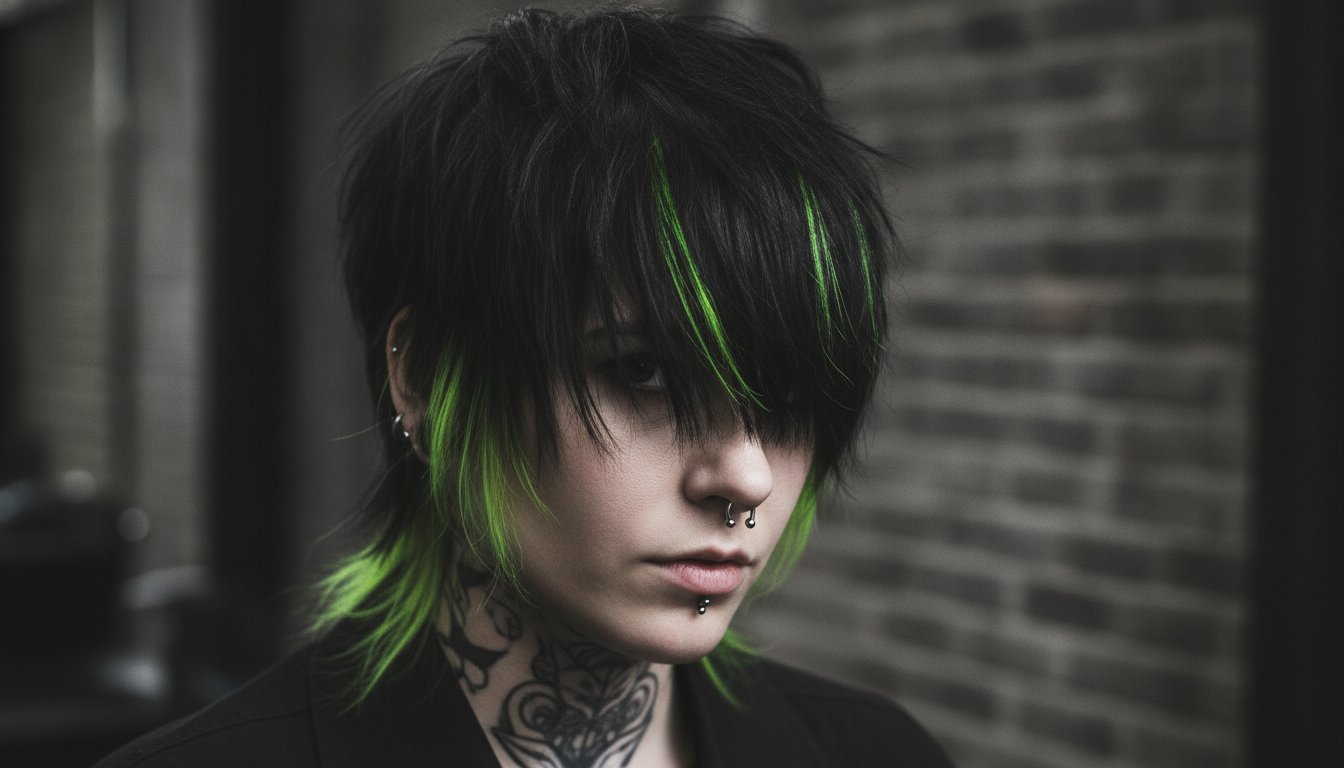
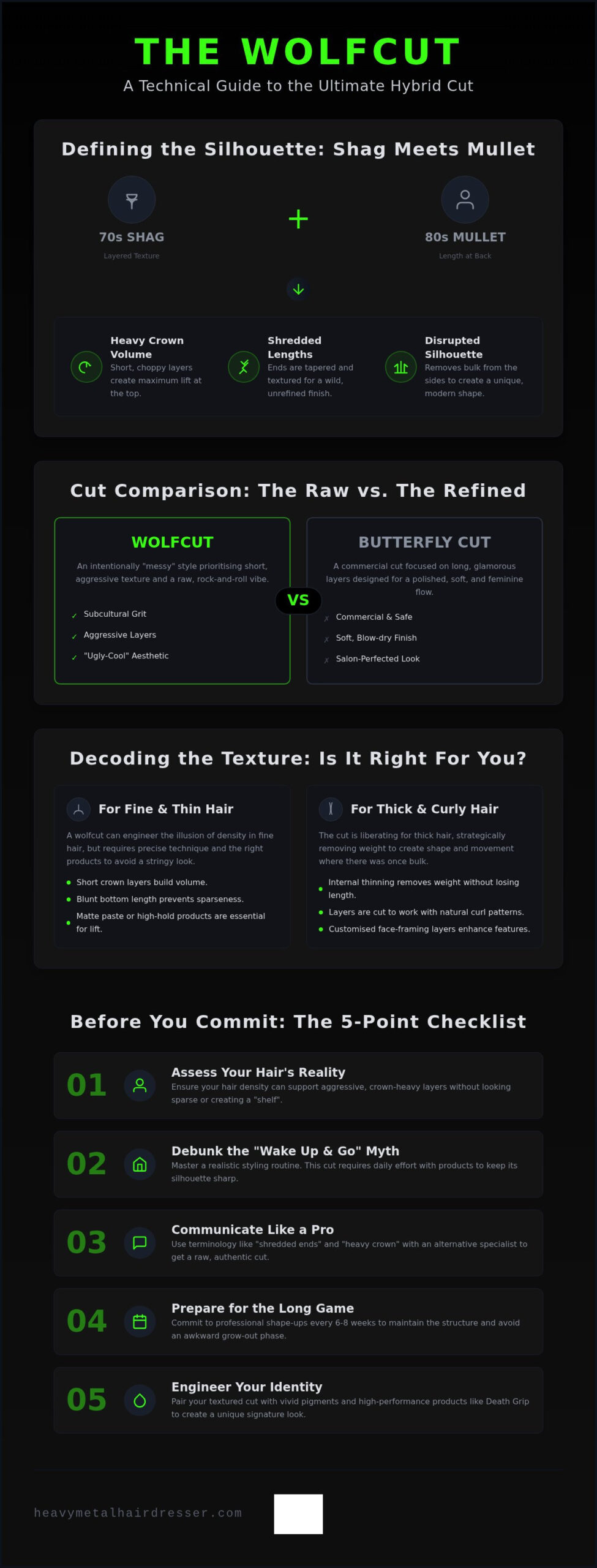
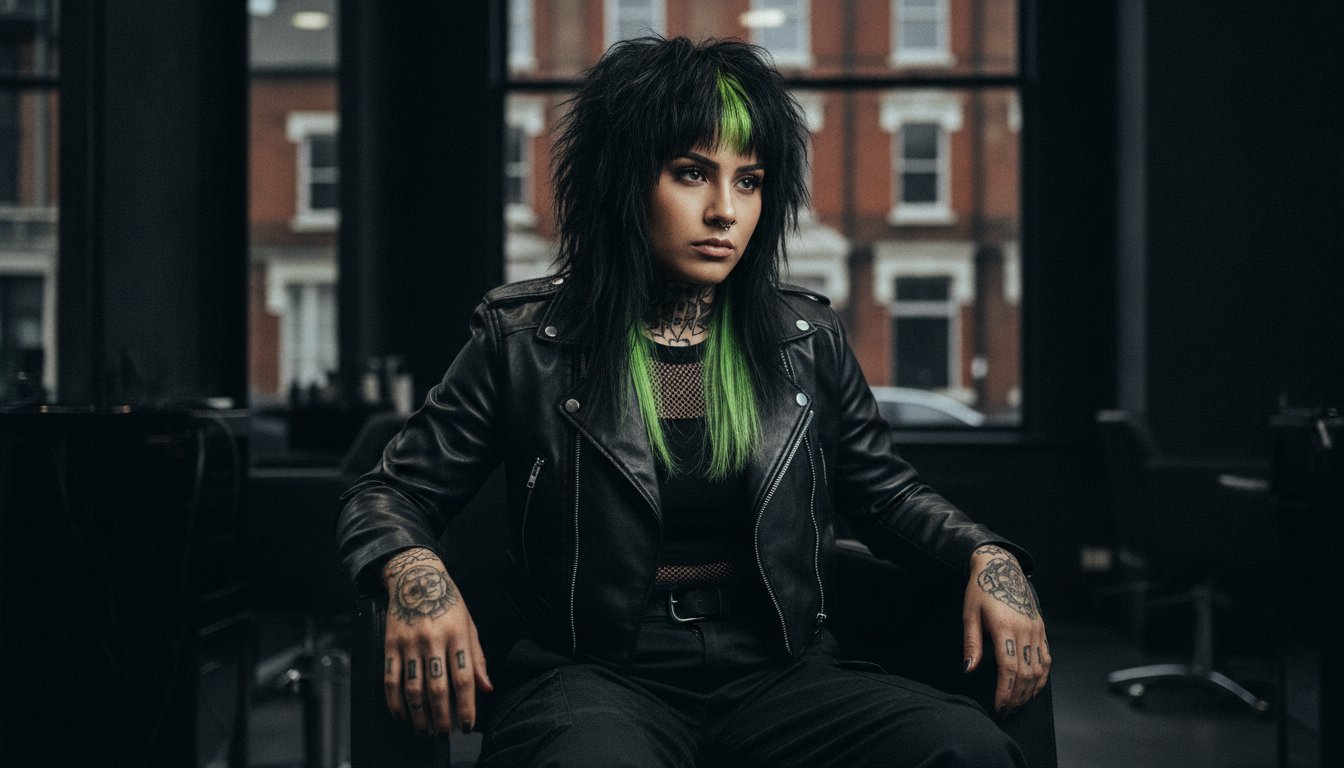
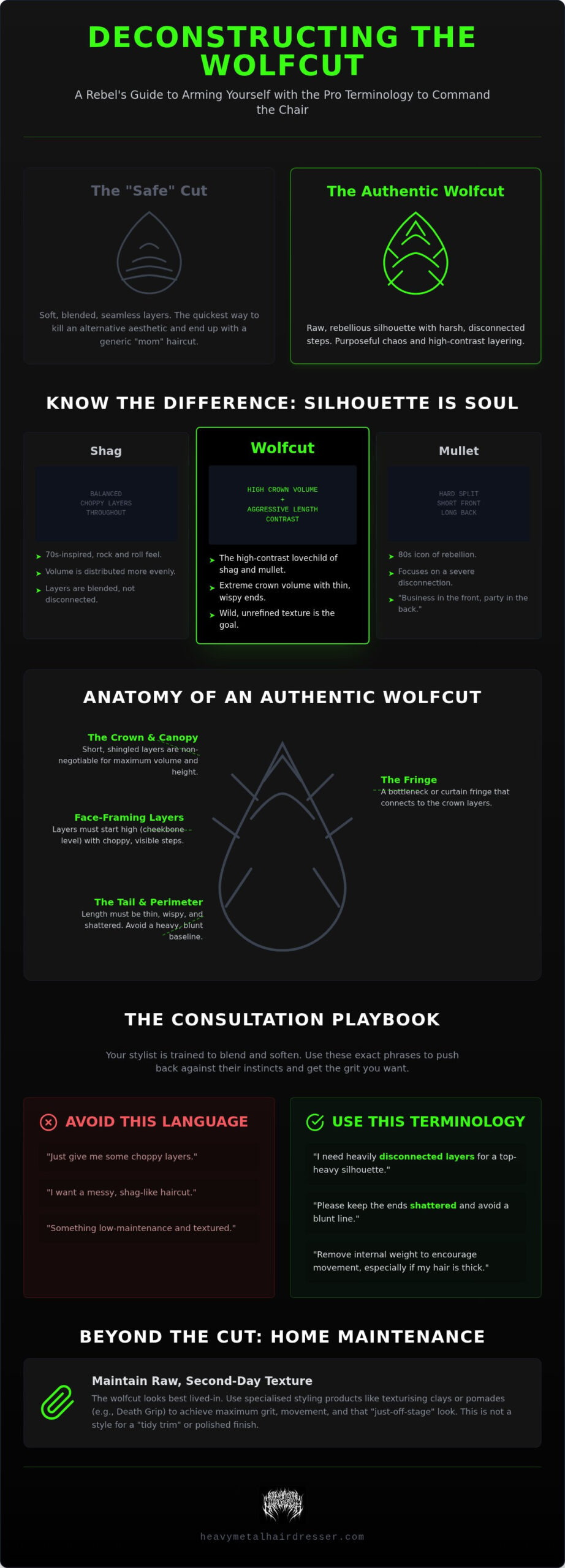
Forget the polished, clinical vibe of high-street salons. The low maintenance wolfcut is a reimagined, 2026 evolution of the subcultural icons that defined the underground scene for decades. It is a deliberate, high-energy hybrid of the modern take on the shag and the rebellious, anti-establishment 80s mullet. This isn’t just a trend; it’s an engineering feat designed for those who value grit over grooming. It thrives on imperfection. It looks better when it’s lived-in, sweaty, and slightly chaotic. A low maintenance wolfcut is a precision-layered shape that utilises natural hair movement to create volume without effort.

The Anatomy of the Wolfcut

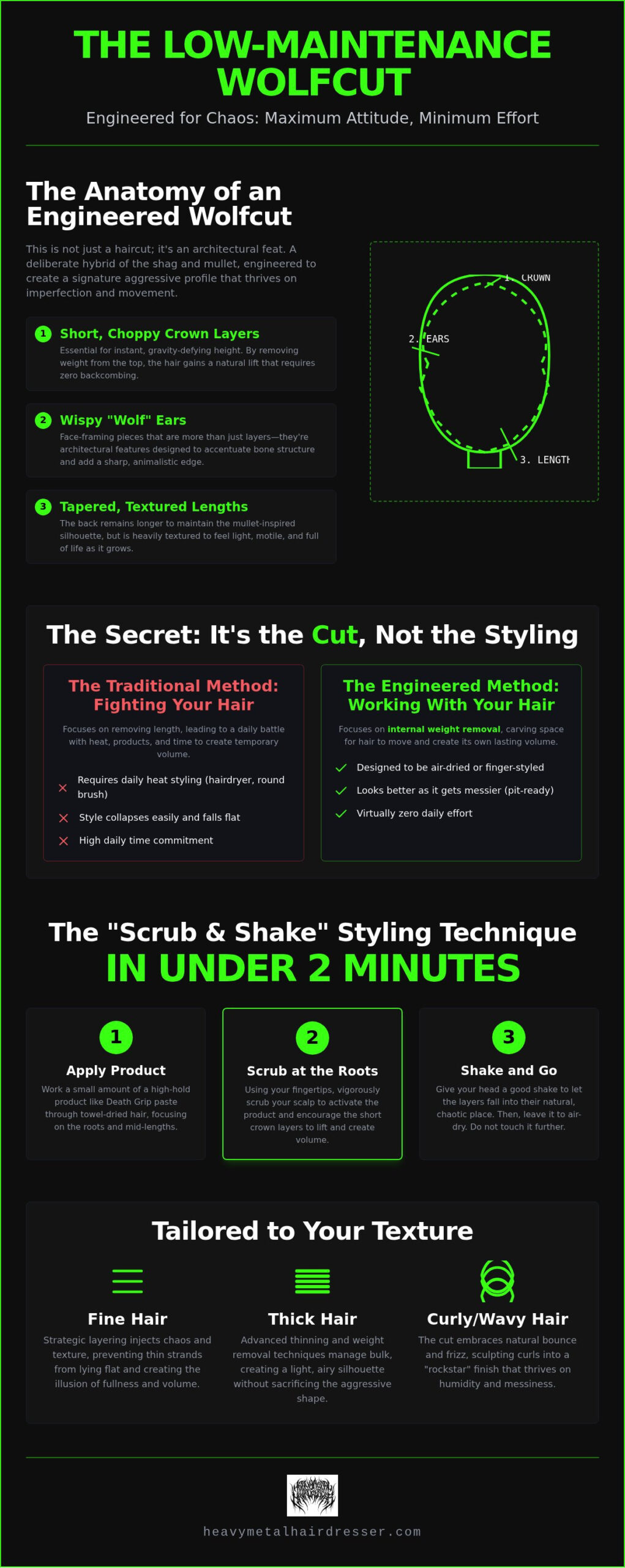
To understand why this style works, you have to look at the architecture of the cut itself. We don’t do “safe” layers here. Instead, we focus on three core elements that create that signature aggressive profile:

  • Short, choppy crown layers: These are essential for instant height. By removing weight at the top, the hair gains a natural lift that stays put even without backcombing.
  • Wispy “wolf” ears: These face-framing pieces aren’t just layers; they are architectural features. They accentuate bone structure and add a sharp, animalistic edge to the silhouette.
  • Tapered lengths: The back remains longer but heavily textured. This maintains the classic mullet-inspired shape whilst ensuring the hair doesn’t feel heavy or lifeless as it grows.

Why “Low Maintenance” Isn’t Just a Buzzword

True low maintenance wolfcut engineering comes from technical weight removal. We aren’t just cutting length; we’re carving out space within the hair so it moves by itself. Unlike the “social media wolfcut” that requires a mountain of product and a round brush to look decent, a professional wolf hair cut is built to air-dry. It’s the ultimate pit-ready style. It’s for the people at Download or Bloodstock who don’t have access to a plug socket but still want to look like they’ve just stepped off the main stage.

By focusing on internal structure rather than surface styling, we ensure your hair keeps its shape through every set. You get maximum volume with zero daily graft. It’s a “wash and go” reality that actually works for alternative identities, allowing you to spend your time on your music or your art rather than fighting with a hairdryer. This cut is designed to grow out beautifully, meaning you can push your appointments further apart without losing your edge.

The Technical Secret: Why the Cut Matters More Than the Styling

If your hair looks like a flat, lifeless helmet the moment you step out of the shower, your technical foundation is broken. Most people struggle with their hair because traditional salons focus on length removal. In the alternative scene, we focus on weight removal. This is the fundamental secret of the low maintenance wolfcut. By carving weight out from the internal structure of the hair, we create pockets of space that allow your strands to move, breathe, and stand up on their own. It isn’t about how you style it; it’s about how we engineer it in the chair.

We often favour a razor over standard shears to achieve that signature “lived-in” grit. Whilst shears create blunt, clean lines, a razor produces tapered, irregular ends that mimic the raw energy of a subcultural aesthetic. This approach is entirely gender-neutral. We don’t care about binary “men’s” or “women’s” styles. We care about the silhouette and how a wolf hair cut can be tailored to your specific bone structure and hair density.

Aggressive Layering for Maximum Volume

To prevent your hair from looking like a mushroom, we use disconnected layers. These layers don’t blend in the traditional, polished sense; they stack. The shorter internal layers act as a “scaffold,” physically pushing the longer top sections upwards to create height that doesn’t collapse. This structural support is what makes the style so easy to live with. Whether you opt for aggressive micro-bangs or heavy, face-shrouding curtains, the fringe is always integrated into these layers to ensure the shape remains balanced as it grows out.

Adapting the Wolfcut to Your Hair Type

The beauty of a low maintenance wolfcut is its versatility across different textures. For those with fine hair, we inject chaos. By creating shorter, strategic layers, we stop thin strands from lying flat against the scalp. If you have thick hair, it’s all about management. We use advanced thinning techniques that remove massive amounts of bulk without sacrificing the alternative silhouette. For the curly-haired community, this cut is a revelation. We embrace the natural bounce and frizz to create a “rockstar” finish that actually looks better the messier it gets. If you’re ready to stop fighting your hair and start embracing your identity, our Wolfcuts are designed to give you that edge with zero effort.

Low Maintenance Wolfcut Pros and Cons

Don’t get it twisted. A low maintenance wolfcut isn’t about being lazy; it’s about being efficient with your rebellion. Most guides show you highly curated, heat-styled versions that take an hour to perfect. The reality of a proper alt-cut is that it should look like intentional bedhead, not a mistake. If the technical foundation is solid, you should be able to roll out of bed, shake your hair, and look pit-ready. Whilst the wolfcut is low-effort daily, it requires a high-skill initial appointment to ensure the architecture doesn’t collapse the moment you leave the chair.

The pros are undeniable for anyone living outside the mainstream. You get effortless volume that defies gravity and a shape that is entirely air-dry friendly. It also works brilliantly with vivid hair colour. Because you’re ditching the daily heat styling, your high-pigment saturation lasts significantly longer without fading into a dull mess. The only real “con” is the need for a specialist. This isn’t a high-street trim. You’ll also need a “dusting” every 8 to 10 weeks to keep the internal weight from dragging the silhouette down.

Is the Wolfcut Right for You?

Assessing your lifestyle is the first step. If you’re a “wash and go” person who hates the clinical feel of traditional styling, this is your match. You need to decide between the low maintenance wolfcut and its cousin, the modern mullet haircut. The wolfcut offers more face-framing softness whilst the mullet leans into sharper, more aggressive disconnection. Because we customise the layers to your specific bone structure, this style is universally inclusive and works across all gender identities and face shapes.

The “Growing Out” Survival Guide

One of the greatest technical triumphs of this style is how it transitions over time. As the aggressive crown layers grow, the silhouette naturally evolves into a shag haircut. It retains its subcultural edge even as it gains length. To keep the shape sharp between salon visits, focus on maintaining the fringe. A quick trim around the eyes can keep the look intentional for weeks. When the crown starts to lose its natural lift and feels heavy, that’s your signal to book a shape-up appointment to restore the grit.
The Low Maintenance Wolfcut: Aggressive Texture Without the Daily Graft

How to Style Your Wolfcut in Under Two Minutes

If you’re still reaching for a round brush, you’ve missed the point entirely. A low maintenance wolfcut is designed to look best when it’s left to its own devices. Traditional salons will tell you to blow-dry with high heat and curling tongs to get that curated “social media” look. We disagree. Finger-styling is the only way to achieve a true alt-aesthetic. It keeps the texture raw and prevents the layers from looking too polished. This isn’t about perfection; it’s about character. By using the “Scrub and Shake” method, you can walk out the door in minutes whilst your hair does the heavy lifting.

Your choice of weapons matters. You need grit-focused products that enhance the internal structure we’ve carved into your hair. On day two, don’t reach for the shampoo. A blast of dry shampoo and a bit of attitude is usually enough to refresh the volume. The natural oils actually help the layers clump together, creating that sought-after lived-in feel that defines the subculture. It’s about working with your hair’s natural behaviour rather than fighting it.

The Air-Dry Routine

Mastering the air-dry is the key to reclaiming your morning. Follow these steps for a perfect finish every time:

  • Step 1: Squeeze out excess moisture with a microfibre towel. Never rub your hair; it ruins the cuticle and creates unwanted frizz.
  • Step 2: Apply a small amount of texture cream or a sea salt spray through the mid-lengths and ends whilst the hair is damp.
  • Step 3: “Scrunch” the layers upwards towards the scalp to encourage natural movement and wave.
  • Step 4: Leave it alone. The more you touch it whilst it dries, the more you disturb the shape. Let the air do the work.

Emergency Styling for the Mosh Pit

When the lights go down and the pit opens up, you need a style that stays out of your eyes without losing its edge. Use heavy-duty products like Death Grip to ensure your texture survives the set. If you need to pin it back, avoid generic “pretty” clips. Opt for a grunge aesthetic with matte black slides or a simple headband that keeps your vision clear whilst you’re in the thick of it. This cut is built for high-energy environments, so don’t be afraid to let it get messy. If you’re ready to embrace a style that works as hard as you do, check out our Wolfcuts and book your transformation today.

Why Heavy Metal Hairdresser is the Ultimate Destination

Simon Tuckwell founded this space with a single mission: to create a safe haven for alternative identities. We don’t do “traditional.” We specialise in the aggressive, the unconventional, and the unapologetically loud. This is a gender-inclusive environment where your identity is celebrated, not just tolerated. Whether you’re a musician on the main stage or a fan in the front row, we understand the subcultural grit that defines your world. Our heritage stretches from the mud of Bloodstock to the high-energy atmosphere of our salon floor. We’ve spent years perfecting styles that thrive in the heat of the pit.

We don’t believe in the polished, clinical feel of high-street service industries. Our vibe is raw, authentic, and community-driven. When you walk into our space, you’re entering a sanctuary for the misfits and the rebels. We take pride in being outside the mainstream. Every low maintenance wolfcut we create is a piece of architectural rebellion designed to empower you. We’re not just cutting hair; we’re helping you claim an alternative identity that demands respect without requiring a daily struggle in front of the mirror.

The Alternative Hair Specialist Advantage

Taking a reference photo for a low maintenance wolfcut to a high-street barber is a recipe for disaster. They often lack the technical understanding of alternative silhouettes, resulting in a cut that feels safe rather than sharp. We aren’t interested in making you look “presentable” for a corporate office. We focus on identity-affirming styling that reflects who you actually are. Our stylists have mastered the art of stage hair for musicians, ensuring your texture survives the lights and the chaos of a live set. We understand how to manipulate weight and density to create a shape that holds its own.

Ready to Join the Pack?

Your first consultation isn’t a clinical checklist. It’s a direct dialogue about your aesthetic, your music, and your lifestyle. We customise every cut to match your specific subcultural vibe, ensuring the layers work with your natural movement. We’ll discuss how to maintain that aggressive texture whilst keeping the daily graft to a minimum. You aren’t just getting a haircut; you’re joining a community that values self-expression above all else. Stop settling for a style that doesn’t fit your soul. Book your low maintenance wolfcut transformation today! and claim the identity you were meant to have.

Claim Your Chaos and Ditch the Daily Graft

A true low maintenance wolfcut isn’t a result of luck; it’s a result of precision engineering. We’ve shown you that by focusing on internal weight removal and aggressive layering, you can finally bin the round brushes and ditch the heat damage. Your hair should be pit-ready from the moment you wake up. This style thrives on your natural movement whilst offering a gender-inclusive silhouette that evolves beautifully into a shag over time. It’s about reclaiming your time and your identity without compromising on that essential alt-aesthetic.

Ready to stop fighting your hair and start embracing who you really are? As official stylists for bands at Download and Bloodstock, we’re the specialists in alternative grit and subcultural texture. Our salon is a dedicated safe space for the misfits, the rebels, and everyone in between. It’s time to let your hair do the talking whilst you focus on the music. Book Your Alternative Cut at Heavy Metal Hairdresser and join a pack that celebrates individuality. Your best, messiest look is just one appointment away.

Frequently Asked Questions

Does a wolfcut look good unstyled?

A wolfcut looks incredible unstyled if the architecture is built on internal weight removal. It’s designed to look like intentional bedhead rather than a mistake. You don’t need a round brush to make it work. The goal is a raw, gritty texture that thrives on your natural movement. If your stylist understands alternative shapes, your hair will have a built-in silhouette that looks pit-ready from the moment you wake up.

Is a wolfcut high maintenance for straight hair?

It isn’t high maintenance for straight hair if you ditch the expectation of a polished finish. We use disconnected layers to prevent straight strands from looking like a flat helmet. By creating a structural scaffold within the cut, your hair gains natural volume without heat. You just need a bit of salt spray and a quick shake to encourage that signature aggressive texture. It’s about embracing a messy, effortless vibe.

How often should I trim my wolfcut to keep it low maintenance?

You should aim for a trim every 8 to 10 weeks to keep the internal structure from collapsing. This “dusting” ensures the weight removal remains effective and the crown layers stay light. A low maintenance wolfcut stays easy to style because the architecture supports itself. If you leave it too long, the silhouette can become heavy and lose its edge. Regular maintenance keeps the shape sharp whilst allowing you to grow it out.

Can I get a wolfcut if I have very thin hair?

You can absolutely get a wolfcut with thin hair because the aggressive layering actually creates the illusion of density. We focus on injecting chaos into the strands to stop them from lying flat against your scalp. By removing weight in specific areas, we allow the remaining hair to bounce and stack. This creates a much fuller, more textured silhouette than a traditional blunt cut ever could. It’s a game-changer for fine hair types.

What is the difference between a wolfcut and a shag?

The wolfcut is a more aggressive, disconnected evolution of the classic shag. Whilst a shag features blended layers for a softer 70s feel, the wolfcut leans into the sharp disconnection of an 80s mullet. It has shorter crown layers and more dramatic face-framing “wolf” ears. It’s a higher-energy shape that prioritises grit and subcultural edge over the more bohemian, rounded silhouette of a traditional shag.

Do I need specific products for a low maintenance wolfcut?

You only need a few grit-focused weapons to keep your look sharp. Ditch the heavy oils and silicones that weigh hair down. Instead, opt for a sea salt spray or a professional texture cream to enhance the internal layers. If you’re heading into a mosh pit, a heavy-duty product like Death Grip provides the maximum hold needed to survive the set. The right low maintenance wolfcut products should provide volume without feeling greasy.

Is the wolfcut a gender-neutral hairstyle?

The wolfcut is a fiercely gender-neutral hairstyle that celebrates individuality across all identities. We don’t believe in binary “men’s” or “women’s” cuts. We focus on bone structure and subcultural aesthetic to create a shape that feels authentic to you. Our salon is a safe space where anyone can claim an alternative identity through aggressive texture. It’s a versatile, inclusive look that works for anyone ready to step outside the mainstream.

What happens if I don’t blow-dry my wolfcut?

If you don’t blow-dry your wolfcut, it actually develops a more authentic, lived-in texture. The cut is engineered to be air-dry friendly, so leaving it alone prevents the frizz caused by excessive handling. You’ll get a raw, gritty finish that perfectly suits the alternative scene. Just use the “Scrub and Shake” method whilst it’s damp and let the air do the heavy lifting. It saves time and keeps your hair healthier.
Posted on

Wolfcut for Thin Hair: Engineering Volume and Aggressive Texture in 2026

Wolfcut for Thin Hair: Engineering Volume and Aggressive Texture in 2026

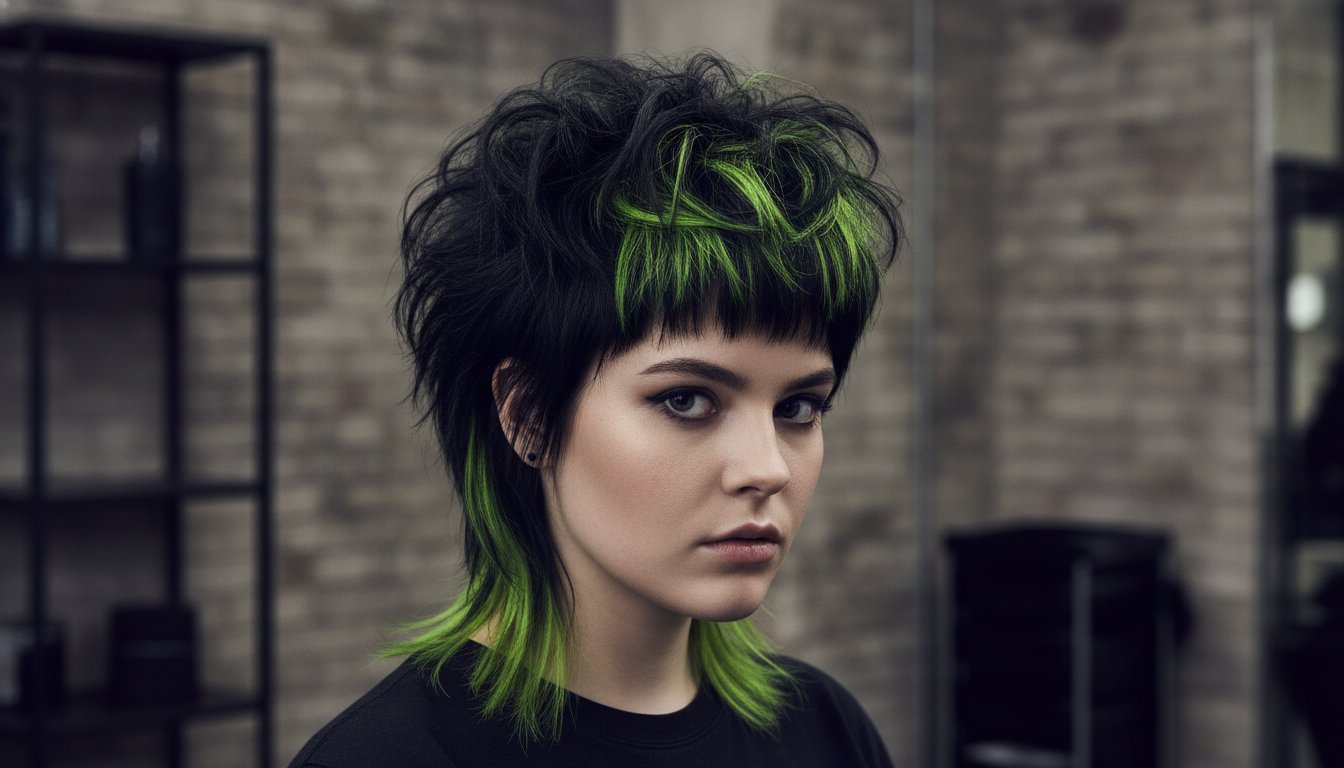
Traditional styling tells you that layers are the enemy of fine hair. They claim you need a blunt, heavy baseline to fake density. They’re wrong. A wolfcut for thin hair isn’t about stripping away what little you have. It’s about strategic architecture. If you’re tired of your hair looking flat and lifeless by midday, you’re in the right place. You want an edgy style that matches your identity, but you’re terrified a stylist will hack away your volume and leave you with stringy ends.

We’re here to kill the myth that alternative cuts are reserved for the thick-haired elite. This guide shows you how to engineer a high-volume, rebellious look using Z-shaped sectioning and professional tools like Death Grip. You’ll discover how shorter layers can actually prop up your length instead of thinning it out. We’re diving into the specific 2026 techniques that create a gritty, textured finish whilst keeping your routine low-maintenance. Stop settling for mainstream boredom. It’s time to transform those thin strands into a weapon of self-expression through expert layering and aggressive texture.

Key Takeaways

  • Shatter the myth that you need massive density to pull off a wolfcut for thin hair by mastering strategic, internal layering.
  • Discover why preserving the perimeter is the secret to keeping your ends from looking stringy or see-through whilst building height at the crown.
  • Learn to distinguish between the top-heavy wolfcut silhouette and the balanced shag to decide which alternative style best serves your volume goals.
  • Master a low-maintenance styling routine using professional tools like Death Grip to keep your texture aggressive and your volume locked in.
  • Understand why seeking an expert eye in alternative textures is vital for avoiding the clinical, flat results of traditional high-street cutting techniques.

Wolfcut for Thin Hair: Can You Actually Pull It Off?

Most internet forums will tell you that a wolfcut for thin hair is a disaster waiting to happen. They claim you need massive density to make it work. They’re wrong. The wolfcut is a rebellious hybrid of the 70s shag and the 80s mullet. It’s a modern variation of the shag that thrives on movement rather than bulk. You don’t need a heavy mane to achieve a high-impact look. You just need a stylist who understands hair architecture.

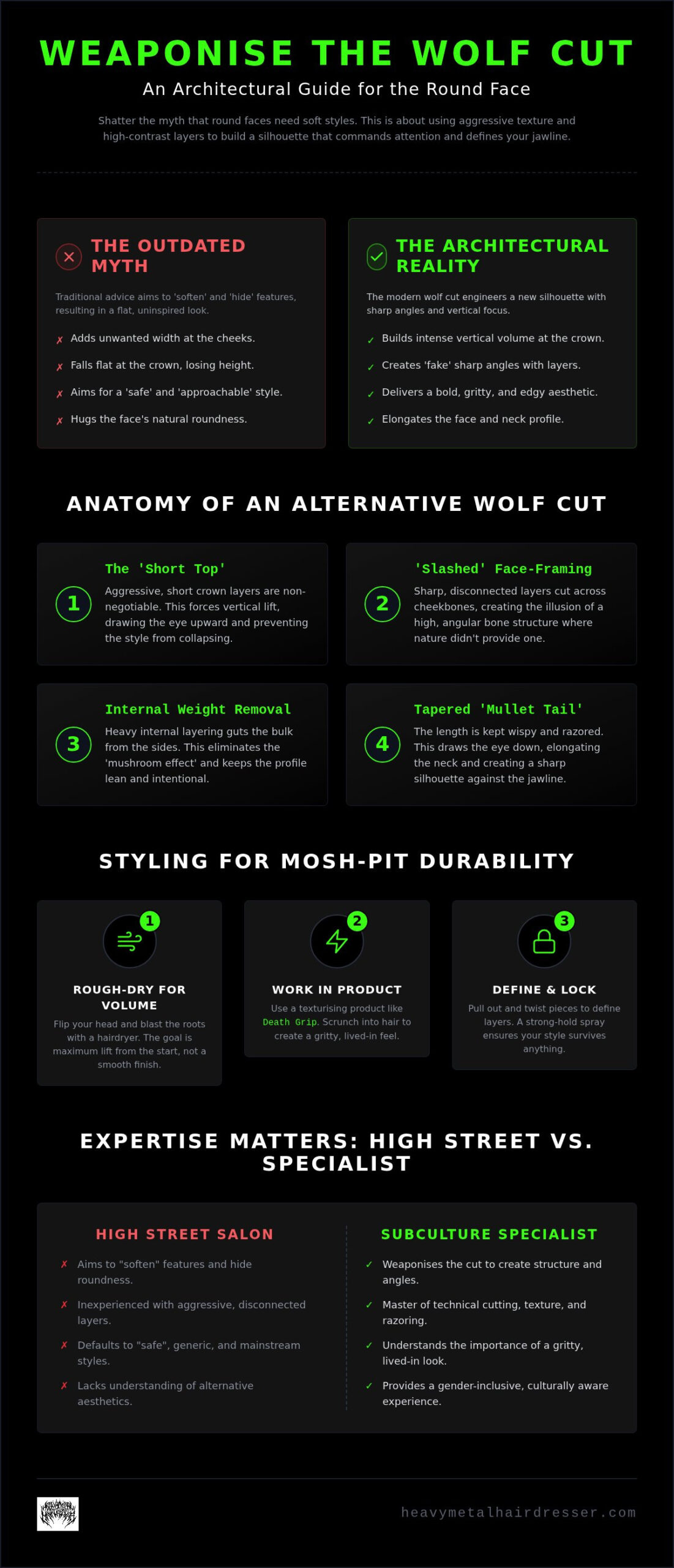
The anxiety you feel about layers is valid. Traditional thinning techniques often leave fine strands looking stringy or hollow. However, the wolfcut creates an illusion of thickness through aggressive crown volume. By concentrating short, choppy layers at the top, we create a visual anchor that draws the eye upward. This provides the height and grit that flat hair usually lacks by midday. We’re not just cutting hair; we’re engineering a silhouette that fights back against gravity.

Why Fine Hair Craves Alternative Texture

Traditional blunt cuts are safe, but they’re also heavy. They pull fine hair down, making it look limp and lifeless. A wolfcut for thin hair introduces disconnected movement that breathes life into your style. These shorter internal layers act as a physical scaffold, propping up the longer pieces so they don’t lie flat against your scalp. Beyond the mechanics, there’s the psychological boost. Wearing a cut that aligns with your alternative identity feels like armour. It’s about taking up space and refusing to blend into the mainstream.

Identifying Your Hair Type: Fine vs. Thin

Knowing the difference between density and diameter is crucial before you sit in the chair. Fine hair refers to the diameter of the individual strand, whilst thin hair refers to the density, or how many hairs you have per square inch.

Hair density in the context of alternative cutting is the total count of strands available to build the structural walls of your silhouette.

If your hair is fine but dense, you can handle more aggressive disconnection. If it’s truly thin, we focus on preserving the perimeter while engineering height at the crown. A wolfcut is versatile enough to adapt to both. We use professional tools like Death Grip to ensure the texture stays gritty and the volume doesn’t collapse the moment you leave the salon. You don’t have to settle for “mainstream” just because your strands are delicate.

The Mechanics of Volume: Engineering Texture into Fine Strands

Building height in a wolfcut for thin hair requires a fundamental shift in perspective. Most stylists focus on what they’re taking away. We focus on what we’re propping up. The real magic happens through internal layering. This is the volumizing secret for thin hair that creates pockets of air between the strands. By removing weight from the mid-sections whilst keeping the perimeter solid, we prevent the ends from looking stringy or see-through. It’s about maintaining a heavy baseline to anchor the chaos above.

The crown cut is where this style gets its bite. We keep the layers at the top short and aggressive. This creates a self-supporting structure that resists the midday slump. We often debate the use of razors on fine hair. A razor can create incredible, feathered texture, but it’s a high-stakes game. In the wrong hands, it shreds the cuticle and makes thin hair look frizzy. We prefer precision shears or a fresh blade used with expert control to ensure the hair remains healthy and bold.

Sectioning for Success

We don’t just hack away. We organise the hair using Z-shaped sectioning to identify exactly where to leave the weight. This technique allows for strategic disconnection. We can create massive volume at the crown without sacrificing the density of your length. One hard rule: we avoid thinning shears. Those tools are designed to strip bulk from thick manes. On fine strands, they’re a disaster. They remove the very density we need to build a rebellious silhouette.

The Role of Face Framing

Aggressive face framing acts as a visual distraction. By concentrating texture around the eyes and cheekbones, the overall density of your hair becomes less of a focus. Curtain bangs are the perfect partner for a wolfcut for thin hair. They blend into the shorter crown layers, creating a seamless flow of movement. We customise the length to sharpen your jawline, ensuring the volume stays locked in place. If you’re ready to ditch the flat look, explore our specialist Wolfcuts to see how we engineer these shapes for alternative identities.

Wolfcut for Thin Hair: Engineering Volume and Aggressive Texture in 2026

Wolfcut vs. Modern Shag: Which Alternative Style Wins for Thin Hair?

Choosing between a wolfcut and a shag isn’t just about the ‘vibe’; it’s a tactical decision based on your hair’s breaking point. The wolfcut is unapologetically top-heavy. It borrows the mullet’s DNA to create a high-contrast shape that screams for attention. Conversely, the modern shag offers a more balanced distribution of texture. Whilst both styles utilise layers to fight flatness, a wolfcut for thin hair relies on a disconnected ledge to fake density where nature failed. If your hair is pin-straight, the wolfcut provides the artificial structure you’re missing. If you’ve got a bit of natural wave, the shag will coax that movement out without making it look forced.

Maintenance is another battlefield. If you’re living in the mosh pit or travelling between festivals, you need a cut that survives the chaos. The shag is forgiving. It grows out into a lived-in, organic shape that requires minimal intervention. The wolfcut demands a bit more discipline. To keep that aggressive crown volume from collapsing into a mullet-lite, you’ll need regular trims to maintain the structural integrity of those shorter top layers. A wolfcut for thin hair isn’t just about the initial chop; it’s about how that shape behaves when you’re three days deep into a festival without a shower. The wolfcut relies on that ‘bite’ at the crown to stay relevant, whereas the shag just gets more ‘grunge’ as it settles.

The Shag: A Softer Alternative?

If your ends are particularly sparse, the shag is often the smarter play. It blends layers more seamlessly, preventing that see-through look that can plague finer strands. It’s about building an organic, effortless movement that masks a lack of density. You can read more about why this style continues to dominate in our piece on The Shag Haircut Resurrection. It provides a safer route to engineering volume for fine hair without the high-stakes disconnection of its wilder cousin. The shag allows for a softer transition that still feels fiercely independent.

The Wolfcut: For the Bold and the Gritty

The wolfcut is for those who refuse to play it safe. By embracing the mullet influence, we create a silhouette that is intentionally undone. This disconnection is the ultimate thin hair hack. It allows us to keep the length you’ve worked hard to grow whilst the crown is hacked into a voluminous, textured crown. This contrast creates a visual weight that a standard layered cut simply can’t match. For a deeper dive into the subcultural roots and technical specs, check out The Ultimate Wolf Hair Cut Guide. It’s the go-to choice for a wolfcut for thin hair when you want maximum edge and zero apologies.

Styling Your Wolfcut: Banishing Limp Hair and Embracing Chaos

Styling a wolfcut for thin hair is about creating friction. Traditional salons will reach for a round brush and a blow-dry cream. Ignore them. That’s how you end up looking like a mainstream newsreader from 2004. We want grit. We want movement. The goal is to make your hair look intentionally undone, like you’ve just walked off a stage or out of a mosh pit. When your hair is fine, you aren’t fighting volume; you’re fighting gravity. We use heat and texture to win that battle.

The Essential Alt-Hair Toolkit

Ditch the heavy, silicone-based conditioners that weigh your strands down. We embrace the “dirty” feel because it actually holds a shape. Sea salt sprays add decent texture, but dry texture powders are the real heroes for fine hair. They provide the friction needed to keep those short crown layers standing. Use professional tools like Death Grip to lock in the shape without the sticky residue of traditional hairspray. This ensures your texture stays aggressive rather than crunchy.

Step-by-Step Volume Routine

Start with the upside-down dry. It’s the oldest trick in the book for a reason. By drying the roots in the opposite direction of growth, you build a foundation of volume that won’t collapse by lunchtime. Once dry, use a flat iron to create sharp flicks at the ends. Don’t curl it into ringlets. We want jagged, rebellious edges that highlight the disconnected layers we engineered during the cut. This creates a visual weight that makes the hair appear much thicker than it is.

Finish with the “scrunch and set” method. Sprinkle a little texture powder into your palms, rub them together, and literally claw at your roots. This activates the product and gives you that piecey, lived-in look without the grease. If you’re heading to festivals like Download or Bloodstock, your wolfcut for thin hair needs to survive three days of sweat and rain. Don’t wash it. Use dry shampoo as a preventative measure on day one. It keeps the volume high and the grease low whilst you’re busy living. Ready to command your own style? Grab some Death Grip and start engineering your volume now.

Professional Execution: Why Your Alternative Cut Needs an Expert Eye

High-street salons usually play it safe. They see thin strands and panic. Most traditional stylists will try to talk you into a blunt bob because they’re terrified of removing weight. But a wolfcut for thin hair isn’t about playing by the rules. It’s about subcultural grit and architectural precision. You need a stylist who understands that “thin” doesn’t mean “weak”. It means we have to be smarter with how we distribute the volume.

The Heavy Metal Hairdresser approach was forged in the chaos of the UK alternative scene. We’ve spent years styling backstage at festivals like Download and Bloodstock. We know how to make hair look aggressive and intentional, even when the density isn’t there. We operate as a gender-inclusive safe space where your identity is celebrated. When you sit in our chair, you don’t need hair industry jargon. Tell us about your favourite subcultures or the energy you want to project. We’ll handle the technical disconnection.

Finding Your Specialist

Don’t trust a portfolio full of polished, mainstream waves. When hunting for a specialist, look for raw, jagged texture and unconventional shapes. Simon Tuckwell’s team prioritises individuality over fleeting trends. We look for the “bite” in a haircut. A specialist in alternative aesthetics knows how to use Z-shaped sectioning to protect your perimeter whilst hacking into the crown for maximum height. We aren’t here to give you a “nice” haircut; we’re here to give you a weapon against flat hair.

Maintenance and Next Steps

To keep your silhouette from collapsing, you’ll need to visit us every 6 to 8 weeks. This ensures the shorter layers stay light enough to prop up the rest of the style. If you want to push the illusion of thickness even further, we recommend integrating vivid colours. High-contrast panels or a darker shadow root can create a sense of depth that makes your hair appear twice as thick as it actually is. It’s time to stop hiding behind safe, boring cuts. Book your alternative transformation today and embrace the chaos.

Command Your Volume: The Future of Fine Hair

You don’t have to settle for the “safe” blunt cut that the high street keeps pushing on you. Engineering a wolfcut for thin hair is about rejecting the idea that fine strands are limited. We’ve shown you how Z-shaped sectioning and internal layering create a physical scaffold that fights gravity. It’s about using aggressive texture at the crown to distract from a lack of density at the ends. Whether you choose the sharp disconnection of the wolf or the organic flow of the shag, your hair can be a weapon of self-expression.

Our team has spent years perfecting these silhouettes backstage at major UK festivals like Download and Bloodstock. We don’t do mainstream. We are a gender-inclusive safe space specialising in aggressive texture and creative colour. It’s time to stop fearing the scissors and start embracing the chaos. You deserve a style that aligns with your identity whilst giving you the volume you’ve been chasing. Claim your alternative identity at Heavy Metal Hairdresser and let’s build something bold together. Your hair has potential; we’re just here to unlock it.

Frequently Asked Questions

Will a wolfcut make my thin hair look even thinner?

A wolfcut for thin hair actually creates the illusion of more density when executed by a specialist. By engineering shorter, aggressive layers at the crown, we create a structural scaffold that prevents the hair from lying flat. Traditional stylists often fear removing weight, but the disconnected layers of a wolfcut provide the lift that fine strands desperately need. It’s about strategic architecture rather than just hacking away at your length.

How do I style a wolfcut for thin hair without it looking flat?

The key is building grit from the roots up. Start with an upside-down rough dry to force the follicles into a high-volume position. Once the hair is dry, apply a dry texture powder or a professional tool like Death Grip to the roots. Avoid heavy, silicone-based serums that cause fine hair to collapse. Instead, focus on “piecing out” the ends with your fingers to maintain that rebellious, disconnected silhouette throughout the day.

Can I have a wolfcut if I have straight, fine hair?

Straight, fine hair is actually a perfect canvas for the sharp, jagged edges of a wolfcut. Whilst wavy hair has natural movement, straight hair allows the disconnected layers to stand out with more architectural precision. You’ll rely more on styling products to keep the volume locked in, but the cut itself provides the “bite” that straight hair usually lacks. It transforms a mainstream, flat look into something much more aggressive and intentional.

What is the difference between a wolfcut and a shag for thin hair?

It comes down to the silhouette and the level of disconnection. A wolfcut is a top-heavy hybrid of a shag and a mullet, featuring much shorter layers at the crown and a sharper contrast with the length. A shag is generally more organic and blended. For thin hair, the wolfcut is often the bolder choice because the aggressive crown layers act as a physical lift, whereas a shag focuses on a more uniform texture.

How often should I get my wolfcut trimmed to maintain volume?

You should aim for a trim every 6 to 8 weeks to keep the shape from becoming bottom-heavy. As those short crown layers grow out, they lose their ability to support the rest of the style, leading to a flatter appearance. Regular maintenance ensures the “bite” of the cut stays sharp and the volume remains engineered at the top. This is especially vital for fine hair, where even an extra centimetre of growth can weigh the style down.

What are the best products for a thin hair wolfcut?

Focus on products that add friction without weight. Dry texture powders and volumising dusts are essential for keeping the crown layers elevated. Sea salt sprays are great for adding a matte, gritty finish to the mid-lengths. We recommend using a professional texture tool like Death Grip to hold the shape in place. Ditch the heavy conditioners and oil-heavy primers, as these are the primary enemies of a long-lasting, high-volume wolfcut for thin hair.

Do I need to blow-dry my wolfcut every day?

You don’t have to blow-dry daily, but it’s the fastest way to reactivate your volume. If you’re short on time, a quick blast at the roots whilst hanging your head upside down works wonders. On non-wash days, you can simply scrunch in some dry shampoo or texture powder to refresh the grit. The wolfcut is designed to look lived-in and undone, so a bit of second-day chaos actually enhances the rebellious, alternative aesthetic.

Is a wolfcut considered a gender-neutral hairstyle?

Absolutely. The wolfcut is a fiercely gender-neutral style that transcends traditional beauty standards. It’s an inclusive choice for anyone looking to express an alternative identity, regardless of gender. Our salon operates as a safe space where we focus on your individual aesthetic and subcultural roots rather than outdated gender norms. Whether you’re aiming for a masculine, feminine, or non-binary look, the wolfcut is a versatile tool for personal empowerment and self-expression.

Posted on

Wolfcut with Fringe: The Ultimate Guide to Aggressive Texture and Subcultural Grit

Wolfcut with Fringe: The Ultimate Guide to Aggressive Texture and Subcultural Grit

The fringe isn’t just a sidekick to your layers; it’s the aggressive anchor that defines the entire subcultural silhouette. A wolfcut with fringe shouldn’t look like a polite salon mistake. It needs to look raw, lived-in, and unapologetically loud. We know the frustration of a fringe that looks far too “done” or “pretty” when you were aiming for pure grit. Dealing with stubborn cowlicks or watching your volume vanish before midday is enough to make anyone reach for the clippers.

You’re in the right place to reclaim that edge. This guide is your blueprint for mastering the wolfcut with fringe, ensuring your look stays high-impact without the high-maintenance faff. We’ll dive into choosing the right fringe for your specific hair texture and reveal the professional styling secrets that keep your volume locked in. Expect a deep dive into aggressive textures and the tools you need to maintain that signature shredded aesthetic. It’s time to stop settling for “nice” hair and start embracing the chaos.

Key Takeaways

  • Understand why the fringe is the non-negotiable anchor of the wolfcut, providing the top-heavy volume that defines this alternative silhouette.
  • Learn how to choose between a high-contrast micro-fringe or a shaggy curtain fringe to best suit your personal subcultural style and hair texture.
  • Discover the “shattered edge” cutting techniques that marry your wolfcut with fringe seamlessly, ensuring you avoid a finish that looks far too polished.
  • Master the “rough dry” method and the use of structural tools like Death Grip to maintain aggressive texture that survives the chaos of a mosh pit.
  • Explore why a gender-inclusive, alternative-focused consultation is vital for crafting a look that truly reflects your individual identity.

The Wolfcut with Fringe: Why the Fringe is the Aggressive Heart of the Look

Forget the “soft” trends you see on social media. The wolfcut with fringe isn’t a haircut for the faint of heart. It’s the bastard child of the 1970s shag and the 1980s mullet, reimagined for a scene that values grit over glamour. While it’s often described as a modern variation of the shag, the wolfcut strips away the softness and replaces it with a jagged, top-heavy silhouette.

The fringe isn’t just an accessory here. It’s the structural engine. Without a heavy, purposeful fringe, the wolfcut loses its bite. It provides that essential weight at the crown, pushing the volume forward and creating a silhouette that feels aggressive rather than just “layered.” In the UK rock and metal scenes, this look serves as a badge of identity. It’s about rejecting the polished norms of the beauty industry in favour of something that feels authentic to the underground. It’s a style that thrives in sweat-soaked venues and mosh pits, looking better as the night gets darker. The wolfcut silhouette is a deliberate balance of chaotic, shattered layers and a heavy, grounded fringe that anchors the entire look.

Shag vs. Wolfcut: The Role of the Fringe

The traditional shag haircut is all about movement and blend. It’s fluid. The wolfcut, however, is built on disconnection and attitude. Where a shag might lean into an “indie-sleaze” softness, the wolfcut leans into heavy metal aggression. We achieve this through disconnected layers in the fringe area, ensuring the transition from the forehead to the crown is sharp and sudden. This isn’t about a seamless flow; it’s about creating visual impact through contrast. The fringe dictates the entire vibe, moving the style from a vintage throwback to a modern alternative statement.

Why Mainstream ‘Polished’ Guides Get it Wrong

Most mainstream guides try to sanitise this look. They talk about “clean girl” wolfcuts or “tame” volume. They’re missing the point entirely. Scruffy isn’t an accident; it’s a technical choice. We don’t want your hair to look like it’s just stepped out of a high-street salon. We want it to look like it has a story. This means embracing natural frizz and the raw texture of your hair. A truly gritty wolfcut with fringe works with your hair’s natural behaviour, using technical point-cutting to make “unruly” look intentional. We focus on the “shredded” finish, ensuring each layer has a job to do in maintaining that chaotic energy.

Anatomy of the Alternative Fringe: Choosing Your Edge

The fringe is the most visible part of your identity. It’s the first thing people see in the pit. When committing to a wolfcut with fringe, you aren’t just getting a trim. You’re choosing an edge that dictates your entire silhouette. This is the difference between a haircut that looks accidental and one that looks like a technical masterpiece of grit.

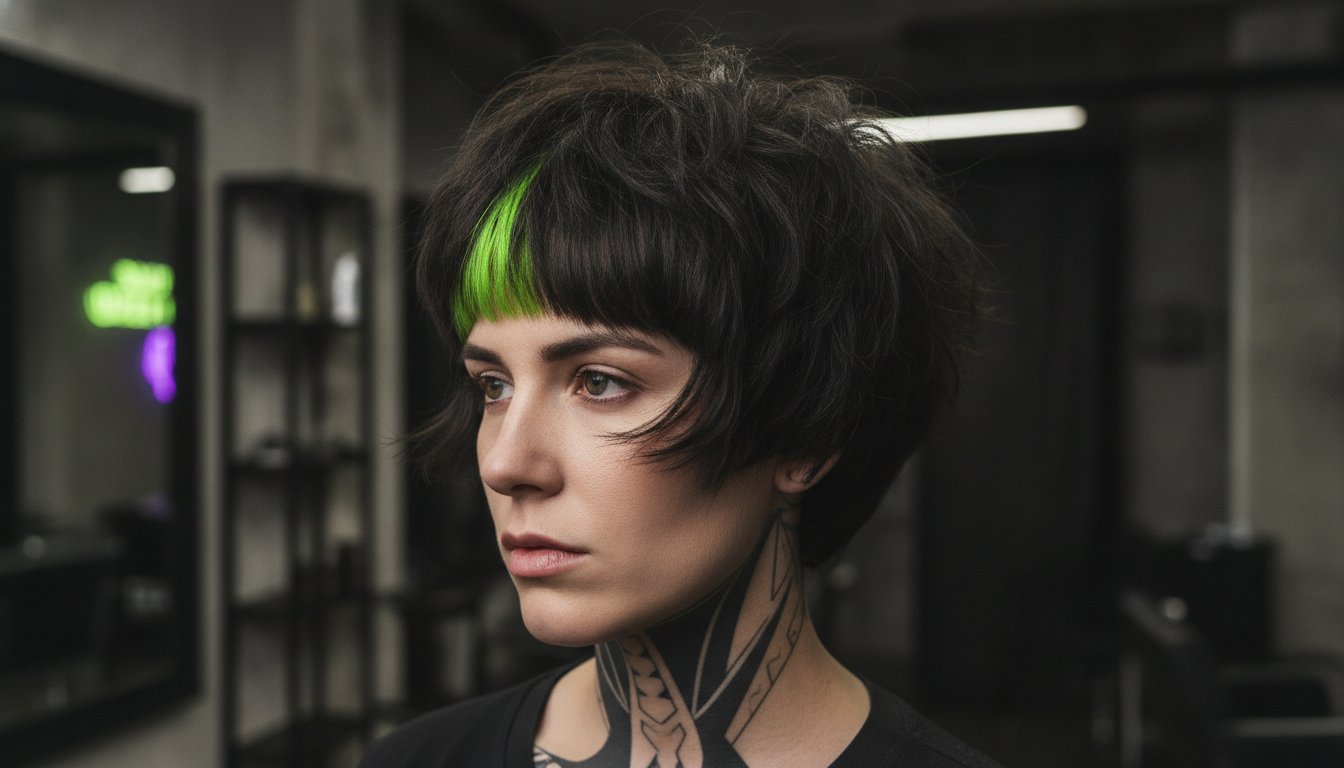
The Micro-Fringe is for the bold. It sits high on the forehead, creating an aggressive, high-contrast look that screams punk. If you want something that flows, the Shaggy Curtain Fringe is your go-to. It’s a classic hybrid of the shag and the mullet, blending seamlessly into your side layers. For those with very thin or exceptionally thick hair, the Heavy Block Fringe provides a solid anchor. It creates a focal point that holds its ground against the chaos of the back layers. During your consultation, don’t just ask for a generic fringe. Talk about weight, shattered edges, and where you want the focus to land.

Matching the Fringe to Your Hair Texture

Curly hair thrives on chaos. We cut curly fringes with enough gap to let the ringlets breathe without adding bulk. For fine hair, a heavy fringe is a technical trick to create the illusion of density. It pulls hair forward to make the front look thicker than it is. If you’re battling cowlicks, don’t reach for the straighteners. We cut into the growth pattern, making the cowlick part of the textured finish.

Face Shapes and Alternative Proportions

Mainstream stylists obsess over “correcting” face shapes. We don’t. Alternative styling is about highlighting what you love. In a wolf hair cut, we use the fringe to frame the eyes and sharpen the cheekbones. It’s about the “Death Grip” on proportions. We balance the width of the fringe with the height of the crown to create a silhouette that feels intentional. If you’re ready to find your edge, explore our specialist wolfcut services to see how we transform standard shapes into subcultural statements.

Wolfcut with Fringe: The Ultimate Guide to Aggressive Texture and Subcultural Grit

Texture, Chaos, and Layering: Marrying the Fringe to the Wolfcut

Engineering a wolfcut with fringe requires more than just hacking at the ends. It’s a technical exercise in over-direction. We pull the hair forward and use aggressive point-cutting to create a shattered edge that looks sharp but feels raw. This isn’t the soft, blended finish you find in high-street salons. Mainstream brands often suggest using a round brush for “bouncy” volume, but that’s the fastest way to kill the subcultural grit. We want the fringe to look like it’s been lived in, not blow-dried into submission. It’s about creating a silhouette that stays aggressive even when the weather turns.

The weight of the fringe is supported by the internal layers of the crown. Without these hidden supports, a heavy fringe would simply hang flat and lifeless. It’s a delicate balance of removing bulk whilst maintaining structural integrity. This foundation is what separates a true wolfcut from a modern mullet haircut. While the mullet focuses on the contrast between the front and back, the wolfcut demands that the fringe and the crown work as one cohesive unit. Most stylists fail at the transition points, leaving the “corners” near the temples too heavy. We ensure those corners are shattered to marry the fringe to the side layers perfectly.

Creating Disconnection for Maximum Impact

Disconnection is our secret weapon. It means the layers don’t meet in a “perfect” line. This creates movement even when you’re standing perfectly still. This is the Simon Tuckwell approach to shattered ends. We don’t want a traditional flow. We want the hair to jump, flick, and stack in ways that feel rebellious and independent. A disconnected fringe creates a high-impact look that doesn’t need constant styling to stay interesting. It’s about technical proficiency disguised as chaos.

The Role of Vivid Colour in Defining Layers

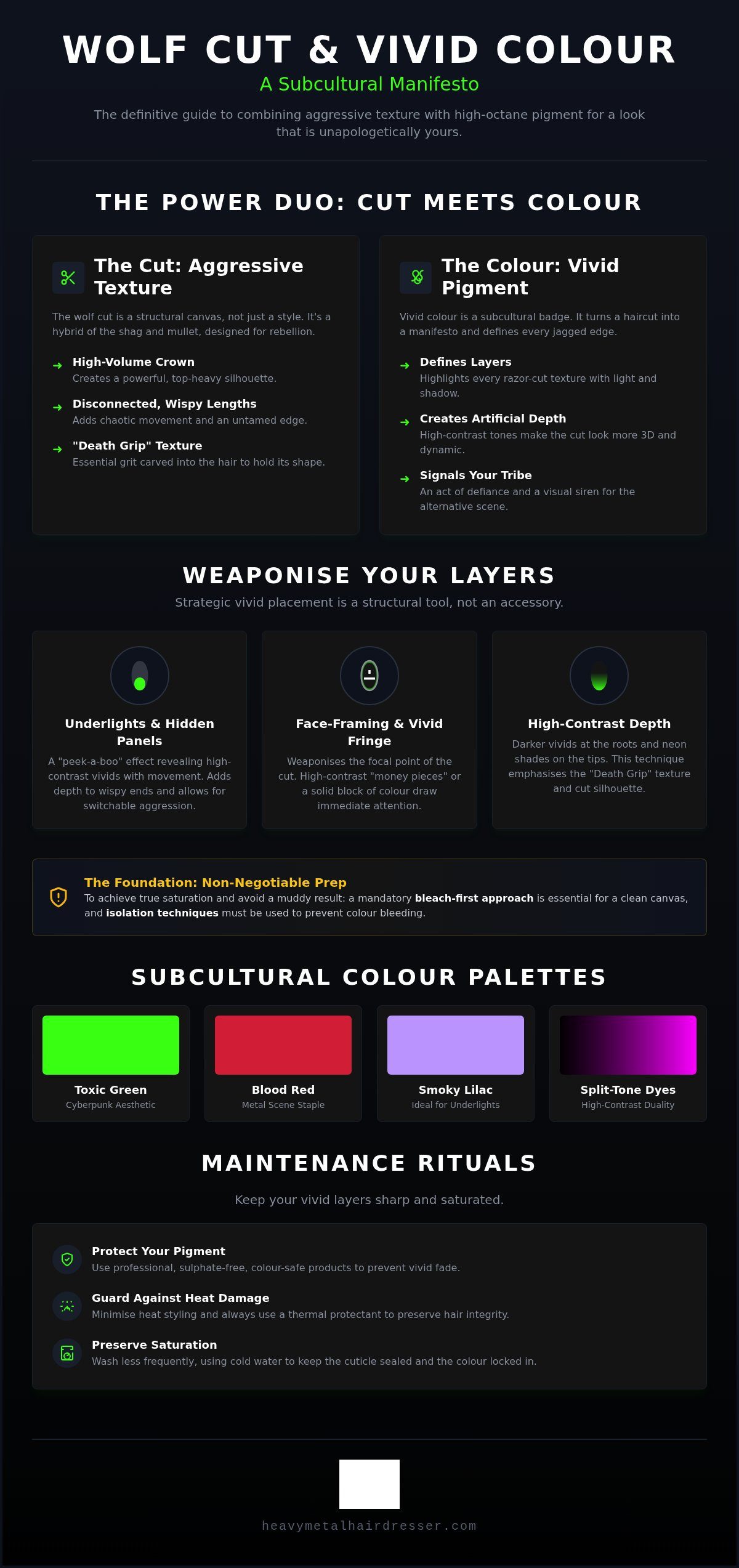
Texture is amplified by vivid hair colour. A flat, single-tone colour can sometimes hide the technical work we’ve done with the shears. Using “peek-a-boo” colours within the fringe adds immediate depth and visual interest. Imagine a deep charcoal base with neon violet or electric green peeking through the shattered edges. It highlights the layers and makes the texture pop under any light. Contrasting your fringe colour against the rest of your hair is a bold subcultural statement. We use high-pigment shades to define where one layer ends and the next begins, ensuring your identity is as loud as your haircut.

Maintenance and Mosh Pits: Keeping Your Wolfcut Fringe Sharp

Getting the cut is only half the battle. A wolfcut with fringe requires a specific maintenance ritual to keep it from looking like a flat, uninspired mess. You aren’t aiming for salon-perfect; you’re aiming for subcultural grit. This starts with ditching the round brush. That tool is for “pretty” hair. For an aggressive silhouette, you need the ‘Rough Dry’ technique. Blast your hair with a dryer whilst using your fingers to shake and lift the roots. This creates the chaotic, textured foundation that defines the look.

Once you’ve built the volume, you need to lock it in. Applying Death Grip or Hair To the Throne provides the structural integrity required for heavy, disconnected layers. These products offer the hold needed to prevent the “mid-day flat” that plagues so many alternative styles. If you do lose volume, don’t reach for the shampoo. Reactivate the texture with a quick blast of air or a small amount of product to wake up the layers. Finally, remember the 6-week rule. A shattered fringe loses its edge as it grows. Professional maintenance is non-negotiable if you want to keep your silhouette sharp.

Mosh Pit Survival Styling

Festivals and gigs are the ultimate stress test for your hair. To ensure your fringe stays in place during a set, the secret is salt spray. It provides a gritty, sweat-resistant texture that actually looks better as the night goes on. It prevents the hair from clumping into a solid mass whilst you’re moving. Post-gig recovery is simple. Detangle with your fingers only. Avoid brushes at all costs, as they strip away the piecey texture you’ve worked so hard to create and leave you with unwanted frizz.

Home Care: Products That Actually Work

Mainstream marketing loves the word “weightless.” In the world of alternative styling, weightless is often a lie. You need products with actual grit and hold to support the weight of a heavy fringe. When using pomades, focus on the ends. This maintains the “piecey” look without making the roots appear greasy. It’s about technical product application that respects the hair’s natural movement. If you’re ready to master your look, check out our range of alternative hair courses to learn professional styling secrets for yourself.

The Heavy Metal Hairdresser Approach: Crafting Your Identity

Traditional salons are built on rules. They follow charts. They aim for “natural” looks that blend into the background. We don’t. At Heavy Metal Hairdresser, we treat your hair as a manifesto. Our focus is entirely on alternative subcultures because we live them. Simon Tuckwell’s vision was simple: create a space where your hair is an extension of your musical and personal soul. Whether you’re on a festival stage or in the front row, your wolfcut with fringe should tell people exactly who you are before you even speak. We aren’t here to make you look “pretty” by someone else’s standards. We’re here to make you look like yourself.

Our consultations are different. We don’t just ask how much you want off the bottom. We talk about your hair history, your favourite bands, and how much time you actually want to spend on your grit. We dive into how vivid colours can slash through those layers to define your edge. We specifically look at how high-pigment shades interact with the fringe to create focal points that traditional highlights simply can’t achieve. We might suggest a neon clash or a deep, moody bleed that follows the shattered lines of your fringe. We don’t use binary styling rules or outdated jargon. We use technical expertise to build a look that’s uniquely yours. It’s a collaborative process between you and an alternative specialist who understands the nuances of the scene.

Beyond the Cut: An Inclusive Experience

We’re a fiercely independent, gender-inclusive safe space. This isn’t just a marketing slogan. It’s the core of our behaviour. We’ve binned the traditional beauty industry clichés in favour of a raw, authentic community vibe. From styling at Download and Bloodstock to the chair in our salon, the energy is the same. We celebrate being outside the mainstream. You won’t find judgement here, only a supportive peer who knows how to handle aggressive texture whilst respecting your identity. We believe that everyone deserves a space where they can experiment with their look without fear of being misunderstood or “corrected” to fit a trend.

Booking Your Transformation

We don’t take walk-ins. Your transformation deserves a dedicated, planned session where we can focus entirely on your silhouette. We value the time it takes to get the texture right and the colour saturated. To get the most out of your appointment, bring references. Show us the textures you love and the colours that resonate with your aesthetic. Knowing your hair history helps us push the boundaries without compromising the health of your hair. Ready to ditch the ordinary? Book your wolfcut with fringe at Heavy Metal Hairdresser and claim your identity.

Own Your Alternative Edge

You now have the technical blueprint to move far beyond the polite, sanitised version of this cut. You’ve learned that the fringe is the aggressive anchor of the silhouette and that maintenance is about embracing chaos rather than fighting it with traditional tools. Whether you’re opting for a sharp micro-edge or a shaggy curtain; your wolfcut with fringe should be a raw reflection of your own subcultural identity and musical soul.

At Heavy Metal Hairdresser, we don’t just cut hair; we curate complete transformations. As the trusted stylists for Download and Bloodstock festivals, alternative specialist Simon Tuckwell and the team provide a gender-inclusive safe space where your look is treated with the technical respect it deserves. It is time to stop settling for the mainstream and start living your aesthetic with confidence. We are ready to help you find your edge.

Claim your identity: Book your wolfcut at Heavy Metal Hairdresser

Frequently Asked Questions

Is a wolfcut with fringe high maintenance?

It is surprisingly low maintenance if you embrace the grit. Since the style relies on a lived-in look, you don’t need to blow-dry it into a perfect shape every morning. Most of the work involves rough-drying with your fingers and applying a bit of texturising product. It is a get up and go style for those who don’t mind a bit of intentional, subcultural chaos.

Can I get a wolfcut with fringe if I have very thin hair?

Yes, this cut is actually a brilliant choice for creating the illusion of density. We use a heavy, forward-swept fringe to pull hair from the crown, making the front appear much thicker. By layering the rest of the hair aggressively, we remove the weight that usually pulls thin hair flat. This technical approach ensures your hair has volume and movement without looking sparse.

How do I stop my wolfcut fringe from looking too ‘puffy’?

Puffy fringes usually happen when the hair is too dry or cut too bluntly. To kill the puff, we use point-cutting to shatter the ends and remove internal bulk. At home, avoid round brushes that add unwanted bounce. Instead, use your fingers to style and apply a small amount of Death Grip to the ends. This adds weight and definition, keeping the fringe piecey.

What’s the difference between a wolfcut fringe and curtain bangs?

A wolfcut fringe is much more aggressive and disconnected than traditional curtain bangs. While curtain bangs are designed to blend softly into the sides, a wolfcut fringe often sits shorter and features shattered, jagged ends. It is built to create a top-heavy silhouette that contrasts with the longer layers at the back. It is about creating an edge rather than a soft frame.

How often should I trim my wolfcut fringe?

You should aim for a professional trim every 6 weeks. Because the fringe is the anchor of the entire wolfcut with fringe silhouette, even a little bit of overgrowth can make the style look messy rather than intentional. These quick maintenance sessions keep the shattered edges sharp and prevent the weight from falling into your eyes. It keeps the aggressive texture looking fresh.

Can a wolfcut with fringe work for curly or wavy hair?

Absolutely, curly hair provides the best natural foundation for this look. The natural bounce of curls adds instant volume to the crown without needing extra styling tools. We cut the fringe specifically to work with your curl pattern, ensuring each ringlet has space to move. It is a great way to embrace your natural texture whilst maintaining a sharp, alternative shape.

What products should I use to style a ‘scruffy’ wolfcut fringe?

Focus on products that provide grip rather than slip. Salt sprays are brilliant for creating that gritty, post-gig texture that survives a mosh pit. For more structural integrity, use a tiny amount of Death Grip pomade on the very ends of the fringe to create definition. Avoid heavy oils or silicone-based serums, as these will flatten the layers and turn your texture greasy.

Is the wolfcut with fringe still in style for 2026?

It is more than just a trend; it is an evolution of subcultural style. In 2026, the wolfcut with fringe has shifted away from flippy, tapered ends toward more solid, boxier shapes. Whether you are leaning into a 90s Britpop vibe or an 80s rock aesthetic, this cut remains the gold standard for alternative hair. It is a timeless choice for anyone rejecting mainstream standards.

Posted on

Split Dye Wolfcut: The Ultimate Guide to High-Contrast Alternative Texture

Split Dye Wolfcut: The Ultimate Guide to High-Contrast Alternative Texture

Your hair isn’t just a style; it’s a structural middle finger to the mundane. You want the chaos of a shag but the surgical precision of high-contrast colour. We know the fear. You’re worried about your split dye wolfcut turning into a muddy, bleeding mess or ending up with flat, “mullet-lite” layers that lack the bite you’re after. It’s a valid concern when you’re chasing the most rebellious aesthetic of 2026.

We’ve spent years in the pits of festivals and the back of independent salons perfecting the art of aggressive texture. This guide is your blueprint to claiming a look that’s as loud as your favourite record. You’ll learn how to master the collision of heavy layering and bold contrast to ensure your aesthetic remains sharp and intentional. We’re here to help you own your identity without compromise.

We’re diving deep into professional colour placement tips to stop the bleed. We’ll show you how to style for maximum volume and help you choose the exact colour split that hits your face shape just right. It’s time to stop settling for safe and start looking like the visionary you actually are.

Key Takeaways

  • Learn how to fuse 70s shag movement with 80s mullet grit to build a structural foundation that screams independence.
  • Discover how a split dye wolfcut uses sharp bisection and vivid pigments to redefine your face shape and claim the most rebellious look of 2026.
  • Understand why professional sectioning and “aggressive layering” are vital for creating chaotic movement without losing the weight of your hair.
  • Master mosh-pit-proof styling using texture dust and cold-water washing techniques to keep your high-contrast colours from bleeding.
  • Get the lowdown on why straight lines and professional execution are the only ways to avoid a muddy, kitchen-sink disaster.

What is a Split Dye Wolfcut? The Anatomy of an Alt Icon

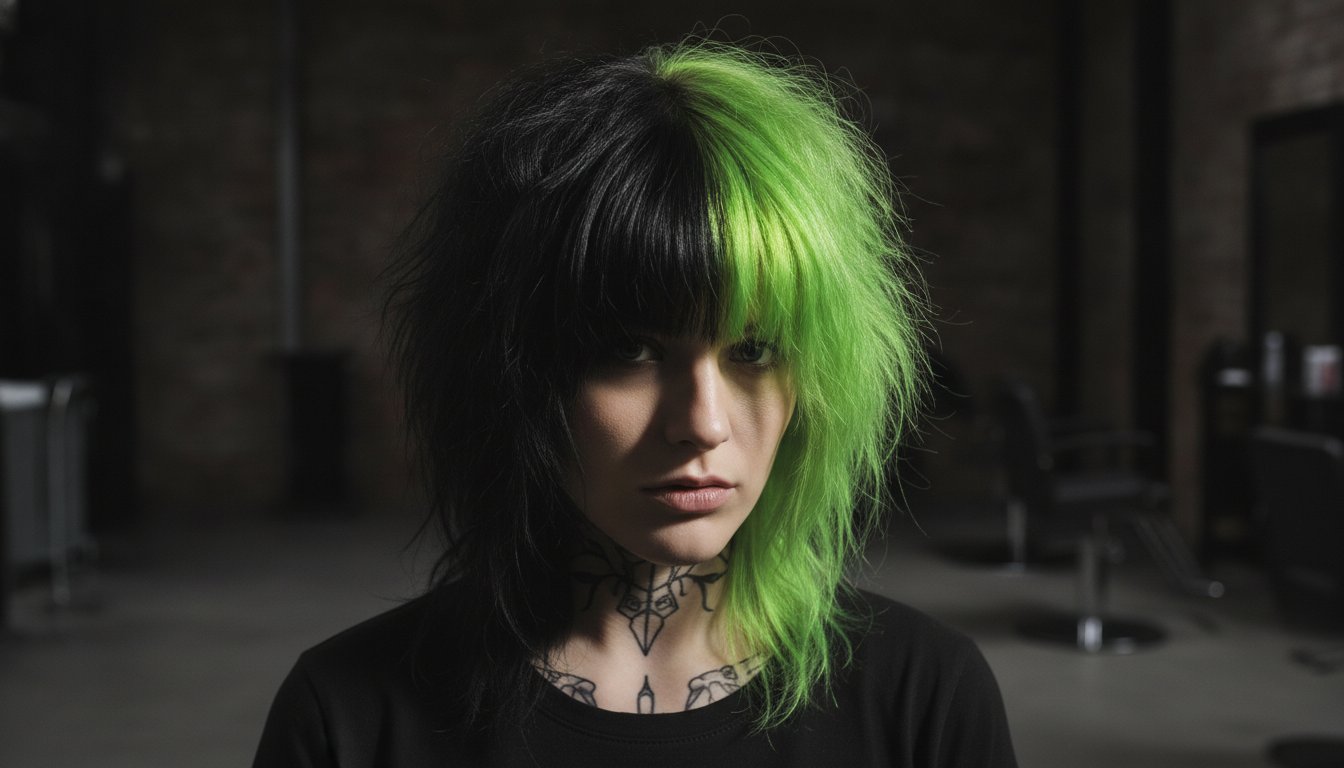
The split dye wolfcut is a structural middle finger to the mundane. It’s a collision of subcultural DNA that refuses to be ignored. By fusing the messy, undone spirit of the shag haircut with the aggressive silhouette of an 80s mullet, this style creates a frame that is both savage and sophisticated. It’s not just about length; it’s about the deliberate chaos of the tiers.

Adding a split dye into the mix doesn’t just change the colour. You’re bisecting the architecture of the cut. This involves splitting the hair, usually down the centre, and saturating each side with a contrasting vivid pigment. In 2026, the aesthetic has evolved. We’ve moved past the soft, blended “money pieces” of previous years. Now, we’re seeing a push for aggressive, sharp contrasts that define the hair’s texture with surgical precision.

The Structural Synergy of Colour and Cut

Movement is where the magic happens. Standard, flat haircuts can’t showcase a split dye quite like a wolfcut can. Because the layers are so heavily textured, they create “peek-a-boo” moments. As you move, the underside colour flashes through the top layers. It’s a visual trick that adds massive depth. Contrast also works to your advantage by:

  • Highlighting the “Step”: The sharp divide makes the transition between short crown layers and longer lengths more visible.
  • Creating Depth: Darker pigments act as a shadow, making the vivid side appear more dimensional.
  • Boosting Volume: The interplay of light and dark colours gives the illusion of thicker, more textured hair.

This style is the ultimate expression of alternative identity. It’s loud. It’s intentional. It’s unapologetically you.

The Subcultural Roots: From Stage to Street

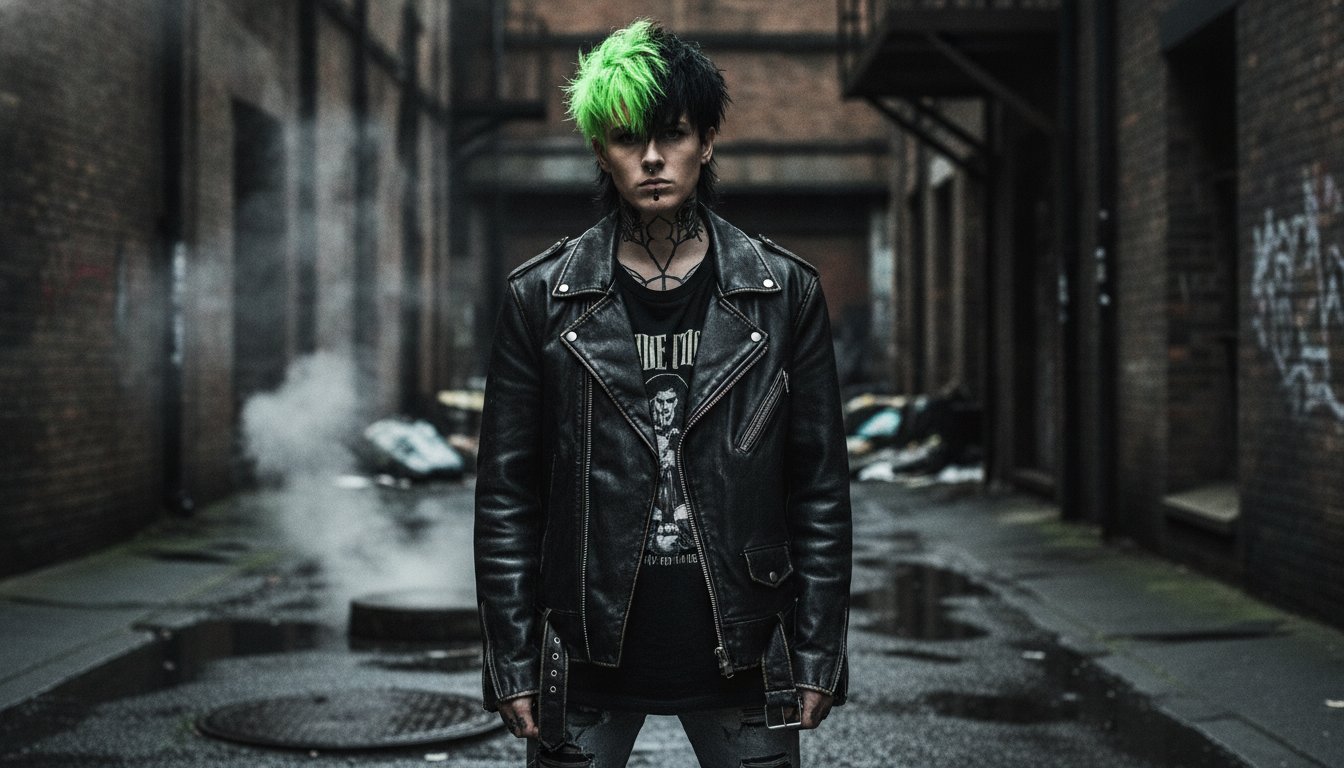
This look didn’t come from a boardroom. It was born in the pits of festivals like Bloodstock and Download. It’s an evolution of the 2000s “scene hair” aesthetic, but with more grit and better structure. Whilst scene hair was often flat and fried, the modern split dye wolfcut prioritises hair health and intentional texture. It signals that you’re part of a tribe that celebrates the unconventional. The UK alternative scene has claimed this look as its own, creating a safe space for self-expression that works as well on the high street as it does in the front row of a gig.

Choosing Your Contrast: High-Impact Colour Pairings

Choosing the right palette for your split dye wolfcut isn’t just about your favourite shade. It’s about visual warfare. You’re using colour to dictate where the eye lands on those aggressive layers. If the cut provides the structure, the colour provides the soul.

Monochrome Madness remains a staple for a reason. Pairing jet black with a stark platinum creates a high-contrast void that makes every razor-cut edge pop. It’s the ultimate ‘alt’ look that never loses its bite. If you want something louder, Complementary Chaos is the way to go. Think neon greens against deep, bruised purples. This pairing vibrates on the eye and screams underground energy.

For those who like to play with temperature, balancing warm fire reds with icy blues creates a striking tension. When working with these high-intensity pigments, it’s vital to follow hair dye safety guidelines to protect your scalp and hair integrity. We always prioritise the health of the canvas before applying the art. A dead, fried mane won’t hold the vivid tones you’re chasing.

The Vertical Split: Classic and Aggressive

This is the traditional bisection. It requires a perfectly straight centre part to avoid a messy, haphazard finish. Symmetry is powerful, but don’t be afraid of asymmetry. You could have a natural brunette on one side and a neon explosion on the other to create a jarring, intentional imbalance. Handling the “middle” where the colours meet is the hardest part. Professionals use precise sectioning to ensure the line is crisp rather than a muddy gradient. The vertical split is the boldest choice for facial framing.

The Horizontal or “Peek-a-Boo” Split

If a full vertical divide feels too exposed, the horizontal split offers a hidden impact. By placing a second colour in the lower layers, you create a “peek-a-boo” effect. The wolfcut is the perfect vehicle for this because the top layers are shorter and more mobile. As the hair flicks or moves, the hidden tone is revealed from beneath the textured canopy.

Try these colour pairings for a more subtle alternative look:

  • Deep forest green on top with a lime green underneath for tonal depth.
  • Midnight black with a deep violet peek-a-boo for a gothic edge.
  • Natural warm brown with a copper underglow for a softer transition.

It’s a more refined way to wear the trend whilst still keeping your edge. If you’re ready to commit to a new silhouette, our expert wolfcuts are designed to make these colour placements shine.

Split Dye Wolfcut: The Ultimate Guide to High-Contrast Alternative Texture

The Cut: Injecting Chaos into Textured Layers

The foundation of a savage split dye wolfcut isn’t found in a bottle of bleach. It’s found in the steel of the shears. Professional sectioning is non-negotiable here. If your stylist doesn’t align the bisection of the cut with the bisection of the colour, the look falls apart the moment you move. We use precise, grid-like sectioning to ensure that the “step” in your layers mirrors the shift in your pigments. This isn’t a “ponytail cut” you can hack together in a bathroom mirror. It requires a rebellious expert who understands how hair falls in three dimensions.

We utilise an “Aggressive Layering” technique to build movement without sacrificing the weight at the perimeter. This involves carving out internal texture to create that signature shaggy crown while keeping the baseline thick and gritty. It prevents the hair from looking like a limp mullet and instead gives it the bite required for an alternative aesthetic. Fringe choice is the final touch. A micro-fringe adds a punk-rock edge, whilst heavy curtain bangs can soften the transition and frame the eyes. Both options work to anchor the high-contrast colour split right at the face.

Wolfcut on Fine Hair: Creating the Illusion of Mass

Don’t let thin strands stop you from claiming this look. For those working with less density, mastering the wolfcut on fine hair is about structural engineering. We prioritise shorter crown layers to create immediate lift and volume. When you combine this with a split dye, the contrast actually works in your favour. The darker side acts as a shadow, providing a visual anchor that makes the hair appear significantly thicker than a solid, flat colour ever could. It’s about using the collision of light and dark to cheat the eye into seeing more mass.

Taming the Beast: Wolfcuts for Thick Hair

Thick hair requires a different kind of discipline. Without proper internal weight removal, a wolfcut can quickly turn into a “mushroom” shape that swallows your face. We use channel cutting and point cutting to remove bulk from the mid-lengths. This ensures your layers flick out with intention rather than just sitting in a heavy block. In a split dye wolfcut, this movement is vital. It prevents the two colours from looking like two separate wigs joined together. Instead, the layers blend and dance, showing off the precision of the split whilst maintaining a sense of controlled chaos. Styling with gritty texture dust helps keep these heavy layers from becoming unruly throughout the day.

Mosh Pit Proof: Styling and Maintenance

You’ve claimed the look. Now you have to defend it. A split dye wolfcut is a high-stakes investment in your identity. If you treat it like a supermarket-shelf trim, it’ll look like one within a fortnight. Maintenance is the difference between a sharp, alternative statement and a muddy, flat mess. You’re fighting against fade and gravity every single day. Staying sharp requires a dedicated routine that prioritises pigment integrity and structural volume.

The first commandment is the cold water rule. Hot water opens the hair cuticle, allowing those expensive vivid pigments to escape and bleed into each other. If you’re rocking a black and platinum split, one hot shower can turn your blonde side a murky grey. Wash with water as cold as you can stand. It’s brutal, but it keeps your bisection crisp and prevents the dreaded “muddy” bleed that ruins high-contrast styles. It’s a small price to pay for a look that stays vibrant for weeks longer than a standard wash would allow.

Volume is king. A wolfcut without volume is just a sad mullet. Use texture dust at the roots for immediate lift and sea salt sprays through the mid-lengths to enhance that “just walked off stage” grit. Heat tools are a double-edged sword. They define those layers but bake the colour out. Always use a professional heat protectant whilst styling. It acts as a barrier, preserving the saturation levels whilst you work the tongs. Don’t ghost your stylist, either. To keep the aggressive layering sharp and the colour split from looking like a grown-out accident, you need a refresh every six weeks.

Step-by-Step Styling for Maximum Grit

Rough-dry your hair upside down. Focus on the roots to build structural lift before the hair sets. Once dry, apply a matte paste to the ends. Twist small sections to define the choppy layers and give them that jagged, rebellious finish. Finally, use a wide-tooth comb to organise the split. This keeps the bisection clean without mixing the contrasting strands together. This method ensures your split dye wolfcut remains defined even after a night in the pit.

Vivid Colour Longevity: The Professional Secret

Sulphate-free shampoos are essential for alternative hair. Sulphates are aggressive detergents that strip vivid tones. Switch to a professional, colour-safe alternative that respects the cuticle. To really push the limits, use colour-depositing conditioners. Apply one colour to one side and the second to the other during your wash. It’s a bit more work, but it keeps the saturation levels at 100%. For a deeper dive into the science of staying bright, check out our guide on vivid hair colour maintenance.

Ready to reclaim your edge? Book your maintenance session with our specialists today and keep your contrast biting.

Why Professional Execution Trumps the Kitchen Sink

Hacking at your hair in a bathroom mirror might feel punk. It usually ends in a structural disaster. A split dye wolfcut is a technical feat that requires more than just a pair of kitchen scissors and a dream. We’ve seen the “shelf” layers and chemical burns that come from DIY tutorials. They promise a quick fix but deliver a mess. Straight lines matter here. If your centre bisection is off by even a millimetre, the symmetry of your face shape is compromised. We use precise tension and surgical sectioning to keep that line clean and intentional.

Then there’s the bleed. Keeping high-contrast colours like jet black and icy platinum separate is an elite skill. One slip during the rinse and your vivid pigments turn into a muddy, grey sludge. Professional execution involves specialised barrier techniques and water temperature control that you simply can’t replicate at home. It’s about protecting the integrity of the contrast. We ensure your colours stay in their own lanes so the bisection remains sharp enough to cut glass. This isn’t just about a service. It’s about respecting the art of the alternative aesthetic.

Finding a stylist who understands alternative subcultures is vital. You don’t want a “mullet-lite” from a stylist who usually does suburban bobs. You want someone who knows the difference between a 70s shag and a modern wolfcut. We speak your language. We know the music, the festivals, and the grit that defines this scene. The salon experience should be a celebration of your identity, not a clinical appointment. It’s a space where being different is the standard, not the exception.

Safe Space Styling: Beyond the Binary

Alternative hair is about more than just looking cool. It’s about feeling seen. Gender-inclusive salons are the natural home of the wolfcut because we don’t care about traditional binaries. We care about the individual sitting in the chair. You need a stylist who celebrates your individuality rather than trying to tone it down. The consultation is the most important part of this journey. We dive into your hair history and your lifestyle to ensure the complex colour work actually fits your reality. It’s a collaborative process designed to empower you.

Ready to Claim Your Look?

Preparation is key for a transformation this bold. Don’t just show up with a vague idea. Bring reference photos that clearly show both the aggressive layering and the specific colour split you’re after. Be honest about your hair history. If there’s box dye hiding under those layers, we need to know so we can plan the lift safely. Wear something that makes you feel like yourself. Your hair should match your energy, and your energy should fill the room.

Stop settling for mainstream salons that are afraid of the razor. It’s time to claim the most rebellious look of 2026. Book your alternative transformation with the experts and finally own your aesthetic.

Claim Your Alternative Identity

The split dye wolfcut is more than a trend; it’s a structural collision of history and rebellion. You’ve seen how aggressive layering provides the perfect canvas for high-contrast vivids. By choosing the right colour pairings and committing to professional execution, you ensure your look remains a sharp statement rather than a muddy accident. We’ve covered the importance of cold-water washing and gritty styling to keep those layers biting long after you leave the salon.

Your hair is the ultimate form of self-expression. Don’t trust it to anyone who doesn’t understand the grit of the underground. We are specialists in wolfcuts and shags, providing a gender-inclusive safe space for those who live outside the mainstream. Our expertise in vivid colour ensures your contrast stays crisp and your identity remains front and centre. It’s time to stop blending in and start leading the charge with a look that is unapologetically yours.

Ready to make your mark? Join the revolution and book your alternative cut today. We’ll see you in the chair.

Frequently Asked Questions

Will a split dye wolfcut work on curly hair?

Yes, curly hair provides incredible natural volume that makes this aesthetic truly pop. The aggressive layering prevents the “triangle” shape often found in blunt cuts, allowing your curls to stack and create height. You’ll need a stylist who understands curl shrinkage to ensure the colour bisection remains symmetrical when dry. It is a savage way to showcase natural texture whilst keeping the high-contrast split dye wolfcut sharp and defined.

How do I stop my split dye from bleeding into the other side?

Wash your hair with ice-cold water and use sulphate-free shampoo to prevent pigments from migrating across the part. When rinsing, tilt your head so the water runs off each side separately rather than over the bisection. This keeps your contrast crisp and avoids the dreaded muddy bleed. Avoid hot water at all costs; it is the fastest way to turn a clean split into a murky, faded disaster.

Can I get a wolfcut if I have very short hair?

You can start the transition as soon as you have enough length for a “shullet” or short mullet silhouette. The key is having enough hair on top to create those signature crown layers and a bit of length at the nape for the tail. If you’re growing out a buzz cut, you’ll need a few months of growth to provide a canvas for the aggressive layering required for this look.

Is a split dye wolfcut high maintenance?

Yes, this is a high-commitment aesthetic that requires a professional refresh every six weeks. You are maintaining both a technical, tiered cut and a sharp bisection of vivid colour. Between salon visits, you’ll need to use colour-depositing conditioners and professional texture products to keep the volume alive. It isn’t a “wash and go” style if you want to keep the rebellious edge that defines the 2026 aesthetic.

How long does it take to get a split dye wolfcut in a salon?

Expect to spend between three and six hours in the chair depending on your starting shade. A split dye wolfcut involves a precision haircut followed by a complex, multi-step bleaching and toning process. If you’re lifting dark hair to a platinum or neon base, it takes time to do so safely without compromising hair health. Quality bisections require surgical patience to ensure the line is perfectly straight.

What is the difference between a wolfcut and a shag?

A wolfcut is the “angrier” sibling of the traditional shag, blending 70s movement with 80s mullet grit. Whilst a standard shag is softer and more blended, the wolfcut features much shorter, choppier layers around the crown and more disconnected length at the back. It’s a more aggressive, high-impact silhouette designed for those who want to stand out rather than blend in with a softer, vintage look.

Do I need to bleach my hair for a vivid split dye?

Yes, you almost always need to bleach the hair to a pale yellow or white base for vivid pigments to show their true saturation. Applying neon green or deep purple over brown hair results in a muddy, barely-visible tint. Professional bleaching ensures the hair is light enough to hold the high-contrast split whilst maintaining as much structural integrity as possible. It’s the only way to achieve that surgical bisection.

What styling products are best for a textured wolfcut?

Texture dust and sea salt sprays are the gold standard for maintaining the grit this style requires. Use a matte paste on the ends to define the jagged layers and prevent them from looking fluffy or “mullet-lite.” Avoid heavy oils or waxes that weigh down the crown, as volume is the lifeblood of the silhouette. A wide-tooth comb is also essential for organising the split without mixing the contrasting colours together.

Posted on

Reshaping a Grown Out Wolfcut: The 2026 Alternative Survival Guide

Reshaping a Grown Out Wolfcut: The 2026 Alternative Survival Guide

Why does every “low-maintenance” wolfcut eventually transform into a puffy, accidental bowl cut that looks more like a mushroom than a masterpiece? It is the classic alternative trap. One minute you are rocking a razor-sharp silhouette, and the next, your crown feels like a helmet whilst your ends look thin and accidental. You aren’t losing your edge, but you are losing the battle against gravity. We know the frustration of watching that aggressive shape melt into a shapeless mess that feels impossible to style.

Growing your hair out does not have to mean looking like a Victorian schoolboy. By mastering the art of reshaping a grown out wolfcut, you can reclaim your identity and pivot towards a longer, more intentional alternative look. This survival guide breaks down the professional technical pivots needed to manage internal weight and maintain that essential grit. We will explore strategic colour evolution, the power of Death Grip for texture, and how to survive the 2026 growth cycle without ever touching a boring, traditional salon chair. It is time to stop waiting for length and start active evolution.

Key Takeaways

  • Identify the “mushroom stage” physics where crown layers meet the ear line, causing unwanted puffiness and loss of your aggressive silhouette.
  • Learn the professional technical pivots for reshaping a grown out wolfcut, focusing on internal weight removal to flatten the sides without losing length.
  • Master “intentional chaos” styling techniques using Death Grip and Hair To the Throne to maintain grit and prevent a flat, lifeless crown.
  • Discover how strategic colour shifts, such as shadow roots and vivid money pieces, can slim down a puffy crown and distract from uneven growth.
  • Map your transition into a long shag or a modern mullet to ensure your hair stays intentional and alternative throughout the entire growth cycle.

The Physics of the Grow-Out: Why the ‘Mushroom’ Stage Happens

The wolfcut is a high-energy silhouette that relies on vertical tension and aggressive texture. When you stop cutting it, that tension collapses. The “mushroom stage” is the precise moment your shorter crown layers migrate south and collide with your ear line. Instead of a sharp, tapered look, you get a rounded, horizontal bulk that feels wider than it is long. Understanding these physics is the first step in reshaping a grown out wolfcut without losing your mind.

This happens because of how weight distributes as it moves. In a variation of the shag called a wolf cut, the layers are designed to be disconnected. This means the top doesn’t blend into the bottom. Whilst this looks incredible when fresh, the grow-out creates a literal shelf at the back of your head. British humidity only makes this worse. Our damp climate swells the hair cuticle, causing those unmanaged layers to expand outwards. Without proper internal weight removal, you aren’t just growing length; you’re growing a helmet.

The Disconnection Point and Visual Weight

Visual weight is about where the eye stops. In a fresh wolfcut, the eye moves vertically from the choppy fringe down to the wispy ends. As it grows, the weight shifts from the top of your head to the sides. Vertical flow turns into horizontal bulk. If your stylist didn’t manage the internal density, those layers sit on top of each other like bricks. Disconnection is the primary enemy of a graceful wolfcut evolution. When the gap between your shortest layer and your longest length becomes too heavy, the silhouette dies. You lose the aggressive edge and end up with a bottom-heavy shape.

Setting Your 2026 Style Goals

Reshaping a grown out wolfcut requires a clear roadmap for your next identity. You have two main routes: the “Long Shag” or the “Modern Mullet.” The Long Shag evolution focuses on blending disconnected layers into a more cohesive, 70s-inspired flow. If you want to keep the aggression, the Modern Mullet pivot is your best bet. This involves keeping the back length whilst your top layers catch up. Avoid blunt cuts at all costs during this transition. A blunt line will kill the movement and make the “mushroom” look even more pronounced. Tell your stylist you want edge-retention through internal thinning. You want to keep the length but lose the bulk.

The Technical Pivot: Reshaping Without Losing Your Length

The goal isn’t to start over. It’s to evolve. When you’re reshaping a grown out wolfcut, the biggest fear is losing those hard-won centimetres of length. Traditional stylists might try to “even it out,” which is often code for cutting it all off into a boring bob. We don’t do that. The technical pivot is about removing bulk from the inside out. By carving out the internal weight that creates the “mushroom puff,” we flatten the sides whilst keeping the perimeter long and jagged.

Maintaining the “V” or “U” shape at the back is non-negotiable for an alternative silhouette. Instead of a standard trim, we use “dusting.” This involves removing only the most damaged tips without sacrificing the overall length. It keeps the hair healthy but preserves the aggressive, tapered look you’ve spent months growing. This method ensures your hair continues to look intentional, even as it reaches new lengths.

Internal Texturising Techniques for Alt-Hair

Thinning shears are often the enemy of a gritty, lived-in texture. They can leave the hair looking frizzy rather than sharp. We prefer point-cutting. This technique allows us to break up heavy, horizontal sections by cutting vertically into the hair. It creates gaps for movement and removes the “shelf” effect mentioned in the previous section. By meticulously removing weight where the hair is densest, we ensure the style remains light and responsive to styling products like Death Grip.

Slide-cutting is another essential tool for reshaping a grown out wolfcut. It acts as a bridge between your short crown layers and the mid-lengths. By sliding the blade down the hair shaft, we create soft, diagonal lines that encourage the hair to lay flat. This is particularly effective when prepping for 2026 hair color trends, as a smoother internal surface allows vivid colours to pop without being obscured by unwanted bulk.

The Face-Framing Adjustment

Your fringe is the focal point of your identity. As it grows, that short “wolf-fringe” needs to evolve. We transition these into gritty, eyebrow-skimming curtain bangs. This involves connecting the temple layers down to the jawline. It creates a seamless flow that slims the face and hides the transition. It stops the hair from looking like two separate haircuts. For deeper insights into this process, check out our guide on how to maintain a shag haircut.

If you’re ready to stop fighting the mushroom and start embracing the evolution, you can book one of our specialised Wolfcut reshaping sessions to keep your edge intact.

Reshaping a Grown Out Wolfcut: The 2026 Alternative Survival Guide

Mastering the Mess: Styling Through the Awkward Growth Stages

Polished blow-outs are for bridal parties and office jobs. When you are reshaping a grown out wolfcut, trying to smooth everything down only highlights the disconnection we discussed earlier. Smooth hair makes that “mushroom shelf” look like a mistake. Instead, you need to embrace intentional chaos. By creating a gritty, lived-in texture, you blur the lines between your short crown layers and your longer ends. It’s about making the mess look like a choice.

The secret lies in preventing the “flat top, puffy sides” disaster. Gravity pulls the top layers down whilst the side layers expand. You need weightless volume at the roots to keep the silhouette vertical. Use products like Hair To the Throne to lift the crown. Then, use aggressive matte products to crush the volume at the ears. This creates a flatter, rockstar silhouette that feels more like a modern mullet than a helmet. High-end advice on maintaining a wolf cut often suggests heat styling to blend these layers. Loose, messy waves help bridge the gap between lengths. Use these tips to blend your layers:

  • Wrap sections of different lengths together around a large barrel wand to force them into a single wave.
  • Keep the ends straight to maintain that jagged, alternative edge.
  • Alternate the direction of your curls to prevent the hair from clumping into one big roll.

The Power of Gritty, Matte Texture

Salt sprays and styling powders are essential amongst the awkward stages of your grow-out. They provide the friction needed for layers to “grab” onto each other rather than sliding into separate shelves. Root powders are perfect for keeping the top of your head from looking like a landing strip. For the ultimate subcultural finish, our own Death Grip creates a matte, rebellious finish that holds your shape through a three-day festival. It kills the shine that often makes grown-out layers look greasy and flat.

Alternative Camouflage Techniques

Sometimes you just don’t have the energy for a full styling routine. This is where alternative camouflage comes in. Bandanas and beanies are your best friends for managing crown volume. They physically flatten the “mushroom” puff whilst letting your length peek out from the bottom. It’s a classic grunge look that never fails. If you want something more intricate, try the “half-up, half-down” style. By securing the top, disconnected layers in a messy knot, you remove the bulk from the sides and let the bottom length shine. Strategic use of chunky hair clips can also add a 90s alternative vibe whilst pinning back those awkward temple layers. Styling is just another tool for reshaping a grown out wolfcut without needing a pair of scissors every week.

Vivid Colour as a Strategic Distraction from Awkward Layers

Colour is your secret weapon for structural deception. When you are reshaping a grown out wolfcut, you can use high-contrast pigments to trick the eye into seeing a more balanced shape. If your crown feels too puffy, we don’t just cut it; we colour it. Darker tones recede, whilst lighter tones advance. By applying a deep shadow root, we create the illusion of depth at the top. This effectively slims down that awkward mushroom-shaped bulk that plagues the mid-growth stage. It’s about using alt-hair physics to your advantage.

Vivid money pieces around the face act as a visual anchor. They pull the focus toward your eyes and jawline, distracting from the wispy, accidental-looking ends that often occur during a grow-out. If those ends feel too thin, a bold dip dye effect can save them. Adding a saturated, high-pigment block of colour to the very tips makes them look intentional and physically thicker. It turns a frustrated transition into a deliberate alternative statement.

Placement Strategies for Visual Slimming

Placement is everything when managing volume. We place darker, moodier shades in the mid-section where the hair tends to poof out most. This “mushroom zone” becomes less noticeable when the colour is receding. Conversely, we use bright, neon pops on the longest layers to emphasise your growth progress. This makes the hair look longer and more energetic. You can discover more about vivid hair colour and how it manipulates texture to suit your specific subcultural identity.

The Root Melt and Blur

Regrowth is often the enemy of a polished alternative look, but it doesn’t have to be. A soft root melt or blur is the essential solution for 2026. It ensures that as your natural hair grows in, it blends seamlessly into your vivid shades. This technique avoids harsh horizontal lines that would otherwise highlight the disconnection between your layers. For the upcoming festival season, we are seeing a massive shift toward deep forest greens and burnt oranges. These shades provide a gritty, organic backdrop that masks uneven lengths. Maintaining the health of these vivids is vital; keep your hair strong so it can handle the weight of your new length.

Ready to manipulate your silhouette with pigment? Book your vivid colour transformation with our specialists today and skip the awkward phase entirely.

The Evolution Roadmap: Transitioning Your Wolfcut into Your Next Signature Shape

Mainstream hair guides are obsessed with bobs. They see a grown-out style and immediately suggest lopping it all off to “even it out.” we call bullshit. A bob is the safe choice for people who want to blend in. You didn’t get a wolfcut to blend in. Reshaping a grown out wolfcut is about active evolution, not surrender. Your current layers are the perfect foundation for a long, textured alternative mane. It is the ultimate base for a 70s rockstar silhouette that carries real weight and attitude.

The most natural path is the Wolf-to-Shag pipeline. This transition involves blending those aggressive, disconnected layers into a more cohesive but still heavily textured flow. It’s a softer approach that keeps the volume but loses the “mushroom” shelf. If you want to keep the aggression high, the Modern Mullet pivot is your best bet. You keep the back length as a priority whilst the top layers catch up. It allows you to maintain a subcultural edge through every awkward centimetre of growth. You are building a signature shape, not just waiting for a trim.

The Shag Resurrection

Your fringe becomes the new anchor of your identity. As it grows past your eyebrows, it transforms into heavy, face-framing curtain layers. You can evolve your wolfcut into a modern mullet haircut by keeping the temple areas shorter whilst letting the back reach for your shoulder blades. This transition relies on shifting the internal layers into a 70s-inspired rhythm. It feels organic and intentional. It’s about making the growth look like a choice rather than a lack of maintenance. The focus stays on the texture, not just the length.

The Rockstar Long-Game

When your hair finally hits shoulder length, the temptation to “tidy up” the ends is strong. Resist it. A perfectly straight hemline kills the alternative spirit. Keep the perimeter jagged and uneven. Maintaining Death Grip texture is essential here. It prevents your long hair from looking flat and conventional. It keeps that rebellious, matte grit alive. Reshaping a grown out wolfcut means you never have to settle for a boring, one-length style. Only “even out” the perimeter if the ends become truly wispy. Otherwise, embrace the unevenness. It’s your hair, your rules, and your identity. Stay loud through every stage of the grow-out.

Own Your Evolution: The Road to Your Next Signature Style

Your hair is a statement, not a waiting room. You’ve mastered the physics of the mushroom stage and learned that internal weight removal is the key to maintaining your edge. By using strategic vivid colour and gritty styling, you’ve turned an awkward transition into a deliberate alternative evolution. Don’t let a mainstream salon talk you into a boring bob. Reshaping a grown out wolfcut is about reclaiming your silhouette as you move towards a long shag or a modern mullet. You aren’t just growing hair; you’re building a new identity.

We are a gender-inclusive safe space for alternative identities. Our specialists live for aggressive textured cuts and high-pigment vivid colour. We have styled bands backstage at Download and Bloodstock, so we know how to keep hair looking gritty through every stage of growth. Your identity shouldn’t hit a plateau just because your layers are catching up. Trust the experts who understand the subcultural grit your hair requires.

Book your wolfcut evolution at Heavy Metal Hairdresser and own your next signature shape. Stay rebellious.

Frequently Asked Questions

How long does it take to grow out a wolfcut completely?

It takes roughly six to twelve months to transition from a choppy wolfcut to a more uniform long style. Hair grows at an average rate of 1.25cm per month; so your crown layers need significant time to reach your shoulders. Focus on maintaining health during this period. Regular dusting prevents breakage from eating away at your progress. Patience is vital, but active reshaping keeps the style intentional throughout the year.

Can I reshape my wolfcut without losing my current length?

You can absolutely achieve reshaping a grown out wolfcut without sacrificing your hard-earned centimetres. We focus on internal texturising and point-cutting to remove the bulk that creates a “shelf” effect. By thinning the hair from the inside, the silhouette flattens and flows better. This technical approach preserves the perimeter of your cut. You keep the jagged alternative edge whilst losing the unwanted roundness around your ears.

What exactly is the “mushroom stage” and how do I fix it?

The mushroom stage occurs when your short crown layers grow down to meet your ear line, creating horizontal bulk. It makes your head look round rather than edgy. You fix it by removing internal weight and using aggressive matte products like Death Grip. These products crush the volume at the sides whilst keeping the top textured. It’s about shifting the focus from width back to a vertical, rockstar silhouette.

Should I get a trim whilst I am growing out my wolfcut layers?

Trims are essential, but you should ask for “dusting” rather than a traditional cut. Dusting removes only the millimetre of damage at the very tips. This prevents split ends from travelling up the hair shaft and ruining your growth progress. It also allows your stylist to manage the internal density. Regular maintenance every eight to ten weeks ensures your evolution looks like a choice rather than a lack of effort.

What is the best product for styling a growing wolfcut in 2026?

For 2026, the gold standard for alternative texture is a combination of Hair To the Throne and Death Grip. You need Hair To the Throne at the roots to provide weightless lift and prevent a flat crown. Death Grip is then used through the mid-lengths to provide that essential matte grit. This combination allows you to manage the puffy sides whilst keeping the rebellious energy of your original wolfcut alive.

Is a wolfcut harder to grow out than a standard layered haircut?

Yes, a wolfcut is more challenging to grow out because the disconnection between layers is so aggressive. In a standard layered cut, the transition between lengths is smoother. The wolfcut features a massive gap between the short top and wispy bottom. This makes reshaping a grown out wolfcut a more technical process. You need a specialist who understands alt-hair physics to bridge that gap without resorting to a boring bob.

Can I turn my wolfcut into a mullet whilst it grows?

Transitioning into a mullet is the most effective way to keep your edge whilst growing length. You simply keep the back length as it is and have your stylist tighten the sides. This maintains the “party in the back” energy whilst the top layers catch up. It allows your crown layers to reach a manageable length without losing your alternative identity. It’s a classic power move for subcultural styles.

How do I stop my hair looking thin at the bottom during the grow-out?

Wispy ends are often a result of the original aggressive texturising. To fix this, ask for a blunt perimeter trim to thicken the baseline. You can also use vivid colour strategically. A saturated dip-dye or a bold block of colour at the ends creates a visual weight that makes the hair appear fuller. Combining a solid colour foundation with regular dusting will keep your long-game looking thick and healthy.

Posted on

Wolf Cut with Vivid Colour Ideas: Weaponising Your Layers for 2026

Wolf Cut with Vivid Colour Ideas: Weaponising Your Layers for 2026

Most people treat hair colour like an accessory, but for the subcultural elite, it is a structural weapon. If you are hunting for wolf cut with vivid colour ideas, you already know that a standard, polished salon job simply won’t cut it. You want hair that feels like a riot, not a rehearsal. You have probably felt the sting of vivids that fade before the weekend is over, or watched your expensive layers disappear into a muddy, shapeless mess. It is frustrating when stylists try to “soften” your edge because they don’t understand the grit of the underground scene.

We agree that your hair should be as loud as your favourite record. This guide is your blueprint for combining aggressive texture with high-octane pigment to create a look that is unapologetically yours. We will explore 2026’s most lethal trends, from “Death Grip” texture to strategic split-tones and smoky lilac underlights. You will discover how to place colour so it highlights every jagged layer and grows out with genuine intent. It is time to stop settling for “pretty” and start weaponising your style.

Key Takeaways

  • Learn how the aggressive texture of a wolf cut acts as a structural canvas for high-saturation pigments.
  • Discover high-impact wolf cut with vivid colour ideas that use strategic placement to make every jagged layer pop.
  • Explore subcultural colour palettes, including toxic greens and high-contrast split dyes, that celebrate your alternative identity.
  • Master the maintenance rituals required to stop vivid fade and protect your layers from heat damage.
  • Understand the importance of choosing a specialist who understands aggressive “Death Grip” texture and inclusive safe spaces.

The Wolf Cut with Vivid Colour: Why This Duo Rules the Alternative Scene

Mainstream salons love to talk about “natural movement” and “subtle blends”. We don’t. In the alternative scene, your hair is a visual siren. The wolf cut is already aggressive by design, but pairing it with high-saturation pigment turns a haircut into a manifesto. It is a synergy that works because the choppy, disconnected layers provide the perfect 3D canvas. Without the right colour, those layers can sometimes look flat or muddy. With vivids, every razor-cut edge is defined by light and shadow.

The Anatomy of an Alternative Wolf Cut

A true alternative wolf cut isn’t just a heavy fringe. It is about the high-volume crown and those signature disconnected, wispy lengths that scream rebellion. Texture is the only word that matters here. We focus on “Death Grip” texture, ensuring the hair has enough grit to hold its shape through a three-day festival set. As a modern take on the shag, the wolf cut is a hybrid of the shag and the mullet for the modern rebel. It demands a stylist who understands how to carve weight out of the hair without losing the structural integrity of the silhouette.

Vivid Colour as a Subcultural Badge

Choosing a bold palette is an act of defiance. It is about moving beyond the binary of traditional styling to express an identity that is uniquely yours. When you are looking for wolf cut with vivid colour ideas, you are looking for a way to signal your tribe. Whether it is the toxic greens of the cyberpunk aesthetic or the deep blood reds of the metal scene, these pigments interact with the gritty texture of the cut to create something visceral.

This transformation requires more than just technical skill; it needs a gender-inclusive safe space where your vision is respected. We celebrate the unconventional. A wolf cut with vivid colour isn’t just a trend for 2026. It is a badge of honour for those who refuse to blend into the background. It is about taking up space and owning your aesthetic with total confidence. Finding the right wolf cut with vivid colour ideas is about more than just picking a shade from a book; it is about weaponising your layers to reflect the music and culture you live for.

Strategic Vivid Placement: Enhancing Your Wolf Cut’s Aggressive Texture

Colour is a structural tool, not just an accessory. It defines the chaos of a wolf cut. When you are exploring wolf cut with vivid colour ideas, you must consider how pigment interacts with the jagged, disconnected layers of the cut. Strategic placement can make short, choppy layers pop with energy or give longer, wispy lengths a sense of fluid movement. It is about using high-contrast tones to create artificial depth. By placing darker vivids at the roots and lighter neon shades on the tips, you emphasise the “Death Grip” texture that makes this style iconic.

Achieving true saturation requires a mandatory bleach-first approach. You cannot get electric blue or toxic green to sing on a dark base. Whilst lightening is essential for that high-octane 2026 look, following professional hair dye safety precautions ensures your hair remains strong enough to hold its textured shape. To avoid a muddy result when mixing multiple shades, we use isolation techniques. This prevents bleeding and keeps your neon yellow from turning into a swampy mess when it hits your jet-black base.

Underlights and Hidden Panels

Hidden panels are the ultimate move for those who want a switchable level of aggression. By placing contrasting vivids in the bottom layers, you create a “peek-a-boo” effect that only reveals itself when the hair moves. This technique adds immense depth to the wispy sections of a long wolf cut, preventing the ends from looking thin or stringy. It is a favourite for the 2026 season, allowing you to hide your subcultural badge during the day and unleash it at the show. If you’re ready to map out your own placement, see how we handle these transformations at Heavy Metal Hairdresser.

Face-Framing Accents and Vivid Fringes

The fringe is the focal point of any wolf cut. Weaponising it with high-contrast “money pieces” or a solid vivid block draws immediate attention to your features. You can create a “halo” effect by applying neon tones specifically to the crown layers, which highlights the volume and height of the cut. This placement ensures that even in low light, the silhouette of your wolf cut with vivid colour ideas remains sharp and recognisable. Whether it’s a razor-sharp platinum blonde or a radioactive green, face-framing accents ensure your alternative identity is the first thing people notice.

Wolf Cut with Vivid Colour Ideas: Weaponising Your Layers for 2026

Colour Palettes for the Unconventional: From Toxic Greens to Blood Reds

Alternative identities aren’t built on “safe” choices. When you are hunting for wolf cut with vivid colour ideas, you are looking for a palette that screams as loud as a distorted guitar. For the metal and rock scenes, colour stories often lean into the dark, the radioactive, and the visceral. We move away from the pastel pinks of the high street. Instead, we embrace deep cherry reds, electric blues, and toxic greens that feel like they belong in a cyberpunk dystopia. These unnatural palettes feel more authentic to subcultural souls because they reject the traditional beauty standard entirely.

Choosing the right palette involves balancing your skin tone whilst maintaining a razor-sharp edge. Cool-toned skin often thrives with smoky lilacs or icy platinums. Warmer skin tones can weaponise neon oranges or blood-soaked reds. The goal isn’t to look “natural”. It is to find a shade that feels like an extension of your creative vision. High-contrast combinations, like neon yellow against jet black, provide the visual impact needed to make those choppy layers stand out in a crowded room.

The High-Contrast Split and Racoon Tails

The “scene” aesthetic is back for 2026, but it is meaner and more refined. Modern racoon tail stripes use aggressive horizontal banding to break up the vertical flow of the layers. This is a technical challenge on heavily layered hair. A perfect split dye requires precision to ensure the line stays sharp across the disconnected lengths of a wolf cut. Whilst many choose vibrant hues, the classic black and white split remains a timeless alternative staple. It provides a stark, graphic look that emphasises the volume and height of the crown.

Gradients and “Melted” Vivids

A colour melt is about creating a seamless flow from deep, shadowy roots to neon-soaked ends. This technique enhances the movement of a textured shag or wolf cut, making the hair look alive. We often recommend palettes that evoke a “radioactive” or “bruised” aesthetic for maximum impact. Consider these combinations for your next session:

  • Radioactive: Deep forest green roots melting into electric lime tips.
  • Bruised: Midnight purple fading into a smoky, ethereal lilac.
  • Volcanic: Jet black crown with fiery orange and blood-red wisps.

These wolf cut with vivid colour ideas work because they use the natural shadows of the cut to their advantage. A well-executed gradient ensures that as your hair moves, the different tones catch the light, revealing the true depth of your “Death Grip” texture. It is high-energy, high-impact, and completely unapologetic.

Maintenance Rituals: Keeping Your Vivid Layers Sharp and Saturated

Achieving the look is only half the battle. You have invested in wolf cut with vivid colour ideas that reflect your identity; now you must defend them. The first 48 hours after your appointment are critical. If you wash your hair too soon, you are literally rinsing your investment down the drain. Let that pigment settle and the cuticle seal. Vivid longevity is about discipline, not luck.

Heat is a double-edged sword. It destroys vivid longevity by blowing open the hair cuticle and wilts the structural integrity of your layers. To keep that “Death Grip” texture looking sharp, you need to step away from the straighteners. Air-drying with the right professional-grade gritty product is the only way to maintain that raw, underground aesthetic without sacrificing your colour saturation. High temperatures will turn your electric blue into a dull grey faster than a bad support act.

The Cold Water Rule and Washing Protocols

Ice-cold water is non-negotiable. It feels like a punishment, but it is the only way to keep those high-octane pigments locked in place. When you do wash, reach for sulphate-free cleansers. Standard high-street shampoos contain harsh detergents that strip your identity along with your natural oils. Wash less, dry shampoo more; this is the fundamental mantra for anyone rocking alternative hair. This approach preserves the natural oils needed to keep your textured ends from becoming brittle.

Protecting Texture in the Mosh Pit

We have spent enough time backstage at Download and Bloodstock to know that a mosh pit is the ultimate stress test for hair. Sweat and friction are the primary enemies of wolf cut with vivid colour ideas. To survive a weekend without looking like a washed-out mess, check out our festival hair survival guide. Using a silk scarf or a loose braid can minimise the friction that leads to colour bleed and tangling during high-energy sets.

Post-festival recovery is about hydration without the damage. Use deep conditioning treatments specifically formulated for alternative hair, avoiding anything with colour-stripping chemicals. This keeps your layers supple and your vivids vibrant until your next session. If your current routine isn’t cutting it, book a maintenance consultation with our specialist team to get your saturation back on track.

Weaponise Your Identity: Booking Your Professional Wolf Cut Transformation

A generalist stylist might give you layers, but they won’t give you a weapon. When you are ready to commit to a wolf cut with vivid colour ideas, you need a specialist who speaks your language. Most traditional salons will try to “soften” your edges or talk you out of high-contrast pigments because they don’t understand the subcultural grit you’re chasing. We don’t do subtle. We specialise in the “Death Grip” texture and aggressive silhouettes that define the alternative scene. Booking with an alt-stylist ensures your vision isn’t diluted by mainstream standards.

Communication is the key to a successful transformation. Reference photos are helpful, but we also want to hear about the subcultural “vibes” you live for. Tell us about your favourite bands or the specific aesthetic you want to project. Do you want “aggressive” layers with sharp, disconnected edges that demand attention? Or are you looking for “soft” layers that offer a more wearable, sophisticated version of the shag? Being clear about the level of chaos you want allows us to carve a silhouette that fits your lifestyle perfectly.

The Consultation: From Concept to Chaos

Our consultation process is a collaboration between your vision and our technical expertise. We translate your aesthetic influences into a concrete hair plan, ensuring the wolf cut with vivid colour ideas we choose will actually work with your hair’s natural behaviour. We honestly discuss the integrity of your hair before any bleach hits the strands. If you want to dive deeper into the mechanics of the cut itself, check out our wolf hair cut guide. We prioritise the health of your hair so your vivids stay saturated and your texture stays gritty.

Joining the Community

Heavy Metal Hairdresser is more than just a place to get a haircut; it is a collective of like-minded individuals who refuse to conform. We take immense pride in being a gender-inclusive, queer-friendly safe space where being different is the only requirement. Our salon is a sanctuary for the outsiders, the metalheads, and the rebels who want their hair to reflect their internal fire. You aren’t just a client; you are part of an independent movement that celebrates individuality above all else. It is time to stop hiding and start owning your space. Book your transformation with Simon Tuckwell and the crew and let’s weaponise your identity for 2026.

Unleash Your Subcultural Edge

Your hair is the loudest thing about you. We have shown how the right wolf cut with vivid colour ideas can transform a standard layered shape into a structural weapon. By using strategic placement like underlights or high-contrast split dyes, you define every razor-cut edge. But the look doesn’t end at the salon door. Success in 2026 relies on your maintenance rituals; cold water and heat protection are your only path to long-term saturation.

Don’t trust your identity to a generalist who wants to play it safe. You deserve a stylist who lives for the mosh pit. As award-winning creative colour specialists with backstage experience at Download and Bloodstock, we know how to make your texture survive the chaos. Our space is a gender-inclusive sanctuary for every rebel, outsider, and alternative soul. It is time to stop settling for a diluted version of yourself. Book your vivid wolf cut transformation at Heavy Metal Hairdresser and own your aesthetic. Your layers are ready for war.

Frequently Asked Questions

How long does vivid colour last on a wolf cut?

Vivid pigments typically last between 4 to 8 weeks depending on your maintenance routine and the specific shade chosen. Cool tones like blue and purple often linger longer than fiery reds or neons. Because wolf cuts feature many exposed, choppy ends, the colour can appear to fade faster on the wispy lengths if you don’t use professional-grade, sulphate-free products to lock in the saturation.

Will bleaching my hair for vivids ruin the wolf cut texture?

Bleaching won’t ruin your texture if it is handled by a specialist who prioritises hair integrity. In fact, the slight opening of the cuticle during the lightening process can actually help you achieve the “Death Grip” texture needed for maximum volume. We use protective treatments to ensure your jagged layers remain resilient and bouncy rather than becoming brittle or losing their structural grit.

Can I get a wolf cut with vivid colour if I have dark hair?

You can definitely achieve a wolf cut with vivid colour ideas starting from a dark base. It simply requires a multi-step lightening process to create a clean canvas for the fantasy pigments to sing. We often suggest strategic placement, such as high-contrast underlights or bold face-framing panels, to give you that subcultural edge whilst protecting the health of your natural dark lengths.

What are the best vivid colour ideas for a short wolf cut?

Short wolf cuts thrive on high-impact crown accents and neon “halo” effects. Because the layers are more compact, electric blues or toxic greens placed at the roots can make the volume look even more aggressive. You might also consider a split-tone fringe or horizontal “racoon tail” banding, which adds a modern, rebellious energy to a shorter, more disconnected silhouette.

How often do I need to visit the salon to maintain the layers and colour?

Most of our community members return every 6 to 8 weeks to keep their silhouette from losing its shape. Whilst the wolf cut is famous for a great grow-out, the aggressive layers need a professional reshape to stay sharp. If you are committed to high-saturation colour, a pigment refresh every 4 weeks will stop the fade from dulling your visual manifesto.

Is a wolf cut with vivid colour suitable for professional environments?

It depends on your workplace, but “peek-a-boo” vivids are the perfect tactical workaround for more conservative settings. We can hide high-octane panels in the bottom layers or under the fringe so they only reveal themselves when you move or style your hair up. This allows you to weaponise your identity on the weekend whilst maintaining a “stealth” look during the working day.

What is the “Death Grip” when it comes to styling a wolf cut?

“Death Grip” is our signature styling philosophy for creating hair that refuses to wilt. It is about using specific gritty products and cutting techniques to ensure your wolf cut with vivid colour ideas holds its aggressive texture through a three-day festival. We move away from polished, “pretty” finishes in favour of a raw, underground feel that stays locked in place no matter the chaos.

How do I stop my vivid colours from bleeding into each other?

Stopping the bleed starts with ice-cold water and minimal friction during your washing ritual. Cold water keeps the hair cuticle clamped shut, preventing the different pigments from migrating into one another. You should also avoid piling your hair on top of your head whilst wet. Use a dedicated colour-safe towel to pat the hair dry rather than rubbing it, which keeps your split-tones crisp.

Posted on

Fixing a Bad Wolfcut: How to Resurrect Your Style After a Haircut Disaster

Fixing a Bad Wolfcut: How to Resurrect Your Style After a Haircut Disaster

You left the salon chair expecting a raw, shaggy masterpiece, but you walked out looking like a suburban newsreader from 1985. Instead of the effortless, gritty texture you craved, you’re staring at disconnected “staircase” layers and a fringe that’s far too short for comfort. It’s a total gut-punch when your hair feels more “polished” than “punk.” Fixing a bad wolfcut haircut starts with acknowledging the mess, then refusing to let a mainstream stylist dictate your aesthetic ever again.

We know that sinking feeling when your external identity doesn’t match the rebel inside. A botched cut feels like a loss of self-expression, especially when the crown lacks volume and the layers look like a literal set of stairs. But your style isn’t dead. You can turn this disaster into a look that’s even bolder and more intentional than your original vision. It is time to reclaim your grit.

In this guide, you’ll discover how to identify exactly where the scissors went rogue and how to manage the chaos with professional blending techniques. We’ll explore structured, intentional alternatives that salvage your length whilst transforming the silhouette. From using aggressive texture to growing it out gracefully amongst the mess, we’ll ensure you walk away with a style that screams independence rather than a mistake.

Key Takeaways

  • Learn to spot technical errors like the “staircase effect” and “rat tails” that ruin the flow of your alternative style.
  • Discover how to pivot a botched cut into a sharp mullet or a blended shag, turning a disaster into a deliberate, edgy statement.
  • Master professional techniques for fixing a bad wolfcut haircut, such as using texture paste to marry disconnected layers together.
  • Apply heat styling tricks and “flicked” ends to hide structural shelves and maintain your grit whilst your hair grows out.
  • Understand why subcultural specialists are essential for resurrecting failed cuts through the science of over-direction and tension.

The Wolfcut Disaster: Identifying Where Your Stylist Went Wrong

You went for gritty, subcultural edge and ended up with a suburban tragedy. It is a common crisis. When you walk out of a salon feeling more like a local councillor than a rock icon, the technical breakdown is usually obvious to the trained eye. Identifying these errors is the first step in reclaiming your look. A botched cut isn’t just a bad day; it’s a structural failure of layers, tension, and weight.

The “Staircase Effect” is the most frequent offender. This happens when a stylist fails to over-direct the hair properly, creating literal steps rather than a raw, aggressive flow. You’re left with disconnected shelves stacked on your head that refuse to blend. Then there is the “Rat Tail” problem. This occurs when the interior weight is stripped away too aggressively, leaving the bottom perimeter looking thin, wispy, and accidental rather than intentional.

Your wolfcut might also suffer from “Mumsy Mullet” syndrome. This is the result of layers that are too short and uniform, creating a rounded, dated silhouette that feels safe. It lacks the “ugly-cool” grit that defines the style. Fringe friction adds to the mess when curtain bangs are cut too blunt or too short, resulting in a shelf-like appearance that sits heavy on the brow instead of sweeping back into the mane.

Why Mainstream Salons Struggle with Wolfcuts

Mainstream salons are built on the foundation of precision and “pretty” hair. They want every strand in its place. A wolfcut is a rebellion against that perfection. Most high-street stylists don’t understand the delicate balance between a 70s shag and a 90s mullet. They often use traditional wet-cutting tension on wavy or curly hair, which leads to massive shrinkage and those dreaded “shelves.” They lack the subcultural vocabulary to translate your alternative vision into a structural reality.

Immediate Damage Assessment: Can It Be Saved?

Before you panic, you need a structural audit. Fixing a bad wolfcut haircut requires a cold, hard look at what is left on your head. You need to determine if the internal structure can still support a correction or if you’re in a “grow-out” phase.

  • The Crown Audit: Check if there is a “hole” in the layers or if the crown has been cut too short to blend with the mid-lengths.
  • Weight Distribution: Assess if there is enough hair left in the middle sections to bridge the gap between the top and bottom.
  • Perimeter Integrity: If the bottom is too thin, you might need to sacrifice some length to regain the style’s density.

Fixing a bad wolfcut haircut often involves shattering those blunt lines with expert point-cutting. If the damage is purely visual, texture paste can often mask the shelves whilst the hair settles. However, if the structure is gone, you’ll need a specialist to pivot the style into something even bolder.

The Anatomy of a Failed Wolfcut: Layers, Tension, and Logic

Understanding the technical failure is the only way to begin fixing a bad wolfcut haircut. It isn’t just a matter of “growing it out”; it is about correcting the geometry that went rogue. Most stylists fail because they apply standard precision logic to a style that thrives on controlled chaos. If layers aren’t properly over-directed towards the face or the ceiling, the weight sits in all the wrong places. You end up with a heavy, dated bob instead of a streamlined, aggressive mane.

Tension is another silent saboteur. When hair is cut whilst soaking wet, it’s at its longest and most elastic. For those with natural wave or curl, the “spring back” effect is real. A stylist might think they’re cutting a subtle transition; however, as soon as that hair dries, it shrinks into a harsh, horizontal shelf. This lack of foresight is why your layers look like they belong on two different people. It’s a total lack of understanding of hair logic.

The Wolfcut Equilibrium is the perfect ratio of crown volume to nape length.

Over-Texturising: The Silent Killer of Alternative Styles

Mainstream stylists often reach for thinning shears when they see thick hair. This is a fatal error for alternative styles. Thinning shears shred the cuticle and remove the “meat” from the hair, leaving the ends looking frizzy and translucent. A true wolfcut needs chunky, deliberate texture that maintains its density. If your ends are already over-thinned, the fix involves blunt-cutting the perimeter to restore a sense of weight. You can’t build a house on a weak foundation; you can’t build a wolfcut on shredded ends.

The Role of Face Framing and Fringe

The fringe is the anchor of this look. If it’s wonky or too blunt, the whole vibe shifts from “rockstar” to “regret.” Many stylists create a boxy frame because they fear the “ugly-cool” C-shape curve. This curve should sweep from the eyebrow down to the jawline, seamlessly marrying the bangs to the sideburns. Fixing a bad wolfcut haircut often starts with re-shaping the face frame to restore balance. For those seeking a real specialist alternative styling experience, getting this transition right is what separates a masterpiece from a mess.

Fixing a Bad Wolfcut: How to Resurrect Your Style After a Haircut Disaster

Salvage vs. Transformation: Choosing Your Correction Strategy

When you’re staring at a botched job in the mirror, the immediate instinct is to hide under a beanie for six months. Don’t do that. You have two real paths forward: salvage the existing structure or transform it into something entirely new. Fixing a bad wolfcut haircut isn’t just about damage control; it’s about reclaiming your identity. You need a strategy that prioritises your aesthetic over the length you’re terrified to lose. Length is temporary, but a bad silhouette is a daily drain on your confidence.

The “Mullet Pivot” is for those who aren’t afraid of a sharper edge. If your layers are too disconnected, stop trying to make them meet. Lean into the gap. By sharpening the temples and keeping the nape long, you transition from a “bad haircut” to an aggressive, intentional statement. It’s a power move that turns a mistake into a choice. Alternatively, the “Shag Resurrection” focuses on softening the edges. This 70s-inspired rock vibe uses deep point-cutting to bridge those staircase layers, giving you a cohesive, shaggy flow that looks like it belongs on a stage rather than in a supermarket.

Sometimes, the scissors have gone too far. If the crown is shredded and the perimeter is gone, the “Pixie Transition” is your best friend. A heavily textured pixie or a “mixie” provides a clean slate whilst maintaining your subcultural edge. Consulting with an alternative specialist is vital here. They speak the language of grit and won’t try to give you a “neat” trim that kills your vibe. They understand that even a reset needs to feel rebellious.

Correction Strategy Comparison

Choosing your path depends on your face shape and how much “maintenance” you can handle. Blending is ideal for softening a square jawline, as it creates a rounder, more inclusive frame. However, it usually means losing two or three inches of bottom length to balance the top. Aggressive disconnection suits those with sharper features who want to lean into a punk aesthetic. If you’re still worried about a visible “shelf” in your hair, consider the vivid colour distraction. Using creative pigments like neon panels or an oil-slick melt draws the eye to the colour, effectively masking structural flaws whilst your hair recovers. If you’re looking to further sharpen your aesthetic or boost your confidence while your hair grows, you can find out more about professional aesthetic treatments designed to enhance your unique features.

The Power of the Modern Mullet

The modern mullet haircut is the ultimate survival tool for a botched wolfcut. It embraces the “business in the front, party in the back” logic but adds a 2026 twist of aggressive texture and grit. By shortening the sides and refining the fringe, you create a shape that grows out beautifully amongst the chaos. The mullet doesn’t just fix the mess; it elevates your look into something unapologetically bold. It’s the perfect way of fixing a bad wolfcut haircut whilst proving that you haven’t lost your edge.

Professional Fixes and At-Home Damage Control

Fixing a bad wolfcut haircut is often an exercise in creative camouflage. You don’t have to wait months for the hair to grow before you can look in the mirror without flinching. The secret lies in marrying those disconnected layers together through aggressive styling. Texture paste is your most valuable weapon here. By working a matte, high-hold paste into the mid-lengths and ends, you can physically bond the shorter “staircase” layers to the longer sections, creating a cohesive, intentional flow instead of a series of accidental shelves.

Heat styling offers another immediate rescue. If your layers are sitting in a heavy, horizontal line, use a flat iron to create “flicked” ends. By curling the ends of the shorter layers outwards and the longer layers inwards, you break up the bluntness and add movement that hides structural flaws. If you have any natural wave, put down the straighteners and pick up a diffuser. Chaos is your friend when the cut is bad. Diffusing for maximum volume at the crown helps fill in any “holes” or gaps in the layers, making the mess look like a deliberate, voluminous choice.

Accessories also play a massive role in survival. Don’t just hide under a hat; use subcultural staples like bandanas, heavy-duty clips, or even safety-pin accents to section off the parts of the cut that bother you most. It’s about distracting the eye whilst your hair gains the “meat” it needs to be properly corrected.

Styling Your Way Through the Growth Phase

Learning how to style a modern mullet or wolfcut whilst it grows out is a vital skill. The “Death Grip” method is our go-to for salvage. It involves using heavy-duty, gritty products to define unruly layers and give them a sharp, wet-look finish that screams “I meant to do this.” Salt sprays and dry shampoos are equally essential. They add the necessary grit to mask a bad cut by creating a rough, matte texture that obscures the precision errors made by a mainstream stylist. If you’re struggling to manage the mess, it might be time to book a session with a specialist who actually speaks the language of texture.

DIY ‘Fixes’ to Avoid at All Costs

The urge to fix a bad wolfcut haircut yourself is strong, but you must resist. Never pick up the kitchen scissors to “even it out.” You lack the sectioning logic and over-direction skills to fix a structural failure, and you will likely end up with layers that are even shorter and more disconnected. Avoid the temptation of box dyes as well. Already compromised, over-textured hair is prone to breakage; adding harsh chemicals will only strip the hair of the density you need for a professional correction. Finally, do not try to “thin it out” further. Removing more weight will only make the staircase effect more prominent and leave you with wispy, unmanageable ends.

Trusting the Experts: How Heavy Metal Hairdresser Resurrects Your Style

When the high-street salon fails you, you need a specialist who understands the architecture of rebellion. Fixing a bad wolfcut haircut isn’t a job for someone who spends their day doing “neat” bobs or traditional bridal styling. It requires a wolf hair cut specialist who can look at your disconnected layers and see the potential for a masterpiece. We don’t just trim the edges; we rebuild the grit from the scalp up. We are the emergency room for alternative hair disasters.

The Heavy Metal Hairdresser approach is unapologetically bold and deeply inclusive. We recognise that your hair is your loudest form of self-expression. By using professional-grade gear like Hair To the Throne and our signature Death Grip product, we define your new look with a level of texture that mainstream stylists simply cannot replicate. Booking a consultation is the first step towards salvation. It’s where we sit down, look at the damage, and map out a path to resurrect your style whilst maintaining your identity.

The Simon Tuckwell Standard of Chaos

Led by Simon Tuckwell, our team brings international acclaim and a raw, underground aesthetic to every chair. We specialise in the aggressive textured layers that define subcultural identities. This isn’t a clinical service. It is a creative transformation. Our backstage experience at major UK metal festivals like Download and Bloodstock has turned us into experts in high-pressure styling. We’ve seen every disaster imaginable and fixed them all. We provide a gender-neutral safe space where being different isn’t just tolerated; it’s the standard. We speak the language of texture and grit because we live it every day.

Join the Alternative Community

Choosing a salon is about more than just the cut. It’s about finding a community that understands your music, your lifestyle, and your refusal to conform. Once we’ve salvaged your look, we help you keep that energy alive at home. You can maintain your corrected style and show your allegiance with our alternative hair merch UK, featuring gear designed for those who value subcultural grit. Don’t hide under a hat or settle for a “safe” fix that kills your vibe. Reach out, book in, and let us fix the grit. Your hair transformation starts here.

Reclaim Your Identity and Fix the Grit

A botched haircut is just a temporary detour on your style journey. You now know how to spot the structural failures, from disconnected staircase layers to those dreaded “rat tail” ends. Whether you choose to pivot into a sharp modern mullet or blend the chaos into a 70s-inspired rock shag, the power is back in your hands. Fixing a bad wolfcut haircut requires a specialist who understands that “ugly-cool” isn’t a mistake; it is a deliberate choice.

Simon Tuckwell and the team bring international acclaim to every hair resurrection, offering a gender-inclusive safe space for those who live outside the mainstream. We specialise in the aggressive texture and subcultural grit that high-street salons simply don’t understand. Stop hiding under beanies and start owning your silhouette again. You deserve a look that screams independence rather than regret.

Book your wolfcut resurrection at Heavy Metal Hairdresser and let us transform your disaster into a bold subcultural statement. You aren’t just getting a repair; you’re joining a community that celebrates your individuality. Your hair is your rebellion. Let’s make it loud.

Frequently Asked Questions

Can a bad wolfcut be fixed without cutting it much shorter?

You can often fix the silhouette without losing significant length by focusing on internal weight removal. A specialist uses deep point-cutting to shatter the “staircase” lines, making the transition look intentional rather than accidental. If the perimeter is too thin, you might lose an inch to restore density, but the goal is always to save the “party” in the back whilst refining the “business” up front.

How long does it typically take for a botched wolfcut to grow out?

It typically takes three to six months for the hair to gain enough “meat” for a total structural reset. Given that hair grows approximately 1.25 centimetres (half an inch) per month, you’ll see a real difference in the blend by the twelve-week mark. Fixing a bad wolfcut haircut is a marathon, not a sprint. Regular maintenance trims ensure the botched layers don’t turn into an unmanageable mess whilst you wait.

What should I say to a new stylist to ensure they don’t mess up the fix?

Tell your stylist you want “aggressive texture” and “shattered ends” rather than “precision layers.” Specifically ask them to avoid thinning shears, as these shred the cuticle and make wolfcuts look frizzy. Mention that you want to bridge the gap between the crown and the nape using over-direction. If they look confused or start talking about “classic bobs,” they aren’t the right specialist for your alternative identity.

Is it better to turn a bad wolfcut into a mullet or a shag?

Choosing between a mullet and a shag depends on how much you want to lean into the disconnect. A mullet is the ultimate pivot for a cut that is already too short on the sides; it turns a mistake into a sharp, punk statement. A shag is better if you have enough length left to blend the layers into a cohesive, 70s-inspired rock flow. Both options provide a more intentional vibe than a failed wolfcut.

Can vivid colour help hide bad layering in a wolfcut?

Vivid colour is a powerful tool for masking structural flaws. Using creative techniques like neon face-framing panels or a deep oil-slick melt draws the eye away from choppy layers and towards the pigment. It creates a visual distraction that makes “staircase” layers look like a deliberate part of a high-energy, alternative aesthetic. Colour adds a layer of grit that disguises technical errors whilst your hair grows.

What styling products are best for blending disconnected layers at home?

Use high-hold texture pastes and salt sprays to marry disconnected sections together. Our Death Grip method is perfect for this, as it provides the heavy-duty grit needed to define unruly layers and hide shelves. Work the product into dry hair, focusing on the mid-lengths where the layers meet. This creates a “shattered” finish that makes the disconnected parts of your hair look like a raw, subcultural choice.

Why does my wolfcut look like a ‘Karen’ haircut instead of being edgy?

Your cut looks “mumsy” because the layers are likely too uniform and the ends are too neat. A proper wolfcut needs “ugly-cool” grit and aggressive disconnection. If your stylist used traditional precision techniques, you’ll end up with a rounded, dated silhouette. Fixing a bad wolfcut haircut involves removing internal weight and shattering those blunt perimeters to move away from the “neat” mainstream look and back into subcultural territory.

How often should I get trims whilst growing out a bad haircut?

You should aim for a maintenance trim every eight to twelve weeks. Whilst it sounds counterintuitive to cut hair you are trying to grow, these “dustings” are essential for maintaining a wearable shape. A specialist will only remove the absolute minimum from the length whilst re-shaping the internal layers to prevent the “staircase” effect from getting worse. This keeps your style looking intentional amongst the growth phase.

Posted on

What to Know Before Getting a Wolfcut: 2026 Style Guide

What to Know Before Getting a Wolfcut: 2026 Style Guide

The wolfcut isn’t just another trend; it’s a technical commitment to chaos that requires a specialist who understands subcultural grit. It’s raw. It’s authentic. You’ve likely spent hours scrolling through galleries, yet that nagging anxiety remains. You’re worried your curls will turn into a “poodle” disaster or your fine hair will just look stringy and sad. It’s a valid fear because this isn’t a “one size fits all” chop. Understanding what to know before getting a wolfcut is the only way to ensure your transformation is legendary rather than a regretful mess.

We agree that your hair should be a middle finger to the mundane, not a source of daily stress. This guide promises to strip away the “wake up and go” myths and reveal the technical reality of aggressive layering and maintenance. We will explore the subcultural roots of the cut, how to communicate your vision to a stylist, and the exact routine needed to keep that silhouette sharp. Whether you’re pairing it with a vivid colour or keeping it raw, we’re diving into the technical requirements of the 2026 wolfcut, including how to handle the grow-out phase and use Death Grip for a finish that actually lasts.

Key Takeaways

  • Understand the technical reality of what to know before getting a wolfcut to ensure your hair density can handle the aggressive volume and crown-heavy layers.
  • Debunk the “wake up and go” myth by mastering a realistic styling routine that keeps your wild, unrefined silhouette sharp between salon visits.
  • Learn how to communicate with an alternative specialist using terminology like “shredded ends” to secure a raw aesthetic rather than a commercial chop.
  • Prepare for the long game with a maintenance schedule that requires professional shape-ups every six to eight weeks to prevent an awkward grow-out phase.
  • Discover how to engineer a unique identity by pairing your textured cut with vivid pigments and the right technical products like Death Grip.

Defining the Wolfcut: Where Shag Meets Mullet

The wolfcut is the hybrid offspring of a 70s shag and an 80s mullet. It prioritises heavy volume at the crown and a tapered, shredded length. This isn’t just a haircut; it’s a technical exercise in weight distribution and texture. It is designed to disrupt standard silhouettes by removing bulk where traditional stylists usually leave it. Unlike a standard layered cut, it utilises short, choppy layers to create a wild, unrefined finish that feels alive. One of the most vital things regarding what to know before getting a wolfcut is that it demands a specialist who isn’t afraid of aggressive, non-conformist shapes.

This style exploded from South Korean street style before being adopted by the global alternative scene as a uniform for rebellion. Its roots are firmly planted in the shag and mullet origins, evolving from retro counter-culture into a modern staple for those who refuse to blend in. It’s about movement. It’s about grit. It’s about engineering a look that reflects an independent spirit rather than following a clinical, polished template.

Wolfcut vs. Butterfly Cut: Knowing the Difference

Don’t confuse these two styles. Butterfly cuts focus on long, glamorous layers designed for a polished, blow-dry finish. They are commercial. They are safe. The wolfcut is the opposite. It’s intentionally “messy” and prioritises short, aggressive texture over sleekness. Whilst the butterfly cut seeks a soft, feminine flow, the wolfcut leans into a raw rock vibe. If you want a style that looks best after a night in a mosh pit or a long weekend at a festival, the wolfcut is your winner. It’s for those who prefer an edgy aesthetic over a salon-perfected commercial look.

The Subcultural Grit: Why It Belongs to the Alt Scene

For modern metalheads and underground creatives, the wolfcut has become the definitive uniform. It’s a reclamation of identity through aggressive texture. This style serves as a visual language for those who exist outside the mainstream. Traditional salons often “soften” the cut too much because they fear the “ugly-cool” aesthetic. They try to make it palatable for a commercial audience. We don’t do that. A true wolfcut should feel slightly dangerous and entirely authentic. It’s a tool for self-expression that works best when it’s allowed to be unapologetically bold. Understanding this subcultural grit is essential when researching what to know before getting a wolfcut, as it ensures you don’t end up with a watered-down version of your vision.

Decoding the Texture: Will a Wolfcut Work for Your Hair Type?

Texture is the foundation of every aggressive silhouette. Your hair density dictates the architecture of the cut. The technical reality is that this style relies on having enough hair to support short, choppy layers without creating a “shelf-like” effect. If the layers are cut too deep into sparse hair, the result looks disconnected and flat. A specialist must evaluate your hair before the first snip to decide if you need a “volume injection” or a massive “de-bulking” session. This assessment is a vital part of what to know before getting a wolfcut because it prevents a technical disaster.

Specialists don’t just hack away at the length. We look at your natural growth patterns to adjust the choppiness. Face-framing “flick” layers are essential. These layers are engineered to kick out at the cheekbones or jawline, customising the shape to your specific features. This bespoke approach ensures the cut works with your movement rather than fighting against it. Understanding the reality of wolfcut maintenance starts with acknowledging that your hair type determines the final result.

Wolfcuts for Fine and Thin Hair

Fine hair doesn’t mean you’re excluded from the alt scene. We inject chaos into thin strands by using short crown layers to create the illusion of density. The secret is keeping the very bottom length blunt whilst shredding the top layers. This prevents the “stringy” look that haunts many DIY attempts. To maintain the grit, you’ll need products that add friction. Using a matte paste or a high-hold product like Death Grip helps the layers stand up rather than collapsing. If you’re unsure if your hair can handle the tension, you can always book a session with our specialists to discuss your options.

Taming the Beast: Wolfcuts for Thick and Curly Hair

Thick hair is often a burden. The wolfcut is liberating because it uses internal thinning to remove massive amounts of weight. For those with natural ringlets, the “Wolf-Shag” is a game-changer. Strategic layering enhances your natural curl pattern without creating the dreaded “triangle head” shape. We focus on removing bulk from the mid-lengths and ends whilst keeping the crown high and proud. It’s about controlled rebellion. When you’re researching what to know before getting a wolfcut, remember that curly hair requires a dry-cut approach to see exactly where those layers will sit once they bounce back. This technical precision ensures your curls look intentional and sharp.

What to Know Before Getting a Wolfcut: 2026 Style Guide

Maintenance and Styling: The Reality of the “Wake Up and Go” Myth

Social media is a liar. The biggest deception is the idea that a wolfcut is a “wake up and go” style. It isn’t. It’s a high-maintenance “low-maintenance” look that demands respect. To prevent that silhouette from collapsing into a flat, shapeless mess, you need a professional shape-up every 6-8 weeks. Without a regular trim, the crown loses its vital lift. The shredded ends start looking frayed and tired. A crucial part of what to know before getting a wolfcut is that the foundation of the look relies on technical products and specific drying techniques. You can enhance the dramatic “flick” of the layers with heat styling, but the goal is always raw texture rather than a polished finish. Many of the skills required for this look overlap with learning how to style a modern mullet, focusing on volume and directional movement.

The Essential Alt-Hair Toolkit

You need a toolkit that prioritises grit over shine. Salt sprays are excellent for that “backstage” crunch, but texture pastes offer more control for those shorter crown layers. We recommend using Death Grip. It is engineered to keep the crown lifted and the layers disconnected all day. Ditch the flat iron. It kills the volume. Embrace the diffuser instead. A diffuser encourages natural movement. It prevents the “shelf” effect by distributing heat evenly. This keeps the aggressive texture intact without making the hair look fried or overly clinical.

Navigating the Grow-Out Phase

The “awkward phase” is inevitable. Eventually, your short layers will hit the “mullet mid-point”. This is where they feel too long for a wolfcut but too short for a standard shag. Don’t panic. You can easily transition your look back into a shag haircut by letting the internal layers blend whilst keeping the face-framing pieces sharp. This allows you to keep your alternative edge without losing your soul to a boring, uniform cut. If you are desperate, the only DIY maintenance we begrudgingly allow is a light fringe trim. Leave the rest to the specialists. Attempting to trim your own layers is a fast track to a disaster that will take months to fix. Consistency is key. Book your maintenance appointments ahead of time to ensure your layers never lose their aggressive edge.

The Salon Consultation: How to Secure the Perfect Cut

Securing a legendary transformation starts long before the first snip. You must lead the conversation with technical precision. Start by curating a mood board that actually reflects your subcultural identity. If you are chasing a raw, aggressive look, avoid K-pop references. Those styles are often too soft and polished for an underground aesthetic. Look for metal-influenced or gritty references instead. When you’re in the chair, use the right terminology to avoid a commercial disaster. Ask for “disconnected layers” and “shredded ends”. This signals to the stylist that you want a silhouette that intentionally disrupts the norm. Understanding what to know before getting a wolfcut means knowing how to speak the language of alternative hair.

Be honest about your fringe. A heavy “block” bang creates a massive, high-impact energy that differs wildly from wispy “curtain” flicks. Your choice here defines the face-framing movement of the entire cut. You must also be truthful about your morning routine. If you don’t own a hairdryer or refuse to use one, your stylist needs to know. They can then engineer the weight distribution to work with your natural air-dry texture. Finally, check their credentials. A stylist who has invested in alternative hair courses UK is far more likely to understand the technical nuances of this style than a traditional high-street hairdresser.

Red Flags to Watch For in a Stylist

If a stylist suggests a “sensible” version or tries to “soften” the layers, they aren’t the right fit. Blending is the enemy of a true, aggressive wolfcut. You want high-contrast texture, not a seamless, commercial transition. A stylist who understands subcultural aesthetics knows that “ugly-cool” is a compliment. They won’t try to “fix” the cut by making it look more mainstream. If they seem hesitant to take enough weight out of the crown, they don’t understand the architecture of the look. This is a primary factor in what to know before getting a wolfcut; the wrong stylist will leave you with a boring, standard layered cut.

Consulting for Colour: Enhancing the Texture

Colour is a technical tool used to make your layers pop. Integrating vivid hair colour can highlight the movement in each shredded section. Use “peek-a-boo” shades to add depth or opt for high-contrast “skunk stripe” dyeing to emphasise the disconnected layers. This adds a visual dimension to the technical cut, turning a great shape into a statement of identity. If you’re ready to commit to a look that refuses to compromise, book your consultation with us today to engineer your new identity.

Why an Alternative Specialist is Your Best Bet for a Wolfcut

Mainstream salons often flinch at the “ugly-cool” aesthetic. They see a wolfcut and try to soften the edges. They want to make it palatable for the masses. We don’t. At Heavy Metal Hairdresser, we don’t just cut hair; we engineer an identity. We understand that a wolfcut is a technical rebellion against the boring and the uniform. It requires a specialist who knows that weight distribution isn’t just about balance; it’s about attitude. Simon Tuckwell’s approach combines clinical technical precision with a “no-rules” alternative spirit. This ensures your cut isn’t just a trend follower but a statement of who you are. It’s about creating a silhouette that feels as raw as the music you listen to. We provide a gender-inclusive safe space where your individuality is the only priority that matters.

Traditional stylists often fear the aggressive texture that makes this cut iconic. They worry about “over-layering” or making the hair look too thin. A specialist understands that the wolfcut is about controlled chaos. We know how to remove the right amount of weight to create that signature lift without sacrificing the integrity of your strands. This is a technical skill that takes years to master. It’s about understanding the intersection of the 70s shag and the 80s mullet and bringing it into 2026 with modern precision. Choosing a specialist is the most important factor in what to know before getting a wolfcut because it determines whether you get a masterpiece or a mess.

From the Mosh Pit to the Salon Chair

Our expertise comes from the front lines. Styling for bands at Download and Bloodstock festivals has taught us how hair behaves under extreme pressure. We know your festival hair needs to survive a mosh pit and still look sharp on Monday morning. We prioritise “grit” over “glamour” in every textured styling session. Alternative hair shouldn’t look like it was made in a factory. It should look lived-in, authentic, and slightly dangerous. By choosing a specialist, you aren’t just getting a trim. You are joining a community that celebrates being outside the mainstream. We understand the subcultures that birthed these styles, and we respect the history behind every shredded layer.

Ready to Join the Pack?

A vital part of what to know before getting a wolfcut is picking the right environment for your transformation. You need a consultation that actually listens to your subcultural needs. Don’t settle for a stylist who doesn’t know your references or tries to talk you out of your vision. When you walk into an alternative space, expect a dialogue about your lifestyle and your aesthetic goals. Be prepared to talk about how you want the layers to move and how much maintenance you can actually handle. We don’t do “sensible” versions. We do the version that makes you feel like your most authentic self. If you’re tired of being misunderstood by high-street salons, it’s time to level up. Book your transformation with the wolfcut specialists today.

Engineer Your New Silhouette

The wolfcut isn’t a safe choice; it’s a bold declaration of identity. You now understand how density dictates the architecture of your hair and why the “wake up and go” promise is a myth that requires the right technical grit. From decoding your texture to securing the perfect consultation, you’ve mastered what to know before getting a wolfcut in 2026. This isn’t about fitting in. It’s about disrupting the mainstream with aggressive texture and unrefined movement that reflects your independent spirit.

Don’t leave your transformation to a high-street stylist who fears the “ugly-cool” aesthetic. Heavy Metal Hairdresser, founded by creative visionary Simon Tuckwell, is a gender-inclusive safe space specialising in aggressive texture and vivid colour. We don’t do commercial. We do authentic. It’s time to stop scrolling and start leading. Claim your identity with a bespoke wolfcut at Heavy Metal Hairdresser. Your hair is your uniform; make sure it tells the right story. Stay rebellious. Stay loud.

Frequently Asked Questions

Is a wolfcut high maintenance for daily styling?

Daily styling is a commitment, not a choice. Whilst it looks effortless, you’ll need to use texturising sprays or pastes to keep the crown from going flat. It’s about building friction. If you leave it to air dry without intervention, the layers can look shelf-like. This is a technical reality of what to know before getting a wolfcut. Expect to spend ten minutes every morning scrunching and diffusing to maintain that aggressive, raw silhouette.

Will a wolfcut make my face look rounder or slimmer?

A wolfcut is a tool for facial engineering. Because the layers are disconnected, a specialist can place “flicks” to either slim the jawline or add width to a narrow face. It’s all about where the weight sits. Short layers at the cheekbones draw the eye upward, creating a lifting effect. If you’re worried about a “round” look, ask for vertical thinning and longer face-framing pieces to elongate the overall shape.

Can I get a wolfcut if I have very short hair?

You need at least a bob-length foundation to start the transformation. Short pixie cuts don’t have enough internal weight to support the aggressive layering required for a true wolfcut. If your hair is currently short, focus on growing out the back and sides first. A specialist can start “shredding” the top layers as they grow, transitioning you through a modern mullet phase before reaching the full, unrefined silhouette.

How often do I need to get my wolfcut trimmed to keep the shape?

Book your shape-up every six to eight weeks. Because the crown layers are so short, even an inch of growth can make the silhouette collapse. The hair starts to look bottom-heavy and loses its rebellious edge. Regular trims ensure the internal thinning stays fresh and the “shredded” ends don’t start to look frayed. Consistency is the only way to prevent the awkward grow-out phase from ruining your alternative aesthetic.

Do I have to have a fringe with a wolfcut?

A fringe is technically essential for the classic silhouette. It connects the short crown layers to the face-framing sections. However, you don’t have to commit to heavy block bangs. You can opt for wispy curtain flicks or even a disconnected “micro-fringe” if you want something more aggressive. The goal is to avoid a “forehead gap” that disrupts the shaggy flow. Your fringe is the anchor that holds the entire messy look together.

What is the best product for styling a wolfcut at home?

Reach for Death Grip if you want a finish that survives the night. This high-hold product is engineered to keep those short layers standing up without looking greasy. For a lighter, “backstage” vibe, a professional-grade salt spray provides the necessary grit. Avoid heavy oils or silicone-based serums. These will weigh down the crown and turn your textured masterpiece into a flat, stringy mess. Friction is your best friend when styling this cut.

How do I explain a “wolfcut” to a hairdresser who doesn’t know the term?

Tell them you want a hybrid of a 70s shag and an 80s mullet. Use technical terms like “disconnected layering” and “extreme weight removal from the crown”. Emphasise that you want the ends to be “shredded” rather than blended. If they seem confused or try to suggest a “soft” version, that’s your cue to find an alternative specialist. A mainstream stylist might accidentally give you a “mom bob” if they don’t understand subcultural grit.

Can I still tie my hair up in a ponytail with a wolfcut?

You can, but expect a lot of “fallout”. Because the layers are so short and aggressive, a standard ponytail will leave the top and side sections hanging loose. This actually creates a cool, “undone” aesthetic that fits the alt scene perfectly. If you need it all back for work or safety, you’ll need a handful of clips to secure the crown. Most people find that a half-up, half-down style works best for this specific cut.

Posted on

How to Ask for a Wolfcut: The Alt-Hair Survival Guide

How to Ask for a Wolfcut: The Alt-Hair Survival Guide

The difference between a high-aggression wolfcut and a generic “mom” haircut is exactly three inches of disconnection and a stylist who isn’t terrified of their scissors. It is incredibly frustrating to walk into a salon craving a raw, rebellious silhouette only to leave with safe layers because you didn’t know how to ask your stylist for a wolfcut using the right technical language. Most stylists are trained to be cautious, which is the quickest way to kill an alternative aesthetic and leave you feeling like a carbon copy of the mainstream.

We agree that your hair should be a weapon of self-expression, not a compromise. This guide promises to arm you with the pro terminology and consultation tactics needed to ensure your stylist delivers pure grit rather than a polished disappointment. We will preview the specific phrases that signal insider knowledge, whilst showing you how to maintain that “just-off-stage” texture at home with products like Death Grip. It is time to stop settling for mediocre results and start commanding the chair with total confidence.

Key Takeaways

  • Master technical terms like “disconnected layers” and “shattered ends” so you know exactly how to ask your stylist for a wolfcut that retains its alternative edge.
  • Understand the essential anatomy of the style, focusing on a top-heavy silhouette and a bottleneck fringe to frame your face whilst maximising volume.
  • Learn how to curate a high-impact mood board that highlights what you want to avoid, ensuring your stylist understands the difference between grit and “safe” styling.
  • Explore variations ranging from the long, textured wolfcut to the more aggressive, short “wolfie” style to find the version that fits your subcultural identity.
  • Discover how to maintain that raw, second-day texture at home using specialised products like Death Grip for maximum grit and movement.

The Wolfcut Identity: Why Terminology Matters for Alternative Styles

The wolfcut isn’t just a fleeting TikTok obsession. It’s a reclamation of subcultural identity. Think of it as the high-contrast lovechild of a 70s shag and an 80s mullet. It’s aggressive. It’s raw. It prioritises extreme crown volume and wispy, shattered ends that frame the face with intent. Reclaiming your individuality starts with the silhouette you present to the world. It is about reclaiming individuality, not just following a TikTok trend. If you want to avoid a generic look, you must understand the grit behind the terminology. Knowing how to ask your stylist for a wolfcut is the difference between looking like a rebel and looking like you’re heading to a PTA meeting.

Wolfcut vs. Shag vs. Mullet: Knowing the Difference

The silhouette defines the soul of the cut. A traditional shag is about balanced, choppy layers throughout. A mullet is a hard split between the short front and the long back. The wolfcut, often described as a modern variation of the shag, bridges these worlds. It keeps the heavy volume of the shag on top but borrows the aggressive length contrast of the mullet. This makes it a favourite amongst those seeking a non-conformist edge. The “wolf” element is found in the wild, unrefined texture. It’s the ultimate gender-neutral choice for alternative souls because it defies the polished expectations of the mainstream. It doesn’t care about traditional beauty standards. It only cares about movement, grit, and attitude.

The Danger of the “Safe” Haircut

Most stylists are trained to blend. They want everything to look seamless and “pretty”. For alternative styles, seamless is boring. When you’re learning how to ask your stylist for a wolfcut, you have to push back against their instinct to soften the edges. Traditional layering creates a soft gradient; the wolfcut demands harsh, disconnected steps. Without this disconnection, you end up with a “mom” haircut that lacks any bite. The wolfcut is a technical exercise in purposeful chaos and high-contrast layering. Demand that your stylist keeps the crown heavy and the ends shattered. This isn’t about a “tidy trim”. It’s about creating a shape that looks just as good after a night in a mosh pit as it does in the mirror.

The Anatomy of a Wolfcut: Breaking Down the Layers

To get the silhouette right, you need to understand the architecture of the cut. It is all about the top-heavy profile. Think maximum height and volume at the crown. This isn’t a stiff 60s beehive; it’s an organic, moving mass of texture that feels alive. When you are figuring out how to ask your stylist for a wolfcut, explain that the internal weight must be gutted. Thick hair needs this aggressive weight removal to achieve that signature flow. Without it, the style collapses under its own bulk and loses its edge. The “tail” is equally vital. The length should look thin, wispy, and intentional, avoiding any hint of a blunt, heavy baseline that might lean towards a standard long-layered look.

The fringe acts as the anchor for the entire frame. Whether you opt for a deep curtain bang or a narrower bottleneck fringe, it must connect to the shorter crown layers. This connection creates the “wolf” energy. If the fringe is too isolated, you lose the subcultural grit that makes this style so potent. It should feel like a cohesive, chaotic frame for your face.

The Crown and the Canopy

Short layers at the top are non-negotiable for that signature volume. Traditional layering often fails here because it is too uniform and blended. Instead, ask for “shingling”. This technique creates overlapping, shorter pieces that support each other, building height from the inside out. It is the secret to hair that stands up to a day of movement without looking flat or lifeless. For a deeper dive into these technical nuances, check out The Ultimate Wolf Hair Cut Guide for more on aggressive texture.

Face-Framing and Perimeter Grit

The layers must start high. We are talking cheekbones or even the eye line. This creates the heavy face-framing that defines the alternative aesthetic. Ensure the bottom length maintains a “mullet-lite” feel by keeping it significantly thinner than the top section. The transition between the fringe and the side layers should be choppy, not blended. You want visible steps. If you are ready to reclaim your look, consider booking one of our bespoke wolfcuts to get the technical precision your hair deserves. This perimeter grit ensures the style looks lived-in and raw from the moment you leave the chair. Keeping the ends shattered whilst maintaining crown density is the ultimate goal. It is about finding balance through purposeful imbalance.

How to Ask for a Wolfcut: The Alt-Hair Survival Guide

Choosing Your Weapon: Wolfcut Variations for Every Vibe

The wolfcut isn’t a one-size-fits-all trend. It is a versatile weapon that adapts to your specific hair behaviour whilst maintaining its subcultural grit. Choosing the right variation depends on how much length you want to keep and how much aggression you want to project. The Long Wolfcut is the ideal choice for those who want to maintain their length but crave a silhouette that feels dangerous. It’s about shredding the mid-lengths to create movement that traditional layers simply cannot achieve. On the other hand, the Short Wolfcut pushes the boundaries closer to a modern mullet. It is high-aggression, high-impact, and perfect for anyone looking to make a bold, non-conformist statement.

Adapting the cut for your natural texture is where many stylists get it wrong. Straight hair requires deep, manual texturising to prevent it from looking flat. Curly hair needs a completely different approach to manage the way the weight sits. Understanding these nuances is a core part of how to ask your stylist for a wolfcut that actually works with your lifestyle rather than against it. You want a style that looks lived-in and raw, not something that requires hours of heat styling to look “right”.

The Wolfcut on Fine Hair

Don’t let thin strands trick you into thinking you can’t pull this off. Injecting chaos into thin hair is actually the best way to create an illusion of density. The secret lies in keeping the perimeter ends blunt whilst shattering the internal layers. This contrast provides a solid base that makes the hair look thicker, whilst the “shattered” layers at the crown add the necessary height. Executing a wolfcut on fine hair requires a specialised touch to ensure the hair doesn’t end up looking stringy. It’s about purposeful texture that builds volume where it usually falls flat.

Curly and Textured Wolfcuts

Curly hair was practically made for the wolfcut silhouette, but it requires a technical strategy to avoid the dreaded “shelf” effect. This happens when layers are cut too horizontally, creating blocks of hair rather than a fluid shape. Your stylist should use a “C-shape” cutting technique to follow the natural curve of your curls. Managing shrinkage is the biggest hurdle here. Demand that your stylist cuts the hair whilst it is dry. This is the only way to see exactly where the curls will sit once the weight is removed. When you are learning how to ask your stylist for a wolfcut, insist on a dry cut to ensure the final shape frames your face perfectly without any surprises once you leave the chair. It ensures the grit remains intact without sacrificing the health of your curls.

The Consultation Playbook: How to Speak Their Language

Walking into a salon and simply saying “give me a wolfcut” is a high-stakes gamble. Most stylists are conditioned to avoid extreme shapes because they are trained to prioritise “pretty” over “powerful”. To get the grit you crave, you must master the consultation. This is how to ask your stylist for a wolfcut without ending up with a generic, blended shag. Start by curating a visual mood board. Crucially, include photos of what you do NOT want. Showing examples of a safe, suburban layer cut helps your stylist understand the aggressive boundaries of your aesthetic.

Next, use the “D-Word”. Ask for “disconnected” layers. This tells the stylist you want visible, purposeful steps between the crown and the length. Demand “shattered” ends. This ensures they use a razor or deep point-cutting to remove any hint of a blunt baseline. Define your fringe limits early. Decide if the shortest layer should sit at your cheekbones or your eye line to frame your face with intent. Discuss the “tail” density too. If they leave too much hair at the bottom, the top-heavy silhouette will vanish. Finally, be honest about your maintenance. If you won’t touch a hairdryer, tell them. A true wolfcut should thrive on a bit of neglect and the right product.

Specific Phrases to Use (and Avoid)

Precision is your best defence against a boring cut. Instead of saying “just give me some layers”, try “I want aggressive internal texture”. This signals that you want the weight gutted from the inside out to create movement. Avoid the vague phrase “thin it out”, which often leads to over-processed, stringy ends. Instead, ask them to “remove weight from the mid-lengths”. If you want maximum shattered grit, ask for a razor cut. The razor creates a raw, uneven finish that traditional scissors simply cannot replicate. It’s about creating purposeful chaos in the silhouette.

The Reference Image Strategy

For those looking to enhance their new silhouette with expert colour work, consulting a blonde specialist Cincinnati can help ensure your highlights perfectly accentuate every disconnected layer.

Photos are a safety net, but only if they are realistic. Show images of people with your actual hair texture. If you have fine hair, showing a thick-haired influencer will only lead to a consultation meltdown. Point out specific elements you like: “I love the fringe here, but the length there”. This level of detail prevents technical misunderstandings. For those craving even more extreme shapes, explore our guide on the modern mullet haircut. Ready to stop compromising on your identity? Book your session with our alternative experts and get the high-aggression wolfcut you actually asked for.

Beyond the Cut: Styling and Maintenance with Heavy Metal Grit

Forget the polished blow-dry. A wolfcut shouldn’t look like you’ve spent three hours with a round brush. It should look like you’ve just walked off a stage or out of a basement show. The “Air-Dry” Manifesto is your new religion. Heat damage kills the raw movement you fought for during the consultation. Instead, let your hair air-dry whilst scrunching in texture to encourage that natural, chaotic wave. This is where you see the true value of knowing how to ask your stylist for a wolfcut with disconnected layers. If the structure is sound, the hair will fall into a gritty silhouette on its own.

Second-day hair is often where this style hits its peak. The natural oils provide a built-in grit that fresh washes often lack. It passes the “Mosh Pit” test with ease. If your hair can survive a night of movement and still look intentional, the cut is a success. If it falls flat, you likely didn’t demand enough internal weight removal. Home maintenance is about preserving that “just-off-stage” energy without over-complicating the process. When you were learning how to ask your stylist for a wolfcut, you fought for disconnection. Don’t ruin it by styling it flat.

Essential Alternative Styling Tools

You need the right gear to keep the vision alive. Use Death Grip to define those shattered ends. It creates a piecey, aggressive texture that prevents the style from looking like a soft shag. For the crown, Hair To the Throne is your ultimate weapon. It provides the height and support needed to keep the top-heavy silhouette from collapsing. To find the best kit for your routine, check out our guide on alternative hair merch UK. Having the right tools ensures you maintain the same level of rebellion at home as you do in the salon chair.

Maintaining Your Wolfcut Between Salon Visits

The fringe is the first thing to lose its shape. Book a “Fringe-Only” appointment every few weeks to keep your vision clear and your frame sharp. You’ll know your layers have grown out too much when the “flow” turns into a “flop” and the crown loses its volume. A wolfcut is a living style that evolves as it grows, provided the initial “aggressive” structure is sound. Keep an eye on the transition between the side layers and the length. When the disconnection starts to blend back into a generic shape, it’s time to return for a refresh. Remind your stylist to gut the weight again to restore that high-contrast grit during your maintenance sessions.

Reclaim Your Identity with Purposeful Chaos

You now have the technical arsenal to ensure your next salon visit results in a weapon of self-expression rather than a suburban compromise. By mastering how to ask your stylist for a wolfcut using terms like “disconnected layering” and “shattered ends”, you’ve removed the risk of a safe, blended look. Remember that the core of this style lies in the top-heavy silhouette and the aggressive face-framing that prioritises grit over polish. Your hair is an extension of your subcultural identity; it deserves the precision of an expert who understands the music and the movement behind the aesthetic.

At Heavy Metal Hairdresser, we provide a gender-inclusive safe space where individuality is the only standard. Our expertise in aggressive textured layering has been seen on stages at Download and Bloodstock, proving that we know how to handle hair that needs to survive a mosh pit. Stop settling for stylists who are afraid of their scissors. Book your wolfcut transformation with the alternative masters today and step into a look that finally matches your energy. It’s time to embrace the chaos and wear your identity with pride.

Frequently Asked Questions

How do I explain a wolfcut to my stylist if they haven’t heard of it?

Explain the cut as a high-contrast hybrid of a 70s shag and an 80s mullet. Emphasise that you want disconnected layering rather than seamless blending. Use technical phrases like “shattered ends” and “aggressive crown volume” to bridge the gap. Knowing how to ask your stylist for a wolfcut means speaking their language. If they seem hesitant, insist on a top-heavy silhouette that focuses on movement rather than a traditional, polished finish.

Is a wolfcut high maintenance for everyday wear?

It is surprisingly low maintenance if the initial structure is sound. The style thrives on natural texture and a lived-in feel. You won’t need a round brush or a blow-dryer every morning. In fact, second-day hair often looks better because the natural oils add grit. Just a quick refresh with Death Grip on the ends is usually enough to maintain the aggressive silhouette. It is built for those who prefer an air-dry routine.

Can I get a wolfcut if I have very thin or fine hair?

Absolutely. Fine hair benefits from the chaos of this cut because it creates the illusion of density. Your stylist should keep the baseline perimeter blunt to provide a solid foundation. They then use shattered layers at the crown to build height where fine hair usually falls flat. This contrast between the heavy base and the airy top creates a much fuller look than traditional long layers ever could whilst maintaining an alternative edge.

What is the best fringe type for a wolfcut?

Bottleneck or deep curtain bangs are the gold standard for this silhouette. The fringe must connect to the shorter layers at the crown to avoid looking like an isolated block of hair. This framing is essential for the wolf energy. Ensure the shortest part of the fringe sits near the bridge of the nose, whilst the outer edges sweep down to meet the cheekbones for maximum impact and a gritty, face-framing finish.

How often should I get my wolfcut trimmed to keep it sharp?

Aim for a full trim every six to eight weeks to keep the layers from losing their flow. However, the fringe usually needs attention every three to four weeks to keep your vision clear. If you wait too long, the crown volume will drop and the disconnection will start to look like a generic, overgrown mess. Regular maintenance ensures the aggressive structure of the cut remains sharp, intentional, and subcultural.

Will a wolfcut work with my natural curls?

Curls and the wolfcut are a perfect match. The key is finding a stylist who performs a dry cut to account for natural shrinkage and bounce. This prevents the dreaded “shelf” effect where layers look too horizontal. Using a “C-shape” cutting technique allows the curls to stack vertically, building volume at the crown whilst keeping the ends wispy and light. It is a game-changer for maintaining texture without the bulk.

What is the difference between a wolfcut and a butterfly cut?

The difference lies in the finish and the grit. A butterfly cut is a polished, highly blended style designed for a “blowout” look with soft, sweeping layers. A wolfcut is its rebellious sibling. It prioritises disconnected steps, shattered ends, and a raw, unrefined texture. Whilst both use layering to create volume, the wolfcut is a technical exercise in purposeful chaos, whereas the butterfly cut seeks a seamless, traditional beauty standard.

Can a wolfcut be styled to look professional for work?

You can easily tone down the aggression for a professional environment. Tucking the side layers behind your ears or pulling the length into a low, textured ponytail softens the silhouette. You can also use a light cream to smooth the shattered ends for a more “controlled” texture. Knowing how to ask your stylist for a wolfcut that remains versatile is key. It is a shape-shifting style that adapts to the office without losing its soul.

Posted on

The Ultimate Wolf Cut for Round Face: Aggressive Layers to Sharpen Your Look

The Ultimate Wolf Cut for Round Face: Aggressive Layers to Sharpen Your Look

Who told you that a round face needs to be ‘softened’ with a boring, safe haircut? If you’re sick of mainstream stylists trying to make you look ‘cute’ when you actually want an edge, you’re in the right place. Most advice tells you to hide your features. We’re here to sharpen them. Finding the perfect wolf cut for round face isn’t about blending in. It’s about using aggressive texture to build an architectural silhouette that commands attention and defines your jawline.

You’re likely tired of hair that falls flat at the crown or looking too ‘approachable’ for your subcultural identity. You need a look that survives a mosh pit and angles that cut through the noise. We’ll show you how to weaponise the wolf cut to create intense volume and bold, gritty texture that defies traditional beauty standards. We will explore how to specialise your routine with Death Grip and Hair To the Throne to keep your style locked in whilst ensuring your look stays fiercely independent. It’s time to stop hiding and start building a shape that reflects who you really are.

Key Takeaways

  • Shatter the myth that round faces need soft styles by weaponising high-contrast, aggressive layers to create sharp, architectural angles.
  • Master the ‘Short Top’ technique to build intense crown volume, ensuring your wolf cut for round face provides height rather than unwanted width.
  • Learn how to use ‘slashed’ face-framing layers and micro-fringes to cut across cheekbones, transforming a soft silhouette into a bold statement.
  • Discover the rough-drying secrets and professional products like Hair To the Throne needed to maintain a gritty texture that survives any mosh pit.
  • Understand why skipping the high street for a subculture expert is vital for a gender-inclusive experience that understands your specific alternative aesthetic.

Why the Wolf Cut Rules for Round Faces (and How It Works)

Forget the ‘soft’ look. We aren’t here to blend your jawline into your neck or make you look ‘approachable’. The wolf cut for round face is a high-contrast hybrid of aggressive shaggy layers and mullet-inspired length. It’s the ultimate weapon for anyone sick of being told to play it safe. The wolf cut has solidified itself as a subcultural staple for 2026, offering a middle finger to traditional beauty standards whilst providing a silhouette that actually has some bite.

High-street stylists often claim that round faces can’t handle short layers. That’s outdated bollocks. They’re scared of the texture because they don’t know how to control the weight. If you look at the history of the shag, you’ll see that volume has always been about rebellion and self-expression. We aren’t trying to hide your face shape. We’re trying to give it structure that it doesn’t naturally have. We call this the ‘Architectural Shift’. It’s about using hair to create height and vertical lines that draw the eye up, rather than out.

The Anatomy of an Alternative Wolf Cut

This isn’t your standard salon trim. We use heavy internal layering to gut the weight from the sides of the head. This prevents the hair from poofing out at the cheeks, which is exactly what you don’t want. Instead, we disconnect the length to create a raw, jagged edge that looks lived-in and intentional. In our world, grit is far more important than perfection. We want your hair to look like it has a history, even if you just walked out of the chair. It’s about texture that stays messy and layers that have a life of their own.

Round Face Dynamics: Geometry vs. Softness

Round faces usually find their widest point at the cheeks. Traditional cuts just hug that width and make everything look circular. We do the opposite. By forcing vertical volume at the crown, we offset that horizontal width and create a more elongated look. We create ‘fake’ angles with choppy, pointed layers that slash across the cheekbones. This turns softness into geometry. It’s about building a frame that looks sharp enough to cut. When you focus on height and aggressive texture, the roundness of the face becomes a canvas for the cut, not a problem to be solved.

Engineering the Silhouette: Crown Volume and Face-Framing

The ‘Short Top’ isn’t a suggestion; it’s the foundation. To master a wolf cut for round face, crown layers must be short and aggressive. This creates a vertical focal point that pulls the eye upward. If the top is too long, the hair collapses under its own weight. It adds width where you least want it. We use internal thinning to gut the weight from the sides, especially in the space behind the ears. This prevents the dreaded ‘mushroom effect’ that haunts so many mainstream salon visits. For thick UK hair types, this technical removal of bulk is vital. We create a streamlined profile that stays narrow through the mid-lengths, ensuring the texture looks intentional rather than accidental.

We don’t use soft, wispy bits to ‘frame’ the face in the traditional sense. We use slashed layers. These are sharp, disconnected sections that cut directly across the cheekbones. It creates a synthetic angle where nature didn’t provide one. It mimics the look of high, sharp bone structure. By removing weight from the internal sections, we ensure the hair moves with you. It doesn’t just sit there like a heavy helmet. This is about engineering a silhouette that feels light but looks heavy and textured.

The “Death Grip” on Volume

Flat hair is the absolute enemy of this aesthetic. If your crown falls, your face looks rounder. It’s that simple. We use Death Grip to lock in that raw, percussive texture that defines the subculture. You want to force volume into the roots from the moment you start styling. Use a ‘scrunching’ motion or light back-combing to create a gritty, unpolished feel. It shouldn’t look like you’ve spent hours in front of a mirror. It should look like you’ve been at a show for three hours. If you’re struggling with the technique, our Hair Courses can help you master the art of alternative styling at home.

Jawline Definition through Tapering

The ‘tail’ of the wolf cut is what separates it from a standard shag. For a round face, tapering these ends is crucial for balance. We keep the ends wispy and thin to draw the eye down, effectively elongating the neck. This sharpens the jawline by providing a high-contrast backdrop of negative space. The transition from the shaggy front to the mullet-back must be seamless. We blend these sections using a razor to ensure the silhouette remains architectural rather than bulky. A wolf cut for round face fails if the back is too heavy. It needs to be lean, mean, and perfectly tapered to maintain that aggressive edge.

The Ultimate Wolf Cut for Round Face: Aggressive Layers to Sharpen Your Look

Choosing Your Fringe: Curtain Bangs vs. Micro-Fringe

The fringe is the anchor of your entire look. It’s the piece that dictates how the rest of the layers behave and where the eye settles. When you’re rocking a wolf cut for round face, the fringe isn’t just an accessory; it’s a strategic tool used to disrupt the circularity of your features. You want something that creates tension and interest. Whether you go for a sweeping shield or a sharp, short blade, the goal is to add structure where nature kept things soft. Don’t let anyone tell you that a certain style is off-limits. It’s all about how you angle the cut to suit your vibe.

Asymmetry is your best friend here. A slightly “wonky” or jagged fringe can actually balance a round face better than a perfectly symmetrical one. It breaks the visual expectation of a circle and introduces a sense of movement. We aren’t looking for salon-perfect precision that looks like a wig. We want a fringe that looks like it has lived a little. It should feel raw, intentional, and unapologetically you.

Curtain Bangs: The Versatile Shield

Mainstream stylists love curtain bangs because they’re safe. We love them because they’re a gateway to more aggressive styling. To make them work for a wolf cut for round face, we cut them cheekbone-high. This creates a sharp diagonal line that slashes across the face, effectively ‘cutting’ the width of the cheeks. When you style them with a slight flick at the eye level, you add width at the top of the face rather than the centre. This draws the eye upward and outward, reinforcing that architectural silhouette we’re building. For a deeper dive into the mechanics of these layers, check out The Ultimate Wolf Hair Cut Guide.

Aggressive Micro-Bangs and Blunt Cuts

Breaking the “round face rules” is what we do best. Conventional wisdom says you should avoid straight horizontal lines, but a micro-fringe is the ultimate bold move for sharpening features. By exposing more of the forehead and the brow, you create a stark, cool contrast against the shaggy length of the rest of the cut. It’s punk, it’s high-fashion, and it’s incredibly effective at defining your brow bone. To keep these short bangs from curling or losing their edge, you need to blow-dry them flat immediately after washing. A tiny bit of product is all you need to keep that blunt line looking sharp whilst the rest of your hair stays chaotic and textured.

Styling Your Wolf Cut for Maximum Grit and Durability

A wolf cut for round face isn’t a ‘wash and go’ style. It requires a specific ritual to ensure those layers don’t just hang there like wet laundry. The goal is to build a structure that looks chaotic but stays exactly where you put it. Start by prepping your damp hair with Hair To the Throne. This isn’t just about heat protection; it adds the initial fibre needed to give the hair some backbone. Without a solid base, the aggressive texture we’ve cut into your hair will simply collapse by midday.

Next, flip your head upside down. Rough-dry your hair whilst focusing the heat at the roots. This forces volume into the crown, which is vital for maintaining that elongated silhouette we discussed earlier. Once dry, use a small amount of Death Grip to define the ‘shards’. Work the product through the ends to create jagged, separated layers that slash across your features. Finally, give it the ‘Mosh-Pit Test’. Shake your head. If it moves but falls back into a gritty, textured shape, you’ve nailed it. Avoid heavy hairsprays that turn your hair into a stiff helmet; we want movement, not a plastic shell.

The Alternative Tool Kit

Your tools dictate the final vibe of your wolf cut. If you have natural waves, a diffuser is your best friend. It enhances the natural chaos of the layers without blowing them into a frizzy mess. For those with straighter hair, use a straightener to create ‘kinks’ rather than curls. Twist the iron back and forth as you move down the hair to create a jagged, irregular bend. For more detailed techniques on managing extreme texture, check out our guide on how to style a modern mullet.

Maintenance Between Salon Visits

Lived-in hair always looks better in the alternative scene, but it needs a bit of help to stay fresh. Use dry shampoo to refresh the texture on second-day hair. It absorbs oil whilst adding even more grit to the roots. If you’re rocking one of our signature vivid colours, avoid high heat where possible to prevent fading. Whilst it’s tempting to trim your own ‘bits’ at home, don’t. One wrong snip can ruin the architectural balance of your wolf cut for round face. Keep your style looking sharp and professional by stocking up on our Death Grip and styling essentials.

Booking Your Specialist: Why a Subculture Expert Matters

Walking into a standard high-street salon and asking for a wolf cut for round face is a massive gamble. Most mainstream stylists are trained to ‘soften’ features and ‘blend’ layers until the edge disappears. They see a round face and immediately try to make it look ‘pretty’ or ‘balanced’ according to traditional beauty standards. That’s not what we do. You aren’t here for a trim; you’re here for a transformation that reflects your identity. A subculture expert understands that ‘aggressive’ is a compliment and that ‘messy’ is a technical skill. We don’t hide your face; we use architectural layers to give it a sharper, more defined attitude.

Finding a gender-inclusive safe space is just as important as the cut itself. Your hair is an extension of your identity, and you shouldn’t have to explain your aesthetic to someone who doesn’t get the scene. When you book with a specialist, you’re entering an environment where being different is the baseline. We speak the same language. Whether you’re preparing for a festival or just want to feel like yourself in the mirror, the right stylist makes all the difference. It’s about feeling seen, not just styled.

Consultation Red Flags to Watch Out For

During your consultation, pay close attention to the language the stylist uses. If they suggest ‘thinning it out’ to make it ‘more manageable’ or ‘softer’, they probably don’t understand the wolf cut for round face. You want to hear terms like ‘gutting the weight’, ‘disconnecting the edges’, or ‘slashing the frame’. If they seem afraid of using a razor or thinning shears to create raw texture, they aren’t the one for you. Always bring photos of musicians or people from the scene rather than over-polished influencers. Real hair that has survived a show is the best reference for what you actually want.

The Heavy Metal Experience

Heavy Metal Hairdresser was built on the front lines of alternative culture. Founder Simon Tuckwell has spent years as a creative stylist for festivals like Download and Bloodstock, meaning we know exactly how to create hair that looks incredible on stage and in the pit. We specialise in the aggressive texture and vivid colour that mainstream salons fear. Our approach is built on inclusive, gender-neutral bookings because your identity shouldn’t dictate your price. For more on why these styles are taking over the UK, check out The Shag Haircut Resurrection. It’s time to stop settling for ‘safe’ and start booking with experts who understand the grit.

Sharpen Your Silhouette and Claim Your Look

You don’t have to settle for the ‘safe’ options mainstream salons push on you. A wolf cut for round face is your chance to break the rules and build a shape that actually reflects your identity. By focusing on aggressive crown volume and slashed face-framing layers, you transform softness into a sharp, architectural statement. It’s about grit, movement, and hair that survives the pit whilst looking effortlessly cool. We’ve spent years styling for the biggest stages at Download and Bloodstock; we specialise in the alternative texture that other stylists fear.

Whether you want a micro-fringe or a disconnected mullet-hybrid, we provide a gender-inclusive safe space for your transformation. Stop hiding behind boring cuts and start weaponising your texture. It is time to step out of the mainstream and into a style that finally feels like you. Book your aggressive wolf cut transformation with the experts and let our team of subculture specialists bring your vision to life. Your new look is waiting. Let’s build something bold.

Frequently Asked Questions

Is a wolf cut good for a round face?

Yes, it is exceptional for adding structure to soft features. A wolf cut for round face works by using aggressive crown volume to create height, which draws the eye upward. This vertical focus breaks the circularity of the face shape. Instead of hiding your features, the disconnected layers create synthetic angles that mimic sharp bone structure. It is about building a frame that has grit, definition, and subcultural edge.

Will a wolf cut make my face look fatter?

No, it won’t make your face look wider if your stylist understands internal thinning. The key is removing bulk from the sides so the hair doesn’t poof out at the cheeks. Mainstream salons often fail here by leaving too much weight. We gut the internal sections to keep the profile lean whilst focusing the volume at the top. This creates a vertical silhouette that sharpens your jawline rather than softening it.

How do I style a wolf cut on a round face if I have fine hair?

Fine hair needs fibre and grit to hold the aggressive shape of a wolf cut for round face. Start by prepping damp hair with Hair To the Throne to build a solid foundation. Rough-dry your hair upside down to force volume into the roots from the start. Once dry, use a tiny amount of Death Grip on the ends to create separated, jagged shards. This prevents fine hair from falling flat.

What is the difference between a wolf cut and a shag?

The wolf cut is a high-contrast hybrid that blends the heavy layering of a shag with the disconnected length of a mullet. Whilst a traditional shag focuses on uniform texture, the wolf cut is more aggressive and architectural. It features a much shorter, choppier top and a distinct tail at the back. It is essentially the shag’s more rebellious sibling, prioritising grit and raw edges over a blended look.

Can I have a wolf cut with a double chin?

Yes, you absolutely can. The wolf cut is actually brilliant for this because the tapered tail at the back draws the eye down and elongates the neck. We keep the ends wispy and thin to create negative space around the jawline, which provides immediate definition. By focusing the volume at the crown and keeping the length lean, we shift the focus toward the sharp, textured angles of the cut.

How often do I need to trim a wolf cut to keep the shape sharp?

You should book a trim every six to eight weeks to maintain the architectural integrity of the layers. Because this style relies on aggressive crown volume and specific internal thinning, it can start to look bottom-heavy as it grows out. Regular maintenance ensures the short top stays short enough to hold its height. It also keeps your face-framing layers sharp enough to cut through the noise of daily life.

Do I need to style my wolf cut every day?

No, you don’t need to do a full styling routine every single morning. In fact, second-day hair often has more of the lived-in grit that makes this style rule. You can refresh the texture in seconds by scrunching a bit more Death Grip into the ends or using dry shampoo to boost the crown. The goal is a look that survives a show, so a bit of morning chaos actually helps.

What products are best for a textured wolf cut?

You need products that provide fibre and hold without adding greasy weight. We recommend Hair To the Throne as a prep spray to build initial volume and protect against heat. For the finishing touch, Death Grip is essential for defining those jagged, shard-like layers. These products are designed for alternative textures that need to stay locked in all day. Avoid heavy waxes that cause the crown to fall flat.